Showing posts with label ed danowski. Show all posts

Tuesday, December 9, 2014

December 9, 1934: Giants Take Title In "Sneaker Game"

December 9, 1934, 80 years ago today: The NFL Championship Game is played at the Polo Grounds in New York.

Until the mid-1970s, title games were rotated between divisional winners. Even as late as 1972, the AFC Championship Game between the Miami Dolphins and the Pittsburgh Steelers was played at Three Rivers Stadium in Pittsburgh, not at the Orange Bowl in Miami, even though the Dolphins were famously going for an undefeated season -- and ended up getting it, beating the Steelers, and then the Washington Redskins in Super Bowl VII.

The 1933 NFL Championship Game was the first official title game. It was played at Wrigley Field in Chicago, between the Chicago Bears and the New York Giants. The Bears won it, 23-22. The Bears had previously won the title in 1921 and 1932; the Giants, in 1925.

Both teams were essentially the same in 1934, with one notable addition: The Bears, owned and coached by George "Papa Bear" Halas, had signed University of Tennessee star Beattie Feathers, and, that season, he became the 1st NFL player to rush for 1,000 yards in a season. (Just 12 regular-season games in those days.)

He joined a backfield that featured the 2 most famous players the League had yet seen -- well, 2 of the 3 most famous, if you remember to include the now-retired Jim Thorpe, who never played for the Bears (but did play 1 game for the Giants, and also played for the baseball Giants).

One was the archetypal speedy halfback, Harold "Red" Grange, the Galloping Ghost. At the University of Illinois, his Number 77 became the first truly famous uniform number in sports. (The National Hockey League did not adopt uniform numbers until the 1926-27 season; Major League Baseball, in part in 1929, in full by 1932.)

When Grange and the Bears came to New York to play the Giants in 1925, the Giants' 1st season, the sellout crowd at the Polo Grounds saved the Giants from bankruptcy, and may have saved the League. Grange was the precursor of such great running backs as Steve Van Buren, Doak Walker, Frank Gifford, Paul Hornung, Gale Sayers, Walter Payton, Eric Dickerson, Barry Sanders, Emmitt Smith, Marshall Faulk and Adrian Peterson. He was a great defensive back, too.

The other was the archetypal big bruising fullback, Bronislau "Bronko" Nagurski. At 6-foot-3, 230 pounds, he was a good size for a running back today; but the standards of the Dirty Thirties, he was a giant -- lower-case G.

There wasn't a defense on Earth that could contain him. Nagurski was the progenitor of such runners as Marion Motley, Paul "Tank" Younger, Jim Brown, Alan "the Horse" Ameche, Jim Taylor, Larry Csonka, Franco Harris, John Riggins, Roger Craig, Christian Okoye, Terrell Davis, Jerome Bettis. And he was a great blocker, thus Feathers, not himself or Grange, was the first 1,000-yard rusher in the NFL.

On defense, he was a ferocious tackler, admitting late in life that, if he played in the two-platoon era, he'd probably have been exclusively a linebacker -- in other words, he paved the way for Bill George, Ray Nitschke, Dick Butkus, Mike Curtis, Lee Roy Jordan, Jack Lambert, Lawrence Taylor and Ray Lewis.

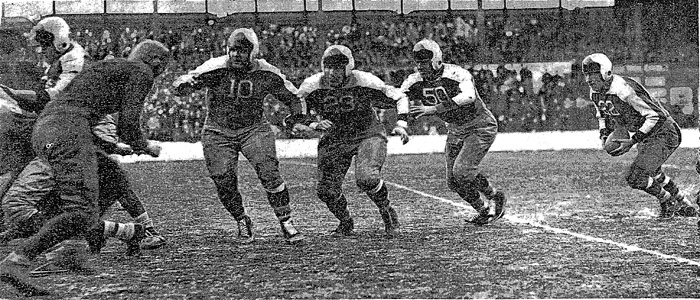
The Giants, however, were no slouches; after all, coach Steve Owen's men had come within 1 point of the title in 1933. Quarterback Harry Newman took snaps from the best two-way lineman of the era, Mel Hein. He handed off to Ken Strong, a fullback out of nearby NYU. As a passing target, he had the best end of the early 1930s, Ray Flaherty. However, by the time of the title game, Ed Danowski was becoming the main passer for the Giants. (In the photo above, he's wearing Number 22 and carrying the ball.) They were 8-5 going into the title game.

Still, despite the fact that the Giants would be at home, the Bears were favored. They were undefeated, and, playing home games in Chicago, the cold weather of New York wouldn't faze them.

*

A freezing rain the night before the game froze the Polo Grounds field. Before the game, Flaherty told Owen that sneakers would provide better footing on the frozen field. So Owen sent equipment manager Abe Cohen to Manhattan College to get some sneakers.

The Bears led 10–3 at the half, thanks to a touchdown by Nagurski and a field goal by Jack Manders, a kicker so accurate (by the standards of the time) that he was known as Automatic Jack. (I don't know whether that nickname makes him sound more like a great mechanic or a pervert.)

Finally, just before the 2nd half started, Cohen got back to the locker room with the Manhattan College sneakers. And did he have any idea whether he could find sneakers that would properly fit 11 players? (Remember, this was the one-platoon era: Players had to play both offense and defense. It would be nearly 20 years before that was finally done away with.)

The sneakers did not make an immediate difference: The only score of the 3rd quarter was another field goal by Automatic Jack, making it 13-3 Bears. And, at the rate pro football teams scored in those days, erasing a 10-point lead seemed unlikely.

But early in the 4th quarter, the Giants coach a break. Danowski threw an interception at the Bears' 2-yard line, but end Ike Frankian pulled it out of the defender's hands and scored a touchdown to make it 13-10 Chicago.

It was all Giants from there: Strong ran for 2 touchdowns and Danowski 1. The Giants won 30-13, scoring 27 unanswered points in the 4th quarter. After the game, both teams said that the Giants' use of sneakers -- legal at the time -- made the difference. Such a tactic would be banned, but the damage was done.

The Giants would return to the NFL Championship Game in 1935, but lose to the Detroit Lions. By the time the Bears got back in 1937, they had almost completely turned over. Grange had retired, making the 1934 title game his last game; the 1937 title game was meant to be Nagurski's last, although he returned in 1943 due to the manpower shortage brought on by the World War II draft.

The Giants won another title in 1938, making Ed Danowski the 1st New York-based quarterback to start and win 2 NFL championship games, under any name. The 2nd? Eli Manning. No, not Charlie Conerly: He went 1-2. No, not Y.A. Tittle: He went 0-3. No, not Joe Namath. He only got into 1. And no, not Phil Simms: The Giants did win 2 Super Bowls during his tenure, but he was injured for the 2nd, and Jeff Hostetler started and won it.

"The Sneaker Game" was one of the greatest of the NFL's early legends. There are no surviving players from this game, and I seriously doubt that anyone in the listed paid attendance of 35,039 is still alive, 80 years later. But there is surviving film of the game. (The Bears are in the all-dark uniforms, with Nagurski figuring prominently in this clip, Number 3. The Giants are in the white helmets with blue trim, and the blue jerseys with white sleeves. Strong wears Number 50.)

Wednesday, February 8, 2012

Top 10 New York Quarterbacks

The Giants' Super Bowl win, their 2nd with Eli Manning as their quarterback, leads to the question of who are New York's best quarterbacks.

Honorable Mention: Ed Danowski, Giants, 1934-41. The position of quarterback was not yet what it would become during the course of his career, largely thanks to Sammy Baugh of the Washington Redskins and Sid Luckman of the Chicago Bears. But with Danowski (1911-1997) as quarterback, the Giants reached 5 NFL Championship Games, winning 2, in 1934 and 1938.

He was the 1st New York quarterback to start in, and the 1st New York quarterback to win, 2 NFL Championship Games. Phil Simms could have been the second, had he not gotten hurt; Eli Manning now is.

Ed's son John Danowski was a successful lacrosse coach at Hofstra University, and has been even more successful at Duke. John's son Matt Danowski is the all time Division I career leader in total points in NCAA lacrosse history.

Honorable Mention: Clarence "Ace" Parker, of the football version of the Brooklyn Dodgers, 1937-41. A great all-around athlete out of Duke University before anyone ever heard of Dick Groat, never mind Mike Gminski or Christian Laettner, he was another pre-Baugh quarterback who nonetheless became an offensive and defensive star.

He also played for the Philadelphia Athletics in 1936 and 1937. This coming May 17, if he makes it, will be his 100th birthday, making him both the oldest living pro football player, the 2nd-oldest living Major League Baseball player, and the oldest living member of any of the 4 major league sports' halls of fame.

10. Jeff Hostetler, Giants, 1984-92. A star at West Virginia University, he married the daughter of his coach, Don Nehlen. He was mainly Simms' backup at the Meadowlands, and only made 25 regular-season starts, nearly all of them in his last 2 seasons with the club. But when Simms was hurt late in the 1990 regular season, it was Hoss who got the Giants all the way through to victory in Super Bowl XXV. In 1993, he went to the Los Angeles Raiders, and got them into the Playoffs.

He is now 50 years old, and has returned to Morgantown, where he runs a construction company.

9. Richard Todd, Jets, 1976-84. Somebody had to succeed Broadway Joe as the Jets' starting quarterback, and, like Joe, he had the University of Alabama pedigree. And while he was mercilessly ripped in the media for not being Broadway Joe, he did get the Jets into the Playoffs twice (same number of times as Joe) and into the 1982 AFC Championship Game.

He is now 58, and works in the finance industry in his native Alabama.

8. Ken O'Brien, Jets, 1983-92. That great "Quarterback Class of '83" included Hall-of-Famers John Elway, Dan Marino and Jim Kelly, All-Pro Todd Blackledge, and Tony Eason whose career wasn't great but he did get the New England Patriots to their first AFL or AFC Championship.

O'Brien wasn't as good as Elway, Marino or Kelly, but he did make a Pro Bowl like Blackledge, passed for over 25,000 yards, and led the NFL with the lowest rate of interceptions in 1985, 1987, and 1988. In 1986 he battled Marino in one of the best-remembered Jet games ever, the 51-46 win over the Dolphins at the Meadowlands.

On a Monday Night Football broadcast, Frank Gifford, who's seen every quarterback since the early Fifties, said of O'Brien, "When he gets the time to throw the football, no one throws it any better than he does."

O'Brien is now 51, and has been a college assistant coach, having coached a Heisman Trophy winner, USC's Carson Palmer, and runs quarterbacking clinics.

7. Vinny Testaverde, Jets, 1998-2003 & 2005. Speaking of Heisman Trophy-winning quarterbacks, Vinny was one at the University of Miami, after being born in Brooklyn and raised just outside New York City in Elmont, Long Island, location of the Belmont Park horse racing track.

His pro career, like that of too many other Heisman winners, looked like it was going to be a bust, until he reached the Jets at age 34. The 1998 season was, and remains, the Jets' best season since the 1968-69 Super Bowl season, as Vinny led Bill Parcells' J-E-T-S-Jets-Jets-Jets to within half an hour of a Super Bowl appearance.

A severed Achilles tendon in the 1st game of the next season ruined things for that group of Jets, but he bounced back, remaining the Jets' starter until 2002, when he was replaced by Chad Pennington (who does not make this list -- nor does current Jets starter Mark Sanchez). Still, he remained in the NFL until 2007, age 44. Think about that: When Barack Obama was beginning his 1st campaign for President, there was a man taking snaps in the NFL who had been born when John F. Kennedy was in the White House.

Vinny is now 48, and will be eligible for the Pro Football Hall of Fame next year. Will he make it? Maybe: He passed for over 46,000 yards, threw 275 touchdown passes (but also 267 interceptions), and holds records for most seasons with at least one touchdown pass (21) and touchdown passes to the most different players (70).

6. Fran Tarkenton, Giants, 1967-71. He's best remembered as the 1st, and then the best, quarterback for the Minnesota Vikings, whom he led to 3 NFC Championships -- but lost the Super Bowl all 3 times. Still, he became the 1st NFL quarterback known for running to avoid a sack and keep a play alive, which became known as "scrambling." This allowed him to set all kinds of NFL records (most since broken), including most completions, passing yards and touchdowns, and reach the Pro Football Hall of Fame.

During his tenure at Yankee Stadium, the Giants weren't a very good team, but it was hardly his fault: A faulty defense meant that the best record the team would have in those years was 9-5 in 1970 -- not unlike the Yankees, whose best finish between 1964 and 1976 was their 93-win season in 1970, but 15 games behind the Pennant-winning Baltimore Orioles. At a time when Broadway Joe was leading the Jets to glory and glamour, Fran the Scrambler was keeping the Giants relevant.

Fran just turned 72, and became a gazillionaire by getting in on the ground floor of the computer industry. He's hosted and co-hosted TV shows, including ABC's That's Incredible!, been a commentator on Monday Night Football, written a self-help book: What Losing Taught Me About Winning, and co-authored a mystery novel, Murder at the Super Bowl.

5. Y.A. Tittle, Giants, 1961-64. Formerly the signal-caller for the Baltimore Colts and the San Francisco 49ers, Yelberton Abraham became, sort of, the Vinny Testaverde of his day. He debuted for the Giants just before turning 35, and got them into the next 3 NFL Championship Games, and it was hardly his fault that they lost them all.

Unfortunately, he is probably best remembered for one of his last games, in 1964, in which he got clobbered by the Pittsburgh Steelers as the great Giants teams of 1956 to 1963 suddenly seemed to get old all at once, a prelude to what would happen to the Yankees the following spring. The photo by Morris Berman of the Pittsburgh Post-Gazette has become a symbol of the price that football players pay for putting their bodies on the line for money.

Tittle is now 85, and retired from the insurance industry. In the film Any Given Sunday, he played the head coach of the Chicago team. He was the 1st quarterback to be elected to the Pro Football Hall of Fame without having led his team to an NFL Championship -- and that's including Ace Parker, who was elected a year after Tittle.

4. Charlie Conerly, Giants, 1948-61. Since Danowski was a pre-Baugh, pre-Luckman quarterback, Charlie (1921-1996) was the 1st "real quarterback" to lead the Giants to a title, in 1956. He was also the first great quarterback out of the University of Mississippi, predating Jake Gibbs, and Archie and Eli Manning.

After the arrival of Tittle led him to retire, he owned a string of shoe stores and appeared as the Marlboro Man in cigarette commercials -- before cigarette advertising was rightly banned from television. Although a member of the College Football Hall of Fame, he has never been elected to the Pro Hall.

3. Joe Namath, Jets, 1965-76. True, he only reached the Playoffs twice. Statistically speaking, Joe's credentials for the Hall of Fame are actually kind of skimpy -- he had far more interceptions (220) than touchdown passes (173), and his career completion percentage was barely over half (50.1). And due to injuries, he had his last good season at age 29, and was done at 34.

But how many New York quarterbacks have won Super Bowls? Four. And how many quarterbacks, for all teams, have won iconic championships? Very few. Joe's Super Bowl III win was one – along with Johnny Unitas and the 1958 NFL Championship Game, one of the top 2 of all time.

Joe is now 68 years old. Since retiring, and being elected to the Hall, he's been an actor and a sportscaster, and has had his personal difficulties. But he's still beloved by fans for his achievement and his personality, and respected by football people for his talent and his determination to succeed despite injuries. And, while he may have been drunk at the time of the interview, I don't blame him for wanting to kiss Suzy Kolber.

2. Phil Simms, Giants, 1979-93. Okay, Phil wasn't the Giants' starting quarterback in Super Bowl XXV, due to injury, but they wouldn't have gotten there without him. And he did complete 22 out of 25 passes in Super Bowl XXI, giving the G-Men their first World Championship of the modern era. Considering how many injuries -- and how many boos -- he got at the beginning of his career, it's amazing how loved he now is.

Now 57, Phil has been CBS' top NFL color commentator for the last few years, although CBS having the AFC package has led him to call a lot more Jet games than Giant games. His son Chris Simms has also been an NFL quarterback, although the less said about Chris' off-field activities, the better.

1. Eli Manning, Giants, 2004–present. Phil Simms led the Giants to 2 Super Bowl seasons and was Super Bowl MVP in 1 of them. Eli has now been named MVP of 2 Super Bowls, and both were better games than the ones Simms and Namath played in. And let's not forget: Much like the Jets were in Super Bowl III, the Giants were underdogs in both of their Supes with the Patriots.

Indeed, being the younger brother of Peyton Manning, having played his college ball at the University of Mississippi rather than a more storied football school, having been greeted with skepticism by Giant fans upon their acquisition of him following the 2004 NFL Draft, and playing in the NFC East with the Philadelphia Eagles' Donovan McNabb and Michael Vick and the Dallas Cowboys' Tony Romo, it can be argued that Eli was an underdog for the first 31 years of his life.

No more. At the beginning of this season, he was asked if he was "an elite quarterback." He said he was. He has now proven it. It will take a mistake of O.J. Simpson or Pete Rose proportions to keep him out of Canton now -- and he and Peyton will probably become the 1st brother combination to both be in the Hall, unless Clay Matthews (father of the Packer linebacker of the same name) joins his brother Bruce (and he should).

Eli at his best still isn't as good as Peyton was at his best, but he's won 2 NFL Championships. Here's a list of the NFL quarterbacks who've done that since Baugh and Luckman rewrote the rules for the passing game:

1. Sid Luckman, 1940, '41, '43 and '46 Chicago Bears
2. Sammy Baugh, 1937 & '42 Washington Redskins
3. Tommy Thompson, 1948 & '49 Philadelphia Eagles
4. Bob Waterfield, 1945 Cleveland & '51 Los Angeles Rams
5. Bobby Layne, 1952 & '53 Detroit Lions (hurt for '57 Championship Game)
6. Otto Graham, 1950, '54 & '55 Cleveland Browns
7. Johnny Unitas, 1958, '59 & '70 Baltimore Colts
8. Bart Starr, 1961, '62, '65, '66 & '67 Green Bay Packers
9. Bob Griese, 1972 & '73 Miami Dolphins
10. Terry Bradshaw, 1974, '75, '78 & '79 Pittsburgh Steelers
11. Roger Staubach, 1971 & '77 Dallas Cowboys
12. Jim Plunkett, 1980 Oakland & '83 Los Angeles Raiders
13. Joe Montana, 1981, '84, '88 & '89 San Francisco 49ers
(Not quite - Phil Simms, 1986 & '90 New York Giants)
14. Troy Aikman, 1992, '93 & '95 Dallas Cowboys
15. John Elway, 1997 & '98 Denver Broncos
16. Tom Brady, 2001, '03 & '04 New England Patriots *
17. Eli Manning, 2007 & '11 New York Giants

And of those, how many have been Super Bowl MVP twice? Just 5: Starr, Bradshaw, Montana, Brady (*) and Elway.

Pretty good company, Eli. He didn't walk off the field either time holding up the "We're Number 1" finger like Namath. But he could have. On the list of the greatest quarterbacks in the history of New York Tri-State Area football, Eli Manning is Number 1. And, hopefully, he's got a few more years to go.