Showing posts with label frank gifford. Show all posts

Wednesday, April 15, 2026

April 15, 1976: The Renovated Yankee Stadium Opens

April 15, 1976, 50 years ago: Yankee Stadium opens, after a renovation of two and a half years. Much of the original 1923 structure remains, but much of it is new. Some old-time Yankee Fans are relieved and thrilled. Others are appalled at the changes.

The support poles, and the obstructions they provided, were removed, while the upper deck was "cantilevered" and extended upward, so it no longer needed the poles' support. Seats and aisles were widened, dropping the Stadium's capacity from 65,010 (from a peak of 67,224) to 57,545.

The back wall of the Bleachers was raised to twice its height. No longer could a fan stand on the platform of the 161st Street Station of the Number 4 Train and watch the game for the price of a Subway token. And the "façade," actually a frieze, that wrapped around the roof of the Stadium was removed, as was the roof itself. A copy of the frieze was placed atop the Bleacher wall.

Robert Merrill sings the National Anthem. Bob Shawkey, the starting and winning pitcher from the 1st game there in 1923, throws out the ceremonial first ball. Among the guests with a connection to the Stadium's history are Babe's widow Claire Ruth, Lou's widow Eleanor Gehrig, Joe DiMaggio, Mickey Mantle, New York Giants legend Frank Gifford, and Joe Louis, who successfully defended the Heavyweight Championship of the World at Yankee Stadium 7 times.

A photograph of "the four great Yankee catchers" in uniform is taken: Bill Dickey as a special guest, Yogi Berra and Elston Howard as current Yankee coaches, and Thurman Munson as the current Yankee catcher, who has been named the team's 1st Captain since Lou Gehrig.
And, yes, there was a game. The opponent was the Minnesota Twins. While Babe Ruth had hit the 1st home run in the Stadium, the 1st home run in the renovated Stadium was hit by the Twins' Dan Ford, off Yankee starter Rudy May. And the Twins led 4-0 going to the bottom of the 3rd inning.

A groundout by Roy White got the Yankees on the board in the 3rd. They put it together in the 4th: With 1 out, Graig Nettles drew a walk. (Cliché Alert: Walks can kill you.) Oscar Gamble tripled him home, and was singled home by Willie Randolph. Randolph stole 2nd, and was singled home by Lou Piniella to tie the game. A wild pitch by Vic Albury got Piniella to 2nd, and Otto Vélez singled him home, and the Yankees had the lead.

The Yankees scored 6 more runs in the 8th, thanks to walks by White, Piniella and Fred Stanley; singles by Nettles, Randolph, Mickey Rivers and Chris Chambliss; and a double by Gamble.

Yankees 11, Twins 4. Dick Tidrow, in relief, was the winning pitcher. Two days later, Munson would have the 1st Yankee homer in the "New Stadium."

The Yankees won the 1st of 3 straight American League Pennants that season. From the Stadium's reopening until its closing in 2008, they won 15 AL Eastern Division titles, 10 Pennants, and 6 World Championships -- more than most teams, to this day, have won in their entire history.

Friday, November 20, 2020

November 20, 1960: Chuck Bednarik Knocks Frank Gifford Out

November 20, 1960, 60 years ago: The New York Giants and the Philadelphia Eagles, arch-rivals since the Eagles' founding in 1933, play at Yankee Stadium. The winner was probably going to win the NFL's Eastern Division and play in the NFL Championship Game, as the Giants had in 3 of the last 4 years. Since the hosting alternated between the East and West winners in those days, the winner would also host the title game.

Some cities, like Los Angeles and Miami, like their sports heroes to be flashy. Others, like Philadelphia and Chicago, prefer them to be tough. Blue-collar. They will accept failure, but they will not accept failure to try. They understand it if you fall, as long as you get back up. New York likes to have it both ways: Men like Joe DiMaggio, Joe Namath, Walt "Clyde" Frazier, Derek Jeter.

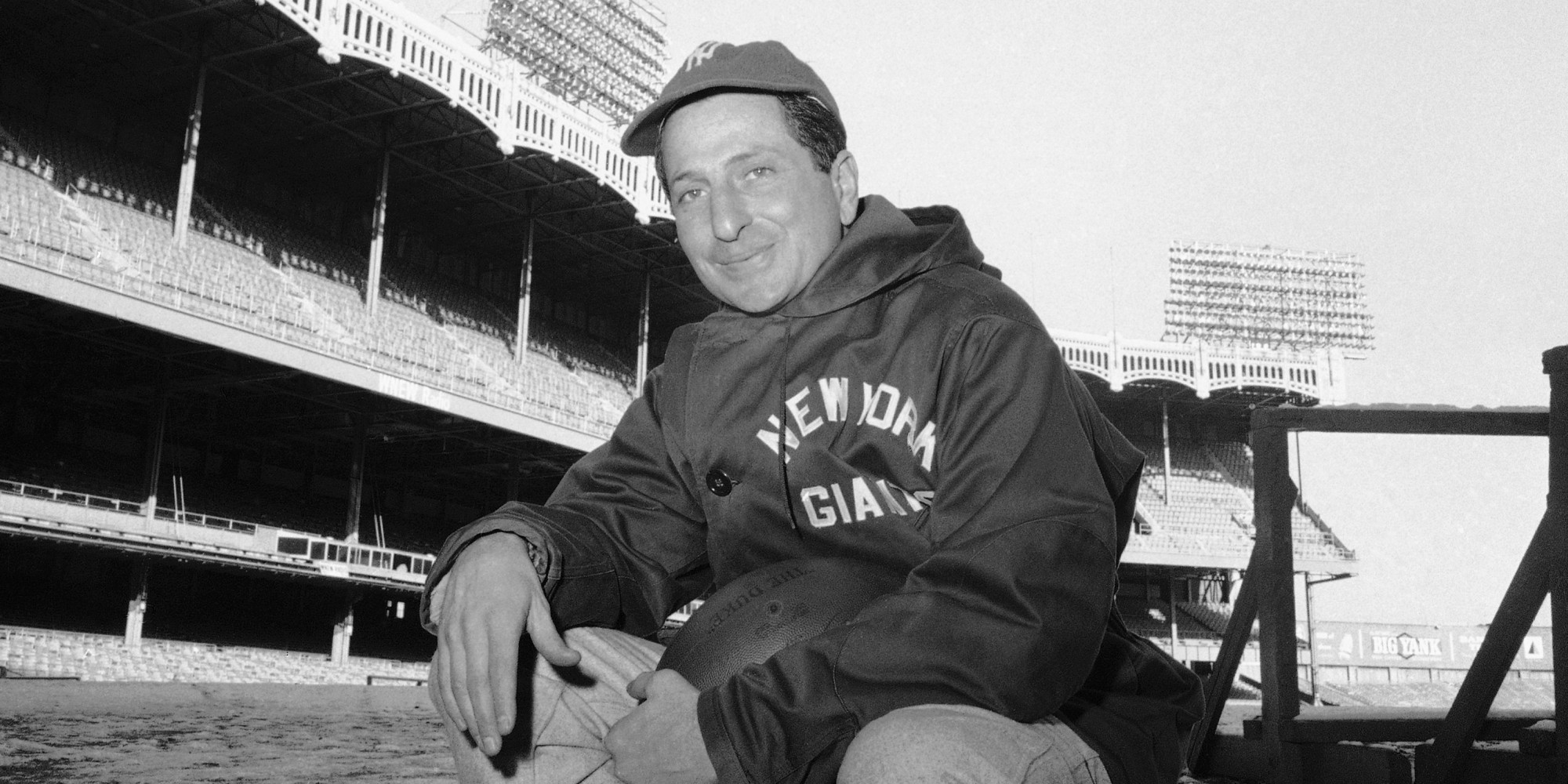
And one of the flashiest New York athletes was Frank Gifford, Hall of Fame running back for the Giants in the 1950s. Until 1960, it never would have occurred to anyone to call Gifford "tough." What they called this handsome devil out of Bakersfield, California and the University of Southern California was "the Golden Boy." He was already the most popular football player in New York history, so much so that, in the off-season at Yankee Stadium, he got Mickey Mantle's locker.

Chuck Bednarik was tough. How tough was he? He came out of still mill country in Northeastern Pennsylvania, and served as a waist gunner on B-24 bomber in World War II. But he was also smart: He got into the University of Pennsylvania in Philadelphia, and the Ivy League doesn't give athletic scholarships.

He was a rookie on the Eagles' NFL Championship team of 1949, and played center and linebacker for them, even after the switch to two-platoon football. He was "the last of the 60-minute men." Of course, in those days, athletes were paid so little that it was necessarily to get off-season jobs. He sold concrete, and that, rather than his toughness, that earned him the nickname "Concrete Charley."

Both teams had toughness. But the Giants embraced flashiness, while the Eagles ignored it.

The Giants led 10-0 at the half, but blew it. In the 4th quarter, the Eagles' Jimmy Carr picked up a fumble and returned it 38 yards for a touchdown, making it 17-10 Eagles.

With the clock running out, George Shaw, filling in for injured quarterback Charlie Conerly, threw a pass toward Gifford at midfield. Gifford caught the pass, but Bednarik arrived at the same time, and he flattened Gifford, who fumbled. The Eagles recovered.

On the film, this doesn't look like an especially devastating hit. I've seen much worse. What made this the most famous hit in NFL history -- aside from the fact that it was in New York, and involved a New York team, and was seen by a national TV audience -- was how Chuck reacted.

The film shows him reacting to the fumble by jumping around and clapping his hands. Then he pumped his fist, and issued what became his catchphrase: "This fucking game is over!" Which, for all intents and purposes, it was. The final score was, indeed, 17-10 Eagles.

But it was the photograph that proved devastating. It showed Bednarik standing over Gifford, pumping his fist. Gifford is lying on the ground, motionless. Bednarik spent the last 54 years of his life explaining that he didn't even realize Gifford was motionless on the ground in front of him, that he was celebrating the Eagles wrapping up a big win, not the fact that he'd knocked Gifford out. He said he didn't even realize he'd knocked Gifford out.

Legend has it that Gifford was knocked out because, despite wearing a helmet, he hit his head on the frozen grass at Yankee Stadium. This couldn't be true: According to Pro-Football-Reference.com, it was 49 degrees at gametime -- not a particularly notable temperature for mid-November New York, and hardly cold enough to freeze the field.

Gifford was taken to the Giants' locker room. Also taken to the locker room for first aid was a security guard who had a heart attack. Frank's first wife, Maxine, didn't know this, and when she went down to the locker room to see Frank, she heard someone say, "He's dead" -- meaning the security guard. When the guard was wheeled out on a stretcher, with his face covered by a sheet, reporters saw this, and thought it was Gifford.

The rumor began to spread that Bednarik had killed him. And when the photo was seen in newspapers across the country the next day, Bednarik looked like a monster, celebrating his "kill."

It got worse. Bednarik went to see Gifford in the hospital the next day, and was told Gifford couldn't receive visitors. But a new rumor circulated, that Bednarik wouldn't see Gifford. It wasn't that he wouldn't, it was that he couldn't.

Gifford missed the rest of the season, and decided to retire at age 30. But he missed playing, and returned in 1962, switching to receiver for safety reasons. He played 3 more seasons and retired again, becoming one of football's greatest broadcasters.

Gifford always said he never held it against Bednarik. Bednarik said he was tired of people remembering him mainly for one thing. "It was always, 'Oh, you're the guy! You're the guy! You're the guy that got Frank Gifford!'" He was also tired of Howard Cosell, on Monday Night Football, seeing a hard hit, and turning to Gifford and saying, "Just like Chuck Bednarik blindsided you at Yankee Stadium, Giffaroo!"

"Blindsided, my fanny! It was a clean hit," he always said. And it was: Like the infamous Denis Potvin hit on Ulf Nilsson in 1979, or Scott Stevens leveling Eric Lindros in 2000, no penalty was called on it. (And, yes, this profane man would say, "fanny," not "ass." In America, "fanny" means rear end. In Britain, it means the other side, of a woman.)

Both men died in 2015. Bednarik had been dealing with dementia for a few years, almost certainly induced by all that head contact in football. Gifford's 3rd wife, entertainer Kathie Lee Gifford, had also begun to notice him slipping. He, too, was a victim of football-induced head trauma. And that would have been the case even if Bednarik had merely tackled him that day, rather than outright knocking him out.

*

November 20, 1960 was a Sunday. These were the other NFL games played that day:

* The football version of the St. Louis Cardinals, who had been in Chicago until this season, beat the Washington Redskins, 26-14 at Griffith Stadium in Washington.

* The Pittsburgh Steelers beat their arch-rivals, the Cleveland Browns, 14-10 at Forbes Field in Pittsburgh.

* The Chicago Bears beat the Detroit Lions, 28-7 at Wrigley Field in Chicago.

* The Los Angeles Rams beat the Green Bay Packers, 33-31 at Milwaukee County Stadium.

* The San Francisco 49ers beat the Dallas Cowboys, 26-14 at the Cotton Bowl in Dallas. The Cowboys, a 1st-year expansion team, went 0-11-1 that 1st season. Their only non-loss was a tie against the Giants at Yankee Stadium.

* Since there were now 13 teams in the NFL, one team had to have a bye week every week. This week, it was the Baltimore Colts.

This was the 1st season of the American Football League. These were their games on the day:

* The Houston Oilers beat the Denver Broncos, 20-10 at Jeppesen Stadium in Houston.

* The Buffalo Bills beat the Los Angeles Chargers, 32-3 at the Los Angeles Memorial Coliseum.

* The Boston Patriots, the Dallas Texans, the New York Titans and the Oakland Raiders -- the teams now known as the New England Patriots, the Kansas City Chiefs, the New York Jets and the Las Vegas Raiders -- had irregular schedules, and did not play on November 20.

There were 2 games in the NBA. The Boston Celtics beat the Cincinnati Royals, 120-103 at the Cincinnati Gardens. And the Los Angeles Lakers beat the Detroit Pistons, 135-131 at the Olympia Stadium in Detroit. Elgin Baylor scored 52 points for the Lakers.

And the entire NHL, the "Original Six," was in action. The New York Rangers lost to the Detroit Red Wings, 4-3 at the old Madison Square Garden. The Toronto Maple Leafs beat the Boston Bruins, 3-2 at the Boston Garden. And the Montreal Canadiens and the Chicago Black Hawks played to a tie, 1-1 at the Chicago Stadium.

Sunday, August 9, 2015

Frank Gifford, 1930-2015

On November 20, 1960, a lot of people thought Frank Gifford had died. It would have been a shocking end for New York's first true football superstar.

As it turned out, he had quite a bit of life left in him.

*

Francis Newton Gifford -- sounding more like the name of a U.S. Senator than that of a sports legend -- was born on August 16, 1930 in Santa Monica, California, outside Los Angeles, and grew up in Bakersfield, an oil town about 100 miles away, in a rural part of the State that would have tremendous growth after 1970.

He starred in football at Bakersfield High School, but didn't have the grades to get into his first choice of school, the University of Southern California. So he went to Bakersfield Junior College, and got the necessary grades to get into USC.

Frank began the tradition of great USC tailbacks, followed by football legends Mike Garrett, O.J. Simpson, Anthony Davis, Charles White, Marcus Allen and Reggie Bush. He was an All-American in 1951, and, despite not having blond hair, was nicknamed the Golden Boy.

He arrived in the National Football League just as the transition was being made from single-platoon football -- players playing both offense and defense -- to two-platoon football. Only in his 1st 2 seasons, 1952 and '53, did he play on both sides of the ball, as a halfback and a cornerback. In 1954, with a new head coach, Jim Lee Howell, he began to be used exclusively at left halfback, behind quarterback Charley Conerly.

In 1955, he made the Pro Bowl for the 1st time. In 1956, the Giants had an epic season. First, they moved out of the crumbling Polo Grounds and into the old Yankee Stadium. There, everything improved: The playing conditions, the morale, the offense, the defense, the fan reactions.

The chant of "Dee-FENSE!" was first heard at an NFL game, as men like Sam Huff, Andy Robustelli and Emlen Tunnell -- all future members of the Pro Football Hall of Fame -- followed the lead of defensive coach (they weren't yet called "coordinators") Tom Landry -- yes, the Tom Landry who went on to coach the Dallas Cowboys -- and became the 1st great NFL defense-only unit. Though the nickname didn't come along until the 1980s, this was the original Big Blue Wrecking Crew.

For the 1st time in football history, defense was cool. And, with New York City being the media center of the nation, the rest of America noticed the defense, and noticed the Giants, who hadn't won an NFL title since 1938, nor been in an NFL Championship Game since 1946.

But it's scoring that truly gets the headlines, and Vince Lombardi -- yes, the Vince Lombardi who went on to coach the Green Bay Packers -- coached the Giant offense. With Conerly, Gifford, and fellow running backs Mel Triplett and Alex Webster in the backfield, and Gifford and Kyle Rote catching passes, and Hall of Fame tackle Roosevelt Brown among the blockers, the Giants were just about unstoppable.

Frank rushed for 819 yards, and and caught 51 passes for another 603 yards. Overall, his 1,422 yards from scrimmage led the NFL -- and that's in a 12-game season. (At the same rate, he would have had 1,895 yards over a 16-game season.) He scored 9 touchdowns, including 3 against the Washington Redskins on December 2.

The Giants hung 38 points on the San Francisco 49ers, 38 on the Pittsburgh Steelers, 28 on the Redskins, and 27 on the Chicago Cardinals (but lost, allowing 35). The Giants went 8-3-1, and won the NFL's Eastern Division. UPI named Frank the NFL's Most Valuable Player.

In the days before the AFL-NFL merger, the hosting duties for the NFL Championship Game rotated between the Eastern and Western Champions. As this was an even-numbered year, the Eastern Champions hosted. On December 30, 1956, the Giants took the field at a frigid Yankee Stadium, and faced the Chicago Bears in front of 56,836 hardy souls and a national television audience on NBC.

It was the peak day for both that offense and that defense. The Bears, despite being used to cold weather, were totally put on ice. The Giants jumped out to a 20-0 lead before the Bears could get on the board, with touchdowns by Triplett and Webster and a pair of field goals by Ben Agajanian. Rick Casares scored for the Bears, with quarterback George Blanda kicking the extra point.

But it was all G-Men after that. Webster scored another touchdown, and the Giants blocked a punt, which Henry Moore recovered in the end zone. It was 34-7 when the teams headed into the locker room.

The Bears should've stayed inside. In the 3rd quarter, Conerly threw a touchdown pass to Rote. In the 4th, he threw one to Gifford to put on the exclamation point. Giants 47, Bears 7. It was a devastating display.

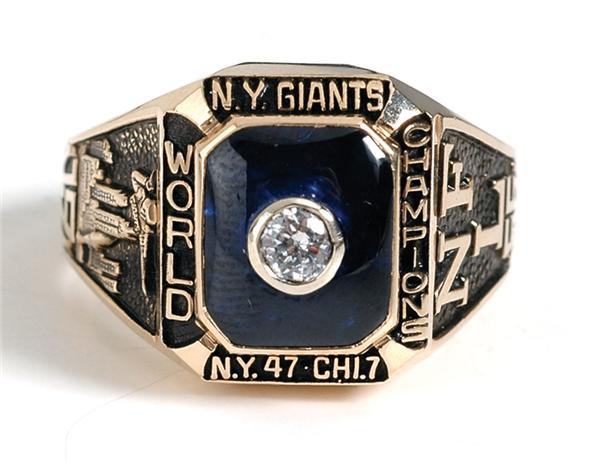
This is Agajanian's ring from the title season. This is what a ring from "Super Bowl Minus-X" looks like. Gifford, of course, got one, too.
Those are a pair of Lower Manhattan skyscrapers on one side, but this was long before the World Trade Center was anything more than an idea. They're a pair of early 1930s buildings: The Bank of Manhattan Trust Building (40 Wall Street, now named the Trump Building) and the Cities Service Building (now named for its address, 70 Pine Street).

*

That wasn't the peak of Frank Gifford's fame, but it did turn out to be the peak of his NFL achievement. The Giants got back into the NFL Championship Game in 1958, but it turned out to be a classic that didn't go their way, as the Baltimore Colts shocked a national TV and Yankee Stadium audience by sending the game to overtime, where Johnny Unitas and his Colt teammates put on a show that is still talked about as "the Greatest Game Ever Played." The Colts won, 23-17, and the NFL became a true TV phenomenon -- mainly because the New York team was involved.

The Colts beat the Giants in the next year's title game as well, but that was in Baltimore, and wasn't as good a game, so it's not as hyped. (Why Baltimore was in the Western Division, I don't know.)

But the New York media machine continued to hype up the Giants, every bit as much as it had their baseball counterparts (who'd moved to San Francisco after the 1957 season), and the Yankees, and would later do to the Mets, the Jets, the Knicks, the Rangers and the Islanders -- and, of course, the Giants again.

New York previously had great football players like Benny Friedman, Ken Strong, Mel Hein and Tuffy Leemans, but Gifford was the 1st of the TV era. In the late Fifties and early Sixties, you couldn't watch a night's TV without watching Gifford do a commercial for Vitalis hairspray (as opposed to Brylcreem, a.k.a. "that greasy kid stuff"), Lucky Strike cigarettes, Florida orange juice, or some other product.

He became a frequent panelist on CBS' game show What's My Line? New Yorkers might not have used the capital letters, but, every bit as much as he was at USC, he was a golden boy.

It almost didn't last. On November 20, 1960, Yankee Stadium was the scene of another historical moment, and Gifford was there -- but he didn't remember it. Indeed, he was lucky to have survived it.

The Giants were playing the Eagles, their arch-rivals since the Eagles' founding in 1933. The winner was probably going to win the Division and host the Championship Game, as the Giants had in 2 of the last 4 years. (If this section looks familiar, it's because I copied-and-pasted, and adapted, it from my memorial piece on Gifford's antagonist in March.)

The Giants led 10-0 at the half, but blew it. In the 4th quarter, the Eagles' Jimmy Carr picked up a fumble and returned it 38 yards for a touchdown, making it 17-10 Eagles.

With the clock running out, George Shaw, filling in for the injured Conerly, threw a pass toward Gifford at midfield. Gifford caught the pass, but Chuck Bednarik, the Eagle linebacker appropriately known as Concrete Charley, 
arrived at the same time, and he flattened Gifford, who fumbled. The Eagles recovered.

On the film, this doesn't look like an especially injurious hit. I've seen much worse. What made this the most famous hit in NFL history -- aside from the fact that it was in New York, and involved a New York team, and was seen by a national TV audience -- was how Chuck reacted.

The film shows him reacting to the fumble by jumping around and clapping his hands. Then he pumped his fist, and issued what became his catchphrase: "This fucking game is over!" (In other words, no, his exact words did not include "effin'.") For all intents and purposes, the game was, indeed, over. The final score was 17-10 Eagles.

But it was the photograph that proved damaging -- not to Gifford's body, but to Bednarik's reputation. Or maybe it enhanced his reputation. It showed Bednarik standing over Gifford, pumping his fist. Gifford is lying on the ground, motionless, as Rote (Number 44) looks on. 

Bednarik spent the last 54 years of his life explaining that he didn't realize Gifford was out cold on the ground in front of him. He said he was celebrating the Eagles wrapping up a big win, not the fact that he'd knocked Gifford out. He said he didn't even know he'd knocked Gifford out.

Legend has it that Gifford was knocked out because, despite wearing a helmet, he hit his head on the frozen grass. This couldn't be true: According to Pro-Football-Reference.com, it was 49 degrees at gametime -- not a particularly notable temperature for mid-November New York, and hardly cold enough to freeze the field.

Gifford was taken to the Giants' locker room -- which, at the old Stadium, was also the Yankees' locker room. As befitting the biggest star on the team, Gifford's locker was also Mickey Mantle's. Also taken to the locker room for first aid was a security guard who had a heart attack.


Frank's first wife, Maxine, didn't know this, and when she went down to the locker room to see Frank, she heard someone say, "He's dead" -- meaning the security guard. When the guard was wheeled out on a stretcher, with his face covered by a sheet, reporters saw this, and thought it was Gifford. The rumor began to spread that Bednarik had killed him. And when the photo was seen in newspapers across the country the next day, Bednarik looked like a monster, celebrating his "kill."

It got worse. Bednarik went to see Gifford in the hospital the next day, and was told Gifford couldn't receive visitors. But a new rumor circulated, that Bednarik wouldn't see Gifford. It wasn't that he wouldn't, it was that he couldn't.

Gifford always said he never held it against Bednarik. Bednarik said he was tired of people remembering him mainly for one thing. "It was always, 'Oh, you're the guy! You're the guy! You're the guy that got Frank Gifford!' Yeah, I'm the guy that 'got' Frank Gifford."


He was also tired of Howard Cosell, on Monday Night Football, seeing a hard hit, and turning to Gifford and saying, "Just like Chuck Bednarik blindsided you at Yankee Stadium, Giffaroo!"

"Blindsided, my fanny! It was a clean hit," Bednarik always said. And it was: Like the infamous Denis Potvin hit on Ulf Nilsson in 1979, or Scott Stevens leveling Eric Lindros in 2000, no penalty was called on it. (And, yes, this profane man would say, "fanny," not "ass." In America, "fanny" means rear end. In Britain, it means the other side, of a woman.)


Chuck died this past March 21. If he hadn't, we might now be talking about how Gifford finally felt the effects of that clobbering, nearly 55 years later

Frank missed the rest of the 1960 season, and retired at age 30. The Giants reached the 1961 NFL Championship Game anyway, but Frank wouldn't have been able to help much, as they got slaughtered by the Green Bay Packers. He missed playing, and returned in 1962, switching to flanker (wide receiver) for safety reasons. He won NFL Comeback Player of the Year, and got the Giants back into the Championship Game, again at Yankee Stadium. But the Packers won again. In 1963, they got to another, this time losing to the Bears.

In 1964, it all came crashing down. The Giants did not look like the team that had reached 6 of the last 8 NFL Championship Games. Like the Yankees would do the following spring, their players all seemed to get old, or hurt, or both, at once. Gifford retired. having rushed for 3,609 yards. That may not look like much compared to modern numbers, but it was a strong 4.3 yards per carry. He caught 367 passes for 5,434 yards. In that era, those were considered enormous numbers. He scored 77 touchdowns in his 12 seasons -- 12-game seasons until 1960, 14-game seasons thereafter.

He was named to 8 Pro Bowls, the NFL's 1950s All-Decade Team, and the College and Pro Football Halls of Fame. In a pair of belated honors, the Giants retired his Number 16, and inducted him into their Ring of Honor when MetLife Stadium opened.

*

Frank went into broadcasting. As CBS had the NFL exclusively at that point, he called some of their games, including Super Bowl I early in 1967 and the NFL Championship Game, the "Ice Bowl" in Green Bay, at the end of the year.

In 1971, he was brought to ABC to do Monday Night Football. where he worked with some of the biggest names in sportscasting, including fellow NFL legends Don Meredith, Alex Karras, Fran Tarkenton, O.J. Simpson, Joe Namath, Dan Dierdorf, Lynn Swann and Joe Theismann -- and, of course, non-athletes Keith Jackson (in the 1st season only), Howard Cosell and Al Michaels.
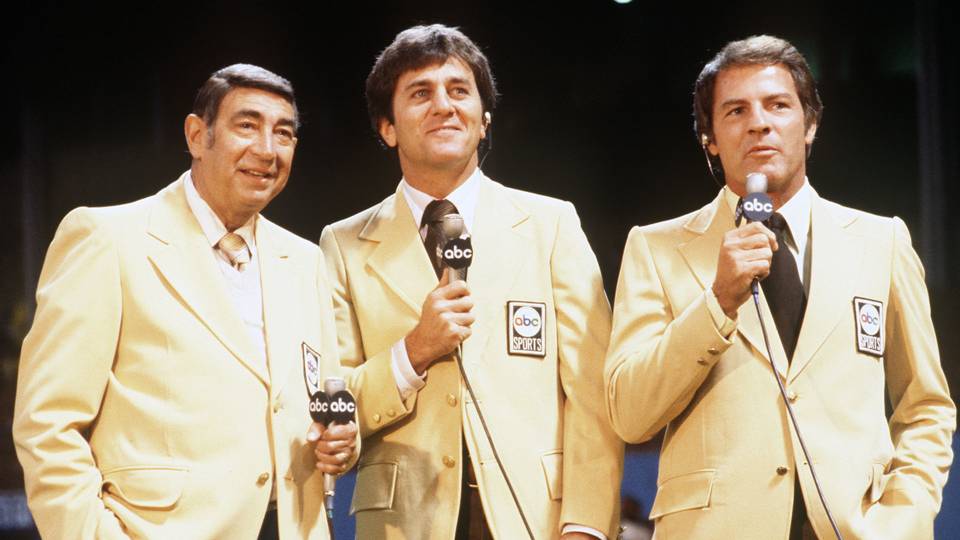
The classic MNF lineup, in the classic yellow jackets:
Cosell, Meredith, Gifford. Together 1971-73, and again 1977-83.
Meredith was at NBC 1974-76, replaced by Alex Karras.

ABC put him on other broadcasts as well, including on the Olympic Games from 1972 (including play-by-play of the basketball Gold Medal game where the U.S. got robbed, to the benefit of the Soviet team) to 1992. These assignments also included The Battle of the Network Stars and their anthology series ABC Wide World of Sports.

His WWOS assignments included several of Evel Knievel's motorcycle jumps, leading to a friendship between the erstwhile Golden Boy and the King of the Daredevils. In 1975, Knievel attempted to jump over 13 of London's red double-decker buses at the old Wembley Stadium. He did it, but couldn't stick the landing, and fell off, with the cycle's front wheel rolling over his arm.

With a live mike, Gifford could clearly be heard saying, "Oh, my God," something that people weren't supposed to say on TV in those days. Although that was the worst-looking part of Knievel's crash, he had worse injuries, including a broken pelvis. Gifford abandoned his post, and ran to him. He and another man helped Knievel up, and carried him into the locker room on their shoulders.
For better or for worse, a pair of American legends.

In 1995, the Pro Football Hall of Fame gave Frank the Pete Rozelle Award, their award for media personalities. This made him the 1st man honored by a sport with election to its Hall of Fame for both playing and broadcasting. He has since been joined by Kansas City Chiefs quarterback and broadcaster Len Dawson, and St. Louis Cardinals offensive tackle and his fellow Monday Night Football analyst Dan Dierdorf.

*

Frank was married to Maxine Ewart, and they had 3 children: Sons Jeff and Kyle, and daughter Victoria. Victoria married Michael Kennedy, son of Bobby. Through his children from his 1st marriage, he has 5 grandchildren.

In 1984, there were a pair of substitute hosts on ABC's Good Morning America. One was Frank. The other was Kathie Lee Johnson, also recently divorced. At the time, she was known as a singer, Tom Kennedy's lady sidekick on the game show Name That Tune, and pitchwoman for Carnival Cruise Lines.

Despite their 23-year age difference -- exactly 23 years, as they share the birthday of August 16 -- they hit it off, and were married on October 18, 1986. He continued on Monday Night Football, and she was paired with Regis Philbin on Live!, which went from a New York-only broadcast to a national one in 1988. They had a son, Cody, and a daughter, Cassidy.
Left to right: Frank, Kathie Lee, Cassidy, Cody.

Kathie Lee shared many details of their private life on the air, making Regis uncomfortable at times. It also didn't help that Regis is a Notre Dame graduate, and they have a bit of a rivalry with Frank's alma mater, USC. On a few occasions, Kathie Lee would refer to her husband as "The Human Love Machine."

If you're in your 60s, and your wife is much younger and gorgeous, and tells a live nationwide audience that you are a love machine, you might begin to believe it. In 1997, Frank was caught cheating, and it was a terrible embarrassment for Kathie Lee.

They stayed together. When Barbara Walters interviewed them on ABC's 20/20, sometime after the public revelation of Frank's infidelity, Kathie Lee said, "Sometimes, when you can't forgive your husband, you have to forgive the father of your children." (I suspect that this is why she rarely mentions her 1st husband, with whom she did not have children.)

*

Because of the scandal, Frank was eased off of Monday Night Football after the 1997 season, doing pregame shows only in 1998, and was then "allowed to retire." After that, he was mostly out of the public eye, although he still wrote books about his football experience and did interviews for them.

Kathie Lee left Live! in 2001, succeeded by Kelly Ripa. Regis' replacement was, appropriately enough, another Giants Hall-of-Famer, who had his own embarrassing marital scandal: Michael Strahan.

In 2008, Kathie Lee moved over to NBC, where she co-hosts the 4th hour of Today with Hoda Kotb. Cody, now 25, followed his father in playing football at USC, and stayed in Los Angeles, as a screenwriter and a producer. His company is called Little Giant Productions. Cassidy, who just turned 23, is also in Hollywood, as an actress. Neither is yet married or a parent.

This morning, Frank was found nonresponsive at the family home in New Haven, Connecticut. He was a week short of his 85th birthday.

More than Eli Manning, more than even Lawrence Taylor, he is the New York Giants' greatest legend -- perhaps not the franchise's all-time greatest all-around player, but its greatest legend.

With Frank's death, there are now 7 surviving members of the 1956 World Champion New York Giants: Linebackers Sam Huff and Harland Svare, defensive tackles Dick Modzelewski and Rosey Grier (probably better known as a Los Angeles Ram), defensive back Henry Moore, tight end Bob Schnelker, and placekicker Ben Agajanian.

Agajanian was 1 of only 3 players to play in the NFL, the All-America Football Conference, and the 1960 version of the American Football League. (There were also AFLs in 1926, 1936-37 and 1940-41.) The other was Hardy Brown, best known as a devastating linebacker for the San Francisco 49ers, and one of the earliest-known sufferers of football-related brain injury. Agajanian, however, topped Brown, because he played for Los Angeles franchises in all 3 cities: The AAFC's Dons, the NFL's Rams, and, playing in L.A. for 1 season before moving to San Diego, the AFL's Chargers.

From the NFL's 1950s All-Decade Team, there are now 6 surviving players, following the recent deaths of Gifford, Bednarik, and Detroit Lions guard Dick Stanfel: Huff, running backs Lenny Moore of the Baltimore Colts and Hugh McElhenny of the San Francisco 49ers, receiver Raymond Berry of the Colts, and linebacker Joe Schmidt and safety Yale Lary of the Detroit Lions.

UPDATE: As of August 16, 2020, the 90th Anniversary of Gifford's birth, there are 3 surviving '56 Giants, Huff, Grier and Moore; and 5 surviving 1950s All-Decade players, Huff, Moore, McElhenny, Berry and Schmidt. Kathie Lee left Today in April 2019. Cody really looks like his father now, runs the Gifford Media Group, and is engaged to be married. Cassidy got married in June 2020. Frank was buried at Ivy Lawn Memorial Park in the Los Angeles suburb of Ventura, California.

Sunday, March 22, 2015

Chuck Bednarik, 1925-2015

This is my 44th post of the calendar year thus far. And 9 of them have been tributes to sports personalities who've died this year.

And this one is the toughest of them all. Not the toughest to write, but the toughest person. How tough does a man have to be to get the nickname "Concrete"?

*

Charles Philip Bednarik was born on May 1, 1925 in Bethlehem, Pennsylvania, in the Lehigh Valley, a region that produces coal, steel, great football players and high school wrestling champions.

In an interview with NFL Films long after he retired, he went back home, where his elderly mother was still alive. She and Chuck's father were immigrants from what was then the Austro-Hungarian Empire -- their former home is now in Slovakia, and they spoke Slovakian. Mama Bednarik told NFL Films host Steve Sabol, "I told him, 'Don't you hit nobody first. But if he hits you first, get him!'"

After graduating from Bethlehem High School in 1943, with World War II still raging, he enlisted in the U.S. Army Air Force, who made him a waist-gunner on a B-24 bomber. He flew 30 combat missions over Nazi Germany, and won the Air Medal. He was discharged with the rank of 1st Lieutenant.

He used the G.I. Bill to get into the University of Pennsylvania. If you know about Chuck, you're probably amazed that this famously tough guy, a son of Eastern European immigrants, got into an Ivy League school.

Two things to keep in mind. One: He was also one of the smartest players of his era. Two: In Philadelphia, even the Ivy Leaguers are tough. He finished 3rd in the Heisman Trophy voting in 1948 -- despite being a center on offense and a linebacker on defense. Very few offensive linemen have ever come even that close to winning the Heisman. (The winner was running back Doak Walker of Southern Methodist University, soon to star for the Detroit Lions.)

*

Chuck was drafted by the Philadelphia Eagles, defending NFL Champions. Yes, you read that correctly. He followed his former Penn teammate, All-America tackle George Savitsky, to the Eagles. He helped them win the NFL Championship again in 1949.

Until 1957, the Eagles played at Shibe Park -- renamed Connie Mack Stadium in 1953. But it was too small, only 33,000 seats, and its North Philadelphia neighborhood was crumbling. So in 1958, they moved to Franklin Field, Penn's 67,000-seat horseshoe on its University City campus, across the Schuylkill River from Center City. This enabled Chuck to play his pro games at his college field.

By the early 1950s, the NFL went from single-platoon to two-platoon football. This meant that players began playing on only one side of the ball: Either offense only, or defense only. But not Chuck Bednarik: He remained the Eagles' starting center and their starting middle linebacker.

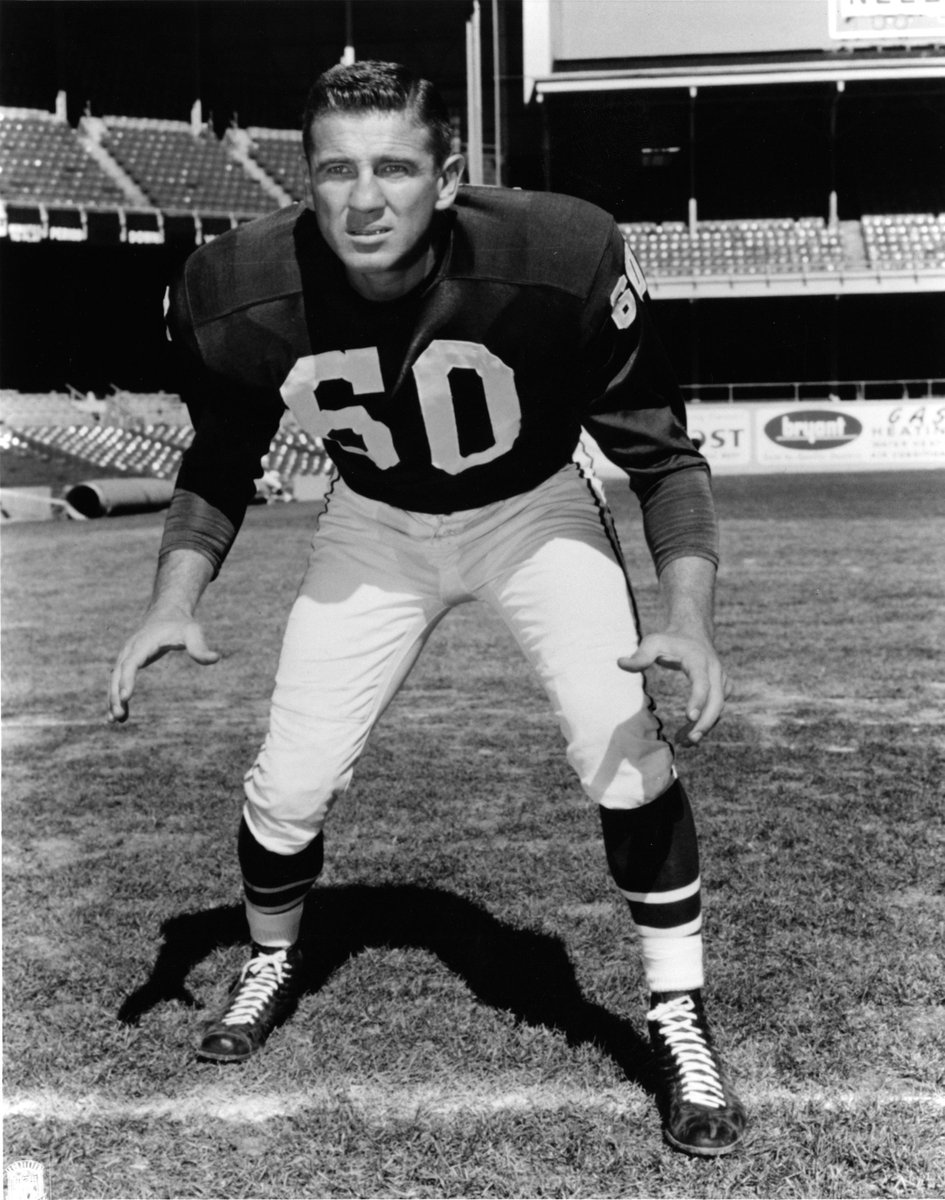
For those of you who grew up in the 1980s like I did: Imagine that Dwight Stephenson and Mike Singletary were the same man, playing for the same team. That was Bednarik. He was the last of "the sixty-minute men." He even wore Number 60, although that had nothing to do with his two-way status.

In those days, athletes weren't paid during the off-season, so they needed to get real jobs. Chuck sold concrete for the Warner Company. Hugh Brown of The Bulletin, a Philadelphia newspaper that went out of business in 1982, gave Chuck the nickname "Concrete Charley," saying he was "as hard as the concrete he sells."

In 1953, the Eagles were playing the Cleveland Browns. Bednarik was snapping for a punt. This required him to have his head down. This was the beginning of the usage of facemasks in the NFL, and the Browns were among the first teams to use them. The Eagles were not. And after snapping the ball, Bednarik looked up, and got clobbered. All he saw when he got hit was the uniform number: 65. When he came to, he saw Number 65 trotting away, and, knowing full well the man couldn't hear him, he pointed, and said, "You son of a bitch. I'll get you. I'll get you!"

He found a copy of the Browns' roster. Number 65 was also a center and linebacker, named Chuck, from a true blue-collar place: East Side of Cleveland native Chuck Noll, a man that Browns coach Paul Brown, himself one of the greatest minds in the history of football, considered so smart that he sent him in to relay plays to quarterback Otto Graham. Noll hated being used as a messenger boy, and when he became head coach of the Pittsburgh Steelers, he trusted quarterback Terry Bradshaw to call his own plays. (And people called Terry dumb.)

Bednarik said it took 4 years for him to get his revenge. Most likely, it was because Noll began playing mostly defense, as a linebacker, and thus not directly opposing a center on most plays. Certainly, it wasn't due to injury: Both men were quite durable. Nor was it due to military service: Bednarik's was done, and, despite being of draft age, Noll didn't miss any playing time for this reason.

It was October 13, 1957, at Connie Mack Stadium. The Eagles won, 24-7. This was a big win, considering that the Browns went on to win the NFL Eastern Division Championship. Late in the game, Bednarik finally had his chance to clobber Noll. And he did, on play after play. At one point, Noll, apparently having forgotten the 1953 hit, yelled that he would take on Bednarik, would take on the entire Eagle team. Even Bednarik had to admit that was pretty tough. Bednarik said that wasn't necessary: When the game was over, he'd be ready for Noll.

When the final whistle blew, Noll, having had enough, came at Bednarik -- with his helmet off. Big mistake. Noll said, "Are you ready, you... " And before Noll could call Bednarik whatever he was going to call him, Bednarik took advantage of the unprotected head, and flattened Noll with one punch.

The result was a brawl that got the attention of one particular spectator at the game: NFL Commissioner Bert Bell -- himself a former Penn player, and the founder of the Eagles, whose office was in Philadelphia. Due to a quirk in the schedule, the same 2 teams were to meet again, this time at Cleveland Municipal Stadium. He hauled Bednarik into his office, and told him that, before taking the field in Cleveland, he had to go into the Browns' locker room and apologize to Noll in front of his teammates, or face what would have been, for that era, a huge fine.

Bednarik took his medicine like a man. He walked in, found Noll, and said, "I want to apologize for what happened in Philadelphia." Noll thought this over for a minute, and said, "Bullshit." Bednarik turned and began to walk off, having done his duty, for all the good it had done. But Noll then said, "All right, I accept your apology." The Browns won the game, 17-7.

But despite all he accomplished as a coach, this is all Noll is known for as a player. Which isn't fair, because he reached 4 NFL Championship Games with the Browns, winning titles in 1954 and '55. He wasn't a great player, but he was a very good one.

Chuck Noll died last year, on June 13. I did not do one of these tributes for him. I should have.

*

Chuck Bednarik played for 14 years, 12 games a season. He missed only 3 games due to injury. This was not necessarily true for his opponents. Most notably, Frank Gifford.

Some cities, like Los Angeles and Miami, like their sports heroes to be flashy. Others, like Philadelphia and Chicago, prefer them to be tough. Blue-collar. They will accept failure, but they will not accept failure to try. They understand it if you fall, as long as you get back up. New York likes to have it both ways: Men like Joe DiMaggio, Joe Namath, Walt "Clyde" Frazier, Derek Jeter. And one of the flashiest New York athletes was Frank Gifford, Hall of Fame running back for the Giants in the 1950s. Until 1960, it never would have occurred to anyone to call Gifford "tough."

On November 20, 1960, the Eagles and Giants, arch-rivals since the Eagles' founding in 1933, played at Yankee Stadium. The winner was probably going to win the NFL's Eastern Division and play in the NFL Championship Game, as the Giants had in 3 of the last 4 years. Since the hosting alternated between the East and West winners in those days, the winner would also host the title game.

The Giants led 10-0 at the half, but blew it. In the 4th quarter, the Eagles' Jimmy Carr picked up a fumble and returned it 38 yards for a touchdown, making it 17-10 Eagles.

With the clock running out, George Shaw, filling in for injured quarterback Charlie Conerly, threw a pass toward Gifford at midfield. Gifford caught the pass, but Bednarik arrived at the same time, and he flattened Gifford, who fumbled. The Eagles recovered.

On the film, this doesn't look like an especially devastating hit. I've seen much worse. What made this the most famous hit in NFL history -- aside from the fact that it was in New York, and involved a New York team, and was seen by a national TV audience -- was how Chuck reacted.

The film shows him reacting to the fumble by jumping around and clapping his hands. Then he pumped his fist, and issued what became his catchphrase: "This fucking game is over!" Which, for all intents and purposes, it was. The final score was, indeed, 17-10 Eagles.

But it was the photograph that proved devastating. It showed Bednarik standing over Gifford, pumping his fist. Gifford is lying on the ground, motionless. Bednarik spent the last 54 years of his life explaining that he didn't even realize Gifford was motionless on the ground in front of him, that he was celebrating the Eagles wrapping up a big win, not the fact that he'd knocked Gifford out. He said he didn't even realize he'd knocked Gifford out.
Legend has it that Gifford was knocked out because, despite wearing a helmet, he hit his head on the frozen grass at Yankee Stadium. This couldn't be true: According to Pro-Football-Reference.com, it was 49 degrees at gametime -- not a particularly notable temperature for mid-November New York, and hardly cold enough to freeze the field.

Gifford was taken to the Giants locker room -- which, at the old Stadium, was also the Yankee locker room -- Gifford's locker was also Mickey Mantle's. Also taken to the locker room for first aid was a security guard who had a heart attack. Frank's first wife, Maxine, didn't know this, and when she went down to the locker room to see Frank, she heard someone say, "He's dead" -- meaning the security guard. When the guard was wheeled out on a stretcher, with his face covered by a sheet, reporters saw this, and thought it was Gifford.

The rumor began to spread that Bednarik had killed him. And when the photo was seen in newspapers across the country the next day, Bednarik looked like a monster, celebrating his "kill."

It got worse. Bednarik went to see Gifford in the hospital the next day, and was told Gifford couldn't receive visitors. But a new rumor circulated, that Bednarik wouldn't see Gifford. It wasn't that he wouldn't, it was that he couldn't.

Gifford missed the rest of the season, and decided to retire at age 30. But he missed the game, and returned in 1962, switching to receiver for safety reasons. He played 3 more seasons and retired again, becoming one of football's greatest broadcasters.

Gifford has always said he never held it against Bednarik. Bednarik said he was tired of people remembering him mainly for one thing. "It was always, 'Oh, you're the guy! You're the guy! You're the guy that got Frank Gifford!'" He was also tired of Howard Cosell, on Monday Night Football, seeing a hard hit, and turning to Gifford and saying, "Just like Chuck Bednarik blindsided you at Yankee Stadium, Giffaroo!"

"Blindsided, my fanny! It was a clean hit," he always said. And it was: Like the infamous Denis Potvin hit on Ulf Nilsson in 1979, or Scott Stevens leveling Eric Lindros in 2000, no penalty was called on it. (And, yes, this profane man would say, "fanny," not "ass." In America, "fanny" means rear end. In Britain, it means the other side, of a woman.)

*

The Eagles did advance to the NFL Championship Game, held at Franklin Field on the day after Christmas, December 26, 1960. At the time, the stadium didn't have lights. Remembering 2 years earlier, when Gifford's Giants and the Baltimore Colts went to overtime, the game was pushed back to a starting time of 12:00 noon.

The Eagles played the Green Bay Packers, in the title game for the 1st time in 16 years. Just 2 years earlier, they were 1-10-1. They had been rebuilt by head coach and general manager Vince Lombardi, a former Giants assistant. The Eagles took a 17-13 lead, thanks to a touchdown by a Philly native, Villanova graduate Ted Dean.

The Packers drove for a winning touchdown. On the last play, as Eagle broadcaster Bill Campbell said, "I wish you could see 67,000 people standing -- standing!" Bart Starr threw over the middle, and running back Jim Taylor caught the pass. But Bednarik, who played 58 1/2 of the game's 60 minutes, met him at the 7-yard-line, and shoved him down, and held him down, as the clock ran out. There was no penalty flag for delay of game.

Taylor said, "Get off me, you son of a bitch!" Bednarik looked up, saw the clock run out, and got up. The film shows him jumping for joy. What it doesn't capture is his words: "You can get up now, you son of a bitch! This fucking game is over!"

*

So were Bednarik's glory days. At age 35, he had played nearly every minute of 13 games (counting the title game). He played 2 more seasons as only a center, and retired. He was elected to the Pro Football Hall of Fame in 1967, his first year of eligibility.

The Eagles retired his Number 60, and made him a charter inductee into the Eagles Honor Roll in 1987. (All the charter inductees were already in the Pro Football Hall of Fame.) He was honored in ceremonies at Veterans Stadium for the 25th Anniversary of the 1960 title team in 1985, and for the 40th Anniversary of the 1948 and '49 title teams in 1988; and at Lincoln Financial Field for the 50th Anniversary of the 1960 title team in 2010. For a while, in the late 1990s and early 2000s, he feuded with Eagle management, but reconciled in 2006.
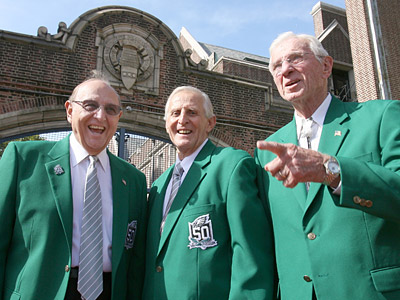
(Left to right: 1960 Eagles Joe Pagliei, Tommy McDonald and Chuck Bednarik,
outside Franklin Field during 50th Anniversary commemorations.)

Chuck was named to the NFL's 50th Anniversary Team in 1969, and its 75th Anniversary Team in 1994. In 1999, The Sporting News made its end-of-century list of the 100 Greatest Football Players. He came in at Number 54, the highest-ranking center, the 8th-ranked linebacker, the highest-ranking career Eagle, and 2nd among all Eagles players behind Reggie White (who, these days, tends to get remembered more as a Packer). In 2010, despite the extra 11 years, he actually moved up when the NFL Network aired the special The Top 100: NFL's Greatest Players.

He became something of a curmudgeon in his later years, the old veteran -- of war and the game -- lamenting what he saw as the insufficient toughness of today's players, and their insufficient respect for players of the past. In essence, he was the NFL's answer to baseball's Bob Feller. But he was always a big draw for NFL Films, giving them several interviews.

But even the toughest men don't live forever. Chuck Bednarik died yesterday morning, at the age of 89. His daughter, Charlene Thomas, said that he'd been suffering from Alzheimer's disease, and she believes the constant hard contact of his 14-year NFL career had something to do with that.

Lots of NFL players, even today, with far greater protection for the head, have fallen victim to brain trauma, including dementia, even in their 50s. This has gotten increasing attention in the last few years.

Whether Chuck, in his final years, understood this well enough to change his mind about the toughness of modern players, only he knew.

With Chuck's death, there are now 5 surviving players from the 1949 NFL Champion Philadelphia Eagles, 65 years later. In alphabetical order, they are: Two-way end Neill Armstrong, backup quarterback Bill Mackrides, two-way halfback Jack Myers, two-way halfback Clyde Scott, and two-way tackle Al Wistert. Armstrong, Mackrides, Myers and Wistert are the last 4 survivors of the 1948 NFL Champion Philadelphia Eagles. (This Neill Armstrong, no relation to the Neil Armstrong who was the 1st man to walk on the Moon, is best remembered as the head coach of the Chicago Bears before Mike Ditka, guiding them to a Playoff berth in 1979.)

From the 1960 NFL Champion Philadelphia Eagles, 54 years later, there are now 22 survivors: Running back Billy Ray Barnes, linebacker Maxie Baughan, running back Timmy Brown, defensive end Marion Campbell, running back Ted Dean, defensive end Riley Gunnels, cornerback Bobby Jackson, quarterback Sonny Jurgensen, defensive end Ed Khayat, center Bill Lapham, receiver Dick Lucas, offensive tackle Jim McCusker, receiver Tommy McDonald, defensive tackle Don Owens, tight end Pete Retzlaff, tight end Jerry Reichow, running back Theron Sapp, offensive tackle J.D. Smith, linebacker Chuck Weber, defensive tackle John Wilcox, defensive end Jerry Wilson and guard John Wittenborn.

(Campbell and Khayat would both become head coaches of the Eagles; Retzlaff, general manager. John Madden was drafted by the Eagles as an offensive tackle in 1959, but hurt his knee in preseason, and never played in the NFL. But quarterback Norm Van Brocklin saw him walk into the locker room on crutches, and invited him to watch film with him. Madden later said that's how he became a coach, by studying film with a quarterback on his way to the Hall of Fame.)

That 1960 title remains the Eagles' last. Since it happened, they have fallen, and risen again -- 4 separate times, and have recently risen again for the 4th time. They have left Franklin Field, moved into Veterans Stadium, left the Vet, and moved into Lincoln Financial Field. The Vet has been demolished, while, amazingly, Franklin Field still stands on Penn's campus, as it has since 1923. (A predecessor had stood on the site since 1895.) Since Chuck got off Jim Taylor 54 years and 3 months ago, the Eagles have become a cultural phenomenon, Philadelphia's most popular sports team. But they have never won another title, only reaching 2 more NFL championship games, both under the Super Bowl name, and losing both.

But Chuck Bednarik remains the Eagle icon. Go to an Eagles home game, and you can still find fans, whose parents weren't born yet in Christmas week 1960, in the last full month of the Ike Age, the time of the Eagles' last World Championship, who file into The Linc wearing 1960 throwback jerseys with Bednarik's name, his Number 60, and, sometimes, his autograph on them. (No doubt purchased from, or online through, the famed Philly nostalgia store Mitchell & Ness.)

In one of those NFL Films interviews, Bednarik pointed out that people he met didn't always point out that he was "the guy that got Frank Gifford":

I still get people come up to me in airports, saying, "Are you Chuck? Hiya, Chuck!"

And, thinking of that, the man remembered as one of the NFL's ultimate tough guys broke out into a big smile, with a twinkle in his eye, that actually suggested sentimentality.

What the hell: He earned the right to be fondly remembered, and the right to be sentimental about it.

UPDATE: Bednarik was buried at Saint Joseph Calvary Cemetery in Limeport, Lehigh County, Pennsylvania.

Tuesday, January 6, 2015

Allie Sherman, 1923-2015

In the wake of the Jets' decision to fire head coach Rex Ryan, and the Giants taking a chance by keeping Tom Coughlin, let us pause to remember Allie Sherman, who guided the Giants through highs and lows long ago.

Alexander Sherman -- who became "Allie" instead of "Alex," or even "Sander," as Michigan Congressman Sander Levin did -- was born on February 10, 1923 in Brooklyn, the son of Russian-Jewish immigrants. He attended Boys High School, in the Bedford-Stuyvesant section, before its merger to become Boys & Girls High School.

Other alumni of Boys High include: 2-time National League batting champion Tommy Davis; basketball stars Lenny Wilkens, Connie Hawkins, Si Green, Mel Davis; and sportswriter/sportscaster Howard Cosell. And that's just from the world of sports. It also produced novelist Norman Mailer, science fiction titan Isaac Asmiov, longtime Congressman Emanuel Celler, housing developer William Levitt, civil rights lawyer Will Maslow, his brother psychologist Abraham Maslow, painter Man Ray, music legends Aaron Copland and Max Roach, comedian Alan King, film producer Irving Thalberg, and actor Norman Lloyd, now 100 years old. Since the merger, its most notable graduate has been basketball star Dwayne "the Pearl" Washington.

When Sherman was 13, he was already a locally renowned athlete, and he tried out for the football team at Boys High. The head coach rejected him, for being too small. This was in 1936; Phil Rizzuto, even smaller, had already been the quarterback at Richmond Hill High School in Queens, before being rejected by Brooklyn Dodger manager Casey Stengel for being too small, and then signing with the Yankees where the rest was history -- although he would be reunited with Stengel, who admitted he was wrong, but Rizzuto never forgave him.

At 16, Sherman graduated, and got into Brooklyn College, paying his tuition with money he made from hustling older kids in handball. He tried out for their football team. This time, the coach wasn't the one who told him not to: His mother was. Allie and the coach talked her into letting him play, and in 1940 he became the starting quarterback. In 1942, he led BC to a shocking upset win over crosstown rival City College of New York (CCNY). He graduated at age 19.

There weren't many lefthanded quarterbacks in Sherman's day. But, knowing that Sherman had quarterbacked the T-formation, and that George Halas' Chicago Bears had shown that the T was the formation of the future and the single wing that of the past, Philadelphia Eagles coach Earl "Greasy" Neale took a chance on him. "Never have I seen a player with a greater understanding of the game," Neale said. "He was so dedicated, he insisted on rooming with a lineman. He wanted to absorb the way a lineman thought."
Eagles quarterback "Al" Sherman

Due to the World War II-induced manpower shortage, for the 1943 season, the NFL convinced the 2 Pennsylvania teams, the Eagles and the Pittsburgh Steelers, to merge for the season. The team, called the "Steagles," finished 3rd in the NFL Eastern Division with a record of 5–4–1. Both teams had started play in 1933, and this was the best finish that either of them had yet had.

The Eagles finished 2nd in 1944, '45 and '46, and tied the Steelers for 1st in '47. They beat the Steelers in a Playoff, the 1st postseason game in either team's history (and the only one the Steelers would play until the "Immaculate Reception" game in 1972). But they lost the NFL Championship Game to the Chicago Cardinals.

The next year, Neale put his faith in a new quarterback, Tommy Thompson. Sherman was gone -- but it worked, as the Eagles won the NFL Championship in 1948 (getting revenge on the Cardinals in a blizzard at Shibe Park) and 1949 (beating the Rams despite a rare Southern California rainstorm turning the Los Angeles Coliseum field into soup).

*

Sherman went into coaching. He won a title with a minor-league team in Paterson, New Jersey. Then Neale made it up to Sherman by recommending him to Steve Owen, longtime coach of the Giants. Owen had been losing due to his loyalty to the single wing, and finally gave up the ghost, and had Sherman teach the T to the Giants, turning Charlie Conerly into a championship and Hall of Fame quarterback.

When Owen retired after the 1953 season, Sherman didn't get the job -- former Giants player Jim Lee Howell did. It is worth nothing that Sherman was only 30 years old. There's no way any NFL team would name a 30-year-old man as head coach today. He did not, however, blame his rejection on his youth, or on his religion.

(UPDATE: The Los Angeles Rams hired Sean McVay as head coach in 2017, when he was only 31.)

He went to Canada, coached the Winnipeg Blue Bombers, and got them to the Playoffs. Canadian football's system, with 12 men on the field, 3 downs instead of 4, a wider field and deeper end zones, led Sherman to adapt with offensive schemes that would later help him in the NFL (even though he had to adapt back to the system he previously knew, as some of his Winnipeg plays, even with 11 men, wouldn't have been legal).

When the Giants took Sherman back as an assistant coach, the new Bombers head man was one of his receivers, Bud Grant, and he led them to 4 Grey Cup wins in 5 seasons, before moving on to the Minnesota Vikings, and leading them to 4 Super Bowls (though they lost them all).

In 1959, Giants offensive coordinator Vince Lombardi got the head job with the Green Bay Packers. He wanted Sherman to come with him as offensive coordinator. He refused, thinking Howell would soon move on, and that he would get the Giants job. This became more likely in 1960, as Giants defensive coordinator Tom Landry was named the 1st head coach of the expansion Dallas Cowboys. (Yes, kids: Lombardi and Landry were on the same coaching staff, in New York.)

In 1961, Howell left, and Sherman got his wish, at age 38, 8 years after he first hoped to. He wasn't the 1st Jewish head coach in the NFL, or even the Giants' 1st: Quarterback Benny Friedman was briefly a player-coach. But Sherman became the most successful Jewish head coach in NFL history.

With an aging but still effective Y.A. Tittle replacing Conerly, Sherman led the Giants to 3 straight Division titles. He earned NFL Coach of the Year awards in 1961 and 1962, the 1st time that a coach won that honor in back-to-back seasons.

But the Giants didn't win the title. In 1961, they got wiped out in the NFL Championship Game, losing 37-0 to the Green Bay Packers on a snowy New Year's Eve at what would later be renamed Lambeau Field.

In 1962, with Frank Gifford ending his 1-year retirement, they faced the Packers again, this time at Yankee Stadium. (In those days, the site rotated between the Division Champions, rather than getting assigned to whoever had the best record. Good thing for the Giants, as the Packers were 13-1 that year.) The cold, freezing the field, helped the Packers, but it shouldn't have fazed a team playing in New York, or a coach who had coached in Canada. But the renowned Giants defense, led by Sam Huff, couldn't stop Jim Taylor, and their offense couldn't get a footing, and the Packers won, 16-7.

The 1963 title game still stands as perhaps the most frustrating in Giants history. They played the Bears at a frigid Wrigley Field, and Tittle sustained a knee injury. Courageously, Tittle convinced Sherman to keep him in the game, and, despite repeatedly getting hit and driven into the frozen Wrigley grass, he led a final drive with the Bears up 14-10. But an interception ended the Giants' chances, and Tittle would never win a title.

In 1964, just as the Yankees would a year later, the Giants faced a situation where everyone seemed to get old, or hurt, or both, at once. The team collapsed from 11-3 to 2-10, its worst season ever, in just that 1 year, and Sherman no longer looked like a genius.

To make matters worse, Giants owner Wellington Mara orchestrated the trades of some of the better players: Huff went to the Washington Redskins, where he became a big part of that franchise's revival after a long down period; while defensive end Rosie Grier went to the Rams, where he became part of their imposing defensive line known as the Fearsome Foursome.

Sherman told Mara he should draft Joe Namath. He refused. Namath proved Sherman right, as he did become a great pro quarterback who led a New York team to a World Championship -- but it was the Jets. Instead of drafting the man who would become Broadway Joe, Mara traded for Vikings quarterback Fran Tarkenton, who never really meshed with New York or its fans, and was sent back to Minnesota, where he led them to 3 of their 4 NFC Championships.

The Giants got back to 7-7 in 1965, but in 1966, they crashed to their worst season ever, 1-12-1. In just 3 seasons, Sherman had coached the 2 worst seasons in Giant history. (They're still 2 of the 4 worst, for this franchise that has now played 90 seasons.) To the tune of "Good Night, Ladies," Giant fans began singing, "Goodbye, Allie."

This was long before the Jet fans' chant of "Joe Must Go" for Joe Walton, the Giant fans' chant of "Ray Must Go" for Ray Handley, or the Jet fans' chant of "FI-re KO-tite!" for Rich Kotite. Fans began bringing "GOODBYE ALLIE" banners. They did this at a time when Yankee management had banners confiscated at Yankee Stadium, thinking it was a bush-league thing that Met fans did. Sherman was unfazed, saying, "They paid their money, and can do what they want."

He may have won a few fans back by being savvy with the media, as he was among the earliest NFL head coaches to take press questions daily. Understanding NFL Commissioner Pete Rozelle's desire to make the NFL more accessible to fans via television, every Monday morning after a game, Sherman presented game film clips and evaluations -- standard procedure now, but revolutionary at the time.

Rethinking his 1963 rejection of writer (and Giant fan) George Plimpton's idea to allow Plimpton to pose in training camp as a rookie quarterback (resulting in him going to the Detroit Lions and producing the bestseller Paper Lion, made into a movie with a young Alan Alda), in 1966 Sherman and Mara accepted the proposal of author Eliot Asinof (author of the Black Sox book Eight Men Out) to spend 2 years with the team having total freedom and unlimited access to players, coaches, and executives, even closed coaches meetings.

This resulted in a never-before seen behind-the-scenes look of the inner world of the professionals, Seven Days To Sunday, published in 1968. This was right before the publication of Packer guard Jerry Kramer's diary of the 1967 season, Instant Replay, and before Roy Blount Jr.'s insider's look at the 1972 Steelers, About Three Bricks Shy of a Load.

While college football coaches had previously had radio shows, Sherman produced and owned the 1st pro football coach's weekly television program, on then-independent station WPIX-Channel 11, reviewing film of the Giants' prior game and discussing football with invited players, coaches, and guests, giving many fans their 1st peek inside professional football and "up close and personal" moments with the players.

He co-produced and hosted a Monday night radio program, Ask Allie, airing on the Giants' station, WNEW (1130 on your AM dial, now Bloomberg Radio), where it was just him sitting in a booth, smoking a cigar, and directly taking fans call-in questions and comments.

The press respected Sherman for facing fans weekly, especially just 24 hours after a tough loss, and always treating them graciously. He also hosted the first nationally syndicated TV panel-discussion sports show called Pro Football Special, where, in reviewing touchdown plays, he would say that the runner, once in the clear, "goes in for the touch."

He annually held a big Christmas party for the press, inviting everyone who regularly covered the Giants, even his critics. All this won some of them over, but he was still sometimes called "very Madison Avenue-ish," suggesting that he should concentrate less on public relations and more on winning; less on "sizzle" and more on "steak."

In 1965 an 1966, he added former Giants Emlen Tunnell and Roosevelt Brown, both future Hall-of-Famers, to his coaching staff. They were the 1st 2 African-American assistant coaches in the NFL. This may have helped, strategically as well as with public relations: In 1967 and 1968, the Giants went 7-7, missing the newly-expanded Playoffs by 1 game in '68. It was a brief reprieve, and the crosstown Jets ended up beating the Baltimore Colts in Super Bowl III for the World Championship, the 1st for a New York football team since the 1956 Giants.

Then came the nail in Allie's coaching coffin: The following preseason, as part of the process of the AFL's absorption into the NFL, the 2 New York teams played each other for the 1st time -- not at Yankee Stadium or Shea, but at the Yale Bowl in New Haven. Three Jet players chose to come out of retirement, just for this 1 game, because they wanted to make a point about being not just the best team in the world, but the best team in New York. The Jets won, 34-17, and at the end of the season, Mara fired Sherman.

In his 1st 3 seasons as an NFL head coach, Sherman went 33-8-1. In his last 6 seasons, he went 30-51-3. Overall, he was 63-59-4. At age 46, he had coached his last game.

*

But he was neither away from the game nor unproductive with the 2nd half of his life. The main reason he didn't coach again in the NFL is that he thought it would be better to go into management, and so he turned down some offers. He tried to put together a group that would buy an NFL team. One of these attempts was with Steve Ross, head of Warner Communications, Inc. (WCI). They tried and failed to buy the Jets from Leon Hess.

Ross agreed with Sherman that sports content also had great potential value, with cable television as a delivery system. Ross asked Sherman to join WCI and use his coaching and media expertise to build good teams and develop these potential assets. While helping WCI win cable franchises in additional cities, Sherman was part of WCI's experimental QUBE system in Columbus, Ohio.

It was the nation's 1st interactive cable system, enabling QUBE customers to individually order film and other content direct from home on a pay-per-view basis. Sherman recognized its marketing and revenue potential for sports programming. He created cable's first sports subscription package with Ohio State University Chancellor Gordon Gee.

In each WCI cable system, in big cities like Dallas and Chicago, Sherman continued to acquire college and professional sports rights, and then built regional sports networks to exhibit the games and specially created related programming. Eventually they were all purchased, and are known today as the Fox Sports Networks. Sherman positioned WCI's growing cable systems as an integral part of the sales and marketing of national pay-per-view events, especially high-priced championship fights. He negotiated special rights deals with impresarios and friends Don King and Bob Arum.

Ross had been a founding co-owner of the North American Soccer League's New York Cosmos, and used WCI to boost the team and the league. When Pelé announced his retirement in 1977, he requested that the man he called "Allie Boss" produce his farewell game, a testimonial at Giants Stadium, between the Cosmos and Pelé's former club team in Brazil, Santos. Pelé would play a half for each team.

Sherman put together a package of an ABC special game presentation, a worldwide syndicate of TV networks in 117 countries, including the Soviet Union, global sponsors to market it, had Frank Gifford as host with myriad celebrities and officials, ending with a special award presented by Muhammad Ali, then still Heavyweight Champion of the World. (Supposedly, the man who liked to call himself "The Greatest" said of Pelé, "Now I understand: He is greater than I am.")

Between Pelé, Ali, the Cosmos, the power of New York, the love of the game, Ross' media reach, and Sherman's promotional genius, this broadcast remains, outside of World Cup matches, the most-watched soccer event ever broadcast.

Sherman was a frequent guest on Warner Wolf's late-Sunday-night sports wrap-up show on WCBS-Channel 2, and this led to him going up to Bristol, Connecticut to appear live on the early ESPN, making him famous beyond the New York Tri-State Area. Having worked with the father-son team of Ed and Steve Sabol to help establish NFL Films in the 1960s, giving their film crews full access to the Giants behind the scenes, Allie worked with Steve to produce ESPN's pregame show for Monday Night Football (now on ESPN but then still on ABC), Monday Night Matchup.

He and his co-hosts would break down the teams into key matchups, and use stop-action film and graphics to analyze the upcoming game. This format later became a standard feature in ESPN's and the networks' sports programming. One of his panelists was a fellow former Eagle quarterback, Ron Jaworski, giving the Polish Rifle (that was his nickname before every ESPN viewer knew him as "Jaws") the springboard to a media career that, as with Sherman, has now outshone his playing days.

In 1994, using his usual lack of tact (which pissed off many, but endeared him to many more, much like predecessor Ed Koch), new Mayor Rudy Giuliani wanted to reform New York's Off-Track Betting system for taking horse racing bets outside the racetracks. He said, "OTB is the only bookie in the world that loses money every year," and asked Sherman to run it.

As Giuliani did with the streets of New York, Sherman cleaned OTB up both figuratively and literally: He closed down run-down stores, fixed up the rest, and leaned on his Warner Cable connections to create a racing station and to allow Warner customers to phone in bets. In just 2 years, OTB was making a profit for the first time. (After he left, it fell into losses again, and The City shut it down in 2010.)

Throughout the years, Sherman was involved with many charities, including charities for children with special needs, the Boys and Girls Clubs of America, and the Veteran's Bedside Network, where he regularly visited veterans’ hospitals, to talk football and sports with disabled veterans.

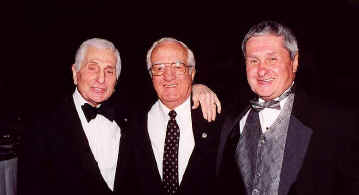
This is the most usable (relatively) recent photo I could find of Allie, from the NFL's "Helping Hands Award" charity dinner in 2002. He's on the left. In the middle is Tony Veteri, an official in the AFL and NFL for 23 years. On the right is George Beim, Events Coordinator for the charity.
Allie Sherman died this past Saturday, a few weeks short of his 92nd birthday. He is survived by his wife Joan, son Randy, daughters Lori Sherman and Robin Klausner, and 2 grandchildren. He is a member of the National Jewish Sport Hall of Fame in Long Island, and the Brooklyn College Hall of Fame as well.

He wasn't a great player or a great coach, but he was good at both. His true brilliance was in bringing football to the people, making him as important a football-in-media figure as Rozelle, the Sabols, and ABC Sports boss and Monday Night Football founder Roone Arledge. The Pro Football Hall of Fame's media award is named for Rozelle. Allie Sherman should have gotten it years ago. Hopefully, with a new Hall of Fame election coming up this month, he will be recognized.

Note: Some of this text is taken from Wikipedia's entry on Sherman.

UPDATE: He was buried at Mount Pleasant Cemetery in Hawthorne, Westchester County, New York, the same cemetery as another New York sports media legend, Bill Mazer. It is near Gate of Heaven Cemetery in Hawthorne, where Babe Ruth is buried; and that is next-door, albeit in an adjacent town, to Kensico Cemetery in Valhalla, where Lou Gehrig is buried.

Monday, February 13, 2012

Top 10 Greatest New York Football Giants


This is the 1st of a new series: The top 10 performers for each of the New York Tri-State Area major league teams.

I'll be leaving out the WNBA's New York Liberty and MLS' New York-New Jersey MetroStars/New York Red Bulls. But I will be including the 2 baseball teams that left after the 1957 season.

I'm starting with the newly recrowned Super Bowl Champions, since they're still freshest in our minds.

Top 10 New York Football Giants

Honorable Mention to the Giant players not in this Top 10 who are in the Pro Football Hall of Fame: Ray Flaherty, Benny Friedman, Pete "Fats" Henry, Clarence "Red" Badgro, Ken Strong, Alphonse "Tuffy" Leemans, Andy Robustelli, Harry Carson, Arnie Weinmeister and Y.A. Tittle. And to owners Tim and Wellington Mara, and to player & coach Steve Owen.

And, while they are not yet in the Hall of Fame, Honorable Mention also to coaches Jim Lee Howell, Bill Parcells and Tom Coughlin; to general manager George Young; to owners Jack Mara and Bob Tisch; and to players Al Blozis, Charlie Conerly, Alex Webster, Dick Lynch, Joe Morrison, Pete Gogolak, Brad Van Pelt, Dave Jennings, George Martin, Carl Banks, Mark Bavaro, Jessie Armstead, Amani Toomer, Osi Umenyiora and Justin Tuck. All of these except the active ones, including Coach Coughlin, are in the Giants' Ring of Honor at MetLife Stadium.

10. Roosevelt Brown, Number 79, offensive tackle, 1953-65. Maybe the Giants should look for more players from old college towns in Virginia: Lawrence Taylor was from Williamsburg, and Rosey Brown was from Charlottesville. Unlike L.T., who went to a fully-integrated University of North Carolina, Brown came from a different era, and had to go to a "historically black college," Morgan State University in Baltimore.

But it got him noticed, and he became one of the best tackles in football history, protecting quarterbacks Charlie Conerly and Y.A. Tittle and blocking for runners Frank Gifford and Mel Triplett. In 1999, when The Sporting News listed the 100 Greatest Football Players, Rosey was listed at Number 57 -- albeit 3rd among men named Brown, behind running back Jim at 1 and defensive back Willie at Number 50.

9. Phil Simms, Number 11, quarterback, 1979-93. Considering how many injuries -- and how many boos -- he got at the beginning of his career, it's amazing how loved he now is. Perhaps, like another "blond bomber" 10 years earlier, Terry Bradshaw, he used that as motivation to make himself respected and his team World Champions.

He didn't make people say, "Ooh" and, "Aah" like his contemporary Dan Marino. But which one has 2 rings? Or even 1? That Simms is not yet in the Pro Football Hall of Fame, after 13 years of eligibility, is ridiculous.

8. Tiki Barber, Number 21, running back, 1997-2006. True, he hurt his legacy by flapping his gums, and even more by an ill-timed retirement, which saw the Giants win the Super Bowl the very next season, making him football's Elgin Baylor. (This also happened to Stan Musial, but he had helped the St. Louis Cardinals win 3 World Series long before.)

But there is only one New York Giant who has rushed for over 10,000 yards, and that's Tiki. And he did help the Giants get into a Super Bowl -- albeit one that became the only NFL Championship Game (under that name or the name "Super Bowl") that the franchise has lost since the aftermath of the JFK assassination.

7. Michael Strahan, Number 29, defensive end, 1993-2007. Sure, he can be a comical figure, with his appearances on Fox NFL Sunday, and that infamous gap in his front teeth. But the man wouldn't be on that show if he didn't know his football. Smirk all you want at his single-season record of 22 1/2 sacks in 2001, but his 141 1/2 sacks are a New York football record.

And he did go out in style, leading the Giant defense in Super Bowl XLII, showing the world how to beat Tom Brady: Get in his face, again and again, and knock him on his ass, again and again.

6. Eli Manning, Number 10, quarterback, 2004–present. Simms led the Giants to 2 Super Bowl seasons and was Super Bowl MVP in 1 of them. Eli has now been named MVP of 2 Super Bowls, and both were better games than the ones Simms and Namath played in. And let's not forget: Much like the Jets were in Super Bowl III, the Giants were underdogs in both of their Supes with the Patriots.

No more underdog status for Eli. At the beginning of this season, he was asked if he was "an elite quarterback." He said he was. He has now proven his ability, his determination, and his courage. From now on, doubt him at your own peril.

5. Mel Hein, Number 7, center-linebacker, 1931-45. Until Mike Webster came along, Hein was generally regarded as the greatest center in NFL history. He helped the Giants into 7 NFL Championship Game, winning in 1934 and 1938. In the latter year, the NFL Most Valuable Player award was given out for the firs time, and Hein won it. He remains the only offensive lineman ever to win it.

He was named to the charter class of the Pro Football Hall of Fame in 1963, the center on the NFL's 50th Anniversary Team in 1969 and also to its 75th Anniversary Team in 1994. When TSN named its 100 Greatest Players in 1999, Hein came in at Number 74. That same year, TSN also listed him as one of 3 centers on their College Football Team of the Century. He was an All-American at both football and basketball at Washington State University.

4. Emlen Tunnell, Number 45, safety, 1948-58. He died in 1975, while a Giant assistant coach, and as a result never got to be interviewed for any of the great NFL Films pieces on the Giants of his era. As a result, he may be the most forgotten great player ever.

He intercepted 79 passes, an all-time record that has only once been surpassed (and then just barely, by Paul Krause's 81). Records that have not been surpassed are his 1,282 yards on interception returns, and 2,217 yards on punt returns. He helped the Giants win the 1956 NFL Championship, and won another title with the Green Bay Packers in 1961 -- with head coach Vince Lombardi having been the Giants' offensive coordinator until 1958.

He was named the NFL's all-time greatest safety on its 50th Anniversary Team in 1969, 2 years after becoming the first black player elected to the Pro Football Hall of Fame. On TSN's 100 Greatest Football Players, Tunnell came in at Number 70 -- clearly, their experts remembered him. We should, too.

3. Sam Huff, Number 70, linebacker, 1956-63. This guy was L.T. before L.T. was even born: The defining player at the position of linebacker. He didn't use drugs like L.T., either. As Charlie Sheen would say, he was on a drug called Sam Huff.

To put it another way: In 1960, CBS Reports (the successor series to Edward R. Murrow's See It Now) did a piece called "The Violent World of Sam Huff." After this program, hosted by Walter Cronkite, aired and practically invented what NFL Films would soon start doing, with Huff miked up, showing the masses for the first time what a football game really sounded like, a CBS executive put an envelope in a mailbox, marked only "Number 70." No name. No address. No return address. In 2 days, that envelope arrived at Huff's locker at the old Yankee Stadium. The post office -- and thus the federal government -- recognized that "Number 70" could only mean Huff.  To this day, he's probably the greatest athlete ever to wear the number.

After 1963, he went to the Washington Redskins, extended his career, and is now remembered there as a broadcaster, much as the man at Number 2 is remembered now. On TSN's 100 Greatest Football Players, Huff came in at Number 76.

2. Frank Gifford, Number 16, running back-receiver, 1952-64. We've known him as a broadcaster (or at least as the husband of Kathie Lee Gifford) for so long, it's easy to forget what a sensational player he was. Before Mike Garrett, O.J. Simpson, Anthony Davis, Charles White, Marcus Allen and Reggie Bush, he was the man who started the USC running back tradition. At the start of his career, when NFL players were still expected to play on offense and defense, all 60 minutes, he was also a good defensive back. He was a glamour boy, so a lot of people who didn't like the Giants didn't like him. But he was sensational.

After getting clobbered by Chuck Bednarik in 1960, he did not return, and retired rather than play in 1961. But he got the bug back, and returned for 3 more seasons, becoming the league's best receiver, before age caught up with him and a few others in 1964. He became the only player in any of the 4 major league sports to be elected to its Hall of Fame as both a player and a broadcaster. (UPDATE: Len Dawson and Dan Dierdorf have since joined him.)

1. Lawrence Taylor, Number 56, linebacker, 1981-93. For all the controversies, during and since his pro career, Taylor has been considered one of the best players ever. On TSN's 100 Greatest Football Players, L.T. came in at Number 4, the highest-ranking defensive player.

All of the above are in the Pro Football Hall of Fame, except Simms and Barber, both now eligible, and Strahan, who becomes eligible next year.