Showing posts with label monday night football. Show all posts

Tuesday, November 18, 2025

November 18, 1985: Lawrence Taylor Breaks Joe Theismann's Leg

November 18, 1985, 40 years ago: One of the nastiest-looking injuries in NFL history occurs, before a national audience on ABC's Monday Night Football.

The New York Giants were a team on the rise, coached by Bill Parcells, quarterbacked by Phil Simms, and with a great defense led by linebacker Lawrence Taylor. Even before it was known that L.T. was a heavy cocaine user, he was seen as a bit unhinged: One NFL Films clip showed him exhorting his teammates by saying, "Hey, baby, let's go out there like a bunch of crazed dogs!"

The Washington Redskins were in the middle of the greatest run in team history. Under coach Joe Gibbs, they had won Super Bowl XVII, reached but lost Super Bowl XVIII, and were the defending NFC Eastern Division Champions. They were quarterbacked by Joe Theismann, from South River, New Jersey, a Notre Dame graduate with a big mouth, but also a strong arm that tended to back his words up. But not always.

He was protected by an offensive line known as "The Hogs": Center Jeff Bostic, guards Russ Grimm and Raleigh McKenzie, and tackles Joe Jacoby and Mark May. They had Hall of Fame running back John Riggins to hand off to, and had an elite receiving corps known as "The Fun Bunch," including Art Monk and Gary Clark Their defense was really good, too, from linemen Charles Mann and Dexter Manley to cornerback Darrell Green, generally regarded as the fastest player in the NFL.

The Giants were 7-4. The Redskins were 5-5. On October 20, the Giants beat the Redskins, 17-3 at Giants Stadium at the Meadowlands. Now, they were playing at Robert F. Kennedy Memorial Stadium in Washington, where the Redskins had one of the best home-field advantages in the League.

I was 15, and a junior at East Brunswick High School in Central Jersey, and the Giants were one of the local teams. On top of that, I really enjoyed watching the Redskins: They were, indeed, a fun bunch. So I was watching this game.

Each team scored in the 1st quarter. Theismann threw a 10-yard touchdown pass to Don Warren, but the Giants equalized on a 56-yard touchdown run. The score was still 7-7 in the 2nd quarter, when Gibbs called for a flea-flicker: Theismann handed off to Riggins, who then spun and lateraled back to Theismann.

But Theismann couldn't find an open receiver, and the blitz was on. Taylor grabbed Theismann and tackled him. Taylor's knee fell on Theismann's lower right leg, breaking both the tibia (the central bone in the lower leg) and the fibula (the thinner bone on the side of the leg). Taylor's fellow linebackers, Harry Carson and Gary Reasons, came into assist on the sack.

To me, at first, the tackle didn't look like anything out of the ordinary. But after about 5 seconds, Taylor began waving his arm at the sideline, to call over the Redskins' trainer. He put his hands up to his head, as if to say, "Oh my God, what have I done?" If Lawrence Taylor is spooked, you know something very bad has happened.

Jim Burt, the Giants' nose tackle, made the same gesture, even though he wasn't involved in the tackle. Carson was, and took off his helmet so that his call for help could be better heard. Grimm, the only member of the "Hogs" who has, thus far, been elected to the Pro Football Hall of Fame, also began waving for someone to come over.

ABC then showed a reverse angle of the play, and the break of Theismann's leg could be clearly seen. Frank Gifford, the 1st man to be elected to the Pro Football Hall of Fame as both a player and an announcer, kept describing the images being shown to the TV audience. Gifford's broadcast partner twice said, "Augh!" at the sight. That partner was O.J. Simpson.

Theismann was 36 years old, so it's not clear how much longer he would have played anyway. Regardless, he never played again, and having his career end at that point may have kept him from being elected to the Hall of Fame. Taylor apologized. Theismann told him that he shouldn't feel bad, that he was just doing his job.
Theismann and Taylor, reunited to promote NBC's
Thanksgiving Night broadcast of Redskins vs. Giants, 2017

Jay Schroeder was sent in to be the new Redskin quarterback. The score was still 7-7 at halftime. And yet, Schroeder rallied his shocked teammates to victory. He got them to the Giants' 1-yard line in the 3rd quarter, and Riggins scored, the 103rd touchdown of his Hall of Fame career. There would be only 1 more, as he retired after the season.

Joe Morris scored 2 more touchdowns for the Giants, putting them up 21-14. But a field goal by Mark Moseley and a pass from Schroeder to Clint Didier, both in the 4th quarter, gave the Redskins a 23-21 win.

In other words, the team that lost their quarterback to one of the nastiest injuries in NFL history ended up winning the game.

Both teams made the Playoffs. Neither team reached the Super Bowl. The following season, the Giants won Super Bowl XXI. The season after that, the Redskins won Super Bowl XXII -- but not with Schroeder as their quarterback. He lost his job to Doug Williams, who became the 1st black quarterback to win a Super Bowl. 

Thursday, September 12, 2024

September 12, 1994: The Great TV Realignment

KYW-TV logo, 1980s

September 12, 1994, 30 years ago: The great TV realignment. Because CBS (for a few years, anyway) lost their NFL contract, a lot of stations switched networks. This didn’t happen in New York, but in Philadelphia, on the other side of my Central Jersey base, it did: KYW-Channel 3 went from NBC to CBS, and WCAU-Channel 10 went from CBS to NBC.
KYW-TV logo, 1995

The buying into NFL broadcast rights helped turn Fox from a distant 4th among networks, behind NBC, CBS and ABC, into a legitimate 4th network. It launched Fox Sports, which has since included Major League Baseball, college football, the NHL, and professional soccer.

And since individual stations valued NFL money more than CBS money, while some of them switched affiliates with NBC, some picked up the former "independent stations" that Fox had picked up in the 1980s, losing a lot of viewers.

Friday, January 6, 2023

The Damar Hamlin Story Exposes the NFL

For nearly 4 full days now, I have resisted writing about what happened to Damar Hamlin of the Buffalo Bills. I wanted to see if there would be improvement in his condition (which there has been); or, to put it politely, not; and, either way, to see what the NFL establishment would do about it.

He was taken to the University of Cincinnati Hospital, following his collapse on the field during this past Monday night's game against the Cincinnati Bengals at Paycor Stadium (formerly Paul Brown Stadium) in Cincinnati.

He attempted to tackle Bengals receiver Tee Higgins, but was hit hard. He was able to get up under his own power, but, within a couple of seconds, fell to the turf. I can't tell from the clip how much the hit had to do with what happened, because I can't tell what happened. It could have been something that would have happened anyway.

Yesterday, after having been intubated, he awakened, and showed no signs of neurological damage. He is breathing on his own. It looks like he is out of the woods. Whether he will ever play again is doubtful.

The game, which was in the 1st quarter, has been officially suspended, a 1st in NFL history. Despite the Playoff implications, the NFL has accepted that the player's life and condition are more important. The League will adjust its Playoff schedule depending on where the Bills and Bengals end up being seeded after this weekend's games. The Bills have clinched the AFC Eastern Division, and the Bengals are likely to win the AFC Northern Division; either could be the top seed in the AFC Playoffs, and thus receive the only bye in the 1st round.


It's not just the injuries. It's not just ripping the fans off with taxpayer-funded stadiums that these billionaires can afford to build themselves, and never miss the money. Ticket prices are exorbitant. So are parking prices. So are concession prices. God forbid your kid wants a jersey or another thingamabob with the team's logo on it.

Someone once pointed out that, with the TV revenue involved, all 16 NFL teams playing home games in a given weekend could keep the fans out, have official attendances of zero, and still make a profit for the week. Because the fans would still watch on television.

Let the record show that I wrote that before COVID proved it true. I continued:

And then there's the perception that the games are rigged. More than any other North American sports league, the NFL has its officials called into question...

NFL fans can't trust the team owners, or the officials, or the League office. And the players are getting killed. Not immediately: While there have been 5 deaths as a result of on-field play in the NFL's 100-year history (counting the AFL), there hasn't been one since Chuck Hughes of the Detroit Lions in 1971. But retired players are dying, and some not dying yet but suffering terribly, from the effects of their playing.

It's actually been 4 players killed. The others have been Stan Mauldin of the 1948 Chicago Cardinals, Howard Glenn of the 1960 New York Titans (Jets), and Stone Johnson of the 1963 Kansas City Chiefs. Mack Lee Hill of the 1965 Chiefs is sometimes counted, but he died in surgery 2 days after an injury. But even if it is only 4, that doesn't reduce the point. I continued:

But we now know things about football that we didn't know before. And then there are the things that we did know, but didn't want to admit. Football changes people. Not just those contractually involved. Fans change.

I attended 18 Phillies home games at Veterans Stadium. Aside from the stadium's bowl sometimes trapping the heat, the team often being bad, and that artificial turf being hideous, my experiences there were good ones. Only once did I ever have a problem with the home fans, and it was a minor, tolerable thing.

I attended 1 Eagles home game there. It was, if you'll pardon the pun, a whole different ballgame. Eagle fans have a reputation for being among the roughest in the League. It is deserved.

Compare Oakland fans for an A's game, where they're passionate, but mostly sane; and for a Raiders game, where they're animals.

Even in the college game, fans get like that. Vandalizing your arch-rival school's statues. Using the kind of language you would never use in polite company. One University of Alabama fan was so mad over losing the "Iron Bowl" to arch-rival Auburn University that he poisoned a pair of trees in downtown Auburn that had become a focal point for the AU community.

So far, we have yet to see an NFL fan do anything like this. But we have seen gun massacres in America. Many of them. How long will it be before a fan takes his frustrations out on fans of his rival team? How long before such a fan drives into the parking lot, whips out an AR-15, and guns down tailgate partiers?

It hasn't happened. But don't tell me it can't.

Maybe the 100th Season is time to come to a painful conclusion: That the National Football League is doing more harm than good, and that the money being made off of it is no longer worth it.

Shut the NFL down. Celebrate this 100th Season, and then shut the League down. Let kids play football in high school and college. And them make them look for work. Let high school and college be what they were always meant to be: Preparations for adult life.

This will not be a popular idea. Too many people have invested too much -- financially and/or emotionally -- to give up pro football.

But it needs to happen. For the players' sake. If your last game is a college bowl game when you're 22, you stand a much better chance of being able to think and move well in your 50s than you do if your last game is an NFL Playoff game when you're 32, or 37, or 40.

The NFL doesn't need to have a 200th Anniversary. Or a 150th. Or a 125th. Or even a 110th.

Let the NFL's 100th Anniversary be its last.

In this, the NFL's 103rd season, my feelings have not changed. If anything, they have deepened.

So here's the best-case scenario: The Bills rebound from this awful occurrence, and give Western New York, which has been hit truly hard the last year, with 2 deadly Winter storms and a racist gun massacre at a supermarket, a lift they could really use: A Super Bowl win.

And then the NFL gets shut down.

It will never happen, of course. There's too much money involved. Not just because the owners are too greedy, but because they have done too good a job of addicting the fans.

It's time for an intervention. And rehab.

Thursday, November 12, 2020

November 12, 1990: The Body Bag Game

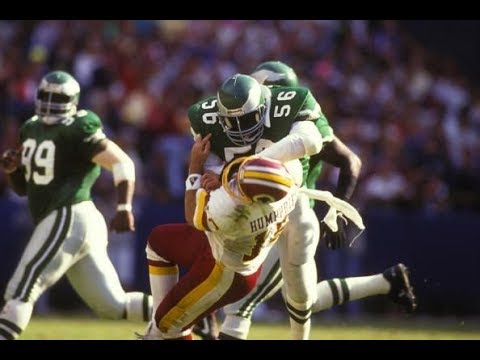
Byron Evans knocks Stan Humphries out of the game.
Jerome Brown looks on.

November 12, 1990, 30 years ago: ABC Monday Night Football broadcasts a game from Veterans Stadium in Philadelphia. The Philadelphia Eagles beat the Washington Redskins, 28-14. Judging by the score, it does not look to a current eye like a particularly notable game.

But it was. It was "The Body Bag Game."

The Redskins, coached by Joe Gibbs, still had a few of the players who had helped them win Super Bowl XVII 8 seasons earlier, and many of the players who had helped them win Super Bowl XXII just 3 seasons earlier. But they were also in something of a transition. Most notably, Doug Williams, the quarterback who was named the Most Valuable Player of Super Bowl XXII, had been cut in a cost-saving measure.

The 3 quarterbacks on the Redskins' roster at this point were Jeff Rutledge, who had led the University of Alabama to a National Championship in 1978, but whose pro career had turned out to be a bust; Stan Humphries, who would one day take the San Diego Chargers to their only Super Bowl, but had thrown all of 10 passes in regular-season NFL games going into this season; and Mark Rypien, who was in his 3rd season as the team's starter, and would go on to lead the Redskins to victory in Super Bowl XXVI and win that game's MVP.

The Eagles were coached by James David "Buddy" Ryan. Once the defensive coordinator for the Chicago Bears, designer of the "46 Defense" that was key to their win in Super Bowl XX, and before that the coach of the New York Jets' defensive line that was a big reason why they won Super Bowl III, he was beloved by his defensive players. But the offensive players on his teams never fully trusted him. The Eagles' quarterback was Randall Cunningham, an incredibly versatile player whose nickname was "The Ultimate Weapon." Ryan didn't have a clue as to how to use him.

But Ryan built a devastating defense in South Philly. Ends Reggie White and Clyde Simmons. Tackles Jerome Brown and Mike Golic. Linebackers Seth Joyner and Byron Evans. Cornerbacks Eric Allen, Izel Jenkins and William Frizzell. Safeties Terry Hoage, Wes Hopkins and Andre Waters. They were good, and they were mean.

How mean were they? In the days leading up to the game, Ryan told reporters the Eagles would beat the Redskins so badly, "they'll have to be carted off in body bags." Big talk, given that, just 3 weeks earlier, in Washington, the Redskins beat the Eagles, 13-7. The Eagles came into this game 4-4, the Redskins 5-3.

It should be noted that Rypien was already injured, and did not play in the game. So Rutledge started for the Redskins. The Eagles knocked him out of the game. Humphries came in. Later on, the Eagles knocked him out, too.

The Redskins were down to just 1 healthy player who had ever played the position of quarterback at any level: Brian Mitchell, a rookie running back who had played quarterback at the University of Southwestern Louisiana (now named simply the University of Louisiana). Pressed into emergency duty, he attempted 6 passes, and completed 3 of them, for 40 yards, and also ran a 1-yard play for a touchdown.

By that point, the Eagles were already up 28-7, with Mitchell's score making the scoreboard at least look respectable. The Eagles got offensive touchdowns on a pass from Cunningham to Heath Sherman and an option pass from Keith Byars to Sherman; and "defensive touchdowns" on a fumble return by Simmons and an interception return by Frizzell.

All told, 9 Redskin players had to leave the game due to injury, and none returned. Did the Eagles play dirty? Well, they were called for 11 penalties, totaling 88 yards. However, I didn't watch the game, even though it was nationally televised, in my case on WABC-Channel 7. So I can't remember what specific penalty calls were made; and I can't find a record with a breakdown of those penalties. But I've also never seen a record of the Redskins, their coaches, or their fans claiming that the Eagles were dirty that night. It's not like they were their South Philadelphia neighbors, the NHL's Flyers.

Both teams ended up winning 5 of their last 7 games to make the Playoffs, and the Redskins returned to The Vet and beat the Eagles, 20-6. The Redskins used the experience to motivate themselves to win the Super Bowl the following season, completing a 9-year run where they went to 4 Super Bowls, winning 3.

Ryan never got the Eagles very far. That loss to the Redskins was his 3rd Playoff game as an NFL head coach, and he lost them all. He was fired after the season, and later coached the Arizona Cardinals for 2 years, without getting them into the Playoffs, and never got another head coaching job. Like so many before him, and a few after him, he proved that a great defensive coordinator does not necessarily make a good head coach.

It would take the Eagles another 14 seasons to reach the Super Bowl, and another 27 seasons to win one.

For the 1991 season, with what became known as "The Body Bag Game" in mind, the NFL instituted the Third Quarterback Rule: If an NFL team went into a game with only 2 healthy quarterbacks, it could dress a 3rd quarterback who was not on the 45-man game-day roster. The catch was that, if he entered the game before the 4th quarter, no other quarterback could return to the game.

There's one more oddity to this game: After 10 seasons with the Redskins, including a Super Bowl XXVI ring and a 1995 Pro Bowl berth, Brian Mitchell played 3 seasons (2000-02) with the Eagles, and became much admired by the hard-to-please Eagle fans. He played 1 last season in 2003, with the New York Giants, and retired with more yards on kick and punt returns, 19,013, than any player in NFL history. His 23,330 career total yards are 2nd all-time, behind only Jerry Rice. He is eligible for the Pro Football Hall of Fame, but is not in it.

For all the talent on their roster, Reggie White is the only Eagle from the Body Bag Game who is in the Hall of Fame. So are Redskins Art Monk (receiver), Russ Grimm (guard) and Darrell Green (cornerback), as well as head coach Joe Gibbs. Jerome Brown was killed in a car crash shortly before preparations for the 1992 season began, having played only 5 seasons. Had he lived, he probably would have made the Hall.

Eagle fans love this game, even though it came to nothing. They like to think of themselves, and their city, as a lot tougher than the pretty boys in the nation's capital of Washington, or fashionable New York, or glitzy Sun Belt cities like Miami, Dallas and Los Angeles.

But ask them now: Which game means more to you, the Body Bag Game, or Super Bowl LII? Even the most posturing of self-proclaimed tough guys will take the Super Bowl win.

Wednesday, November 18, 2015

November 18, 1985: Lawrence Taylor Breaks Joe Theismann's Leg

November 18, 1985, 30 years ago: One of the nastiest-looking injuries in NFL history occurs, before a national audience on ABC's Monday Night Football.

The New York Giants were a team on the rise, coached by Bill Parcells, quarterbacked by Phil Simms, and with a great defense led by linebacker Lawrence Taylor. Even before it was known that L.T. was a heavy cocaine user, he was seen as a bit unhinged: One NFL Films clip showed him exhorting his teammates by saying, "Hey, baby, let's go out there like a bunch of crazed dogs!"

The Washington Redskins were in the middle of the greatest run in team history. Under coach Joe Gibbs, they had won Super Bowl XVII, reached but lost Super Bowl XVIII, and were the defending NFC Eastern Division Champions. They were quarterbacked by Joe Theismann, from South River, New Jersey, a Notre Dame graduate with a big mouth, but also a strong arm that tended to back his words up. But not always.

He was protected by an offensive line known as "The Hogs": Center Jeff Bostic, guards Russ Grimm and Raleigh McKenzie, and tackles Joe Jacoby and Mark May. They had Hall of Fame running back John Riggins to hand off to, and had an elite receiving corps known as "The Fun Bunch," including Art Monk and Gary Clark Their defense was really good, too, from linemen Charles Mann and Dexter Manley to cornerback Darrell Green, generally regarded as the fastest player in the NFL.

The Giants were 7-4. The Redskins were 5-5. On October 20, the Giants beat the Redskins, 17-3 at Giants Stadium at the Meadowlands. Now, they were playing at Robert F. Kennedy Memorial Stadium in Washington, where the Redskins had one of the best home-field advantages in the League.

I was 15, and a junior at East Brunswick High School in Central Jersey, and the Giants were one of the local teams. On top of that, I really enjoyed watching the Redskins: They were, indeed, a fun bunch. So I was watching this game.

Each team scored in the 1st quarter. Theismann threw a 10-yard touchdown pass to Don Warren, but the Giants equalized on a 56-yard touchdown run. The score was still 7-7 in the 2nd quarter, when Gibbs called for a flea-flicker: Theismann handed off to Riggins, who then spun and lateraled back to Theismann.

But Theismann couldn't find an open receiver, and the blitz was on. Taylor grabbed Theismann and tackled him. Taylor's knee fell on Theismann's lower right leg, breaking both the tibia (the central bone in the lower leg) and the fibula (the thinner bone on the side of the leg). Taylor's fellow linebackers, Harry Carson and Gary Reasons, came into assist on the sack.

To me, at first, the tackle didn't look like anything out of the ordinary. But after about 5 seconds, Taylor began waving his arm at the sideline, to call over the Redskins' trainer. He put his hands up to his head, as if to say, "Oh my God, what have I done?" If Lawrence Taylor is spooked, you know something very bad has happened.

Jim Burt, the Giants' nose tackle, made the same gesture, even though he wasn't involved in the tackle. Carson was, and took off his helmet so that his call for help could be better heard. the only member of the "Hogs" who has, thus far, been elected to the Pro Football Hall of Fame, also began waving for someone to come over.

ABC then showed a reverse angle of the play, and the break of Theismann's leg could be clearly seen. Frank Gifford, the 1st man to be elected to the Pro Football Hall of Fame as both a player and an announcer, kept describing the images being shown to the TV audience. Gifford's broadcast partner twice said, "Augh!" at the sight. That partner was O.J. Simpson.

Theismann was 36 years old, so it's not clear how much longer he would have played anyway. Regardless, he never played again, and having his career end at that point may have kept him from being elected to the Hall of Fame. Taylor apologized. Theismann told him that he shouldn't feel bad, that he was just doing his job.
Theismann and Taylor, reunited to promote NBC's
Thanksgiving Night broadcast of Redskins vs. Giants, 2017

Jay Schroeder was sent in to be the new Redskin quarterback. The score was still 7-7 at halftime. And yet, Schroeder rallied his shocked teammates to victory. He got them to the Giants' 1-yard line in the 3rd quarter, and Riggins scored, the 103rd touchdown of his Hall of Fame career. There would be only 1 more, as he retired after the season.

Joe Morris scored 2 more touchdowns for the Giants, putting them up 21-14. But a field goal by Mark Moseley and a pass from Schroeder to Clint Didier, both in the 4th quarter, gave the Redskins a 23-21 win.

In other words, the team that lost their quarterback to one of the nastiest injuries in NFL history ended up winning the game.

Both teams made the Playoffs. Neither team reached the Super Bowl. The following season, the Giants won Super Bowl XXI. The season after that, the Redskins won Super Bowl XXII -- but not with Schroeder as their quarterback. He lost his job to Doug Williams, who became the 1st black quarterback to win a Super Bowl.

Sunday, August 9, 2015

Frank Gifford, 1930-2015

On November 20, 1960, a lot of people thought Frank Gifford had died. It would have been a shocking end for New York's first true football superstar.

As it turned out, he had quite a bit of life left in him.

*

Francis Newton Gifford -- sounding more like the name of a U.S. Senator than that of a sports legend -- was born on August 16, 1930 in Santa Monica, California, outside Los Angeles, and grew up in Bakersfield, an oil town about 100 miles away, in a rural part of the State that would have tremendous growth after 1970.

He starred in football at Bakersfield High School, but didn't have the grades to get into his first choice of school, the University of Southern California. So he went to Bakersfield Junior College, and got the necessary grades to get into USC.

Frank began the tradition of great USC tailbacks, followed by football legends Mike Garrett, O.J. Simpson, Anthony Davis, Charles White, Marcus Allen and Reggie Bush. He was an All-American in 1951, and, despite not having blond hair, was nicknamed the Golden Boy.

He arrived in the National Football League just as the transition was being made from single-platoon football -- players playing both offense and defense -- to two-platoon football. Only in his 1st 2 seasons, 1952 and '53, did he play on both sides of the ball, as a halfback and a cornerback. In 1954, with a new head coach, Jim Lee Howell, he began to be used exclusively at left halfback, behind quarterback Charley Conerly.

In 1955, he made the Pro Bowl for the 1st time. In 1956, the Giants had an epic season. First, they moved out of the crumbling Polo Grounds and into the old Yankee Stadium. There, everything improved: The playing conditions, the morale, the offense, the defense, the fan reactions.

The chant of "Dee-FENSE!" was first heard at an NFL game, as men like Sam Huff, Andy Robustelli and Emlen Tunnell -- all future members of the Pro Football Hall of Fame -- followed the lead of defensive coach (they weren't yet called "coordinators") Tom Landry -- yes, the Tom Landry who went on to coach the Dallas Cowboys -- and became the 1st great NFL defense-only unit. Though the nickname didn't come along until the 1980s, this was the original Big Blue Wrecking Crew.

For the 1st time in football history, defense was cool. And, with New York City being the media center of the nation, the rest of America noticed the defense, and noticed the Giants, who hadn't won an NFL title since 1938, nor been in an NFL Championship Game since 1946.

But it's scoring that truly gets the headlines, and Vince Lombardi -- yes, the Vince Lombardi who went on to coach the Green Bay Packers -- coached the Giant offense. With Conerly, Gifford, and fellow running backs Mel Triplett and Alex Webster in the backfield, and Gifford and Kyle Rote catching passes, and Hall of Fame tackle Roosevelt Brown among the blockers, the Giants were just about unstoppable.

Frank rushed for 819 yards, and and caught 51 passes for another 603 yards. Overall, his 1,422 yards from scrimmage led the NFL -- and that's in a 12-game season. (At the same rate, he would have had 1,895 yards over a 16-game season.) He scored 9 touchdowns, including 3 against the Washington Redskins on December 2.

The Giants hung 38 points on the San Francisco 49ers, 38 on the Pittsburgh Steelers, 28 on the Redskins, and 27 on the Chicago Cardinals (but lost, allowing 35). The Giants went 8-3-1, and won the NFL's Eastern Division. UPI named Frank the NFL's Most Valuable Player.

In the days before the AFL-NFL merger, the hosting duties for the NFL Championship Game rotated between the Eastern and Western Champions. As this was an even-numbered year, the Eastern Champions hosted. On December 30, 1956, the Giants took the field at a frigid Yankee Stadium, and faced the Chicago Bears in front of 56,836 hardy souls and a national television audience on NBC.

It was the peak day for both that offense and that defense. The Bears, despite being used to cold weather, were totally put on ice. The Giants jumped out to a 20-0 lead before the Bears could get on the board, with touchdowns by Triplett and Webster and a pair of field goals by Ben Agajanian. Rick Casares scored for the Bears, with quarterback George Blanda kicking the extra point.

But it was all G-Men after that. Webster scored another touchdown, and the Giants blocked a punt, which Henry Moore recovered in the end zone. It was 34-7 when the teams headed into the locker room.

The Bears should've stayed inside. In the 3rd quarter, Conerly threw a touchdown pass to Rote. In the 4th, he threw one to Gifford to put on the exclamation point. Giants 47, Bears 7. It was a devastating display.

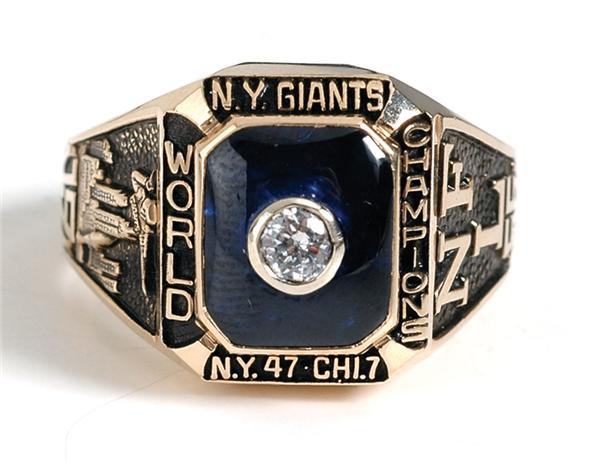
This is Agajanian's ring from the title season. This is what a ring from "Super Bowl Minus-X" looks like. Gifford, of course, got one, too.
Those are a pair of Lower Manhattan skyscrapers on one side, but this was long before the World Trade Center was anything more than an idea. They're a pair of early 1930s buildings: The Bank of Manhattan Trust Building (40 Wall Street, now named the Trump Building) and the Cities Service Building (now named for its address, 70 Pine Street).

*

That wasn't the peak of Frank Gifford's fame, but it did turn out to be the peak of his NFL achievement. The Giants got back into the NFL Championship Game in 1958, but it turned out to be a classic that didn't go their way, as the Baltimore Colts shocked a national TV and Yankee Stadium audience by sending the game to overtime, where Johnny Unitas and his Colt teammates put on a show that is still talked about as "the Greatest Game Ever Played." The Colts won, 23-17, and the NFL became a true TV phenomenon -- mainly because the New York team was involved.

The Colts beat the Giants in the next year's title game as well, but that was in Baltimore, and wasn't as good a game, so it's not as hyped. (Why Baltimore was in the Western Division, I don't know.)

But the New York media machine continued to hype up the Giants, every bit as much as it had their baseball counterparts (who'd moved to San Francisco after the 1957 season), and the Yankees, and would later do to the Mets, the Jets, the Knicks, the Rangers and the Islanders -- and, of course, the Giants again.

New York previously had great football players like Benny Friedman, Ken Strong, Mel Hein and Tuffy Leemans, but Gifford was the 1st of the TV era. In the late Fifties and early Sixties, you couldn't watch a night's TV without watching Gifford do a commercial for Vitalis hairspray (as opposed to Brylcreem, a.k.a. "that greasy kid stuff"), Lucky Strike cigarettes, Florida orange juice, or some other product.

He became a frequent panelist on CBS' game show What's My Line? New Yorkers might not have used the capital letters, but, every bit as much as he was at USC, he was a golden boy.

It almost didn't last. On November 20, 1960, Yankee Stadium was the scene of another historical moment, and Gifford was there -- but he didn't remember it. Indeed, he was lucky to have survived it.

The Giants were playing the Eagles, their arch-rivals since the Eagles' founding in 1933. The winner was probably going to win the Division and host the Championship Game, as the Giants had in 2 of the last 4 years. (If this section looks familiar, it's because I copied-and-pasted, and adapted, it from my memorial piece on Gifford's antagonist in March.)

The Giants led 10-0 at the half, but blew it. In the 4th quarter, the Eagles' Jimmy Carr picked up a fumble and returned it 38 yards for a touchdown, making it 17-10 Eagles.

With the clock running out, George Shaw, filling in for the injured Conerly, threw a pass toward Gifford at midfield. Gifford caught the pass, but Chuck Bednarik, the Eagle linebacker appropriately known as Concrete Charley, 
arrived at the same time, and he flattened Gifford, who fumbled. The Eagles recovered.

On the film, this doesn't look like an especially injurious hit. I've seen much worse. What made this the most famous hit in NFL history -- aside from the fact that it was in New York, and involved a New York team, and was seen by a national TV audience -- was how Chuck reacted.

The film shows him reacting to the fumble by jumping around and clapping his hands. Then he pumped his fist, and issued what became his catchphrase: "This fucking game is over!" (In other words, no, his exact words did not include "effin'.") For all intents and purposes, the game was, indeed, over. The final score was 17-10 Eagles.

But it was the photograph that proved damaging -- not to Gifford's body, but to Bednarik's reputation. Or maybe it enhanced his reputation. It showed Bednarik standing over Gifford, pumping his fist. Gifford is lying on the ground, motionless, as Rote (Number 44) looks on. 

Bednarik spent the last 54 years of his life explaining that he didn't realize Gifford was out cold on the ground in front of him. He said he was celebrating the Eagles wrapping up a big win, not the fact that he'd knocked Gifford out. He said he didn't even know he'd knocked Gifford out.

Legend has it that Gifford was knocked out because, despite wearing a helmet, he hit his head on the frozen grass. This couldn't be true: According to Pro-Football-Reference.com, it was 49 degrees at gametime -- not a particularly notable temperature for mid-November New York, and hardly cold enough to freeze the field.

Gifford was taken to the Giants' locker room -- which, at the old Stadium, was also the Yankees' locker room. As befitting the biggest star on the team, Gifford's locker was also Mickey Mantle's. Also taken to the locker room for first aid was a security guard who had a heart attack.


Frank's first wife, Maxine, didn't know this, and when she went down to the locker room to see Frank, she heard someone say, "He's dead" -- meaning the security guard. When the guard was wheeled out on a stretcher, with his face covered by a sheet, reporters saw this, and thought it was Gifford. The rumor began to spread that Bednarik had killed him. And when the photo was seen in newspapers across the country the next day, Bednarik looked like a monster, celebrating his "kill."

It got worse. Bednarik went to see Gifford in the hospital the next day, and was told Gifford couldn't receive visitors. But a new rumor circulated, that Bednarik wouldn't see Gifford. It wasn't that he wouldn't, it was that he couldn't.

Gifford always said he never held it against Bednarik. Bednarik said he was tired of people remembering him mainly for one thing. "It was always, 'Oh, you're the guy! You're the guy! You're the guy that got Frank Gifford!' Yeah, I'm the guy that 'got' Frank Gifford."


He was also tired of Howard Cosell, on Monday Night Football, seeing a hard hit, and turning to Gifford and saying, "Just like Chuck Bednarik blindsided you at Yankee Stadium, Giffaroo!"

"Blindsided, my fanny! It was a clean hit," Bednarik always said. And it was: Like the infamous Denis Potvin hit on Ulf Nilsson in 1979, or Scott Stevens leveling Eric Lindros in 2000, no penalty was called on it. (And, yes, this profane man would say, "fanny," not "ass." In America, "fanny" means rear end. In Britain, it means the other side, of a woman.)


Chuck died this past March 21. If he hadn't, we might now be talking about how Gifford finally felt the effects of that clobbering, nearly 55 years later

Frank missed the rest of the 1960 season, and retired at age 30. The Giants reached the 1961 NFL Championship Game anyway, but Frank wouldn't have been able to help much, as they got slaughtered by the Green Bay Packers. He missed playing, and returned in 1962, switching to flanker (wide receiver) for safety reasons. He won NFL Comeback Player of the Year, and got the Giants back into the Championship Game, again at Yankee Stadium. But the Packers won again. In 1963, they got to another, this time losing to the Bears.

In 1964, it all came crashing down. The Giants did not look like the team that had reached 6 of the last 8 NFL Championship Games. Like the Yankees would do the following spring, their players all seemed to get old, or hurt, or both, at once. Gifford retired. having rushed for 3,609 yards. That may not look like much compared to modern numbers, but it was a strong 4.3 yards per carry. He caught 367 passes for 5,434 yards. In that era, those were considered enormous numbers. He scored 77 touchdowns in his 12 seasons -- 12-game seasons until 1960, 14-game seasons thereafter.

He was named to 8 Pro Bowls, the NFL's 1950s All-Decade Team, and the College and Pro Football Halls of Fame. In a pair of belated honors, the Giants retired his Number 16, and inducted him into their Ring of Honor when MetLife Stadium opened.

*

Frank went into broadcasting. As CBS had the NFL exclusively at that point, he called some of their games, including Super Bowl I early in 1967 and the NFL Championship Game, the "Ice Bowl" in Green Bay, at the end of the year.

In 1971, he was brought to ABC to do Monday Night Football. where he worked with some of the biggest names in sportscasting, including fellow NFL legends Don Meredith, Alex Karras, Fran Tarkenton, O.J. Simpson, Joe Namath, Dan Dierdorf, Lynn Swann and Joe Theismann -- and, of course, non-athletes Keith Jackson (in the 1st season only), Howard Cosell and Al Michaels.
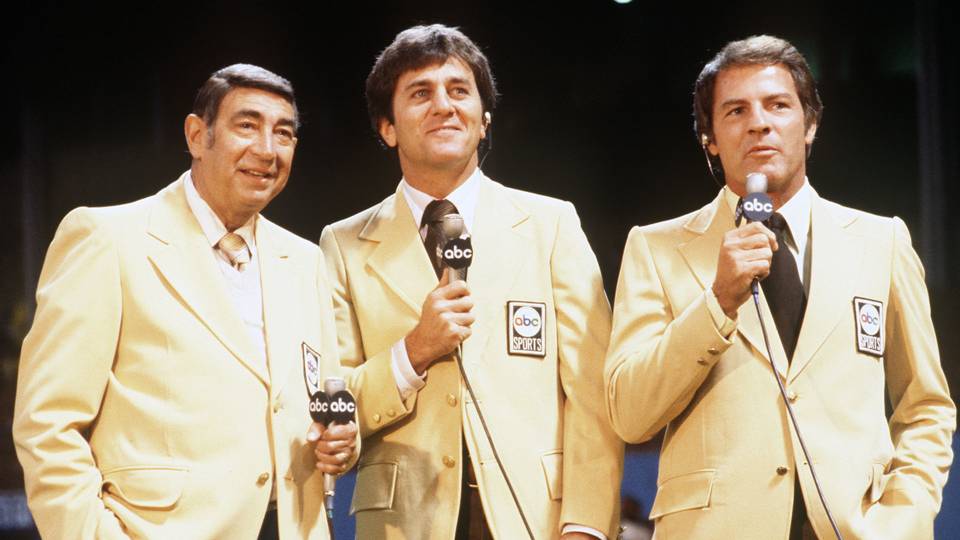
The classic MNF lineup, in the classic yellow jackets:
Cosell, Meredith, Gifford. Together 1971-73, and again 1977-83.
Meredith was at NBC 1974-76, replaced by Alex Karras.

ABC put him on other broadcasts as well, including on the Olympic Games from 1972 (including play-by-play of the basketball Gold Medal game where the U.S. got robbed, to the benefit of the Soviet team) to 1992. These assignments also included The Battle of the Network Stars and their anthology series ABC Wide World of Sports.

His WWOS assignments included several of Evel Knievel's motorcycle jumps, leading to a friendship between the erstwhile Golden Boy and the King of the Daredevils. In 1975, Knievel attempted to jump over 13 of London's red double-decker buses at the old Wembley Stadium. He did it, but couldn't stick the landing, and fell off, with the cycle's front wheel rolling over his arm.

With a live mike, Gifford could clearly be heard saying, "Oh, my God," something that people weren't supposed to say on TV in those days. Although that was the worst-looking part of Knievel's crash, he had worse injuries, including a broken pelvis. Gifford abandoned his post, and ran to him. He and another man helped Knievel up, and carried him into the locker room on their shoulders.
For better or for worse, a pair of American legends.

In 1995, the Pro Football Hall of Fame gave Frank the Pete Rozelle Award, their award for media personalities. This made him the 1st man honored by a sport with election to its Hall of Fame for both playing and broadcasting. He has since been joined by Kansas City Chiefs quarterback and broadcaster Len Dawson, and St. Louis Cardinals offensive tackle and his fellow Monday Night Football analyst Dan Dierdorf.

*

Frank was married to Maxine Ewart, and they had 3 children: Sons Jeff and Kyle, and daughter Victoria. Victoria married Michael Kennedy, son of Bobby. Through his children from his 1st marriage, he has 5 grandchildren.

In 1984, there were a pair of substitute hosts on ABC's Good Morning America. One was Frank. The other was Kathie Lee Johnson, also recently divorced. At the time, she was known as a singer, Tom Kennedy's lady sidekick on the game show Name That Tune, and pitchwoman for Carnival Cruise Lines.

Despite their 23-year age difference -- exactly 23 years, as they share the birthday of August 16 -- they hit it off, and were married on October 18, 1986. He continued on Monday Night Football, and she was paired with Regis Philbin on Live!, which went from a New York-only broadcast to a national one in 1988. They had a son, Cody, and a daughter, Cassidy.
Left to right: Frank, Kathie Lee, Cassidy, Cody.

Kathie Lee shared many details of their private life on the air, making Regis uncomfortable at times. It also didn't help that Regis is a Notre Dame graduate, and they have a bit of a rivalry with Frank's alma mater, USC. On a few occasions, Kathie Lee would refer to her husband as "The Human Love Machine."

If you're in your 60s, and your wife is much younger and gorgeous, and tells a live nationwide audience that you are a love machine, you might begin to believe it. In 1997, Frank was caught cheating, and it was a terrible embarrassment for Kathie Lee.

They stayed together. When Barbara Walters interviewed them on ABC's 20/20, sometime after the public revelation of Frank's infidelity, Kathie Lee said, "Sometimes, when you can't forgive your husband, you have to forgive the father of your children." (I suspect that this is why she rarely mentions her 1st husband, with whom she did not have children.)

*

Because of the scandal, Frank was eased off of Monday Night Football after the 1997 season, doing pregame shows only in 1998, and was then "allowed to retire." After that, he was mostly out of the public eye, although he still wrote books about his football experience and did interviews for them.

Kathie Lee left Live! in 2001, succeeded by Kelly Ripa. Regis' replacement was, appropriately enough, another Giants Hall-of-Famer, who had his own embarrassing marital scandal: Michael Strahan.

In 2008, Kathie Lee moved over to NBC, where she co-hosts the 4th hour of Today with Hoda Kotb. Cody, now 25, followed his father in playing football at USC, and stayed in Los Angeles, as a screenwriter and a producer. His company is called Little Giant Productions. Cassidy, who just turned 23, is also in Hollywood, as an actress. Neither is yet married or a parent.

This morning, Frank was found nonresponsive at the family home in New Haven, Connecticut. He was a week short of his 85th birthday.

More than Eli Manning, more than even Lawrence Taylor, he is the New York Giants' greatest legend -- perhaps not the franchise's all-time greatest all-around player, but its greatest legend.

With Frank's death, there are now 7 surviving members of the 1956 World Champion New York Giants: Linebackers Sam Huff and Harland Svare, defensive tackles Dick Modzelewski and Rosey Grier (probably better known as a Los Angeles Ram), defensive back Henry Moore, tight end Bob Schnelker, and placekicker Ben Agajanian.

Agajanian was 1 of only 3 players to play in the NFL, the All-America Football Conference, and the 1960 version of the American Football League. (There were also AFLs in 1926, 1936-37 and 1940-41.) The other was Hardy Brown, best known as a devastating linebacker for the San Francisco 49ers, and one of the earliest-known sufferers of football-related brain injury. Agajanian, however, topped Brown, because he played for Los Angeles franchises in all 3 cities: The AAFC's Dons, the NFL's Rams, and, playing in L.A. for 1 season before moving to San Diego, the AFL's Chargers.

From the NFL's 1950s All-Decade Team, there are now 6 surviving players, following the recent deaths of Gifford, Bednarik, and Detroit Lions guard Dick Stanfel: Huff, running backs Lenny Moore of the Baltimore Colts and Hugh McElhenny of the San Francisco 49ers, receiver Raymond Berry of the Colts, and linebacker Joe Schmidt and safety Yale Lary of the Detroit Lions.

UPDATE: As of August 16, 2020, the 90th Anniversary of Gifford's birth, there are 3 surviving '56 Giants, Huff, Grier and Moore; and 5 surviving 1950s All-Decade players, Huff, Moore, McElhenny, Berry and Schmidt. Kathie Lee left Today in April 2019. Cody really looks like his father now, runs the Gifford Media Group, and is engaged to be married. Cassidy got married in June 2020. Frank was buried at Ivy Lawn Memorial Park in the Los Angeles suburb of Ventura, California.

Wednesday, December 8, 2010

Top 10 Beatles Songs About Sports

December 9, 1974. 36 years ago tomorrow.

John Lennon saw the Los Angeles Rams' game against the Washington Redskins at the Los Angeles Memorial Coliseum on ABC's Monday Night Football.

At halftime, Howard Cosell interviewed him. Cosell was already in his 40s when the Beatles arrived, so he wasn't exactly in their target audience. But, to use words he might have used, he was astute enough to recognize their cultural significance. He treated John Lennon like an honored guest.

Don Meredith wasn't in the booth that night, but was part of the MNF team for most of its early days. The ex-Dallas Cowboy quarterback and Lipton tea pitchman died earlier this week at age 72.

Frank Gifford, the former New York Giants running back, probably the premier player in that franchise's history until the 1980s, remembers it fondly.

Unfortunately, I can't find a clip of John and Ronald Reagan, then Governor of California (the game was in L.A.), talking about American football. Reagan's supporters called John a Communist and an atheist. John's supporters called Reagan a fascist, or, if they were English, a wanker -- or maybe even used John's familiar phrase from A Hard Day's Night: "Yer a swine!" But, face-to-face, they treated each other like old friends and great entertainers. And they were great entertainers -- well, Reagan did make some good movies.

The Redskins won the game, beating the Rams 23-17.

*

December 8, 1980. 30 years ago tonight.

Another Monday night. The New England Patriots played the Miami Dolphins at the Orange Bowl in Miami. And this time, Cosell did not have a special guest to present. Rather, he had some awful news.

Later reports would confirm 5 shots. The kicker, John Smith, was, himself, an Englishman (Leafield, Oxfordshire) named John. In case anyone cares enough to wonder about the result, the Dolphins won the game, 16-13 in overtime, on a field goal by Uwe von Schamann. When these same teams played again in Foxboro 2 years later, John Smith was the beneficiary of a little snow-plowing, giving the Pats a 3-0 win over the Dolphins.

Ronald Reagan had been elected President 34 days before John Lennon was killed. It is easy to say there was no room for John Lennon in Ronald Reagan's America. I ask, Where did he more belong?

Here's Reagan's reaction. It is ironic that he spoke out against gun control, and then, within 4 months, he would be shot himself -- but survive.

*

John would want us to think about his life, not his death. So, to honor this man, and his bandmates, and even their sense of humor -- perhaps I should spell it "humour," since they were British...

The Top 10 Beatles Songs About Sports

Not really. I did this for Elvis last year on the anniversary of his death.

Note that bodybuilding, while a competition, is not a sport. So I'm not going to say "I'll Be Back" was by Arnold Schwarzenegger.

Honorable Mentions: These are cover versions that the Beatles did, so they can't be counted in the Top 10.

"Money (That's What I Want)." How many athletes, team owners, and agents have said variations of this? The response would be "Baby, You're a Rich Man."

"Kansas City." They got some tasty little barbecue in the parking lot at Arrowhead Stadium for Chiefs games, and I'm gonna get me some.

Also an Honorable Mention to "Yellow Submarine," which is the nickname of Villareal Club de Football, a soccer team in Spain, due to their bright yellow home uniforms.
Another Honorable Mention to "Blue Jay Way." When the SkyDome/Rogers Centre was built as the new home of the Toronto Blue Jays, the street along its western edge was renamed Blue Jays Way.

Another Honorable Mention to "I Am the Walrus," which reminds me of golfer Craig Stadler and evil soccer manager Sam Allardyce.

Dishonorable Mention to the Whatever They're Calling Themselves Now Angels of Anaheim, and their stupid rally pet: "Everybody's Got Something to Hide Except For Me and My Monkey."

Then there's "Back in the U.S.S.R.," which could be about any number of Russian athletes who made their fortunes in the U.S., post-1989.

The obvious one is "I'm a Loser," but there's too many examples to cite.

10a. "You Can't Do That." What someone said to a Red Sox fan wearing his cap into Yankee Stadium. Followed after the game by his response...

10b. "I Should've Known Better." Which could also by said by every baseball player who ever signed a contract with the Mets.

9. "Not a Second Time." What the Yankees should have said to the Red Sox after the 2004 World Series.

8. "I Saw Her Standing There." Sung by Joe Namath to Suzy Kolber? Terrell Owens to Nicollette Sheridan? Brett Favre to Jenn Sterger? Possibly followed by "Why Don't We Do It In the Road?"

7. "Strawberry Fields Forever." About Darryl's defensive difficulties.

6. "You've Got to Hide Your Love Away." What we said to Alex Rodriguez after his then-wife Cynthia wore an obscene T-shirt into the stands at the old Yankee Stadium.

5. "I'll Follow the Sun." What Walter O'Malley said, heading west with the Dodgers. The wanker. Other team owners thinking of moving their teams could be called "Nowhere Man."

4a. "Help!" The words of every Rutgers quarterback who saw his offensive line fail to protect him. Which leads to the coach telling him...

4b. "Run For Your Life."

3. "You Won't See Me." What A-Rod seems to be saying every October. Which was quite a weight on his shoulders, and we could've told him, "Boy, you've got to carry that weight, carry that weight a long time." But on November 4, 2009, he finally came to "The End" of "The Long and Winding Road." Unfortunately, in October 2010, he decided to "Get Back."

2. "Tomorrow Never Knows." What we should say to every fan who ever said, "Wait 'til next year."

1. "When I'm Sixty-Four." Said by Brett Favre, when asked when he will finally retire.