Showing posts with label 1958 nfl championship game. Show all posts

Tuesday, January 11, 2022

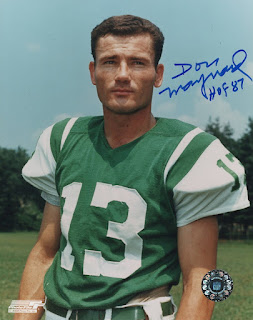
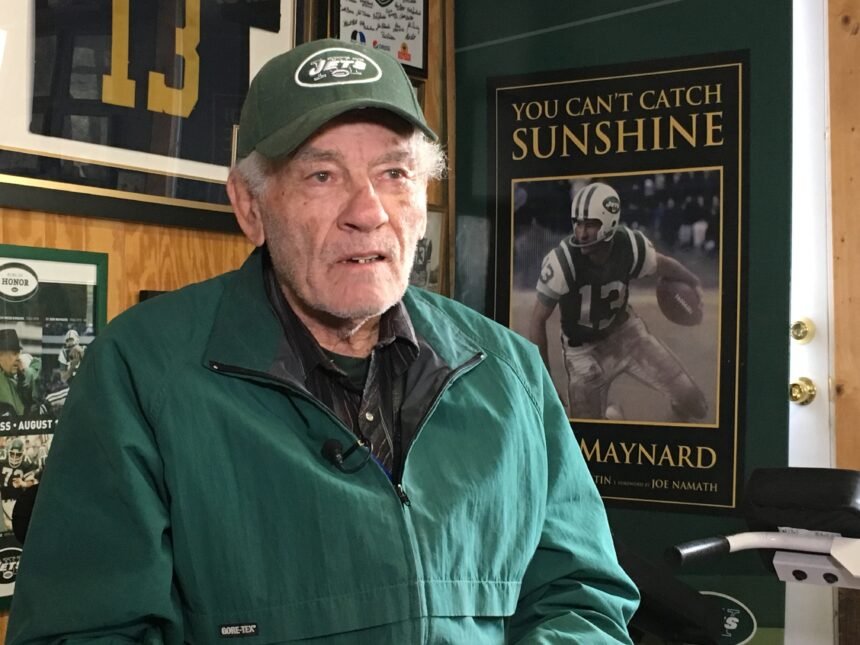
Don Maynard, 1935-2022

It's easy to forget just how much time has passed. Tomorrow marks the 53rd Anniversary of the New York Jets' one and only appearance, and victory, in the Super Bowl. And the number of players from that game who are still alive just got a little smaller.

Donald Rogers Maynard was born on January 25, 1935 in Crosbyton, in the Texas Panhandle. His father worked in the cotton industry, and moved around a lot, settling in Colorado City, still in West Texas. At Colorado City High School, he lettered in football, basketball and track -- not surprising, given the element of speed in all 3.

He started at Rice University in Houston, then transferred to Texas Western University. (In 1967, that school became the University of Texas at El Paso, or UTEP.) He was drafted by the New York Giants, and played in the 1958 NFL Championship Game, which the Giants lost in overtime to the Baltimore Colts at Yankee Stadium. It has been called "The Greatest Game Ever Played."

But in a truly dumb move, the Giants cut him during the next season's training camp. Given the fact that Frank Gifford missed the end of the 1960 season and all of 1961, and returned only to retire again in 1964, they really could have used a prime Don Maynard.

Instead, Don went to the Canadian Football League, and played a season for the Hamilton Tiger-Cats. In 1960, the American Football League was founded, with the New York Titans. Their 1st head coach was Sammy Baugh, one of the greatest quarterbacks of all time, and a Texan. Having been head coach at Hardin-Simmons University in Abilene, he had coached against TWU, and knew how good Maynard was.

Despite drawing pathetically small crowds to the Polo Grounds, the Titans were a respectable 7-7 that 1st season, and, with Baugh contributing to the early AFL's reputation as a pass-happy league, Maynard and Art Powell were the 1st professional receiving pair to both gain over 1,000 yards on receptions in a season. They did this again in 1962.

In 1963, the Titans were renamed the New York Jets, and in 1964, they moved to Shea Stadium in Queens. In 1965, the Jets drafted and signed quarterback Joe Namath, and they combined for 68 passes for 1,218 yards. In 1967, Namath became the 1st pro quarterback to pass for 4,000 yards in a season, with Maynard contributing 1,434 of them on 71 catches.

In 1968, the Jets advanced to the AFL Championship Game against the Oakland Raiders. Namath completed 6 passes to Maynard for 118 yards and 2 touchdowns, and the Jets won, 27-23. This advanced them to Super Bowl III. Namath told the media, "We're gonna win, I guarantee it!" The Jets did, 16-7. However, a hamstring injury sustained in the AFL Championship Game limited Maynard's success, as he caught no passes. Instead, George Sauer was the biggest recipient of Namath's largesse, and Matt Snell rushed for their only touchdown.

Maynard remained with the Jets for the entire 10-year run of the AFL, 1 of only 7 men to play all 10 years for only 1 team. He stayed through 1972, played the 1973 season with the football version of the St. Louis Cardinals, and played in 1974 in the World Football League, with the original version of the Houston Texans.

He retired after that season, having caught 633 passes for 11,834 yards, making him the 1st receiver ever to surpass 10,000 yards, scoring 88 touchdowns. He said, "I don't really look at it like I'm the greatest receiver. After you play a while, anybody can break certain records. Longevity is the key. The record I'm proudest of is being the first guy to get 10,000 yards in receptions. Others may do it, but I'm the first, and only one guy can be the first."  

After playing, he taught math and industrial arts in El Paso. While in college, he married a woman named Marilyn Weaver, who predeceased him. They had a son and a daughter.

In 1987, he became the 2nd Jet to be elected to the Pro Football Hall of Fame, following Namath in 1985. He was a 4-time AFL All-Star, and was named to the AFL All-Time Team. The Jets retired his Number 13, and named him to their Ring of Honor. He published a memoir, You Can't Catch Sunshine; and attended anniversary celebrations for the Super Bowl III winners, at Giants Stadium for the 25th in 1993, and at MetLife Stadium for the 50th in 2018.
Don Maynard died yesterday, January 10, 2022, at his home in El Paso. He was 86 years old.

With his death, there are now: 

* 8 living men who played in the 1958 NFL Championship Game. For the Giants: Rosey Grier and Al Barry. For the Colts: Lenny Moore, Raymond Berry, Dick Horn, Jack Call, Leo Sanford and Andy Nelson.

* 16 surviving players from the original 1960 New York Titans/Jets: Dewey Bohling, Leon Burton, Dan Callahan, Ken Campbell, Ed Cooke, Charlie Dupre, Pete Hart, Blanch Martin, Nick Mumley, Joe Pagliei, Bob Reifsnyder, Dave Ross, Rick Sapienza, Gerhard Schwedes, Bob Scrabis and Hall Whitley.

* 27 surviving players from the Jets' win in Super Bowl III: Joe Namath, Bob Talamini, Matt Snell, Emerson Boozer, Jim Turner, Bake Turner, Mark Smolinski, Lee White, John Schmitt, Randy Rasmussen, Dave Herman, Jeff Richardson, Gerry Philbin, Steve Thompson, Carl McAdams, Ralph Baker, Al Atkinson, John Neidert, Randy Beverly, John Dockery, Earl Christy, Jim Richards, Michael Stromberg, Bill Baird, Mike D'Amato, Cornell Gordon and Karl Henke.

* And 10 living players from the AFL All-Time Team: Namath and Philbin from the Jets; Lance Alworth, Ron Mix and Paul Lowe from the San Diego Chargers; Jim Otto from the Oakland Raiders; Billy Shaw from the Buffalo Bills; and Johnny Robinson, Bobby Bell and Ed Budde from the Kansas City Chiefs.

Sunday, November 14, 2021

Sam Huff, 1934-2021

Maybe the greatest player in New York Giants history has left us -- and if you're under the age of 70, if you know about him at all, you probably associate him with another team.

Robert Lee Huff was born on October 4, 1934, at the Edna mining camp, now part of the town of Farmington, West Virginia, near the Pennsylvania State Line. By his own admission, he didn't know why he was called "Sam" instead of Robert, or a variation such as "Bob" or "Bobby." He helped Farmington High School, now closed, to an undefeated season in his senior year, 1951, and earned a scholarship to West Virginia University.

Along with basketball legend Jerry West, who came along a few years later, Huff is the greatest athlete that WVU has ever produced. Over 4 years, playing both offensive line and defensive line, he helped them go 31-7. This included 2 road upsets of arch-rival Pittsburgh, road upsets of Penn State and South Carolina, 3 Southern Conference Championships, and a loss to Georgia Tech in the 1954 Sugar Bowl. He was named a First Team All-American, a First Team Academic All-American, Captain of the East team in the East-West Shrine Game, and Captain of the North team in the Senior Bowl.

The New York Giants selected him in the 3rd round of the 1956 NFL Draft. He did not get along with head coach Jim Lee Howell, and quit. But before he could get on a plane to go home, the team's offensive coordinator caught him at the airport, and talked him into going back. That coach's name was Vince Lombardi.

The defensive coordinator was Tom Landry, who had been perhaps the 1st player in the two-platoon era to became a great defensive back without also playing on offense. He devised the 4-3 defense, with 2 tackles, 2 ends, and 3 linebackers, and dropped Huff to the position of middle linebacker, which did not previously exist. (Up to then, most teams used a 5-2 defense.)

He recalled, "Before, I always had my head down, looking right into the center's helmet. Now, I was standing up, and I could see everything, and I mean everything. I always had outstanding peripheral vision. It's one of the reasons I was so perfectly suited for the position."

The Giants had a good offense, with quarterback Charley Conerly; running backs Frank Gifford, Mel Triplett and Alex Webster; end Kyle Rote; and offensive tackle Roosevelt Brown. But, for the 1st time in NFL history, it was a defense that caught everybody's attention. Before the various Fearsome Foursomes (at least 3 teams had lines nicknamed that), before the No-Name Defense in Miami, before the Steel Curtain in Pittsburgh, before the Doomsday Defense in Dallas, before the Jets' New York Sack Exchange, and before the 46 Defense in Chicago, there was the Big Blue Wrecking Crew.

The tackles were Dick Modzelewski and Rosey Grier. The ends were Jim Katcavage and Andy Robustelli. The linebackers were Sam Huff, flanked by Bill Svoboda and Harland Svare. The cornerbacks were Ed Hughes and Dick Nolan. The safeties were Emlen Tunnell and Jimmy Patton. They were so good, a new chant rang around the rafters of the pre-renovation original Yankee Stadium: "De-FENSE! De-FENSE! De-FENSE!"

Huff said, "Landry built the 4-3 defense around me. It revolutionized defense, and opened the door for all the variations of zones and man-to-man coverage, which are used in conjunction with it today."

Gifford, the 1st in a long line of great tailbacks at the University of Southern California, was the glamour boy on offense, but Huff became that on defense. And on December 30, 1956, with the field at Yankee Stadium frozen solid, the Giants played the NFL Championship Game against the Chicago Bears, and crushed the Monsters of the Midway, 47-7.

This began a run of 8 seasons in which the Giants would win their Division 6 times, but they wouldn't win the NFL Championship Game again. In 1958, the Giants hosted the Baltimore Colts, and lost in overtime, in what has become known as "The Greatest Game Ever Played." In 1959, they had a rematch at Memorial Stadium in Baltimore, and the Colts won again.

By that point, Lombardi was gone, having been named the head coach of the Green Bay Packers. In 1960, Landry was named the 1st head coach of the expansion Dallas Cowboys. That season, the Giants lost the Division title to the Philadelphia Eagles, after a fumble-forcing tackle by Chuck Bednarik knocked Gifford out for the rest of the season.

Gifford sat out the 1961 season, while Allie Sherman was named the Giants' new head coach, and Y.A. Tittle having replaced Conerly as quarterback. They won the Division again, but lost the Championship Game to Lombardi's Packers on a snow-strewn Lambeau Field on New Year's Eve. In 1962, with Gifford returning, it was Giants vs. Packers again, this time at Yankee Stadium, again with the field frozen, and the Packers won. In 1963, on yet another frozen field, the Giants went out against the Bears at Wrigley Field, and lost a tough battle.

All the while, Huff became more and more famous. He was named to 5 Pro Bowls. Time magazine had placed college football players on its cover before, but Huff became the 1st NFL player on it, for its issue dated November 30, 1959.

In the 1960 preseason, the CBS news program The Twentieth Century approached Huff, offering to put a microphone on his uniform for practices and an exhibition game, to show TV viewers what a football game really sounded like. Hosted by Walter Cronkite, it was titled "The Violent World of Sam Huff," and it aired, perhaps appropriately, on October 30, Mischief Night.

How successful was the program? The next day, a CBS executive wrote a letter, put it in an envelope, and wrote nothing on the envelope except "Number 70." No actual name, no return address, nothing except "Number 70." Three days later, the letter was delivered to Huff's locker at Yankee Stadium.

The U.S. Postal Service employees knew exactly what, and who, it meant. Even before Lawrence Taylor was born, Huff might have been a better linebacker.

Sherman, the Giants' general manager as well as the head coach, began to think that the defense was the problem. He was wrong: The average score of a Giants game in 1963 was New York 30, Opposition 20. True, there were 5 games where they allowed at least 24 points; but there were also 7, including the Championship Game, where they allowed 14 or fewer.

In hindsight, the Giants' biggest problem may have been a lack of home-field advantage. Like every other pro football team that rented a stadium from a baseball team, they had to play their first few games on the road, in case the baseball team reached the World Series. And the Giants were playing in the home of the New York Yankees. Of their 8 losses in the regular seasons of 1961, '62 and '63, 3 were early in the season.

But Sherman broke up the defense, trading Modzelewski to Cleveland, where he helped them win the title in 1964; and Grier to Los Angeles, where he joined Hall-of-Famers Deacon Jones and Merlin Olsen, and All-Pro Lamar Lundy, to form one of those "Fearsome Foursomes" I mentioned.

Huff went to Giants owner Wellington Mara, and demanded not to be traded. Mara assured him he was staying put. Instead, Sherman traded Huff to the Washington Redskins for running back Dick James and defensive tackle Andy Stynchula.

Huff said, "As long as I live, I will never forgive Allie Sherman for trading me." On September 25, 1964, the Redskins made their 1st appearance at Yankee Stadium after the trade. The Giants won 13-10, but the home fans chanted Huff's name throughout the game. Huff was also appeased by the Redskins offering to raise his salary from the $19,000 he was making just to play for the Giants to $30,000 for playing and an additional $5,000 for scouting.

In 1963, the Giants were 11-3, and the Redskins were 3-11. In 1964, the Giants got old in a hurry, and fell to 2-10-2, while the Redskins improved to 6-8, mainly because Huff reorganized the defense. In 1965, their defense was ranked 2nd in the NFL. And on November 27, 1966, the highest-scoring game in NFL history was played at District of Columbia Stadium (later renamed Robert F. Kennedy Stadium): The Redskins beat the Giants 72-41. True, Huff's defensive teammates had allowed 6 touchdowns... but without him at middle linebacker, the Giants allowed 10 touchdowns.
In 1967, at the age of 33, Huff injured an ankle. He had played 150 games in the NFL, and had never missed one until now. He decided to retire. But in 1969, having led the Packers to 5 NFL Championships, Vince Lombardi became head coach of the Redskins, and, again, talked Huff back onto a team. The Redskins went 7-5-2, and looked like they were ready to join the NFL's elite.

But Lombardi developed cancer, and died. Bill Austin became head coach, and asked Huff to stay on as linebackers coach. The following season, George Allen was lured away from the Rams, and brought in his own staff, and Huff never coached again.

Huff was fine with that: In 1971, he joined the Marriott Corporation, working with the hotel chain to provide lodging for traveling NFL teams, and made a lot more money doing that than he ever made playing.

From 1971 to 1973, he was also a color commentator for Giants radio broadcasts. (By this point, Sherman was gone, and Huff and Mara had reconciled.) In 1974, he went back to the Redskins, calling games with former quarterback Sonny Jurgensen, remaining in this role until 2012. He also became a successful breeder of racehorses. In 1988, he wrote a memoir with Washington Post columnist Leonard Shapiro, Tough Stuff.
He even tried politics. He was one of the State natives who helped John F. Kennedy win the 1960 West Virginia Primary, key to JFK's securing the Democratic nomination and then the general election. But, like coach Allen and many of the Redskins, he also managed to become friends with Republican President Richard Nixon. In 1970, Huff ran for the Democratic nomination for a seat in the U.S. House of Representatives. He lost to Bob Mollohan, who had previously held the seat, and served a total of 18 years in Congress. Huff often said that he thought Lombardi would make a good President.

Huff was elected to the College Football Hall of Fame in 1980, and the Pro Football Hall of Fame in 1982. WVU retired his Number 75. Neither of the teams he played for retired his Number 70, but the Giants named him to their Ring of Honor, and the Redskins to their Ring of Fame. He was named to the NFL's 1950s All-Decade Team, despite playing only 4 seasons in the decade. (He was not named to the All-Decade Team for the 1960s.)

In 1999, The Sporting News listed him 76th on their list of the 100 Greatest Football Players. In 2010, the NFL Network ranked him 93rd on their list of the 100 Greatest Players. In somewhat of a surprise, he was not among the 6 inside or middle linebackers named to the NFL's 100th Anniversary All-Time Team in 2019. (They were, in chronological order: Joe Schmidt, Dick Butkus, Willie Lanier, Jack Lambert, Junior Seau and Ray Lewis.)

He was married once, to Mary Helen Fletcher. They had 2 sons, Joseph and Robert Jr.; and a daughter, Carol. He lived to see 3 grandchildren and a great-grandchild. After he and Mary were divorced, he lived on a farm outside Winchester, Virginia, about 75 miles northwest of Washington. For 30 years, he lived and trained horses there with domestic partner Carol Holden.

But in 2013, he was diagnosed with dementia, and had to bring his broadcasting career to a close. Sam Huff died yesterday, November 13, 2021, at a hospital in Winchester. He was 87 years old.

Giants co-owner and team president John Mara released this statement: "Sam was one of the greatest Giants of all time. He was the heart and soul of our defense in his era. He almost singlehandedly influenced the first chants of 'Defense, defense' in Yankee Stadium."

With his death, there are now:

* Only 2 surviving players from the 1956 NFL Champion New York Giants: Defensive tackle Rosey Grier and defensive back Henry Moore.

* 9 surviving players players from the 1958 NFL Championship Game, "The Greatest Game Ever Played": From the Giants, Grier, Don Maynard and Al Barry; from the Colts, Lenny Moore, Raymond Berry, Dick Horn, Jack Call, Leo Sanford and Andy Nelson.

* And 3 surviving players from the NFL's 1950s All-Decade Team: Moore, Joe Schmidt and Hugh McElhenny.

Friday, December 28, 2018

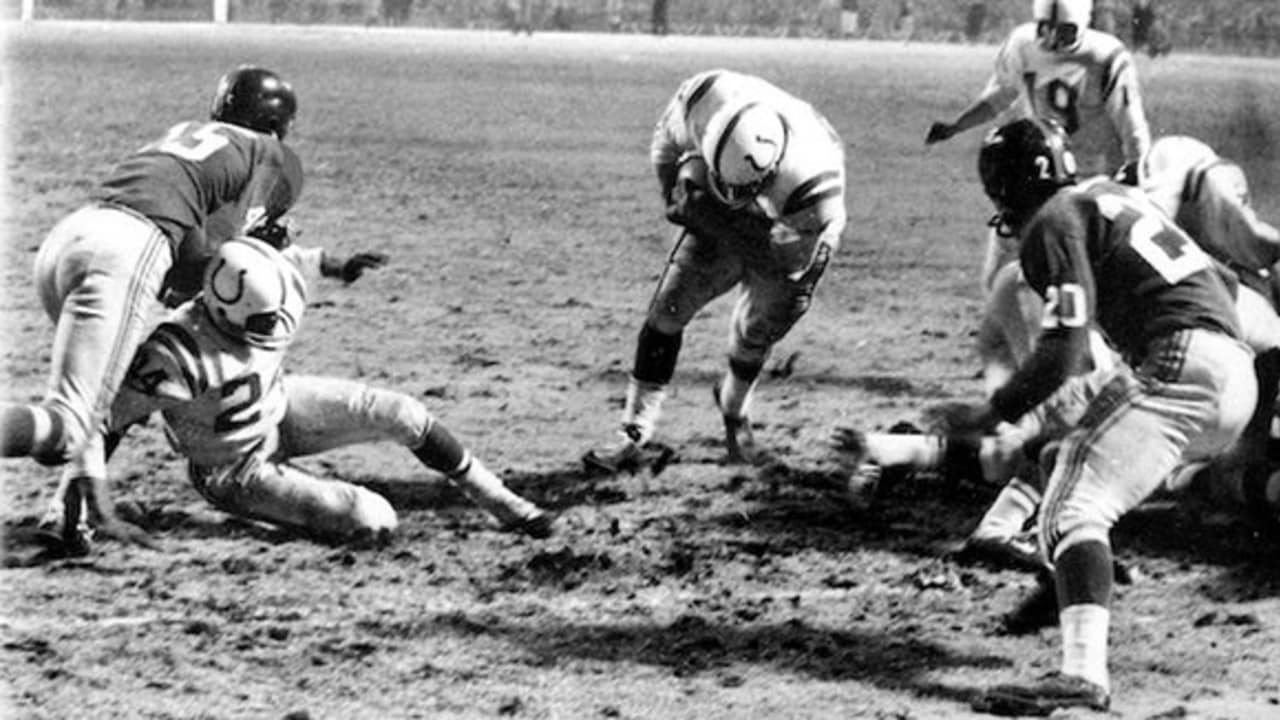
December 28, 1958: Pro Football's "Greatest Game"

Alan Ameche scores the winning touchdown.
Lenny Moore (24) provides the key block on Emlen Tunnell.
Johnny Unitas (19) watches.

December 28, 1958, 60 years ago: The NFL Championship Game is held at Yankee Stadium. The New York Giants, Champions of the NFL Eastern Division, play the Baltimore Colts, Champions of the Western Division. It is the 1st Championship Game for the Colts, the 10th for the Giants, who had previously won it in 1934, 1938 and 1956. (Why Baltimore, a Northeastern city, was placed in the League's Western Division, I don't know.)

The Giants had Charlie Conerly as their quarterback, and the biggest football star of the time, Frank Gifford, at running back. They were the 1st team to really make defense a priority, led by future Hall-of-Famers Sam Huff, Andy Robustelli and Emlen Tunnell. Two years earlier, they had destroyed the Chicago Bears in the Championship Game, 47-7.
The pre-renovation original Yankee Stadium, set up for football


But the Colts were on the rise. Their quarterback was Johnny Unitas. He had Raymond Berry to throw to, Lenny Moore in his backfield, and Jim Parker to block for him. All 4 would make the Hall of Fame. His defense was led by Hall-of-Famers Gino Marchetti and Art Donovan.

The 1st half was a bit sloppy, and didn't live up to the legend. Pat Summerall, future broadcasting legend, began the scoring with a field goal in the 1st quarter, putting the Giants up 3-0. In the 2nd quarter, Alan Ameche, who won the Heisman Trophy at the University of Wisconsin in 1954, scored a touchdown to put the Colts ahead. Unitas threw a touchdown pass to Berry, giving the Colts a 14-13 lead at the half.

In the 3rd quarter, Mel Triplett snuck the ball over the goal line to put the Giants back in it. Early in the 4th quarter, Conerly threw a touchdown pass to Gifford, giving the Giants a 17-14 lead. As the clock wound down, Unitas drove the Colts, but couldn't get them over. So Steve Myhra was sent in to kick a field goal as time expired. With the clock reading 0:00, the scoreboard read 17-17.

No NFL Championship Game had ever ended in a tie. Overtime was needed, for the 1st time in NFL history. (The League didn't institute overtime for the regular season until 1974.) The Giants won the toss, but couldn't score. Unitas led an inspiring drive, toward what would have been left field in The Stadium's baseball setup, which finally ended with Ameche scoring from the 1-yard line -- appropriately where Monument Park would later be in The Stadium's post-renovation period (1976-2008).

Bob Wolff, who had been in the same Stadium 2 years earlier to call Don Larsen's perfect game for the New York Yankees against the Brooklyn Dodgers in the 1956 World Series, was at the microphone for NBC again, and had the call: "Unitas gives to Ameche... The Colts are the World Champions! Ameche scores!" He later said he was glad he didn't "bury the lead" by saying, "Ameche scores!" first.

This game had the largest TV audience in NFL history to that point, 45 million people. The fact that it was in New York, and involved a New York team, helped it loom large in the public consciousness. This was the game that launched the NFL on a path to becoming, at least in perception, more popular than Major League Baseball.

It made legends of the Colts, and Unitas in particular. He would go on to be recognized as the greatest quarterback of all time. It's been 62 years, and some people still think he is. And the Colts, playing in a city that didn't have a big college football team -- Morgan State University is a historically black school, the U.S. Naval Academy is a national school, and the University of Maryland is closer to Washington -- became known as the team of America's working class, an "America's Team" in a way that felt artificial when the Dallas Cowboys later called themselves that.
Johnny Unitas

It also became known as "The Greatest Game Ever Played." It has been noted that it would never have been called that had the Colts beaten, say, the Philadelphia Eagles. But every so often, polls are taken that show this game as the "greatest." The most recent was in 2019, for the NFL's 100th Anniversary.

The teams had a rematch in the 1959 NFL Championship Game. In those days, home field was rotated between the Eastern and Western Champions, and the Colts hosted it at Memorial Stadium, beating the Giants again.

Sunday, August 9, 2015

Frank Gifford, 1930-2015

On November 20, 1960, a lot of people thought Frank Gifford had died. It would have been a shocking end for New York's first true football superstar.

As it turned out, he had quite a bit of life left in him.

*

Francis Newton Gifford -- sounding more like the name of a U.S. Senator than that of a sports legend -- was born on August 16, 1930 in Santa Monica, California, outside Los Angeles, and grew up in Bakersfield, an oil town about 100 miles away, in a rural part of the State that would have tremendous growth after 1970.

He starred in football at Bakersfield High School, but didn't have the grades to get into his first choice of school, the University of Southern California. So he went to Bakersfield Junior College, and got the necessary grades to get into USC.

Frank began the tradition of great USC tailbacks, followed by football legends Mike Garrett, O.J. Simpson, Anthony Davis, Charles White, Marcus Allen and Reggie Bush. He was an All-American in 1951, and, despite not having blond hair, was nicknamed the Golden Boy.

He arrived in the National Football League just as the transition was being made from single-platoon football -- players playing both offense and defense -- to two-platoon football. Only in his 1st 2 seasons, 1952 and '53, did he play on both sides of the ball, as a halfback and a cornerback. In 1954, with a new head coach, Jim Lee Howell, he began to be used exclusively at left halfback, behind quarterback Charley Conerly.

In 1955, he made the Pro Bowl for the 1st time. In 1956, the Giants had an epic season. First, they moved out of the crumbling Polo Grounds and into the old Yankee Stadium. There, everything improved: The playing conditions, the morale, the offense, the defense, the fan reactions.

The chant of "Dee-FENSE!" was first heard at an NFL game, as men like Sam Huff, Andy Robustelli and Emlen Tunnell -- all future members of the Pro Football Hall of Fame -- followed the lead of defensive coach (they weren't yet called "coordinators") Tom Landry -- yes, the Tom Landry who went on to coach the Dallas Cowboys -- and became the 1st great NFL defense-only unit. Though the nickname didn't come along until the 1980s, this was the original Big Blue Wrecking Crew.

For the 1st time in football history, defense was cool. And, with New York City being the media center of the nation, the rest of America noticed the defense, and noticed the Giants, who hadn't won an NFL title since 1938, nor been in an NFL Championship Game since 1946.

But it's scoring that truly gets the headlines, and Vince Lombardi -- yes, the Vince Lombardi who went on to coach the Green Bay Packers -- coached the Giant offense. With Conerly, Gifford, and fellow running backs Mel Triplett and Alex Webster in the backfield, and Gifford and Kyle Rote catching passes, and Hall of Fame tackle Roosevelt Brown among the blockers, the Giants were just about unstoppable.

Frank rushed for 819 yards, and and caught 51 passes for another 603 yards. Overall, his 1,422 yards from scrimmage led the NFL -- and that's in a 12-game season. (At the same rate, he would have had 1,895 yards over a 16-game season.) He scored 9 touchdowns, including 3 against the Washington Redskins on December 2.

The Giants hung 38 points on the San Francisco 49ers, 38 on the Pittsburgh Steelers, 28 on the Redskins, and 27 on the Chicago Cardinals (but lost, allowing 35). The Giants went 8-3-1, and won the NFL's Eastern Division. UPI named Frank the NFL's Most Valuable Player.

In the days before the AFL-NFL merger, the hosting duties for the NFL Championship Game rotated between the Eastern and Western Champions. As this was an even-numbered year, the Eastern Champions hosted. On December 30, 1956, the Giants took the field at a frigid Yankee Stadium, and faced the Chicago Bears in front of 56,836 hardy souls and a national television audience on NBC.

It was the peak day for both that offense and that defense. The Bears, despite being used to cold weather, were totally put on ice. The Giants jumped out to a 20-0 lead before the Bears could get on the board, with touchdowns by Triplett and Webster and a pair of field goals by Ben Agajanian. Rick Casares scored for the Bears, with quarterback George Blanda kicking the extra point.

But it was all G-Men after that. Webster scored another touchdown, and the Giants blocked a punt, which Henry Moore recovered in the end zone. It was 34-7 when the teams headed into the locker room.

The Bears should've stayed inside. In the 3rd quarter, Conerly threw a touchdown pass to Rote. In the 4th, he threw one to Gifford to put on the exclamation point. Giants 47, Bears 7. It was a devastating display.

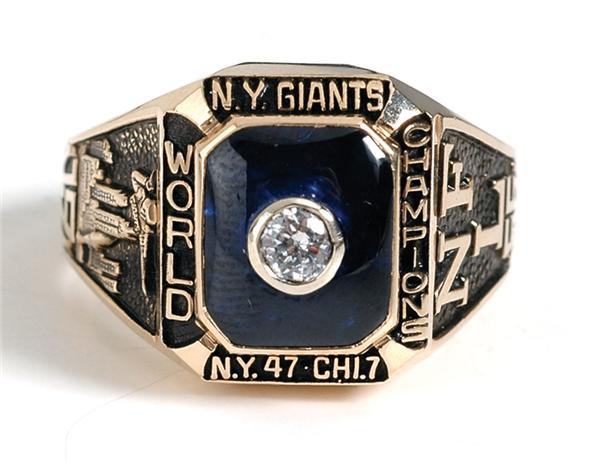
This is Agajanian's ring from the title season. This is what a ring from "Super Bowl Minus-X" looks like. Gifford, of course, got one, too.
Those are a pair of Lower Manhattan skyscrapers on one side, but this was long before the World Trade Center was anything more than an idea. They're a pair of early 1930s buildings: The Bank of Manhattan Trust Building (40 Wall Street, now named the Trump Building) and the Cities Service Building (now named for its address, 70 Pine Street).

*

That wasn't the peak of Frank Gifford's fame, but it did turn out to be the peak of his NFL achievement. The Giants got back into the NFL Championship Game in 1958, but it turned out to be a classic that didn't go their way, as the Baltimore Colts shocked a national TV and Yankee Stadium audience by sending the game to overtime, where Johnny Unitas and his Colt teammates put on a show that is still talked about as "the Greatest Game Ever Played." The Colts won, 23-17, and the NFL became a true TV phenomenon -- mainly because the New York team was involved.

The Colts beat the Giants in the next year's title game as well, but that was in Baltimore, and wasn't as good a game, so it's not as hyped. (Why Baltimore was in the Western Division, I don't know.)

But the New York media machine continued to hype up the Giants, every bit as much as it had their baseball counterparts (who'd moved to San Francisco after the 1957 season), and the Yankees, and would later do to the Mets, the Jets, the Knicks, the Rangers and the Islanders -- and, of course, the Giants again.

New York previously had great football players like Benny Friedman, Ken Strong, Mel Hein and Tuffy Leemans, but Gifford was the 1st of the TV era. In the late Fifties and early Sixties, you couldn't watch a night's TV without watching Gifford do a commercial for Vitalis hairspray (as opposed to Brylcreem, a.k.a. "that greasy kid stuff"), Lucky Strike cigarettes, Florida orange juice, or some other product.

He became a frequent panelist on CBS' game show What's My Line? New Yorkers might not have used the capital letters, but, every bit as much as he was at USC, he was a golden boy.

It almost didn't last. On November 20, 1960, Yankee Stadium was the scene of another historical moment, and Gifford was there -- but he didn't remember it. Indeed, he was lucky to have survived it.

The Giants were playing the Eagles, their arch-rivals since the Eagles' founding in 1933. The winner was probably going to win the Division and host the Championship Game, as the Giants had in 2 of the last 4 years. (If this section looks familiar, it's because I copied-and-pasted, and adapted, it from my memorial piece on Gifford's antagonist in March.)

The Giants led 10-0 at the half, but blew it. In the 4th quarter, the Eagles' Jimmy Carr picked up a fumble and returned it 38 yards for a touchdown, making it 17-10 Eagles.

With the clock running out, George Shaw, filling in for the injured Conerly, threw a pass toward Gifford at midfield. Gifford caught the pass, but Chuck Bednarik, the Eagle linebacker appropriately known as Concrete Charley, 
arrived at the same time, and he flattened Gifford, who fumbled. The Eagles recovered.

On the film, this doesn't look like an especially injurious hit. I've seen much worse. What made this the most famous hit in NFL history -- aside from the fact that it was in New York, and involved a New York team, and was seen by a national TV audience -- was how Chuck reacted.

The film shows him reacting to the fumble by jumping around and clapping his hands. Then he pumped his fist, and issued what became his catchphrase: "This fucking game is over!" (In other words, no, his exact words did not include "effin'.") For all intents and purposes, the game was, indeed, over. The final score was 17-10 Eagles.

But it was the photograph that proved damaging -- not to Gifford's body, but to Bednarik's reputation. Or maybe it enhanced his reputation. It showed Bednarik standing over Gifford, pumping his fist. Gifford is lying on the ground, motionless, as Rote (Number 44) looks on. 

Bednarik spent the last 54 years of his life explaining that he didn't realize Gifford was out cold on the ground in front of him. He said he was celebrating the Eagles wrapping up a big win, not the fact that he'd knocked Gifford out. He said he didn't even know he'd knocked Gifford out.

Legend has it that Gifford was knocked out because, despite wearing a helmet, he hit his head on the frozen grass. This couldn't be true: According to Pro-Football-Reference.com, it was 49 degrees at gametime -- not a particularly notable temperature for mid-November New York, and hardly cold enough to freeze the field.

Gifford was taken to the Giants' locker room -- which, at the old Stadium, was also the Yankees' locker room. As befitting the biggest star on the team, Gifford's locker was also Mickey Mantle's. Also taken to the locker room for first aid was a security guard who had a heart attack.


Frank's first wife, Maxine, didn't know this, and when she went down to the locker room to see Frank, she heard someone say, "He's dead" -- meaning the security guard. When the guard was wheeled out on a stretcher, with his face covered by a sheet, reporters saw this, and thought it was Gifford. The rumor began to spread that Bednarik had killed him. And when the photo was seen in newspapers across the country the next day, Bednarik looked like a monster, celebrating his "kill."

It got worse. Bednarik went to see Gifford in the hospital the next day, and was told Gifford couldn't receive visitors. But a new rumor circulated, that Bednarik wouldn't see Gifford. It wasn't that he wouldn't, it was that he couldn't.

Gifford always said he never held it against Bednarik. Bednarik said he was tired of people remembering him mainly for one thing. "It was always, 'Oh, you're the guy! You're the guy! You're the guy that got Frank Gifford!' Yeah, I'm the guy that 'got' Frank Gifford."


He was also tired of Howard Cosell, on Monday Night Football, seeing a hard hit, and turning to Gifford and saying, "Just like Chuck Bednarik blindsided you at Yankee Stadium, Giffaroo!"

"Blindsided, my fanny! It was a clean hit," Bednarik always said. And it was: Like the infamous Denis Potvin hit on Ulf Nilsson in 1979, or Scott Stevens leveling Eric Lindros in 2000, no penalty was called on it. (And, yes, this profane man would say, "fanny," not "ass." In America, "fanny" means rear end. In Britain, it means the other side, of a woman.)


Chuck died this past March 21. If he hadn't, we might now be talking about how Gifford finally felt the effects of that clobbering, nearly 55 years later

Frank missed the rest of the 1960 season, and retired at age 30. The Giants reached the 1961 NFL Championship Game anyway, but Frank wouldn't have been able to help much, as they got slaughtered by the Green Bay Packers. He missed playing, and returned in 1962, switching to flanker (wide receiver) for safety reasons. He won NFL Comeback Player of the Year, and got the Giants back into the Championship Game, again at Yankee Stadium. But the Packers won again. In 1963, they got to another, this time losing to the Bears.

In 1964, it all came crashing down. The Giants did not look like the team that had reached 6 of the last 8 NFL Championship Games. Like the Yankees would do the following spring, their players all seemed to get old, or hurt, or both, at once. Gifford retired. having rushed for 3,609 yards. That may not look like much compared to modern numbers, but it was a strong 4.3 yards per carry. He caught 367 passes for 5,434 yards. In that era, those were considered enormous numbers. He scored 77 touchdowns in his 12 seasons -- 12-game seasons until 1960, 14-game seasons thereafter.

He was named to 8 Pro Bowls, the NFL's 1950s All-Decade Team, and the College and Pro Football Halls of Fame. In a pair of belated honors, the Giants retired his Number 16, and inducted him into their Ring of Honor when MetLife Stadium opened.

*

Frank went into broadcasting. As CBS had the NFL exclusively at that point, he called some of their games, including Super Bowl I early in 1967 and the NFL Championship Game, the "Ice Bowl" in Green Bay, at the end of the year.

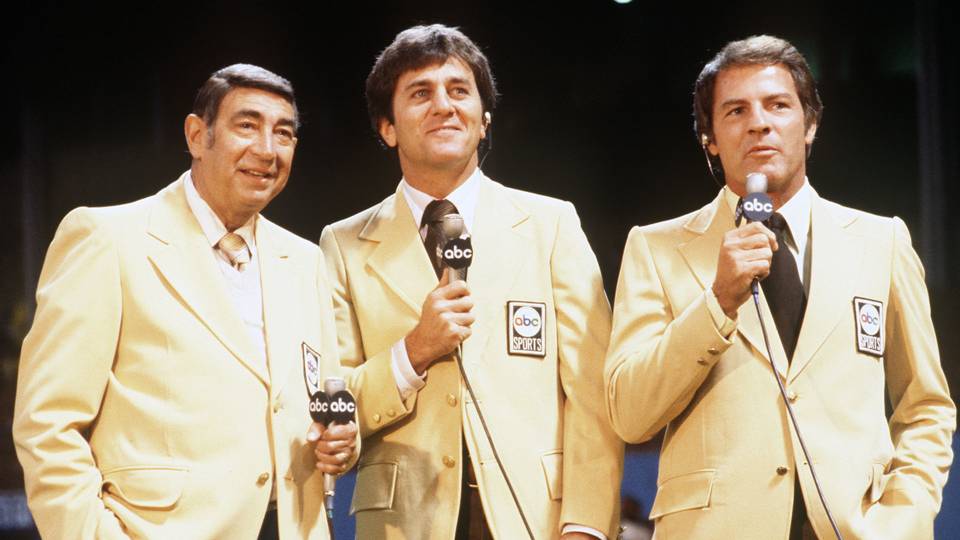
In 1971, he was brought to ABC to do Monday Night Football. where he worked with some of the biggest names in sportscasting, including fellow NFL legends Don Meredith, Alex Karras, Fran Tarkenton, O.J. Simpson, Joe Namath, Dan Dierdorf, Lynn Swann and Joe Theismann -- and, of course, non-athletes Keith Jackson (in the 1st season only), Howard Cosell and Al Michaels.
The classic MNF lineup, in the classic yellow jackets:
Cosell, Meredith, Gifford. Together 1971-73, and again 1977-83.
Meredith was at NBC 1974-76, replaced by Alex Karras.

ABC put him on other broadcasts as well, including on the Olympic Games from 1972 (including play-by-play of the basketball Gold Medal game where the U.S. got robbed, to the benefit of the Soviet team) to 1992. These assignments also included The Battle of the Network Stars and their anthology series ABC Wide World of Sports.

His WWOS assignments included several of Evel Knievel's motorcycle jumps, leading to a friendship between the erstwhile Golden Boy and the King of the Daredevils. In 1975, Knievel attempted to jump over 13 of London's red double-decker buses at the old Wembley Stadium. He did it, but couldn't stick the landing, and fell off, with the cycle's front wheel rolling over his arm.

With a live mike, Gifford could clearly be heard saying, "Oh, my God," something that people weren't supposed to say on TV in those days. Although that was the worst-looking part of Knievel's crash, he had worse injuries, including a broken pelvis. Gifford abandoned his post, and ran to him. He and another man helped Knievel up, and carried him into the locker room on their shoulders.
For better or for worse, a pair of American legends.

In 1995, the Pro Football Hall of Fame gave Frank the Pete Rozelle Award, their award for media personalities. This made him the 1st man honored by a sport with election to its Hall of Fame for both playing and broadcasting. He has since been joined by Kansas City Chiefs quarterback and broadcaster Len Dawson, and St. Louis Cardinals offensive tackle and his fellow Monday Night Football analyst Dan Dierdorf.

*

Frank was married to Maxine Ewart, and they had 3 children: Sons Jeff and Kyle, and daughter Victoria. Victoria married Michael Kennedy, son of Bobby. Through his children from his 1st marriage, he has 5 grandchildren.

In 1984, there were a pair of substitute hosts on ABC's Good Morning America. One was Frank. The other was Kathie Lee Johnson, also recently divorced. At the time, she was known as a singer, Tom Kennedy's lady sidekick on the game show Name That Tune, and pitchwoman for Carnival Cruise Lines.

Despite their 23-year age difference -- exactly 23 years, as they share the birthday of August 16 -- they hit it off, and were married on October 18, 1986. He continued on Monday Night Football, and she was paired with Regis Philbin on Live!, which went from a New York-only broadcast to a national one in 1988. They had a son, Cody, and a daughter, Cassidy.
Left to right: Frank, Kathie Lee, Cassidy, Cody.

Kathie Lee shared many details of their private life on the air, making Regis uncomfortable at times. It also didn't help that Regis is a Notre Dame graduate, and they have a bit of a rivalry with Frank's alma mater, USC. On a few occasions, Kathie Lee would refer to her husband as "The Human Love Machine."

If you're in your 60s, and your wife is much younger and gorgeous, and tells a live nationwide audience that you are a love machine, you might begin to believe it. In 1997, Frank was caught cheating, and it was a terrible embarrassment for Kathie Lee.

They stayed together. When Barbara Walters interviewed them on ABC's 20/20, sometime after the public revelation of Frank's infidelity, Kathie Lee said, "Sometimes, when you can't forgive your husband, you have to forgive the father of your children." (I suspect that this is why she rarely mentions her 1st husband, with whom she did not have children.)

*

Because of the scandal, Frank was eased off of Monday Night Football after the 1997 season, doing pregame shows only in 1998, and was then "allowed to retire." After that, he was mostly out of the public eye, although he still wrote books about his football experience and did interviews for them.

Kathie Lee left Live! in 2001, succeeded by Kelly Ripa. Regis' replacement was, appropriately enough, another Giants Hall-of-Famer, who had his own embarrassing marital scandal: Michael Strahan.

In 2008, Kathie Lee moved over to NBC, where she co-hosts the 4th hour of Today with Hoda Kotb. Cody, now 25, followed his father in playing football at USC, and stayed in Los Angeles, as a screenwriter and a producer. His company is called Little Giant Productions. Cassidy, who just turned 23, is also in Hollywood, as an actress. Neither is yet married or a parent.

This morning, Frank was found nonresponsive at the family home in New Haven, Connecticut. He was a week short of his 85th birthday.

More than Eli Manning, more than even Lawrence Taylor, he is the New York Giants' greatest legend -- perhaps not the franchise's all-time greatest all-around player, but its greatest legend.

With Frank's death, there are now 7 surviving members of the 1956 World Champion New York Giants: Linebackers Sam Huff and Harland Svare, defensive tackles Dick Modzelewski and Rosey Grier (probably better known as a Los Angeles Ram), defensive back Henry Moore, tight end Bob Schnelker, and placekicker Ben Agajanian.

Agajanian was 1 of only 3 players to play in the NFL, the All-America Football Conference, and the 1960 version of the American Football League. (There were also AFLs in 1926, 1936-37 and 1940-41.) The other was Hardy Brown, best known as a devastating linebacker for the San Francisco 49ers, and one of the earliest-known sufferers of football-related brain injury. Agajanian, however, topped Brown, because he played for Los Angeles franchises in all 3 cities: The AAFC's Dons, the NFL's Rams, and, playing in L.A. for 1 season before moving to San Diego, the AFL's Chargers.

From the NFL's 1950s All-Decade Team, there are now 6 surviving players, following the recent deaths of Gifford, Bednarik, and Detroit Lions guard Dick Stanfel: Huff, running backs Lenny Moore of the Baltimore Colts and Hugh McElhenny of the San Francisco 49ers, receiver Raymond Berry of the Colts, and linebacker Joe Schmidt and safety Yale Lary of the Detroit Lions.

UPDATE: As of August 16, 2020, the 90th Anniversary of Gifford's birth, there are 3 surviving '56 Giants, Huff, Grier and Moore; and 5 surviving 1950s All-Decade players, Huff, Moore, McElhenny, Berry and Schmidt. Kathie Lee left Today in April 2019. Cody really looks like his father now, runs the Gifford Media Group, and is engaged to be married. Cassidy got married in June 2020. Frank was buried at Ivy Lawn Memorial Park in the Los Angeles suburb of Ventura, California.