January 26, 1837: Michigan is admitted to the Union as the 26th State.
Top 10 Athletes From Michigan
Michigan is a big State, with almost 10 million people, and one of the largest metropolitan areas in the country, Detroit -- although a noticeable chunk of that metro area is across the Detroit River in Windsor, Ontario, Canada, and anyone from there is thus ineligible for this list.
Baseball. Football. Basketball. Hockey. Boxing. You could limit Michigan's Top 10 Athletes to any of those 5 sports, and come up with a list that could stand alongside 40 of the 50 States' Top 10.
Honorable Mention to Baseball Hall-of-Famers Hazen "Kiki" Cuyler of Harrisville, Hal Newhouser of Detroit, and John Smoltz of the Detroit suburb of Warren.
Honorable Mention to Jim Kaat of the Grand Rapids suburb of Zeeland. As both his name and his hometown's suggest, he is part of the large Dutch-American community in Michigan. He is not in the Hall of Fame, but he should be -- as either a player or a broadcaster. He was a 3-time All-Star, and won 16 Gold Gloves.
He won 283 games, including Pennants 17 years apart, in the American League with the 1965 Minnesota Twins, and in the National League with the 1982 St. Louis Cardinals, winning the World Series. When he retired the following year, he was the last active player who had played for the original Washington Senators (1901-60).
Honorable Mention to Kirk Gibson of the Detroit suburb of Pontiac. He played both baseball and football at Michigan State University. (So did Steve Garvey, but he's from Tampa.) He helped MSU's football team win the 1978 Big Ten Championship, then became a World Series hero in both leagues, for the 1984 Detroit Tigers and the 1988 Los Angeles Dodgers (following a regular season that won him the National League MVP).
Injuries cut short what could have been a Hall of Fame career, but still hit 255 home runs. In 2011, he was named NL Manager of the Year for getting the Arizona Diamondbacks to the NL Western Division title.
Honorable Mention to Orel Hershiser of Detroit. He was born in Buffalo, but was living in Detroit when he learned how to pitch, before moving to Toronto, and then to the Philadelphia suburb of Cherry Hill, New Jersey for high school. He had a 204-150 record over 18 seasons, reaching the postseason with the Los Angeles Dodgers in 1983, 1985 and 1988; the Cleveland Indians in 1995 and 1997; the San Francisco Giants in 1998; and the Mets in 1999.
A 3-time All-Star, his
annus mirabilis was 1988: He won 23 games, set a new major league record with 59 consecutive scoreless innings pitched, won a Gold Glove and the National League Cy Young Award, and was named Most Valuable Player of both the NL Championship Series and, after winning Game 2 and the clinching Game 5, the World Series. In 1995, helping the Indians won the American League Pennant, he became the 1st (and still only) man to win LCS MVPs in both leagues.
He is not yet in the Hall of Fame, but he could be. He is now one of the game's most respected broadcasters.
Honorable Mention to Jim Abbott of Flint. Born without a hand on his right arm, he nonetheless learned how to pitch with his left, and to then switch his glove from his right wrist to his left hand and field his position. He won the 1987 James E. Sullivan Memorial Award as the nation's outstanding amateur athlete, for his pitching at the University of Michigan.
The team then known as the California Angels took a chance on him, and he reached the major leagues. Over 11 seasons, he had a record of 87-108, including a no-hitter with the Yankees in 1993.
Dishonorable Mention to Derek Lowe of the Detroit suburb of Dearborn. He went 176-157with 86 saves in a 17-season career as a major league pitcher. He reached the postseason with the Boston Red Sox in 1998, 1999, 2003 and 2004; the Los Angeles Dodgers in 2008; the Atlanta Braves in 2010; and the Yankees in 2012.
A 2-time All-Star, he led the AL in saves in 2000 and the NL in wins in 2006, a rare combination. He pitched a no-hitter for the Red Sox in 2002. And he was a beneficiary of their steroid-induced cheating that helped them win the 2004 World Series, which led to Lowe's inclusion with his teammates as
Sports Illustrated's Sportspeople of the Year. The Red Sox have elected him to their team Hall of Fame.
Somewhat Honorable Mention to George Gipp of Laurium. The way the University of Notre Dame handled him then would get them put on probation now, with the gambling and the womanizing and the barely showing up for class (and, worse from their perspective, the barely showing up for Mass), and for not doing anything about it.
But, by the standards of the time, he was a great runner, a great passer, a great punter, a great defensive back, and a great kick returner. He helped Notre Dame win the National Championship in 1919 and 1920. In 2008, ESPN named ranked him 22nd on their list of the Top
25 College Football Players of All Time.
He might have been the ideal guy to be the 1st great star of the newly-founded NFL, except he got strep throat, which developed into pneumonia, and died on December 14, 1920 -- almost certainly
not telling head coach Knute Rockne to tell the team to "Win one for the Gipper" on his deathbed, as seen in the 1940 film
Knute Rockne, All-American, with Ronald Reagan as Gipp and Pat O'Brien as Rockne.
As it is, despite not having played pro ball -- that we know of, lots of athletes in that era played it under assumed names to protect their eligibility, Jim Thorpe being the most notable one to get caught -- he remains the greatest athlete from Michigan's Upper Peninsula.
Honorable Mention to Bennie Oosterbaan of Muskegon. Baseball, football and basketball: He played, and coached, all 3 sports at the University of Michigan. In 1928, he led the league that became known as the Big Ten in batting average and in basketball scoring.
But football was his best sport. A 2-way end, he became the 1st great receiver in the Big Ten, taking passes from Benny Friedman -- the "Benny-to-Bennie" combination. (Friedman was from Ohio, although this is not as ironic as it sounds, as Ohio State was not then considered the Wolverines' big rival.) Michigan went 20-4 with 2 league titles while he played for them, despite Red Grange then being at Illinois. The school would eventually retire his Number 47.
But he never played any sport professionally, which is why I can't place him any higher. He went right into coaching, spending 20 years as a Michigan assistant, before becoming head coach in 1948 -- and winning the National Championship and Coach of the Year in his 1st season. He won the Big Ten in his 1st, 2nd and 3rd seasons. His record was 63-33-4.
Honorable Mention to Heisman Trophy winners Pete Dawkins of the Detroit suburb of Bloomfield Hills (1958) and Mark Ingram Jr. of the Detroit suburb of Grand Blanc (2011).
Honorable Mention to Reggie Williams of Flint. A star linebacker at Dartmouth College, he played 14 seasons for the Cincinnati Bengals, helping them win AFC Championships in 1981 and 1988. His charitable work earned him 2 different NFL "Man of the Year" awards, and a share of
Sports Illustrated's "Athletes Who Care" Sportspeople of the Year in 1987. He later served a term on the City Council in Cincinnati.
Honorable Mention to Mel Daniels of Detroit, who is in the Basketball Hall of Fame. Don Nelson of Muskegon is in, but as a coach. Rudy Tomjanovich of Hamtramck is not yet in as either a player or a coach; most likely, he will be elected as a coach. Dan Majerle of Traverse City and Chris Webber of Detroit could be elected as players.
Honorable Mention to Hockey Hall-of-Famers Mark Howe of Detroit (son of Red Wings legend Gordie), Pat LaFontaine of Waterford, and Mike Modano of the Detroit suburb of Livonia. Craig Patrick of Detroit, son of Lynn and grandson of Lester, is in the Hall of Fame, but for his executive achievements, not his playing.
Honorable Mention to Ken Morrow of the Flint suburb of Davison and Mark Wells of the Detroit suburb of St. Clair Shores. Members of the U.S. hockey team that won the Gold Medal at the 1980 Winter Olympics, along with their teammates, they were named Sportsmen of the Year by
Sports Illustrated. Wells never got out of the minor leagues, but Morrow went right to the New York Islanders and helped them win their 4 straight Stanley Cups.
Honorable Mention to New Jersey Devils Stanley Cup Winners: Brian Rolston of Flint (1995, beating his home-State Red Wings in the Finals), Shawn Chambers of the Detroit suburb of Sterling Heights (also 1995, won another with the 1999 Dallas Stars), Danton Cole of the Detroit suburb of Pontiac (also 1995), and Brian Rafalski of the Detroit suburb of Dearborn (2000 and 2003, won another with the Wings in 2008).
Honorable Mention to members of the U.S. team that won the 1996 World Cup of Hockey: LaFontaine, Modano, Rolston, Chambers, Doug Weight of the Detroit suburb of Warren (he had played for the New York Islanders, and is now their head coach and general manager), and the brothers Derian and Kevin Hatcher of the Detroit suburb of Sterling Heights.
Honorable Mention to Tim Thomas of Flint, who won the 2011 Conn Smythe Trophy for MVP of the Stanley Cup Playoffs, winning the Cup with the Boston Bruins.
Honorable Mention to Kate Sobrero of the Detroit suburb of Bloomfield Hills. Now Kate Markgraf, she was a member of the U.S. soccer team that won the 1999 Women's World Cup, and was, with her teammates, named to
Sports Illustrated's Sportswomen of the Year. She also won Olympic Gold Medals in Sydney in 2000 and Athens in 2004.
Honorable Mention to William Bonthron of Detroit. He won the 1934 Sullivan Award as a middle-distance runner, and for 2 years held the world record in the 1,500 meters. But he fell short of qualifying for the 1936 Olympics.
Honorable Mention to James "Lights Out" Toney of Grand Rapids. He first held a World Championship in 1991, the IBF Middleweight Championship; and last did so in 2003, the IBF Cruiserweight Championship.
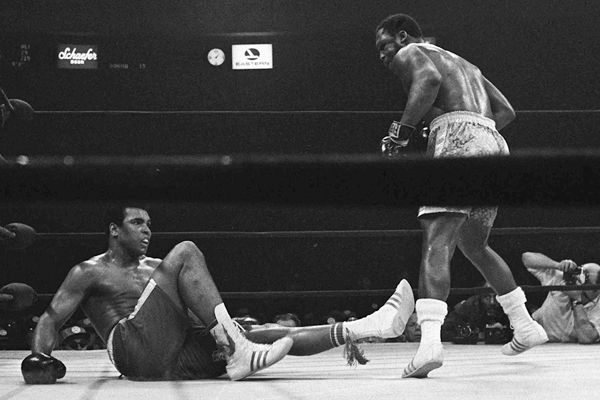
The Ring magazine named him Fighter of the Year in 1991 and 2003 -- 12 years apart. In the 2001 film
Ali, with Will Smith as The Greatest, "The Dark Emperor" played Joe Frazier.
Honorable Mention to Vernon Forrest of Marquette. "The Viper" was Welterweight Champion of the World from 2001 to 2003, and Super Welterweight Champion from 2007 to 2009. The Ring magazine named him Fighter of the Year in 2002.
Dishonorable Mention to Floyd Mayweather Jr. of Grand Rapids. You've heard of "The Good, the Bad, and the Ugly"? Well, here it is:
The good: The son of a fine boxer and the nephew of 2 others, the man nicknamed "Pretty Boy" after 1930s gangster Pretty Boy Floyd and "Money" because his skill made him "money in the bank" first won a World Championship in 1998, WBC Super Featherweight Championship. He most recently held a title in 2005 -- 17 years later -- the WBA and WBC Welterweight Championships.
He was
The Ring's Fighter of the Year in 1998 and 2007. He beat such fighters as Arturo Gatti, an aging but still tough Oscar De La Hoya, Ricky Hatton, Victor Ortiz and Miguel Cotto. His career record is 50-0, with 27 knockouts.
The bad: Although he was 1 of 2 contenders for the title of best fighter, pound-for-pound, in the world during the 2000s, he spent years ducking the other such contender, Manny Pacquiao. In 2010, it appeared the fight would finally happen, with Mayweather 33 years old and Pacquiao 31, both still very much in their prime. But Mayweather kept ducking him and making excuses for it, until 2015, when, after Pacquiao had already lost 2 additional fights, and at 36 was the younger of the fighters. Mayweather won an easy decision.
The ugly: He was convicted of misdemeanor battery against a woman in 2002, against 2 women in 2004, against a man in 2005, and against another woman in 2011. So, until things were ironed out, he wasn't willing to fight the boxer then considered the most likely to ruin his undefeated record, but he was willing to hit women.
Now, the Top 10:
10. Paul Krause of the Flint suburb of Burton. He scored 54 points in a high school basketball game, and also lettered in baseball and track. He played baseball and football, as a receiver and a safety, at the University of Iowa. He was considered a legitimate MLB prospect until an injury.
But he made his professional mark in football. A 9-time All-Pro, he led the NFL in interceptions as a rookie with the 1964 Washington Redskins. He was traded to the Minnesota Vikings, and helped them win the 1969 NFL Championship and reach 4 Super Bowls. Although he is the only player ever to both intercept a pass in a Super Bowl (IV) and recover a fumble in another (IX), the Vikings lost all 4.
He is the NFL's all-time leader in interceptions, with 81. The old record of 79 was also held by an Iowa player, Emlen Tunnell. He also recovered 19 fumbles. Think about that: He personally had a turnover ratio of +100. He was named to the 70 Greatest Redskins, the Vikings Ring of Honor, and the Pro Football Hall of Fame.
9. George Gervin of Detroit. "The Iceman" came out of Eastern High School (now named for Martin Luther King) and Eastern Michigan University to become one of the most exciting players in pro basketball. He was a 12-time All-Star, 3 in the ABA and 9 in the NBA, including winning the All-Star Game MVP in 1980.
He led the NBA in scoring 4 times, his finger-roll becoming as much of a trademark in those days as Kareem Abdul-Jabbar's skyhook. Unfortunately for him, he never had a great team around him, and the closest he got to a League title was the 1976 ABA Semifinals (losing to the New York Nets) and 3 NBA Western Conference Finals, all with the San Antonio Spurs.
The Spurs retired his Number 44. He was named to the ABA All-Time Team and the NBA's 50th Anniversary 50 Greatest Players, 1 of 5 players so honored. Hall-of-Famer Gary Payton and Heisman Trophy-winning quarterback Ty Detmer, a San Antonio native, have called him their favorite athlete of all time.
8. Stanley Ketchel of Grand Rapids. A son of Polish immigrants, the man born Stanisław Kiecal and nicknamed the Michigan Assassin was, in the words of boxing historian Bert Sugar, "half animal."
As Jack Dempsey later would, he went around the American West, getting fights wherever he could. Officially, he would build a pro record of 51-4-4. As for the fights he got paid for that haven't been counted, who knows.
He became Middleweight Champion of the World in 1908. He was known for his 4 fights with Billy Papke, winning 3. He frequently fought guys who were much bigger, beating Light Heavyweight Champion Philadelphia Jack O'Brien.
He and Heavyweight Champion Jack Johnson were friends, in spite of the racial difference. They agreed to fight each other, in spite of Johnson's tremendous size advantage. The deal was, it would go the distance, 20 rounds, and thus there would be no decision, and they would split the film rights to the fight 50-50. But Ketchel got carried away, forgot the deal, and knocked Johnson down. Big mistake: Johnson got up, and knocked out both Ketchel and some of his teeth.
Ketchel was training for a rematch with Johnson on a ranch in Missouri when he was shot and killed by a ranch hand on October 15, 1910. He was only 24. He is in the International Boxing Hall of Fame, and his hometown of Grand Rapids put up a statue of him. Nat Fleischer, founder and editor of
The Ring magazine, called him the greatest middleweight fighter ever.
7. Jerome Bettis of Detroit. "The Bus" starred at Notre Dame, and moved with the Los Angeles Rams to St. Louis, before becoming a mainstay with the Pittsburgh Steelers. A 6-time Pro Bowler, he rushed for 13,664 yards and 91 touchdowns, and caught 200 passes for 1,457 yards and 3 touchdowns.
He closed his career in his hometown, as the Steelers won Super Bowl XL at Ford Field. The Steelers named him to their Hall of Honor, and have unofficially retired his Number 36. He is in the Pro Football Hall of Fame.
6. Charlie Gehringer of the Detroit suburb of Fowlerville. Mickey Cochrane, the catcher and manager of the Detroit Tigers in the mid-1930s, said, "Charlie says, 'Hello' on Opening Day, 'Goodbye' on closing day, and, in between, hits .350." His taciturnity, letting his bat and his glove do the talking, led to his nickname "The Mechanical Man."
There were no Gold Gloves in his day, and the All-Star Game didn't start until 1933, his 10th major league season. But he was the American League's starting 2nd baseman in the 1st 6 Games. He led the AL in stolen bases in 1929 and batting average in 1937, winning the Most Valuable Player that year. He helped the Tigers win Pennants in 1934, 1935 and 1940, winning the World Series in 1935.
He finished with a batting average of .320 and 2,839 hits. Following a barnstorming tour with a white team against a team of Negro Leaguers, Satchel Paige called him the best white hitter he ever pitched against. The Tigers retired his Number 2, and he was elected to the Baseball Hall of Fame. In 1999,
The Sporting News chose him as one of their 100 Greatest Baseball Players.
5. Dave DeBusschere of Detroit. He pitched for the Chicago White Sox in the 1962 and '63 seasons, but he was also a basketball star in his home town, first for the University of Detroit, then for the Pistons, where he became the youngest head coach in NBA history, at 24, from 1964 to 1967.
He is 1 of only 12 athletes to have played in both Major League Baseball and the National Basketball Association (or its predecessor, the Basketball Association of America).
For a long time, Madison Square Garden would host NBA doubleheaders, with the Knicks playing the nightcap but not the opener. When the new Garden opened on February 14, 1968, Dave DeBusschere, playing for the Pistons, scored the new building's 1st basket.
The Knicks traded Walt Bellamy to the Pistons to get DeBusschere, already with a reputation as one of the league’s best defensive players. He led the defense that helped the Knicks win the NBA Championship in 1970 and 1973. He later served as head coach and general manager of the Knicks, and his Number 22 has been retired. He was elected to the Basketball Hall of Fame, and named to the NBA’s 50th Anniversary 50 Greatest Players.
My generation knows DeBusschere best as the Knick GM who won the 1st pick in the 1st-ever NBA Draft Lottery in 1985, selecting Patrick Ewing. Sadly, the great Double D suffered a heart attack and died in 2003, age 63.
4. Thomas Hearns of Detroit. The "Hit Man," also known as the "Motor City Cobra," first won a World Championship in 1980, the WBA Welterweight Championship. He last held a title in in 1992, the WBA Light Heavyweight Championship. In between, he was one of the most feared boxers in the world, being named Fighter of the Year by The Ring magazine in 1980 and 1984.
He lost a unification bout for the Middleweight Championship to Sugar Ray Leonard in 1981, but Leonard was barely hanging on before knocking Hearns out. After that, Hearns beat Wilfred Benitez and knocked out Roberto Duran. He got clobbered by Marvin Hagler, but it says something about him that even his 2 most notable defeats were fights in which he got in some great licks. His final record was 61-5-1.
3. Derek Jeter of Kalamazoo. His roots are in New Jersey. Born in Pequannock, Morris County, he lived in West Milford, Passaic County until age 4, when he moved with his parents to "Kazoo," about halfway between Chicago and Detroit. But because his grandparents still lived in North Arlington, Bergen County, he stayed a Yankee Fan.
His 2,747 games and 20 seasons are Yankee records. A 14-time All-Star and (contrary to the stories you may have been told about his bad fielding) a 5-time Gold Glove winner, he was AL Rookie of the Year in 1996, as the new Yankee Dynasty began. World Championships were won in 1996, 1998, 1999, 2000 and 2009. Additional Pennants were won in 2001 and 2003. In only 3 of his 20 seasons -- 1 of the 1st 18 -- did the Yankees fail to make the Playoffs.
In 2000, he became the 1st (and still only) player to be named Most Valuable Player of the All-Star Game and the World Series in the same season. However, he was never named a regular-season MVP, finishing in the top 3 in the voting in 1998, 2006 and 2009. In 2009,
Sports Illustrated named him Sportsperson of the Year.
He finished with a .310 lifetime batting average, and 3,465 hits -- more than any person born after 1941 -- 260 of them home runs. The Yankees have retired his Number 2, and dedicated a Plaque for him in Monument Park. He will be eligible for the Hall of Fame in the election whose results will be announced in January 2020. He is now a part-owner of the Miami Marlins.
2. Earvin "Magic" Johnson of Lansing. He led Michigan State University to the 1979 National Championship, beating an Indiana State team led by Larry Bird. Magic was named the NCAA Tournament's Most Outstanding Player. This game, still the most-watched in college basketball history, is credited with launching the sport to a new level. It also started a professional and personal rivalry between Magic and Larry, although it never got nasty.
Magic was drafted by the Los Angeles Lakers, who already had Kareem Abdul-Jabbar, forcing him to switch from Number 33 to 32. The Lakers reached the 1980 NBA Finals, and when Kareem was hurt for Game 6, Magic, though 6-foot-9 was by then short for a center, moved from point guard, and torched the Philadelphia 76ers for 42 points on their own court, and won the title.
He also helped the Lakers win the NBA Championship in 1982 (again against the 76ers), 1985 (against Bird's Celtics), 1987 (against Bird again) and 1988 (against the Detroit Pistons). He was named Finals MVP (now named the Bill Russell Award) in 1980, 1982 and 1987. They also reached the Finals in 1983, 1984, 1989 and 1991. He became the all-time assists leader, a record since broken by John Stockton. He was a 12-time All-Star, and a 2-time All-Star Game MVP.
Now I come to the elephant in the room. Just before the 1991-92 season could begin, Magic announced he was retiring, because he'd been diagnosed with HIV, the virus that causes AIDS. He was nonetheless selected to that season's All-Star Game, and showed he still had his A-game, and was named the Game's MVP. He was named to the "Dream Team" that stormed to victory at the 1992 Olympics in Barcelona. Even then, he couldn't stay away, briefly coaching the Lakers in 1994 (not well) and briefly returning as a player in 1996 (ditto).
Michigan State retired his Number 33. The Lakers retired his Number 32 and dedicated a statue of him outside the Forum, since moved to the Staples Center. He was named to the Basketball Hall of Fmae and the NBA's 50th Anniversary 50 Greatest Players.
More than that, before he retired, he was already investing wisely, and had founded a chain of movie theaters, all in historically black neighborhoods, including on Harlem's iconic 125th Street. Not long before his diagnosis was announced, but right after Michael Jordan had led the Chicago Bulls to their 1st NBA Championship (beating Magic and the Lakers in the Finals), Magic said, "If Michael were doing what I'm doing, he really would own the world."
Magic's holdings now include a minority share of the Lakers, and the majority ownership of baseball's Los Angeles Dodgers, now defending National League Champions. Earvin Johnson still has a magic touch.
A man would have to be not just great at his sport, but a shaper of the world, to be ahead of Magic on this list. And the man at Number 1 was:
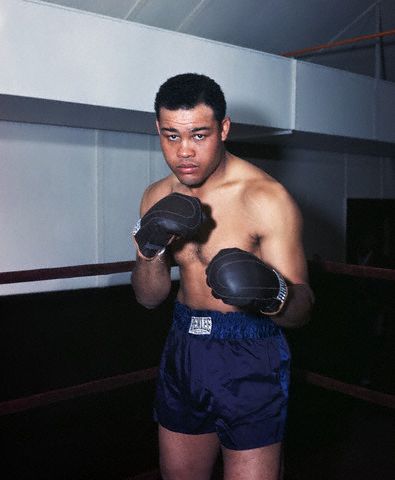
1. Joe Louis of Detroit. Born in Alabama as Joseph Louis Barrow, but trained to fight in Detroit, "the Brown Bomber" was the Motor City's 1st great fighter. By 1935, he was challenging men who had been Heavyweight Champion of the World, and winning. In 1936, he lost for the 1st time, to former Champion Max Schmeling.
But he recovered, won 6 more fights, and got a title shot against Champion Jim Braddock, knocking him out at Comiskey Park in Chicago on June 22, 1937. This completed an era in which the Detroit Tigers won back-to-back American League Pennants and a World Series, the Lions won an NFL Championship, and the Red Wings won back-to-back Stanley Cups. Detroit became the 1st city ever to call itself "the City of Champions," and they were right.
There were 5 men who were Heavyweight Champion in the 1930s before Louis, and he had beaten 4 of them: Braddock, Max Baer, Primo Carnera and Jack Sharkey. But he said he wouldn't consider himself the real champ until he beat Schmeling.
Schmeling had previously been rather popular in America, partly because he looked a bit like 1920s Champion Jack Dempsey, and partly because, although heavily accented, he spoke fluent English. And while Germans were despised in America during World War I, that was no longer the case during Schmeling's title-hold, 1930 to 1932.
But at this point, Nazi Germany was holding Schmeling up as an example of "Aryan supremacy." Schmeling didn't like that. He wasn't a bigot. And, with his dark complexion, dark hair, and thick eyebrows, he looked more like one of the Jews that the Nazis hated than a blond, blue-eyed
Aryan Übermensch. Even when World War II came, and he was a paratrooper in the German army -- thus forcing him to swear an oath of loyalty to Adolf Hitler -- he was never a member of the National Socialist Party.
They fought at Yankee Stadium, the same site as their 1st fight, on June 22, 1938. President Franklin D. Roosevelt had told Louis he had to win for all America. He did: The fight lasted 2 minutes and 4 seconds. Joseph Goebbels, the Nazi propaganda minister, ordered the radio network broadcasting the fight throughout the Third Reich to stop broadcasting before Schmeling could be counted out.
Louis was now a hero to all America, white and black alike. He defended the Heavyweight Championship more times than anyone, 25. He held it continuously longer than anyone, 12 years. His fights with "Two Ton" Tony Galento, Light Heavyweight Champion Billy Conn, and Jersey Joe Walcott became legend.
The Ring magazine named him Fighter of the Year in 1936, 1938, 1939 and 1941.
He retired after his 2nd fight with Walcott in 1948, and Ezzard Charles won the "elimination tournament" to become the new Champion in 1949. But Joe needed money, and came out of retirement, and it was a disaster. Charles beat him, and then rising contender Rocky Marciano knocked him out in 1951, ending his career with a record of 69-3. Still needing money, he became a pro wrestler. He wasn't good at it. And his last years saw him plagued by illness as well as debt. He died in 1981.
President Ronald Reagan, noting that Louis had served in the Army during World War II, ordered that he be buried at Arlington National Cemetery (which his family approved). His original hometown of Lafayette, Alabama erected a statue of him. Detroit erected an arena with his name on it, and a monument in his memory, a giant bronze arm with a clenched fist outside their City Hall.
Muhammad Ali called himself "The Greatest," but the generation that remembers Joe Louis as Heavyweight Champion may go to their eternal rests convinced that Louis was the best ever.