Showing posts with label south korea. Show all posts

Monday, September 15, 2025

September 15, 1950: The Incheon Landing

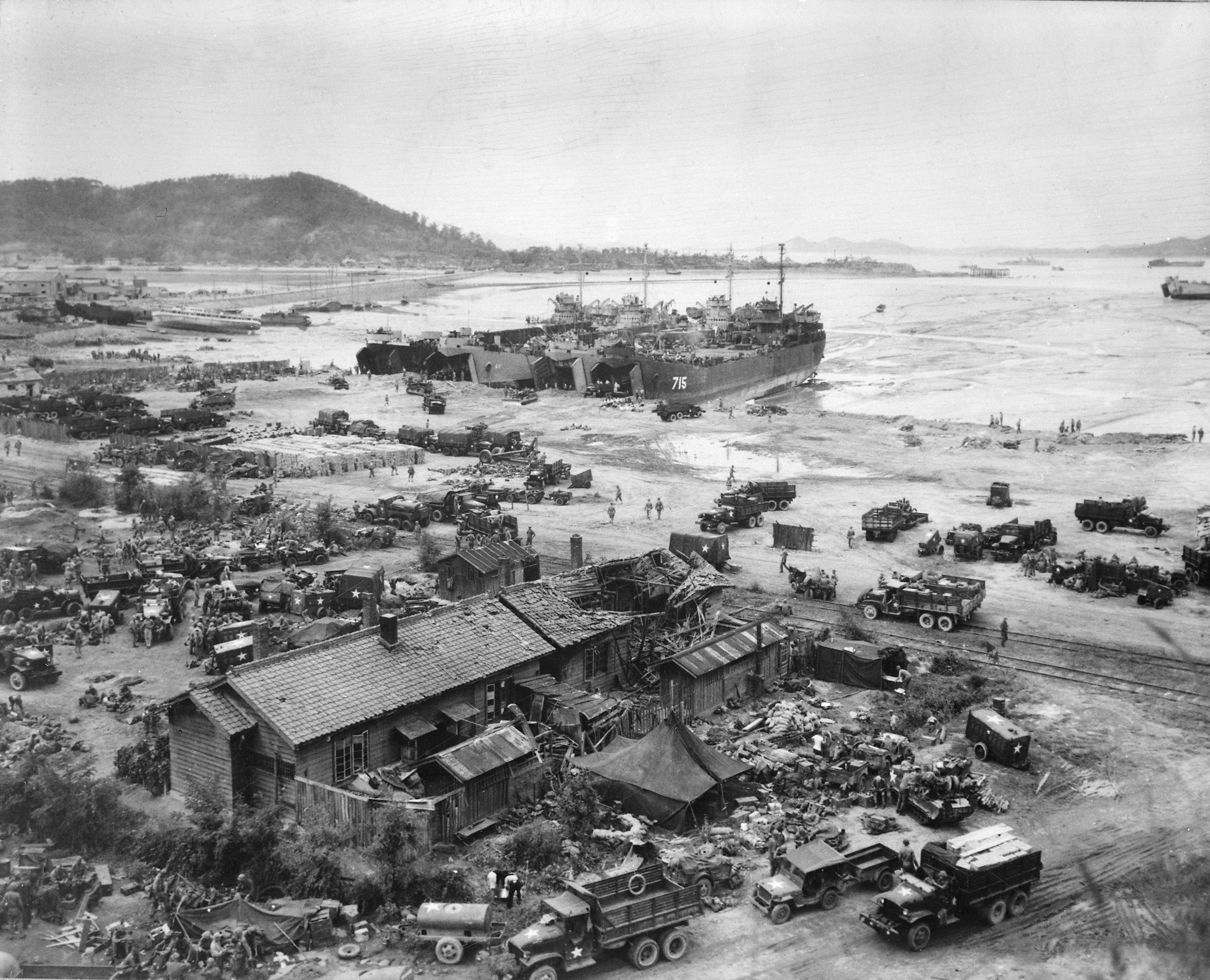
September 15, 1950, 75 years ago: General of the Army Douglas MacArthur, supreme commander of United Nations forces, launches what amounts to the Korean War's "D-Day," an amphibious landing of 40,000 infantry from 230 ships.

On June 25, troops of the Democratic People's Republic of Korea (a.k.a. North Korea), a Communist nation, and by no means democratic or a republic -- crossed the parallel of 38th degrees north latitude, and invaded the Republic of Korea (a.k.a. South Korea), which was capitalist, but hardly free.

Two days later, President Harry S Truman announced that American and other NATO forces would come to the aid of South Korea. The next day, North Korean troops took the South Korean capital of Seoul. But it was not just NATO troops, but 16 United Nations countries that came to the South's aid.

At first, it looked like that aid might be too late. On August 5, North Korea had South Korean troops backed up into the southeastern corner of the peninsula, centered on the city of Pusan (now usually written in English as "Busan"). They held what became known as the Pusan Perimeter. It was a siege, but the ROK troops were holding on.

There would be no evacuation, the way the Nationalist Chinese had gone to Taiwan the previous year; the American troops had done in the Philippines in 1942, by escaping to Australia; or the British troops had done at Dunkirk in 1940 by retreating to their home island.

It wasn't just a matter of pride: The South Koreans had no place to go. American troops could have evacuated them to the nearest friendly country, but that would be Japan, where "friendly" was a bit of a stretch: That nation had occupied them from 1910 (and had effectively ruled them from 1876) until the end of World War II in 1945 -- just 5 years earlier. And Japan was still in the rebuilding process: Taking on millions of Korean refugees was not part of the plan of their military governor.

That was MacArthur, the 70-year-old 5-star General who had been commander of Allied forces in the Pacific. In spite of his age, there was no one more qualified to lead the mission than "Big Mac." As with D-Day, the invasion of Normandy in France in 1944, the U.S. had a deception operation underway, to convince the enemy that the invasion would be elsewhere -- in this case, at Kunsan, 105 miles to the south. The Communist spy network bought it.

After 5 days of bombing to provide air support, MacArthur, invading with his troops as he had at Leyte Gulf in the Philippines in 1944, gave the green light on September 15. The invasion began at 6:30 AM, local time. As with Normandy, there were invasion points given different code names: Green Beach, Red Beach and Blue Beach. The U.N. lost 224 troops; the North Koreans, 1,350.
Within 2 days, U.S. forces were able to take Kimpo, Seoul's international airport. Within 2 more, they were able to use it to bring more troops in. By September 22, they had over 53,000 men on the ground. By September 25, Red troops had abandoned the Pusan Perimeter, and were attempting to defend their ill-gotten gains at Seoul. On September 28, they had to abandon that.

In a span of 2 weeks, MacArthur had led, for all intents and purposes, the liberation of South Korea. He wanted more: He wanted to kick the Commies completely off the peninsula. He nearly did it: By November 26, 10 weeks after the Incheon landing, he had them backed up to the Yalu River, which separates the Korean peninsula from mainland China (and, technically, makes Korea not a peninsula but an island).

China then intervened on behalf of its Communist "little brother." Again, U.N. troops were pushed below the 38th parallel. By April 1951, they had gained back most of South Korea's territory, and a line cutting southwest-to-northeast across the peninsula became like the trench warfare of World War I, 35 years earlier.

MacArthur wanted to use tactical nuclear weapons against China. Truman told him no, because that would get the Soviet Union involved, and it would be World War III. MacArthur let his objections be known to the Republican leader of the House of Representatives, Joe Martin of Massachusetts. Martin leaked this to the press. Truman found out, and fired MacArthur for subordination, replacing him with 4-star General Matthew Ridgeway, and later replacing him with 4-star General Mark Clark.

The war became a stalemate, lasting 3 years. About 327,000 Americans served in the conflict, and 36,574 were killed, with another 103,000 wounded but surviving.

It's not clear how many of those wounded, but surviving, were treated at Mobile Army Surgical Hospitals, or MASHes, which, due to the 1972-83 CBS TV series M*A*S*H, became popular culture's most familiar story of the Korean War. But, by being close to the front, they were able to save soldiers who surely would have died in the conditions of World War II. But that, and the addition of antibiotics and sulfa in World War II, saved a lot of lives that would have been lost in the conditions of World War I.

Today, Incheon is home to just under 3 million people, making it the 3rd-largest city in South Korea, behind Seoul, with 9.6 million; and Busan, with 3.3 million. Pyongyang, the North Korean capital, has 3.2 million.

Wednesday, June 25, 2025

June 25, 1950: The Korean War Begins

June 25, 1950, 75 years ago: Troops of the Democratic People's Republic of Korea -- a.k.a. North Korea, a Communist nation, and by no means democratic or a republic -- cross the parallel of 38th degrees north latitude, and invade the Republic of Korea -- a.k.a. South Korea, which is capitalist, but hardly free.

Two days later, President Harry S Truman announced that American and other NATO forces would come to the aid of South Korea. The next day, North Korean troops took the South Korean capital of Seoul.

A total of 16 United Nations countries came to the South's aid: America, Canada, Britain, France, Belgium, the Netherlands, Luxembourg, Greece, Turkey, Colombia, Ethiopia, South Africa, the Philippines, Thailand, Australia and New Zealand. In addition, Norway, Sweden, Denmark, Italy and India provided medical and other support.

On September 15, Korea had its "D-Day," as General of the Army Douglas MacArthur, despite being 70 years old, personally led an amphibious landing at Inchon. Within weeks, not only was Seoul liberated, but the North's troops were backed up to the Yalu River, separating the Korean peninsula from the People's Republic of China.

That country then intervened on behalf of its Communist "little brother." The war became a stalemate, lasting 3 years. Truman ended up relieving MacArthur of duty in April 1951, for disobeying orders, replacing him with Matthew Ridgeway. He commanded UN troops in Korea until May 1952, when he was transferred to command U.S. troops in Europe. He was replaced as UN commander by Mark Clark, who held that role until the Armistice was signed on July 27, 1953, by which point Dwight D. Eisenhower was the President.

About 327,000 Americans served in the conflict, and 36,574 were killed, with another 103,000 wounded but surviving.

Kim Il-Sung, the founder of the DPRK, remained in power until his death in 1994. His son, Kim Jong-Il, was then in charge until his own death in 2011. And his son, Kim Jong-Un, is now in charge, and is every bit as bad as his father and his grandfather. The military is well-supplied, but the civilians are poor, and many are starving.

Not that Syngman Rhee, the founder of the ROK, was a saint. South Korea may have been capitalist, but it was hardly democratic. He remained in power until being deposed in 1960, and died in 1965. South Korea's path to democracy has been difficult, including the assassination of President Park Chung-hee over fears he was bringing dictatorship back in 1979; and the impeachment and removal of his daughter, President Park Geun-hye, on corruption charges in 2017.

MacArthur died in 1964, Eisenhower in 1969, Truman in 1972, Clark in 1984, and Ridgeway in 1993. South Korea's leading General, Chung Il-kwon, served as Prime Minister from 1964 to 1970, and lived until 1994. Kim Il-Sung operated as his own commanding General.

Coming between the epic of World War II and the more recent national trauma of the Vietnam War, Korea became "the forgotten war." Even the TV series M*A*S*H, running on CBS from 1972 to 1983, didn't help much, as details were frequently gotten wrong.
The Korean War Veterans Memorial, Washington

A memorial to the American troops of the Korean War opened in 1995 on the National Mall in Washington, across from a counterpart to the Vietnam War, between the Washington Monument and the Lincoln Memorial. Surviving veterans are now age 90 and up.

U.S. forces remain on South Korean soil. These included an engineering unit to which my father was assigned in 1967 and 1968.

Friday, June 18, 2010

Nothing Makes Sense at the World Cup

Nothing makes sense at the 2010 World Cup in South Africa. Including the fact that tonight begins another Yankees-Mets series -- remember, it's not a World Series, so it's not a Subway Series -- and the Devils finally hired a new coach, and I'm talking about soccer.

Here are the things that don't make sense, in alphabetical order by country (thus allowing me to list America first, in the A's, not in the U's for "U.S." or "U.S.A."):

* My fellow Americans, we have finally arrived as a proper "football nation." We have been screwed by a referee at a World Cup. We should have beaten Slovenia.

Not that they were a bad team, but they were beatable. But we played the first half like garbage. Sorry, forgot to "speak English" there: We were rubbish, we were fucking rubbish. That first goal, it might not have been savable, but Tim Howard should have at least moved. Then we fail to get off a good shot with several chances, and the opponent comes rushing back and scores a goal when clearly offside. Throw in the hacking at our legs, and "It's just like watching Arsenal."

But Bob Bradley must've made some kind of halftime speech, because, "Two-nil, and you fucked it up!" Landon Donovan got off his ass and scored the 1st, and the coach's son Michael Bradley hit a corker in the 81st. But Maurice Edu's game-winner in the 85th was waved off for no reason other than that the referee was a bald cunt. We won fair and square, and we was robbed.

* Cameroon. Does manager Paul Le Guen realize that he has Alex Song in his side? He left Song on the bench. Does he realize that he was playing Samuel Eto'o -- arguably the best player in the world if you're going by club performance these last 2 seasons -- out of position?

* France. Paul Domenech -- who looks like Sacha Baron Cohen's character Borat -- has ruined one of the great national football teams. Patrice Evra was crying like Tonya Harding before and after the game, and this is your Captain? France are old.

* Germany destroys Australia, looking like they might be the best team in the tournament, looking more like a typically flashy Netherlands team than the dour, uber-defensive German squads we've come to know. And then they get beat 1-0 this morning by Serbia? And who do you root for in that one? Germany hasn't been committing genocide for 63 years, Serbia was last doing that only 11 years ago. The Krauts vs. the Serbs? What, did the Galactic Empire and the Cardassian Union fail to qualify? Did Darth Vader get called for a handball? Whoops, awkward comment...

* Greece. How could they look so bad against Korea, and then beat Nigeria?

* Italy are old, too. These guys won the World Cup 4 years ago, but a lot can change in 4 years, including Marcello Lippi going from genius manager to bonehead. I'm still expecting him to bring Gigi Riva and Sandro Mazzola on in the late minutes of one of their remaining games. (Note for the soccer neophyte): Those guys were superstars of the late Sixties and early Seventies, members of the Italy team that made it to the 1970 Final.)

* Korea (the real one) looked marvelous in beating Greece, but then got stripped by Argentina. And then Korea (the Red one), supposedly the worst team in the tournament, held Brazil to a standstill for three-quarters of the game, and only lost 2-1? Huh?

* New Zealand won a World Cup match. That had never happened before. I can hear Lucy Lawless singing from here!

* South Africa. Desperately trying to not become the first host country to fail to get out of the Group Stage, they had a nice 1-0 lead over Mexico before settling for a 1-1 tie, then got embarrassed by Uruguay.

* Spain. All that hype, all those Barcelona players, and they lose to Switzerland? And not because they kept getting carded for being diving cunts (or even for having Ozzfest hair), but because they couldn't score? Maybe they should have started Arsenal Captain Cesc Fabregas. If those Barca bastards want Cesc so much, they should tell manager Vicente del Bosque to start Cesc.

After 4 years of trying to learn this game since the last World Cup, I still don't get it.

Then again, I've been watching baseball for a third of a century, and I still don't understand that game. Nobody does. Maybe soccer has that in common with baseball: Just when you think you understand it, it slugs you in the gut and proves that you don't understand nothin'. If you think you do, you're deluding yourself.

As the English would say, "Bollocks."

UPDATE: Speaking of England, they only got a 0-0 draw with Algeria, supposedly a weak team. I'm too stunned to gloat.

Wayne Rooney, the "fat ugly Scouser" who spurned boyhood club Everton to go to Manchester United (hating them is one of the few things both Everton and crosstown rival Liverpool agree on), and is now regarded as the best striker in England if not the world, doesn't have the English FA and its referees to protect him in this tournament, and he's not used to not getting his way, and as the England fans booed their team off the pitch, Rooney tells an interviewer -- this is translated from whatever the hell language he speaks -- "Nice, ain't it? Own fans booing you, just 'cause you don't win a football match."

Welcome to the real world, Wooney you cunt pig bastard.