Showing posts with label north korea. Show all posts

Monday, September 15, 2025

September 15, 1950: The Incheon Landing

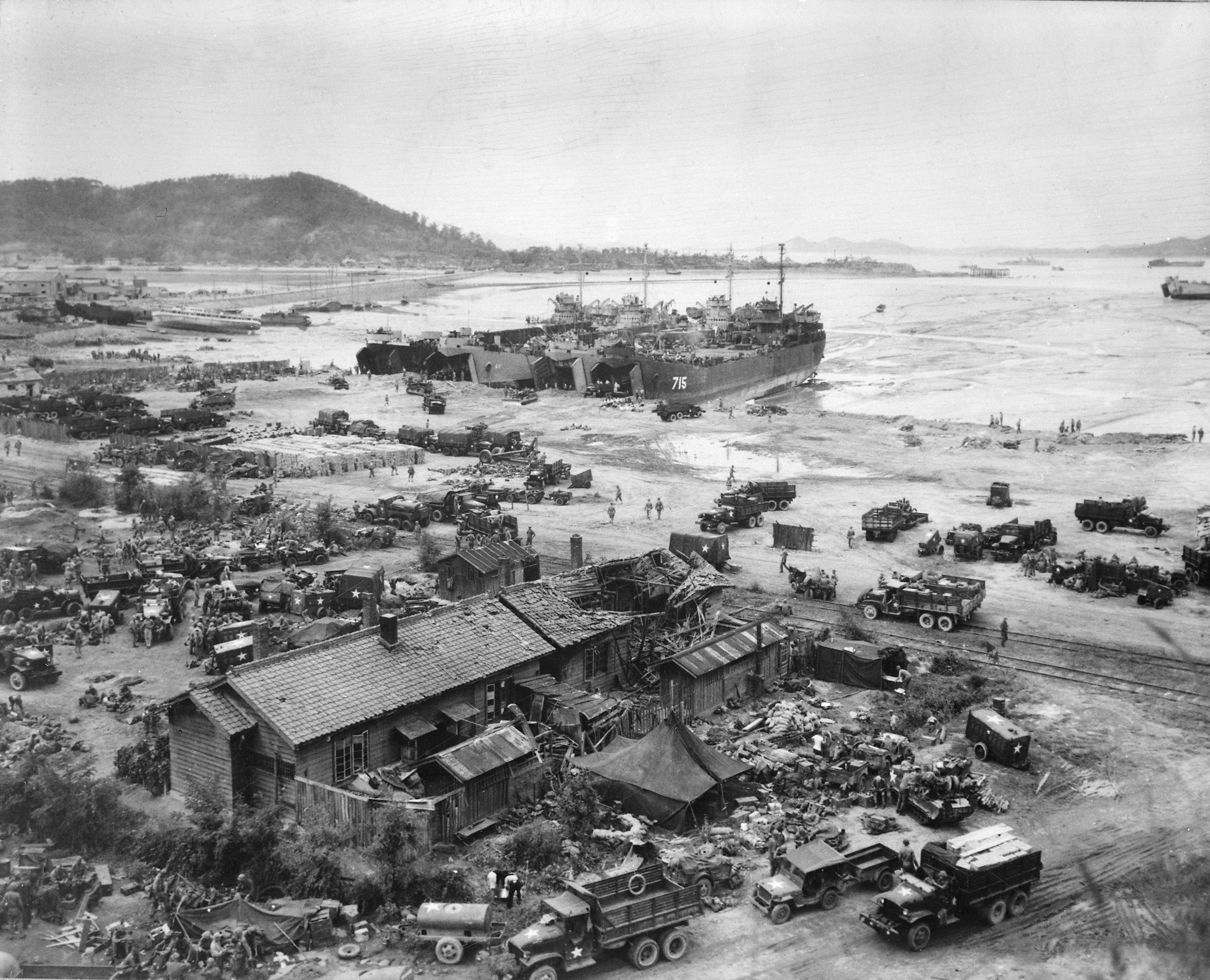
September 15, 1950, 75 years ago: General of the Army Douglas MacArthur, supreme commander of United Nations forces, launches what amounts to the Korean War's "D-Day," an amphibious landing of 40,000 infantry from 230 ships.

On June 25, troops of the Democratic People's Republic of Korea (a.k.a. North Korea), a Communist nation, and by no means democratic or a republic -- crossed the parallel of 38th degrees north latitude, and invaded the Republic of Korea (a.k.a. South Korea), which was capitalist, but hardly free.

Two days later, President Harry S Truman announced that American and other NATO forces would come to the aid of South Korea. The next day, North Korean troops took the South Korean capital of Seoul. But it was not just NATO troops, but 16 United Nations countries that came to the South's aid.

At first, it looked like that aid might be too late. On August 5, North Korea had South Korean troops backed up into the southeastern corner of the peninsula, centered on the city of Pusan (now usually written in English as "Busan"). They held what became known as the Pusan Perimeter. It was a siege, but the ROK troops were holding on.

There would be no evacuation, the way the Nationalist Chinese had gone to Taiwan the previous year; the American troops had done in the Philippines in 1942, by escaping to Australia; or the British troops had done at Dunkirk in 1940 by retreating to their home island.

It wasn't just a matter of pride: The South Koreans had no place to go. American troops could have evacuated them to the nearest friendly country, but that would be Japan, where "friendly" was a bit of a stretch: That nation had occupied them from 1910 (and had effectively ruled them from 1876) until the end of World War II in 1945 -- just 5 years earlier. And Japan was still in the rebuilding process: Taking on millions of Korean refugees was not part of the plan of their military governor.

That was MacArthur, the 70-year-old 5-star General who had been commander of Allied forces in the Pacific. In spite of his age, there was no one more qualified to lead the mission than "Big Mac." As with D-Day, the invasion of Normandy in France in 1944, the U.S. had a deception operation underway, to convince the enemy that the invasion would be elsewhere -- in this case, at Kunsan, 105 miles to the south. The Communist spy network bought it.

After 5 days of bombing to provide air support, MacArthur, invading with his troops as he had at Leyte Gulf in the Philippines in 1944, gave the green light on September 15. The invasion began at 6:30 AM, local time. As with Normandy, there were invasion points given different code names: Green Beach, Red Beach and Blue Beach. The U.N. lost 224 troops; the North Koreans, 1,350.
Within 2 days, U.S. forces were able to take Kimpo, Seoul's international airport. Within 2 more, they were able to use it to bring more troops in. By September 22, they had over 53,000 men on the ground. By September 25, Red troops had abandoned the Pusan Perimeter, and were attempting to defend their ill-gotten gains at Seoul. On September 28, they had to abandon that.

In a span of 2 weeks, MacArthur had led, for all intents and purposes, the liberation of South Korea. He wanted more: He wanted to kick the Commies completely off the peninsula. He nearly did it: By November 26, 10 weeks after the Incheon landing, he had them backed up to the Yalu River, which separates the Korean peninsula from mainland China (and, technically, makes Korea not a peninsula but an island).

China then intervened on behalf of its Communist "little brother." Again, U.N. troops were pushed below the 38th parallel. By April 1951, they had gained back most of South Korea's territory, and a line cutting southwest-to-northeast across the peninsula became like the trench warfare of World War I, 35 years earlier.

MacArthur wanted to use tactical nuclear weapons against China. Truman told him no, because that would get the Soviet Union involved, and it would be World War III. MacArthur let his objections be known to the Republican leader of the House of Representatives, Joe Martin of Massachusetts. Martin leaked this to the press. Truman found out, and fired MacArthur for subordination, replacing him with 4-star General Matthew Ridgeway, and later replacing him with 4-star General Mark Clark.

The war became a stalemate, lasting 3 years. About 327,000 Americans served in the conflict, and 36,574 were killed, with another 103,000 wounded but surviving.

It's not clear how many of those wounded, but surviving, were treated at Mobile Army Surgical Hospitals, or MASHes, which, due to the 1972-83 CBS TV series M*A*S*H, became popular culture's most familiar story of the Korean War. But, by being close to the front, they were able to save soldiers who surely would have died in the conditions of World War II. But that, and the addition of antibiotics and sulfa in World War II, saved a lot of lives that would have been lost in the conditions of World War I.

Today, Incheon is home to just under 3 million people, making it the 3rd-largest city in South Korea, behind Seoul, with 9.6 million; and Busan, with 3.3 million. Pyongyang, the North Korean capital, has 3.2 million.

Wednesday, June 25, 2025

June 25, 1950: The Korean War Begins

June 25, 1950, 75 years ago: Troops of the Democratic People's Republic of Korea -- a.k.a. North Korea, a Communist nation, and by no means democratic or a republic -- cross the parallel of 38th degrees north latitude, and invade the Republic of Korea -- a.k.a. South Korea, which is capitalist, but hardly free.

Two days later, President Harry S Truman announced that American and other NATO forces would come to the aid of South Korea. The next day, North Korean troops took the South Korean capital of Seoul.

A total of 16 United Nations countries came to the South's aid: America, Canada, Britain, France, Belgium, the Netherlands, Luxembourg, Greece, Turkey, Colombia, Ethiopia, South Africa, the Philippines, Thailand, Australia and New Zealand. In addition, Norway, Sweden, Denmark, Italy and India provided medical and other support.

On September 15, Korea had its "D-Day," as General of the Army Douglas MacArthur, despite being 70 years old, personally led an amphibious landing at Inchon. Within weeks, not only was Seoul liberated, but the North's troops were backed up to the Yalu River, separating the Korean peninsula from the People's Republic of China.

That country then intervened on behalf of its Communist "little brother." The war became a stalemate, lasting 3 years. Truman ended up relieving MacArthur of duty in April 1951, for disobeying orders, replacing him with Matthew Ridgeway. He commanded UN troops in Korea until May 1952, when he was transferred to command U.S. troops in Europe. He was replaced as UN commander by Mark Clark, who held that role until the Armistice was signed on July 27, 1953, by which point Dwight D. Eisenhower was the President.

About 327,000 Americans served in the conflict, and 36,574 were killed, with another 103,000 wounded but surviving.

Kim Il-Sung, the founder of the DPRK, remained in power until his death in 1994. His son, Kim Jong-Il, was then in charge until his own death in 2011. And his son, Kim Jong-Un, is now in charge, and is every bit as bad as his father and his grandfather. The military is well-supplied, but the civilians are poor, and many are starving.

Not that Syngman Rhee, the founder of the ROK, was a saint. South Korea may have been capitalist, but it was hardly democratic. He remained in power until being deposed in 1960, and died in 1965. South Korea's path to democracy has been difficult, including the assassination of President Park Chung-hee over fears he was bringing dictatorship back in 1979; and the impeachment and removal of his daughter, President Park Geun-hye, on corruption charges in 2017.

MacArthur died in 1964, Eisenhower in 1969, Truman in 1972, Clark in 1984, and Ridgeway in 1993. South Korea's leading General, Chung Il-kwon, served as Prime Minister from 1964 to 1970, and lived until 1994. Kim Il-Sung operated as his own commanding General.

Coming between the epic of World War II and the more recent national trauma of the Vietnam War, Korea became "the forgotten war." Even the TV series M*A*S*H, running on CBS from 1972 to 1983, didn't help much, as details were frequently gotten wrong.
The Korean War Veterans Memorial, Washington

A memorial to the American troops of the Korean War opened in 1995 on the National Mall in Washington, across from a counterpart to the Vietnam War, between the Washington Monument and the Lincoln Memorial. Surviving veterans are now age 90 and up.

U.S. forces remain on South Korean soil. These included an engineering unit to which my father was assigned in 1967 and 1968.

Wednesday, January 8, 2025

Top 5 Reasons Why Elvis Might Have Been a MAGA (And 5 Why He Would Have Left)

January 8, 1935, 90 years ago: Elvis Aaron Presley is born in Tupelo, Mississippi, and grows up in Memphis, Tennessee. He became the King of Rock and Roll, and the world was never the same.

Much has done to make him a heroic figure. Much has also been done to make him a figure of ridicule. Much like Donald Trump, whose ego far exceeded Elvis', and who never had any talent besides fraud.

Top 5 Reasons Why Elvis Might Have Been a MAGA (And 5 Why He Would Have Left)

10. Would Have Been: Elvis Supported Richard Nixon. If he supported one criminal Republican President, surely, supporting another wouldn't have been hard.

9. Would Have Left: Elvis Supported Law and Order. The famous meeting between the Memphis Flash and Tricky Dick happened on December 21, 1970, before we knew Nixon was involved in anything criminal, much less had totally, as would Trump all those years later, betrayed his commitment to "law and order." Elvis believed in law and justice. That's why he wanted to see Nixon: He wanted to be made a federal agent, even if it only meant getting a symbolic badge.

8. Would Have Been: Show of Strength. Elvis loved comic book heroes and movie heroes. At first, he would have seen Trump as one.

7. Would Have Left: Reality of Weakness. The reality would have sunk in during COVID. Elvis would have seen that Trump was afraid to do what would have helped people, because it would have made him look weak. Elvis would have hated that: He knew that helping people makes you look stronger. He didn't talk about that, he actually did it. (UPDATE: He absolutely would have loved the 2025 Superman movie: "People were going to die!" "I'm human! That's my greatest strength!")

After seeing Trump mishandle COVID, other things might have sunk in, like how submissive Trump acted before the Russians and the Saudis, and how easily Trump was moved by the flattery of North Korea's dictator Kim Jong Un. Elvis would have realized: This guy is not a strong man. He is weak.

6. Would Have Been: Trump's Macho Appeal. It's easy to imagine Elvis voting for Trump because of the image the right wing created of Hillary Clinton: The privileged Yankee outsider who turned a true poor son of the South into the same kind of left-wing extremist that she is. Elvis would have been pleased to see that "real men" were back in charge.

5. Would Have Left: Trump's Bigotry Appeals. Joe Biden said that the spark of his deciding to run for President in 2020 was the far-right demonstration in Charlottesville, Virginia on August 12, 2017. Elvis would have been disgusted by that.

And other things would have sunk in. He would have seen that Mexicans were not the people Trump was describing. He would have seen that immigrants in general were people who tended to believe in America, and, once here, obeyed the law better than did Trump himself. He would have seen that Trump believes that black lives don't matter. That use of the Army to clear the streets so Trump could do that photo-op with an upside-down Bible? That really would have chafed Elvis' chaps.

Elvis had his flaws -- including one he shared with Trump, liking women a little too young for present-day tastes -- but he was no bigot. He might not have been "woke," but he was definitely inclusive.

4. Would Have Been: Trump's Pandering to the Military. Elvis would have dug that.

3. Would Have Left: Trump's Actual Treatment of the Men and Women In Uniform -- and Veterans. Elvis was a veteran, and would not have put up with Trump calling him, or anyone else who served, "losers" and "suckers."

2. Would Have Been: The Words Themselves. Of course, Elvis would have wanted to "make America great again."

1. Would Have Left: The Words Rendered Meaningless. Elvis would have been sickened by the Insurrection of January 6, 2021. If he had still supported Trump up until that moment, that would have ended it. And no price of gas or eggs would have swayed him. (Why would it? He was rich.) And he certainly wouldn't have been dumb enough to be persuaded by, "They're eating the dogs! They're eating the cats!" That would not have turned him back to Trump.

You see, it's bad enough that Trump did the opposite of what he promised: He made America no longer great, because he rendered America no longer good.
 
But now, he wants to remake America in his image: The image of a bully who does whatever he wants, and gets away with all of it, but is really a coward at heart. And Elvis would not have put up with that.

Elvis was satisfied with being a King in nickname only. Trump wants to be King of America. And, thanks to a Supreme Court hand-picked by the Heritage Foundation and Mitch McConnell, he essentially is. Even though he is on his knees before Vladimir Putin and Mohammed bin Salman.

In many ways -- some beautiful, some excessive, and some not so good -- Elvis Presley was about as American as you can get. He wasn't brilliant, but he was smart enough to have eventually seen that Donald Trump is about as un-American as you can get.