Showing posts with label douglas macarthur. Show all posts

Saturday, April 11, 2026

April 11, 1951: President Harry Truman Fires General Douglas MacArthur

April 11, 1951, 75 years ago: President Harry S Truman fires General of the Army Douglas MacArthur as Supreme Commander of United Nations forces in the Korean War.

MacArthur's offense: Insubordination. Truman had given him orders not to further engage the Chinese forces in Korea. MacArthur had sent a letter to Representative Joseph W. Martin of Massachusetts, the Republican Party's leader in the U.S. House of Representatives -- he had been Speaker in the 1947-48 session, and would be again in that of 1953-54 -- objecting to Truman's orders.

Had Martin not mentioned this letter to the media of the time, MacArthur probably would have gotten away with it. But Truman was incensed, and decided to give MacArthur, a 5-star General and perhaps the most popular living military man in America, a lesson that every American needs to learn: One of the guiding principles of the country is civilian control of the military.

But America did not accept this at first. MacArthur returned home, and was treated as a hero. The City of New York gave him the biggest ticker-tape parade in its history, breaking the record set for Charles Lindbergh in 1927, and lasting until the Mets won the 1969 World Series.

Martin talked his opposite number in the Democratic Party, Speaker Sam Rayburn of Texas, into letting MacArthur speak before a Joint Session of Congress on April 19. There was nothing Truman could do: He did not control Congress, and had already sent Mac into forced retirement. (Mac shouldn't still have been on active duty, anyway: He was 71 years old.)

He reminisced about his time as a young soldier, and quoted "one of the most popular barrack ballads of that day, which proclaimed, most proudly, that 'Old soldiers never die, they just fade away.' And like the old soldier of that ballad, I now close my military career and just fade away, an old soldier who tried to do his duty, as God gave him the light to see that duty. Good Bye."
For the record, the line is, "Old soldiers never die, they simply fade away."

MacArthur was more popular than ever, and people began to speculate that he would run for the Republican Party's nomination for President in 1952 -- and that he would win, easily.

He refused to campaign for that nomination, figuring he didn't need to work for it, because a popular groundswell would lead to his nomination. He was wrong: It was the man he had once called "the best clerk I ever had," Dwight D. Eisenhower, who was nominated due to a popular groundswell, the closest thing to a "draft" any Presidential candidate has ever had.

Truman could have run for what would have amounted to a 3rd term -- due to the 22nd Amendment to the Constitution having been ratified a few weeks earlier, he was the last President who could have done so -- but he chose not to. He would have lost badly, as Governor Adlai Stevenson of Illinois, who turned out to be the Democratic nominee, did.

MacArthur lived until 1964. By that point, Truman's reputation, in the dumps when he left office, had recovered. He lived until 1972.

Monday, September 15, 2025

September 15, 1950: The Incheon Landing

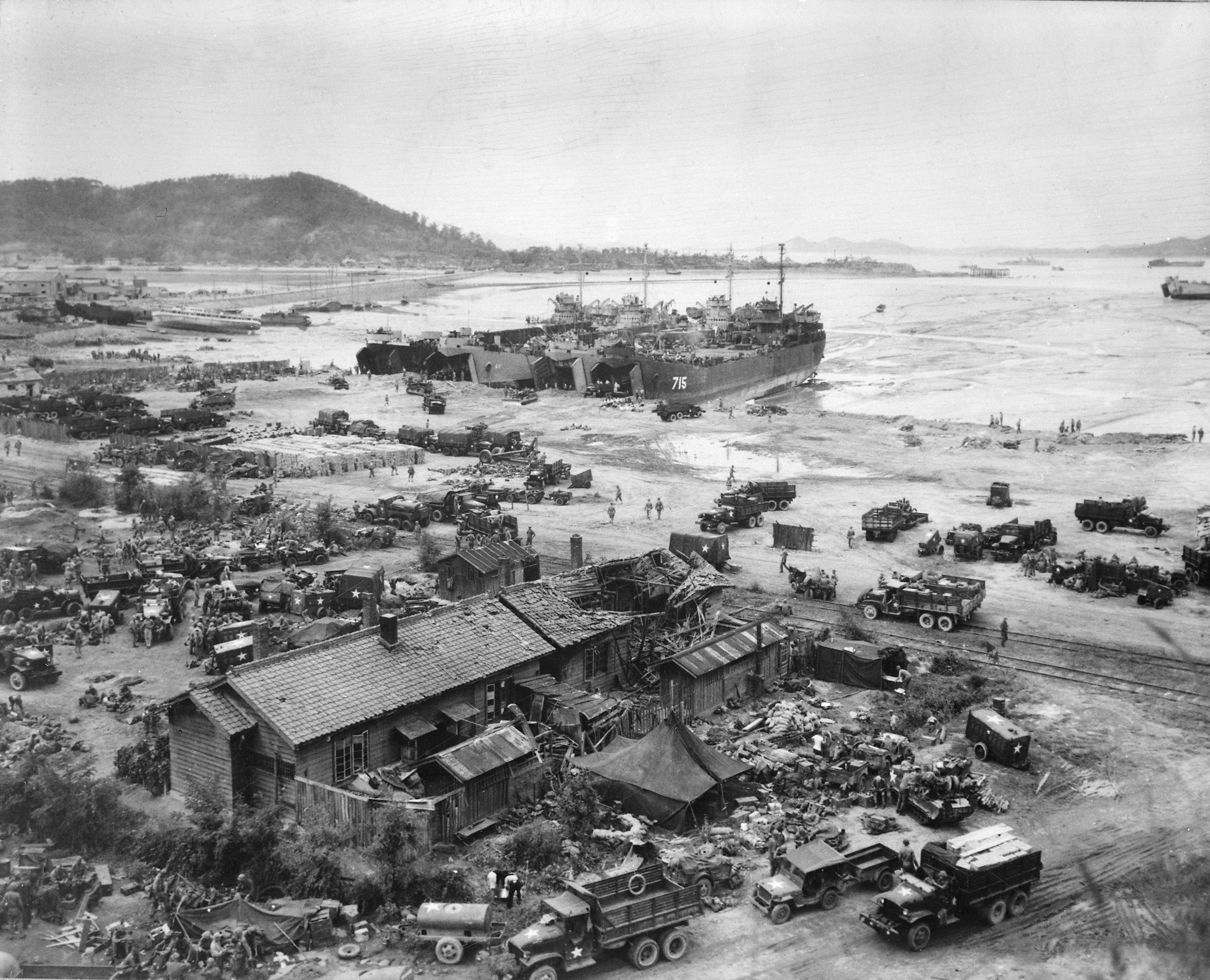
September 15, 1950, 75 years ago: General of the Army Douglas MacArthur, supreme commander of United Nations forces, launches what amounts to the Korean War's "D-Day," an amphibious landing of 40,000 infantry from 230 ships.

On June 25, troops of the Democratic People's Republic of Korea (a.k.a. North Korea), a Communist nation, and by no means democratic or a republic -- crossed the parallel of 38th degrees north latitude, and invaded the Republic of Korea (a.k.a. South Korea), which was capitalist, but hardly free.

Two days later, President Harry S Truman announced that American and other NATO forces would come to the aid of South Korea. The next day, North Korean troops took the South Korean capital of Seoul. But it was not just NATO troops, but 16 United Nations countries that came to the South's aid.

At first, it looked like that aid might be too late. On August 5, North Korea had South Korean troops backed up into the southeastern corner of the peninsula, centered on the city of Pusan (now usually written in English as "Busan"). They held what became known as the Pusan Perimeter. It was a siege, but the ROK troops were holding on.

There would be no evacuation, the way the Nationalist Chinese had gone to Taiwan the previous year; the American troops had done in the Philippines in 1942, by escaping to Australia; or the British troops had done at Dunkirk in 1940 by retreating to their home island.

It wasn't just a matter of pride: The South Koreans had no place to go. American troops could have evacuated them to the nearest friendly country, but that would be Japan, where "friendly" was a bit of a stretch: That nation had occupied them from 1910 (and had effectively ruled them from 1876) until the end of World War II in 1945 -- just 5 years earlier. And Japan was still in the rebuilding process: Taking on millions of Korean refugees was not part of the plan of their military governor.

That was MacArthur, the 70-year-old 5-star General who had been commander of Allied forces in the Pacific. In spite of his age, there was no one more qualified to lead the mission than "Big Mac." As with D-Day, the invasion of Normandy in France in 1944, the U.S. had a deception operation underway, to convince the enemy that the invasion would be elsewhere -- in this case, at Kunsan, 105 miles to the south. The Communist spy network bought it.

After 5 days of bombing to provide air support, MacArthur, invading with his troops as he had at Leyte Gulf in the Philippines in 1944, gave the green light on September 15. The invasion began at 6:30 AM, local time. As with Normandy, there were invasion points given different code names: Green Beach, Red Beach and Blue Beach. The U.N. lost 224 troops; the North Koreans, 1,350.
Within 2 days, U.S. forces were able to take Kimpo, Seoul's international airport. Within 2 more, they were able to use it to bring more troops in. By September 22, they had over 53,000 men on the ground. By September 25, Red troops had abandoned the Pusan Perimeter, and were attempting to defend their ill-gotten gains at Seoul. On September 28, they had to abandon that.

In a span of 2 weeks, MacArthur had led, for all intents and purposes, the liberation of South Korea. He wanted more: He wanted to kick the Commies completely off the peninsula. He nearly did it: By November 26, 10 weeks after the Incheon landing, he had them backed up to the Yalu River, which separates the Korean peninsula from mainland China (and, technically, makes Korea not a peninsula but an island).

China then intervened on behalf of its Communist "little brother." Again, U.N. troops were pushed below the 38th parallel. By April 1951, they had gained back most of South Korea's territory, and a line cutting southwest-to-northeast across the peninsula became like the trench warfare of World War I, 35 years earlier.

MacArthur wanted to use tactical nuclear weapons against China. Truman told him no, because that would get the Soviet Union involved, and it would be World War III. MacArthur let his objections be known to the Republican leader of the House of Representatives, Joe Martin of Massachusetts. Martin leaked this to the press. Truman found out, and fired MacArthur for subordination, replacing him with 4-star General Matthew Ridgeway, and later replacing him with 4-star General Mark Clark.

The war became a stalemate, lasting 3 years. About 327,000 Americans served in the conflict, and 36,574 were killed, with another 103,000 wounded but surviving.

It's not clear how many of those wounded, but surviving, were treated at Mobile Army Surgical Hospitals, or MASHes, which, due to the 1972-83 CBS TV series M*A*S*H, became popular culture's most familiar story of the Korean War. But, by being close to the front, they were able to save soldiers who surely would have died in the conditions of World War II. But that, and the addition of antibiotics and sulfa in World War II, saved a lot of lives that would have been lost in the conditions of World War I.

Today, Incheon is home to just under 3 million people, making it the 3rd-largest city in South Korea, behind Seoul, with 9.6 million; and Busan, with 3.3 million. Pyongyang, the North Korean capital, has 3.2 million.

Tuesday, September 2, 2025

September 2, 1945: The Battleship Missouri Surrender

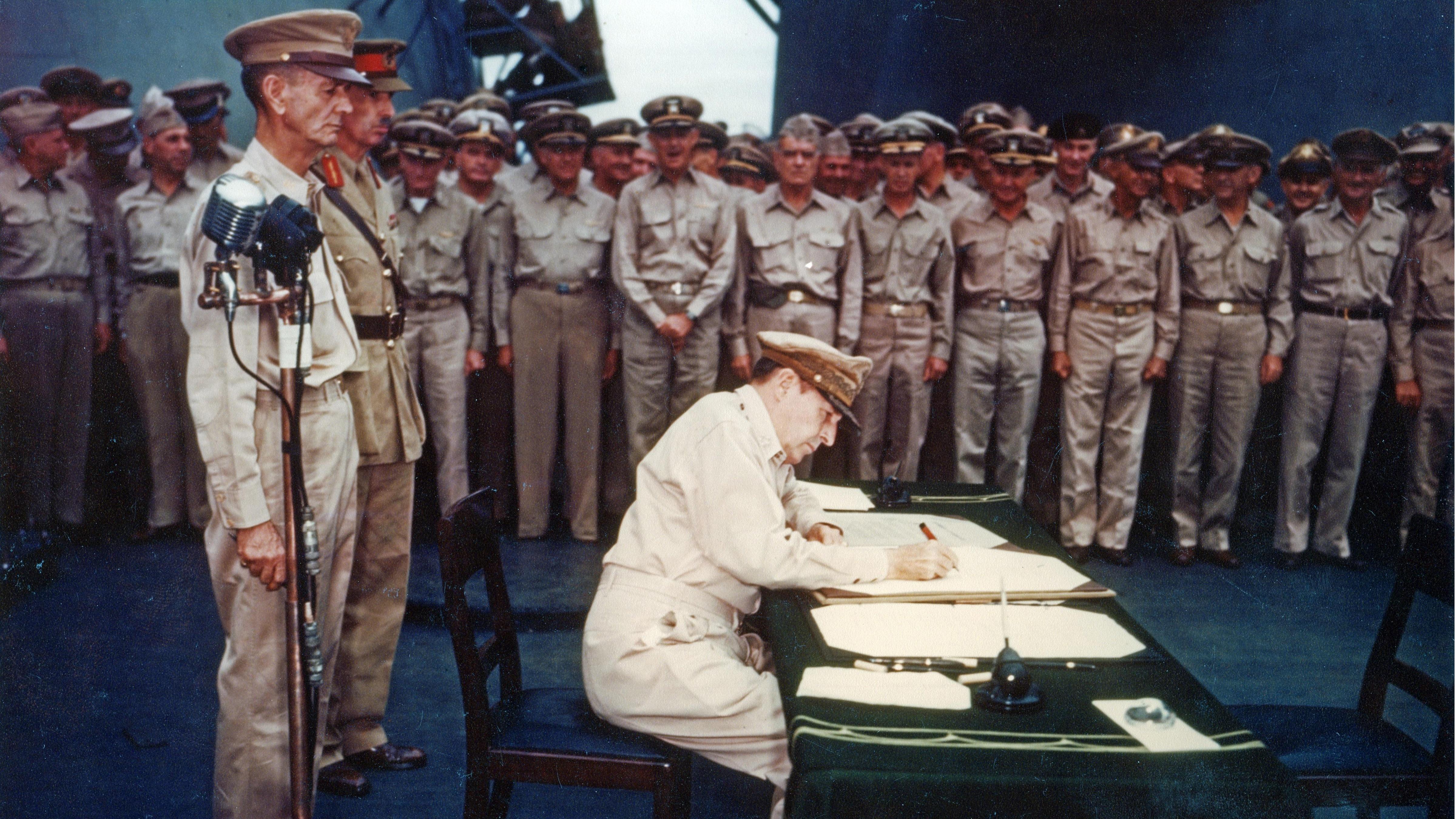
MacArthur signing, for the U.S. acknowledgement of the surrender

September 2, 1945, 80 years ago: Foreign Minister Mamoru Shigemitsu, acting for the Empire of Japan, signs the Instrument of Surrender to end World War II, on the deck of the American battleship USS Missouri, anchored in Tokyo Bay. Shigemetsu later served as Deputy Prime Minister, and died in 1957.

Representing the Allied Powers:

* The United States of America: General of the Army Douglas MacArthur, Fleet Admiral Chester Nimitz, and Admiral John S. McCain Sr., grandfather of the longtime Senator and Presidential candidate.

* The British Empire: British Admiral of the Fleet Sir Bruce Fraser, Canadian Colonel Lawrence Moore Cosgrave, Australian General Sir Thomas Blamey, and New Zealand Air Vice Marshall Sir Leonard Isitt.

* France: Général d'armée Philippe Leclerc.

* The Netherlands: Vice Admiral Conrad Helfrich.

* The Republic of China: General Xu Yongchang.

* The Union of Soviet Socialist Republics: Lieutenant General Kuzma Derevyanko.

Admiral Fraser was the last survivor of these men, living until 1981.

World War II is over, and the Allies have won. Now, the victorious nations have work to do, to set their own people free. The British Empire will get there first, mostly getting it done by 1960. France will take a little longer, due to a nasty war in Algeria. America will take until the Voting Rights Act of 1965. The Soviet Union, and the countries formed when it broke apart? Some of those countries have been free, to this day.
USS Missouri

The Missouri, built at the Brooklyn Navy Yard, was the last ship built by the U.S. Navy to be classified as a "battleship." The "Mighty Mo" also served in the Korean War, the Vietnam War, and the Persian Gulf War, and was decommissioned in 1992. It is now a museum ship – appropriately, at Pearl Harbor in Honolulu, Hawaii.

Sunday, December 15, 2024

December 15, 1944: A Big Day In "The Big One"

December 15, 1944, 80 years ago: It's a big day in World War II. Or "Double-you Double-you Two." Or "The Big One." Or, simply, "The War." As my grandmother, who lived through it, said, "Always Capital T, Capital W."

The Battle of the Bulge began. It was Nazi Germany's last stand on the Western Front. With the Allies having liberated France, and marching toward Germany itself from the West, and the Soviet Union's Red Army marching from the East, the Nazis needed a win, somewhere. On December 15, they attacked in the Ardennes Forest, which stretches over France, Belgium, Luxembourg, and even part of Germany.

They pushed forward, and formed a "bulge" in the American line, leading to the conflict being known as "The Battle of the Bulge." By the 22nd, they had the U.S. Army's 101st Airborne Division, then stationed in Bastogne, Belgium, virtually surrounded.

One of the reasons the attack was launched when it was is that the 101st's commanding officer, Major General Maxwell D. Taylor, was away, attending a staff conference. In temporary command was Brigadier General Anthony C. McAuliffe.

(In the Army, the Marine Corps, and, since its separation from the Army in 1947, the Air Force, A Brigadier General wears one star, a Major General two, a Lieutenant General three, a full General four, and a General of the Army five. In the Navy, the equivalent ranks are, respectively: Commodore, Rear Admiral, Vice Admiral, Admiral, and Admiral of the Fleet. However, the Navy discontinued the rank of Commodore in 1985.)

On December 22, the Nazi commander, General der Panzertruppe Heinrich Diepold Georg Freiherr von Lüttwitz, sent a major under a flag of truce, and delivered this message to McAuliffe:

To the U.S.A. Commander of the encircled town of Bastogne.
The fortune of war is changing. This time the U.S.A. forces in and near Bastogne have been encircled by strong German armored units. More German armored units have crossed the river Ourthe near Ortheuville, have taken Marche and reached St. Hubert by passing through Hompre-Sibret-Tillet. Libramont is in German hands.
There is only one possibility to save the encircled U.S.A. troops from total annihilation: that is the honorable surrender of the encircled town. In order to think it over a term of two hours will be granted beginning with the presentation of this note.
If this proposal should be rejected one German Artillery Corps and six heavy A. A. Battalions are ready to annihilate the U.S.A. troops in and near Bastogne. The order for firing will be given immediately after this two hours term.
All the serious civilian losses caused by this artillery fire would not correspond with the well-known American humanity.
The German Commander. 
According to those present when McAuliffe received the German message, he read it, crumpled it into a ball, threw it in a wastepaper basket, and muttered, "Aw, nuts." The officers in McAuliffe's command post were trying to find suitable language for an official reply when Lieutenant Colonel Harry Kinnard suggested that McAuliffe's first response summed up the situation pretty well, and the others agreed. The official reply was typed and delivered by Colonel Joseph Harper. It read as follows:
To the German Commander.
NUTS!
The American Commander.
The German major appeared confused, and asked Harper what the message meant. Harper said, "In plain English? 'Go to Hell.'"
The choice of "Nuts!" rather than something earthier was typical for McAuliffe. Captain Vincent Vicari, his personal aide at the time, recalled that "General Mac was the only general I ever knew who did not use profane language. 'Nuts' was part of his normal vocabulary."
The artillery fire did not materialize, although several infantry and tank assaults were directed at the positions of the 327th Glider Infantry. In addition, the German Luftwaffe attacked the town, bombing it nightly. The 101st held off the Germans until the 4th Armored Division arrived on December 26 to provide reinforcement.
The Battle of the Bulge was the largest battle ever to involve American troops, with 705,000 men eventually taking on a peak of 449,000 Germans. Losses: 75,000 Americans, 104,000 Germans. Among the Americans serving, and earning a Bronze Star and a Purple Heart, was Warren Spahn, who would survive the war and pitch his way into the Baseball Hall of Fame.
Once the American reinforcements arrived, the Nazis were doomed, both on the Western Front and overall. By January 28, 1945, they were in retreat.
A 1919 West Point graduate, McAuliffe would be awarded a Distinguished Service Cross, a Silver Star and 2 Bronze Stars over the course of his career. After General Taylor returned, McAuliffe was given command of the 103rd Infantry Division, which liberated the Kaufering concentration camp and the Austrian city of Innsbruck. He was named Commander of the Seventh Army in 1953. In 1955, he was promoted to a full General, and appointed Commander-in-Chief of the U.S. Army Europe. He retired in 1956, and lived until 1975.
Harry Kinnard, who recommended the response of "Nuts!", had already received the Distinguished Service Cross for his service in Operation Market Garden earlier in the year. He remained in the Army. During the Vietnam War, he came up with the "airmobile" concept: Using helicopters to send troops into battle and then get them out. He retired as a Lieutenant General, and lived until 2009.
Freiherr von Lüttwitz was captured in the Battle of the Ruhr Pocket on April 16, 1945, and was held as a prisoner of war until July 1, 1947. He was not charges with war crimes, was permitted to retire in peace, and lived until 1969.

*

Also on December 15, William D. Leahy was named the 1st Fleet Admiral, a 5-star Admiral. This makes him the 1st U.S. military officer, in any branch, to wear 5 stars. Regardless of official status, George Washington, Andrew Jackson and Zachary Taylor never wore more than 2 stars; while Ulysses S. Grant and John J. Pershing limited themselves to 4.

The next day, December 16, George C. Marshall was named the 1st 5-star General in U.S. history: "General of the Army." On December 17, Ernest J. King was named a Fleet Admiral. On December 18, Douglas MacArthur was named a General of the Army. On December 19, Chester Nimitz was named an Admiral of the Fleet. On December 20, Dwight D. "Ike" Eisenhower was named a General of the Army. On December 21, 1944, Henry H. "Hap" Arnold was named a General of the Army.

On December 11, 1945, after V-E Day and V-J Day, William F. "Bull" Halsey was named an Admiral of the Fleet. On May 7, 1949, Hap Arnold was made the 1st General of the Air Force. He remains the only one.

On September 22, 1950, during the Korean War, Omar Bradley was named a General of the Army, our last. Despite some calls for it, there was no promotion from 4 stars for William C. Westmoreland (Vietnam War), Colin Powell (Persian Gulf War) or Norman Schwarzkopf (also the Persian Gulf War). There has never been a 5-star General in the U.S. Marine Corps.

After World War II, it was recommended that George C. Marshall be named the 1st Field Marshal in American history. Other countries have that rank, but America doesn't. President Harry S Truman admitted that Marshall deserved it, but thought that calling him "Marshal Marshall" wouldn't be dignified. So we still don’t have the rank.

*

Also on December 15, 1944, Glenn Miller, the biggest name of the "Big Band" era of music, disappeared.

Miller was a trombonist, and led The Glenn Miller Orchestra. In 1939, they had hits with "Moonlight Serenade" and "In the Mood." In 1940, he would record "Tuxedo Junction" and "PEnnsylvania 6-5000." In 1941 came "Chattanooga Choo Choo." In 1 day, May 20, 1942, he recorded "At Last" (now better known for the 1961 version by Etta James) and "(I've Got a Gal in) Kalamazoo."

So in a span of a little over 3 years, he recorded 7 iconic songs, which led to his band being featured in some movies. They became the biggest band of the World War II years (I'm talking about popularity, not just in number of members) -- bigger than Benny Goodman's, bigger than either Tommy Dorsey's or Jimmy Dorsey's, and (no doubt helped by the fact that he and his band were white) bigger than Duke Ellington's and Count Basie's.

Miller's career came to what was expected to be a temporary interruption when he joined the war effort. He was ready to give up a civilian income of $20,000 per week -- about $354,000 in 2024 money, or around $18.4 million a year, so it was comparable to today's biggest stars -- to put on a uniform and serve his country.

At 38, he was too old to be drafted by the U.S. Army. So he volunteered for the U.S. Navy. They told him they didn't need him. So he wrote to an Army General, suggesting that he "be placed in charge of a modernized Army band."

This was done, as he was assigned to the U.S. Army Air Forces, the precursor to the U.S. Air Force. This allowed his band members -- not the same ones he had in his Orchestra -- to fly to various U.S. installations and perform for their fellow troops.

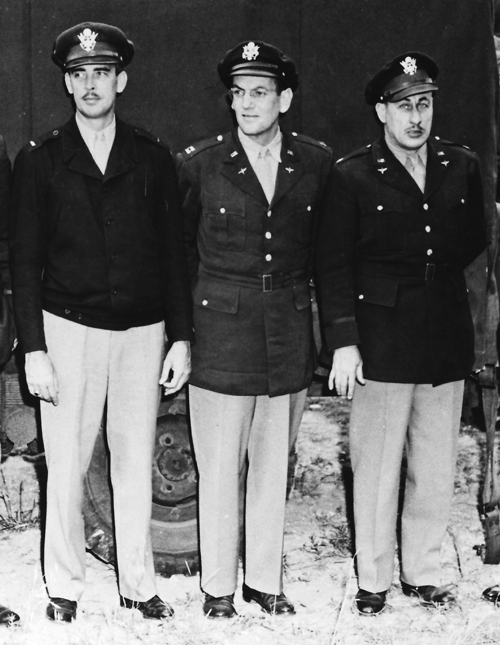
On December 15, 1944, Major Glenn Miller boarded a single-engine UC-64 Norseman at Clapham, England, heading for recently-liberated Paris, where he would establish the headquarters his band intended to have for the duration of the War. With him were 2 other officers: Lieutenant Colonel Norman Baessell, who would supervise the construction of the HQ; and the pilot, Flight Officer John Morgan.
Left to right: Morgan, Miller, Baessell

The weather was bad the day before, leading to all planes being grounded. Miller was expected to be in Paris on the 16th, but on the 15th, Baessell made a guess that there would be enough of a break in the weather to fly. So the plane took off at 1:55 PM Greenwich Mean Time (8:55 AM on the U.S. East Coast).

No one was expecting the plane to arrive in Paris that afternoon, and so, when it didn't show up, no one thought to look for it. It was only when the rest of the band arrived at Paris' Orly Airport on December 18, and Miller wasn't there to meet them, that anybody realized that anything was wrong. The intended hotel was called, and Miller hadn't checked in.

It was only on December 24, Christmas Eve, that it was announced by the Army that Miller's plane was missing and presumed lost. No trace of it has ever been found. The band's deputy leader, Technical Sergeant Jerry Gray, led the band in that evening's performance in Miller's place.

Investigations turned up nothing solid, but the most common theory is that, given the weather, the plane's carburetor iced up, causing a crash that would have killed everybody on impact with the water. Suggestions of the Nazis shooting the plane down, or a horrible mistake of "friendly fire," or Miller having made it to Paris, dying in a brothel, and having the Army cover it up were dismissed as impossible.

Miller was 39, and left behind a wife and 2 children. His wife, Helen, was given a Bronze Star awarded to him 3 months later.

Today, as with some of the other bands I mentioned, a "legacy band," authorized by the Miller estate, performs the Miller catalog. Trumpeter Ray Anthony was the last surviving member of the original Glenn Miller Orchestra. On January 20, 2024, he celebrated his 102nd birthday.

*

Finally, December 15, 1944 was the day the film Hollywood Canteen premiered, with an all-star cast. It was filmed at the real-life Hollywood Canteen, at 1451 Cahuenga Boulevard in Los Angeles.

The Canteen operated between October 3, 1942, and November 22, 1945 (Thanksgiving Day), as a club offering food, dancing and entertainment for servicemen, usually on their way overseas. It was open to servicemen of allied countries, as well as women in all branches of service.

A serviceman's ticket for admission was his uniform, and everything at the canteen was free of charge. The driving forces behind its creation were Bette Davis and John Garfield, along with Jules Stein, President of Music Corporation of America.

Davis and Garfield were both in this film. So was Roy Rogers.

Sunday, April 11, 2021

April 11, 1951: President Harry Truman Fires General Douglas MacArthur

April 11, 1951, 70 years ago: President Harry S Truman fires General of the Army Douglas MacArthur as Supreme Commander of United Nations forces in the Korean War.

MacArthur's offense: Insubordination. Truman had given him orders not to further engage the Chinese forces in Korea. MacArthur had sent a letter to Representative Joseph W. Martin of Massachusetts, the Republican Party's leader in the U.S. House of Representatives -- he had been Speaker in the 1947-48 session, and would be again in that of 1953-54 -- objecting to Truman's orders.

Had Martin not mentioned this letter to the media of the time, MacArthur probably would have gotten away with it. But Truman was incensed, and decided to give MacArthur, a 5-star General and perhaps the most popular living military man in America, a lesson that every American needs to learn: One of the guiding principles of the country is civilian control of the military.

But America did not accept this at first. MacArthur returned home, and was treated as a hero. The City of New York gave him the biggest ticker-tape parade in its history, breaking the record set for Charles Lindbergh in 1927, and lasting until the Mets won the 1969 World Series.

Martin talked his opposite number in the Democratic Party, Speaker Sam Rayburn of Texas, into letting MacArthur speak before a Joint Session of Congress on April 19. There was nothing Truman could do: He did not control Congress, and had already sent Mac into forced retirement. (Mac shouldn't still have been on active duty, anyway: He was 71 years old.)

He reminisced about his time as a young soldier, and quoted "one of the most popular barrack ballads of that day, which proclaimed, most proudly, that 'Old soldiers never die, they just fade away.' And like the old soldier of that ballad, I now close my military career and just fade away, an old soldier who tried to do his duty, as God gave him the light to see that duty. Good Bye."
For the record, the line is, "Old soldiers never die, they simply fade away."

MacArthur was more popular than ever, and people began to speculate that he would run for the Republican Party's nomination for President in 1952 -- and that he would win, easily.

He refused to campaign for that nomination, figuring he didn't need to work for it, because a popular groundswell would lead to his nomination. He was wrong: It was the man he had once called "the best clerk I ever had," Dwight D. Eisenhower, who was nominated due to a popular groundswell, the closest thing to a "draft" any Presidential candidate has ever had.

Truman could have run for what would have amounted to a 3rd term -- due to the 22nd Amendment to the Constitution having been ratified a few weeks earlier, he was the last President who could have done so -- but chose not to. He would have lost badly, as Governor Adlai Stevenson of Illinois, who turned out to be the Democratic nominee, did.

MacArthur lived until 1964. By that point, Truman's reputation, in the dumps when he left office, had recovered. He lived until 1972.