Showing posts with label korea. Show all posts

Sunday, August 9, 2026

August 9, 1936: His Name Was Sohn Kee-chung

August 9, 1936, 90 years ago: Legendary journalist Lincoln Steffens died in Carmel-by-the-Sea, California. He was 70 years old.

Meanwhile, the marathon race is held in the Olympics in Berlin, Nazi Germany. Officially, it was won by Kitei Son of Japan, a nation that would soon be an ally of the Nazis.

Unofficially, it was a much better story.

His real name was Sohn Kee-chung. He was born on August 29, 1912, in Sinŭiju, in what is now North Korea. Since 1910, however, Korea had been part of the Empire of Japan. And so, any athletes from Korea were forced to compete for Japan, under their flag, and with Japanese names.

Between 1933 and 1936, Sohn Kee-chung ran 12 marathons, finishing in the top 3 in each, and won 9. On November 3, 1935, in the Japanese capital of Tokyo, he set a world record with a time of 2 hours, 26 minutes and 42 seconds.

In the 1936 Olympics, Sohn tried to sign his name in its correct Korean form. But it was not his legal name, and so he was forced to write it in, and compete, as Kitei Son. Another Korean, Nam Sung-yong, entered the marathon, and had to compete under his legal Japanese name, Nan Shōryū. Sohn won the race in 2 hours, 29 minutes, 19.2 seconds, breaking the Olympic record. Nam finished 3rd, winning the Bronze Medal.

The International Olympic Committee, not recognizing Korea as a member, credited both medals to Japan's total. Sohn refused to acknowledge the Japanese national anthem while it was played at his award ceremony, and later told reporters that he was ashamed to run for Japan.

In 1945, Allied forces forced the surrender of Japan, and Korea was free. But, as part of the peace treaty, a line was drawn at the 38th parallel, and Communist forces had control over the northern part, including Sohn's hometown of Sinŭiju. The Korea War resulted, from 1950 to 1953, and the new border was a diagonal across the country, but roughly around the 38th parallel.

Sohn was named the team manager for Korea's national track & field team. In 1947, his trainee, Suh Yun-Bok, won the Boston Marathon, breaking the record that Sohn had set in Tokyo in 1935. For the Opening Ceremony for the 1948 Olympics in London, the entire Korean team chose Sohn to be their flag bearer. In 1950, another Sohn trainee, Ham Kee-Young, won the Boston Marathon.

In 1988, the Olympics were held in Seoul, the capital of the Republic of Korea (a.k.a. South Korea). The final runner in the Olympic torch relay, receiving perhaps the greatest ovation anyone has ever received in an Olympic ceremony, was 75-year-old Sohn Kee-chung. He attended the 1992 Olympics in Barcelona, Spain, and saw Hwang Young-Cho win the Olympic marathon.
Sohn died on November 15, 2002. Nam Sung-young, who had worked with him at the Korean Sporting Association, had died a year earlier. On December 9, 2011, the IOC recognized Korean nationality of Sohn and Nam, and all other Korean athletes under the Empire of Japan, in their official profiles.

Monday, September 15, 2025

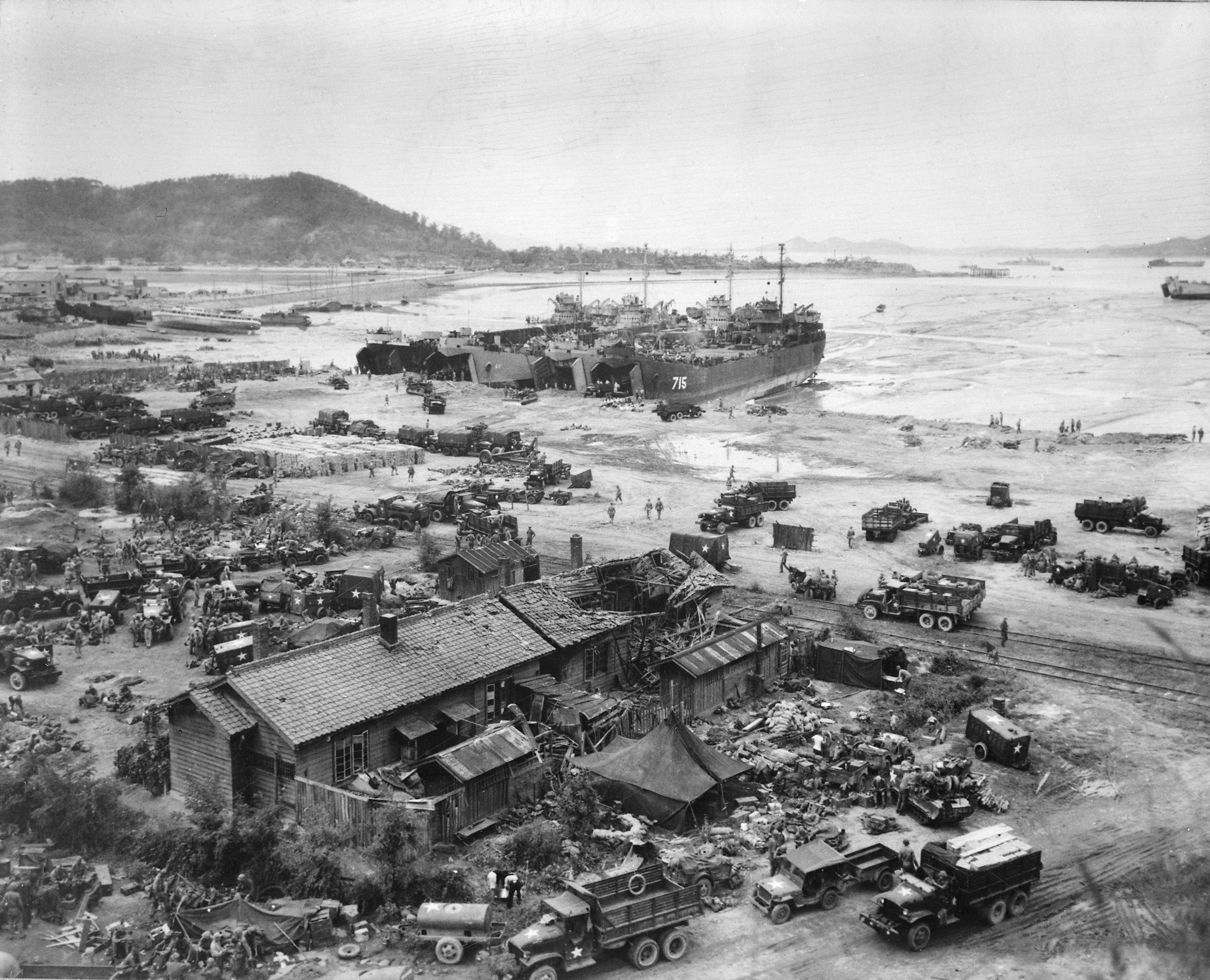
September 15, 1950: The Incheon Landing

September 15, 1950, 75 years ago: General of the Army Douglas MacArthur, supreme commander of United Nations forces, launches what amounts to the Korean War's "D-Day," an amphibious landing of 40,000 infantry from 230 ships.

On June 25, troops of the Democratic People's Republic of Korea (a.k.a. North Korea), a Communist nation, and by no means democratic or a republic -- crossed the parallel of 38th degrees north latitude, and invaded the Republic of Korea (a.k.a. South Korea), which was capitalist, but hardly free.

Two days later, President Harry S Truman announced that American and other NATO forces would come to the aid of South Korea. The next day, North Korean troops took the South Korean capital of Seoul. But it was not just NATO troops, but 16 United Nations countries that came to the South's aid.

At first, it looked like that aid might be too late. On August 5, North Korea had South Korean troops backed up into the southeastern corner of the peninsula, centered on the city of Pusan (now usually written in English as "Busan"). They held what became known as the Pusan Perimeter. It was a siege, but the ROK troops were holding on.

There would be no evacuation, the way the Nationalist Chinese had gone to Taiwan the previous year; the American troops had done in the Philippines in 1942, by escaping to Australia; or the British troops had done at Dunkirk in 1940 by retreating to their home island.

It wasn't just a matter of pride: The South Koreans had no place to go. American troops could have evacuated them to the nearest friendly country, but that would be Japan, where "friendly" was a bit of a stretch: That nation had occupied them from 1910 (and had effectively ruled them from 1876) until the end of World War II in 1945 -- just 5 years earlier. And Japan was still in the rebuilding process: Taking on millions of Korean refugees was not part of the plan of their military governor.

That was MacArthur, the 70-year-old 5-star General who had been commander of Allied forces in the Pacific. In spite of his age, there was no one more qualified to lead the mission than "Big Mac." As with D-Day, the invasion of Normandy in France in 1944, the U.S. had a deception operation underway, to convince the enemy that the invasion would be elsewhere -- in this case, at Kunsan, 105 miles to the south. The Communist spy network bought it.

After 5 days of bombing to provide air support, MacArthur, invading with his troops as he had at Leyte Gulf in the Philippines in 1944, gave the green light on September 15. The invasion began at 6:30 AM, local time. As with Normandy, there were invasion points given different code names: Green Beach, Red Beach and Blue Beach. The U.N. lost 224 troops; the North Koreans, 1,350.
Within 2 days, U.S. forces were able to take Kimpo, Seoul's international airport. Within 2 more, they were able to use it to bring more troops in. By September 22, they had over 53,000 men on the ground. By September 25, Red troops had abandoned the Pusan Perimeter, and were attempting to defend their ill-gotten gains at Seoul. On September 28, they had to abandon that.

In a span of 2 weeks, MacArthur had led, for all intents and purposes, the liberation of South Korea. He wanted more: He wanted to kick the Commies completely off the peninsula. He nearly did it: By November 26, 10 weeks after the Incheon landing, he had them backed up to the Yalu River, which separates the Korean peninsula from mainland China (and, technically, makes Korea not a peninsula but an island).

China then intervened on behalf of its Communist "little brother." Again, U.N. troops were pushed below the 38th parallel. By April 1951, they had gained back most of South Korea's territory, and a line cutting southwest-to-northeast across the peninsula became like the trench warfare of World War I, 35 years earlier.

MacArthur wanted to use tactical nuclear weapons against China. Truman told him no, because that would get the Soviet Union involved, and it would be World War III. MacArthur let his objections be known to the Republican leader of the House of Representatives, Joe Martin of Massachusetts. Martin leaked this to the press. Truman found out, and fired MacArthur for subordination, replacing him with 4-star General Matthew Ridgeway, and later replacing him with 4-star General Mark Clark.

The war became a stalemate, lasting 3 years. About 327,000 Americans served in the conflict, and 36,574 were killed, with another 103,000 wounded but surviving.

It's not clear how many of those wounded, but surviving, were treated at Mobile Army Surgical Hospitals, or MASHes, which, due to the 1972-83 CBS TV series M*A*S*H, became popular culture's most familiar story of the Korean War. But, by being close to the front, they were able to save soldiers who surely would have died in the conditions of World War II. But that, and the addition of antibiotics and sulfa in World War II, saved a lot of lives that would have been lost in the conditions of World War I.

Today, Incheon is home to just under 3 million people, making it the 3rd-largest city in South Korea, behind Seoul, with 9.6 million; and Busan, with 3.3 million. Pyongyang, the North Korean capital, has 3.2 million.

Wednesday, June 25, 2025

June 25, 1950: The Korean War Begins

June 25, 1950, 75 years ago: Troops of the Democratic People's Republic of Korea -- a.k.a. North Korea, a Communist nation, and by no means democratic or a republic -- cross the parallel of 38th degrees north latitude, and invade the Republic of Korea -- a.k.a. South Korea, which is capitalist, but hardly free.

Two days later, President Harry S Truman announced that American and other NATO forces would come to the aid of South Korea. The next day, North Korean troops took the South Korean capital of Seoul.

A total of 16 United Nations countries came to the South's aid: America, Canada, Britain, France, Belgium, the Netherlands, Luxembourg, Greece, Turkey, Colombia, Ethiopia, South Africa, the Philippines, Thailand, Australia and New Zealand. In addition, Norway, Sweden, Denmark, Italy and India provided medical and other support.

On September 15, Korea had its "D-Day," as General of the Army Douglas MacArthur, despite being 70 years old, personally led an amphibious landing at Inchon. Within weeks, not only was Seoul liberated, but the North's troops were backed up to the Yalu River, separating the Korean peninsula from the People's Republic of China.

That country then intervened on behalf of its Communist "little brother." The war became a stalemate, lasting 3 years. Truman ended up relieving MacArthur of duty in April 1951, for disobeying orders, replacing him with Matthew Ridgeway. He commanded UN troops in Korea until May 1952, when he was transferred to command U.S. troops in Europe. He was replaced as UN commander by Mark Clark, who held that role until the Armistice was signed on July 27, 1953, by which point Dwight D. Eisenhower was the President.

About 327,000 Americans served in the conflict, and 36,574 were killed, with another 103,000 wounded but surviving.

Kim Il-Sung, the founder of the DPRK, remained in power until his death in 1994. His son, Kim Jong-Il, was then in charge until his own death in 2011. And his son, Kim Jong-Un, is now in charge, and is every bit as bad as his father and his grandfather. The military is well-supplied, but the civilians are poor, and many are starving.

Not that Syngman Rhee, the founder of the ROK, was a saint. South Korea may have been capitalist, but it was hardly democratic. He remained in power until being deposed in 1960, and died in 1965. South Korea's path to democracy has been difficult, including the assassination of President Park Chung-hee over fears he was bringing dictatorship back in 1979; and the impeachment and removal of his daughter, President Park Geun-hye, on corruption charges in 2017.

MacArthur died in 1964, Eisenhower in 1969, Truman in 1972, Clark in 1984, and Ridgeway in 1993. South Korea's leading General, Chung Il-kwon, served as Prime Minister from 1964 to 1970, and lived until 1994. Kim Il-Sung operated as his own commanding General.

Coming between the epic of World War II and the more recent national trauma of the Vietnam War, Korea became "the forgotten war." Even the TV series M*A*S*H, running on CBS from 1972 to 1983, didn't help much, as details were frequently gotten wrong.
The Korean War Veterans Memorial, Washington

A memorial to the American troops of the Korean War opened in 1995 on the National Mall in Washington, across from a counterpart to the Vietnam War, between the Washington Monument and the Lincoln Memorial. Surviving veterans are now age 90 and up.

U.S. forces remain on South Korean soil. These included an engineering unit to which my father was assigned in 1967 and 1968.

Friday, September 1, 2023

September 1, 1983: The Soviet Union Shoots Down Korean Air Lines Flight 007

The Boeing 737-230B that later served as KAL007,
at Zurich International Airport in Switzerland, 1980.

September 1, 1983, 40 years ago: A particularly chilly moment in the Cold War. Korean Air Lines Flight 007 (or KAL007 for short), a Boeing 737-230B jet plane, having taken off from John F. Kennedy International Airport New York, and refueled in Anchorage, Alaska, is headed for the South Korean capital of Seoul.

It never gets there: It goes off course, crossing the Kamchatka Peninsula, part of the section of eastern Russia known as Siberia, which it was not authorized to do. This is noticed by the Soviet Union Air Defense Forces. It then crosses Sakhalin Island, the largest island under Soviet control. This is also unauthorized. Both crossings were almost certainly mistakes.

But tensions were already high. President Ronald Reagan had been building up America's nuclear missile presence, at home and abroad. Military exercises in the Pacific had gotten the Soviets' attention. They suspected that KAL007 might have been a spy plane. A commander ordered it shot down. A Soviet Su-15 interceptor did so. There were 269 people on board, including Representative Larry McDonald of Georgia. They all died.

The late Summer and the Autumn of 1983 was the most tense time in the Cold War since the Cuban Missile Crisis of October 1962. It also included a false alarm that nearly led the Soviets to launch nuclear missiles on September 26, the military exercise known as Able Archer 83 that fooled the Soviets into thinking NATO was preparing for a first strike in the 2nd week of November, and ABC's broadcast of the TV-movie The Day After on November 20.

Things calmed down after that. Soviet leader Yuri Andropov died in early 1984. His replacement, Konstantin Chernenko, died a year later. Reagan found it much easier to deal with the next leader, Mikhail Gorbachev. His reforms, liberation movements around Eastern Europe, and some of Reagan's policies led to the end of the Soviet Union and the Cold War in 1991.

Gimpo International Airport, frequently mentioned on the TV show M*A*S*H, was replaced as Seoul's main airport in 2001, by Incheon International Airport. Korean Air Lines retired flight number 007. They now use flight numbers 82, 85 and 250 in flights between JFK and Incheon, and technology is such that they no longer need to refuel at Anchorage.

Anatoly Kornukov, the General who ordered the shootdown, was never punished. Indeed, after the fall of the Soviet Union in 1991, he remained a senior figure in the Russian Air Force, serving as its Commander-in-Chief from 1998 until 2002. He died in 2014.
Major Gennadiy Osipovich, the pilot who fired the air-to-air missile that brought KAL007 down, was not told that the plane was a civilian one until 13 years later. He is still alive.

Country singer Lee Greenwood has said that he wrote the song "God Bless the U.S.A." in response to this incident. It was used so often during the Persian Gulf War of early 1991 that it's easy to forget that it's an older song.

President Reagan announced on September 16, 1983, that the Global Positioning System (GPS) would be made available for civilian use, free of charge, once completed in order to avert similar navigational errors in the future. Perhaps that would have happened eventually, but it was a step forward in the computer revolution.

Monday, June 30, 2014

Taking a Loss

In the interest of privacy, I don't post pictures of myself or my family on this blog. This time, I wanted to post a recent family photo here, but the system couldn't "read" it. I suppose it's just as well.

Instead, I've posted a picture of a veterans' poppy, in memory one particular U.S. military veteran.

My father died yesterday. The cause isn't clear, but it appears to have been peaceful. He was 71.

As you might expect, something as frivolous as a sports-themed blog is taking a back seat to trying to deal with feelings of loss and emptiness, wondering what could have been done, trying as best I can to stand up for the remaining members of my family, and assisting with funeral arrangements -- including, as you might also guess, writing and delivering a eulogy.

So my intended polemic against the Red Sox for their usual lack of class, Mike Napoli in particular for calling Masahiro Tanaka an "idiot," and the Yankees for their pathetic performance, will have to wait.

As will a new round of reaction to the World Cup. As will my trip guides for the Yankees' upcoming roadtrips to Cleveland and Baltimore. As will a tribute to Frank Cashen, who built 2 World Champions with the Baltimore Orioles and another with the Mets, and died earlier today. Most likely, I'll have time to write and post again before this coming Friday morning (July 4).

*

My father was from Newark, New Jersey, and was a classic post-World War II American nerd. Whatever difficulties he had growing up, he was able to overcome them through study, and eventually earned two science degrees at the Newark College of Engineering -- now the New Jersey Institute of Technology.

Lucky for my mother, and eventually me, the U.S. Army sent him to the site of "the last war" -- not Vietnam, but Korea. The Army needed engineers, and for a year, from Summer 1967 to Summer 1968, he was on the Demilitarized Zone, waiting for a Red invasion that could have (and still could) come at any time, but never did.

Meanwhile, his wife was back home, riding a bus to work in downtown Newark, hearing gunshots. Because of the riot in July 1967, she was in more of a war zone than he was. Both returned home safely.

He did not grow up as a sports fan.That his wife's parents, and later his son, were so wrapped up in the subject mystified him. But, as people who do not start out that way often are, he began to wonder if he might be missing something, and if getting interested might be worth it.

The old Newark Bears, a Yankee farm team and for a quarter of a century a power in the International League, left town after the 1950 season, when he was 7 years old. The Newark Eagles of the Negro Leagues also left town at around that time, victims of poaching from the now-integrated major leagues.

He didn't attend a professional baseball game until 1985, when, along with my mother and grandmother, we went to a game at the old Yankee Stadium. He didn't attend a professional game in his hometown until 2006, when I took him to see the new Newark Bears at Bears & Eagles Riverfront Stadium on Father's Day. They got clobbered, and when he expressed a desire to leave early, I saw the wisdom in it.

By the time I reached high school, he had heard me speak so much of our football team (then very good), that he wanted to see a game. Instead of the competition, or even the intellectual or the strategic side of the game, which I thought might appeal to him, he got wrapped up in the atmosphere: The crowd, the scenery (our stadium is surrounded by an "amphitheater" of trees whose changing leaves look nice in October), the marching band (music was always a passion of his, all kinds of music).

Eventually, he heard the men at his church talking about Rutgers University football so much, he decided he wanted to join them at Rutgers Stadium (now High Point Solutions Stadium), even though he had no official connection to Rutgers, or to any college with a football team. (NCE/NJIT does not have one. As far as I can determine, they never have.)

A crowd of 44,000 (now 52,000) is a lot bigger than one of 3,000. The Marching Scarlet Knights, "the Pride of New Jersey," was a considerably better-trained band than even the best high school bands. Having an armored Knight riding a real horse around the field was more impressive to him than a teenager in a Bear costume. And the Revolutionary War cannon that RU students fire off after every score was something that can't be matched in high school football. (My alma mater has one opponent that has a smaller cannon that can be very loud, but it's not the same.)

He told me that he enjoyed the atmosphere. I told him that if it was atmosphere he wanted, he should go to a game at Princeton University, RU's arch-rivals (in sports other than football, as they didn't want to leave the Ivy-League to go "big-time"). Princeton is a spirited but less rowdy town, the fans are better-behaved, and Palmer Stadium and its replacement Powers Field at Princeton University Stadium is a nicer setting. Besides, my mother already preferred Princeton as a town, and wanted me to go to school there. (Despite also being a nerd, I was also quite lazy, and I never gave myself the chance to get accepted at a school like Princeton.) He never did.

So he stayed a Rutgers fan. He never made the adjustment to the professional game, though, and in hindsight, it’s easy to see why: He preferred that the emphasis be on playing well, not just winning; and he understood the difference between a good atmosphere and mere noise. It was easy for him to imagine his Rutgers fan friends as a small part of a very large family, whereas pro football seems to take pride in being impersonal. And he understood enough to not appreciate the fact that scoreboard direction and sound effects took the place of marching bands at the pro level.

George Will said something that Dad would have understood, having had enough regimentation and enough meetings for any one man: "Football combines the two worst features of modern American life: It is violence, punctuated by committee meetings. In addition, it speaks to the increasing specialization of our culture. Who wants to be known as a third down and long yardage pulling guard?" My father had a wide range of interests, and he wouldn't want himself, or anybody else, to be known as only one thing.


Together, we saw the dedication game at the new Rutgers Stadium in 1994, a win over West Virginia -- and Rutgers hasn't beaten them since. With both teams moving to new leagues recently, it may be many years before they get another chance.

We saw Donovan McNabb lead Syracuse to a 50-3 blowout win in a Thursday night ESPN broadcast. We saw Michael Vick lead Virginia Tech to a 58-20 rout. We saw some better moments, too, including a 2005 win over Navy that clinched Rutgers' first "real" appearance in a bowl game. I wasn't there, but he saw what remains RU's signature win, the 2006 win over the University of Louisville.

He also saw the win against Army at MetLife Stadium in 2010, when linebacker Eric LeGrand was paralyzed. I wasn't at that game, but the whole family -- me, him, my mother, my sister, her husband, and her two daughters -- saw a Somerset Patriots game in 2012 where, in a nice move that we did not know would happen, LeGrand was introduced in a pregame ceremony honoring efforts to raise money for spinal cord research.

He indulged my love of baseball, but would tease me a little when the Yankees didn't do well. I reached a point where I stopped taking that personally, but for years I resented it. He kept telling me he wasn't a Mets fan, but, in my teenaged mind, I thought, "What other team would be his?"

The game that stands out with the two of us watching together -- on television, not live -- was on October 19, 1999, Game 6 of the National League Championship Series between the Mets and the Atlanta Braves. The Mets had trailed the series three games to none, but had won two, including Game 5, in 15 innings, in the rain, with a walkoff home run, just like the Yankees had done against the Seattle Mariners in the 1995 American League Division Series -- this time, it was Robin Ventura doing what Jim Leyritz had done.

But in Game 6 in Atlanta, the Mets fell behind 5-0. And yet, they came back to take an 8-7 lead, and 9-8 in the 10th inning. But the Braves refused to give up, too, and kept it going.

Not having any love for the team that represented a region with too many ignorant rednecks, but seeing him every bit as fascinated by the spectacle as I was, I told him, "This game is a classic, and it deserves to end with a hero, not with a goat."

Had Andruw Jones gotten a hit to win the game, and thus the Pennant, with the bases loaded in the bottom of the 11th, I would have been fine with it as a baseball fan (if not wanting either team to enjoy the success that would result from winning it).

Instead, Met manager Bobby Valentine brought in Kenny Rogers -- not the country singer, whom my Dad and I both liked a lot. This Kenny Rogers would have pitching success everywhere he went, except New York. (He was the reason the Yankees fell into the 6-0 hole that another postseason homer by Leyritz got us out of in Game 4 of the 1996 World Series, also in Atlanta against the Braves.) And Rogers walked Jones to force home the Pennant-clinching run.

"I don't believe it," I groaned, thinking that the Mets, who seemed to be generating a team-of-destiny thing, couldn't and shouldn't have let their season come to such an ignominious end. "Believe it," Dad said, with a half-smile and a chuckle.

By this point, he had surpassed me as a sports fan in one aspect: He understood the Mets better than I did: 1969 and 1986 being brief interruptions, they would always be the Mets. He certainly wasn't surprised the next year, when the Yankees beat the Mets in the World Series, largely because of the Mets' baserunning blunders.

Tonight, the Mets were in Atlanta again. They had a 3-1 lead on the Braves in the bottom of the 8th, but made 3 errors, and lost 5-3.

He would think that not much has changed.

But he always looked forward. Even in his not-that-old age, he still seemed young. He believed there was always something new to do, and that there was always something interesting to find out.


And that's a good lesson from any one person to another, especially from a father to a son.