Showing posts with label congress. Show all posts

Sunday, November 16, 2025

November 16, 1995: The Gingrich Tantrum

November 16, 1995, 30 years ago: President Bill Clinton's victory in the federal government shutdown is sealed when the New York Daily News prints a front-page cartoon, showing the Speaker of the House, and the leader of the Republican Party's move to make drastic cuts in the federal budget, as a "cry baby."

After the failure of his health care initiative in 1994, Clinton saw his Democratic Party battered in the midterm elections, with the Republicans taking both houses of Congress. Bob Dole, from Russell, Kansas, regained the office of Senate Majority Leader that he had held in 1985 and 1986, having been the Minority Leader from 1987 to 1994.

And Gingrich, a Pennsylvania native who moved to the Atlanta suburb of Marietta, Georgia to teach at a college, and was first elected to Congress in 1978 and used fiery rhetoric to get into the Republican Party's leadership in the U.S. House of Representatives in 1989, became the Speaker of the House.
Dole was considered mean, a reputation he got in his 1976 Vice Presidential debate with Walter Mondale, and deepened in his 1988 Presidential run. But, politically speaking, he was still a center-right candidate, willing to compromise for the greater good of the country. Gingrich was not: He was frequently called a "firebrand" and a "bombthrower."

Like most politicians, especially Republicans, he wanted to balance the federal budget. But his plan severely cut social services -- and also seriously cut taxes, especially on the wealthy. This didn't work when Ronald Reagan was President in the 1980s, and actually created the harsh economic conditions that led to Clinton's election in 1992. As we have since seen, it didn't work in 2001, and it didn't work in 2017. It would not have worked in 1995.

Every year, the federal budget takes effect on October 1. To put it another way: "Fiscal Year 1996" ran from October 1, 1995 to September 30, 1996. If no deal between Congress and the President is in place by October 1, they can pass a "continuing resolution," or "CR": For the length of the resolution, the proportions of the previous fiscal year continue.

But Clinton and the Republicans controlling Congress couldn't reach a deal by September 30. So they passed a CR that ran until November 13. But the Republicans refused to pass a new budget or a new CR by November 14. So, at 12:00 Midnight on November 13, the federal government shut down, because it was not legally permitted to spend any more money. People were still working for it, but without pay.

And the Republicans went before the media and said it was Clinton's fault. Except Clinton also went before the media, and pointed out that he was still willing to make a deal, and the Republicans weren't. Finally, he called Dole and Gingrich into the Oval Office. So often willing to compromise on things, seemingly desperate to get re-elected, not wanting to be a one-term President like 3 of the last 4 (Gerald Ford, Jimmy Carter, and George H.W. Bush), but angering many in his own party, Clinton stiffened his spine, and told them, "I don't care if I go down to 5 percent in the polls. If you want that budget signed into law, you're going to have to get somebody else behind this desk."

For once, Clinton held his ground. And polls showed that more people supported his stance than the Republicans' stance. Once the Daily News printed that front page, and blow-ups of it were displayed on the floor of the very House of which Gingrich was Speaker, their approval rating plummeted. It has never again reached its 1995 height.

Clinton had invited Dole and Gingrich to go with him to the funeral of the assassinated Prime Minister of Israel, Yitzhak Rabin -- certainly, a gesture of respect, if not reconciliation. But the article accompanying the cartoon alleged that, on the flight back, Gingrich wanted to talk about the budget impasse, Clinton didn't, and Clinton made Gingrich get off Air Force One at the back entrance, and Gingrich got upset about these developments.

Was it true? Only Clinton and Gingrich know for sure. The problem was, given Gingrich's own actions over the 17 years he'd served in Congress to that point, the story was completely believable. He had lived by the persona of a guy who tapped into people's emotions, and now, politically, he was dying by them. His tantrums had worked pretty well when he was in the opposition to House Democrats like his predecessors as Speaker, Jim Wright of Texas and Tom Foley of Washington State. They did not work when he had a position of power, and they certainly didn't work against a political talent like Clinton.
That front page became the Daily News' 2nd-best-known ever, trailing only the October 30, 1975 front page concerning another budget mess, that of New York City, when President Ford refused to use federal money to bail the City out. The News' front page read, "FORD TO CITY: DROP DEAD." That headline probably cost Ford the State of New York in the 1976 election, and thus the election itself. Having brought down a President, now, 20 years later, the News was bringing down a Speaker.

Finally, on November 19, the Republicans caved. And when the general election campaign got underway, the Democrats aired commercials showing Dole and Gingrich together so many times, it began to look like Gingrich was Dole's running mate, instead of his actual choice, Jack Kemp, former pro quarterback and Congressman from New York.

Once the Democrats had their convention, Clinton and his running mate, Vice President Al Gore, solidified their lead, and Dole and Kemp never really challenged them. Dole didn't run a bad campaign, but once Clinton won the battle over the budget, Dole never had a chance.

What no one yet knew was that the government shutdown, at the same time that it was securing Clinton's win, was also setting the stage for the biggest crisis of his Presidency: Among the volunteers working in the White House during the government shutdown was a young woman named Monica Lewinsky.

But the public's backlash against the Republicans' effort to impeach Clinton led to the Democrats gaining seats in the 1998 Congressional elections. Gingrich's marital infidelities had been at least as notorious as Clinton's, and the Republicans didn't care. But now, they cared: To the conservative movement, everything is acceptable except losing, and Gingrich was forced to step down, not just from the Speakership but from Congress.

Monday, March 17, 2025

March 17, 2005: Congress vs. Baseball's Steroid Cheats

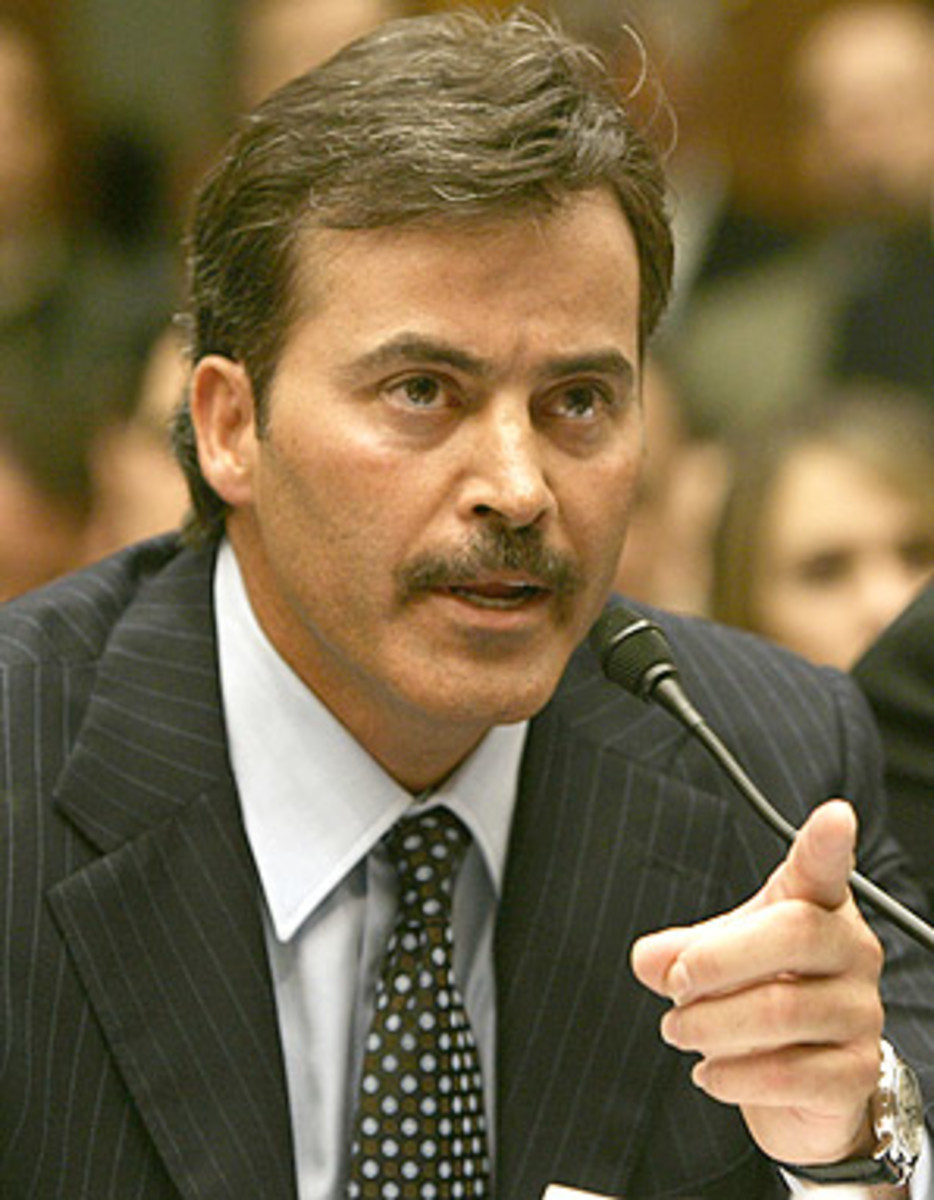
Rafael Palmeiro: Slugger, Cheater, Perjurer

March 17, 2005, 20 years ago: The Government Reform Committee of the U.S. House of Representatives holds a hearing on the topic of performance-enhancing drugs in Major League Baseball.

A few weeks earlier, former Oakland Athletics slugger Jose Canseco published a book titled Juiced: Wild Times, Rampant 'Roids, Smash Hits & How Baseball Got Big. In addition to details about his career and his personal life, he named names, revealing that some of the biggest stars in the game -- some already having been suspected as having done so, some not yet widely suspected -- used steroids.

He also gave the opinions that steroid use is not in and of itself a bad thing, as long as the person using them is being monitored by a physician and the dosages are small; that steroids cannot only improve the game of baseball, but also improve and lengthen lives; and that more research needs to be done on the topic.

Canseco himself testified before the Committee, and asserted that his opinions on steroids were sincere, and that the facts he had given in the book were true. Among the other players who were called to testify were 3 players that Canseco named in the book as having used PEDs: Mark McGwire, Sammy Sosa and Rafael Palmeiro.

McGwire had been Canseco's teammate on the Oakland Athletics' American League Pennant winners of 1988, 1989 and 1990. Palmeiro had been his teammate with the Texas Rangers in 1992 and 1993. He was never a teammate of Sosa.

In the 1998 season, McGwire and Sosa both surpassed Roger Maris' single-season record of 61 home runs, with McGwire finishing with 70 and Sosa with 66. In 1999, they both surpassed Maris again, with McGwire hitting 65 and Sosa 63.

Palmeiro, like Canseco born in Cuba and taken to Miami by his family as a boy, had twice hit 47 in a season, hardly an outrageous total, and never topped that. But, entering the 2005 season, he had 551 career home runs, while Sosa had 574, and McGwire had retired after the 2001 season with 583. Even with the advantage of steroids, Canseco last played in 2001, and had "only" 462 homers, hitting 46 in that homer-happy season of 1998.

In his testimony, Sosa, a native of the Dominican Republic, played dumb, pretending that his ability to speak proper English had declined. His attorney read a statement: "To be clear, I have never taken illegal performance-enhancing drugs. I have never injected myself, or had anyone inject me, with anything. I have not broken the laws of the United States, or the laws of the Dominican Republic. I have been tested as recently as 2004, and I am clean."

McGwire avoided the question as best he could: "My lawyers have advised me that I cannot answer these questions without jeopardizing my friends, my family, and myself. I will say, however, that it remains a fact in this country that a man, any man, should be regarded as innocent unless proven guilty." He added, "I'm not here to talk about the past. I'm here to be positive about this subject."

Except the Committee was there to talk about the past.

Palmeiro did not avoid the question the way McGwire and Sosa did. He pointed his finger at the Committee members, and said, "Let me start by telling you this: I have never used steroids, period. I don't know how to say it any more clearly than that. Never."

Not called to testify at that time was Barry Bonds, who had already broken McGwire's record by hitting 73 home runs in 2001, and was on his way to surpassing Hank Aaron's career record, finishing with 762 after the 2007 season.

On July 15, 2005, playing for the Baltimore Orioles, Palmeiro collected his 3,000th career hit. At the time, the only players to have previously achieved that milestone and 500 home runs were Hank Aaron, Willie Mays and Eddie Murray.

But on August 1, it was revealed that Palmeiro had tested positive for steroids, and he was suspended for 10 games. Upon his return, he was heavily booed by the Baltimore fans, and was held out of the lineup after August 30, and was released after the season. He was just short of turning 41, and was still a productive player. But he was now unhireable, and never played in the major leagues again. He was never charged with perjury for lying to Congress under oath.

In 2009, by then retired with 609 home runs, Sosa was exposed as having failed a steroid test in 2003. He was not prosecuted for perjury, either.

In 2010, offered a coaching position, McGwire knew he had to finally come clean, and talk about the past: "I wish I had never touched steroids. It was foolish, and it was a mistake. I truly apologize. Looking back, I wish I had never played during the Steroid Era."

Major League Baseball cracked down on steroids more heavily after 2005. Nevertheless, some exposed steroid cheats were allowed to continue to play. In 2022, David Ortiz was elected to the Baseball Hall of Fame. Bonds, McGwire, Sosa, Palmeiro, Alex Rodriguez, and Gary Sheffield -- like Ortiz, all members of the 500 Home Run Club who were caught using performance-enhancing drugs -- have not been.

Saturday, March 1, 2025

March 1, 1945: FDR's Last Speech

March 1, 1945, 80 years ago: President Franklin D. Roosevelt addresses a Joint Session of Congress, at the Capitol Building in Washington.

Just 18 days earlier, he had concluded the Yalta Conference, meeting with Prime Minister Winston Churchill of Britain and Premier Joseph Stalin of the Soviet Union, in the Crimea, on Stalin's home turf. They discussed how to finish the European and Pacific phases of World War II, and what to do with the defeated nations afterward, and how to rebuild the postwar world.

Due to having contracted polio in 1921, whenever FDR had to give a public speech, would be "walked" up to the podium by holding onto a cane with one hand and an aide's arm with the other. His braces would be adjusted so that he could stand, and he would then deliver his speech.

But now, early in his 4th term, he was 63 years old, tired, and sick: His blood pressure was much too high, and he had heart disease. As I said, it had been 18 days since Yalta had wrapped up. Had he been healthy, then, given the transportation modes then available, he could have needed only about half that to get home and prepare his remarks for Congress.

And it wasn't just rest he needed: He wasn't going to be able to stand to make the speech. For the 1st time, he addressed Congress from his wheelchair. Also for the 1st time during his Presidency, in an address broadcast coast-to-coast over the nation's radio networks, he made a public reference to his disability. 

He began as follows: "I hope that you will pardon me for this unusual posture of sitting down during the presentation of what I want to say. But I know that you will realize that it makes it a lot easier for me not to have to carry about ten pounds of steel around on the bottom of my legs; and also because of the fact that I have just completed a fourteen-thousand-mile trip." The members of Congress applauded.

He added, "First of all, I want to say, it is good to be home." More applause. He went on: "It has been a long journey. I hope you will also agree that it has been, so far, a fruitful one. Speaking in all frankness, the question of whether it is entirely fruitful or not lies to a great extent in your hands. For unless you here in the halls of the American Congress, with the support of the American people, concur in the general conclusions reached at Yalta, and give them your active support, the meeting will not have produced lasting results."

In other words, unless Congress properly funded the Department of War to end the job of the war, and the Department of State to start the job of the peace, then the war effort, which had already killed about 300,000 Americans, would have amounted to nothing.

Roosevelt went on to explain the progress of our fighting men. U.S. troops had already crossed into German territory. Six days later, they would cross the Rhine River at the Ludendorff Bridge. He spoke of why Yalta was chosen as the site, because it was once a Black Sea resort, and of what the Nazis had done to devastate it. So he spoke of how the Nazis had to pay for what they'd done, but that the German people shouldn't have to suffer any further.

And he spoke of building a new international organization to replace the failed League of Nations, the United Nations, with a Charter that would be based on the Constitution of the United States.

He also said, "On the way back from the Crimea, I made arrangements to meet personally King Farouk of Egypt; Halle Selassie, the Emperor of Ethiopia; and King Ibn Saud of Saudi Arabia. Our conversations had to do with matters of common interest. They will be of great mutual advantage because they gave me, and a good many of us, an opportunity of meeting and talking face to face, and of exchanging views in personal conversation instead of formal correspondence."

He said, "Twenty-five years ago, American fighting men looked to the statesmen of the world to finish the work of peace for which they fought and suffered. We failed them then. We cannot fail them again, and expect the world again to survive."

Ever since the Yalta Conference, conservatives have claimed that FDR "betrayed" Eastern Europe by leaving it to Stalin there. But the war was not over. Germany was still fighting, even if the end, there, was in sight. Japan was still fighting, with no end in sight. The Battles of Iwo Jima and Okinawa were yet to come. FDR needed the Soviet Union in that fight.

The Red Army was already in control of most of Poland by the time they met at Yalta. In other words, Poland and Eastern Europe were not Roosevelt's to "sell." Stalin already had already "bought" them, his "currency" being the lives of millions of Soviet soldiers.

FDR also knew that the United Nations would be stronger after the war if the Soviets were in it. He agreed to some concessions at Yalta, for the same reason he cut his social programs short, telling a reporter, "Dr. New Deal had to give way to Dr. Win the War."

FDR never made another public speech. This address, and his Inaugural Address on January 20, would be his only public appearances in the U.S. during his 4th term. He left Washington, and returned to his home in Hyde Park, New York. But he didn't think he was getting the rest he needed there. So, on March 30, he left for his "Little White House" in Warm Springs, Georgia, where he had previously gone in his vain attempt to regain the use of his legs. He died there on April 12. Not only was the war not finished, but Adolf Hitler was still alive and in charge -- albeit of a quickly crumbling Third Reich.

After FDR's death, it was 18 days before Hitler killed himself, rather than be taken by Soviet troops; 26 days before Germany surrendered, V-E Day; and 134 days before Japan surrendered, V-J Day.

Between the lasting legacy of the New Deal, and the way he set things up for the postwar world, perhaps FDR's greatest achievement was building a world that didn't need him anymore.

Monday, February 12, 2024

February 12, 1999: President Bill Clinton Is Acquitted

February 12, 1999, 25 years ago: President Bill Clinton is acquitted by the U.S. Senate in an Impeachment trial.

There were 4 Articles of Impeachment drawn up by the House's Committee on the Judiciary, and 2 of them passed the full House, with a 2/3rds' majority, of the Senate, 67 out of 100, required to vote "Guilty" in order to remove him from office:

* Perjury before a grand jury: 55 Nay, 45 Yea. All Democrats voted Nay. Republicans voting Nay: Ted Stevens of Alaska, Richard Shelby of Alabama, Olympia Snowe and Susan Collins of Maine, Arlen Specter of Pennsylvania, John Chafee of Rhode Island, Fred Thompson of Tennessee, Jim Jeffords of Vermont, John Warner of Virginia, and Slade Gorton of Washington. 

Specter had been a Democrat until switching parties as a young prosecutor in 1965, and would switch back in 2009. Shelby had been a Democrat until 1994, when the Republicans won the Congressional majority, and he cowardly joined them. Chafee died later in the year, and was succeeded by his son, Lincoln Chafee, who later switched parties. Jeffords switched parties in 2001.

* Obstruction of Justice: 50 Yea, 50 Nay. All Democrats voted Nay. This time, Stevens, Shelby, Thompson, Warner and Gorton voted to convict, while the other Republicans stayed consistent.

The case was based on Clinton's attempt to hide the fact that he had an extramarital relationship with Monica Lewinsky, a former White House intern. It had nothing to do with using the power of his office to commit election fraud, as was the case with Richard Nixon, who resigned in 1974 before the full House could vote on Articles of Impeachment; and with Donald Trump, who was impeached in 2019 and acquitted early the next year.

The evidence against Clinton was so ridiculous, the Republicans, who held the majority, could not get a majority, 51 votes, to say that he had done it. Surely, there were some Senators who knew he was innocent, but voted "Guilty" anyway, because, like the leaders of the impeachment movement in the House, they hated him so much.

And yet, with Speaker Newt Gingrich having resigned before the impeachment, once the trial was over, things calmed down considerably. Over the last 2 years of Clinton's Administration, the White House and the Congress worked together much better, got some things done, and kept the good economy going. It can be argued that, by the end of the year, decade, century and millennium, America had never been in better shape. Maybe, it still hasn't.

Of the 50 Republican Senators who voted "Guilty" on at least 1 Article of Impeachment, 3 are still serving in the Senate, 25 years later:

* Chuck Grassley of Iowa, elected with the "Reagan Robots" Class of 1980, now the last remaining member of that class, and the longest-serving active Senator.

* Mitch McConnell of Kentucky, elected in 1984, the 2nd-longest-serving active Senator, and the Republicans' longest-serving Senate Leader, in that post 2007.

* And Mike Crapo of Idaho, who had been elected to the Senate just before the Impeachment vote, and thus voted to both successfully impeach Clinton in the House and unsuccessfully convict him in the Senate. (And that's pronounced KRAY-poh, not CRAP-o, although confusion would be understandable.)

Thursday, January 6, 2022

A Year Since the Insurrection At the Capitol

January 6, 2021, 1 year ago: Treason was committed by supporters of the sitting President of the United States, and possibly by the President himself.

These facts are not in dispute:

* September 29, 2020: President Donald J. Trump, having been nominated by the Republican Party for a 2nd term, was debating the Democratic Party's nominee, former Vice President Joseph R. Biden Jr. Trump was asked about right-wing groups, including the one calling themselves the Proud Boys: "Proud Boys, stand back, and stand by."

* November 3: Election Day. For most of the night, Trump led in Electoral Votes and popular votes.

* November 4: After midnight on Election Day, things began to change, because votes on the West Coast, which were always expected to favor Biden, began to come in. Biden surpassed Trump in the popular vote, and the Electoral Vote became very close, as several States saw Trump's lead in them shrink, and eventually turn toward Biden.

* November 7: Most major news outlets admit that Biden has a lead in the State of Pennsylvania that is so large, Trump cannot possibly retake it. Therefore, if every other State still in doubt still falls to Trump, Biden will still have the 270 Electoral Votes necessary to win the election. Joe Biden is now the President-elect.

Biden makes a victory speech that night in his hometown of Wilmington, Delaware. Trump refuses to concede.

* December 7: The Republican Party of the State of Arizona -- a state narrowly won by Biden -- sends out a communication, asking supporters if they were willing to give their lives fighting over the election results.

* December 14: The Electoral College meets. Biden wins their vote, 306 to 232.

* December 19: On his Twitter account, Trump announced the following: "Statistically impossible to have lost the 2020 Election. Big protest in D.C. on January 6th. Be there, will be wild!"

* December 27: Trump has a conference call with officials with the U.S. Department of Justice, who tell him, "DOJ can't and won't snap its fingers and change the outcome of the election." Trump tells them, "Just say that the election was corrupt and leave the rest to me and the Republican Congressmen." He again tweets a promotion of the scheduled January 6 rally.

* January 3, 2021: Trump orders Secretary of Defense Christopher C. Miller to "do whatever was necessary to protect the demonstrators" on January 6. Not the Capitol. Not members of Congress. The demonstrators.

* January 4: Secretary Miller orders prohibiting the deployment of members of the District of Columbia National Guard with weapons, helmets, body armor or riot control agents, without his personal approval. In other words, the only protection the Capitol Building complex will have for the certification of the Electoral Votes will be the U.S. Capitol Police, under the control of the Congress, not the President as Commander-in-Chief of the armed forces, as would be the U.S. Army or the D.C. National Guard.

* January 5: Secretary of the Army Ryan McCarthy -- reporting to Miller, who reports to Trump -- issues orders to D.C. National Guard Commanding Major General William J. Walker: He must seek approval from McCarthy and Miller before preparing to respond to a civil disturbance. Previously, he had the authority to respond without such permission.

* January 6, 2021:

** 3:23 AM: Ron Watkins posts a tweet accusing Vice President Mike Pence of orchestrating a coup against Trump, and links to a blog post calling for "the immediate arrest of VP, for treason." The idea appears to be that Pence isn't doing enough to keep Trump (and himself) in office, because, as Vice President, it is his duty to read and certify the Electoral Vote totals, and he has already told Trump that he will do his duty.

Watkins is the son of Jim Watkins, operator of the white supremacist website 8chan. Both are major figures in the QAnon conspiracy group. (Ironically, Jim's ex-wife and Ron's mother is Korean. Jim met her while serving in Korea in the U.S. Army.)

** 8:17 AM: Trump tweets: "States want to correct their votes, which they now know were based on irregularities and fraud, plus corrupt process never received legislative approval. All Mike Pence has to do is send them back to the States, AND WE WIN. Do it Mike, this is a time for extreme courage!"

Here, the ALL CAPS are Trump's, not mine. At least 55 lawsuits attempting to get various States' vote totals disqualified have been filed, and all of them have failed, due to lack of evidence. As I said, I am listing facts that are not in dispute. The fact that Trump has launched accusations of voter fraud is not in dispute. The fact that none of his accusations has yet been found by any court to have any merit is also not in dispute. It is possible to believe that there is merit to these cases, but, as of January 5, 2022, no court has found any such merit.

** 9:00 AM: The "March to Save America" rally begins at the Ellipse, to the south of the White House. Among the speakers is Representative Morris "Mo" Brooks of Alabama, who says, "Today is the day American patriots start taking down names and kicking ass!"

** 10:50 AM: Rudy Giuliani, former Mayor of New York, and one of the lawyers helping Trump sue to overturn the election, begins speaking at the rally. He repeats conspiracy theories that voting machines were "crooked," and calls for "trial by combat." This is a tradition dating to the Middle Ages, essentially a sanctioned duel, in which the winner -- who kills the loser -- must have been the one who was right, since God allowed him to be the one to live.

** 10:58 AM: A Proud Boys contingent leaves the rally, and marches toward the Capitol Building, a mile and a half southeast down Pennsylvania Avenue.

** 12:00 Noon: Trump begins his speech, lasting over 1 hour. He repeats his allegations of a stolen election. He criticizes Pence by name 6 times. He accuses fellow Republicans of not doing enough to help him. He says he will walk with the crowd to the Capitol. Of course, as he usually does, he breaks his word, and heads back to the White House. Why should he risk anything, when he's got thousands of people willing to do it for him?

** 12:05 PM: Representative Paul Gosar of Arizona tweets that Biden should concede, and demands that this happen by the next morning.

** 12:20 PM: An officer of the Federal Protective Service, the security agency for federal government buildings other than the White House and the Capitol, writes in an email, "POTUS is encouraging the protestors to march to capitol grounds and continue protesting there." "POTUS" meaning "President Of The United States."

** 12:28 PM: A FPS officer -- I have no way of knowing whether it is the same one -- reports 10-15,000 people moving toward the Capitol.

** 12:49 PM: Capitol Police respond to a report of possible explosive devices at the headquarters of both major parties' National Committee headquarters. Molotov cocktails and homemade napalm are found. No bombs are detonated.

** 12:57 PM: FPS officer report that the Capitol Police barricade on the west side of the building has been breached.

** 1:00 PM: The ceremony to certify the Electoral Vote begins. Pence has released a letter stating that the Constitution of the United States prevents him from unilaterally interfering with the vote count. Capitol Police Chief Steven Sund calls Robert J. Contee III, Chief of the Metropolitan Police Department of Washington (a.k.a. "DC Metro Police" or just "DC Metro"). Contee deploys 100 officers to the Capitol complex.

** 1:10 PM: The earliest DC Metro officers arrive. Meanwhile, Trump's speech finally ends, with these words: "We're going to try and give them the kind of pride and boldness that they need to take back our country."

** 1:12 PM: As required for an objection to be heard in such a case, one Republican Congressman, Gosar, and one Republican Senator, Rafael "Ted" Cruz of Texas, object to certifying the Electoral Votes of the State of Arizona. (The States' votes are read alphabetically: Those of Alabama and Alaska, which went for Trump, were accepted as certified. Arizona, which went for Biden, was next.) The joint session of Congress breaks up, and members go to their separate chambers to debate the objection.

(Cruz had opposed Trump for the 2016 Republican Presidential nomination, heard Trump call his wife ugly and accuse his father of being involved in the 1963 assassination of President John F. Kennedy, and not only did nothing to defend them, but became one of Trump's leading supporters.)

** 1:30 PM: Capitol Police are overwhelmed, and retreat up the steps of the Building.

** 1:49 PM: Chief Sund requests assistance from General Walker. Walker loads Guardsmen onto buses in anticipation of receiving permission to deploy from Secretary McCarthy.

** 1:51 PM Michael D. Brown, former Director of the Federal Emergency Management Agency, and now a radio talk show host, tweets that the people breaching Capitol security are not pro-Trump right-wing protestors, but left-wing protestors in disguise: Antifa, Black Lives Matter, and others. Given the pro-Trump paraphernalia they had, they would have been, to borrow a Winston Churchill phrase, very well disguised. These claims are soon repeated by others, including Todd Herman, guest hosting for the ailing Rush Limbaugh.

You might remember Brown as the FEMA Director who botched the response to Hurricane Katrina in New Orleans in 2005, and was told by President George W. Bush, "Yer doin' a heck of a job, Brownie."

** 2:05 PM: The 1st death of the proceedings occurs. Kevin Greeson, 55, of Athens, Alabama, suffers a heart attack on the West Front of the Capitol. There is no indication that he had participated in any violence. The accusation that his heart attack was caused by a taser left in his pocket going off is unfounded, as is the accusation that he stole a portrait from the Capitol, as none of the protestors had yet made it inside.

** 2:12 PM: The 1st rioter enters the Capitol, through a window on the northwest side, broken by rioter Dominic Pezzola.

** 2:13 PM: Pence is removed from the Senate chamber to a nearby office. The Senate is gaveled into recess.

** 2:14 PM: Capitol Police Officer Eugene Goodman leads a mob to backup in front of a set of Senate doors while Senators attempt to evacuate. In so doing, he may have saved several lives, including Pence's: Several videos of the attack include a chant of "Hang Mike Pence!" Supporters of the President wanted to hang the Vice President, for doing his duty to the Constitution, instead of maintaining loyalty to the President.
Yes, it really happened. No, they were not kidding.

At the same time, the Speaker of the House of Representatives, Nancy Pelosi, Democrat of California, is removed from the House Chamber by her protective detail. Her life was definitely in danger: Within a few minutes of this action, Dawn Bancroft, a gym owner from Doylestown, Pennsylvania, made a selfie video claiming, "We got inside. We did our part. We were looking for Nancy to shoot her in the friggin' brain, but we didn't find her."

UPDATE: On the one-year anniversary, Senate Majority Leader Chuck Schumer revealed that he was targeted: He was "within 30 feet" of "nasty, racist bigoted insurrectionists," and heard one of them yell, "There's the big Jew, let's get him!"

** 2:22 PM: A conference call of D.C. leaders, including Mayor Muriel Bowser, Metro Police Chief Contee, and Capitol Police Chief Sund, calls Secretary McCarthy, and asks for additional D.C. National Guard support. Sund says, "I am making urgent, urgent, immediate request for National Guard assistance." 

** 2:23 PM: A police lieutenant sprays the crowd with a chemical substance, possibly tear gas. Julian Khater sprays a chemical substance of his own, hitting Capitol Police Officer Brian Sicknick, a 42-year-old native of South River, Middlesex County, New Jersey, who had publicly expressed support of Trump.

** 2:24 PM: Trump tweets, "Mike Pence didn't have the courage to do what should have been done to protect our Country and our Constitution, giving States a chance to certify a corrected set of facts, not the fraudulent or inaccurate ones which they were asked to previously certify. USA Demands the truth!"

** 2:44 PM: A rioter attempts to force entry into the Speaker's Lobby next to the House Chamber. She is shot by a Capitol Police officer. Her name is Ashli Babbitt, from California. She had shown signs of mental illness and violent tendencies as far back as 2015. She had accused Pence of treason and called for the resignation of Chief Justice John Roberts, and she had now been shot and killed committing an act of treason. She was 35 years old, and the 1st "martyr" of the QAnon movement.

** 2:49 PM: Governor Ralph Northam of Virginia offers the use of the Virginia National Guard, stationed across the Potomac River from Washington, for the protection of the Capitol. His offer is refused by Secretary McCarthy.

** 3:04 PM: Secretary Miller finally approves the activation of 1,100 DCNG soldiers. But he still doesn't approve their deployment.

** 3:05 PM: House Minority Leader Kevin McCarthy of California does a live interview with DC TV station WUSA-Channel 9. He says he called Trump to urge him to calm people down, but Trump did nothing.

** 3:10 PM: Dave Rorher, Deputy Executive of Fairfax County, Virginia, dispatches County police to cross the Potomac and aid the Capitol Police.

** 3:13 PM: Trump tweets, "I am asking for everyone at the U.S. Capitol to remain peaceful. No violence! Remember, WE are the Party of Law & Order -- respect the Law and our great men and women in Blue. Thank you!" The violence was already over 2 hours old.

** 3:15 PM: Governor Northam calls Speaker Pelosi, and tells her he's sending the Virginia National Guard, no matter what Trump and his lackeys want.

** 3:37 PM: Governor Larry Hogan of Maryland, a Republican, orders mobilization of his State's National Guard, because he anticipates it being called.

** 4:05 PM: Biden holds a press conference, and calls on Trump to "demand an end to this siege."

** 4:17 PM: After watching the events unfold on TV, and after receiving requests from his own children -- Ivanka was upset with not the violence, but the "optics," and Donald Jr. told White House Chief of Staff Mark Meadows, "He's got to condemn this shit, ASAP" -- Trump uploads a video to his Twitter account: 

I know your pain. I know you're hurt. We had an election that was stolen from us. It was a landslide election, and everyone knows it, especially the other side.

But you have to go home now. We have to have peace. We have to have law and order. We have to respect our great people in law and order. We don't want anybody hurt.

It's a very tough period of time. There's never been a time like this where such a thing happened where they could take it away from all of us -- from me, from you, from our country. This was a fraudulent election, but we can't play into the hands of these people. We have to have peace.

So go home. We love you. You're very special. You've seen what happens. You see the way others are treated that are so bad and so evil. I know how you feel, but go home, and go home in peace.

** 4:26 PM: Rosanne Boyland, 34, of Kennesaw, Georgia, a recovering drug addict who wanted to become a drug counselor, but was addicted to QAnon, collapses at the Capitol, and is taken to a hospital. She dies that night. The cause is later determined to be an amphetamine overdose.

** 4:32 PM: Secretary Miller finally approves the DCNG's deployment.

** 5:08 PM: General Walker finally gets Secretary Miller's permission to deploy the DCNG, over 4 hours after the violence began.

** 5:40 PM: The Capitol Building is cleared of rioters, but not before portraits are stolen, Pelosi's office is broken into, and some rioters had even smeared their own excrement on the walls. Some carried Confederate flags inside the Building.

It was noted that this was the worst attack on the Capitol since August 24, 1814, when the British Army burned it (and the White House) as part of the War of 1812, but even they did not walk around the Building with their own flags. And no one dared bring a Confederate flag into the Building during the American Civil War of 1861 to 1865, either. Yet, now, it had been done.

** 5:45 PM: Ashli Babbitt is pronounced dead.

** 6:09 PM: Rosanne Boyland is pronounced dead.

** 7:00 PM: Facebook, which also owns Instagram, removes Trump's posts from both platforms. Twitter, Trump's favorite social media platform, follows, 2 minutes later with a temporary ban.

** 8:00 PM: The Capitol Police declare the Capitol Building to be secure.

** 8:06 PM: The Senate reconvenes, with Pence presiding, and debates the objection to the Electoral Votes from Arizona.

** 9:00 PM: Pelosi calls the House back to order.

** 10:00 PM: A few hours after texting his brother that he had twice been hit with what he thought was pepper spray, but was "in good shape," Officer Sicknick collapses from what is later determined to have been a stroke. He is taken to a nearby hospital.

** 10:15 PM: The Senate votes 93-6 to reject the objection to Arizona's Electoral Votes.

** 11:30 PM: The House votes 303-121 to reject the objection to Arizona's Electoral Votes.

* January 7:

** 12:15 AM: The recording of the Electoral Votes continues. When Pennsylvania's are read, Representative Scott Perry of that State and Senator Josh Hawley of Missouri file an objection.

** 12:55 AM: The Senate rejects the Pennsylvania objection, 92-7.

** 3:10 AM: The House rejects the Pennsylvania objection, 282-138.

** 3:36 AM: The Electoral Vote is certified: Biden 306, Trump 232, just as had been presented to Congress. Despite the shock of the day, I had stayed up, watching the whole thing, and noted that the time of the certification was reminiscent of the 1970 hit by the band Chicago: "25 or 6 to 4."

** 9:30 PM: Officer Sicknick dies, after being attacked by a Trump supporter. So much for "law and order" and "Back the Blue." This finalizes the death toll from the insurrection: 5, 2 of them not directly due to violence.

* January 8: Trump tweets that he will not attend Biden's Inauguration. This is his last tweet, as Twitter permanently bans him, citing "the risk of further incitement of violence." Meanwhile, FBI Assistant Director Steve D'Antuono calls a press conference, saying that there is no evidence that Antifa members were part of the crowd storming the Capitol.

* January 13: The House impeaches Trump for the high crime of "Incitement of Insurrection." The House does this, knowing full well that the Senate will acquit him, and that the Senate trial won't begin until after Trump leaves office anyway. There have now been 4 impeachments of a President by the House in the 232-year history of both offices, and 2 of them have been of Trump.

* January 20: Biden is inaugurated as the 46th President of the United States. Trump, for once as good as his word, did not attend: He left the White House in the morning, and was already on the ground at Mar-a-Lago, his Palm Beach, Florida retreat, when Biden was sworn in.

Donald Trump tried to overturn the result of the election. It was an attempted coup d'état, and he didn't care who got hurt in service to him. Not even his own Vice President.

The Capitol Insurrection was a greater threat to American democracy than the attacks on Fort Sumter, Pearl Harbor and the World Trade Center combined. Hundreds of people have been prosecuted as a result of it. So far, none of these have been people in the Trump Administration. Trump himself has not been formally charged with anything.

What have we learned, Charlie Brown?

Sunday, April 11, 2021

April 11, 1951: President Harry Truman Fires General Douglas MacArthur

April 11, 1951, 70 years ago: President Harry S Truman fires General of the Army Douglas MacArthur as Supreme Commander of United Nations forces in the Korean War.

MacArthur's offense: Insubordination. Truman had given him orders not to further engage the Chinese forces in Korea. MacArthur had sent a letter to Representative Joseph W. Martin of Massachusetts, the Republican Party's leader in the U.S. House of Representatives -- he had been Speaker in the 1947-48 session, and would be again in that of 1953-54 -- objecting to Truman's orders.

Had Martin not mentioned this letter to the media of the time, MacArthur probably would have gotten away with it. But Truman was incensed, and decided to give MacArthur, a 5-star General and perhaps the most popular living military man in America, a lesson that every American needs to learn: One of the guiding principles of the country is civilian control of the military.

But America did not accept this at first. MacArthur returned home, and was treated as a hero. The City of New York gave him the biggest ticker-tape parade in its history, breaking the record set for Charles Lindbergh in 1927, and lasting until the Mets won the 1969 World Series.

Martin talked his opposite number in the Democratic Party, Speaker Sam Rayburn of Texas, into letting MacArthur speak before a Joint Session of Congress on April 19. There was nothing Truman could do: He did not control Congress, and had already sent Mac into forced retirement. (Mac shouldn't still have been on active duty, anyway: He was 71 years old.)

He reminisced about his time as a young soldier, and quoted "one of the most popular barrack ballads of that day, which proclaimed, most proudly, that 'Old soldiers never die, they just fade away.' And like the old soldier of that ballad, I now close my military career and just fade away, an old soldier who tried to do his duty, as God gave him the light to see that duty. Good Bye."
For the record, the line is, "Old soldiers never die, they simply fade away."

MacArthur was more popular than ever, and people began to speculate that he would run for the Republican Party's nomination for President in 1952 -- and that he would win, easily.

He refused to campaign for that nomination, figuring he didn't need to work for it, because a popular groundswell would lead to his nomination. He was wrong: It was the man he had once called "the best clerk I ever had," Dwight D. Eisenhower, who was nominated due to a popular groundswell, the closest thing to a "draft" any Presidential candidate has ever had.

Truman could have run for what would have amounted to a 3rd term -- due to the 22nd Amendment to the Constitution having been ratified a few weeks earlier, he was the last President who could have done so -- but chose not to. He would have lost badly, as Governor Adlai Stevenson of Illinois, who turned out to be the Democratic nominee, did.

MacArthur lived until 1964. By that point, Truman's reputation, in the dumps when he left office, had recovered. He lived until 1972.

Sunday, May 28, 2017

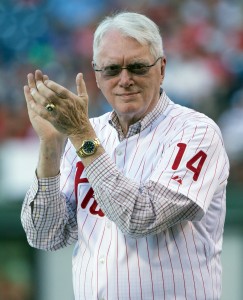
Jim Bunning, 1931-2017

Jim Bunning was a Hall-of-Famer as a pitcher. As a politician, well, let's just say we were not often in agreement. For this post, I'm going to stick to the facts.

James Paul David Bunning was born on October 23, 1931 in Southgate, Kentucky, about 3 miles across the Ohio River from downtown Cincinnati. He was born the same week as Mickey Mantle, but took much better care of himself, and, as a result, lived 22 years longer.

He attended Cincy's St. Xavier High School and Xavier University, getting a degree in economics while pitching minor-league baseball. In 1950, he signed with the Detroit Tigers, and remained in their minor-league system until his promotion in 1955. In between, he married Mary Catherine Theis.

He made his major league debut on July 20, 1955. Wearing Number 15, he started for the Tigers at Briggs Stadium (renamed Tiger Stadium in 1961), and lost to the Baltimore Orioles 6-3. Eventually, he switched to Number 14, and developed a hard slider, and a pitching motion that made his 6-foot-3, 190-pound frame look like it was jumping out at the batter, much as did that of fellow future Hall-of-Famer Bob Gibson. That slider enabled him to pitch a no-hitter against the Boston Red Sox on July 20, 1958, a 3-0 win at Fenway Park.

Sox star Ted Williams was not impressed. Jim Pagliaroni, a rookie catcher on the Sox in Ted's last season, 1960, recalled hearing Ted psych himself up in batting practice, saying things like, "My name is Ted Fucking Williams!" (He would swing the bat, and hit the ball, and produce a Crack! sound.) "And I'm the greatest hitter in baseball!" (Crack!) "Jesus H. Christ himself couldn't strike me out!" (Crack!) "Here comes Jim Bunning!" (Crack!) "Jim Bunning, with that little shit slider of his!" (Crack!) "He can't get me out, I'm Ted Fucking Williams!" (Crack!)

After the 1963 season, the Tigers traded Bunning and his slider -- Williams' opinion to the contrary, a really good one -- to the Philadelphia Phillies. The Phils raced out to 1st place in the National League, and Bunning was a big reason why. On June 21, 1964, he pitched a perfect game against the Mets at brand-new Shea Stadium.

It was the 1st regular-season perfect game in 42 years (Don Larsen, of course, pitched one in the World Series 8 years earlier), the 1st by a National League pitcher in 84 years, and the 1st no-hitter by a Phillies pitcher in 58 years. It made him only the 2nd pitcher to have pitched no-hitters in both Leagues, after Cy Young. (They have since been joined by 2 others: Nolan Ryan and Hideo Nomo.) He even doubled home 2 runs in the 6th inning, as the Phils won 6-0. It was the 1st game of a doubleheader, and the Phils also won the 2nd game, 8-2, as Rick Wise got his 1st major league win.

It was Father's Day, and Bunning was already the father of 7 children. Eventually, he would have 9, including David Bunning, now a federal judge. He had 35 grandchildren, including Patrick Towles, now the starting quarterback at the University of Kentucky; and 14 great-grandchildren.

But that 1964 season would end in embarrassment for the Phillies, as they had a 6 1/2-game lead with 12 games to play, lost 10 straight games, and blew it. for over half a century, manager Gene Mauch has been criticized for overpitching righthander Bunning and lefthander Chris Short during the slide. Fair or not, the St. Louis Cardinals won the Pennant, and then the World Series.

The Phils traded Bunning to the Pittsburgh Pirates in 1968, they traded him to the Los Angeles Dodgers in 1969, and they traded him back to the Phillies in 1970. That year, the Phils closed out their tenure at Connie Mack Stadium. On April 10, 1971, Bunning started and won the 1st game at Veterans Stadium, beating the Montreal Expos 4-1.

He retired at the end of that season, with a record of 224-184, becoming only the 2nd pitcher, after Cy Young, to have won at least 100 games in each League: 118-87 in the American, and 106-97 in the National. His career ERA was 3.27, his ERA+ 115, and his WHIP 1.179. He had 2,855 strikeouts, then 2nd on the all-time list behind Walter Johnson. He was a 9-time All-Star, was elected to the Philadelphia Baseball Wall of Fame in 1984, was elected to the Baseball Hall of Fame in 1996, and had his Number 14 retired by the Phillies in 2001.

*

In 1977, he was elected to the City Council in Fort Thomas, Kentucky. In 1979, he was elected to the State Senate. In 1983, he was the Republican nominee for Governor, but lost. In 1986, he ran for the U.S. House of Representatives, for the District that included the Kentucky suburbs of Cincinnati, including Cincinnati/Northern Kentucky International Airport. It is considered the State's most conservative District, and he won it 6 times.

When longtime Democratic Senator Wendell Ford retired, Bunning won his seat. Winning this seat in November 1998 and being sworn into it in January 1999 made him 1 of 2 Republicans who voted to impeach President Bill Clinton in the House, and then vote to convict him in his impeachment trial in the Senate. The other was Mike Crapo of Indiana. Of course, Clinton was acquitted, because the Republicans had no admissible evidence.

In 2004, knowing that his District depended on the Ohio River flowing well, and not flooding he sponsored a bill that became the Bunning-Bereuter-Blumenauer Flood Insurance Reform Act of 2004. (Apparently, to sponsor it, you had to have a German last name that started with a B.)

But that year, as he approached his 73rd birthday, people began criticizing him for "bizarre" behavior, especially concerning allegations he made against his Democratic opponent as he ran for re-election. His race was a lot closer than it was expected to be.

In April 2006, Time magazine did a profile on "America's Five Worst Senators." Fairly or not, it named Bunning to that list, saying he treated his staff badly and "shows little interest in policy unless it involves baseball." He had been part of the investigation into steroid use in the game. (I said I would stick to the facts. Saying that he was one of the worst Senators would be an opinion, and Time held it; saying that Time called him that is a fact.)

In 2009, as the Bush Recession hit rock bottom, he refused to vote for a bill boosting unemployment insurance until he was mollified with some amendments. His approval rating dropped to 28 percent, and he announced he wouldn't run again in 2010.
Jim Bunning continued to attend induction ceremonies for both the Baseball Hall of Fame and the Philadelphia Baseball Wall of Fame until last year, when he suffered a stroke. He died in a hospital in Southgate on May 26, 2017, at the age of 85.

UPDATE: He was buried at St. Stephen Cemetery in Fort Thomas, Kentucky.