Showing posts with label fort wayne pistons. Show all posts

Saturday, November 22, 2025

November 22, 1950: Pistons 19, Lakers 18

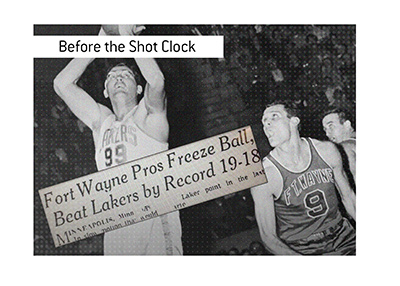
99: George Mikan. 9: Bob Harris.

November 22, 1950, 75 years ago: The worst game in NBA history is played. There were games that were sloppier, and games that had ugly brawls. But as far as quality of play is concerned, nothing will ever top this one -- or "bottom" it, if you prefer.

The Minneapolis Lakers were hosting the Fort Wayne Pistons at the Minneapolis Auditorium. The Lakers were representing Minnesota, the State known as "the Land of 10,000 Lakes," while the Pistons were owned by Fred Zollner, whose Fort Wayne, Indiana-based Zollner Corporation ran a foundry that manufactured pistons, primarily for car, truck and locomotive engines.

Both teams began play in the Midwest-based National Basketball League before entering the NBA. The Pistons won the NBL Championship in 1944 and 1945. The Lakers won it in 1948, then joined the NBA, and won their title in 1949 and 1950.

Coached by John Kundla, a Minneapolis native and University of Minnesota basketball star who wasn't much older than his players, the Lakers were led by George Mikan, at 6-foot-10 the professional game's 1st great big man. Before coming to the Lakers, he had helped Chicago's DePaul University win the NIT (then considered a more important competition than the NCAA Tournament) in 1944 and 1945. Earlier in 1950, despite being just 26 years old, the Associated Press named Mikan the greatest basketball player of the 1st half of the 20th Century.

(The AP's other honorees: Babe Ruth for baseball, Howie Morenz for hockey, Jack Dempsey for boxing, Bill Tilden -- despite his recent scandal -- for men's tennis, Suzanne Lenglen for women's tennis, Man o' War as the greatest racehorse; and Jim Thorpe for football and track and field, and as greatest athlete overall.)

Mikan wasn't fast or graceful: In 1969, longtime New York sportscaster Bill Mazer wrote, "He was more like a stampeding elephant"; while Boston Globe columnist Bob Ryan said on a 1996 ESPN panel, "Great player in his time. Deserved every accolade he ever got. But, today? He's Greg Kite with a hook shot."

The Lakers had other players who would make the Hall of Fame: Jim Pollard jumped around the court so much, he had the nickname "the Kangaroo Kid" years before Billy Cunningham of the Philadelphia 76ers did; while Slater Martin and Vern Mikkelsen were also among the best players in the game. Kundla would also eventually be elected to the Hall, and lived to be 100, outliving each of these players.

The Lakers' game was simple: Find an outside shot, and, if you can't, get the ball to Mikan and let him shoot over everybody. So, Pistons coach Murray Mendenhall decided that the only way to win the game was to make sure that Mikan doesn't get the ball. And the way to do that was to hold onto possession for as long as possible. In other words, or other word: Stall.

A crowd of 7,021 saw this: The Pistons leading 8-7 at the end of the 1st quarter, the Lakers leading 13-11 at the half, and the Lakers leading 17-14 at the end of the 3rd quarter. The crowd, hoping to see Mikan do his stuff, knew what the Pistons are trying, and they booed vociferously.

The Lakers scored only 1 point in the 4th quarter, but were still leading 18-17 with 6 seconds left in regulation, with Mikan having scored 15 of their points, including all of their field goals, 4 in 11 attempts. The rest came from 3 free throws: The other Lakers shot 0-for-6 from the field.

On the game's final play, unable to stall any longer, Pistons rookie Larry Foust took an inbounds pass, and laid it up over Mikan's outstretched arms. Mikan couldn't stop the shot, and it went in. Final score: Pistons 19, Lakers 18.

Point totals: Pistons: John Oldham 4, Curly Armstrong 4, Foust 3, Fred Schaus 3, John Hargis 2, Jack Kerris 2, Bob Harris 0, Ralph Johnson 0; Lakers: Mikan 15, Bob Harrison 2, Pollard 1, and none for Martin, Mikkelsen, Arnie Ferrin, Joe Hutton, and Bud Grant. Yes, football fans, the same Bud Grant who made the Pro Football Hall of Fame for leading the Minnesota Vikings into 4 Super Bowls (but losing them all).

Kundla told the sportswriters, "Play like that will kill professional basketball." But teams found the Lakers' weakness: Hold on to possession, and you can beat them. The 1950-51 NBA Championship was won by the Rochester Royals.

Kundla got his team to bounce back, winning the NBA Championship in 1952, 1953 and 1954. Then Mikan retired, and they didn't win another title until 1972 -- and not in Minneapolis.

Mikan's timing may have been absolutely right: For the 1954-55 season, the NBA adopted the 24-second shot clock. Stalling was no longer possible. Other teams, by necessity, needed faster players to copy the Lakers' now-useless fast break. For that reason, the aforementioned Bob Ryan said that 1954 is the demarcation line: When comparing great players and great teams in NBA history, you shouldn't put pre-1954 entries into the discussion, because they weren't really playing the same game.

The 19-18 game didn't kill pro hoops, but winning it didn't help the Pistons much. Although they reached the NBA Finals in 1955 and 1956, they didn't win either time. In 1957, accepting that Fort Wayne was too small a market in which to compete, Zollner moved the team to Detroit, the Motor City, where the Pistons name still made sense.

Murray Mendenhall lived until 1972, Fred Zollner until 1982, Larry Foust until 1984, and George Mikan until 2005.

Built in 1927, the Minneapolis Auditorium seated 10,545 people, and was home to the Lakers from 1947 to 1959. They played the 1959-60 season at the Minneapolis Armory, which still stands. After that season, they moved to Los Angeles, where the Lakers name didn't make sense. But they became L.A.'s most popular sports team, and remain so.

Since 1980, they have won 11 NBA Championships, the most of any team over that stretch. In total, in Minneapolis and Los Angeles combined, they have won 17, 2nd only to the Boston Celtics, with 18, for the most. One of those Laker titles came in 2002, when a questionable imbalance of fouls gave them the Western Conference title over the Sacramento Kings. That remains the closest the Kings franchise has come to the NBA Finals since... 1951, when they were the Rochester Royals, the team that briefly interrupted the Lakers' Minneapolis dynasty.

Since their respective moves, the Lakers and the Pistons have played each other in 3 NBA Finals. The Lakers won in 1988, the Pistons in 1989, and the Pistons in one of the great NBA Finals upsets in 2004.

Made obsolete by the construction of the Metropolitan Sports Center in suburban Bloomington in 1967, and more so by the plan to build the Target Center downtown (it opened in 1990), the Auditorium was demolished in 1988, and the Minneapolis Convention Center was built on the site. The Minnesota Timberwolves began play in 1989, playing their 1st season in the Metrodome before the Target Center was ready. They have not been a success: Only twice have they made the NBA Western Conference Finals, and they've lost both: 2004, to the Lakers; and 2024, to the Dallas Mavericks.

*

November 22, 1950 was a Wednesday, the day before Thanksgiving. Steven Van Zandt, who played guitar for Bruce Springsteen's E Street Band, and played consigliere Silvio Dante on The Sopranos, was born on this day.

There were 2 other games played in the NBA that night. The New York Knicks beat the Baltimore Bullets, 87-73 at the Baltimore Coliseum. And the Washington Capitols beat the Tri-Cities Blackhawks, 65-60 at the Uline Arena (now the Washington Coliseum).

Baseball was in the off-season. Football was in midweek. There were 2 NHL games played that night. The New York Rangers beat the Montreal Canadiens, 3-2 at the old Madison Square Garden. And the Toronto Maple Leafs beat the Chicago Black Hawks, 5-2 at Maple Leaf Gardens in Toronto. The Boston Bruins and the Detroit Red Wings were not scheduled.

In spite of the next day being Thanksgiving, a day on which the NBA generally doesn't play today, 5 games were played: New York 109, Washington 78; Philadelphia 89, Rochester 71; Boston 94, Tri-Cities 78; Indianapolis 92, Syracuse 85; and, in a rematch in Fort Wayne, Pistons 73, Lakers 63. So the 19-18 game was an aberration: The Pistons proved they could win while playing what then passed for normal basketball.

In the NHL on Thanksgiving 1950: Toronto 2, Detroit 1 in Detroit; and host Chicago 4, Boston 1. In the modern era, the NBA and the NHL avoid playing on Thanksgiving Day, so as not to compete with college and pro football, although there are usually some college basketball games on the day.

Among the college football games on T-Day '50: Number 12 Wyoming 42, the University of Denver 12 in Denver; Number 19 Washington & Lee 67, Richmond 7 in Richmond; Columbia 33, Brown 0 in Providence; Virginia Military Institute 27, Virginia Tech 0 in Roanoke; Missouri 20, Kansas 6 in Columbia; and Utah 46, Utah State 0 in Salt Lake City.

And in the NFL on T-Day '50: Detroit Lions 49, New York Yanks 14 at Briggs Stadium (Tiger Stadium) in Detroit; and Pittsburgh Steelers 28, Chicago Cardinals 17 at Comiskey Park in Chicago.

Thursday, April 10, 2025

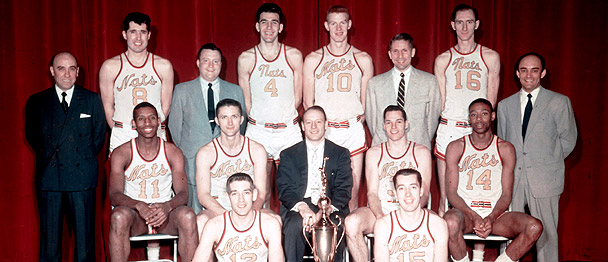
April 10, 1955: A Title for Syracuse

April 10, 1955, 70 years ago: The NBA Championship goes to Syracuse, New York.

Go ahead, clean your glasses. I got it right: Syracuse.

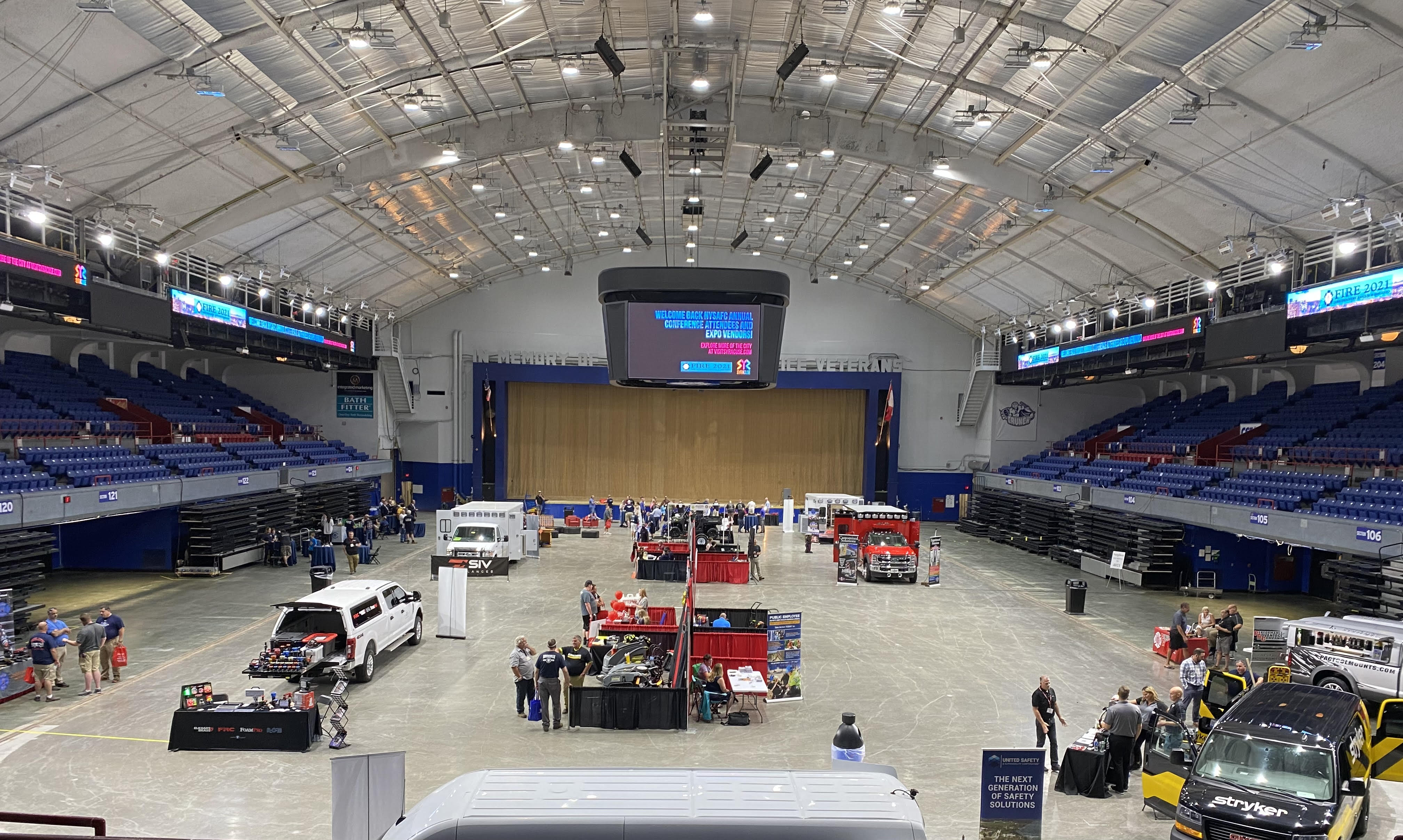
The Salt City has long been a home to Italian immigrants and their descendants. One son of those immigrants was Carmen Basilio, Middleweight Champion of the World in the 1950s. Danny Biasone was an immigrant from Chieti, in central Italy. In 1946, he paid $5,000 for a National Basketball League franchise, and the Syracuse Nationals set up shop at the State Fair Coliseum, a 7,500-seat auditorium built in 1927. It still stands, in the suburb of Geddes, New York, and is known as the Toyota Coliseum.

In their 1st season, 1946-47, the Nats made the Playoffs, but lost to their closest opponents, the Rochester Royals, who had won the NBL title in 1945. Biasone signed former Royals star Al Cervi to coach, and drafted Dolph Schayes as his star player. In 1949, the Nats were among the NBL teams absorbed into the Basketball Association of America, which renamed itself the National Basketball Association.

The Nats had the best record in the NBA in 1949-50, going 51-13. (That's equivalent to 65-17 over a full 82-game season.) They reached the NBA Finals, but lost to George Mikan and the Minneapolis Lakers. The New York Knicks were the Eastern Division Champions the next 3 years.

In 1951, the Onondaga County War Memorial opened, seating 11,000, and the Nats moved in. When the Indianapolis Olympians folded in 1953, the Nats picked up Alex Groza and Ralph Beard (who, unlike some of their 1948 Kentucky and Olympic teammates, had not been barred from the NBA due to the 1951 point-shaving scandal), and reached the 1954 NBA Finals, again losing to the Lakers.
The War Memorial

It was Biasone who recommended the 24-second shot clock to the NBA, and it was instituted for the 1954-55 season. With guards Paul Seymour and George King, forwards Dolph Schayes and Earl Lloyd (who had been the NBA's 1st black player, with the Washington Capitols in 1950), center Ephraim "Red" Rocha, and talented backups like centers Johnny "Red" Kerr (a rookie who went on to become a star) and Connie Simmons, the Nats went 43-29, earning them a 1st-round bye in the Playoffs. They beat the Boston Celtics in the East Finals.

In the NBA Finals, they faced another former NBL team, the Fort Wayne Pistons, featuring Bob Houbregs, Max Zaslofsky, George Yardley and Andy Philip. They were 43-29, and were no pushovers.

As it turned out, home-court advantage meant everything in this series, as no game was a blowout, but the home team won each of the 1st 6. The Nats won Games 1 and 2 at home, 87-82 and 87-84, respectively. Games 3, 4 and 5 were played at the Allen County War Memorial Coliseum in Fort Wayne, Indiana, and the Pistons won them all: 96-89, 109-102, and 74-71. Game 6 was back in Syracuse, and the Nats won, 109-104.

Game 7 was also in Syracuse. The Nats had to keep the pattern going. But the Pistons led 31-21 at the end of the 1st quarter. They started a comeback, and it was 53-47 Fort Wayne at the half. At the end of the 3rd quarter, it was tied, 74-74. With 12 seconds left in regulation, with the game tied, George King was fouled by Frankie Brian. He sank 1 of his free throws, making it 92-91 Syracuse. King then stole an inbounds pass from Andy Philip to seal the title.

Unlike the John Havlicek steal in Boston 10 years later, this one is not preserved on film, which is why, unless you're from the Syracuse area, or King's hometown of Charleston, West Virginia, or really know your NBA history, you've never heard of this steal. Come to think of it, Philip was later traded to the Celtics, and wore Number 17 with them before Havlicek did.

The Pistons returned to the NBA Finals in 1956, losing to the Philadelphia Warriors. In 1957, they moved to Detroit, and, while they have changed home venues 4 times, they have remained in the Detroit metropolitan area.

For those of you who are wondering about the name, knowing that "Pistons" makes sense for a team in "The Motor City," but that they were called that before moving there: They were founded in 1937 by Fred Zollner, whose Zollner Corporation ran a Fort Wayne foundry that manufactured pistons, for the engines of cars, trucks and locomotives. They won the NBL title in 1944 and 1945.

From 1949-50 to 1956-57, the Syracuse Nationals had 8 straight Playoff berths, 3 regular-season NBA Eastern Division titles, 9 Playoff series won, 7 Eastern Division Finals reached, 3 NBA Finals, and the 1955 NBA Championship -- still the last World Championship won by a team in New York State but not in New York City.

(The Rochester Royals had won the NBA title in 1951. The Buffalo Bills went as far as they could go in 1964 and 1965, winning the AFL Championship, but no Buffalo-based team has won a World Championship.)

But it wasn't enough. Syracuse, named for a city in Sicily, has a population of just 150,000. With a metropolitan area of under 700,000, Central New York simply isn't a big enough market to support a major league sports team. In 1963, the Nationals moved to Philadelphia, taking the place of the Warriors, who had moved to San Francisco a year earlier. They became the Philadelphia 76ers, winning the NBA Championship in 1967 and 1983, and losing in the Finals in 1977, 1980, 1982 and 2001.

Syracuse is still home to a Class AAA baseball team, the Chiefs; a hockey team at the same level, the Syracuse Crunch; and Syracuse University, a top-level college sports program. As far as major league sports goes, the Buffalo teams are about 150 miles west;  the Toronto teams are 250 miles west, then northeast; the New York teams are 250 miles southeast; and the Boston teams are a little over 300 miles east.
The War Memorial still stands, under the name of the Upstate Medical University Arena, and is home to the Crunch, concerts, and the occasional college and high school basketball game.
George King coached at West Virginia University, and then led Purdue to the NCAA Final in 1969. He died in 2006. Al Cervi, Dolph Schayes and Earl Lloyd were elected to the Basketball Hall of Fame, and Schayes was named to the NBA's 50th Anniversary 50 Greatest Players and its 75th Anniversary 75 Greatest Players. Cervi died in 2009. Schayes, whose son Danny Schayes had a fine NBA career, died in 2015, as did Lloyd. Jim Tucker was the last survivor of the '55 Nats, living until 2020.

Friday, March 19, 2021

Top 5 Reasons You Can't Blame the Fort Wayne Pistons for Moving to Detroit

March 19, 1957: The Minneapolis Lakers beat the Fort Wayne Pistons, 110-109 at the Allen County War Memorial Coliseum in Fort Wayne, Indiana.

Larry Foust scores 30 points for the Pistons, and George Yardley adds 23. But it's not enough, as the Lakers get at least 15 points from 5 players, including Hall-of-Famers Clyde Lovellette and Bob "Slick" Leonard (elected as a coach for a later Indiana-based pro team, the 3-time ABA Champion Indiana Pacers).

This completes a 2-game sweep of the Playoff series between the teams. The Lakers move on to the NBA Western Division Finals, where they are beaten by the St. Louis Hawks, who are subsequently beaten by the Boston Celtics for the title. The Lakers will move to Los Angeles in 1960.

For the Pistons, this is their last game in Fort Wayne. In the off-season, they move to Detroit. They had been founded in 1941 by Fred Zollner, who owned a foundry that made pistons, for engines of all kinds. Like the NFL's Chicago Bears and Green Bay Packers, the team, originally known as the Zollner Pistons, had their roots as a "company team." The move to Detroit, the Motor City, the world's greatest automobile-producing center, made the name "Pistons" make more sense than before.

Zollner was from Minnesota, and graduated from the University of Minnesota. Fort Wayne was where he was able to build his foundry, so that's the only connection he had to the city. Since he had made pistons for both Ford and General Motors, he did have connections to Detroit.
Fred Zollner

In Fort Wayne, the Pistons joined the Midwest-based National Basketball League, and won its title in 1944 and 1945. When the NBL merged with the Northeast-based Basketball Association of America to form the National Basketball Association in 1949, the Pistons were welcomed in. They reached the NBA Finals in 1955, losing to the Syracuse Nationals; and again in 1956, losing to the Philadelphia Warriors.

But after just 1 more season, they moved to Detroit. With the Indianapolis Olympians and the Anderson Packers both having folded since 1951, Indiana, the most basketball-crazy State of them all, went from having 3 teams in the NBA to none in just 6 years. Why did this happen?

Top 5 Reasons You Can't Blame the Fort Wayne Pistons for Moving to Detroit

5. The National Football League. The NFL had set the precedent: A league centered around mid-sized Midwestern Cities. Rochester, New York. Pottsville, Pennsylvania. Akron, Canton, Massillon, Portsmouth, Toledo and Dayton, Ohio. Decatur and Rock Island, Illinois. Green Bay and Racine, Wisconsin. Duluth, Minnesota. And, yes, Fort Wayne, Evansville, Hammond and Muncie, Indiana. Aside from Green Bay, none of those teams would still have an NFL team by the 1934 season.

Likewise, the NBA had teams from the BAA and the NBL that played in such cities: Syracuse, Rochester and Buffalo, New York; Moline, Illinois; Oshkosh and Sheboygan, Wisconsin; Waterloo, Iowa; and, in Indiana, the aforementioned Fort Wayne and Anderson. Some of those teams survive today, but only because they moved to bigger cities.

The NBA knew that the teams couldn't stay in such cities. The Fort Wayne Pistons and the Rochester Royals both moved in 1957, leaving the Syracuse Nationals the last of these, becoming the Philadelphia 76ers in 1963.

4. Fort Wayne. Whatever qualities the city may have, good or bad, it's just not big enough to be the home of a major league sports team. It was home to only about 140,000 people in 1957. It's got nearly twice that now, around 270,000, making it the 2nd-largest city in Indiana, after Indianapolis. But that's still not big enough. The metropolitan area is home to maybe 615,000, depending on which Counties you count as part of it.
Downtown Fort Wayne, including the Allen County Courthouse

3. The Arena Situation. After playing their 1st 11 seasons in the gymnasium of Fort Wayne's North Side High School, the Pistons were able to move in 1952, to the Allen County War Memorial Coliseum. By the standards of the time, it was a good arena. But it was still too small for a major league sport team: Only 8,000 seats. Later renovations and expansions have pushed it to 13,000, but that's still too small. 
Allen County War Memorial Coliseum,
after a 1989 renovation added a convention center

The Coliseum still stands. Since its opening, it has been home to a minor league hockey team, the Fort Wayne Komets, now in the ECHL (which, because its geographic reach is now huge, no longer stands for "East Coast Hockey League": It doesn't stand for anything, it's just "the ECHL"). It's hosted minor-league basketball teams, including the Fort Wayne Fury of the Continental Basketball Association from 1991 to 2001, and since 2007 the Fort Wayne Mad Ants of the NBA G League, the top farm team of the Indiana Pacers.

In spite of its age, it's a good arena -- for a city that's big enough for minor-league teams, but not major-league teams.
Coliseum interior, during a Fort Wayne Komets game

But if the Pistons were going to draw bigger crowds, they were going to need a bigger arena. Detroit offered one, and from 1957 to 1961, the Pistons played home games at the 15,000-seat Olympia Stadium, home of the NHL's Detroit Red Wings.
Why did they stay there only 4 years? Because they didn't have first choice of dates there. The arena was controlled by the Red Wings' owner, Bruce Norris, one of the biggest jerks in sports at the time -- and that's saying something. So from 1961 to 1978, the Pistons accepted a drop in available capacity to 11,000 to play at Cobo Hall on the riverfront, next-door to where the Wings later built the Joe Louis Arena.

Fred Zollner sold the Pistons to Bill Davidson in 1974. From 1978 to 1988, they played in suburban Pontiac, at the huge Silverdome. From 1988 to 2017, they played 4 miles away in the adjoining suburb of Auburn Hills, at the Palace. Since 2017, with the Wings long since having passed out of the Norris family's grubby hands, they have again groundshared with the Wings, at the Little Caesars Arena.

But in 1957, the Olympia looked like a better location than the Allen County Coliseum.

2. Detroit. Try not to look at it from the perspective of 1967 to the present, with that year's riot still casting a shadow over the Motor City, with poverty and crime still out of control. Think of what Detroit was in the Fifties.

It was a vibrant, forward-looking city. It was thought of as a place of industry, of innovation, a city of the future. That the future it imagined didn't come to pass was cruel on multiple levels. But the things Detroit gets called today -- a hole, a giant ghetto, hopeless, in serious need of a rebuild -- were unimaginable in 1957.
Detroit in the 1960s. Cobo Hall is at the lower left.

And it was a great sports city. The Lions had won the NFL Championship in 1952 and 1953, and reached the NFL Championship Game in 1954. They would win the title again in 1957. The Red Wings had won the Stanley Cup in 1950, 1952, 1954 and 1955, and reached the Finals in 1948, 1949 and 1956.

The Tigers hadn't won a Pennant since they won the 1945 World Series, but in the 11 seasons between then and the Pistons' move, they had 7 winning seasons. They were 82-72 in 1956, albeit 15 games behind the Yankees. They weren't contenders, but they were good.

So Detroit was a good destination for a sports team looking to move.

1. It Didn't Matter. The Pistons weren't missed. Like some other basketball-crazy places, Indiana is populated by people who care more about their high school and college teams than their pro teams. 

Kentucky had a team that won an ABA title, but has never had an NBA team. North Carolina's pro teams haven't done much. New Jersey, Cleveland, Cincinnati, St. Louis, San Francisco until the Warriors caught fire again in 2015 -- these are places that love basketball, but don't care that much about pro basketball. Even Detroit didn't seem to care much about the Pistons until Chuck Daly got their act together in the late 1980s.

Indianans do love their college teams: Indiana University, Purdue, Notre Dame, Butler, the University of Evansville. But the Pistons didn't set the world on fire in Fort Wayne, and while the Pacers have had their moments in Indianapolis, I don't think it would be considered a great tragedy by the people of that city if they moved.

Or, to put it another way: There have been books published lamenting the losses of baseball's Brooklyn Dodgers and football's Baltimore Colts. But show me the people who've said, "It broke my heart when the Pistons left" or "Fort Wayne has never been the same." Go ahead. Show me one. I've never seen one, let alone met one.

VERDICT: Not Guilty.

Sunday, April 7, 2019

Indiana's 10 Greatest Teams

This afternoon, the Brooklyn Nets play the Indiana Pacers at Bankers Life Fieldhouse in Indianapols.

Indiana's 10 Greatest Teams

Note: This is for major league teams only. No Notre Dame. No Bobby Knight's Hoosiers. No Purdue. And as for Larry Bird's 1979 Indiana State Sycamores, well, let's face it: Without him, most sports fans might not even know that university exists.

10. 1987-89 Indianapolis Colts. After starting off 12-35 in their 1st 3 seasons in Indiana, the Colts got it together in the strike-stunted season of 1987, going 9-6 and winning the AFC Eastern Division for the 1st time since they were in Baltimore 10 years earlier. But they lost their 1st Indiana-based Playoff game, away to the Cleveland Browns.

They followed this with seasons of 9-7 and 8-8, but in 1990 they fell back below .500, and crashed to 1-15 in 1991.

9. 1994-96 Indianapolis Colts. They got back to .500 in 1994, then in 1995 won Playoff games away to San Diego and Kansas City, before going into Pittsburgh and taking the Steelers to the last play of the game.

They made the Playoffs again in 1996, but a return trip to Three Rivers Stadium saw them get clobbered, and then they fell apart, with back-to-back 3-13 seasons. Those seasons did, however, help them draft Peyton Manning and build into a contender, and finally a champion.

8. 1989-96 Indiana Pacers. The 1st Reggie Miller era. They made the Playoffs 7 straight seasons, but only won 1 Central Division title, in 1995. In 1993, they lost to the Knicks in the 1st round, and a brief rivalry was born. In 1994, they got to the Conference Finals, but lost to the Knicks again. In 1995, they beat the Knicks, but lost the Conference Finals to the Orlando Magic.

7. 2012-18 Indianapolis Colts. The Andrew Luck Era began in 2012 with 3 straight 11-5 seasons, including AFC South Division titles in 2013 and 2014. But, just as Peyton Manning did, Luck ended up losing to the New England Patriots in a Divisional Playoff and an AFC Championship Game, both in Foxboro. Could the Colts get the Pats into their house, now Lucas Oil Stadium, and turn the tables?

Not yet. After 3 straight Playoff misses, the Colts got back into the Playoffs this past season, and beat the Texans in Houston before losing to the Chiefs in Kansas City. This current Colt team is a work in progress, and could yet rise on this list.

6. 1954-56 Fort Wayne Pistons. Yes, the NBA's Pistons were in Fort Wayne, Indiana before they were in Detroit. You thought they were named the Pistons because of their placement in "The Motor City"? No, that was just a neat little coincidence. The team's founder was Fred Zollner, and his Zollner Corporation made pistons for automotive engines. In fact, from their founding in 1941 until 1948, they were officially named the Fort Wayne Zollner Pistons. (A few early pro basketball teams had the owner's name, or the sponsoring company's name, in the team's name.)

In the 1954-55 season, they won the NBA's Western Division, and beat the defending Champion Minneapolis Lakers in the Playoffs, before losing the NBA Finals to the Syracuse Nationals. Fort Wayne and Syracuse, and also the Rochester Royals: That's the kind of league it was then.

In 1955-56, they won the Division again, and beat the St. Louis Hawks, before losing the Finals to the Philadelphia Warriors. Again, the kind of league it was then: By the close of the following season, 1957, the Pistons (Detroit) and the Royals (Cincinnati) would move; the Lakers would do so in 1960 (Los Angeles); the Warriors in 1962 (San Francisco); the Nationals in 1963 (becoming the Philadelphia 76ers); the Hawks in 1968 (Atlanta); and the Royals again in 1972 (becoming the Kansas City Kings), and again in 1985 (Sacramento).

Guard Andy Phillip, forward George Yardley, center Bob Houbregs, and owner Zollner were elected to the Basketball Hall of Fame.

5. 1997-2006 Indiana Pacers. As far as the NBA is concerned, this is the most accomplished Pacer team. They made the Playoffs 9 straight seasons, won Central Division titles in 2000 and 2004, reached the Conference Finals 3 straight seasons and in 4 out of 7, and in 2000, beat the Milwaukee Bucks, the Philadelphia 76ers and the Knicks to reach the NBA Finals for the 1st time. Reggie Miller and company did not roll over for the Los Angeles Lakers, extending them to 6 games.

4. 1914 Indianapolis Hoosiers. They went 88-65 and won the Pennant in the Federal League, which was challenging the established major leagues. Benny Kauff won the batting title with .370, and led the League with 75 stolen bases. Cy Falkenberg went 25-16 and led the League with 236 strikeouts. They had Hall-of-Fame outfielder Edd Roush. (They also had Bill McKechnie playing for them, but he was elected to the Hall as a manager.)

And yet, the following season, they were moved -- to Harrison, New Jersey, outside New York. Or, more precisely, outside Newark. And they were renamed the Newark Peppers. Aside from the Indianapolis Blues, who played in the National League in 1878, the 1914 Hoosiers are the only Major League Baseball team ever to play regular home games in Indiana.

3. 1968-75 Indiana Pacers. In 7 seasons, the Pacers won 3 regular-season Division titles, and reached 5 ABA Finals, winning the ABA Championship in 1970, 1972 and 1973; and losing in 1969 and 1975. The Pacers made the Playoffs in all 9 seasons of the ABA's existence, and went 15-6 in Playoff series and 72-47 in games. They were called "the Celtics of the ABA."

So the question is: Did winning the Championship in the ABA mean more than reaching the NBA Finals, but not winning them? There were 4 teams from the ABA that were admitted into the NBA: The Pacers, the New York (now Brooklyn) Nets, the San Antonio Spurs and the Denver Nuggets. A couple of other teams, most likely the Kentucky Colonels (whom the Pacers beat in the '73 Finals but lost to in the '75 Finals) and the Virginia Squires/Spirits of St. Louis, could have made it in the NBA. The competition wasn't that weak.

2. 1943-45 Fort Wayne Zollner Pistons. It's been 75 years since their 1st title, and the Zollner Pistons are still the only Indiana-based basketball team to be undisputed World Champions. They won the championships of the National Basketball League in 1944 and 1945. The Midwest-based, 1937-founded NBL merged with the Northeast-based, 1946-founded, Basketball Association of America (BAA) in 1949, to form the National Basketball Association (NBA), and the Pistons were among the NBL teams included.

They were not as talented as the Pacers' ABA Champions of the early 1970s or their 2000 NBA Finalists. But they did win 2 World Championships, and that overrides anything else. Guard Bobby McDermott was the big star, and was elected to the Basketball Hall of Fame.

1. 2002-10 Indianapolis Colts. In 9 straight Playoff seasons, they won the AFC South Division 7 times, including 14-2 seasons in 2005 and 2009, a 13-3 in 2007, and 12-4s in 2003, 2004, 2006 and 2008.

The problem for Tony Dungy's team of Peyton Manning, Marvin Harrison, Reggie Wayne and Joseph Addai was the New England Patriots. Since the 2001 season, any team that's wanted to win the AFC Championship has had to go through Bill Belichick's Foxboro cheats. The Colts lost the 2003 AFC Championship and a 2004 Division Playoff, both in Foxboro.

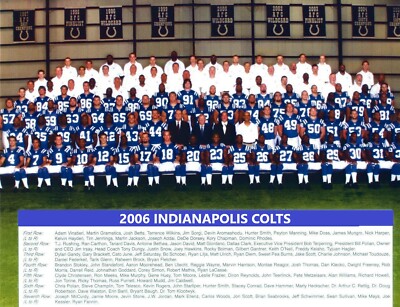
In 2006, having dispatched the Kansas City Chiefs in Indianapolis and the Ravens in Baltimore, the Colts finally got the Pats in the Hoosier/RCA Dome, and beat them in the AFC Championship Game, 38-34, before going to Miami to beat the Chicago Bears in Super Bowl XLI, 29-17. It was the 1st World Championship ever for an Indianapolis-based team, the 1st for an Indiana team since the '45 Pistons, and the 1st for the Colt franchise since the 1970 season in Baltimore.

The Colts lost to the San Diego Chargers in the next 2 Playoffs, then won another AFC Championship in 2009, but lost Super Bowl XLIV to the New Orleans Saints. The following season, they lost a Playoff game to the Jets. The year after that, Peyton Manning missed the entire season with a neck injury, and his era was over, and Andrew Luck's began.