when the old New York Central Railroad ran it from Grand Central Terminal to Chicago's LaSalle Street Station. It leaves New York's Penn Station at 3:40 every afternoon, and arrives at Union Terminal in Toledo at 5:55 every morning. From there, you have to wait until 6:30 to get on a bus to Detroit's Amtrak station, arriving at 7:35. The station is at 11 W. Baltimore Avenue, at Woodward Avenue, 2 1/2 miles north of Comerica, so walking there is not a good option; the number 16 or 53 bus would take you down Woodward.
In reverse, the bus leaves Detroit at 9:30 PM -- not enough to time to get out of the arena to the station the same night, so you'd have to stay over nearly an additional 24 hours -- arrives in Toledo at 10:35, and then you have to hang around there until the
comes back at 3:15 AM, arriving back in New York at 6:47 PM. Total cost: $220. A lot cheaper than flying, but a tremendous inflammation in the posterior.
How about Greyhound? Yeah, ride a bus for 14 hours to Detroit, there's a great idea. (Rolleyes.) Actually, having done it, I can tell you that it's not that bad. Two Greyhound buses leave Port Authority every day with connections to Detroit. One is at 5:15 PM, and arrives at 7:20 AM, with a 1 hour and 35 minute stopover in Cleveland in the middle of the night (but you won't have to change buses, in case you want to stay on the bus and sleep). The other leaves Port Authority at 10:15 PM, and you
have to change buses in Cleveland, arriving 6:50 AM and leaving 7:50, arriving at 11:25 AM. Despite having to change buses, this one is actually faster, taking 13 hours and 10 minutes, as opposed to the single through bus ride, taking 14 hours and 5 minutes.
Compared to most of Detroit, the bus terminal, at 1001 Howard Street, is relatively new and quite clean. It was just about within walking distance of Tiger Stadium, which really helped me in 1999. It's also not a long walk to Ford Field, but I wouldn't recommend this. Better to take a cab, especially if you're getting a hotel. Round-trip fare is $354, but it can drop to $195 on advanced purchase.
If you decide to drive, the directions are rather simple, down to (literally) the last mile. You'll need to get into New Jersey, and take Interstate 80 West. You'll be on I-80 for the vast majority of the trip, through New Jersey, Pennsylvania and Ohio. In Ohio, in the western suburbs of Cleveland, I-80 will merge with Interstate 90. I point this out merely to help you avoid confusion, not because I-90 will become important -- though it is for "How to Be a Yankee Fan in Chicago" and some other cities.
In Ohio, you'll take I-80's Exit 64, and get onto Interstate 75 North, known as the Fisher Freeway in Detroit. This will take you into Michigan. Take Exit 50 onto Fisher Service Drive, turn left on Cass Avenue, and then turn right on Sproat Street. The Arena will be on your right.
If you do it right, you should spend about an hour in New Jersey, 5 hours and 15 minutes in Pennsylvania, 3 hours in Ohio and an hour in Michigan. That's 10 hours and 15 minutes. Counting rest stops, preferably halfway through Pennsylvania and in the Cleveland suburbs, and accounting for traffic in both New York and Detroit, it should be about 12 hours.
Detroit was founded in 1701 as Fort Ponchartrain du Detroit du Lac Erie (Day-TWAH, strait of Lake Erie), by Antoine de La Mothe Cadillac, for whom the downtown Cadillac Square and the brand of car was named.
Detroit's centerpoint, in culture and in terms of address numbers, is the Woodward Fountain, where Woodward, Michigan and Gratiot Avenues come together, with Cadillac Square just off to the east. Woodward is the East-West divider.
Since the July 1967 race riot, Detroit has become known as a city of poverty, crime, decay, and poor city services, the kind of place where even Batman would fear to tread. The legendary comedian Red Skelton once said, "In Detroit, you can go 10 miles and never leave the scene of the crime." It's no wonder the
film series was set there.
There was a Nike commercial a few years back, in which young basketball players were seated, yoga-style, in front of a TV screen, on which their "master," a fat black man with a turban and sunglasses who looked nothing like an athlete, was dispensing wisdom. At the end, after the Swoosh logo was shown, the camera went back to one of the students, who asked, "But, Master, what if we behave badly?" And the Master lowered his shades, looked over them, and said, "You go to Detroit."
This was in the early 1990s, when the Pistons had begun to fall from their 1989-90 "Bad Boys" championship teams, and going to Detroit was not a good option in any sport -- indeed, the only Detroit team doing well at the time was, strangely, the Lions, who were then a perennial Playoff team thanks largely to Barry Sanders.
I once saw a T-shirt that read, "I'm so bad, I vacation in Detroit." As I mentioned, I have. (I'm not saying I'm "bad," or a "hard man," just that I went.) Newark had a race riot 2 weeks before Detroit's. In May 1999, I saw Detroit, and I realized just how far back Newark had come, by seeing how far Detroit had not.
In the 1950 Census, Detroit was the 4th-largest city in America, after New York, Chicago and Philadelphia, with over 2 million people just within the city limits. "White flight" after the '67 riot has led to the Detroit metropolitan area having roughly the same number of people it had then, about 5.3 million, but within the city limits the number has dropped from over 2 million to just 680,000. The suburbs are beautiful, but the city itself is a hole, and good men (and a few bad ones) have busted their humps trying to get it back on its feet.
One of the good men who tried was Mike Ilitch, probably the most famous American of Macedonian descent, who runs Little Caesar's Pizza, and owns the Tigers and Red Wings. He rebuilt the city's historic Fox Theater, put Little Caesar's headquarters in the building above it, and had Comerica Park built across the street. He, and many others, including Pistons Hall-of-Famer turned major area businessman Dave Bing, who served a term as Mayor, are trying, they really are.
But Governor Rick Snyder, a Tea Party Republican, ordered a State takeover of Detroit's finances. Apparently, he didn't learn the lesson of Hugh Carey, New York's Governor in 1975, who found another way to get New York City's finances back on their feet. In Detroit's case, as in every other place in which it's tried, austerity hasn't worked.
As recently as 1950, the city was 83 percent white, 16 percent black. By the time of the 1967 riot, it was about half and half. Now, it's 82 percent black, 8 percent white, 7 percent Hispanic, 1 percent Asian. But Wayne County, which includes, but is not limited to, the City of Detroit? 52 percent white, 40 percent black, 5 percent Hispanic, 3 percent Asian. Oakland County? 77 percent white, 13 percent black, 6 percent Asian, 4 percent Hispanic. If there's another city in America that's that segregated, I'm not aware of it.
Detroit will never escape the stigma of the 12th Street Riot in July 1967. But it previously had race riots in 1863 and 1943. Even Benton Harbor, in Western Michigan, on the east coast of Lake Michigan, had race riots in 1960, 1966, 1967, 1990 and 2003.
Detroit is a weird city in some ways. It often seems like a cross between a past that was once glorious but now impossible to reach, and a future that never quite happened. (That observation was once made about the remaining structures from New York's 1964-65 World's Fair and the Astrodome in Houston.) Art Deco structures of the 1920s and '30s, such as the Penobscot Building (the tallest building outside New York and Chicago when it opened in 1928, the tallest in Michigan until 1977) stand alongside abandoned, boarded-up or chained-up stores.
But alongside or across from them, there are glassy, modern structures such as the Renaissance Center, shown in the photo above: A 5-tower complex that includes, at its center, the 750-foot tallest building in Michigan (the tallest all-hotel skyscraper in the Western Hemisphere), and, in one of its 4 outer towers, the headquarters of General Motors (although the RenCen was originally financed by Ford).
Downtown also has the Detroit People Mover, a monorail system that is part of the suggestion of Detroit trying to get from 1928 to 2028 while jumping over the difficult years in between. Like the Washington and Montreal Metro (subway) systems, the company running it prides itself on the artwork in its stations.
The People Mover, outside the Renaissance Center
It has a stop called Times Square, but it won't look anything like the one in New York. It has a stop called Bricktown, but it won't look anything like Brick Township, the sprawling Jersey Shore suburb off Exits 88 to 91 on the Garden State Parkway. It's cheap, only 75 cents, and it still uses tokens, although it also accepts cash. Be advised, though, that it stops running at midnight, except on Fridays and Saturdays, when it runs until 2:00 AM. Bus fare is $1.50.
ZIP Codes in the Detroit area start with the digits 480, 481, 482 and 483, and the Area Code is 313, with 248 (overlaid by 947), 586 and 734 serving the suburbs. Detroit has no "beltway." The sales tax in the State of Michigan is 6 percent, and does not go up in either the County of Wayne or the City of Detroit. As with New York, Chicago and a few other cities, the electricity in Detroit is run by a company with the name of the inventor of the electricity industry (if not the light bulb): Detroit Edison Company.
Going In. The Little Caesars Arena opened in 2017. Its official address is 2645 Woodward Avenue, at Henry Street, across Interstate 75 from Comerica Park and Ford Field, and about a mile north of downtown. The arena, originally known as the Detroit Events Center, was, surprising no one, renamed for Mike Ilitch's pizza company.
"Pizza, pizza."
Take Bus 053. If you drive in, parking is $24. This is more than for a Devils home game, but it's a lot better than parking at Tiger Stadium, which usually had people boxed in, resulting in tremendous traffic jams both before and after the game (and, every bit as much as the crime and the condition of the stadium, was why the Lions wanted to get out and built the Silverdome). It also involved local kids being willing to "Watch your car, Mister?" for a small fee. Translation: "If you pay me $5.00, I'll make sure nobody damages your car. If you don't pay me, I'll make sure somebody, namely myself, does."
Seating 19,515 for hockey and 20,491 for basketball -- slightly less than Joe Louis Arena -- it is 1 of 10 arenas currently hosting an NHL team and an NBA team. The court is laid out east-to-west.
The Pistons' arrival meant that not only would all 4 Detroit-area teams be playing in the city for the 1st time since 1974, but that both of the teams that moved out to the suburbs have moved back: The Lions after 27 seasons, 1975 to 2001; and the Pistons after 39 seasons, 1978 to 2017. So "
Dee-troit
bas-ket-
ball" is again being played
in Detroit, not just sort-of near it.
"The Baddest Bowl" is also, even more so that Boston's TD Garden with its Beanpot Tournament, the capital of American college hockey. Like its predecessors the Olympia from 1965 to 1978, and the Joe Louis Arena from 1979 to 2016, in the week between Christmas and New Year's, it hosts the Great Lakes Invitational, with the University of Michigan, Michigan State and Upper Peninsula-based Michigan Tech participating every season.
The 4-team selection has been rounded out by nearby schools such as Western Michigan, Northern Michigan and Lake Superior State; Midwestern powers like Wisconsin and North Dakota (but never, as yet, Minnesota); and even New Jersey's Princeton. Michigan, the defending champion, has won it 17 times, Michigan State 12, and Michigan Tech 10. It also alternates hosting the Big Ten hockey tournament with the Xcel Energy Center in St. Paul, home of the Minnesota Wild.
In addition, it is set to rotate with the Xcel Energy Center as host of the Big Ten hockey tournament, and hosted 2018 NCAA Tournament basketball games.
The 1st event was on September 12, 2017, a concert, by a Detroit area native. Unfortunately, it was by millionaire kid turned Trumpian U.S. Senate candidate Robert Ritchie, a.k.a. slob rocker Kid Rock.
Paul McCartney, The Eagles (without the late Michigan native Glenn Frey), Janet Jackson, Lady Gaga, Jay-Z, New Jersey native Halsey, Katy Perry, Demi Lovato, Justin Timberlake, Hall & Oates, Shania Twain, former One Direction singer Harry Styles, Radiohead, Shakira, Drake, Bruno Mars and Elton John have already played concerts there.
Food. When I visited Tiger Stadium in its final season, 1999, it had great food, including the very best ballpark hot dog I've ever had. Since they were owned by Little Caesars mogul Ilitch, and before that were owned by Domino's Pizza boss Tom Monaghan, food was, and remains, taken very seriously by the club. This is, after all, Big Ten Country, where college football tailgate parties are practically a sacrament. One would hope that the same would be true of the Red Wings.
They are. As you would expect, there are Little Caesars stands, but there's also Mike's Pizza Bar, named for Ilitch. There's also Bell's Brewery, the Dearborn Sausage Haus, the Via Sports Bar, and the 313 Grill Co. (named for Detroit's Area Code).
What is "Detroit style pizza"? It's rectangular, with toppings such as pepperoni and mushrooms, and is differentiated from the styles of New York and Chicago with a thick, crispy bottom crust. There's also "Coneys," Detroit-style hot dogs, with chili, cheese and onions. These are also popular in Cincinnati -- but not many of them are sold at Coney Island.
Team History Displays. The Palace's very address, 6 Championship Drive, was a testament to its history, although half of those titles, 3, were WNBA titles won by the now-gone Detroit Shock (all coached by Pistons legend Bill Laimbeer).
The Shock's 2003, 2006 and 2008 WNBA Championship banners still hang in the Palace rafters, but the Pistons brought with them to the Little Caesars Arena their NBA Championship banners for 1989, 1990 and 2004; their Eastern Conference Championship banners for 1988, 1989, 1990, 2004 and 2005; and their Central Division Championship banners for 1988, 1989, 1990, 2002, 2003, 2005, 2006, 2007 and 2008. (They won the 2004 NBA title without having won their Division in the regular season.)
Their is no notation of the Pistons' Fort Wayne era (1941-57), even though they reached the NBA Finals in 1955 and '56, and their 1944 and '45 National Basketball League titles made them, essentially, the world champions of professional basketball in those seasons. They note neither championships nor retired numbers from those days. And, yes, there was an auto/war vehicles plant in Fort Wayne, Indiana, so the "Pistons" name made sense long before they arrived in the Motor City.
The Pistons have 13 banners honoring team legends. From the 1970s, before their 1st title, the Pistons have honored Number 15, center Bob Lanier; and Number 21, Dave Bing, who served a term as Mayor of Detroit.
From the 1989 and 1990 World Championship teams, a.k.a. the Motor City Bad Boys, these numbers are retired: 4, guard Joe Dumars; 10, forward Dennis Rodman; 11, guard Isiah Thomas; 15, guard Vinnie Johnson; and 40, center Bill Laimbeer.
Longtime team owner William Davidson, who built the Palace, has a long banner with his signature on it. Jack McCloskey, who built the Bad Boys title team, has a banner with "GM" standing in for a number, standing for "general manager," not "General Motors." Chuck Daly, who coached the Pistons to their 1st 2 titles, has the Number 2 retired for him. So far, the Number 44 of Rick Mahorn remains available.
From the 2004 World Championship team, which Dumars built as general manager: 1, guard Chauncey Billups; 3, center Ben Wallace; and 32, guard Richard "Rip" Hamilton.
Photo of the banners from the Palace.
The banners for Billups, Wallace and Hamilton
were put in a separate row.
Greg Monroe was wearing 10 when the number was retired for Rodman. The basketball player I like to call "the other Reggie Jackson" was wearing 1 when it was retired for Billups. In each case, the honoree gave the current wearer permission to keep wearing it as long as he remained with the Pistons.
Bing, Lanier, Thomas, Rodman, Dumars, Wallace, Daly, Davidson, 1960s forwards Bailey Howell and Dave DeBusschere (later acquired by the Knicks), 1980s title team forward Adrian Dantley, and 2004 title-winning coach Larry Brown (still the only man to coach both an NCAA Champion and an NBA Champion) have been elected to the Basketball Hall of Fame based at least in part on what they did with the Pistons in Detroit. So has 1990s forward Grant Hill.
So have 4 players from the team's Fort Wayne days: Guards Bobby McDermott and Andy Phillip, forward George Yardley, and center Bob Houbregs. So has Fred Zollner, the owner who moved them to Detroit.
While Dick Vitale did coach the Pistons (and the University of Detroit Mercy), and he has been elected to the Hall, it was based on his broadcasting career, not on his coaching. (He was a decent college coach, but awful in the NBA.)
DeBusschere, Bing, Thomas and Rodman were named to the NBA's 50th Anniversary 50 Greatest Players in 1996, and also to the 75th Anniversary 75 Greatest Players in 2021. Katie Smith of the Shock, now head coach of the New York Liberty, was named to the WNBA's 15th Anniversary 15 Greatest Players in 2012. She, Swin Cash and Deanna Nolan were named to the WNBA Top 20 at 20 in 2016 -- in the 20th Season, rather than at the 20th Anniversary.
Zollner, DeBusschere, Yardley, Bing, Lanier, Davidson, McCloskey, Daly, Thomas, Rodman, Johnson, Laimbeer, Dumars, Ben Wallace (but not, as yet, Rasheed) and Ray Scott, a Pistons forward in the 1960s, have been elected to the Michigan Sports Hall of Fame, located at Cobo Hall in downtown Detroit.
One of the streets outside the Palace was named Isiah Thomas Drive, although those of you who are Knicks fans may want to ignore that name. The Little Caesars Arena has statues of Gordie Howe and Joe Louis, but, as yet, no Pistons.
As you might guess, the Pistons' biggest rivalry is with the Chicago Bulls, going back to the Bulls' inception in 1966, and peaking in the George H.W. Bush era, 1988 to 1992, when each team had to g through the other to get to the NBA Finals. The rivalry couldn't get much closer: The Bulls lead it 154-152.
Stuff. The Little Caesars Arena has a Team Store is on the south side, with an address of 76 Henry Street. There's also a store named Hockeytown Authentics, owned by Olympia Entertainment. 1845 E. Big Beaver Road in Troy, next to the Troy Sports Center, 19 miles north of downtown. Car only.
Most of the books about the Pistons focus on the 1988-89 and 1989-90 title-winning Bad Boys. A good retrospective, if a bit out of date, is the 1997 book
The Detroit Pistons: Four Decades of Motor City Memories, by Steve Addy. After the 2004 title, the staff of the
Detroit Free Press published
Men at Work: Blue-Collar Pistons Show Who's the Boss. DVD collections for the 1989, 1990 and 2004 World Championship teams are also available.
Charles C. Avison wrote
Detroit: City of Champions, telling of how the city produced champion after champion in the Great Depression and World War II: The Tigers winning Pennants in 1934, '35, '40 and '45; the Lions debuting in 1934 and winning the NFL Championship in 1935; the Red Wings winning the Stanley Cup in 1936, '37 and '43; and Alabama-born, Detroit-trained Joe Louis winning the Heavyweight Championship of the World in 1937 and keeping it until his first retirement in 1948. Back then, Detroit was a city where anything was possible. But then, the Pistons didn't arrive in the Motor City until 1957.
During the Game. A November 13, 2014 article on DailyRotoHelp ranked the NBA teams' fan bases, and listed the Pistons' fans as 25th. The days of packing 'em in for "
Dee-troit
bas-ket-
ball!" are over, at least for now. The article compares the Pistons to the Oakland Athletics: A once-great but now terrible team in a once-hip but now terribly poor city (in the Pistons' case, being in the wealthy suburbs until 2017 didn't seem to help), and playing in a large venue that they cannot hope to fill.
You might think this would lead the fans who do show up to have a chip on their shoulder, and to be nasty. Most likely, they won't be. "The Malice at the Palace" (where, not to condone the players' reactions, but the fans did provoke them) was 14 seasons ago. It was 1 event in the 64-season history of Detroit Pistons basketball. You do not have to fear for Pistons players running into the seats to come after you.
Nor do you have to worry about wearing your Knicks or Nets gear in the Arena, or anywhere in the Detroit area. Maybe if you were wearing Chicago Bulls, Cleveland Cavaliers, or possibly Boston Celtics or Los Angeles Lakers stuff. Not Knicks or Nets.
In those 64 years, the Pistons have had just 2 public-address announcers. (Those of you who are Yankee Fans may scoff, knowing that the Bronx Bombers had only Bob Sheppard for 57 years. But it's still remarkable.) Ken Calvert served from 1958 to 2001, at the Olympia, Cobo Hall, the Silverdome and the Palace, including the rise and fall of the Motor City Bad Boys of the late 1980s and early 1990s.
Since 2001, the announcer has been John Mason, who made the chant, "
Dee-troit
bas-ket-
ball!" famous. He became so admired around the NBA that he was invited to announce the 2007 All-Star Game in Las Vegas, which, of course, does not have a team of its own. He hosts 2 different daily radio shows in Detroit.
None of the Pistons' 3 2018-19 games against a New York teams will feature a promotion. LaShell Renee is their regular National Anthem singer. In addition to the "
Dee-troit
bas-ket-
ball!" chant, the Pistons use Europe's "The Final Countdown" as a get-the-crowd-going song.
LaShell Renee
Their mascot is Hooper the Horse -- a "hooper" is a basketball player, and a car's pistons provide "horsepower," get it? Some of Hooper's stunts include rappelling off the roof of the Palace, and breaking bricks with his hoof. He can also juggle and perform magic tricks. Hooper's "birthday" is March 15, and he celebrates his birthday at a Pistons home game. Guests often include other NBA mascots, plus fellow Detroit mascots Paws the Tiger and Roary the Lion.
Hooper is not much of a Hula Hooper.
The Pistons have a Cheer Team (currently 9 men and 11 women), a Dance Team (18, all women), another dance team called the D-Town dancers (14, all men), and a Drumline (15, all but 1 of them men -- as far as I know, the closest any NBA team comes to having a pep band). I can see having a cheer/dance team, but 3 separate teams that, essentially, do the same thing?
Those of you who are Yankee Fans might see the name Reggie Jackson playing for the Pistons. No relation to Mr. October, he previously reached the NBA Finals for the Oklahoma City Thunder.
After the Game. With Detroit's rough reputation, I would recommend not hanging around downtown after a night game. If you want a postgame drink or meal, you're better off sticking to your hotel.
But when you come out of the arena, at the northeast corner, at Woodward and Sproat, there's District Market, which calls itself "restaurants within a restaurant." There's Sugar and Brew (a Midwestern mini-Starbucks), Mex n Co, and Moroccan Lamb & Fig.
Left over from Joe Louis Arena are some recommendations from local fan websites, although most of them closed after the Arena was demolished. The Anchor Bar at 450 W. Fort Street is still open, but should not be confused with the Buffalo bar of the same name, which invented Buffalo wings.
Giants gather at the Town Pump Tavern, 100 W. Montcalm Street at Park Avenue, 2 blocks from Comerica Park. Harry's Detroit Bar is also said to be a Giants' fan haven. It's right over the Fisher Freeway overpass from Comerica and the Town Pump, at 2482 Clifford Street, near the famous Cass Tech High School. Be warned, though, that over the freeway is not an area to traverse at night.
If your visit to Detroit is during the European soccer season, which is now in full gear, most of the better choices to watch games are in the suburbs. Thomas Magee's Sporting House Whiskey Bar is the home pub of the Detroit branch of the U.S. national team fan group, the American Outlaws. 1408 East Fisher Service Drive, in the Lafayette Park neighborhood, about a mile east of the arena. 5-minute walk from Comerica Park and Ford Field. SMART Bus 34 to Gratiot and Russell.
Sidelights. On November 30, 2018,
Thrillist published a list of "
America's 25 Most Fun Cities," and Detroit, for all its problems, came in 20th. For all its problems, Detroit is a great city, not just a great basketball city or even a great sports city. Check out the following – but do it in daylight:
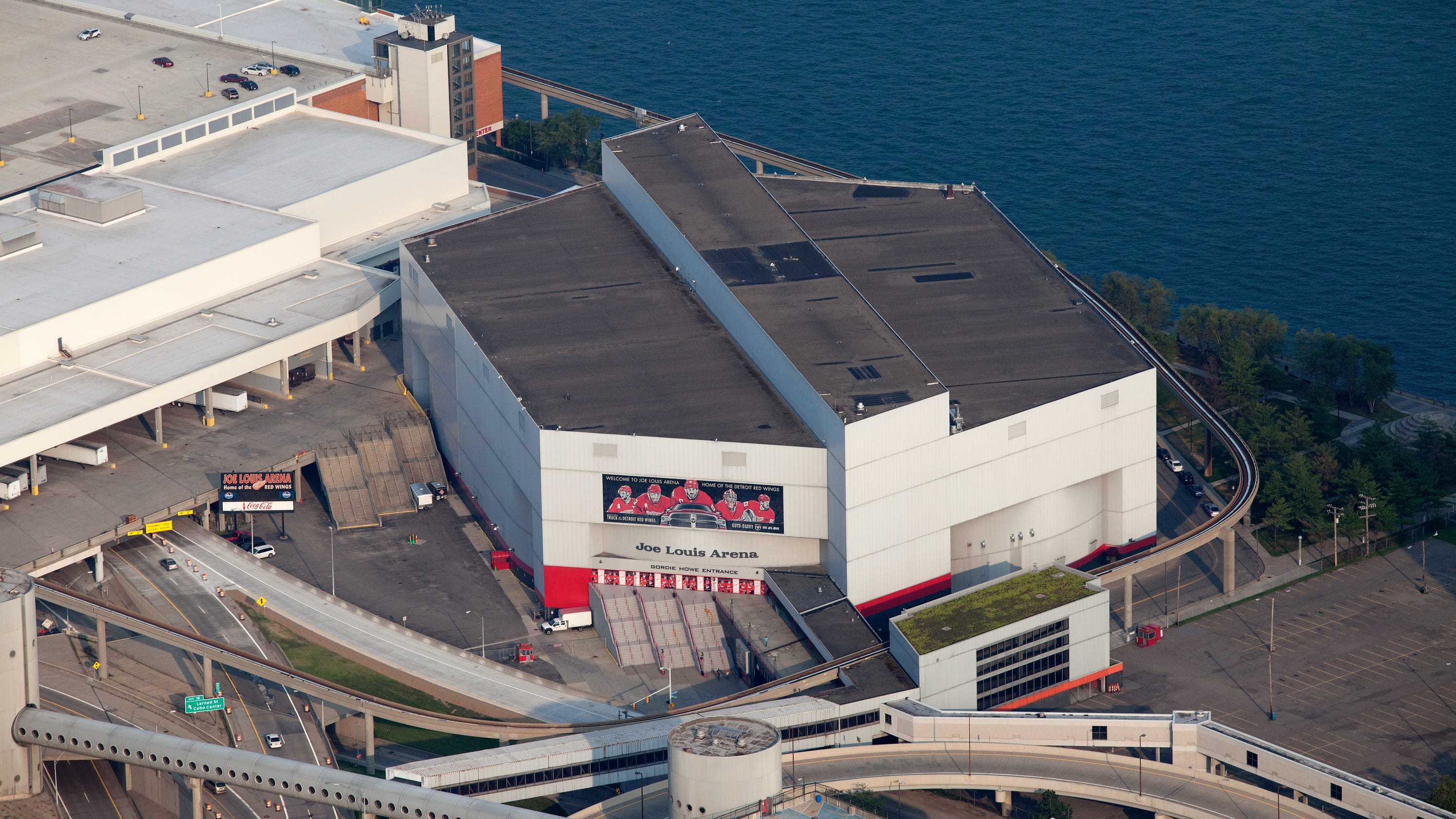
* Cobo Hall and Joe Louis Arena. From 1979 to 2017, the Red Wings played at the riverfront arena named for the Alabama-born, Detroit-raised-and-trained Heavyweight Champion of the World from 1937 to 1949. While there, they reached 6 Stanley Cup Finals, winning 4, and became what the Boston Bruins used to be, and what the New York Rangers only dream they are: The signature team of American hockey.It hosted the NCAA Frozen Four in 1985, 1987 and 1990. The Joe was home to the Detroit Drive of Arena Football from 1988 to 1993. They won as many league championships in 5 seasons as the Lions have won in over 80: 4, in 1988, 1989, 1990 and 1992. In fact, they made the ArenaBowl every season of their existence. The Joe also hosted the ArenaBowl in 1989, 1990, 1991 and 1993. So what happened? Mike Ilitch, who also owned the Red Wings, sold the Drive so that he could buy the Tigers. The Drive were moved to Worcester, Massachusetts, played 1 more season, and folded.
Many people complained that the stairs at the entrances were very steep, and at certain areas on the outside of the arena, were breaking apart. To make matters worse, the arena was the same model as the Meadowlands Arena and the Nassau Coliseum: One level of concourse for two levels of seats. There also wasn't enough bathrooms, resulting in very long lines, and a drop in atmosphere at the starts of the 2nd and 3rd periods, as many fans didn't make it back in time. So the Wings decided to build a new arena. Demolition is scheduled to begin within days.
The Joe was built next-door to Cobo Center, which was named for Albert E. Cobo, Mayor from 1950 to 1957. Its centerpiece, a building originally known as Cobo Hall, has been Detroit's major convention center since its opening in 1960, and, following the rejection of a plan to demolish it and put a new Pistons-Red Wings arena on the site, it recently underwent a renovation and expansion.
It includes a 12,000-seat arena that was home to the Pistons from 1961 to 1978, the Michigan Stags of the World Hockey Association in the 1974-75 season, and a convention complex that includes the city's famed annual auto show. It is known for some legendary rock concerts, including the KISS album Alive! and area native Bob Seger's Live Bullet. Unfortunately, it may be best known for the January 6, 1994 attack on Nancy Kerrigan during a practice session for the U.S. Figure Skating Championships.
Cobo Hall hosted a fight for the Heavyweight Championship of the World on November 18, 1970, with Joe Frazier remaining Champion by knocking out Light Heavyweight Champion Bob Foster. As you might guess, Joe Louis Arena also hosted one, on June 12, 1981, just 2 months after Louis died: Larry Holmes remained Champion by knocking out former Champion Leon Spinks.
The Cobo Center is now named the TCF Center. Its address is 600 Civic Center Drive, at Jefferson Avenue; and of Joe Louis Arena, 19 Steve Yzerman Drive. Each arena has its own station on the Detroit People Mover.
* Comerica Park and Ford Field. Home to the Tigers since 2000, the team has seen the good (Pennants in 2006 and '12), the bad (a nosedive that cost them the American League Central Division title in 2008), and the ugly (losing an AL record 119 games in 2003) at Comerica Park. The official address is 2100 Woodward Avenue, but Woodward does not border the park; Witherell, Montcalm and Brush Streets, and Adams Avenue, do. The Lions have mostly been terrible at Ford Field, whose address is 2000 Brush Street.
The area around Comerica Park (named for a Midwest-based bank) and Ford Field (named for the automaker), at the northern edge of downtown Detroit, is called Foxtown, after the Fox Theater, which, as I said, Tigers/Wings/Little Caesars owner Mike Ilitch had restored.
Ford Field hosted Super Bowl XL in 2006, won by the Pittsburgh Steelers in the final game of Detroit native Jerome Bettis; the 2010 NCAA Frozen Four; and the 2009 NCAA Final Four, the only one ever held in the State of Michigan, won by North Carolina, overcoming a "home-court advantage" for Michigan State in the Final. Appropriately, for a city on the U.S.-Canadian border, it hosted a match between the U.S. and Canada soccer teams on June 7, 2011. The U.S. won. (UPDATE: It will host the Final Four again in 2027.)
* Site of Tiger Stadium. The first ballpark on the site was called Bennett Park, after Charlie Bennett, a catcher for the NL's Detroit Wolverines, who didn't play there. Bennett Park opened in 1896, for the Detroit team in the Western League, which became the American League in 1901. However, the team we know as the Tigers (so named because the orange stripes on their socks evoked not just tigers but the teams at New Jersey's Princeton University, also called the Tigers) are officially dated from 1901.
After the 1911 season, the wooden Bennett Park was demolished, and replaced with a concrete and steel structure, opening on April 20, 1912 (the same day as Fenway Park in Boston) and named Navin Field, after Tiger owner Frank Navin. He died in 1935, and his co-owner, Walter Briggs, expanded the place to its more familiar configuration in 1938, renaming it Briggs Stadium. In 1961, new owner John Fetzer renamed it Tiger Stadium.
The Tigers played there from 1912 to 1999, and the NFL's Lions did so from 1938 to 1974. The Tigers won the World Series while playing there in 1935, 1945, 1968 and 1984; the Lions won the NFL Championship while playing there in 1952, 1953 and 1957. (The '52 Championship Game was played in Cleveland against the Browns; the '53 and '57 editions, also against the Browns, at Tiger Stadium.)
In addition, early NFL teams the Detroit Heralds played there in 1920 and '21, and the Detroit Panthers in 1926. Detroit's own Joe Louis defended the Heavyweight Championship of the World at Tiger (then Briggs) Stadium on September 20, 1939, knocking Bob Pastor out. The Three Tenors -- Luciano Pavarotti, Placido Domingo and José Carreras -- sang at Tiger Stadium on July 17, 1999.
A youth baseball field is on the site now. Northwest corner of Michigan Avenue and Trumbull Street, 1 mile west of Cadillac Square down Michigan Avenue (U.S. Route 12). Number 29 bus from downtown.
* Site of Olympia Stadium. From the outside, it looked more like a big brick movie theater, complete with the Art Deco marquee out front. But "The Old Red Barn" was home to the Red Wings from 1927 to 1979, during which time they won the Stanley Cup in 1936, '37, '43, '50, '52, '54 and '55.
In 1950, they hosted Game 7 of the Stanley Cup Finals, and Pete Babando's overtime winner defeated the Rangers. In '54, they had another overtime Game 7 winner, as "Tough Tony" Leswick hit a shot that deflected off Doug Harvey, the great defenseman of the Montreal Canadiens. (In hockey, the shooter is still credited; in soccer, this would have been officially listed as an "own goal" on Harvey.)
A rare color photo of a Wings game at the Olympia
The Olympia was also home to the Pistons from 1957 to 1961; the Falcons in the NBA's inaugural season of 1946-47; the NCAA Frozen Four in 1977 and 1979; and the site of some great prizefights, including Jake LaMotta's 1942 win over Sugar Ray Robinson – the only fight Robinson would lose in his career until 1952, and the only one of the 6 fights he had with LaMotta that LaMotta won.
Despite Detroit being his adopted hometown, Joe Louis only had 1 fight at the Olympia. On March 21, 1941, he knocked Abe Simon out. It had just 1 other fight for the Heavyweight Championship of the World, on March 7, 1951, the 2nd of 4 fights between Ezzard Charles and Jersey Joe Walcott, with Charles retaining the title by a unanimous decision.
Elvis Presley did 2 shows there early in his career, an afternoon and an evening show on March 31, 1957. (If you think that's a lot for one day, he did 3 shows at the Fox Theater on May 25, 1956.) He returned to the Olympia on September 11, 1970; April 6, 1972; September 29 and October 4, 1974; and April 22, 1977.
The Beatles played there on September 6, 1964 and August 13, 1966. (However, it was in the Detroit area -- specifically, on the University of Michigan's radio station in Ann Arbor -- that a disc jockey started the 1969 rumor that Paul McCartney was dead. In a 1989 interview, Paul said, "'Paul is dead'? I didn't believe that one for a minute.")
It was the neighborhood, not the building, that was falling apart: Lincoln Cavalieri, its general manager in its last years, once said, "If an atom bomb landed, I'd want to be in Olympia." It was not a nuclear attack, but an ordinary demolition crew, that took it down in 1987. The Olympia Armory, home of the Michigan National Guard, is now on the site. 5920 Grand River Avenue, corner of McGraw Street, on the Northwest Side. Number 21 bus. If you're a hockey fan, by all means, visit – but do it in daylight.
* University of Detroit Stadium. Also known as Titan Stadium, this was the Lions' first home, from 1934 to 1937, until what became Tiger Stadium was double-decked. The Lions played and won the 1935 NFL Championship Game there, beating the Giants.
The previous NFL team in the city, the Detroit Wolverines, play there in their lone season, 1928. Built in 1922 and seating 25,000, the University's suspension of its football program in 1964 doomed it, and it was demolished in 1971. The school, now known as the University of Detroit Mercy (it's a Catholic school), has since put a new, multipurpose, artificial turf field on the site. 3801 McNichols Road at Birchcrest Drive. 016 Bus.
* Silverdome. Originally Pontiac Metropolitan Stadium, this stadium was home to the Lions from 1975 to 2001 (after which they moved back downtown to Ford Field), and very nearly became home to the Tigers as well, before owner John Fetzer decided to commit himself to Tiger Stadium. Heisman-winning running backs Billy Sims and Barry Sanders ran wild for the Lions here, but the closest they got to a Super Bowl was reaching the NFC Championship Game in January 1992 – unless you count hosting Super Bowl XVI, 10 years earlier, the beginning of the San Francisco 49er dynasty led by Bill Walsh and Joe Montana.
The Pistons, playing here from 1978 to 1988, had a little more luck, reaching the NBA Finals in their last year there. It seated 80,000 for football, set an NBA attendance record (since broken) of 61,983 between the Pistons and Boston Celtics in 1988, and 93,682 for a Mass by Pope John Paul II in 1987.
In 1994, it hosted 4 World Cup matches, including 1 by the U.S. and 1 by eventual winner Brazil. It hosted 2 games by the U.S. national soccer team, in 1992 win over Russia and the 1994 World Cup draw against Switzerland. Elvis had his biggest crowd ever at the Silverdome, 60,500, on New Year's Eve, December 31, 1975.
It hosted a Don King-promoted boxing card in January 2011, and in August 2010 hosted a friendly between Italian soccer giant A.C. Milan and leading Greek club Panathinaikos – appropriate, considering the area's ethnic makeup.
In 2013, the roof was deflated as an energy-saving measure, with the idea that, if a new tenant was found, a new roof would be put in as part of renovations. But in October 2015, it was announced that the Silverdome would be demolished the following Spring, and the area would be part of a
Oakland County, Michigan mixed-use development. After the explosives failed the previous day, the Silverdome was imploded on December 4, 2017.
1200 Featherstone Road, Pontiac. Getting there by public transportation is a pain: The Number 465 bus takes an hour and 25 minutes, and then you gotta walk a mile down Featherstone from Oakland Community College. So if you didn't drive in (or rent a car at the airport), unless you
have to see everything on this list, or if you're a Lions fan living in New York who has to see it one more time, or if you're a soccer nut on a pilgrimage to all World Cup sites, I'd suggest skipping it.
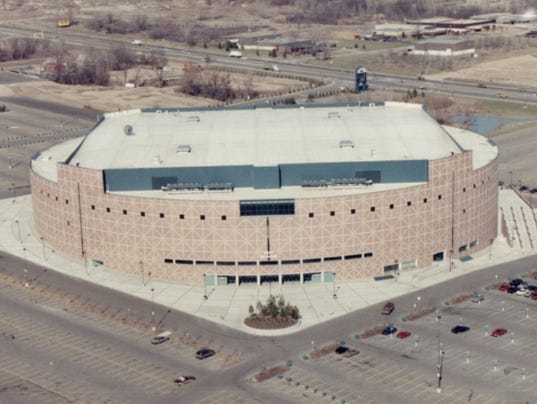
* The Palace. Home to the Pistons from 1988 to 2017, they won the 1989, 1990 and 2004 NBA Championships here, and almost won another in 2005. The Detroit Shock won 3 WNBA Championships here, and, as a result, every time a title was won, the address changed: Currently, it's "Six Championship Drive, Auburn Hills, MI 48326." However, the Shock moved to Tulsa in 2010, so unless the arena stays open and becomes the home of a new WNBA team, the address will never change to "Seven Championship Drive."
Unfortunately, the 22,000-seat building's best-known event isn't a Pistons title or a rock concert, but the November 19, 2004 fight between the Pistons and the Indiana Pacers that spilled into the stands, becoming known as "the Malice at the Palace." Even the WNBA had a rare brawl there, between the Shock and the Los Angeles Sparks in 2008.
The Shock moved to Tulsa in 2010, and the Pistons just moved to Little Caesars Arena, so the address will never become "Seven Championship Drive." What will happen to the arena now is not clear: It has outlived Tiger Stadium, the Silverdome and the Olympia, and will almost certainly outlive Joe Louis Arena. It has lived to see its 30th Anniversary. But I wouldn't bet on it seeing a 40th.
Lapeer Road and Harmon Road, Auburn Hills, off I-75. Don't even think about trying to reach it by public transportation: You'd need 2 buses and
then a half-hour walk. So unless you've got a car, or you're a big sucker for NBA history, I'd suggest skipping it.
* Mack Park. The Negro Leagues' Detroit Stars played here from 1920 to 1929, featuring center fielder Norman "Turkey" Stearnes and pitcher Andy Cooper, who would both be posthumously elected to the Baseball Hall of Fame. A senior citizens' complex, the Fairview Apartments, is on the site now. 3568 Fairview Street at Mack Avenue, about 5 miles east of downtown. Bus 7 will get you within a 15-minute walk.
* Hamtramck Stadium. After Mack Park burned down in 1929, they moved into this nearby facility for the 1930 season. Pronounced "Ham-TRAM-ick," this city is actually completely surrounded by Detroit. But between the Mack Park fire and the start of the Great Depression at the end of the year, the Stars' fate was sealed.
New teams with the name would occasionally be revived. At its peak, Hamtramck Stadium seated over 8,000 people. However, the decline of the Negro Leagues and the "industrial leagues" in the 1950s doomed it to high school use, it hasn't been used at all since 2012, and its sideline wings have been removed, reducing its capacity to 1,500. Nevertheless, it is 1 of 12 Negro League ballparks still standing. 3201 Dan Street.
When the Dodge Brothers (who later sold the car company bearing their name to Chrysler) opened an auto plant in Hamtramck in 1914, it became a hub for Polish immigration. However, the Polish population of the city has dropped from 90 percent in 1970 to 22 percent today. And Arabs and South Asians have moved in, making it Michigan’s most internationally diverse city.
Nevertheless, if you want the best kielbasa, kapusta, golumpkis and paczkis this side of the Oder, this is the place to go. Hamtramck Town Shopping Center, Joseph Campau Street and Hewitt Street.
Detroit City FC plays in the 4th tier of American soccer, at Keyworth Stadium in Hamtramck, a 7,000-seat high school football stadium, 5 1/2 miles north of downtown. All of these Hamtramck locations can be reached via the Number 10 bus.
Detroit is the largest metropolitan area in North America without a Major League Soccer team, although there is a drive to get an expansion team. For the moment, the closest MLS team to Detroit is the Columbus Crew, 204 miles away. However, the Ohio State-Michigan rivalry may complicate that. The threatened move of the Crew to Austin, Texas may eliminate it altogether. The next-closest team, Toronto FC, 241 miles away, may be preferred by Detroiters, soon by default.
* Holy Redeemer High School. In the 1946-47 basketball season, the Detroit Gems played in the National Basketball League at this school. They may not have been redeemable, going 4-40. The next season, they moved, and became the Minneapolis Lakers. And so, this is where the Los Angeles Lakers franchise began. 5679 Vernor Highway, about 3 miles west of downtown. Bus 1.
* Site of Cadillac Athletic Club. Housed in the Masonic Temple from 1895 to 1935, this auditorium hosted a fight for the Heavyweight Championship of the World on April 6, 1900. Jim Jeffries retained the title by decision over John Finnegan. A bank building is now on the site. 411 W. Lafayette Blvd. Fort/Cass station on the People Mover.
Only one site in Michigan, outside Detroit and its immediate suburbs, has ever hosted a Heavyweight title fight: The Floyd Fitzsimmons Arena hosted Jack Dempsey's defense against Billy Miske on September 6, 1920. Southeast corner of Fair Avenue & Britain Avenue, about 3 miles east of downtown in Benton Harbor. The resort town is all the way across the State, on the shore of Lake Michigan, 186 miles west of Detroit, and 99 miles by road "east" of Chicago (but considerably closer as the crow flies). Amtrak goes to Benton Harbor.
*AAGPBL. From 1943 to 1954, the All-American Girls' Professional Baseball League provided an alternative to Major League Baseball. Michigan had 2 teams in the League. The Grand Rapids Chicks won Pennants in 1947 and 1953. They played at South High School, which closed in 1968. The building still stands, as the Gerald R. Ford Job Corps Center, named for the city's most famous son. 110 Hall Street SE. 161 miles northwest of downtown Detroit.
And the Kalamazoo Lassies won the League's last Pennant, in 1954. They played at Lindstrom Field, at 3100 Portage Street. Stores are on the site now. 139 miles west of downtown Detroit, and 145 miles east of Chicago's Loop.
* Motown Historical Museum. As always, I'm going to include some non-sports items. Detroit is generally known for 3 good things: Sports, music and cars. The Motown Historical Museum is the former Motown Records studio, which company founder Berry Gordy Jr. labeled "Hitsville, U.S.A." His sister, Esther Gordy Edwards, now runs it, and it features records and costumes of performers such as the Supremes, the Temptations and the Four Tops. 2648 W. Grand Blvd., on the North Side. Number 16 bus.
* Henry Ford Museum. The centerpiece of the nation's foremost automotive-themed museum is a replica of Independence Hall in Philadelphia. Henry Ford himself established the museum: "I am collecting the history of our people as written into things their hands made and used... When we are through, we shall have reproduced American life as lived, and that, I think, is the best way of preserving at least a part of our history and tradition."
It contains the fascinating, including early cars and bicycles, Henry Ford's 1st car (his 1896 "Quadricycle"), Igor Sikorsky's prototype for the helicopter, the bus Rosa Parks was riding in when she refused to give up her seat to start the 1955-56 Montgomery Bus Boycott, and a Buckminster Fuller "Dymaxion house." It also contains the macabre, with the chair Abraham Lincoln was supposedly sitting in when he was assassinated at Ford's Theater in Washington (the theater owner was no relation to Henry); and the chair, and the rest of the car as well, that John F. Kennedy was definitely sitting in when he was assassinated, the back seat of in the 1961 Lincoln Continental convertible limousine he was riding in through downtown Dallas.
Next door to the museum is Greenfield Village, which Ford imagined as a kind of historical park, a more modern version of Colonial Williamsburg – that is, celebrating what was, in 1929 when it opened, considered modern American life, including a reconstruction of the Menlo Park, New Jersey laboratory of his good friend Thomas Edison. Ford and Edison were both friends of rubber magnate Henry Firestone (whose tires certainly made Ford's cars easier to make), and Firestone's family farm is reconstructed on the site.
Please note that I am
not excusing Henry Ford's control-freak attitude toward his employees' private lives, nor his despicable anti-Semitism, nor his failed union-busting in the 1930s. To be fair, he did give his black auto workers the same pay and benefits as his white ones. But I am recommending the museum. It's a tribute to the role of technology, including the automobile, in American life, not to the man himself. Oakwood Blvd. and Village Road. Number 200 bus to Michigan Avenue and Oakwood Blvd., then a short walk down Oakwood.
* Greektown Historic District. Although Detroit is famed for its Irish (Corktown, including the site of Tiger Stadium) and Italian communities, and has the largest Arab-American community of any major city, its best-known ethnic neighborhoods are Greektown and the Polish community of Hamtramck. New York's Astoria, Queens has nothing on Detroit's Greektown, which not only has some of the country's finest Greek restaurants, but also the Greektown Casino, which is at 555 E. Lafayette Street, at Beaubien Street. Greektown Station on the People Mover.
* Mariners' Church. On my 1999 visit to Detroit, I discovered this church by accident, walking past it without realizing it was there until I saw the historical marker. Every March, it holds a Blessing of the Fleet for every person and ship going to sea. Every November, it holds a Great Lakes Memorial Service for those who have lost their lives at sea within the past year.
The most famous of these ceremonies was for the 29 men lost on the iron ore freighter SS
Edmund Fitzgerald in Lake Superior on November 10, 1975. Built and homeported in Detroit, the Big Fitz was commemorated by Gordon Lightfoot, whose 1976 song "The Wreck of the
Edmund Fitzgerald" mistakenly, but poetically, called the church "The Maritime Sailors' Cathedral." (Edmund Fitzgerald himself was the president of Northwestern Mutual Life Insurance Company, which invested in the ship's construction, because it was heavily invested in the ore industry.)
170 E. Jefferson Avenue, at Randolph Street, across from the Renaissance Center. If you're going to visit the church, be careful, because Randolph Street empties into the Detroit-Windsor Tunnel.
* Spirit of Detroit. In front of the Coleman A. Young Municipal Center, the city hall named for the 1974-93 Mayor, stands a marble monument with a bronze statue of a kneeling man, the seals of the City of Detroit and Wayne County, and a Biblical inscription, from 2nd Corinthians 3:17: "Now the Lord is that spirit, and where the spirit of the Lord is, there is liberty."
In his left hand, the 26-foot-high kneeling figure holds a gilt bronze sphere emanating rays, to symbolize God. The people in the figure's right hand are a family group.
The statue was dedicated in 1958, 4 years after the Municipal Center opened. In recent years, a large jersey has been placed over it when the Tigers, Pistons or Wings have been in their sport's finals. (As yet, this has never been done for the Lions, who haven't been to an NFL Championship Game since 1957, 9 seasons before they started calling it the Super Bowl.) 2 Woodward Avenue at Jefferson Avenue.
The Spirit of Detroit, wearing a Pistons jersey
in honor of the 2004 NBA Finals, which they won
* Monument to Joe Louis. Erected in 1986, on a traffic island at the intersection of Woodward & Jefferson, it is a 24-foot-long arm with a fisted hand suspended by a 24-foot-high pyramidal framework. Since it is a monument to Louis, the great black heavyweight champion, the arm and fist are black bronze.
The Louis Monument, with the Spirit of Detroit behind it
* Colleges. The University of Michigan is 44 miles west of downtown Detroit, in Ann Arbor. It is possible to reach it from Detroit by bus, but it will take 2 hours: You can take the 851 bus to the airport, and transfer there to the 787.
Gerald Ford (no relation to Henry) was President from August 9, 1974 to January 20, 1977, and was a graduate of (and an All-American football player at) Michigan in the 1930s. His Presidential Library, and a School of Public Policy named for him, are on the Ann Arbor campus, at 1000 Beal Avenue.
However, he is the only President whose Library and Museum are separated, and his Presidential Museum, where he and Betty are buried, is in his hometown of Grand Rapids, at 303 Pearl Street NW, 158 miles northwest of Detroit. You'll need Greyhound if you want to visit Grand Rapids.
Michigan Stadium is at 1201 S. Main Street at Stadium Blvd. "The Big House" has hosted UM football since 1927. Its peak attendance is 115,109 for Michigan's 2013 win over Notre Dame. This past year, it set new records for highest U.S. attendance for soccer (109,318 for Manchester United beating Real Madrid in the International Champions Cup), and for highest attendance anywhere on the planet for hockey (105,491 for the NHL Winter Classic, the Toronto Maple Leafs beating the Detroit Red Wings).
Adjacent is Crisler Arena, named for Herbert "Fritz" Crisler, the UM football coach from 1938 to 1947, who, in another connection between Princeton University sports and the State of Michigan, had previously coached Princeton's Tigers, and brought his "winged" helmet design with him, making Michigan's "maize and blue" helmets among the most famous in college football. Elvis sang at Crisler Arena on April 24, 1977. The other sports facilities, including Yost Arena (hockey) and Fisher Stadium (named for Ray Fisher, who pitched for the Yankees in the 1910s before they got good and then coached at Michigan, including Charlie Gehringer), are adjacent.
Michigan State University is 88 miles northwest of Detroit, in East Lansing, adjacent to Lansing, the State capital. Greyhound runs 4 buses a day from Detroit to East Lansing, at 8:00 AM, 12:10 PM, 2:20 PM and 7:40 PM, and it takes about 2 hours. Two buses go back to Detroit, at 3:40 and 5:55 PM. $38 round-trip.
Spartan Stadium, formerly Macklin Field, is at 325 W. Shaw Lane at Red Cedar Road, which is named for the river that bisects the MSU campus. Jenison Field House (the old basketball arena, where Magic Johnson starred on their 1979 National Champions), Breslin Events Center (their new arena), and Munn Arena (hockey) are a short walk away, at Kalamazoo Street & Birch Road.
According to an October 3, 2014 article in
The New York Times, UM has a decided, though not overwhelming, advantage in fans in the Detroit area, and also in most of the State of Michigan. Only around the State capital of Lansing do you get an edge for MSU.
In addition to the preceding, Elvis sang in Michigan at
Wings Stadium (a minor-league hockey arena, now named Wings Event Center) in Kalamazoo on October 21, 1976 and April 26, 1977; and the Saginaw County Event Center (now the Dow Event Center) in Saginaw on April 25 and May 3, 1977.
* Jimmy Hoffa. No, I don't know where Hoffa is buried. All I know for sure is that, when they demolished Giants Stadium in 2010, they found no human remains. Hoffa, who was born in Indiana but lived most of his life in and around Detroit, was last seen alive on July 30, 1975, sitting in his car in the parking lot of Machus' Red Fox.
A fine-dining establishment open from 1965 to 1996, the building is still there, occupied by an Italian restaurant named Andiamo's. 6676 Telegraph Road (U.S. Route 24) at Country Club Drive, Bloomfield, 22 miles northwest of Cadillac Square. As with most sites in Detroit's outer suburbs, getting there by public transportation is a hassle: In this case, you'd need 3 buses.
* Beaches. Michigan's State motto is, "If you seek a pleasant peninsula, look around you." It is surrounded on 3 sides by Great Lakes: Michigan to the west, Huron to the north and northeast, and Erie to the southeast. It has various protrusions into the water, and many islands, leading singer Gordon Lightfoot to say, "The islands and bays are for sportsmen."
Two areas of the State are renowned by beachgoers. South Haven, "the Catskills of the Midwest," is on the shore of Lake Michigan, 181 miles west of Cadillac Square. Mackinac Island (pronounced MACK-in-aw, not MACK-in-ack), over the Mackinac Bridge (the Mighty Mac), is closed to car traffic, and must be reached by ferry from Mackinac City. It is Michigan's Hamptons, its Cape May, its Martha's Vineyard. 289 miles northwest of Cadillac Square.
* Windsor. Across the Detroit River is Windsor, Ontario. Most Americans know it for Caesar's Windsor, one of 4 casinos in the area. Like its namesakes in Las Vegas and Atlantic City, it has a Roman theme. It may be only 2 miles from downtown Detroit, but because it's in Canada, where they have things like sensible gun laws and national health care, it may feel like the other side of the world (if not Rome itself). And, because it's in Canada, you'll need a passport.
377 Riverside Drive East. There is bus service available -- less for Michiganders wanting to gamble, more for Windsorites wanting to go to Red Wings games and concerts -- and you can contact Transit Windsor at tw@city.windsor.on.ca.
The Wings' first home was actually in Windsor: They played their first season, 1926-27, at the Border Cities Arena, which still stands, and is now named Windsor Arena. Like a lot of old arenas (this one was built in 1924), it looks like a barn, and so is nicknamed The Barn. It seats only 4,400 people in its current configuration.
Its long-term tenants, the University of Windsor hockey team and the Windsor Spitfires of the Ontario Hockey League, now play elsewhere. The City of Windsor has approved a plan to tear it down and build the new building for Catholic Central High School on the site. 334 Wyandotte Street East, at McDougall Street.
The University of Windsor Lancers haven't been very successful in sports. Their greatest achievement is their football team winning the Yates Cup, for the championship of Ontario University Athletics, in 1975. The Yates Cup was founded in 1898, and is the oldest football trophy in North America.
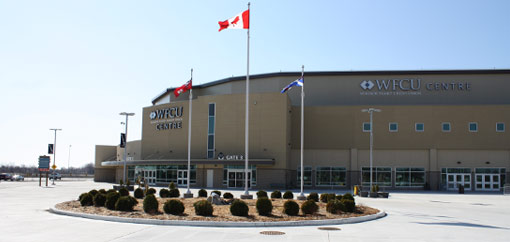
Since 2008, the Spitfires have played at the WFCU Centre. No, that's not named for a radio station: Canadian radio stations' call letters always been with a C. The naming rights are held by the Windsor Family Credit Union. The Spitfires won the Memorial Cup, the championship of Canadian junior hockey, while playing there, in 2009 and '10, and one of the streets bordering is named Memorial Cu Way.
The Lancers also play hockey and basketball there. The Windsor Express play in the National Basketball League of Canada there. 8787 McHugh Street, 8 miles from downtown Detroit and 7 miles east of downtown Windsor. Bus 2 from there.
*
Home Improvement. The 1991-99 ABC sitcom is easily the best-known TV show to have been set in Detroit, with the studio for the show-within-the show
Tool Time being in the city and the Taylors' house in the suburbs. I don't think the exact town was ever specified, but a likely location is in Bloomfield Hills.
As far as I know, there were no location shots, not even in the episode in which the Taylors got to see the Lions' annual Thanksgiving game from a Silverdome skybox. So if you're looking for the Taylors' house, you're not going to find it -- if there was ever a house, not just a studio set, it was likely in or around Los Angeles. Other shows set in or around Detroit have included
Martin, Freaks and Geeks, Sister, Sister, and
8 Simple Rules for Dating My Teenage Daughter.Several films have been set, but not necessarily filmed, in Detroit. Axel Foley, Eddie Murphy's character in the
Beverly Hills Cop films, was a Detroit police detective, but most of the film, including the Detroit scenes, was shot in Los Angeles. While
RoboCop was set in Detroit, it was filmed in Dallas. (And you thought "Dallas sucks" was just a sports chant.)
Billy Crystal's movie about the 1961 home run record chase,
61*, used Tiger Stadium as a stand-in (with computer-generated help) for the original Yankee Stadium (since the 1973-76 renovation left it looking very little like it did in 1961). Other recent movies set in Detroit include Eminem's
Roman à clef, 8 Mile; and Clint Eastwood's retired autoworker vs. gangs film
Gran Torino.
*
A visit to Detroit does not have to be a scary experience. These people love basketball -- especially "Dee-troit bas-ket-ball!" And, while they don't necessarily like the Yankees, they don't have a problem with Knick and Net fans. They love basketball, and they should be able to show you a good time.