Showing posts with label danny biasone. Show all posts

Thursday, April 10, 2025

April 10, 1955: A Title for Syracuse

April 10, 1955, 70 years ago: The NBA Championship goes to Syracuse, New York.

Go ahead, clean your glasses. I got it right: Syracuse.

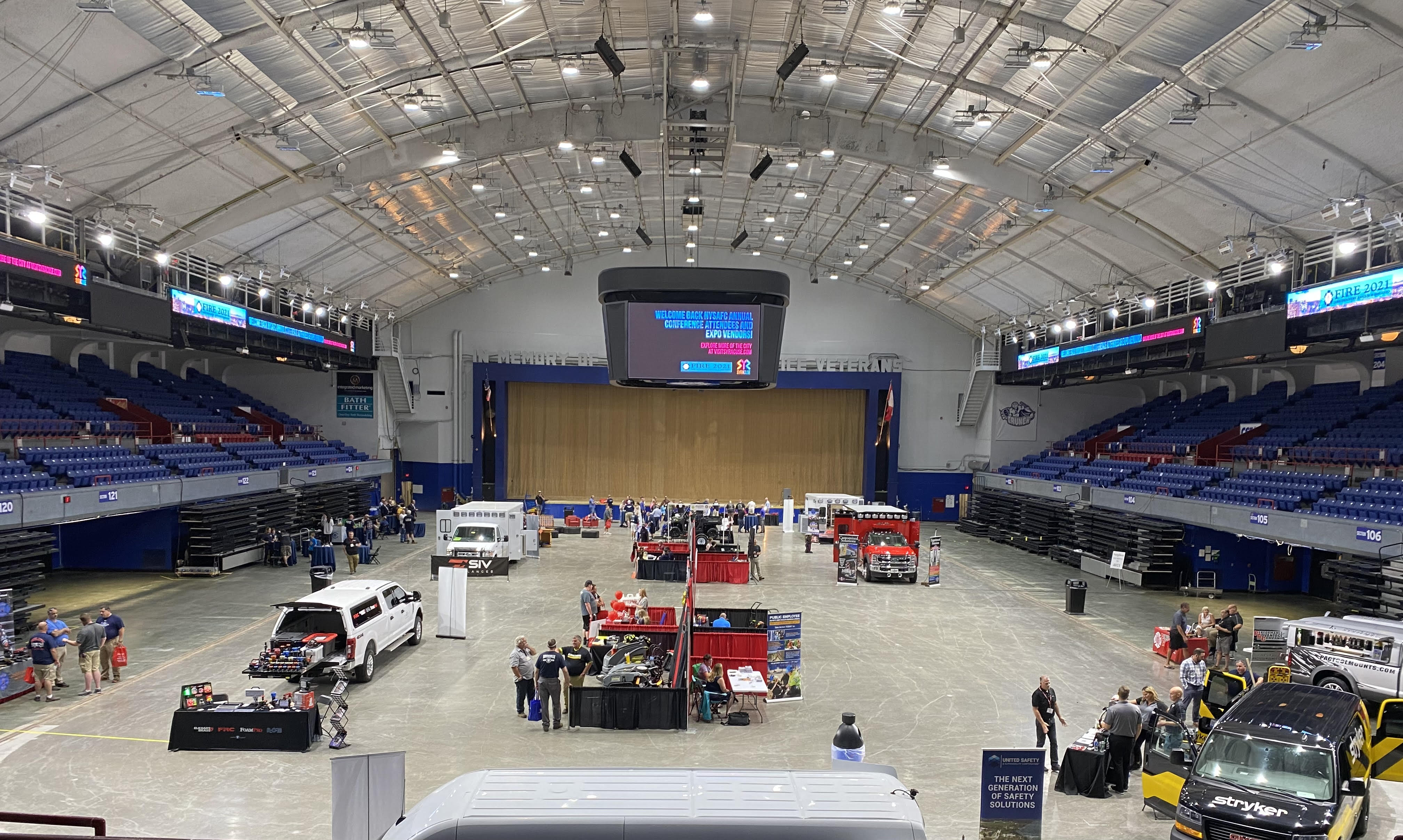
The Salt City has long been a home to Italian immigrants and their descendants. One son of those immigrants was Carmen Basilio, Middleweight Champion of the World in the 1950s. Danny Biasone was an immigrant from Chieti, in central Italy. In 1946, he paid $5,000 for a National Basketball League franchise, and the Syracuse Nationals set up shop at the State Fair Coliseum, a 7,500-seat auditorium built in 1927. It still stands, in the suburb of Geddes, New York, and is known as the Toyota Coliseum.

In their 1st season, 1946-47, the Nats made the Playoffs, but lost to their closest opponents, the Rochester Royals, who had won the NBL title in 1945. Biasone signed former Royals star Al Cervi to coach, and drafted Dolph Schayes as his star player. In 1949, the Nats were among the NBL teams absorbed into the Basketball Association of America, which renamed itself the National Basketball Association.

The Nats had the best record in the NBA in 1949-50, going 51-13. (That's equivalent to 65-17 over a full 82-game season.) They reached the NBA Finals, but lost to George Mikan and the Minneapolis Lakers. The New York Knicks were the Eastern Division Champions the next 3 years.

In 1951, the Onondaga County War Memorial opened, seating 11,000, and the Nats moved in. When the Indianapolis Olympians folded in 1953, the Nats picked up Alex Groza and Ralph Beard (who, unlike some of their 1948 Kentucky and Olympic teammates, had not been barred from the NBA due to the 1951 point-shaving scandal), and reached the 1954 NBA Finals, again losing to the Lakers.
The War Memorial

It was Biasone who recommended the 24-second shot clock to the NBA, and it was instituted for the 1954-55 season. With guards Paul Seymour and George King, forwards Dolph Schayes and Earl Lloyd (who had been the NBA's 1st black player, with the Washington Capitols in 1950), center Ephraim "Red" Rocha, and talented backups like centers Johnny "Red" Kerr (a rookie who went on to become a star) and Connie Simmons, the Nats went 43-29, earning them a 1st-round bye in the Playoffs. They beat the Boston Celtics in the East Finals.

In the NBA Finals, they faced another former NBL team, the Fort Wayne Pistons, featuring Bob Houbregs, Max Zaslofsky, George Yardley and Andy Philip. They were 43-29, and were no pushovers.

As it turned out, home-court advantage meant everything in this series, as no game was a blowout, but the home team won each of the 1st 6. The Nats won Games 1 and 2 at home, 87-82 and 87-84, respectively. Games 3, 4 and 5 were played at the Allen County War Memorial Coliseum in Fort Wayne, Indiana, and the Pistons won them all: 96-89, 109-102, and 74-71. Game 6 was back in Syracuse, and the Nats won, 109-104.

Game 7 was also in Syracuse. The Nats had to keep the pattern going. But the Pistons led 31-21 at the end of the 1st quarter. They started a comeback, and it was 53-47 Fort Wayne at the half. At the end of the 3rd quarter, it was tied, 74-74. With 12 seconds left in regulation, with the game tied, George King was fouled by Frankie Brian. He sank 1 of his free throws, making it 92-91 Syracuse. King then stole an inbounds pass from Andy Philip to seal the title.

Unlike the John Havlicek steal in Boston 10 years later, this one is not preserved on film, which is why, unless you're from the Syracuse area, or King's hometown of Charleston, West Virginia, or really know your NBA history, you've never heard of this steal. Come to think of it, Philip was later traded to the Celtics, and wore Number 17 with them before Havlicek did.

The Pistons returned to the NBA Finals in 1956, losing to the Philadelphia Warriors. In 1957, they moved to Detroit, and, while they have changed home venues 4 times, they have remained in the Detroit metropolitan area.

For those of you who are wondering about the name, knowing that "Pistons" makes sense for a team in "The Motor City," but that they were called that before moving there: They were founded in 1937 by Fred Zollner, whose Zollner Corporation ran a Fort Wayne foundry that manufactured pistons, for the engines of cars, trucks and locomotives. They won the NBL title in 1944 and 1945.

From 1949-50 to 1956-57, the Syracuse Nationals had 8 straight Playoff berths, 3 regular-season NBA Eastern Division titles, 9 Playoff series won, 7 Eastern Division Finals reached, 3 NBA Finals, and the 1955 NBA Championship -- still the last World Championship won by a team in New York State but not in New York City.

(The Rochester Royals had won the NBA title in 1951. The Buffalo Bills went as far as they could go in 1964 and 1965, winning the AFL Championship, but no Buffalo-based team has won a World Championship.)

But it wasn't enough. Syracuse, named for a city in Sicily, has a population of just 150,000. With a metropolitan area of under 700,000, Central New York simply isn't a big enough market to support a major league sports team. In 1963, the Nationals moved to Philadelphia, taking the place of the Warriors, who had moved to San Francisco a year earlier. They became the Philadelphia 76ers, winning the NBA Championship in 1967 and 1983, and losing in the Finals in 1977, 1980, 1982 and 2001.

Syracuse is still home to a Class AAA baseball team, the Chiefs; a hockey team at the same level, the Syracuse Crunch; and Syracuse University, a top-level college sports program. As far as major league sports goes, the Buffalo teams are about 150 miles west;  the Toronto teams are 250 miles west, then northeast; the New York teams are 250 miles southeast; and the Boston teams are a little over 300 miles east.
The War Memorial still stands, under the name of the Upstate Medical University Arena, and is home to the Crunch, concerts, and the occasional college and high school basketball game.
George King coached at West Virginia University, and then led Purdue to the NCAA Final in 1969. He died in 2006. Al Cervi, Dolph Schayes and Earl Lloyd were elected to the Basketball Hall of Fame, and Schayes was named to the NBA's 50th Anniversary 50 Greatest Players and its 75th Anniversary 75 Greatest Players. Cervi died in 2009. Schayes, whose son Danny Schayes had a fine NBA career, died in 2015, as did Lloyd. Jim Tucker was the last survivor of the '55 Nats, living until 2020.

Wednesday, October 30, 2024

October 30, 1954: The NBA Begins Using the 24-Second Shot Clock

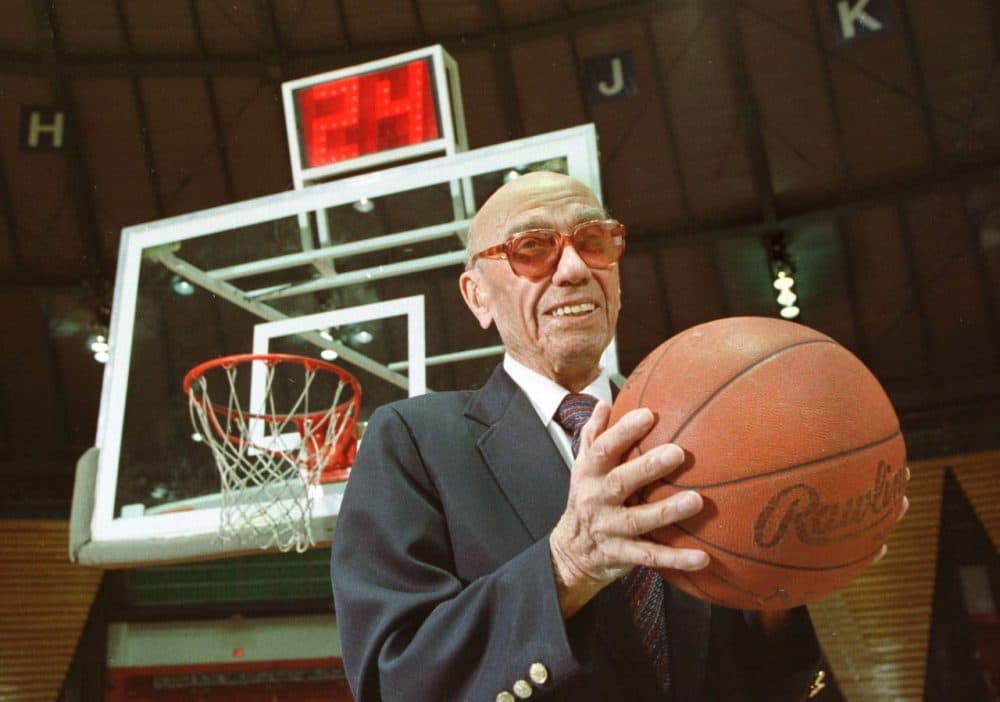
Danny Biasone, 1992

October 30, 1954, 70 years ago: The National Basketball Association starts the 1954-55 season, the 1st with the 24-second shot clock. Professional basketball would never be the same.

From their arrival from the rival National Basketball League in 1948 until the retirement of their star center George Mikan in 1954, the NBA was dominated by the Minneapolis Lakers. Although they had others who that would go on to the Basketball Hall of Fame -- forwards Jim Pollard and Vern Mikkelsen, and guard Slater Martin -- their game was mainly to get the ball in to Mikan, at 6-foot-10 the pro game's 1st great "big man," and let him lay it in.

But Mikan was not fast. The New York sportscaster Bill Mazer once said, "He was more like a stampeding elephant." And, unlike some later big men, he was unwilling to foul his way into shooting position, which, for him, wasn't a big area. So the Lakers would keep passing the ball around until Mikan, or somebody else, could get into the lane. This could take several minutes.

The only way to defend against this was to commit fouls, hope that a free throw was missed, and hope that someone could rebound the miss before Mikan could. Or, for the other team to do the same: Hold the ball, pass it around, for as long as possible until someone got inside before Mikan could.

This resulted in scores that even the 1990s New York Knicks version of Pat Riley would think were too low, bottoming out on November 22, 1950: The Fort Wayne Pistons attempted only 13 shots through the entire 48 minutes, and beat the Lakers, 19-18. The 4th quarter saw just 3 points from the Pistons, 1 from the Lakers. A few weeks after that, on January 6, 1951, the Indianapolis Olympians beat the Rochester Royals, 75-73. The final score wasn't the problem. The problem was that game went to 6 overtimes, an NBA record; and, in each overtime, the team that won the jump ball held the ball for nearly the entire 5 minutes before attempting a last-second shot.

The NBA was getting boring. Attendance was dropping. Teams were dropping out. When the NBA was founded as the Basketball Association of America in 1946, it had teams in Washington, Toronto, Chicago, St. Louis, Detroit, Cleveland and Pittsburgh. By the start of the 1951-52 season, all of those teams were gone. Eventually, all of those cities but Pittsburgh would get new teams (although St. Louis eventually lost their replacement, and Chicago lost theirs before a 2nd replacement, the Bulls, succeeded). But big cities were losing teams, because fans didn't want to come out to see the games. Something had to be done.

In 1954, the owner of the Syracuse Nationals, Danny Biasone, had an idea: "I looked at the box scores from the games I enjoyed, games where they didn't screw around and stall. I noticed each team took about 60 shots. That meant 120 shots per game. So I took 2,880 seconds (48 minutes) and divided that by 120 shots. The result was 24 seconds per shot."

Biasone showed his findings to his general manager, Leo Ferris, and his head coach Al Cervi. Cervi ran intrasquad games with a stopwatch, and blew his whistle after 24 seconds without a shot. They agreed that 24 seconds worked well. Ferris talked to the other NBA GMs, and they adopted it for the 1954-55 season, although Biasone has gone down in history as the idea man: He is in the Basketball Hall of Fame, while Ferris is not. (Cervi is in, but was elected for what he did as a player.)
At first, the clock made players nervous. Dolph Schayes, the Nats' best player, said, "We thought we had to take quick shots – a pass and a shot was it – maybe 8–10 seconds... But as the game went on, we saw the inherent genius in Danny's 24 seconds. You could work the ball around for a good shot."

The shot clock, together with some rule changes concerning fouls, revolutionized NBA play. In the last pre-clock season, 1953-54, teams averaged 79 points per game; in the first year with the clock, 1954-55, the average was 93 points, which went up to 107 points by its fourth year in use, 1957-58. The increase in scoring led to an increase in attendance of 40 percent within a few years, to an average of 4,800 per game.

And, wouldn't you know it: The Nationals, the 1st team to work with the shot clock, and thus the team with the most exposure to it, won the 1955 NBA Championship. They got back to the Finals in 1956, but lost to the Philadelphia Warriors. Then Red Auerbach drafted Bill Russell for the Boston Celtics, and they used the shot clock better, and dominated the NBA for the next 13 years.
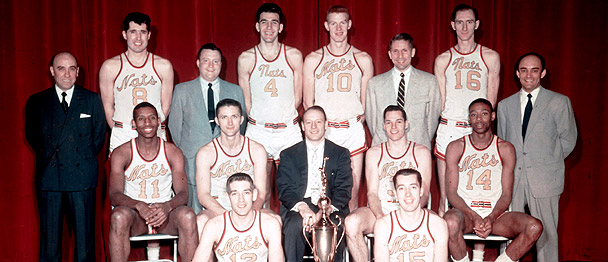
The 1955 NBA Champion Syracuse Nationals.
Biasone is at far left, Farris at far right, Cervi in the middle.
Number 4 is Hall-of-Famer Dolph Schayes.

The Nationals remained a good team, but Syracuse eventually proved to be too small a market for a major league sports team. In 1963, the Nats moved, becoming the Philadelphia 76ers, taking the place of the Warriors, who had moved to San Francisco a year earlier.

The American Basketball league of 1961-63 used a 30-second shot clock. The American Basketball Association started in 1967, and also used a 30-second clock. To get its teams ready for absorption by the NBA (4 of them were: The New York Nets, the Indiana Pacers, the San Antonio Spurs and the Denver Nuggets), they switched to a 24-second clock for 1975-76, which turned out to be the ABA's last season.

The NCAA resisted putting a shot clock in the college game, but allowed conferences to experiment with it, and some did, with enough success that the NCAA put in a 45-second shot clock in 1985. The college game was already growing in popularity, and the institution of the shot clock increased it. The clock was reduced to 35 seconds in 1995, and 30 seconds in 2015.

Biasone died in 1992, not long after the photo at the top was taken at the Nats' arena, the Onondaga County War Memorial, built in 1951, and now named the Upstate Medical University Arena. It is home to the Syracuse Crunch of the American Hockey League. Ferris died in 1993, Cervi in 2009.

In 1996, ESPN held a panel discussion on what was the greatest team in NBA history. Bob Ryan of The Boston Globe said that the 1954 institution of the shot clock should be a demarcation line. He cited both Mikan and the NBA's 1st scoring champion, the leader of the Warriors who won the 1st NBA title in 1946-47, as players who would not have excelled under the new system: "I'm not gonna kid you, I don't think Jumpin' Joe Fulks makes it in today's NBA, except maybe as a 12th man. George Mikan? A good backup center. He was great in his time, deserved every accolade he ever got. But, today? He's Greg Kite with a hook shot."

(Ryan decided that the best team in league history was the 1986 Celtics. The other panelists chose teams like the 1967 and 1983 Philadelphia 76ers, and the 1987 Los Angeles Lakers. They also discussed the 1965 Celtics, the 1970 New York Knicks, the 1972 Lakers, the 1977 Portland Trail Blazers, and the Chicago Bulls team that had just gone 72-10 and won the title.)

*

October 30, 1954 was a Saturday. There were 3 games played in the NBA on that Opening Day. It would have made sense for the Syracuse Nationals to be among the teams scheduled, but they weren't. The other appropriate teams would have been the Lakers and the Pistons, the teams that played the 19-18 game. And they did:

* The New York Knicks beat the Minneapolis Lakers, 94-83 at the old Madison Square Garden. Without Mikan, no Laker scored more than the 18 of Clyde Lovellette. Carl Braun -- the man whose saying, "Swish!" whenever he hit a shot that hit nothing but net inspired Knick broadcaster Marty Glickman to use it on the air, and later Warner Wolf to do so in WCBS-Channel 2 recaps -- led all scorers in the game with 26. The Lakers moved to Los Angeles in 1960.

* The Fort Wayne Pistons beat the Milwaukee Hawks, 91-72 at the Milwaukee Arena. In 1974, it was renamed the Milwaukee Exposition, Convention Center and Arena, or "The MECCA." Since 2014, it has been named the UW-Panther Arena. This was the 1st professional game for Bob Pettit, who scored 17 points, and went on to become the greatest player in Hawks history. The Hawks moved to St. Louis the next season, and to Atlanta in 1968. The Pistons moved to Detroit in 1957.

* And the Rochester Royals beat the Boston Celtics, 98-95 at the Rochester War Memorial. Like Syracuse's war memorial arena, former arch-rival Rochester's still stands and hosts minor-league hockey, the Rochester Americans, under the name of the Blue Cross Arena. But it does not host pro basketball: The Royals moved to Cincinnati in 1957, to Kansas City as the Kings in 1972, and to Sacramento in 1985.