Showing posts with label dolph schayes. Show all posts

Thursday, April 10, 2025

April 10, 1955: A Title for Syracuse

April 10, 1955, 70 years ago: The NBA Championship goes to Syracuse, New York.

Go ahead, clean your glasses. I got it right: Syracuse.

The Salt City has long been a home to Italian immigrants and their descendants. One son of those immigrants was Carmen Basilio, Middleweight Champion of the World in the 1950s. Danny Biasone was an immigrant from Chieti, in central Italy. In 1946, he paid $5,000 for a National Basketball League franchise, and the Syracuse Nationals set up shop at the State Fair Coliseum, a 7,500-seat auditorium built in 1927. It still stands, in the suburb of Geddes, New York, and is known as the Toyota Coliseum.

In their 1st season, 1946-47, the Nats made the Playoffs, but lost to their closest opponents, the Rochester Royals, who had won the NBL title in 1945. Biasone signed former Royals star Al Cervi to coach, and drafted Dolph Schayes as his star player. In 1949, the Nats were among the NBL teams absorbed into the Basketball Association of America, which renamed itself the National Basketball Association.

The Nats had the best record in the NBA in 1949-50, going 51-13. (That's equivalent to 65-17 over a full 82-game season.) They reached the NBA Finals, but lost to George Mikan and the Minneapolis Lakers. The New York Knicks were the Eastern Division Champions the next 3 years.

In 1951, the Onondaga County War Memorial opened, seating 11,000, and the Nats moved in. When the Indianapolis Olympians folded in 1953, the Nats picked up Alex Groza and Ralph Beard (who, unlike some of their 1948 Kentucky and Olympic teammates, had not been barred from the NBA due to the 1951 point-shaving scandal), and reached the 1954 NBA Finals, again losing to the Lakers.
The War Memorial

It was Biasone who recommended the 24-second shot clock to the NBA, and it was instituted for the 1954-55 season. With guards Paul Seymour and George King, forwards Dolph Schayes and Earl Lloyd (who had been the NBA's 1st black player, with the Washington Capitols in 1950), center Ephraim "Red" Rocha, and talented backups like centers Johnny "Red" Kerr (a rookie who went on to become a star) and Connie Simmons, the Nats went 43-29, earning them a 1st-round bye in the Playoffs. They beat the Boston Celtics in the East Finals.

In the NBA Finals, they faced another former NBL team, the Fort Wayne Pistons, featuring Bob Houbregs, Max Zaslofsky, George Yardley and Andy Philip. They were 43-29, and were no pushovers.

As it turned out, home-court advantage meant everything in this series, as no game was a blowout, but the home team won each of the 1st 6. The Nats won Games 1 and 2 at home, 87-82 and 87-84, respectively. Games 3, 4 and 5 were played at the Allen County War Memorial Coliseum in Fort Wayne, Indiana, and the Pistons won them all: 96-89, 109-102, and 74-71. Game 6 was back in Syracuse, and the Nats won, 109-104.

Game 7 was also in Syracuse. The Nats had to keep the pattern going. But the Pistons led 31-21 at the end of the 1st quarter. They started a comeback, and it was 53-47 Fort Wayne at the half. At the end of the 3rd quarter, it was tied, 74-74. With 12 seconds left in regulation, with the game tied, George King was fouled by Frankie Brian. He sank 1 of his free throws, making it 92-91 Syracuse. King then stole an inbounds pass from Andy Philip to seal the title.

Unlike the John Havlicek steal in Boston 10 years later, this one is not preserved on film, which is why, unless you're from the Syracuse area, or King's hometown of Charleston, West Virginia, or really know your NBA history, you've never heard of this steal. Come to think of it, Philip was later traded to the Celtics, and wore Number 17 with them before Havlicek did.

The Pistons returned to the NBA Finals in 1956, losing to the Philadelphia Warriors. In 1957, they moved to Detroit, and, while they have changed home venues 4 times, they have remained in the Detroit metropolitan area.

For those of you who are wondering about the name, knowing that "Pistons" makes sense for a team in "The Motor City," but that they were called that before moving there: They were founded in 1937 by Fred Zollner, whose Zollner Corporation ran a Fort Wayne foundry that manufactured pistons, for the engines of cars, trucks and locomotives. They won the NBL title in 1944 and 1945.

From 1949-50 to 1956-57, the Syracuse Nationals had 8 straight Playoff berths, 3 regular-season NBA Eastern Division titles, 9 Playoff series won, 7 Eastern Division Finals reached, 3 NBA Finals, and the 1955 NBA Championship -- still the last World Championship won by a team in New York State but not in New York City.

(The Rochester Royals had won the NBA title in 1951. The Buffalo Bills went as far as they could go in 1964 and 1965, winning the AFL Championship, but no Buffalo-based team has won a World Championship.)

But it wasn't enough. Syracuse, named for a city in Sicily, has a population of just 150,000. With a metropolitan area of under 700,000, Central New York simply isn't a big enough market to support a major league sports team. In 1963, the Nationals moved to Philadelphia, taking the place of the Warriors, who had moved to San Francisco a year earlier. They became the Philadelphia 76ers, winning the NBA Championship in 1967 and 1983, and losing in the Finals in 1977, 1980, 1982 and 2001.

Syracuse is still home to a Class AAA baseball team, the Chiefs; a hockey team at the same level, the Syracuse Crunch; and Syracuse University, a top-level college sports program. As far as major league sports goes, the Buffalo teams are about 150 miles west;  the Toronto teams are 250 miles west, then northeast; the New York teams are 250 miles southeast; and the Boston teams are a little over 300 miles east.
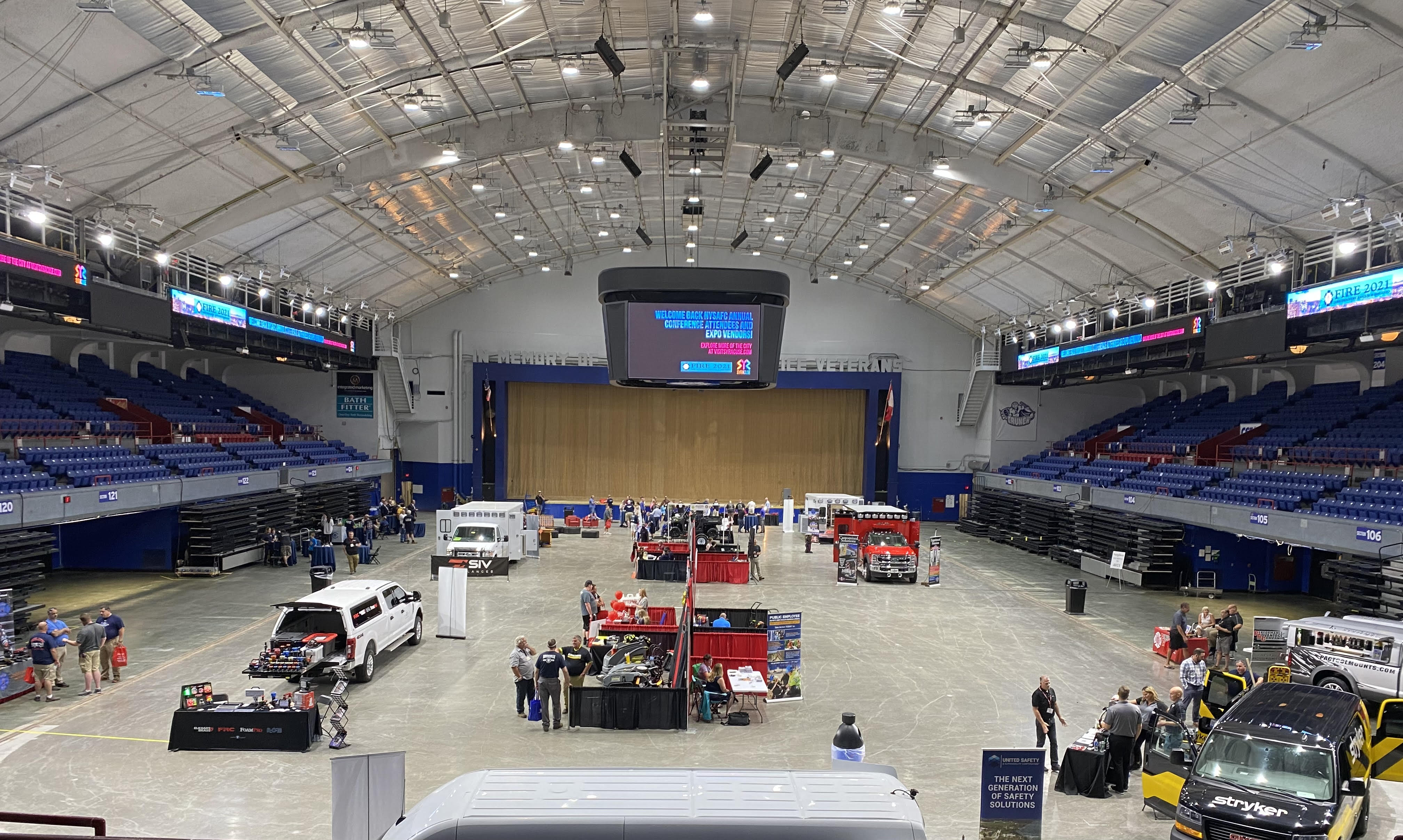
The War Memorial still stands, under the name of the Upstate Medical University Arena, and is home to the Crunch, concerts, and the occasional college and high school basketball game.
George King coached at West Virginia University, and then led Purdue to the NCAA Final in 1969. He died in 2006. Al Cervi, Dolph Schayes and Earl Lloyd were elected to the Basketball Hall of Fame, and Schayes was named to the NBA's 50th Anniversary 50 Greatest Players and its 75th Anniversary 75 Greatest Players. Cervi died in 2009. Schayes, whose son Danny Schayes had a fine NBA career, died in 2015, as did Lloyd. Jim Tucker was the last survivor of the '55 Nats, living until 2020.

Tuesday, January 8, 2019

Western New York's 10 Greatest Athletes

Tonight, the New Jersey Devils are in Buffalo to play the Sabres.

Western New York's 10 Greatest Athletes

Honorable Mention to members of the Baseball Hall of Fame from the 1880s Buffalo Bisons: Jim "Pud" Galvin, Jim "Orator" O'Rourke, Jim "Deacon" White, Dan Brouthers, and one of the few black players to make the major leagues before the color line was drawn, Frank Grant. Apparently, you didn't have to be named Jim and have a cool nickname to play for those old Bisons, but it apparently helped.

Honorable Mention to the following players from the Class AAA version of the Buffalo Bisons who are in the Baseball Hall of Fame: Ray Schalk, Jim Bunning, Johnny Bench, Ferguson Jenkins and Jim Thome.

Honorable Mention to Buffalo Bills in the Pro Football Hall of Fame, other than those in this Top 10: Billy Shaw, Joe DeLamielleure, James Lofton and Andre Reed.

Honorable Mention to Bob McAdoo, center, Buffalo Braves, 1972-76. He helped the Braves reach 3 straight Playoffs, 1974-76. He was named NBA Most Valuable Player in 1975. He was a 5-time All-Star, including 3 with the Braves. He later won NBA Championships with the Los Angeles Lakers in 1982 and 1985, and is in the Hall of Fame.

Honorable Mention to Dale Hawerchuk, center, Buffalo Sabres, 1990-95. He's in the Hockey Hall of Fame, but is better known for his play with the Winnipeg Jets.

Honorable Mention to Pat LaFontaine, center, Buffalo Sabres, 1991-96. He is 1 of 5 players to play for all 3 teams in the State of New York: The Sabres, the Rangers and the Islanders. He once said, "I think I'm the only player in history who has been traded twice and hasn't had to change his license plate."

He'd be a bit higher on this list if he'd been a one-club man. A 5-time All-Star, his struggles against injury led the NHL to award him the Bill Masterton Memorial Trophy in 1995. He had 3 40-goal seasons with the Sabres, topping out at 53 in 1992-93. He is in the Hockey Hall of Fame. In 2017, he was named to the NHL's 100th Anniversary 100 Greatest Players.

Now, the Top 10:

10. Phil Housley, defenseman, Buffalo Sabres, 1982-90. A defenseman who can score 338 goals in NHL play is rare, and Housley scored over half of them, 178, with the Sabres. He had 1,232 points in his career.

He played in 7 NHL All-Star Games, and was a member of the U.S. team that won the 1996 World Cup. He is in the Hockey Hall of Fame, and is now the Sabres' head coach.

9. Dave Andreychuk, left wing, Buffalo Sabres, 1982-93. A 2-time All-Star, he scored 640 goals in his career, 368 of them for the Sabres. He holds the record for most career power-play goals, and not even Wayne Gretzky can match his 274. He had 1,338 points. He finally won a Stanley Cup in 2004, with the Tampa Bay Lightning.

In spite of his goal totals, he was not named to the NHL's 100th Anniversary 100 Greatest Players in 2017. He was, however, elected to the Hockey Hall of Fame that year.

8. Bob Davies, guard, Rochester Royals, 1945-55. He would probably be called a "slow white guy" by today's NBA fans. But he helped the Royals win the National Basketball League title in 1946, and the NBA title in 1951. He was a 4-time All-Star, and led the NBA in assists in 1949.

Both Seton Hall University in South Orange, New Jersey and the Sacramento Kings, the successor to the Royals franchise, have retired his Number 11. He was named to the NBA's 25th Anniversary Team and the Basketball Hall of Fame.

7. Jim Kelly, quarterback, Buffalo Bills, 1986-96. A 7-time All-Star -- twice in the USFL with the Houston Gamblers, and 5 times in the NFL with the Bills -- he remains the only man to quarterback a team to 4 straight Super Bowl appearances. He is in the Pro Football Hall of Fame and the Bills have retired his Number 12.

6. Dolph Schayes, forward, Syracuse Nationals, 1948-63. Another one of the "slow white guys" who dominated the early NBA. But he wasn't that slow: He was a 12-time All-Star, reaching the All-Star Game both before and after the institution of the 24-second shot clock in 1954. That season, he led the Nats to the NBA Finals; the following year, he led them to win it. He led the NBA in rebounding in 1951.

He was with the Nats when they moved to become the Philadelphia 76ers in 1963, and was NBA Coach of the Year with them in 1966. They retired his Number 4. He was named to the NBA's 25th Anniversary team, its 50th Anniversary 50 Greatest Players, and the Basketball Hall of Fame.

His son Danny Schayes played in the NBA even longer, 18 years. Four of his grandchildren won medals at the Maccabiah Games, the Jewish mini-Olympics: Grandson Mickey Ferri won a Gold Medal in track in 2005, and granddaughters Abi, Carla and Rachel Goettsch won Silver Medals in volleyball in 2001.

5. Dominik Hasek, goaltender, Buffalo Sabres, 1992-2001. Had he played his entire career with the Sabres, he might be Number 1 on this list. He was never the greatest goalie ever, or even of his own time, as he was a contempoary of Patrick Roy and Martin Brodeur. But he was sensational -- the hockey goaltending equivalent of a great dunker in basketball.

With the Sabres, he led NHL goalies in save percentage 6 straight seasons (1993-99). His goals-against average of 2.20 is the 2nd-lowest in NHL history. He made 6 All-Star Games, won the Vezina Trophy as best goalie 6 times, and won the Hart Memorial Trophy as NHL regular-season Most Valuable Player in 1997 and 1998.

He led the Czech Republic to the Gold Medal at the 1998 Winter Olympics in Nagano, Japan. The closest he got to a Stanley Cup with the Sabres was in 1999, allowing that controversial goal to Brett Hull of the Dallas Stars in overtime of Game 6 of the Finals. In 2002, he and Hull were teammates on the Detroit Red Wings, and Hasek finally won a Cup. He won another with the Wings in 2008.

He is in the Hockey Hall of Fame, and the Sabres have retired his Number 39. In 2017, he was named to the NHL's 100th Anniversary 100 Greatest Players.

4. Gilbert Perreault, center, Buffalo Sabres, 1970-1986. The 1st pick in the 1970 NHL Draft, he was the original Sabre, and remains the best. He still holds franchise records for most games played (1,191), goals (512), assists (814) and points (1,326).

He won the Calder Memorial Trophy as NHL Rookie of the Year in 1971, and the Lady Byng Memorial Trophy for "most gentlemanly player" in 1973. He was named to 9 NHL All-Star Teams. Alas, the closest he got to a Stanley Cup was the 1975 Finals, which the Sabres lost to the Philadelphia Flyers in 6 games.

He is in the Hockey Hall of Fame. The Sabres retired his Number 11, along with the 7 of Rick Martin and the 14 Rene Robert. Together, they were "the French Connection Line," and a joint statue of them stands outside the KeyBank Center. In 1998, Gil Perreault was ranked Number 47 on The Hockey News' list of the 100 Greatest Hockey Players. In 2017, he was named to the NHL's 100th Anniversary 100 Greatest Players.

3. Thurman Thomas, running back, Buffalo Bills, 1988-99. A 5-time Pro Bowler, he was named NFL MVP in 1991, helping the Bills win the 2nd of 4 straight AFC Championships. He had 12,074 yards rushing for 65 touchdowns, and 472 receptions for 4,458 yards for 23 touchdowns.

He was named to the College and Pro Football Halls of Fame, the NFL's 1990s All-Decade Team, and the Bills Wall of Fame. The Bills retired his Number 34.

2. O.J. Simpson, running back, Buffalo Bills, 1969-77. It is easy to forget that, until June 12, 1994, Orenthal James Simpson was a beloved figure in America, one of the greatest runners in football history, a decent actor, a good football announcer, and a great commercial pitchman. Few people saw the warning signs, and saw what he was really like. It's hard to now think of him as someone other than the despicable man he has been known to be for almost a quarter of a century now.

At USC, he won the National Championship in 1967 and the Heisman Trophy in 1968. In 1973, he became the 1st player to reach 1,000 yards rushing in just 7 games (only Terrell Davis has matched that since), and the 1st player to reach 2,000 yards in a season.

He set a record (also since broken) with 273 yards in a single game, and was 2nd all-time in rushing yards to Jim Brown when he retired, with 11,236. But he only played in 1 Playoff game, in 1974, which the Bills lost. The joke was that he never had a good defense until 1994. 

Just as Adolf Hitler is the only wax figure behind protective glass at Madame Tussaud's in London, O.J. has the only bust in the Pro Football Hall of Fame that cannot be displayed, for fear that it will be vandalized.

The Bills have kept his Number 32 out of circulation, but they have not officially retired it, since that will require an explanation. In 1999, The Sporting News listed him at Number 26 on their list of the 100 Greatest Football Players. In 2010, the NFL Network listed him at Number 40 on their list of the 100 Greatest Players.

Thankfully, the greatest athlete in the history of major league sports in Western New York is only a killer in the metaphorical sense:

1. Bruce Smith, defensive end, Buffalo Bills, 1985-99. As Dennis Hopper famously said in a Nike commercial, "You know what Bruce Smith does in this shoe? Bad things, man! I mean bad things!" An 11-time Pro Bowler, he was named NFL Defensive Player of the Year in 1990 and 1996, and helped the Bills win the 1990, 1991, 1992 and 1993 AFC Championships.

His 200 sacks are an NFL career record. He was named to the College and Pro Football Halls of Fame, the Buffalo Bills Wall of Fame, and the NFL's 1980s and 1990s All-Decades Teams. The Bills have retired his Number 78. In 1999, The Sporting News listed him at Number 58 on their list of the 100 Greatest Football Players. In 2010, the NFL Network listed him at Number 31 on their list of the 100 Greatest Players.

Friday, December 11, 2015

Dolph Schayes, 1928-2015

When someone says, "This guy was a New York basketball legend," they usually mean that he played for the Knicks. They don't mean he played for the Nets: The Long Island and New Jersey editions don't get counted (not even Julius Erving), and the Brooklyn edition hasn't produced any legends yet. They could mean he played for St. John's. They could also mean he was a local high school star or a "playground legend."

But the days when New York colleges other than St. John's produced basketball legends are long gone, a victim of the early 1950s point-shaving scandals that relegated New York University (NYU), City College of New York (CCNY) and downtown Brooklyn-based Long Island University (LIU) to 2nd-class status, thus helping to pave the way for the success of the nascent NBA.

And one of the last of the players who made those schools matter has left us.

*

Adolph Schayes (no middle name) was born on May 19, 1928 in The Bronx. A son of Romanian Jewish immigrants, he grew up in the University Heights section of The Bronx, on Davidson Avenue off 183rd Street, and attended the prestigious DeWitt Clinton High School.

Too young to have served in World War II, he attended NYU and played basketball there, when playing there really meant something. He was a classic gym rat: NYU's coach, Howard Cann, said, "He was in the gym practicing, every spare minute. We had to chase him out."

The hard work paid off: In 1945, NYU reached the NCAA Final, losing to Oklahoma A&M, coached by Hank Iba and led by Bob "Foothills" Kurland, the 1st 7-footer to be more than just a roadblock. (The school won the title again the next year, and became Oklahoma State in 1958.)

In 1948, the 2 leagues that would merge a year later to form the NBA battled over his services. His hometown New York Knicks of the Basketball Association of America drafted him, and so did the Tri-Cities Blackhawks of the National Basketball League. (They played their games in Moline, Illinois, representing the region that usually gets called the Quad Cities today, also including Rock Island, Illinois and Davenport and Bettendorf, Iowa.) The Blackhawks traded his rights to the Syracuse Nationals, who offered him $7,500, twice what the Knicks did, and so Dolph left home.

In his rookie season, he broke his right arm. He played anyway, with a cast, and learned to shoot with his left hand, making him an even deadlier shooter, right up there with Bill Sharman of the Boston Celtics as the best shooter of the 1950s. He led the league in rebounding in 1951, making the 1st of what turned out to be 12 NBA All-Star Teams.

In 1954, the Nationals (like today's Washington Nationals baseball team, known as the Nats for short) reached the NBA Finals, losing to the Minneapolis Lakers of George Mikan. Then the 24-second shot clock was established -- an innovation thought up by the Nats' owner, Danny Biasone. The Lakers could not adapt. The Nats did, and defeated the Fort Wayne Pistons to win the 1955 NBA Championship.
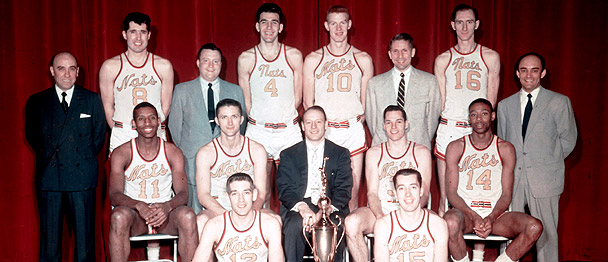
Hail the Champions, as you will almost certainly -- with the possible exception of the Green Bay Packers -- never again see a North American major sports league champion from a metropolitan area so small: Number 3, guard George King; Number 4, forward Dolph Schayes; Number 5, guard Paul Seymour; Number 6, center Connie Simmons; Number 7, guard Billy Gabor; Number 8, forward Wally Osterkorn; Number 10, center Johnny "Red" Kerr; Number 11, forward Earl Loyd; Number 12, guard Dick Farley; Number 14, forward Jim Tucker; Number 15, guard Bill Kenville; Number 16, center Ephraim "Red" Rocha; and head coach Al Cervi.

*

In 1957, Schayes hit 18 consecutive free throws in a game, then a record. In that year that began the space race, his high arcing shots earned him the nickname "Sputnik."

From February 17, 1952 to December 26, 1961, he played in 706 consecutive games, also then a record. (That one would be broken by his Nats teammate, Red Kerr.) He was, for a time, the NBA's all-time leading scorer, becoming the 1st player to finish with at least 15,000 career points.

As the NBA grew, its smaller cities, as happened to the NFL by the time the 1920s ended, fell by the wayside. Tri-Cities Blackhawks moved to Milwaukee in 1951, becoming the Hawks; then to St. Louis in 1955, then to Atlanta in 1968. The Fort Wayne Pistons moved to Detroit in 1957. The same year, the Rochester Royals moved to Cincinnati, later to Kansas City where they became the Kings, and then to Sacramento. And in 1963, the other Western New York team, the Syracuse Nationals, moved to take the place of the Philadelphia Warriors, who had moved to San Francisco. The Nats became the Philadelphia 76ers.

Their 1st coach in Philly was Dolph Schayes, who retired as a player at the end of that 1st season, 1963-64. He was named NBA Coach of the Year in 1966, but stepped aside when he was offered the job of the NBA's supervisor of referees. Can you imagine that happening today, in any sport: A former player being named supervisor of game officials? There's a laugh.

In 1970, Schayes returned to Western New York, as the 1st coach of the expansion Buffalo Braves. But he left at the start of the next season. The team is now known as the Los Angeles Clippers.

His home still in Syracuse, he became a real estate developer there. He was also heavily involved in the Maccabiah Games, effectively the Jewish Olympics, held in Israel. In 1977, he coached the U.S. team to the gold medal there.

That team included his son Danny Schayes, who played at Syracuse University, and for 18 years in the NBA, his best years for the Denver Nuggets of the 1980s. Danny's wife is Wendy Lucero, a former Olympic diver. He now runs an investment firm in Phoenix.

He and his wife Naomi had another son, David; daughters Carrie Goettsch and Debra Ferri; and 9 grandchildren.

Carrie's daughters, Abi, Carla and Rachel Goettsch, won silver medals with the U.S. volleyball team at the 2001 Maccabiah Games. And Debra's son, Mickey Ferri, was part of the gold medal-winning 4 by 100 meter relay team at the 2005 Maccabiah Games.

In 1971, Dolph was named to the NBA's 25th Anniversary team. In 1972, he was elected to the Basketball Hall of Fame. In 1979, he was elected to the International Jewish Sports Hall of Fame. In 1996, he was named to the NBA's 50th Anniversary 50 Greatest Players, and attended the unveiling of the 50 at the 1997 All-Star Game in Cleveland. He was the only Nationals player selected, although others from the franchise's Philadelphia days were chosen. The 76ers retired his Number 4, even though he barely played for them after the move.
Dolph Schayes died of cancer in Syracuse yesterday. He was 87 years old, and one of the grand old men of American sports.

With Schayes' death, Billy Gabor, 93 years old; Jim Tucker, who turns 83 today; and Bill Kenville, who just turned 85, are still alive from the 1955 NBA Champion Syracuse Nationals, 60 years later.

Oddly, especially considering how the NBA tends to treat its venues as disposable, the Nats' arena still stands. Opened in 1951 as the Onondaga County War Memorial Arena, it is now known as the Oncenter, and is home to a minor-league hockey team, the Syracuse Crunch.