Showing posts with label buffalo braves. Show all posts

Friday, April 9, 2021

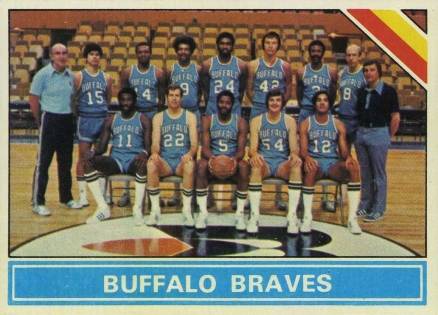
Top 5 Reasons You Can’t Blame the Buffalo Braves for Moving to San Diego

April 9, 1978: The Boston Celtics beat the Buffalo Braves, 131-114 at the Boston Garden. It was appropriate that they ended the regular season -- and, since neither made the NBA Playoffs, their entire season -- against each other.

The Celtics had fallen apart in the 2 years since their 1976 NBA Championship. Team owner Irv Levin wanted to move the league's most historic franchise to San Diego. The NBA wouldn't let him. So he worked out a deal with the Braves' owner, John Y. Brown: They would swap teams. Brown would keep the Celtics in Boston, but sell the team to Harry Mangurian a year later. Levin would gain control of the Braves, and move them to San Diego.

The NBA team owners approved this deal, 21-1. Commissioner Larry O'Brien refused to announce who the owner who voted against the deal was. The Braves were moved, and their name was changed to the San Diego Clippers.

After 8 years in Buffalo, including 3 Playoff berths and a Playoff round win over the Philadelphia 76ers in 1976, the Clippers did not do well in San Diego. They had a winning record in only their 1st season. Trading for the city's native son, Bill Walton, didn't help, as he was too injured to make a difference. They bottomed out at 17-65 in 1982, and were bought by Los Angeles real estate mogul Donald Sterling, who moved them to his hometown in 1984.

As the Los Angeles Clippers, they missed the Playoffs for the next 7 seasons, never won a Playoff series until 2006, didn't win another until 2012, didn't win a Division title until 2013, and the NBA forced Sterling to sell in 2014 after it came out just how much of a racist and a misogynist he is. Under the ownership of former Microsoft CEO Steve Ballmer, they've been better. But, up to this, their 51st season in the NBA, the franchise has never even reached a Conference Finals.

Sounds like Levin made a mistake in moving the Braves to San Diego. Did he?

Top 5 Reasons You Can't Blame the Buffalo Braves for Moving to San Diego

5. Western New York State. In 1970, the population of Buffalo was about 460,000 people. It seemed like it was still a big enough city to support an NFL team (the Bills), an NBA expansion team (the Braves), an NHL expansion team (the Sabres) and a Triple-A baseball team (the Bisons).
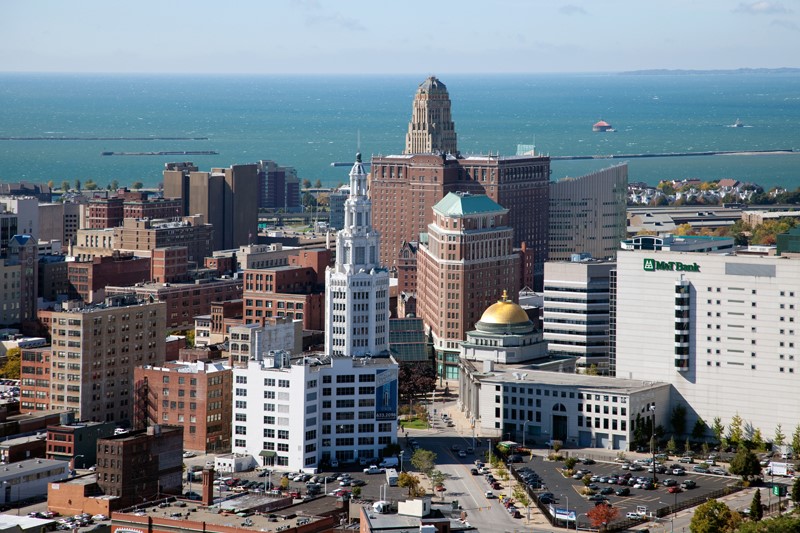
Buffalo had already lost the Basketball Association of America's Bisons in 1946. Buffalo also had a team called the Buffalo Bills in the All-America Football Conference from 1946 to 1949, but when the NFL took 3 teams from the AAFC, they took the Cleveland Browns, the Baltimore Colts and the San Francisco 49ers. It became known as "The Screwing of Buffalo."

Buffalo would gain the AFL's version of the Bills in 1960, and the NBA's Braves and the NHL's Sabres in 1970, the same year the Bills became part of the AFL-NFL merger. But the Braves moved in 1978. And the Bills and Sabres have both faced the possibility of having to move, in spite of the Sabres having a relatively new arena. Today, both are still struggling, despite both being owned by billionaires Terry and Kim Pegula.

This is matched by the other cities in Western New York. Rochester lost the NBA's Royals in 1957. Syracuse lost the NBA's Nationals in 1963. Like Syracuse, Rochester has a longtime team in minor-league hockey, the  Rochester Americans. And all 3 cities also have long had teams in baseball's Class AAA International League.

But not in the major leagues. In spite of the Toronto Blue Jays' COVID-forced tenancy at Sahlen Field last season, Buffalo hasn't had a Major League Baseball team since the 1915 Buffalo Blues -- or, if you don't count the Federal League, then the version of the Bisons that dropped out of the National League in 1885.

Today, with half a century of white flight, the population of Buffalo is more like 260,000. The metropolitan area has about 1.2 million. That would place it ahead of only New Orleans, still recovering from Hurricane Katrina, among NBA markets.

Even with the most generous possible measure, including the metropolitan areas of Rochester, Syracuse, Niagara Falls on both sides of the U.S.-Canadian border, and half of Hamilton, Ontario, it's about 3.8 million, which would rank it in the middle of the pack of every major sports league in North America (even the Canadian Football League).

Remember the movie It's a Wonderful Life? George Bailey (played by Jimmy Stewart), operator of a building and loan association, is shown what his New York State hometown of Bedford Falls would have been like if he had never been born.

He sees that the company his father had founded had gone out of business, because George wasn't there to save it; the low-income housing George had built wasn't built; Henry Potter, the miserable old man who controlled everything in town but the building and loan, had changed the town's name to Pottersville; and, like an organized crime boss, he let the other businessmen do what they pleased, so long as he got his cut.

And what businesses were doing well? Bars and casinos. The very things that, today, are pretty much the only businesses doing well in New York State, thanks to the local Native tribes getting casino licenses. In 2009, at the depth of a recession, a New York Times writer pointed this out, and contrasted it with the housing market that George Bailey once ran. The writer concluded that, for the sake of the future of the State of New York, the kindhearted Bailey was wrong, and the old bastard Potter was right. (And you thought the Times was a liberal newspaper.)

Put simply, New York State, from the capital of Albany on west through Syracuse, Rochester and Buffalo, simply can't support major league sports in the modern era.

4. San Diego. In contrast, San Diego, like pretty much the entire State of California in the 1970s, was growing by leaps and bounds. The city's population had soared to over 800,000; the metro area, 1.6 million. They had MLB's Padres and the NFL's Chargers, and had recently had the San Diego Mariners in the World Hockey Association. San Diego looked like a city of the future.

Today, it's a different story. The Clippers are gone. The Chargers are gone. The city has never regained major league hockey. And the Padres would be gone if not for their 1998 Pennant leading people to vote for funding for what became Petco Park. They could well have been a city of over 3 million people with no major league sports teams.
The fact that the Braves/Clippers franchise didn't stay in San Diego, either, is a story for another time. But that's got nothing to do with whether moving out of Buffalo was a good idea.

3. The Arena Situation. The Braves and Sabres were playing in the Buffalo Memorial Auditorium. It was built in 1940, and had 16,235 cramped seats. It was also 1 of 3 arenas in the NHL -- the Boston Garden and the Chicago Stadium being the other 2 -- that had rinks shorter than the NHL standard of 200 feet: 196. It did meet than the NHL standard width of 85 feet, as did Chicago Stadium (185 by 85), but Boston did not (191 by 83).
"The Aud" should never have been more than a stopgap facility for both teams. But the City of Buffalo and the County of Erie couldn't afford a new arena. This made it inevitable that either the Braves or the Sabres would have to go.

In contrast, the San Diego Sports Arena was 2,000 seats smaller, but was built in 1966, and was a considerably more modern arena, with a lot more parking, and thus a lot more gameday revenue.

Today, under the name Pechanga Arena, it's considered as outdated as The Aud was in 1978. It's considered among the best smaller arenas in the country, but it just doesn't have enough regular seats, and certainly not enough luxury suites, for a present-day NBA or NHL team.
2. The NBA. It's become conventional wisdom that the league didn't yet have the star power that it would soon have. Magic Johnson and Larry Bird arrived in 1979; Isiah Thomas in 1981; Michael Jordan, Hakeem Olajuwon and Charles Barkley in 1984; and Patrick Ewing in 1985.

This is garbage. In 1978, the NBA already had Kareem Abdul-Jabbar, Julius "Dr. J" Erving, Darryl "Chocolate Thunder" Dawkins, Bill Walton, Elvin "Big E" Hayes, "Pistol" Pete Maravich, David "Skywalker" Thompson, George "Iceman" Gervin, Moses Malone; and, on the Knicks, the veteran but still fine Earl "the Pearl" Monroe, and the former Buffalo Brave Bob McAdoo.

But the league was even worse at marketing its stars than was MLB. At their peak, the Braves had McAdoo, Ernie DiGregorio and Randy Smith. McAdoo was nearly as flashy as Dr. J., "Ernie D" was nearly as slick a mover and passer as Maravich, and Smith was as fast as anybody in the game.

It shouldn't have been that hard to make the Braves as admired a small-market team as Walton's Portland Trail Blazers were, or the San Antonio Spurs became 20 years later under David Robinson and Tim Duncan, or the Cleveland Cavaliers a few years after than under LeBron James. But Larry O'Brien, once a great political operative, was a lousy Commissioner: Under his leadership, the NBA didn't know its ass from a hole in the ground. Why the league's Championship trophy is named for him, I have no idea.

1. The French Connection. No, not the 1971 movie in which Gene Hackman plays a New York cop busting up an international drug ring. Named for that movie was a forward line for the Buffalo Sabres: Gilbert Perreault at center, Rick Martin at left wing, and René Robert at right wing. They had gotten the Sabres into the Playoffs in only their 3rd season, 1972-73, and into the Stanley Cup Finals in 1975. The Sabres made the Playoffs every season from 1973 to 1985.
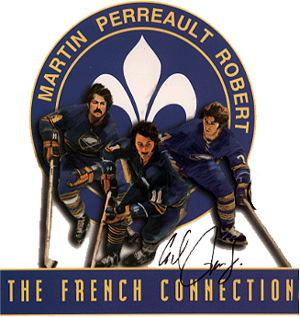
And with Western New York's economy crashing, fans couldn't afford 2 major league teams in the Winter. One had to go. And since there were more white people there than black people, they flocked to the hockey team, not the basketball team. Or, you could say that racism had nothing to do with it, but that the French Connection Line had more star power than McAdoo, Ernie D and Randy.

In 1996, what's now named the KeyBank Center opened, a couple of blocks from The Aud, which was demolished in 2009. Outside the new arena is a statue of the French Connection Line. There's hardly any indication that Buffalo ever had an NBA team.

VERDICT: Not Guilty. The Braves simply weren't sustainable in Buffalo.

Sunday, December 9, 2018

Western New York's 10 Greatest Teams

This Sunday, the New York Jets visit Orchard Park, New York to play the Buffalo Bills.

Western New York's 10 Greatest Teams

10. 1973-75 Buffalo Bills. 3 seasons, 26-16, but only 1 Playoff berth, in 1974 -- the only postseason game of O.J. Simpson's career. The 1970s Bills had the misfortune to play in the AFC East at a time when the Miami Dolphins dominated it every bit as much as the New England Patriots have in this past generation.

9. 1980-81 Buffalo Bills. Back-to-back Playoff berths, the team's 1st Division title in 14 years (1980), and its 1st postseason win in 16 years (1981 -- of course, against the Jets). But they stumbled into mediocrity in 1982, and went 8-40 from 1984 to 1986. Of course, that allowed them to pile up the draft picks that built their early 1990s AFC dynasty.

8. 1995-99 Buffalo Bills. A sub-.500 season in 1994 allows this period to be considered separate from the one of 1988-93. 5 seasons, 4 Playoff berths, and the 1995 AFC East title, but only 1 Playoff win. Marv Levy's gang still had something left in them, but they were getting old. "The Music City Miracle" of January 4, 2000 would be the Bills' last Playoff game for 18 years.

Before clinching a Playoff berth on the last day of last season, the Bills were the only team in the "big four" sports not to have clinched a Playoff berth in the 21st Century. But they made it. They almost certainly won't make it this season, but there could be more for this team.

7. 1973-76 Buffalo Braves. They made 3 straight NBA Playoffs, something the franchise now known as the Los Angeles Clippers would not do again until 2015. But they only won 1 Playoff series, against the Philadelphia 76ers in 1976, and wouldn't make the Playoffs again until 1992.

6. 1996-2001 Buffalo Sabres. 5 straight Playoff berths, an NHL Northeast Division title, 2 trips to the Eastern Conference Finals, and a Conference Championship in 1999. They got slightly closer than the 1975 edition, taking Game 6 to overtime. It's worth remembering, though: Even if that goal had been waved off, the Sabres would still have had to win that game and then beat the Stars in Dallas in Game 7.

5. 1974-81 Buffalo Sabres. 7 straight Playoff berths, 3 NHL Adams Division titles, 2 trips to the Stanley Cup Finals, and the Bills' 1st berth in the Stanley Cup Finals. They gave the Philadelphia Flyers a better fight than the Boston Bruins had the year before. But they couldn't get back until 1999.

4. 1988-93 Buffalo Bills. This is the most talented team in the history of Western New York sports, but not the most accomplished. 6 straight Playoff berths, 5 AFC Eastern Division titles, 10 postseason victories, 5 trips to the AFC Championship Game, and 4 AFC Championships. But they lost the Super Bowl by margins of 1, 13, 17 and 35 points (not in that order). It was a great achievement to keep getting back, but they could never finish the job.

3. 1949-57 Syracuse Nationals. Okay, Syracuse is in Central New York, not Western New York, but I'm counting it. 8 straight Playoff berths, 3 regular-season NBA Eastern Division titles, 9 Playoff series won, 7 Eastern Division Finals reached, 3 NBA Finals, and the 1955 NBA Championship -- still the last World Championship won by a team in New York State but not in New York City.

2. 1945-55 Rochester Royals. Rochester definitely counts as "Western New York," Although it says something that the NBA put Syracuse in the Eastern Division and Rochester in the Western Division. Syracuse, State College and Harrisburg are where America's Northeast begins to turn into its Midwest.

8 straight Playoff berths, 3 regular-season NBA Western Division titles, 4 trips to the Division Finals, 3 National Basketball League Finals berths, the 1945 NBL Championship, and, after moving to the NBA in 1948, the 1951 NBA Championship.

But the NBA could not be sustained in small cities. So, in 1957-58, the Rochester Royals moved to Cincinnati (then the Kansas City Kings in 1972 and the Sacramento Kings in 1985), and the Fort Wayne Pistons moved to Detroit. In 1963, the Syracuse Nationals moved to become the Philadelphia 76ers. The days when the teams from mid-sized Midwest cities like Anderson, Indiana; Moline, Illinois; and Waterloo, Iowa could be absorbed into the NBA were over.

1. 1963-66 Buffalo Bills. 4 straight Playoff berths, 3 AFL Championship Games, and the 1964 and 1965 AFL Championships. These are still the only 2 times that a major league sports team from Buffalo has gone as far as the rules of the time allowed them to go.

Friday, December 11, 2015

Dolph Schayes, 1928-2015

When someone says, "This guy was a New York basketball legend," they usually mean that he played for the Knicks. They don't mean he played for the Nets: The Long Island and New Jersey editions don't get counted (not even Julius Erving), and the Brooklyn edition hasn't produced any legends yet. They could mean he played for St. John's. They could also mean he was a local high school star or a "playground legend."

But the days when New York colleges other than St. John's produced basketball legends are long gone, a victim of the early 1950s point-shaving scandals that relegated New York University (NYU), City College of New York (CCNY) and downtown Brooklyn-based Long Island University (LIU) to 2nd-class status, thus helping to pave the way for the success of the nascent NBA.

And one of the last of the players who made those schools matter has left us.

*

Adolph Schayes (no middle name) was born on May 19, 1928 in The Bronx. A son of Romanian Jewish immigrants, he grew up in the University Heights section of The Bronx, on Davidson Avenue off 183rd Street, and attended the prestigious DeWitt Clinton High School.

Too young to have served in World War II, he attended NYU and played basketball there, when playing there really meant something. He was a classic gym rat: NYU's coach, Howard Cann, said, "He was in the gym practicing, every spare minute. We had to chase him out."

The hard work paid off: In 1945, NYU reached the NCAA Final, losing to Oklahoma A&M, coached by Hank Iba and led by Bob "Foothills" Kurland, the 1st 7-footer to be more than just a roadblock. (The school won the title again the next year, and became Oklahoma State in 1958.)

In 1948, the 2 leagues that would merge a year later to form the NBA battled over his services. His hometown New York Knicks of the Basketball Association of America drafted him, and so did the Tri-Cities Blackhawks of the National Basketball League. (They played their games in Moline, Illinois, representing the region that usually gets called the Quad Cities today, also including Rock Island, Illinois and Davenport and Bettendorf, Iowa.) The Blackhawks traded his rights to the Syracuse Nationals, who offered him $7,500, twice what the Knicks did, and so Dolph left home.

In his rookie season, he broke his right arm. He played anyway, with a cast, and learned to shoot with his left hand, making him an even deadlier shooter, right up there with Bill Sharman of the Boston Celtics as the best shooter of the 1950s. He led the league in rebounding in 1951, making the 1st of what turned out to be 12 NBA All-Star Teams.

In 1954, the Nationals (like today's Washington Nationals baseball team, known as the Nats for short) reached the NBA Finals, losing to the Minneapolis Lakers of George Mikan. Then the 24-second shot clock was established -- an innovation thought up by the Nats' owner, Danny Biasone. The Lakers could not adapt. The Nats did, and defeated the Fort Wayne Pistons to win the 1955 NBA Championship.
Hail the Champions, as you will almost certainly -- with the possible exception of the Green Bay Packers -- never again see a North American major sports league champion from a metropolitan area so small: Number 3, guard George King; Number 4, forward Dolph Schayes; Number 5, guard Paul Seymour; Number 6, center Connie Simmons; Number 7, guard Billy Gabor; Number 8, forward Wally Osterkorn; Number 10, center Johnny "Red" Kerr; Number 11, forward Earl Loyd; Number 12, guard Dick Farley; Number 14, forward Jim Tucker; Number 15, guard Bill Kenville; Number 16, center Ephraim "Red" Rocha; and head coach Al Cervi.

*

In 1957, Schayes hit 18 consecutive free throws in a game, then a record. In that year that began the space race, his high arcing shots earned him the nickname "Sputnik."

From February 17, 1952 to December 26, 1961, he played in 706 consecutive games, also then a record. (That one would be broken by his Nats teammate, Red Kerr.) He was, for a time, the NBA's all-time leading scorer, becoming the 1st player to finish with at least 15,000 career points.

As the NBA grew, its smaller cities, as happened to the NFL by the time the 1920s ended, fell by the wayside. Tri-Cities Blackhawks moved to Milwaukee in 1951, becoming the Hawks; then to St. Louis in 1955, then to Atlanta in 1968. The Fort Wayne Pistons moved to Detroit in 1957. The same year, the Rochester Royals moved to Cincinnati, later to Kansas City where they became the Kings, and then to Sacramento. And in 1963, the other Western New York team, the Syracuse Nationals, moved to take the place of the Philadelphia Warriors, who had moved to San Francisco. The Nats became the Philadelphia 76ers.

Their 1st coach in Philly was Dolph Schayes, who retired as a player at the end of that 1st season, 1963-64. He was named NBA Coach of the Year in 1966, but stepped aside when he was offered the job of the NBA's supervisor of referees. Can you imagine that happening today, in any sport: A former player being named supervisor of game officials? There's a laugh.

In 1970, Schayes returned to Western New York, as the 1st coach of the expansion Buffalo Braves. But he left at the start of the next season. The team is now known as the Los Angeles Clippers.

His home still in Syracuse, he became a real estate developer there. He was also heavily involved in the Maccabiah Games, effectively the Jewish Olympics, held in Israel. In 1977, he coached the U.S. team to the gold medal there.

That team included his son Danny Schayes, who played at Syracuse University, and for 18 years in the NBA, his best years for the Denver Nuggets of the 1980s. Danny's wife is Wendy Lucero, a former Olympic diver. He now runs an investment firm in Phoenix.

He and his wife Naomi had another son, David; daughters Carrie Goettsch and Debra Ferri; and 9 grandchildren.

Carrie's daughters, Abi, Carla and Rachel Goettsch, won silver medals with the U.S. volleyball team at the 2001 Maccabiah Games. And Debra's son, Mickey Ferri, was part of the gold medal-winning 4 by 100 meter relay team at the 2005 Maccabiah Games.

In 1971, Dolph was named to the NBA's 25th Anniversary team. In 1972, he was elected to the Basketball Hall of Fame. In 1979, he was elected to the International Jewish Sports Hall of Fame. In 1996, he was named to the NBA's 50th Anniversary 50 Greatest Players, and attended the unveiling of the 50 at the 1997 All-Star Game in Cleveland. He was the only Nationals player selected, although others from the franchise's Philadelphia days were chosen. The 76ers retired his Number 4, even though he barely played for them after the move.
Dolph Schayes died of cancer in Syracuse yesterday. He was 87 years old, and one of the grand old men of American sports.

With Schayes' death, Billy Gabor, 93 years old; Jim Tucker, who turns 83 today; and Bill Kenville, who just turned 85, are still alive from the 1955 NBA Champion Syracuse Nationals, 60 years later.

Oddly, especially considering how the NBA tends to treat its venues as disposable, the Nats' arena still stands. Opened in 1951 as the Onondaga County War Memorial Arena, it is now known as the Oncenter, and is home to a minor-league hockey team, the Syracuse Crunch.