Showing posts with label indianapolis. Show all posts

Monday, July 22, 2024

July 22, 1934: John Dillinger Is Gunned Down

 
July 22, 1934, 90 years ago: John Dillinger, "Public Enemy Number One," is killed.

John Herbert Dillinger Jr. was born on June 22, 1902 in Indianapolis. As a boy, he bullied smaller children. In 1922, he was arrested for auto theft. The following year, he enlisted in the U.S. Navy, but soon deserted, and was dishonorably discharged. He was arrested for stealing $50 from a grocery store, and served 9 years in State prison.

He was released on May 10, 1933. Just 42 days later, using advice he got from fellow prisoners, he robbed his 1st bank, getting $10,000 (about $207,000 in today's money) from a bank in New Carlisle, Ohio, outside Dayton. On August 14, he robbed another in Bluffton, Ohio, outside Toledo. But he got caught, and was sent to another prison. He escaped on October 12, and formed what became known as the Dillinger Gang.

On January 25, 1934, the Dillinger Gang was arrested in Tucson, Arizona, and extradited to Indiana, where one of their robberies had led to the death of a policeman. Local police boasted that the prison was escape-proof. On March 3, 1934, Dillinger proved them wrong.

He formed a new gang, made up of those members of his original gang not presently in jail, and other gangs, including Lester Gillis, a.k.a. "Baby Face Nelson." On March 20, the gang and FBI Agents had a shootout in St. Paul, Minnesota. Dillinger was wounded in the leg, but got away, and laid low in Minneapolis to recover. Eventually, he got to Chicago. One member of his gang, Eddie Green, was shot and killed by St. Paul police on April 10. Another, John Hamilton, was shot and killed by police in nearby Aurora, Illinois on April 26.

On May 23, 1934, Bonnie Parker and Clyde Barrow were ambushed by a posse in Bienville Parish, Louisiana. Dillinger and fellow Midwestern bank robber Charles "Pretty Boy" Floyd apparently never met either Bonnie or Clyde (or each other), but both sent flowers to their funerals in Dallas.

Like Bonnie and Clyde, Dillinger was embraced by a section of the public that didn't like how the banks were foreclosing on their homes during the Great Depression. Also like Bonnie and Clyde, he was a ruthless killer who didn't deserve the adulation. That adulation, and his escapes from jail, much more than his crimes themselves, led J. Edgar Hoover, Director of the Federal Bureau of Investigation (FBI) to name him "Public Enemy Number One."

Hoover put Melvin Purvis on the case, and Special Agent in Charge (SAC) of the FBI's Chicago office. On July 22, 1934, John Dillinger went to the Biograph Theater at 2433 North Lincoln Avenue, on the North Side of Chicago, to see the film Manhattan Melodrama, starring Clark Gable and Myrna Loy. FBI Agents, including Purvis, aware that Dillinger liked to go to the movies, were already staking the place out.

At 10:40 PM, Dillinger walked out, and the Agents opened fire. He was hit 4 times, with 1 bullet entering through the back of the neck, severing his spinal cord, going into his brain, and coming out of his right eye. He was dead before he hit the ground. He was 31 years old.

As the body was taken away, souvenir hunters dipped things into his blood, like newspapers and handkerchiefs. A photo of his dead body showed his arm folded over his body, giving rise to the legend that Dillinger was phenomenally endowed. He was a known womanizer, but none of his girlfriends ever mentioned him "packing a cannon" other than his gun.

The rest of the Dillinger Gang didn't last much longer. Homer Van Meter was shot and killed by St. Paul police on August 23. Charles Makley was killed by guards at Ohio State Prison during an escape attempt on September 22. And Baby Face Nelson died in the Chicago suburb of Wilmette, Illinois on November 27, a few days after a shootout with police in nearby Barrington. Pretty Boy Floyd, not part of the Dillinger Gang, was given Dillinger's place as "Public Enemy Number One" by the FBI, and died on October 22, after a shootout with police in East Liverpool, Ohio. The year of "public enemies" was over.

Purvis became nationally famous. This angered Hoover, a publicity hound who wanted the credit for the Bureau in general and himself in particular. He went out of his way to marginalize Purvis, who ended up quitting the Bureau the next year, and, like the Communist leader he so despised, Joseph Stalin, "wrote his enemy out of history": Even when Purvis died in 1960, shot in the head, rather than tell the true story -- which the coroner couldn't determine, but the evidence suggests an accident -- Hoover smeared Purvis in the press, saying that he was mentally ill and that his death was definitely a suicide.
Dillinger was played by Lawrence Tierney in the 1945 film Dillinger, Leo Gordon in the 1957 film Baby Face Nelson, Nick Adams in the 1965 film Young Dillinger, Warren Oates in the 1973 film Dillinger, Robert Conrad in the 1979 film The Lady In Red, Mark Harmon in the 1991 TV-movie Dillinger, Martin Sheen in the 1995 film Dillinger and Capone (which was mostly fictional, as it appears that Dillinger and Al Capone never met), and Johnny Depp in the 2009 film Public Enemies.

Friday, March 29, 2024

March 29, 1984: The Baltimore Colts Are Moved

March 29, 1984, 40 years ago: Baltimore Colts owner Bob Irsay moves the team to Indianapolis, with Mayflower moving vans infamously getting loaded up with equipment, and driving out of their training camp in suburban Owings Mills, Maryland overnight and in the early morning. Thus ended an American sports institution.

The Baltimore Colts played at Municipal Stadium, in the All-America Football Conference in 1947, 1948 and 1949, and were admitted to the NFL in 1950. But they were terrible, and folded. But Municipal Stadium was converted from a 70,000-seat football stadium built in 1922 into a 54,000-seat stadium capable of hosting baseball as well, and in 1953, the Colts returned, with the baseball Orioles getting promoted from minor league to major league the following Spring.

The Colts won the NFL Championship in 1958 and 1959, beating the Giants in the NFL Championship Game both times. They were good through most of the 1960s, losing the 1964 NFL Championship Game to the Cleveland Browns, then tying the Green Bay Packers for the 1965 Western Division title before losing to them in a controversial Playoff game.

In 1967, they lost only 1 regular-season game, but lost to the Los Angeles Rams in the Playoffs. In 1968, they went 13-1, losing only to the Browns, then beat the Browns in the Championship Game -- and then lost Super Bowl III to the Jets.

They rebounded to win Super Bowl V for the 1970 NFL Championship. They got old and bad, but rebounded, winning the AFC Eastern Division in 1975, 1976 and 1977, but couldn't get past the Pittsburgh Steelers and the Oakland Raiders to get back to the Super Bowl.

In the strike-shortened 1982 season, they didn't win a game, going 0-8-1. On December 18, 1983, they beat the Houston Oilers 20-10, to finish 7-9. Attendance at Memorial Stadium: 20,418. Average attendance that season: 38,336.

The Baltimore Colts have become thought of as the Brooklyn Dodgers of the NFL, the "working man's team" that made the nation fall in love with them in the 1950s, but got pushed out of town by an evil owner, only in it for the money, with the complicity of the league's powers-that-be. Bob Irsay became the Walter O'Malley of the NFL.
And he looks like the kind of guy who played a secondary villain
on Dallas. You know, the kind of guy who made us say,
"J.R. Ewing sure is an asshole, but at least he's not that guy!"

But does he deserve that title? The truth is a bit more complicated. In 1980, Irsay asked Governor Harry Hughes of Maryland for $25 million in State funds to renovate Memorial Stadium, to extend the upper deck and replace the seats with wider ones, expanding football capacity from 60,020 to 64,124. It would also have improved the plumbing, and given both the Orioles and the Colts sufficient office space.

The plan's approval was contingent on both the Colts and the O's signing long-term leases. The Orioles challenged the requested football improvements, thinking it would've provided too much short-term inconvenience and not enough long-term benefit, and refused to sign anything more than a 1-year lease. Irsay also refused to sign long-term. As a result, the State legislature dropped the plan.

In hindsight, both the Orioles and the current football team are better off at Camden Yards, at the western edge of downtown, next to Camden Station and the light rail and a short walk from the subway, than the Orioles and the Colts would have been at even an expanded and improved Memorial Stadium, 4 miles north of downtown, unless there had been a subway or light rail extension to 33rd Street. But the Orioles did do as much to kill this project as Irsay and the Maryland legislature did.

Carroll Rosenbloom, a Baltimore native, had owned the team from its 1953 revival until July 13, 1972, when he did something shocking: He sold the Colts to Bob Irsay, the owner of the Los Angeles Rams, who then sold the Rams to Rosenbloom.

Why would they do that? Rosenbloom didn't like Memorial Stadium any more than Irsay later would, and the City of Baltimore raised his rent in 1969. Rosenbloom asked the City to build him a new stadium, and, proud of their municipal venue (with some reason), they wouldn't do it. The lease ran out after the 1972 season, and Rosenbloom threatened to build a stadium on land in Baltimore County -- from which Baltimore City is separate.

Rosenbloom was also feuding with the Baltimore media. And his new wife, Georgia, hated Baltimore, a declining city with often rotten weather, and wanted to move to Los Angeles. So, realizing how much it would cost to build a new stadium (probably around $20 million at the time), and rather than move the team to L.A., he moved himself and his wife Georgia there. (After he died, Georgia remarried, and, as Georgia Frontiere, moved the Rams first down the freeway to Anaheim, then to her hometown of St. Louis. They have since moved back to the L.A. area.)

Oakland Raiders owner Al Davis moved his team to Los Angeles in 1982, and the NFL tried to stop him, and he took the League to court, and won. He got away with it. (Yes, he moved them back in 1995, and his son Mark has now moved them to Las Vegas, but that's not relevant to this discussion.) Irsay figured, "If Al can do it, I can do it. They can't stop me." He did it, and, perhaps weary from the fight with the man nicknamed Darth Raider, they didn't even try to stop him.

If Davis had worked out his differences with the Oakland-Alameda County Coliseum Authority, and the Raiders had stayed put, maybe Irsay would have started to think he could get a good deal from Baltimore anyway. Or, suppose the NFL succeeded in stopping Davis. Maybe Irsay would have thought twice about taking the NFL on. (At the very least, he would have been more conciliatory, giving the other owners more velvet glove, less iron fist than Davis did.)

At the time, Indianapolis was the 3rd-largest city in the Midwest, and now that Detroit has fallen below them in population, they're 2nd only to Chicago. They had a new domed stadium. They had a fan base used to watching football: Notre Dame, Indiana University, Purdue University, smaller schools like Indiana State and Ball State, and the Chicago Bears. They were ready for their own NFL team.

And in less than 30 years, the Colts have become as ingrained in the minds and hearts of Indiana sports fans as the Notre Dame Fighting Irish, the Indiana Hoosiers and Purdue Boilermakers basketball teams, the Indiana Pacers, and the Indianapolis 500. If the Colts had to move, Indy was a good place in which to set up shop.

As with the legendary Brooklyn Dodger fans of the 1950s, the much-lauded Colt fans weren't selling out Memorial Stadium. Were they betrayed? Yes, but they weren't coming out in overwhelming numbers.

This was partly due to the success of the Washington Redskins. In the late 1950s and through the 1960s, the Colts were good and the Redskins were bad, and a lot of people in the suburbs between Baltimore and Washington, and a lot of people further away in Maryland, such as on the Eastern Shore and the western Panhandle, became Colt fans.

But in the early 1970s, the Redskins got good and the Colts got old and bad, and a lot more people became Redskin fans. The Colts' brief revival in the latter half of the 1970s didn't help, and when the Redskins won Super Bowl XVII in January 1983, after the Colts had finished the strike-shortened 1982 season without a win, the Redskin publicity machine went into overdrive, hyping running back John Riggins, the receivers known as the Fun Bunch, even making the least glamorous position on the field, the offensive line, famous: The Hogs.

With fans showing up in Indian headdresses and plastic pig masks (or at least rubber snouts), the 'Skins became more popular than ever, just as the Colts were bottoming out again, and taking suburban Maryland fans away. Never mind the Unitas-led NFL Championships of 1958 and '59: Super Bowl V, and even the AFC East titles of 1975, '76 and '77 now seemed a long way back.

The Colts were bad, and not the least bit interesting. The Redskins were great, and fun. It was the same combination that happened in New York baseball in the latter half of the 1960s, with the Colts in the Yankees' place and the Redskins in the Mets' place. It was probably the worst thing that could have happened to Baltimore football fans.

Memorial Stadium wasn't a bad stadium, but it was in a bad location. Not because of neighborhood crime, but because of access and parking. It also didn't have enough office space for either the Orioles or the Colts, much less both teams. It also didn't have enough luxury boxes, which is why a replacement for it was necessary for any team moving to Baltimore to take the Colts' place.

In 1973, the NBA's Baltimore Bullets moved to Washington, and O's owner Jerry Hoffberger wanted out, eventually selling the team to Redskins owner Edward Bennett Williams -- who, because of the NFL's rule at the time, prohibiting a majority owner from being a majority owner of a team in another sport, had to sell a majority stake in the 'Skins to Jack Kent Cooke. Now, the possibility of the Orioles moving to Washington, Williams' hometown, to take the place of the departed Senators, was real.

Irsay was willing to wait. But it's not like he didn't drop hints. The City of Baltimore and the State of Maryland didn't take Irsay's threat to move seriously. "It's not a matter of saying that there will be no stadium," he said. "It's a matter of getting the facts together, so everybody is happy when they build the stadium. I'm a patient man. I think the people of Baltimore are going to see those new stadiums in New Orleans and Seattle opening in a year or two around the country, and they are going to realize the need a stadium... for conventions, and other things besides football." This was in 1975, and he was referring to the Louisiana Superdome and the Kingdome, respectively.

He talked with city officials of Phoenix in 1976 -- and then, in 1977, Indianapolis, which, unlike Phoenix with Sun Devil Stadium in nearby Tempe, didn't yet have a suitable stadium, but was planning the Hoosier Dome.

By 1980, with Georgia Frontiere having taken the Rams out of the Los Angeles Coliseum, hard by the South Central ghetto, down the freeway to Anaheim, the Los Angeles Memorial Coliseum Commission approached Irsay about moving the Colts to Los Angeles, which Carroll Rosenbloom had decided not to do with them in 1972. Memphis wanted the Colts for the Liberty Bowl. Jacksonville wanted the Colts for the Gator Bowl. It seemed like everybody without a team wanted the Colts, but the City of Baltimore -- at least, the City's government -- didn't.

In 1983, Mayor William Donald "Dud" Schaefer asked the State legislature for $15 million to renovate Memorial Stadium. But it took weeks to approve it. In January 1984, Schaefer said, "We're not going to build a new stadium... We don't have the voters or taxpayer who can support a $60 million stadium." The inflation of the 1970s was so bad (How bad was it?), the cost of a new stadium had gone up 3 times in just 11 years.

On February 23, Irsay visited the Hoosier Dome, which was scheduled to open in August, and was very impressed. On March 2, 8 days later, NFL owners gave Irsay permission to move the Colts. He talked to Indianapolis, Phoenix, Jacksonville and Memphis, all of which he'd talked to before, and also to Birmingham, Alabama, although their Legion Field was hardly a new stadium. He narrowed his choices down to Indianapolis and Phoenix.

(Indianapolis was also talking to John Mecom, then the owner of the New Orleans Saints, about a local buyer bringing the Saints there, even though the Superdome was still new. He ended up selling the Saints to Tom Benson, who kept them in N'Awlins.)

On March 27, the Maryland State Senate passed legislation giving the City of Baltimore the right to seize ownership of the Colts franchise by eminent domain. And that's why Irsay took the team and its stuff out of Owings Mills in the moving vans in the middle of the night on March 28-29: He was, as the old saying goes, one step ahead of the law. He also had all 15 moving trucks take different routes, in case the Maryland State Police stopped one of them, so they couldn't stop all of them.

As the team's lawyer, Michael Chernoff, put it, "They not only threw down the gauntlet, but they put a gun to his head and cocked it, and asked, 'Want to see if it's loaded?' They forced him to make a decision that day." The metaphor of "putting a gun to our head" has been used to describe what team owners have done to cities and their fans. This time, it was the other way around.

That day, March 29, 1984, the lower house of the legislature, the House of Delegates, passed the eminent domain legislation, and Governor Hughes signed it. But it was too late: The Colts, lock, stock and jockstraps, were out of Maryland, and, legally, there was no longer anything that either the City or the State could do about it.

The only thing the franchise owned that stayed put was the uniforms of the Baltimore Colts Marching Band. They were being drycleaned at the time. Irsay agreed to let the bandmembers keep them, and the band stayed together, finally changing their name to the Marching Ravens in 1998, upon the move into the new stadium, keeping the old name while the Ravens were at Memorial Stadium in 1996 and '97.

It took a while before the Indianapolis Colts got good. But in their 1st 40 seasons, they've made the Playoffs 19 times, reached the AFC Championship Game 5 times, and reached 2 Super Bowls, winning Super Bowl XLI and losing Super Bowl XLIV. Compare that to their 35 seasons in Baltimore: 10 Playoff berths, 7 times reaching the round of 4, 5 times reaching the World Championship game (under any name), and winning 3 titles.

No, they haven't been more successful in Indianapolis than in Baltimore -- yet. And the Ravens have done fairly well for themselves in their 1st 28 seasons: 15 Playoff berths, 5 AFC Championship Games, and 2 trips to the Super Bowl, winning both: XXXV and XLVII.

So, in spite of the 12-year interregnum, Baltimore hasn't done all that badly.

And, let's be honest: Bob Irsay tried to find a way to stay in Baltimore. He tried for over 11 years. He tried harder to keep his NFL team where it was than did Al Davis, Billy Bidwill, Art Modell or Georgia Frontiere with theirs. He certainly tried harder than did Walter O'Malley, Calvin Griffith, Bob Short and Jeffrey Loria in baseball; Short and Clay Bennett in basketball; and Norm Green and Peter Karmanos in hockey.

He was willing to make a deal. It was the politicians, Democratic and Republican alike, who didn't try hard enough. The people of Baltimore, the people of Maryland, got screwed out of their Colts, but it wasn't Irsay who did that.

The United States Football League tried to step into the breach: After the 1984 season, the Philadelphia Stars announced they were moving to Baltimore. But due to a legal technicality, the Indianapolis Colts still held veto power over another football team using Memorial Stadium, so the Baltimore Stars had to play their 1985 home games at the University of Maryland, closer to D.C. (which was possible because the Washington Federals had moved to Orlando), with the promise of playing at Memorial Stadium in 1986.

That didn't happen, because the idiot owner of the USFL's New Jersey Generals wanted the League go head-to-head with the NFL in the Autumn, and the League collapsed as a result. His name was Donald Trump.

A settlement was reached, and from 1986 onward, Irsay agreed to support a new team for Baltimore, either through a team's move or an expansion of the NFL. The Maryland Stadium Authority got serious, and, with Dud Schaefer having been elected Governor, got the Camden Yards projects approved. The Orioles moved in for 1992.

In 1985, Leonard Tose, bankrupt due to being a compulsive gambler, considered moving the Philadelphia Eagles -- not 100 miles down Interstate 95 to Baltimore, but to Phoenix. Instead, he sold them, and they stayed put. In 1987, Billy Bidwill moved the football Cardinals out of St. Louis -- not to Baltimore, but to Phoenix, where they became the Arizona Cardinals. In 1993, the NFL chose 2 new expansion cities, to begin play in 1995, but not Baltimore: Charlotte, with the Carolina Panthers; and Jacksonville, with the Jaguars.

During this period, the Sullivan family, bankrupted through their ownership of the New England Patriots, considered selling the team to people who might move them, and Baltimore was one of the cities being considered. Once Bob Kraft bought the team, it was going to be either going to Hartford, a stadium in downtown Boston, or (as actually happened) a new stadium next to the old one in Foxboro. But Kraft wasn't taking the Pats out of New England, and if he ever considered moving them to Baltimore, it was momentary at most.

In 1994, the Canadian Football League expanded into America, and put the Baltimore Stallions in Memorial Stadium. After 2 years, the experiment failed, through no fault of the Stallions, and they were moved to become the new Montreal Alouettes. In 1995, both the Rams and the Raiders moved out of Los Angeles -- but neither to Baltimore: Georgia Frontiere took the Rams to her hometown of St. Louis, and Al Davis took the Raiders back to Oakland.

Later that year, dissatisfied with how he was being treated by the City of Cleveland, and unable to fund improvements to Municipal Stadium himself, Art Modell moved the Browns to Baltimore, and they became the Ravens. They played in Memorial Stadium in 1996 and '97, moved to what's now named M&T Bank Stadium at Camden Yards in 1998, and surpassed the Orioles to become Baltimore's most popular sports team.

Johnny Unitas attended the 1st Ravens home game on September 1, 1996, handed the game ball to the officials, and watched as the Ravens beat Al Davis' Oakland Raiders 19-14 -- 19 being his number with the Colts, and 14 being the number he briefly had in the Pittsburgh Steelers' training camp before being cut in 1955, allowing him to become a Baltimore legend.

The Ravens erected a statue to Johnny U outside M&T Bank Stadium after his death in 2002, and hired his son, Chad Unitas, in their executive sales department.

Bob Irsay kept his word, and voted to permit the Browns to move to Baltimore. Baltimore fans still haven't forgiven him; and, now, Cleveland fans hated him, too. Shortly thereafter, he suffered a stroke, and his health never recovered. He lived long enough to see the NFL return to Baltimore, and died on January 14, 1997, at the age of 73. His son Jim Irsay now runs the team. He's not particularly popular in Maryland, either, or anywhere outside of Indiana.

The Colts' 1st game back in Baltimore was on November 29, 1998, at M&T Bank Stadium -- after the death of Bob Irsay. The Ravens won, 38-31. This was an outlier: Since the arrival of the Ravens, the Colts have a 11-7 record against them. This includes Playoff wins by Indianapolis in 2007 and 2010 (for the 2006 and 2009 seasons), and a Playoff win by Baltimore in 2013 (2012).

Sunday, October 31, 2021

How to Be a New York Football Fan In Indianapolis -- 2021 Edition

This coming Thursday night, the New York Jets play a prime-time game, away to the Indianapolis Colts.

The Jets played the Colts, formerly of Baltimore, both home and away as AFC Eastern Division opponents every season from 1970 to 2001. Now, the Colts play in the AFC North, but this game counts the same.

Both New York NFL teams are inextricably linked with the Colts. It's an NFL myth that the 2 most important games in the League's history involved the Baltimore Colts vs. New York: The 1958 NFL Championship Game, against the Giants at the original Yankee Stadium (a.k.a. "The Greatest Game Ever Played"); and Super Bowl III, capping the 1968 season, between the NFL Champion Colts and the AFL Champion Jets at the Orange Bowl in Miami.

(If there has been an NFL game more important than those 2, it was likely also a Giants game, the 1925 game against the Chicago Bears and their rookie sensation Red Grange, which packed the Polo Grounds and saved the Giant franchise at the least, the NFL as a whole at the most.)

Of course, none of that has anything to do with Indianapolis. But then, neither should the Colts, even though they've now been there almost as long as they were in Baltimore: This is their 32nd season in Indianapolis, while they played only 31 seasons in Baltimore (1953 to 1983, unless you count the failed Baltimore Colt franchise of 1947 to 1950).

Before You Go. Lucas Oil Stadium has a retractable roof. Given that this is November, the roof will almost certainly be closed. Even before you go in, the weather won't be all that bad: The website of the Indianapolis Star is predicting high 40s for Thursday afternoon, and low 30s for the evening. You will need a Winter jacket. But they are not predicting either rain or snow for any day in this coming week.

Indiana used to be 1 of 2 States, Arizona being the other, where Daylight Savings Time was an issue; however, since 2006 -- 4 years after a West Wing episode lampooned this -- the State has used it throughout. There will be no need to adjust your timepieces.

Tickets. The stadium seats 62,421, one of the lower capacities in the NFL, although 2,000 more than the team's previous homes, Baltimore's Memorial Stadium and the Hoosier Dome. The Colts averaged 61,233 fans per home game, about 94 percent of capacity, in 2019, the last pre-COVID season. You might be able to get get tickets without going to StubHub or the NFL Ticket Exchange.

There are 6 levels in the stadium. In both the 100 Level, tickets are $275 in midfield and $100 in the end zone. Forget the 200, 300 and 400 Levels, as those are prohibitively expensive Club Level seats. In the 500 Level, they're $115 in midfield, and there's no end zone seating. And in the 600 Level, they're $74 in midfield, and $49 in the end zone.

Getting There. Keep in mind, this is Christmas week. The normal travel rules may not apply, due to demand reducing the available seats and jacking up prices.

It's 714 miles from Times Square in Manhattan to Monument Circle in the center of the City of Indianapolis. Knowing this, your first reaction is going to be to fly out there. You could get nonstop flights on United Airlines from Newark to Indianapolis International Airport, it will be expensive, in the neighborhood of $800 if you're lucky. The Number 8 bus is a 45-minute ride from the airport to downtown.

Amtrak doesn't work this time, because they've suspended Cardinal service from Penn Station to Union Station in Indianapolis. Union Station is at 350 S. Illinois Street, corner of South Street, 6 blocks from the Fieldhouse.
Indianapolis' Union Station

Greyhound runs 4 buses a day from Port Authority Bus Terminal to Indianapolis. The fare is $254, but it can drop to $203 with advanced purchase. The station is at 154 W. South Street, at Illinois Street, around the corner from Union Station. (That's right, "West South Street," but that's South Street, west of downtown.)

If you decide to drive, it's far enough that it will help to get someone to go with you and split the duties, and to trade off driving and sleeping. You'll need to get on the New Jersey Turnpike, and take Interstate 78 West across New Jersey, and at Harrisburg get on the Pennsylvania Turnpike, which at this point will be both I-70 and I-76. When the two Interstates split outside Pittsburgh, stay on I-70 west. You'll cross the northern tip of West Virginia, and go all the way across Ohio (through Columbus), and halfway through Indiana.

If you do it right, you should spend about an hour and 15 minutes in New Jersey, 5 hours in Pennsylvania, 15 minutes in West Virginia, 3 hours and 45 minutes in Ohio, and an hour and 15 minutes in Indiana. That' going to be 11 and a half hours. Counting rest stops, preferably 6 of them, and accounting for traffic in both New York and Indianapolis, it should be about 14 hours.

Once In the City. Indianapolis, named (as was its State) for the Native Americans, was founded in 1821, 200 years ago (Bicentennial Day was January 6), and is home to over 888,000 people -- making it the 2nd-largest city in the Midwest, behind Chicago -- with a metropolitan area of 2.4 million.

Like many other cities, Indianapolis experienced "white flight": While it was 81 percent white in 1970, that figure is now down to 56 percent, with 29 percent black, 11 percent Hispanic and 3 percent Asian.

Notably, Indianapolis was spared a race riot after Martin Luther King was assassinated on April 4, 1968. Senator Robert F. Kennedy had planned to give a speech in a black neighborhood in advance of the Indiana Primary, and the Mayor at the time, Richard Lugar, later himself a Senator and a Presidential candidate (Republican, 1996), advised Bobby to cancel. He wouldn't, and gave a speech calling for an end to violence, as Dr. King would have wanted. He kept the peace, and won the Primary. Two months later, he was also assassinated.

The centerpoint of the City, and indeed of the State, is the 284-foot-high Soldiers' and Sailors' Monument inside Monument Circle, at Market & Meridian Streets. Interstate 465 serves as a beltway.
The Indiana State Soldiers and Sailors Monument,
at Monument Circle

The sales tax in the State of Indiana is 7 percent. ZIP Codes in Indianapolis start with the digits 462, and the Area Code is 327, with 463 overlaid. Indianapolis Power & Light (IPL) supplies the electricity. There's no subway, but IndyGo offers a $4.00 all-day pass for its buses.
The State House

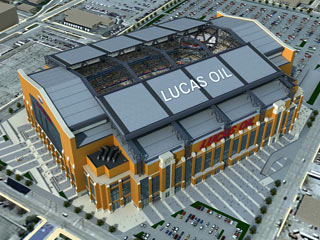
Going In. Lucas Oil Stadium, named for an energy company, opened in 2008. Its official address is 500 South Capitol Avenue. It is bounded by Capitol, McCarty Street, Missouri Street and South Street. It's downtown, with the Amtrak station only a block away and the Greyhound station across the street, so unless you flew in, you won't need to take public transportation to get there.
Stadium with roof closed

Indianapolis doesn't have a "sports complex," but the Pacers' Bankers Life Fieldhouse and the Triple-A ballpark are short walks away on either side.

Parking at the stadium is $20, and all parking is first-come-first-served. Tailgating must take place either in front of, or behind, the parked vehicle without blocking the drive aisle. For safety reasons, all aisle ways must have room for a vehicle to pass through. There will be no tailgating in an empty parking space: No parking spaces will be purchased for tailgating, and all parking spaces must be occupied with a vehicle. There will be no tents set up across aisle ways. Charcoal grills and the throwing of balls are not permitted.
Stadium with roof open

The stadium looks like red brick, as do a lot of buildings in the city. Actually, it's made out of Indiana limestone -- as is the decidedly not-brick-looking Empire State Building. This makes it look more like an oversized version of an old-style gym. This was also done with the new Pacers arena. Inside, the "old gym" look continues, making it a huge improvement over the Hoosier Dome, which more closely, inside and out, resembled the atrocious Metrodome in Minneapolis.

In spite of its retractable roof, the stadium has artificial turf, specifically FieldTurf. In fact, the Colts haven't played a home game on natural grass since they left Baltimore after the 1983 season. While fully enclosed, behind each end zone is a large window that can be opened; however, there's not much of a view to speak of, since Indianapolis isn't exactly loaded with interesting skyscrapers.
Lucas Oil Stadium hosted Super Bowl XLVI, the Giants' 2nd title game victory over the New England Patriots. It hosted the NCAA Final Four in 2010 (Duke beating Butler despite Butler playing in their hometown), 2015 (Duke winning for the 5th time, the 3rd time in Indy, over Wisconsin), and 2021 (Baylor beating Gonzaga). Indianapolis is where the NCAA keeps its headquarters, and after 4 Final Fours were held at the Hoosier Dome, they've decided to make sure the Final Four is held in Indianapolis at least once every 5 years. It will host again in 2026. For this event, the stadium can be adjusted into a 70,000-seat configuration. 

It has also hosted the Big Ten Football Championship since its first game in 2011, and is under contract to do so through 2021. And it will host the College Football National Championship Game for the 2021-22 season. (UPDATE: It will host the Final Four again in 2029.)

It was built on the site of the Expo Center, which hosted 2 shows by Elvis Presley on October 5, 1974.

On September 12, 2017, Thrillist had an article ranking all 31 NFL stadiums. Lucas Oil Stadium ranked 8th, in the top quartile:

The brick behemoth is meant to look like an old-school high school gym -- albeit one with a retractable roof and a massive (also retractable) bank of windows at its north end. With the top closed, the noise from 62,000 spectators gets projected onto the field, making this a decidedly unfriendly place for visiting teams. 

Food. Indiana is in the heart of the Midwest, right-smack-dab in the middle (or what used to be the middle, before Penn State, and then Nebraska, Rutgers and Maryland, were admitted) of Big Ten Country, where tailgate parties are practically a sacrament. So you would expect there to be great food inside the Colts' stadium.

Certainly, there are plenty of stands. The stadium's website specifically mentions these varieties, although not at which sections they can be bought: Hot Dogs, Pork Tenderloins, Homestyle Pot Roast Sandwich, Gyros, Pizza, Philly Cheese Sandwich (I'm presuming they mean "Philadelphia-style Cheesesteak Sandwich," unless they mean "Philadelphia Band Cream Cheese Sandwich"), Chicken Caesar Salad, "Barbeque" (the Q should be a C), French Fries, Onion Rings and Ice Cream (I'd recommend the last 2, but not together).

About those pork tenderloins: The Thrillist article says:

The concessions menu offers one true gem: an authentic breaded tenderloin sandwich. This is basically a piece of pork pounded paper-thin, flash-fried, and served on a bun with fries. Unheard of outside of Indiana, it's the Hoosier state sandwich and well worth a taste.

Team History Displays. The Colts hang their championship banners at each end of the stadium. At the north end are the ones they've won from 2004 onward, including their 2006 World Championship and 2009 AFC Championship banners. At the south end are the ones they won from 1995 to 2003.

There is no mention of their achievements from their days in Baltimore, which is as it should be, since the Indianapolis Colts did not win the 1958, 1959, 1968 and 1970 NFL Championships, nor Super Bowl V.
In the 2 cities combined, the franchise has won 4 World Championships, including 2 Super Bowls, and 5 NFL Championships. They've won 19 Division Championships: The NFL Western (yes, the NFL placed Northeastern city Baltimore in the West) in 1958, 1959 and 1964; the NFL Coastal in 1968; the AFC Eastern in 1970, 1975, 1976 and 1977 in Baltimore, and 1987 and 1999 in Indianapolis; and the AFC South in 2003, 2004, 2005, 2006, 2007, 2009, 2010, 2013 and 2014.

The Colts have a Ring of Honor, currently with 12 players, 4 nonuniformed men, and a notation for Colt fans:

* From the 1987-88 team that was the 1st Colt team to make the Playoffs in Indianapolis: "Original" team owner Bob Irsay, running back Eric Dickerson, offensive tackle Chris Hinton (the only one of these players who was with them in Baltimore), and receiver Bill Brooks.

* From the 1995-96 team that reached the AFC Championship Game: Irsay, head coach Ted Marchibroda, quarterback Jim Harbaugh (now the head coach at the University of Michigan); running back Marshall Faulk. Marchibroda also coached the Baltimore Colts to AFC East titles in 1975, '76 and '77. He is also the only man to have been head coach of both the Colts and their replacements, the Baltimore Ravens.

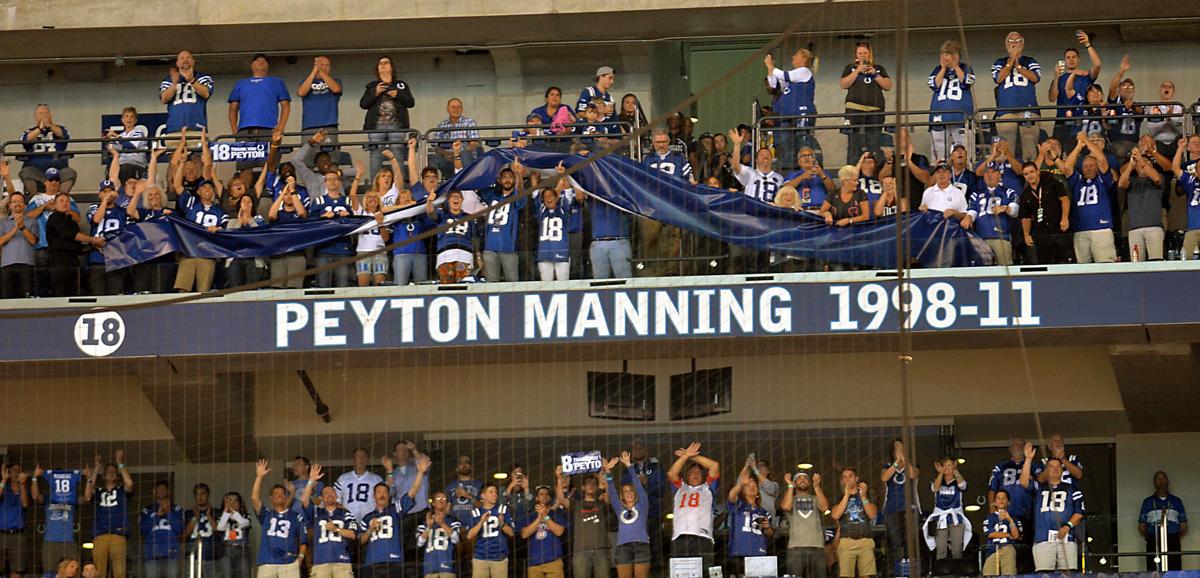
* From the 2006-07 team that won Super Bowl XLI, and the 2009-10 team that won the AFC Championship but lost Super Bowl XLIV: General manager Bill Polian, head coach Tony Dungy, quarterback Peyton Manning, running back Edgerrin James, receivers Marvin Harrison and Reggie Wayne, center Jeff Saturday, and defensive ends Dwight Freeney and Robert Mathis.
It should be "1998-2011." They had the room.

The Colts have 8 retired numbers. All but Manning's 18 are from their Baltimore years: 19, quarterback Johnny Unitas; 22, running back Buddy Young; 24, running back Lenny Moore; 70, defensive tackle Art Donovan; 77, guard Jim Parker; 82, receiver Raymond Berry; and 89, defensive end Gino Marchetti. Number 12 not retired for the fans, and was recently worn by former quarterback Andrew Luck.

Only Young left the team before it won the 1958 NFL Championship. The rest were all together from 1957 to 1961, and Donovan was the only other that didn't last until 1966. Donovan was the 1st Baltimore athlete to get his number retired, before Unitas, before Brooks or Frank Robinson. Unitas was the only one to last to their Super Bowl III loss, much less their Super Bowl V win.
From the Baltimore years: Unitas, Moore, Donovan, Parker, Berry, Marchetti, and a pair of players from the Super Bowl V win, tight end John Mackey and linebacker Ted Hendricks, are in the Pro Football Hall of Fame. Also from that team, linebacker Mike Curtis should be in the Hall of Fame, but isn't. Also worthy of consideration is defensive end Charles "Bubba" Smith, who's probably now better known as an actor.

Mackey wore Number 88, also worn by Harrison. Curtis and James wore 32. Neither of these numbers has yet been retired, but neither is any of them currently being worn. 

Also in the Hall are 1954-62 head coach Weeb Ewbank (who led the Colts to World Championships in 1958 and 1959 and then beat them for one for the Jets in 1969), and 1953-56 defensive back and 1963-69 head coach Don Shula (who lost Super Bowl III, then was replaced by Don McCafferty who won Super Bowl V, but Shula went on to coach the Miami Dolphins in 5 Super Bowls, winning VII and VIII).

From the Indianapolis years: Polian, Dungy, Dickerson, Faulk, Manning, James and Harrison are in the Pro Football Hall of Fame. So is Chicago Bears legend Richard Dent, who played the 1996 season with the Colts. 

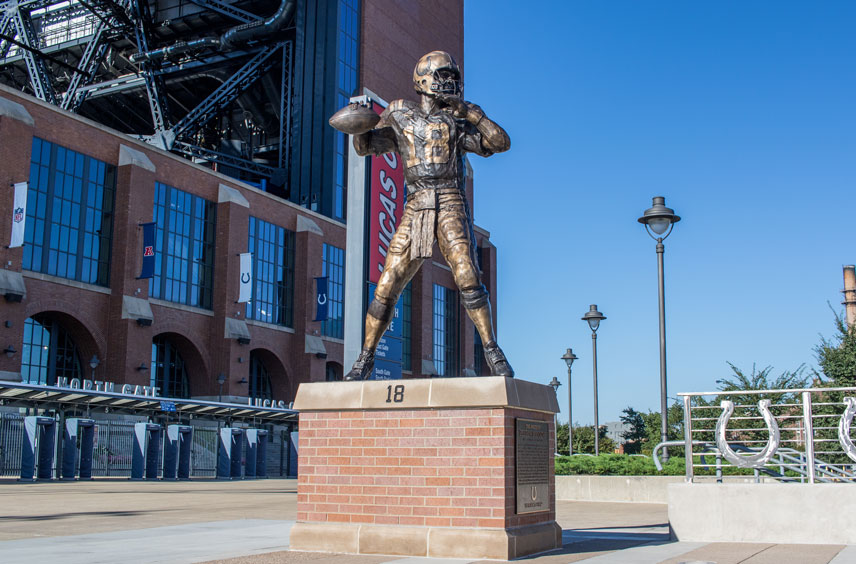
Unitas, Berry, Parker, Marchetti, and Hendricks were named to the NFL's 75th Anniversary team in 1994. Moore, Mackey and Dickerson, were named to The Sporting News' 100 Greatest Football Players in 1999. All of those, as well as Manning and Faulk, were named to the NFL Network's 100 Greatest Players in 2010. Unitas, Moore, Berry, Parker, Marchetti, Mackey, Hendricks, Dickerson, Manning, Harrison, placekicker Adam Vinatieri, and 1960s Baltimore head coach Don Shula were named to the NFL's 100th Anniversary All-Time Team in 2019. A statue of Manning now stands outside Lucas Oil Stadium.
Despite their long history, only 4 Heisman Trophy winners have ever played for the Colts franchise, and only 1 of those in Indianapolis: Gino Torretta, the 1992 winner at the University of Miami, played quarterback for the Colts in 1997, and was so bad, he was one of the reasons the Colts had to draft Manning, who, that year, finished 2nd to Michigan's Charles Woodson in the Heisman voting.

Two of the Baltimore players made little impact: Running back Frank Sinkwich, the 1942 winner at Georgia, played for the original Colt team, in the AAFC in 1947, but didn't do much. Nor did Billy Vessels, the Oklahoma running back who won the Trophy in 1952, in his brief Baltimore run in 1956.

But Alan "the Horse" Ameche, who won it with Wisconsin in 1954, played with the Colts from 1955 to 1960, scored the winning touchdown in the 1958 NFL Championship Game, and was apparently on his way to a Hall of Fame career when an Achilles tendon injury forced him out of the football business and into the restaurant business.

The games between the former Baltimore team, the Colts, and the current Baltimore team, the Ravens, mean a whole lot more to Baltimore than to Indianapolis. To people in Indiana, the Ravens are just another team that they might face in the AFC Playoffs.

Actually, being in the AFC South means that the teams that should be their geographic rivals aren't: The 2 closest teams are the Chicago Bears and the Cincinnati Bengals. The Colts lead the Bears 25-19 and the Bengals 20-12; but if you count only games where they represented Indianapolis, the Colts trail the Bears 4-6 and lead the Bengals 15-8.

Ask a Colts fan who their arch-rivals are, and they'd probably say the New England Patriots. At least that dates back to the old AFC East, from 1970 to 2001, including Baltimore vs. Boston from 1970 to 1983. But it's more for their Playoff matchups, especially after it became Peyton Manning vs. Tom Brady.

The Pats hold a whopping 52-29 lead in the rivalry, including having won the last 8. Counting just the Colts' Indianapolis years, they trail the Pats 14-38. The Colts' last win was on November 15, 2009, a 35-34 win at Lucas Oil Stadium. There have been 5 Playoff meetings, with the Pats winning in 2003-04, 2004-05, 2013-14 and 2014-15, and the Colts winning in 2006-07.

Stuff. The Colts Pro Shop is in the stadium's northeast corner, at South & Capitol. Additional souvenir stands are all over.

In 2013, Lew Freedman published Indianapolis Colts: The Complete Illustrated History, taking the team from their 1984 arrival through the 2012 season, the first with Andrew Luck at quarterback. Freedman has written many sports books, including a similar book about the Giants and a biography of LeBron James.

The DVDs Colts: The Complete History (including the Baltimore years but only going up to 2006 and thus missing the Super Bowl win by 1 season) and the official Super Bowl XLI DVD should be available at the Pro Shop. If not, they are available at Amazon.com

During the Game. According to a recent Thrillist article, Colt fans were ranked 18th, in the middle of the NFL's pack when it comes to "obnoxiousness":

There are basically three kinds of Colts fans: die-hards who thought building the Hoosier Dome before you had an actual team was a stroke of GENIUS; Peyton Manning fans who dropped $200 on an authentic jersey in 2005 and don't much feel like switching; and people who know nothing about football and are just attracted by the smell of frying pork. 

Because of their Midwestern/Heartland image, Colts fans like a "family atmosphere." They don't much like New York, but they won't bother Giant or Jet fans just for being Giant or Jet fans, or for wearing Giant or Jet gear in their stadium. Indiana is first and foremost a basketball State, so as long as you don't mention the Knicks-Pacers rivalry, or say anything bad about Reggie Miller or former Indiana University basketball coach Bobby Knight, you should be okay.

From September 1 to 7, 2017, at the height of the NFL National Anthem protest controversy,
FiveThirtyEight.com polled fans of the 32 NFL teams, to see where they leaned politically. Despite Indiana's natural conservatism, Colt fans were said to be in the more liberal half of NFL fanbases, 4.9 percent more liberal than conservative.

The Colts' mascot is a man in a suit designed to look like a blue horse, named Blue. The Colts hold auditions for National Anthem singers, instead of having a regular.
Blue, horsing around with a pair of Colts cheerleaders

They don't seem to have a fight song, although in their Baltimore years they had the Baltimore Colts Marching Band, which kept going, nicknamed "The Band That Wouldn't Die," and are now the Baltimore Marching Ravens. But don't expect to hear the old fight song, "Fight On You Baltimore Colts," at either Lucas Oil or M&T Bank Stadium. What you could expect to hear is the Black Keys' song "Gold On the Ceiling."

After the Game. Indianapolis is a big city, bigger than most people realize, and has every problem that comes with that, including crime. But since the stadium is right downtown, this will probably not affect you. As I said, leave the home fans alone, and they'll probably leave you alone. I can't find a reference to a bar in Indianapolis were expatriate (not to be confused with "ex-Patriot") New Yorkers gather to watch the Giants.

If your visit to Indianapolis is during the European soccer season, as we are now in, your best bet to see your club is at Chatham Tap, 719 Massachusetts Avenue, on the northeastern edge of downtown. Another possibility is the Union Jack Pub, at 924 Broad Ripple Avenue, about 8 miles north of downtown. Bus 17 will take you to both.

Sidelights. Indianapolis is often said to be boring: Its most common nickname is "India-no-place." On February 3, 2017, Thrillist made a list ranking the 30 NFL cities (New York and Los Angeles each having 2 teams), and Indianapolis came in 21st, in the bottom 1/3rd, saying it's "like a big suburb that's really trying."

But there are some things worth visiting, particularly for a sports fan. As I said, the city's new NFL stadium, new NBA arena, and new minor-league ballpark are within a few blocks of each other downtown.

* Victory Field. This 12,230-seat ballpark opened in 1996 as the home of the Indianapolis Indians of the International League (formerly in the American Association), one of the oldest and proudest minor-league franchises. While the Indians have won just 1 Pennant since moving in, in 2000, they are still a legendary franchise, winning 10 International League Pennants.

There have been 10 future Hall-of-Famers who have played for them: Napoleon Lajoie, Mordecai "Three-Finger" Brown, Rube Marquard, Ray Schalk, Grover Cleveland Alexander, Gabby Hartnett, Al Lopez, Harmon Killebrew and Randy Johnson. Three others managed them: Luke Appling, Joe McCarthy and Al Lopez. In addition to McCarthy, Yankee Legends associated with them are Roger Maris, Don Zimmer and Aaron Boone.

Considering their name, it is a bit odd that they were only briefly, from 1952 to 1956, a farm team of the Cleveland Indians. They contributed players to the Pennant winners of the 1939 and '40 Cincinnati Reds, the 1948 Boston Braves, the 1954 Indians, the 1959 Chicago White Sox; and the Reds again in 1970, '72, '75 and '76. Currently, they are the top farm team of the Pittsburgh Pirates. 501 W. Maryland Street & West Street.

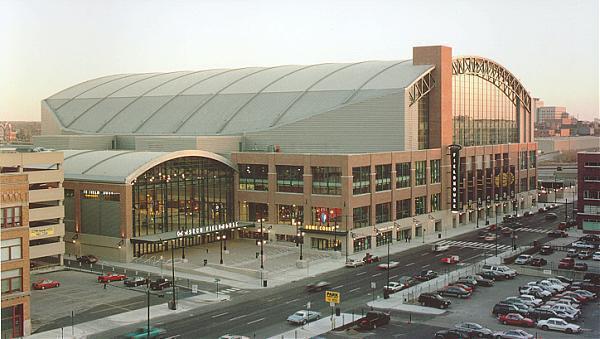
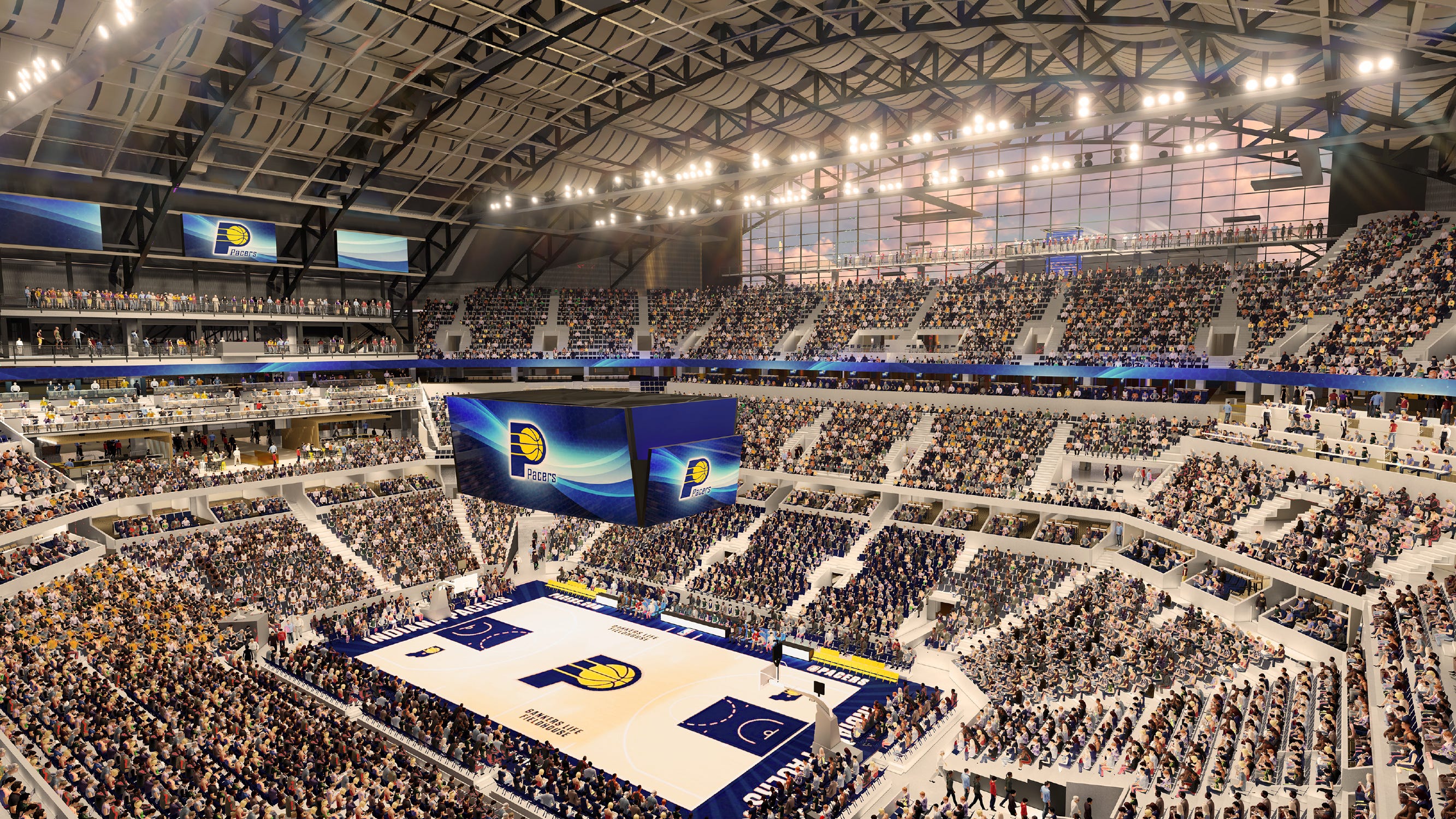
* Gainbridge Fieldhouse. Formerly Conseco Fieldhouse, and known as Bankers Life Fieldhouse from 2011 to 2021, the Pacers' new arena was designed to be a throwback, "the Camden Yards of basketball," if you will. (A little ironic, but at least this time they only took Baltimore's idea, not it's team. Then again, Washington, D.C. already took the Bullets, now Wizards, in 1973.) In particular, there is a strong resemblance to "Indiana's Basketball Cathedral," Hinkle Fieldhouse. (More about which in a moment.) It seats 18,165.

In their first season at the new arena, 1999-2000, the Pacers reached the NBA Finals for the first time, but got swept by the Los Angeles Lakers. They have not gotten back since.

The WNBA's Indiana Fever and minor-league hockey's Indianapolis Ice also play at Bankers Life. It has regularly (but not every year) hosted the Big Ten Conference Men's Basketball Tournament. 125 S. Pennsylvania Street at Georgia Street.

* Site of Hoosier Dome/RCA Dome. The 60,000-seat near-clone of Minneapolis' Metrodome, along with Bob Irsay's greed, made the move of the Colts to Indianapolis possible. It hosted only 24 seasons of NFL football, from 1984 to 2007.
The building, whose name was changed in 1994, hosted 4 Final Fours: 1991 (Duke's 1st title, shocking defending champion UNLV and then beating Michigan's Fab Five), 1997 (Arizona's only title to date, over defending champion Kentucky), 2000 (Michigan State over Florida) and 2006 (Florida over UCLA).
The stadium was demolished in 2008, and its fabric roof was recycled to make hundreds of new products. An expansion of the Indiana Convention Center is now on the site. 100 S. Capitol Avenue at Georgia Street.

* Site of Market Square Arena. Home of the Pacers from 1974 to 1999, this 16,530-seat arena had a weird egg shape, possibly the result of a Seventies-inspired drug haze. It also hosted minor-league hockey, and the World Hockey Association's Indianapolis Racers from 1974 to 1979. This was the first major league team of Wayne Gretzky. It also hosted the NCAA Final Four in 1980 (Louisville over UCLA), and what turned out to be Elvis's last concert, on June 26, 1977. 300 E. Market Street at Alabama Street.

The closest NHL team to Indianapolis is the Columbus Blue Jackets, 174 miles away. The Chicago Blackhawks are a little further away, 184 miles. Due to their long-term presence (the Jackets have only played since 2000), the Hawks are the most popular NHL team throughout Indiana, including those areas closer to St. Louis and Nashville.

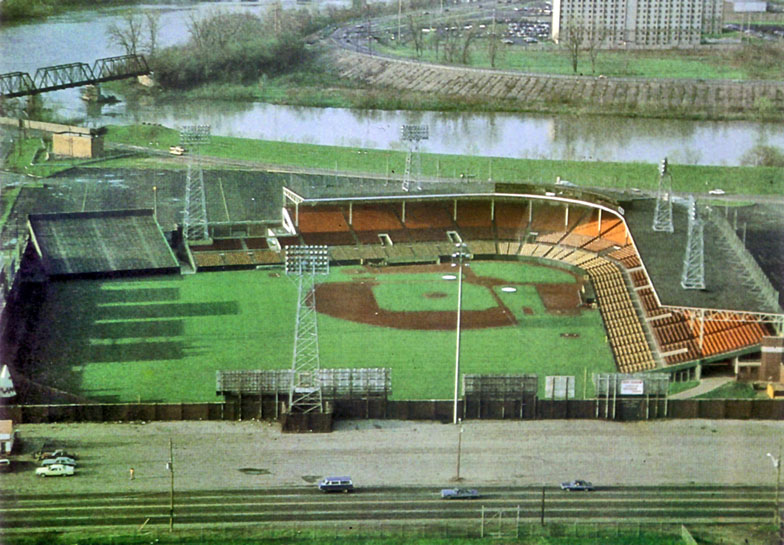
* Bush Stadium. This was the Indians' home from 1931 to 1995. It was first known as Perry Field, after the Indians' owner. In 1942, he took his own name off it, and, in line with the war effort, renamed it Victory Field, a name brought back for its replacement.

In 1967, it was renamed Owen J. Bush Stadium, in honor of "Donie" Bush, a former major league shortstop from Indianapolis who had managed the Pirates to the 1927 National League Pennant, and also served the Indianapolis Indians as manager and team president.
Like Wrigley Field in Chicago and Forbes Field in Pittsburgh, Bush Stadium had ivy on its outfield walls. In 1987, it was dressed up to resemble both Chicago's Comiskey Park and Cincinnati's Redland Field (later Crosley Field) for the movie Eight Men Out, about the 1919-21 Black Sox Scandal, as it was one of the few remaining pre-1920 ballparks left. (Comiskey Park was still standing, but it didn't yet have an upper deck in 1919, so it was unsuitable for the film.) Interestingly enough, both the White Sox and the Reds had the Indians as their top farm team for some time (though not, of course, at the same time).

The Indians won Pennants at Bush Stadium in 1949, 1956, 1963, 1982, 1986, 1987, 1988, 1989 and 1994. Peak capacity was 15,000. The Indianapolis ABCs of the Negro Leagues -- named for the American Brewing Company -- played here from 1931 to 1938. So did the Indianapolis Clowns, for whom Hank Aaron played briefly in 1952, making him the last remaining active former Negro League player, in 1976. The Clowns were also the last remaining Negro League team, playing until 1966.

Parts of the stadium have been preserved and turned into housing. 1501 W. 16th Street, northwest of downtown. Number 25 bus.

Across W. 16th Street, at 1502, is Kuntz Stadium, a 5,257-seat soccer stadium. The U.S. national team played 3 games there in the late 1980s. That shows you how far that team has come: They couldn't even sell out 5,000 seats. If they were to play in Indy now, they would sell out the 62,000-seat Lucas Oil Stadium.

* Washington Park. The Indians and the ABCs -- the latter then led by perhaps the greatest of the pre-1947 black players, Oscar Charleston -- played here before Perry Field/Bush Stadium opened. 1235 W. Washington Street, on ground now occupied by the Indianapolis Zoo, about a mile and a half east of downtown. Bus 8.

* South Street Park. In 1878, the Indianapolis Blues went 24-36 in the National League, and folded. They played at South Street Park, bounded by Delaware Street, South Street, Alabama Street and a railroad. The site is now retail and a hotel.

* Tinker Park. In 1884, the Indianapolis Hoosiers went a horrible 29-78 in the American Association, and folded. They played at Seventh Street Park, bounded by Senate Boulevard, 16th Street, Capitol Street and 18th Street. In 1887, a new team with the same name began National League play there, with the ballpark renamed Athletic Park, but the new Hoosiers only lasted through the 1889 season. It was later renamed Tinker Park. The Indiana University Medical Center is on the site now, about 2 miles north of downtown. Bus 28. 

* Federal Park. In 1914, the Federal League was founded, and their 1st Pennant was won by a new version of the Indianapolis Hoosiers, going 88-65. They played at Federal Park. In spite of the Hoosiers' success, they wanted another team in the New York market, along with the Brooklyn Tip-Tops, and the Hoosiers played the 1915 season in Harrison, New Jersey, as the Newark Peppers. Federal Park was at 400 Kentucky Avenue at West Street, 2 blocks west of Lucas Oil Stadium.

Don't expect Indianapolis to get a major league team anytime soon: The metro area would rank 29th in Major League Baseball. It would actually rank higher in the NHL, 25th, but who thinks of hockey when they think of Indiana sports?

The nearest MLB teams to Indianapolis are the Cincinnati Reds, 112 miles away; the Chicago White Sox, 178 miles; the Chicago Cubs, 188 miles; and the St. Louis Cardinals, 242 miles. But according to a recent New York Times article, the most popular team in and around Indianapolis is the Cubs, with the Yankees 2nd, and the Reds and the Boston Red Sox battling it out for 3rd. Why? And why not the much-closer White Sox or Cardinals? Because of the media, particularly the influence of Chicago's superstation WGN, and ESPN and Fox constantly showing the Yankees and Red Sox.

* Hinkle Fieldhouse. Formerly Butler Fieldhouse, and renamed for longtime basketball coach Tony Hinkle, this gym was built for Butler University in 1928, and has hosted countless Indiana basketball memories, including the State high school championships. Most notably, it hosted the 1954 Final, which saw Milan defeat Muncie Central, inspiring the film Hoosiers, which filmed on the same court and used the original announcers. (Milan had also been to the Final 2 years earlier, so while it was an upset, it wasn't like Milan was a total unknown. An underdog, yes; a dark horse, no.)

Seating 15,000 at its peak (a sellout of which at the 1987 Pan American Games becoming, to this day, the largest crowd ever to attend a volleyball match in America), modernizations, including wider seats, have reduced capacity to 10,000. But it still stands, and is one of the oldest remaining buildings to have hosted one of the 4 major sports leagues in North America. 510 W. 49th Street, north of downtown. Number 28 bus, then walk west on 49th from Illinois Street to Rookwood Avenue.

Indiana University is in Bloomington, 50 miles to the southwest. Purdue University is in West Lafayette, 68 miles to the northwest. The University of Notre Dame is in South Bend, 149 miles to the north. And Ball State University is in Muncie, 60 miles to the Northeast.

On November 19, 2018, Moneywise compiled a list of their Worst College Football Stadiums, the bottom 19 percent of college football, 25 out of 129. Ball State was ranked 15th: "Scheumann Stadium would never make a Top 10 list from Ball State alum David Letterman."

* Previous Indiana NFL teams. The Muncie Flyers played only in the NFL's 1st 2 seasons, 1920 and 1921, when it was still known as the APFA, the American Professional Football Association. They only played 3 games against NFL teams, lost them all, dropped out, and folded after the 1925 season.

Bosse Field, built in 1915 and the oldest regularly-used stadium for minor-league baseball, was the home of the Evansville Crimson Giants. They also lasted just 2 seasons, going 3-2 against NFL competition in 1921 and 0-3 in 1922. The ballpark has an address named for the city's favorite baseball son: 23 Don Mattingly Way (formerly N. Main Street), 164 miles southwest of Indianapolis, across the Ohio River from Henderson, Kentucky.

The Hammond Pros were founding members of the APFA/NFL in 1920, but folded after the 1926 season, never having won more than 2 games in a season. And while they represented that industrial city just outside Chicago, home to writer and radio show host Jean Shepherd of A Christmas Story fame, they didn't play in Hammond. They played at Cubs Park, soon to be renamed Wrigley Field. Downtown Hammond is 159 miles northwest of downtown Indianapolis, and Wrigley is 30 miles northwest of that -- still closer than the 49ers' new stadium in Santa Clara is to downtown San Francisco.  

* Previous Indiana NBA teams. The 1st pro basketball team in Indianapolis was first called the Indianapolis Kautskys, founded by grocer Frank Kautsky in 1931. In 1937, they joined the National Basketball League, and were thus big enough to move into Butler (Hinkle) Fieldhouse.

They made the Playoffs in 1942, '47 and '48. In 1948, they, along with the NBL's Minneapolis Lakers, Fort Wayne Pistons and Rochester Royals, jumped to the Basketball Association of America, which became the NBA a year later. Because the league didn't allow commercial names, the team's name was changed to the Indianapolis Jets. But they only lasted 1 season, as the Olympians arrived.

Today, the Kautskys/Jets are noted mainly for having on their roster John Wooden, who coached UCLA to 10 National Championships from 1964 to 1975; and Branch McCracken, who coached Indiana to the 1940 and 1953 National Championships.

In 1949, the Indianapolis Olympians were welcomed into the NBL, but then the merger with the BAA happened to become the NBA, and the Olympians, so named because of their players' representation of the U.S. in winning the Gold Medal at the 1948 Olympics in London, were in, and the Jets were out. They included Alex Groza (brother of Cleveland Browns star Lou Groza), Ralph Beard, Cliff Barker and Wallace "Wah-Wah" Jones, all of whom had played on the University of Kentucky's 1948 and '49 National Champions; Paul Walther of the University of Tennessee and Clarence "Kleggie" Hermsen of the University of Minnesota.

Also playing at the Butler fieldhouse, the Olympians won the Western Division in 1950, and made the Playoffs again in 1951. But after that season, Groza and Beard were banned from the NBA for life after they admitted shaving points at Kentucky. The Olympians never recovered, and folded after the 1953 season.

The Anderson Packers played from 1946 to 1951 at Anderson High School, 4610 Madison Avenue, 41 miles to the northeast. Not reachable by public transportation.

The Fort Wayne Pistons began in the NBL in 1941, 128 miles to the northeast, and won that league's title in 1944 and '45 -- making them, technically if not officially, the World Champions of professional basketball for those seasons. Owner Fred Zollner and his sister Janet ran a foundry, manufacturing Pistons.

The team moved into the NBA in 1948, and won the Western Division and reached the Finals in 1955 (losing to the Syracuse Nationals) and 1956 (losing to the Philadelphia Warriors). But despite moving from the gym at North Side High School (475 E. State Boulevard) to the new 13,000-seat Allen County War Memorial Coliseum (still standing at 4000 Parnell Avenue) in 1952, they were stuck in a market that was too small for the major leagues.

In 1957, Zollner moved the team to Detroit -- the Motor City, so keeping the "Pistons" name made sense. (Ironically, they weren't much closer to Indianapolis than they were to Detroit. Or Chicago, for that matter.) After that, Indianapolis wouldn't have another NBA team until the Pacers arrived with the ABA merger 19 years later.

* Indiana Farmers Coliseum. Opening in 1939 as part of the Indiana State Fair complex, this 6,800-seat arena, formerly known as the Fairgrounds Coliseum, was the Pacers' first home, from 1967 to 1974. It was their home when they won the American Basketball Association Championship in 1970, 1972 and 1973.

Heavyweight Champion Floyd Patterson successfully defended his title here, beating Brian London on May 1, 1959. On October 31, 1963, a propane leak at a concession stand caused an explosion that killed 74 people during a Holiday On Ice show. Elvis sang there on April 12, 1972.

It has also been home to a series of minor-league hockey teams. The Indianapolis Capitals won the Calder Cup, the championship of the American Hockey League, in 1942 and 1950. The Indianapolis Ice won the Turner Cup, the championship of the International Hockey League, in 1990; and the Ray Miron Cup, the championship of the Central Hockey League, in 2000. The Indiana Ice won the Clark Cup, the championship of the United States Hockey League, in 2009 and 2014.

The current team is called the Indy Fuel, tied into the city's racing theme. 1202 E. 38th Street, northeast of downtown. Number 39 bus.

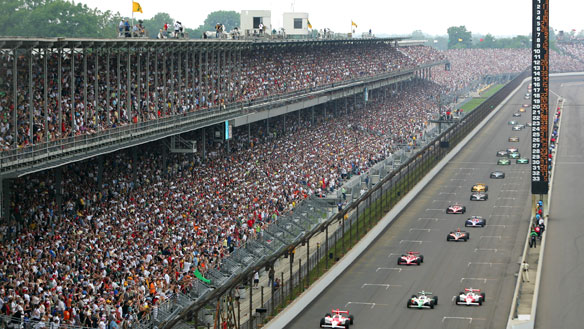
* Indianapolis Motor Speedway. The most famous building in the State of Indiana, and the largest sports facility in the world, has nothing to do with basketball or football or baseball. It's the home of the Indianapolis 500, held there every year (usually on the Sunday of Memorial Day weekend) since 1911 (except for the World War years: 1917, '18, '42, '43, '44 and '45).

The track opened in 1909, and has spread the name of the city all over the world, as drivers from as far away as Britain (Dan Wheldon and Dario Franchitti), Brazil (Helio Castroneves and Tony Kanaan), Australia (Scott Dixon and the aptly-named Will Power), Colombia (Juan Pablo Montoya) and Japan (Takuma Sato) have won the 500 in recent years.

The permanent seating capacity is 257,325. Infield seating can push it to over 400,000 -- and the Indy 500 sells out every year. Although the mailing address is "4790 W. 16th Street, Speedway, Indiana 46222," it's within the city limits of Indianapolis, 5 miles northwest of downtown. Number 25 bus.

* Michael Carroll Stadium. This is the home of the Indy Eleven, of the new version of the North American Soccer League, the 2nd division of North American soccer. It sets 12,111. 1001 W. New York Street, a mile west of downtown. There is no bus service there. The nearest MLS team is the Columbus Crew, 178 miles away. The Chicago Fire are 183 miles away.

Early in his career, Elvis gave 8 concerts in 4 days, December 4 through 7, 1955 at the Lyric Theater, at 121 N. Illinois Street, a block west of the Monument. A parking deck is on the site now.

Elvis also sang in Indiana at the Fort Wayne Memorial Coliseum on March 30, 1957, June 12, 1972, and October 25, 1976; at Roberts Memorial Stadium in Evansville on June 13, 1972 and October 24, 1976; at Assembly Hall in Bloomington on June 27, 1974 and May 27, 1976; at the Notre Dame Athletic Center (now the Joyce Center) on September 30 and October 1, 1974 and October 20, 1976; and at the Hulman Civic Center in Terre Haute on July 9, 1975.

* Soldiers' and Sailors' Monument. Standing 284 1/2 feet high at the geographic center of the City and the State, this tower was dedicated in 1902, commemorating the Indiana military personnel of the recent Spanish-American War, the American Civil War, the Mexican-American War, the frontier conflicts that were a part of the War of 1812 (which produced several battles in Indiana), and the American capture of Vincennes from the British during the War of the American Revolution. During the holiday season, it is decorated like a Christmas tree. (If that sounds sacrilegious, in New Brunswick, New Jersey, the considerably shorter Civil War Monument is turned into an artificial Christmas tree, and nobody objects.) Monument Circle, at Meridian & Market Streets.

The tallest building in the State of Indiana is the Salesforce Tower, formerly named the Chase Tower, with a roof 700 feet high and spires rising to 830 feet. 111 Monument Circle.

Indianapolis is not big on museums. The best-known is the Indiana State Museum, at a complex that includes the Eiteljorg Museum of American Indians and Western Art. Washington & West Streets, downtown. Number 8 bus if you don't feel like walking.

William Henry Harrison, 9th President of the United States and former Territorial Governor (died just 1 month after his 1841 Inauguration), and his grandson, Benjamin Harrison, 23rd President (1889-1893), both lived in Indiana (as did Abraham Lincoln as a boy). But Grouseland, the house of "Old Tippecanoe," is 130 miles away in Vincennes. The Benjamin Harrison Presidential Site is just north of downtown, at 1230 N. Delaware Street. Number 19 bus.

Benjamin Harrison is buried at Crown Hill Cemetery. So are Vice Presidents Thomas Hendricks (served under Grover Cleveland, died in office 1885), Charles Fairbanks (Theodore Roosevelt, 1905-09) and Thomas Marshall (Woodrow Wilson, 1913-21).

So are Bob Irsay, the man who moved the Colts from Baltimore; poet James Whitcomb Riley, novelist Booth Tarkington, bank robber John Dillinger, Sudoku inventor Howard Garns, and James Baskett, the 1st black man to win an Oscar, for playing Uncle Remus in Walt Disney's Song of the South. 700 W. 38th Street, about 4 1/2 miles north of downtown. Bus 38.

Only 3 TV shows are known to have been set in Indianapolis. Close to Home and the U.S. version of the British hit Men Behaving Badly are best forgotten. But the CBS sitcom One Day at a Time, which aired from 1975 to 1984, and starred Bonnie Franklin and launched Mackenzie Phillips and Valerie Bertinelli to stardom, was groundbreaking: It was not only the first TV show to show a divorced single mother (rather than a widowed one), but it actually made Indianapolis seem like a fun place to be.

Parks and Recreation is set in the fictional Indiana town of Pawnee. The Fugitive established the hometown of Dr. Richard Kimble (Dave Janssen) as Stafford, not far from South Bend, and the final episode, at the time of its August 29, 1967 airing the most-watched program in U.S. TV history, took place there, although the amusement park where the climactic scene took place was filmed in Southern California. Stranger Things is set in the fictional Indiana town of Hawkins.

Movies set in Indianapolis are also rare. Some early scenes of Close Encounters of the Third Kind were set there, before moving out to the iconic Devil's Tower National Monument in Wyoming. Last year, the cult hit The Fault In Our Stars was set there, but filmed in Pittsburgh.

*

No matter what the Colts achieve, and 2 trips to the Super Bowl in 30 years is more than some teams have done, Indiana will always be a basketball State, and Indianapolis will always be a basketball city. But that doesn't mean a visiting football fan can't have fun there.

Friday, October 29, 2021

How to Be a New York Basketball Fan In Indiana -- 2021-22 Edition

The New York Knicks travel to play the Indiana Pacers this coming Wednesday, and will do so again on December 8. The Brooklyn Nets will do so on January 5, 2022.

Before You Go. Indianapolis is about as far south as Baltimore and Washington. Despite being in the Midwest, it is not on a Great Lake, bringing strong winds and "lake effect snow." So the weather won't be substantially different from what we get in the Middle Atlantic States. The website of the Indianapolis Star is predicting the mid-40s for next Wednesday afternoon, and mid-30s for the evening. Bring a Winter jacket.

Indiana used to be 1 of 2 States, Arizona being the other, where Daylight Savings Time was an issue; however, since 2006 -- 4 years after a West Wing episode lampooned this -- the State has used it throughout. There will be no need to adjust your timepieces.

Tickets. The Pacers averaged 16,531 fans per home game in 2019-20 before COVID shut everything down, about 92 percent of capacity. So, despite Indiana's reputation as a basketball-crazy State, tickets shouldn't be hard to get. 

They are among the cheapest in the NBA: Seats in the lower level are $100 between the baskets and $43 behind them. In the upper level, they're just $9.00 all around.

Getting There. It's 714 miles from Times Square in Manhattan to Monument Circle in the center of the City of Indianapolis. Knowing this, your first reaction is going to be to fly out there. You could get nonstop flights on United Airlines from Newark to Indianapolis International Airport, it will be expensive, in the neighborhood of $800 if you're lucky. The Number 8 bus is a 45-minute ride from the airport to downtown.

Amtrak doesn't work this time, because they've suspended Cardinal service from Penn Station to Union Station in Indianapolis. Union Station is at 350 S. Illinois Street, corner of South Street, 6 blocks from the Fieldhouse.
Indianapolis' Union Station

Greyhound runs 4 buses a day from Port Authority Bus Terminal to Indianapolis. The fare is $254, but it can drop to $203 with advanced purchase. The station is at 154 W. South Street, at Illinois Street, around the corner from Union Station. (That's right, "West South Street," but that's South Street, west of downtown.)

If you decide to drive, it's far enough that it will help to get someone to go with you and split the duties, and to trade off driving and sleeping. You'll need to get on the New Jersey Turnpike, and take Interstate 78 West across New Jersey, and at Harrisburg get on the Pennsylvania Turnpike, which at this point will be both I-70 and I-76. When the two Interstates split outside Pittsburgh, stay on I-70 west. You'll cross the northern tip of West Virginia, and go all the way across Ohio (through Columbus), and halfway through Indiana.

If you do it right, you should spend about an hour and 15 minutes in New Jersey, 5 hours in Pennsylvania, 15 minutes in West Virginia, 3 hours and 45 minutes in Ohio, and an hour and 15 minutes in Indiana. That's going to be 11 and a half hours. Counting rest stops, preferably 6 of them, and accounting for traffic in both New York and Indianapolis, it should be about 14 hours.

Once In the City. Indianapolis, named (as was its State) for the Native Americans, was founded in 1821, 200 years ago (Bicentennial Day was January 6), and is home to over 888,000 people -- making it the 2nd-largest city in the Midwest, behind Chicago -- with a metropolitan area of 2.4 million.

Like many other cities, Indianapolis experienced "white flight": While it was 81 percent white in 1970, that figure is now down to 56 percent, with 29 percent black, 11 percent Hispanic and 3 percent Asian.

Notably, Indianapolis was spared a race riot after Martin Luther King was assassinated on April 4, 1968. Senator Robert F. Kennedy had planned to give a speech in a black neighborhood in advance of the Indiana Primary, and the Mayor at the time, Richard Lugar, later himself a Senator and a Presidential candidate (Republican, 1996), advised Bobby to cancel. He wouldn't, and gave a speech calling for an end to violence, as Dr. King would have wanted. He kept the peace, and won the Primary. Two months later, he was also assassinated.

The centerpoint of the City, and indeed of the State, is the 284-foot-high Soldiers' and Sailors' Monument inside Monument Circle, at Market & Meridian Streets.
The Indiana State Soldiers and Sailors Monument,
at Monument Circle

The sales tax in the State of Indiana is 7 percent. ZIP Codes in Indianapolis start with the digits 462, and the Area Code is 327, with 463 overlaid. Indianapolis Power & Light (IPL) supplies the electricity.

There's no subway, but IndyGo offers a $4.00 all-day pass for its buses. Interstate 465 is the city's beltway.
The State House

Going In. The official address of Gainbridge Fieldhouse, named for an insurance company, is 125 E. Georgia Street, at Pennsylvania Street. Any bus going downtown will get you within a couple of blocks. If you drive in, the cost for parking varies as to lot, but usually runs from $10 to $20.
Actually, it looks like one big old gym and one smaller old gym.

Built in 1999 as Conseco Fieldhouse, and named Bankers Life Fieldhouse from 2011 to 2021, the Pacers' new arena was designed to be a throwback, "the Camden Yards of basketball," if you will. (A little ironic, but at least this time they only took Baltimore's idea, not its team. Then again, Washington, D.C. already took the Bullets, now Wizards, in 1973.) In particular, there is a strong resemblance to "Indiana's Basketball Cathedral," Hinkle Fieldhouse. It seats 18,165. The court is laid out north-to-south.
In their 1st season at the new arena, 1999-2000, the Pacers reached the NBA Finals for the first time, but got swept by the Los Angeles Lakers. They have not gotten back since.

Minor-league hockey's Indianapolis Ice once played at Bankers Life. However, you should not expect an NHL team to play there: Due to the layout, the capacity for hockey is just 12,300, and some of the seats end up being obstructed view. The place was built for basketball.

The WNBA's Indiana Fever play there, and it has regularly (but not every year) hosted the Big Ten Conference Men's Basketball Tournament, and Indiana's high school State Championships for boys basketball, girls basketball, and wrestling.

The Fieldhouse was set to host the 2021 NBA All-Star Game, but that was canceled due to COVID restrictions. It has received the 2024 edition as compensation.

Food. Indiana is in the heart of the Midwest, right-smack-dab in the middle (or what used to be the middle, before Penn State, and then Nebraska, Rutgers and Maryland, were admitted) of Big Ten Country, where tailgate parties are practically a sacrament. So you would expect there to be great food inside the Pacers' arena.

The Coors Light Beer Wagon (if you're willing to say that Coors Light is "beer") can be found at Section 2; Mr. Smoothie at 3, 14, 207, 220 and 226; Snack Shoppe at 4, 16, 202 and 217; Dippin' Dots at 4, 208, 220 and 229; Crossroads Tavern at 5 and 15; Homestead Favorites (including the evil Papa John's Pizza) at 5, 15, 208 and 224; Union Smokehouse at 6, 14, 215 and 231; Sno Zone (cotton candy and snow cones) at 6, 17 and 222; Sun King (local craft beer) at 6; Nacho Cart at 7 and 213; Gluten Free Cart at 8; Hardee's at 10; Red Burrito at 10; Salt & Lime Bar (margaritas) at 10; Golden Kettle (popcorn & pretzels) at 11 and 212; Merchant Bar at 13; Street Taco Cart at 13 and 232; Sun King (local craft beer) at 13, 216 and 224; Bud Light Lima-A-Rita at 16; The Amazing Potato Chip Company at 18 and 225; Blue Moon Tap Room at 19; Philly Cheese Steak Cart at 19 and 201; Capital Sausage Cart at 207 and 226; Scratch Food Truck at 224; and Indiana Ale House at 231.

And there's a Dunkin Donuts inside the Fieldhouse, in the Entry Pavilion, on the building's north, Pennsylvania Street side, next to the Pacers Home Court Gift Shop. 

Team History Displays. The Pacers were the most successful team in the American Basketball Association of 1967 to 1976, reaching 4 Finals, winning 3. (The Nets went 2-1, and no other team reached 3 Finals or won 2 titles.) Since joining the NBA, the exciting moments have been many, but the achievements have been few. Indeed, they had no 1st-place finishes for 22 years (1973 to 1995).

The Pacers hang banners for their 1970, 1972 and 1973 ABA Championships; their 2000 NBA Eastern Conference Championship; and for their 1995, 1999, 2000, 2004, 2013 and 2014 NBA Central Division Championships. They do not, however, hang banners for their 1969 and 1971 ABA Eastern Division Championships.
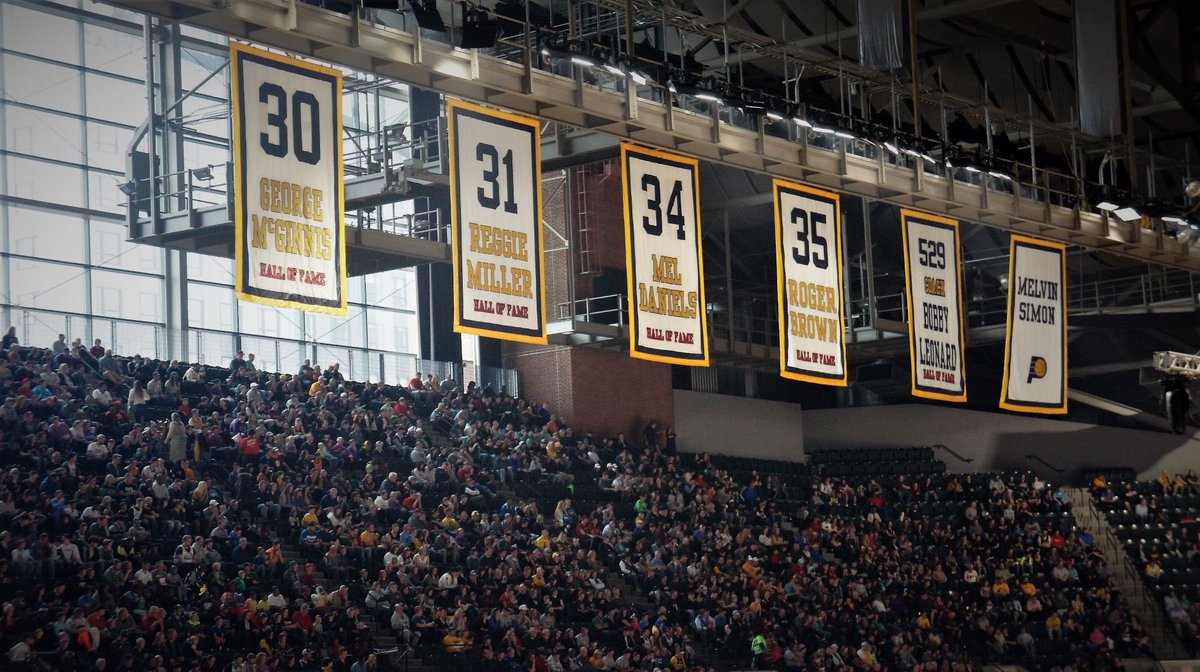
The Pacers honor 6 men with banners: Former owner Mel Simon (no number on the banner), former head coach Bobby "Slick" Leonard (529, for the number of games he won as Pacer coach, not counting the postseason and the 3 ABA titles), and 4 players. Naturally, they honor 1990s-2000s guard Reggie Miller. The other 3 are from the ABA days: Forwards George McGinnis (30) and Roger Brown (35), and center Mel Daniels (34).
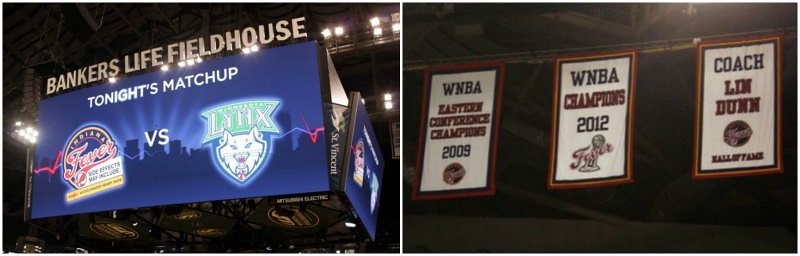
The Fieldhouse also includes banners for the Indiana Fever's 2012 WNBA Championship, and their Conference titles in 2009, 2012 and 2015.
In 2007, Pacers fans chose a 40th Anniversary Team. In addition to Miller, Daniels, McGinnis and Brown, they chose guards Billy Keller, Billy Knight (now general manager of the Nets) and Mark Jackson (the ex-Knick, now ESPN NBA analyst), forwards Clark Kellogg (former CBS college basketball analyst analyst, also working in the Pacers' front office), Dale Davis, Antonio Davis and Jermaine O'Neal, center Rik Smits. They did not have a 50th Anniversary Team in 2017.

Miller was the only Pacer named to the NBA's 50th Anniversary 50 Greatest Players in 1996, and now he's the only one Ned to the 75th Anniversary 75 Greatest Players.

Brown, Daniels, McGinnis, Donnie Freeman, Freddie Lewis and Bob Netolicky were named to the ABA All-Time Team. Tamika Catchings of the Fever was named to the WNBA's 15th Anniversary 15 Greatest Players in 2012; she and Yolanda Griffith were named to the Top 20 at 20 in 2016 -- in the 20th Season, rather than at the 20th Anniversary.

Stuff. The Pacers Home Court Gift Shop is located in the Entry Pavilion on the building's north side, on Pennsylvania Street.

Despite nearly half a century of history with some success, there aren't many books about the Pacers. Your best bet is probably Nate Frisch's entry about the Pacers in the NBA's A History of Hoops series, publishes earlier this year.

As part of its 30 For 30 series, ESPN produced the documentary Winning Time: Reggie Miller vs. the New York Knicks. Other than that, the most notable DVD about the Pacers is the NBA's official Indiana Pacers Greatest Games collection. Two Playoff games against the Knicks (including that one), two against the Chicago Bulls.

During the Game. A November 13, 2014 article on DailyRotoHelp ranked the NBA teams' fan bases, and listed the Pacers' fans at 18th, in the lower half. They site low attendance as a reason. Or, it could be that Indiana, while a great State for high school and college basketball, simply isn't one for the pros. (See also: Neighboring Kentucky, neighboring Ohio, North Carolina, which, for all their hoop mania -- 7 legendary college basketball programs between them -- have a combined total of 2 NBA teams.)

Because of their Midwestern/Heartland image, Pacer fans like a "family atmosphere." They don't much like New York, but they won't bother Knick or Net fans just for being Knick or Net fans, or for wearing Knick or Net gear in their arena. As long as you don't say anything bad about Reggie Miller or former Indiana University basketball coach Bobby Knight, you should be okay.

None of the 4 Pacers home games against New York teams will feature a promotion. The Pacers hold auditions for National Anthem singers, instead of having a regular. Their mascot is Boomer the Panther, although what a panther has to do with pace (the cheetah is the fastest land animal) or Indiana is unclear.
Pacers player Paul George sang lead on a new theme song for the Pacers, mixing in the team colors: "Blue Collar Gold Swagger." You likely won't hear any fan chants more imaginative than, "Let's go, Pacers!" But the fans do have a tradition of wearing yellow team jerseys and T-shirts, providing a takeoff on the "whiteout" effect seen at some basketball and hockey games.

After the Game. Indianapolis is a big city, bigger than most people realize, and has every problem that comes with that, including crime. But since the arena is right downtown, this will probably not affect you. As I said, leave the home fans alone, and they'll probably leave you alone.

There are several eateries near the arena, with, at the least, interesting names. Howl at the Moon is 2 blocks away at 20 E. Georgia Street. Kilroy's Bar & Grill is across from it, at 201 S. Meridian Street. Cadillac Ranch (named for the Amarillo, Texas pop art display that also inspired the title of a Bruce Springsteen song) is inside Union Station. Although connected to a different Indianapolis team, the Indianapolis Colts Grille is at 110 W. Washington Street at Illinois Street, and is festooned with local sports memorabilia.

I can only find one reference to a bar in Indianapolis where expatriate New Yorkers gather to watch their teams: Claddagh Irish Pub, at 234 S. Meridian Street, corner of Jackson Street, 3 blocks from the Fieldhouse, is said to be the local headquarters of Jet fans.

If your visit to Indianapolis is during the European soccer season, as we are now in, your best bet to see your club is at Chatham Tap, 719 Massachusetts Avenue, on the northeastern edge of downtown. Another possibility is the Union Jack Pub, at 924 Broad Ripple Avenue, about 8 miles north of downtown. Bus 17 will take you to both.

Sidelights. Indianapolis is often said to be boring: Its most common nickname is "India-no-place." But there are some things worth visiting, particularly for a sports fan. Helpfully, the city's new NFL stadium, new NBA arena, and new minor-league ballpark are within a few blocks of each other downtown.

* Victory Field. This 12,230-seat ballpark opened in 1996 as the home of the Indianapolis Indians of the International League (formerly in the American Association), one of the oldest and proudest minor-league franchises. While the Indians have won just 1 Pennant since moving in, in 2000, they are still a legendary franchise, winning 10 International League Pennants, and won their Division this season.
There have been 10 future Hall-of-Famers who have played for them: Napoleon Lajoie, Mordecai "Three-Finger" Brown, Rube Marquard, Ray Schalk, Grover Cleveland Alexander, Gabby Hartnett, Al Lopez, Harmon Killebrew and Randy Johnson. Three others managed them: Luke Appling, Joe McCarthy and Al Lopez. In addition to McCarthy, Yankee Legends associated with them are Roger Maris, Don Zimmer and Aaron Boone.

Considering their name, it is a bit odd that they were only briefly, from 1952 to 1956, a farm team of the Cleveland Indians. They contributed players to the Pennant winners of the 1939 and '40 Cincinnati Reds, the 1948 Boston Braves, the 1954 Indians, the 1959 Chicago White Sox; and the Reds again in 1970, '72, '75 and '76. Currently, they are the top farm team of the Pittsburgh Pirates. 501 W. Maryland Street & West Street.

* Bush Stadium. This was the Indians' home from 1931 to 1995. It was first known as Perry Field, after the Indians' owner. In 1942, he took his own name off it, and, in line with the war effort, renamed it Victory Field, a name brought back for its replacement.

In 1967, it was renamed Owen J. Bush Stadium, in honor of "Donie" Bush, a former major league shortstop from Indianapolis who had managed the Pirates to the 1927 National League Pennant, and also served the Indianapolis Indians as manager and team president.
Like Wrigley Field in Chicago and Forbes Field in Pittsburgh, Bush Stadium had ivy on its outfield walls. In 1987, it was dressed up to resemble both Chicago's Comiskey Park and Cincinnati's Redland Field (later Crosley Field) for the movie Eight Men Out, about the 1919-21 Black Sox Scandal, as it was one of the few remaining pre-1920 ballparks left. (Comiskey Park was still standing, but it didn't yet have an upper deck in 1919, so it was unsuitable for the film.) Interestingly enough, both the White Sox and the Reds had the Indians as their top farm team for some time (though not, of course, at the same time).

The Indians won Pennants at Bush Stadium in 1949, 1956, 1963, 1982, 1986, 1987, 1988, 1989 and 1994. Peak capacity was 15,000. The Indianapolis ABCs of the Negro Leagues -- named for the American Brewing Company -- played here from 1931 to 1938. So did the Indianapolis Clowns, for whom Hank Aaron played briefly in 1952, making him the last remaining active former Negro League player, in 1976. The Clowns were also the last remaining Negro League team, playing until 1966.

Parts of the stadium have been preserved and turned into housing. 1501 W. 16th Street, northwest of downtown. Number 25 bus.

Across W. 16th Street, at 1502, is Kuntz Stadium, a 5,257-seat soccer stadium. The U.S. national team played 3 games there in the late 1980s. That shows you how far that team has come: They couldn't even sell out 5,000 seats. If they were to play in Indy now, they would sell out the 62,000-seat Lucas Oil Stadium.

* Washington Park. The Indians and the ABCs -- the latter then led by perhaps the greatest of the pre-1947 black players, Oscar Charleston -- played here before Perry Field/Bush Stadium opened. 1235 W. Washington Street, on ground now occupied by the Indianapolis Zoo, about a mile and a half east of downtown. Bus 8.

* South Street Park. In 1878, the Indianapolis Blues went 24-36 in the National League, and folded. They played at South Street Park, bounded by Delaware Street, South Street, Alabama Street and a railroad. The site is now retail and a hotel.

* Tinker Park. In 1884, the Indianapolis Hoosiers went a horrible 29-78 in the American Association, and folded. They played at Seventh Street Park, bounded by Senate Boulevard, 16th Street, Capitol Street and 18th Street. In 1887, a new team with the same name began National League play there, with the ballpark renamed Athletic Park, but the new Hoosiers only lasted through the 1889 season. It was later renamed Tinker Park. The Indiana University Medical Center is on the site now, about 2 miles north of downtown. Bus 28. 

* Federal Park. In 1914, the Federal League was founded, and their 1st Pennant was won by a new version of the Indianapolis Hoosiers, going 88-65. They played at Federal Park. In spite of the Hoosiers' success, they wanted another team in the New York market, along with the Brooklyn Tip-Tops, and the Hoosiers played the 1915 season in Harrison, New Jersey, as the Newark Peppers. Federal Park was at 400 Kentucky Avenue at West Street, 2 blocks west of Lucas Oil Stadium.

Don't expect Indianapolis to get a major league team anytime soon: The metro area would rank 29th in Major League Baseball. It would actually rank higher in the NHL, 25th, but who thinks of hockey when they think of Indiana sports?

The nearest MLB teams to Indianapolis are the Cincinnati Reds, 112 miles away; the Chicago White Sox, 178 miles; the Chicago Cubs, 188 miles; and the St. Louis Cardinals, 242 miles. But according to a recent New York Times article, the most popular team in and around Indianapolis is the Cubs, with the Yankees 2nd, and the Reds and the Boston Red Sox battling it out for 3rd. Why? And why not the much-closer White Sox or Cardinals? Because of the media, particularly the influence of Chicago's superstation WGN, and ESPN and Fox constantly showing the Yankees and Red Sox.

* Lucas Oil Stadium. Home of the Colts since 2008, the stadium looks like red brick, as do a lot of buildings in the city. Actually, it's made out of Indiana limestone -- as is the decidedly not-brick-looking Empire State Building. This makes it look more like an oversized version of an old-style gym.
In spite of its retractable roof, the stadium has artificial turf, specifically FieldTurf. While fully enclosed, behind each end zone is a large window that can be opened; however, there's not much of a view to speak of, since Indianapolis isn't exactly loaded with interesting skyscrapers.

Lucas Oil Stadium hosted Super Bowl XLVI, the Giants' 2nd title game victory over the New England Patriots. It hosted the NCAA Final Four in 2010 (Duke beating Butler despite Butler playing in their hometown), 2015 (Duke winning for the 5th time, the 3rd time in Indy, over Wisconsin), and 2021, Baylor beating Gonzaga. It will host it again in 2026. (UPDATE: It will host the Final Four again in 2029.)

Indianapolis is where the NCAA keeps its headquarters, and after 4 Final Fours were held at the Hoosier Dome, they've decided to make sure the Final Four is held in Indianapolis at least once every 5 years. For this event, the stadium can be adjusted into a 70,000-seat configuration.

It has also hosted the Big Ten Football Championship since its first game in 2011, and is under contract to do so through 2021. And it will host the College Football National Championship Game for the 2021-22 season.

500 S. Capitol Avenue. It is bounded by Capitol, McCarty Street, Missouri Street and South Street. It's downtown, with Union Station only a block away. It was built on the site of the Expo Center, which hosted 2 shows by Elvis Presley on October 5, 1974.

* Site of Hoosier Dome/RCA Dome. The 60,000-seat building that, along with Bob Irsay's greed, made the move of the Colts to Indianapolis possible hosted only 24 seasons of NFL football, from 1984 to 2007. The building, whose name was changed in 1994, hosted 4 Final Fours: 1991 (Duke's 1st title, shocking defending champion UNLV and then beating Michigan's Fab Five), 1997 (Arizona's only title to date, over defending champion Kentucky), 2000 (Michigan State over Florida) and 2006 (Florida over UCLA).
The stadium was demolished in 2008, and its fabric roof was recycled to make hundreds of new products. An expansion of the Indiana Convention Center is now on the site. 100 S. Capitol Avenue at Georgia Street.

* Site of Market Square Arena. Home of the Pacers from 1974 to 1999, this 16,530-seat arena had a weird egg shape, possibly the result of a Seventies-inspired drug haze. It also hosted minor-league hockey, and the World Hockey Association's Indianapolis Racers from 1974 to 1979. This was the first major league team of Wayne Gretzky.
It also hosted the NCAA Final Four in 1980 (Louisville over UCLA), and what turned out to be Elvis' last concert, on June 26, 1977. 300 E. Market Street at Alabama Street.

The closest NHL team to Indianapolis is the Columbus Blue Jackets, 174 miles away. The Chicago Blackhawks are a little further away, 184 miles. According to an article in the January 8, 2016 edition of Business Insider, the Blackhawks are the most popular NHL team in the State of Indiana, including those areas closer to St. Louis and Nashville. This is probably due to their long-term presence, as the Jackets have only played since 2000.

* Hinkle Fieldhouse. Formerly Butler Fieldhouse, and renamed for longtime basketball coach Tony Hinkle, this gym was built for Butler University in 1928, and has hosted countless Indiana basketball memories, including the State high school championships.

Most notably, it hosted the 1954 Final, which saw Milan defeat Muncie Central, inspiring the film Hoosiers, which filmed on the same court and used the original announcers. (Milan had also been to the Final 2 years earlier, with some of the same players, so while it was an upset, it wasn't like Milan was a total unknown. An underdog, yes; a tremendous longshot, no.)
The NBA's Indianapolis Jets played here from 1937 to 1949. Their replacement (not the same team), the Indianapolis Olympians, played there from 1949 to 1953. After the Fort Wayne Pistons moved to Detroit in 1957, not until the 1976 ABA-NBA merger would another NBA team play in the most basketball-crazy State of all.
Seating 15,000 at its peak (a sellout of which at the 1987 Pan American Games becoming, to this day, the largest crowd ever to attend a volleyball match in America), modernizations, including wider seats, have reduced capacity to 10,000. But it still stands, and is one of the oldest remaining buildings to have hosted one of the 4 major sports leagues in North America. 510 W. 49th Street, north of downtown. Number 28 bus, then walk west on 49th from Illinois Street to Rookwood Avenue.

* Indiana Farmers Coliseum. Opening in 1939 as part of the Indiana State Fair complex, this 6,800-seat arena, formerly known as the Fairgrounds Coliseum, was the Pacers' first home, from 1967 to 1974. It was their home when they won the American Basketball Association Championship in 1970, 1972 and 1973.

Heavyweight Champion Floyd Patterson successfully defended his title here, beating Brian London on May 1, 1959. On October 31, 1963, a propane leak at a concession stand caused an explosion that killed 74 people during a Holiday On Ice show. Elvis sang there on April 12, 1972.

It has also been home to a series of minor-league hockey teams. The Indianapolis Capitals won the Calder Cup, the championship of the American Hockey League, in 1942 and 1950. The Indianapolis Ice won the Turner Cup, the championship of the International Hockey League, in 1990; and the Ray Miron Cup, the championship of the Central Hockey League, in 2000. The Indiana Ice won the Clark Cup, the championship of the United States Hockey League, in 2009 and 2014.

The current team is called the Indy Fuel, tied into the city's racing theme. 1202 E. 38th Street, northeast of downtown. Number 39 bus.
Indiana University is in Bloomington, 50 miles to the southwest. Purdue University is in West Lafayette, 68 miles to the northwest. And the University of Notre Dame, easily more popular in Indianapolis than either IU or PU, is in South Bend, 149 miles to the north.

* Previous Indiana NBA teams. The 1st pro basketball team in Indianapolis was first called the Indianapolis Kautskys, founded by grocer Frank Kautsky in 1931. In 1937, they joined the National Basketball League, and were thus big enough to move into Butler (Hinkle) Fieldhouse.

They made the Playoffs in 1942, '47 and '48. In 1948, they, along with the NBL's Minneapolis Lakers, Fort Wayne Pistons and Rochester Royals, jumped to the Basketball Association of America, which became the NBA a year later. Because the league didn't allow commercial names, the team's name was changed to the Indianapolis Jets. But they only lasted 1 season, as the Olympians arrived.

Today, the Kautskys/Jets are noted mainly for having on their roster John Wooden, who coached UCLA to 10 National Championships from 1964 to 1975; and Branch McCracken, who coached Indiana to the 1940 and 1953 National Championships.

In 1949, the Indianapolis Olympians were welcomed into the NBL, but then the merger with the BAA happened to become the NBA, and the Olympians, so named because of their players' representation of the U.S. in winning the Gold Medal at the 1948 Olympics in London, were in, and the Jets were out. They included Alex Groza (brother of Cleveland Browns star Lou Groza), Ralph Beard, Cliff Barker and Wallace "Wah-Wah" Jones, all of whom had played on the University of Kentucky's 1948 and '49 National Champions; Paul Walther of the University of Tennessee and Clarence "Kleggie" Hermsen of the University of Minnesota.

Also playing at the Butler fieldhouse, the Olympians won the Western Division in 1950, and made the Playoffs again in 1951. But after that season, Groza and Beard were banned from the NBA for life after they admitted shaving points at Kentucky. The Olympians never recovered, and folded after the 1953 season.

The Anderson Packers played from 1946 to 1951 at Anderson High School, 4610 Madison Avenue, 41 miles to the northeast. Not reachable by public transportation.

The Fort Wayne Pistons began in the NBL in 1941, 128 miles to the northeast, and won that league's title in 1944 and '45 -- making them, technically if not officially, the World Champions of professional basketball for those seasons. Owner Fred Zollner and his sister Janet ran a foundry, manufacturing Pistons.

The team moved into the NBA in 1948, and won the Western Division and reached the Finals in 1955 (losing to the Syracuse Nationals) and 1956 (losing to the Philadelphia Warriors). But despite moving from the gym at North Side High School (475 E. State Boulevard) to the new 13,000-seat Allen County War Memorial Coliseum (still standing at 4000 Parnell Avenue) in 1952, they were stuck in a market that was too small for the major leagues.

In 1957, Zollner moved the team to Detroit -- the Motor City, so keeping the "Pistons" name made sense. (Ironically, they weren't much closer to Indianapolis than they were to Detroit. Or Chicago, for that matter.) After that, Indianapolis wouldn't have another NBA team until the Pacers arrived with the ABA merger 19 years later.

* Early Indiana NFL teams. The Muncie Flyers played only in the NFL's 1st 2 seasons, 1920 and 1921, when it was still known as the APFA, the American Professional Football Association. They only played 3 games against NFL teams, lost them all, dropped out, and folded after the 1925 season.

Bosse Field, built in 1915 and the oldest regularly-used stadium for minor-league baseball, was the home of the Evansville Crimson Giants. They also lasted just 2 seasons, going 3-2 against NFL competition in 1921 and 0-3 in 1922. The ballpark has an address named for the city's favorite baseball son: 23 Don Mattingly Way (formerly N. Main Street), 164 miles southwest of Indianapolis, across the Ohio River from Henderson, Kentucky.

The Hammond Pros were founding members of the APFA/NFL in 1920, but folded after the 1926 season, never having won more than 2 games in a season. And while they represented that industrial city just outside Chicago, home to writer and radio show host Jean Shepherd of A Christmas Story fame, they didn't play in Hammond. They played at Cubs Park, soon to be renamed Wrigley Field. Downtown Hammond is 159 miles northwest of downtown Indianapolis, and Wrigley is 30 miles northwest of that -- still closer than the 49ers' new stadium in Santa Clara is to downtown San Francisco.

* Indianapolis Motor Speedway. The most famous building in the State of Indiana, and the largest sports facility in the world, has nothing to do with basketball or football or baseball. It's the home of the Indianapolis 500, held there every year (usually on the Sunday of Memorial Day weekend) since 1911 (except for the World War years: 1917, '18, '42, '43, '44 and '45).

The track opened in 1909, and has spread the name of the city all over the world, as drivers from as far away as Britain (Dan Wheldon and Dario Franchitti), Brazil (Helio Castroneves and Tony Kanaan), Australia (Scott Dixon) and Colombia (Juan Pablo Montoya) have won the 500 in recent years.
The permanent seating capacity of "The Old Brickyard" is 257,325. Infield seating can push it to over 400,000 -- and the Indy 500 sells out every year. Although the mailing address is "4790 W. 16th Street, Speedway, Indiana 46222," it's within the city limits of Indianapolis, 5 miles northwest of downtown. Number 25 bus.

* Michael Carroll Stadium. This is the home of the Indy Eleven, of the new version of the North American Soccer League, the 2nd division of North American soccer. It sets 12,111. 1001 W. New York Street, a mile west of downtown. There is no bus service there. The nearest MLS team is the Columbus Crew, 178 miles away. The Chicago Fire are 183 miles away.
Early in his career, Elvis gave 8 concerts in 4 days, December 4 through 7, 1955 at the Lyric Theater, at 121 N. Illinois Street, a block west of the Monument. A parking deck is on the site now.

Elvis also sang in Indiana at the Fort Wayne Memorial Coliseum on March 30, 1957, June 12, 1972, and October 25, 1976; at Roberts Memorial Stadium in Evansville on June 13, 1972 and October 24, 1976; at Assembly Hall in Bloomington on June 27, 1974 and May 27, 1976; at the Notre Dame Athletic Center (now the Joyce Center) on September 30 and October 1, 1974 and October 20, 1976; and at the Hulman Civic Center in Terre Haute on July 9, 1975. The Beatles never performed in Indiana.

* Soldiers' and Sailors' Monument. Standing 284 1/2 feet high at the geographic center of the City and the State, this tower was dedicated in 1902, commemorating the Indiana military personnel of the recent Spanish-American War, the American Civil War, the Mexican-American War, the frontier conflicts that were a part of the War of 1812 (which produced several battles in Indiana), and the American capture of Vincennes from the British during the War of the American Revolution. During the holiday season, it is decorated like a Christmas tree. (If that sounds sacrilegious, in New Brunswick, New Jersey, the considerably shorter Civil War Monument is turned into an artificial Christmas tree, and nobody objects.) Monument Circle, at Meridian & Market Streets.

The tallest building in the State of Indiana is the Salesforce Tower, formerly known as the Bank One Tower and the Chase Tower, with a roof 700 feet high and spires rising to 830 feet. 111 Monument Circle.

Indianapolis is not big on museums. The best-known is the Indiana State Museum, at a complex that includes the Eiteljorg Museum of American Indians and Western Art. Washington & West Streets, downtown. Number 8 bus if you don't feel like walking.

William Henry Harrison, 9th President of the United States and former Territorial Governor (died just 1 month after his 1841 Inauguration), and his grandson, Benjamin Harrison, 23rd President (1889-1893), both lived in Indiana (as did Abraham Lincoln as a boy). But Grouseland, the house of "Old Tippecanoe," is 130 miles away in Vincennes. The Benjamin Harrison Presidential Site is just north of downtown, at 1230 N. Delaware Street. Number 19 bus.

Benjamin Harrison is buried at Crown Hill Cemetery. So are Vice Presidents Thomas Hendricks (served under Grover Cleveland, died in office 1885), Charles Fairbanks (Theodore Roosevelt, 1905-09) and Thomas Marshall (Woodrow Wilson, 1913-21).

So are Bob Irsay, the man who moved the Colts from Baltimore; poet James Whitcomb Riley, novelist Booth Tarkington, bank robber John Dillinger, Sudoku inventor Howard Garns, and James Baskett, the 1st black man to win an Oscar, for playing Uncle Remus in Walt Disney's Song of the South. 700 W. 38th Street, about 4 1/2 miles north of downtown. Bus 38.

Only 3 TV shows are known to have been set in Indianapolis. Close to Home and the U.S. version of the British hit Men Behaving Badly are best forgotten. But the CBS sitcom One Day at a Time, which aired from 1975 to 1984, and starred Bonnie Franklin and launched Mackenzie Phillips and Valerie Bertinelli to stardom, was groundbreaking: It was not only the 1st TV show whose lead character was a divorced single mother (rather than a widowed one), but it actually made Indianapolis seem like a fun place to be. (The new version of ODAAT, with Hispanic characters, is not set there.)

Other shows set in Indiana, but in fictional locations, have been Parks and Recreation in Pawnee, and the current hit Stranger Things in Hawkins. The Fugitive established the hometown of Dr. Richard Kimble (Dave Janssen) as Stafford, not far from South Bend, and the final episode, at the time of its August 29, 1967 airing the most-watched program in U.S. TV history, took place there, although the amusement park where the climactic scene took place was filmed in Southern California.

Movies set in Indianapolis are also rare. Some early scenes of Close Encounters of the Third Kind
were set there, before moving out to the iconic Devil's Tower National Monument in Wyoming. The 2015 cult hit The Fault In Our Stars was set there, but filmed in Pittsburgh.

*

Indiana is the most basketball-crazy State of them all. That love of the game extends to the Pacers, though success has been in short supply for them.

But New Yorkers love their basketball, too, and memories of past Knicks-Pacers games will keep this rivalry fresh. Enjoy yourself, but don't rub it in if you win.