Showing posts with label patrick vieira. Show all posts

Thursday, April 25, 2019

How Long It's Been: Arsenal Won the Premier League

April 25, 2004, 15 years ago: Never did a tie feel more like a win.

Or, to put it another way: If, as the saying from American football goes, "A tie is like kissing your sister," then this was like doing the deed with your sister's really hot best friend.

On a Sunday afternoon, Chelsea's defeat in the early game meant that Arsenal need only a draw to clinch the Premier League title at White Hart Lane, home of their North London arch-rivals, Tottenham Hotspur, with 4 League games to spare. They jump at the chance, with team captain Patrick Vieira (in only the 3rd minute of the game) and Robert Pires (in the 35th) each scoring a beauty.

But Jamie Redknapp -- whose father Harry would later cause Arsenal some trouble as a manager, including for Tottenham -- hits a screamer of his own. In stoppage time, there is a dive in the box, and referee Mark Halsey stupidly (or corruptly?) awards a penalty. Robbie Keane takes it, and it's 2-2.

Before the game, Arsenal manager Arsène Wenger had told his players that, if they get the point they need, they should not celebrate on the pitch, but rather wait until they were in the dressing room. But, as Thierry Henry later said, after the equalizer, the Spurs fans "celebrated like they won the World Cup Final." (As a part of the France team that did just that in 1998, he would know.)

Play resumes, and when Halsey almost immediately blows his whistle, the Gunners basically say, "Fuck it, we're the Champions," and party along with the Arsenal fans who'd made the 4 1/2-mile trip up the Seven Sisters Road to celebrate. The song, dating back to the 1971 title clincher in the old Football League Division One, goes up:

We won the League (We won the League)
at White Hart Lane! (at White Hart Lane!)
We won the League at White Hart Lane!
We won the League at the Shithole!
We won the League at White Hart Lane!

(Sometimes it's "Shite Hart Lane!")

Arsenal had already crashed out of the FA Cup in the Semifinal against Man United and the Champions League in the Quarterfinal against Chelsea. But they would finish the season unbeaten in League play, something that hadn't been done since the 1st League season, 1888-89 -- 115 years. And when Preston North End did that, it was a 22-game season. This was 38. Or, as Jon Champion, broadcasting the finale, said at the time, "They were, quite literally, unbeatable: Played 38, won 26, drawn 12, lost exactly none!"

So not only had Arsenal now won the League at White Hart Lane as many times as Tottenham had won it there -- as many times as Tottenham had won it anywhere (2, in 1951 and 1961, whereas Arsenal had done it in 1971 and 2004) -- but they'd come up with an unmatched achievement in English football. Tottenham have never done it. Nor have Liverpool, nor Man United, nor Chelsea, nor any other club, since the (much shorter) 1888-89 season and Preston North End. Just The Arsenal.

They would run their streak of unbeaten matches in the League to an all-time record 49, before a Wayne Rooney dive would give Man United a dubious penalty and a dubious win at Old Trafford the following October 24.

Arsenal have not won the Premier League since. They've won the FA Cup in 2005, 2014, 2015 and 2017. They've reached the Final of the League Cup in 2007 and 2018, and of the UEFA Champions League in 2006. They finished 2nd in the Premier League in 2016. But never since, 1st.

They've seriously challenged for the League title -- contrary to what a bunch of damn fools will tell you -- in 2008, 2009, 2010, 2011, 2014 and 2016. But they haven't won it.

Those same damn fools will tell you that not winning the League is "failure." Did I mention they were damn fools?

Since then, the League title has been won by Chelsea 5 times (2005, '06, '10, '15 and '17), Manchester United 5 times (2007, '08, '09, '11 and '13), Manchester City 3 times (2012, '14 and '18), and Leicester City once (2016). The 2019 title will be won by either Man City or Liverpool, as they are neck-and-neck at this moment, and no other team is close.

Arsenal have had long droughts before. They first got into the top flight of English soccer, known until 1992 at the Football League Division One, in 1906, but didn't win it until 1931, 25 years; and had a pair of 18-year droughts, 1953 to 1971 and 1971 to 1989. So a 14-year drought isn't as bad as it sounds, especially since, during that 1st drought, there was also a 17-year trophy drought between the 1953 League title and the 1970 Inter-Cities Fairs Cup; and, during the 2nd drought, the only trophies were the 1979 FA Cup and the 1987 League Cup.

But it's been exactly 15 years since Arsenal won the League. How long has that been?

*

Wenger finally left Arsenal after last season. Did he retire or was he fired? That is still debated, as is the question of whether he left at the right time, or should have left sooner, or should have stayed longer. Clearly, looking at how Unai Emery is managing Arsenal this season (including yesterday's debacle away to West Midlands team Wolverhampton Wanderers), a case can be made that Wenger left too soon -- or, at least, that Arsenal hired the wrong man to replace him.

Only 5 players who played so much as 1 game for Arsenal that season are still playing, anywhere in the world: Ashley Cole (Derby County in England's 2nd division), Jose Antonio Reyes (Extramadura in Spain's 2nd division), Gaël Clichy (İstanbul Başakşehir in Turkey's top division), Michal Papadopulos (Piast Gliwice in Poland's top division), and Justin Hoyte (FC Cincinnati in America). Clichy was the last of the Invincibles to leave Arsenal, in 2011.

Several of them have gone into coaching, and some have even managed: Patrick Vieira runs OGC Nice in France, Sol Campbell manages Macclesfield Town in England’s 4th division, and Thierry Henry bombed as manager of AS Monaco.

Several members have gone into soccer media: The aforementioned Henry, Campbell and Kanu, and also Ray Parlour and Martin Keown.

Football (soccer) legends Bill Nicholson, Juan Carlos Muñoz, Bert Williams, Tom Finney, Bert Trautmann, Eddie Turnbull, Laurie Hughes, Nilton Santos, Nat Lofthouse, Alfredo Di Stéfano, Walter Bahr, Ferenc Puskás, Jimmy Hill, Lawrie Reilly, Djalma Santos, Josef Masopust, Raymond Kopa, Cesare Maldini, Bobby Smith, Bobby Robson, Ray Wilson, Johnny Haynes, Jimmy Armfield, Don Howe, Gordon Banks, Gerry Byrne, Brian Labone, Billy McNeill, Giacinto Facchetti, Eusébio, Jeff Astle, Carlos Alberto, Jinky Johnstone, Alan Ball, George Best, Giorgio Chinaglia, Peter Osgood, Johan Cruijff and Sócrates were all still alive at the time. Now, they're all dead. 

Olivier Giroud, Jamie Vardy and Luis Suarez were 17 years old; Dax McCarty and Lionel Messi were 16 (Dax is listed first because he's older); Sergio Agüero, Robert Lewandowski, Diego Costa, and Mesut Özil were 15; Alex Morgan, Gareth Bale and Toni Kroos were 14; Aaron Ramsey, Eden Hazard and Antoine Griezmann were 13; Jack Wilshere and Neymar were 12; Mario Götze and Paul Pogba were 11; Harry Kane was 10 Dele Alli was 8; Christian Pulisic and Gianluigi Donnaruma were 5; Reiss Nelson was 4; and Emile Smith Rowe was 3.

Unai Emery of Arsenal was playing for Lorca Deportiva in Spain, Domènec Torrent of New York City FC was managing Girona in Spain, and Chris Armas of the Red Bulls was playing for the Chicago Fire.

Barry Trotz of the Islanders was head coach of the Nashville Predators, Pat Shurmur of the Giants was an assistant coach with the Philadelphia Eagles, Adam Gase of the Jets was an assistant coach with the Detroit Lions, David Fizdale of the Knicks was an assistant coach with the Golden State Warriors, and David Quinn of the Rangers and John Hynes of the Devils were both coaching with the U.S. national hockey team.

Mickey Callaway of the Mets was playing for the Texas Rangers, Aaron Boone of the Yankees was under contract to the Yankees but missed the entire season due to injury, Katie Smith of the Liberty was playing for the Minnesota Lynx, and Kenny Atkinson of the Nets was playing in the French basketball league.

Arsenal dethroned Manchester United as Premier League Champions, but Man U would dethrone Arsenal as FA Cup winners. FC Porto won the UEFA Champions League, beginning the rise of Jose Mourinho. This was not a good thing.

The defending Champions of North American sports were the Florida Marlins, the Tampa Bay Buccaneers, the Los Angeles Lakers, the Detroit Red Wings, and the Los Angeles Galaxy. The Heavyweight Champion of the World? It was John Ruiz according to the WBA, Chris Byrd according to the IBF, and, the day before, Vitali Klitschko had won the WBC version.

The Olympic Games have since been held in Greece, Italy, China, Canada, Britain, Russia, Brazil and Korea. The World Cup has since been held in Germany, South Africa, Brazil and Russia.

The idea that corporations were "people," and entitled to the rights thereof, was considered ridiculous. But then, so was the idea that two people of the same gender could marry each other. Massachusetts became the 1st State to legalize same-sex marriage later in that year.

The President of the United States was George W. Bush, running for re-election. Bill Clinton, George H.W. Bush, Jimmy Carter, Gerald Ford, and, for a few more weeks, Ronald Reagan were still alive. So were their wives, and the widow of Lyndon Johnson.

The Governor of the State of New York was George Pataki. The Mayor of the City of New York was Michael Bloomberg. The Governor of the State of New Jersey was Jim McGreevey.

There were still living veterans of World War I, the Mexican Revolution, the Bolshevik Revolution, and the Irish War of Independence. There were still survivors of the Galveston Hurricane of 1900, the General Slocum Fire of 1904, the Great San Francisco Earthquake of 1906, the sinking of the Titanic in 1912, and the Italian Hall Disaster of 1913.

The monarch of Great Britain was Queen Elizabeth II -- that hasn't changed -- and the Prime Minister was Tony Blair. The Mayor of London was Ken Livingstone. The Prime Minister of Canada was Paul Martin. The Pope was John Paul II. The current Pope, Francis, was Cardinal Jorge Mario Bergoglio, and an archbishop in his native Argentina. The holder of the Nobel Peace Prize was Iranian women's and children's advocate Shirin Ibadi. There have since been 3 Presidents of the United States, 4 Prime Ministers of Britain, and 3 Popes.

Major novels of 2004 included Layer Cake by J.J. Connolly, and Boy A by Jonathan Trigell, both of which have been made into major films; and Philip Roth's The Plot Against America, an alternate history showing how fascism could have come to America in the 1940 election. Stephen King published the last 2 books in his 7-book Dark Tower saga. J.K. Rowling published Harry Potter and the Half-Blood Prince, the 6th book in that story. George R.R. Martin published A Feast for Crows, the 4th book in his A Song of Ice and Fire series that inspired the TV show Game of Thrones.

Major films in the Spring of 2004 included Quentin Tarantino's Kill Bill: Vol. 2, Shrek 2, Jersey Girl, Eternal Sunshine of the Spotless Mind, 13 Going on 30, Man On Fire, Mean Girls, The Day After Tomorrow, the Trojan War film Troy; remakes of The Alamo, The Stepford Wives, Dawn of the Dead and Walking Tall; a film version of the comic books Hellboy, The Punisher and Van Helsing, a film version of the 1970s cop show Starsky & Hutch, Harry Potter and the Prisoner of Azkaban (the 4th film in the series), and the documentary Super Size Me.

Star Trek was wrapping up the 3rd season of Enterprise. George Lucas was putting the finishing touches on Star Wars Episode III: Revenge of the Sith, and we all thought that "the saga" was complete. Steven Spielberg was about to release his remake of War of the Worlds. As the actor playing Tarantino in an episode of Epic Rap Battles of History put it, "Due to War of the Worlds, a failure is what I label you. It looked like some sellout bullshit Michael Bay would do."

Daniel Craig was about to be introduced as a new James Bond, one that was absolutely not the same man of the 1962 to 2002 films. Brandon Routh was about to be introduced as Superman, in a film that acted as though Christopher Reeve's Superman III and Superman IV had never happened. Christian Bale was about to be introduced as Batman. Christopher Eccleston was about to be introduced as The Doctor.

TV shows that had recently been introduced included The L Word, Extreme Makeover: Home Edition, Pimp My Ride, Deadwood, Drake & Josh; and, to the world's great detriment, The Apprentice. The American debut of Peppa Pig, already popular in Britain, was a few weeks away.

No one had yet heard of Lisbeth Salander, Bella Swan, Michael Scott, Don Draper, Katniss Everdeen, Walter White, Jax Teller, Richard Castle, Leslie Knope, Sarah Manning, Jane "Eleven" Hopper or Maggie Bell. And most people hadn't heard of the Kardashians, except for the late Robert Kardashian Sr., and maybe (if they counted him as one) the person then known as Bruce Jenner.

The Number 1 song in America was "Yeah!" by Usher, Lil Jon and Ludacris -- and it was ludicrous that such a piece of crap should be in its 9th of 12 weeks at Number 1. The Number 1 song in Britain, the country in question, was listed as "F**k It (I Don't Want You Back)," by Eamon Doyle -- despite his Irish name, not a native of the British isles, but of Staten Island, New York City. And he only used his first name, Eamon. As you might guess, the song was not a hit in America.

Phish announced their breakup. Fantasia Barrino won Season 3 of American Idol, beating, among others, Jennifer Hudson. Paul McCartney was finishing up his album Chaos and Creation in the Backyard. Bob Dylan was working on his album Modern Times. Michael Jackson was too busy defending himself to work on an album.

Inflation was such that what $1.00 bought then, $1.35 would buy now. Given the country in which this occurred, I should add that what £1.00 bought then, £1.50 would buy now. A U.S. postage stamp cost 37 cents, and a New York Subway ride $2.00. The average price of a gallon of gas was $1.92, a cup of coffee $2.15, a McDonald's meal (Big Mac, fries, shake) $6.50, a movie ticket $6.19, a new car $22,068, and a new house $265,300. The Dow Jones Industrial Average closed the preceding Friday at 10,472.84.

In the Spring of 2004, there were terrorist bombings in Karbala, Iraq and the Spanish capital of Madrid. A ceasefire ended the Darfur War. Israel assassinated Ahmed Yassin, the founder of Hamas. And Pat Tillman, who had quit professional football to enlist in the U.S. Army after the 9/11 attacks, was accidentally killed by "friendly fire" during a mission in Afghanistan.

Bulgaria, Estonia, Latvia, Lithuania, Romania, Slovakia and Slovenia were admitted to NATO; while the aforementioned Estonia, Latvia, Lithuania, Slovakia and Slovenia, plus already-NATO members the Czech Republic, Hungary and Poland, and non-NATO members Cyprus and Malta were admitted to the European Union. But as to Cyprus, while the nation's Turks approved a proposal to reunite the island, its Greeks rejected it.

Queen Juliana of the Netherlands, and Tony Randall, and Estee Lauder died. So, within the preceding weeks, had British football legends John Charles and Bob Stokoe. Very few people born at that time have yet become famous, but it's worth noting that hardly anyone had yet heard of Lady Gaga, Bruno Mars, Drake, Rihanna, Adele, Taylor Swift, Justin Bieber, Selena Gomez, Demi Lovato, Miley Cyrus, Nicki Minaj, Cardi B, Ariana Grande, Halsey, any of the Jonas Brothers, any of the members of One Direction, Henry Cavill, Gal Gadot, Chrissy Teigen, Emma Stone, Jennifer Lawrence, or any of the younger actors from Modern Family, Game of Thrones, or the Star Wars and Harry Potter film series.

April 25, 2004. Arsenal Football Club clinched the Premier League title. They have not done it since.

When will it happen again? If you're expecting it to ever happen under Unai Emery, then you have more faith in his vaunted "system" than I do.

Sunday, May 13, 2018

Arsène Wenger's All-Time Team

As Elton John might have written, if he were a fan of The Arsenal instead of Watford:

Goodbye, Professeur
though I never knew you at all.
You had the grace to hold yourself
while all your critics crawled.
Crawled out of the woodwork
and they wrote some things insane.
But you uplifted The Arsenal
and you made us sing your name.

Arsène's Wenger's All-Time Team

This is a list of players that he signed for Arsenal, not just players who played for him. So "the George Graham back five" of David Seaman, Lee Dixon, Tony Adams, Steve Bould or Martin Keown, and Nigel Winterburn is out. So is Dennis Bergkamp, signed by David Dein in the Bruce Rioch interregnum.

Nor does it include players he managed as AS Monaco from 1987 to 1994, despite having won France's Ligue 1 in 1988 and the Coupe de France in 1991.

Goalkeeper: Jens Lehmann, Germany, 2003-08. Backup: Wojciech Szczęsny, Poland, 2009-15.

Right Back: Lauren Etamé-Mayer (usually listed by just his first name, Lauren), Cameroon, 2000-06. Backup: Bacary Sagna, France, 2007-14.

Centerback: Sol Campbell, England, 2001-06.

Centerback: Laurent Koscielny, France, 2010-18. Backup: Kolo Touré, Ivory Coast, 2002-09.

Left Back: Ashley Cole, England, 1999-2006. Yes, I'm including him, despite his treachery. Backup: Nacho Monreal, Spain, 2013-18 (and possibly into the tenure of the next manager).

Right Wing: Freddie Ljungberg, Sweden, 1998-2007.

Central Midfield: Patrick Vieira, France, 1996-2005. Backup: Aaron Ramsey, Wales, 2008-18 (and probably into the tenure of the next manager).

Central Midfield: Mesut Özil, Germany, 2013-18 (and probably into the tenure of the next manager). Backup: Cesc Fàbregas, Spain, 2003-11. Yes, I'm including him, despite his treachery.

Left Wing: Robert Pirès, France, 2000-06.

Forward: Thierry Henry, France, 1999-2007. Backup: Robin van Persie, Netherlands, 2004-12. Yes, I'm including him, despite his treachery.

Forward: Olivier Giroud, France, 2012-18 (sold earlier this season).

Honorable Mention to Emmanuel Petit, who played for him at both Monaco and Arsenal, and was a teammate of Vieira and Henry when France won the 1998 World Cup.

Honorable Mention also to George Weah, who played for him at Monaco, and has been elected President of his homeland, Liberia. One of his Arsenal players, Nwankwo Kanu, has talked about running for President of Nigeria. It's almost a "Hold my beer... " situation. Both credit Wenger for much of their success.

So:

Lehmann
Lauren - Campbell - Koscielny - Cole
Ljungberg - Vieira - Özil - Pirès
Giroud - Henry

Tuesday, August 1, 2017

How to Attend the Hudson River Derby at Yankee Stadium -- 2017 Edition

In 2015, the 1st season in Major League Soccer for New York City Football Club, the New York Red Bulls won all 3 inaugural installments of "the Hudson River Derby":

* On May 10, 2015, at Red Bull Arena in Harrison, New Jersey, the Red Bulls won 2-1.
* On June 28, at Yankee Stadium II, a match that NYCFC really hyped up, thinking that home-field advantage would give them the victory, "Metro" beat them won 3-1.
* And on August 9, at Red Bull Arena, the Red Bulls won 2-0.

The NYCFC fans didn't like that, and they tried to make something of it. They failed.

In 2016, Metro laid the greatest humiliation in MLS history on NYCFC, going into Yankee Stadium and beating them 7-0 on May 21. NYCFC finally beat them at Yankee Stadium on July 3, 2-0. But on July 24, at Red Bull Arena, Metro won 4-1. Metro beat NYCFC out for the Eastern Conference regular season title by 3 points.

This year, on June 24, NYCFC finally got their 1st win in Harrison, 2-0. This Saturday, they play again, at Yankee Stadium. On August 25, they will play again, at Red Bull Arena.

The record currently stands as follows: Red Bulls 5 wins, City 2; Red Bulls 18 goals, City 7. It's not close: Even if City were to win these next 2 games 5-0, they'd still trail 5-4 and 18-17.

But because of the incidents between the teams, the Hudson River Derby has become a special circumstance, like Yankees vs. Red Sox, or a Philadelphia Eagles or Oakland Raiders game. Pay attention now, and be on your guard then.

Before You Go. It's New York. It's a roadtrip, but it's not. You won't have to concern yourself with time zones, passports, Customs officials or exchange rates, and the weather's going to be pretty much the same as it is where you live -- currently projected at mid-80s for Saturday afternoon, mid-60s for Saturday night. Thunderstorms are predicted for the morning, but that shouldn't be a factor for the game, scheduled for a 6:00 PM kickoff.

Tickets. NYCFC is averaging 22,979 fans per game this season, a drop of 6,000 from their debut season. They say 22,979 is 76 percent of what The Stadium's seating capacity for soccer is. Well, I went to the Real Madrid vs. AC Milan match there on August 8, 2012 (Madrid won, 5-1), and was one of 49,474, so it's really 46 percent of capacity.

NYCFC fans mock the Red Bulls for their attendance, currently 20,184 per game, but they're only getting 2,800 per game more, and a big chunk of that is their games against the Red Bulls. They could open more sections if they had to, but they don't have to. Now that the novelty has worn off, and the on-field product has proven rather underwhelming, I suspect attendance will remain low.

Away supporters are assigned Sections 223 and 224, on what would be the 3rd base side. Tickets are $43. However, Red Bulls supporters groups tend to buy up Sections 205 to 210, the box seats in the 2nd deck in right field. Those run $40.

Getting There. Flying is not necessary. Nor is Amtrak, nor is Greyhound. You might come into The City using New Jersey Transit or the Long Island Rail Road into Penn Station. If so,walk to the 8th Avenue end, and take the A Train to 59th Street-Columbus Circle, and switch to the D Train to 161st Street-Yankee Stadium. Or, walk out the 7th Avenue entrance, walk a block east to Herald Square, and take the D Train all the way up.

If you come into The City on a bus, Port Authority Bus Terminal is 1 stop further up the A Train than Penn Station, so follow those directions.

If you come into The City via Metro-North Commuter Railroad, take it into Grand Central Terminal, then take the 4 Train to 161st Street. Unfortunately, unlike for Yankee games, there's no special Metro-North train that goes directly to The Stadium for NYCFC games. This is the same setup that the Massachusetts Bay Transportation Authority has for Patriots as opposed to Revolution games at Foxboro, but it's not as bad, since you'll only have to take a $2.75 Subway ride from Grand Central, as opposed to the $18 cab ride from Walpole to Gillette Stadium.

If you're driving, take the New Jersey Turnpike to the George Washington Bridge, then get on Interstate 87 South, the Major Deegan Expressway. Take Exit 5 for The Stadium.

Once In the City. It's New York vs. New York. You live in the Tri-State Area. You already know this part. Let's move on.
Times Square

Going In. When you come up the steps of the D station, or come down the steps of the 4 station, you'll be led onto 161st Street, which is also named Babe Ruth Plaza. (The official address is 1 East 161st Street.) Most likely, you'll enter the new, 2009 version of Yankee Stadium through either the home plate entrance, Gate 4, or the right field entrance, Gate 6. These are connected by a Great Hall that includes banners of past Yankee greats.
The old Yankee Stadium, which stood across 161st Street, was home to many great events besides baseball. It hosted many championship prizefights, most notably in 1938, with Joe Louis defending the heavyweight title against Max Schmeling, the unwilling stand-in for Nazi Germany. In 1965, Pope Paul VI visited, and delivered the first Papal Mass anywhere in the Western Hemisphere. As for soccer:

* Glasgow Celtic, aware of New York's strong Irish heritage, came in 1931.
* Hapoel Tel Aviv, with New York's strong Jewish heritage in mind, came in 1947, not so much to play soccer as to raise funds for Israel's independence. When Israel's national team was formed, they played their first match at the old Yankee Stadium.
* In 1952, Liverpool played Swiss club Grasshopper Club Zurich, and Tottenham Hotspur walloped Manchester United 7-1.
* In 1953, shortly after being embarrassed by Hungary at Wembley, and 3 years after their World Cup defeat to the U.S., England salvaged some pride by beating the U.S. 6-3.
* In 1966, Pele and his Brazilian club, Santos, beat Inter Milan.
* In 1968, a local team, the New York Generals, beat Pele's Santos and lost to Real Madrid, while Santos beat Napoli there.
* In 1969, Barcelona beat Juventus, Inter beat Sparta Prague, AC Milan beat Panathinaikos, and a Milan derby was held, with AC Milan beating Inter.
* The original version of the New York Cosmos played their 1971 and 1976 seasons there -- for reasons I won't get into here, they bounced around the Tri-State Area before moving to the Meadowlands in 1977.
* And in 1976, England beat Italy there.

In 2012, the new Stadium hosted Chelsea vs. Paris Saint-Germain and Real Madrid vs. AC Milan. In 2013, it hosted Chelsea vs. Manchester City, inspiring Man City to partner with the Yankees to create New York City FC (they also bought Australian club Melbourne Heart, and changed its name to Melbourne City), and Ireland vs. Spain. In 2014, it hosted Man City vs. Liverpool. I saw the Madrid-Milan match, and there really isn't a bad seat in the house.
The pitch, which is natural grass, will be laid out from left and center field to first base. There really isn't a bad seat in the house. My seat for Madrid-Milan, in the upper deck, which would have been way up in left field for baseball, was right over one of the goals, and I got to see Iker Casillas make some sick saves for Madrid. (And I got to see Cristiano Ronaldo score 2 goals, and Kaka get cheered by both sets of fans, for both of whom he'd played.)
Food. At the old Yankee Stadium, back in the good old days, the food wasn't great, but at least it was overpriced. As the team moved into the Nineties and got better, to his credit, Yankees owner George Steinbrenner demanded that the fans get a better food experience. A few specialty stands went up. And the new Stadium has chain restaurant stands, including Nathan's Hot Dogs, Johnny Rockets, Brother Jimmy's Barbecue, Famiglia Pizzeria, Carvel Ice Cream, and others. There's a Hard Rock Café, and a restaurant called NYY Steak.

Pretty much anything you get will be expensive, but it'll be good. Think of it this way: It would cost the same as movie theater food, but it's better, there's more variety, and the show is better than most movies, and longer, too. Both the show on the field and the show in the stands will be better.
One of the few things that Yankee Fans and Red Sox fans can agree on -- the putridness of the Mets and their fans is another -- is Dunkin Donuts. Finally, after putting in stands at both Fenway Park and Citi Field, Dunkin has put one in at Yankee Stadium.

Team History Displays. Ha! NYCFC are the opposite of the Yankees: As the old song about Chelsea FC goes, They ain't got no history!

Stuff. There are team stores throughout The Stadium, but it's all Yankees stuff. NYCFC gear may be available at smaller souvenir stands. And, since they ain't got no history, there's no team books or videos.

During the Game. For the 1st 19 seasons of MLS' existence, the league kept a close watch on the potential for hooligan confrontations. As a result, such issues were few and far between. In 2015, NYCFC fans decided they wanted to, as the old saying goes, make something of it.

First, there were neo-Nazi chants in Yankee Stadium -- the successor building to the one where Joe Louis knocked out Max Schmeling, and where the Israeli national soccer team played its first-ever game. Then, there was an incident at the 1st Hudson River Derby to be played at the new Yankee Stadium. Then, before the next Derby, at Red Bull Arena, some NYCFC morons decided to fight the Red Bulls ultras on their home turf, on Market Street in Newark. To put it mildly, this was a gross, and very stupid, miscalculation.

NYCFC fans also started something with New York Cosmos fans during a U.S. Open Cup match on Long Island. And got their heads handed to them by a team in America's 2nd division. Maybe they should just stop, before they embarrass themselves any further.

Nevertheless, these dipsticks are trying their damnedest to cross what they see as traditional soccer hardman menace (English hooligans, Italian fascists, South American barras bravas) with pre-Giuliani New York violence (including the kind we saw in The Bronx, the kind that kept many baseball fans away from the old Yankee Stadium), to create the ultimate 1980s sports nightmare.

So if you can't get tickets for Section 223 or 224, the designated away supporters' section, get tickets anywhere but...

* Section 235, home of Brown Bag SC (in this case, standing for Social Club, not Soccer Club or Supporters' Club) and NYC 12 (the 12th Man).

* Section 236, home of the Third Rail, the biggest NYCFC supporters' group, named because, like the third rail in the Subway system, they want to "power" the team to victory. (Red Bulls fans have nicknamed them the Third Fail.)

* Section 238, home of Hearts of Oak, a largely-black group named for a renowned supporters' group in the African nation of Ghana.

These sections are all in the left field bleachers, behind the north goal. So you should probably also avoid Section 237, in between 236 and 238, in order to avoid unnecessary unpleasantness. (Is there such a thing as "necessary unpleasantness"?)

Kearny, New Jersey native and former U.S. national team star Claudio Reyna is NYCFC's "sporting director." Former Arsenal Captain and France World Cup winner Patrick Vieira is their manager. They have legendary players Andrea Pirlo of AC Milan and Juventus, and David Villa of Barcelona. However, former Chelsea star Frank Lampard has retired, and current U.S. national team star Mix Diskerud is on loan at Swedish club Göteborg, and thus unavailable.

On the whole, they are truly an average team. They went for big names who turned out to be well past their prime. So far, this strategy isn't working any better than it did for the Mets in the early 1960s or the New Jersey Devils in the early 1980s.

NYCFC tends to have New York-based celebrities sing the National Anthem. With the costumes worn by some of the "Bleacher Creatures" in left field (opposite from their counterparts at Yankee games, who sit in right field), they neither have nor need a mascot.

Among the chants used by the NYCFC supporters is a reworking of the 1962 Bruce Channel chart-topper: "Hey... hey, baby... I wanna know... if you're NYC!" And a reworking of a KISS classic: "I... wanna Diskerud all night... and party every day!" (Yeah, I know: Truly lame.) To "Hey Jude," they sing, "Na, na na, na na na na... na na na na, New York!" To "Mrs. Robinson": "Here's to you, NYCFC, New York loves you more than you will know!" (No, it's less.) They are one of many teams to adapt "When the Saints Go Marching In," none of which (except Southampton, long known as the Saints) do it well.

Lamest of all, to the tune of "You Are My Sunshine":

He's David Villa! He drinks sangria! 
Came from España, to bring us joy!!
He's 5-foot-7, of football heaven!
Please don't take my Villa away!!


Actually, no: Their lamest song is doing Taylor Swift's "Welcome to New York." It's no Frank Sinatra "Theme from New York, New York." It's no Billy Joel "New York State of Mind." Hell, it's not even Jay-Z and Alicia Keys doing "Empire State of Mind."

After the Game. Since there's already been 2 incidents between RBNY and NYCFC supporters (both started by the latter), and especially since it's on their ground, follow the instructions of the Stadium ushers, the Stadium security, and the NYPD.

Especially the NYPD: From their experience with Yankees vs. Red Sox, Yankees vs. Mets, and Rangers vs. Islanders, these men (and a few women) are seriously trained, they know what they're doing, and they do not kid around. If you follow their instructions, you'll be able to get both in and out of the Stadium area safely.

Stay out of Stan's Sports Bar. This legendary Yankee Fans' bar is where Brown Bag SC goes after the game. This is not, as they would say in England, an away supporters' pub.

If you came by Subway, your best bet is to get back to Midtown, and do what you want there. If you drove in, get to your car, follow the traffic instructions, and get back to where you started out from, and then chow down there.

If you're a fan of a European team, you probably already know where your team's supporters gather on matchday. Since the off-season for these teams (except for the FA Cup and Champions League Finals) is upon us, it won't matter anyway.

Sidelights. This is the part of the trip guide where I talk about other sports-related sites in the city's metropolitan area, and then move on to other noted tourist attractions. But this is New York, and you already live in the Tri-State Area, so you know this stuff already.

*

Be on your guard. Cheer your team as hard as you want. But try to avoid contract with NYCFC ultras. Remember: It's better to be an injured coward than a hospitalized tough guy.

Thursday, February 26, 2015

Best Soccer Players By Uniform Number

Part 5 of a series. I will conclude it by doing the greatest performers in all of sport to wear the number.

In this case, I am making an exception to the rule of club over country, and finding out, as best I can -- we're talking, literally, about a whole world of players, going back to 1928 when numbers first appeared on English football shirts -- who was the best player ever to wear the number.

Especially in the era before squad numbers were set (1993 in England), players would be shifted in position, and would wear the number assigned to that position. So many great players, even since 1993, have worn more than one number. Nevertheless, it's one number to a player here. So Cristiano Ronaldo doesn't get to wear 7 and 17. In fact, he doesn't get to wear either.

0 Alex Stepney of England. The Manchester United goalkeeping legend wore it with the Dallas Tornado in 1979 and '80.

00 Steve Zerhusen of America (Baltimore). Wore it for the Fort Lauderdale Strikers in 1979 and '80.

1 Lev Yashin of Russia. The traditional goalkeeper's number goes to the man more often than any other called the best of all time. Starred in goal for Dynamo Moscow in both soccer and hockey for 20 years.

2 Cafu of Brazil. Starred at Right Back for São Paulo in Brazil, Real Zaragoza in Spain, and AS Roma and AC Milan in Italy, as well as Captaining Brazil to the 2002 World Cup.

3 Paolo Maldini of Italy. Wore it for AC Milan for 25 years.

4 Patrick Vieira of France. In 1998, won the League and the FA Cup -- The Double -- for Arsenal, and the World Cup for France. Won another Double in 2002. Was Captain of Arsenal's "Invincibles" in 2004. Nearly won another World Cup in 2006.

5 Franz Beckenbauer of Germany. Wore it in victorious Finals for 3 European Cups for Bayern Munich and a World Cup Final for West Germany.

6 Bobby Moore of England. Wore it in Finals in Wembley Stadium 3 straight years: The 1964 FA Cup and the 1965 European Cup Winners' Cup for West Ham United, and the 1966 World Cup for England.

7 Kenny Dalglish of Scotland. Those of you who are Manchester United fans will consider this blasphemy, but then, you also consider your Ferguson-era trophies to be fairly won. "King Kenny" is arguably the greatest player ever for 2 legendary British clubs: Glasgow's Celtic, and Liverpool.

8 Giuseppe Meazza of Italy. Starred for Internazionale Milano, and the stadium that "Inter" shares with AC Milan is named for him. Led Italy to victory in the 1934 and 1938 World Cups.

Yes, Liverpool fans, Steven Gerrard was considered for this list. No, he was never going to be chosen for this number.

9 Bobby Charlton of England. Unlike such previous English legends wearing the number, like Dixie Dean of Everton and Jackie Milburn of Newcastle United, the Manchester United legend wore it in the television era, including the 1966 World Cup win, and thus is more familiar with it.

Don't even think of putting Alan Shearer here. You may think of putting Alfredo Di Stéfano, Gianni Rivera, Marco van Basten or the Brazilian Ronaldo here, and Ronaldo will show up later on this list. 

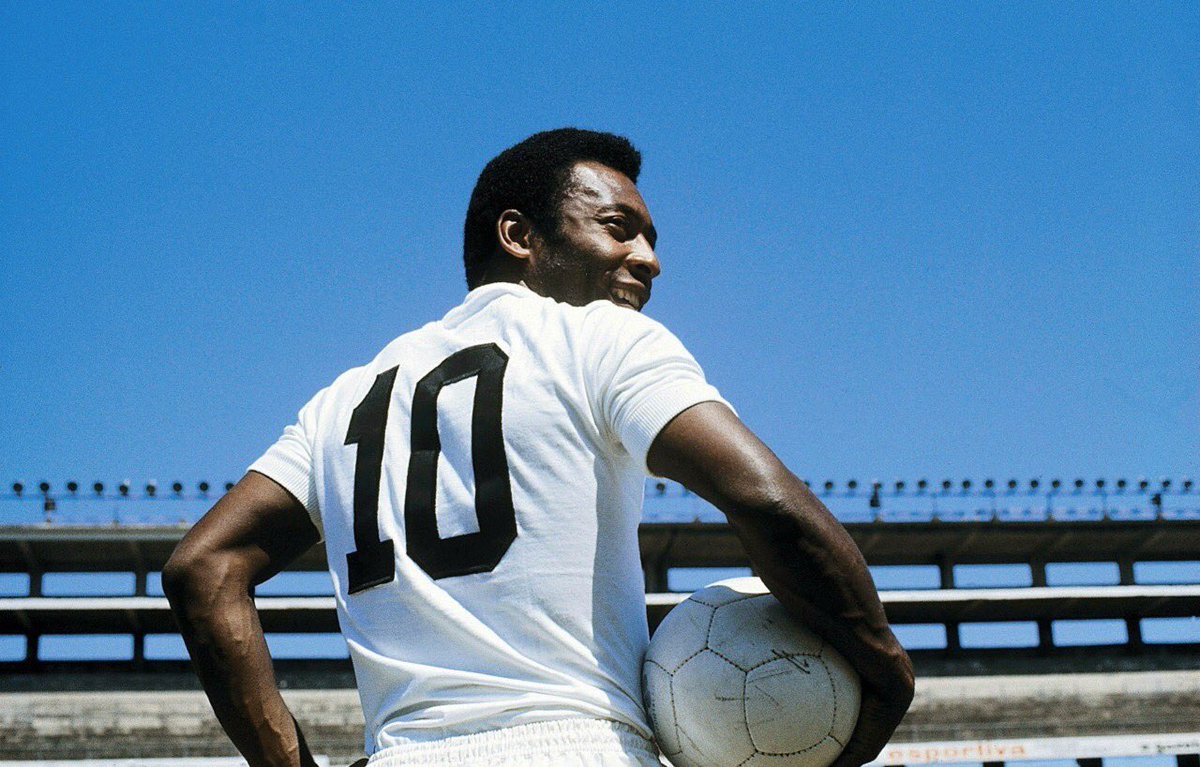
10 Pelé of Brazil. Starred for Santos in his homeland in the 1960s, and in the mid-1970s dragged America kicking and screaming (for joy) into the soccer world with the New York Cosmos. The only man to play on 3 World Cup winners.

There are, of course, people who would have preferred that I select Ferenc Puskás, Denis Law, Diego Maradona, Dennis Bergkamp, Zinedine Zidane or Lionel Messi. Puskás, Zidane and Messi will show up on this list.

If you still doubt that Pelé is the greatest player ever, or at least the greatest ever to wear Number 10, take a look at the photo above. It was taken at his farewell match at the Meadowlands in 1977. And the other man in that picture, Muhammad Ali, still Heavyweight Champion of the World at the time, and a man who liked to call himself "the Greatest of All Time," said after seeing the spectacle, "Now I understand: He is greater than me."

11 Garrincha of Brazil. The legend of Rio de Janeiro club Botafogo wore it while starring in the 1958 World Cup. Was even more amazing in the 1962 World Cup, wearing 7.

12 Júlio César of Brazil. Now wrapping up his career with Portuguese giants Benfica, the goalie starred for Rio de Janeiro's Flamengo and Milan's Inter, wearing 12 with the latter, and in the last World Cup for Brazil.

13 Eusébio of Portugal. The Benfica star wore it in the 1966 World Cup. Usually wore 10.

14 Thierry Henry of France. Wore it for his club teams, but wore 12 for his national team and in his brief 2012 loan return to Arsenal. No doubt, some of you think I've forgotten somebody. Rest assured, the man you're thinking of is on this list.

15 Lilian Thuram of France. Starred for AS Monaco (Monaco is an independent nation, but so small of one that its club team competes in France's Ligue 1), Parma and Juventus. World Cup winner 1998.

16 Martin Peters of England. At a time when England didn't allow numbers past 11 (and then 12, once substitutions were legalized in 1966), he wasn't intended to be a starter for England's World Cup team in 1966. He ended up not only playing in the Final, but scoring. Usually wore 10 for West Ham United, Tottenham Hotspur and Norwich City.

17 Steven Gerrard of England. Wore it for Liverpool before switching to the more familiar 8. Usually wears 4 for England.

18 Lionel Messi of Argentina. The Barcelona star has long since switched to 10 for both club and country. Honorable mention to Doctor Sócrates, the Brazilian legend of the 1980s.

19 Ferenc Puskás of Hungary. "The Galloping Major" wore it while captaining his country to the Gold Medal at the 1952 Olympics. He usually wore 10 for his national team thereafter, having usually worn it for Budapest Honvéd, and later for Real Madrid.

20 Vavá of Brazil. Starred for Rio de Janeiro club Vasco da Gama and Spanish side Atlético Madrid. Scored the biggest goals in Brazil's 1958 World Cup win, and also played on the 1962 World Cup winners (having switched to 19). 

21 Zinedine Zidane of France. Wore it at Juventus, 5 at Real Madrid, 10 for his country. A tough call over AC Milan and Juventus legend Andrea Pirlo.

22 Kaká of Brazil. Wore 8 at São Paulo and Real Madrid, 22 at AC Milan. He has worn 8 and 10 for Brazil, and now wears 10 for MLS expansion team Orlando City.

23 Sol Campbell of England. Famously made the switch across North London from Tottenham Hotspur (switching from 23 to the more common centreback number of 5 by the end of his tenure there) to Arsenal (taking 31 on his brief return to the club after playing at Portsmouth, where he also wore 23). If you expected to see Manchester United legend David Beckham, who wore 23 for the Los Angeles Galaxy and AC Milan, he will show up later.

24 Tim Howard of America (North Brunswick, New Jersey). Always wears 1 for the national team, wore 14 at Manchester United, and has worn 24 for Liverpool-based Everton since 2006.

25 Gianfranco Zola of Italy. Starred for Napoli, Parma and Chelsea. Wore 21 for his country.

26 John Terry of England. Yes, he represents so much of what's wrong with the modern game (and wears 6 for his national team), but show me anyone else whose done more with 26 than Captain Cuckold has with Chelsea.

27 Nwankwo Kanu of Nigeria. Wore it at Portsmouth after wearing 14 at Ajax, 19 at Inter and 25 at Arsenal. Always wore 4 for his country.

28 Cristiano Ronaldo of Portugal. Wore it at Sporting Lisbon, but was given 7 upon his arrival at Manchester United, because manager Alex Ferguson wanted him to become the kind of legend who had worn it for the Salford club: George Best, Bryan Robson, Eric Cantona, David Beckham.

29 Rio Ferdinand of England. Wore it at Leeds United before getting poached by Manchester United and switching to 5.

30 Johan Cruijff of the Netherlands. Aside from Pelé and Maradona with 10, no footballer is more identified with a single number than Cruijff (whose name is frequently, but incorrectly, spelled "Cruyff") is with the 14 he wore in his best years at Ajax, in the NASL with the Los Angeles Aztecs and the Washington Diplomats, and with the Dutch national team. But he wore 9 at Barcelona, and wore 30 in a friendly with the New York Cosmos in 1978. He played in only 1 other game for the Cosmos, another friendly that year, and wore 16.

True, he never played a competitive match wearing 30. But who else are you going to pick for the number -- Obafemi Martins?

31 George Weah of Liberia. Normally a 9, wore 31 for Chelsea.

32 David Beckham of England. The Manchester United and Real Madrid legend wore it with AC Milan.

33 Alex (Rodrigo Dias da Costa) of Brazil. Wears it for AC Milan, after also wearing it for Chelsea.

34 Nigel de Jong of the Netherlands. Wears it at AC Milan, after also wearing it at Manchester City. Usually wears 8 for his country, but has also worn 6 and 17 in international tournaments.

35 Viktor Genev of Bulgaria. Was a star by his home country's standards. Now plays in Scotland for St. Mirren.

36 Matteo Darmian of Italy. Wore it for Sicilian side Palermo.

37 Jari Litmanen of Finland. Wore it at Liverpool, after usually wearing 10 with clubs like Ajax and Barcelona.

38 Sinan Bolat of Turkey. Wears it for Istanbul giants Galatasaray.

39 Nicolas Anelka of France. Wore 9 at Arsenal, but whenever he wears out his welcome at a club (which is usually soon to happen), "Le Sulk" goes to one where 9 is occupied, so he takes 39. Has worn 8, 9 and 21 for France.

40 Henrique Hilário of Portugal. Wore it with Chelsea.

41 Jérôme Agyenim Boateng of Germany. Wore it at the start of his career, for hometown club Hertha Berlin. Now better known for wearing 17.

42 Yaya Toure of the Ivory Coast.

43 Julian Dicks of England.

44 Massimo Oddo of Italy. Wore it for AC Milan, although switched to 17 -- which is usually considered a bad-luck number in Italy.

45 Mario Balotelli of Italy. Has worn it for both Milan clubs, Manchester City, and now Liverpool, but usually wears 9 for his country.

46 Salvator Sirigu of Italy. Wore it for Palermo.

47 Andrea Consigli of Italy. Wears it for Sassuolo.

48 Salih Uçan of Turkey. Wears it for Istanbul giants Fenerbahçe, and also in his current loan spell at AS Roma.

49 Muhammed Demirci of Turkey. Wears it for Istanbul side Beşiktaş.

50 Michele Somma of Italy. Wears it for Empoli, on loan from AS Roma.

51 Mauricio Pinilla of Chile. Has worn in for several Italian clubs, currently Genoa (but on loan to Atalanta).

52 Emre Çolak of Turkey. Wears it for Istanbul giants Galatasaray.

53 Serdar Kesimal of Turkey. Wears it for Fenerbahçe.

54 Isaac Donkor of Ghana. Wears it for Inter.

55 Yuto Nagatomo of Japan. Wears it for Inter. Wears 5 for his country.

56 Nico Pulzetti of Italy. Plays for Bologna.

57 Cesc Fabregas of Spain. Wore it in his 1st season for Arsenal, 2003-04, before switching to 15 the next season and 4 in 2006-07. Kept 4 when he betrayed the club and went to Barcelona, and now Chelsea.

58 Gedion Zelalem of America (born in Germany of Ethiopian parents, but grew up in the Washington, D.C. area and will play for the U.S. team). Wore it once for Arsenal, and has now switched to 35. (UPDATE: In 2020, he wears 23 for New York City FC.)

59 Couldn't find one worth posting.

60 Jeff Parke of America (the Philadelphia area). Wore it with the New York Red Bulls in 2008.

61 Konstantinos Kotsaris of Greece. Wears it for Athens giants Panathinaikos.

62 Couldn't find one worth posting. (UPDATE: Michael Amir Murillo of Panama began wearing it for the Red Bulls in 2017. He wears 2 for his national team.)

63 Couldn't find one worth posting.

64 Couldn't find one worth posting. (UPDATE: Sergi Canos made 1 appearance for Liverpool, in 2016, wearing 64.)

65 Couldn't find one worth posting. (UPDATE: Michael Baldisimo, a midfielder born in 2000, began wearing it in 2018, for his hometown team, the Vancouver Whitecaps.)

66 Giampiero Pinzi of Italy. Wears it for Udinese.

67 Eray İşcan of Turkey. Wears it for Galatasaray.

68 Andrea Fulignati of Italy. Wears it for Palermo.

69 Bixente Lizarazu of France. Wore it at Bayern Munich in 2005. No, it doesn't refer to anything naughty: He was born in 1969, stood 169 centimeters tall, and weighed 69 kilograms, so he considered it his lucky number.

70 Ainsley Maitland-Niles of England. Hasn't yet done much, for Arsenal or any other club, but he's played (and worn the number) in a UEFA Champions League match, which is more than I can say for the only other Number 70 I could find, Stefano Sorrentino of Italy, a backup goalie who wears it for Palermo. (UPDATE: In 2018, AMN began wearing 15 for Arsenal.)

71 Diego Serna of Colombia. Wore it with the New York/New Jersey MetroStars (now the New York Red Bulls) in 2002.

72 Josip Iličić of Slovenia. Wore it for Palermo, and now wears it for Fiorentina.

73 Stefan O'Connor of England. Hasn't yet done much, for Arsenal or any other club, but he's played (and worn the number) in a UEFA Champions League match, which is more than I can say for any other Number 73 I could find.

74 Mohamed Salah of Egypt. Signed to Chelsea, but on loan to Fiorentina, with whom he wears it.

75 Couldn't find one worth posting. (UPDATE: In 2018, Wan Kuzain of Carbondale, Illinois wore began wearing it for Sporting Kansas City.)

76 Andriy Shevchenko of Ukraine. Wore the last 2 digits of his birth year at AC Milan because his usual 10 wasn't available. Wearing your birth year as a uniform number is going to become less common once we have players born in 2000 or later, and it won't be long now.

77 Gianluigi Buffon of Italy. One of the greatest goalies ever, wore it at Juventus in the 1999-2000 season.

78 Aurélien Collin of France. The MLS All-Star wore it for Sporting Kansas City, and will now wear it for expansion Orlando City.

79 Gianluca Pegolo of Italy. Wears it for Sassuolo.

80 Ronaldinho of Brazil. Wore his birth year at AC Milan because his usual 10 wasn't available. 

81 Cristian Zaccardo of Italy. The AC Milan player wears his birth year, but wore 2 for his country.

82 Alexandre Geijo of Spain. Wears his birth year for Udinese.

83 Antonio Miranti of Italy. Wears his birth year for Parma.

84 Clint Mathis of America (the Atlanta area). Wore it with the Los Angeles Galaxy from 1998 to 2000, and again in 2010. Usually wore 13, including with the Red Bulls.

85 Diego Novaretti of Italy. Wears his birth year for Rome club SS Lazio.

86 Fabrizio Cacciatore of Italy. Wears his birth year for Genoa side Sampdoria.

87 Ervin Zukanović of Bosnia and Herzegovina. Plays for Chievo Verona, on loan from Belgian club KAA Gent. Wears his birth year. 

88 Hernanes of Brazil. Wore 8 at São Paulo and Rome club Lazio, but wears 88 at Inter.

89 Guido Marilung of Italy. Plays for Cesena, on loan from Atalanta. Wears his birth year. 

90 Duje Čop of Croatia. On loan from Dinamo Zagreb to Cagliari, where he wears his birth year. 

91 Xherdan Shaqiri of Switzerland. Wears 11 for his country, and also wore it for Bayern. Now wears 91 for Inter.

92 Stephan El Shaarawy of Italy. The Egyptian-descended "Il Faraone" (The Pharoah) of AC Milan wears his birth year. Wears 14 for Italy.

93 Octávio of Brazil. The Botafogo prospect is on loan to Fiorentina this season, and wears his birth year.

94 Jimmy Medranda of Colombia. Wears his birth year for Sporting Kansas City.

95 Alberto Grassi of Italy. Wears his birth year for Atalanta.

96 Andrea Palazzi of Italy. The Inter starlet wears his birth year.

97 Federico Bonazzoli of Italy. The Sampdoria player, currently on loan with Inter, also wears his birth year.

98 Hachim Mastour of Italy. The AC Milan starlet wears his birth year.

99 Ronaldo of Brazil (a.k.a. "The Real Ronaldo" or "Fat Ronaldo" since Cristiano became a star). Wore it at AC Milan because his usual 9 wasn't available.

There have been players who've worn triple-digit numbers, usually as a one-time-only publicity stunt. Mexico, in particular, has seen a few of these worn regularly, as they have no numerical restrictions.

Of these 96 players, 78 are still alive. (UPDATE: Through the start of the 2020-21 season, 76 are.)

Sunday, May 18, 2014

List of FA Cup-Winning Goalscorers

These men scored the goals that won FA Cup Finals.

Year, name, club (location, if club has not already been mentioned), uniform number (or the number that would have corresponded to his position prior to 1930), minute of the game.

1872 Morton Betts, Wanderers (London), 7, 15th
1873 Arthur Kinnaird, Wanderers, 10, 27th
1874 Charles Mackarness, Oxford University, 2, 10th
1875 William Stafford, Royal Engineers, 8, time of goal unknown
1876 Charles Wollaston, Wanderers, 6, 30th
1877 William Lindsay, Wanderers, 3, 86th
1878 Arthur Kinnaird, Wanderers, 4, 35th
1879 Charles Clerke, Old Etonians (Eton, Berkshire), 6, 59th

1880 Clopton Lloyd-Jones, Clapham Rovers (London), 11, time unknown
1881 Edwards Wynyard, Old Carthusians (Godalming, Surrey), 9, time unknown
1882 Reginald Macaulay, Old Etonians, 8, 8th
1883 Jimmy Costley, Blackburn Olympic (Lancashire), 10, time unknown but was in extra time
1884 Jimmy Forest, Blackburn Rovers, 5, approximately 35th
1885 Jimmy Forest, Blackburn Rovers, 6, time unknown
1886 Joe Sowerbutts (his real name), Blackburn Rovers, 9, time unknown
1887 Archie Hunter, Aston Villa (Birmingham), 9, time unknown
1888 Jem Bayliss, West Bromwich Albion (West Midlands), 9, time unknown
1889 Fred Dewhurst, Preston North End (Lancashire), 10, 15th

1890 Nat Walton, Blackburn Rovers, 10, 10th
1891 Jack Southworth, Blackburn Rovers, 9 time unknown
1892 Jasper Geddes, West Bromwich Albion, 10, time unknown
1893 Harry Allen, Wolverhampton Wanderers (West Midlands), 5, 60th
1894 James Logan, Notts County (Nottingham), 9, time unknown
1895 Bob Chatt, Aston Villa, 8, 1st (30 seconds)
1896 Fred Spiksley, Sheffield Wednesday (Yorkshire), 11, 18th
1897 Jimmy Crabtree, Aston Villa, 6, 44th
1898 Arthur Capes, Nottingham Forest, 10, 42nd
1899 Billy Beer, Sheffield United, 8, 65th

1900 Jasper McLuckie, Bury (Lancashire, now in Greater Manchester), 9, 9th
1901 Tom Smith, Tottenham Hotspur (Middlesex, didn't get put in London until 1965), 7, 76th
1902 Billy Barnes, Sheffield United (Yorkshire), 7, 79th
1903 George Ross, Bury (Lancashire, now in Greater Manchester), 6, 20th
1904 Billy Meredith, Manchester City (Lancashire, now in Greater Manchester), 7, 23rd
1905 Harry Hampton, Aston Villa, 9, 2nd
1906 Sandy Young, Everton (Lancashire, now in Merseyside), 9, 77th
1907 George Simpson, Sheffield Wednesday, 11, 86th
1908 George Hedley, Wolverhampton Wanderers, 9, 43rd
1909 Sandy Turnbull, Manchester United (Lancashire, now in Greater Manchester), 10, 22nd

1910 Albert Shepherd, Newcastle United (Northumberland, now in Tyne and Wear), 9, 52nd
1911 Jimmy Speirs, Bradford City (Yorkshire), 8, 15th
1912 Harry Tufnell, Barnsley (Yorkshire), 8, 118th (ET)
1913 Tommy Barber, Aston Villa, 4, 78th
1914 Bert Freeman, Burnley (Lancashire), 9, 57th
1915 James Simmons, Sheffield United, 7, 36th
1916 Canceled due to World War I
1917 Canceled due to World War I
1918 Canceled due to World War I
1919 Canceled due to World War I

1920 Billy Kirton, Aston Villa, 8, 100th (ET)
1921 Jimmy Dimmock, Tottenham Hotspur, 11, 53rd
1922 Billy Smith, Huddersfield Town (Yorkshire), 11, 67th (penalty)
1923 David Jack (futuer Arsenal star), Bolton Wanderers, 8, 2nd
1924 Neil Harris (not the actor), Newcastle United, 9, 83rd
1925 Fred Tunstall, Sheffield United, 11, 30th
1926 David Jack, Bolton Wanderers, 9, 76th
1927 Hughie Ferguson, Cardiff City (Wales), 9 74th
1928 Tommy McLean, Blackburn Rovers, 10, 22nd
1929 Billy Butler, Bolton Wanderers, 7, 79th

1930 Alex James, Arsenal (London), 10, 16th
1931 W.G. Richardson, West Bromwich Albion, 9, 58th
1932 Jack Allen, Newcastle United, 9, 72nd
1933 Jimmy Stein, Everton, 11, 41st
1934 Fred Tilson, Manchester City, 11, 74th
1935 Ellis Rimmer, Sheffield Wednesday, 11, 85th
1936 Ted Drake, Arsenal, 9, 74th
1937 Raich Carter, Sunderland, 8, 72nd
1938 George Mutch, Preston North End, 8, 119th (ET, penalty)
1939 John Anderson, Portsmouth, 9, 43rd

1940 Canceled due to World War II
1941 Canceled due to World War II
1942 Canceled due to World War II
1943 Canceled due to World War II
1944 Canceled due to World War II
1945 Canceled due to World War II
1946 Peter Doherty, Derby County, 10, 92nd (ET)
1947 Chris Duffy, Charlton Athletic (London), 11, 114th (ET)
1948 Stan Pearson, Manchester United, 10, 80th
1949 Jessie Pye, Wolverhampton Wanderers, 9, 42nd

1950 Reg Lewis, Arsenal, 10, 18th
1951 Jackie Milburn, Newcastle United, 9, 40th
1952 George Robledo, Newcastle United, 84th
1953 Bill Perry Blackpool, 11, 92nd
1954 Frank Griffin, West Bromwich Albion, 7, 87th
1955 Bobby Mitchell, Newcastle United, 11, 52nd
1956 Bobby Johnstone, Manchester City, 7, 62nd
1957 Peter McParland, Aston Villa, 11, 73rd
1958 Nat Lofthouse, Bolton Wanderers, 9, 3rd
1959 Tommy Wilson, Nottingham Forest, 9, 14th

1960 Mick McGrath, Blackburn Rovers, 6, 41st, own goal to Wolverhampton Wanderers
1961 Bobby Smith, Tottenham Hotspur, 9, 66th
1962 Bobby Smith, Tottenham Hotspur, 9, 51st
1963 David Herd (former Arsenal star), Manchester United, 9, 57th
1964 Ronnie Boyce, West Ham United (London), 8, 90th
1965 Ian St. John, Liverpool, 9, 113th (ET)
1966 Derek Temple, Everton, 11, 74th
1967 Frank Saul, Tottenham Hotspur, 11, 67th
1968 Jeff Astle, West Bromwich Albion, 9, 93rd (ET)
1969 Neil Young (not the singer), Manchester City, 10, 24th

1970 David Webb, Chelsea (London), 6, 104th (ET)
1971 Charlie George, Arsenal, 11, 111th (ET)
1972 Allen Clarke, Leeds United (Yorkshire), 8, 53rd
1973 Ian Porterfield, Sunderland, 10, 51st
1974 Kevin Keegan, Liverpool, 7, 57th
1975 Alan Taylor, West Ham United, 9, 60th
1976 Bobby Stokes, Southampton, 11, 83rd
1977 Jimmy Greenhoff, Manchester United, 8, 55th
1978 Roger Osborne, Ipswich Town, 7, 77th
1979 Alan Sunderland, Arsenal, 8, 89th

1980 Trevor Brooking, West Ham United, 10, 13th
1981 Ricky Villa, Tottenham Hotspur, 5, 76th
1982 Glenn Hoddle, Tottenham Hotspur, 10, 6th (penalty)
1983 Bryan Robson, Manchester United, 7, 25th
1984 Graeme Sharp, Everton, 9, 38th
1985 Norman Whiteside, Manchester United, 4, 110th (ET)
1986 Craig Johnston, Liverpool, 8, 62nd
1987 Gary Mabbutt, Tottenham Hotspur, 6, 95th (ET), own goal to Coventry City (West Midlands)
1988 Lawrie Sanchez, Wimbledon (London), 10, 37th
1989 Ian Rush, Liverpool, 14 (usually 9), 104th

1990 Lee Martin, Manchester United, 3, 59th
1991 Des Walker, Nottingham Forest, 4, 94th (ET), own goal to Tottenham Hotspur
1992 Michael Thomas (former Arsenal star), Liverpool, 11, 47th
1993 Andy Linighan, Arsenal, 5, 119th (ET)
1994 Eric Cantona, Manchester United, 7, 60th (penalty)
1995 Paul Rideout, Everton, 15, 30th
1996 Eric Cantona, Manchester United, 7, 85th
1997 Roberto Di Matteo, Chelsea, 16, 1 (42 seconds)
1998 Marc Overmars, Arsenal, 11, 23rd
1999 Teddy Sheringham, Manchester United, 10, 11th

2000 Roberto Di Matteo, Chelsea, 16, 73rd
2001 Michael Owen, Liverpool, 10, 88th
2002 Ray Parlour, Arsenal, 15, 70th
2003 Robert Pires, Arsenal, 7, 38th
2004 Cristiano Ronaldo, Manchester United, 7, 44th
2005 Patrick Vieira, Arsenal, 4, penalties
2006 John Arne Riise, Liverpool, 6, penalties
2007 Didier Drogba, Chelsea, 11, 116th (ET)
2008 Nwankwo Kanu (former Arsenal star), Portsmouth, 27 (previously 25), 37th
2009 Frank Lampard, Chelsea, 8, 72nd

2010 Didier Drogba, Chelsea, 11, 59th
2011 Yaya Toure, Manchester City, 42, 74th
2012 Didier Drogba, Chelsea, 11, 52nd
2013 Ben Watson, Wigan Athletic (Greater Manchester), 91st (stoppage time)
2014 Aaron Ramsey, Arsenal, 16, 109th (ET)

Done it twice: 7 men, most recently Didier Drogba.
Done it 3 times: Drogba.
Fastest: Bob Chatt, 30 or so seconds.
Did it to his own team with an own goal: Mick McGrath, Gary Mabbutt, Des Walker.
Latest in regular time: Ben Watson, 91st minute.
Did it in extra time: 16 men, most recently Aaron Ramsey.
Latest in extra time: George Mutch and Andy Linighan, 119th minute.
Did it with an in-game penalty: 4 men, most recently Eric Cantona.
Did it during postgame penalties: Patrick Vieira, John Arne Riise.

In 2009, Louis Saha of Everton scored 25 seconds into the game, the fastest FA Cup Final goal ever, but Everton went on to lose the game.

Squad numbers were assigned to positions until 1993. The highest number allowed was 11 until substitutes were allowed starting in the 1966-67 season, then 12 until 1986-87, then 14 with the allowance of a second sub, until 1993. The highest number yet worn in an FA Cup Final is 45, by Mario Balotelli of Manchester City in 2011. Yaya Toure's 42 worn in the same game would have broken the record had Balotelli not played.

Thursday, May 15, 2014

10 Years After Arsenal's Invincibles: Where Are They Now?

May 15, 2004, 10 years ago today: Arsenal defeat Leicester City, 2-1 at Highbury, and complete an undefeated Premier League season.

Only once before had an English team gone through an entire top-flight season without a League loss: Preston North End, in the 1st Football League season, 1888-89. And that was a season of 22 games. Arsenal in 2003-04? As the announcer on that day's broadcast, Jon Champion, said at the final whistle, "Played 38, won 26, drawn 12, lost exactly none!"

The season before, Arsenal manager Arsène Wenger was mocked for saying he dreamed of going an entire League season unbeaten. When it didn't happen, oh, how the English media and fans of other teams laughed at him. But a year later, in 2003-04, he did it. No other manager has.

Like those Preston pioneers, the 2003-04 Gunners became known as "The Invincibles." Their League unbeaten streak, which began late the preceding season, would stretch into the first quarter of the next season, reaching 49 games. The old record of 42 was set by Nottingham Forest in 1977-78.

Where are they now?

1 GK (Goalkeeper) Jens Lehmann, Essen, Germany: Left for Stuttgart in 2008, playing 2 seasons, then retired. Came back to Arsenal as an emergency goalkeeper after all of the keepers they had on their roster got hurt, except for the man who had succeeded Mad Jens as starting goalie: Manuel Almunia -- who, by that point, was so bad that Gooners were calling him "The Clown." Was 41 years old, missing by 8 days becoming the club's oldest player ever. (Jock Rutherford, a winger, was the oldest, in 1926.)

Now 44 and retired for good, he does a lot of charity work.

3 LB (Left Back) Ashley Cole, Stepney, East London, England (of Afro-Caribbean descent): Controversially began the process of leaving Arsenal when he felt insulted by a lowball contract offer, he was transferred to Chelsea early in the 2006-07 season, and was even more successful with them than with Arsenal. Now 33, was just left off England's World Cup roster, and is rumored to be leaving Chelsea as well.

(UPDATE: Signed with Italian capital side AS Roma, moved on to the Los Angeles Galaxy, and in 2019 played for Derby County.)

4 MF (Midfielder) Patrick Vieira, Dakar, Senegal by way of Dreux, France: Had hinted that he wanted to leave for another club for a couple of years, but stuck with Arsenal through 2005. His last acts as a Gunner were to convert the final penalty in the 2005 FA Cup, and then raise the Cup as the winning Captain. Played 5 seasons in Italy: 1 at Juventus of Turin, 4 at Internazionale of Milan. Closed his career with a season back in England at Manchester City.

About to turn 38, he now coaches Man City's reserves. (UPDATE: Later managed of Man City's MLS farm club, New York City FC, and is now back in France as manager of OGC Nice.)

5 CB (Centreback) Martin Keown, Oxford, England: Left at the end of the season. Played 1 more season, with Leicester City and Reading. About to turn 48, now back at Arsenal as a coach, and is a pundit on BBC and Ireland's TV3.

7 MF Robert Pirès, Reims, France (by ancestry, half-Spanish and half-Portuguese): Remained with Arsenal through 2006. Played 4 seasons in Spain for Villareal, and 1 more in England for Birmingham club Aston Villa.

Now 40, Super Rob is involved with several charities, including playing in charity matches. (UPDATE: He came out of retirement to play 2 seasons in the fledgling Indian Super League, for FC Goa. Has since resumed training with Arsenal, giving rise to a rumor that he may move into a coaching capacity with them.)

8 MF Freddie Ljungberg, Vittsjö, Sweden: Remained with Arsenal through 2007, then moved to East London club West Ham United for a season. Played 2 years with the Seattle Sounders, and, in a game away to the New York Red Bulls, became the 1st former Arsenal player I ever saw live. Which, as Freddie the Red himself would say, in his lightly accented but superbly-grasped English, was "fuckin' excellent!" Briefly played for the Chicago Fire, in Scotland for Celtic, and in Japan for Shimizu S-Pulse.

Now 37, is rumored to be coming out of retirement to play in a new league in India. (UPDATE: He and Pires both did so, but injuries limited Freddie to 4 games for Mumbai City, at which point he retired again.)

9 FW (Forward) Jose Antonio Reyes, Utrera, Spain: Like his namesake, former Met shortstop Jose Reyes, ended up a great disappointment. Also like that other Jose Reyes, it was in part due to his own attitude. Arsenal loaned him to Real Madrid in 2006, and sold him to Atletico Madrid a year later. He was on their books for 4 years, but that included a season in Lisbon, Portugal with Benfica.

Now 30, just concluded a season back at his original club, Sevilla, in his native Spain, in which they won the Europa League. (UPDATE: In 2019, plays for Extremadura UD in Spain's 2nd division.)

10 FW Dennis Bergkamp, Amsterdam, the Netherlands: Stayed with Arsenal through 2006 and retired. His testimonial match was the 1st event at the Emirates Stadium when it opened that summer. Now 45, the Dutch Master -- known to many Arsenal fans as God, leading to the lines, "Praise Dennis" and "Dennis, save us" -- is back at his former club, Ajax Amsterdam, as assistant manager to former teammate Frank DeBoer. Has often been rumored to be a successor to Wenger as Arsenal manager. (UPDATE: That didn't happen.)

11 MF Sylvain Wiltord, Neully-sur-Mar, France (of Afro-Caribbean descent): Left Arsenal after the season, playing 8 more seasons in France. Now 40, he is retired.

12 RB (Right Back) Lauren Etame Mayer (like #s 17 & 19 on this list, usually known only by his first name), Kribi, Cameroon by way of Sevilla, Spain: Remained with Arsenal through 2006, playing 3 more seasons in England with Portsmouth and 1 in Spain with Cordoba. Now 37, he has been a pundit on various TV networks.

14 FW Thierry Henry, Les Ulis, France (of Afro-Caribbean descent): Remained with Arsenal through 2007, succeeding Vieira as Captain for 2 years. Moved on to Barcelona, and since 2010 has been the face of the New York Red Bulls -- indeed, of the entire MLS.

Now 35, Titi is no longer the best player in the world, but he's still got it. (UPDATE: Retired after the 2014 season, is now studying to become a coach, and is a pundit on Sky Sports.)

15 MF Ray Parlour, Romford, East London: Left Arsenal after the season. Played 3 seasons with Middlesbrough and Hull City before retiring. Now 41, "the Romford Pelé" is a pundit on the BBC and Radio 5 Live.

17 MF Edu Gaspar, São Paulo, Brazil: Played 1 more season with Arsenal, 4 in Spain with Valencia, and 1 back in Brazil with his original club, São Paulo-based Corinthians. Now 36, he is on temporary leave as that club's director of football, so that he can assist Portuguese star Carlos Quieroz with the Iran national team at the World Cup. (UPDATE: He is now the general coordinator of the Brazil national team.)

18 CB Pascal Cygan, Lens, France: Generally considered the prototype for the "bad Arsenal player who wears the Number 18 shirt," followed by Mikael Silvestre and Sebastien Squillaci. (UPDATE: Nacho Monreal appears to have shattered that jinx.) He still managed to play on the Invincibles, 2 FA Cup winners, and a team that reached the 2006 Champions League Final.

After that Final, joined Pires at Villareal, and after 3 years closed his career at another Spanish club, Cartagena. Now 40, he is out of the game.

19 MF Gilberto Silva, Lagoa da Prata, Brazil: Stayed with Arsenal through 2008. Joined Greek powerhouse Panatinaikos for 3 years, then closed his career back in Brazil with Gremio and Atletico Mineiro, closing his career by (along with the great Ronaldinho) leading them to the Copa Libertadores, South America's equivalent of the European Cup/Champions League.

Now 37, he is not signed to any team, but has not officially retired. (UPDATE: He officially retired in October 2015. As of March 2016, he was not employed with any club.)

22 LB Gaël Clichy, Toulouse, France  (of Afro-Caribbean descent): The youngest and longest-lasting of the players who received a Premier League medal, stayed with Arsenal through 2011, going to Manchester City. Only 28 going on 29, but has barely played for them in their 2012 and 2014 Premier League title wins.

23 CB Sol Campbell, Plaistow, East London (of Afro-Caribbean descent): Remained with Arsenal through 2006. Went to Portsmouth for 3 seasons. Played 1 game for Notts County, made a brief 11-game return to Arsenal, and closed his career with 7 games for Newcastle United.

Now 39, he is not currently involved in the game. (UPDATE: He has gone into politics, and was an unsuccessful candidate for the Conservative Party's nomination for Mayor of London in 2016. He now manages Macclesfield Town in England's 4th division, known as League Two.)

25 FW Nwankwo Kanu, Owerri, Nigeria: Left Arsenal after the season. Stayed 8 more years in England with West Bromwich Albion and Portsmouth. Now 37, he is retired from the game, runs a TV sports network in Nigiera, and is an ambassador for UNICEF.

27 CB Efstathios Tavlaridis, Serres, Greece. Only played in 3 League Cup matches, didn't get a PL winner's medal. Loaned to French club Lille after Arsenal lost the League Cup Semifinal to Middlesbrough, then signed with them and stayed 3 seasons. Now 34, he plays back in Greece for Athens giants Panathinaikos.

28 CB Kolo Touré, Bouaké, Ivory Coast. Stayed with Arsenal through 2009. Played 4 seasons with Manchester City, including alongside his brother Yaya, helping them win the 2011 FA Cup and the 2012 League title. Now 33, he rejuvenated his career this past season with Liverpool. (UPDATE: He closed his playing career with Celtic FC in Glasgow, where Brendan Rodgers was manager. He joined Rodgers' coaching staff, and has followed him to Leicester City.)

30 FW Jérémie Aliadière, Ramboulliet, France: Stayed with Arsenal through 2007, despite loans to Celtic, West Ham United and Wolverhampton Wanderers. Played 3 seasons at Middlesbrough, then returned to France in 2011, with Lorient. Now 31, still plays for them. (UPDATE: He is now retired.)

None of the players listed hereafter made enough Premier League appearances to qualify for a winner's medal.

32 FW Michal Papadopulos, Ostrava, Czech Republic (but of Greek descent): Made just 1 appearance, in the League Cup, as he was on loan from hometown club Banik Ostrava. Now 29, he is with Polish side Zagłębie Lubin, and has never played in Britain again. (UPDATE: He now plays for Polish team Piast Gliwice.)

33 GK Graham Stack, Hampstead, North London (a son of Irish parents, and thus played internationally for the Republic of Ireland): Made 5 League Cup appearances. First Arsenal, and then Reading, loaned him out to several England clubs.

Now 32, has spent the last 2 seasons as the starting goalie for North London club Barnet, who were just relegated out of the Football League to the Conference, the 5th division -- but that's hardly his fault. (UPDATE: He is now on the coaching staff at Hertfordshire team Watford.)

37 MF David Bentley, Peterborough, Cambridgeshire, England: Officially, stayed with Arsenal through 2006, but never lived up to his promise. Was loaned out to Norwich City and Blackburn Rovers before joining Blackburn on a permanent basis. Played 3 seasons for Tottenham, resulting in Arsenal fans serenading him with "Arsenal reject!"

It got worse: That other North London club also got tired of his bad attitude, and continually loaned him out: To Birmingham City, West Ham, Russian club Rostov, and back to Blackburn. So, when those teams (except Rostov, who never came) played at the Emirates, he was serenaded with "Tottenham reject!" (Is that the lowest?)

Now 29, no one seems to want him. What a spectacular failure. (UPDATE: He has officially retired, and runs a restaurant in Marbella, on Spain's Costa del Sol. He has said, "Certain people are built for the life of a footballer, but I don't think I was. I had the tools, but I don't think I had that."

45 RB Justin Hoyte, Leytonstone, North London (of Afro-Caribbean descent): Made 2 League Cup appearances. Stayed with Arsenal through 2008, then spent 5 seasons with Middlesbrough. Now 29, he is with Millwall. His brother Gavin, 6 years younger, also played for Arsenal, but only made 1 senior appearance, and is now with Dagenham & Redbridge. Both brothers played their international football for Trinidad & Tobago. (UPDATE: Justin now plays for MLS expansion team FC Cincinnati, while Gavin is back with D&R.)

51 RB Frank Simek, St. Louis, Missouri (of Czech descent). The 1st North American ever to play for Arsenal in the club's 117-year history (to that point), he made his debut in the League Cup against Wolverhampton Wanderers on December 2, 2003. It turned out to be his only senior appearance for the club.

He was loaned out to fellow Londoners Queens Park Rangers and South Coast club Bournemouth. He played 5 seasons for Yorkshire club Sheffield Wednesday and 3 for Cumbrian club Carlisle United. Now 29, he is a free agent. (UPDATE: Has broken more ground for an American athlete: The 1st one to play in Vietnam, at Sông Lam Nghệ An.)

52 FW John Spicer, Romford, East London: While Parlour came from that neighborhood and played 14 seasons with Arsenal at the senior level, Spicer made just 1 League Cup appearance, and bounced around England for the next 9 years. Now 30, he is a free agent. (UPDATE: He is retired.)

53 MF Jerome Thomas, Wembley, West London (of Afro-Caribbean descent): Made 2 League Cup appearances, and ended up loaned out, before being sold to South London club Charlton Athletic, and made his mark there and at Hampshire club Portsmouth. Now 31, played for South London club Crystal Palace this season. (UPDATE: Injuries forced him into retirement in 2017.)

54 MF Quincy Owusu-Abeyie, Amsterdam, the Netherlands (to parents from Ghana, and has played for their national team): Made 2 League Cup appearances. Stayed with Arsenal through 2006, before being sold to Russian giants Spartak Moscow. Now 28, he is a free agent, last playing a season ago for Panathinaikos. (UPDATE: After 2 seasons in Portugal, he is currently a free agent again.)

55 MF Ólafur Ingi Skúlason, Reykjavik, Iceland: Made just 1 League Cup appearance, then bounced around Britain. Now 31, plays for Belgian club Zulte Wargarem. (UPDATE: He is back with his original team, Fylkir of Reykjavik.)

56 FW Ryan Smith, Islington, North London (of Afro-Caribbean descent): Despite coming from Arsenal's home neighborhood, he never got past the League Cup. Played in MLS for Sporting Kansas City and Chivas USA. Now 27, he is a free agent. (UPDATE: Like Spicer, He is not listed as retired, but hasn't played since 2013.)

57 MF Cesc Fabregas, Barcelona, Spain: Only played in League Cup matches in 2003-04, but was a regular reserve the next season, and started the FA Cup Final, getting a winner's medal. Wenger sold Vieira, essentially to build a team around Fabregas, and it was then that Arsenal's trophy drought began.

Arsenal reached the 2006 CL Final with Fabregas' considerable contributions, but despite occasional spectacular goals and moves, his tenure at Arsenal was a monumental failure. He was a member of the Arsenal team that lost the 2007 League Cup Final, and his injuries cost Arsenal dearly in the 2008, 2009 and 2010 seasons. Within days of each other, he was injured for the 2011 League Cup Final which Arsenal lost, and backheeled a pass that his former club Barcelona was able to convert to a goal, knocking Arsenal out of the Champions League and giving rise to the perception that Cesc was a "double agent" for Barca.

He confirmed 2 years of rumors and tapping-up by his former club Barcelona by whining his way into a strike, with the aim of forcing a sale. He succeeded. In the 3 years since, Barca have won a La Liga title and a Copa del Rey, but also blew 2 Liga titles that they probably should have won, and have failed to reach the CL Final. Maybe Fabregas is a jinx. Certainly, he poisoned the atmosphere at Arsenal: Cesc Mustardgas.

Now, some Arsenal fans want him back. And who, exactly, would he replace in the lineup? Mesut Ozil? Aaron Ramsey? Santi Cazorla? Jack Wilshere? They're all better than Fabregas now. Mikel Arteta? Not really the same position. There's no room for him on the team -- and there shouldn't be any place in the club for someone who stabbed Arsene Wenger, and all Arsenal fans, in the back. The future that he promised turned out to be a mirage.

(UPDATE: Having worn out his welcome at Barca, he accepted a sale to Chelsea, whom he helped to his 1st Premier League title in 2015. So, 3 years after giving Arsenal fans a stab in the back, he gave them a slap in the face. He now plays for AS Monaco.)