In this case, I am making an exception to the rule of club over country, and finding out, as best I can -- we're talking, literally, about a whole world of players, going back to 1928 when numbers first appeared on English football shirts -- who was the best player ever to wear the number.
Especially in the era before squad numbers were set (1993 in England), players would be shifted in position, and would wear the number assigned to that position. So many great players, even since 1993, have worn more than one number. Nevertheless, it's one number to a player here. So Cristiano Ronaldo doesn't get to wear 7 and 17. In fact, he doesn't get to wear either.
0 Alex Stepney of England. The Manchester United goalkeeping legend wore it with the Dallas Tornado in 1979 and '80.
00 Steve Zerhusen of America (Baltimore). Wore it for the Fort Lauderdale Strikers in 1979 and '80.
1 Lev Yashin of Russia. The traditional goalkeeper's number goes to the man more often than any other called the best of all time. Starred in goal for Dynamo Moscow in both soccer and hockey for 20 years.
2 Cafu of Brazil. Starred at Right Back for São Paulo in Brazil, Real Zaragoza in Spain, and AS Roma and AC Milan in Italy, as well as Captaining Brazil to the 2002 World Cup.
3 Paolo Maldini of Italy. Wore it for AC Milan for 25 years.
4 Patrick Vieira of France. In 1998, won the League and the FA Cup -- The Double -- for Arsenal, and the World Cup for France. Won another Double in 2002. Was Captain of Arsenal's "Invincibles" in 2004. Nearly won another World Cup in 2006.
5 Franz Beckenbauer of Germany. Wore it in victorious Finals for 3 European Cups for Bayern Munich and a World Cup Final for West Germany.
6 Bobby Moore of England. Wore it in Finals in Wembley Stadium 3 straight years: The 1964 FA Cup and the 1965 European Cup Winners' Cup for West Ham United, and the 1966 World Cup for England.
7 Kenny Dalglish of Scotland. Those of you who are Manchester United fans will consider this blasphemy, but then, you also consider your Ferguson-era trophies to be fairly won. "King Kenny" is arguably the greatest player ever for 2 legendary British clubs: Glasgow's Celtic, and Liverpool.
8 Giuseppe Meazza of Italy. Starred for Internazionale Milano, and the stadium that "Inter" shares with AC Milan is named for him. Led Italy to victory in the 1934 and 1938 World Cups.
Yes, Liverpool fans, Steven Gerrard was considered for this list. No, he was never going to be chosen for this number.
9 Bobby Charlton of England. Unlike such previous English legends wearing the number, like Dixie Dean of Everton and Jackie Milburn of Newcastle United, the Manchester United legend wore it in the television era, including the 1966 World Cup win, and thus is more familiar with it.
Don't even think of putting Alan Shearer here. You may think of putting Alfredo Di Stéfano, Gianni Rivera, Marco van Basten or the Brazilian Ronaldo here, and Ronaldo will show up later on this list.
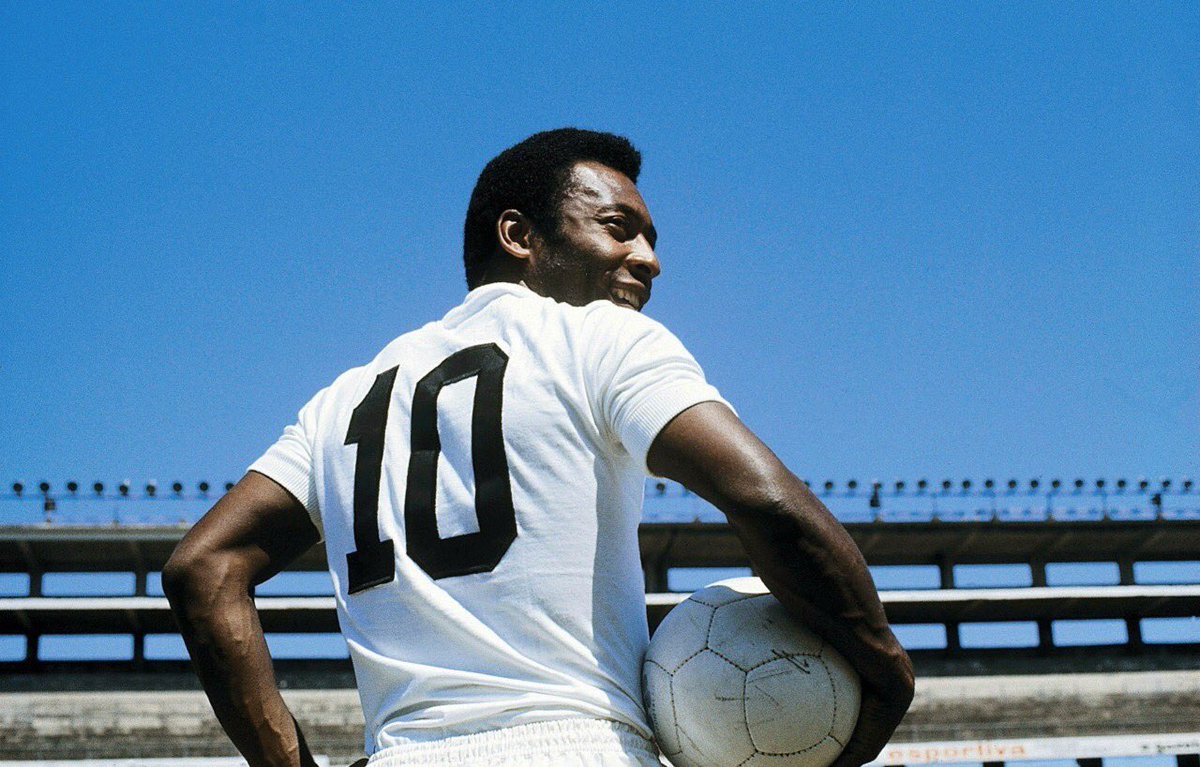
10 Pelé of Brazil. Starred for Santos in his homeland in the 1960s, and in the mid-1970s dragged America kicking and screaming (for joy) into the soccer world with the New York Cosmos. The only man to play on 3 World Cup winners.
There are, of course, people who would have preferred that I select Ferenc Puskás, Denis Law, Diego Maradona, Dennis Bergkamp, Zinedine Zidane or Lionel Messi. Puskás, Zidane and Messi will show up on this list.
If you still doubt that Pelé is the greatest player ever, or at least the greatest ever to wear Number 10, take a look at the photo above. It was taken at his farewell match at the Meadowlands in 1977. And the other man in that picture, Muhammad Ali, still Heavyweight Champion of the World at the time, and a man who liked to call himself "the Greatest of All Time," said after seeing the spectacle, "Now I understand: He is greater than me."
11 Garrincha of Brazil. The legend of Rio de Janeiro club Botafogo wore it while starring in the 1958 World Cup. Was even more amazing in the 1962 World Cup, wearing 7.
12 Júlio César of Brazil. Now wrapping up his career with Portuguese giants Benfica, the goalie starred for Rio de Janeiro's Flamengo and Milan's Inter, wearing 12 with the latter, and in the last World Cup for Brazil.
13 Eusébio of Portugal. The Benfica star wore it in the 1966 World Cup. Usually wore 10.
14 Thierry Henry of France. Wore it for his club teams, but wore 12 for his national team and in his brief 2012 loan return to Arsenal. No doubt, some of you think I've forgotten somebody. Rest assured, the man you're thinking of is on this list.
15 Lilian Thuram of France. Starred for AS Monaco (Monaco is an independent nation, but so small of one that its club team competes in France's Ligue 1), Parma and Juventus. World Cup winner 1998.
16 Martin Peters of England. At a time when England didn't allow numbers past 11 (and then 12, once substitutions were legalized in 1966), he wasn't intended to be a starter for England's World Cup team in 1966. He ended up not only playing in the Final, but scoring. Usually wore 10 for West Ham United, Tottenham Hotspur and Norwich City.
17 Steven Gerrard of England. Wore it for Liverpool before switching to the more familiar 8. Usually wears 4 for England.
18 Lionel Messi of Argentina. The Barcelona star has long since switched to 10 for both club and country. Honorable mention to Doctor Sócrates, the Brazilian legend of the 1980s.
19 Ferenc Puskás of Hungary. "The Galloping Major" wore it while captaining his country to the Gold Medal at the 1952 Olympics. He usually wore 10 for his national team thereafter, having usually worn it for Budapest Honvéd, and later for Real Madrid.
20 Vavá of Brazil. Starred for Rio de Janeiro club Vasco da Gama and Spanish side Atlético Madrid. Scored the biggest goals in Brazil's 1958 World Cup win, and also played on the 1962 World Cup winners (having switched to 19).
21 Zinedine Zidane of France. Wore it at Juventus, 5 at Real Madrid, 10 for his country. A tough call over AC Milan and Juventus legend Andrea Pirlo.
22 Kaká of Brazil. Wore 8 at São Paulo and Real Madrid, 22 at AC Milan. He has worn 8 and 10 for Brazil, and now wears 10 for MLS expansion team Orlando City.
23 Sol Campbell of England. Famously made the switch across North London from Tottenham Hotspur (switching from 23 to the more common centreback number of 5 by the end of his tenure there) to Arsenal (taking 31 on his brief return to the club after playing at Portsmouth, where he also wore 23). If you expected to see Manchester United legend David Beckham, who wore 23 for the Los Angeles Galaxy and AC Milan, he will show up later.
24 Tim Howard of America (North Brunswick, New Jersey). Always wears 1 for the national team, wore 14 at Manchester United, and has worn 24 for Liverpool-based Everton since 2006.
25 Gianfranco Zola of Italy. Starred for Napoli, Parma and Chelsea. Wore 21 for his country.
26 John Terry of England. Yes, he represents so much of what's wrong with the modern game (and wears 6 for his national team), but show me anyone else whose done more with 26 than Captain Cuckold has with Chelsea.
27 Nwankwo Kanu of Nigeria. Wore it at Portsmouth after wearing 14 at Ajax, 19 at Inter and 25 at Arsenal. Always wore 4 for his country.
28 Cristiano Ronaldo of Portugal. Wore it at Sporting Lisbon, but was given 7 upon his arrival at Manchester United, because manager Alex Ferguson wanted him to become the kind of legend who had worn it for the Salford club: George Best, Bryan Robson, Eric Cantona, David Beckham.
29 Rio Ferdinand of England. Wore it at Leeds United before getting poached by Manchester United and switching to 5.
30 Johan Cruijff of the Netherlands. Aside from Pelé and Maradona with 10, no footballer is more identified with a single number than Cruijff (whose name is frequently, but incorrectly, spelled "Cruyff") is with the 14 he wore in his best years at Ajax, in the NASL with the Los Angeles Aztecs and the Washington Diplomats, and with the Dutch national team. But he wore 9 at Barcelona, and wore 30 in a friendly with the New York Cosmos in 1978. He played in only 1 other game for the Cosmos, another friendly that year, and wore 16.
True, he never played a competitive match wearing 30. But who else are you going to pick for the number -- Obafemi Martins?
31 George Weah of Liberia. Normally a 9, wore 31 for Chelsea.
32 David Beckham of England. The Manchester United and Real Madrid legend wore it with AC Milan.
33 Alex (Rodrigo Dias da Costa) of Brazil. Wears it for AC Milan, after also wearing it for Chelsea.
34 Nigel de Jong of the Netherlands. Wears it at AC Milan, after also wearing it at Manchester City. Usually wears 8 for his country, but has also worn 6 and 17 in international tournaments.
35 Viktor Genev of Bulgaria. Was a star by his home country's standards. Now plays in Scotland for St. Mirren.
36 Matteo Darmian of Italy. Wore it for Sicilian side Palermo.
37 Jari Litmanen of Finland. Wore it at Liverpool, after usually wearing 10 with clubs like Ajax and Barcelona.
38 Sinan Bolat of Turkey. Wears it for Istanbul giants Galatasaray.
39 Nicolas Anelka of France. Wore 9 at Arsenal, but whenever he wears out his welcome at a club (which is usually soon to happen), "Le Sulk" goes to one where 9 is occupied, so he takes 39. Has worn 8, 9 and 21 for France.
40 Henrique Hilário of Portugal. Wore it with Chelsea.
41 Jérôme Agyenim Boateng of Germany. Wore it at the start of his career, for hometown club Hertha Berlin. Now better known for wearing 17.
42 Yaya Toure of the Ivory Coast.
43 Julian Dicks of England.
44 Massimo Oddo of Italy. Wore it for AC Milan, although switched to 17 -- which is usually considered a bad-luck number in Italy.
45 Mario Balotelli of Italy. Has worn it for both Milan clubs, Manchester City, and now Liverpool, but usually wears 9 for his country.
46 Salvator Sirigu of Italy. Wore it for Palermo.
47 Andrea Consigli of Italy. Wears it for Sassuolo.
48 Salih Uçan of Turkey. Wears it for Istanbul giants Fenerbahçe, and also in his current loan spell at AS Roma.
49 Muhammed Demirci of Turkey. Wears it for Istanbul side Beşiktaş.
50 Michele Somma of Italy. Wears it for Empoli, on loan from AS Roma.
51 Mauricio Pinilla of Chile. Has worn in for several Italian clubs, currently Genoa (but on loan to Atalanta).
52 Emre Çolak of Turkey. Wears it for Istanbul giants Galatasaray.
53 Serdar Kesimal of Turkey. Wears it for Fenerbahçe.
54 Isaac Donkor of Ghana. Wears it for Inter.
55 Yuto Nagatomo of Japan. Wears it for Inter. Wears 5 for his country.
56 Nico Pulzetti of Italy. Plays for Bologna.
57 Cesc Fabregas of Spain. Wore it in his 1st season for Arsenal, 2003-04, before switching to 15 the next season and 4 in 2006-07. Kept 4 when he betrayed the club and went to Barcelona, and now Chelsea.
58 Gedion Zelalem of America (born in Germany of Ethiopian parents, but grew up in the Washington, D.C. area and will play for the U.S. team). Wore it once for Arsenal, and has now switched to 35. (UPDATE: In 2020, he wears 23 for New York City FC.)
59 Couldn't find one worth posting.
60 Jeff Parke of America (the Philadelphia area). Wore it with the New York Red Bulls in 2008.
61 Konstantinos Kotsaris of Greece. Wears it for Athens giants Panathinaikos.
62 Couldn't find one worth posting. (UPDATE: Michael Amir Murillo of Panama began wearing it for the Red Bulls in 2017. He wears 2 for his national team.)
63 Couldn't find one worth posting.
64 Couldn't find one worth posting. (UPDATE: Sergi Canos made 1 appearance for Liverpool, in 2016, wearing 64.)
65 Couldn't find one worth posting. (UPDATE: Michael Baldisimo, a midfielder born in 2000, began wearing it in 2018, for his hometown team, the Vancouver Whitecaps.)
66 Giampiero Pinzi of Italy. Wears it for Udinese.
67 Eray İşcan of Turkey. Wears it for Galatasaray.
68 Andrea Fulignati of Italy. Wears it for Palermo.
69 Bixente Lizarazu of France. Wore it at Bayern Munich in 2005. No, it doesn't refer to anything naughty: He was born in 1969, stood 169 centimeters tall, and weighed 69 kilograms, so he considered it his lucky number.
70 Ainsley Maitland-Niles of England. Hasn't yet done much, for Arsenal or any other club, but he's played (and worn the number) in a UEFA Champions League match, which is more than I can say for the only other Number 70 I could find, Stefano Sorrentino of Italy, a backup goalie who wears it for Palermo. (UPDATE: In 2018, AMN began wearing 15 for Arsenal.)
71 Diego Serna of Colombia. Wore it with the New York/New Jersey MetroStars (now the New York Red Bulls) in 2002.
72 Josip Iličić of Slovenia. Wore it for Palermo, and now wears it for Fiorentina.
73 Stefan O'Connor of England. Hasn't yet done much, for Arsenal or any other club, but he's played (and worn the number) in a UEFA Champions League match, which is more than I can say for any other Number 73 I could find.
74 Mohamed Salah of Egypt. Signed to Chelsea, but on loan to Fiorentina, with whom he wears it.
75 Couldn't find one worth posting. (UPDATE: In 2018, Wan Kuzain of Carbondale, Illinois wore began wearing it for Sporting Kansas City.)
76 Andriy Shevchenko of Ukraine. Wore the last 2 digits of his birth year at AC Milan because his usual 10 wasn't available. Wearing your birth year as a uniform number is going to become less common once we have players born in 2000 or later, and it won't be long now.
77 Gianluigi Buffon of Italy. One of the greatest goalies ever, wore it at Juventus in the 1999-2000 season.
78 Aurélien Collin of France. The MLS All-Star wore it for Sporting Kansas City, and will now wear it for expansion Orlando City.
79 Gianluca Pegolo of Italy. Wears it for Sassuolo.
80 Ronaldinho of Brazil. Wore his birth year at AC Milan because his usual 10 wasn't available.
81 Cristian Zaccardo of Italy. The AC Milan player wears his birth year, but wore 2 for his country.
82 Alexandre Geijo of Spain. Wears his birth year for Udinese.
83 Antonio Miranti of Italy. Wears his birth year for Parma.
84 Clint Mathis of America (the Atlanta area). Wore it with the Los Angeles Galaxy from 1998 to 2000, and again in 2010. Usually wore 13, including with the Red Bulls.
85 Diego Novaretti of Italy. Wears his birth year for Rome club SS Lazio.
86 Fabrizio Cacciatore of Italy. Wears his birth year for Genoa side Sampdoria.
87 Ervin Zukanović of Bosnia and Herzegovina. Plays for Chievo Verona, on loan from Belgian club KAA Gent. Wears his birth year.
88 Hernanes of Brazil. Wore 8 at São Paulo and Rome club Lazio, but wears 88 at Inter.
89 Guido Marilung of Italy. Plays for Cesena, on loan from Atalanta. Wears his birth year.
90 Duje Čop of Croatia. On loan from Dinamo Zagreb to Cagliari, where he wears his birth year.
91 Xherdan Shaqiri of Switzerland. Wears 11 for his country, and also wore it for Bayern. Now wears 91 for Inter.
92 Stephan El Shaarawy of Italy. The Egyptian-descended "Il Faraone" (The Pharoah) of AC Milan wears his birth year. Wears 14 for Italy.
93 Octávio of Brazil. The Botafogo prospect is on loan to Fiorentina this season, and wears his birth year.
94 Jimmy Medranda of Colombia. Wears his birth year for Sporting Kansas City.
95 Alberto Grassi of Italy. Wears his birth year for Atalanta.
96 Andrea Palazzi of Italy. The Inter starlet wears his birth year.
97 Federico Bonazzoli of Italy. The Sampdoria player, currently on loan with Inter, also wears his birth year.
98 Hachim Mastour of Italy. The AC Milan starlet wears his birth year.
99 Ronaldo of Brazil (a.k.a. "The Real Ronaldo" or "Fat Ronaldo" since Cristiano became a star). Wore it at AC Milan because his usual 9 wasn't available.
There have been players who've worn triple-digit numbers, usually as a one-time-only publicity stunt. Mexico, in particular, has seen a few of these worn regularly, as they have no numerical restrictions.
Of these 96 players, 78 are still alive. (UPDATE: Through the start of the 2020-21 season, 76 are.)


