Showing posts with label gary sheffield. Show all posts

Monday, December 8, 2025

Mattingly, Murphy, Baines and Kent

Yesterday, the Baseball Hall of Fame's Contemporary Era Ballot -- a piece of what used to be known as the Committee on Veterans -- elected Jeff Kent to the Hall.

The main argument for Kent is that he hit 351 of his 377 career home runs at the position of 2nd base, and that's a record for the position. The main arguments against him are that, even taking his position into account, it's not good enough; and that he's a jerk, as if there aren't plenty of those in the Hall.

As with the vote for recently-retired players taken annually by the Baseball Writers Association of America, 75 percent of the vote is necessary to gain election. This committee had 16 members, so 12 votes were needed. Here was the vote, as published last night:

Jeff Kent: 14
Carlos Delgado: 9
Don Mattingly: 6
Dale Murphy: 6
Barry Bonds: "Less than 5"
Roger Clemens: "Less than 5"
Gary Sheffield: "Less than 5"
Fernando Valenzuela: "Less than 5"

For the record: Bonds, Clemens and Sheffield still have, at the least, the suspicion of steroids. Kent, Delgado, Mattingly, Murphy and Valenzuela never have.

Getting less than 5 votes mean that Bonds, Clemens, Sheffield and Valenzuela will not be included on future "Contemporary Era Ballots." 

The next Contemporary Era Ballot will be in December 2028. The Contemporary Baseball Era Committee Managers/Executives/Umpires ballot will be considered in December 2026. The Classic Baseball Era Committee, which considers player, manager, umpire and executive candidates whose primary contributions to the game came prior to 1980, will consider candidates in December 2027.

If I'm doing the math right, Valenzuela, Bonds, Clemens and Sheffield will have to wait for their next consideration until, respectively, 2024, 2054, 2054 and 2056. Valenzuela is already dead. Bonds would be 90 years old, Clemens 92, and Sheffield 88. And guys who use steroids tend not to live that long.

*

Yankee Fans not old enough to remember the Reggie Jackson era believe Mattingly should be in. People who became Atlanta Braves fans by watching "SuperStation WTBS" in the 1980s believe Murphy should be in. They don't think Kent should be in, just as they didn't think Harold Baines should be in. Baines has become the "poster boy" for players who shouldn't be in the Hall of Fame.

Let me explain this, so that even my 9-year-old niece -- who, sadly, has no interest in baseball, unlike her 18-year-old sisters -- can understand it:

Kent was a 2nd baseman, a position that generally produces lower hitting stats than 1st base, which Mattingly played; and both generally produce lower hitting stats than the outfield, which both Murphy and Baines played.

Mattingly played his entire career in a stadium perfect for his swing. Murphy played most of his career in the most hitter-friendly stadium in the National League at the time. Kent played most of his career in pitcher-friendly stadiums. Baines played the majority of his career in one of the most pitcher-friendly stadiums in the majors.

Mattingly had 7,722 career plate appearances. Murphy had 9,041. Kent had 9,537. Baines had 9,908. Kent had a season's worth more than Murphy, and Baines had 2 more. Compared to Mattingly, Baines had 5 more, Kent 4 more, Murphy 2 more.

Murphy got 2,111 hits, Mattingly 2,153, Kent 2,461, Baines 2,866. Kent had 2 more good seasons' worth than Murphy and Mattingly, Baines 4 more.

Mattingly hit 222 home runs, Kent 377, Baines 384, Murphy 398. Given the difference in ballparks, Murphy should have had considerably more than the others. Baines hit 2 more, and Kent 5 fewer, than Jim Rice, for whom home runs were his thing, and who had the Green Monster to hit to, and nobody is questioning Rice's worthiness.

Mattingly had 1,099 RBIs, Murphy 1,266, Kent 1,518, Baines 1,628. That's about 3 more good seasons' worth over Murphy for Kent, 4 for Baines. Over Mattingly, it's 3 more for Murphy, 4 for Kent, 6 for Baines.

At the age of 40, Baines batted .312, hit 25 home runs, and had 103 RBIs. At 39, Kent batted .302, with 20 homers and 79 RBIs. Murphy played his last game at 37, and had his last good season at 35. Mattingly played his last game at 35, and had his last full season at 32. Yes, he had a back injury, but peak performance should only be taken into account as, for all intents and purposes, a tiebreaker. Mattingly is not tied with the other 3. He is noticeably behind them.

Does fielding matter? It should. Mattingly was an exceptional fielder, but not enough to boost him to Hallworthiness. Murphy and Baines were good fielders, but not great ones. Kent was not a very good fielder, and that might have cost him until now.

Mattingly helped his team reach the postseason once -- and the Yankees won the Pennant in both the year before he arrived and the year after he left. Murphy helped his teams reach the postseason once -- and both the Braves and the Phillies won the Pennant the season after he left. Baines helped his teams reach the postseason 6 times, although they only won 1 Pennant. Kent helped his teams reach the postseason 7 times, albeit also with just 1 Pennant.

If Harold Baines and Jeff Kent don't belong in the Hall of Fame, then supporting Don Mattingly or Dale Murphy for it is a joke. If Mattingly and Murphy do belong, then you need to shut up about Baines and Kent.

Wednesday, January 24, 2024

Analyzing the 2024 Baseball Hall of Fame Vote

Last night, the Baseball Writers Association of America balloting for the 2024 election to the Baseball Hall of Fame was released. This election was for players who retired between 2009 and 2018.

Players must be retired for 5 full seasons, and may remain on the ballot for up to 10 seasons, before they are moved to one of the committees that replaced the old Committee on Veterans.

Players had to get 75 percent of the vote to be elected. As is usually the case, the vote ended up including at least one obvious selection, at least one questionable selection, at least one questionable denial, and at least one denial that was pure baloney.

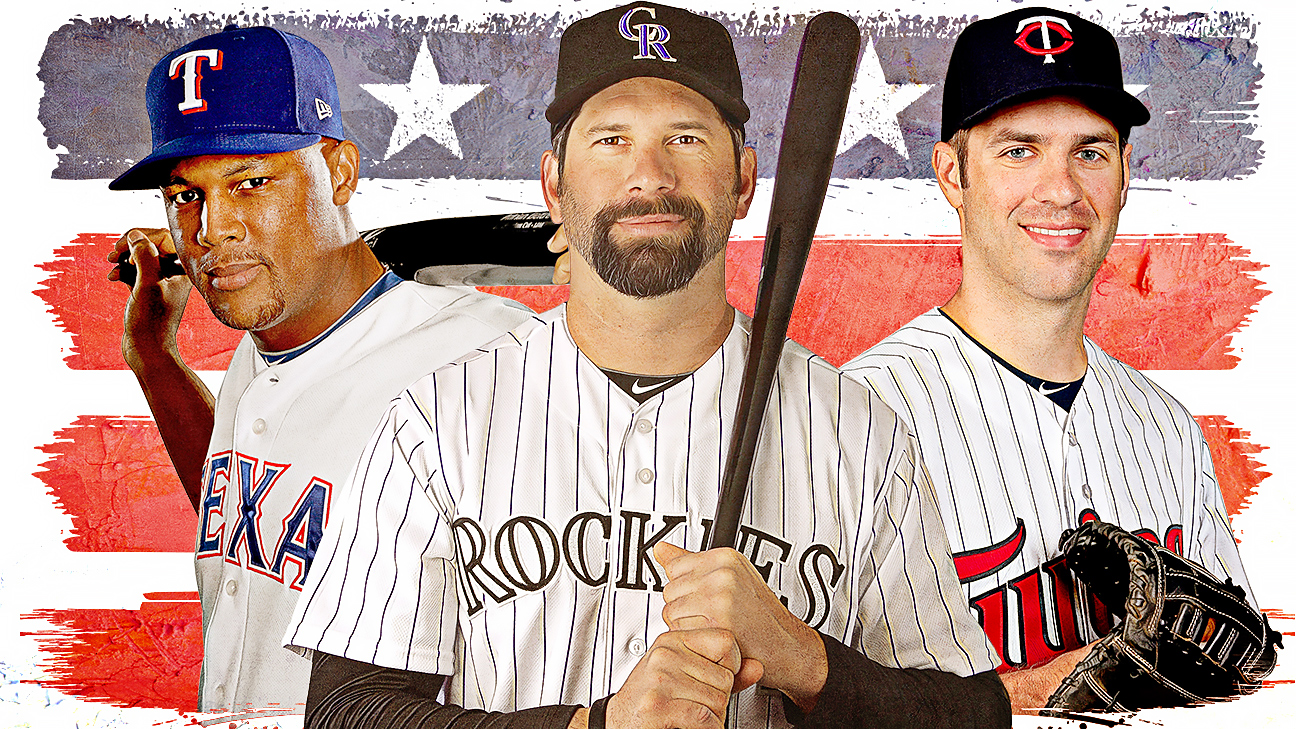
Adrián Beltré was elected in his 1st year of eligibility, receiving over 95 percent of the vote. The Dominican 3rd baseman was the obvious selection: 3,166 hits, 477 home runs, 5 Gold Gloves, 4 All-Star Games. He reached the postseason with the 2004 Los Angeles Dodgers; and with the Texas Rangers in 2011 (winning his only Pennant), 2012, 2015 and 2016.

Todd Helton was elected on his 6th try, receiving 79 percent. The 1st baseman is probably the greatest player in the history of the Colorado Rockies, with a .316 lifetime batting average, 2,519 hits including 369 home runs, 3 Gold Gloves and 5 All-Star Games. He helped the Rockies win their 1st Pennant in 2007, and reach the postseason again in 2009.

Joe Mauer was elected on his 1st try, receiving 76 percent. One of the top catchers of his generation before the Minnesota Twins switched him to 1st base, his retirement at age 35 left him with career statistics, which, I thought, made him a borderline case.

Despite a .306 lifetime batting average, he only had 2,123 hits, 143 of them home runs, despite playing most of his early career's home games at the homer-happy Metrodome in Minneapolis. He won 3 Gold Gloves, made 6 All-Star Teams, was selected (over Derek Jeter, dubiously) as the 2009 American League Most Valuable Player; and reached the postseason with the Twins in 2006, 2009, 2010 and 2017.

Billy Wagner fell just short, with 73.8 percent. That's 5 votes short. This was his 9th time on the ballot, leaving him with 1 more, next year. The case for Wagner is that he has 422 saves, 2nd-most among all lefthanded pitchers, and a 2.31 ERA, the 2nd-lowest among all pitchers in the post-1920 Lively Ball Era, behind only Mariano Rivera. He was a 7-time All-Star.

Who's kidding who? He's not a Hall-of-Famer. The lefty ahead of him, with 424, is John Franco, and he's not in, and he was a much more reliable pitcher.

The Houston Astros made the Playoffs in 1997, 1998, 1999 and 2001, but never won a postseason series. The Philadelphia Phillies came close to the Playoffs in 2004 and 2005, but didn't make it either time. The New York Mets came within 1 run of the Pennant in 2006, but didn't make it. The Mets came within 1 win of making the Playoffs in 2007 and 2008, but didn't make it. The Boston Red Sox made the Playoffs in 2009, and the Atlanta Braves did so in 2010, but each was knocked out of the Playoffs in the Division Series.

What did all of those teams have in common? Billy Wagner. His career postseason ERA was 10.03. His career postseason WHIP was 1.971. He was the worst pitcher in postseason history. Armando Benitez looks like Goose Gossage in comparison. Bottom line: If your team needed to win a game, to get into the postseason or win in it, Wagner was not your guy.

Gary Sheffield got 63.9 percent, in his 10th and last year. He now falls to the "Contemporary Baseball Committee." Since he has been credibly accused of using steroids, he should not get in. Nor should the Alex Rodriguez, who got 34.8 percent; or Manny Ramirez, who got 32.5 percent.

On the other hand David Ortiz, who flat-out failed a test, got in. And Sheff, A-Rod and Manny were all far better all-around players. I'll say it again. Either steroid use matters, or it doesn't. If it does, then Ortiz and any other proven steroid user who is in must be kicked out. If it doesn't, then any player who has been credibly accused, but has the stats, has to be let in. If you are in the BBWAA, and you voted for David Ortiz, but you've never voted for Alex Rodriguez, you are intellectually dishonest, and your membership and voting privileges should be revoked.

And Andy Pettitte, in his 6th year on the ballot, got 13.5 percent. They call him a "cheater." What he did can hardly be called cheating. If you refuse to vote for Pettitte because he "cheated," but voted for Ortiz, you're not merely a goddamned liar, you're a blithering idiot.

Carlos Beltrán got 57.1 percent. This was his 2nd time on the ballot. Stat-wise, he should be in. But he is forever tainted by the Houston Astros cheating scandal, and should never get in. Different kind of cheating than steroid use, but cheating is cheating, even if what you did before was enough.

Andruw Jones got 61.6 percent. This was his 7th time. He has never been credibly accused of cheating, but he does have a domestic violence cloud over him. Statistically, he's close, but it's not definitive. Omar Vizquel, also in his 7th go-round, should be in based on performance alone, but also has the taint of domestic violence against him, and he only got 17.7 percent.

Three Philadelphia Phillies stars of the 21st Century were on the ballot and didn't come close. Chase Utley got 28.8 percent, while both Bobby Abreu and Jimmy Rollins got 14.8 percent. Ryan Howard first reached the ballot in 2022, but got less than 5 percent of the vote, and will now have to wait for consideration from the Contemporary Era Committee.

Met "legend" David Wright, in his 1st year on the ballot, got 6.2 percent, barely staying on. He'll never get in.

Among next year's 1st-time eligibles: Ichiro Suzuki is a shoo-in; CC Sabathia should be; Dustin Pedroia, Ian Kinsler, Félix Hernández, Troy Tulowitzki and Curtis Granderson are longshots at best; and the rest can forget it.

Monday, March 21, 2016

Top 10 Yankee Right Fielders

And so I close with the last remaining position. Or should I do the Managers as well? Or the Broadcasters?

Two things you'll notice about Yankee right fielders: They win a lot of Pennants, and they have great nicknames. Number 1 on the list having more nicknames than James Brown and Apollo Creed combined.

And, keep in mind, I've already included Lou Piniella and Dave Winfield among the left fielders.

Mention... Honorable?... to Gary Sheffield, 2004-06. He was only a Yankee for 3 seasons, only had 2 good ones, and he did sort of get caught using steroids. But look at the numbers: In 2004 and '05, he batted .291 with 57 doubles, 70 homers and 244 RBIs. That's some heavy production.

And then, in 2006... injuries limited him to 166 plate appearances. He still batted .298, but only 5 doubles, 6 homers and 25 RBIs. And, in postseason play, while he tore it up for the 1997 Florida Marlins (his only World Series win), he was otherwise invisible, both for the Atlanta Braves before he came to the Yankees, and in Pinstripes.

In that infamous 4-game flop in the 2004 ALCS (cough-Roid-Sox-cough), he went 1-for-17 (.059 -- 5-for-21 counting walks for an OBP of .238). In the 2006 ALDS, in which the Yankees meekly went down to the Detroit Tigers, 1-for-12, no walks, no XBH, no RBIs.

His career led to some great totals: .292 BA, 140 OPS+, 2,689 hits, 467 doubles and 509 home runs. But will we ever know how much of that was legit?

10. Nick Swisher, 2009-12. He hit 105 of his 245 home runs as a Yankee, with a 124 OPS+ (113 overall), helped the Yankees reach the Playoffs all 4 times, and helping the team loosen up after a few years of a "corporate" image was a big reason why the Yankees won the 2009 World Series. He now plays for the Atlanta Braves.

9. Jesse Barfield, 1989-92. One of the great embarrassments of my life came when I attended my first Opening Day, in 1990 – and not because it was the start of the worst Yankee season in my lifetime. In fact, the Yankees won that day, beating the Cleveland Indians. But there was a point late in the game when Barfield came up, and I yelled, "Come on, Jesse, you can do it!" Guess who was pitching for the Indians: Former Met closer Jesse Orosco. Perhaps not as bad as that night in 1994 when the Yankees were playing Texas in April, and a hockey Playoff score went up on the scoreboard, and the home fans chanted, "Let's go Rangers!" But bad enough.

But there was nothing wrong with cheering for Jesse Barfield. Well, maybe in 1985, when he helped the Toronto Blue Jays reach the postseason for the first time, beating the Yankees out for the AL East title as the teams battled in Toronto on the final weekend. In 1986 he had 108 RBIs, led the AL with 40 homers and made the All-Star Team.

In 1986 and '87, he won Gold Gloves. He had one of the best right field arms of his time, along with Winfield and Dwight Evans. George Bell in left, Lloyd Moseby in center and Barfield in right was a fantastic outfield. When the Yankees sent Al Leiter to the Jays for him on April 30, 1989, Barfield was arguably the greatest player the Jays' franchise (then in its 13th season) had yet had.

Unfortunately, as so often happened to the Yankees in the Eighties, injuries prevented a guy who was great elsewhere from being great in The Bronx. Barfield hit 60 homers in what amounted to 3 full seasons in Pinstripes, but by 1992 he was broken-down. Still, despite playing in unfriendly ballparks (Exhibition Stadium was a wind tunnel and Yankee Stadium is bad for righthanded hitters), he managed to hit 241 home runs.

He became a broadcaster for the Blue Jays, and now runs a baseball school in Houston. He is the father of 2 professional ballplayers: Josh played 2nd base for the Indians, and Jeremy got as far as Single-A ball.

8. Hank Bauer, 1948-59. Mel Allen, the Voice of the Yankees, gave him a nickname that rhymed with his name: The Man of the Hour. He sure was: From a catch sliding on his knees to make the final out of the 1951 World Series to homering in 1958 to extend his World Series hitting streak to 17 games – still a record – Hank always seemed to be coming through.

He was pretty good in the regular season, too: A 113 OPS+, 2 .300+ seasons, 164 homers despite being a righthanded hitter in the pre-renovation Yankee Stadium, a 3-time All-Star, led the AL in triples in 1957.

And nobody messed with this Marine Corps veteran of the battles of Guadalcanal and Okinawa – 2 Bronze Stars and 2 Purple Hearts to go with his 7 World Series rings. In 1966, he managed the Baltimore Orioles to their 1st-ever Pennant and World Series win.

7. George Selkirk, 1934-42. It wasn't going to be easy for the man who would replace Babe Ruth as the Yankees' right fielder. It was harder still because he was given Ruth's Number 3, which was not retired until right before Ruth' death in 1948. But it was worse for Selkirk: His nickname was Twinkletoes. No, he wasn't gay (that I know of): The nickname was because he seemed to be dancing across the outfield to make great plays.

He could hit, too. A 2-time All-Star, he batted .300 5 times, and twice had 100 RBIs. His career OPS+ was 127, so he wasn't just padding stats in the hitting-friendly 1930s. He helped the Yankees win 6 Pennants (1936, '37, '38, '39, '41 and '42) and 5 World Series (all but the last). But he was already in decline by 1940, and after World War II never returned to the majors as a player.

He did serve as a major-league and minor-league manager, and a major-league scout (with the Yankees) and general manager (with the “new” Washington Senators, getting him on the Washington Wall of Stars at Robert F. Kennedy Stadium and now Nationals Park). Probably the greatest Canadian native in Yankee history, he is a member of the Canadian Baseball Hall of Fame.

6. Willie Keeler, 1903-09. The 1st man to play for all 3 of the classic New York City teams, the Brooklyn native actually began his career in 1892 with the New York Giants. A a year later he went to his hometown team – and, yes, until January 1, 1898, the day the consolidation of "Greater New York" took effect, Brooklyn was a separate city. But Wee Willie's sojourn in Brooklyn didn't last long, and in 1894 he went to the original Baltimore Orioles, winning the next 3 NL Pennants.

Unfortunately for him, his best year was the next, 1897, when the Orioles lost to the Boston Beaneaters (forerunners of the Braves) in what author Bill Keller, in his book A Game of Brawl, called the 1st truly great Pennant race. (If you love baseball and you do not have this book, find it. You'll thank me later.) Keeler batted .424, had 239 hits (an National League record for years to come), and 74 RBIs (a good total in the Dead Ball Era). He hit no home runs, but had 27 doubles and 19 triples.

Also that season, he had a 44-game hitting streak, the longest in baseball history for 44 years (Joe DiMaggio), and while it was matched after 81 years (Pete Rose), it has never been topped in the NL (114 years). And yet, according to Keller's book, the streak was barely even mentioned at the time – hence lots of people's surprise when it was mentioned that Keeler, not George Sisler with 41, had the real record that DiMaggio was going for.

In 1899, he was brought back to Brooklyn, and led the Dodgers (the name was used off and on from 1883 to 1931, but at this time they were officially called the Superbas) to back-to-back Pennants. Since there was no postseason series in either year, the 1899 and 1900 Pennants marked the last World Championship for a Brooklyn sports team until the 1955 Dodgers.

In 1903, Keeler was lured across the City to Manhattan and the brand-new New York Highlanders, who changed their name to the New York Yankees in 1913, after the nickname had been unofficial almost the whole time. In 1904, he batted .343, and he, pitching superstar Jack Chesbro, and pitcher-manager Clark Griffith nearly led them to the Pennant. It was not to be, nor was it in 1906 when the team again finished 2nd. In 1910, he played one last season for the Giants and hung 'em up.

His lifetime batting average was .341, his OPS+ 126, and he fell just 68 hits short of 3,000. At 5-foot-4 and 140 pounds, he was not only one of the smallest players in major league history, but the smallest in the Hall of Fame. In 1999 – 89 years after his last game, and 76 years after he died – The Sporting News put him at Number 75 on its list of the 100 Greatest Baseball Players, the smallest, and aside from Cy Young the earliest-debuting.

If Wee Willie Keeler is remembered at all today, it is for his nickname, and thus his lack of height, his hitting streak, and his advice to hitters, meaning to not drink so much and to keep the ball away from opposing fielders: "Keep your eye clear, and hit 'em where they ain't."

5. Roger Maris, 1960-66. A lack of longevity and physical health prevents the man from Fargo, North Dakota from being higher on this list, but make no mistake, he was a great all-around player. He was named AL MVP in 1960 – and deserved it, too, hitting 39 home runs with 112 RBIs. True, Mickey beat him in both categories, but Roger was the difference between the Yanks' mediocre 3rd-place finish the season before and their Pennant that season.

Everyone talks about the homers the Rajah hit, but he took a few away, too. He was probably the best-fielding right fielder the Yankees ever had, and might have been the best-fielding outfielder in team history except for DiMaggio.

Of course, he will always be remembered – usually fondly, but there are some still alive who choose not to – for "61 in '61," the single-season home run record he set on October 1, 1961, and, if we're being honest, still stands, because Mark McGwire, Sammy Sosa and Barry Bonds were not honest.

Some said he wasn't good enough to break the record of Babe Ruth, and that the 8 extra games that season gave him an unfair advantage. Well, Roger batted against black and Hispanic pitchers, which the Babe didn't have to do – which also counters the argument that, "In 1961, the pitching was watered down by expansion." The Babe also never batted against the forkball (predecessor of the split-fingered fastball) like Roger did, and faced very few sliders, knuckleballs and screwballs, unlike Roger who batted in a time when those pitches were well-known. (Then again, Roger faced very few of the pitches that fall into the category of “spitballs,” while the Babe faced plenty.)

And Roger had 698 plate appearances in the 161 games he played in 1961, while the Babe had 691 in his 151 games in 1927 – in other words, those extra 8 (or 10) games gave Roger an average of one extra trip to the plate per extra game. Or, to put it another way: In 1927, Babe Ruth hit a home run every 11.52 plate appearances; in 1961, Roger Maris, every 11.33. Slightly better.

Roger won 7 Pennants in his career (1960, '61, '62, '63, '64, '67 and '68) and 3 World Series (1961, '62 and '67). He, Johnny Hopp and Enos Slaughter are the only players to win World Series with each of the top 2 teams in terms of most Series won: The Yankees (27) and the St. Louis Cardinals (10).

Injuries limited Roger to what amounted to 10 full seasons, and 275 home runs. But this 4-time All-Star had a 127 career OPS+. To give you an idea, there were 4 right fielders in Roger's generation who made the Hall of Fame. Hank Aaron's was 155. Frank Robinson's was 154. But Al Kaline's was 134, and Roberto Clemente's was 130 – theirs wasn't substantially higher than Roger's, and no one questions whether they belong in the Hall of Fame.

But does Roger belong? Baseball-Reference.com's Hall of Fame Monitor has him at 89 out of 100 (a bit short), and their HOF Standards have him at 22 out of 50 (well short). Their 10 Most Similar Batters include some interesting names, including ex-Yankees Barfield, Curtis Granderson and Jay Buhner (and also Hank Sauer, not to be confused with Hank Bauer), but not HOFers. In all honesty, I can’t say that Roger Maris belongs in the Baseball Hall of Fame.

But he is in Yankee Stadium's Monument Park, his Number 9 is retired, and he has a museum in his memory in his hometown of Fargo, North Dakota, at the West Acres Shopping Center. I should say, "In his honor," because it opened in 1984, while he was still alive. When asked by the man running it if he could, Roger asked 2 conditions: That it be where people could easily get to it (a mall would have parking lots and bus service) and that admission be free. Both requests were granted.

4. Paul O'Neill, 1993-2001. In spite of his recent endorsement of Donald Trump, My Man O'Neill remains 1 of my 2 favorite athletes of all time. (You'll see the other in a moment.) Why?Because he played the game the way I would have: With desire, with intensity, with a drive to win that would make the fans say, "This is the guy for us." The difference is, Paulie Pinstripes had something I don't have. It's called "talent."

His intensity reminded me a lot of Lou Piniella, who was his manager on the 1990 World Champion Cincinnati Reds. When the Yankees got him for Roberto Kelly in the 1992-93 offseason, I was thrilled. His lefty stroke was perfect for Yankee Stadium, and he could field, too.

What I didn't know was that he was also a great opposite-field hitter (in fact, nearly all the 1996-2001 Yankee stars were), that he would win a batting title in 1994, that he would play through pain, that he would hit one of my favorite home runs of all time (the Mel Rojas Game, June 26, 1998), and that he would have the most important plate appearance in Yankee history (his 9th-inning walk that led to him scoring the tying run, saving Game 1 of the 2000 World Series and making possible the most important of Yankee World Series wins, the one over The Other Team).

You know how much this guy is loved, right? Knowing that he had talked about retiring, and that it was probably his last game at Yankee Stadium, the fans chanted his name late in Game 5 of the 2001 World Series – a game the Yankees were losing at the moment. For once, Yankee Fans decided something was more important than winning. They did not, however, give such a salute to Tino Martinez, even though the rumor was already floating that Yankee brass would not re-sign him, but rather would go after Jason Giambi. I wonder what the fans would have done if they'd known Scott Brosius was also retiring. Or if it would be the last home game in The Bronx for Chuck Knoblauch. But O'Neill got the kind of reaction that Don Mattingly might have gotten – if he'd gotten that far even once.

Lifetime batting average .288 (.303 with the Yankees), OPS+ 120 (125), 451 doubles (304), 281 homers (185). Won 6 Pennants (1990, '96, '98, '99, 2000 & '01, all but the 1st with the Yankees) and 5 World Championships (all but the last). His Number 21 was briefly given out to pitcher LaTroy Hawkins in 2008, which was received rather poorly at The Stadium. Hawkins, who had not previously worn it (usually wearing 32) and had no attachment to it, wisely gave it up. Paulie got his Monument Park Plaque, but it is time to retire his number.

3. Tommy Henrich, 1937-50. Probably the best of the many nicknames Mel Allen thought up was "Ol' Reliable" for the man from Massillon, Ohio – which was already renowned as a football factory, but he is still the greatest baseball player to come from the town.

How reliable was Henrich? In 1941, when DiMaggio's bat was stolen in between games of a doubleheader, right after Joe had tied Sisler's AL record of a 41-game hitting streak, he remembered that the bat that Joe was using was his own model – Louisville Slugger then made them to each player's specifications – and offered Joe another of his own. Joe took it and broke Sisler's record, and the previous Henrich/DiMaggio bat was recovered in time for Joe to break the Keeler record.

Later that season, seeing that Mickey Owen of the Brooklyn Dodgers had dropped the ball, Henrich was reliable enough (and alert enough) to turn a game-ending strikeout into the start of a rally, and the Yankees won Game 4 of the World Series.

On October 5, 1949, in Game 1 of that year's World Series, Henrich broke up a scoreless pitching duel between Allie Reynolds and the Dodgers' Don Newcombe by taking Newk deep, and hitting the 1st walkoff home run (as we would now call it) in the history of postseason baseball.

Henrich missed the 1942 and '43 Series due to serving in the Coast Guard in World War II, but was with the Yankees in their World Championship seasons of 1937, '38, '39, '41, '47, '49 and '50 – and the Yankees won all 7 of those.

When he died in 2009, he was 96 years old, the oldest living Yankee, the last one to have played for Lou Gehrig, and the last player to have won a World Series in the 1930s. As late as 1994, he was still coming to Old-Timers' Day. He wore Number 7 before The War, and Number 15 after it; both are retired, but neither for him. Still, I can't help thinking that Ol' Reliable deserves a Plaque in Monument Park.

2. Reggie Jackson, 1977-81. Did I say a lack of longevity hurts Maris? Yeah, well, this is my list, and this is my favorite athlete of all time. Henrich or Jackson? Old Reliable or Mister October? The difference in the nicknames is negligible, if you think about it.

Reggie was probably a better all-around player when he was younger, with the Oakland Athletics dynasty of the 1970s. Supposedly, when George Steinbrenner was trying to sign him in the 1976-77 offseason, Billy Martin objected, saying he's a bad fielder, strikes out too much, and would "mess up my running game." Billy, you already had Thurman Munson, Graig Nettles, Chris Chambliss and Lou Piniella. You didn't need a damn running game! And, as Reggie proved (and as another Philly-area native who starred in New York, Mike Piazza, would later say), if you hit the ball far enough, you don’t have to run.

Reggie's lifetime batting average is .262, one of the lowest of any nonpitcher in the Hall of Fame. And his 2,597 strikeouts are an all-time record. But his BA rises to .281 if you count only his Yankee seasons, his career OPS+ is a hefty 139 (148 in Pinstripes), he had 2,584 hits, including 463 doubles and 563 homers – among non-cheaters, the only ones with more are Hank Aaron, Babe Ruth, Willie Mays, Ken Griffey Jr., Jim Thome, Frank Robinson and Harmon Killebrew. He hit 18 homers in postseason play, including 5 in the 1977 World Series (only Chase Utley in 2009 has matched that in a Series), including 3 in Game 6 (a one-game performance preceded only by Ruth, in '26 and again in '28, and not done since).

He was the American League regular-season and World Series MVP in 1973, and was the Series MVP again in 1977. In 21 seasons, with the A's, Yanks and California Angels (he also had 1 with the Baltimore Orioles, but they didn't make the postseason), he reached the postseason 11 times (1971, '72, '73, '74, '75, '77, '78, '80, '81, '82 and '86). He won 6 Pennants (1972, '73, '74, '77, '78 and '81) and 5 World Series (all but the last of those). He was one of those guys about whom it was said, "It's funny how these winning teams keep following him around." He says he never said it, but if he did, he wasn't lying: He really was "the straw that stirs the drink."

As I said, he's in the Hall of Fame. His Number 9 was retired by the A's, his Number 44 by the Yankees (on August 14, 1993 – I was there), who also gave him a Plaque in Monument Park (July 6, 2002 – I wasn't gonna miss that day, either). The Angels haven't retired his Number 44 yet, nor have they elected him to their team Hall of Fame – what are they waiting for?

But for the Yankees, Reggie is the symbol of a generation of stars that amazed, shocked, sometimes appalled, and so often thrilled. He helped to bring the excitement back to The Bronx – and away from Flushing Meadow. He was the 1st black man to be a star for the Yankees (in a way that the quiet, good but not spectacular Elston Howard or even the Pennant-clinching Chris Chambliss could never be), thus helping local black fans to see that the Yankees could bring in their people as well.

He was the right man in the right place at the right time: The man who was the biggest star of the team that meant the most to me when I was first seeing what sports was. For that reason, whatever his flaws, Mr. Reginald Martinez Jackson will always be my guy.

In spite of his massive ego, he understands what matters most: In an interview with Tom Seaver shown on WPIX-Channel 11 prior to his number retirement ceremony (which came a few days after his Hall of Fame induction), he said, "It's not important that I did it; what's important is that it was done."

And nobody ever did more for baseball than this last man – not even Jackie Robinson, because, if you think about it, if this guy hadn't done what he did, baseball wouldn't have been big enough of a stage upon which to try an experiment like the one Jackie and Branch Rickey tried.

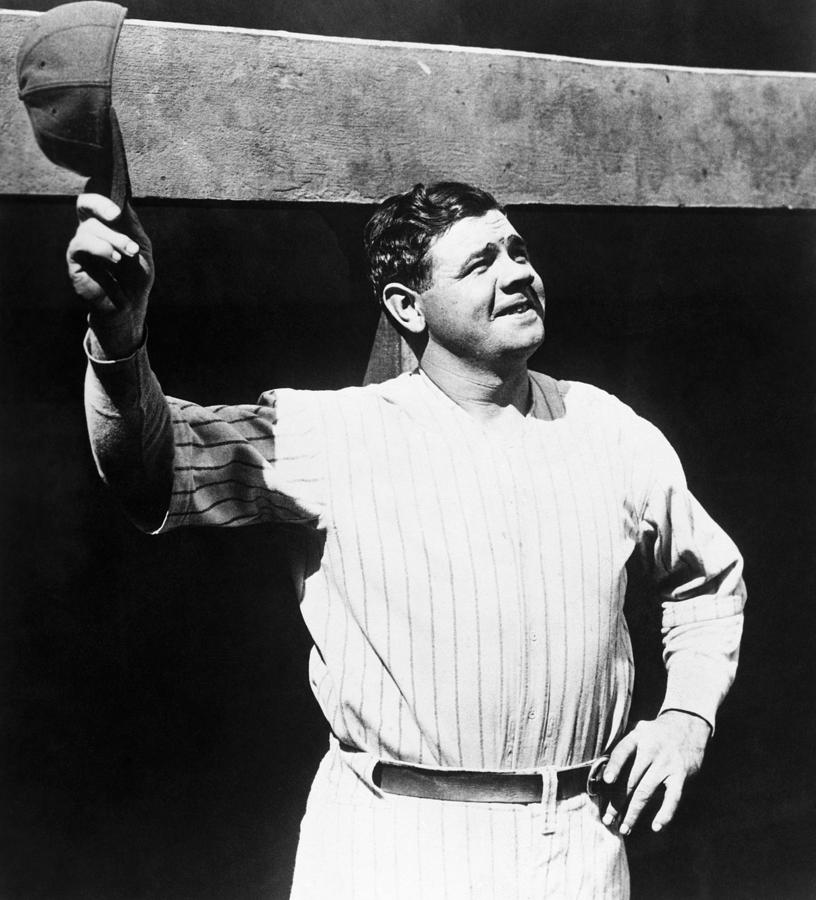
1. Babe Ruth, 1920-34. What can I say about the Big Guy that hasn't already been rehashed a thousand times? Not much. But there is much to say about The Great Bambino that needs to be said.

He's not only in the Hall of Fame, but he was one of the 1st 5 inductees when they began voting in 1936, along with Ty Cobb, Christy Mathewson, Honus Wagner and Walter Johnson. A life-size wooden carving, meticulously shaped and painted (right down to the fold of his shirt and the cracks on the leather of his belt), of the Babe, and another of Ted Williams by the same artist, greets you when you walk into the Hall in Cooperstown, New York.

He was elected to the All-Century Team in 1999, 64 years after his last game, by fans whose parents were too young to have ever seen him play. The Yankees retired his Number 3, and put a Monument on the field at Yankee Stadium on Opening Day 1949, a few months after his death, before moving it to the new Monument Park in 1976, and to the new Stadium's Monument Park in 2009.

Is he The Greatest Baseball Player Who Ever Lived? Let me put it this way. From 1915 to 1918, 4 years, he was a lefthanded pitcher as good as Randy Johnson. Then, from 1919 to 1934, 16 years, he was a lefthanded hitter better than Barry Bonds, and he didn't use steroids, either -- they weren't available. Book editor and baseball writer Daniel Okrent said, "It's like Beethoven and Cezanne were the same man, doing the same things." No, it wasn't: Beethoven composed music, Cezanne painted. Pitching and hitting are different sides of the same game, so it's more like if he were a great film actor and a great film director. Like Orson Welles, who also got fat midway through his career. Except Welles' window of greatness turned out to be very brief; the Babe was one of the best players in the game over a 20-season stretch.

And if you think Willie Mays was the greatest all-around baseball player who ever lived, you're wrong: Willie  was not in the Babe's league as a hitter (figuratively or literally), Willie never threw a pitch in a major league game, and there's no way Willie, even as good an outfielder as he was, was as good at preventing runs as even the best pitchers of his time, which the Babe was one of in his own time.

And don't tell me the Babe never faced black or Latin pitchers: He faced them on postseason "barnstorming tours," and the surviving accounts of those at-bats show that they weren't any more successful at getting him out than white pitchers were in regular-season and postseason games.

The new Yankee Stadium is not "The House That Ruth Built." But the Babe Ruth Plaza outside the right-field stands, across 161st Street from the site of the ballpark whose construction his home runs, and the money they made for Colonel Jacob Ruppert, made possible, testifies to his life, his performance, and his legacy.

He played in 10 World Series (1915, '16 and '18 with the Boston Red Sox; 1921, '22, '23, '26, '27, '28 and '32 with the Yankees), winning 7 (1915, '16, '18, '23, '27, '28 and '32). As much as Ruppert's money and Ed Barrow's trades and purchases, Ruth’s hitting made the Yankees, and made baseball, more popular than ever before, aided by the development of radio and motion pictures, and doing it in the media center of North America, New York City. Had he put up the same numbers in Boston, playing there for his entire career instead of just the first 6 seasons (5 full), it would simply not have been the same.

"A big, badly flawed, swashbuckling palooka who strides with great spirit -- not just talent, but with a spirit of possibility and an enjoyment of life -- across the American stage. That's an American... You give me Babe Ruth over any king who's ever sat on the throne, and I'll be happy with that trade." – Bob Costas.

Except he was a king. The King of Crash. The Sultan of Swat. The Rajah of Rap. The Majarajah of Mash. The High Mandarin of Maul. The Wizier of Wham. The Czar of Clout. (Sometimes it's "the Colossus of Clout," and you can add "the Behemoth of Bust," although neither the Colossus of Rhodes nor the mythological Behemoth was a monarch.)

Some people compare baseball to religion. Well, as with Christianity, in baseball, a babe shall lead them. Then again, Babe Ruth tended to lie in places other than a manger. And he certainly did a lot that required repentance and forgiveness. But has any American ever been loved by more people in his own time? Don't forget, even Washington, Lincoln and FDR had their haters during their public service.

The Babe was one of a kind, and my generation hasn't seen another – and, if the rise and fall of Mark McGwire is any indication, we never will, and neither will any other generation. More than any other player, he was the right man, in the right place, at the right time.

Like Art LaFleur said while playing the Babe in The Sandlot: "Heroes get remembered, but legends never die."

Tuesday, July 5, 2011

4,000 Times Reached Base Club

With all the talk of Derek Jeter approaching 3,000 hits, I decided to see how many, and which, players reached base at least 4,000 times.

The following stats come from Baseball-Reference.com (if you dispute any of them, take it up with them, not me), and includes hits and walks -- but not times hit by a pitch or reached base due to catcher's interference, both of which are not exactly earning a place on base -- and are up to date through the games of July 4, 2011.

Players in bold were, for a significant part of their careers, Yankees. Players in italics have their stats tainted due to steroid use -- that we know of, or at least seriously suspect.

RANK PLAYER HITS WALKS TOTAL
1 Pete Rose 4256 1566 5822
2 Barry Bonds 2935 2558 5493
3 Ty Cobb 4189 1249 5438
4 Carl Yastrzemski 3419 1845 5264
5 Rickey Henderson 3055 2190 5245
6 Stan Musial 3630 1599 5229
7 Hank Aaron 3771 1402 5173
8 Babe Ruth 2873 2062 4935
9 Tris Speaker 3514 1381 4895
10 Eddie Collins 3315 1499 4814
11 Willie Mays 3283 1464 4747
12 Ted Williams 2654 2021 4675
13 Eddie Murray 3255 1333 4588
14 Mel Ott 2876 1708 4584
15 Wade Boggs 3010 1412 4422
16 Cap Anson 3435 984 4419
17 Paul Molitor 3319 1094 4413
18 Honus Wagner 3420 963 4383
19 Joe Morgan 2517 1865 4382
20 Rafael Palmeiro 3020 1353 4373
21 Frank Robinson 2943 1420 4363
22 Dave Winfield 3110 1216 4326
23 Cal Ripken 3184 1129 4313
24 Al Kaline 3007 1277 4284
25 George Brett 3154 1096 4250
26 Paul Waner 3152 1091 4243
27 Lou Gehrig 2721 1508 4229
28 Craig Biggio 3060 1160 4220
29 Gary Sheffield 2689 1475 4164
30 Mickey Mantle 2415 1733 4148
31 Frank Thomas 2468 1667 4135
32 Robin Yount 3142 966 4108
33 Jimmie Foxx 2646 1452 4098
34 Ken Griffey Jr. 2781 1312 4093
35 Rod Carew 3053 1018 4071
36 Luke Appling 2749 1302 4051
37 Charlie Gehringer 2839 1186 4025
38 Chipper Jones 2560 1441 4001

All of the above are in the Hall of Fame, except for the following; Pete Rose is banned; Rafael Palmeiro is eligible but will probably never make it due to his proven steroid use; Craig Biggio will be eligible in 2013; Gary Sheffield will be eligible in 2015, but has a steroid cloud hanging over him; Frank Thomas will be eligible in 2014; Ken Griffey Jr. will be eligible in 2016; and Chipper Jones, believe it or not, is the active leader.

Derek Jeter went into tonight's game with 2994 hits and 971 walks, for 3965. He will make it well before this season ends. Jim Thome may also join this list by the end of the season. Alex Rodriguez might, and will certainly get it by early next season. Reggie Jackson was among those who just missed. Having missed 3 years due to World War II and retiring at age 37 due to injuries, Joe DiMaggio, for all his achievements, barely made 3,000.

Saturday, March 5, 2011

Top 10 Yankee Right Fielders

And so I close with the last remaining position. Or should I do the Managers as well? Or the Broadcasters?

Two things you'll notice about Yankee right fielders: They won a lot of Pennants, and they had great nicknames. Number 1 on the list having more nicknames than James Brown and Apollo Creed combined.

And, keep in mind, I’ve already included Lou Piniella and Dave Winfield among the left fielders.

10. Jesse Barfield, 1989-92. One of the great embarrassments of my life came when I attended my 1st Opening Day, in 1990 – and not because it was the start of the worst Yankee season in my lifetime. In fact, the Yankees won that day, beating the Cleveland Indians. But there was a point late in the game when Barfield came up, and I yelled, "Come on, Jesse, you can do it!" Guess who was pitching for the Indians: Former Met closer Jesse Orosco. Perhaps not as bad as that night in 1994 when the Yankees were playing Texas in April, and a hockey Playoff score went up on the scoreboard, and the home fans chanted, "Let's go Rangers!" But bad enough.

But there was nothing wrong with cheering for Jesse Barfield. Well, maybe in 1985, when he helped the Toronto Blue Jays reach the postseason for the 1st time, beating the Yankees out for the AL East title as the teams battled in Toronto on the final weekend. In 1986 he had 108 RBIs, led the AL with 40 homers and made the All-Star Team.

In 1986 and '87, he won Gold Gloves. He had one of the best right field arms of his time, along with Winfield and Dwight Evans. George Bell in left, Lloyd Moseby in center and Barfield in right was a fantastic outfield. When the Yankees sent Al Leiter to the Jays for him on April 30, 1989, Barfield was arguably the greatest player the Jays' franchise (then in its 13th season) had yet had.

Unfortunately, as so often happened to the Yankees in the Eighties, injuries prevented a guy who was great elsewhere from being great in The Bronx. Barfield hit 60 homers in what amounted to 3 full seasons in Pinstripes, but by 1992 he was broken-down. Still, despite playing in unfriendly ballparks (Exhibition Stadium was a wind tunnel and Yankee Stadium is bad for righthanded hitters), he managed to hit 241 home runs. He’s now a broadcaster for the Blue Jays, and the father of 2 professional ballplayers: Josh is a second baseman for the Indians, and Jeremy played in Single-A ball last season.

9. Gary Sheffield, 2004-06. I seriously debated whether to include him – after all, he was only a Yankee for 3 seasons, only had 2 good ones, and he did sort of get caught using steroids. But look at the numbers: In 2004 and '05, he batted .291 with 57 doubles, 70 homers and 244 RBIs. That's some heavy production.

And then, in 2006... injuries limited him to 166 plate appearances. He still batted .298, but only 5 doubles, 6 homers and 25 RBIs. And, in postseason play, while he tore it up for the 1997 Florida Marlins (his only World Series win), he was otherwise invisible, both for the Atlanta Braves before he came to the Yankees, and in Pinstripes. In that infamous 4-game flop in the 2004 ALCS (cough-Roid-Sox-cough), he went 1-for-17 (.059 -- 5-for-21 counting walks for an OBP of .238). In the 2006 ALDS, in which the Yankees meekly went down to the Detroit Tigers, 1-for-12, no walks, no XBH, no RBIs.

His career led to some great totals: .292 BA, 140 OPS+, 2,689 hits, 467 doubles and 509 home runs. But will we ever know how much of that was legit?

8. Hank Bauer, 1948-59. Mel Allen, the Voice of the Yankees, gave him a nickname that rhymed with his name: The Man of the Hour. He sure was: From a catch sliding on his knees to make the final out of the 1951 World Series to homering in 1958 to extend his World Series hitting streak to 17 games – still a record – Hank always seemed to be coming through.

He was pretty good in the regular season, too: A 113 OPS+, 2 .300+ seasons, 164 homers despite being a righthanded hitter in the pre-renovation Yankee Stadium, a 3-time All-Star, led the AL in triples in 1957. And nobody messed with this Marine Corps veteran of the battles of Guadalcanal and Okinawa – 2 Bronze Stars and 2 Purple Hearts to go with his 7 World Series rings. In 1966, he managed the Baltimore Orioles to their 1st-ever Pennant and World Series win.

7. George Selkirk, 1934-42. It wasn't easy for the man who would replace Babe Ruth as the Yankees' right fielder. It was harder still because he was given Ruth's Number 3, which was not retired until right before Ruth's death in 1948. But it was worse for Selkirk: His nickname was Twinkletoes. No, he wasn't gay (that I know of): The nickname was because he seemed to be dancing across the outfield to make great plays.

He could hit, too. A 2-time All-Star, he batted .300 5 times, and twice had 100 RBIs. His career OPS+ was 127, so he wasn't just padding stats in the hitting-friendly 1930s. He helped the Yankees win 6 Pennants (1936, '37, '38, '39, '41 and '42) and 5 World Series (all but the last). But he was already in decline by 1940, and after World War II never returned to the majors as a player.

He did serve as a major-league and minor-league manager, and a major-league scout (with the Yankees) and general manager (with the "new" Washington Senators, getting him on the Washington Wall of Stars at Robert F. Kennedy Stadium and now Nationals Park). He was probably the greatest Canadian native in Yankee history, and is a member of the Canadian Baseball Hall of Fame.

6. Willie Keeler, 1903-09. He was the 1st man to play for all 3 of the classic New York City teams. The Brooklyn native actually began his career in 1892 with the New York Giants, but a year later he went to his hometown team – and, yes, until January 1, 1898, the day the consolidation of "Greater New York" took effect, Brooklyn was a separate city. But Wee Willie's sojourn in Brooklyn didn't last long, and in 1894 he went to the original Baltimore Orioles, winning the next 3 NL Pennants.

Unfortunately for him, his best year was the next, 1897, when the Orioles lost to the Boston Beaneaters (forerunners of the Braves) in what author Bill Keller, in A Game of Brawl, called the 1st truly great Pennant race. (If you love baseball and you do not have this book, find it. You’ll thank me later.) Keeler batted .424, had 239 hits (an NL record for years to come), and 74 RBIs (a good total in the Dead Ball Era). He hit no home runs, but had 27 doubles and 19 triples. And he had a 44-game hitting streak, the longest in baseball history for 44 years (Joe DiMaggio), and while it was matched after 81 years (Pete Rose), it has never been topped in the NL (114 years).

And yet, according to Keller's book, the streak was barely even mentioned at the time – hence lots of people's surprise when it was mentioned that Keeler, not George Sisler with 41, had the real record that DiMaggio was going for.

In 1899, he was brought back to Brooklyn, and led the Dodgers (the name was used off and on from 1883 to 1931, but at this time they were officially called the Superbas) to back-to-back Pennants. Since there was no postseason series in either year, the 1899 and 1900 Pennants marked the last World Championship for a Brooklyn sports team until the 1955 Dodgers.

In 1903, Keeler was lured across the City to Manhattan and the brand-new New York Highlanders, forerunners of the Yankees. In 1904, he batted .343, and he, pitching superstar Jack Chesbro, and pitcher-manager Clark Griffith nearly led them to the Pennant. It was not to be, nor was it in 1906 when the team again finished 2nd. In 1910, he played 1 last season for the Giants, and hung 'em up.

His lifetime batting average was .341, his OPS+ 126, and he fell just 68 hits short of 3,000. At 5-foot-4 and 140 pounds, he was not only one of the smallest players in major league history, but the smallest in the Hall of Fame. In 1999 – 89 years after his last game, and 76 years after he died – The Sporting News put him at Number 75 on its list of the 100 Greatest Baseball Players, the smallest, and, aside from Cy Young, the earliest-debuting.

If Wee Willie Keeler is remembered at all today, it is for his nickname, and thus his lack of height, his hitting streak, and his advice to hitters, meaning to not drink so much and to keep the ball away from opposing fielders: "Keep your eye clear, and hit 'em where they ain't."

5. Roger Maris, 1960-66. No player has hit 'em where they really ain't more in a single season than the Rajah -- not honestly, anyway.

A lack of longevity and physical health prevents him from being higher on this list, but make no mistake, he was a great all-around player. He was named AL MVP in 1960 – and deserved it, too, hitting 39 home runs with 112 RBIs. True, Mickey Mantle beat him in both categories, but Roger was the difference between the Yanks' mediocre 3rd-place finish the season before and their Pennant that season.

And everyone talks about the homers he hit, but he took a few away, too. He was probably the best-fielding right fielder the Yankees ever had, and might have been the best-fielding outfielder in team history except for DiMaggio.

Of course, he will always be remembered – usually fondly, but there are some still alive who choose not to – for "61 in '61," the single-season home run record he set on October 1, 1961 (we're approaching the 50th Anniversary), and, if we're being honest, still stands.

Some said he wasn't good enough to break the record of Babe Ruth, and that the 8 extra games that season gave him an unfair advantage. Well, Roger batted against black and Hispanic pitchers, which the Babe didn't have to do – which also counters the argument that, "In 1961, the pitching was watered down by expansion."

The Babe also never batted against the forkball (the predecessor of the split-fingered fastball) like Roger did, and faced very few sliders, knuckleballs and screwballs, unlike Roger who batted in a time when those pitches were well-known. (Then again, Roger faced very few of the pitches that fall into the category of "spitballs," while the Babe faced plenty of them.) And Roger had 698 plate appearances in the 161 games he played in 1961, while the Babe had 691 in his 151 games in 1927 – in other words, those extra 8 (or 10) games gave Roger an average of one extra trip to the plate per extra game.

Roger won 7 Pennants in his career (1960, '61, '62, '63, '64, '67 and '68) and 3 World Series (1961, '62 and '67). He, Johnny Hopp and Enos Slaughter are the only players to win World Series with each of the top 2 teams in terms of most Series won: The Yankees (27) and the St. Louis Cardinals (10).

Injuries limited Roger to what amounted to 10 full seasons, and 275 home runs. But this 4-time All-Star had a 127 career OPS+. To give you an idea, there were 4 right fielders in Roger's generation who made the Hall of Fame. Hank Aaron's was 155. Frank Robinson's was 154. But Al Kaline's was 134, and Roberto Clemente's was 130 – theirs weren't substantially higher than Roger's, and no one questions whether they belong in the Hall of Fame.

But does Roger belong? Baseball-Reference.com's Hall of Fame Monitor has him at 85 out of 100 (a bit short), and their HOF Standards, which are weighted much more toward career totals, have him at 22 out of 50 (well short). Their 10 Most Similar Batters include some interesting names, including ex-Yankees Barfield, Danny Tartabull and Jay Buhner (and also Hank Sauer, not to be confused with Hank Bauer), but not HOFers. In all honesty, I can't say that Roger Maris belongs in the Baseball Hall of Fame.

But he is in Yankee Stadium's Monument Park, his Number 9 is retired, and he has a museum in his memory in his hometown of Fargo, North Dakota, at the West Acres Shopping Center. I should say, "In his honor," because it opened in 1984, while he was still alive. When asked by the man running it if he could, Roger asked 2 conditions: That it be where people could easily get to it (a mall would have parking lots and bus service) and that admission be free. Both requests were granted.

4. Paul O’Neill, 1993-2001. My Man O’Neill. Why him? Why is he one of my 2 favorite athletes of all time? (You'll see the other in a moment.) Because he played the game the way I would have: With desire, with intensity, with a drive to win that would make the fans say, "This is the guy for us." The difference is, Paulie Pinstripes had something I don't have. It's called "talent."

His intensity reminded me a lot of Lou Piniella, who was his manager on the 1990 World Champion Cincinnati Reds. When the Yankees got him for Roberto Kelly in the 1992-93 offseason, I was thrilled. His lefty stroke was perfect for Yankee Stadium, and he could field, too. What I didn't know at the time was that he was also a great opposite-field hitter (in fact, nearly all the 1996-2001 Yankee stars were), that he would win a batting title in 1994, that he would play through pain, that he would hit one of my favorite home runs of all time (the Mel Rojas Game, June 26, 1998), and that he would have the most important plate appearance in Yankee history (his 9th-inning walk that led to him scoring the tying run, saving Game 1 of the 2000 World Series and making possible the most important of Yankee World Series wins, the one over The Other Team).

You know how much this guy is loved, right? Knowing that he had talked about retiring, and that it was probably his last game at Yankee Stadium, the fans chanted his name late in Game 5 of the 2001 World Series – a game the Yankees were losing at the moment. For once, Yankee Fans decided something was more important than winning. They did not, however, give such a salute to Tino Martinez, even though the rumor was already floating that Yankee brass would not re-sign him, but rather would go after Jason Giambi. I wonder what the fans would have done if they'd known Scott Brosius was also retiring. Or if it would be the last home game in The Bronx for Chuck Knoblauch. 

But O'Neill got the kind of reaction that Don Mattingly might have gotten – if he'd gotten that far even once. Yankee Fans knew of his passion for the game. They knew he was what George Steinbrenner called him: "The Warrior."

He had a lifetime batting average .288 (.303 with the Yankees), an OPS+ of 120 (125), 451 doubles (304) and 281 homers (185). He won 6 Pennants (1990, ’96, ’98, ’99, 2000 & ’01, all but the first with the Yankees) and 5 World Championships (all but the last). His Number 21 was briefly given out to pitcher LaTroy Hawkins in 2008, which was received rather poorly at The Stadium. Hawkins, who had not previously worn it (usually wearing 32) and had no attachment to it, wisely gave it up. It is time to give Paulie his retired number and his Monument Park Plaque.

3. Tommy Henrich, 1937-50. Probably the best of the many nicknames Mel Allen thought up was "Ol' Reliable" for the man from Massillon, Ohio – which was already renowned as a football factory, but he is still the greatest baseball player to come from the town.

How reliable was Henrich? In 1941, when DiMaggio's bat was stolen in between games of a doubleheader, right after Joe had tied Sisler's AL record of a 41-game hitting streak, he remembered that the bat that Joe was using was his own model – Louisville Slugger then made them to each player’s specifications – and offered Joe another of his own. Joe took it and broke Sisler's record, and the previous Henrich/DiMaggio bat was recovered in time for Joe to break the Keeler record.

Later that season, seeing that Mickey Owen of the Brooklyn Dodgers had dropped the ball, Henrich was reliable enough (and alert enough) to turn a game-ending strikeout into the start of a rally, and the Yankees won Game 4 of the World Series. On October 5, 1949, in Game 1 of that year's World Series, Henrich broke up a scoreless pitching duel between Allie Reynolds and the Dodgers' Don Newcombe by taking Newk deep, and hitting the 1st walkoff home run (as we would now call it) in the history of postseason baseball.

Henrich missed the 1942 and '43 Series due to serving in the Coast Guard in World War II, but was with the Yankees in their World Championship seasons of 1937, '38, '39, '41, '47, '49 and '50 – and the Yankees won all 7 of those.

When he died in 2009, he was 96 years old, the oldest living Yankee, the last one to have played for Lou Gehrig, and the last player to have won a World Series in the 1930s. As late as 1994, he was still coming to Old-Timers' Day. He wore Number 7 before The War, and Number 15 after it; both are retired, but neither for him. Still, I can't help thinking that Ol' Reliable deserves a Plaque in Monument Park.

2. Reggie Jackson, 1977-81. Did I say a lack of longevity hurts Maris? Yeah, well, this is my list, and this is my favorite athlete of all time. Henrich or Jackson? Old Reliable or Mister October? The difference in the nicknames is negligible, if you think about it.

Reggie was probably a better all-around player when he was younger, with the Oakland Athletics dynasty of the 1970s. Supposedly, when George Steinbrenner was trying to sign him in the 1976-77 offseason, Billy Martin objected, saying he's a bad fielder, strikes out too much, and would "mess up my running game." Billy, you already had Thurman Munson, Graig Nettles, Chris Chambliss and Lou Piniella. You didn’t need a damn running game! And, as Reggie proved (and as another Philly-area native who starred in New York, Mike Piazza, would later say), if you hit the ball far enough, you don't have to run.

Reggie's lifetime batting average is .262, one of the lowest of any nonpitcher in the Hall of Fame. And his 2,597 strikeouts are an all-time record (although Jim Thome comes into the 2011 season only 202 behind him, and will probably play at least 2 more seasons). But his BA rises to .281 if you count only his Yankee seasons, his career OPS+ is a hefty 139 (148 in Pinstripes), he had 2,584 hits, including 463 doubles and 563 homers – among non-cheaters, the only ones with more are Hank Aaron, Babe Ruth, Willie Mays, Ken Griffey Jr., Jim Thome, Frank Robinson and Harmon Killebrew.

He hit 18 homers in postseason play, including 5 in the 1977 World Series (only Chase Utley in 2009 has matched that), including 3 in Game 6 (a 1-game performance preceded only by Ruth, in '26 and again in '28, and not done since).

He was the AL regular-season and World Series MVP in 1973, and was the Series MVP again in 1977. In 21 seasons, with the A’s, Yanks and California Angels (he also had one with the Baltimore Orioles, but they didn’t make the postseason), he reached the postseason 11 times (1971, '72, '73, '74, '75, '77, '78, '80, '81, '82 and '86). He won 6 Pennants (1972, '73, '74, '77, '78 and '81) and 5 World Series (all but the last of those). He was one of those guys about whom it was said, "It's funny how these winning teams keep following him around.:"He says he never said it this, but if he did say it, he wasn't lying: He really was "the straw that stirs the drink."

As I said, he's in the Hall of Fame. His Number 9 was retired by the A's, his Number 44 by the Yankees (on August 14, 1993 – I was there), who also gave him a Plaque in Monument Park (July 6, 2002 – I wasn't gonna miss that day, either). The Angels haven't retired his Number 44 yet, nor have they elected him to their team Hall of Fame – what are they waiting for?

But for the Yankees, Reggie is the symbol of a generation of stars that amazed, shocked, sometimes appalled, and so often thrilled. He helped to bring the excitement back to The Bronx – and away from Flushing Meadow. He was the 1st black man to be a star for the Yankees (in a way that the quiet, good but not spectacular Elston Howard or even the Pennant-clinching Chris Chambliss could never be), thus helping local black fans to see that the Yankees could bring in their people as well.

He was the right man in the right place at the right time: The man who was the biggest star of the team that meant the most to me when I was first seeing what sports was. For that reason, whatever his flaws, Mr. Reginald Martinez Jackson will always be my guy.

In spite of his massive ego, he understands what matters most: In an interview with Tom Seaver shown on WPIX-Channel 11 prior to his number retirement ceremony (which came a few days after his Hall of Fame induction), he said, "It's not important that I did it. What's important is that it was done."

And nobody ever did more for baseball than this last man – not even Jackie Robinson, because, if you think about it, if this guy hadn't done what he did, baseball wouldn't have been big enough of a stage upon which to try an experiment like the one Jackie and Branch Rickey tried.

1. Babe Ruth, 1920-34. What can I say about the Big Guy that hasn't already been rehashed a thousand times? Not much. But there is much to say about The Great Bambino that needs to be said, and I'll do that in a later post.

He's not only in the Hall of Fame, but he was one of the 1st 5 inductees when they began voting in 1936, along with Ty Cobb, Christy Mathewson, Honus Wagner and Walter Johnson. A life-size wooden carving, meticulously shaped and painted (right down to the fold of his shirt and the cracks on the leather of his belt), of the Babe, and another of Ted Williams by the same artist, greets you when you walk into the Hall of Fame Gallery in the Hall of Fame building in Cooperstown, New York.

He was elected to the All-Century Team in 1999, 64 years after his last game, by fans whose parents were too young to have ever seen him play. The Yankees retired his Number 3, and put a Monument on the field at Yankee Stadium on Opening Day 1949, a few months after his death, before moving it to the new Monument Park in 1976, and to the new Stadium's MP in 2009.

The new Yankee Stadium is not "The House That Ruth Built." But the Babe Ruth Plaza outside the right-field stands, across 161st Street from the site of the ballpark whose construction his home runs, and the money they made for Colonel Jacob Ruppert, made possible, testifies to his life, his performance, and his legacy.

He played in 10 World Series (1915, '16 and '18 with the Boston Red Sox; 1921, '22, '23, '26, '27, '28 and '32 with the Yankees), winning 7 (1915, '16, '18, '23, '27, '28 and '32). As much as Ruppert's money and Ed Barrow's trades and purchases, Ruth's hitting made the Yankees, and made baseball, more popular than ever before.

"A big, badly flawed, swashbuckling palooka who strides with great spirit - not just talent, but with a spirit of possibility and an enjoyment of life across the American stage. That's an American... You give me Babe Ruth over any king who's ever sat on the throne, and I'll be happy with that trade." – Bob Costas

Except he was a king. The King of Crash. The Sultan of Swat. The Rajah of Rap. The Majarajah of Mash. The High Mandarin of Maul. The Wizier of Wham. The Czar of Clout. (Sometimes it's "the Colossus of Clout," and you can add "the Behemoth of Bust," although neither the Colossus of Rhodes nor the mythological Behemoth was a monarch.)

Some people compare baseball to religion. Well, as with Christianity, in baseball, a babe shall lead them. Then again, Babe Ruth tended to lie in places other than a manger. And he certainly did a lot that required repentance and forgiveness. But has any American ever been loved by more people in his own time? Don't forget, even Washington, Lincoln and FDR had their haters during their public service.

The Babe was one of a kind, and my generation hasn't seen another – and, if the rise and fall of Mark McGwire is any indication, we never will, and neither will any other generation. More than any other player, he was the right man, in the right place, at the right time.

As Art LaFleur, who also played disgraced Chicago White Sox 1st baseman Chick Gandil in Field of Dreams, said when playing the Babe's ghost in The Sandlot, "Heroes get remembered, but legends never die."

Friday, July 16, 2010

Tampa Bay's All-Time Baseball Team

The Yankees begin a big series with the Rays tonight, although it's overshadowed by the deaths of Yankee owner -- and Tampa native -- George Steinbrenner and public-address announcer Bob Sheppard.

So, with the Rays as the opponent, here's one of the strongest of these squads, as North & Central Florida is a baseball-rich area...

Tampa Bay's All-Time Baseball Team

To be eligible for this team, you need to be from the Tampa Bay Rays' region, which includes every Florida County except the following: Broward, Collier, Dade, Lee, Martin, Monroe, Palm Beach and St. Lucie. Anyone from one of those will be assigned to the Florida Marlins' region, whenever I decide to do that region’s all-time team.

One thing is for sure: I will not make Billy Beane the general manager. A weak-hitting outfielder from Orlando, he's been GM in Oakland since the late 1990s. But anybody who’s a big-league GM for as long as he’s been, and has never built a Pennant-winner, is no genius. Maybe if the A’s still had "genius" manager Tony LaRussa (who I’ll get to later), LaRussa and Beane would have won one together. Maybe not.

1B Constantino "Tino" Martinez of Tampa. The Bamtino was a big part of the Seattle Mariner team that saved big-league baseball in the Northwest with that 1995 American League Western Division title, and he sure didn't let up in the Division Series against the Yankees.

So out went Donnie Regular Season Baseball, and in came Tino, who had worn Number 23 in Seattle, and didn't need enough reminders of who he was replacing. So he switched to 24, and, sorry, Robinson Cano, but it's going to be a while before I can imagine any other Yankee wearing the number.

With a lefty swing tailor-made for Yankee Stadium's short right-field porch, and a glove not that far behind Mattingly's, Tino helped the Yankees win the World Series in 1996 (immediately placing him ahead of Mattingly in my mind), 1998, 1999 and 2000, and almost in 2001.

In 1997, a year when the Yankees didn't win the Pennant, he got the hit that clinched the 1st-ever regular-season series against the Mets, which makes him a huge hero in my eyes. That same year, he hit 44 homers (most by a Yankee between 1961 and 2005) with 144 RBIs (most by a Yankee between 1985 and 2007). His grand slam in Game 1 of the 1998 World Series and his down-to-the-last-out, game-tying homer in Game 4 in 2001 still rank among the most thrilling homers in Yankee history.

The Yankees made a mistake in letting him go after 2001, especially since Jason Giambi never lived up to the hype. Tino went to St. Louis and helped the Cardinals reach the 2002 postseason, and did he ever get a nice hand in 2003 when the Cards game to The Bronx for an Interleague series. Tino played for his hometown Devil Rays in 2004 before one last, reasonably productive season with the Yanks. With 339 homers (192 as a Yankee), he'll never make the Hall of Fame, but so what. He'll make Monument Park at the new Stadium.

Very Honorable Mention to John "Buck" O'Neil of Carrabelle, in the Florida Panhandle. The longtime star and manager of the Kansas City Monarchs became a household name thanks to Ken Burns' miniseries Baseball, and afterward founded the Negro Leagues Museum, just a few blocks from the site of the Monarchs' (and minor-league K.C. Blues', and Athletics', and original Royals') ballpark, Municipal Stadium. That he is not in the Hall of Fame is, as the French say, worse than a crime, it is a blunder.

Honorable Mention to Fred McGriff of Tampa -- in fact, preceded Tino at Tampa's Jefferson High School by just a little bit, being 4 years older. The Yankees had him at Class A ball when, on December 9, 1982, they traded him, didn't-work-out speedster Dave Collins, and pitcher Mike Morgan to the Toronto Blue Jays for an injured Dale Murray and a never-made-it Tom Dodd.

How bad a trade was this? Aside from the Red Sox selling Babe Ruth to the Yankees with 665 homers to go, McGriff’s 493 post-Yankee homers may be the most round-trippers ever traded away. But the Yanks already had Mattingly, and McGriff still didn't reach the majors until 1986, by which point Mattingly was the best player in baseball, and they had plenty of DHs, so, really, what could the Yanks have done? Still, McGriff and Morgan were still productive players 19 years later -- and don’t forget, the Arizona Diamondbacks would not have won the 2001 World Series against the Yanks without Morgan.

McGriff made 5 All-Star teams, led each League in homers once, helped make the Jays respectable and the Atlanta Braves a quasi-dynasty, including 2 homers in the 1995 World Series. He became the 1st Tampa Bay-area native to play for the Devil Rays when they started in 1998, along with Wade Boggs. It’s a shame he couldn’t get the 7 more homers to reach 500, but he was done.

Honorable Mention to Prince Fielder of Melbourne -- as suggested by a reader (see comment below). I initially missed Prince because he was born in Ontario, California, but grew up in Melbourne and attended Eau Gallie High School (as did Tim Wakefield, listed below).

In just 5 full seasons, plus this half-season, he's already hit 180 home runs, with an OPS+ of a whopping 140, and this while playing his home games at Miller Park in Milwaukee, not exactly a hitter's paradise. He's also helped the Brewers nearly reach the postseason in 2007 and finally do so in 2008, only their 3rd berth in their 40-year history. He led the NL in homers in 2007 and in RBIs in 2009.

To give you an idea: He's only 26, the age at which his father Cecil broke out. Cecil last played at age 34, and finished with 319 homers. Hmmmm... We could say that both Cecil and Prince are too fat to be suspected of steroids, but look at David Ortiz. Still, while Cecil may never make the Hall of Fame, Prince may be on his way.

Honorable Mention to Glenn Davis of Jacksonville. A 2-time All-Star, in 1986 he led the Houston Astros to the National League West title and finished 2nd to Mike Schmidt in the Most Valuable Player voting. He was, for a time, the Astros' all-time home run leader, hitting 166 despite playing his home games in the pitcher-friendly Astrodome. A good fielder, too.

But a back injury in 1990 curtailed his career. Before the 1991 season, the Astros traded him to the Baltimore Orioles for Steve Finley, Pete Harnisch and Curt Schilling. It looked like a good trade for both teams, but it turned into a bad one for both. Finley didn’t get good until after he left the Astros, Harnisch had personal issues that wrecked his career, and Schilling didn't blossom until the Astros traded him to Philadelphia. As for Davis, the injury meant he wouldn’t be able to take advantage of the close RF wall at Camden Yards. His career OPS+ was 123, but because of the injury he was finished at 32, with "only" 192 homers.

Honorable Mention... sort of... to Steve Garvey of Tampa. Like Kirk Gibson, he played both baseball and football at Michigan State University. Ten times an All-Star, 5 times a Gold Glove, 5 times a 100-RBI man, once an MVP in the NL (1974) and twice in the All-Star Game.

He was the Los Angeles Dodgers' Mr. Clean, their Captain America, their... let’s face it, their Ken Doll. He was the red-white-and-blue good guy of the 1970s, in contrast to the green-and-gold gangbangers in Oakland; the funky, Afro-wearing (including a couple of the white guys) street hustlers in Philly; the garish, black-and-gold disco pimps in Pittsburgh; and the wiseass goombas in The Bronx. Or so the believers in the O'Malley/Lasorda/Garvey Dodger Blue myth tried to tell us. 

Garvey played every day (his 1,207 consecutive games played is still an NL record and 4th all-time), and he played well, winning 5 Pennants (4 with L.A. and 1, as Chicago Cub fans don't like to be reminded, with the San Diego Padres) and the 1981 World Series. That year, at a point in his career when it looked like he would one day rank among the game's all-time greats, Lawrence Ritter and Donald Honig included him in their book The 100 Greatest Baseball Players of All Time.

So why isn't this guy in the Hall of Fame? On Baseball-Reference.com, their Hall of Fame Monitor, which has a Likely HOFer at 100, has Garvey at 130; but their Hall of Fame Standards, which has the Average HOFer at 50, has him at only 32. So what gives?

Well, it's not that he didn't just plain stop hitting, or get his career curtailed by injury: His last productive season was at age 37. But, while from age 25 to 31, he was one of the top 10 players in baseball, after that, he was only a pretty good one, not putting together the kinds of seasons true greats still do in their early 30s. Only once did he hit more than 28 home runs (granted, Dodger Stadium is a pitcher's park), finishing with 272, not a HOF total. He collected 2,599 hits, a very good total but not, by itself, HOF material. His career OPS+ was 116, very good but, again, not HOF level. And, with Reggie Smith and usually at least 2 really good pitchers, a case can be made that Garvey was never even the best player on his own team. Tha'’s why I have him behind Tino here: He wasn't that, either, and he's not in the Hall, but he helped his team win more.

It has nothing to do with the fact that Garvey's Mr. Clean image was shattered, leading to the bumper sticker (probably most popular with Giants and Angels fans), "STEVE GARVEY IS NOT MY PADRE." At least the Padres retired his Number 6; the Dodgers still haven't, and manager Joe Torre has it now.

2B Davey Johnson of Orlando. I cheated a little on this one: Davey went to high school in San Antonio, which would put him in the Houston Astros' region; but I didn't see another 2nd baseman in the Rays' region that I thought was good enough, and, besides, Davey's not going to finish above Rogers Hornsby in the race for Texas' best at that position.

While he's known now as the only living person to manage the Mets to a World Championship (rest in peace, Gil Hodges), Davey was a pretty good player with the Baltimore Orioles' semi-dynasty of 1966-71, including making the last out in the only other World Series the Mets won, in 1969. He was a 4-time All-Star, a 3-time Gold Glove, and had a little power.

Only once did he hit more than 18 homers in a season, but in that year, 1973, with the Atlanta Braves, he hit 43 -- with "only" 99 RBIs. Those of you familiar with Brady Anderson must have an alarm going off in your head, but it wasn't due to steroids, it was due to Fulton County Stadium being at the highest elevation in the majors in those pre-Coors Field days, and it became known as the Launching Pad; if the Braves had stayed in Milwaukee and Hank Aaron had stayed with them, he still might have hit 600 homers, but he wouldn’t have hit 755.

Davey finished with 136, but with 2 World Series rings (1966 and 1970) -- and, of course, a 3rd as a manager (1986), although with all the talent he had to manage in Flushing, Cincinnati, Baltimore and L.A., he should have won more, which is why he’s not also the manager of this team.

SS David Eckstein of Sanford. I had the good fortune to watch him a few times for the Trenton Thunder in their 1999 Division Title-winning season (though they didn't win a Pennant until 2007). But, with former Thunder player Nomar Garciaparra having a hammerlock on the position at the big-league level, the Boston Red Sox let him go, and he made his debut with the Anaheim Angels (as the team was then officially known)

In 2002, he batted .293 with 63 RBIs, and led the AL in both sacrifice hits and hit-by-pitch, and became the first Thunder alumnus to play on a World Champion, hitting .310 with 3 RBIs in the Series. The Angels traded him to the Cardinals in 2005, and he helped them win a Series in 2006. Now 35, he is still a productive player as the starting second baseman for the Padres. The Thunder have retired Nomar's Number 5 and Tony Clark's Number 33 (and, of course, Jackie Robinson's Number 42), so why not Eckstein's Number 22? He is, after all, if not their greatest, then their most accomplished player. (UPDATE: They have since retired it.)

Honorable Mention to Jay Bell of Pensacola, who split time between short and 2nd, and had 195 homers, but I couldn't bring myself to put him at either position on this team.

3B Wade Boggs of Tampa. I almost missed him, because he was born in Omaha, Nebraska. He won 5 batting titles, including a peak of .368 in 1985. Career batting average of .328, career OPS+ of 130. The only man to hit a home run for his 3,000th career hit. Only 118 homers, but a whopping 578 doubles. An All-Star 12 times... in a row. Six straight times, he led the AL in intentional walks, despite being in a powerful Boston lineup. Won 2 Gold Gloves.

After the heartbreak of the 1986 World Series with the Red Sox, finally won one with the Yankees in 1996, and who will ever forget him riding behind the police officer on the horse around the warning track at Yankee Stadium. The Red Sox have not yet retired his Number 26, nor have the Yankees retired his Number 12 or given him a Monument Park Plaque, but when he closed his career with his hometown Devil Rays, they retired Number 12 for him. Yeah, he had his issues, and maybe trying to avoid them makes me... chicken. So what.

(UPDATE: The Red Sox have since retired his number, and Derek Jeter and Alex Rodriguez have also made their 3,000th hits home runs.)

Honorable Mention... sort of... to Larry Wayne Jones Jr. of Deland. Yeah, Chipper. A 142 OPS+, 433 home runs thus far, 488 doubles, 2,468 hits, the 1999 NL MVP, and 11 postseason appearances for the Atlanta Braves... but only 1 ring. Baseball-Reference.com has him at 162 on their Hall of Fame Monitor and 65 on their Hall of Fame Standards, meaning he would make it... although he wouldn't exactly be the last player I'd suspect of steroid use.

Honorable Mention to Howard Johnson of Clearwater. By a weird occurrence, the Mets have won 2 World Series, and each time, the starting 3rd baseman was from the Tampa Bay area. In 1969, they platooned Ed Charles of St. Petersburg and Wayne Garrett of Sarasota (who also started on their 1973 Pennant-winners). After helping the Detroit Tigers win the 1984 World Series, the Mets got him for pitcher Walt Terrell, and he platooned with Ray Knight for a couple of years, including 1986. (Knight breaks the pattern, but not by much: He's from Albany, Georgia, but the Rays aren’t that much further to the south than the Braves are to the north.)

In 1987, '89 and '91, HoJo was the 2nd Met, after Darryl Strawberry, to hit 30 homers and steal 30 bases in the same season; I often joked that he was actually a 30-30-30 man, having also made 30 errors, but the most he ever made was 24, not good but hardly an atrocious total for a 3rd baseman.

With a .249 lifetime batting average and 228 homers, he'll never make the Hall of Fame, but he's still the best hot-corner man the Mets have ever had -- and will be until David Wright wins a World Series (don't hold your breath). He’s now the Mets' 3rd-base coach, and has managed in their minor-league system, so some people think he'll be the next manager when Jerry Manuel is fired.

Honorable Mention to Larry Parrish of Winter Haven. An All-Star once with the Montreal Expos and once with the Texas Rangers, statistically he had a better career than HoJo (256 homers despite not playing in a hitters' park), but his only trip to the postseason was in 1981 with the Expos, so HoJo made a bigger impact. Not to be confused with Lance Parrish, nor any relation. Also to Jim Presley of Pensacola, a pretty good slugger for the mid-1980s Seattle Mariners, but burned out quickly.

Honorable Mention to Dean Palmer of Tallahassee. Also a 3rd baseman for the Rangers, and later for the Tigers. Hit 275 home runs and had 4 100-RBI seasons.

LF Tim Raines of Sanford. This seems like a tough one at first, because I could have gone with a very similar player, Vince Coleman of Jacksonville, who stole 752 bases in his career, including at least 107 in each of his 1st 3 seasons, but really tailed off before he was 30 years old. By contrast, "Rock" Raines batted .304 as a 21-year-old rookie with the 1981 Expos, and .290 as a 38-year-old veteran with the 1998 Yankees, making the postseason each time. He had to get to the Yankees to win a ring in 1996 and another in '98, but it was well worth it.

He led the NL with a .336 batting average in 1986, but fell victim to collusion, and in his first 2 games back with the Expos in '87, on May 1 and 2, torched the Mets -- I was at the May 2 game at Shea, and the Met fans gave him a nice hand because they knew he was a good guy who got screwed.

Actually, he wasn't always a good guy, as he had to overcome a cocaine addiction, but overcome it he did. Lifetime batting average .294, OPS+ 123, 2,605 hits and 808 stolen bases. He has been eligible for the Hall of Fame since 2008, Baseball-Reference.com’s HOF Monitor has him at 90 of a "necessary" 100, their HOF Standards has him at 47 out of 50. He belongs, but, as Coleman did to him, he may be suffering in comparison to Rickey Henderson. (UPDATE: He's now in the Hall.)

His son, center fielder Tim Raines Jr., played briefly with the Orioles, including the 2002 season with his father, joining the Ken Griffeys as the only father-son combo to play for the same team at the same time. Tim Sr. is now the manager of the Atlantic League's Newark Bears, and Tim Jr. plays for them.

I could have given an Honorable Mention to Luis Gonzalez of Tampa, a Jefferson High School teammate of Tino Martinez. Not to do so would suugest that I'm still upset over his World Series-winning hit against the Yankees in 2001. (Well, I am.) But he's just too suspicious. He debuted in 1990, and from then until 1997, his peak homer year was 18. Then, in 1998, at age 30, he suddenly starts jacking them out: Seasons of 23, 26 and 31, and then, in the Arizona Diamondbacks' World Championship year of 2001, 57. And, just like that, he drops again, to 28, 26, 17, 24, 15, 15, and 8 when he retired. He finished with 354 homers. Something's not right there.

CF Johnny Damon of Orlando. I missed him at first because he was born at Fort Riley, Kansas, where his father was stationed at the time (and where Jackie Robinson was stationed in World War II). But he grew up in Orlando, putting him in the Rays' territory.

A .288 lifetime batting average, he just passed the 2,500 hit mark, he has 213 home runs, he led the AL in hits and stolen bases in 2000 (with the Kansas City Royals), led it in triples in 2002 (with the Red Sox), and, along with Ramiro Mendoza and Eric Hinske, is one of only 3 men in the last 86 years to have won World Series with both the Red Sox and the Yankees.

RF Lou Piniella of Tampa. Now best known as a chunky manager, who led the Cincinnati Reds to the 1990 World Championship, the Mariners to every postseason berth they've ever had, and the Cubs to a couple of NL Central titles, he was one heck of a hitter.

He won the 1969 AL Rookie of the Year award with the Kansas City Royals, before being traded to the Yankees after the 1973 season, a great trade for the Yanks as all they gave up was aging reliever Lindy McDaniel. He had 6 .300 seasons, and although he always seemed to be platooning between left, right and the DH spot with Reggie Jackson and Roy White, he was productive when it counted. It seemed like he saved his best games for the arch-rival Red Sox (including 2 tremendously important defensive plays in the 1978 AL East Playoff), the ALCS against the Royals (revenge for getting rid of him, maybe?) and the World Series against the Dodgers (his 10th-inning single drove home White with the winning run in Game 4 in 1978).

He was known as "Sweet Lou" for his swing, not for his personality: While his teammates loved him, he had a temper that Carl Everett would have envied. I'll never forget him getting nailed at the plate in the '78 ALCS -- looking at the replay years later, it's clear that he was out -- and then going into a tirade that led one sportswriter to call him "the Wild Man of Borneo."

As manager in The Bronx, Cincy, Seattle, Tampa and North Side Chicago, everyone waited for bad calls by the umpires to see "the Eruption of Mount Lou." (He's been compared to Italian volcanoes Mt. Vesuvius and Mt. Etna, but is, in fact, descended from immigrants from Spain.) From the time I first became aware of baseball, he's been one of my favorite personalities in the game. If you don’t like Lou Piniella, you’re a sad case. Or a Red Sox, Royals or Dodgers fan.

Honorable Mention to Derek Bell of Tampa, one of the "Killer B's" with Jeff Bagwell and Craig Biggio on the Astros' 1997-98-99 NL Central Champions. He also helped the Mets win the 2000 NL Pennant, but got hurt and was out of baseball after just one more year. Had he played longer, he might have the starting nod here.

Dishonorable Mention to Gary Sheffield of Tampa. Dwight Gooden's nephew seems to have Hall of Fame credentials, including the 1992 NL batting title, a career OPS+ of 140, 2,689 hits, 509 home runs, 467 doubles and, surprisingly, 253 stolen bases. And, let's face it, we all had to applaud when he faced that guy who was trying to extort his wife, who posed for some racy photos before becoming a gospel singer. Sheff called first his bluff and then the cops. Great.

But... Eight different teams wanted to get him, but all 8 teams ended up wanting to get rid of him. He reached the postseason with 3, but only won 1 Pennant, winning the 1997 World Series with the Marlins. When the Yankees got him in 2004, I was against it, using the cliche "clubhouse cancer." Well, he didn't look like it through that regular season, but he disappeared at the plate during those last 4 ALCS games against the Red Sox. He put up another great regular season in 2005, but again didn't get the job done in October. In 2006, he got hurt, and didn't get the job done in any month, including the embarrassing ALDS loss to the Tigers, and my prophecy was, sadly, fulfilled. He played with the Mets last season, and gave them some big hits at age 40, but got hurt again, and was released.

And then, of course... Seriously, Gary, you didn't know "the cream" had a steroid in it? He may be many things, but he's not stupid. But he didn't respect the baseball establishment, or baseball fans, enough to give us the truth, or even enough to give us a plausible lie. He does not make this team, and, while he's currently not on any roster, and thus stands to become eligible for the Hall of Fame in 2015, I hope he doesn't get in.

DH Hal McRae of Sebring. One of the first players to make his name as a designated hitter, he helped the Kansas City Royals to 10 postseason appearances -- every one they've ever made, including the 1980 Pennant and the 1985 World Championship. A career OPS+ of 122, he led the AL in doubles in 1977 and in doubles and RBIs in 1982. He was less successful as a manager, and although his son Brian McRae also played in the majors, he wasn't nearly as successful as his father.

UT Chone Figgins of Brandon -- originally missed by me because he was born in Leary, Georgia. He's played every position except 1st base, catcher and pitcher, and not just once or twice: Each position he's played, he's played at least 27 times, with 3rd base his most frequent position.

A rookie with the Anaheim Angels' World Champions of 2002, he drove the Yankees crazy in the 2002, '05 and '09 postseasons, and was a big reason why the Angels reached the postseason 6 times in 8 years. He's now with the Seattle Mariners, and at age 32 has a .285 lifetime batting average and 322 stolen bases, leading the AL with 62 in 2005.

C Al Lopez of Tampa. A very good defensive catcher for the Brooklyn Dodgers and Pittsburgh Pirates, and in fact once held the record for most games played at the position. Not a great hitter, but did bat .301 in 1933. And the next-best catchers for the Rays' region are Mike Heath of Tampa, Thurman Munson's backup on the 1978 World Champions, who later became a starter in Oakland and Detroit; and Zack Taylor, Gabby Hartnett's backup on the 1929 NL Champion Cubs, who is better known as the St. Louis Browns manager who Bill Veeck usurped for "Grandstand Managers Night" in 1951.

Speaking of managers, Lopez is also the manager of this team. From 1949 to 1964, only twice did the Yankees not win the American League Pennant. That was in 1954 with the Cleveland Indians, and in 1959 with the Chicago White Sox. Both teams had Lopez as their manager. He makes it ahead of Tony LaRussa of Tampa. True, LaRussa has now joined Sparky Anderson as the only managers to win World Series from both Leagues, but if he was really a "genius," he'd have a better World Series won-lost record than 2-3 in series and 9-12 in games, and would have a lot more than the 2 titles in 10 trips to the postseason. In other words, if Bobby Cox were from this region, I wouldn't take him over Lopez, either.

What Lopez did, beating out the Yankee Dynasty of Casey Stengel, was a lot harder. And that, more than his catching, is what got Lopez into the Hall of Fame. Actually, it's amazing how many managers the Tampa Bay area produced, because I could also have tried Davey or Sweet Lou.

Honorable Mention to Anthony John "A.J." Pierzynski of Orlando. Went to Dr. Phillips H.S. with Damon. A 2-time All-Star, he reached the postseason with the 2003 Minnesota Twins, before becoming a key figure in the Chicago White Sox' 2005 World Series run, with that controversial missed 3rd strike in the ALCS. A lot of people who aren't White Sox fans hate him. I think he's a gamer, and if the Yankees ever got him, I'd be fine with it.

SP Jack Billingham of Orlando. Helped the Cincinnati Reds win 3 Pennants and 2 World Series in the 1970s, on his way to 145 career wins.

SP Don Sutton of Pensacola -- originally missed by me because he was born in Clio, Alabama, which also happens to be the birthplace of another somewhat disreputable character, George Wallace. True, Sutton was caught cheating (sandpaper taped to his glove hand, good way to hide it until, of course, he couldn't), but he apparently didn't do it for his entire career. He only won 20 once, in 1976, but won 324 games in his career, and struck out 3,574 batters. Of pitchers with more wins – Nolan Ryan has exactly as many – only Roger Clemens and Steve Carlton have more strikeouts. His career WHIP is 1.142.

Hall of Fame, Number 20 retired by the Los Angeles Dodgers, whom he got to the postseason in 1974, '77, '78 and (through a one-game Playoff for the NL West title) '80. He also reached the postseason with the Houston Astros in '81, the Milwaukee Brewers in '82, and the California Angels in '86. He never won a World Series, though: He was re-signed by the Dodgers in 1988, but was released in August, just before they won the Series (as they had in '81, when he was in Houston).

He was also an occasional panelist on Match Game, one of many Dodgers to take advantage of Hollywood being nearby. He has parlayed that into a broadcasting career for the Atlanta Braves.

SP Dwight Gooden of Tampa. At age 19 and 20, Doctor K was one of the best pitchers we'll ever see. From 21 to 26, he was one of the best pitchers in baseball. From 27 to 35, he was just another pitcher as he battled his demons, which, don't forget, included injuries as well as drugs. And at 35, much too soon, he was done.

He should have been 194-112 at the 2/3rds mark of his career, but that was his final record. But he did pitch a no-hitter (as a Yankee, not a Met), and he did win 3 World Series (1986 as a Met, 1996 and 2000 as a Yankee).

SP Mike Hampton of Crystal River. He helped the Astros to 3 straight postseason appearances, going 22-4 in the last of those seasons, 1999. So the Mets made him a rent-a-star in 2000, and he led them to a Pennant, pitching the NLCS clincher in Game 5 at Shea. But the Mets chose not to sign him to a new contract, and he chose to sign with the Colorado Rockies. So, Hamp, how good are the schools in the Denver area?

Injuries have dogged him ever since. Officially, he's not retired, but it looks like his current career record of 148-115 is going to hold.

SP Tim Wakefield of Melbourne. Since 1995, the Boston Red Sox have reached the postseason 8 times in 15 seasons, and he's been there for all of them. He's still at it at age 43, having won 192 games, including Games 1 and 4 of the 2003 ALCS, before giving up Aaron Boone's homer in Game 7. Still, he has been as much a part of the Sox' success, throughout their history, as anyone.

Honorable Mention to Zack Greinke of Orlando. He won last year's AL Cy Young Award, going 16-8 with an ERA of 2.16, an ERA+ of 205, and a WHIP of 1.073, all leading the League. A far cry from the 5-17 he had with the Kansas City Royals in 2005. For a career, he’s only 55-61... but he's only 26, and the next-best choice for a 5th starter for the Tampa Bay region was Brett Myers of Jacksonville. Greinke will be there, especially if he can get away from Kansas City and get to a contender.

Dishonorable Mention to Kenny Rogers of Plant City (initially missed by me because he was born in Savannah, Georgia). True, he went 219-156 for a .528 winning percentage, and his career ERA of 108 isn't bad, but his career WHIP is 1.403, and he's a known cheater and a massive jackass.

Plus, how many players can say they screwed over both New York baseball teams? The Yankees came back from 6-0 down in Game 4 of the 1996 World Series, but the reason they were in that hole is because Rogers, 12-8 that regular season but with a 14.14 ERA in the postseason, put them there. And he threw the biggest base on balls in baseball history in Game 6 of the 1999 NLCS, walking Andruw Jones with the bases loaded to give the Atlanta Braves the Pennant against the Mets. His name may have been Kenny Rogers, but it was a manager bringing him in who was "The Gambler."

RP Tom Gordon of Avon Park. A pretty good starter for the Royals, he became a great reliever for the Red Sox. In 1998, he saved 46 for the Sox, and Sox fan Stephen King wrote a fantasy novel titled The Girl Who Loved Tom Gordon.

This is how strong the Curse of the Bambino -- if it actually existed -- was: Gordon got hurt the next season, which may have prevented the Sox from beating the Yanks in the '99 ALCS. He was with the Yankees in 2004, and... lost in the ALCS to the Red Sox! He finally got a ring with the 2008 Phillies. At age 41, he appears to be done, with 138 wins and 158 saves. But a good career.

Honorable Mention to Bobby Thigpen of Tallahassee. For a few years, he was a great closer with the Chicago White Sox. In 1990, he saved 57 games, a record that stood until 2008. But injury cut his career short at age 30, with 201 saves. He did make it into a World Series, with the Phillies in 1993.