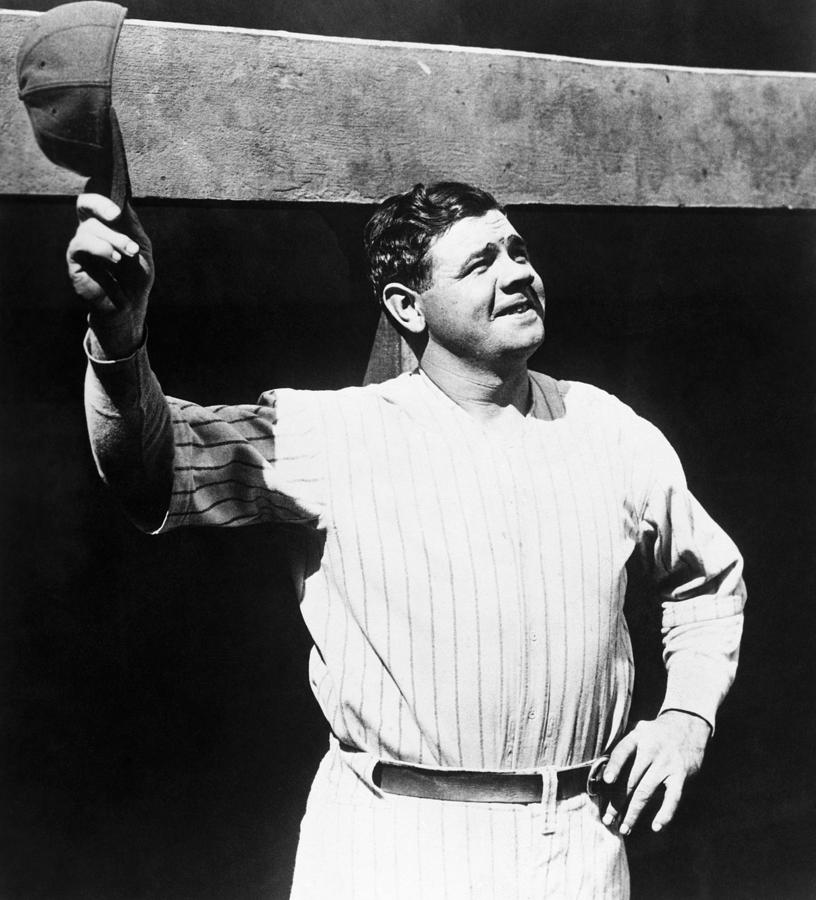
Showing posts with label willie keeler. Show all posts

Monday, March 21, 2016

Top 10 Yankee Right Fielders

And so I close with the last remaining position. Or should I do the Managers as well? Or the Broadcasters?

Two things you'll notice about Yankee right fielders: They win a lot of Pennants, and they have great nicknames. Number 1 on the list having more nicknames than James Brown and Apollo Creed combined.

And, keep in mind, I've already included Lou Piniella and Dave Winfield among the left fielders.

Mention... Honorable?... to Gary Sheffield, 2004-06. He was only a Yankee for 3 seasons, only had 2 good ones, and he did sort of get caught using steroids. But look at the numbers: In 2004 and '05, he batted .291 with 57 doubles, 70 homers and 244 RBIs. That's some heavy production.

And then, in 2006... injuries limited him to 166 plate appearances. He still batted .298, but only 5 doubles, 6 homers and 25 RBIs. And, in postseason play, while he tore it up for the 1997 Florida Marlins (his only World Series win), he was otherwise invisible, both for the Atlanta Braves before he came to the Yankees, and in Pinstripes.

In that infamous 4-game flop in the 2004 ALCS (cough-Roid-Sox-cough), he went 1-for-17 (.059 -- 5-for-21 counting walks for an OBP of .238). In the 2006 ALDS, in which the Yankees meekly went down to the Detroit Tigers, 1-for-12, no walks, no XBH, no RBIs.

His career led to some great totals: .292 BA, 140 OPS+, 2,689 hits, 467 doubles and 509 home runs. But will we ever know how much of that was legit?

10. Nick Swisher, 2009-12. He hit 105 of his 245 home runs as a Yankee, with a 124 OPS+ (113 overall), helped the Yankees reach the Playoffs all 4 times, and helping the team loosen up after a few years of a "corporate" image was a big reason why the Yankees won the 2009 World Series. He now plays for the Atlanta Braves.

9. Jesse Barfield, 1989-92. One of the great embarrassments of my life came when I attended my first Opening Day, in 1990 – and not because it was the start of the worst Yankee season in my lifetime. In fact, the Yankees won that day, beating the Cleveland Indians. But there was a point late in the game when Barfield came up, and I yelled, "Come on, Jesse, you can do it!" Guess who was pitching for the Indians: Former Met closer Jesse Orosco. Perhaps not as bad as that night in 1994 when the Yankees were playing Texas in April, and a hockey Playoff score went up on the scoreboard, and the home fans chanted, "Let's go Rangers!" But bad enough.

But there was nothing wrong with cheering for Jesse Barfield. Well, maybe in 1985, when he helped the Toronto Blue Jays reach the postseason for the first time, beating the Yankees out for the AL East title as the teams battled in Toronto on the final weekend. In 1986 he had 108 RBIs, led the AL with 40 homers and made the All-Star Team.

In 1986 and '87, he won Gold Gloves. He had one of the best right field arms of his time, along with Winfield and Dwight Evans. George Bell in left, Lloyd Moseby in center and Barfield in right was a fantastic outfield. When the Yankees sent Al Leiter to the Jays for him on April 30, 1989, Barfield was arguably the greatest player the Jays' franchise (then in its 13th season) had yet had.

Unfortunately, as so often happened to the Yankees in the Eighties, injuries prevented a guy who was great elsewhere from being great in The Bronx. Barfield hit 60 homers in what amounted to 3 full seasons in Pinstripes, but by 1992 he was broken-down. Still, despite playing in unfriendly ballparks (Exhibition Stadium was a wind tunnel and Yankee Stadium is bad for righthanded hitters), he managed to hit 241 home runs.

He became a broadcaster for the Blue Jays, and now runs a baseball school in Houston. He is the father of 2 professional ballplayers: Josh played 2nd base for the Indians, and Jeremy got as far as Single-A ball.

8. Hank Bauer, 1948-59. Mel Allen, the Voice of the Yankees, gave him a nickname that rhymed with his name: The Man of the Hour. He sure was: From a catch sliding on his knees to make the final out of the 1951 World Series to homering in 1958 to extend his World Series hitting streak to 17 games – still a record – Hank always seemed to be coming through.

He was pretty good in the regular season, too: A 113 OPS+, 2 .300+ seasons, 164 homers despite being a righthanded hitter in the pre-renovation Yankee Stadium, a 3-time All-Star, led the AL in triples in 1957.

And nobody messed with this Marine Corps veteran of the battles of Guadalcanal and Okinawa – 2 Bronze Stars and 2 Purple Hearts to go with his 7 World Series rings. In 1966, he managed the Baltimore Orioles to their 1st-ever Pennant and World Series win.

7. George Selkirk, 1934-42. It wasn't going to be easy for the man who would replace Babe Ruth as the Yankees' right fielder. It was harder still because he was given Ruth's Number 3, which was not retired until right before Ruth' death in 1948. But it was worse for Selkirk: His nickname was Twinkletoes. No, he wasn't gay (that I know of): The nickname was because he seemed to be dancing across the outfield to make great plays.

He could hit, too. A 2-time All-Star, he batted .300 5 times, and twice had 100 RBIs. His career OPS+ was 127, so he wasn't just padding stats in the hitting-friendly 1930s. He helped the Yankees win 6 Pennants (1936, '37, '38, '39, '41 and '42) and 5 World Series (all but the last). But he was already in decline by 1940, and after World War II never returned to the majors as a player.

He did serve as a major-league and minor-league manager, and a major-league scout (with the Yankees) and general manager (with the “new” Washington Senators, getting him on the Washington Wall of Stars at Robert F. Kennedy Stadium and now Nationals Park). Probably the greatest Canadian native in Yankee history, he is a member of the Canadian Baseball Hall of Fame.

6. Willie Keeler, 1903-09. The 1st man to play for all 3 of the classic New York City teams, the Brooklyn native actually began his career in 1892 with the New York Giants. A a year later he went to his hometown team – and, yes, until January 1, 1898, the day the consolidation of "Greater New York" took effect, Brooklyn was a separate city. But Wee Willie's sojourn in Brooklyn didn't last long, and in 1894 he went to the original Baltimore Orioles, winning the next 3 NL Pennants.

Unfortunately for him, his best year was the next, 1897, when the Orioles lost to the Boston Beaneaters (forerunners of the Braves) in what author Bill Keller, in his book A Game of Brawl, called the 1st truly great Pennant race. (If you love baseball and you do not have this book, find it. You'll thank me later.) Keeler batted .424, had 239 hits (an National League record for years to come), and 74 RBIs (a good total in the Dead Ball Era). He hit no home runs, but had 27 doubles and 19 triples.

Also that season, he had a 44-game hitting streak, the longest in baseball history for 44 years (Joe DiMaggio), and while it was matched after 81 years (Pete Rose), it has never been topped in the NL (114 years). And yet, according to Keller's book, the streak was barely even mentioned at the time – hence lots of people's surprise when it was mentioned that Keeler, not George Sisler with 41, had the real record that DiMaggio was going for.

In 1899, he was brought back to Brooklyn, and led the Dodgers (the name was used off and on from 1883 to 1931, but at this time they were officially called the Superbas) to back-to-back Pennants. Since there was no postseason series in either year, the 1899 and 1900 Pennants marked the last World Championship for a Brooklyn sports team until the 1955 Dodgers.

In 1903, Keeler was lured across the City to Manhattan and the brand-new New York Highlanders, who changed their name to the New York Yankees in 1913, after the nickname had been unofficial almost the whole time. In 1904, he batted .343, and he, pitching superstar Jack Chesbro, and pitcher-manager Clark Griffith nearly led them to the Pennant. It was not to be, nor was it in 1906 when the team again finished 2nd. In 1910, he played one last season for the Giants and hung 'em up.

His lifetime batting average was .341, his OPS+ 126, and he fell just 68 hits short of 3,000. At 5-foot-4 and 140 pounds, he was not only one of the smallest players in major league history, but the smallest in the Hall of Fame. In 1999 – 89 years after his last game, and 76 years after he died – The Sporting News put him at Number 75 on its list of the 100 Greatest Baseball Players, the smallest, and aside from Cy Young the earliest-debuting.

If Wee Willie Keeler is remembered at all today, it is for his nickname, and thus his lack of height, his hitting streak, and his advice to hitters, meaning to not drink so much and to keep the ball away from opposing fielders: "Keep your eye clear, and hit 'em where they ain't."

5. Roger Maris, 1960-66. A lack of longevity and physical health prevents the man from Fargo, North Dakota from being higher on this list, but make no mistake, he was a great all-around player. He was named AL MVP in 1960 – and deserved it, too, hitting 39 home runs with 112 RBIs. True, Mickey beat him in both categories, but Roger was the difference between the Yanks' mediocre 3rd-place finish the season before and their Pennant that season.

Everyone talks about the homers the Rajah hit, but he took a few away, too. He was probably the best-fielding right fielder the Yankees ever had, and might have been the best-fielding outfielder in team history except for DiMaggio.

Of course, he will always be remembered – usually fondly, but there are some still alive who choose not to – for "61 in '61," the single-season home run record he set on October 1, 1961, and, if we're being honest, still stands, because Mark McGwire, Sammy Sosa and Barry Bonds were not honest.

Some said he wasn't good enough to break the record of Babe Ruth, and that the 8 extra games that season gave him an unfair advantage. Well, Roger batted against black and Hispanic pitchers, which the Babe didn't have to do – which also counters the argument that, "In 1961, the pitching was watered down by expansion." The Babe also never batted against the forkball (predecessor of the split-fingered fastball) like Roger did, and faced very few sliders, knuckleballs and screwballs, unlike Roger who batted in a time when those pitches were well-known. (Then again, Roger faced very few of the pitches that fall into the category of “spitballs,” while the Babe faced plenty.)

And Roger had 698 plate appearances in the 161 games he played in 1961, while the Babe had 691 in his 151 games in 1927 – in other words, those extra 8 (or 10) games gave Roger an average of one extra trip to the plate per extra game. Or, to put it another way: In 1927, Babe Ruth hit a home run every 11.52 plate appearances; in 1961, Roger Maris, every 11.33. Slightly better.

Roger won 7 Pennants in his career (1960, '61, '62, '63, '64, '67 and '68) and 3 World Series (1961, '62 and '67). He, Johnny Hopp and Enos Slaughter are the only players to win World Series with each of the top 2 teams in terms of most Series won: The Yankees (27) and the St. Louis Cardinals (10).

Injuries limited Roger to what amounted to 10 full seasons, and 275 home runs. But this 4-time All-Star had a 127 career OPS+. To give you an idea, there were 4 right fielders in Roger's generation who made the Hall of Fame. Hank Aaron's was 155. Frank Robinson's was 154. But Al Kaline's was 134, and Roberto Clemente's was 130 – theirs wasn't substantially higher than Roger's, and no one questions whether they belong in the Hall of Fame.

But does Roger belong? Baseball-Reference.com's Hall of Fame Monitor has him at 89 out of 100 (a bit short), and their HOF Standards have him at 22 out of 50 (well short). Their 10 Most Similar Batters include some interesting names, including ex-Yankees Barfield, Curtis Granderson and Jay Buhner (and also Hank Sauer, not to be confused with Hank Bauer), but not HOFers. In all honesty, I can’t say that Roger Maris belongs in the Baseball Hall of Fame.

But he is in Yankee Stadium's Monument Park, his Number 9 is retired, and he has a museum in his memory in his hometown of Fargo, North Dakota, at the West Acres Shopping Center. I should say, "In his honor," because it opened in 1984, while he was still alive. When asked by the man running it if he could, Roger asked 2 conditions: That it be where people could easily get to it (a mall would have parking lots and bus service) and that admission be free. Both requests were granted.

4. Paul O'Neill, 1993-2001. In spite of his recent endorsement of Donald Trump, My Man O'Neill remains 1 of my 2 favorite athletes of all time. (You'll see the other in a moment.) Why?Because he played the game the way I would have: With desire, with intensity, with a drive to win that would make the fans say, "This is the guy for us." The difference is, Paulie Pinstripes had something I don't have. It's called "talent."

His intensity reminded me a lot of Lou Piniella, who was his manager on the 1990 World Champion Cincinnati Reds. When the Yankees got him for Roberto Kelly in the 1992-93 offseason, I was thrilled. His lefty stroke was perfect for Yankee Stadium, and he could field, too.

What I didn't know was that he was also a great opposite-field hitter (in fact, nearly all the 1996-2001 Yankee stars were), that he would win a batting title in 1994, that he would play through pain, that he would hit one of my favorite home runs of all time (the Mel Rojas Game, June 26, 1998), and that he would have the most important plate appearance in Yankee history (his 9th-inning walk that led to him scoring the tying run, saving Game 1 of the 2000 World Series and making possible the most important of Yankee World Series wins, the one over The Other Team).

You know how much this guy is loved, right? Knowing that he had talked about retiring, and that it was probably his last game at Yankee Stadium, the fans chanted his name late in Game 5 of the 2001 World Series – a game the Yankees were losing at the moment. For once, Yankee Fans decided something was more important than winning. They did not, however, give such a salute to Tino Martinez, even though the rumor was already floating that Yankee brass would not re-sign him, but rather would go after Jason Giambi. I wonder what the fans would have done if they'd known Scott Brosius was also retiring. Or if it would be the last home game in The Bronx for Chuck Knoblauch. But O'Neill got the kind of reaction that Don Mattingly might have gotten – if he'd gotten that far even once.

Lifetime batting average .288 (.303 with the Yankees), OPS+ 120 (125), 451 doubles (304), 281 homers (185). Won 6 Pennants (1990, '96, '98, '99, 2000 & '01, all but the 1st with the Yankees) and 5 World Championships (all but the last). His Number 21 was briefly given out to pitcher LaTroy Hawkins in 2008, which was received rather poorly at The Stadium. Hawkins, who had not previously worn it (usually wearing 32) and had no attachment to it, wisely gave it up. Paulie got his Monument Park Plaque, but it is time to retire his number.

3. Tommy Henrich, 1937-50. Probably the best of the many nicknames Mel Allen thought up was "Ol' Reliable" for the man from Massillon, Ohio – which was already renowned as a football factory, but he is still the greatest baseball player to come from the town.

How reliable was Henrich? In 1941, when DiMaggio's bat was stolen in between games of a doubleheader, right after Joe had tied Sisler's AL record of a 41-game hitting streak, he remembered that the bat that Joe was using was his own model – Louisville Slugger then made them to each player's specifications – and offered Joe another of his own. Joe took it and broke Sisler's record, and the previous Henrich/DiMaggio bat was recovered in time for Joe to break the Keeler record.

Later that season, seeing that Mickey Owen of the Brooklyn Dodgers had dropped the ball, Henrich was reliable enough (and alert enough) to turn a game-ending strikeout into the start of a rally, and the Yankees won Game 4 of the World Series.

On October 5, 1949, in Game 1 of that year's World Series, Henrich broke up a scoreless pitching duel between Allie Reynolds and the Dodgers' Don Newcombe by taking Newk deep, and hitting the 1st walkoff home run (as we would now call it) in the history of postseason baseball.

Henrich missed the 1942 and '43 Series due to serving in the Coast Guard in World War II, but was with the Yankees in their World Championship seasons of 1937, '38, '39, '41, '47, '49 and '50 – and the Yankees won all 7 of those.

When he died in 2009, he was 96 years old, the oldest living Yankee, the last one to have played for Lou Gehrig, and the last player to have won a World Series in the 1930s. As late as 1994, he was still coming to Old-Timers' Day. He wore Number 7 before The War, and Number 15 after it; both are retired, but neither for him. Still, I can't help thinking that Ol' Reliable deserves a Plaque in Monument Park.

2. Reggie Jackson, 1977-81. Did I say a lack of longevity hurts Maris? Yeah, well, this is my list, and this is my favorite athlete of all time. Henrich or Jackson? Old Reliable or Mister October? The difference in the nicknames is negligible, if you think about it.

Reggie was probably a better all-around player when he was younger, with the Oakland Athletics dynasty of the 1970s. Supposedly, when George Steinbrenner was trying to sign him in the 1976-77 offseason, Billy Martin objected, saying he's a bad fielder, strikes out too much, and would "mess up my running game." Billy, you already had Thurman Munson, Graig Nettles, Chris Chambliss and Lou Piniella. You didn't need a damn running game! And, as Reggie proved (and as another Philly-area native who starred in New York, Mike Piazza, would later say), if you hit the ball far enough, you don’t have to run.

Reggie's lifetime batting average is .262, one of the lowest of any nonpitcher in the Hall of Fame. And his 2,597 strikeouts are an all-time record. But his BA rises to .281 if you count only his Yankee seasons, his career OPS+ is a hefty 139 (148 in Pinstripes), he had 2,584 hits, including 463 doubles and 563 homers – among non-cheaters, the only ones with more are Hank Aaron, Babe Ruth, Willie Mays, Ken Griffey Jr., Jim Thome, Frank Robinson and Harmon Killebrew. He hit 18 homers in postseason play, including 5 in the 1977 World Series (only Chase Utley in 2009 has matched that in a Series), including 3 in Game 6 (a one-game performance preceded only by Ruth, in '26 and again in '28, and not done since).

He was the American League regular-season and World Series MVP in 1973, and was the Series MVP again in 1977. In 21 seasons, with the A's, Yanks and California Angels (he also had 1 with the Baltimore Orioles, but they didn't make the postseason), he reached the postseason 11 times (1971, '72, '73, '74, '75, '77, '78, '80, '81, '82 and '86). He won 6 Pennants (1972, '73, '74, '77, '78 and '81) and 5 World Series (all but the last of those). He was one of those guys about whom it was said, "It's funny how these winning teams keep following him around." He says he never said it, but if he did, he wasn't lying: He really was "the straw that stirs the drink."

As I said, he's in the Hall of Fame. His Number 9 was retired by the A's, his Number 44 by the Yankees (on August 14, 1993 – I was there), who also gave him a Plaque in Monument Park (July 6, 2002 – I wasn't gonna miss that day, either). The Angels haven't retired his Number 44 yet, nor have they elected him to their team Hall of Fame – what are they waiting for?

But for the Yankees, Reggie is the symbol of a generation of stars that amazed, shocked, sometimes appalled, and so often thrilled. He helped to bring the excitement back to The Bronx – and away from Flushing Meadow. He was the 1st black man to be a star for the Yankees (in a way that the quiet, good but not spectacular Elston Howard or even the Pennant-clinching Chris Chambliss could never be), thus helping local black fans to see that the Yankees could bring in their people as well.

He was the right man in the right place at the right time: The man who was the biggest star of the team that meant the most to me when I was first seeing what sports was. For that reason, whatever his flaws, Mr. Reginald Martinez Jackson will always be my guy.

In spite of his massive ego, he understands what matters most: In an interview with Tom Seaver shown on WPIX-Channel 11 prior to his number retirement ceremony (which came a few days after his Hall of Fame induction), he said, "It's not important that I did it; what's important is that it was done."

And nobody ever did more for baseball than this last man – not even Jackie Robinson, because, if you think about it, if this guy hadn't done what he did, baseball wouldn't have been big enough of a stage upon which to try an experiment like the one Jackie and Branch Rickey tried.

1. Babe Ruth, 1920-34. What can I say about the Big Guy that hasn't already been rehashed a thousand times? Not much. But there is much to say about The Great Bambino that needs to be said.

He's not only in the Hall of Fame, but he was one of the 1st 5 inductees when they began voting in 1936, along with Ty Cobb, Christy Mathewson, Honus Wagner and Walter Johnson. A life-size wooden carving, meticulously shaped and painted (right down to the fold of his shirt and the cracks on the leather of his belt), of the Babe, and another of Ted Williams by the same artist, greets you when you walk into the Hall in Cooperstown, New York.

He was elected to the All-Century Team in 1999, 64 years after his last game, by fans whose parents were too young to have ever seen him play. The Yankees retired his Number 3, and put a Monument on the field at Yankee Stadium on Opening Day 1949, a few months after his death, before moving it to the new Monument Park in 1976, and to the new Stadium's Monument Park in 2009.

Is he The Greatest Baseball Player Who Ever Lived? Let me put it this way. From 1915 to 1918, 4 years, he was a lefthanded pitcher as good as Randy Johnson. Then, from 1919 to 1934, 16 years, he was a lefthanded hitter better than Barry Bonds, and he didn't use steroids, either -- they weren't available. Book editor and baseball writer Daniel Okrent said, "It's like Beethoven and Cezanne were the same man, doing the same things." No, it wasn't: Beethoven composed music, Cezanne painted. Pitching and hitting are different sides of the same game, so it's more like if he were a great film actor and a great film director. Like Orson Welles, who also got fat midway through his career. Except Welles' window of greatness turned out to be very brief; the Babe was one of the best players in the game over a 20-season stretch.

And if you think Willie Mays was the greatest all-around baseball player who ever lived, you're wrong: Willie  was not in the Babe's league as a hitter (figuratively or literally), Willie never threw a pitch in a major league game, and there's no way Willie, even as good an outfielder as he was, was as good at preventing runs as even the best pitchers of his time, which the Babe was one of in his own time.

And don't tell me the Babe never faced black or Latin pitchers: He faced them on postseason "barnstorming tours," and the surviving accounts of those at-bats show that they weren't any more successful at getting him out than white pitchers were in regular-season and postseason games.

The new Yankee Stadium is not "The House That Ruth Built." But the Babe Ruth Plaza outside the right-field stands, across 161st Street from the site of the ballpark whose construction his home runs, and the money they made for Colonel Jacob Ruppert, made possible, testifies to his life, his performance, and his legacy.

He played in 10 World Series (1915, '16 and '18 with the Boston Red Sox; 1921, '22, '23, '26, '27, '28 and '32 with the Yankees), winning 7 (1915, '16, '18, '23, '27, '28 and '32). As much as Ruppert's money and Ed Barrow's trades and purchases, Ruth’s hitting made the Yankees, and made baseball, more popular than ever before, aided by the development of radio and motion pictures, and doing it in the media center of North America, New York City. Had he put up the same numbers in Boston, playing there for his entire career instead of just the first 6 seasons (5 full), it would simply not have been the same.

"A big, badly flawed, swashbuckling palooka who strides with great spirit -- not just talent, but with a spirit of possibility and an enjoyment of life -- across the American stage. That's an American... You give me Babe Ruth over any king who's ever sat on the throne, and I'll be happy with that trade." – Bob Costas.

Except he was a king. The King of Crash. The Sultan of Swat. The Rajah of Rap. The Majarajah of Mash. The High Mandarin of Maul. The Wizier of Wham. The Czar of Clout. (Sometimes it's "the Colossus of Clout," and you can add "the Behemoth of Bust," although neither the Colossus of Rhodes nor the mythological Behemoth was a monarch.)

Some people compare baseball to religion. Well, as with Christianity, in baseball, a babe shall lead them. Then again, Babe Ruth tended to lie in places other than a manger. And he certainly did a lot that required repentance and forgiveness. But has any American ever been loved by more people in his own time? Don't forget, even Washington, Lincoln and FDR had their haters during their public service.

The Babe was one of a kind, and my generation hasn't seen another – and, if the rise and fall of Mark McGwire is any indication, we never will, and neither will any other generation. More than any other player, he was the right man, in the right place, at the right time.

Like Art LaFleur said while playing the Babe in The Sandlot: "Heroes get remembered, but legends never die."

Saturday, April 5, 2014

The New York Yankees' All-Time Regional Team

Finally, the project is finished. The 30th team -- the home team -- my team. The New York Yankees.

Not that I'm "saving the best for last." After all, while no team in all of sports can match the Yankees for glory, their regional team is not necessarily the best.

Remember, this team is for players who:

1. Were from either the State of New York, North or Central New Jersey, or the southwestern one-third of Connecticut, and...

2. Had an organizational connection to the Yankees -- or, if also to the Mets, New York Giants or Brooklyn Dodgers, a greater one to the Yankees. Failing that...

3. Publicly expressed a fandom for the Yankees while growing up. Failing that...

4. Came from The Bronx, Staten Island, the Hudson Valley from Westchester on up to the Canadian border, or Central New York including the Syracuse area -- which, interestingly enough, would include any Major League Baseball player who actually came from Cooperstown, Otsego County (alas, there have been none).

Batter up!

1. The New York Yankees' All-Time Regional Team

Each of these players was from the State of New York, unless otherwise stated.

1B Lou Gehrig of Manhattan, and that Borough's High School of Commerce and Columbia University. The Iron Horse has been out of baseball for 75 years, and he is still the greatest 1st baseman of all time.

Cal Ripken may have broken his record of 2,130 consecutive games played (June 1, 1925 to April 30, 1939), and Alex Rodriguez has broken his record of 23 career grand slams. And A-Rod and several other players in the post-World War II era have hit more than Lou's 493 home runs, and a few have hit 4 home runs in a game (although he was the first to do it in the American League). But who's going to bat .340 for a career? Or have a 178 career OPS+? Or have 1,995 RBIs in a career? Or have 184 RBIs in a season, still the AL record? Or hit 534 doubles?

He won the AL Most Valuable Player award in 1927 (under the old format, in which a player could win it only once, and teammate Babe Ruth already had) and 1936 (under the current format, although not in 1934 when he became the first Yankee to win the Triple Crown).

He was the AL's starting 1st baseman in the 1st 6 All-Star Games, 1933 to 1938. He appeared in 7 World Series (1926, '27, '28, '32, '36, '37 and '38), winning all but the first, and batted .361 in Series play -- let's see A-Rod, or anyone else, try that! Had there been an MVP for the Series back then, he probably would have won it in '27, '28 and '32.

Despite several injuries that looked like they would break his streak, he played every game for 14 years, at a time when the life of a ballplayer was far less cushy. It took a fatal illness to stop him, amyotrophic lateral sclerosis, or ALS -- which became known as Lou Gehrig's Disease. (Since he died just 2 years after the diagnosis, and several people, including the great physicist Stephen Hawking, have lived for years or even decades with ALS, some people now think Gehrig may have been misdiagnosed.)

The Yankees retired his Number 4, the 1st retired number in baseball, making him the only Yankee ever to wear it. On Lou Gehrig Appreciation Day, July 4, 1939, he told the crowd at Yankee Stadium, "Today, I consider myself the luckiest man on the face of the Earth... I might have been given a bad break, but I've got an awful lot to live for."

The Hall of Fame, thinking he would die before he became eligible, held a special election, and he was easily elected. Shortly after his death in 1941, the Yankees dedicated a Monument to his memory, which now stands in Monument Park at the new Yankee Stadium. And East 161st Street, just past the elevated tracks, between River Avenue and the Grand Concourse, was renamed Lou Gehrig Plaza.

In 1999, 60 years after his last game, The Sporting News named him Number 6 on their list of the 100 Greatest Baseball Players, and he was elected in a fan ballot to the All-Century Team -- getting more votes than even the Babe.

He was portrayed in films by Gary Cooper in The Pride of the Yankees (1942, with Teresa Wright as his wife Eleanor and Babe Ruth as himself), and by Edward Herrmann in A Love Affair: The Eleanor and Lou Gehrig Story (1978, with Blythe Danner -- Gwyneth Paltrow's mother -- as Eleanor). As Bob Costas has said, "There's one area where Gehrig has it all over Ruth: The movies about Gehrig are good, the movies about Ruth are all bad!"

He is buried at Kensico Cemetery in Valhalla, New York, as are the Yankee-connected Jacob Ruppert, Ed Barrow and Robert Merrill; former Red Sox owner Harry Frazee; legendary entertainer and briefly Seattle Mariners part-owner Danny Kaye; New York's first Jewish Governor, Herbert Lehman; entertainer Florenz Ziegfeld; RCA & NBC founder David Sarnoff; composer Sergei Rachmaninoff; Big Band leader Tommy Dorsey (but not his brother Jimmy); historian Allan Nevins; Atlas Shrugged writer Ayn Rand; and a far better author, Network writer Paddy Chayefsky. Gate of Heaven Cemetery in the adjoining town of Hawthorne is right next-door, and is where Babe Ruth and Billy Martin are buried.

And, yes, that is a color photograph of Lou Gehrig, in a Yankee home uniform, at the top of this post.

2B Eddie Collins of Tarrytown, Westchester County. Just as New York produced the best 1st baseman ever, here's a good candidate for best 2nd baseman ever. Known as Gettysburg Eddie because he went to Gettysburg College -- just as Gehrig was known as Columbia Lou -- he played for the Philadelphia Athletics, then the Chicago White Sox, and finished up back with the A's, where he also served as one of Connie Mack's coaches, his son Eddie Jr. eventually playing for the A's as well.

He batted .333 lifetime, OPS+ of 142, 3,315 hits, 438 doubles, 187 triples, and 741 stolen bases, peaking at 81 in 1910.  Until Bill Mazeroski came along, he was frequently regarded as the best-fielding 2nd baseman of his time.

He won Pennants with the A's in 1910, '11, '13, '14, '29 and '30, and with the White Sox in 1917 and '19 (and was always held up as one of the Sox who stayed clean). His playing career ended before uniform numbers were universally adopted, but he did wear Number 32 as an A's coach. (Not that it matters, since the Philly edition of the A's are no longer around to retire it, and the Oakland edition haven't retired any numbers from their Philly era.)

He was elected to the Baseball Hall of Fame, and to the Philadelphia Baseball Wall of Fame, his plaque having been moved from Veterans Stadium to the Philadelphia Athletics Historical Society display at Spike's Trophies in Northeast Philadelphia. For the last few years of his life, he was the general manager of the Boston Red Sox, and a plaque in his memory graces the Jersey Street/Yawkey Way old main entrance of Fenway Park. When The Sporting News announced its 100 Greatest Baseball Players in 1999, he came in at Number 24, despite not having played a game in 69 years.

Honorable Mention to Johnny Evers of Troy, Rensselaer County, across the Hudson River from the State Capital of Albany. It's easy, now, to think that he's only in the Hall of Fame because of the poem that Franklin P. Adams wrote about the 1906-10 Chicago Cubs double-play combo: "These are the saddest of possible words: Tinker to Evers to Chance."

But while Joe Tinker was not a great shortstop (those he was a good one), and 1st baseman Frank Chance is rightly in the Hall for his managing, Evers was the best player of the three. He won Pennants with the Cubs in 1906, '07, '08 and '10, and with the Boston Braves in 1914. He starred on the only Cub teams ever to win the World Series, in 1907 and 1908. It was his effort to get the attention of umpire Hank O'Day that got the winning run in the "Merkle's Boner" Game of September 23, 1908 cancelled, leading to the Cubs' Pennant. He wasn't one of the nicest men in the game (his nickname was the Crab), but one of the smartest.

Honorable Mention to Stanley "Bucky" Harris of Port Jervis, Rockland County. He would have been an All-Star had there been an All-Star Game in the 1920s, and he managed the Washington Senators to their first and only World Series win in 1924, at the tender age of 27. "The Boy Manager" or "The Boy Genius" won another Pennant with the Senators in 1925, and another World Series with the Yankees in 1947 (at age 50). But he's not the manager of this team.

Honorable Mention to Willie Randolph of Brooklyn, and that Borough's Samuel Tilden H.S. Born in South Carolina, he grew up in Bedford-Stuyvesant as a Met fan, but played his best years for the Yankees. He won Pennants in 1976, '77, '78 and '81, and World Championships 1977 and '78. He also appeared in the postseason with the 1990 AL Champion Oakland Athletics. He was a 6-time All-Star.

Later a Yankee coach (6 more Pennants, 4 more rings), the Mets hired him as manager, and he got them to within 1 run of the Pennant in 2006... Anyway, Met fans blame "Witless Willie" for blowing that Pennant and for the 2007 collapse, because he was "a Yankee." Damn right he was a Yankee: When he was fired in 2008, he got a HUGE standing ovation at Yankee Old-Timers' Day. At the old Stadium's finale that September, he slid into 2nd base, and got a big cheer. It may have been 2nd base, but he was, truly, safe at home. He later, as he did with the 1994-95 Yankees, coached under Buck Showalter, with the Baltimore Orioles, and is now a studio analyst for ESPN.

SS Phil Rizzuto of Queens, and that Borough's Richmond Hill H.S. Holy Cow, how could a guy only 5-foot-6 and maybe 140 pounds be a starting quarterback? Well, it was high school football, and it was the early 1930s. He was turned away by his favorite team, the Brooklyn Dodgers, whose manager supposedly said, "You're too small, kid. Go get a shoeshine kit." Then he was turned away by the New York Giants. But the Yankees agreed to give him a tryout, and in 1937, they signed him to a minor-league contract. For the next 70 years, he was a part of the Yankee family.

As a minor-leaguer, his speed and fielding earned him the nickname "Scooter." In 1940, with the Kansas City Blues, he was named Minor League Player of the Year by The Sporting News. There was no Rookie of the Year award in 1941, but if there was, he surely would have won it for the AL.

After returning from World War II, he became the best shortstop in the AL, with a player of nearly identical ability (and, as it turned out, pretty close in career stats) across town, Harold "Pee Wee" Reese of the Brooklyn Dodgers. They would oppose each other in 6 World Series. Phil was a member of 9 Pennant winners with the Yankees: 1941, '42 (missing '43 due to the War), '47, '49, '50 (AL MVP with 200 hits), '51, '52, '53 and '55, winning 7 World Series (1941, '47, '49, '50, '51, '52 and '53). This despite, from 1949 onward, being reunited with the Dodger manager who rebuffed him in 1937, Casey Stengel.

Casey sure changed his tune: "If I were a retired gentleman, I would watch the Yankees just to watch Phil Rizzuto." Pitcher Lefty Gomez: "My best pitch is anything the batter hits in the direction of Phil Rizzuto." Joe DiMaggio, at a ceremony honoring the 50th Anniversary of the 1941 Yankees and his 56-game hitting streak: "Nobody had a better view than I of watching him play shortstop... And, Phil, I just want to say, that you're my Hall-of-Famer. And I mean that." (I was there that day: Joe's comment got a huge ovation, especially considering that, both being Italian-Americans, Joe was Phil's big hero, and Joe didn't talk in public much, much less give compliments easily.)

Released in 1956, Phil was hired as a broadcaster in 1957, beginning a 40-season run behind the microphone. His memorable calls included Roger Maris' 61st home run in 1961 and Chris Chambliss' Pennant-winning homer in 1976. His broadcasting included 12 seasons in which the Yankees won Pennants (from 1957 to 1996), and 6 in which they won World Series -- making his grand total 21 Pennants and 13 World Series. (Only 2 Yankee figures can compare to these totals: Mel Allen's broadcasting career included 23 Pennants and 15 World Championships, while Bob Sheppard was public-address announcer for 22 Pennants and 13 World Championships.)

His broadcasting was really good early on, but by the time I became old enough to watch games on television in the late 1970s, he had become an object of parody, for his catchphrases ("Holy Cow!"; "Did you see that?"; "You huckleberry!"), his referring to his boothmates by their last names ("I tell ya, White, it's unbelivable"; "Ooh, these Yankees can get the clutch hits, Murcer!"); his misreading of plays ("Deep to left-center, nobody's gonna get that one! Holy Cow, somebody got it!"; "All right, stay fair! No, it won't stay fair. Good thing it didn't stay fair, or I think he would have caught it."; "Bouncer to short, they'll never get him, no, why don't I just shut up!"); his "homerism" in the Yankees' favor; his stories about the old days of baseball, his plugging of local restaurants and golf courses, and his wishes for a happy birthday or anniversary or get-well wishes. In this, he was a lot like Richie Ashburn, the Phillies' center fielder-turned-broadcaster who, like Phil, had to wait a long time before he finally got his rightful election to the Hall of Fame.

Well before that, the Yankees retired his Number 10 and gave him a Phil Rizzuto Day and a Plaque for Monument Park. I was at both his Day in 1985 and his HOF induction ceremony in 1994. He retired from broadcasting after the 1996 season, but still came to Old-Timers' Day until 2004, when age and fragility forced him into hospice care. He died in 2007, and at the time he was the oldest living Hall-of-Famer.

For the record, Harry Caray claimed he was saying "Holy Cow!" on the air when Phil was still playing. But Phil claimed he was saying "Holy Cow!" as a player before he ever heard of Harry Caray. So maybe they're both right. Phil was cremated, and his remains are not at any cemetery.

Honorable Mention to George Wright of Yonkers, Westchester County. All he did was become the first great openly professional baseball player, with the 1869-70 Cincinnati Red Stockings. His brother Harry Wright (who, unlike George, was already grown up when the family moved from England, and thus doesn't qualify for this team) formed the game's 1st great double-play combination. So not only did one pair of Wright Brothers in Ohio (Orville and Wilbur of Dayton) invent the airplane, but an earlier pair of Wright Brothers invented professional baseball as we know it.

3B Billy Johnson of Montclair, Essex County, New Jersey. Born the same day as Ted Williams, August 30, 1918, and outlived him, lasting until 2006. He wasn't as good a hitter as Williams (shocking, I know), but he was a member of 4 Yankee World Championship teams: 1943, '47, '49 and '50. Unfortunately, he's the best of a weak batch at this position in this region, but he was an All-Star in 1947.

I had considered Frank Malzone of The Bronx, and that Borough's Samuel Gompers H.S., but it wouldn't have felt right putting a career Red Sock on this team. Still, he was a 6-time All-Star and a 3-time Gold Glove.

LF Hank Greenberg of The Bronx, and that Borough's James Monroe H.S. Mainly played 1st base, but played left field almost exclusively in 1940, '41 and '45, as the Tigers tried to find a place where Rudy York, a good slugger but a born DH in a pre-DH world, could do the least damage on the field.

Known as "Hammerin' Hank" before Henry Louis Aaron was even born, Henry Benjamin Greenberg won AL MVP awards in 1935 and 1940 – the former at 1st base, the latter in left field, becoming the first player to win MVPs at 2 different positions. (Only one has done it since, Robin Yount.) Besides, if I didn't move Hank to left field, he wouldn't even have started ahead of Lou Gehrig, his idol and the reason the Yankees didn't pursue this great slugger growing up in their own backyard.

Because the Yankees already had Gehrig, they didn't pursue Greenberg. The Detroit Tigers did, and he rewarded their decision. In 1934, he hit 63 doubles (the 2nd-highest total in MLB history), and helped them win their first Pennant in 25 years, despite missing a key game down the stretch because it fell on Yom Kippur, the holiest day in the Jewish calendar. (This was a year before Sandy Koufax was born, and 31 years before Koufax would do the same on the day of Game 1 of the World Series.)

In 1935, he won the AL MVP, and led the Tigers to their 1st World Championship, although he was injured during the World Series. In 1937, he had a whopping 183 RBIs, 1 off Gehrig's AL record. In 1938, he hit 58 home runs, and for a while it looked like he might break Babe Ruth's record of 60. In 1940, he won the MVP and led the Tigers to another Pennant.

Then he became the 1st baseball All-Star to enlist in the armed forces, in anticipation of World War II. Discharged in the middle of the 1945 season, he rejoined the Tigers, and hit a grand slam on the last day of the regular season to win the Pennant, and the Tigers won the World Series as well.

A bad back convinced him to retire after 1946, but the Pittsburgh Pirates talked him out of it by offering him baseball's first $100,000-a-year contract. As a Pirate, he mentored young slugger Ralph Kiner (who would also have to retire early because of a bad back), and told Dodger rookie Jackie Robinson, as only he with his background of facing horrible anti-Semitism possibly could, that he understood what Jackie was going through, earning him Jackie's permanent admiration.

The original "Hammerin' Hank" walked away after that season, with a .313 batting average, a 158 OPS+, and 1,628 hits and 331 home runs despite having played only enough games to add up to 10 full seasons. He then joined Bill Veeck in the front office of the Cleveland Indians, mentored Jewish slugger Al Rosen (yet another victim of a bad back), helped build the Indians' 1948 World Champions, and joined Veeck again to build the Chicago White Sox' 1959 Pennant winners. Late in life, he became one of the nation's foremost players in senior-citizens' tennis tournaments.

He was elected to the Hall of Fame, and the Tigers retired his Number 5. When The Sporting News announced its 100 Greatest Baseball Players in 1999, he came in at Number 37. Hank Greenberg: The Story of My Life, edited by New York Times columnist Ira Berkow, is one of the classics of sports literature. Oh yeah, one more thing to thank Hank for: His son Steve Greenberg, a good ballplayer whose career was ended by injury before he could reach the majors, founded Classic Sports Network, which became ESPN Classic. Having settled in the Los Angeles area, Hank is buried there.

CF Elliott Maddox of Union, Union County, New Jersey. Considering that New York has been home to such center fielders as Earle Combs, Joe DiMaggio, Pete Reiser, Duke Snider, Willie Mays, Mickey Mantle, Tommie Agee, Mickey Rivers, Mookie Wilson, Lenny Dykstra, Bernie Williams, Carlos Beltran and Curtis Granderson, you'd think there'd be a better Tri-State Area native at the position. But Maddox is the best -- even though, with the unrelated Garry in Philadelphia, he wasn't even the best center field named Maddox in his era.

Not that it was all his fault: In 1975, playing for the Yankees at Shea Stadium while the original Yankee Stadium was being renovated, he slipped on the wet grass and wrecked his knee. He was in the middle of his second straight .300 season, but he was never the same. Almost literally adding insult to injury, his last 3 seasons, 1978-80, were back at Shea, with a horrible Mets team.

RF Willie Keeler of Brooklyn. At 5-foot-4 and 140 pounds (maybe), Wee Willie is the smallest player in the Hall of Fame. But he was big at the plate, batting .341 lifetime, OPS+ of 126, 2,932 hits, and in 1897 had a .424 batting average and a 44-game hitting streak -- although this has been matched by Pete Rose and surpassed by Joe DiMaggio in the AL, no NLer has ever had a longer one.

He debuted with the Giants in 1892, making him the earliest player on The Sporting News' 100 Greatest Baseball Players named in 1999 (he came in at Number 75), and played his last game with the Giants in 1910, not just over 100 years ago but 89 years prior to that TSN poll. In he between, helped the NL version of the Baltimore Orioles win Pennants in 1894, '95 and '96; his hometown Brooklyn Superbas win Pennants in 1899 and 1900 (since there was no other league at the time, these would be the last "world championships" the team later known as the Dodgers would win until 1955), and moved to the Highlanders (the future Yankees) and became their first hitting star, nearly helping them win AL Pennants in 1904 and '06. He is probably best remembered for his philosophy of hitting: "Keep your eye clear, and hit 'em where they ain't" -- "they" being opposing fielders.

He died in 1923 and was one of the earliest Hall of Fame inductees, in 1939. He is buried at Calvary Cemetery in Woodside, Queens, also the final resting place of fellow Hall-of-Famer Mickey Welch; former Governor Alfred E. Smith, the first Catholic major-party candidate for President; and all three New York City politicians named Robert F. Wagner: the Senator who wrote the Social Security and National Labor Relations Acts, his son the 1954-65 Mayor who let the Dodgers and Giants get away and then fought to bring the Mets in, and his son who served as President of the Board of Education.

Honorable Mention to Rocky Colavito of The Bronx, and that Borough's Theodore Roosevelt H.S. -- also the alma mater of my grandfather, George Goldberg, who played on its City Champion basketball team in 1924. A 6-time All-Star, Colavito had one of the best outfield arms ever, led the AL in homers with 42 in 1959, nearly leading the Indians to the Pennant, was controversially traded to the Tigers just before the next season, had career highs with 45 homers and 140 RBIs in 1961 as the Tigers had their best season between 1945 and 1967; had 6 100-RBI seasons, and battled injuries for the rest of his career, finishing in 1968 with his boyhood team, even pitching and winning a game for the Yankees. (He also has a tangential role in Yankee history for being one of the Kansas City Royals' coaches in the Pine Tar Game in 1983.)

He hit 374 home runs and had an OPS+ of 132. After being traded by Indians GM Frank Lane, for reasons only Lane ever knew, the Indians, so close to the previous year's Pennant, did not get into another Pennant race until 1994. His popularity was enormous in Northern Ohio, and fans were furious over the trade, the only time a defending league home run champion was traded for a defending batting champion, Harvey Kuenn. (Since Al Kaline wore Number 6 in Detroit, Colavito and Kuenn even swapped numbers, Colavito taking Number 7.) Cleveland-area newspaper columnist Terry Pluto titled a book about the Indians The Curse of Rocky Colavito.

Now 80 and living near Reading, Pennsylvania, Colavito remains proud that the fans love him and hate the long-dead Lane. The Indians elected him to their team Hall of Fame, although his Number 6 remains in circulation.

C Joe Torre of Brooklyn, and that Borough's St. Francis Prep. He wasn't quite Hall of Fame quality as a player, but he was close. He debuted with the Milwaukee Braves in 1960, while his older brother Frank Torre was their 1st baseman. He was runner-up to Cubs star Billy Williams for NL Rookie of the Year in 1961. Moving with the Braves in 1966, he hit the first big-league home run in Atlanta-Fulton County Stadium. Traded to the St. Louis Cardinals for Orlando Cepeda after the 1968 season, he just missed a Cardinal Pennant and a Brave NL West title.

He was a 9-time All-Star, a 1965 Gold Glove winner, and the 1971 NL MVP, winning the batting title with a .363 average -- no NL righthander has topped that since. He finished his career with the Mets, playing mostly 3rd base and 1st base, and in 1977 was briefly player-manager before retiring to concentrate on managing. (There have been only 2 player-managers since: Don Kessinger with the 1979 White Sox and Pete Rose with the 1984-86 Reds.)

As you might guess, Joe is also the manager of this team. Not having the horses with the Mets, he was fired after the 1981 season. He was picked up by the Braves, and managed them to the NL West title in 1982 and almost to another in '83, but was fired in '85. He became a broadcaster, and played himself as such in the film Taking Care of Business, in which the Cubs beat the Angels in the World Series. (At the time, the Angels even being in a World Series was "fantasy baseball" -- for the Cubs, it still is.) He managed the Cardinals for a few years, without reaching the postseason, and was fired in 1995.

He thought he was done. He'd managed all 3 times for whom he played. "I ran out of teams," he joked. He'd been involved in over 4,200 games as a player and a manager without ever appearing in a World Series -- a record.

Then the Yankees threw him a lifeline. The New York Daily News, on its back page, called him "CLUELESS JOE." I was also against the hiring. Well, as Yogi Berra taught us, "In baseball, you don't know nothin'." (Joe and Yogi are 2 of the 4 men to have managed the Yankees and the Mets. The others are Casey Stengel and Dallas Green.)

Joe won the World Series in 1996, 1998, 1999 and 2000; Pennants in 2001 and 2003; AL East titles in 2002, 2004, 2005 and 2006; and Wild Card berths in 1997 and 2007. After receiving an offer of a pay cut from Yankee management, he moved on to the Dodgers, and won NL West titles in 2008 and '09.

Now retired, he was recently elected to the Hall of Fame. Hopefully, the Yankees will retire his Number 6 and give him a Monument Park Plaque while he's still alive to receive it.

SP Waite Hoyt of Brooklyn, and that Borough's Erasmus Hall H.S. He was one of the players Harry Frazee sold from the Red Sox to the Yankees. Big mistake: He won 237 games in his career, 10 of them for the Red Sox and 157 for the Yankees. He won Pennants in 1921, '22, '23, '26, '27 and '28. He won another with the A's in '31. He won the World Series in 1923, '27 and '28. He was the first great pitcher of a "dynastic" Yankee team. Hall of Fame, although, surprisingly, no Plaque in Monument Park. He closed his career with his hometown Dodgers.

He became one of the first former players to become a broadcaster (though not the first, as his Baseball-Reference.com page claims, that was Jack Graney of the Indians), calling games for the Cincinnati Reds from 1940 to 1965. The Reds elected him to their team Hall of Fame. But he never forgot that it was the Yankees that made him rich and famous: He was renowned for telling Yankee stories, especially Babe Ruth stories, during rainouts in games at Crosley Field. He also overcame alcoholism, inspiring thousands of people in the Ohio Valley (the Reds' listening area) to seek help as well, overcoming the stigma. Waite Hoyt was a true hero.

SP Hank Borowy of Bloomfield, Essex County, New Jersey. I'm a little biased here, as Bloomfield is my original hometown. I had Billy Johnson from Bloomfield's arch-rival, Montclair, so I had to have a proud Bengal, Class of '34. (Don Savage, Class of '35, also briefly played for the Yankees.)

A member of a high school football team that went 9-0 and outscored its opponents 325-6 in his senior year, he went to Fordham and helped the Yankees win the 1942 Pennant and the 1943 World Series. He had a rare season winning 20 games spread over both Leagues in 1945, with the Yankees and then, after a trade, to the Cubs. (This would be matched by Indian-turned-Cub Rick Sutcliffe in 1984.) He helped the Cubs win (still) their last Pennant, but was overused in the World Series and had nothing left in Game 7 and got bombed. He came close to another Pennant in 1950: Started the season with the Phillies, who won in the NL; closed it with the Tigers, who finished 2nd in the NL; in between, he pitched for the Pirates, who in those days were lucky if they could challenge for 6th place.

He finished his career at 108-82. He went into the insurance business, and, ironically since he grew up in my old home town, lived the last few years of his life in Brick, Ocean County, New Jersey -- where my grandparents moved after leaving North Jersey, and died in the same hospital as my Grandma.

SP Edward Charles "Whitey" Ford of Queens, and the Manhattan H.S. of Aviation. The all-time winningest Yankee pitcher, and the all-time winningest pitcher in World Series play with 10, he was nicknamed the Chairman of the Board, a nickname he shared with his favorite singer, Frank Sinatra. With a career record of 236-106, his .690 winning percentage is the highest ever among pitchers with at least 300 decisions. His 2.75 ERA is the lowest of any starting pitcher in the post-1920 Lively Ball Era. ERA+ 133, WHIP 1.215.

He won World Series with the Yankees in 1950, '53 (missing '51 and '52 due to serving in the Korean War), '56, '58, '61 and '62. From 1960 to '62, he pitched 33 2/3 consecutive scoreless innings -- still a World Series record, although Mariano Rivera now holds the postseason record. Hall of Fame, Monument Park, Number 16 retired. When The Sporting News announced its 100 Greatest Baseball Players in 1999, he came in at Number 52.

My grandmother, then named Grace Darton, grew up as a Dodger fan in South Jamaica, Queens, and, like any good Dodger fan, she hated the Yankees. Hated Joe DiMaggio. Hated Yogi Berra. Really hated Casey Stengel. Had no use for Mickey Mantle. But two Yankees, she loved: Phil Rizzuto and Whitey Ford. She liked that they were "scrappy," and that Whitey, in an oft-used phrase, was a "money pitcher." Maybe it also had to do with both of them also coming from Queens.

SP Steve Blass of Housatonic, Litchfield County, Connecticut. From age 27 to 30, he was one of the best pitchers in the game, including going the distance to win Game 7 of the 1971 World Series with the Pirates, on the road against the Orioles. He also helped get the Bucs to the NLCS in '70 and '72.

But in '73, he totally lost it. In 1 season, despite the Pirates still being a very good-hitting and good-fielding team, his record went from 19-8 to 3-9, his ERA from 2.49 to 9.85 (nope, that's not a misprint), his ERA+ from 135 to 36 (also not a typo), and his WHIP from 1.246 to 2.177.

What happened? No one, not even Blass himself, has ever figured it out. The team lost Roberto Clemente to an off-season plane crash, but that didn't affect any other Pirate player the same way, and Blass has gone out of his way to say Clemente's death had nothing to do with his loss of control. There was no injury, no illness, no substance abuse, no problem in his personal life, nothing to explain his sudden loss of control. When a player suddenly loses it, without any logical explanation, it is now known as "Steve Blass Disease." Blass became a broadcaster for the Pirates, although he now does only home games.

SP Andy Messersmith of Toms River, Ocean County, New Jersey. He was born in the seat of Ocean County on August 6, 1945, the day the atomic bomb was dropped on Hiroshima, and he was part of a nuclear change in baseball.

He is 1 of only 2 pitchers to win 20 for both Los Angeles-area teams – and in 1972, he was traded from the Angels to the Dodgers for the other, Bill Singer. A 4-time All-Star, he was runner-up to his teammate Mike Marshall for the 1974 NL Cy Young Award (20-6, 2.59 and leading the NL with a 1.098 WHIP), and pitched in the World Series.

He pitched the 1975 season without a contract to test the reserve clause, and, only 29 years old and one of the game's top starters at the time, he had a lot to lose. He won, and the reserve clause was deservedly dead. He signed with the Braves... but injuries doomed him after that. He did pitch for the Yankees in 1978, but was limited to 6 games and did not appear in the postseason. He had his last productive season at 30 and threw his last pitch at 33.

His career record was 130-99, and his career ERA of 2.861 ranks 4th among starting pitchers whose careers began in the post-1920 Lively Ball era, trailing only Ford, Sandy Koufax (2.76) and Jim Palmer (2.856). But he should have been able to pitch longer, and to put up near-Hall of Fame numbers. He is now the baseball coach at Cabrillo College in Northern California.

Honorable Mention to Chester Cornelius Hoff of Ossining, Westchester County. Born May 8, 1891, Chet (or sometimes "Red") reached the majors on September 6, 1911, pitching for the New York Highlanders – not yet officially the Yankees – at Hilltop Park in Washington Heights, against the Detroit Tigers.

He struck out the 1st batter he faced: "I didn't know who he was, no more than the man in the moon, until the next morning. I picked up The New York Journal, and the big red headline in the paper says, 'Hoff Strikes Out Ty Cobb.' Boy! I couldn't believe it at first. It was the biggest thrill I ever had."

He remained in the majors until 1915, only 24, and had a career record of 2-4. He stayed on for a while in the minors, pitching well in Rochester, Salt Lake City and Kansas City, but threw his last professional pitch at 27.

So what's the big deal? Well, after working for Rand McNally mapmakers in Ossining, he retired to Florida, and returned to New York for the dedication of a plaque at Columbia-Presbyterian Medical Center, built on the site of Hilltop Park, in 1993. He was 102 years old. He lived to be 107, until September 17, 1998. He was the last living player to have played in the pre-1920 Dead Ball Era, and is believed to be the longest-lived former major league athlete in North American history.

Honorable Mention to Johnny Vander Meer of Midland Park, Bergen County. Best known for pitching the only pair of back-to-back no-hitters in MLB history, June 11 & 15, 1938, for the Cincinnati Reds. The 2nd was against the Dodgers at Ebbets Field, in the first night game in New York's major-league history.

Vander Meer was interviewed for John P. Carmichael's classic 1945 book My Greatest Day In Baseball, and he said that those no-hitters weren't his career highlight, because he got sent down in 1939, but came back up, and redeemed himself by pitching the Pennant clincher. The Reds won another Pennant in 1940, and won the World Series.

Like another no-hit hero, Don Larsen, he was slightly below .500 for his career. (In fact, their records were very close: Larsen was 114-118, Vander Meer was 119-121.) But Vander Meer had 5 seasons of at least 15 wins, and made 4 All-Star teams. His achievement was a fluke, but he was still, often, a very good pitcher.

Honorable Mention to Frank "Spec" Shea of Naugatuck, New Haven County, Connecticut. "The Naugatuck Nugget" went 14-5 for the Yankees in his rookie season, 1947. He became the first, and still only, Yankee rookie to start Game 1 or Game 7 of a World Series, and was a member of World Championship teams in 1947, '49 and '51 (missing '50 due to service in the Korean War). He was just 56-46 for his career, but his achievements are enough to get him an Honorable Mention here.

Honorable Mention to Johnny Kucks of Jersey City, Hudson County, New Jersey. In 1956, he went 18-9 and pitched a shutout in Game 7 of the World Series. He was also a part of the Yankees' 1958 World Champions.

Honorable Mention to Al Downing of Trenton, Mercer County, New Jersey. He would probably go on the Philadelphia all-time regional team if he hadn't pitched for the Yankees. But he did, and thus became the Yankees' first black pitcher. He had September call-ups in the 1961 and '62 World Championship seasons, but he didn't appear in the World Series and didn't get a ring. He did pitch in the '63 and '64 Series, and led the AL in strikeouts in '64. He was an All-Star in 1967. He went 123-107 for his career, including 20-9 for the Dodgers in 1971.

But he's best known for giving up Hank Aaron's record-breaking 715th career home run in 1974, but he says it doesn't bother him, and he did pitch in that year's World Series. I was at Trenton's Waterfront Park (now Arm & Hammer Park) a few years ago, when he was inducted into the Trenton Baseball Hall of Fame, and he threw out the first pitch. Not a bad slider for a man in his early 60s. He now works in the Dodger organization.

Honorable Mention to Downing's Yankee teammate, Jim Bouton of Rochelle Park, Bergen County, New Jersey. He grew up in Jersey as a Giants fan, then the family moved to the Chicago suburbs, but I'm keeping him here, because he still identified as a Jersey guy.

He helped the Yankees win the 1962 World Series and the '63 and '64 Pennants -- going 39-20 in those 2 seasons, plus winning Games 3 and 6 of the '64 Series. He was just 26 going into the 1965 season. But he hurt his elbow, and his fastball was gone. He switched to the knuckleball, and by 1969 was exiled to an expansion team, the Seattle Pilots.

He kept a diary of that season, which was published early the next season as Ball Four. An injury ended his career that season -- not the backlash against the book, which never "named names" of players who cheated on their wives or were openly bigoted. What he did do was show that players were human, lusty, profane, and didn't like getting pushed around by authority figures such as team owners and the Commissioner of Baseball, the clueless Bowie Kuhn.

Bouton became a sportscaster for WABC-Channel 7's Eyewitness News, then had a brief comeback in 1978 with Ted Turner's Atlanta Braves -- pitching at age 39 when he hadn't done so in the majors since 31. He and a former teammate invented a gum called Big League Chew, and he has written other books since. But Ball Four will live forever, because he took a lot of stuffed shirts, and he smoked 'em inside. You think he doesn't belong on this team? Yeah, surrrre! Take a hike, son!

Honorable Mention to John Montefusco of Long Branch, Monmouth County, New Jersey. With his name and his team, the San Francisco Giants, he became known as "the Count of Montefusco," "the Count of Monte Frisco," or just "the Count." Fortunately, he was good enough to get ahead in the count. He was NL Rookie of the Year in 1975 and pitched a no-hitter for the Giants in 1976. But injuries took their toll, and he was done at 36, closing his career with the Yankees in 1986, at 90-83.

Honorable Mention to Charles Nagy of Fairfield, Fairfield County, Connecticut. A winner of 129 games, all for the Indians, and a 3-time All-Star, he helped them reach the postseason in 1995, '96, '97, '98, '99 and 2001. Unfortunately, he is best known for his relief appearance in Game 7 of the 1997 World Series where, Jose Mesa having already blown a 9th-inning lead, Nagy ended up as the losing pitcher in the 11th. He is in the Indians' team Hall of Fame, and recently served as the pitching coach of the Arizona Diamondbacks.

RP Johnny Murphy of The Bronx, and that Borough's Fordham Prep and Fordham University. One of the first great relief pitchers, he helped the Yankees win Pennants in 1936, '37, '38, '39, '41, '42 and '43, winning the World Series in all but '42. Known as "Grandma" because his windup seemed to resemble the motion of a rocking chair, he may also have been the first reliever to be called "the Fireman" because he seemed to be putting out fires. (Some sources have his successor as Yankee relief ace, Joe Page, being the first to receive the nickname.)

He joined the Mets' front office at their beginning (as a business, anyway) in 1961. Appointed GM in 1967, hired Gil Hodges as manager; between them, they were more responsible than anyone for turning "the worst team in baseball history" (not really, it just seemed like it to those with short memories) into the 1969 World Championship "Miracle.") Sadly, he died just 3 months later.

RP Jim Konstanty of Strykersville, Wyoming County, New York. Warren Spahn of Buffalo is in the Hall of Fame, and Sal Maglie of Niagara Falls probably would have won the NL's Cy Young Award had it existed in 1951, and Orel Hershiser was born in Buffalo but grew up in Cherry Hill, South Jersey. Casimir James Konstanty is the only Western New Yorker to win either League's MVP award, in 1950, and the 1st reliever from anywhere to do so – he would remain the only one until Mike Marshall in 1974.

He was the relief ace of the Phillies' "Whiz Kids" that won the team's only Pennant between 1915 and 1980. He pitched in the 1950 World Series against the Yankees and in the 1955 World Series for them, although he never won a title.

RP Elroy Face of Stephentown, Rensselaer County. The longtime relief ace of the Pittsburgh Pirates, he is believed to be the first pitcher to throw the forkball, a very nasty breaking pitch that was the progenitor of the split-fingered fastball. He claimed to have learned it from a Pirate teammate, the aforementioned former Yankee Joe Page.

In 1959 he set a record for single-season winning percentage, going 18-1 for .947. In 1960, he went 10-8 with 24 saves, and the Pirates won their first World Series in 35 years, with Face saving 3 of their 4 wins. (Only John Wetteland has topped that, but a few others have matched it, including fellow Pirate Kent Tekulve and Mariano Rivera.) A 3-time All-Star, he almost closed his career with another World Champion, the 1968 Detroit Tigers, but got into only 2 games and did not receive a World Series ring. Instead, he was chosen in the expansion draft by the Montreal Expos. He became a carpenter, and still attends sports memorabilia shows.

RP Ron Perranoski of Fair Lawn, Bergen County, New Jersey. I almost put him with the Mets' team, but he was signed by the Dodgers in 1958, their first year in Los Angeles, thus throwing organizational ties out of the way; and, as I’m unaware of what team he rooted for growing up, and he’s white, it falls to geography, so he’s on the Yankees’ team.

He was a superb 16-3 with a 1.67 ERA and 21 saved for the Dodgers' 1963 World Champions, and was also a member of their 1965 World Champions, their 1966 Pennant winners, and the Minnesota Twins' 1969 and '70 AL West Champions. He led the AL in saves in both of those seasons, finishing with 179 for his career. He became one of the game's top pitching coaches, first for the Dodgers, then for the Giants, and is now a member of the Giants' front office, making him the only man to have a World Series ring from both the Los Angeles edition of the Dodgers and the San Francisco edition of the Giants.

RP Joe Nathan of Pine Bush, Ulster County. Injuries cost him the 1996, 2001 and 2010 seasons, and he didn't become a regular reliever until 2003, going 12-4 as the Giants' setup reliever. In 2004, the Twins acquired him to be their closer, At age 29, he had 1 career save. By 39, he had 341 -- and, with the retirement of Mariano Rivera, he is now the active leader.

A 6-time All-Star, he has a career ERA of 2.76, ERA+ of 157, and WHIP of 1.091. He reached the postseason with the Giants in 2003; the Twins in 2004, '06 and '09; and the Texas Rangers in 2012. He's now with the Tigers, so he could have another shot.

And that's it. It's done. All 30 teams.

Saturday, March 5, 2011

Top 10 Yankee Right Fielders

And so I close with the last remaining position. Or should I do the Managers as well? Or the Broadcasters?

Two things you'll notice about Yankee right fielders: They won a lot of Pennants, and they had great nicknames. Number 1 on the list having more nicknames than James Brown and Apollo Creed combined.

And, keep in mind, I’ve already included Lou Piniella and Dave Winfield among the left fielders.

10. Jesse Barfield, 1989-92. One of the great embarrassments of my life came when I attended my 1st Opening Day, in 1990 – and not because it was the start of the worst Yankee season in my lifetime. In fact, the Yankees won that day, beating the Cleveland Indians. But there was a point late in the game when Barfield came up, and I yelled, "Come on, Jesse, you can do it!" Guess who was pitching for the Indians: Former Met closer Jesse Orosco. Perhaps not as bad as that night in 1994 when the Yankees were playing Texas in April, and a hockey Playoff score went up on the scoreboard, and the home fans chanted, "Let's go Rangers!" But bad enough.

But there was nothing wrong with cheering for Jesse Barfield. Well, maybe in 1985, when he helped the Toronto Blue Jays reach the postseason for the 1st time, beating the Yankees out for the AL East title as the teams battled in Toronto on the final weekend. In 1986 he had 108 RBIs, led the AL with 40 homers and made the All-Star Team.

In 1986 and '87, he won Gold Gloves. He had one of the best right field arms of his time, along with Winfield and Dwight Evans. George Bell in left, Lloyd Moseby in center and Barfield in right was a fantastic outfield. When the Yankees sent Al Leiter to the Jays for him on April 30, 1989, Barfield was arguably the greatest player the Jays' franchise (then in its 13th season) had yet had.

Unfortunately, as so often happened to the Yankees in the Eighties, injuries prevented a guy who was great elsewhere from being great in The Bronx. Barfield hit 60 homers in what amounted to 3 full seasons in Pinstripes, but by 1992 he was broken-down. Still, despite playing in unfriendly ballparks (Exhibition Stadium was a wind tunnel and Yankee Stadium is bad for righthanded hitters), he managed to hit 241 home runs. He’s now a broadcaster for the Blue Jays, and the father of 2 professional ballplayers: Josh is a second baseman for the Indians, and Jeremy played in Single-A ball last season.

9. Gary Sheffield, 2004-06. I seriously debated whether to include him – after all, he was only a Yankee for 3 seasons, only had 2 good ones, and he did sort of get caught using steroids. But look at the numbers: In 2004 and '05, he batted .291 with 57 doubles, 70 homers and 244 RBIs. That's some heavy production.

And then, in 2006... injuries limited him to 166 plate appearances. He still batted .298, but only 5 doubles, 6 homers and 25 RBIs. And, in postseason play, while he tore it up for the 1997 Florida Marlins (his only World Series win), he was otherwise invisible, both for the Atlanta Braves before he came to the Yankees, and in Pinstripes. In that infamous 4-game flop in the 2004 ALCS (cough-Roid-Sox-cough), he went 1-for-17 (.059 -- 5-for-21 counting walks for an OBP of .238). In the 2006 ALDS, in which the Yankees meekly went down to the Detroit Tigers, 1-for-12, no walks, no XBH, no RBIs.

His career led to some great totals: .292 BA, 140 OPS+, 2,689 hits, 467 doubles and 509 home runs. But will we ever know how much of that was legit?

8. Hank Bauer, 1948-59. Mel Allen, the Voice of the Yankees, gave him a nickname that rhymed with his name: The Man of the Hour. He sure was: From a catch sliding on his knees to make the final out of the 1951 World Series to homering in 1958 to extend his World Series hitting streak to 17 games – still a record – Hank always seemed to be coming through.

He was pretty good in the regular season, too: A 113 OPS+, 2 .300+ seasons, 164 homers despite being a righthanded hitter in the pre-renovation Yankee Stadium, a 3-time All-Star, led the AL in triples in 1957. And nobody messed with this Marine Corps veteran of the battles of Guadalcanal and Okinawa – 2 Bronze Stars and 2 Purple Hearts to go with his 7 World Series rings. In 1966, he managed the Baltimore Orioles to their 1st-ever Pennant and World Series win.

7. George Selkirk, 1934-42. It wasn't easy for the man who would replace Babe Ruth as the Yankees' right fielder. It was harder still because he was given Ruth's Number 3, which was not retired until right before Ruth's death in 1948. But it was worse for Selkirk: His nickname was Twinkletoes. No, he wasn't gay (that I know of): The nickname was because he seemed to be dancing across the outfield to make great plays.

He could hit, too. A 2-time All-Star, he batted .300 5 times, and twice had 100 RBIs. His career OPS+ was 127, so he wasn't just padding stats in the hitting-friendly 1930s. He helped the Yankees win 6 Pennants (1936, '37, '38, '39, '41 and '42) and 5 World Series (all but the last). But he was already in decline by 1940, and after World War II never returned to the majors as a player.

He did serve as a major-league and minor-league manager, and a major-league scout (with the Yankees) and general manager (with the "new" Washington Senators, getting him on the Washington Wall of Stars at Robert F. Kennedy Stadium and now Nationals Park). He was probably the greatest Canadian native in Yankee history, and is a member of the Canadian Baseball Hall of Fame.

6. Willie Keeler, 1903-09. He was the 1st man to play for all 3 of the classic New York City teams. The Brooklyn native actually began his career in 1892 with the New York Giants, but a year later he went to his hometown team – and, yes, until January 1, 1898, the day the consolidation of "Greater New York" took effect, Brooklyn was a separate city. But Wee Willie's sojourn in Brooklyn didn't last long, and in 1894 he went to the original Baltimore Orioles, winning the next 3 NL Pennants.

Unfortunately for him, his best year was the next, 1897, when the Orioles lost to the Boston Beaneaters (forerunners of the Braves) in what author Bill Keller, in A Game of Brawl, called the 1st truly great Pennant race. (If you love baseball and you do not have this book, find it. You’ll thank me later.) Keeler batted .424, had 239 hits (an NL record for years to come), and 74 RBIs (a good total in the Dead Ball Era). He hit no home runs, but had 27 doubles and 19 triples. And he had a 44-game hitting streak, the longest in baseball history for 44 years (Joe DiMaggio), and while it was matched after 81 years (Pete Rose), it has never been topped in the NL (114 years).

And yet, according to Keller's book, the streak was barely even mentioned at the time – hence lots of people's surprise when it was mentioned that Keeler, not George Sisler with 41, had the real record that DiMaggio was going for.

In 1899, he was brought back to Brooklyn, and led the Dodgers (the name was used off and on from 1883 to 1931, but at this time they were officially called the Superbas) to back-to-back Pennants. Since there was no postseason series in either year, the 1899 and 1900 Pennants marked the last World Championship for a Brooklyn sports team until the 1955 Dodgers.

In 1903, Keeler was lured across the City to Manhattan and the brand-new New York Highlanders, forerunners of the Yankees. In 1904, he batted .343, and he, pitching superstar Jack Chesbro, and pitcher-manager Clark Griffith nearly led them to the Pennant. It was not to be, nor was it in 1906 when the team again finished 2nd. In 1910, he played 1 last season for the Giants, and hung 'em up.

His lifetime batting average was .341, his OPS+ 126, and he fell just 68 hits short of 3,000. At 5-foot-4 and 140 pounds, he was not only one of the smallest players in major league history, but the smallest in the Hall of Fame. In 1999 – 89 years after his last game, and 76 years after he died – The Sporting News put him at Number 75 on its list of the 100 Greatest Baseball Players, the smallest, and, aside from Cy Young, the earliest-debuting.

If Wee Willie Keeler is remembered at all today, it is for his nickname, and thus his lack of height, his hitting streak, and his advice to hitters, meaning to not drink so much and to keep the ball away from opposing fielders: "Keep your eye clear, and hit 'em where they ain't."

5. Roger Maris, 1960-66. No player has hit 'em where they really ain't more in a single season than the Rajah -- not honestly, anyway.

A lack of longevity and physical health prevents him from being higher on this list, but make no mistake, he was a great all-around player. He was named AL MVP in 1960 – and deserved it, too, hitting 39 home runs with 112 RBIs. True, Mickey Mantle beat him in both categories, but Roger was the difference between the Yanks' mediocre 3rd-place finish the season before and their Pennant that season.

And everyone talks about the homers he hit, but he took a few away, too. He was probably the best-fielding right fielder the Yankees ever had, and might have been the best-fielding outfielder in team history except for DiMaggio.

Of course, he will always be remembered – usually fondly, but there are some still alive who choose not to – for "61 in '61," the single-season home run record he set on October 1, 1961 (we're approaching the 50th Anniversary), and, if we're being honest, still stands.

Some said he wasn't good enough to break the record of Babe Ruth, and that the 8 extra games that season gave him an unfair advantage. Well, Roger batted against black and Hispanic pitchers, which the Babe didn't have to do – which also counters the argument that, "In 1961, the pitching was watered down by expansion."

The Babe also never batted against the forkball (the predecessor of the split-fingered fastball) like Roger did, and faced very few sliders, knuckleballs and screwballs, unlike Roger who batted in a time when those pitches were well-known. (Then again, Roger faced very few of the pitches that fall into the category of "spitballs," while the Babe faced plenty of them.) And Roger had 698 plate appearances in the 161 games he played in 1961, while the Babe had 691 in his 151 games in 1927 – in other words, those extra 8 (or 10) games gave Roger an average of one extra trip to the plate per extra game.

Roger won 7 Pennants in his career (1960, '61, '62, '63, '64, '67 and '68) and 3 World Series (1961, '62 and '67). He, Johnny Hopp and Enos Slaughter are the only players to win World Series with each of the top 2 teams in terms of most Series won: The Yankees (27) and the St. Louis Cardinals (10).

Injuries limited Roger to what amounted to 10 full seasons, and 275 home runs. But this 4-time All-Star had a 127 career OPS+. To give you an idea, there were 4 right fielders in Roger's generation who made the Hall of Fame. Hank Aaron's was 155. Frank Robinson's was 154. But Al Kaline's was 134, and Roberto Clemente's was 130 – theirs weren't substantially higher than Roger's, and no one questions whether they belong in the Hall of Fame.

But does Roger belong? Baseball-Reference.com's Hall of Fame Monitor has him at 85 out of 100 (a bit short), and their HOF Standards, which are weighted much more toward career totals, have him at 22 out of 50 (well short). Their 10 Most Similar Batters include some interesting names, including ex-Yankees Barfield, Danny Tartabull and Jay Buhner (and also Hank Sauer, not to be confused with Hank Bauer), but not HOFers. In all honesty, I can't say that Roger Maris belongs in the Baseball Hall of Fame.

But he is in Yankee Stadium's Monument Park, his Number 9 is retired, and he has a museum in his memory in his hometown of Fargo, North Dakota, at the West Acres Shopping Center. I should say, "In his honor," because it opened in 1984, while he was still alive. When asked by the man running it if he could, Roger asked 2 conditions: That it be where people could easily get to it (a mall would have parking lots and bus service) and that admission be free. Both requests were granted.

4. Paul O’Neill, 1993-2001. My Man O’Neill. Why him? Why is he one of my 2 favorite athletes of all time? (You'll see the other in a moment.) Because he played the game the way I would have: With desire, with intensity, with a drive to win that would make the fans say, "This is the guy for us." The difference is, Paulie Pinstripes had something I don't have. It's called "talent."

His intensity reminded me a lot of Lou Piniella, who was his manager on the 1990 World Champion Cincinnati Reds. When the Yankees got him for Roberto Kelly in the 1992-93 offseason, I was thrilled. His lefty stroke was perfect for Yankee Stadium, and he could field, too. What I didn't know at the time was that he was also a great opposite-field hitter (in fact, nearly all the 1996-2001 Yankee stars were), that he would win a batting title in 1994, that he would play through pain, that he would hit one of my favorite home runs of all time (the Mel Rojas Game, June 26, 1998), and that he would have the most important plate appearance in Yankee history (his 9th-inning walk that led to him scoring the tying run, saving Game 1 of the 2000 World Series and making possible the most important of Yankee World Series wins, the one over The Other Team).

You know how much this guy is loved, right? Knowing that he had talked about retiring, and that it was probably his last game at Yankee Stadium, the fans chanted his name late in Game 5 of the 2001 World Series – a game the Yankees were losing at the moment. For once, Yankee Fans decided something was more important than winning. They did not, however, give such a salute to Tino Martinez, even though the rumor was already floating that Yankee brass would not re-sign him, but rather would go after Jason Giambi. I wonder what the fans would have done if they'd known Scott Brosius was also retiring. Or if it would be the last home game in The Bronx for Chuck Knoblauch. 

But O'Neill got the kind of reaction that Don Mattingly might have gotten – if he'd gotten that far even once. Yankee Fans knew of his passion for the game. They knew he was what George Steinbrenner called him: "The Warrior."

He had a lifetime batting average .288 (.303 with the Yankees), an OPS+ of 120 (125), 451 doubles (304) and 281 homers (185). He won 6 Pennants (1990, ’96, ’98, ’99, 2000 & ’01, all but the first with the Yankees) and 5 World Championships (all but the last). His Number 21 was briefly given out to pitcher LaTroy Hawkins in 2008, which was received rather poorly at The Stadium. Hawkins, who had not previously worn it (usually wearing 32) and had no attachment to it, wisely gave it up. It is time to give Paulie his retired number and his Monument Park Plaque.

3. Tommy Henrich, 1937-50. Probably the best of the many nicknames Mel Allen thought up was "Ol' Reliable" for the man from Massillon, Ohio – which was already renowned as a football factory, but he is still the greatest baseball player to come from the town.

How reliable was Henrich? In 1941, when DiMaggio's bat was stolen in between games of a doubleheader, right after Joe had tied Sisler's AL record of a 41-game hitting streak, he remembered that the bat that Joe was using was his own model – Louisville Slugger then made them to each player’s specifications – and offered Joe another of his own. Joe took it and broke Sisler's record, and the previous Henrich/DiMaggio bat was recovered in time for Joe to break the Keeler record.

Later that season, seeing that Mickey Owen of the Brooklyn Dodgers had dropped the ball, Henrich was reliable enough (and alert enough) to turn a game-ending strikeout into the start of a rally, and the Yankees won Game 4 of the World Series. On October 5, 1949, in Game 1 of that year's World Series, Henrich broke up a scoreless pitching duel between Allie Reynolds and the Dodgers' Don Newcombe by taking Newk deep, and hitting the 1st walkoff home run (as we would now call it) in the history of postseason baseball.

Henrich missed the 1942 and '43 Series due to serving in the Coast Guard in World War II, but was with the Yankees in their World Championship seasons of 1937, '38, '39, '41, '47, '49 and '50 – and the Yankees won all 7 of those.

When he died in 2009, he was 96 years old, the oldest living Yankee, the last one to have played for Lou Gehrig, and the last player to have won a World Series in the 1930s. As late as 1994, he was still coming to Old-Timers' Day. He wore Number 7 before The War, and Number 15 after it; both are retired, but neither for him. Still, I can't help thinking that Ol' Reliable deserves a Plaque in Monument Park.

2. Reggie Jackson, 1977-81. Did I say a lack of longevity hurts Maris? Yeah, well, this is my list, and this is my favorite athlete of all time. Henrich or Jackson? Old Reliable or Mister October? The difference in the nicknames is negligible, if you think about it.

Reggie was probably a better all-around player when he was younger, with the Oakland Athletics dynasty of the 1970s. Supposedly, when George Steinbrenner was trying to sign him in the 1976-77 offseason, Billy Martin objected, saying he's a bad fielder, strikes out too much, and would "mess up my running game." Billy, you already had Thurman Munson, Graig Nettles, Chris Chambliss and Lou Piniella. You didn’t need a damn running game! And, as Reggie proved (and as another Philly-area native who starred in New York, Mike Piazza, would later say), if you hit the ball far enough, you don't have to run.

Reggie's lifetime batting average is .262, one of the lowest of any nonpitcher in the Hall of Fame. And his 2,597 strikeouts are an all-time record (although Jim Thome comes into the 2011 season only 202 behind him, and will probably play at least 2 more seasons). But his BA rises to .281 if you count only his Yankee seasons, his career OPS+ is a hefty 139 (148 in Pinstripes), he had 2,584 hits, including 463 doubles and 563 homers – among non-cheaters, the only ones with more are Hank Aaron, Babe Ruth, Willie Mays, Ken Griffey Jr., Jim Thome, Frank Robinson and Harmon Killebrew.

He hit 18 homers in postseason play, including 5 in the 1977 World Series (only Chase Utley in 2009 has matched that), including 3 in Game 6 (a 1-game performance preceded only by Ruth, in '26 and again in '28, and not done since).

He was the AL regular-season and World Series MVP in 1973, and was the Series MVP again in 1977. In 21 seasons, with the A’s, Yanks and California Angels (he also had one with the Baltimore Orioles, but they didn’t make the postseason), he reached the postseason 11 times (1971, '72, '73, '74, '75, '77, '78, '80, '81, '82 and '86). He won 6 Pennants (1972, '73, '74, '77, '78 and '81) and 5 World Series (all but the last of those). He was one of those guys about whom it was said, "It's funny how these winning teams keep following him around.:"He says he never said it this, but if he did say it, he wasn't lying: He really was "the straw that stirs the drink."

As I said, he's in the Hall of Fame. His Number 9 was retired by the A's, his Number 44 by the Yankees (on August 14, 1993 – I was there), who also gave him a Plaque in Monument Park (July 6, 2002 – I wasn't gonna miss that day, either). The Angels haven't retired his Number 44 yet, nor have they elected him to their team Hall of Fame – what are they waiting for?

But for the Yankees, Reggie is the symbol of a generation of stars that amazed, shocked, sometimes appalled, and so often thrilled. He helped to bring the excitement back to The Bronx – and away from Flushing Meadow. He was the 1st black man to be a star for the Yankees (in a way that the quiet, good but not spectacular Elston Howard or even the Pennant-clinching Chris Chambliss could never be), thus helping local black fans to see that the Yankees could bring in their people as well.

He was the right man in the right place at the right time: The man who was the biggest star of the team that meant the most to me when I was first seeing what sports was. For that reason, whatever his flaws, Mr. Reginald Martinez Jackson will always be my guy.

In spite of his massive ego, he understands what matters most: In an interview with Tom Seaver shown on WPIX-Channel 11 prior to his number retirement ceremony (which came a few days after his Hall of Fame induction), he said, "It's not important that I did it. What's important is that it was done."

And nobody ever did more for baseball than this last man – not even Jackie Robinson, because, if you think about it, if this guy hadn't done what he did, baseball wouldn't have been big enough of a stage upon which to try an experiment like the one Jackie and Branch Rickey tried.

1. Babe Ruth, 1920-34. What can I say about the Big Guy that hasn't already been rehashed a thousand times? Not much. But there is much to say about The Great Bambino that needs to be said, and I'll do that in a later post.

He's not only in the Hall of Fame, but he was one of the 1st 5 inductees when they began voting in 1936, along with Ty Cobb, Christy Mathewson, Honus Wagner and Walter Johnson. A life-size wooden carving, meticulously shaped and painted (right down to the fold of his shirt and the cracks on the leather of his belt), of the Babe, and another of Ted Williams by the same artist, greets you when you walk into the Hall of Fame Gallery in the Hall of Fame building in Cooperstown, New York.

He was elected to the All-Century Team in 1999, 64 years after his last game, by fans whose parents were too young to have ever seen him play. The Yankees retired his Number 3, and put a Monument on the field at Yankee Stadium on Opening Day 1949, a few months after his death, before moving it to the new Monument Park in 1976, and to the new Stadium's MP in 2009.

The new Yankee Stadium is not "The House That Ruth Built." But the Babe Ruth Plaza outside the right-field stands, across 161st Street from the site of the ballpark whose construction his home runs, and the money they made for Colonel Jacob Ruppert, made possible, testifies to his life, his performance, and his legacy.

He played in 10 World Series (1915, '16 and '18 with the Boston Red Sox; 1921, '22, '23, '26, '27, '28 and '32 with the Yankees), winning 7 (1915, '16, '18, '23, '27, '28 and '32). As much as Ruppert's money and Ed Barrow's trades and purchases, Ruth's hitting made the Yankees, and made baseball, more popular than ever before.

"A big, badly flawed, swashbuckling palooka who strides with great spirit - not just talent, but with a spirit of possibility and an enjoyment of life across the American stage. That's an American... You give me Babe Ruth over any king who's ever sat on the throne, and I'll be happy with that trade." – Bob Costas

Except he was a king. The King of Crash. The Sultan of Swat. The Rajah of Rap. The Majarajah of Mash. The High Mandarin of Maul. The Wizier of Wham. The Czar of Clout. (Sometimes it's "the Colossus of Clout," and you can add "the Behemoth of Bust," although neither the Colossus of Rhodes nor the mythological Behemoth was a monarch.)

Some people compare baseball to religion. Well, as with Christianity, in baseball, a babe shall lead them. Then again, Babe Ruth tended to lie in places other than a manger. And he certainly did a lot that required repentance and forgiveness. But has any American ever been loved by more people in his own time? Don't forget, even Washington, Lincoln and FDR had their haters during their public service.

The Babe was one of a kind, and my generation hasn't seen another – and, if the rise and fall of Mark McGwire is any indication, we never will, and neither will any other generation. More than any other player, he was the right man, in the right place, at the right time.

As Art LaFleur, who also played disgraced Chicago White Sox 1st baseman Chick Gandil in Field of Dreams, said when playing the Babe's ghost in The Sandlot, "Heroes get remembered, but legends never die."