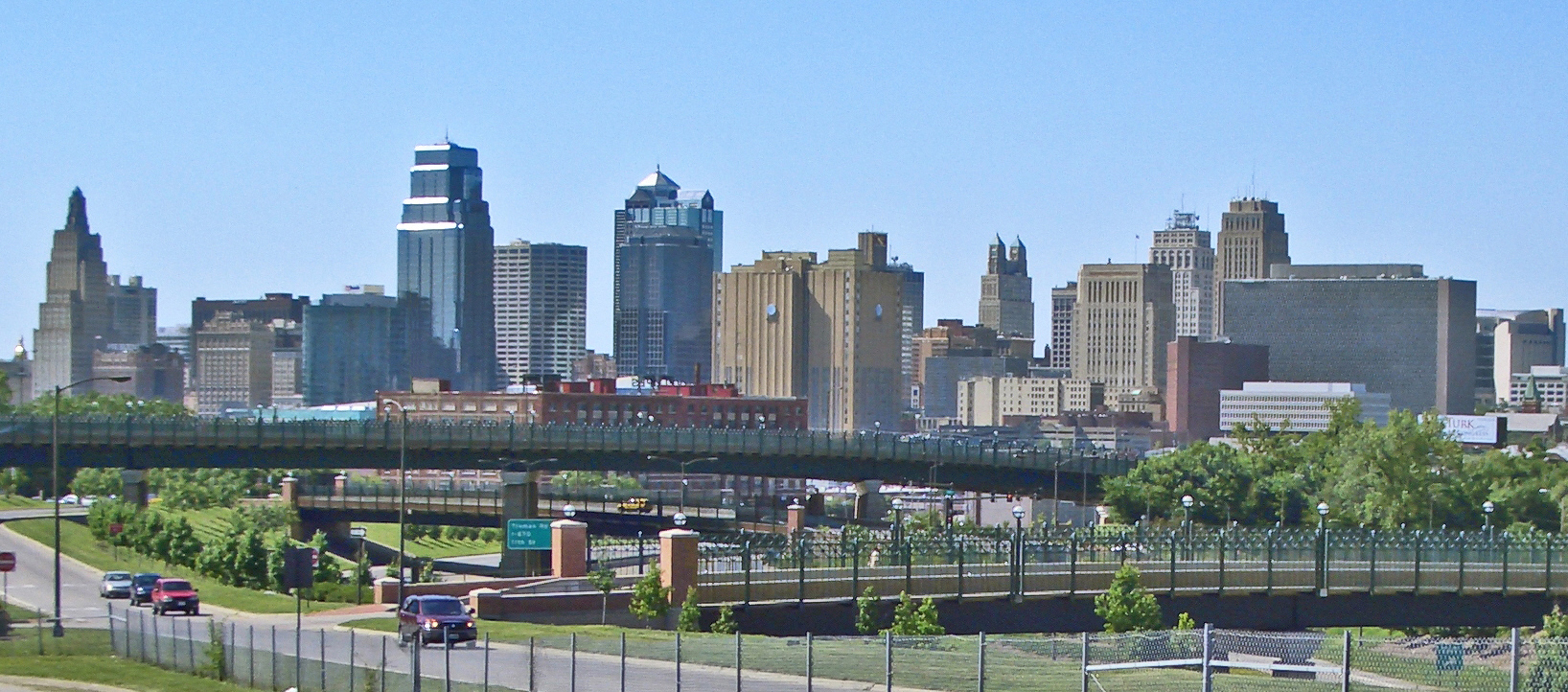
Going to Kansas City.
Kansas City, here I come.
They got some crazy little women there
and I'm a-gonna get me one.
Jerry Lieber and Mike Stoller wrote that tune back in the 1950s, and it's been recorded by a lot of people. It hit Number 1 for Wilbert Harrison in 1959.
It doesn't say anything about baseball, though. Until recently, the Royals had a very spotty history -- they didn't make the Playoffs for 28 seasons (1986 to 2013), and in 58 seasons of Major League Baseball (13 for the A's, 1955-67; 45 for the Royals, 1969-2013), the city had been in the postseason just 7 times.
That changed in 2014, as they won one of the American League's Wild Card slots, won the Pennant for the 1st time since their 1985 World Championship, took the San Francisco Giants to the 9th inning of Game 7 of the World Series, won another Pennant last year, and reaped the rewards of the Mets embarrassing themselves in the World Series to take their 1st title in 30 years.
Kansas City has quite a fascinating baseball history, and should still be regarded as a good baseball town.
Before You Go. Check the Kansas City Star website for the weather forecast before you go. (The rival Kansas City Times stopped publishing in 1990.) K.C. can get really hot in the summer, but, this time, the problem won't be the temperatures, but the rain: It should be in the low 70s by day, and the low 50s at night, but "Scattered Thunderstorms" are predicted for Friday. There could be at least one rain delay, maybe even a rainout, and Kauffman Stadium has no seats covered.
Kansas City is in the Central Time Zone, an hour behind New York and New Jersey. Adjust your timepieces accordingly.
Tickets. The Royals averaged 18,661 fans per home game in 2019, the last pre-COVID season. What this means for a fan visiting Kansas City is that you can pretty much walk up to the ticket booth on the day of the game and buy any seat you can afford.
Dugout Boxes run $92, Field Boxes $52, Outfield Boxes $39, Hy-Vee Boxes (these and all after them are upper deck) $23, and Hy-Vee View $16.
Getting There. Kansas City's Crown Center is 1,194 road miles from New York's Times Square, and it's 1,190 miles from Yankee Stadium to Kauffman Stadium. Knowing this, your first reaction is going to be to fly out there. Round-trip, nonstop, on United Airlines can be just $438. When you get there, the 129 bus takes you from Kansas City Mid-Continent Airport to downtown in under an hour, so that's convenient.
Bus? Not a good idea. Greyhound runs 6 buses a day between Port Authority and Kansas City, and only 2 of them are without changes in Pennsylvania (possibly in Philadelphia, possibly in Pittsburgh). The total time is about 29 hours, and costs $614 round-trip, although it can drop to as little as $363 with advanced purchase -- only a little less than flying this time. The Greyhound terminal is at 1101 Troost Avenue, at E. 11th Street. Number 25 bus to downtown.
Train? Amtrak sends the Lake Shore Limited out of Penn Station at 3:40 PM Eastern Time, to Union Station in Chicago at 9:50 AM Central Time. Then you have to switch to the Southwest Chief – the modern version of the Santa Fe Railroad's Chicago-to-Los Angeles Super Chief, the train that, along with his Cherokee heritage, gave 1950s Yankee pitcher Allie Reynolds his nickname.
The Southwest Chief leaves Chicago at 2:50 PM, and arrives at Union Station in K.C. at 10:00 PM, meaning you would need to leave New York on Wednesday afternoon to get there Thursday night, about 21 hours ahead of the Friday game, in order to attend the entire series. Round trip fare is $427, also only slightly less than flying. K.C.'s Union Station is at Pershing Road and Main Street. Take the MAX bus to get downtown.

Union Station in Kansas City. This city has a fountain fetish.
You'll cross the northern tip of West Virginia, and go all the way across Ohio (through Columbus), Indiana (through Indianapolis), Illinois and very nearly Missouri (through the northern suburbs of St. Louis). You'll begin the Missouri section in St. Louis, on the Stan Musial Memorial Bridge; and end it in Kansas City, on the George Brett Super Highway. (The St. Louis portion of I-70 had been the Mark McGwire Highway, but after the steroid revelations, it was renamed the Mark Twain Highway.) In Missouri, Exit 9 will be for the Sports Complex. But you'd be crazy to come all this way and not get a hotel so you'll get a decent night's sleep, so take I-70 right into downtown.
If you do it right, you should spend about an hour and 15 minutes in New Jersey, 5 hours in Pennsylvania, 15 minutes in West Virginia, 3 hours and 45 minutes in Ohio, 2 hours and 30 minutes in Indiana, 2 hours and 30 minutes in Illinois, and 4 hours and 15 minutes in Missouri before you reach the exit for your hotel. That's going to be nearly 19 and a half hours. Counting rest stops, preferably 7 of them, and accounting for traffic in both New York and Kansas City, it should be about 28 hours.
Once In the City. Kansas City, founded in 1838 and named for the Kanza tribe of Native Americans who lived there, is one of the smallest cities in the major leagues, with just 480,000 people, and one of the smallest metropolitan areas, with 2.4 million -- indeed, if you rank the 30 MLB markets (remembering to divide New York, Los Angeles, Chicago and San Francisco in half, although the fandom doesn't really break that way), only Milwaukee has a smaller market.
Kansas City is set on the confluence of the Missouri and Kansas Rivers, and on the Missouri/Kansas State Line. Kansas City, Kansas is a separate city with about 150,000 people, and is known locally as KCK, while the more familiar city is KCMO. As for KCMO, Main Street runs north-south and divides Kansas City addresses between East and West, while the north-south addresses start at 1 at the Missouri River. Famously (or infamously), prior to the Civil Rights Act of 1964, Kansas City was segregated: North of 27th Street was white, south of it was black.

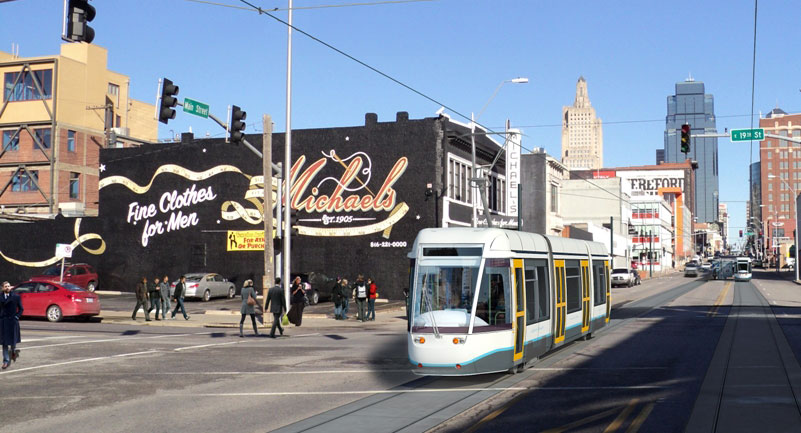
The Kansas City Streetcar light rail system
The State Capitol is in Jefferson City, 147 miles east of downtown Kansas City, 126 miles west of downtown St. Louis, and 30 miles south of the University of Missouri campus in Columbia.

The Missouri State House,
on the Missouri River in Jefferson City
ZIP Codes for the Missouri side of the Kansas City area start with the digits 640 and 641; and for the Kansas side, 660 and 661. The Area Codes are 816 in Missouri, 913 in Kansas. The metro area does not have a "beltway." Kansas City Power & Light Company (KCP&L) runs the electricity.
With its legacy of jazz and the Negro Leagues' Monarchs, Kansas City has been one of the top cities for black American culture. And it has been luckier than most in terms of racial disturbances. But in back-to-back years, it suffered one of the 1967 "Long Hot Summer" riots and another following the assassination of Martin Luther King.

Public transportation is not much of an option. In fact, aside from Arlington, Texas, this may be the most unfriendly ballpark in the majors for those without a car. The Number 28 bus will drop you off at 35th Street South and Blue Ridge Cutoff, and then it's a one-mile walk down the Cutoff, over I-70, to the ballpark. The Number 47 bus will drop you off a little closer, on the Cutoff at 40th Terrace, about half a mile away.
Most fans will enter by the spiral walkways behind home plate, a holdover from the 1960s sports stadium architecture that also befell Giants Stadium, among others.
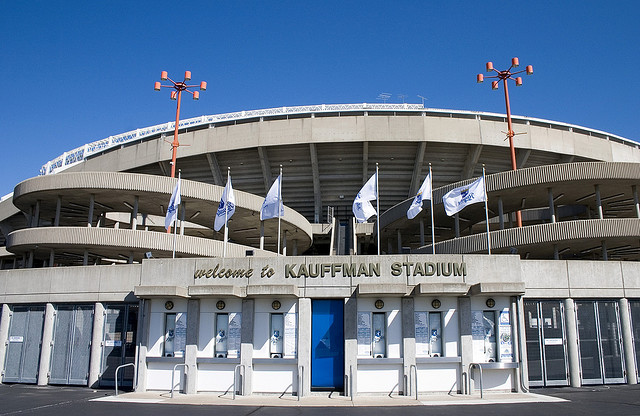
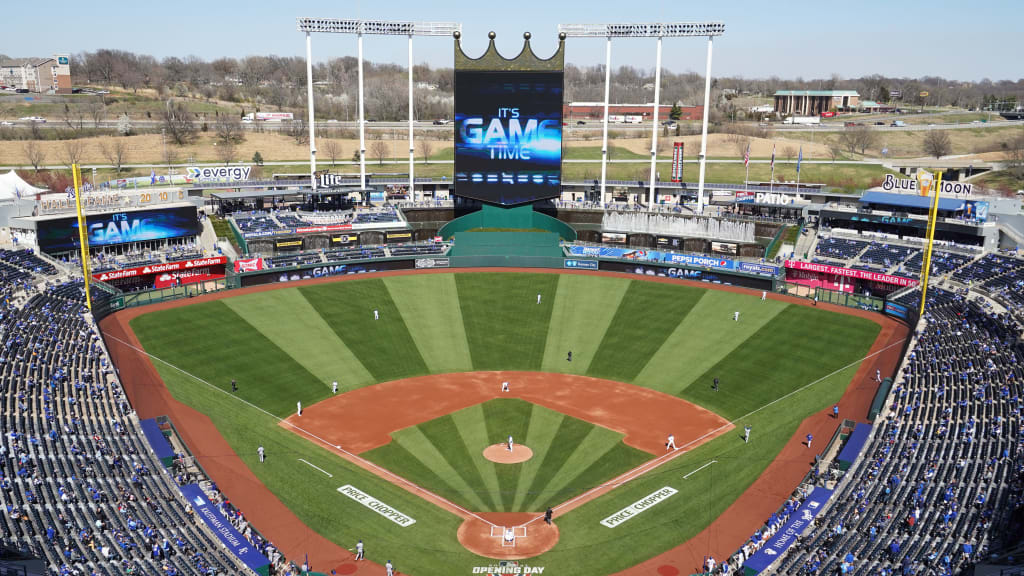

Johnny Bench hit a 480-foot home run there in the 1973 All-Star Game, in the park's 1st season. If you only count the regular season, the park's longest home run was a 475-foot shot by Bo Jackson in 1986. In 2014, Mike Trout hit one there that ESPN said went 489 feet, but they measure from home plate to where the ball would have landed if nothing had gotten in the way. You're supposed to measure from home plate to where the ball first hits anything, and so Bench's drive is still, well, the benchmark.
With the carpet replaced by real grass, the Royals' go-go-go game of the 1976-85 era is reduced, although the franchise was in decline well before the switchover to grass in 1995. Seating capacity is currently listed as 37,903, pushable to 40,933 with standing room.
Arrowhead Stadium has been selected by the U.S. Soccer Federation as a finalist to be one of the host venues for the 2026 World Cup. (UPDATE: FIFA approved it as a venue.)
Food. Kansas City has a reputation for great barbecue, and "The K" has that, and some other good food items. Royals All-Star Barbecue is behind Sections 221 (3rd base) and 422 (Upper Deck behind home plate). The .390 Bar & Grill (named for George Brett's 1980 batting average) is in the upper deck on the 3rd base side.
Blue Moose Sausage Emporium is under the right field stands. Boulevard Brewing Company is behind 223. Boulevard Pub is at 230. The Captain Morgan Bar is at 420. Crown Classics (presumably the usual ballpark fare with a team-themed name) are all over the place. Dugout Dog House stands are behind 208 and 247. Farmland Grill is at 239.
There are several Hot Corner Grills and FryWorks stands. There are 4 Hostess Sweet Spot stands (Deep-fried Twinkies, perhaps?), Mexican-themed KC Cantina Cart at 224 and 232, an Irish Pub (no cutesy faux-Hibernian name) at 218 and 237, German-themed Leinenkugel's Leinie Lodge at 412 and Nutty Bavarian at 213 and 242, and – brace yourselves, Yankee Fans – the Pine Tar Pub in the outfield corners.
According to a recent Thrillist article on the best food at each big-league ballpark, the best food at Kauffman Stadium isn't anything barbecue-related -- the author, Wil Fulton, said, "We know, 'blasphemy,' 'heresy,' 'we'll burn for this,' blah, blah, blah. Hear us out" -- but Belfonte Ice Cream, which, like the Royals, began operation in 1969. Considering how hot the weather (and the barbecued meats) are, they may have a point. It's available all over the stadium.
Team History Displays. The Royals have their championship flags on poles in the outfield: 1985 and 2015 World Champions; 1980 and 2014 American League Champions; 1976, 1977, 1978 and 1984 AL Western Division Champions. Once they were realigned into the AL Central Division, they didn't win it until 2015, entering the 2014 postseason as Wild Card winners.

No players from the 2014 and 2015 Pennant winners have yet been elected. The fact that only 3 players who have arrived in the 37 years since the 1985 World Championship -- Montgomery, Appier and Sweeney -- have been elected says a lot.
Outside of this Hall, in left field, includes statues of the Kauffmans, the retired number players, and Buck O'Neil -- more about him in a moment.
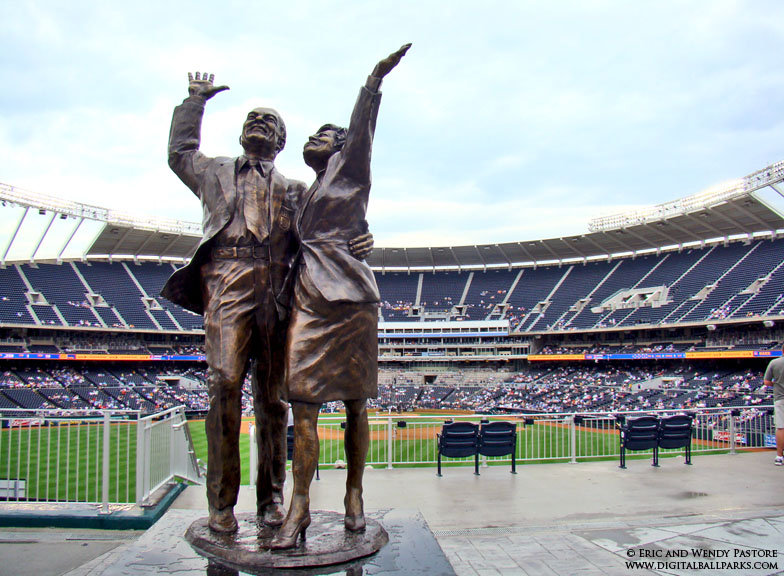
The Kauffmans' statue
Splittorff was also a Royals broadcaster before his death in 2011. Toma, a.k.a. "The Sod God," has worked for Kansas City sports teams since the 1950s, including the A's, and was recommended by Chiefs founder-owner Lamar Hunt to prepare the field for Super Bowl I, where the Chiefs lost to the Green Bay Packers at the Los Angeles Coliseum.
The NFL was so impressed with this AFL groundskeeper that he was kept on, and while he retired from active work in 1999, at age 93, he still oversees the work at Kauffman and Arrowhead, and is 1 of 7 people known to have been in attendance at all 56 Super Bowls. The others are Norma Hunt, Lamar's widow; former Detroit News sportswriter Jerry Green, who has still never covered his hometown Lions in one; photographer John Biever; and fans Don Crisman, Gregory Eaton and Tom Henschel (who, at 80, is the youngest).

The Sod God
He also took care of Arrowhead's newly-planted real grass for the 1994 World Cup, and was imported for the Olympics by Los Angeles in 1984 and Atlanta in 1996. The oddity is that, as good as he was with grass, for over 20 years he was working with artificial turf at both Kansas City stadiums.
Beginning with the 2007 season, the Royals had a red seat placed in the stadium amongst the all-blue seats behind home plate to honor John Jordan "Buck" O'Neil, the star 1st baseman and manager for the city's long-ago Negro League team, the Kansas City Monarchs. He had died the previous October.
One person, "a person who embodies the spirit of Buck O'Neil," is selected every game from community nominees to sit in that seat, formerly Buck's free season-ticket seat.
Previously, the Buck O'Neil Legacy Seat was Section 101, Row C, Seat 1. Due to the renovations and section renumbering in 2009, the seat number is now Section 127, Row C, Seat 9.

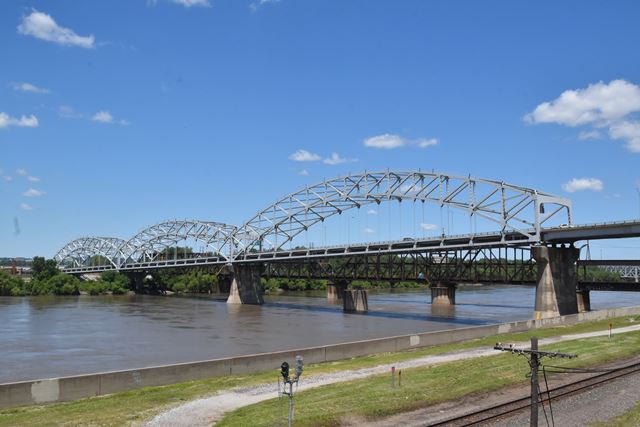
In 2016, O'Neil was honored with the renaming of the Broadway Bridge, carrying U.S. Route 169 over the Missouri River, as the Buck O'Neil Bridge.
Brett and Matthews are in the Baseball Hall of Fame. So is Whitey Herzog, who was their manager before crossing Missouri and doing what really got him in, being the manager and general manager of the Cardinals. So is John Schuerholz, who was the Royals' GM before moving on to the Atlanta Braves, building World Champions with both teams.
Also associated, however briefly, with the Royals, and in the Hall of Fame, are players who played with them toward the ends of their great careers, Orlando Cepeda, Harmon Killebrew and Gaylord Perry; and managers Joe Gordon and Bob Lemon, who were elected for what they did as players.
Herzog played for the Kansas City Athletics. So did Enos Slaughter, Tommy Lasorda, and, for 1 game in 1965, at age 59, making him the oldest MLB player ever, Negro League legend Leroy "Satchel" Paige. Luke Appling and Lou Boudreau managed the A's, but that's not part of what got them into the Hall of Fame.
Monarchs in the Hall include Paige, James "Cool Papa" Bell, Willard Brown, Hilton Smith, Bullet Joe Rogan, Andy Cooper, their owner J.L. Wilkinson, and a teenaged shortstop who went on to bigger things in Chicago, Ernie Banks. And, briefly in 1945, which is where the Brooklyn Dodgers found him, Jackie Robinson. One of the great unfairnesses of baseball history is that it took until 2021 for Buck O'Neil to be elected.
Also a bit unfair, considering that the A's and Royals combined have won just 4 Pennants in 66 seasons of play, is that there is no display at The K honoring the Monarchs' 13 Pennants: 1923, 1924, 1925, 1929, 1937, 1939, 1940, 1941, 1942, 1946, 1950, 1953 and 1955; or their wins in the 1924 and 1942 Negro World Series. Nor is there a display honoring the 10 minor-league Pennants won by the Kansas City Blues: 1888, 1890, 1898, 1901, 1918, 1923, 1929, 1938, 1952 and 1953 -- the last 5 as a Yankee farm team.
The Missouri Sports Hall of Fame is located in Springfield, 174 miles southeast of Kauffman Stadium. As a way of showing who rules the roost in Missouri sports, the Hall is considerably further away from St. Louis, but its address is 3861 East Stan Musial Drive.
Every member of the Royals Hall of Fame is in the Missouri Sports Hall of Fame, except Muriel Kauffman, Joe Burke, Dayton Moore, Denny Matthews, Dick Howser, Larry Gura, Cookie Rojas, Bret Saberhagen and Kevin Appier.
But they have also elected Cepeda and Perry; pitchers Al Hrabosky and Jeff Suppan, catcher Darrell Porter, 3rd baseman Terry Pendleton and left fielder Vince Coleman, though they are all better known for their associations with the Cardinals; catchers Jamie Quirk and John Wathan; outfielders Bo Jackson, Jim Eisenreich and Alex Gordon; catcher Mike MacFarlane; and manager Ned Yost. Yost and Gordon are the earliest honorees, by any agency, of the 2014-15 Pennant winners.
George Brett, Satchel Paige and Cool Papa Bell were named to The Sporting News' 100 Greatest Baseball Players in 1999. Brett was Kansas City's choice in the DHL Hometown Heroes poll in 2006. In 2022, ESPN
named its 100 Greatest Baseball Players. Among players who played
significant time for the Royals, only George Brett was selected, ranked 43rd.
There is no trophy for the annual season-series winner against the St. Louis Cardinals. The Cardinals lead it 71-46 -- 74-50 if you count the 1985 World Series. The Cardinals have won the season series 16 times, the Royals 8 (counting the '85 Series), and there have been 3 ties.
Stuff. The Royals Majestic Team Store is located at Gate C, behind home plate. The usual items that can be found at a souvenir store can be found there. I suppose this could include crowns with the KC logo on them.
Books about the Royals are not exactly well-known outside the K.C. area. Their Hall of Fame (Cooperstown and Kansas City) broadcaster Denny Matthews wrote Tales from the Royals Dugout, but that's probably the closest you're going to get to an inside story about the club.
Jeff and Jeffrey Spivak, father and son, wrote a 25th Anniversary retrospective, Crowning the Kansas City Royals: Remember the 1985 World Series Champs; and Sara Gilbert (not the Roseanne actress, now a panelist on CBS' The Talk) wrote The Story of the Kansas City Royals, which takes the franchise from its 1969 beginning to the 2006 season.
The 2015 title resulted in some books, including Matt Fulks' and Dayton Moore's Taking the Crown: The Kansas City Royals' Amazing 2015 Season; and a children's version, Jason Sivewright's and Kevin Howdeshell's The Year a Royal Dream Came True.
There is, as yet, no video of Essential Games of the Kansas City Royals (or Essential Games of Royals/Kauffman Stadium), but the official 1985 and 2015 World Series highlight film packages are available.
During the Game. A recent Thrillist article on "Baseball's Most Intolerable Fans" ranks the Royals 19th, putting them in the "more tolerable" half:
It's hard not to be a little bit happy for the Royals, what with their interminably long stretch of bleakness followed by consecutive World Series appearances, including winning the damn thing last year. It finally worked! But be warned -- winning has a tendency to breed obnoxiousness, and they're already exhibiting some of those "aw shucks, aren't we just the best" symptoms trademarked by another Missouri team.
That, of course, refers to the St. Louis Cardinals. Royals fans don't like the Cardinals.
Because of their Great Plains/Heartland image, Royals fans like a "family atmosphere." Therefore, while they hate the Yankees more than they hate their Central Division opponents Chicago, Cleveland, Detroit and Minnesota, and their former Western Division rivals in Oakland and Anaheim, they will not directly antagonize you. At least, they won't initiate it. But don't call them rednecks, hicks or sheep-shaggers. And don't say anything unkind about George Brett. Sure, he deserves it, but what's the point? He can't hurt you anymore; his supporters, theoretically, can.
The Friday game will feature postgame fireworks. The Sunday game will be Family FunDay Sunday, including a kids-run-the-bases event after the game.
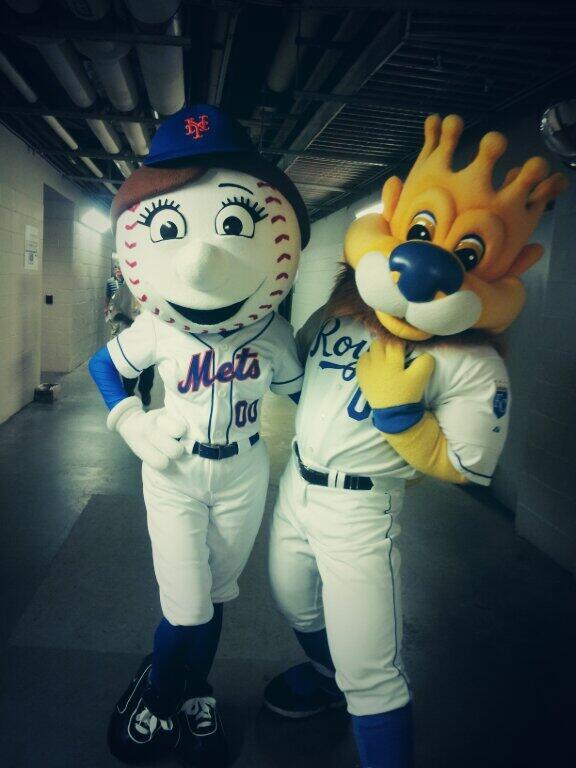
The Royals hold auditions for National Anthem singers, rather than having a regular. They have a mascot, Sluggerrr, a lion (royal, king of the jungle) with a crown on his head. (Why the 3 R's, I don't know, maybe he encourages kids with the legendary "Three R's: Reading, 'Riting and 'Rithmetic." I didn't make those up, and neither did the Royals.) From his page on the Royals' site:
Height: 7'0". (That may be his actual height, but it may also be a nod to Interstate 70.) Weight: Muscle weighs more than fat. Position: King of the Jungle. Bats: Doesn't remember, "It's been a while since I was a designated hitter." Throws: Hot Dogs, T-shirts, and visiting fans out of the park! Steals: Cotton candy, peanuts, and sometimes popcorn. Favorite Food: Cardinal Wings, Filet O' Mariner, Rays Soup, Tiger Steak, Oriole Sandwich, Blue Jay Bites.
Steals popcorn? Shades of Don Mattingly. No mention of Yankee Bean Soup among his favorite foods? Sorry, Sluggerrr: No soup for you! But he has been elected to the Mascot Hall of Fame.
The Royals do a takeoff on the Milwaukee Brewers' Sausage Race, with a "Heinz Condiment Race," featuring Ketchup, Mustard and Relish. They don't play a song after "Take Me Out to the Ballgame" during the 7th stretch, but in the middle of the 8th inning, they play "Friends in Low Places" by Oklahoma native and Royals fan Garth Brooks. The Beatles' version of "Kansas City" is their postgame victory song. Perhaps, to welcome people to the ticket windows before the game, they should play "Come to My Window" by Leavenworth, Kansas native and Royals fan Melissa Etheridge.
Starting in the 2014 season, in a reflection of the Chicago Cubs and their W flag on the scoreboard, the Royals have placed a W on the Hall of Fame wall after every win.
After the Game. Since the sports complex is not in any neighborhood, let alone a bad one, you should be safe after a game, day or night. As I said, leave the home fans alone, and they'll probably leave you alone.
Chappell's Restaurant & Sports Museum, not really a museum but with a huge memorabilia collection, has been called the best sports bar in town. 323 Armour Rd., at Erie St, 11 miles northeast of the sports complex, and 5 miles north of downtown.
If you want to be around other New Yorkers, Johnny's Tavern, 1310 Grand Blvd., downtown, across from the T-Mobile Center (the new arena), is known as a Giants fan's bar. Be advised that it is also known as a Sporting Kansas City bar -- and a U.S. national soccer team bar, and a University of Kansas bar.
Stuff. The Royals Majestic Team Store is located at Gate C, behind home plate. The usual items that can be found at a souvenir store can be found there. I suppose this could include crowns with the KC logo on them.
Books about the Royals are not exactly well-known outside the K.C. area. Their Hall of Fame (Cooperstown and Kansas City) broadcaster Denny Matthews wrote Tales from the Royals Dugout, but that's probably the closest you're going to get to an inside story about the club.
Jeff and Jeffrey Spivak, father and son, wrote a 25th Anniversary retrospective, Crowning the Kansas City Royals: Remember the 1985 World Series Champs; and Sara Gilbert (not the Roseanne actress, now a panelist on CBS' The Talk) wrote The Story of the Kansas City Royals, which takes the franchise from its 1969 beginning to the 2006 season.
The 2015 title resulted in some books, including Matt Fulks' and Dayton Moore's Taking the Crown: The Kansas City Royals' Amazing 2015 Season; and a children's version, Jason Sivewright's and Kevin Howdeshell's The Year a Royal Dream Came True.
There is, as yet, no video of Essential Games of the Kansas City Royals (or Essential Games of Royals/Kauffman Stadium), but the official 1985 and 2015 World Series highlight film packages are available.
During the Game. A recent Thrillist article on "Baseball's Most Intolerable Fans" ranks the Royals 19th, putting them in the "more tolerable" half:
It's hard not to be a little bit happy for the Royals, what with their interminably long stretch of bleakness followed by consecutive World Series appearances, including winning the damn thing last year. It finally worked! But be warned -- winning has a tendency to breed obnoxiousness, and they're already exhibiting some of those "aw shucks, aren't we just the best" symptoms trademarked by another Missouri team.
That, of course, refers to the St. Louis Cardinals. Royals fans don't like the Cardinals.
Because of their Great Plains/Heartland image, Royals fans like a "family atmosphere." Therefore, while they hate the Yankees more than they hate their Central Division opponents Chicago, Cleveland, Detroit and Minnesota, and their former Western Division rivals in Oakland and Anaheim, they will not directly antagonize you. At least, they won't initiate it. But don't call them rednecks, hicks or sheep-shaggers. And don't say anything unkind about George Brett. Sure, he deserves it, but what's the point? He can't hurt you anymore; his supporters, theoretically, can.
The Friday game will feature postgame fireworks. The Sunday game will be Family FunDay Sunday, including a kids-run-the-bases event after the game.
The Royals hold auditions for National Anthem singers, rather than having a regular. They have a mascot, Sluggerrr, a lion (royal, king of the jungle) with a crown on his head. (Why the 3 R's, I don't know, maybe he encourages kids with the legendary "Three R's: Reading, 'Riting and 'Rithmetic." I didn't make those up, and neither did the Royals.) From his page on the Royals' site:
Height: 7'0". (That may be his actual height, but it may also be a nod to Interstate 70.) Weight: Muscle weighs more than fat. Position: King of the Jungle. Bats: Doesn't remember, "It's been a while since I was a designated hitter." Throws: Hot Dogs, T-shirts, and visiting fans out of the park! Steals: Cotton candy, peanuts, and sometimes popcorn. Favorite Food: Cardinal Wings, Filet O' Mariner, Rays Soup, Tiger Steak, Oriole Sandwich, Blue Jay Bites.
Steals popcorn? Shades of Don Mattingly. No mention of Yankee Bean Soup among his favorite foods? Sorry, Sluggerrr: No soup for you! But he has been elected to the Mascot Hall of Fame.
Sluggerrr also manged to cuckold Mr. Met
during the 2015 World Series.
The Royals do a takeoff on the Milwaukee Brewers' Sausage Race, with a "Heinz Condiment Race," featuring Ketchup, Mustard and Relish. They don't play a song after "Take Me Out to the Ballgame" during the 7th stretch, but in the middle of the 8th inning, they play "Friends in Low Places" by Oklahoma native and Royals fan Garth Brooks. The Beatles' version of "Kansas City" is their postgame victory song. Perhaps, to welcome people to the ticket windows before the game, they should play "Come to My Window" by Leavenworth, Kansas native and Royals fan Melissa Etheridge.
Starting in the 2014 season, in a reflection of the Chicago Cubs and their W flag on the scoreboard, the Royals have placed a W on the Hall of Fame wall after every win.
After the Game. Since the sports complex is not in any neighborhood, let alone a bad one, you should be safe after a game, day or night. As I said, leave the home fans alone, and they'll probably leave you alone.
Chappell's Restaurant & Sports Museum, not really a museum but with a huge memorabilia collection, has been called the best sports bar in town. 323 Armour Rd., at Erie St, 11 miles northeast of the sports complex, and 5 miles north of downtown.
If you want to be around other New Yorkers, Johnny's Tavern, 1310 Grand Blvd., downtown, across from the T-Mobile Center (the new arena), is known as a Giants fan's bar. Be advised that it is also known as a Sporting Kansas City bar -- and a U.S. national soccer team bar, and a University of Kansas bar.
If you visit Kansas City during the European soccer season, which is now over until early August, you can probably find your favorite club on TV at either Johnny's Tavern, or practically next-door at No Other Pub, 1370 Grand Blvd.
Sidelights. Kansas City's sports history is a bit uneven. When the Royals and Chiefs have been good, they've been exceptional. But they've also had long stretches of mediocrity. Still, there are some local sites worth checking out.
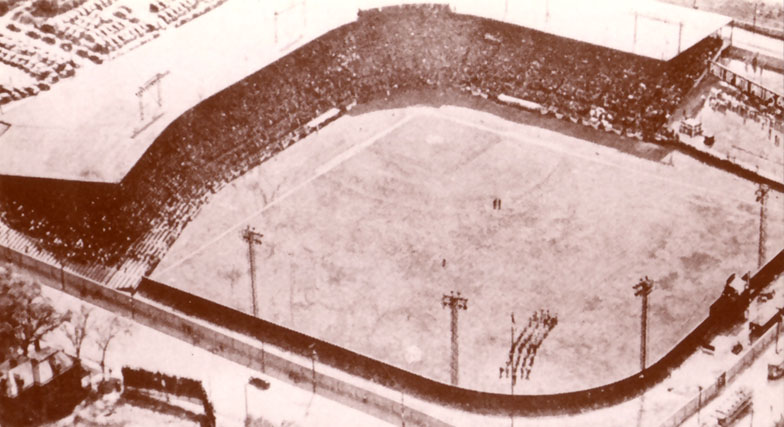
* Site of Municipal Stadium. The single-decked, 17,000-seat Muehlebach Field was built in 1923, by George Muehlebach, who also owned the beer and the hotel that bore his name, and the American Association's Kansas City Blues.
It hosted the Blues' Pennants in 1929, 1938, 1952 and 1953 – the last 3 as a farm club of the Yankees. (They'd previously won Pennants in 1888, 1890, 1898 and 1901, for a total of 8 Pennants -- or 6 more than the A's and Royals combined in nearly 60 years thus far.) Future Yankee legends Phil Rizzuto (Sporting News Minor League Player of the Year in 1940) and Mickey Mantle (1951) played for this club at this ballpark.
Hall-of-Famers Satchel Paige, Willard Brown and Hilton Smith, and, of course, Buck O'Neil, were their biggest stars, although it should be noted that, while he played with them in the 1945 season, Jackie Robinson was, at the time, not considered as much of a baseball prospect some of the other players who were thought of as potential "first black players," like Paige, Monte Irvin and Larry Doby; it was his competitiveness and his temperament, as much as his talent, that got Brooklyn Dodgers president Branch Rickey interested in him. The Monarchs had to leave after the 1955 season, because of the arrival of the A's.
Muehlebach Field, as it was then known was also the home to Kansas City's 1st pro football team, the team known as the Blues in 1924 and the Cowboys in 1925 and '26.
In 1954, the Philadelphia Athletics were sold to trucking company owner Arnold Johnson, and he moved the club to Kansas City, where his pal Del Webb, co-owner of the Yankees, had his construction company put an upper deck on what was renamed Municipal Stadium, raising the capacity to 35,020.

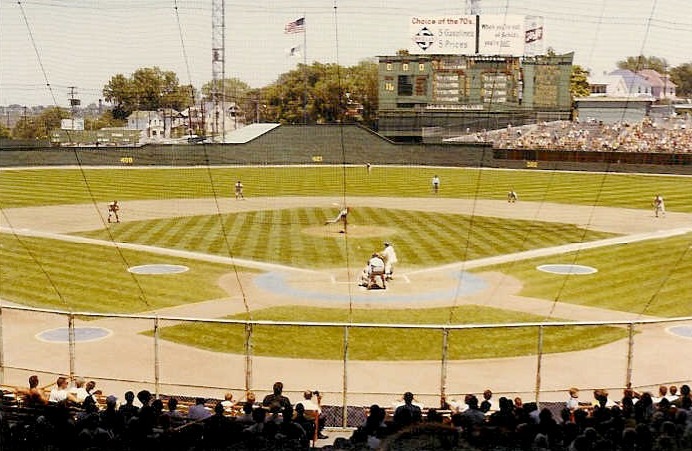
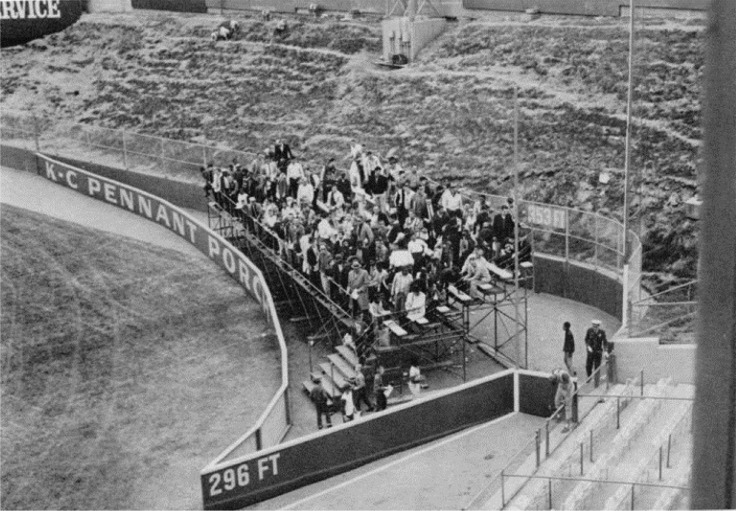
Note the 296 marker, the pole maintained at 325,
and the 353 marker behind them.
Commissioner Ford Frick ruled that what Finley called the "KC Pennant Porch," with a small bleacher between the old and new fences, was illegal. So Finley scaled it back to 325 feet at its closest point, making it the "KC One-Half Pennant Porch."
Finley also debuted some of his promotional shenanigans at Municipal, including Harvey the Rabbit, a Bugs Bunny lookalike that mechanically popped out of home plate to deliver fresh baseballs to the plate umpire.
But Finley wanted a new ballpark, and Kansas City wouldn't give it to him. It's not that they didn't support big-league ball, it's that they couldn't stand him. After flirting with Atlanta, Louisville, Dallas, New Orleans and Denver, he moved the team out of Kansas City in 1967, leading Senator Stuart Symington of Missouri to say, "Oakland, California just became the luckiest city since Hiroshima."
Despite being from the St. Louis side of the State, Symington lobbied Major League Baseball for a replacement team in K.C., and MLB granted an expansion franchise to Ewing Kauffman, to start play in 1969. Symington was invited to throw out the first ball at the first Royals home game. For the new team, with Kauffman rather than Finley as owner, the city built a new park. The Royals moved out after the 1972 season. Neither the Royals nor the A's ever came close to October while playing there.
The Chiefs began playing at Municipal Stadium in 1963, won AFL Championships in 1966 and 1969 (in addition to their 1962 title as the Dallas Texans), won Super Bowl IV, and played their last game there on Christmas Day 1971, a double-overtime Playoff loss to the Miami Dolphins that is still the longest game in NFL history. And Finley convinced Brian Epstein to let the Beatles play there, on September 17, 1964, their only concert in Kansas City. (Having covered the song "Kansas City," of course, they played it that night.)
The U.S. soccer team played Bermuda at Municipal Stadium on November 2, 1968, and won. The attendance was 2,265. That gives you an idea of how far U.S. soccer has come.
The stadium was torn down in 1976, and a housing development named Monarch Manor going up on the site. 2123 Brooklyn Avenue, near the 18th and Vine district that was the home of Kansas City jazz, making it a favorite of the Monarchs players. The original Arthur Bryant's barbecue restaurant, now a chain due to its legendary status, is 4 blocks away at 1727 Brooklyn Avenue. Number 123 bus.
* Negro Leagues Baseball Museum and American Jazz Museum. Founded by Buck O'Neil and some friends, this museum "tells the other side of the story." The pre-1947 all-white major leagues called themselves "Organized Baseball," but, as Buck himself said, "We were organized."

The museum's lobby features statues of several Negro League legends, including Paige, Josh Gibson, Buck Leonard and Oscar Charleston – having played for the Monarchs was by no means a requirement for that.

The Negro Leagues were a sometimes dignified, sometimes willingly silly, and very successful response to the color bar. But the raiding of their rosters, with no regard to contracts and thus no money changing hands, by the white majors from 1947 onward, was the beginning of the end. Buck had the right perspective, as he said in Ken Burns' Baseball miniseries: "Happy. Happy... Of course, it meant the death of our baseball, but who cared? Who cared?" The owners of the Negro League teams cared. Other than that...
1616 E. 18th Street. The same building is home to the American Jazz Museum, which includes a working jazz club, the Blue Room. Number 108 bus. The Museum is 5 blocks west of Arthur Bryant's, and a short walk from the site of Municipal Stadium, and neither of these facts is a coincidence. In fact, for the Monarchs, baseball and jazz were so intertwined that Ken Burns interviewed Buck for his documentaries on both subjects.
* Municipal Auditorium. Built in 1935 in the Art Deco style then common to public buildings (especially in New York), it replaced the Convention Hall that was across the street, which hosted the 1900 Democratic Convention which nominated William Jennings Bryan for President (and at which a 16-year-old Harry S Truman served as a page) and the 1928 Republican Convention that nominated Herbert Hoover.
The arena seats 7,316 people, but for special events can be expanded to 10,721. The NCAA hosted what would later be called the Final Four here in 1940 (Indiana over Kansas), '41 (Wisconsin over Washington State), '42 (Stanford over Dartmouth, '53 (Indiana over Kansas), '54 (Tom Gola's La Salle over Bradley), '55 (Bill Russell's San Francisco over Gola's LaSalle), '57 (North Carolina over Kansas, Wilt Chamberlain losing in triple overtime), '61 (Cincinnati over Ohio State's defending champs, including Jerry Lucas and John Havlicek) and '64 (John Wooden starting his UCLA dynasty by beating Duke and completing an undefeated season with Walt Hazzard and Gail Goodrich).
 The NBA's Kansas City Kings played their 1972-73 and 1973-74 home games here after moving from Cincinnati – having to change their name because Kansas City already had a team called the Royals. An accident at the Kemper Arena forced the Kings to move back to the Auditorium for a few games in the 1979-80 season. The basketball team at the University of Missouri at Kansas City (UMKC) played their home games here from its opening until they opened an on-campus arena in 2010.
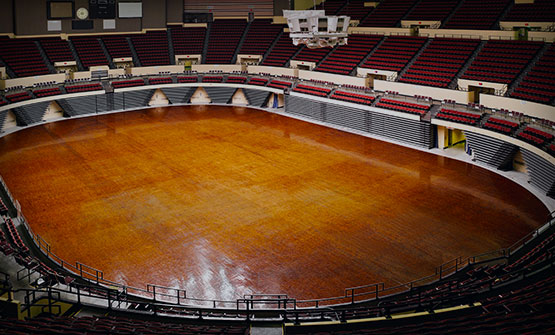 Elvis Presley sang there as a new national star on May 24, 1956, and as an entertainment legend on November 15, 1971 and June 29, 1974. The 2nd Presidential Debate of 1984 was held there. This is where Ronald Reagan joked about his age and experience compared to Walter Mondale's, then gave a closing statement that made him look like the Alzheimer's he was later diagnosed with was already in effect. 301 W. 13th Street. Pretty much any downtown bus will get you close.
* Kemper Arena. Built in 1974, it immediately began hosting 2 major league sports teams – neither of which lasted very long. The NBA's Kansas City Kings played here until 1985, when they moved to Sacramento.
 The NHL's Kansas City Scouts were the ne plus ultra – or should that be ne minus ultra? – of expansion teams, lasting only 2 seasons before moving in 1976 to become the Colorado Rockies, and then again in 1982 to become the New Jersey Devils. A few minor league hockey teams have played here since, but its only current tenant is the American Royal show.
In the Kings' final season, they hosted the Knicks in a game that resulted in one of the most frustrating injuries in NBA history, Knick star Bernard King jumping for a rebound and tearing up his knee. I'll never forget watching on TV and hearing him yell, "Oh, damn! Oh, damn!" and then crumpling to the floor, repeatedly slapping it with his hand. Bernard did play again, and well, but a great career turned into a what-might-have-been.
But that wasn't the worst injury here, and I don't mean the 1979 roof damage, either: This was where professional wrestler Owen Hart was killed in an accident on May 23, 1999.
Kemper was also the last building seating under 20,000 people to host a Final Four, hosting the 50th Anniversary edition in 1988, in which the University of Kansas, led by Danny Manning, upset heavily favored Oklahoma. In fact, KU made the 40-mile trip from Lawrence many times, creating an atmosphere that got the place nicknamed Allen Fieldhouse East, a name they have now transplanted to the T-Mobile Center. They went 80-24 at Kemper, including the 1988 title game.
The 1976 Republican Convention was held there, nominating Gerald Ford. Elvis sang there on April 21, 1976 and, in one of his last concerts, June 18, 1977.
The building has been sold to Mosaic Life Center, which will convert it into a combination regional sports facility and medical clinic, and rename it the Mosaic Arena. 1800 Genesee Street, at American Royal Drive, a block from the Missouri-Kansas State Line. Number 12 bus.
In addition to the preceding, Elvis sang in Western Missouri at the Shrine Mosque in Springfield on May 17, 1956; and the Hammons Student Center at Southwest State University (now Missouri State) in Springfield on June 17, 1977.
* T-Mobile Center. This arena opened in 2007, as the Sprint Center, with the idea of bringing the NBA or NHL back to Kansas City. (The arena builders appear not to care which one they get, but with K.C. being a "small market," they'll be lucky to get one, and will not get both.) It almost got the Pittsburgh Penguins, before a deal to build the Consol Energy Center was finalized. It was also being considered for the New York Islanders, before they cut a deal to move to the Barclays Center in Brooklyn.
 For basketball, it seats 18,555; for hockey, 17,752. For the moment, no teams, major- or minor-league, play here regularly, although has hosted college basketball: KU games, the Big 12 Tournament, NCAA Tournament games. 1407 Grand Boulevard, at W. 14th Street. Number 57 or MAX bus from downtown. In 2020, it was renamed the T-Mobile Center.

Buck and his statue at the Museum
The Negro Leagues were a sometimes dignified, sometimes willingly silly, and very successful response to the color bar. But the raiding of their rosters, with no regard to contracts and thus no money changing hands, by the white majors from 1947 onward, was the beginning of the end. Buck had the right perspective, as he said in Ken Burns' Baseball miniseries: "Happy. Happy... Of course, it meant the death of our baseball, but who cared? Who cared?" The owners of the Negro League teams cared. Other than that...
1616 E. 18th Street. The same building is home to the American Jazz Museum, which includes a working jazz club, the Blue Room. Number 108 bus. The Museum is 5 blocks west of Arthur Bryant's, and a short walk from the site of Municipal Stadium, and neither of these facts is a coincidence. In fact, for the Monarchs, baseball and jazz were so intertwined that Ken Burns interviewed Buck for his documentaries on both subjects.
* Municipal Auditorium. Built in 1935 in the Art Deco style then common to public buildings (especially in New York), it replaced the Convention Hall that was across the street, which hosted the 1900 Democratic Convention which nominated William Jennings Bryan for President (and at which a 16-year-old Harry S Truman served as a page) and the 1928 Republican Convention that nominated Herbert Hoover.
The arena seats 7,316 people, but for special events can be expanded to 10,721. The NCAA hosted what would later be called the Final Four here in 1940 (Indiana over Kansas), '41 (Wisconsin over Washington State), '42 (Stanford over Dartmouth, '53 (Indiana over Kansas), '54 (Tom Gola's La Salle over Bradley), '55 (Bill Russell's San Francisco over Gola's LaSalle), '57 (North Carolina over Kansas, Wilt Chamberlain losing in triple overtime), '61 (Cincinnati over Ohio State's defending champs, including Jerry Lucas and John Havlicek) and '64 (John Wooden starting his UCLA dynasty by beating Duke and completing an undefeated season with Walt Hazzard and Gail Goodrich).
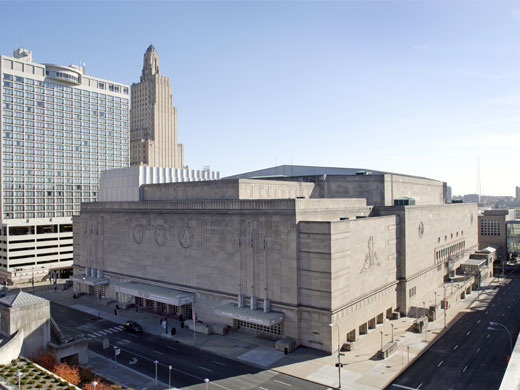
* Kemper Arena. Built in 1974, it immediately began hosting 2 major league sports teams – neither of which lasted very long. The NBA's Kansas City Kings played here until 1985, when they moved to Sacramento.

In the Kings' final season, they hosted the Knicks in a game that resulted in one of the most frustrating injuries in NBA history, Knick star Bernard King jumping for a rebound and tearing up his knee. I'll never forget watching on TV and hearing him yell, "Oh, damn! Oh, damn!" and then crumpling to the floor, repeatedly slapping it with his hand. Bernard did play again, and well, but a great career turned into a what-might-have-been.
But that wasn't the worst injury here, and I don't mean the 1979 roof damage, either: This was where professional wrestler Owen Hart was killed in an accident on May 23, 1999.
Kemper was also the last building seating under 20,000 people to host a Final Four, hosting the 50th Anniversary edition in 1988, in which the University of Kansas, led by Danny Manning, upset heavily favored Oklahoma. In fact, KU made the 40-mile trip from Lawrence many times, creating an atmosphere that got the place nicknamed Allen Fieldhouse East, a name they have now transplanted to the T-Mobile Center. They went 80-24 at Kemper, including the 1988 title game.
The 1976 Republican Convention was held there, nominating Gerald Ford. Elvis sang there on April 21, 1976 and, in one of his last concerts, June 18, 1977.
The building has been sold to Mosaic Life Center, which will convert it into a combination regional sports facility and medical clinic, and rename it the Mosaic Arena. 1800 Genesee Street, at American Royal Drive, a block from the Missouri-Kansas State Line. Number 12 bus.
In addition to the preceding, Elvis sang in Western Missouri at the Shrine Mosque in Springfield on May 17, 1956; and the Hammons Student Center at Southwest State University (now Missouri State) in Springfield on June 17, 1977.
* T-Mobile Center. This arena opened in 2007, as the Sprint Center, with the idea of bringing the NBA or NHL back to Kansas City. (The arena builders appear not to care which one they get, but with K.C. being a "small market," they'll be lucky to get one, and will not get both.) It almost got the Pittsburgh Penguins, before a deal to build the Consol Energy Center was finalized. It was also being considered for the New York Islanders, before they cut a deal to move to the Barclays Center in Brooklyn.
On May 12, 2014, the New York Times printed a story that shows NBA fandom by ZIP Code, according to Facebook likes. You would think that, being between Chicago and Oklahoma City, with no team in St. Louis, the Kansas City area would be divided between Bulls and Thunder fans. Instead, the distance is so great (509 miles from T-Mobile Center to United Center, 349 miles to whatever OKC's arena is called now, and 475 miles to Indiana's Bankers Life Fieldhouse), that they divide up their fandom among the "cool" teams: The Bulls, the Los Angeles Lakers and the Miami Heat. (As yet, there is no hockey version.)
The closest NHL team to Kansas City is the St. Louis Blues, 249 miles away. The Kansas City metropolitan area's population would rank it 24th in the NBA, and 23rd in the NHL.
* Children's Mercy Park. The new home of Major League Soccer's Sporting Kansas City, formerly the Kansas City Wizards, has also hosted 5 games, by the U.S. soccer team, 4 wins and a draw, most recently a 4-0 win over Bolivia in the Copa America on May 28, 2016. It hosted 5 games of the 2021 CONCACAF Gold Cup.
SKC won the MLS Cup in 2000, and again in 2013, with the Final on home soil. They shared their stadium with FC Kansas City, who had to move to Salt Lake City after the 2017 season, despite winning the Championship of the National Women's Soccer League in 2014 and 2015. In 2021, a new NWSL team, the Kansas City Current, began playing there.
 It is across the State Line in Kansas City, Kansas. Seating 18,467, it is at State Aveune & France Family Drive, with the ballpark for the independent baseball team the Kansas City T-Bones, the Kansas Speedway racetrack, and the Legends Shopping Mall all adjacent. Number 57 bus, transferring to Number 101 bus.
* Museums. Kansas City has 2 prominent art museums. The Nelson-Atkins Museum of Art is K.C.'s "Metropolitan Museum of Art," 3 miles north of downtown, at 4525 Oak Street, in Southmoreland Park. And their "Museum of Modern Art" is the Kemper Museum of Contemporary Art, 2 blocks away, at 4420 Warwick Boulevard at 45th Street. Both can be reached by the Number 57 bus.
Kansas City is still, in a way, Harry Truman's town. The 33rd President, serving from April 12, 1945 to January 20, 1953, was born in nearby Lamar, and grew up in nearby Independence. He opened his Presidential Library and Museum in 1957, and frequently hosted events there until a household accident in 1964 pretty much ended his public life.
Upon his death in 1972, he was buried in the Library's courtyard; his wife Bess, born Elizabeth Wallace, followed him in 1982, at age 97, to date the oldest former First Lady; and their only child, Margaret Truman Daniel, was laid to rest there in 2008. Currently, the Library is run by his only grandchild, Clifton Truman Daniel.
500 West U.S. Highway 24, Independence. Number 24X bus to Osage & White Oak Streets, and then 4 blocks north on Osage and 3 blocks west on Route 24. The Truman Home – actually the Wallace House, as Bess' family always owned it – is nearby at 219 N. Delaware Street. Same bus.
Just west of the Crown Center is the Liberty Memorial, including the National World War I Museum, honoring the 1914-18 conflict that was then frequently called "The Great War" (accurate) and "The War to End All Wars" (not accurate, as it turned out). 100 West 26th Street.
 Satchel Paige, Buck O'Neil, and Zack Wheat, the the Hall of Fame left fielder for the 1910s and '20s Brooklyn Dodgers who collected nearly 3,000 hits, are all buried at Forest Hill & Calvary Cemetery. 6901 Troost Avenue, about 7 miles south of downtown. Bus 85.
There aren't a whole lot of tall buildings: One Kansas City Place, at 1200 Main Street, is the tallest in the State, at 624 feet, but only one other building is over 500 feet. The Kansas City Power & Light Building, at 1330 Baltimore Street, and the twin-towered 909 Walnut were built in the early 1930s and are the city's tallest classic buildings.
If you want to copy the song "Kansas City," and be "standing on the corner, 12th Street and Vine," you're out of luck: Due to urban renewal, it no longer exists. There is, however, a park with a plaque roughly where it was.
There haven't been many TV shows set in Kansas City. By far the most notable was Malcolm & Eddie, the 1996-2000 UPN sitcom that starred Malcolm-Jamal Warner and Eddie Griffin (a KCMO native). ABC Family's Switched at Birth is also set there. But both shows were taped in Los Angeles and did no location shots, so if you're a fan of that show, there's nothing in Kansas City to show you. The United States of Tara was set in suburban Overland Park, Kansas.
There have been a few movies set in Kansas City and the surrounding areas. The 1962 horror film Carnival of Souls was filmed in Lawrence, Kansas. The 1983 nuclear-war TV-movie The Day After was filmed in KCMO and Lawrence. Raquel Welch's roller-derby movie Kansas City Bomber was filmed in KCMO, as were Mr. & Mrs. Bridge and Article 99.
Most movies filmed or set in Kansas itself tend to be Westerns, such as The Plainsman, Dodge City, Santa Fe Trail, Red River, Winchester '73, Dances with Wolves and Sarah, Plain and Tall. The TV Western Gunsmoke was set in Dodge City, although filmed in Hollywood. Kansas' desolate plains lend themselves well to Depression-era films like Splendor in the Grass, Paper Moon and The Great Waldo Pepper.
The 1978 version of Superman established the hero's hometown of Smallville, previously considered a typical American small town, as being in Kansas, and every version of Superman since has accepted this. Plains, Trains and Automobiles had a big chunk set in Kansas, but actually filmed in Illinois.
And, of course, Kansas was the setting for the "real" parts of L. Frank Baum's novel The Wonderful Wizard of Oz, and all its film adaptations since. (Judy Garland's line as Dorothy in the most familiar version, 1939, is one of those movie/TV lines everybody gets wrong: It's actually, "Toto, I've a feeling we're not in Kansas anymore!")
*
The closest NHL team to Kansas City is the St. Louis Blues, 249 miles away. The Kansas City metropolitan area's population would rank it 24th in the NBA, and 23rd in the NHL.
* Children's Mercy Park. The new home of Major League Soccer's Sporting Kansas City, formerly the Kansas City Wizards, has also hosted 5 games, by the U.S. soccer team, 4 wins and a draw, most recently a 4-0 win over Bolivia in the Copa America on May 28, 2016. It hosted 5 games of the 2021 CONCACAF Gold Cup.
SKC won the MLS Cup in 2000, and again in 2013, with the Final on home soil. They shared their stadium with FC Kansas City, who had to move to Salt Lake City after the 2017 season, despite winning the Championship of the National Women's Soccer League in 2014 and 2015. In 2021, a new NWSL team, the Kansas City Current, began playing there.
* Swope Soccer Village. FC Kansas City played here in 2015, and won another NWSL title. They also played here in 2016 and 2017, before moving to Salt Lake City and becoming the Utah Royals. 6310 Lewis Road, 7 1/2 miles south of downtown. Any of several buses can get you to 63rd and Paseo, where you would transfer to Bus 63.
* Museums. Kansas City has 2 prominent art museums. The Nelson-Atkins Museum of Art is K.C.'s "Metropolitan Museum of Art," 3 miles north of downtown, at 4525 Oak Street, in Southmoreland Park. And their "Museum of Modern Art" is the Kemper Museum of Contemporary Art, 2 blocks away, at 4420 Warwick Boulevard at 45th Street. Both can be reached by the Number 57 bus.
Kansas City is still, in a way, Harry Truman's town. The 33rd President, serving from April 12, 1945 to January 20, 1953, was born in nearby Lamar, and grew up in nearby Independence. He opened his Presidential Library and Museum in 1957, and frequently hosted events there until a household accident in 1964 pretty much ended his public life.
Upon his death in 1972, he was buried in the Library's courtyard; his wife Bess, born Elizabeth Wallace, followed him in 1982, at age 97, to date the oldest former First Lady; and their only child, Margaret Truman Daniel, was laid to rest there in 2008. Currently, the Library is run by his only grandchild, Clifton Truman Daniel.
500 West U.S. Highway 24, Independence. Number 24X bus to Osage & White Oak Streets, and then 4 blocks north on Osage and 3 blocks west on Route 24. The Truman Home – actually the Wallace House, as Bess' family always owned it – is nearby at 219 N. Delaware Street. Same bus.
Just west of the Crown Center is the Liberty Memorial, including the National World War I Museum, honoring the 1914-18 conflict that was then frequently called "The Great War" (accurate) and "The War to End All Wars" (not accurate, as it turned out). 100 West 26th Street.
There aren't a whole lot of tall buildings: One Kansas City Place, at 1200 Main Street, is the tallest in the State, at 624 feet, but only one other building is over 500 feet. The Kansas City Power & Light Building, at 1330 Baltimore Street, and the twin-towered 909 Walnut were built in the early 1930s and are the city's tallest classic buildings.
If you want to copy the song "Kansas City," and be "standing on the corner, 12th Street and Vine," you're out of luck: Due to urban renewal, it no longer exists. There is, however, a park with a plaque roughly where it was.
There haven't been many TV shows set in Kansas City. By far the most notable was Malcolm & Eddie, the 1996-2000 UPN sitcom that starred Malcolm-Jamal Warner and Eddie Griffin (a KCMO native). ABC Family's Switched at Birth is also set there. But both shows were taped in Los Angeles and did no location shots, so if you're a fan of that show, there's nothing in Kansas City to show you. The United States of Tara was set in suburban Overland Park, Kansas.
There have been a few movies set in Kansas City and the surrounding areas. The 1962 horror film Carnival of Souls was filmed in Lawrence, Kansas. The 1983 nuclear-war TV-movie The Day After was filmed in KCMO and Lawrence. Raquel Welch's roller-derby movie Kansas City Bomber was filmed in KCMO, as were Mr. & Mrs. Bridge and Article 99.
Most movies filmed or set in Kansas itself tend to be Westerns, such as The Plainsman, Dodge City, Santa Fe Trail, Red River, Winchester '73, Dances with Wolves and Sarah, Plain and Tall. The TV Western Gunsmoke was set in Dodge City, although filmed in Hollywood. Kansas' desolate plains lend themselves well to Depression-era films like Splendor in the Grass, Paper Moon and The Great Waldo Pepper.
The 1978 version of Superman established the hero's hometown of Smallville, previously considered a typical American small town, as being in Kansas, and every version of Superman since has accepted this. Plains, Trains and Automobiles had a big chunk set in Kansas, but actually filmed in Illinois.
And, of course, Kansas was the setting for the "real" parts of L. Frank Baum's novel The Wonderful Wizard of Oz, and all its film adaptations since. (Judy Garland's line as Dorothy in the most familiar version, 1939, is one of those movie/TV lines everybody gets wrong: It's actually, "Toto, I've a feeling we're not in Kansas anymore!")
*
Kansas City is a great American city, almost literally in the center of this great country. And its citizens, and the people who come from hundreds of miles around to see the Royals and Chiefs, love their sports. It's well worth saving up to check it out.


