Showing posts with label comedy. Show all posts

Monday, August 3, 2026

August 3, 1966: The Death of Lenny Bruce

Yes, he made jokes about the Catholic Church.
No, here, he's not dressing like a priest to make a point.
He's wearing a "Nehru jacket," made popular
by the late Jawaharlal Nehru, Prime Minister of India.

August 3, 1966, 60 years ago: Comedian Lenny Bruce is found dead at his home in the Hollywood Hills of Los Angeles. He was 40 years old.

He was born Leonard Alfred Schneider on October 13, 1925, the same day as Margaret Thatcher. He didn't live to see her rise to power, and God only knows what the "Iron Lady" (or, more accurately, the "Iron" "Lady") would have thought if she knew about this fact.

He was born in Mineola, Long Island, New York, and grew up in nearby Bellmore. While Alan King moved to Long Island after growing up in Brooklyn and becoming famous, Bruce was the 1st Long Island native to make it big in comedy, preceding such names as Eddie Murphy, Joy Behar, Rosie O'Donnell, Jerry Seinfeld, Kevin James and Jim Breuer.

He was the 1st comedian to get big by using profanity and "sick humor." Typical of his material: "My wife caught me in bed with her mother. She said, 'You're sick!' I said, 'Why? She's your mother, not mine!'"

Bruce would joke about anything. Especially sex. And religion. Particularly the Catholic Church. In his routine, he called Pope John XXIII "John Baby." That, plus the fact that he was Jewish, pissed off a lot of conservative people in "the establishment."

He was often arrested for obscenity, for using "dirty words" onstage, or for talking about sex onstage. In a rare TV appearance, on The Steve Allen Show on April 5, 1959, he said, "There are words that offend me. Uh, let's see: 'Governor Faubus,' 'segregation' offend me. Uh, 'nighttime television' offends me. Some nighttime television. Uh, the shows that exploit homosexuality, narcotics and prostitution, under the guise of helping these societal problems."

October 13, 1960 was his 35th birthday. Dick Schaap was doing a profile on him for Newsweek magazine. At the same time, Schaap was covering the World Series. He invited Bruce to sit with him in the press box at Forbes Field in Pittsburgh for Game 7. Bruce admitted that he had never been to a baseball game before. It turned out to be one of the greatest games of all time, with Bill Mazeroski hitting a home run in the bottom of the 9th inning, giving the Pittsburgh Pirates a 10-9 win over the New York Yankees, and winning the Series in a major upset. Bruce told Schaap he'd enjoyed the game. But in his memoir, Schaap said that, as far as he knew, Bruce never went to another.

In the late 1950s and early 1960s, if "the establishment" decided you needed what we would now call "canceling," it meant you wouldn't get hired. And any place that would hire you might get closed down. It also meant that you could get arrested for using profanity onstage. That was the conservatives closing you down. The conservatives doing the canceling.

Bruce was convicted of obscenity in New York on November 4, 1964. He was sentenced to 4 months in a workhouse. He appealed, and was freed pending that appeal.

That appeal was never heard: On August 3, 1966, at age 40, he was found with a needle in his arm at his home in the Hollywood Hills. It was known that he had a drug problem, but this was a little too convenient for his fans. They came to believe that he was murdered.

In 1972, Julian Barry staged the play Lenny on Broadway. Cliff Gorman won a Tony Award as its star. In 1974, Bob Fosse, better known for his dance-filled musicals, directed a film version. Dustin Hoffman was nominated for the Academy Award for Best Actor.

In 2003, Governor George Pataki of New York gave Bruce a posthumous pardon. In 2004, the cable-TV network Comedy Central aired a special on the 100 greatest standup comedians of all time. Bruce was ranked 3rd. Coming in 2nd was George Carlin, who had once been arrested along with Bruce. Carlin called him "a brilliant comedian, who influenced me as much as a man in my moral thinking and attitudes as he did as a comedian." Coming in 1st was Richard Pryor, who had once said that hearing Bruce for the first time "changed my life."

Saturday, October 11, 2025

October 11, 1975: "Saturday Night Live" Premieres

Back row, left to right: Laraine Newman, John Belushi,
Jane Curtin, Chevy Chase and Dan Aykroyd.
Bottom row, left to right: Garrett Morris and Gilda Radner.

October 11, 1975, 50 years ago: Saturday Night premieres on NBC, taping from the network's studios at 30 Rockefeller Plaza in Midtown Manhattan. After this 1st season, it will be renamed Saturday Night Live. The original cast, known as "the Not Ready for Prime Time Players," includes John Belushi, Dan Aykroyd, Gilda Radner, Chevy Chase, Jane Curtin, Laraine Newman and Garrett Morris -- but not, as is commonly believed, Bill Murray, who replaced Chase after 1 season.

The 1st guest host is George Carlin, who begins his monologue with a whacked-out version of the Lord's Prayer, and goes on to do "Baseball and Football," a routine he will expand on a few times. (This version is from 1990, from the State Theatre in New Brunswick, New Jersey.)

Not long before Carlin died, someone took a poll to determine the greatest standup comedians of all time. Carlin came in 2nd. Coming in 1st was Richard Pryor, who, like Carlin, was at the peak of his powers in the mid-Seventies.
A month into SNL's run, Pryor was asked to host the show. But, nervous that he would issue some four-letter words — they didn't seem as nervous about such language coming from Carlin, creator of the 1972 bit "Seven Words You Can Never Use On Television," none of which he used when he hosted -- the show was not quite "Live, from New York." They used a 7-second delay, in case they had to bleep anything out. They did. Ever since, even SNL hasn't been totally live.
In addition to the preceding, SNL would make stars of Eddie Murphy, Joe Piscopo, Julia Louis-Dreyfus, Christopher Guest, Harry Shearer, Dana Carvey, Phil Hartman, Norm McDonald, Mike Myers, Chris Farley, Sarah Silverman, Will Ferrell, Tina Fey, Keenan Thompson, and Kate McKinnon.
Billy Crystal was already a star when he signed on for the 1984-85 season. The next season would be the one and only on the show for Robert Downey Jr., whose true fame was yet to come.

Wednesday, February 7, 2024

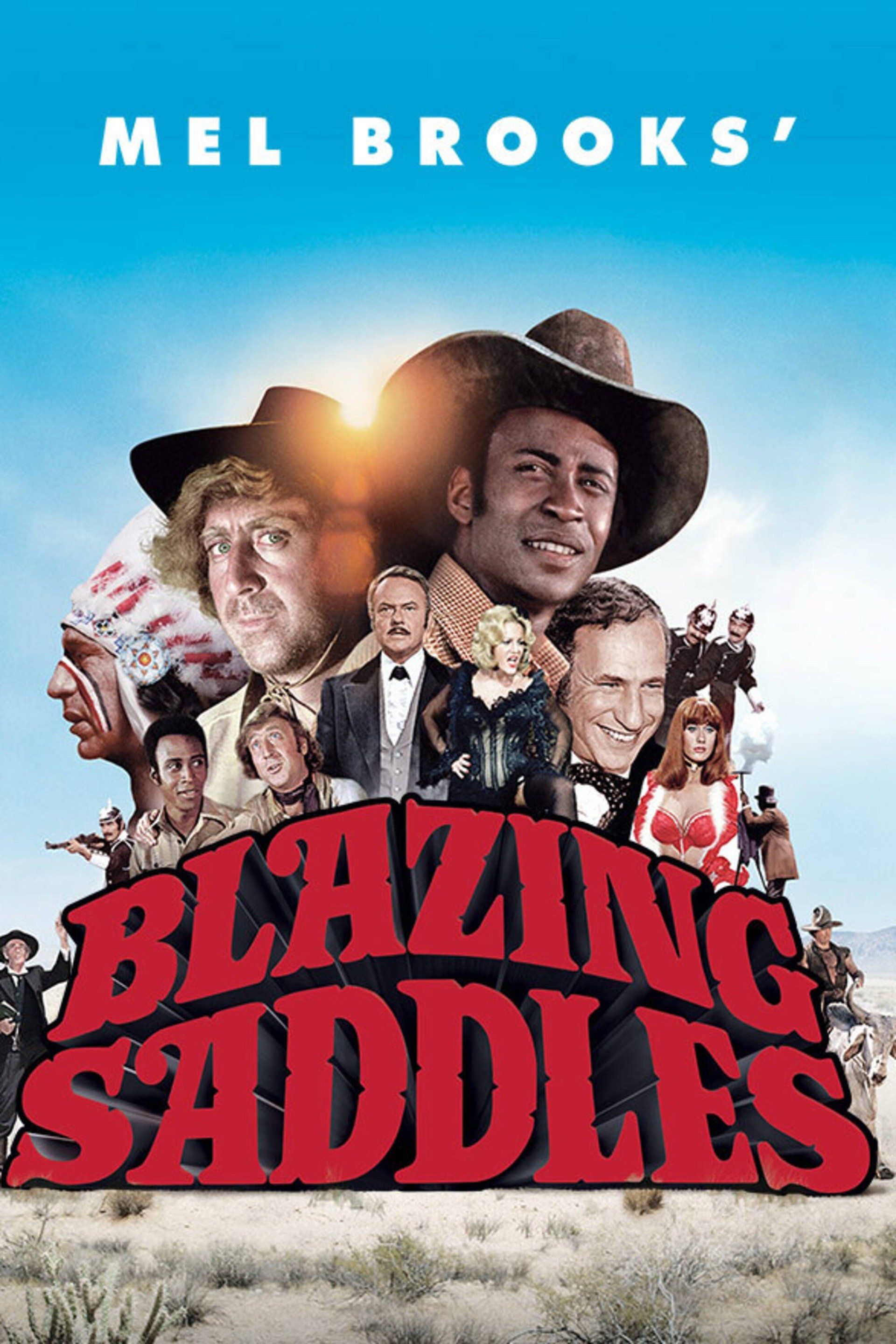
February 7, 1974: "Blazing Saddles" Premieres

February 7, 1974, 50 years ago: Blazing Saddles premieres, director Mel Brooks' tribute to, and parody of, classic Western movies.

Hedley Lamarr (played by Harvey Korman) is a railroad executive, and the Attorney General of an unidentified Western territory of the United States. His name always gets turned into that of Hedy Lamarr, a popular actress of the 1930s and '40s. He gets told, "This is 1874: You can sue her!" He wants to build his railroad through the town of Rock Ridge, but the residents (who all seemed to be named Johnson) won't leave.

So he sends his flunky Taggart (Slim Pickens) and his goons there, to, as Taggart, says, "go ridin' into town, whompin' and a-whompin'," until the terrified citizens leave. But the move backfires: They are willing to fight for their town, and demand that the Territorial Governor, William J. Le Petomane (Brooks) appoint a Sheriff to protect them.

Lamarr figures out a way around this: Since Le Petomane is an idiot, and Lamarr is clearly the power behind the throne, he convinces Le Petomane to appoint a Sheriff that the people of Rock Ridge will never accept: A black man named Bart (Cleavon Little -- the character's last name is never mentioned).

Sure enough, at first, they are repulsed. As Jim (Gene Wilder), a former hired gun known as the Waco Kid, explains: "You've got to remember that these are just simple farmers. These are people of the land. The common clay of the new West. You know: Morons." (The ending was an ad-lib by Wilder. Little cracked up, and Brooks left it in, because it was funny. As Brooks has said, "The only true sin is not being funny.")

In a flashback, where Bart tells Jim his backstory, he mentions his family being the only black family in a wagon train, and thus at the back of it, as if it was a segregation-era bus. When they're attacked by Indians, the chief, also played by Brooks, tells his braves to give them a break: "They're even darker than we are!"

Jim helps Bart win the town over. So Lamarr sends in his doomsday weapon: Mongo (former football star Alex Karras), a gigantic man of limited intelligence and words. Lamarr figures Bart wouldn't be able to handle him. As Jim says, when Bart suggests shooting him, "Don't do that. It'll only make him mad!" Well, not only does Bart find a way to handle Mongo, but Mongo defects to Bart's side, respecting him as the only man ever to stand up to him.

This not having worked, Lamarr sends in another secret weapon: Lili von Shtupp, an overtly sexy German singer (Madeline Kahn, in an obvious homage to Marlene Dietrich), who is meant to seduce Bart. But Bart is a lover as well as a fighter, so she defects to his side, too.

So Lamarr decides he needs total war, telling Taggart, "I want you to round up every vicious criminal and gunslinger in the west. Take this down. I want rustlers, cutthroats, murderers, bounty hunters, desperados! Mugs, pugs, thugs! Nitwits, halfwits, dimwits! Vipers, snipers! Con men, Indian agents, Mexican bandits! Muggers, buggerers! Bushwhackers, hornswogglers, horse thieves, bull dykes! Train robbers, bank robbers! Asskickers, shitkickers! And Methodists!"

The final brawl breaks the fourth wall. Well, it breaks a wall, as the fighting Wild Westerners crash through the set of a movie musical, directed by Buddy Bizarre (Dom DeLuise). Then it breaks into the commissary at Warner Brothers' studio. Finally, it spills out onto the streets of Hollywood, where Bart shoots Lamarr in front of the famous Chinese Theatre. Back in 1874, the townspeople thank Bart for his service, and he and Jim start to ride off into the sunset, as Western heroes tend to do. Then they get off their horses and into a limousine, and are driven off into the desert -- possibly to Las Vegas.

Brooks wrote the screenplay with black comedy legend Richard Pryor, who was supposed to play Sheriff Bart. But Pryor's cocaine habit was out of control at the time, and he became unreliable: The insurance company for the film wouldn't insure him. So it became a starmaking role for Little.

Brooks also wrote the songs for the film, including the title song. Thinking of Frankie Laine's singing of the theme to the TV show Rawhide, and his big Western-themed hit song "Mule Train," both with the sound effect of a cracking whip, Brooks placed an ad in the trade paper Variety, calling for "a Frankie Laine type." Laine himself answered the ad. Brooks didn't tell him the film was a comedy, and he sang it absolutely straight, and it's a great performance.

(There was precedent for this: Ten years earlier, Stanley Kubrick directed Dr. Strangelove, and told half the cast that the film was a comedy, and the other half that it was a drama, with equally stunning results.)

The studio had a lot of problems with the film. There was a lot of usage of "The N-word." In a 2012 interview, Brooks said, "If they did a remake of Blazing Saddles today, they would leave out the N-word. And then, you've got no movie." The purpose was to satirize racism, to show how rotten it is, and how stupid it is. And Brooks got support on it from both Pryor and Little.

There were also objections to Karras punching a horse. And to the beans scene. Brooks pointed out that, in pretty much every movie with cowboys in it, they're eating beans, but nobody hears the sounds that result. But Brooks' contract gave him final content control, and he refused to make any substantive changes.

Times change. When the film is shown on TV today, the N-word is blanked out. And there's a scene near the beginning where Taggart accuses some of the rail workers of "jumping around like a bunch of Kansas City faggots!" That word is often called the gay version of the N-word, but the TV version could have used a better rewrite than "a bunch of Kansas City dummies!"

And Kahn's German singer? Her name is Lili von Shtupp. "Schtup" is, basically, "fuck" in Yiddish. So the TV version blanks it out, so it sounds like her name is "Lili von Sh." And yet, her name can be seen on the poster for the concert. But they left in the Indian chief's reaction upon seeing Bart's family, the single word "Schwarzes!" (German, or in Brooks' case, Yiddish, for "Blacks!" In the vampire parody Love at First Bite, George Hamilton's Dracula said it, but, for the TV version, it was replaced with, "Good evening!")

Wilder, who had previously worked with Brooks in The Producers, agreed to be in Blazing Saddles on one condition: He had a special project he wanted to do, and he asked Brooks to direct. So they made that movie next: Young Frankenstein. Brooks has said that Blazing Saddles is his funniest movie, but Young Frankenstein is his best.

In 1995, I had a terrible cold, a cough that lasted for weeks, and kept me up nights. One night, I saw that Blazing Saddles was going to be on TV. I'd never seen it before, so I figured, what the heck. Big mistake: Every time I laughed, I started coughing again. I began to wonder who would die first, me or Hedley Lamarr. (I didn't see Young Frankenstein until 2021. Shame on me for waiting until then to get over the hump.)

Slim Pickens died in 1983, Jack Starrett (Gabby Johnson, a parody of Western actor Gabby Hayes) in 1989, Cleavon Little in 1992, Madeline Kahn in 1999, Richard Pryor in 2005, Frankie Laine in 2007, Harvey Korman in 2008, Dom DeLuise in 2009, Alex Karras in 2012, Gene Wilder and David Huddleston (Olson Johnson) in 2016, and John Hillerman (Howard Johnson) in 2017.

Amazingly, as of February 7, 2023, Mel Brooks is still alive, at age 96. Also of note in the film and still alive on that date are Robyn Hilton, who played Miss Stein, the Governor's top-heavy secretary; and Rodney Allen Rippy, the former hamburger spokeskid who played young Bart, who grew up and left acting for a successful career in marketing. 

Sunday, March 12, 2023

March 12, 1983: Buckwheat Is Assassinated on "Saturday Night Live"

March 12, 1983, 40 years ago: Buckwheat is assassinated on Saturday Night Live. This was a big deal at the time.

Eddie Murphy had been playing a grownup version of Buckwheat, the black kid with the speech impediment and the upswept hair in the Our Gang serials from 1938 to 1944, on the show. His use of "O-tay!" instead of "Okay!" briefly became a popular catchphrase.

The actor who played Buckwheat, William Thomas Jr., billed as "Billie Thomas," later served in the U.S. Army, was decorated for his service, and returned to the film industry as an editor. On July 31, 1980, he was one of several former Our Gang (rebranded as The Little Rascals for later broadcasts on television) members honored at a convention in Los Angeles. But just a few weeks later, on October 10, he died of a heart attack. He was only 49 years old.

It was only after Thomas' death that Murphy began playing the character. What Thomas would have thought can only be speculated. His son, also named William Thomas Jr., became the executor of his father's estate and image, and raised no objection. But former co-star George "Spanky" McFarland hated it. Murphy got tired of it, too, and decided to "kill the character off." SNL executive producer Dick Ebersol agreed.

Despite being at night, instead of in daylight, the scene was staged to resemble the attempted assassination of President Ronald Reagan by John Hinckley 2 years earlier: Murphy, in character as Buckwheat, walks out of 30 Rockefeller Plaza, which includes NBC headquarters and the studio where SNL is taped, and waves to a crowd, saying "I wub noo!" (Meaning, "I love you!")

Then, as Buckwheat approaches his limousine, just as Hinckley shouted out, "Mr. President!" a voice is heard yelling, "Hey, Mr. Wheat!" Buckwheat turns, with his hands still up, and says, "Yes?" And he is shot. A bodyguard shoves him into the limo, which speeds off toward a hospital, while several people jump on the shooter.

SNL shot two versions, one with "blood squibs" and one without. They decided to go with the one without the squibs, because the one with the squibs looked too real, and they didn't want to actually scare anyone.

Castmember Joe Piscopo, known for his impersonation of Frank Sinatra, played ABC News Nightline host Ted Koppel, reporting on the story, and playing it absolutely straight, as if this was a real story happening in real time. He showed the shooting over and over, including in slow motion, as had been done with Reagan's shooting. Finally, he made the tragic announcement: "We have just received word: Buckwheat is dead!" Again and again, in slow motion, the shooting was repeated, and the audience got the joke.

As the character was taken in for emergency surgery, Mary Gross came on to play Alfalfa, another of the Our Gang characters. "His" reaction was, "I'm alarmed, and confused, and I don't know what to say." Ironically, the actual actor who played Alfalfa, Carl Switzer, was murdered, at his home in Los Angeles, on January 21, 1959. He was only 31.

Later, during the show's regular Saturday Night News segment -- it had originally been, and would again, be Weekend Update -- anchor Brad Hall (now better known for being the husband of Julia Louis-Dreyfus, also then an SNL castmember -- did the show as if it was a complete story, and posted reactions from famous people, who were obviously talking about someone else:

* Actor Charlton Heston, by then also known for his gun advocacy: "Well, he was one of the best we had, maybe the best America had had in this century." (He may have been talking about actor Henry Fonda, who died 7 months earlier.)

* Former Secretary of State Henry Kissinger: "He was tough. He had a good sense of humor." (He may have been talking about Soviet dictator Leonid Brezhnev, who died 4 months earlier; or Egyptian President Anwar Sadat, assassinated in late 1981.)

* President Reagan: "Nancy and I feel that we have lost a close and dear friend." (He could also have been talking about Fonda, or Sadat. In spite of their respective positions, he never met Brezhnev.)

* Pope John Paul II (graphics on the screen suggesting a translation from the original Italian -- yes, I know he was Polish, but he was speaking to Italians): "The entire world mourns the loss of this great humanitarian. Buckwheat was a man of peace. We all know how he died. But, perhaps some of you haven't seen the videotape. Let's take a look." (That made the live audience at 30 Rockefeller Plaza crack up.)

And every minute or so, they squeezed in a "commercial": "Buckwheat shot. America stunned. Brought to you by Texxon. Life goes on, and Texxon is there." "Emergency surgery. The world waits. Brought to you by Texxon. Life goes on, and Texxon is there." "Buckwheat dead. America mourns. Brought to you by Texxon. Life goes on, and Texxon is there." Finally, they closed the sketch with, "Buckwheat dead. America mourns. Brought to you by Texxon. Life goes on, and Texxon is there. Because Buckwheat would have wanted it that way."

The following week, Buckwheat's funeral was shown, again with Piscopo as Koppel covering it. It parodied Brezhnev's funeral, with soldiers doing a slow goose-step. But it also showed American soldiers firing a cannon in salute, probably taken from Reagan's Inauguration in 1981.

Among the simulated guests were First Lady Nancy Reagan, but not the President; and Diana, Princess of Wales, but not her husband, Prince Charles, or his mother, Queen Elizabeth II. Also, in footage clearly taken from Sadat's funeral: Former Presidents Richard Nixon, Gerald Ford and Jimmy Carter; plus Kissinger, and Prime Minister Menachem Begin of Israel.

They also showed footage of the candlelight vigil held in Central Park for former Beatle John Lennon after his assassination, in 1980, saying that this was for Buckwheat. (The entire Our Gang cast combined didn't have the impact that Lennon had.)

Piscopo/Koppel then announced that the police had identified the assassin. Like John Wilkes Booth, Lee Harvey Oswald, and Lennon's killer Mark David Chapman, he was always identified with all three names: John David Stutts. Murphy did double duty as victim and assassin.

As police led Stutts into court for his arraignment, a reporter asked him why he did it. Parodying David Berkowitz, the 1976-77 serial killer known as the Son of Sam, "Well, I had to kill him, because my dog told me he was the Antichrist."

Koppel introduced a clinical psychologist, asking him why people kill famous people. The psychologist said it was to become famous themselves, "and, unfortunately, certain irresponsible people in the media are only too eager to turn these assassins into instant celebrities." Koppel then introduced a profile of Stutts.

Everybody interviewed on the subject, including his former pastor, said Stutts was "Quiet, kind of a loner," which is what people always tend to say about famous killers, whether their victims are famous or not. But Koppel asked them all, "Do you think he killed Buckwheat?" They all said, "Oh, yes!" showing they were not surprised about his apparent guilt. His high school yearbook showed him to be President of the Future Assassins of America, and his class voted him "Most Likely to Kill Buckwheat."

Then, they parodied the shooting of Oswald in 1963, just 2 days after the assassination of President John F. Kennedy. Stutts was even dressed like Oswald, wearing a sweater, and the shooter was wearing a hat like the one Jack Ruby wore while shooting Oswald. Stutts' killer was not identified on the air.

There was also a new "commercial": "Brought to you by Mutual Life: Because you could die tomorrow." The last time, the announcer added, "Just like John David Stutts."

In spite of the "death," and having tired of the character, Murphy has brought Buckwheat back a few times.