Showing posts with label eddie murphy. Show all posts

Sunday, March 12, 2023

March 12, 1983: Buckwheat Is Assassinated on "Saturday Night Live"

March 12, 1983, 40 years ago: Buckwheat is assassinated on Saturday Night Live. This was a big deal at the time.

Eddie Murphy had been playing a grownup version of Buckwheat, the black kid with the speech impediment and the upswept hair in the Our Gang serials from 1938 to 1944, on the show. His use of "O-tay!" instead of "Okay!" briefly became a popular catchphrase.

The actor who played Buckwheat, William Thomas Jr., billed as "Billie Thomas," later served in the U.S. Army, was decorated for his service, and returned to the film industry as an editor. On July 31, 1980, he was one of several former Our Gang (rebranded as The Little Rascals for later broadcasts on television) members honored at a convention in Los Angeles. But just a few weeks later, on October 10, he died of a heart attack. He was only 49 years old.

It was only after Thomas' death that Murphy began playing the character. What Thomas would have thought can only be speculated. His son, also named William Thomas Jr., became the executor of his father's estate and image, and raised no objection. But former co-star George "Spanky" McFarland hated it. Murphy got tired of it, too, and decided to "kill the character off." SNL executive producer Dick Ebersol agreed.

Despite being at night, instead of in daylight, the scene was staged to resemble the attempted assassination of President Ronald Reagan by John Hinckley 2 years earlier: Murphy, in character as Buckwheat, walks out of 30 Rockefeller Plaza, which includes NBC headquarters and the studio where SNL is taped, and waves to a crowd, saying "I wub noo!" (Meaning, "I love you!")

Then, as Buckwheat approaches his limousine, just as Hinckley shouted out, "Mr. President!" a voice is heard yelling, "Hey, Mr. Wheat!" Buckwheat turns, with his hands still up, and says, "Yes?" And he is shot. A bodyguard shoves him into the limo, which speeds off toward a hospital, while several people jump on the shooter.

SNL shot two versions, one with "blood squibs" and one without. They decided to go with the one without the squibs, because the one with the squibs looked too real, and they didn't want to actually scare anyone.

Castmember Joe Piscopo, known for his impersonation of Frank Sinatra, played ABC News Nightline host Ted Koppel, reporting on the story, and playing it absolutely straight, as if this was a real story happening in real time. He showed the shooting over and over, including in slow motion, as had been done with Reagan's shooting. Finally, he made the tragic announcement: "We have just received word: Buckwheat is dead!" Again and again, in slow motion, the shooting was repeated, and the audience got the joke.

As the character was taken in for emergency surgery, Mary Gross came on to play Alfalfa, another of the Our Gang characters. "His" reaction was, "I'm alarmed, and confused, and I don't know what to say." Ironically, the actual actor who played Alfalfa, Carl Switzer, was murdered, at his home in Los Angeles, on January 21, 1959. He was only 31.

Later, during the show's regular Saturday Night News segment -- it had originally been, and would again, be Weekend Update -- anchor Brad Hall (now better known for being the husband of Julia Louis-Dreyfus, also then an SNL castmember -- did the show as if it was a complete story, and posted reactions from famous people, who were obviously talking about someone else:

* Actor Charlton Heston, by then also known for his gun advocacy: "Well, he was one of the best we had, maybe the best America had had in this century." (He may have been talking about actor Henry Fonda, who died 7 months earlier.)

* Former Secretary of State Henry Kissinger: "He was tough. He had a good sense of humor." (He may have been talking about Soviet dictator Leonid Brezhnev, who died 4 months earlier; or Egyptian President Anwar Sadat, assassinated in late 1981.)

* President Reagan: "Nancy and I feel that we have lost a close and dear friend." (He could also have been talking about Fonda, or Sadat. In spite of their respective positions, he never met Brezhnev.)

* Pope John Paul II (graphics on the screen suggesting a translation from the original Italian -- yes, I know he was Polish, but he was speaking to Italians): "The entire world mourns the loss of this great humanitarian. Buckwheat was a man of peace. We all know how he died. But, perhaps some of you haven't seen the videotape. Let's take a look." (That made the live audience at 30 Rockefeller Plaza crack up.)

And every minute or so, they squeezed in a "commercial": "Buckwheat shot. America stunned. Brought to you by Texxon. Life goes on, and Texxon is there." "Emergency surgery. The world waits. Brought to you by Texxon. Life goes on, and Texxon is there." "Buckwheat dead. America mourns. Brought to you by Texxon. Life goes on, and Texxon is there." Finally, they closed the sketch with, "Buckwheat dead. America mourns. Brought to you by Texxon. Life goes on, and Texxon is there. Because Buckwheat would have wanted it that way."

The following week, Buckwheat's funeral was shown, again with Piscopo as Koppel covering it. It parodied Brezhnev's funeral, with soldiers doing a slow goose-step. But it also showed American soldiers firing a cannon in salute, probably taken from Reagan's Inauguration in 1981.

Among the simulated guests were First Lady Nancy Reagan, but not the President; and Diana, Princess of Wales, but not her husband, Prince Charles, or his mother, Queen Elizabeth II. Also, in footage clearly taken from Sadat's funeral: Former Presidents Richard Nixon, Gerald Ford and Jimmy Carter; plus Kissinger, and Prime Minister Menachem Begin of Israel.

They also showed footage of the candlelight vigil held in Central Park for former Beatle John Lennon after his assassination, in 1980, saying that this was for Buckwheat. (The entire Our Gang cast combined didn't have the impact that Lennon had.)

Piscopo/Koppel then announced that the police had identified the assassin. Like John Wilkes Booth, Lee Harvey Oswald, and Lennon's killer Mark David Chapman, he was always identified with all three names: John David Stutts. Murphy did double duty as victim and assassin.

As police led Stutts into court for his arraignment, a reporter asked him why he did it. Parodying David Berkowitz, the 1976-77 serial killer known as the Son of Sam, "Well, I had to kill him, because my dog told me he was the Antichrist."

Koppel introduced a clinical psychologist, asking him why people kill famous people. The psychologist said it was to become famous themselves, "and, unfortunately, certain irresponsible people in the media are only too eager to turn these assassins into instant celebrities." Koppel then introduced a profile of Stutts.

Everybody interviewed on the subject, including his former pastor, said Stutts was "Quiet, kind of a loner," which is what people always tend to say about famous killers, whether their victims are famous or not. But Koppel asked them all, "Do you think he killed Buckwheat?" They all said, "Oh, yes!" showing they were not surprised about his apparent guilt. His high school yearbook showed him to be President of the Future Assassins of America, and his class voted him "Most Likely to Kill Buckwheat."

Then, they parodied the shooting of Oswald in 1963, just 2 days after the assassination of President John F. Kennedy. Stutts was even dressed like Oswald, wearing a sweater, and the shooter was wearing a hat like the one Jack Ruby wore while shooting Oswald. Stutts' killer was not identified on the air.

There was also a new "commercial": "Brought to you by Mutual Life: Because you could die tomorrow." The last time, the announcer added, "Just like John David Stutts."

In spite of the "death," and having tired of the character, Murphy has brought Buckwheat back a few times.

Thursday, August 4, 2016

Stupid Things I Used to Think

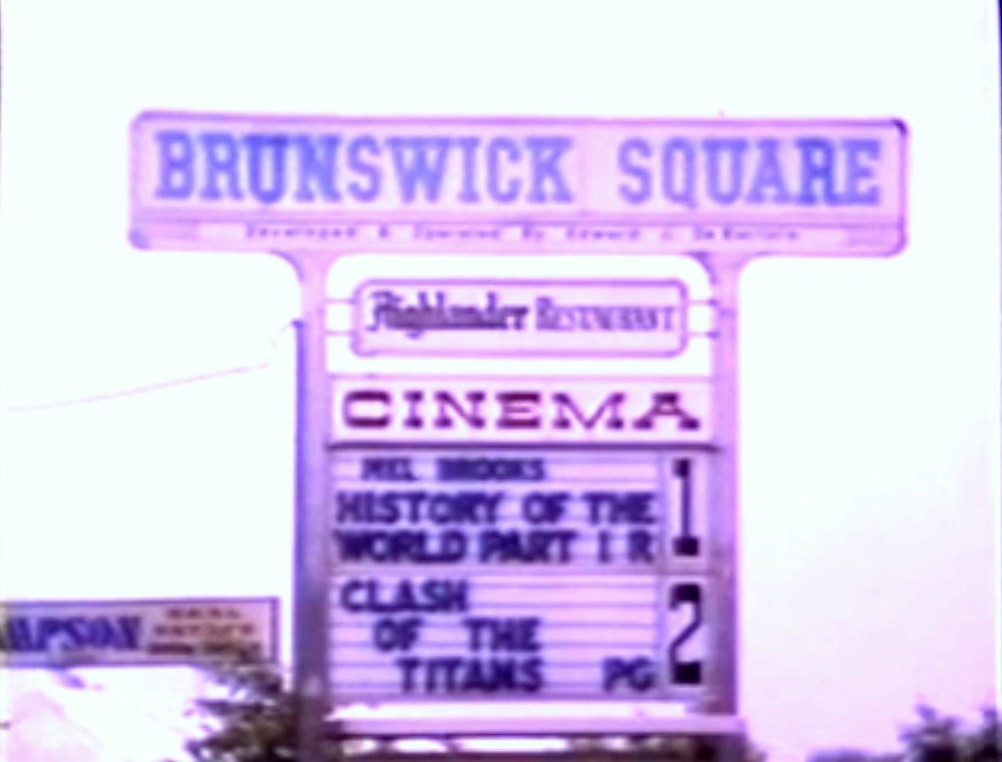
The old marquee for the Brunswick Square Mall
in my hometown of East Brunswick, New Jersey.
From the titles of the films, I know that this photo
was taken in June 1981.
I was 11 1/2 years old, and lived half a mile down the hill.

When I was a kid, I thought some things that seem ridiculous now.

I thought my father's parents lived next-door to each other in Newark. Grandma's house was separated from the house next door by a driveway that led to a parking lot in back of the houses on Woodside Avenue, in the Forest Hill section of the North Ward. Since her house shared a driveway with the house next door, I figured that house next door had to be Grandpa's house. And the man who lived there was certainly old enough to be my grandfather.

So, one time, I must have been about 4 years old, I looked up at him, and I called him "Grandpa." I don't remember his reaction.

Grandpa Mike -- I wasn't actually named for my father's father; my mother just liked the name "Michael," and my father went along with it -- smoked like a chimney, drank like a fish and ate like a pig. He only lived to be 57. My father stopped smoking in his 30s, and rarely drank, but ate bacon and eggs for breakfast pretty much every day that I knew him. He lived to be 71.

Even at the age of 4, I remembered hearing my parents say that Grandpa Mike was dead, and was no longer living with Grandma Dot. Did I get what that meant? Maybe not. Maybe that's what confused me. He had lived with her in that house for 33 years. He had lived there, but he wasn't living there anymore. Maybe knowing that part led me to think that maybe he was living next-door.

I never did learn the name of the man who lived next door. Even if he was only in his 50s then, he's almost certainly dead now. And that neighborhood, mostly-white in the mid-1970s, is now nearly all-Hispanic, mostly Central and South American. So even if he is still alive, he's almost certainly not living there.

*

I thought the camera and operator at the opening of The 4:30 Movie on WABC-Channel 7 was a frog. I thought the reels on top were the eyes, and the back of the chair was the tail.

I thought, "Why are they playing the Channel 9 Million Dollar Movie theme in this promo for Gone with the Wind?" I didn't know that it was the theme from that movie, also known as "Tara's Theme," for the O'Hara family mansion in the film. Max Steiner composed it. Mack David wrote lyrics for it, titled "My Own True Love," and it became a hit for New Jersey-based doo-wop group The Duprees in 1962.

I thought it was crazy for newsmen to switch networks. When Harry Reasoner left ABC for CBS in 1978, I thought that was very, very wrong. I had no idea that he had started on CBS, and so had former ABC anchorman Howard K. Smith. Or that Barbara Walters, very recently, had left NBC for ABC.

I also thought it was crazy for actors to leave successful TV shows. Why did Sally Struthers, Rob Reiner, and then Jean Stapleton leave All in the Family? Why did Gary Burghoff leave M*A*S*H?

I thought it was crazy for there to be a New Dick Van Dyke Show. My parents loved the old Dick Van Dyke Show. Well, if the old one was so great, why was there a new one? And why did Lucille Ball have 3 different shows? (Little did I know that, when first-run, they were on 3 different networks. That would have really confused me!)

Little Uncle Mike was so white! (How white was he?) I was so white, and so suburban, I thought James Brown, the Godfather of Soul, was a character that Eddie Murphy created for Saturday Night Live. It didn't occur to me that a man that over-the-top could actually exist. (Even though I had seen Liberace and Elton John on TV. God only knows what I would have thought of George Clinton... or Sun Ra!) I didn't know that James was a real person until I saw Rocky IV. 

I thought it didn't make sense for the Yankees and Mets to be on other channels. WNBC-Channel 4 would broadcast The Game of the Week on Saturday. WABC-Channel 7 would broadcast Monday Night Baseball on, well, Monday. And the Yankees would frequently be on it -- because, being successful at that point, they were in demand. Lots of people wanted to see the Yankees. Lots of those wanted to see them get beat. The Mets were on each broadcast less often because, at the time, they stunk, and everybody knew it.

But wait! Aren't the Yankees supposed to be on Channel 11? (WPIX.) And aren't the Mets supposed to be on Channel 9? (WOR, now WWOR.) I thought that if a channel showed a TV show, only that channel could show that show. So how could the Yankees be on Channel 4 or Channel 7?

Back then, channels like 9, 11 and WNEW-Channel 5 (now WNYW) would show reruns of old shows, like The Honeymooners, Gilligan's Island, Lost In Space, Star Trek, The Odd Couple, I Dream of Jeannie, the aforementioned original Dick Van Dyke Show, and the aforementioned referred-to shows starring Lucille Ball: I Love Lucy, The Lucy Show and Here's Lucy. Okay, I got that. I figured a show could only be on one channel at a time.

But then, Channel 5, then an "independent station" (now part of Fox), started showing reruns of M*A*S*H, which was still running on WCBS-Channel 2; and Three's Company, which was still on Channel 7. Channel 11 started showing Happy Days, which was still running on Channel 7. And who were these guys on M*A*S*H: Henry, Trapper and Frank? Wait, Henry is McLean Stevenson, the guy on Hello, Larry? Trapper is Wayne Rogers, the guy on House Calls? They can be on more than one show, like Lucy? I was so confused. And why did Stevenson, Rogers and Linville leave M*A*S*H?

And explaining those things to my pre-adolescent mind still didn't clear up for me why the baseball establishment (at the time, I seemed to get that concept, if not the expression "the establishment") would let the big networks show games when the local stations already did.

*

Which allows me to segue into stupid things I used to think about sports.

I thought baseball managers wore uniform numbers based on how they finished. In 1978, Billy Martin, manager of the Yankees, wore Number 1. Tommy Lasorda, manager of the Los Angeles Dodgers, wore Number 2. Martin's Yankees beat Lasorda's Dodgers in the previous year's World Series. So, that's how it worked, right? If the Dodgers had won, Lasorda would have wore 1, and Billy would have worn 2.

Then, when Billy, ahem, was allowed to resign in mid-1978, and Bob Lemon was hired as manager, he didn't take Number 1. He took the number he'd always worn as a major league pitcher, 21. I didn't get it.

I thought Reggie Jackson began his career with the Oakland A's, in 1967. It said so, right there on his baseball card: "1967 A's." And he did begin his career with the Oakland A's -- sort of. That first season, the A's were still in Kansas City. Same team, different city. I didn't know that yet.

I knew that the Los Angeles Dodgers had started out in Brooklyn, and that the San Francisco Giants had started out in New York. And I had a vague idea that there had been, fairly recently, a baseball team called the Washington Senators, but that they no longer existed.

But when I looked in the back of the Yankees' Yearbook, they had the players' statistics, and also the teams they'd played for. Except they listed the cities, not the team names like the cards did. And in his first year, Reggie was listed as with "Kansas City." I presumed that this meant that he had played for the Royals. That wasn't true: They replaced the A's in Kansas City, starting in 1969.

I saw that Lou Piniella had also played with "Kansas City." But that really was the Royals. I also saw that Fred Stanley had played with "Seattle." I presumed that meant the Mariners. Since I began watching baseball games on TV in 1977, I couldn't remember a time when there was no Seattle Mariners, and no Toronto Blue Jays.

But then I got Stanley's baseball card, and it said that he spent the 1969 season with the "Pilots." Huh? The Pilots? Who the heck were the Pilots? I didn't know about this 1969 expansion team that failed after just 1 season and became the Milwaukee Brewers in 1970. I knew about the Brewers, but not the Pilots.

I hadn't yet read Jim Bouton's Ball Four. I only knew Bouton as the sportscaster who used to pitch for the Yankees in the 1960s, and was now making a comeback with the Atlanta Braves at age 39.

Had I known that the Pilots had Piniella on their payroll, before trading him to the Royals, my mind truly would have been blown.

And then when I read a book about Mickey Mantle, and it said he was "sent down to Kansas City" in his rookie year of 1951, I couldn't figure that out. I knew that major league teams had minor league teams in their "farm systems." But how could Kansas City be a minor-league team? They had a major league team! Not in 1951, they didn't. Not until the A's moved from Philadelphia to Kansas City in 1954-55, before moving to Oakland in 1967-68, and were then replaced by the expansion Royals in 1969.

I didn't yet know that, as recently as 1952, the following cities that had major league teams by 1978 were all in the minors: Milwaukee, Baltimore, Kansas City, Los Angeles (2 teams), San Francisco, Oakland, Houston, Atlanta, Seattle, Montreal, San Diego and Toronto. And Minnesota had 2 teams: One in Minneapolis, the other in St. Paul. And Dallas had 2 teams: One in Dallas, the other in Fort Worth.

*

I thought it was silly to name the mall in my hometown of East Brunswick the Brunswick Square Mall. There's no square named Brunswick Square. There wasn't then, and there isn't now. And the plot of land on which the mall was built was not shaped like a square. So why that name? To this day, I have not learned the reason, and I wouldn't know where to go to find out.

What's more, I didn't know why East Brunswick and the adjoining town of North Brunswick were south of New Brunswick. Why wasn't North Brunswick called South Brunswick, and the town to the south of that, which was (and is) called South Brunswick, called something else? Why wasn't Piscataway, which is north of New Brunswick, called North Brunswick? Why wasn't Highland Park, which is east of New Brunswick, called East Brunswick? Why wasn't Franklin, which is west of New Brunswick, called West Brunswick? And why wasn't there a West Brunswick?

Why, back where we used to live in Essex County (Bloomfield, northwest of Newark), was there an Orange, an East Orange, a South Orange, and a West Orange, but not a North Orange? (That would have been Montclair.) And if there's a town named only "Orange" up where we used to live, why isn't there one named only "Brunswick"?

This last sequence still doesn't make sense to me.