Showing posts with label brett hull. Show all posts

Tuesday, January 31, 2023

Bobby Hull, 1939-2023

Before Sidney Crosby (give me a break), before Wayne Gretzky, before Bobby Orr, Bobby Hull was America's favorite hockey player.

Robert Marvin Hull was born on January 3, 1939 in Belleville, Ontario, Canada, about halfway between Toronto and Ottawa. (Not to be confused with Belleville, New Jersey, although there is also a town named Bloomfield, and another named Trenton, nearby.) He had a brother, Dennis Hull, who would later join him on the Chicago Black Hawks. After Bobby's son, Brett Hull, also became an NHL superstar, Dennis wrote a memoir titled The Third Best Hull: I Should Have Been Fourth, But They Wouldn't Let My Sister Maxine Play.

Before I go any further, let me point this out: The Chicago NHL team, since its founding in 1926, had always had its name written as two words: "Black Hawks." But in 1986, someone went through the team's records, and found their original NHL charter, which had the name listed as a single word, "Blackhawks." The team notified the NHL, and so, officially, they have been the "Chicago Blackhawks" ever since. But in Hull's era, they were the "Chicago Black Hawks."

The team's founding owner, Chicago coffee tycoon Frederic McLaughlin, had commanded the 333rd Machine Gun Battalion of the U.S. Army's 86th Infantry Division during World War I. Since it was based in Illinois, it was called the Blackhawk Division, after Black Hawk, a chief of the Sauk tribe in Illinois in the early 19th Century.

In 1955, Bobby Hull led the Woodstock Warriors to the Sutherland Cup, the amateur hockey championship of the Province of Ontario. In 1957, he was signed by the Black Hawks, and, that season, finished 2nd to Frank Mahovlich of the Toronto Maple Leafs for the Calder Memorial Trophy, the NHL's Rookie of the Year award.

In 1960, he made the 1st of his 12 NHL All-Star Games, and won the 1st of his 3 Art Ross Trophies as the NHL's leading scorer. In 1961, after years of struggling, the Hawks won the Stanley Cup, with a team featuring 4 future Hall-of-Famers: Hull at left wing, Stan Mikita at center, Pierre Pilote on defense, and Glenn Hall in goal.
Hull (left) and Jack "Tex" Evans with the 1961 Stanley Cup

Hull had worn Number 16 up to that point. For the next 2 seasons, he wore Number 7. From 1963 onward, he wore Number 9, like many other great scorers before him, including the recently-retired Maurice "the Rocket" Richard of the Montreal Canadiens, and the man then regarded as the best player in the game, Gordie Howe of the Detroit Red Wings.

Hull won the Ross Trophy again in 1962, scoring 50 goals, joining Richard and another Canadien, Bernie "Boom-Boom" Geoffrion, as the only players ever to do this. Geoffrion has been credited as the inventor of the slap shot, but Hull made it an art form, especially after curving the blade of his stick, in what became known as "the banana blade." This would be outlawed later in his career.

Despite his 50 goals in 1961-62, the Hawks couldn't make it back-to-back Cups, losing in the Finals to Mahovlich and the Leafs. In 1965, Hull won the Hart Memorial Trophy as the NHL's Most Valuable Player, and the Lady Byng Trophy as its "most gentlemanly player."

On March 12, 1966, Hull became the 1st NHL player to score more than 50 goals in a season, sending his 51st past Cesare Maniago of the New York Rangers at Chicago Stadium. He topped out at 54, and his 43 assists gave him 97 points on the season, breaking the record of 96 set by the Canadiens' Dickie Moore in 1959. He again won the Hart Trophy and the Ross Trophy.
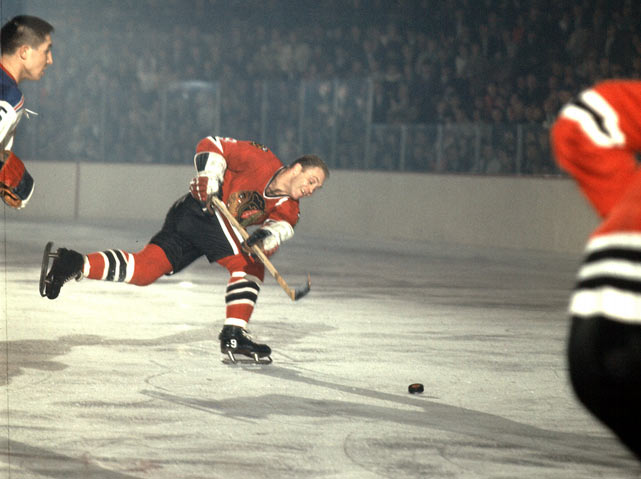
The 51st goal. Note the curve on the stick blade.

By this point, he had surpassed Howe as the most popular player in America. He was the fastest skater in the League, timed at 29 miles per hour, and this speed, combined with his long, flowing blond hair, earned him the nickname "the Golden Jet." His brother Dennis joined the Hawks in 1964, wearing Number 10, and, as the 2nd-best brother became known as "the Silver Jet." Bobby also had the fastest-measured shot in hockey: 118 MPH.

In 1969, he set new personal bests with 58 goals and 107 points, but Phil Esposito of the Boston Bruins, a former Chicago teammate, shattered both records with 76 goals and 152 points. Still, the NHL awarded Hull the Lester Patrick Trophy, for contributions to hockey in America. He was only 30 years old.

On February 21, 1970, he blasted a shot past Eddie Giacomin of the New York Rangers, for his 500th career goal. Only Richard and Howe had reached the milestone before him. In a 1988 interview, Giacomin said that Hull’s slap shot "would rise or dip. You'd pull up when you should really be ducking. It played games with your mind."

But there was trouble on the horizon. His thinning hair, which eventually led to one of the most famous toupees in sports -- perhaps 2nd only to that of ABC sportscaster Howard Cosell -- soon became the least of his worries. And in the 1970 off-season, the NHL banned the banana blade, which cut down on his shooting ability. Still, he helped the Hawks reach the Stanley Cup Finals again in 1971, losing to the Canadiens.

In spite of all he had achieved, he was underpaid. So was every Black Hawk, even though the team's owner, William Wadsworth Wirtz, was filthy rich. Some of his wealth came from his family. But where he was really making money was as the owner of the traveling Holiday On Ice and Ice Follies shows.

Bill Wirtz was known as Dollar Bill, because he was cheap. He was also behind the times: He wouldn't let Black Hawks home games be televised, unless they were picked up by national broadcasters, which usually only happened for the Playoffs. He said broadcasting regular-season home games was unfair to season-ticket holders. He didn't realize that he could add to his fortune with the TV revenue.

In 1972, the World Hockey Association was founded. They wanted a big star to get fans and income. They asked Hull to jump the NHL and join them. He said he would -- for $1 million. (About $7.1 million in 2023 money.) He was joking.

They weren't: Ben Hatskin, majority owner of the WHA's Winnipeg franchise, who made his fortune in lumber and jukebox rentals, offered him a $1 million signing bonus, a contract worth $1.75 million over 10 years, the head coach's job, and a small share of ownership. Hatskin was even willing to name the team after him, sort of: The Winnipeg Jets. To borrow a line from the year's biggest film, The Godfather, it was an offer he couldn't refuse.

Hull signed with the Jets. The NHL sued to stop it, and the litigation prevented him from opening the season with them. In addition, because he had "defected" to the WHA, he was not permitted to play on the all-NHL "Team Canada" that would face the Soviet team in the "Summit Series." Dennis was selected, but threatened to boycott the team for keeping Bobby off. Bobby told him he should play anyway. Without Bobby Hull, and without Bobby Orr, who was injured, it took Canada the full 8 games beat the Soviets. To this day, aside from being the Golden Jet's brother, being a member of 1972 Team Canada is what Dennis Hull is best known for.

The Jets debuted on October 12, 1972, beating the New York Raiders, 6-4 at Madison Square Garden. On October 15, they played their 1st home game, losing 5-2 to the Alberta Oilers at the Winnipeg Arena. (After the 1st season, the Oilers switched from their Province's name to their City's name, becoming the Edmonton Oilers.)

Hull was finally able to join them on November 8, a 3-2 loss to the Quebec Nordiques at the Colisée de Québec. In spite of the late start, he was able to feast on the lesser assemblage of talent in the "rebel league," and also to take advantage of the fact that they allowed the banana blade, to score 51 goals, winning the Gary Davidson Trophy as the league's 1st Most Valuable Player. (Davidson was the league's founder, as he was for the ABA and the WFL.)

With Hull, the Jets reached the WHA Finals, but lost to the New England Whalers, then based in Boston. Without him, but with Mikita and goaltender Tony Esposito (Phil's brother), the Black Hawks reached the Stanley Cup Finals, again losing to the Canadiens. If Wirtz had paid Hull what he was worth, who knows?

After Howe joined the Houston Aeros and won the MVP for 1973-74, the award was renamed the Gordie Howe Trophy. Hull won it in 1975, then resigned as head coach after 3 seasons. The Jets beat the NHL to the idea of signing players from Sweden, signing Andres Hedberg, Ulf Nilsson and Lars-Erik Sjöberg. Hull, Hedberg and Nilsson formed "The Hot Line." The Jets won the WHA title 3 times: In 1976, 1978 and 1979. The other teams combined only won 4 titles. Hull made the All-Star Game in 5 of the league's 7 seasons.
In 1979, the Jets, the Oilers, the Nordiques and the Whalers were invited to join the NHL. By that point, Howe and his sons Mark and Marty had been sold by the bankrupt Aeros to the Whalers. The Whalers traded for Hull and former Maple Leafs star Dave Keon. With Howe already wearing Number 9 for the team, renamed the Hartford Whalers, he went back to his old Number 16. After the season, both Hull and Howe retired.
Bobby Hull (left) and Gordie Howe

The 8 goals Hull scored for the Jets and the Whalers in 1979-80 gave him 610 in NHL play. He scored another 303 in the WHA -- which matched the NHL total of his brother Dennis, who ended his career in 1978, with the Red Wings. In total, Bobby had 914 major league goals. Both the 610 and the 914 were then 2nd all-time to Howe.

Mikita retired in 1980. The Black Hawks made his Number 21 the 1st uniform number they retired. In 1973, they gave Number 9 to Dale Tallon, whom they'd acquired from the Vancouver Canucks, for whom he'd worn the number for 2 years. Tallon, a decent player who was one of the last players cut for the Summit Series, objected: "They forgot to add the decimal point." He played the 1st preseason exhibition game wearing 9, and the fans booed -- directed at team management more than at Tallon himself -- every time he touched the puck. The next game, he switched to 19, and spent 5 years mainly getting cheered in Chicago.

In 1983, Hull was elected to the Hockey Hall of Fame. He and Wirtz finally made peace, and on December 18 of that year, his Number 9 was rightfully retired. The Jets also retired his Number 9. In 2011, statues of Hull and Mikita were placed outside the Blackhawks' new arena, the United Center.
Hull was also elected to the Ontario and Manitoba Sports Halls of Fame, and the WHA Hall of Fame. In 1998, The Hockey News ranked him 8th, the highest-ranking left wing, on their list of the 100 Greatest Hockey Players. 

He married 3 times, and 2 of his wives alleged that he had assaulted them. His 3rd wife initially pressed charges, then dropped them. His daughter, Michelle Hull, was a champion figure skater as a child, but a knee injury led her to study law instead. As a result of how her father treated her mother, his 1st wife, she works with battered women.

Bobby had 4 sons. Bobby Hull Jr. won the Memorial Cup, the championship of junior hockey's Canadian Hockey League, with the 1980 Cornwall Royals. Bobby Jr. and Blake Hull won the Allan Cup, the championship of Canadian senior amateur hockey, in 1987 with the Brantford Mott's Clamatos. Bart Hull played college football at Boise State University, and played with the Canadian Football League's Ottawa Rough Riders and Saskatchewan Roughriders. (Yes, both teams had almost the same name.)

Most notably, Bobby's son Brett Hull joined him as the only father & son pair to both score 50 goals in a season, the only such pair to both score more than 600 (or even 400) goals in a career, the only such pair to win the Hart Trophy, the only such pair to win the Ross Trophy, and the only such pair to win the Lady Byng Trophy. And while there are a few father & son pairs in the Hockey Hall of Fame, including Bobby and Brett, they were the only such pair to both be named, in 2017, to the NHL's 100th Anniversary 100 Greatest Players.

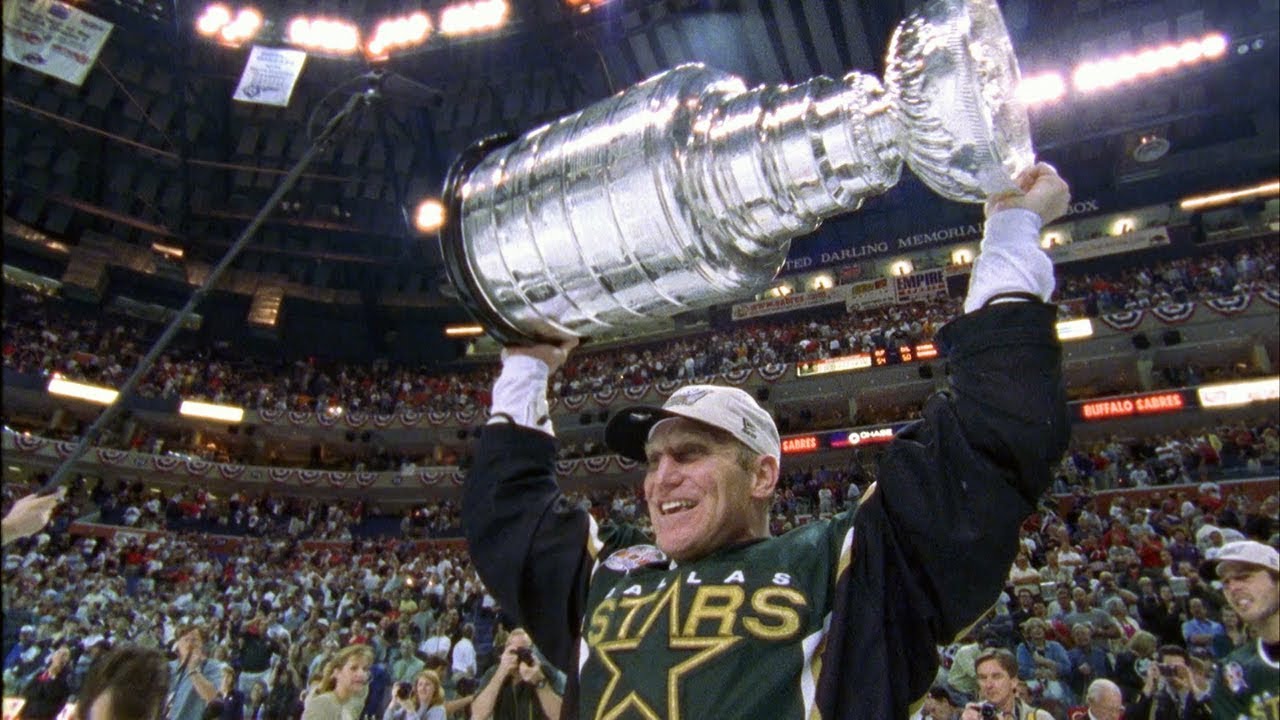
After starring for years with the St. Louis Blues, Brett won the Stanley Cup in 1999 with the Dallas Stars (scoring the Cup-winning goal in controversial fashion) and in 2002 with the Red Wings. So "The Golden Brett" not only scored more goals in NHL play than his father, 741, but won more Cups, 2 to 1.

The Blues retired Brett's Number 16. In 1996, new owners moved the Jets to the Phoenix area, where they are now named the Arizona Coyotes. Toward the end of his career, they acquired Brett, and Bobby gave permission for his Number 9 to be unretired for him. In 1999, the Atlanta Thrashers entered the NHL as an expansion team, but in 2011, they moved to become the new Winnipeg Jets. They have honored the old Jets' retired numbers, although Evander Kane asked Bobby for permission to wear Number 9, and got it.

In 2007, Bill Wirtz died. The Blackhawks won the Stanley Cup since 1961, hadn't been to the Stanley Cup Finals since 1992, or even to the Conference Finals since 1995. Because of their owner's cheapness, they didn't even have a TV contract.

Mahovlich made a point that was indicative of the Hawks' struggles: He had won the Cup at Chicago Stadium 3 times, clinching there with the Leafs in 1962 and with the Canadiens in 1971 and 1973; while Hull had never clinched at home, since their 1961 win had been clinched in Detroit. (The Hawks had clinched at home in 1934, against Detroit; and in 1938, away to Toronto.)

I don't want to say that it's a good thing when anyone dies, but the death of Bill Wirtz was the best thing that could have happened to the Blackhawks. His son, William Rockwell "Rocky" Wirtz, became the owner, and followed a George Costanza-style "do the opposite" philosophy. He put the Hawks back on TV, fixed the team's scouting system, and made peace with former stars, including Hull.

He said, "When I assumed leadership of the organization upon my father's passing in 2007, one of my first priorities was to meet with Bobby to convince him to come back as an ambassador of the team. His connection to our fans was special and irreplaceable." The Hawks won the Cup in 2010, 2013 and 2015, and Bobby was part of the celebrations all 3 times.
In 2019, the NHL Winter Classic was played at Busch Stadium in St. Louis, between the Blues and the Blackhawks. Although the Blackhawks consider the Red Wings to be their historic arch-rivals, the Blues, in Missouri but across the Mississippi River from Illinois, consider their arch-rivals to be the Blackhawks. For this game, Bobby, representing Chicago, and Brett, representing St. Louis, were named honorary captains, and participated in the ceremonial opening face-off.
Left to right: Blackhawks Captain Jonathan Towes, Bobby Hull,
Brett Hull, Blues Captain Alex Pietrangelo

Bobby Hull died on January 30, 2023, at his home in Wheaton, Illinois, outside Chicago -- also the hometown of another Chicago sports legend, Bears pioneer Red Grange. He was 84 years old.

Yes, I know, he was a domestic abuser, an egomaniac, and left the NHL when they really needed him against the Soviets. But he still gave hockey fans a lot of great memories, not to mention a son who actually scored more goals in NHL play than he did.

With his death, there are now 3 surviving players from the 1961 Stanley Cup Champion Chicago Black Hawks: Glenn Hall, Bill Hay and Wayne Hicks.

UPDATE: Bobby Hull was cremated, and has no publicly known "final resting place." Bill Hay died on October 25, 2024; and Glenn Hall on January 7, 2026; leaving Wayne Hicks as the last survivor of the '61 Black Hawks. Dennis Hull died on May 30, 2026.

Wednesday, June 19, 2019

Top 5 Reasons You Can't Blame the Referees for the Buffalo Sabres Losing the 1999 Stanley Cup

Puck: In net. Foot: In crease. Rule: In place.

June 19, 1999, 20 years ago: The Dallas Stars win the Stanley Cup, defeating the Buffalo Sabres 2-1, in triple overtime, in Game 6 of the Stanley Cup Finals, at the Marine Midland Arena (now the KeyBank Center) in Buffalo.

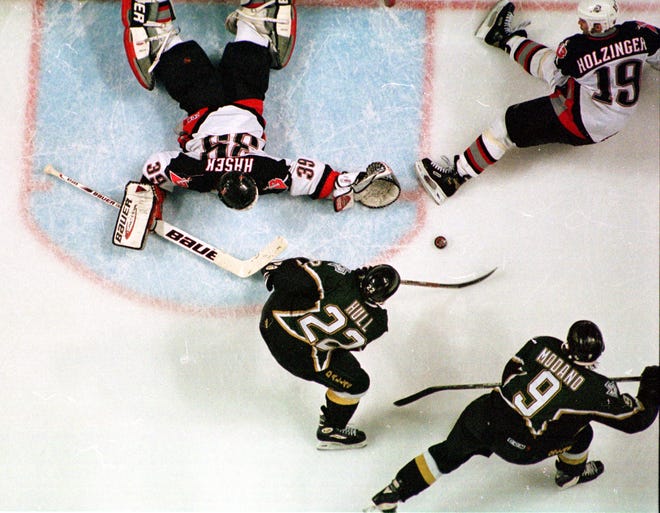
At 14:51 over the 3rd overtime, Brett Hull, frustrated through years of not reaching the Finals with the St. Louis Blues, scored off a rebound over a sprawling Dominik Hasek. It ended the longest Cup-clinching game ever. Another 25 seconds, and it would have surpassed Game 1 of 1990 (Edmonton over Boston) as the longest Finals game ever.

The Sabres protested, citing the NHL rule of the time that a player could not be credited with a goal if any part of his body was within the goal crease. The replay showed that Hull's right foot was in the crease.

But the referees ruled that he had possession of the puck prior to entering the crease, making the goal legal and the Stars the World Champions.

Before the next season, the NHL changed the rule, allowing players to score from within the crease freely, as long as they did not interfere with the goaltender.

Sabres fans from Plattsburgh in the north to Binghamton in the south, from Albany in the east to Cleveland in the west, still say they got screwed. And, given that no major league team from Western New York has won a World Championship since the Syracuse Nationals were NBA Champions in 1955, they need all the correct calls they can get.

But did they get screwed?

Top 5 Reasons You Can't Blame the Referees for the Buffalo Sabres Losing the 1999 Stanley Cup

5. The Rule. It was in place. Was it a bad rule? Yes. Was the change made for the next season worse? Yes. But does anybody who wants the Sabres to win have a case? No, not as the rule was written at the time.

Think about it this way. You know what kind of person the typical North Texan is when he talks about politics or the Dallas Cowboys. Now, imagine that the goal had been waved off. And that the Sabres had gone on to win Games 6 and 7 and take the Cup. We'd have spent the last 20 years hearing people from Texas calling the '99 Sabres the greatest cheats in the history of sports, and that the Stars deserved to win the Cup.

4. Dominik Hasek. Despite having one of the best regular seasons that any NHL goaltender has ever had, he wasn't nearly so good in the Finals. He had already allowed 12 goals in 22 periods, nearly 1 every 2. Had he stopped this shot, we wouldn't be talking about it now.
But even if the goal had been waved off...

3. The Stars Still Could Have Won the Game. Had the goal been waved off, the game would have gone on, and would still have been tied, and the Stars could still have won it.

2. Game 7. If the Sabres had won Game 6, then the series would have gone to a Game 7, it would have been played in Dallas, and the odds would still have been against the Sabres.

The Stars got back to the Finals the next year, against the New Jersey Devils, winning Game 5 in triple overtime at the Meadowlands, before the Devils won Game 6 in double overtime in Dallas. Moral of the story: If you want to beat the Dallas Stars in the Stanley Cup Finals, do it before the game gets to triple overtime. (The Sabres did win Game 1 in the 1st overtime.)

1. The Stars Were Better. I don't like Texas, especially Dallas, and I despise their teams. I don't want to say a team from the State of Texas is better than a team from the State of New York, even if they are about 400 miles from both Midtown Manhattan and my Central Jersey nerve center.

But Brett Hull, Ed Belfour, Mike Modano and Joe Nieuwendyk are in the Hockey Hall of Fame. Guy Carbonneau, Jere Lehtinen, Darryl Sydor and Derian Hatcher could be. (UPDATE: Carbonneau has been elected.) Only one '99 Sabre has made it: Dominik Hasek. Granted, the more talented team doesn't always win, and may not even deserve to win. But the Stars were, easily, the more talented team. And they did clinch on the road. There is something to be said for that.
VERDICT: Not Guilty. Before the beginning of the play that ended with Hull's goal, the chances of the Sabres winning the Cup were already remote. Did they get screwed? Maybe. But would it have mattered in the end? Probably not.

There is an unusual postscript to this story. In 2002, Hull and Hasek would be teammates on the Detroit Red Wings, winning the Stanley Cup together.
Hasek would win another Cup with the Wings in 2008, giving him 2, as many as Hull -- and twice as many as Hull's father Bobby, who only won it with the 1961 Chicago Blackhawks.

For all the good any of that did the Sabres.

How Long It's Been: The Dallas Stars Won the Stanley Cup (Or the Buffalo Sabres Were In the Finals)

The St. Louis Blues were the last of the 1967 expansion teams to win their 1st Stanley Cup.

What's that, you say? The team variously known as the California Seals (1967), the Oakland Seals (1967-70), the Bay Area Seals (1970), the California Golden Seals (1970-76) and the Cleveland Barons (1976-78) never won one?

That's technically true. However, A, they were merged with the Minnesota North Stars in 1978, so, unofficially, any Cups won by that franchise can be credited to them; and, B, if you don't buy that, then you have to consider them to be no longer in existence, in which case they don't count anyway.

The Philadelphia Flyers won their 1st Cup in 1974; the Pittsburgh Penguins, in 1991; the Los Angeles Kings, in 2014; and the North Stars, in 1999 -- as the Dallas Stars, which they have been since 1993.

They won it by taking Game 6 against the Buffalo Sabres in Buffalo, on a controversial goal by Brett Hull. I'm not going to debate the merit of that goal now, but suffice it to say that, had it been waved off, the game would have gone on, tied, and the Stars could still have won it. If the Sabres had won it, then the series would have gone to a Game 7 in Dallas, and the odds would have been against the Sabres.

The Stars got back to the Finals the next year, against the New Jersey Devils, winning Game 5 in triple overtime at the Meadowlands, before the Devils won Game 6 in double overtime in Dallas. The Stars have not been back since.

The Sabres and the Vancouver Canucks, both coming into the NHL in 1970, are now the longest-lasting teams to have never won the Cup. The Canucks have lost in the Finals in 1982, 1994 and 2011; the Sabres, in 1975 and 1999.

It's been 20 years -- June 19, 1999 -- since the Dallas Stars won the Stanley Cup, and the Buffalo Sabres were in the Stanley Cup Finals. How long has that been?

*

The Stars had Pat Verbeek, an original 1982-83 Devil; Shawn Chambers, a member of the Devils' 1995 Cup winners; and Joe Nieuwendyk, Jamie Langenbrunner and Grant Marshall, all of whom would play on the Devils' 2003 Cup winners.

Hull and Mike Modano are in the Hockey Hall of Fame. Nieuwendyk, Guy Carbonneau, Jere Lehtinen, Darryl Sydor and Ed Belfour could be. But that thug Derian Hatcher can forget it. Only one '99 Sabre has made it, goalie Dominik Hasek.

The Tampa Bay Lightning, the Carolina Hurricanes, the Anaheim Ducks, the Los Angeles Kings, the Washington Capitals and the St. Louis Blues had never yet won the Stanley Cup. The Chicago Blackhawks had not won the Cup since 1961. The 'Canes, the Ducks, the Lightning, the Ottawa Senators, the San Jose Sharks, the Nashville Predators, and the Vegas Golden Knights had not yet reached the Finals. The Knights, the Columbus Blue Jackets and the Minnesota Wild had not yet begun play. The Atlanta Thrashers had just started, and had not yet become the new Winnipeg Jets.

All of those facts are no longer true.

The Stars, the Devils, Kings, the 'Canes, the New York Islanders, the Colorado Avalanche, the Phoenix (now Arizona) Coyotes, the Pittsburgh Penguins, the Edmonton Oilers and the Detroit Red Wings have all since built new arenas.


Maurice (the Rocket) Richard, and original 1926-27 New York Ranger Murray Murdoch were still alive.

Henrik Lundqvist, Andy Greene and Marc-Andre Fleury were in high school. Alexander Ovechkin, Jonathan Quick and Cory Schneider were 13 years old; Evgeni Malkin and T.J. Oshie were 12; Sidney Crosby, Carey Price, Claude Giroux, Jonathan Toews and Brad Marchand were 11; Sergei Bobrovsky, Patrick Kane, P.K. Subban and Ryan McDonagh were 10; Braden Holtby and Steven Stamkos were 9; John Tavares and Ryan O'Reilly were 8; Aretemi Panarin and Taylor Hall were 7; Jordan Binnington was 5; Connor McDavid was 2; Auston Matthews was a year and a half; and Nico Hischier was 5 months old.

The Stars' coach was Ken Hitchcock; the Sabres', Lindy Ruff -- yes, his birth name is Lindy Cameron Ruff. Current Stars coach Jim Montgomery was playing in the Flyers' farm system, and current Sabres coach Ralph Krueger was coaching the national team of Switzerland. Islanders coach Barry Trotz was the head coach of the Nashville Predators; Rangers coach David Quinn was an assistant coach at the University of Nebraska at Omaha; and Devils coach John Hynes was an assistant coach at Boston University.

Domenec Torrent of New York City FC was managing Palafrugell in his native Spain. Pat Shurmur of the Giants was an assistant coach with the Philadelphia Eagles. David Fizdale of the Knicks was an assistant coach at the University of San Diego. Aaron Boone of the Yankees was playing for the Cincinnati Reds. Katie Smith of the Liberty was playing for the Minnesota Lynx. Chris Armas of the Red Bulls was playing for the Chicago Fire. Mickey Callaway of the Mets was playing in the Tampa Bay Devil Rays' farm system. Kenny Atkinson of the Nets was playing in Germany's basketball league. And Adam Gase of the Jets was playing at Michigan State University.

The Stars dethroned the Detroit Red Wings as Stanley Cup winners. The other defending World Champions were the Yankees (coming off their 125-50 season), the Denver Broncos, and the Chicago Bulls, about to be replaced by the San Antonio Spurs. The Heavyweight Championship of the World was divided between Evander Holyfield (WBA & IBF) and Lennox Lewis (WBC).

The Olympic Games have since been held in Australia, America, Greece, Italy, China, Canada and Great Britain, Russia, Brazil and Korea. The World Cup has since been held in Japan, Korea, Germany, South Africa, Brazil and Russia.

The President of the United States was Bill Clinton. Former Presidents George H.W. Bush, Jimmy Carter and Gerald Ford, their wives, and the widow of Lyndon Johnson, were still alive. (The Carters still are.) George W. Bush had just been re-elected Governor of Texas, and was preparing his 1st run for the Presidency. Barack Obama was in the State Senate in Illinois. Donald Trump was with his 2nd wife.

The Governor of New York was George Pataki, of New Jersey Christine Todd Whitman, and of Texas, as I said, George W. Bush. Rudy Giuliani was Mayor of New York, Ron Kirk of Dallas, and Anthony Masiello of Buffalo.

Current Governor Andrew Cuomo was U.S. Secretary of Housing & Urban Development, with Bill de Blasio as one of his assistants. Phil Murphy had just been promoted to the Management Committee (effectively, the board of directors) at Goldman Sachs. Current Texas Governor Greg Abbott was a Judge on the State Supreme Court. Current Dallas Mayor Eric Johnson was an investment banker, fresh out of Harvard University. Current Buffalo Mayor Byron Brown was on that city's Common Council.

Three Justices then on the U.S. Supreme Court are still on it now: Clarence Thomas, Ruth Bader Ginsburg and Stephen Breyer. The idea that same-sex marriage would soon be legal in 1 State, let alone many or even all 50, was a bit ridiculous, as even "civil unions" were having trouble passing. But then, the idea that corporations were "people," and thus entitled to the rights thereof, was considered insane.

There were still surviving veterans of World War I, the Mexican Revolution, the Pancho Villa Expedition, the Buffalo Soldiers, the Bolshevik Revolution, the Easter Rising and the March On Rome. There were still living survivors of the 1900 Galveston Hurricane, the 1906 San Francisco Earthquake, the 1911 Triangle Shirtwaist Factory Fire, the 1914 Ludlow Massacre, the builders of the Panama Canal, and the disasters that befell the General Slocum in 1904, the Titanic in 1912, the Lusitania and the Eastland in 1915, and the Britannic in 1916.

Northern Ireland peacemakers John Hume and David Trimble were the holders of the Nobel Peace Prize. The Pope was John Paul II. The current Pope, Francis, then Jorge Mario Bergoglio, was Archbishop of Buenos Aires -- not yet a Cardinal.

The Prime Minister of Canada was Jean Chretien. The monarch of Great Britain was Queen Elizabeth II (that hasn't changed), but the Prime Minister was Tony Blair. There have since been 4 Presidents of the United States, 4 Prime Ministers of Britain (soon to be 5), and 3 Popes.

Manchester United had just won the Premier League, the FA Cup, and the UEFA Champions League, the only time an English club has done the "European Treble." To win the Champions League Final, they had to come from behind in stoppage time to beat German giants Bayern Munich, a highly symbolic victory considering the 1958 Munich Air Disaster that killed 8 Man United players and injured 2 others so badly that they never played again.

Major novels of 1999 included Girl with a Pearl Earring by Tracy Chevalier, Timeline by Michael Crichton, Bridget Jones: The Edge of Reason by Helen Fielding, The Testament by John Grisham, Chocolat by Joanne Harris, The Girl Who Loved Tom Gordon by Boston Red Sox fan Stephen King, Harry Potter and the Prison of Azkaban (the 3rd book in the series) by J.K. Rowling, and Hannibal (chronologically, the most recent book in the series) by Thomas Harris. George R.R. Martin was working on A Storm of Swords (the 3rd book in his A Song of Ice and Fire series).

June 1999 was not a good month for new movies. It featured Disney's cartoon version of Tarzan, complete with a love theme sung by Phil Collins. Me Tarzan, you nauseous. It featured the spy spoof sequel Austin Powers: The Spy Who Shagged Me. It featured the Adam Sandler gross-out film Big Daddy. It featured the South Park film, Bigger, Longer & Uncut, in which series creators Trey Parker and Matt Stone were able to show all the stuff that was too disgusting for TV, even by their standards.

And it featured the awful film version of the 1960s TV Western Wild Wild West, including the giant spider (in this case, mechanical/steampunk) that producer Jon Peters so badly wanted to have Superman fight in a movie, a big reason why there were no Superman movies from 1987 to 2006. This movie was so bad (How bad was it?), even Salma Hayek couldn't save it.

Star Wars Episode I: The Phantom Menace and the James Bond film The World Is Not Enough with Pierce Brosnan had premiered the month before, while Star Trek: Insurrection had premiered 6 months earlier. None of these would do its franchise much critical good.

The attempts to bring Superman and Batman back to the big screen were failing, and so the last men to play them remained Dean Cain (a Superman on TV) and George "This is why Superman works alone" Clooney, respectively. Paul McGann, in a one-shot deal, was the most recent man to play The Doctor.

Major TV shows that debuted in the 1998-99 season included Sports Night, Will & Grace, The King of Queens, Felicity, Becker, MTV's Total Request Live, and some shows that weren't set in New York City, like The Sopranos (okay, it was in North Jersey, and some of it happened in New York), Farscape (which didn't even take place on this planet), V.I.P. (which frequently seemed like it was on another planet), The Hughleys, Charmed, the disastrous The Secret Diary of Desmond Pfeiffer, and cartoons like Batman Beyond, The Powerpuff Girls, Jay Jay the Jet Plane, The Wild Thornberrys, Rolie Polie Olie, Ed, Edd n Eddy, Family Guy, Futurama, SpongeBob SquarePants, and the U.S. premiere of Pokémon.

No one had yet heard of Robert Langdon, Master Chief, Leroy Jethro Gibbs, Rick Grimes, Lisbeth Salander, Bella Swan, Don Draper, Katniss Everdeen, Walter White or Richard Castle.

Kourtney Kardashian was 20 years old, Kim 18, Khloe was about to turn 15, Rob was 12, Kendall 3 and Kylie almost 2. Of the Modern Family kids, Sarah Hyland was 8, Ariel Winter was a year and a half, and Rico Rodriguez and Nolan Gould were less than a year old. From Game of Thrones: Richard Madden had just turned 13; Emilia Clarke, Kit Harington and Rose Leslie were 12, Nathalie Emmanuel was 10, Jack Gleeson was 7, Sophie Turner was 3, Maisie Williams was 2, and Isaac Hempstead Wright was 2 months old.

Jennifer Lopez and Ricky Martin had just released their debut albums, the White Stripes were about to, and the debuts of Britney Spears and Eminem were new. For most of us, "Selena" still meant Quintanilla-Perez; "Demi" meant Moore; and "Kylie" meant Minogue.

Christina Aguilera had debuted thanks to her song in the Disney cartoon Mulan, but the English-speaking world had not yet heard of Shakira, and Pink, Destiny's Child and Alicia Keys had yet to debut. Katy Perry was in high school. Lady Gaga was 13 years old, Drake 12, Rihanna 11, Taylor Swift 9, Ed Sheeran 8, Louis Tomlinson 7; Selena Gomez, Demi Lovato, Nick Jonas, Cardi B, Miley Cyrus, Nicki Minaj and Zayn Malik were all 6; Ariana Grande was about to turn 6; Liam Payne, Niall Horan Harry Styles and Justin Bieber were 5 (Justin wasn't yet a "Boyfriend," he was barely past being a "Baby"); Halsey was 3, and Camila Cabello was 2.

Inflation was such that what $1.00 bought then, $1.54 would buy now. A U.S. postage stamp cost 33 cents, and a New York Subway ride $1.50. The average price of a gallon of gas was $1.22, a cup of coffee $1.90, a McDonald's meal (Big Mac, fries, shake) $5.69, a movie ticket $5.09, a new car $20,686, and a new house $189,100. The Dow Jones Industrial Average closed the preceding Friday at 9,358.82.


At that point, the leading home video game system was the original Sony PlayStation. We did have the Internet, but not yet Facebook, Twitter, Instagram or Pinterest. Nor the iPod, iPhone or iPad.

Mobile phones were now quite common, but they were still the flip-open kind, bringing to mind the communicators on the original Star Trek series -- except that show took place 300 years in the future, and the new "mobiles" were smaller. This was around the time that cellular phones began to be called "cell phones" more often, and were already becoming, in some cases, so annoying that New York Daily News writer Pete Hamill described them in his column as "yell phones."

A movie released the next year, Frequency, had a storyline where a 1999 New York police detective found his father's old ham radio set (sort of like the Internet for the middle of the 20th Century), and, through a sci-fi phenomenon, is able to talk to his father, a New York fireman in 1969, and warn him of his impending death in a fire. The Mets' '69 World Series win becomes a major plot point in the film.

Remembering his best friend complaining about not buying stock in Yahoo! when it was cheap, he uses the ham set to tell the 7-year-old version of that best friend to remember the word "Yahoo!" When (spoiler alert) the movie's happy ending happens, the cop is shown hitting a baseball that breaks the headlight of the best friend's car -- a Mercedes with a New York license plate reading YAHOO1. 

In June 1999, America's economy was booming like never before -- and, sadly, like never since. The single European currency had gone into effect. NATO and Serbia signed a peace treaty, ending the Kosovo War, and allowing the independence of Kosovo. The post-Nelson Mandela era began in South Africa, as Thabo Mbeki was elected the country's 2nd President. The Fourth Nigerian Republic was proclaimed, ending military rule in Africa's most populous nation. Napster debuted. A week into July, Moroccan runner Hicham El Guerrouj set a new record for the mile run: 3 minutes, 43.13 seconds. It remains the record.

Mel Torme, and DeForest Kelley, and Marion Motley died. Kately Nacon, and Natalie Alyn Lynd, and Eddie Nketiah were born.

June 19, 1999. The Dallas Stars won the Stanley Cup, beating the Buffalo Sabres. The Stars haven't won the Cup since, nor have the Sabres been back to the Finals since. The Stars lost the next season's finals to the New Jersey Devils, and haven't been back since.

When will they get back? Well, this season, the Stars had the 7th seed in the Western Conference Playoffs, and beat the Nashville Predators in the 1st Round, before losing to the eventual Cup winners, the St. Louis Blues. The Sabres, on the other hand, finished 23 points behind the last Eastern Conference Playoff berth. It may be a while before either gets back.

Thursday, March 29, 2018

St. Louis' 10 Greatest Athletes

Left to right: Bruce Sutter, Bob Gibson, Red Schoendienst,
Stan Musial, Whitey Herzog, Lou Brock and Ozzie Smith.

Today, the Mets opened the 2018 baseball season at home to the St. Louis Cardinals, winning 9-4.

St. Louis' 10 Greatest Athletes

My metro areas lists won't be like my lists for the States: While it is possible for someone to qualify on both lists, this is about players who played for local teams, not necessarily athletes who grew up there. In other words, great players in individual sports like boxing or tennis or track are out.

Honorable Mention to members of the Baseball Hall of Fame not otherwise in the Top 10: From the Cardinals, 1st basemen Charles Comiskey, Jake Beckley, Jim Bottomley, Johnny Mize and Orlando Cepeda; 2nd basemen Frankie Frisch and Red Schoendienst shortstop Ozzie Smith; left fielders Chick Hafey and Joe Medwick; and pitchers Grover Cleveland Alexander, Jessie Haines, Burleigh Grimes, Dizzy Dean, Steve Carlton and Bruce Sutter. (Ol' Diz was an all-time great, but an injury kept him from being great long enough to make the Top 10.

And from the Browns, shortstop Bobby Wallace, left fielder Goose Goslin, catcher Rick Ferrell, and pitcher Satchel Paige.

Honorable Mention to members of the Pro Football Hall of Fame not otherwise in the Top 10: From the Cardinals, tight end Jackie Smith, cornerback Roger Wehrli, and offensive tackle Dan Dierdorf; and from the Rams, offensive tackle Orlando Pace.

Honorable Mention, in particular, to Kurt Warner, quarterback, St. Louis Rams, 1998-2003 -- who is, after all, the only quarterback to lead a St. Louis team to an NFL Championship. The Rams' "Greatest Show On Turf" didn't last long, pretty much from Warner's assumption of the quarterbacking duties in the 1999 preseason following Trent Green's injury, until a finger injury Warner suffered early in the 2003 season -- barely 4 full seasons.

But those seasons, with Warner, running backs Marshall Faulk and Dre Bly, and receivers Isaac Bruce, Torry Holt, Az-Zahir Hakim and Ricky Proehl, with Orlando Pace blocking for them, was one of the most spectacular offensive shows in NFL history, winning Super Bowl XXXIV -- the 1st NFL Championship in St. Louis history, and the 1st for the Rams franchise in 48 years. Warner was named Most Valuable Player of that game, and would be named NFL MVP in 1999 and 2001.

A 4-time Pro Bowler, he got the Rams into Super Bowl XXXVI, but they lost. He was later be signed by the Arizona Cardinals, the former St. Louis football team, and got them into Super Bowl XLIII, their 1st NFC Championship, and their 1st NFL Championship Game under any name in 60 years. But they lost, too.

He was elected to the Pro Football Hall of Fame earlier this year. He was elected to the St. Louis Football Ring of Fame and the Arizona Cardinals Ring of Honor. In 2010, the NFL Network ranked him 90th on their list of the 100 Greatest Football Players. If the Rams institute a new team hall of fame once their permanent Los Angeles (Inglewood) stadium opens, he might be named to it, even though he never played a professional game in the L.A. metropolitan area.

Honorable Mention to members of the Basketball Hall of Fame not otherwise in the Top 10: From the Hawks, centers Ed Macauley and Clyde Lovellette; forwards Cliff Hagan and Lenny Wilkens; and guard Slater Martin, Richie Gerin and Zelmo Beaty; and from the Spirits, forward Maurice Lucas.

Honorable Mention to Blues who are members of the Basketball Hall of Fame not otherwise in the Top 10: Goaltenders Glenn Hall and Grant Fuhr, defensemen Al MacInnis and Chris Pronger, left wing Brendan Shanahan, right wing Joe Mullen, and centers Bernie Federko, Doug Gilmour and Adam Oates.

Honorable Mention to the St. Louis Boys of 1950. Of the 11 players of the U.S. team that upset England at the 1950 World Cup, 5 were from St. Louis. Goalkeeper Frank Borghi and center-half Charlie Colombo, outside right Frank "Pee Wee" Wallace and inside right Gino Parianiplayed for St. Louis Simpkins-Ford. Right back Harry Keough played for St. Louis McMahon, St. Louis Raiders and St. Louis Kutis.

Left back Joe Maca played for Brooklyn Hispano. Center forward Joe Gaetjens played for Brookhattan. Left half Walter Bahr, the last survivor, and midfielder Ed McIlvenny were playing for Philadelphia Nationals. Inside left John Souza and outside left Ed Souza played for Fall River Delponta Delgada in Massachusetts.

10. Larry Wilson, safety, St. Louis Cardinals (football), 1960-72. Like 1920s football star George Wilson, to whom he appears not to have been related, he was nicknamed Wildcat, but the earlier Wilson is not the reason. When he was drafted by the Chicago Cardinals in 1960 -- they moved to St. Louis between the draft and the next season -- their defensive coordinator, Chuck Drulis, created a play he code-named "Wildcat," inventing the safety blitz. The Cards drafted Larry specifically to take advantage of this, as his play at the University of Utah showed him to be both really fast and hard-hitting.

Larry Wilson was so tough! (How tough was he?) He was so tough, he once played a game with both hands taped over, including his fingers, because he had broken both wrists -- and still intercepted a pass. It was 1 of 52 he picked off in his career, for 800 yards, including 5 touchdowns.

The aforementioned Jerry Kramer called him "the finest football player in the NFL." It seems a crime that he never appeared in a Playoff game in his 13 seasons, but Kramer's Packers dominated the NFL Western Division at the time, so the closest the Cardinals came was finishing 2nd in 1964, making the subsequent Bert Bell Benefit Bowl (a.k.a. the Playoff Bowl).

It's not that they weren't good: They were 9-5 in 1963, 9-3-2 in 1964, 8-5-1 in 1966, 9-4-1 in 1968, and 8-5-1 in 1970. We're not talking about a one-man team here. Had he hung on just a little longer, he could have been a part of the Cardinals' 1974 and '75 NFC Eastern Division Champions.

He made 8 Pro Bowls, and was named to the Pro Football Hall of Fame, the NFL 1960s and 1970s All-Decade Teams (even though he retired in 1972, and the only other man named to both teams was Dick Butkus), and the NFL 75th Anniversary All-Time Team.

In 1999, The Sporting News ranked him 43rd on their list of the 100 Greatest Football Players. It is a crime that he was not named to the NFL Network's 100 Greatest Players in 2010, especially since he was still alive and available for an interview (and still is now). No player from the 1999 TSN 100 had a bigger dropoff. Along with Ronnie Lott, Paul Krause, Ken Houston and Emlen Tunnell, he is probably still 1 of the top 5 safeties in football history.

The Cardinals retired his Number 8 well before they moved to Arizona. Even though he never played for Arizona (though he was a Cardinals executive both before and after the move, serving as scouting director, personnel director, general manager and vice president, retiring from an active role in 2002), he is in their Ring of Honor at University of Phoenix Stadium. Although he never played for the Rams, they (before moving back to Los Angeles) named him to the St. Louis Football Ring of Fame at the Edwards Jones Dome.

9. Marshall Faulk, running back, St. Louis Rams, 1999-2005. A star at San Diego State University, he made 7 Pro Bowls, and was named the NFL's Rookie of the Year in 1994 and Most Valuable Player in 2000. At the turn of the 21st Century, he was probably the NFL's best all-around player, helping the Rams reach Super Bowls XXXIV (won) and XXXVI (lost).

He finished his career with 12,280 rushing yards and an even 100 rushing touchdowns; and 767 catches for 6,875 yards and 36 touchdowns. The Indianapolis Colts, with whom he started, named him to their Ring of Honor. San Diego State and the Rams both retired Number 28 for him. He was elected to both the College and the Pro Football Hall of Fame. In 2010, the NFL Network listed him 70th on their list of the NFL's 100 Greatest Players.

His cousin Kevin Faulk was also a star running back, and helped the Patriots win 3 Super Bowls, including beating the Rams in Super Bowl XXXVI.

8. Rogers Hornsby, 2nd base, St. Louis Cardinals, 1915-26 and 1933; and St. Louis Browns, 1933-37. He would rank a bit higher on this list had he stayed in St. Louis for his entire career, but he was traded away from the Cardinals -- despite being their best hitter and their manager of their 1st World Series-winning team -- because he was a rotten guy. This included being a racist and a compulsive gambler.

He also might have been the greatest righthanded pure hitter who ever lived. His .358 lifetime batting average is a record for righthanders. He batted .402 over a 5-year stretch from 1922 to 1926, including .424 in 1924, the highest in Major League Baseball since 1894.

He won 7 National League batting titles, 2 home run titles, 4 RBI titles, and all 3, the Triple Crown, in 1922 and 1925. He was named NL Most Valuable Player in 1925 and 1929. He collected 2,930 hits, and had 301 home runs. That doesn't sound like much now, but when he played his last game in 1937, only Babe Ruth, Lou Gehrig and Jimmie Foxx had more. In addition to his 1926 World Championship with the Cardinals, he also won Pennants with the Chicago Cubs in 1929 and 1932.

But he went on to make 2 troubling discoveries: He was respected, but hated, and teams couldn't wait to get rid of him, his ego, and his private troubles; and he was a far better manager with himself as a player than without, frequently frustrated when his players weren't very good, let alone as good as he was.

He was named to the Baseball Hall of Fame and the Major League Baseball All-Century Team. When The Sporting News named its 100 Greatest Baseball Players in 1999, Hornsby came in 9th, the highest-ranked 2nd baseman.

The Cardinals named him to their team Hall of Fame, and dedicated a statue to him outside Busch Stadium. While uniform numbers began to be used during his career, he never wore the same number long enough to be identified with it, so a Cardinal "STL" logo stands in for a retired number along with their other honorees.

7. Brett Hull, right wing, St. Louis Blues, 1988-98. Picking a player for the Blues is difficult, because most of their better players also spent significant time with other teams, including Hull, Al MacInnis, Chris Pronger and Keith Tkachuk. But Hull is the only one with a statue outside their arena. He scored 741 goals in his NHL career, 527 of them with the Blues.

6. Bob Pettit, forward, St. Louis Hawks, 1955-65. He was an 11-time NBA All-Star, a 2-time NBA MVP, and the 1st NBA player to score 20,000 points. (This wouldn't be a big deal today. It was a huge deal then, in 1965.) He won the 1958 NBA Championship with the Hawks. After they moved to Atlanta, they retired his Number 9. He was named to the Basketball Hall of Fame and the NBA's 50th Anniversary 50 Greatest Players.

5. George Sisler, 1st base, St. Louis Browns, 1915-27. He started out as a pitcher, and in his rookie year, 1915, he outpitched his hero, Walter Johnson of the Washington Senators, twice. But, like another lefthanded pitcher who had his 1st full season in 1915, Babe Ruth, he turned out to be a much better hitter.

"Gorgeous George" -- or "the Sizzler" -- had a .340 lifetime batting average, including American League batting titles in 1920 and 1922. In 1922, he nearly led the Browns to the Pennant, falling 1 game short of the Yankees. He collected 257 hits, a major league record that stood until Ichiro Suzuki got 262 in 2004. For his career, he had 2,812 hits, and he might be much better remembered had he gotten the remaining 188 to get to 3,000.

He also led the AL in stolen bases 4 times, and for decades was regarded as the best-fielding 1st baseman in the game's history. When the Baseball Hall of Fame opened in 1939, there were 25 inductees, 12 of whom were still alive, and 11 of them attended the opening ceremony -- all but Ty Cobb, who got held up getting there and just missed it. Sisler was the last survivor of those 12, living until 1973.

Many people forgot him, but The Sporting News didn't, ranking him 33rd on their list of the 100 Greatest Baseball Players in 1999. When the current Busch Stadium opened in 2006, a statue of Sisler was placed outside, even though he never played for the Cardinals.

(The Browns became the Baltimore Orioles in 1954, but they have not honored him in any way. And since his last season in the majors was 1930, the last year before every team adopted uniform numbers, there is no number to retire for him, which is another reason why he's not as well remembered as, say, Cobb or Ruth.)

He had 3 sons involved with professional baseball, including Dick Sisler, whose home run on the last day of the 1950 regular season gave the Philadelphia Phillies the National League Pennant over the Brooklyn Dodgers -- whose team president, fellow University of Michigan graduate Branch Rickey, had signed him as a scout. George said, "I felt awful and terrific at the same time."

4. Albert Pujols, 1st base, St. Louis Cardinals, 2001-11. In 11 seasons with the Cards, Phat Albert made 10 All-Star teams. He also drove in at least 100 runs every season until 2011, when he had 99. He batted .328 with the Cardinals, with a 170 OPS+, 455 doubles, and 445 home runs. With all of that, and his being a 1st baseman, he was frequently compared with Stan Musial, a.k.a. Stan the Man, even getting the same nickname, "El Hombre."

His subsequent tenure with the Los Angeles Angels of Anaheim hasn't been as successful, but he goes into the 2018 season with 614 home runs, more than any player has ever hit honestly except Hank Aaron, Babe Ruth, Willie Mays and Ken Griffey Jr. (Jim Thome finished with 612.) By the year 2027, expect to see him in the Hall and to see his Number 5 retired at Busch Stadium.

3. Lou Brock, left field, St. Louis Cardinals, 1964-79. He led Southern University of Baton Rouge, Louisiana to the 1959 NAIA Championship (national championship for small schools). Based on this, and on his major league achievements, he was elected to the College Baseball Hall of Fame.

An 8-time MLB All-Star, he collected over 3,000 hits, and set records (which still stand, at least within the National League) for stolen bases in a season and a career. He led the St. Louis Cardinals to the 1964 (won), 1967 (won) and 1968 (lost) World Series. In 1967, he won the Babe Ruth Award, 1 of the 2 awards given to the Most Valuable Player of the World Series. (Bob Gibson got the better-known award, the Sport Magazine Award.)

The Cardinals retired his Number 20. He was named to the Baseball Hall of Fame and The Sporting News' 100 Greatest Baseball Players, ranked 58th.

2. Bob Gibson, pitcher, St. Louis Cardinals, 1959-75. Like Wilt Chamberlain, he played college basketball, in his case for Omaha's Creighton University. Also like Wilt, he played for the Harlem Globetrotters. Unlike Wilt, he couldn't stand the clowning, and wanted to play serious sports only. And since baseball paid more than basketball at that point, he chose baseball. And when Bob Gibson played baseball, it was a serious sport.

He didn't regret his choice of sports, but many men did. More so than even Don Drysdale, he was considered the meanest pitcher of his generation. He once said, "I didn't throw at a lot of guys, but when I did, I made sure I hit them." He also presaged Charles Barkley with this remark: "Why do I have to be a role model for your kid? You be a role model for your kid."

Along with Brock and Ken Boyer, he helped the St. Louis Cardinals win the 1964 and (with the additions of Orlando Cepeda and Roger Maris) 1967 World Series, and was named the Series MVP both times. In Game 1 in 1968, he set a Series record with 17 strikeouts. He seemed unbeatable, having already won Game 7 in both 1964 and 1967, but the Detroit Tigers got to him in Game 7 in 1968.

That 1968 season saw him put together the lowest earned-run average of the post-1920 Lively Ball Era, 1.12. For his career, he was 251-714, with 3,117 strikeouts, making him the 1st National League pitcher to fan 3,000. He made 9 All-Star Games, won 2 Cy Young Awards (1968 and 1970), and won 9 Gold Gloves. He also pitched a no-hitter in 1971.

He was named to the Baseball Hall of Fame, The Sporting News' 100 Greatest Baseball Players, and the Major League Baseball All-Century Team. The Cardinals elected him to their team Hall of Fame, retired his Number 45, and erected a statue of him outside Busch Stadium.

Do you want to tell Gibson he's not the greatest athlete ever to play for a St. Louis sports team? Neither do I. But he respects the history of the game, and of the Cardinals in particular, to accept that, in St. Louis, only Stan was truly The Man.

1. Stan Musial, left field, St. Louis Cardinals, 1941-63. Like Sisler and Babe Ruth, he was a lefthander who started as a pitcher. Like Ruth, but also played the outfield. Unlike Sisler and Ruth, his pitching career ended when he landed on his shoulder while making a great catch in the minor leagues. So he became a full-time outfielder -- and, along with Hornsby and Hank Aaron, a candidate for the title of greatest hitter in National League History.
Ted Williams, Stan's contemporary, always said he wanted people to think of him as the greatest hitter who ever lived. If there's one thing Ted liked more than hitting, it was talking about hitting. Once, he went on and on about Stan, until his son, John Henry Williams, asked if he thought Stan was as good a hitter as he was, and Ted said, "Yes, I do." That says it all; the rest is details.

Here's some of the details. He shares with Aaron and Willie Mays the record of 24 All-Star Game appearances. (There were 2 ASGs every year from 1958 to 1962, so he appeared in them in the last 20 of his 22 MLB seasons.) He had a career batting average of .331. Someone once asked him why he was always smiling, and he said, "If you had a lifetime batting average of .331, you'd be smiling, too!" He won 7 batting titles. His OPS+ was a whopping 159, meaning he was 59 percent better at producing runs than the average player of his time.

He was the 1st man to collect his 3,000th career hit on television, in 1958. He finished with 3,630 hits -- exactly 1,815 at home and 1,815 on the road. He hit 725 doubles, 3rd all-time behind Tris Speaker and Pete Rose -- and Stan's last hit, in 1963, went under the glove of Rose, then a rookie 2nd baseman for the Cincinnati Reds.

He hit 475 home runs, more than any National Leaguer before him except Mel Ott. He had 1,951 RBIs, more than any NLer before him and still 7th all-time, including 10 100+ seasons. He finished with more extra-base hits (1,377) and more total bases (6,134) than any other player (with both records having been broken by Aaron).

He won 4 Pennants with the Cardinals, winning the World Series in 1942, 1944 and 1946, and losing it in 1943. He won 3 NL MVP awards, in 1943, 1946 and 1948 -- in this last, missing the Triple Crown by 1 home run -- and finished 2nd 4 other times, including 1957, when he won his last batting title, and Sports Illustrated named him Sportsman of the Year.

He was elected to the Baseball Hall of Fame in his 1st year of eligibility. In 1999, The Sporting News listed him 10th on their list of the 100 Greatest Baseball Players, and fan balloting put him on the Major League Baseball All-Century Team.

In 2011, Barack Obama awarded him the nation's highest civilian honor, the Presidential Medal of Freedom. Reflecting his service to his adopted hometown, and to his country, serving in the U.S. Navy in World War II in 1945 -- the only year between 1942 and 1946 that the Cardinals didn't win the Pennant -- a new bridge for Interstate 70 over the Mississippi River, which opened just after his death in 2013, was named the Stan Musial Veterans Memorial Bridge, and is nicknamed the Stan Span.

The Cardinals retired his Number 6, and dedicated a statue to him outside Busch Stadium, having since moved it to the new ballpark with that name. On its base is a quote from the Commissioner at the time, Ford Frick: "Here stands baseball's perfect warrior. Here stands baseball's perfect knight."