Showing posts with label 1950 world cup. Show all posts

Wednesday, July 16, 2025

July 16, 1950: Maracanazo

July 16, 1950, 75 years ago: The last game -- officially, not a "Final," since this edition was not a knockout tournament in the traditional sense -- of the World Cup is played at the Estádio do Maracanã in Rio de Janeiro, Brazil. Given the goal difference, all that hosts Brazil had to do was gain a draw, and they would be World Champions on home soil. Uruguay, on the other hand, had to win.

The 1st half ended scoreless. Shortly after play resumed, Albino Friaça put Brazil on the board. The gigantic crowd of 199,854 was ecstatic. Being 1-0 up in the 2nd half made it look like the tremendous pre-tournament and pre-game hype and confidence had been worth it.

But Uruguay's Captain, Obdulio Varela, was smart: He went to the referee, an Englishman named George Reader, and disputed the validity of the goal. Varela didn't speak English, and Reader didn't speak Spanish. An interpreter was found, and Reader learned Varela's objection: He believed (or said he did) that Friaça was offside. Reader called the linesman over, and the linesman denied it. Reader made his decision final: The goal stood.

Varela didn't get everything he wanted, but he got a big thing that he wanted: He stopped Brazil's momentum. They were standing around, waiting for play to be allowed to resume. Their fans had calmed down a bit. The home-field advantage had been dented. Reader handed the ball to Varela, who took it to the center of the field, and shouted to his teammates, "Now, it's time to win!"

And they did as he wanted: They attacked. Brazil didn't have a defense as good as their offense, and, in the 66th minute, Pepe Schiaffino equalized for Uruguay. That didn't matter much: If that 1-1 score had held, Brazil would still be World Champions.

In the 79th minute, Alcides Ghiggia ran down the right sideline, and fired a low shot that went under Brazilian goalkeeper Moacir Barbosa. It was Uruguay 2, Brazil 1. Every Brazilian -- on the pitch, in the stadium, and listening on the radio -- was in shock. Brazil attacked the rest of the way, but couldn't find the all-important equalizer. The home crowd was quiet.
Alcides Ghiggia

Shortly after 5:00, Reader blew his whistle to end the match. Uruguay had now won 2 of the 1st 4 World Cups. Brazil had lost the world championship of their national sport, in their national stadium.

In that stadium, 3 fans died from heart attacks. Another, who had brought a gun in, killed himself.

There was no public ceremony after the game. FIFA President Jules Rimet wisely chose to present the trophy that would later bear his name to Uruguay in their locker room. Brazil manager Flavio Costa had to leave the stadium in disguise -- as a nanny. Yes, like some deposed dictators have done, he left in drag, so as not to be recognized.

The loss was a blow to the national psyche of Brazil, so often wrapped up in this sport of soccer. It is known as Maracanazo in Spanish, Maracanaço in Portuguese: "The Agony of Maracanã." The 1950 World Cup was supposed to be a statement for Brazil, showing the world that it was a modern country, worthy of respect and admiration around the postwar world. This was the country's coming-out party, and it was ruined.

Minister of Sport Aldo Rebelo said, "Losing to Uruguay in 1950 not only impacted on Brazilian football, it impacted on the country's self-esteem." Instead of hating Uruguay for the ruination, Brazilians blamed themselves.

Brazil have gone on to win the World Cup a record 5 times: Beating Sweden in the Final in Sweden in 1958, beating Czechoslovakia in the Final in Chile in 1962, beating Italy in the Final in Mexico City in 1970, beating Italy in the Final again in the Rose Bowl in 1994, and beating Germany in Japan in 2002. They have also lost the Final to France in Paris in 1998.

You will notice that none of those 5 wins have been in Brazil. The World Cup has returned to that country only once, in 2014, and Brazil got to the Semifinal, but had an even more stunning loss at the Maracanã. It wasn't that they lost to Germany, who then beat Argentina in the Final. It wasn't even that they were looking forward to beating Argentina in the Final in the Maracanã themselves. The truly shocking part was the score: Germany beat Brazil, in the Maracanã, by a score of 7-1.
The Maracanã is 1 of 2 stadiums to have hosted 2 World Cup Finals, along with the Estadio Azteca in Mexico City. And it's 1 of 5 stadiums to have hosted a World Cup Final and be the main stadium for the Olympic Games. The Azteca is not 1 of the other 4: Although it was used during the 1968 Olympics, it was not the main stadium for those games. The others are the old Wembley Stadium in London, the Olympiastadions in Berlin and Munich, and  the Stade de France outside Paris.

Much as the 1980 and 2008 World Series wins have not fully erased the humiliation of the blown 1964 National League Pennant for Philadelphia Phillies fans, Brazilians still have not gotten over Maracanazo after 72 years, despite winning 5 World Cups and the admiration of the rest of the world.

Because of the soccer connection, it remains the most famous building on the entire continent. It is home to Rio’s 2 biggest teams, Flamengo and Fluminense, and "the Fla-Flu Derby" is the event of the year in Rio. (Aside from that whole Carnival business.)

Outside of soccer, in 1980, it hosted the largest crowd ever to watch a volleyball match, 95,000 to see the national teams of Brazil and the Soviet Union. It hosted the preaching of Billy Graham in 1960 and 1974, and Pope John Paul II in 1980, 1987 and 1997.

Frank Sinatra sang before 175,000 in 1980, and "Rock In Rio" brought more than that for Sting in 1987, Tina Turner in 1988, Paul McCartney in 1990, a-ha in 1991, Madonna in 1993, and the Rolling Stones in 1995.

In 1966, the stadium was officially renamed Estádio Jornalista Mário Filho, for a sportswriter who had just died, but everybody still calls it the Maracanã. A conversion to all-seater and renovations for the 2014 World Cup and the 2016 Olympics has reduced capacity to 78,838, making it still the largest stadium in South America.

Sunday, June 29, 2025

June 29, 1950: The Miracle On Grass

June 29, 1950, 75 years ago: The U.S. national soccer team beats England, 1-0 at Estádio Independência in Belo Horizonte, Brazil, in the 1950 World Cup.

The England team had some of the greatest players in the world, including Stanley Matthews, "the Wizard of Dribble." But Matthews was kept out of this game, and that may have made the difference. Among England stars who did play in this game were Matthews' Blackpool teammate Stan Mortenson, Jackie Milburn of Newcastle United, Billy Wright of Wolverhampton Wanderers, Laurie Hughes of Liverpool, Tom Finney of Preston North end, Wilf Mannion of Middlesbrough, and goalkeeper Ted Ditchburn of Tottenham Hotspur.

Counting Bill Nicholson of Tottenham, who was much more honored for his managing of that team than for his playing, 6 of the players -- the others being Wright, Milburn, Matthews, Finney and Mannion -- would have statues dedicated outside their teams' stadiums.

The U.S. team was taken from various clubs in the top league in the country at the time, the American Soccer League. There was nothing like a "first division" as in European or South American countries. And none of them was still in college, although they weren't over the hill: One player was 38, the rest were between the ages of 21 and 31, coming from ASL clubs.

The U.S. got off to a good start in their 1st game, against Spain, scoring in the 17th. But the defense collapsed late, allowing 3 goals between the 81st and 89th minutes, and Spain won, 3-1. For the England game, Frank Borghi was in goal. In front of him were the fullbacks, Harry Keough on the right, Joe Maca on the left. In front of them were the halfbacks: Right to left, Ed McIlvenny, Charlie Colombo and Walter Bahr. Then the forwards: Right to left, Frank Wallace, Gino Pariani, Joe Gaetjens, John Souza and Ed Souza. Bahr was usually the Captain of this team, but, since he was British, McIlvenny was chosen as Captain for this game.

* 1 Goalkeeper: Frank Borghi, born April 9, 1925 in St. Louis, played for St. Louis team Simpkins-Ford.
* 2 Right Back: Harry Keough, born November 15, 1927 in St. Louis, played for St. Louis McMahon, later known as St. Louis Kutis.
* 3 Left Back: Joe Maca, born September 28, 1920 in Brussels, Belgium, played for Brooklyn Hipsano.
* 4 Right Halfback, Ed McIlvenny, born October 21, 1924 in Greenock, Scotland, played for Philadelphia Nationals.
* 5 Center Halfback: Charlie Colombo, born July 20, 1920 in St. Louis, played for Simpkins-Ford.
* 6 Left Halfback: Walter Bahr, born April 1, 1927 in Philadelphia, played for Philadelphia Nationals.
* 7 Outside Right: Frank Wallace, born July 15, 1922 as Frank Valicenti in St. Louis, played for Simpkins-Ford.
* 8 Inside Right: Gino Pariani, born February 21, 1928 in St. Louis, played for Simpkins-Ford.
* 9 Center Forward: Joe Gaetjens, born March 19, 1924 in Port-au-Prince, Haiti, played for New York team Brookhattan.
* 10 Inside Left: John Souza, born July 12, 1920 in Fall River, Massachusetts. Played for Ponta Delgada, which was named after one of the Azores, off the coast of Portugal, and was staffed by Portuguese immigrants and their sons from Fall River and nearby New Bedford. Early in their history, to get around Massachusetts' "blue law" prohibiting playing professional sports on Sundays, teams like Ponta Delgada and the New Bedford Whalers would go just over the State Line, and play at St. Mark's Stadium in Tiverton, Rhode Island.
* 11 Outside Left: Ed Souza, born September 22, 1921 in Fall River. Played for Ponta Delgada, although was believed to not be related to John Souza. "Souza" and its variant "Sousa" are common names in Portugal: The most famous American of Portuguese descent has been "March King" John Philip Sousa.

The U.S. team's manager was William Jeffrey, born on August 3, 1892 in Edinburgh, Scotland. Since 1927, he had been the head coach of the soccer team at Pennsylvania State University (a.k.a. Penn State).

As a British citizen familiar with the English game, as well as that of the country he had adopted, Jeffrey told the press, "We have no chance," and called his team "sheep ready to be slaughtered." One of the English national newspapers, the Daily Express, wrote, "It would be fair to give the U.S. three goals of a start." Indeed, England's 1st half attack was so fierce that, if even half of their attempts had gone in, they would have been up at least 4-0.

Then came the 37th minute. McIlvenny made a throw-in. Bahr took it, and shot from 25 yards out. Williams moved to his right to get it. But before he could, Gaetjens threw himself forward, and headed it in to Williams' left.
Joe Gaetjens

One-nil to the Stars and Stripes. Years, later Bahr said, "The overwhelming majority was Brazilians, but they rooted for us the entire time. We didn't realize why until after. They were hoping we would beat England and that Brazil would not have to play England in the final game." (In hindsight, this may have been counterproductive, as Brazil also suffered a tremendous upset, losing the Final to neighboring Uruguay.)

The Americans' confidence had been seriously boosted, and they came out for the 2nd half like a house afire. They had another scoring chance in the 54th, but couldn't do anything with it. In the 59th, Generoso Dattilo, the Italian referee, awarded England a direct free kick, but Borghi saved Mortensen's shot. England was dominant for a while, and it wasn't until the 74th minute that the U.S. could get another shot.

In the 82nd minute, soccer history hung in the balance. Mortensen drove toward the penalty area, and Charlie Colombo brought him down. The way Keough described it, it sounds like Colombo should have been sent off. (No red and yellow cards in those days, but a player could be sent off for an egregious foul.) But the film cameras didn't get the foul into the highlights, so there's no way to know for sure.

England pleaded for the awarding of a penalty, but Dattilo didn't buy it, saying the foul was outside the area. He awarded a free kick. Ramsey took it, and Mullen headed it toward the goal. Borghi tipped it away. Again, the England players appealed to Dattilo, saying the ball had gone in, but he ruled that it hadn't crossed the line.

In the 85th, Peewee Wallace managed to draw Williams out of position, giving himself an empty net. But Ramsey managed to get in and clear his shot off the line.

Without much stoppage time, Dattilo blew his whistle. Final score: America 1, England 0. Or, as would be said in soccer circles, England 0-1 USA. No "Man of the Match" was given. Clearly, it was Borghi, who kept it from being about 7-1 in England's favor.

No one could believe it. Contrary to what we would expect today, not only was the game not broadcast live to the U.K. on BBC television, it wasn't even broadcast around the world on BBC radio. When the BBC reporter delivered the final score that night (it would have been around 10:00 PM, London time), many people remembered hearing it, and thinking it was an error: That it must have been England that won 1-0.

And in America? It was barely reported at all. Since 5 players were from St. Louis, Dent McSkimming of the St. Louis Post-Dispatch wanted to cover it. He couldn't talk the paper into covering his expenses. So he applied for "vacation" time, paid his own way, and, when he got there, he discovered that he was the only American reporter at the game.

Soccer was so low on the totem pole of American sports at the time, the Post-Dispatch was one of the few papers to report the result at all. Not only had The New York Times refused to send a reporter, but, when they got the result from the Associated Press wire report, they refused to print it, figuring the report of the upset was a hoax.

The World Cup went on. On July 2, the Americans were knocked out of the tournament, losing 5-2 to Chile in Recife. And England fell to Spain 1-0 at the Estadio Maracanã in Rio de Janeiro. Spain thus won Group 2, and only the 4 Group winners advanced to a knockout round.

The 1-0 win over England has been nicknamed "The Miracle Match." In a nod to the U.S. hockey upset over the Soviet Union at the 1980 Winter Olympics, known as "The Miracle On Ice," this game has been called "The Miracle On Grass." Given how many shots Borghi had to stop, Belo Horizonte '50 was much closer to being a miracle than was Lake Placid '80.

The U.S. and England have played only 1 World Cup match since, a 1-1 draw in Bloemfontain, South Africa in 2010.

The Miracle On Grass was hardly seen then, and it has hardly been seen since. But it might just be the greatest upset in American sports history. Not the most satisfying -- that remains the Miracle On Ice -- but the greatest.

Gaetjens eventually returned to Haiti. In 1964, he was one of thousands of people arrested by the government of dictator François "Papa Doc" Duvalier. He was never seen again, nor has his body ever been found, but it is presumed that he was executed in jail. So there is no known final resting place for the man who may still be America's greatest soccer hero.

Jeffrey died in 1966, Wallace and Ed Souza, in 1979, Maca in 1982, Colombo in 1986, McIlvenny in 1989, Pariani in 2007, Keough and John Souza in 2012, Borghi in 2015. Bahr was the last survivor, living until 2018. He was also the father of Matt and Chris Bahr, Super Bowl-winning placekickers.

Thursday, July 16, 2020

July 16, 1950: Maracanazo

If Gordon Lightfoot had written it, it could have gone...

The legend lives on from Ipanema on down
of the sport called O Jogo Bonito.
It's said that the game has brought plenty of fame
but the bounces of July can beat you.

In 1950, Brazil, the country that would eventually give the sport of soccer the name "O Jogo Bonito" -- The Beautiful Game -- hosted the World Cup for the 1st time.

The World Cup had first been held in 1930, in Uruguay, and the host nation won it. That wasn't surprising, since they had won the Olympic Gold Medal in 1924 and 1928. Brazil split its 2 games, and was not 1 of the 4 teams that progressed to the knockout stage.

The 1934 edition, in Italy, was a simple knockout stage of 16 teams, and Brazil lost to Spain in the 1st round. Again, the hosts won. The same format was used in France in 1938, and Brazil got to the Semifinal, before losing to Italy, who won again.

Brazil had been promised the 1942 World Cup, because it was neutral in World War II, but the war made holding the tournament impossible. Most of the countries that would have participated in 1946 were still rebuilding, so that tournament was canceled as well. So Brazil was granted hosting rights for 1950.

They built new stadiums in their major cities, including a new national stadium, the Estadio
Maracanã, in their capital city, Rio de Janeiro. (The city of Brasilia was already being constructed as a new, more centrally-located capital, and it opened in 1960.) With standing room, it could hold 200,000 people.
Brazil, with its footballing roots in several nations, including England, Spain, Italy, and its former colonial master Portugal, was considered one of the favorites in the tournament. They had a relatively easy Group Stage, beating Mexico 4-0, being held to a 2-2 draw by Switzerland, and beating Yugoslavia 2-0. It was no easy group: In modern times, this might have been called "The Group of Death," which every international tournament seems to have.

England and America were put in a separate group, and on June 29, 1950, in Belo Horizonte, the U.S. shocked their own former colonial masters 1-0. It is still considered the biggest upset in World Cup history. But it would not turn out to be the most devastating defeat of this tournament.

The Group winners were put in a final Group, with the winner of the Group to be declared the winner. This is the only time that this format has been used in the World Cup. On July 9, Brazil thrashed Sweden 7-1 at the Maracanã, and Uruguay and Spain played to a 2-2 draw in São Paulo. On July 13, Brazil beat Spain 6-1 at the Maracanã, and Uruguay beat Sweden 3-2 in São Paulo.

The final day was July 16, and Sweden's game with Spain in São Paulo was meaningless. Sweden won it 3-1. It was all down to Brazil vs. Uruguay, neighboring nations, at the Maracanã. Brazil had cruised, except for their draw with Switzerland. Uruguay had considerably more trouble in advancing.

Centre forward Ademir had already scored 8 goals, a record for a single World Cup that ended up standing until 2002. Goalkeeper Moacir Barbosa and the Brazil defense had allowed just 4 goals in 5 games.
Ademir

Given the goal difference, all Brazil had to do was gain a draw, and they would be World Champions on home soil. Uruguay, on the other hand, had to win.

Furthermore, the previous year, also in Brazil, Brazil had won the national-team continental championship, the Copa América, rather easily, including a 5-1 win over Uruguay. And so it seemed a foregone conclusion that the home team would win.

O Mundo (The World), a national newspaper, printed an early edition, with the Brazil team's picture on the front page, with the headline, "These are the world champions." Not for the first time, and certainly not for the last, an incendiary headline was posted in the other team's locker room. Uruguay's Captain, Obdulio Varela, bought several copies of the paper, took them to his hotel room, brought his teammates in, laid the copies on the bathroom floor, and had them piss all over the copies.

In the locker room before the game, Varela told his teammates, "If we play defensively against Brazil, our fate will be no different from Spain or Sweden." He then delivered a pep talk, inspiring them to attack the whole way, concluding with, "Boys, outsiders don't play. Let's start the show."

*

The fans filed into the Maracanã. It remains the largest paying crowd in soccer history, 199,854. (With conversion to all-seater and various renovations since, the Maracanã now has a capacity of 78,838, still big, but not huge.) These were the starting lineups. For Brazil, wearing all-white uniforms:

1 Moacir Barbosa, goalkeeper, of Rio club Vasco da Gama.
2 Augusto da Costa, right fullback and Captain, also of Vasco.
3 Juvenal Amarijo, left fullback, of Rio club Flamengo.
4 José Carlos Bauer, right halfback, of São Paulo FC.
5 Danilo Alvim, centre halfback, of Vasco.
6 João Ferreira, a.k.a. Bigode, left halfback, of Flamengo.
7 Albino Friaça, outside right forward, of São Paulo FC.
8 Thomaz Soares da Silva, a.k.a. Zizinho, inside right forward, of Flamengo.
9 Ademir de Menezes, centre forward, of Vasco.
10 Jair da Rosa Pinto, inside left forward, of São Paulo club Palmeiras.
11 Francisco Aramburu, a.k.a. Chico, outside left forward, of Vasco.

For Uruguay, wearing sky blue shirts and navy blue shorts, with each playing for a club team in the national capital of Montevideo: 

1 Roque Máspoli, goalkeeper, of Club Atlético Peñarol, the country's most successful team.
2 Matías González, right back, of Cerro.
3 Eusebio Tejera, left back, of Nacional.
4 Schúbert Gambetta, right half, of Nacional.
5 Obdulio Varela, centre half and Captain, of Peñarol.
6 Víctor Rodríguez Andrade, left half, of Central Español, and would later star for Peñarol.
7 Alcides Ghiggia, outside right, of Peñarol, and would later star in Italy for A.S. Roma.
8 Julio Pérez, inside right, of River Plate (the one in Montevideo, not the better-known one in Buenos Aires, Argentina).
9 Óscar Omar Miguez, centre forward, of Peñarol.
10 Juan Alberto Chiaffino, a.k.a. Pepe, inside left, of Peñarol.
11 Rubén Morán, outside left, of Cerro.

At 3:00 PM local time -- 1:00 U.S. Eastern, 6:00 in Britain, and 7:00 in Western Europe -- the referee, George Reader of England, blew his whistle, and the game was underway. Brazil attacked immediately, but Uruguay held, and the 1st half ended scoreless.

Shortly after play resumed, Friaça put Brazil on the board. The gigantic crowd was ecstatic. Again: Brazil didn't have to win, because, with goal difference, a draw would also have given them the Cup. So being 1-0 up in the 2nd half made it look like all the hype and all the confidence had been worth it.

But Varela was smart: He went to the referee, and disputed the validity of the goal. He didn't speak English, and Reader didn't speak Spanish. An interpreter was found, and Reader learned Varela's objection: He believed (or said he did) that Friaça was offside. Reader called the linesman over, and the linesman denied it. Reader made his decision final: The goal stood.
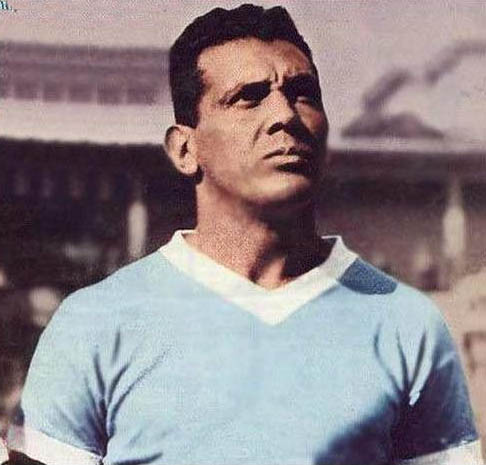
Obdulio Varela

Varela didn't get everything he wanted, but he got a big thing that he wanted: He stopped Brazil's momentum. They were standing around, waiting for play to be allowed to resume. Their fans had calmed down a bit. The home-field advantage had been dented. Reader handed the ball to Varela, who took it to the center of the field, and shouted to his teammates, "Now, it's time to win!"

And they did as he wanted: They attacked. Brazil didn't have a defense as good as their offense, and, in the 66th minute, Pepe equalized for Uruguay. That didn't matter much: If that 1-1 score had held, Brazil would still be World Champions.

In the 79th minute, Ghiggia ran down the right sideline, and fired a low shot that went under Barbosa. It was Uruguay 2, Brazil 1. Every Brazilian -- on the pitch, in the stadium, and listening on the radio -- was in shock. Brazil attacked the rest of the way, but couldn't find the all-important equalizer. The home crowd was quiet.
Alcides Ghiggia

Shortly after 5:00, Reader blew his whistle to end the match. Uruguay had now won 2 of the 1st 4 World Cups. Brazil had lost the world championship of their national sport, in their national stadium.

In that stadium, 3 fans died from heart attacks. Another, who had brought a gun in, killed himself.

There was no public ceremony. Rimet wisely chose to present the trophy that would later bear his name to Uruguay in their locker room.

Outside that stadium, a group of fans knocked over a bust of Mayor Mendes. Brazil manager Flavio Costa had to leave the stadium in disguise -- as a nanny. Yes, like some deposed dictators have done, he left in drag, so as not to be recognized.

*

The loss was a blow to the national psyche, so often wrapped up in this sport of soccer. It is known as Maracanazo in Spanish, Maracanaço in Portuguese: "The Agony of Maracanã."

You think losing the Gold Medal in basketball to the Soviets in the 1972 Olympics in Munich was bad for the U.S.? You think the shock of losing the opening game of the "Summit Series" to the Soviets a week before was a blow to Canada, though they dramatically won the series anyway? You think losing the Gold Medal in hockey to the U.S. in the 1980 Winter Olympics in Lake Placid was a devastating defeat for the Soviets? You think any World Cup loss by England, or Italy, or any other country compares?

The 1950 World Cup was supposed to be a statement for Brazil, showing the world that is was a modern country, worthy of respect and admiration around the postwar world. This was the country's coming-out party, and it was ruined. Minister of Sport Aldo Rebelo said, "Losing to Uruguay in 1950 not only impacted on Brazilian football, it impacted on the country's self-esteem." Instead of hating Uruguay for the ruination, Brazilians blamed themselves.

They needed that boost for their self-esteem. Brazil, like many other countries, is a young nation but an old civilization. And, as with those other countries, its old civilization had been built up by a European power, but also severely damaged by one. Very little of what the colonizing nation liked was accepted. But, as with the Caribbean and India with cricket, and South Africa with rugby, Brazil was one of those countries that took to soccer as the colonizers had taught it.

There was a racial aspect as well. From 1502 to 1860, 38 percent of slaves brought to the New World ended up in Brazil, and it became the last country in the Western Hemisphere to outlaw slavery, doing so in 1888. The descendants of slaves became scapegoats for what went wrong in Brazilian society. But it was black footballers, more than the white ones, that had brought glory to the national team, the Seleção, including winning the Copa América in 1919, 1922 and 1949, and helping to unify the vast, diverse nation.

Much of the blame for the defeat fell upon goalkeeper Moacir Barbosa, who was black. He continued to be a scapegoat even after Brazil's greatest victories. In 1994, he wanted to meet with the keeper on that year's Brazil World Cup team, Cláudio Taffarel. But Mário Zagallo, who played on the 1958 and 1962 wins, and managed the 1970 win, was now the overall boss of Brazilian football, and forbid it. And Brazil won, with Taffarel keeping 5 clean sheets in 7 games, including the Final.
Moacir Barbosa died in 2000. He had lived to see Brazil win the World Cup 4 times, and become the most admired nation in the world at the sport. Shortly before his death, he said, "Under Brazilian law, the maximum sentence is 30 years. But my imprisonment has been for 50 years."
Even the two most famous photos of him,
taken inside a goal, makes it look like he's in a cage.

As with quarterback in American football, goalkeeper is seen as a "brain" position in Brazilian football. Brazil would not trust a black man as their starting goalkeeper, with the Number 1 shirt, in the World Cup again, until 2006, 6 years after Barbosa died, when Nélson de Jesus Silva, a.k.a. Dida, who had been the starting goalie for A.C. Milan's 2003 UEFA Champions League win, was selected.

Barbosa wasn't the only scapegoat. Brazil wore white shirts that day, and have never worn them again: Always yellow when they have the choice, otherwise green.

Also, one of Brazil's proudest clubs took some of the blame. There were 5 players in the starting lineup for the 1950 "Final" who played at Club de Regatas Vasco da Gama in Rio. The team, which started as a rowing club (Regatas = Rowing), was named for the Portuguese explorer (1460-1524) remembered for his voyages not to South America, as a modern observer might think, but to Africa and India.

Since 1950, Vasco have won the Brazilian national league 4 times, most recently in 2000; the Rio State Championship 15 times, most recently in 2016, for a total of 24 titles; and the South American continental club championship, the Copa Libertadores, in 1998. Despite this, there was a stigma on the club, taking some of the blame for the 1950 loss.

This is the total number of Vasco players on Brazil's World Cup entire squads since: 1954, 3; 1958, winning it, 3; 1962, winning it, none; 1966, 1; 1970, winning it, none; 1974, none; 1978, 3; 1982, considered one of the best teams ever despite not reaching the Final, 2; 1986, none; 1990, 5, but by now it had been 40 years; 1994, winning it, 1; 1998, reaching the Final, 1, a backup goalkeeper who saw no time in the tournament; and in 2002, which they won, plus 2006, 2010, 2014 and 2018 combined, exactly none.

There is a more tragic element to the loss, and I mean true tragedy, not the loss itself. Manuel Marinho Alves, known as Maneca, was another Vasco player on the 1950 Brazil team, playing in 4 games and scoring a goal, but didn't play in the Final.

In his career, he would help Vasco win 4 State Championships, and the South American Club Championship (the predecessor tournament to the Copa Libertadores) in 1948. But he never got over the Maracanazo, and on June 28, 1961, at his girlfriend's house, he committed suicide by mercury poisoning. He was only 35 years old.

Only 1 player on the 1950 Brazil team was still there to win the 1958 World Cup: Nílton Santos, who barely played in 1950, and was not one of those held responsible. He was also the last survivor of the 1950 team, living until 2013. Juvenal, the left back, was the last survivor of those who actually played in the game, living until 2009.

Brazil have gone on to win the World Cup a record 5 times: Beating Sweden in the Final in Sweden in 1958, beating Czechoslovakia in the Final in Chile in 1962, beating Italy in the Final in Mexico City in 1970, beating Italy in the Final again in the Rose Bowl in 1994, and beating Germany in Japan in 2002. They have also lost the Final to France in Paris in 1998.

You will notice that none of those 5 wins have been in Brazil. The World Cup has returned to that country only once, in 2014, and Brazil got to the Semifinal, but had an even more stunning loss at the Maracanã. It wasn't that they lost to Germany, who then beat Argentina in the Final. It wasn't even that they were looking forward to beating Argentina in the Final in the Maracanã themselves. It was the score: Germany beat Brazil, in the Maracanã, by a score of 7-1.

There is another legend of Maracanazo: João Ramos do Nascimento, a striker for Bauru known as Dondinho, was listening to the game on the radio, and cried at the result. His 9-year-old son, Edson Arantes do Nascimento, told his father that, one day, he would win the World Cup, for him, and for Brazil.

In 1958, Edson, by then called Pelé and playing for Santos in São Paulo State, kept that promise. He repeated it in 1962 and 1970. Dondinho lived until 1996, so he saw his son become an icon in American soccer as well, and he also saw Brazil's 1994 World Cup win.

The last surviving player from the game was Alcides Ghiggia, who died on July 16, 2015, 65 years to the day after he scored the winning goal for Uruguay.
*

Much as the 1980 and 2008 World Series wins have not fully erased the humiliation of the blown 1964 National League Pennant for Philadelphia Phillies fans, Brazilians still have not gotten over Maracanazo after 70 years, despite winning 5 World Cups and the admiration of the rest of the world.

Should they let themselves, and the 1950 players, off the hook?

Top 5 Reasons You Can't Blame Brazil for losing the 1950 World Cup

5. The Brazilian Media. Modern observers of international tournaments see how the media in England builds their national team up as sure winners. The England theme in 2018 was "It's coming home." They were right, but not in the way they think: "It," the World Cup trophy, is known as the Jules Rimet Trophy, for the longtime President of FIFA, who founded the tournament. And the tournament and the trophy were won by his homeland, France.

Brazil is no different. Their success in the "Baby Boom" years, winning in 1958, 1962 and 1970, made them many a neutral fan's "second team" in World Cup play thereafter. (That, and the many TV shots of gorgeous Brazilian women in tight yellow team shirts.) When Brazil won in 1994 and 2002, lots of people with no connection to the country were happy for them (if not as happy as they would have been if their own team had won it).

The shocking defeat the next time the World Cup was in Brazil, the 7-1 demolition by Germany in the Semifinal, hurt a great deal, because this was supposed to be it. But it wasn't. As I said, Brazil have won the World Cup a record 5 times, and it's never been in Brazil.

For whatever reason, Brazil seem to do better away from home. Maybe it's the national media. There have been cases where American teams won a title when their local newspapers were on strike, and not badgering their players with questions. The 1978 New York Yankees are the most notable example.

But in 1950, the Brazilian media were out of control, promoting the team. And the overconfidence became insane. Each player on the winning team gets a winner's medal, but, this time, 22 gold medals were made, with each player's name inscribed on them, before the Final.

A "cup final song" is nothing new in England: Sometimes, both teams in the FA Cup Final will be brought into a recording studio to record one. And the England team usually goes into a studio before leaving for a World Cup to record a song. In 1950, without the players participation, a song was composed, to be played after the Final: "Brasil Os Vencedores" (Brazil the Victors).

Ângelo Mendes de Morais, the Mayor of Rio de Janeiro, met with the players on the morning before the Final, and told them, "You, players, who in less than a few hours will be hailed as Champions by millions of compatriots! You, who have no rivals in the entire Hemisphere! You, who will overcome any other competitor! You, who I already salute as victors!" Even Rimet himself prepared a congratulatory speech for Brazil.

Victory wasn't just expected, it was assumed. As Felix Unger, played by Tony Randall on The Odd Couple, taught us, "You should never assume. Because, when you assume, you make an ASS of U and ME!"

4. Argentina. The other major South American power, though not what they would become in the 1970s, withdrew from the tournament, due to a dispute with the Brazilian Football Confederation. Could they have caused problems for Brazil? Could they have knocked Uruguay out, thus leaving a clearer path for Brazil? We'll never know.

What we do know is that the path for Brazil and Uruguay was clearer than it should have been, and not just because Argentina weren't there to stop either of them:

3. The State of Postwar Europe. Germany was one of the best teams in Europe even before their 1938 Anschluss with Austria, which had done well before that. After it, the Nazi team was even better. And Italy had won the World Cup in 1934 and 1938.

Even with the Superga disaster the year before, which wiped out nearly all of the Torino team that had dominated Italian soccer in the 1940s, Italy would still have been a serious threat to win the 1950 World Cup, as would Germany -- had they been allowed to play.

But Germany was still occupied by the Allied powers. Although both West Germany and East Germany had been established as nations in 1949, the German Football Association (DFB) had only been re-established in January 1950, and wasn't readmitted to FIFA until September, after the World Cup. East Germany's FA wasn't admitted until 1952.

As, officially, still the defending champions after 12 years, Italy were invited to the World Cup without having to go through the qualifying process, and they did play. But they lost to Sweden in their 1st game, and that led to Sweden topping the Group. Italy were out. Perhaps, in a different format, they might have lasted longer, and thus been a bigger threat to win. (And, of course, given the U.S. win over England, and then the Final, this turned out to be only the 3rd-biggest upset of the tournament.)

As for teams in the Soviet sphere: The Soviet Union, 1934 Finalists Czechoslovakia, and 1938 Finalists Hungary did not enter the tournament. All would participate in the qualifying process for the 1954 World Cup, and Hungary reached the Final. But of all of Eastern Europe, only Yugoslavia, whose dictator Josip Tito had had a falling out with the Soviets' Josef Stalin, sent a team to Brazil in 1950.

2. England. If not Brazil, then the best team in the world was probably England. But they choked, as they so often do in major tournaments (rather than simply getting beat by a better team), losing 1-0 to both Spain (somewhat understandable) and the U.S. (understandable only in hindsight, and, even then, it's a bit of a stretch.)

England would have topped their Group had they beaten Spain, regardless of their game against the U.S., and might then have been a threat to win: Spain tied Uruguay 2-2, but got slaughtered by Brazil 6-1. England could have done better than that, but they didn't get the job done.

Who did?

1. Uruguay Were Better. It had been 20 years since the 1930 World Cup win, and none of the players were the same. But some of their 1950 players had been on the team that won the 1942 Copa América, and had reached the Semifinal in 1947. Some would still be on it when they reached the Semifinal in 1953, 1955, 1956, 1957 and 1959, winning it in 1956 and 1959. They also reached the Semifinal of the 1954 World Cup.

Both teams were good in attack. But Uruguay were renowned for their defense, and Brazil were not. If any team was going to beat Brazil in this tournament, it was going to be Uruguay: They didn't have to travel far, they were used to the weather, they were used to the atmosphere, and they were familiar with their opponents. To beat Brazil, they were ready, they were willing, and, clearly, they were able.

VERDICT: Not Guilty. Still, there are old men in Brazil who remember, and pass the story down to children who do not yet know it, who know their country as one that has succeeded at this sport, and not as one with a self-esteem problem.

The legend lives on from Ipanema on down
of the event called Maracanazo.
It's said that the game brought a terrible shame
that can't be erased by a golazo!

Monday, June 29, 2020

Top 5 Reasons You Can't Blame England for Losing to the U.S. at the 1950 World Cup

June 29, 1950, 70 years ago: The U.S. soccer team played England in a game everybody assumed England would win.

The England team was loaded. From 1949 and 1950 Football League Champions Portsmouth: Midfielder Jimmy Dickinson. From 1950 FA Cup winners Arsenal: Defender Laurie Scott. From 1949 FA Cup winners Wolverhampton Wanderers, who would go on to win 3 League titles in the 1950s: Defender Billy Wright (the national team's Captain), forward Jimmy Mullen, and goalkeeper Bert Williams.

From 1948 League Champions Manchester United: Defender John Aston and midfielder Henry Cockburn. From 1947 League Champions Liverpool: Midfielder Laurie Hughes. From the Tottenham Hotspur team that would win the 1951 League title: Goalkeeper Ted Ditchburn, defender Alf Ramsey (who would manage England to the 1966 World Cup win), and midfielders Bill Nicholson (who would manage Tottenham to the 1961 League and Cup "Double") and Eddie Baily. From the Newcastle United team that would win 3 of the next 5 FA Cups: Forward Jackie Milburn.

From the Blackpool team that would win the 1953 FA Cup, a pair of geniuses: Right wing Stanley Matthews (known as the Wizard of the Dribble) and forward Stan Mortensen. From Preston North End: Forward Tom Finney. From Middlesbrough: Forward Wilf Mannion.

It speaks to the talent of this team that 6 of the players -- Wright, Nicholson, Milburn, Matthews, Finney and Mannion -- would have statues dedicated outside their teams' stadiums.

The U.S. team was taken from various clubs in the top league in the country at the time, the American Soccer League. There was nothing like a "first division" as in European or South American countries. And none of them was still in college, although they weren't over the hill: One player was 38, the rest were between the ages of 21 and 31, coming from ASL clubs in New York, Philadelphia, the Boston satellite city of Fall River, Pittsburgh, Chicago and St. Louis.

England started by beating Chile 2-0. The U.S. got off to a good start against Spain, jumping ahead 1-0 in the 17th minute. But the defense allowed 3 goals between the 81st and 89th minutes, and Spain won, 3-1.

This set up the U.S.-England meeting, at Estádio Independência in Belo Horizonte, Minas Gerais, Brazil on Thursday, June 29, 1950, 70 years ago today. Surely, this would be an easy England win, and nobody would talk about it forever.

As a British citizen familiar with the English game, as well as that of the country he had adopted, the U.S. manager, Bill Jeffrey, told the press, "We have no chance," and called his team "sheep ready to be slaughtered." One of the English national newspapers, the Daily Express, wrote, "It would be fair to give the U.S. three goals of a start."

England had 8 shots on goal in the 1st 32 minutes. U.S. goalkeeper Frank Borghi put on a heroic performance. Then, in the 37th minute, game an Ed McIlvenny throw-in, taken by Walter Bahr, whose shot toward foal was deflected by the head of Joe Gaetjens, and the U.S. led 1-0.

In the last few minutes of the game, the England players appealed for a penalty and insisted that a deflected shot had gone over the goal line, but were denied by the referee each time. Final score: America 1, England 0.

On July 2, the Americans were knocked out of the tournament, losing 5-2 to Chile, and England fell to Spain 1-0. Spain thus won Group 2, and only the 4 Group winners advanced to a knockout round. Uruguay ended up beating Brazil in the Final, an even worse defeat for Brazil, but not nearly as shocking around the world as the U.S. beating England. (Uruguay had, after all, dominated international soccer in the 1920s, won the 1st World Cup in 1930, and, obviously, was still pretty good.)

The 1-0 win over England has been nicknamed "The Miracle Match." In a nod to the U.S. hockey upset over the Soviet Union at the 1980 Winter Olympics, known as "The Miracle On Ice," this game has been retroactively called "The Miracle On Grass." Given how many shots Borghi had to stop, Belo Horizonte '50 was much closer to being a miracle than Lake Placid '80.


The Miracle On Grass was hardly seen then, and it has hardly been seen since. But it might just be the greatest upset in American sports history.

How could England have lost this game?

Top 5 Reasons You Can't Blame England for Losing to the U.S. at the 1950 World Cup

5. The Weather. Brazil is a tropical nation. The Americans, especially the players from St. Louis, were used to the kind of heat they were facing. In contrast, the entirety of the British Isles is further north than the entirety of the continental United States.

The English (and the Welsh, and the Scots, and the Irish) may complain about the cold and the rain, and long to spend time on the warm coasts of France, Spain and Italy. But they don't actually like to play football in the heat. And they did not handle it as well as the Americans.

The old saw from American-style football, "Don't blame the weather, it was the same for both teams" is frequently untrue, especially when one team is used to cold weather and the other plays in a dome. If this game had been played anywhere in England, the English would probably have won it.

4. The Media Disparity. The English were under intense pressure, after not playing in the World Cups of the 1930s, to finally put their money where their mouths were, and prove they were the best team in the world.

Since the establishment of the European Championships in 1960, and especially after they finally did win the World Cup in 1966, every 2 years, the media builds up the national side, makes them seem unbeatable, and then roasts them when they inevitably fail.

But the Americans faced no media pressure. Because they faced no media. There was a grand total of one American reporter at the game, and he had to pay his own way, because his newspaper wouldn't pay it -- even though it was the St. Louis Post-Dispatch, and there were a few St. Louisians on the roster. They wouldn't even "go for the local angle."

There were no annoying or embarrassing media questions for the U.S. team to dodge. There were no media questions at all.

3. Walter Winterbottom. At the time, he was a 37-year-old native of Oldham, outside Manchester, who played a few games for Manchester United, but saw his career cut short by having to serve in World War II. In a rotten case of "It's not what you know, it's who you know," he became an officer in the Royal Air Force, and gained access to Stanley Rous, the secretary of the governing body of English soccer, the Football Association (the FA).

In 1946, Rous talked the FA Council into appointing Winterbottom as the FA's 1st Director of Coaching, thus making him the national team's 1st real manager. He proved to be a bust. Under his leadership:

* 1949: England lost to the Republic of Ireland at Goodison Park in Liverpool, home of Everton. But that was considered a fluke. Or, as they would say in England, a one-off. As it turned out, it wasn't, not by a long shot:

* 1950: England lost to the United States in the World Cup in Brazil, and didn't make it out of the Group Stage.

* 1953: England lost on English soil to a team from outside the British Isles for the 1st time, getting embarrassed 6-3 by the "Magnificent Magyars" of Hungary at the original Wembley Stadium in London.

* 1954: England played a warmup match in Budapest, figuring another game with Hungary would be good preparation for the upcoming World Cup in Switzerland, but they got shellacked again, 7-1. lost. Maybe it was a good exercise after all: At the World Cup, they won their Group Stage. But they lost to defending Champions Uruguay in the Quarterfinal.

* 1958: England couldn't get out of the Group Stage of the World Cup in Sweden. To make matters more embarrassing, both Wales and Northern Ireland did make the knockout stage.

* 1962: England again reached the Quarterfinal of the World Cup, this time in Chile, but lost. At least it was to Brazil, the defending Champions, who won it again.

After that World Cup, Winterbottom was finally let go. If the current English media climate was in place in 1950, he probably would have been sacked before he got back on the plane. Especially since he left the already-beloved Stanley Matthews on the bench.

Can you imagine the reaction today if current England manager Gareth Southgate left his best player on the bench for a World Cup match? Then again, it's hard to say who that is. Raheem Sterling? Harry Kane, the diver and the great dribbler (and that doesn't refer to his footballing ability)? Jordan Henderson, who would be practically ignored by the media were he not Captain of Liverpool?
Regardless, in 2018, those guys started in 5 of the 6 games England played. Southgate only held them back from the last Group Stage game, because England had already advanced, and there was no reason to risk them for injury.

Stanley Matthews had been injured a few weeks before the 1950 World Cup, but was working his way back. Had he played, it's hard to imagine American goalie Frank Borghi keeping the same clean sheet against the kind of attacks Sir Stan would have launched.
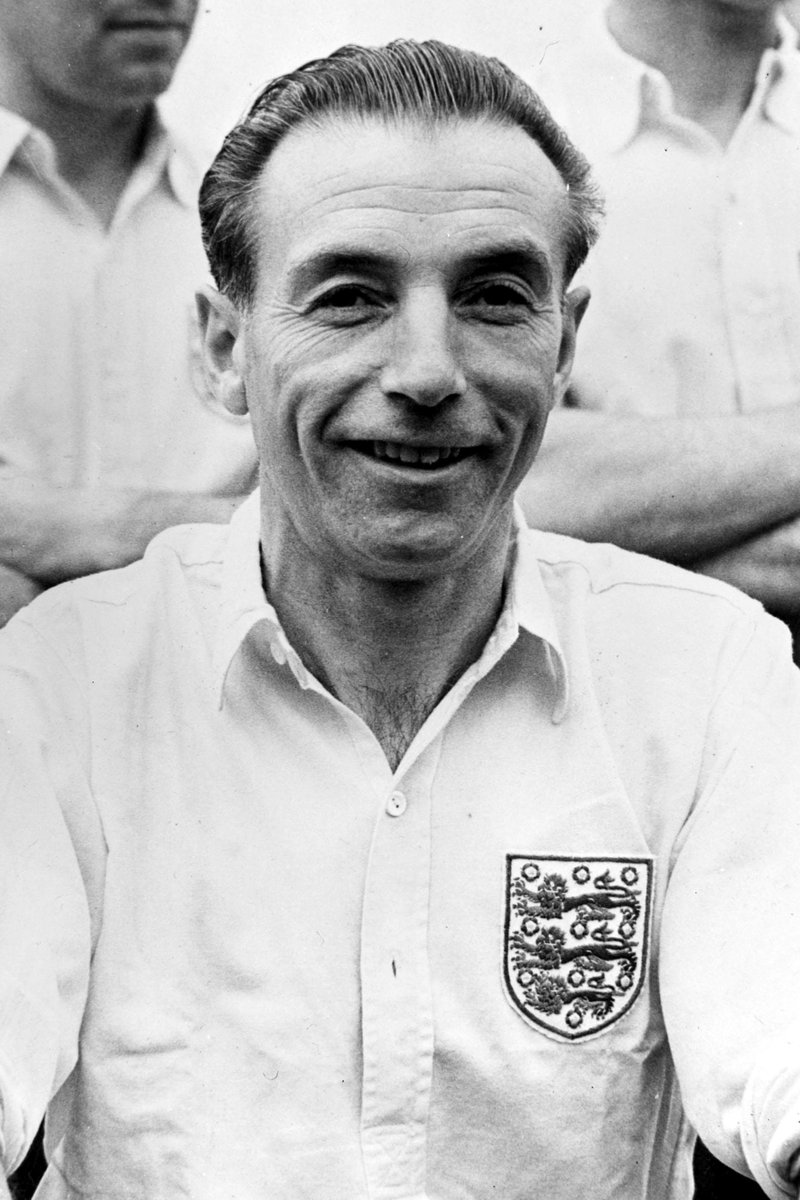
Sir Stan

Soccer historian David Goldblatt has suggested that Winterbottom failed to properly learn from his defeats: "His inability to anticipate or learn significantly from the Hungarian debacle suggests that his grasp of tactics and communication with the players was limited." Another writer, William Baker, said that, due to having upper-class origins, he could not "effectively instruct, much less inspire, working-class footballers." And longtime football journalist Brian Glanville said, "I got on very well with Walter Winterbottom, but he was a rotten manager." Nevertheless, he was knighted in 1978, and lived until 2002.
Good man? Maybe. Good intentions? Certainly.
Good manager? Yer havin' a laugh, mate.

He was replaced by Alf Ramsey, who had played for him in the 1950 disaster, helped Tottenham Hotspur win the League title in 1951, and had just managed Ipswich Town to the League title. He knew England would host the World Cup in 1966, and he told the FA he could manage them to victory. He was right.

2. No Scouting. In the modern era, a national team would collect as much footage of an upcoming opponent as possible, and study the hell out of it, looking for any possible weakness. But there was no film of the U.S. team for the English to study. It wouldn't matter if they'd decided to look at it before leaving for Brazil, because there was no "it" to look at.

And the reports they had read about the U.S. team? They couldn't possibly have been reliable. They had no way of knowing whether Brookhattan, Ponta Delgada, or St. Louis Simpkins-Ford, and the players they were sending to Brazil on the U.S. team, were any good, or what their tendencies were.

And therein lay the biggest problem of all:

1. The Americans Were Good. In an exercise like this, the tendency is to make Reason Number 1 "The opposition were better." There's no way the U.S. team was better than the England team. But, as with the Pittsburgh Pirates against the Yankees in the World Series 10 years later, they were a good team, worthy of being on the field with the alleged world's best, and the fact that they won should not be considered that much of a shock.

You could say that, in their 1st game in the tournament, the U.S. defense collapsed at the end and let Spain win 3-1. Or you could say that they were 10 minutes from having a famous 1-0 win 4 days sooner than the one they actually got.

Yes, they got pounded 5-2 by Chile in their finale. But had they held that 1-0 lead against Spain, they would have finished atop the Group, and advanced to the Final Group. Would the win over England still have been considered an upset? Of course. Would it have been as much of a shock? No.

Put it all together, and accept that the conditions for England to win that game weren't so good, and you really can't blame them for losing. Their manager, yes. The players, no.

VERDICT: Not Guilty.

June 29, 1950: The Miracle On Grass

June 29, 1950, 70 years ago: The U.S. soccer team played England in a game everybody assumed England would win.

In the words of the immortal Felix Unger (as played by Tony Randall on The Odd Couple), "You should never assume. Because when you assume, you make an ASS of U and ME!"

The U.S. team played in the 1st World Cup, in Uruguay in 1930. In their Group Stage, they beat Belgium and Paraguay, each by a 3-0 score. This enabled them to top their Group and advance to the Semifinals. Then reality set in, and they got clobbered 6-1 by Argentina, who then lost the Final to the hosts, 4-2.

The 1934 World Cup in Italy was a simple knockout tournament of 16 teams, and the U.S. lost in the 1st round, to the hosts, 7-1. The U.S. withdrew from qualifying for the 1938 tournament.

The 4 "Home Nations" of the United Kingdom of Great Britain and Northern Ireland -- England, Wales, Scotland and Northern Ireland -- did not compete in these 1st 3 World Cups. There was a dispute between the U.K. and the governing body of world soccer, FIFA, the Fédération Internationale de Football Association.

Only 13 teams competed in 1930, and France, Belgium, Yugoslavia and Romania were the only representatives from Europe. Travel from Europe to South America was prohibitively expensive. So it wasn't surprising that no "nation" in the U.K. played in it.

In 1934, 12 of the 16 teams were from Europe, but no nation in the British Isles competed. This was also true for 1938, when it was supposed to be 16, but Austria withdraw after their "Anschluss" with Nazi Germany, making it 15. Ireland, then known as "the Irish Free State," entered qualifying, but failed to make it.

Then came World War II. The World Cups of 1942 and 1946 were canceled. Since Brazil was supposed to host in 1942, they got the 1st postwar World Cup, in 1950. And as the centerpiece, in what was then their capital city, Rio de Janeiro (the capital was moved to Brasilia in 1960), they built the most famous soccer stadium in the Western Hemisphere, the Estadio Maracanã. With standing room, it could hold nearly 200,000 people.

Only 13 teams entered this tournament. Finally, though, there was representation from Britain, the country that had invented the sport, giving the tournament more legitimacy than ever. It had not helped FIFA that, after the 1934 World Cup, winners Italy went to London and lost to an England team that then called themselves "World Champions."

The U.K. "football" authorities collectively decided that the 1949-50 Home Nations Tournament would send its top 2 teams. England won, and sent its team. Scotland finished 2nd, but the Scottish Football Association had decided only to go if they'd won, and so they withdrew, and only England went.

And what a team it was. From 1949 and 1950 Football League Champions Portsmouth: Midfielder Jimmy Dickinson. From 1950 FA Cup winners Arsenal: Defender Laurie Scott. From 1949 FA Cup winners Wolverhampton Wanderers, who would go on to win 3 League titles in the 1950s: Defender Billy Wright (the national team's Captain), forward Jimmy Mullen, and goalkeeper Bert Williams.

From 1948 League Champions Manchester United: Defender John Aston and midfielder Henry Cockburn. From 1947 League Champions Liverpool: Midfielder Laurie Hughes. From the Tottenham Hotspur team that would win the 1951 League title: Goalkeeper Ted Ditchburn, defender Alf Ramsey (who would manage England to the 1966 World Cup win), and midfielders Bill Nicholson (who would manage Tottenham to the 1961 League and Cup "Double") and Eddie Baily. From the Newcastle United team that would win 3 of the next 5 FA Cups: Forward Jackie Milburn.

From the Blackpool team that would win the 1953 FA Cup, a pair of geniuses: Right wing Stanley Matthews (known as the Wizard of the Dribble) and forward Stan Mortensen. From Preston North End: Forward Tom Finney. From Middlesbrough: Forward Wilf Mannion.

It speaks to the talent of this team that 6 of the players -- Wright, Nicholson, Milburn, Matthews, Finney and Mannion -- would have statues dedicated outside their teams' stadiums.

Sure, the host nation, Brazil, was the prohibitive favorite. But England were going to win the tournament. After all, England invented the sport.

*

The U.S. team was taken from various clubs in the top league in the country at the time, the American Soccer League. There was nothing like a "first division" as in European or South American countries. And none of them was still in college, although they weren't over the hill: One player was 38, the rest were between the ages of 21 and 31, coming from these ASL clubs:

* St. Louis Simpkins-Ford, sponsored by Joe Simpkins' Ford car dealership: Frank Borghi, 25, goalkeeper; Robert Annis, 21, defender; Charlie Colombo, 29, midfielder; Gino Pariani, 22, forward; and Frank "Peewee" Wallace, 27, forward.
Frank Borghi

* St. Louis McMahon: Harry Keough, 22, defender. Each of these 6 men was a St. Louis native. Borghi, Colombo and Pariani came from the "Dago Hill" neighborhood on the North Side, which also produced baseball legends Yogi Berra and Joe Garagiola. A line Berra would later use about the 1969 Mets, on whom he coached, would apply to this U.S. team: "We were overwhelming underdogs."

* Philadelphia Nationals: Walter Bahr, 23; and Ed McIlvenny, 25; both midfielders. Bahr was a Philadelphia naive, born on the exact same day as the great Ferenc Puskás, whose Hungary team did not enter the tournament but would star in it 4 years later. But McIlvenny was born and raised in Scotland, and had played in his homeland for Greenock Morton and in Wales for Wrexham. He came to America because labor paid more than "football" back home, and since he had begun the process of attaining American citizenship, he qualified for the U.S. team under the rules of the time.
Walter Bahr

* Brookhattan, which, as its name suggests, played home games in both Brooklyn and Manhattan: Joe Gaetjens, 26, forward. A native of Haiti, he came to New York in 1947, and led the ASL in scoring in the 1949-50 season. Then, as now, there was a notable Haitian community in Brooklyn.
Joe Gaetjens

* Brooklyn Hispano: Joe Maca, 29, defender. A native of Belgium, he played in his country's 1st division and for its Army team during World War II, then came to America. Perhaps someone thought "Maca" was a Hispanic-sounding name, and recommended Hispano to him and vice versa.

* Ponta Delgada: Frank Moniz, 38; John Souza, 29; and Ed Souza, 28; all forwards. Ponta Delgada was named for a town in the Azores, islands off the west coast of Portugal, and all 3 players were from Fall River, Massachusetts, a small city south of Boston with a large Portuguese community -- large enough that no close relationship between the 2 Souzas could be established. Because of "blue laws" in Masschusetts, Ponta Delgada played their Sunday games in Tiverton, Rhode Island, in a stadium whose northern boundary was literally the State Line.

* Pittsburgh Harmarville: Nicholas DiOrio, 29; and Robert Craddock, 26; both forwards.

* Chicago Vikings, so named for their largely Scandinavian ethnic makeup: Geoff Coombes, 31, defender.

* Chicago Eagles, so named for their largely Polish ethnic makeup: Adam Wolanin, 30, forward.

* Chicago Slovak, yet another mostly ethnic team: Gino Gardassanich, 27, goalkeeper.

This was probably the most talented national team the U.S. had ever had -- and would remain so for a long time to come. But nobody thought they would do much in the World Cup. The odds on them winning the tournament were given as 500-1.

*

June 24: Brazil opens the tournament, and the Maracanã, with a 4-0 win over Mexico.

June 25: England starts by beating Chile 2-0 at the Maracanã. Mortensen scores in the 39th minute, Mannion in the 51st. The U.S. gets off to a good start against Spain, with Pariani scoring in the 17th. But the defense collapses late, allowing 3 goals between the 81st and 89th minutes, and Spain win, 3-1. Elsewhere, Yugoslavia beats Switzerland 3-0, and Sweden beats Italy 3-2. As amazing as this game was, this would not be the biggest upset of the tournament, or even the 2nd-biggest.

June 28: Brazil can only manage a 2-2 tie with Switzerland, blowing 1-0 and 2-1 leads, with Switzerland equalizing in the 88th minute. Yugoslavia beats Mexico 4-1.

June 29: Spain beats Chile 2-0. Sweden and Paraguay play to a 2-2 draw. And then there was the game between England and the U.S. Surely, this would be an England win, and nobody would talk about it forever.

Indeed, in America, hardly anybody talked about it for decades.

*

This is what the world was like on June 29, 1950, 70 years ago today:

American soccer, as I pointed out, was barely noticeable. What would later be called Major League Baseball was no further south than Washington and Cincinnati, and no further west than St. Louis. And yet, there were teams in both the American League and the National League in Boston, Philadelphia and St. Louis. Within 5 years, each of those cities would be down to 1 team.

The National Basketball Association had just completed its 4th season, its 2nd straight with the Champions being the Minneapolis Lakers, but their only Western outpost had just folded. It was known as the Denver Nuggets. That name would be used again. The next season would see the NBA following MLB and the National Football League in racially integrating.

The NFL had stretched to Los Angeles and San Francisco, but no further into the South than had baseball. And the National Hockey League had only 6 teams: The Montreal Canadiens, the Toronto Maple Leafs, the Boston Bruins, the New York Rangers, the Detroit Red Wings and the Chicago Blackhawks.

In addition to the Lakers, the Red Wings, the Yankees and the Los Angeles Rams were defending Champions. Ezzard Charles was the Heavyweight Champion of the World. There was, as yet, no European Cup (the tournament now called the UEFA Champions League). Television and sports was still a new combination, as radio, newspapers, and movie theaters' "newsreels" still dominated the way people found out what was going on in "the world of sports."

The defining soccer players of my childhood? Pelé was a 9-year-old boy named Edson Arantes do Nascimento, nicknamed "Dico" by his family, and using radio and newspapers to keep tabs on the tournament, especially the Brazil team, in his hometown of Três Corações (Three Hearts) in the State of Minas Gerias.

Eusébio was 8, and living in Mozambique in Africa, then still a colony of Portugal. Sandra Mazzola was 7, and watching his father, Valentino Mazzola, star for Torino in Turin, Italy. Gianni Rivera was 6. Franz Beckenbauer was 4. Giorgio Chinaglia and Johan Cruijff were 3.

Arséne Wenger -- not a defining player of my childhood, but a defining figure in the game in my adulthood -- was 8 months old. And Charlie George, Kevin Keegan, Kenny Dalglish, Doctor Sócrates, Mario Kempes, Michel Platini, Liam Brady, Paolo Rossi and Diego Maradona hadn't been born yet.

The World Cup has since been held twice each in Mexico and Germany; and once each in Switzerland, Sweden, Chile, England, Argentina, Spain, Italy, America, France, Japan, Korea, South Africa, Brazil again, and Russia.

And the Olympic Games have since been held in America 5 times; 3 times each in Japan, Italy and Canada; twice each in Austria, France, Norway, Australia, Russia and Korea; and once each in Finland, Mexico, Germany, Bosnia, Spain, Greece, China, Britain and Brazil.

America had 48 States. There were 22 Amendments to the Constitution of the United States. There had not been a Civil Rights Act since 1886. There was Social Security, but no Medicare, Medicaid, Environmental Protection Agency, OSHA or Title IX. The ideas that abortion, same-sex marriage and recreational marijuana use would one day be legal were absurd -- but so was the idea that corporations were "people" and entitled to the rights thereof.

The President of the United States was Harry Truman. Herbert Hoover, and the widows of Calvin Coolidge and Woodrow Wilson, were still alive. Dwight D. Eisenhower was the President of Columbia University. John F. Kennedy, Richard Nixon and Gerald Ford were in the U.S. House of Representatives. Lyndon Johnson was in the U.S. Senate. Jimmy Carter was in the U.S. Navy. Ronald Reagan was an actor. George H.W. Bush was in the oil business.

Joe Biden was 7 years old. Donald Trump was 4 years old (and hasn't gotten any more mature), while George W. Bush and Bill Clinton would soon reach that birthday. Barack Obama and Mike Pence weren't born yet.

The Governor of the State of New York was Thomas E. Dewey. The Mayor of the City of New York was William O'Dwyer. The Governor of the State of New Jersey was Alfred E. Driscoll. The current holders of those offices -- Andrew Cuomo, Bill de Blasio and Phil Murphy -- weren't born yet.

There were still surviving veterans of the American Civil War, the U.S. Army's wars with the Native Americans, the Franco-Prussian War, and the Zulu War. There were still a living person who had witnessed the assassination of Abraham Lincoln, another who had witnessed the Wright Brothers' 1st flight, and a living former policeman who had worked on the Jack the Ripper case.

The holder of the Nobel Peace Prize was John Boyd Orr, who had worked with the nascent United Nations to increase the world's food supply and get it to starving people. This is one of several examples of the Prize going to someone whose efforts were humanitarian and deserved some kind of recognition, but were not really related to the stopping or the prevention of a war.

The Prime Minister of Britain was Clement Attlee, and of Canada Louis St. Laurent. The head of state for both was King George VI of Britain. The Pope was Pius XII. The current Pope, Francis, was then Jorge Mario Bergoglio, 13 years old, and following the World Cup, though his native Argentina had not qualified for it. There have since been 13 Presidents of the United States, 2 British Monarchs, and 7 Popes.

Major novels of 1950 included Across the River and Into the Trees by Ernest Hemingway, Strangers on a Train by Patricia Highsmith, A Town Like Alice by Nevil Shute, The Town and the City, whose author is listed on the cover as John Kerouac, although it's the debut novel of Jack Kerouac; Gormenghast by Mervyn Peake, Mr. Midshipman Hornblower by C.S. Forester, Conan the Conqueror by Robert E. Howard, The Martian Chronicles, by Ray Bradbury, and Pebble in the Sky, the debut novel of science fiction writer Isaac Asimov.

The year would also see the publication of Asimov's collection of short stories I, Robot; Damon Knight's collection of short stories To Serve Man, the title story later forming one of the most renowned episodes of the anthology TV series The Twilight Zone; and Beverly Cleary's children's story Henry Huggins -- not to be confused with Henry Higgins, the nasty dialectician created for the play Pygmalion by George Bernard Shaw, who died that year.

Later in the year, C.S. Lewis will begin his Chronicles of Narnia, by publishing The Lion, the Witch and the Wardrobe. His close friend J.R.R. Tolkein had published The Hobbit, but not yet any of his Lord of the Rings trilogy.

J.D. Salinger was still working on The Catcher in the Rye. Ian Fleming was working for a newspaper syndicate, and had not yet published any books. Vladimir Nabokov had, but they hadn't succeeded, so he was teaching at Cornell University. Truman Capote had published novels, but not yet the one for which he would be best known. Aleksandr Solzhenitsyn had been sent to what the Soviet government called a "special camp" in Kazakhstan. Robert Ludlum was producing Broadway plays, and hadn't yet published a novel.

Joseph Heller was a Fulbright Scholar at Oxford University. John Updike and Philip Roth had both just graduated from high school. Thomas Harris was 9 years old, Anne Rice and John Irving were 8, Winston Groom 7, Alice Walker 6, James Patterson and Tom Clancy 3, Stephen King 2, George R.R. Martin a year and a half, and Douglas Adams, Stieg Larsson, Helen Fielding, Suzanne Collins, J.K. Rowling and Stephenie Meyer weren't born yet.

So no one yet heard of Dean Moriarty, Holden Caulfield, James Bond, Dolores "Lolita" Haze, Holly Golightly, Yuri Zhivago, Jason Bourne, John Yossarian, Harry "Rabbit" Angstrom, Alexander Portnoy, Hannibal Lecter, Lestat de Lioncourt, T.S. Garp, Forrest Gump, Celie Harris, Alex Cross, Jack Ryan, Jack Torrance, Jon Snow, Arthur Dent, Lisbeth Salander, Bridget Jones, Katniss Everdeen, Harry Potter or Bella Swan.

Major films of the Summer of 1950 included The Asphalt Jungle (which helped launch Marilyn Monroe to fame), the best-known film version of Robert Louis Stevenson's pirate epic Treasure Island, the Western Winchester '73, the film version of the Broadway musical Annie Get Your Gun, Father of the Bride, the baseball biopic The Jackie Robinson Story (with Jackie playing himself), Elia Kazan's epidemic film Panic in the Streets, the original film noir versions of Night and the City and No Way Out, the science fiction film Destination Moon, and the film noir tribute to old Hollywood Sunset Boulevard.

Kirk Alyn once again played the Man of Steel in Atom Man vs. Superman. Robert Lowry had recently played Batman in a serial. Gene Roddenberry was a Los Angeles policeman. Sydney Newman was helping to establish British episodic television, and hadn't yet created The Avengers (the 1960s spy series, not the superhero team) or Doctor Who. George Lucas was 6 years old, Steven Spielberg 3.

Lucille Ball and her husband Desi Arnaz had just founded Desilu Productions. While they hadn't yet begun filming I Love Lucy, this did make Lucy one of the earliest women, and Desi one of the earliest Hispanics (if a very light-skinned one), to have any creative control in Hollywood. American TV was dominated by anthology shows like Kraft Television Theatre and The Philco Television Playhouse; game shows like the brand-new What's My Line? and Beat the Clock; and variety shows like Your Show of Shows hosted by Sid Caesar, and Toast of the Town, which would later be renamed for its host: The Ed Sullivan Show. The Hazel Scott Show made its debut on the DuMont Television Network, making singer Scott the 1st African-American woman to host a TV program.

Among the writers of Your Show of Shows were Neil Simon, his brother Danny Simon, Carl Reiner, Mel Brooks, Selma Diamond, Larry Gelbart and Woody Allen. Neil would base Felix Unger of The Odd Couple on Danny. Carl would create The Dick Van Dyke Show, basing his character Alan Brady on Sid, Dick's character Rob Petrie on himself, Rob's wife Laura on his own wife Estelle, their son Ritchie on real-life son Rob, Buddy Sorrell on Mel, and Sally Rogers on Selma. Mel would go on to create Get Smart with Buck Henry.

No one had yet heard of Joe Friday, Ralph Kramden, Marshal Matt Dillon, Captain Kangaroo, Paladin, Beaver Cleaver, Ben Cartwright, or any of the legendary TV characters of the 1950s onward.

The Number 1 song in America was "The Third Man Theme," Anton Karas' zither-driven theme song from an Orson Welles spy thriller film. Frank Sinatra was at a low point in his career, as his original fans, the "bobby-soxers," had outgrown him and weren't drawn to his new material. Nat King Cole, Frankie Laine, Patti Page and Teresa Brewer were the year's big singers.

Hank Williams was already big in the South, but not in the North. Elvis Presley was in high school. Johnny Cash had just graduated, and, before the World Cup was out, would enlist in the U.S. Air Force. Roy Orbison, Buddy Holly, and Don and Phil Everly were in junior high. Tina Turner was 10 years old; John Lennon, Ringo Starr and Bob Dylan were 9; Paul McCartney, Paul Simon and Aretha Franklin 8; George Harrison 7, Mick Jagger and Diana Ross 6, Pete Townshend 5, Cher 4, David Bowie and Elton John 3, Billy Joel 1, Bruce Springsteen 9 months old, and Michael Jackson, Madonna and Prince weren't born yet.

Inflation was such that what $1.00 bought then, $10.64 would buy now. A U.S. postage stamp cost 3 cents, and a New York Subway ride 10 cents. The average price of a gallon of gas was 23 cents, a cup of coffee 15 cents, a burger-fries-and-Coke meal 46 cents, a movie ticket 46 cents, a new car $1,700, and a new house $7,150. The Dow Jones Industrial Average closed that day at 206.72. Not 20,006, or even 2,006, but two hundred and six.

The tallest building in the world was the Empire State Building in New York. Telephones had been possible in cars since 1946, but a phone you could carry around with you? Forget it. Telephone numbers were still based on "exchanges," based on the letters on a rotary dial. So a number that, today, would be (718) 293-6000 (this is the number for the Yankees' ticket office, so I’m not hurting anyone's privacy), would have been CYpress 3-6000.

There were no ZIP Codes, either. They ended up being based on the old system: The old New York Daily News Building, at 220 East 42nd Street, was "New York 17, NY"; it became "New York, NY 10017."

Color film was expensive, so it was far from universal. Color television was still in the experimental stage. Small transistor radios were still a few years off. Photocopiers, a few more, so carbon paper was a hot commodity in offices.

Computers were still in their early stages of development. Alan Turing was still alive and working on them, but Bill Gates, Steve Jobs and Tim Berners-Lee hadn't been born yet. A worldwide network of data, similar to what became the Internet, had been suggested as an idea in some science fiction stories. Diners Club had just introduced the credit card, but American Express had not yet popularized it. There were no automatic teller machines.

There were artificial kidneys, but no artificial hearts. Transplanting a kidney was possible, but not a heart, lung or liver. The polio vaccine was still in development. There was no birth control pill, but there was no Viagra, either. Insects and apes had been launched into space, but no object had yet been put into orbit.

In the Summer of 1950, Communist North Korea invaded capitalist (but hardly free) South Korea, and President Truman mobilized the United Nations to push them back, beginning the Korean War. This would also be the debut of jet airplanes in U.S. combat.

The European Coal and Steel Community was formed in Paris by France, West Germany, Italy, Belgium, the Netherlands, and Luxembourg, beginning the process of creating the European Union. The Arab League signed a Joint Defence and Economic Co-operation Treaty. The African National Congress held a National Day of Protest against the apartheid government of South Africa. Radio Free Europe began broadcasting.

Guam was given the status of a U.S. Territory, and its residents were granted U.S. citizenship. The volcano Mauna Loa started erupting in Hawaii. On the U.S. mainland, the Rev. Billy Graham visited Truman at the White House. A fan watching a 4th of July doubleheader between the arch-rival New York Giants and Brooklyn Dodgers at the Polo Grounds was killed by a sniper from a nearby apartment building. Sam Walton opened his 1st store in Bentonville, Arkansas, beginning the Walmart empire. And the U.S. Army used Cape Canaveral, on the Atlantic Coast of Florida, to launch rockets for the 1st time.

The book Red Channels was published, listing names of actors, directors, writers and producers as members of the Communist Party or sympathizers -- some, incorrectly. Nuclear technician David Greenglass was arrested and charged with spying for the Soviet Union. He cops a plea, and implicates his sister Ethel, and her husband Julius Rosenberg. Ethel and Julius would be executed for treason in 1953. Greenglass, who betrayed America more deeply than either of them, served less than 10 years, and lived until 2014.

Former Canadian Prime Minister William Lyon Mackenzie King, and coffee filter inventor Melitta Bentz, and songwriter Buddy DeSylva died. Richard Branson, and Ann Wilson, and Huey Lewis were born.

That's what the world was like when the national soccer teams of the United States of America and England took the field (or "pitch") at Estádio Independência in Belo Horizonte, Minas Gerais, Brazil on Thursday, June 29, 1950, 70 years ago today.

*
Estádio Independência, during the 1950 World Cup

England wore blue shirts and white shorts, and lined up in the W-M formation that had been standard on their shores since Herbert Chapman brought it to Arsenal in 1925. Bert Williams was in goal. The back line was Alf Ramsey, Billy Wright and John Aston. The midfielders were Laurie Hughes and Jimmy Dickinson. And the 5-man forward line was Wilf Mannion, Tom Finney, Jimmy Mullen, Stan Mortensen and Roy Bentley.
Billy Wright

England's best player, Stanley Matthews, was left on the bench. Because substitutes were not allowed yet, manager Walter Winterbottom would not be able to bring him on at all.
Stanley Matthews

Bill Jeffrey, a 57-year-old Scotsman who was head coach at Penn State, and thus had coached the Philadelphia players, was the American manager. He had his players, wearing white shirts with a red sash from upper right to lower left, and blue shorts, in a 2-3-5 formation.
Frank Borghi was in goal. In front of him were the fullbacks, Harry Keough on the right, Joe Maca on the left. In front of them were the halfbacks: Right to left, Ed McIlvenny, Charlie Colombo and Walter Bahr. Then the forwards: Right to left, Frank Wallace, Gino Pariani, Joe Gaetjens, John Souza and Ed Souza. Bahr was usually the Captain of this team, but, since he was British, McIlvenny was chosen as Captain for this game.
Ed McIlvenny

As a British citizen familiar with the English game, as well as that of the country he had adopted, Jeffrey told the press, "We have no chance," and called his team "sheep ready to be slaughtered." One of the English national newspapers, the Daily Express, wrote, "It would be fair to give the U.S. three goals of a start."

Only 10,151 fans paid to watch this game, which kicked off at the traditional English soccer kickoff time of 3:00 in the afternoon, making it 4:00 PM Eastern Daylight Time, on a Thursday. England won the coin toss, and chose to kick off.

In the 2nd minute, Bentley fired a shot that Borghi barely saved. By the 12th minute, Borghi had had to make another great save, an England shot just went over the crossbar, and 2 other shots hit the post. The U.S. didn't get a shot on goal until the 25th, and Williams blocked it. Between then and the 32nd, Mortensen fired over the crossbar twice, and Borghi just deflected a Finney header. If even half of these England attempts had gone in, England would have been up at least 4-0 by this point.

Then came the 37th minute. McIlvenny made a throw-in. Bahr took it, and shot from 25 yards out. Williams moved to his right to get it. But before he could, Gaetjens threw himself forward, and headed it in to Williams' left.

One-nil to the Stars and Stripes. Years, later Bahr said, "The overwhelming majority was Brazilians, but they rooted for us the entire time. We didn't realize why until after. They were hoping we would beat England and that Brazil would not have to play England in the final game." (In hindsight, this may have been counterproductive, as you'll see in my July 16 post commemorating that anniversary.)

The Americans' confidence had been seriously boosted, and they came out for the 2nd half like a house afire. They had another scoring chance in the 54th, but couldn't do anything with it. In the 59th, Generoso Dattilo, the Italian referee, awarded England a direct free kick, but Borghi saved Mortensen's shot. England was dominant for a while, and it wasn't until the 74th minute that the U.S. could get another shot.

In the 82nd minute, soccer history hung in the balance. Mortensen drove toward the penalty area, and Charlie Colombo brought him down. The way Keough described it, it sounds like Colombo should have been sent off. (No red and yellow cards in those days, but a player could be sent off for an egregious foul.) But the film cameras didn't get the foul into the highlights, so there's no way to know for sure.

England pleaded for the awarding of a penalty, but Dattilo didn't buy it, saying the foul was outside the area. He awarded a free kick. Ramsey took it, and Mullen headed it toward the goal. Borghi tipped it away. Again, the England players appealed to Dattilo, saying the ball had gone in, but he ruled that it hadn't crossed the line.

In the 85th, Peewee Wallace managed to draw Williams out of position, giving himself an empty net. But Ramsey managed to get in and clear his shot off the line.

Without much stoppage time, Dattilo blew his whistle. Final score: America 1, England 0. Or, as would be said in soccer circles, England 0-1 USA. No "Man of the Match" was given. Clearly, it was Borghi, who kept it from being about 7-1 in England's favor.

*

No one could believe it. Contrary to what we would expect today, not only was the game not broadcast live to the U.K. on BBC television, it wasn't even broadcast around the world on BBC radio. When the BBC reporter delivered the final score that night (it would have been around 10:00 PM, London time), many people remembered hearing it, and thinking it was an error: That it must have been England that won 1-0.

To make matters worse for England, their national cricket team also suffered an epic loss, with their 1st-ever home defeat to the West Indies, at Lord's Cricket Ground, "the Home of Cricket," just outside Central London. That was a bigger story in some papers. One headline read, "England Caned at Soccer Too." (So it has not always been the case that the English hate it when "football" is called "soccer," as modern "geezers" would have you believe.)

And in America? It was barely reported at all. Since several players were from St. Louis, Dent McSkimming of the St. Louis Post-Dispatch wanted to cover it. He couldn't talk the paper into covering his expenses. So he applied for "vacation" time, paid his own way, and, when he got there, he discovered that he was the only American reporter at the game.

Soccer was so low on the totem pole of American sports at the time, the Post-Dispatch was one of the few papers to report the result at all. Not only had The New York Times refused to send a reporter, but, when they got the result from the Associated Press wire report, they refused to print it, figuring the report of the upset was a hoax.

The World Cup went on. On July 1, Brazil beat Yugoslavia 2-0. On July 2, the Americans were knocked out of the tournament, losing 5-2 to Chile in Recife, despite Wallace and Maca (with a penalty) scoring within a minute of each other. And England fell to Spain 1-0 at the Maracanã. Spain thus won Group 2, and only the 4 Group winners advanced to a knockout round. Elsewhere on that day, Italy beat Paraguay 2-0, Switzerland beat Mexico 2-1, and Uruguay walloped Bolivia 8-0.

The Group winners were put in a final Group, with the winner of the Group being declared the winner. This is the only time that this format has been used in the World Cup. On July 9, Brazil thrashed Sweden 7-1 at the Maracanã, and Uruguay and Spain played to a 2-2 draw in São Paulo. On July 13, Brazil beat Spain 6-1 at the Maracanã, and Uruguay beat Sweden 3-2 in São Paulo.

The final day was July 16, and Sweden's game with Spain in São Paulo was meaningless. Sweden won it 3-1. It was all down to Brazil vs. Uruguay, neighboring nations, at the Maracanã. Given the goal difference, all Brazil had to do was gain a draw, and they would be World Champions on home soil.

It remains the largest paying crowd in soccer history, 199,854. Brazil opened the scoring early in the 2nd half. But Uruguay scored in the 66th and the 79th, and won 2-1. Brazil had lost the world championship of their national sport, in their national stadium. It is known as Maracanazo in Spanish, Maracanaço in Portuguese: "The Agony of Maracanã."

Outside of the U.S. and the U.K., the Maracanazo is what the 1950 World Cup is remembered for. In England, it was part of a difficult run for the national side. In 1949, Ireland had beaten England at Goodison Park, home of Everton, in Liverpool. But that was considered a fluke, or, as they would say in England, a one-off.

It wasn't. In 1953, England lost at the original version of Wembley Stadium in London, their national stadium, to a team from outside the British Isles for the 1st time, a spectacular 6-3 performance by a Hungary team that became known as the Magnificent Magyars. Hungary would embarrass them again in Budapest the next year. And while England won their Group at the 1954 World Cup, they lost to Uruguay in the Quarterfinals.

England have rarely worn blue shirts since. It would be 9 years after the Belo Horizonte debacle before they did so again. Usually, their solid color shirt is red. And it would take until the appointment of Alf Ramsey as manager in 1962, after 2 more World Cup flops, before England would get its act together, and win the whole thing in 1966.

Inside the U.S., it took years for anyone to notice. Anniversaries passed: The 10th in 1960, the 20th in 1970 (a World Cup year), the 25th in 1975, the 30th in 1980, the 40th in 1990 (another World Cup year). It didn't help that the U.S. didn't qualify for the World Cup again until 1990. The North American Soccer League was founded in 1968, and it folded in 1984, and that included 4 World Cups, and the U.S. never came close to qualifying for any of them.

But the U.S. was awarded the 1994 World Cup, and thus automatic qualification. The team qualified for the 1990 edition, and did not make it out of the Group Stage. But in the buildup to 1994, Geoffrey Douglas wrote a book about the 1950 upset, titled The Game of Their Lives. A movie was made about it in 2005.

The U.S. advanced to the Round of 16 in 1994, didn't make it out of the Group Stage in 1998, got to the Quarterfinal in 2002, didn't make it out of the Group Stage in 2006, made it to the Round of 16 in 2010 and 2014, and didn't qualify for the tournament at all in 2018. Qualification for the 2022 World Cup has not yet begun.

The 1-0 win over England has been nicknamed "The Miracle Match." In a nod to the U.S. hockey upset over the Soviet Union at the 1980 Winter Olympics, known as "The Miracle On Ice," this game has been called "The Miracle On Grass." Given how many shots Borghi had to stop, Belo Horizonte '50 was much closer to being a miracle than Lake Placid '80.

The U.S. and England have played only 1 World Cup match since, a 1-1 draw in Bloemfontain, South Africa in 2010.

*

On July 7, 1964, President François Duvalier of Haiti, known as Papa Doc, declared himself President For Life -- in other words, dictator. Joe Gaetjens had returned to Haiti, and joined his brothers Jean-Pierre and Fred in a resistance movement. The morning after Duvalier's declaration. Joe was arrested, taken to a prison, and was never seen in public again. The man who scored the biggest goal in the history of American soccer -- seen by fewer people than Landon Donovan's 2010 winner over Algeria, but far bigger -- was 40 years old.

He was joined in death by manager Bill Jeffrey in 1966, Ed Souza and Frank Wallace in 1979, Joe Maca in 1982, Charlie Colombo in 1986, Adam Wolanin in 1987, Ed McIlvenny in 1989, Bob Annis in 1995, Geoff Coombes in 2002, Bob Craddock and Nicholas DiOrio in 2003, Gino Pariani in 2007, Gino Gardassanich in 2010, Harry Keough and John Souza in 2012, Frank Borghi in 2015, and Walter Bahr -- father of Matt Bahr and Chris Bahr, who both won Super Bowl rings as placekickers -- was the last survivor of this game, living until June 18, 2018, dying during the 2018 World Cup in Russia.
Walter Bahr with then-Vice President Joe Biden,
at the opening match of the Philadelphia Union,
their shared home team in Major League Soccer,
at Lincoln Financial Field, April 10, 2010.
The Union beat D.C. United 3-2.

From the England team: Bill Eckersley and Jimmy Dickinson died in 1982, Jimmy Mullen in 1987, Jackie Milburn in 1988, Stan Mortensen in 1991, Billy Wright in 1994, Alf Ramsey and Laurie Scott in 1999, Stanley Matthews and Wilf Mannion in 2000, Jim Taylor in 2001, manager Walter Winterbottom in 2002, John Aston in 2003; Henry Cockburn, Henry Watson and Bill Nicholson in 2004; Ted Ditchburn in 2005, Eddie Baily in 2010, Laurie Hughes in 2011, Bert Williams and Tom Finney in 2014, and Roy Bentley in 2018, 2 months before Walter Bahr.

The referee from the game, Generoso Dattilo, died in 1976. Estádio Independência in Belo Horizonte, the site of the game, was demolished in 2010, and rebuilt at the same location in 2012, in anticipation of the 2014 World Cup. Its official name is Estádio Raimundo Sampaio, for a former chairman of Sete de Setembro, a team that once existed and played at the previous stadium, named for Brazil's Independence Day, September 7. 1822. It is now home to 2 clubs, Atlético Mineiro and América.
Estádio Raimundo Sampaio today

The Miracle On Grass was hardly seen then, and it has hardly been seen since. But it might just be the greatest upset in American sports history. Not the most satisfying -- that remains the Miracle On Ice -- but the greatest.