Showing posts with label ara parseghian. Show all posts

Saturday, November 23, 2024

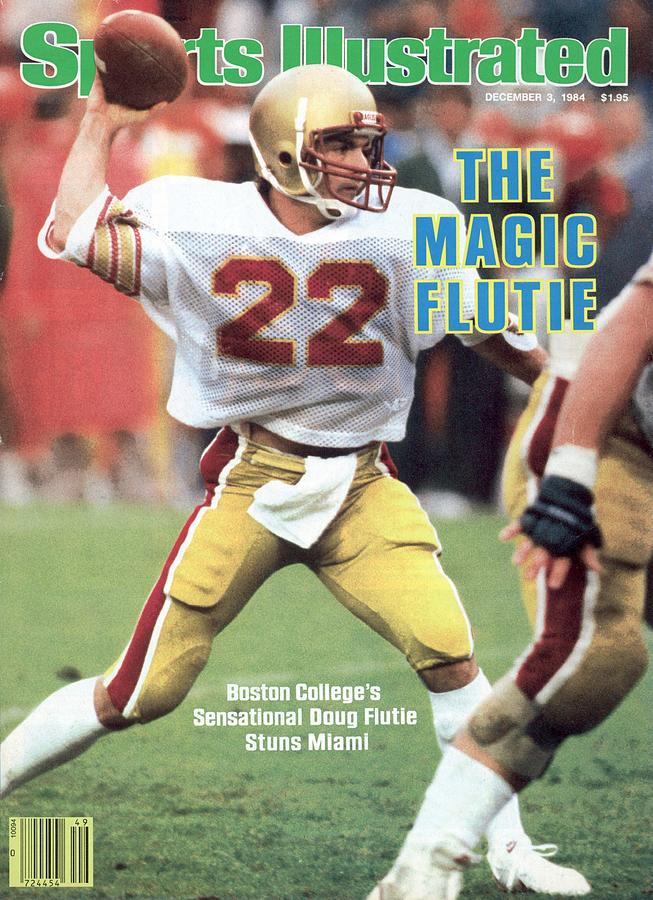
November 23, 1984: Doug Flutie's Miracle In Miami

November 23, 1984, 40 years ago: It is the day after Thanksgiving, and this was the early days of retail treating it as "Black Friday," the biggest shopping day of the year, which has come to, traditionally, set the tone for the Christmas season: Either they will make big profits, and be "in the black"; or they will be wearing black for mourning.

Thanksgiving weekend is also a time for football. The day before, many high school games were played, much more so than are played today. I was a sophomore at East Brunswick High School in Central New Jersey, and my Bears came back from a 27-13 deficit to beat Colonia High School of Woodbridge, 33-27, and clinch the Championship of the Middlesex County Athletic Conference and an undefeated regular season. It's often regarded as the greatest football game in the school's history. Unfortunately, we lost the Central Jersey Group IV Final, costing us a "State Championship" and an undefeated full season, something, to this day, we've never had.

There was only one college football game that Thanksgiving Day, a minor rivalry to everyone but those connected to the schools playing: Miami University of Ohio beat the University of Cincinnati, 31-26 at Nippert Stadium in Cincinnati. Miami University, in Oxford, Ohio, was founded in 1809, 8 years before Ohio gained Statehood. In contrast, the University of Miami, in suburban Coral Gables, Florida, wasn't founded until 1925.

In the NFL, both of the traditional home teams won: The Detroit Lions beat the Green Bay Packers, 31-28 at the Silverdome in Pontiac, Michigan; and the Dallas Cowboys beat the New England Patriots, 20-17 at Texas Stadium in Irving.

There was only one college game played on the day after Thanksgiving, on CBS. So anybody who wanted to watch a football game at that point was watching it. At the time, there was a Big East Conference, but they did not sponsor a football competition. If they did, this game would have decided its Championship. The fact that both teams involved have since moved to the Atlantic Coast Conference (ACC) should not attract from what that meant.

The University of Miami were the defending National Champions, having shocked the University of Nebraska in the previous season's Orange Bowl game, in the stadium of the same name, which was the Hurricanes' usual home field.

Bernie Kosar quarterbacked them as a freshman, and now, as a sophomore, had led them to an 8-3 record. They had won the Kickoff Classic at the Meadowlands, beating then-Number 1 Auburn. They beat Number 17 Florida on neutral ground in Tampa. They beat Number 16 Notre Dame away. But they had lost to Number 14 Michigan away, losing the Number 1 ranking in the process. They had lost to Number 15 Florida State at home.

And, in their last game before this one (they had a week off in between), they lost an embarrassing one: They led Maryland 31-0 at the half, and lost, 42-40. For many years thereafter, it was the biggest comeback in NCAA Division I-A (now FBS, the Football Bowl Subdivision) history. The Maryland quarterback was Frank Reich, substituting for the injured Boomer Esiason. In the 1992 NFL Playoffs, subbing for the injured Jim Kelly -- who had played at Miami -- Reich led the Buffalo Bills to what is still the biggest comeback in NFL history, from 35-3 down to beat the Houston Oilers, 41-38 in overtime.

Their opponents for this game would be Boston College. BC had some good teams in the 1930s and '40s, but hadn't done much since. In 1981, they were struggling, losing to the University of Pittsburgh, ranked Number 2 in the country, and coach Jack Bicknell turned to a 5-foot-9 3/4-inch freshman quarterback from nearby Natick, Massachusetts, and said, "Okay, Flutie, see what you can do."

And Doug Flutie went in, and nearly pulled the upset. They ended the season 5-6. The next season, Sports Illustrated noted that Flutie would be the starting quarterback, and whoever was writing the article finished with, "Good luck, Flutie."

Flutie made his own luck, leading BC to an 8-3-1 record. Their non-wins were all against then-ranked teams: A tie away to Number 16 Clemson, and losses away to Number 16 West Virginia, home to Number 8 Penn State, and to Number 18 Auburn in the Citrus Bowl. It was their 1st bowl game in 39 years.

As a junior in 1983, Flutie led them to a 9-3 season, losing at home to Number 12 West Virginia, away to unranked Syracuse, and in the Liberty Bowl to Notre Dame. On October 29, in a game too big for their 32,000-seat on-campus Alumni Stadium, they played defending National Champion (but, at the time, unranked) Penn State at Sullivan Stadium, home of the NFL's New England Patriots (later renamed Foxborough Stadium). Before a crowd of 56,605, and millions more watching on ABC, the Eagles beat the Nittany Lions, 27-17. Flutie, already the classic "local boy makes good," became a national star.

BC were 7-2 going into their game with Miami. They had beaten Number 9 Alabama in Birmingham, but had lost 2 games, away to Number 20 West Virginia and away to Penn State -- by a combined 8 points. BC were ranked Number 10, Miami Number 12. In spite of these rankings, Miami were a 6-point betting favorite. (Keep in mind: In football, home-field advantage is traditionally said to be worth 3 points.) Flutie was the favorite for the Heisman Trophy, although Kosar was also a contender for it. The winning quarterback would get his Heisman vote totals boosted significantly.

The game was played at the Orange Bowl, in a driving rainstorm throughout. It was almost as if there was a real hurricane going on. It kicked off at 2:30 PM Eastern Time, and BC jumped out to a 14-0 lead. Miami scored a touchdown before the 1st quarter ran out, and tied the game with a touchdown early in the 2nd quarter.

BC scored on a run by Flutie, then Miami scored on a Kosar touchdown pass, then BC did so on a touchdown pass from Flutie to his college roommate, Gerard Phelan. At halftime, the score was Boston College 28, Miami 21. So there had already been as much action as in most full games.

In the 3rd quarter, Miami scored another touchdown, and the teams traded field goals. The quarter ended with the game tied, 31-31. BC kicked another field goal to make it 34-31, but Melvin Bratton broke off a 52-yard run to make it 38-34 Miami. It seemed like Miami had the game won. Flutie led a drive that ended with a touchdown, and it was 41-38 BC. But Kosar led a drive that ended with another touchdown run by Bratton, and it was 45-41 Miami.

BC got the ball back with 28 seconds left in regulation, on their own 20 yard line. Flutie got the Eagles to the Hurricanes' 48-yard line. There were 6 seconds left. Time for one more play. A field goal wouldn't have helped, it would have been 65 yards anyway, and the weather and the wet grass would have made it a tricky proposition regardless of how close it was. There was no choice: The play had to result in a touchdown.

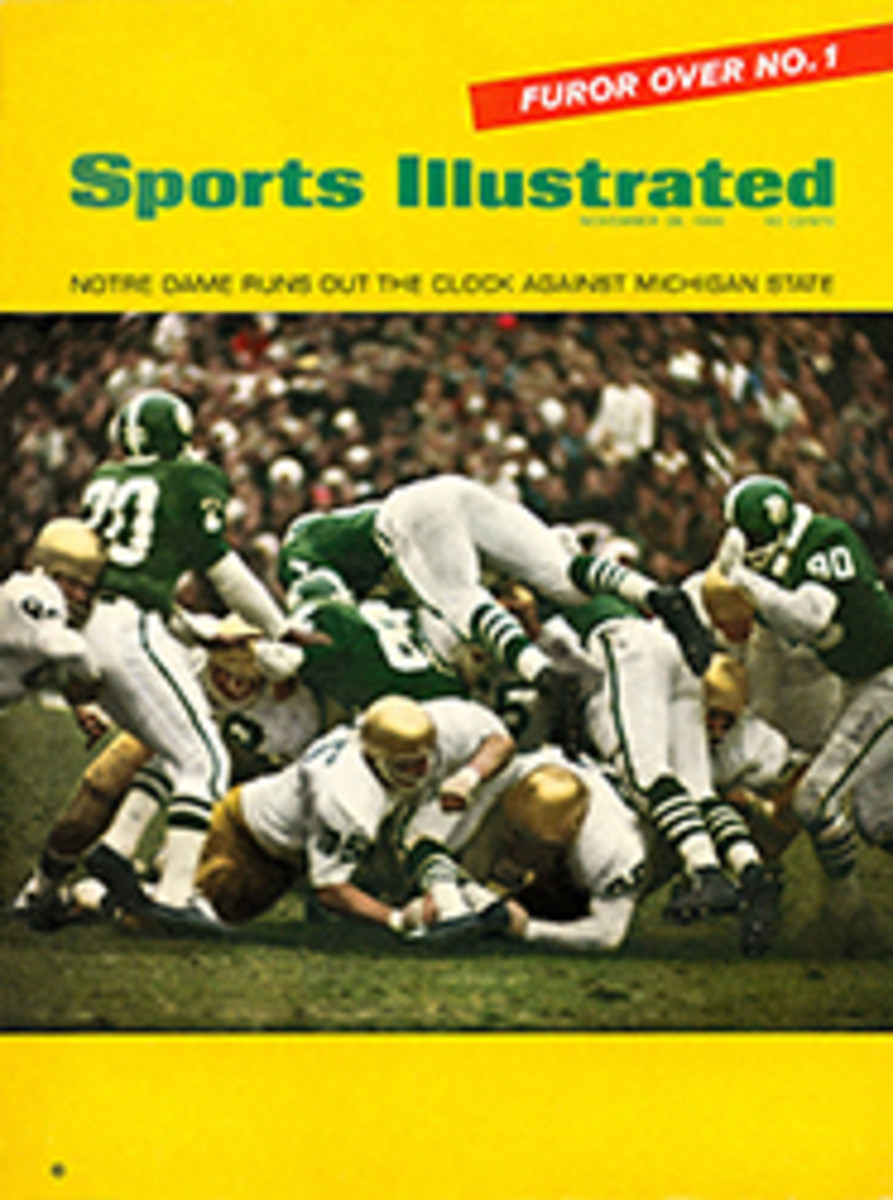
Before the play, CBS announcer Brent Musberger said, "One thing is certain: Those brave folks who sat out here in the Orange Bowl, and put up with this terrible weather, saw a whale of a football game, and they should give both teams a rousing ovation when this one is over." His broadcast partner, former Notre Dame coach Ara Parseghian, whose career included a 10-10 tie with Michigan State in 1966, known as "The Game of the Century," followed this with, "This is one of the better ones that I've seen."

Flutie called "55 Flood Tip": No running backs, and all eligible receivers run straight routes to the end zone. He was flushed out of the pocket by the Miami defense, and had to scramble. He had to attempt his 46th pass of the game, on the run, throwing from his own 37-yard line, meaning the ball had to fly at least 63 yards, into a 30-mile-per-hour wind, and through the rain.

Flutie heaved the ball. Since a Roger Staubach to Drew Pearson play in the 1975 NFL Playoffs, such a pass had been known as a "Hail Mary." Some Catholics find the expression offensive. In this case, given that Boston College is a Catholic school -- specifically, Jesuit -- it might have been appropriate.

Three Miami defensive backs blanketed receiver Kelvin Martin. There would be no way he could catch the ball. Phelan was behind them. It would require perfect placement of both man and ball for him to catch it. He did. Boston College 47, Miami 45. Ballgame. No chance to try for an extra point, with everyone running onto the field, and no need for it.

"Caught by Boston College!" Musberger yelled. "I don't believe it! It's a touchdown! The Eagles win it! I don't believe it! Phelan is at the bottom of that pile!" The entire team piled onto Phelan. As Musberger noted, "Jack Bicknell is the only person over there on the sidelines! He couldn't get the headset off fast enough! Doug Flutie has done it! And your heart goes out to Bernie Kosar. He did everything he could."

Kosar had passed for 447 yards, then a school record, with 2 touchdowns. And Bratton had run for 4 touchdowns. It was all for naught, as Flutie passed for 472 yards, becoming the 1st major college quarterback with 10,000 career passing yards. He also threw for 3 touchdowns. Miami punted only once all game; BC, just 3 times.

The game became known as the Miracle in Miami, and if there was any doubt before the game that Flutie would win the Heisman Trophy, that doubt disappeared into Phelan's hands. Ohio State running back Keith Byars finished 2nd. Robbie Bosco, who quarterbacked Brigham Young University to a controversial National Championship, finished 3rd. Kosar was 4th. Jerry Rice of Mississippi Valley State, who went on to become the greatest receiver in football history, finished 9th. Bo Jackson of Auburn, who would win it the next season, did not finish in the Top 10 this season.

Miami went on to lose the Fiesta Bowl to UCLA. Kosar would have a good pro career with the Cleveland Browns, before winning a Super Bowl ring as Troy Aikman's backup on the Dallas Cowboys.

Flutie's last college game was in the Cotton Bowl, and BC beat the University of Houston. But NFL teams passed on him due to his lack of height. This was so dumb. How dumb was it? Well, let's absolve the following teams, because they drafted Hall-of-Famers: The San Francisco 49ers, Rice; the Buffalo Bills, Bruce Smith; and the Minnesota Vikings, Chris Doleman. And, besides, the 49ers had Joe Montana, while the Bills had the rights to Jim Kelly. And several other teams drafted All-Pros. But lots of teams needed a quarterback, and didn't draft Flutie, and struggled for years to come.

Flutie signed with the New Jersey Generals of the United States Football League, and led them to the Playoffs. When the USFL folded, the Chicago Bears signed him, against the wishes of head coach Mike Ditka. Ditka refused to start him over an already-injured Jim McMahon, and the Bears haven't won a Super Bowl since. In 1987, the Bears traded Flutie to his hometown New England Patriots, but they kept him as a backup to Tony Eason, and didn't get too far, and released him after the 1989 season, and got even worse.

Flutie signed with the Vancouver-based BC Lions of the Canadian Football League. In 1992, he was traded to the Calgary Stampeders, and he led them to the CFL Championship, the Grey Cup. He did the same for the Toronto Argonauts in 1996 and '97. All 3 times, he was named the game's Most Valuable Player. He was named the CFL's Most Outstanding Player 6 times in 7 years from 1991 to 1997.

Finally, at the age of 36, the NFL could ignore him no longer. With Kelly having retired after the 1996 season, the Bills signed Flutie, and he led them to the Playoffs, made the Pro Bowl, and was named the NFL Comeback Player of the Year. He got them back into the Playoffs in 1999, but coach Wade Phillips benched him for the Playoff game against the Tennessee Titans, in favor of Rob Johnson. The Bills lost, and didn't make the Playoffs again for 18 years.

Flutie played 4 years for the San Diego Chargers, and closed his career with the Patriots, as a backup to Tom Brady. In his last game, against the Miami Dolphins, on New Year's Day 2006, he did something no NFL player had done since 1941: He converted a dropkick. It was good for a point-after-touchdown, and the Patriots won.

Doug Flutie is not in the Pro Football Hall of Fame. It is, quite specifically, not "The National Football League Hall of Fame." It includes a few players who would not have made it if not for their performances in the All-America Football Conference (1946-49) and the 1960s version of the American Football League, including Billy Shaw, who played 9 seasons for the Bills, all in the AFL, and never played a down in the NFL.

Still, voters for it tend not to consider CFL statistics. There are really only 2 NFL players who are not in the Hall whose qualifications would be noticeably boosted if their CFL tenures were included, and they're both quarterbacks: Joe Theismann and Doug Flutie. Another quarterback, Warren Moon, is the only player in the Hall with significant CFL performance, although Bud Grant won 4 Grey Cups as a coach in Winnipeg before becoming a Hall of Fame coach in Minnesota.

Oddly, for all the exposure BC got from the Flutie years, their Alumni Stadium wasn't expanded to its present 44,500 seats until the 1994 season.

Thursday, January 2, 2020

Top 5 Reasons You Can't Blame Tom Osborne for Nebraska Losing the 1983 National Championship

January 2, 1984: The University of Nebraska, ranked Number 1 in the nation, plays the University of Miami, ranked Number 5, in the Orange Bowl. The game was played on January 2 because January 1, New Year's Day, fell on a Sunday.

Nebraska had put together one of the greatest seasons in college football history. They began it ranked Number 1, and opened in the Kickoff Classic at the Meadowlands, against Number 4 Penn State, and won 44-6.

The Cornhuskers scored more points than anyone had seen in the modern era. They beat Minnesota away 84-13. They beat Iowa State 72-29. They beat Colorado 69-19. They beat Kansas 67-13. They beat Syracuse 63-7. They beat Wyoming 56-20. They beat Kansas State away 51-25. They beat UCLA 42-10.

Not all their games were easy. They went to Missouri and beat them "only" 34-13. In what was then their biggest rivalry, they went to Oklahoma and beat them 28-21. Aside from Penn State, the only ranked team they played was Number 20 Oklahoma State, away, and escaped with a 14-10 win. Still, they were 12-0, scoring 624 points and allowing just 186, for an average score of 52-15.

How good was that opposition: Minnesota went just 1-10, beating only Rice, who also went 1-10. Kansas State went 3-8. Kansas went 4-6-1. Iowa State and Colorado both went 4-7.

But Penn State went 8-4-1, won the Aloha Bowl, and finished ranked Number 17. Oklahoma went 8-4, and probably would have been ranked and gotten a bowl bid, had they not been on probation. Oklahoma State also went 8-4, won the Bluebonnet Bowl, and was ranked Number 18. UCLA went 7-4-1, won the Pac-10 and the Rose Bowl, and was ranked Number 13. Wyoming went 7-5. So did Missouri, who went to the Holiday Bowl, but lost. Syracuse went 6-5. So the 'Huskers were doing more than just running up the score on weak opposition.

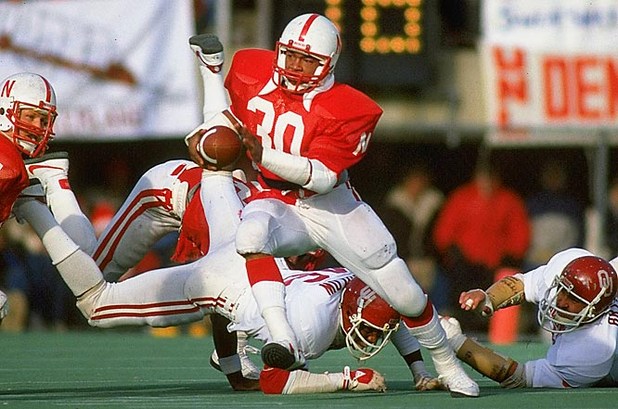
Head coach Tom Osborne was named National Coach of the Year. Running back Mike Rozier won the top 2 Player of the Year awards, the Heisman Trophy and the Maxwell Award. Guard Dean Steinkuhler won the top 2 Lineman of the Year awards, the Outland Trophy and the Lombardi Trophy. Rozier, Steinkuhler and receiving Irving Fryar were named 1st team All-Americans; quarterback Turner Gill, 2nd team. Each of those was named to the All-Big Eight Conference 1st team, along with offensive tackle Scott Raridon and center Mark Traynowicz.
Mike Rozier

Rozier and Steinkuhler would go on to become All-Pros with the Houston Oilers. Fryar would go to the Pro Bowl with the New England Patriots, the Miami Dolphins and the Philadelphia Eagles, and get to a Super Bowl with the Patriots. Running backs Doug DuBose and Tom Rathman would go on to win a Super Bowl with the San Francisco 49ers. (Rathman would win 2 with them.) Defensive end Jim Skow would reach a Super Bowl with the Cincinnati Bengals. Gill is now an administrator at the University of Arkansas, after winning conference titles as head coach at the University of Buffalo and Liberty University.

The Hurricanes, then an independent, were no slouches. Their previous 3 seasons saw them go 9-3, 9-2 and 7-4, and they were 10-1 this season. After losing their opener at Number 16 Florida, they had shut out Purdue and Number 13 Notre Dame, held Number 12 West Virginia to 3, and held 4 teams to just 7 points: Houston, Mississippi State, Cincinnati and East Carolina (and only the last of these was at home).

But they only had 2 games that compared to Nebraska's blowouts, winning 56-17 away to Duke and 42-14 at home to Louisville. Their last game before the Orange Bowl was away to arch-rival Florida State, and they escaped 17-16 winners.

Unlike later Miami teams, coach Howard Schnellenberger's '83 'Canes were not loaded with future NFL talent, but they did have Bernie Kosar, a redshirt freshman quarterback, who would later make some noise. And they would be playing the Orange Bowl game in the Orange Bowl stadium, their home field. Nevertheless, Nebraska went into the game favored by 10 1/2 points -- maybe the greatest insult an 10-1 team playing at home had ever received.

The day's other bowl games played into both teams' hands. In the early game, the Cotton Bowl in Dallas, Number 2-ranked Texas lost to Georgia. In the afternoon, the Rose Bowl in Pasadena saw Number 4 Illinois lose to UCLA. And, while the Orange Bowl was going on, Number 3 Auburn was struggling against Michigan in the Sugar Bowl in New Orleans.

So the National Championship was likely to come down to the winner of the Orange Bowl: Nebraska would have won the title with a win, anyway; while, if Miami won, and Auburn lost, or if Auburn didn't win convincingly, Miami could jump from 5th to 1st.

*

And, just as the New York Jets had done to the Baltimore Colts in Super Bowl III on the same field, 15 years to the month earlier, the 'Canes shocked everybody. They held Nebraska to a field goal attempt by Mark Hagerman on the 1st possession of the game, and blocked it.

With the momentum on their side, and with a key interception later, the 'Canes jumped out to a 17-0 lead in the 1st quarter. Only Colorado and Iowa State had managed more than that on Nebraska in 3 quarters, before the backup defenders had been put in.

Nebraska settled down, and closed to within 17-14 at the half. Early in the 3rd quarter, a Miami fumble gave Nebraska the ball deep in Hurricane territory, but, again, the 'Canes held the 'Huskers to a field goal attempt, which Hagerman made, to tie the game at 17.

Before the quarter ended, Kosar engineered 2 more touchdown drives, to make it 31-17 Miami. Rozier, the best player in the country all season long -- he got 482 1st-place votes for the Heisman Trophy, and Brigham Young quarterback Steve Young was next-best with 153 -- had to leave the game with an ankle injury, taking the 'Huskers' best weapon away. And Jeff Smith, subbing for Rozier, got off a 40-yard run, but was stripped of the ball at the 1-yard line, and Miami recovered.

Early in the 4th quarter, Nebraska was held to another field goal attempt, and, unlike the early blocked attempt, Hagerman simply missed this one. Nebraska later scored a touchdown to make it 31-24, and then it was Miami's turn to miss a field goal attempt.

With less than 2 minutes to go, Gill passed to Fryar, who got inside the Miami 35-yard line. On 2nd and 8 from the Miami 24, Fryar was wide open in the end zone, but dropped Gill's pass. It went to 4th and 8, and Gill threw to Smith, who got into the end zone. That made it 31-30.

Now, Osborne had a decision to make: Kick the extra point, make it 31-31, and settle for a tie -- or, maybe, go for the onside kick, hope you get into field goal range, but also risk Miami winning it with a field goal -- or go for a 2-point conversion and a 32-31 win, with Miami still having time to maybe get into field goal range. Earlier in the week, he was asked about this very situation, and said, "I hope it doesn't come up."

It now had. With overtime not available (and this would remain true for college football until the 1996 season), Osborne decided to go for 2. The ball was placed on Miami's 3-yard line. Once again, Gill rolled to his right, and looked for Smith. But Smith was double-covered, and Kenny Calhoun knocked the pass away.
A recent photo of Kenny Calhoun, "Throwing the U"

Nebraska kicked off, and Miami ran out the clock. Auburn ended up winning the Sugar Bowl only 9-7, and, when the Associated Press and United Press International released their polls the next day, they both awarded Miami the National Championship. The AP (the sportswriters) gave 11-1 Miami 47 1/2 1st-place votes, 11-1 Auburn 7, and 12-1 Nebraska 4 1/2. UPI (the coaches) gave Miami 30, Nebraska 6, and Auburn 4.
Bernie Kosar, on an NBC screen capture

With a little bit of irony, Jeff Smith, rather than Mike Rozier, was the man on the cover of Sports Illustrated after the season-opening win over Penn State. Therefore, when "The Dreaded SI Cover Jinx" hit Nebraska, it was the player who had the chance to clinch the National Championship, 4 months later, that it gave a delayed hit.
*

This would begin a run for Miami of 12 seasons in which they were, effectively, in 6 National Championship Games, winning 4 of them (in the seasons of 1983, 1987, 1989 and 1991). They would win another in 2001 and come very close in 2002.

The '84 Orange Bowl would haunt Nebraska, which last won the National Championship in 1971, and had some other close calls. They would lose the Orange Bowl to Miami again in 1988 (thus blowing a shot at the title and letting Miami win it), and lose it to Florida State in 1994 (again blowing the title to a team from Florida).

Finally, on January 1, 1995, they again went to the Orange Bowl, again played Miami, and beat them 24-17, to win the 1994 National Championship, finally getting the monkey off Osborne's back. (He had been an assistant to Bob Devaney when they won the title in 1970 and '71.)
They would win the National Championship again in 1995, and share the 1997 title with Michigan, the last "split poll" title. That 1995 team is considered by some to be what the 1983 team should have been: The greatest team in college football history.

Osborne then retired, with a career record of 255-49-3, having coached 53 All-Americans, 13 Conference Championships (the last in the Big 12, the others in the Big 8), and 3 National Championships. In 2000, '02 and '04, he was elected to Congress from Nebraska as a Republican. He retired rather than run again in the 2006 election, to accept the post of the University of Nebraska's athletic director, a post he held until 2013. The playing surface at their Memorial Stadium is named Tom Osborne Field. He is still alive, 82 years old.

*

Did Osborne make the right choice in going for 2 in the '84 Orange Bowl?

Top 5 Reasons You Can't Blame Tom Osborne for Nebraska Losing the 1983 National Championship

5. Miami Stepped Up. In situations like this, it's easy to make Reason Number 1 "The opposition was better." Only the most deluded of Hurricanes fans would say their team was better than the Cornhuskers'

But if the Hurricanes hadn't played so well, becoming college football's answer to the 1960 Pittsburgh Pirates, to Nebraska's Yankees -- or, to use an earlier-cited example from the same stadium, the Jets to the Cornhuskers' Colts -- Nebraska wouldn't have been in the position where Osborne had to make the critical decision.

4. Nebraska Blew It. All season long, they had gotten the job done, until now. And they had come back from 17-0 and 31-17 to get to 31-30. There was plenty of reason to believe they could gain 3 yards on this one play. But, between the missed field goal, the blocked field goal, the fumbled sure touchdown, and the dropped passes on the last drive, they had their chances, and they blew them.

Think about it: Had either of Hagerman's missed field goals gone through, that last touchdown would have made it 33-31 Nebraska. True, there was enough time left on the clock where the conversion would have been more meaningful at 35-31 than at 34-31, but not by that much. Had Hagerman made both of those misses, it would have been 36-31, and Miami would have needed a touchdown no matter what.

Even Osborne blew it: If he had gone for 2 on the preceding touchdown, and made it, that would have made the score 31-25, and he could have won the game 32-31 with an extra point kick on the touchdown in question. Nobody talks about that choice.

3. Principle. If you can't gain 3 yards on 1 play to win 1 game, you don't deserve to win the National Championship.

2. Ara Parseghian. As head coach of Notre Dame in 1966, he went for a tie against Michigan State, knowing it wouldn't cost him the National Championship, whereas a loss would have. But, in the ensuing 17 years, the words had been spoken many times: "Parseghian had no guts."
Osborne was not going to be accused of having no guts. He knew that, for all Parseghian had achieved, that 1966 10-10 tie was the thing for which he was most remembered. "We were trying to win the game," Osborne said at the time. "I don't think you go for a tie in that case. You try to win the game. We wanted an undefeated season and a clear-cut National Championship."

Clear-cut. Because...

1. America Hates Ties. Long ago, though the identity of the coach who first said it depends on who's telling the story, a coach lost a game on a 1-yard run attempt rather than kick a tying field goal, and explained to the reporters, "A tie is like kissing your sister."

It's not like in European soccer, where a win is worth 3 points to your team in the league standings (or "table"), and a tie (or "draw") is worth 1 point. A tie that gave Nebraska the 1983 National Championship would have satisfied very few people -- outside the State of Nebraska, anyway. America hates ties, to the point that the NHL no longer has them.

Sure, with a tie, Nebraska would still have been National Champions. But any pretense to "Greatest Team Ever" status would have been gone.

After all, as Herman Edwards, then still playing cornerback for the Philadelphia Eagles, would later put it while coaching the New York Jets, "This is what the greatest thing about sports is: You play to win the game!"

VERDICT: Not Guilty. A lot of people would have understood it if he had gone for the tie and, presumably, still won the National Championship. But 32-31 and 13-0 would have been better than 31-31 and 12-0-1.

Besides, the '95 Orange Bowl win over Miami, and the resulting National Championship, was all the sweeter because of the '84 Orange Bowl loss to Miami.

Wednesday, August 2, 2017

Ara Parseghian, 1923-2017

Who is America's most famous citizen of Armenian descent? Since 2007, it's been Kim Kardashian. For over 40 years before that, it was one of college football's most accomplished coaches.

He lived long enough to see the 50th Anniversary of his greatest triumph -- and his greatest controversy. And, compared to so many other college sports coaches, his greatest controversy was a mild one.

Ara Raoul Parseghian was born on May 21, 1923 in Akron, Ohio. His father had fled the Armenian Genocide of 1915, and his mother fled besieged France, as World War I was also going on. Young Ara's character was noted quickly: In the 8th grade, the Akron Board of Education hired him as a safety patrol officer, deterring vandals on school grounds.

His mother was very protective, and let him play baseball and basketball, but not football. In his junior year at South High School, the head coach talked him into disobeying his parents. Under subterfuge, a legend was born.

He enrolled at the University of Akron, but left to enlist in the U.S. Navy during World War II. He was assigned to the Great Lakes Naval Training Station in Chicago, which had a great sports program, including a baseball team managed by Mickey Cochrane and having Bob Feller as its pitcher. The football team was coached by Paul Brown, who had already become well-known for having coached Ohio State University.

Parseghian got hurt, and wasn't able to play. But, like John Madden later would at the side of head coach Buck Shaw and quarterback Norm Van Brocklin of the Philadelphia Eagles, that injury led him to observe one of the great football minds of the time, and he learned how to coach.

After The War, Parseghian enrolled at Miami University in southwestern Ohio, which would eventually become known as "The Cradle of Coaches" for how many football coaches it would produce. At the time, their head coach was Sid Gillman, who would become one of the geniuses of the passing game. Ara quickly figured out that Sid knew his stuff, and paid close attention -- which is rather ironic, considering what both men's reputations became by November 1966.

A decent halfback, Ara was drafted by the Pittsburgh Steelers in the NFL and the Cleveland Browns in the All-America Football Conference. The Browns coach who drafted him was Paul Brown. Ara didn't need an engraved invitation. He was a member of the Browns team that won the 1948 AAFC Championship, going undefeated. But he got hurt early in the 1949 season, and that was the end of his playing career. The Browns would enter the NFL in 1950, but Ara Parseghian never drew a paycheck from the NFL or any of its teams.

*

Because he went directly into coaching. John Brickels, who'd been a Brown assistant was now the athletic director at Miami, and Woody Hayes had succeeded Gillman as head coach. They offered Ara the job of coaching the Miami freshmen. He went 4-0. The following year, Woody was hired as head coach at Ohio State -- taking with him an assistant coach named Glenn "Bo" Schembechler -- and Ara was promoted to the head job for the 1951 season. He was just 28 years old.

He led them to undefeated seasons and Mid-American Conference Championships in 1954 and '55. In 1956, he was lured away by Northwestern University outside Chicago. At 33, he was the youngest head coach in Big Ten history. His staff included Schembechler and future Northwestern coach Alex Agase.

(But not, as I previously believed, future Yankee owner George Steinbrenner: Although also an Ohioan, who had been a track star and varsity football player at Massachusetts' Williams College, George had been a member of the previous year's staff, under Lou Saban, the future Buffalo Bills coach who would later be one of George's Yankee scouts. In 1956 and '57, George was on the staff of a Big Ten school, but it was Purdue, not Northwestern. That said, George and Ara did become friends.)

Northwestern went 0-9 in 1957 -- but Schembechler, who played and coached under Hayes and later built a great coaching legacy at the University of Michigan, called it "the best job of coaching I ever witnessed." Some of the losses were close, and Ara had his Wildcats believing they were a good team. In 1958, they proved it, going 5-4, including wins over Michigan and Ohio State.

In 1959, he had them beat Michigan and Notre Dame, and they rose to be the Number 2 team in the country. But 3 straight losses at the end of the season cost them the Big Ten title. In 1962, he got them to 7-0, beating Ohio State and Notre Dame, and they rose to Number 1, a ranking they had never had before, nor have since. But 2 straight losses at the end cost them the title.

During the 1963 season, Ara was told that, despite his achievements, including beating Notre Dame 4 straight times, his contract would not be renewed for 1964. Notre Dame decided, "If you can't beat him, hire him."

*

And that 1964 season would be a big revival for Notre Dame, who had won the National Championship in 1949 and had gone undefeated as recently as 1953, but had struggled since, going 2-7 in 1963.

Ara recognized, as his predecessor Joe Kuharich (not a very smart man, as his Philadelphia Eagles tenure would prove) did not, that quarterback John Huarte and receiver Jack Snow were gems. In their 1st game together, Huarte threw for more yards than all of Notre Dame's quarterbacks had thrown in the entire previous season, and they upset Wisconsin.

At the final gun, his players picked him up and carried him off the field -- quite a tribute after only the 1st game. A statue depicting this moment now stands outside Notre Dame Stadium.

Notre Dame rose to Number 1 in the country, and needed only to defeat the University of Southern California in the last game of the season -- the Fighting Irish refused bowl bids in those days -- to clinch an undefeated season and the National Championship. But USC won on a last-minute touchdown pass, ending the dream. Huarte still received the Heisman Trophy.

"The talent was there," Ara said. "It was just misplaced."

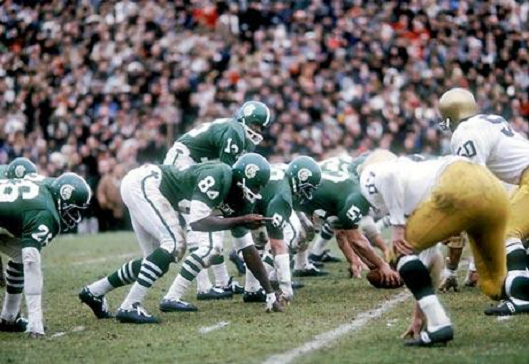
Notre Dame went 7-2-1 in 1965, and then in 1966, set up what became known as "The Game of the Century": Due to some scheduling quirks, they were undefeated and ranked Number 2; Michigan State were undefeated, ranked Number 1, and the defending National Champions; and they played each other in East Lansing, Michigan in the last game of the regular season.

ABC televised the game nationally, albeit on a tape delay. This was the 1st time a single college football game went coast-to-coast over national television -- and in color, no less -- except for New Year's Day bowl games. This was a time when the words "in color" and "coast-to-coast" still had a special meaning. In 1966, such a thing was still a novelty.

Michigan State had gone to the Rose Bowl the year before. At the time, the Big Ten Conference had 2 unbelievably stupid rules: No team could go to the Rose Bowl in back-to-back years, and only the Conference Champion (or, if disqualified by the preceding stupid rule, the 2nd-place team) could go to any bowl game. This, and Notre Dame's refusal of bowl bids, meant that, regardless of the result of this game, neither team was going to a bowl.

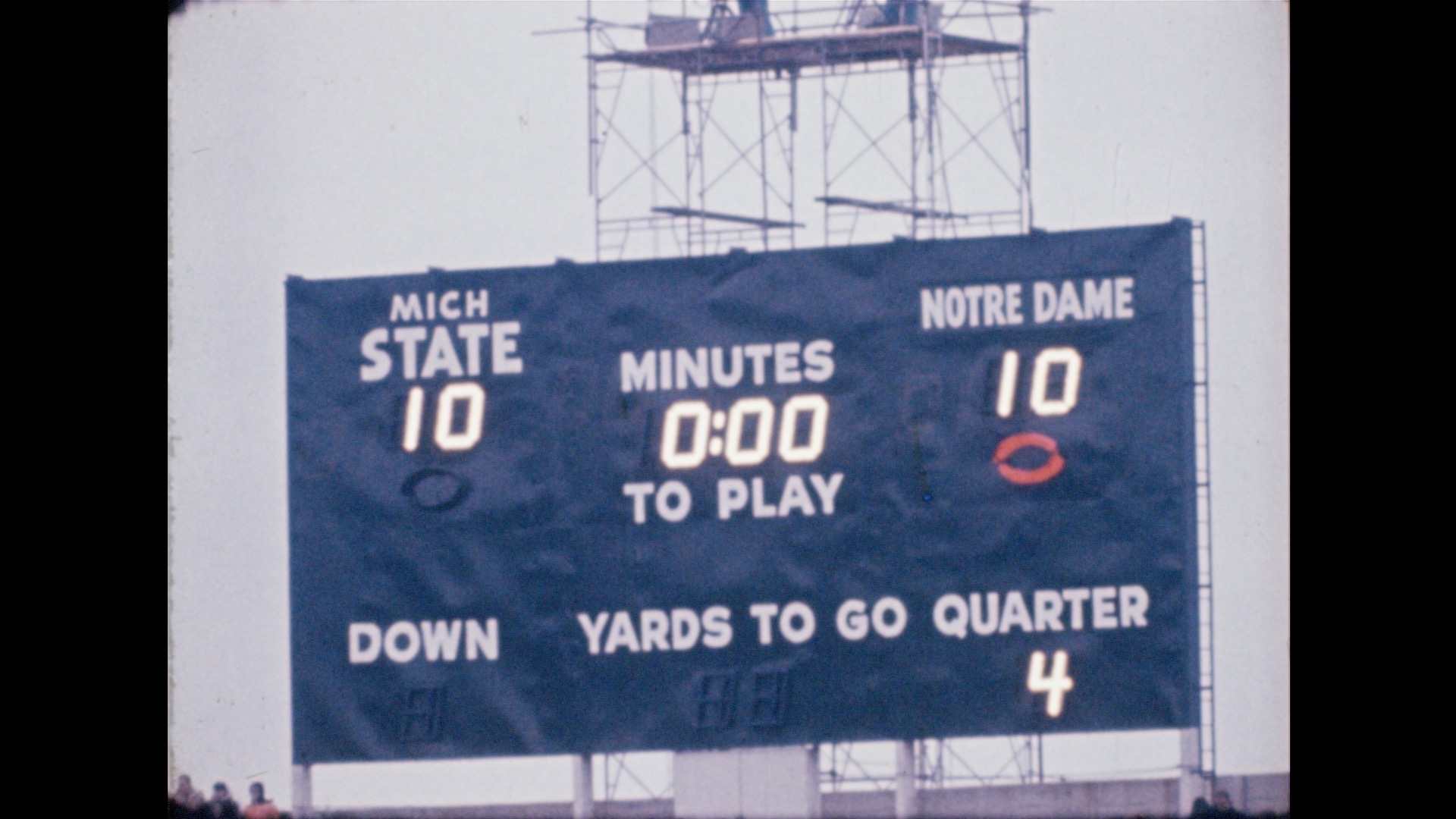
Michigan State took a 10-0 lead in the 2nd quarter. Notre Dame made it 10-7 before the half, and tied it at 10-10 early in the 4th quarter. There was still plenty of time left for either team to win the game, but neither did.

The last series of the game began with 1:10 left on the clock, and Notre Dame had the ball on its own 30-yard line. Gaining 40 yards in 70 seconds would have put them in position for Azzaro to try again to win it with a field goal. But Parseghian chose to run out the clock. Final score, Michigan State 10, Notre Dame 10.

Normally, the national media, so swept up in the myth of the Golden Dome -- Knute Rockne, George Gipp and Rockne's "Win One for the Gipper" speech, the Four Horsemen, Frank Leahy and "Leahy's Lads," and Paul Hornung... and this was well before Rudy Ruettiger and his movie, Joe Montana, and Lou Holtz's tenure -- gives Notre Dame the benefit of the doubt.

Not this time. In Sports Illustrated's writeup of the game, Dan Jenkins, then as now perhaps the greatest living writer on the subject of college football, titled his article "Tying One for the Gipper." Jenkins quoted one observer as saying, "Parseghian had no guts."

Was that fair? Here was Ara's explanation: "We'd fought hard to come back and tie it up. After all that, I didn't want to risk giving it to them cheap. They get reckless and it could cost them the game. I wasn't going to do a jackass thing like that at this point."

Both teams ended the season 9-0-1. And the polls? Both the Associated Press (the college football writers) and United Press International (the coaches), still issuing their final polls before the bowl games, ranked Notre Dame Number 1 in their last poll, Michigan State Number 2, and undefeated Alabama Number 3.

Alabama, led by Paul "Bear" Bryant and actually having a bowl game to win, did so, and finished 11-0. They should have thus gotten their 3rd straight National Championship (splitting the 1965 polls with Michigan State). Both Notre Dame and Alabama claim to be 1966 National Champions, but Notre Dame still gets the official recognition. Keith Dunnavant came out with a book about the '66 Crimson Tide squad and how they were screwed by the polls, titling it The Missing Ring.

After more than half a century, I think we can let Ara off the hook. Although America already had a "winning is everything" mentality, it would not be until a documentary a year later, in 1967, that the nation heard the great Green Bay Packer coach Vince Lombardi say the words, "Winning isn't everything, but it's the only thing." If Lombardi had publicly said that before the fall of 1966, maybe Ara would have noted that, and gone for the win.

This was also long before Tom Osborne went for the win instead of a tie in the 1984 Orange Bowl, costing Nebraska a National Championship; let alone before Jets coach Herman Edwards' 2002 press conference where he declared, "This is what the greatest thing about sports is: You play to win the game. Hello? You play to win the game! You don't play it to just play it! That's the great thing about sports: You play to win!"

It's also worth noting that Ara had played for Woody Hayes. I'm not sure if Woody came up with these words himself, but he did like to say, "There are three things that can happen when you throw the football, and two of them are bad." In other words, an incomplete pass and an interception. When Ara had 70 seconds of play remaining, and 70 yards to go for a touchdown, and at least 40 yards to go for a field goal, no doubt he heard Woody's words in his mind. After all, at the time, the man was still, along with Bear Bryant at Alabama, one of the top 2 coaches in college football. (Darrell Royal at Texas and John McKay at USC were still building their legends, and Joe Paterno had just taken the reins at Penn State.)

Recall also: In 1946, Army was undefeated and ranked Number 1, and Notre Dame was undefeated and ranked Number 2, and they finished the regular season against each other, at the original Yankee Stadium, in the 1st college football game to get the "Game of the Century" tag from the national media.

That game did not live up to the hype, ending in a 0-0 tie. As they would say in that other kind of football, soccer, "a turgid nil-nil draw." The word "turgid" so perfectly suits 0-0 draws, regardless of what game you call "football."

Frank Leahy, then the Notre Dame coach, had "tied one for the Gipper" 20 years before Ara. Yet he never got the derision that Ara got. Probably because it wasn't on television: In order to see this game in its entirety, you had to be inside The Stadium. Newsreel highlights in movie theaters wouldn't have shown you all you needed to see. Nobody's ever said, "Leahy had no guts." Essentially, he played for a tie, and got away with it.

Michigan State's head coach Duffy Daugherty didn't exactly go for the win, either. And it really did cost his team the National Championship. But nobody mocked him for it, and nobody, in Michigan or elsewhere, holds it against him now.

Recall also that the Odds Were Against the Irish. Michigan State had the home field. They were the defending National Champions. They were favored to win. And Notre Dame went into the game with a major injury (their top rusher) and got more of them as the game went on (their starting quarterback and center). And still, they held Michigan State to just 10 points at home and avoided a loss. That's a pretty good achievement.

And here's the biggest reason of all why Ara deserves to be exonerated: A win wasn't necessary. The polls proved it, giving Notre Dame the National Championship anyway. Ara knew that a loss would kill their national title dreams, just as they had against USC 2 years earlier. But a tie would still leave them undefeated.

And, as they nearly always do (except where this one game was concerned), the national media gave Notre Dame the benefit of the doubt, and crowned them National Champions, even though Alabama, undefeated and untied in 11 games as opposed to undefeated but tied in 10 games, was a more deserving National Champion.

Sounds like Ara Parseghian had more guts than the media: Not only were they gutless in claiming him to be a coward, but they ended up rolling over for the Irish anyway. If not for Ara himself.

Like Knute Rockne (1920) and Frank Leahy (1943), and later Dan Devine (1977) and Lou Holtz (1988), Ara Parseghian had taken 3 years to build a National Champion in South Bend, Indiana. But he was modest about it: "I don't think I was a miracle man. Neither were Lou Holtz or Frank Leahy. We all found ways to win."

*

In 1969, Notre Dame finally started accepting bowl bids again, and went to the Cotton Bowl, where they lost to Royal's Texas Longhorns, who clinched the National Championship. But the next season, with Royal going for back-to-back titles, Notre Dame upset them, clinching the Number 2 spot in the polls. They reached the Orange Bowl in the 1972 season, but lost to Nebraska.

In 1973, Ara Parseghian won another National Championship at Notre Dame, this time beating Alabama in a Number 1 vs. Number 2 matchup in the Sugar Bowl. After a 10-2 season in 1974, his last game another upset of an undefeated Bear Bryant Alabama team in the 1975 Orange Bowl, 13-11, he retired. His career record was 170 wins, 58 losses and 6 ties, including 95-17-4 at Notre Dame -- an average of 9-2 every season.

He was only 51, but was dealing with a criminal situation involving some of his players (no charges ended up being filed, but the suspension of those players in the interim hurt the team), and his daughter's health difficulties. He had been a head coach for 24 consecutive seasons -- a record some men don't begin until they're age 51 or over -- said he was "physically exhausted and emotionally drained," and said he wanted to take 1975 off before considering pro jobs.

Instead, he never coached again. He didn't need to: Criticism over that 1966 game aside, his legacy was secure. Huarte was his only Heisman Trophy winner.  Quarterback Joe Theismann, a native of South River, New Jersey, famously changed the pronunciation of his name from Theeze-man to Thighs-man because it would rhyme with "Heisman," but lost the 1970 Trophy to Jim Plunkett of Stanford anyway.

Nevertheless, in addition to Huarte and Theismann, his players included Jack Snow, Bill Wolski, Nick Eddy, Jim Lynch, Mike Wadsworth, Pete Duranko, George Goeddeke, Terry Hanratty, Rocky Bleier, Tom Schoen, Bob Kuechenberg, Jim Seymour, Mike McCoy, Walt Patulski, Clarence Ellis, Bill Etter, Mike Kadish, Greg Marx, Dave Casper, Tom Clements, Cliff Brown, Mike Townsend, Steve Sylvester, and, while he didn't get into a game until the last game of the 1975 season, the season after Ara left, Daniel "Rudy" Ruettiger.

*

Ara was content to not coach again. He served as a color commentator with Keith Jackson on ABC college football broadcasts from 1975 to 1981, then moved to CBS, calling games through the 1988 season.

He and his wife, the former Kathleen Davis, had a son, Mike; and 2 daughters, Kris Humbert and Karan Parseghian. In 2012, Karan died from multiple sclerosis. Mike had 3 children -- Michael, Cristia and Marcia -- who died, all before age 17, from Niemann-Pick disease Type C. It is a rare genetic disorder, which primarily afflicts children, causing buildup of cholesterol in cells, damaging the nervous system.

In 1994, when the grandchildren were diagnosed, Ara, Kathleen, Mike and Mike's wife founded the Ara Parseghian Medical Research Foundation, which raises awareness of the disease and money for research into treatment, and, hopefully, one day, a cure. So far, it has raised over $45 million.

Ara never took his own health for granted, and remained active in the Notre Dame community. At the 2007 Spring Game, he and Holtz coached the opposing sides. He lived long enough to see Brian Kelly revive the Fighting Irish program, and to see the 50th Anniversaries of his 1964 and 1966 highlights.

His last public appearance, last Summer, was at a 75th birthday party for former Notre Dame basketball coach and ESPN basketball analyst Richard "Digger" Phelps. Upon seeing Ara, Digger was moved to tears.
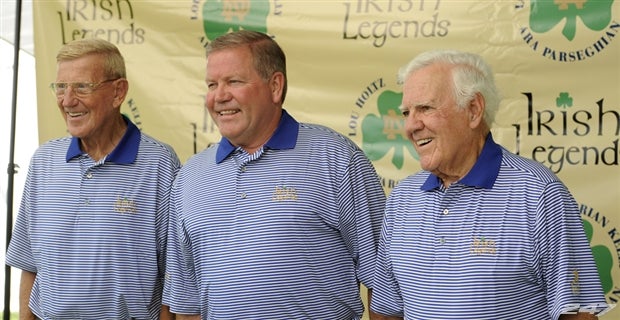
Lou Holtz, current Notre Dame coach Brian Kelly, and Ara Parseghian

Ara Parseghian died overnight, on August 2, 2017, at his home in Granger, Indiana. He was 94 years old.

The Rev. John I. Jenkins, UND President, said in an official statement:

Notre Dame mourns the loss of a legendary football coach, a beloved member of the Notre Dame family and good man, Ara Parseghian.

Among his many accomplishments, we will remember him above all as a teacher, leader and mentor who brought out the very best in his players, on and off the field.


He continued to demonstrate that leadership by raising millions of research dollars seeking a cure for the terrible disease that took the lives of three of his grandchildren. Whenever we asked for Ara’s help at Notre Dame, he was there.
My prayers are with Katie, his family and many friends as we mourn his passing and celebrate a life that was so well lived.
"An amazing man," Digger Phelps said. For once, Digger showed a gift for understatement.
UPDATE: Parseghian was buried at Cedar Grove Cemetery in South Bend.

Saturday, November 19, 2016

November 19, 1966: Michigan State vs. Notre Dame: "The Game of the Century"

Ara Parseghian (left) and Duffy Daugherty

November 19, 1966, 50 years ago: One of college football's occasional "Games of the Century" is played, at Spartan Stadium in East Lansing, Michigan.

Michigan State University, coached by Hugh "Duffy" Daugherty and known as "Duffy's Toughies," defending National Champions and now back-to-back Big Ten Champions, were undefeated, and ranked Number 1 in one of the major polls in use at the time and Number 2 in the other.

The University of Notre Dame, based in South Bend, Indiana, coached by Ara Parseghian, was also undefeated, and ranked 1st in one and 2nd in the other.

ABC televised the game nationally, albeit on a tape delay, with Chris Schenkel and former Oklahoma coach Bud Wilkinson calling it. This was the 1st time a single college football game went coast-to-coast over national television -- and in color, no less -- except for New Year's Day bowl games.

This was a time when the words "in color" and "coast-to-coast" still had a special meaning. Even today, ABC/ESPN and CBS split some of their games regionally: While the East Coast and the Midwest might see, for example, Ohio State vs. Penn State, the South and the West Coast might see, say, Southern California vs. Texas. But each network usually staggers its schedule so that, on any given Saturday, there's at least one game that most of the country, unless their own team is otherwise occupied, will want to see. In 1966, such a thing was still a novelty.

These two teams weren't even supposed to play. Notre Dame had usually played the University of Iowa on the 3rd Saturday in November from 1945 onward. But after 1964, Iowa opted out of that arrangement. Since Michigan State only had 9 regular-season games scheduled, and it was a relatively short trip -- 149 miles, or 2 1/2 hours by road -- the game was set up, and as luck would have it, they both came in undefeated, Number 1 vs. Number 2.

The teams had first played each other in 1897, before either one was a major football power. At this point, they had played each other every year since 1948.

Michigan State had gone to the Rose Bowl the year before. At the time, the Big Ten Conference had 2 unbelievably stupid rules: No team could go to the Rose Bowl in back-to-back years, and only the Conference Champion (or, if disqualified by the preceding stupid rule, the 2nd-place team) could go to any bowl game. This meant that, regardless of the result of their game against Notre Dame, MSU were not going to play a bowl game. (Purdue, quarterbacked by future Miami Dolphin Super Bowl winner Bob Griese, finished 2nd, and went on to their 1st-ever Rose Bowl, and won it for what remains the only time in their history.)

Notre Dame had a policy against bowl games, and hadn't been to one since Knute Rockne's legendary "Four Horsemen" (Harry Stuhldreher, Jim Crowley, Don Miller & Elmer Layden) beat Ernie Nevers' Stanford in the Rose Bowl on New Year's Day 1925. They wouldn't stop turning down bowl invitations until the 1970 season. So for both the Spartans and the Fighting Irish, this was it.
At first, it didn't go too well for Notre Dame: Their leading rusher, Nick Eddy, did not play due to a shoulder injury. Quarterback Terry Hanratty got sacked by the massive (for the time, anyway) Spartan defensive lineman (and future actor) Charles "Bubba" Smith, and had to leave the game with an injury. Center George Goeddeke hurt his ankle blocking for a punt.

Early in the 2nd quarter, the Spartans took a 7-0 lead on a Regis Cavender touchdown. God only knows what Regis Philbin, at age 32 already a known entertainer, and a Notre Dame graduate, so much of a fan that his request to be buried in the school's Cedar Grove Cemetery was granted, thought of a man named Regis scoring against his beloved Irish.

Dick Kenney, a barefooted kicker, added a field goal to make it 10-0 Michigan State. Barefoot kickers are now illegal in high school in every State except Massachusetts and Texas. It's still legal in college and in the NFL, but very rare since the 1980s.

Notre Dame came back. Backup quarterback Coley O'Brien threw a touchdown pass to Bob Gladieux, and it was 10-7 Spartans at the half. On the 1st play of the 4th quarter, Joe Azzaro kicked a field goal to tie it. There was still plenty of time left for either team to win the game.

A Spartan pass play gave both teams a good chance to score: Quarterback Jimmy Raye -- a black quarterback, not the first at Michigan State but rare on national television at that point -- attempted to pass to Gene Washington (not the man who went on to All-Pro honors with the 49ers and then became an executive in the NFL's main office; this one went on to play for the Vikings and Broncos), but Washington outran the pass, doubled back, and Tom Schoen intercepted it. That gave the Irish a chance, but Azzaro just missed what could have been a game-winning field goal.

The last series of the game began with 1:10 left on the clock, and Notre Dame had the ball on its own 30-yard line. Gaining 40 yards in 70 seconds would have put them in position for Azzaro to try again to win it with a field goal.

But Parseghian chose to run out the clock. He called 4 running plays, one of which gained a 1st down, then O'Brien was sacked by Bubba Smith, and then ran up the middle on the final play. None of these plays got the ball across midfield, let alone within field goal range. Final score, Michigan State 10, Notre Dame 10. The home crowd booed the final play-call.
I've seen ESPN Classic's broadcast of the game's surviving footage, which is all but the 1st quarter. The video is clear, the color is bright, and both teams, while looking small compared to the college teams of today, fought hard, and both seemed worthy of the National Championship -- until the last 70 seconds, of course.

Normally, the national media, so swept up in the myth of the Golden Dome -- Knute Rockne, George Gipp and Rockne's "Win One for the Gipper" speech, the Four Horsemen, Frank Leahy and "Leahy's Lads," and Paul Hornung... and this was well before Rudy Ruettiger and his movie, Joe Montana, and Lou Holtz's tenure -- gives Notre Dame the benefit of the doubt.

Not this time. In Sports Illustrated's writeup of the game, Dan Jenkins, until his death in 2019 perhaps the greatest living writer on the subject of college football, titled his article "Tying One for the Gipper." Jenkins quoted one observer as saying, "Parseghian had no guts."
Was that fair? Here was Ara's explanation: "We'd fought hard to come back and tie it up. After all that, I didn't want to risk giving it to them cheap. They get reckless and it could cost them the game. I wasn't going to do a jackass thing like that at this point."

Both teams ended the season 9-0-1. And the polls? Both the Associated Press (the college football writers) and United Press International (the coaches), still issuing their final polls before the bowl games, ranked Notre Dame Number 1 in their last poll, Michigan State Number 2, and undefeated Alabama Number 3.

Alabama, led by Paul "Bear" Bryant and actually having a bowl game to win, did so, beating Number 6 Nebraska in the Sugar Bowl, and finishing 11-0. They should have thus gotten their 3rd straight National Championship, having split the 1965 polls with Michigan State.

Both Notre Dame and Alabama claim to be 1966 National Champions, but Notre Dame still gets the official recognition. Keith Dunnavant came out with a book about the '66 Crimson Tide squad and how they were screwed by the polls, titling it The Missing Ring.

Ara Parseghian won another National Championship at Notre Dame in 1973, this time beating Alabama in a Number 1 vs. Number 2 matchup in the Sugar Bowl. That year, Ohio State and Michigan played to a tie, thus tying for the Big Ten title, and the Conference sent Ohio State to the Rose Bowl. Despite this, Ohio State coach Woody Hayes joined with Bo Schembechler, once his player and assistant coach but now the Michigan coach, in his outrage, and together they got the only-the-Rose-Bowl rule changed.

Duffy Daugherty remained Michigan State's coach until 1972, and lived until 19867, barely seeing the 20th Anniversary of this game. Parseghian retired after the 1974 season, and became a broadcaster in the sport. He died on August 2, 2017, at the age of 94. living long enough to see the 50th Anniversary of this game. He never took his good health for granted, and continued to raise money for research into diseases that have hit his family. Until the Kardashians became famous, he was easily the most famous American of Armenian descent. A statue of him stands outside Notre Dame Stadium.
Yet, even in death, he still gets dogged by charges of cowardice for 1966.

I'm not a Notre Dame fan. Indeed, I once did a blog post of "The Top 10 Reasons to Hate Notre Dame." Ara's successor, Dan Devine, who led them to the 1977 National Championship with Joe Montana at quarterback, once said, "There's Notre Dame fans, and then there's Notre Dame haters, and, frankly, they're both a pain in the ass."

But I think we can let Ara off the hook. Like Schembechler, Ara both played for Hayes and coached under him at Miami University of Ohio before becoming a great head coach himself. Woody's philosophy was simple: Run the football. Or, as it became known, "Three yards and a cloud of dust." I'm not sure if Woody came up with those words himself, but words that have been attributed to him are, "There are three things that can happen when you throw the football, and two of them are bad." In other words, an incomplete pass and an interception.

When Ara had 70 seconds of play remaining, and 70 yards to go for a touchdown, and at least 40 yards to go for a field goal, no doubt he heard Woody's wisdom in his mind. After all, at the time, the man was still, along with Bear Bryant at Alabama, recognized as one of the top 2 coaches in college football, well ahead of some men who would soon be adding to their records: Darrell Royal at Texas, John McKay at USC, and Joe Paterno, then in his 1st season at Penn State.

At the time, Woody and the Bear were it. Ara wanted to be "it," and, to do that, he couldn't lose this game. So he chose to not risk losing on an interception that might put Michigan State in position to win with a last-second field goal. It worked, and, as times changed, Ara became part of that top tier of great college football coaches.

In 1946, Army was undefeated and ranked Number 1, and Notre Dame was undefeated and ranked Number 2, and they finished the regular season against each other, at the original Yankee Stadium, in the 1st college football game to get the "Game of the Century" tag from the national media.

That game did not live up to the hype, ending in a 0-0 tie. As they would say in that other kind of football, soccer, "a turgid nil-nil draw." The word "turgid" so perfectly suits 0-0 draws, regardless of what game you call "football."

Frank Leahy, Notre Dame's coach at the time, had "tied one for the Gipper" 20 years before Ara. Yet he never got the derision that Ara got. Probably because it wasn't on television: In order to see this game in its entirety, you had to be inside The Stadium. Newsreel highlights in movie theaters wouldn't have shown you all you needed to see. Nobody's ever said, "Leahy had no guts." Essentially, he played for a tie, and got away with it.

Duffy Daugherty didn't exactly go for the win, either. And it really did cost his team the National Championship. But nobody mocked him for it, and nobody, in Michigan or elsewhere, holds it against him now.

Also, the odds were against the Fighting Irish. Michigan State had the home field. They were the defending National Champions. They were favored to win. And Notre Dame went into the game with a major injury (their top rusher) and got more of them as the game went on (their starting quarterback and center). And still, they held Michigan State to just 10 points at home and avoided a loss. That's a pretty good achievement.

Finally, a win wasn't necessary. The polls proved it, giving Notre Dame the National Championship anyway. Ara knew that a loss would kill their national title dreams, just as they had against USC 2 years earlier. But a tie would still leave them undefeated.

And, at that point, as they nearly always do (except where this one game was concerned), the national media gave Notre Dame the benefit of the doubt, and crowned them National Champions, even though Alabama, undefeated and untied in 11 games as opposed to undefeated but tied in 10 games, was a more deserving National Champion.

Sounds like Ara Parseghian had more guts than the media: Not only were they gutless in claiming him to be a coward, but they ended up rolling over for the Irish anyway. If not for Ara himself.

The teams will play each other again on September 23, 2017. Until then, Notre Dame leads the rivalry, 46-29-1. It should be 48-29-1, but due to the discovery of their use of ineligible players, the NCAA vacated all of their wins, including their wins over Michigan State, in the 2012 and 2013 seasons.

Friday, November 19, 2010

Top 5 Reasons You Can't Blame Ara Parseghian For "Tying One for the Gipper"

On November 19, 1966, 44 years ago today, one of college football's "Games of the Century" was played at Spartan Stadium in East Lansing, Michigan.

Michigan State, coached by Hugh "Duffy" Daugherty and known as "Duffy's Toughies," defending National Champions and now back-to-back Big Ten Champions, were undefeated, and ranked Number 1 in one of the major polls in use at the time and Number 2 in the other. Notre Dame, coached by Ara Parseghian, was also undefeated, and ranked 1st in one and 2nd in the other.
ABC televised the game nationally, albeit on a tape delay. This was the 1st time a single college football game went coast-to-coast over national television -- and in color, no less -- except for New Year's Day bowl games.

This was a time when the words "in color" and "coast-to-coast" still had a special meaning. Even today, ABC/ESPN and CBS split some of their games regionally: While the East Coast and the Midwest might see, for example, Ohio State vs. Penn State, the South and the West Coast might see, say, Southern California vs. Texas. But each network usually staggers its schedule so that, on any given Saturday, there's at least one game that most of the country, unless their own team is otherwise occupied, will want to see. In 1966, such a thing was still a novelty.

These two teams weren't even supposed to play. Notre Dame had usually played the University of Iowa on the 3rd Saturday in November from 1945 onward. But after 1964, Iowa opted out of that arrangement. Since Michigan State only had 9 regular-season games scheduled, and it was a relatively short trip -- about 160 miles, or 3 hours by road -- the game was set up, and as luck would have it, they both came in undefeated, Number 1 vs. Number 2.

Michigan State had gone to the Rose Bowl the year before. At the time, the Big Ten Conference had 2 unbelievably stupid rules: No team could go to the Rose Bowl in back-to-back years, and only the Conference Champion (or, if disqualified by the preceding stupid rule, the 2nd-place team) could go to any bowl game. This meant that, regardless of the result of their game against Notre Dame, MSU were not going to play a bowl game. (Purdue, quarterbacked by future Miami Dolphin Super Bowl winner Bob Griese, finished 2nd, and went on to their 1st-ever Rose Bowl, and won it for what remains the only time in their history.)

Notre Dame had a policy against bowl games, and hadn't been to one since Knute Rockne's legendary "Four Horsemen" (Harry Stuhldreher, Jim Crowley, Don Miller & Elmer Layden) beat Ernie Nevers' Stanford in the Rose Bowl on New Year's Day 1925. They wouldn't stop turning down bowl invitations until the 1970 season. So for both the Spartans and the Fighting Irish, this was it.

At first, it didn't go too well for Notre Dame: Their leading rusher, Nick Eddy, did not play due to a shoulder injury. Quarterback Terry Hanratty got sacked by the massive (for the time, anyway) Spartan defensive lineman (and future actor) Charles "Bubba" Smith, and had to leave the game with an injury. Center George Goeddeke hurt his ankle blocking for a punt.

Early in the 2nd quarter, the Spartans took a 7-0 lead on a Regis Cavender touchdown. (God only knows what Regis Philbin, at age 32 already a known entertainer and a big Notre Dame fan, thought of a man named Regis scoring against his beloved Irish.) Dick Kenney, a barefooted kicker, added a field goal to make it 10-0 Michigan State. (Barefoot kickers are now illegal in high school in every State except Massachusetts and Texas. It's still legal in college and in the NFL, but very rare since the 1980s.)

Notre Dame came back. Backup quarterback Coley O'Brien threw a touchdown pass to Bob Gladieux, and it was 10-7 Spartans at the half. On the 1st play of the 4th quarter, Joe Azzaro kicked a field goal to tie it. There was still plenty of time left for either team to win the game.

A Spartan pass play gave both teams a good chance to score: Quarterback Jimmy Raye attempted to pass to Gene Washington (not the man who went on to All-Pro honors with the 49ers and then became an executive in the NFL's main office; this one went on to play for the Vikings and Broncos), but Washington outran the pass, doubled back, and Tom Schoen intercepted it. That gave the Irish a chance, but Azzaro just missed what could have been a game-winning field goal.

The last series of the game began with 1:10 left on the clock, and Notre Dame had the ball on its own 30-yard line. Gaining 40 yards in 70 seconds would have put them in position for Azzaro to try again to win it with a field goal.

But Parseghian chose to run out the clock. Final score, Michigan State 10, Notre Dame 10.
I've seen ESPN Classic's broadcast of the game's surviving footage, which is all but the 1st quarter. The video is clear, the color is bright, and both teams, while looking small compared to the college teams of today, fought hard, and both seemed worthy of the National Championship -- until the last 70 seconds, of course.

Normally, the national media, so swept up in the myth of the Golden Dome -- Knute Rockne, George Gipp and Rockne's "Win One for the Gipper" speech, the Four Horsemen, Frank Leahy and "Leahy's Lads," and Paul Hornung... and this was well before Rudy Ruettiger and his movie, Joe Montana, and Lou Holtz's tenure -- gives Notre Dame the benefit of the doubt.

Not this time. In Sports Illustrated's writeup of the game, Dan Jenkins, then as now perhaps the greatest living writer on the subject of college football, titled his article "Tying One for the Gipper." Jenkins quoted one observer as saying, "Parseghian had no guts."

Was that fair? Here was Ara's explanation: "We'd fought hard to come back and tie it up. After all that, I didn't want to risk giving it to them cheap. They get reckless and it could cost them the game. I wasn't going to do a jackass thing like that at this point."

Both teams ended the season 9-0-1. And the polls? Both the Associated Press (the college football writers) and United Press International (the coaches), still issuing their final polls before the bowl games, ranked Notre Dame Number 1 in their last poll, Michigan State Number 2, and undefeated Alabama Number 3.

Alabama, led by Paul "Bear" Bryant and actually having a bowl game to win, did so, and finished 11-0. They should have thus gotten their 3rd straight National Championship (splitting the 1965 polls with Michigan State). Both Notre Dame and Alabama claim to be 1966 National Champions, but Notre Dame still gets the official recognition. Keith Dunnavant came out with a book about the '66 Crimson Tide squad and how they were screwed by the polls, titling it The Missing Ring.

Ara Parseghian won another National Championship at Notre Dame in 1973, this time beating Alabama in a Number 1 vs. Number 2 matchup in the Sugar Bowl. That year, Ohio State and Michigan played to a tie, thus tying for the Big Ten title, and the Conference sent Ohio State to the Rose Bowl. Despite this, Ohio State coach Woody Hayes joined with Bo Schembechler, once his player and assistant coach but now the Michigan coach, in his outrage, and together they got the only-the-Rose-Bowl rule changed.

Parseghian retired after the 1974 season, and became a broadcaster in the sport. A statue of him stands outside Notre Dame Stadium. He is 87 years old, and still full of life. Yet he still gets dogged by charges of cowardice for 1966. (Duffy Daugherty died in 1987, barely living to see the 20th Anniversary of the game.)

I'm not a Notre Dame fan. Indeed, I once did a blog post of "The Top 10 Reasons to Hate Notre Dame." Ara's successor, Dan Devine, who led them to the 1977 National Championship with Joe Montana at quarterback, once said, "There's Notre Dame fans, and then there's Notre Dame haters, and, frankly, they're both a pain in the ass."

But I think we can let Ara off the hook. For 3 seasons, ESPN ran a series called The Top 5 Reasons You Can't Blame... I loved that series, and have many of the episodes on tape. I wish they'd release the series on DVD. They never did an episode for Ara. I'll do it now.

The Top 5 Reasons You Can't Blame Ara Parseghian for "Tying One For the Gipper"

Here's some reasons that didn't make the cut, because they happened afterward:

Vince Lombardi. Although America already had a "winning is everything" mentality, it would not be until a documentary a year later, in 1967, that the nation heard the great Green Bay Packer coach say the words, "Winning isn't everything, but it's the only thing." If Lombardi had publicly said that before the fall of 1966, maybe Ara would have noted that, and gone for the win.

Tom Osborne. Still an assistant to Bob Devaney at the University of Nebraska in 1966, in the 1984 Orange Bowl he would get Nebraska back from a 31-17 deficit to 31-30 in the final minute. A tie and a final record of 12-0-1 would probably have salvaged a National Championship for one of the most spectacular teams in college football history, the 1983 Nebraska Cornhuskers.

But, remembering "Parseghian had no guts," Osborne went for the 2-point conversion and the 32-31 win and the 13-0 record. They didn't make it, and the National Championship -- dubiously, in my opinion -- went to the Huskers' opponents in that game, the University of Miami. If such a situation had arisen in a bowl game prior to the 1966 season, maybe Ara would have noted that, and gone for the win.

Herman Edwards. Just 12 years old at this point, Herm was playing junior high school football. He was a long way from becoming an NFL head coach, and giving us those famous words: "This is what the greatest thing about sports is: You play to win the game. Hello? You play to win the game! You don't play it to just play it! That's the great thing about sports: You play to win!"

Granted, most coaches' press conferences weren't televised in those days. But, surely, if some NFL coach had said something like this in the years leading up to November '66, maybe Ara would have noted it, and...

But these things weren't there for Ara to note. So here's the Top 5 Reasons:

5. Woody Hayes. Like Bo Schembechler, Ara both played for Woody and coached under him at Miami University of Ohio before becoming a great head coach himself. Woody's philosophy was simple: Run the football. Or, as it became known, "Three yards and a cloud of dust."

I'm not sure if Woody came up with those words himself, but words that have been attributed to him are, "There are three things that can happen when you throw the football, and two of them are bad." In other words, an incomplete pass and an interception.

When Ara had 70 seconds of play remaining, and 70 yards to go for a touchdown, and at least 40 yards to go for a field goal, no doubt he heard Woody's wisdom in his mind. After all, at the time, the man was still, along with Bear Bryant at Alabama, one of the top 2 coaches in college football.

This was after Darrell Royal had won the 1963 National Championship at Texas, but before Royal's Longhorns won it in 1969 (featuring another "Game of the Century," against Arkansas) and 1970. This was after John McKay had won the 1964 National Championship at Southern California (including a late-season win over Notre Dame that killed their title hopes that season), but before McKay's Trojans won it in 1967 (featuring yet another "Game of the Century," against UCLA) and 1972. And 1966 was Joe Paterno's 1st season as the head man at Penn State, so he wasn't yet a legend.

At the time, Woody and the Bear were it. Ara wanted to be "it," and, to do that, he couldn't lose this game. So he chose to not risk losing on an interception that might put Michigan State in position to win with a last-second field goal. It worked, and, as times changed, Ara became part of that top tier of great college football coaches.

4. Frank Leahy. In 1946, Army was undefeated and ranked Number 1, and Notre Dame was undefeated and ranked Number 2, and they finished the regular season against each other, at the original Yankee Stadium, in the 1st college football game to get the "Game of the Century" tag from the national media.

That game did not live up to the hype, ending in a 0-0 tie. As they would say in that other kind of football, soccer, "a turgid nil-nil draw." The word "turgid" so perfectly suits 0-0 draws, regardless of what game you call "football."

Leahy had "tied one for the Gipper" 20 years before Ara. Yet he never got the derision that Ara got. Probably because it wasn't on television: In order to see this game in its entirety, you had to be inside The Stadium. Newsreel highlights in movie theaters wouldn't have shown you all you needed to see. Nobody's ever said, "Leahy had no guts." Essentially, he played for a tie, and got away with it.

3. Duffy Daugherty. Michigan State's head coach didn't exactly go for the win, either. And it really did cost his team the National Championship. But nobody mocked him for it, and nobody, in Michigan or elsewhere, holds it against him now.
Ara Parseghian (left) and Duffy Daugherty

2. The Odds Were Against the Irish. Michigan State had the home field. They were the defending National Champions. They were favored to win. And Notre Dame went into the game with a major injury (their top rusher) and got more of them as the game went on (their starting quarterback and their starting center). And still, they held Michigan State to just 10 points at home and avoided a loss. That's a pretty good achievement.

Again, I don't like Notre Dame. But Ara Parseghian deserved, and still does deserve, to be exonerated for playing for the tie. And here's the biggest reason of all:

1. A Win Wasn't Necessary. The polls proved it, giving Notre Dame the National Championship anyway. Ara knew that a loss would kill their national title dreams, just as they had against USC 2 years earlier. But a tie would still leave them undefeated.

And, as they nearly always do (except where this one game was concerned), the national media gave Notre Dame the benefit of the doubt, and crowned them National Champions, even though Alabama, undefeated and untied in 11 games as opposed to undefeated but tied in 10 games, was a more deserving National Champion.

Sounds like Ara Parseghian had more guts than the media: Not only were they gutless in claiming him to be a coward, but they ended up rolling over for the Irish anyway. If not for Ara himself.

VERDICT: Not Guilty.

As Top 5 Reasons host Brian Kenny would say at this point in the show, "Maybe we changed your mind, maybe we didn't, but, hopefully, we led you think about things in a new light."

UPDATE: Ara Parseghian died on August 2, 2017, living long enough to see November 19, 2016, the 50th Anniversary of this "Game of the Century." He never took his good health for granted, and continued to raise money for research into diseases that have hit his family.
Lou Holtz, current Notre Dame coach Brian Kelly, Ara Parseghian

The teams last played each other on September 23, 2017, a few weeks after Parseghian's death. Notre Dame won, 38-18, raising their lead in the rivalry to 47-29-1. It should be 49-29-1, but due to the discovery of their use of ineligible players, the NCAA vacated all of their wins, including their wins over Michigan State, in the 2012 and 2013 seasons.

Wednesday, January 13, 2010

Top 10 Reasons to Hate Notre Dame

Note: Paul Finebaum hosts a talk show on a Birmingham radio station, discussing college football. He has written several other books on the subject. And he is a fan of the University of Alabama, which competes with Notre Dame and a few other schools for, as far as college football is concerned, the title of "America's Team." So he had motive to write the book shown in that picture.

*

As a Rutgers fan, I am quite pleased that Brian Kelly has left the University of Cincinnati, which just won back-to-back Big East Championships (including back-to-back throttling of Ye Olde Scarlet Knights), for the University of Notre Dame.

Hopefully, Cincy will now follow the pattern set by the University of Louisville, which was such an arrogant pain in the ass until their bastard coach Bobby Petrino left for the Atlanta Falcons, then left them in the lurch (not all his fault, there was a problem with their quarterback, some guy named Vick), for the University of Arkansas, and they haven't done well either, while the Falcons rebounded under a new regime.

In November 2011, Rutgers will play Notre Dame at Yankee Stadium. It won't be the same Yankee Stadium in which Knute Rockne lied to his players about George Gipp on his deathbed giving a damn about what happened in some future football game he wouldn't see, or the same Yankee Stadium in which Notre Dame and Army played "The Game of the Century" in 1946. (Some Game of the Century: Final score, 0-0. At least in soccer tournaments, they go to extra time, penalty kicks or a replay.) It'll be the new Yankee Stadium, and RU should be ready to take on Kelly's Smellies.

What's that? You didn't know? Well, Notre Dame stinks.

You see, like all people with taste, I hate Notre Dame. Granted, I'm Protestant, but if Boston College football, and Georgetown and Villanova basketball, are any indication, there's a lot of Catholics who haven't drunk the South Bend Kool-Aid, either. Some of them have even got to be Irish (particularly at BC).

I went around the Internet looking for assists on a top 10 reasons to hate Notre Dame. I came upon several. I came upon one, done by a University of Michigan fan, who came up with a Top 111. Nope, that's not a misprint: One hundred and eleven.

I could say a few words about Michigan fans, but that Top 111 reference gave me a chuckle.

Top 10 Reasons to Hate Notre Dame

Dishonorable Mention: The way they treated Tyrone Willingham. The way they put up with even more losing from Charlie Weis before they finally realized that being white doesn't make you a good coach. Giving Joe Kuharich enough of a profile so that he would eventually be hired as coach and general manager of the Philadelphia Eagles -- How'd that Sonny-for-Norm trade work out, Joe?.

Undeserved Heisman Trophies: Paul Hornung in 1956 over Jim Brown, Johnny Majors and Tommy McDonald; John Huarte in 1964 over Jerry Rhome and Dick Butkus, when Orange Bowl-winning quarterback Joe Namath wasn't even in the Top 10 (well, it's not like he went to a football school, it was only the University of Alabama, and besides, Huarte had the better pro career, right?); Tim Brown in 1987 over Don McPherson, Lorenzo White, Craig "Ironhead" Hayward, Keith Jackson (the tight end, not the broadcaster), Daniel Stubbs, Chris Spielman, Ken Norton Jr., Deion Sanders, and, oh yeah, Thurman Thomas.

(Granted, Brown is worthy of the Pro Football Hall of Fame, as are some of the preceding, but do you think he would have been chosen if, like White, he had played for, say, Michigan State? Michigan State only won the Big 10 that year, after all. And beat Notre Dame along the way.)

One of the ironies about the above is the guys who didn't win the Heisman with Notre Dame: Joe Theismann -- who changed the pronunciation of his name from the "THEEZ-man" it had been in South River, New Jersey so that it would rhyme with "Heisman" -- finished 2nd to Jim Plunkett in 1970 (and then Plunkett beat Theesman in Super Bowl XVIII 13 years later); and Joe Montana got stuck in the Billy Sims-Charles White buzzsaw in 1978 and '79.

Then again, Beano Cook's whacked-out prediction that Ron Powlus would win the Heisman twice... well, let's just say that Tim Tebow came a lot closer to matching Archie Griffin. Powlus came closer to matching Archie Bunker.

Here we go:

10. The Notredame Broadcasting Company. It used to be that the only college football games NBC would broadcast would come on New Year's Day: An early bowl game at 12 or 1, then the Rose Bowl at 4:30, finally the Orange Bowl at 8. The BCS messed that up (and ABC got the Rose Bowl contract), but these things happen.

But one school making a unilateral deal with a network? This wasn't like the 1970s and early 1980s, when The NFL Today was followed by a Dallas game so many times that CBS seemed to stand for Cowboys Broadcasting Service. This was obscene.

9. Lou Holtz. He was annoying enough before going to South Bend. But ever since he stepped onto that campus, he has been so, so hatable.

There's an old joke (this also comes from a Michigan fan) about a guy who walks into a bar and says he's the world's biggest Notre Dame fan. Another guy in the bar, who hates Notre Dame, asks him how he knows this. The ND fan says he's such an ND fan, he has a tattoo of Joe Montana on one side of his ass, and a tattoo of Paul Hornung on the other. Naturally, our man in the bar with an ounce of taste doesn't believe anybody would be so stupid as to tattoo a pair of guys who haven't played for Notre Dame in decades on his gluteus maximus.

So the ND fan drops his pants and moons the other guy. He's got to prove it, after all. And the other guy says, "I can't make out Montana on the left, and I can't make out Hornung on the right. But that's definitely Lou Holtz in the middle."

Actually, in the original joke, it was Montana on the left and Rick Mirer on the right. But aside from angry Seattle Seahawk and Chicago Bear fans, still fuming that such a stiff ever took snaps for them, who remembers Mirer today?

8. The Ethnicity Issue. Another old joke: What do you call five Italians, three Poles and three black guys? "The Fighting Irish."

True, Frank Leahy was Irish, and so were two of the Four Horsemen, Jim Crowley and Elmer Layden. So were George Gipp, Johnny Lattner, Leon Hart and Dan Devine.

But, ahem. Knute Rockne was Norwegian. The other two Horsemen? Don Miller was English, and Harry Stuhldreher was German. Their 1st Heisman winner was Angelo Bertelli, Italian. Johnny Lujack, Polish. Hornung? Sounds German. Huarte? An anglicization of the French name Huard. Theismann? German. Ara Parseghian? Armenian. Holtz? German. And, oh yeah, Daniel Ruettiger Jr. -- a.k.a. "Rudy"? German.

Yet if someone is Irish, and especially Irish Catholic, rooting against Notre Dame is "against your religion." Oy vey.

The nickname isn't even original: Like Loyola University of Chicago, Notre Dame was the Ramblers in Gipp's time. It wasn't until alumnus Francis Wallace began using the phrase "Fighting Irish" in his New York Daily News columns in the 1920s that anybody thought to call them that. In 1927, the University President, the Rev. Matthew Walsh, made it official. (At least Walsh was Irish: Wallace is a Scottish name. Similar, although the Irish pronounce Gaelic "GAY-lick," while the Scots pronounce it "GAL-ick," like the French "Gallic.")

7. Going 6-5 and Still Getting Invited to Bowl Games. And this was when there were half as many bowls as there are today.

6. Ara vs. Herm. In 1966, knowing that a tie would not hurt his chances for the National Championship, Parseghian had his Irish run out the clock in their 1966 "Game of the Century" against Michigan State.

In all fairness, they'd lost their top 2 quarterbacks and a running back to injury, and they were playing on the road, and still held the mighty Spartans to just 10 points and denied them the win. But what was it that Herman Edwards taught us? "Hello? You play to win the game!"

Ara is now 86, hasn't coached a down in 35 years, and did win a lot of games, big and small. So when does he get to live down "Tying one for the Gipper"? Never.

5. Undeserved Rooting. Notre Dame makes otherwise sensible, tasteful people root for Boston College. And USC. And Michigan. And Miami. And, dear God, Penn State. That's where I draw the line: If the Tarnished Dome is playing Ratface's Shittany Lions, I cheer, cheer for old Notre Dame, holding my nose to hide all my shame.

4. Subway Alumni. This is a term that came about through Notre Dame's trips to New York in the 1920s, to play Army and Rutgers. The term was applied to people who couldn't meet Notre Dame's stringent academic standards (unless they can play football, in which case they don't need no stinkin' academic standards), and have never set foot in Indiana, much less in South Bend, but still rode the Subway to Yankee Stadium or the Polo Grounds to "cheer, cheer for old Notre Dame."

There have been times when the three biggest football teams in New York City were: 1. Giants; 2. Notre Dame; 3. Jets. And the Patriots were often 4th in Boston, behind Notre Dame, BC and Harvard. Philadelphia has a subway, and while it has college football, the University of Pennsylvania has always been too tony for most blue-collar fans, Temple University has never been a football power, and even Catholic schools like La Salle, St. Joseph's and Villanova were never a factor on the gridiron, so Notre Dame became more popular there. Certainly, Notre Dame was more popular in Chicago than the nearby but unsuccessful Northwestern University, and the more successful but not-so-nearby University of Illinois.

This is where Rudy comes in again: Daniel Ruettiger Jr. was from Joliet, Illinois, which is 115 miles from UI in Champaign, and 109 miles from South Bend -- but at least UI is in the guy's home State. I could see not wanting to go to the even closer Northwestern in Evanston, but they weren't all that bad then: They finished 2nd in the Big 10 in 1970 and again in '71. As for the Illini: What, the alma mater of George Halas, Red Grange, Buddy Young, Ray Nitschke, Jim Grabowski and Dick Butkus (and a few really good players since) wasn't good enough for you?

3. Conference Cowards. They say the reason they haven't joined the Big 10 or another league is that they don't want to split the bowl money up with the other teams in the league. Bull fucking shit: They just don't want to get their heads handed to them by Ohio State, Michigan and Penn State every year.

In the last few years, Notre Dame has played each of those schools, and also Northwestern, Illinois and Indiana. In fact, they play Big 10 schools Michigan, Michigan State and Purdue every single season. That's 8 of the... 11. Okay, aside from what to call the Big 10 (and what to then call the Big 12), what's the issue? Cowardice, plain and simple.

2. The God Complex. Notre Dame is not the Catholic university of America. There is "The Catholic University of America," but CUA is in Washington, D.C., and plays a Division III football schedule. 

Anthony Davis tells of his amazing performance for USC against Notre Dame in 1974, running into the end zone, and there's an elderly nun waving a crucifix at him, saying, "Nobody does that to Notre Dame! You must be the Devil!" (She would have been more accurate waving it at A.D.'s USC predecessor, O.J. Simpson.)

Then, of course, there is the mural on the wall of the library tower, with the Lord raising his hands in a blessing. But since it overlooks Notre Dame Stadium, he's called "Touchdown Jesus." Men and women of Notre Dame, do you really think God or Jesus or any of the saints care one bit about who wins a football game?

Oh, you do? Well, no, they don't.

It's been said before, and I'll say it here: All those athletes thanking God or Jesus when they win, you never hear them mentioning any part of the Trinity when they lose. (Come to think of it, how come I never hear, "I want to thank the Holy Spirit"? Except maybe at that parochial high school outside Atlantic City.)

The only example of it that I'm aware of was in 1951, when Ralph Branca gave up that home run to Bobby Thomson, and he was met by his soon-to-be-wife's brother, a priest. Ralph said, "Why me?" And the priest said, "Because God knew your faith would be strong enough to bear this cross." Well, did Gerry Faust, Tyrone Willingham or Bob Davie ever ask, "Why me?" when they failed to "wake up the echoes"? After all, it's not like they ever got a school put on probation.

Which brings me to Number 1. If the current NCAA regulations had been in place in 1920, Notre Dame's athletic program -- the whole thing -- might have gotten the "death penalty." Because of what they did to protect one man.

1. The Gippers. George Gipp was an alcoholic. He was a compulsive gambler, who bet on anything, including his own team. He attended classes about as often as the Pope lit a menorah. He hardly ever showed up for Mass, too. And, in 2007, his body was exhumed for DNA testing, to see if he'd fathered an illegitimate child. In that case, it was proven that he hadn't, but it still raised the possiblity than, in addition to everything else, he was a womanizer.

In spite of all that, because he was the best football player Notre Dame had yet seen, Knute Rockne got the administration to keep him on the team.

When he died on December 14, 1920 -- in those pre-penicillin days, you really could die from strep throat -- if he said anything to Rockne, it was probably, "Put a hundred bucks on the 4 horse in tomorrow's 7th race at Arlington for me." It sure wouldn't have been, "Tell the boys to win just one for the Gipper."

Twenty years later, the film Knute Rockne, All-American was made. (Rockne was actually a pretty good player himself, at least by the standards of 1913.) Pat O'Brien played Rockne. Playing Gipp was a young actor who'd been a small-college lineman, and a radio announcer, including a recreator-by-telegraph of Chicago Cubs games for WHO in Des Moines, Iowa. His name was Ronald Reagan.

If the truth about Gipp had been told, Reagan would have been much more likely to have the Richard Widmark role in Kiss of Death than he would to have the kindly role in Bedtime for Bonzo. It would have been highly unlikely that he would have been cheerfully called "the Gipper," he probably wouldn't have been elected Governor of California, and it might not have taken the United States of America until 2008, with the year's economic meltdown and never-ending stupid war based on lies and greed, to come to the obvious conclusion that conservatism does not work.

So Notre Dame gave us something worse than hundreds of football defeats, the massive egos of Hornung and Theismann and Holtz, 2 ridiculous movies, and a bunch of arrogant fans who have never set foot any closer to South Bend than in Toledo: Notre Dame gave us the Reagan Revolution.

Personal foul. Offense. Very offensive. Half the distance to the goal line. Fourth down.

Punt, Irish, punt. (Not a pun on the currency of the Republic of Ireland.)

And if you actually are Irish and are reading this, trust me, there are worthier football teams to receive your cheers.

All of them.

Except Penn State.