Showing posts with label nebraska cornhuskers. Show all posts

Wednesday, January 1, 2025

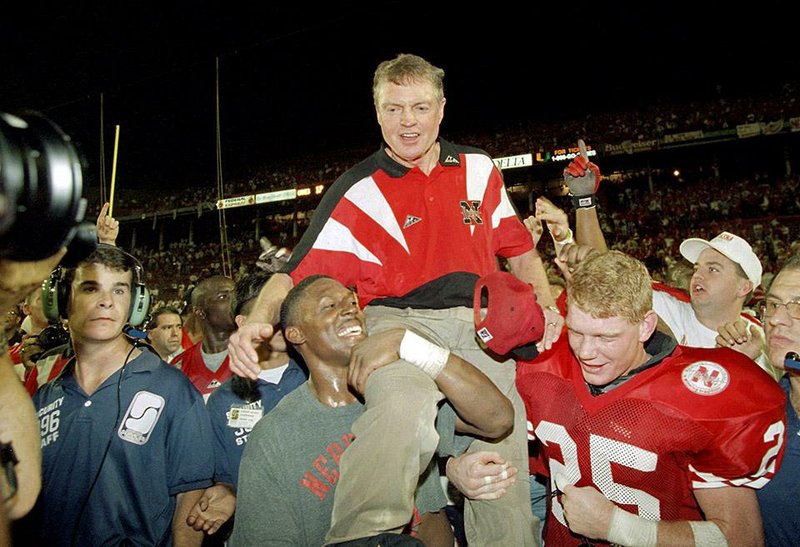
January 1, 1995: Nebraska Redeemed

January 1, 1995, 30 years ago: The World Trade Organization (WTO) begins operation. The History Channel is launched.

And the Orange Bowl is played in Miami, at the stadium of the same name. It was also the home field for the football team at the University of Miami, who were ranked Number 3 in the country, and invited to play in it.

The Number 1 team in the country was also invited to play in it. This was the University of Nebraska.

In spite of Nebraska being ranked higher, all signs pointed to a Miami win.

Since winning back-to-back National Championships in 1970 and 1971, Nebraska had won 12 Big Eight Conference Championships, 3 Sugar Bowls, 2 Orange Bowls and a Cotton Bowl. But they hadn't won another National Championship. They only lost 1 game in 1982, by 3 points, away to Penn State. They put up one of the most stunning seasons in college football history in 1983, but lost the Orange Bowl to Miami on a missed 2-point conversion.

That started Miami on a quasi-dynasty that saw them awarded that season's National Championship, and win it again in 1987, 1989 and 1991, and just miss it in 1986, 1988 and 1992. So in a stretch of 10 seasons, they reached an official or unofficial game for the National Championship 7 times, winning 4 of them. In those 10 seasons, they ended up Number 1 in the final poll 4 times, Number 2 twice, and Number 3 3 times.

But Nebraska couldn't get over the hump. Head coach Tom Osborne had been an assistant to Bob Devaney on those early 1970s titles, but since taking over in 1973, he couldn't win one himself. From 1982 to 1993, 12 seasons, the Cornhuskers had regular seasons of 11-1, 12-0, 9-2, 9-2, 9-2, 10-1, 11-1, 10-1, 9-2, 9-1-1, 9-2 and 11-0. They lost 3 Orange Bowls to Miami. And just 1 year earlier, on New Year's Day 1994, they thought they had the National Championship won with a last-minute field goal over Florida State. But they gave up a field goal, and then missed one on the last play.

At this point, the Chicago Cubs hadn't won a World Series in 86 years, the Boston Red Sox hadn't won one in 76 years, the New York Rangers had just ended a Stanley Cup drought at 54 years, and Nebraska football, while their drought was a much shorter 33 years, it was similarly tinged with painful close calls.

So when football fans found out that Nebraska's opponents for the de facto National Championship game were the Miami Hurricanes, it seemed like, as baseball legend Yogi Berra would have said, "Déjà vu all over again."

This was a typical Nebraska team, pounding weak opponents and doing enough, sometimes just enough, to beat the stronger ones. They opened the season ranked Number 4, and beat Number 24 West Virginia in the Kickoff Classic at the Meadowlands. They hung 70 points on the University of the Pacific, 49 on Number 13 UCLA, 45 on Kansas, 42 on Texas Tech, 42 on Wyoming, 42 on Missouri.

Kansas State was ranked Number 16 when Nebraska went there and won, 17-6. The 'Huskers essentially wrapped up the Big Eight Conference title when, ranked Number 3, they beat Number 2 Colorado at home, 24-7. And they went to arch-rival Oklahoma and beat them, 13-3.

Miami were 10-1 under head coach Dennis Erickson. Their only loss was to Number 17 Washington, but it did come at the Orange Bowl. They did manage to beat Number 3 Florida State, Number 10 Syracuse, Number 13 Virginia Tech, and Number 25 Boston College, winning the Big East Conference title.

Cliché Alert: In football, home-field advantage is said to be worth 3 points. The Las Vegas oddsmakers took that into account, and installed Miami as favorites by 1 point.

Midway through the 1st quarter, Dan Prewitt kicked a field goal to put Miami on the board. At the end of the quarter, Frank Costa threw a touchdown pass to Trent Jones, and now the Hurricanes were up 10-0. It was looking like another bad ending for Nebraska.

But the 'Huskers made the only score of the 2nd quarter, as Brook Berringer threw a touchdown pass to Mark Gilman. The teams went into the locker room with the score 10-7 Miami, and the game still either team's to win.

Early in the 3rd quarter, Costa threw to Jonathan Harris, who ran 44 yards for a touchdown. It was 17-7 Miami, and with 28 minutes to go, it looked like Nebraska were beaten. Within 2 minutes, Nebraska had to punt the ball away. But with 11:35 left in the 3rd, Dwayne Harris sacked Costa in the end zone for a safety. The 3rd quarter ended 17-9 in Miami's favor.

Theoretically, it was now a one-score game. Quarterback Tommie Frazier drove the 'Huskers down the field. With 7:38 left in regulation, running back Cory Schlesinger scored on a 15-yard run. Frazier threw to Eric Alford for the 2-point conversion, the play that had doomed Nebraska on that very field 11 years earlier (and had helped to do so 1 year earlier). This time, it was successful, and the game was tied, 17-17.

Miami could do nothing with their next possession. Nebraska got the ball back, and Frazier drove them again. With 2:46 left, Schlesinger broke off a nearly identical run, and rumbled into the end zone. The extra point was good, and Nebraska led. Their defense held, and they were 24-17 victors.

The Nebraska Cornhuskers were redeemed. Tom Osborne had his National Championship. And his greatest victory had just been won on the site of his greatest defeat.

Two weeks later, Erickson resigned from Miami, to become head coach of the NFL's Seattle Seahawks. He did not do well there. In contrast, Osborne won another National Championship in 1995, and another in 1997 (albeit with the polls split, one poll choosing Nebraska, the other choosing Michigan).

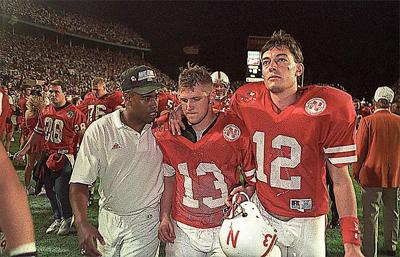
Schlesinger played 12 seasons in the NFL, mostly as a blocking back for the Detroit Lions, making 3 Pro Bowls. Despite quarterbacking the 'Huskers to back-to-back National Championships, Frazier was not drafted, because NFL teams were afraid of his history of blood clots. He played 1 season with the CFL's Montreal Alouettes, but his illness took hold again, and he had to retire. Like Turner Gill, the quarterback on the 1983 Nebraska team that crashed through everybody before losing the title to Miami, he went into coaching. He was still better off than his backup, Berringer, who was killed in a plane crash in 1996.

Only 1 other bowl game was played that New Year's Day: Number 23 North Carolina State beat Number 16 Mississippi State in the Peach Bowl, at the Georgia Dome in Atlanta.

The rest of the major bowl games were played the next day, January 2 -- and it could have been argued that Nebraska still didn't have the National Championship won. Penn State was undefeated, and playing in the Rose Bowl. They beat Oregon, 38-20, and their fans still claim the 1994 season as a National Championship.

But both the final AP poll (the Associated Press, the sportswriters) and the final UPI poll (United Press International, the coaches) gave it to Nebraska. I guess they didn't want to take Osborne's great moment away. Or maybe they already knew about the harm that was being caused in Joe Paterno's program.

The reason there were comparatively few bowl games played on New Year's Day is that it was a Sunday, and it was the 1st round of the NFL Playoffs. Two games were played in those Playoffs. The Cleveland Browns beat the New England Patriots, 20-13, in what turned out to be the last postseason game, in any sport, at Cleveland Municipal Stadium. The Browns didn't win another Playoff game for 16 years. And the Chicago Bears beat the Minnesota Vikings, 35-18 at the Metrodome in Minneapolis.

Tuesday, January 2, 2024

January 2, 1984: Miami Shocks Nebraska In the Orange Bowl

Bernie Kosar, on an NBC screen capture

January 2, 1984, 40 years ago: The Orange Bowl is played, at the stadium of the same name in Miami. The usual date, New Year's Day, fell on a Sunday, so, not wanting to compete with the NFL for TV viewers, the game was pushed back a day.

Since winning back-to-back National Championships in 1970 and 1971, the University of Nebraska had won 6 Big Eight Conference Championships, 2 Orange Bowls, a Sugar Bowl and a Cotton Bowl. But they hadn't won another National Championship. They only lost 1 game in 1982, by 3 points, away to Penn State.

In 1983, head coach Tom Osborne's Cornhuskers put up one of the most stunning seasons in college football history in 1983. They were ranked Number 1 to open the season, and their 1st game was the Kickoff Classic at the Meadowlands, against Number 4 Penn State, the defending National Champions. The 'Huskers crushed Joe Paterno's Nittany Lions, 44-6.

What followed was the most devastating offensive display in the history of college football. With quarterback Turner Gill handing off to Heisman Trophy winner Mike Rozier, and Outland Trophy winner Dean Steinkuhler blocking for them, they beat Wyoming at home, 56-20. They went into the Metrodome and beat Minnesota 84-13. That is not a misprint: Eighty-four to thirteen. They beat UCLA at home, 42-10. They beat Syracuse at home, 63-7.

Their next game was a tough one: Away to Number 20 Oklahoma State. Nebraska won that one, 14-10. They won away to Missouri, 34-13; beat Colorado at home, 69-19; won away to Kansas State, 51-25; beat Iowa State at home, 72-29; beat Kansas at home, 67-13. They closed the regular season by beating arch-rival Oklahoma away, 28-21, clinching the Big Eight Conference Championship.

They outscored their opponents 634-186. In other words, in the 1983 regular season, the average score of a Nebraska football game was Cornhuskers 53, Opponents 10. Fifty-three to ten.

To be fair: Some of these opponents were better than others. Minnesota finished 1-10, and, in other games, gave up 69, 61, 58, 56 and 50. Kansas State finished 3-8, Colorado and Iowa State 4-7, Kansas 4-6-1. But Penn State finished 8-4-1, both Oklahoma and Oklahoma State 8-4, UCLA 7-4-1 and as Pac-10 Champions, Wyoming and Missouri 7-5. UCLA won the Rose Bowl, Penn State the Aloha Bowl, Oklahoma State the Bluebonnet Bowl. Missouri reached the Holiday Bowl.

As Big 8 Champions, they were locked into the Orange Bowl, at the Orange Bowl stadium in Miami. It was also the home stadium of the University of Miami. And that would be their opponents.

The Hurricanes were coached by Howard Schnellenberger, who, with his stocky build and his big mustache, looked more like an old big-city butcher than a football coach. But he was smart, and was recruited by Bear Bryant to play end, both offensively and defensively, at Kentucky.

After playing in the Canadian Football League, he became one of Bryant's assistants at Alabama, and recruited Joe Namath. He then served as an assistant to George Allen with the Los Angeles Rams, and to Don Shula with the Miami Dolphins, including the undefeated season of 1972-73.

In 1979, the University of Miami hired him as head coach. He coached them to a 9-3 season in 1980, 9-2 in 1981, and 7-4 in 1982. They were then an independent, so there was no conference title for them to win. But they won the 1981 Peach Bowl, would have gone to a bowl game for the 1981 season had they not been on probation, and were denied a bowl bid for 1982.

In 1983, they opened the season with a bad 28-3 loss away to Number 16 Florida. But they cruised from there: Beating Houston away, 29-7; Purdue at home, 35-0; Number 13 Notre Dame at home, 20-0; Duke away, 56-17; Louisville at home, 42-14; Mississippi State away, 31-7; Cincinnati away, 17-7; Number 12 West Virginia at home, 20-3; East Carolina at home, 12-7; and Florida State away, 17-16.

So here's how the bowl games stood: Number 1 Nebraska vs. Number 5 Miami in the Orange Bowl; Number 2 Texas vs. Number 7 Georgia in the Cotton Bowl in Dallas; Number 3 Auburn vs. Number 8 Michigan in the Sugar Bowl in New Orleans; and Number 4 Illinois vs. unranked UCLA in the Rose Bowl in Pasadena.

But in the early afternoon, on CBS, Georgia beat Texas, 10-9. So that eliminated the Longhorns. In the late afternoon, on ABC, UCLA crushed Illinois, 45-9. (Students at Caltech, responding to a recent prank by MIT students at the Harvard-Yale game, hacked the Rose Bowl scoreboard, so that it read "CALTECH 38 MIT 9.") So that eliminated the Fighting Illini.

In those days, the Orange Bowl and the Sugar Bowl were usually held at the same time, the former on NBC, the latter on ABC. Auburn's hope was that they would beat Michigan solidly, and that Miami would pull the tremendous upset against Nebraska. Miami's hope was that they would pull the upset, and then Michigan would upset Auburn.

What followed was one of the lamest games in New Year's Day bowl history -- and one of the most stunning football games ever played at any level.

Nebraska were favored by 10 1/2 points. Most fans expected Miami to put up a fight, but Nebraska to win solidly. And yet, Miami stopped their opening drive, and blocked a field goal attempt. Miami quarterback Bernie Kosar threw a touchdown pass to Glenn Dennison. Miami held Nebraska again, and Jeff Davis kicked a field goal. Miami intercepted Gill, and Kosar threw another touchdown pass to Dennison.

At the end of the 1st quarter, it was Miami 17, Nebraska 0. The nation -- or, at least, its football fans -- were stunned. Meanwhile, in the Superdome, Michigan quarterback Steve Smith ran for a touchdown, and put the Wolverines up 7-0 on Auburn.

Despite having a potent wishbone attack led by the next season's Heisman winner, running back Vincent "Bo" Jackson, Auburn couldn't score in the 2nd quarter, either. It was still 7-0 at the half, and it was looking like Miami had a shot at the National Championship: They were Number 5, they were beating Number 1, Number 2 and Number 4 had already lost, and Number 3 were losing.

Nebraska got back on track, intercepted Kosar, and drove into Miami territory. With a 3rd & 5 on the Hurricane 19, Gill took the snap, and ran to his right. So did fullback Mark Schellen, who appeared to have the ball. So did tight end Monte Engebritson. It looked like a power sweep.

Except Gill didn't give the ball to Schellen. He just set it on the ground. Officially, it was a fumble. But none of the Miami players saw it. Steinkuhler, by design, did, picked it up, and ran for a touchdown. Had it been a pass, he would have been an ineligible receiver. But, under the rules of the time, when the ball was fumbled, all offensive players were permitted to pick it up and run it forward. It was a trick play known as the fumblerooski, and would be outlawed in 1992.

For the moment, though, it was 'Canes 17, 'Huskers 7. Gill led another drive, ending with a quarterback sneak. At halftime, it was Miami 17, Nebraska 14. The upset was still on, but the sense that Nebraska had shaken off the shock of Miami's initial attack, and was ready to run their momentum straight down the Hurricanes' throats, was now strong.

It got stronger when Miami fumbled early in the 3rd quarter, and Nebraska tied it 17-17 on a Scott Livingston field goal. But the fact that they got only a field goal, not a touchdown, would matter later on. Meanwhile, in New Orleans, Al Del Greco kicked a 31-yard field goal to close Auburn to within 7-3 of Michigan.

Miami got its act together, and Kosar engineered 2 more touchdown drives, capped by runs by Alonzo Highsmith and Albert Bentley. At the end of the 3rd quarter, it was 31-17 Miami. And Rozier, after running for 147 yards, had to leave the game with an injured ankle.

Midway through the 4th quarter at the Sugar Bowl, Del Greco kicked a 32-yard field goal, to close Auburn to within 7-6 of Michigan. They still had a chance.

So did Nebraska. With 7 minutes left, Gill got them to the 1-yard line, and Jeff Smith ran it over for a touchdown. That made it 31-23. Osborne could have gone for a 2-point conversion here, and made a big difference. Instead, he went for the 1-point kick, and it was 31-24 Miami.

With 58 seconds left in the Sugar Bowl, Del Greco attempted a 19-yard field goal. It was good, and Auburn beat Michigan, 9-7. The Tigers had done what they absolutely had to do: Win. But they did it by just 2 points, and without having scored a touchdown. Would it be enough to convince poll voters, in case Miami hung on to beat Nebraska?

The Orange Bowl also came down to the last minute. Davis missed a field goal that would have iced it for the 'Canes. Gill drove the 'Huskers down, and Smith broke off a 24-yard run, scoring with 48 seconds left. It was Miami 31, Nebraska 30.

Going for one, and a 31-31 tie, presuming Nebraska's defense could hold Miami for the last 48 seconds, would have left Nebraska at 12-0-1, and almost certainly gained them the National Championship. Going for two, and a 32-31 win, would not only guarantee the 13-0 Cornhuskers the National Championship, but perhaps certify them as the greatest college football team of all time, especially since they could, in this scenario, add to their resume, "Their last test was their greatest, and they passed it." But fail on the conversion, and there would be no title, and the poll voters would have to choose between Miami and Auburn.

There was a principle at hand: If you can't gain 3 yards on 1 play to win 1 game, you don't deserve to win the National Championship.

There was also a memory to contend with: That of the 1966 "Game of the Century" between Notre Dame and Michigan State. As Notre Dame head coach, Ara Parseghian went for a tie, knowing it wouldn't cost him the National Championship, whereas a loss would have. But, in the ensuing 17 years, the words had been spoken many times: "Parseghian had no guts."

Osborne was not going to be accused of having no guts. He knew that, for all Parseghian had achieved, that 10-10 tie was the thing for which he was most remembered. "We were trying to win the game," Osborne said at the time. "I don't think you go for a tie in that case. You try to win the game. We wanted an undefeated season and a clear-cut National Championship."

Clear-cut. Because Americans hate ties. Long ago, though the identity of the coach who first said it depends on who's telling the story, a coach lost a game on a 1-yard run attempt rather than kick a tying field goal, and explained to the reporters, "A tie is like kissing your sister."

It's not like in European soccer, where a win is worth 3 points to your team in the league standings (or "table"), and a tie (or "draw") is worth 1 point. A tie that gave Nebraska the 1983 National Championship would have satisfied very few people -- outside the State of Nebraska, anyway. Americans hate ties, to the point that the NHL no longer has them. Sure, with a tie, Nebraska would still have been National Champions. But any pretense to "Greatest Team Ever" status would have been gone.

The ball was placed on Miami's 3-yard line. Once again, Gill rolled to his right, and looked for Smith. But Smith was double-covered, and Miami's Kenny Calhoun knocked the pass away. It was still Miami 31, Nebraska 30. Nebraska kicked off, and Miami ran out the clock, and won the game.

When the Associated Press and United Press International released their polls the next day, they both awarded Miami the National Championship. The AP (the sportswriters) gave 11-1 Miami 47 1/2 1st-place votes, 11-1 Auburn 7, and 12-1 Nebraska 4 1/2. UPI (the coaches) gave Miami 30, Nebraska 6, and Auburn 4.

Auburn won a major bowl game. They won the Sugar Bowl, the 2nd-best thing an SEC team could do in those pre-Playoff days, behind winning the National Championship. And they were ranked Number 3, and the teams ranked Number 1 and Number 2 had both lost. But their performance in that game was so weak, both polls put them behind Miami, and UPI also put them behind a defeated Nebraska.

This would begin a run for Miami of 12 seasons in which they were, effectively, in 6 National Championship Games, winning 4 of them (in the seasons of 1983, 1987, 1989 and 1991). They would win another in 2001, and come very close in 2000 and 2002.

Schnellenberger wouldn't be there for any more of it. After 1 more season, he left Coral Gables to become head coach at the University of Louisville, in the city where he grew up. He built them into a powerhouse, winning a Fiesta Bowl over Alabama, and later returned to the Miami area as head coach at Florida Atlantic University.

The '84 Orange Bowl would haunt Nebraska. They lost the Orange Bowl to Miami again in 1988 (thus blowing a shot at the title and letting Miami win it), and lost it to Florida State in 1994 (again blowing the title to a team from Florida).

Finally, on January 1, 1995, they again went to the Orange Bowl, again played Miami, and beat them 24-17, to win the 1994 National Championship, finally getting the monkey off Osborne's back. They would win the National Championship again in 1995, and share the 1997 title with Michigan, the last "split poll" title. That 1995 team is considered by some to be what the 1983 team should have been: The greatest team in college football history.

Monday, January 1, 2024

January 1, 1994: Florida State Finally Does It

 
January 1, 1994, 30 years ago: The Orange Bowl is played, at the stadium of the same name in Miami. The University of Nebraska hasn't won the National Championship since the 1971 season, 32 years earlier. Florida State University has never won it. Both teams have had some agonizing close calls the last few years. Something's got to give.

Bobby Bowden had been an assistant coach at Florida State before becoming the offensive coordinator, and then the head coach, at West Virginia. After taking the Mountaineers to victory in the 1975 Peach Bowl, FSU asked him to come back.

He inherited a mess. As he said at the time, "At West Virginia, the bumper stickers say, 'BEAT PITT.' At Florida State, they say, 'BEAT ANYBODY.'" It took him just 2 years to turn them into a 10-2 team and winners of the Tangerine Bowl.

The Seminoles were not in a league until joining the Atlantic Coast Conference in 1992. But they put together some great teams. In 1979, they had an undefeated regular season, 11-0. In 1980, they went 10-1. But, both seasons, they lost a chance at the National Championship by losing the Orange Bowl.

In 1987, they went 11-1 and won the Fiesta Bowl. In 1988, they went 11-1 and won the Sugar Bowl. But, both times, they lost a regular season game to the University of Miami, one of their main rivals, costing them a shot at the National Championship. In 1989 and 1990, they went 10-2.

The 1991 season seemed like the year. They began the season ranked Number 1, and won their 1st 10 games. And then it all fell apart. In back-to-back games -- though with a bye week in between -- they faced Number 2 Miami at home at Doak Campbell Stadium in Tallahassee, and lost 17-16; and then faced their other main rivals, Number 5 University of Florida, away, and lost 14-9. A win over Texas A&M in the Cotton Bowl did little to console them, as Miami won the National Championship for the 4th time in the last 9 seasons.

Could 1992 be the year? They won their 1st 5 games, then had to go to the Orange Bowl stadium to play Miami: The Hurricanes were Number 2, the Seminoles Number 3, so it was a big game, if not the big game of the regular season, as it was the year before. Miami won, 19-16. Florida State won the rest of their games, including a return to the Orange Bowl where they beat Nebraska, but finished Number 3. Miami lost the Sugar Bowl to Alabama, costing them another National Championship.

In both 1991 and 1992, Miami won because Florida State missed a last-play field goal: The 1st time, by Gerry Thomas from 34 yards; the 2nd time, by Dan Mowrey from 39. Both were wide and to the right. These games are now known as Wide Right I and Wide Right II.

Seminole fans could only console themselves by calling on Miami's "thug" image, saying, "You can't spell SCUM without UM." In time, a free sneakers scandal would lead to Miami (and Florida) fans saying, "FSU" stood for "Free Shoes University."

Again in 1993, Florida State opened the season at Number 1. And they tempted fate by recruiting Scott Bentley, a native of the Denver suburbs and the country's highest-ranked high school kicker, and letting him be put on the cover of Sports Illustrated's 1993 College Football Preview Issue. It was as if they were telling "The Dreaded SI Cover Jinx," "Come on, then!"

As it turned out, Bentley missed 7 extra points in the team's 1st 5 games. Not 7 field goals. Seven extra point attempts. The Jinx was punishing Bentley for his team's defiance.

As it turned out, it didn't matter: It was only Bentley, not the team as a whole, that was getting punished. They won those 1st 5 games: 42-0 over Kansas in the Kickoff Classic at the Meadowlands, 45-7 away to Duke, 57-0 home to Number 17 Clemson, 33-7 away to Number 13 North Carolina, and 51-0 home to Georgia Tech.

This time, with Miami coming into Doak Campbell with the Number 3 ranking, the Seminoles left no doubt, winning 28-10. No last-play, or even last-minute, heroics necessary. They followed this with a 40-14 win home to Number 15 Virginia, a 54-0 home win over Clemson, and a 49-20 win away to Maryland.

That set up a showdown with Number 2 Notre Dame in South Bend, Indiana. NBC tried billing it as "The Game of the Century," and it lived up to the hype, being in doubt until a last-gasp FSU pass was broken up in the end zone. Notre Dame won, 24-17, and rose to Number 1.

It looked like the Seminoles' dreams had been shattered again. But the very next week, Notre Dame were upset by Boston College on a last-play field goal. Meanwhile, Florida State beat North Carolina State 62-3 to clinch the ACC title, and won 33-21 away to Number 7 Florida to regain the Number 1 ranking.

Since winning back-to-back National Championships in 1970 and 1971, Nebraska had won 11 Big Eight Conference Championships, 3 Sugar Bowls, 2 Orange Bowls and a Cotton Bowl. But they hadn't won another National Championship. They only lost 1 game in 1982, by 3 points, away to Penn State. They put up one of the most stunning seasons in college football history in 1983, but lost the Orange Bowl to Miami on a missed 2-point conversion, starting Miami's quasi-dynasty.

Expectations for 1993 were not especially high, as the Cornhuskers started out ranked Number 9. Putting up 76 points on North Texas, 50 on Texas Tech, 49 on Missouri, 49 on Iowa State, 48 on Colorado State, and 45 on Kansas State were not unusual for The 'Huskers under head coach Tom Osborne.

What did get people's attention was a nationally-televised 14-13 win over UCLA at the Rose Bowl stadium; a 21-17 win away to Colorado, which had been the top team in the Big 8 the last few years; and a 21-7 day-after-Thanksgiving win over their arch-rivals, Number 16 Oklahoma.

It pushed Nebraska up to Number 2, and set up a New Year's Day prime-time matchup between Osborne's 'Huskers and Bowden's 'Noles. One of these teams was going to end their years of heartbreak, while the other was going to extend it. It was college football's equivalent of having a World Series between the pre-2004 Boston Red Sox and the pre-2016 Chicago Cubs.

Nebraska were undefeated. Florida State were not. And yet, Florida State were favored by 17 1/2 points. Was it because they had the Heisman Trophy winner, quarterback Charlie Ward? It shouldn't have been: Nebraska had the country's best defense. Was it because Nebraska had a history of choking? It shouldn't have been: So did Florida State.

Was it because Florida State were used to playing on this field? Not really: So were Nebraska. And being in the same State didn't make any difference: It was 482 miles from Doak Campbell Stadium to the Orange Bowl, so this was no "home game" for the Seminoles and their fans.

The 1st quarter ended scoreless, but it shouldn't have been: Nebraska returned a punt for a touchdown, but it was called back due to an illegal block, which the instant replay showed didn't happen. Bentley opened the scoring with a field goal midway through the 2nd quarter. Nebraska scored a touchdown, but with time running out in the half, Bentley kicked another field goal. It was Nebraska 7, Florida State 6.

Nebraska got robbed again early in the 3rd quarter. William Floyd appeared to have scored a touchdown for FSU, but the replay showed that he fumbled before crossing the goal line. The 2-point conversion attempt failed, and the Seminoles led 12-7. Bentley kicked another field goal, and it was 15-7 Seminoles at the end of the quarter. By all rights, it should have been 14-9 Cornhuskers.

At the beginning of the 4th quarter, Lawrence Phillips scored a touchdown for Nebraska. Just as it had on the same field 10 years earlier, the 2-point conversion attempt did not go Nebraska's way, and it was still 15-13 Seminoles. Time began to run out. But quarterback Tommie Frazier drove the 'Huskers down, and with 1:16 left, Byron Bennett kicked a 27-yard field goal. Nebraska led, 16-15.

But it wasn't over yet. The 'Noles still had Heisman winner Ward. He got them down to a 1st & goal on the Nebraska 3-yard line. The 'Husker defense held, and, with 21 seconds left, Scott Bentley finally had his date with destiny. It was an attempt from 22 yards out. Basically, an extra point attempt. If he makes it, he's a Seminole hero for all time. If he misses it, he's the biggest flop in team history. He nailed it, and his teammates piled onto him.

But the game still wasn't over. The Seminoles were penalized for excessive celebration. That, and a bad kickoff -- by Bentley, mind you -- gave the 'Huskers the ball at their own 43. They only needed about 25 yards for a game-winning field goal.

Frazier got Nebraska to the Seminole 28, with a pass to Trumane Bell. That would make a field goal attempt 45 yards. Not easy on natural grass, but with hardly any wind, certainly possible. But the clock seemed to run out when Bell went down. Thinking their coach had finally won his National Championship, some Florida State players dumped the Gatorade on Bowden.

But referee John Soffey ruled that Bell was down with 1 second left. By NCAA rules, the clock must stop to move the first down marker. This gave Nebraska time to get their field goal unit on in time. If Bennett made his attempt, it would have been the cruelest loss yet for Florida State: Losing on a last-play field goal when you thought you already had the National Championship won.

Bennett missed. Not wide right, but wide left.
Like Ralph Branca, a victim of big-game fate
in baseball in 1951, he wore Number 13.

Now, Florida State were the National Champions -- clinching it with the other team missing a field goal attempt. No one cared about the irony, or that they hadn't played especially well: They were Champions at last.

It was another crushing defeat for Nebraska. Finally, the next season, they went all the way -- and in the perfect way, beating Miami on their own field in the Orange Bowl game. This started a run of 3 National Championships in 4 seasons.

Byron Bennett would not be a part of it. The man who thought he'd made the field goal to get Tom Osborne his 1st National Championship as a head coach -- he'd been an assistant to Bob Devaney in 1970 and '71 -- and then missed the one that would have really done it, became a parole officer in Dallas, and then a high school football coach. He's done rather well at it.

Bobby Bowden would lead Florida State to another National Championship in 1999. His successor, Jimbo Fisher, did so in 2013.

Scott Bentley remained with Florida State through the 1996 season, and graduated. In 1997, the Atlanta Falcons signed him as a kickoff specialist, but released him after 2 games. The Denver Broncos picked him up, as a backup to Jason Elam, and he played 1 game, kicking 2 field goals in 3 attempts and going 4-for-4 on extra points. He remained a kickoff specialist, playing 2 games in 1999 for the Kansas City Chiefs; and, in 2000, 1 more for the Broncos and 6 for the Washington Redskins, making 1 field goal, for 50 yards. He is now an operations manager for Amazon.com.

One other note: This game was broadcast on NBC, with Dick Enberg and former Cincinnati Bengals star Bob Trumpy in the booth, and legendary USC and Buffalo Bills running back O.J. Simpson as the sideline reporter. If what happened between Florida State and Nebraska on January 1, 1994 was shocking, what Simpson did in the week of June 12 to 17, 1994 was even more so.

In the other New Year's Day bowl games:

* Rose Bowl, Pasadena, California: Number 9 Wisconsin beat Number 14 UCLA, 21-16.

* Sugar Bowl, Superdome, New Orleans: Number 8 Florida beat Number 3 and previously undefeated West Virginia, 41-7. West Virginia fans were hoping that the Orange Bowl, being played at the same time, would be a dull, or mistake-filled, game, giving them hope for the National Championship. But Florida, who'd lost only to Florida State and Auburn, put a quick stop to that.

* Cotton Bowl, Dallas: Number 4 Notre Dame beat Number 7 Texas A&M.

* Fiesta Bowl, Sun Devil Stadium, Tempe, Arizona: Number 16 Arizona beat Number 10 Miami, 29-0. Arizona did this despite playing on the home field of their arch-rivals, Arizona State.

* Hall of Fame Bowl, Tampa Stadium: Number 23 Michigan beat unranked North Carolina State, 42-7.

* Florida Citrus Bowl, Orlando, Florida: Number 13 Penn State beat Number 6 Tennessee, 31-13.

* Carquest Bowl, Joe Robbie Stadium, Miami Gardens, Florida: Number 15 Boston College beat unranked Virginia, 31-13. This game debuted in 1990 as the Blockbuster Bowl, and has gone through many names. It moved to Orlando in 2001, and took up the former name of the Florida Citrus Bowl, the Tangerine Bowl. Still in Orlando, it is now known as the Cheez-It Bowl. 

Thursday, January 2, 2020

Top 5 Reasons You Can't Blame Tom Osborne for Nebraska Losing the 1983 National Championship

January 2, 1984: The University of Nebraska, ranked Number 1 in the nation, plays the University of Miami, ranked Number 5, in the Orange Bowl. The game was played on January 2 because January 1, New Year's Day, fell on a Sunday.

Nebraska had put together one of the greatest seasons in college football history. They began it ranked Number 1, and opened in the Kickoff Classic at the Meadowlands, against Number 4 Penn State, and won 44-6.

The Cornhuskers scored more points than anyone had seen in the modern era. They beat Minnesota away 84-13. They beat Iowa State 72-29. They beat Colorado 69-19. They beat Kansas 67-13. They beat Syracuse 63-7. They beat Wyoming 56-20. They beat Kansas State away 51-25. They beat UCLA 42-10.

Not all their games were easy. They went to Missouri and beat them "only" 34-13. In what was then their biggest rivalry, they went to Oklahoma and beat them 28-21. Aside from Penn State, the only ranked team they played was Number 20 Oklahoma State, away, and escaped with a 14-10 win. Still, they were 12-0, scoring 624 points and allowing just 186, for an average score of 52-15.

How good was that opposition: Minnesota went just 1-10, beating only Rice, who also went 1-10. Kansas State went 3-8. Kansas went 4-6-1. Iowa State and Colorado both went 4-7.

But Penn State went 8-4-1, won the Aloha Bowl, and finished ranked Number 17. Oklahoma went 8-4, and probably would have been ranked and gotten a bowl bid, had they not been on probation. Oklahoma State also went 8-4, won the Bluebonnet Bowl, and was ranked Number 18. UCLA went 7-4-1, won the Pac-10 and the Rose Bowl, and was ranked Number 13. Wyoming went 7-5. So did Missouri, who went to the Holiday Bowl, but lost. Syracuse went 6-5. So the 'Huskers were doing more than just running up the score on weak opposition.

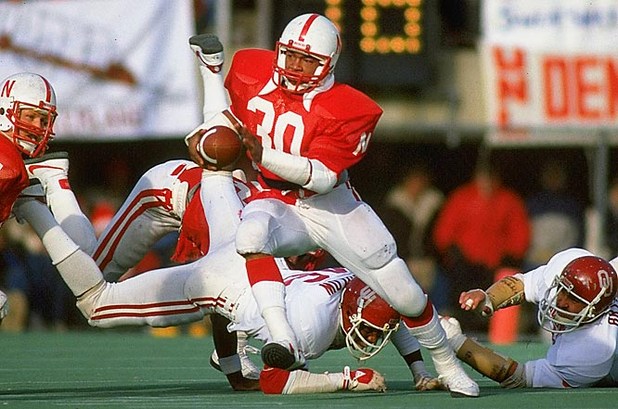
Head coach Tom Osborne was named National Coach of the Year. Running back Mike Rozier won the top 2 Player of the Year awards, the Heisman Trophy and the Maxwell Award. Guard Dean Steinkuhler won the top 2 Lineman of the Year awards, the Outland Trophy and the Lombardi Trophy. Rozier, Steinkuhler and receiving Irving Fryar were named 1st team All-Americans; quarterback Turner Gill, 2nd team. Each of those was named to the All-Big Eight Conference 1st team, along with offensive tackle Scott Raridon and center Mark Traynowicz.
Mike Rozier

Rozier and Steinkuhler would go on to become All-Pros with the Houston Oilers. Fryar would go to the Pro Bowl with the New England Patriots, the Miami Dolphins and the Philadelphia Eagles, and get to a Super Bowl with the Patriots. Running backs Doug DuBose and Tom Rathman would go on to win a Super Bowl with the San Francisco 49ers. (Rathman would win 2 with them.) Defensive end Jim Skow would reach a Super Bowl with the Cincinnati Bengals. Gill is now an administrator at the University of Arkansas, after winning conference titles as head coach at the University of Buffalo and Liberty University.

The Hurricanes, then an independent, were no slouches. Their previous 3 seasons saw them go 9-3, 9-2 and 7-4, and they were 10-1 this season. After losing their opener at Number 16 Florida, they had shut out Purdue and Number 13 Notre Dame, held Number 12 West Virginia to 3, and held 4 teams to just 7 points: Houston, Mississippi State, Cincinnati and East Carolina (and only the last of these was at home).

But they only had 2 games that compared to Nebraska's blowouts, winning 56-17 away to Duke and 42-14 at home to Louisville. Their last game before the Orange Bowl was away to arch-rival Florida State, and they escaped 17-16 winners.

Unlike later Miami teams, coach Howard Schnellenberger's '83 'Canes were not loaded with future NFL talent, but they did have Bernie Kosar, a redshirt freshman quarterback, who would later make some noise. And they would be playing the Orange Bowl game in the Orange Bowl stadium, their home field. Nevertheless, Nebraska went into the game favored by 10 1/2 points -- maybe the greatest insult an 10-1 team playing at home had ever received.

The day's other bowl games played into both teams' hands. In the early game, the Cotton Bowl in Dallas, Number 2-ranked Texas lost to Georgia. In the afternoon, the Rose Bowl in Pasadena saw Number 4 Illinois lose to UCLA. And, while the Orange Bowl was going on, Number 3 Auburn was struggling against Michigan in the Sugar Bowl in New Orleans.

So the National Championship was likely to come down to the winner of the Orange Bowl: Nebraska would have won the title with a win, anyway; while, if Miami won, and Auburn lost, or if Auburn didn't win convincingly, Miami could jump from 5th to 1st.

*

And, just as the New York Jets had done to the Baltimore Colts in Super Bowl III on the same field, 15 years to the month earlier, the 'Canes shocked everybody. They held Nebraska to a field goal attempt by Mark Hagerman on the 1st possession of the game, and blocked it.

With the momentum on their side, and with a key interception later, the 'Canes jumped out to a 17-0 lead in the 1st quarter. Only Colorado and Iowa State had managed more than that on Nebraska in 3 quarters, before the backup defenders had been put in.

Nebraska settled down, and closed to within 17-14 at the half. Early in the 3rd quarter, a Miami fumble gave Nebraska the ball deep in Hurricane territory, but, again, the 'Canes held the 'Huskers to a field goal attempt, which Hagerman made, to tie the game at 17.

Before the quarter ended, Kosar engineered 2 more touchdown drives, to make it 31-17 Miami. Rozier, the best player in the country all season long -- he got 482 1st-place votes for the Heisman Trophy, and Brigham Young quarterback Steve Young was next-best with 153 -- had to leave the game with an ankle injury, taking the 'Huskers' best weapon away. And Jeff Smith, subbing for Rozier, got off a 40-yard run, but was stripped of the ball at the 1-yard line, and Miami recovered.

Early in the 4th quarter, Nebraska was held to another field goal attempt, and, unlike the early blocked attempt, Hagerman simply missed this one. Nebraska later scored a touchdown to make it 31-24, and then it was Miami's turn to miss a field goal attempt.

With less than 2 minutes to go, Gill passed to Fryar, who got inside the Miami 35-yard line. On 2nd and 8 from the Miami 24, Fryar was wide open in the end zone, but dropped Gill's pass. It went to 4th and 8, and Gill threw to Smith, who got into the end zone. That made it 31-30.

Now, Osborne had a decision to make: Kick the extra point, make it 31-31, and settle for a tie -- or, maybe, go for the onside kick, hope you get into field goal range, but also risk Miami winning it with a field goal -- or go for a 2-point conversion and a 32-31 win, with Miami still having time to maybe get into field goal range. Earlier in the week, he was asked about this very situation, and said, "I hope it doesn't come up."

It now had. With overtime not available (and this would remain true for college football until the 1996 season), Osborne decided to go for 2. The ball was placed on Miami's 3-yard line. Once again, Gill rolled to his right, and looked for Smith. But Smith was double-covered, and Kenny Calhoun knocked the pass away.
A recent photo of Kenny Calhoun, "Throwing the U"

Nebraska kicked off, and Miami ran out the clock. Auburn ended up winning the Sugar Bowl only 9-7, and, when the Associated Press and United Press International released their polls the next day, they both awarded Miami the National Championship. The AP (the sportswriters) gave 11-1 Miami 47 1/2 1st-place votes, 11-1 Auburn 7, and 12-1 Nebraska 4 1/2. UPI (the coaches) gave Miami 30, Nebraska 6, and Auburn 4.
Bernie Kosar, on an NBC screen capture

With a little bit of irony, Jeff Smith, rather than Mike Rozier, was the man on the cover of Sports Illustrated after the season-opening win over Penn State. Therefore, when "The Dreaded SI Cover Jinx" hit Nebraska, it was the player who had the chance to clinch the National Championship, 4 months later, that it gave a delayed hit.
*

This would begin a run for Miami of 12 seasons in which they were, effectively, in 6 National Championship Games, winning 4 of them (in the seasons of 1983, 1987, 1989 and 1991). They would win another in 2001 and come very close in 2002.

The '84 Orange Bowl would haunt Nebraska, which last won the National Championship in 1971, and had some other close calls. They would lose the Orange Bowl to Miami again in 1988 (thus blowing a shot at the title and letting Miami win it), and lose it to Florida State in 1994 (again blowing the title to a team from Florida).

Finally, on January 1, 1995, they again went to the Orange Bowl, again played Miami, and beat them 24-17, to win the 1994 National Championship, finally getting the monkey off Osborne's back. (He had been an assistant to Bob Devaney when they won the title in 1970 and '71.)
They would win the National Championship again in 1995, and share the 1997 title with Michigan, the last "split poll" title. That 1995 team is considered by some to be what the 1983 team should have been: The greatest team in college football history.

Osborne then retired, with a career record of 255-49-3, having coached 53 All-Americans, 13 Conference Championships (the last in the Big 12, the others in the Big 8), and 3 National Championships. In 2000, '02 and '04, he was elected to Congress from Nebraska as a Republican. He retired rather than run again in the 2006 election, to accept the post of the University of Nebraska's athletic director, a post he held until 2013. The playing surface at their Memorial Stadium is named Tom Osborne Field. He is still alive, 82 years old.

*

Did Osborne make the right choice in going for 2 in the '84 Orange Bowl?

Top 5 Reasons You Can't Blame Tom Osborne for Nebraska Losing the 1983 National Championship

5. Miami Stepped Up. In situations like this, it's easy to make Reason Number 1 "The opposition was better." Only the most deluded of Hurricanes fans would say their team was better than the Cornhuskers'

But if the Hurricanes hadn't played so well, becoming college football's answer to the 1960 Pittsburgh Pirates, to Nebraska's Yankees -- or, to use an earlier-cited example from the same stadium, the Jets to the Cornhuskers' Colts -- Nebraska wouldn't have been in the position where Osborne had to make the critical decision.

4. Nebraska Blew It. All season long, they had gotten the job done, until now. And they had come back from 17-0 and 31-17 to get to 31-30. There was plenty of reason to believe they could gain 3 yards on this one play. But, between the missed field goal, the blocked field goal, the fumbled sure touchdown, and the dropped passes on the last drive, they had their chances, and they blew them.

Think about it: Had either of Hagerman's missed field goals gone through, that last touchdown would have made it 33-31 Nebraska. True, there was enough time left on the clock where the conversion would have been more meaningful at 35-31 than at 34-31, but not by that much. Had Hagerman made both of those misses, it would have been 36-31, and Miami would have needed a touchdown no matter what.

Even Osborne blew it: If he had gone for 2 on the preceding touchdown, and made it, that would have made the score 31-25, and he could have won the game 32-31 with an extra point kick on the touchdown in question. Nobody talks about that choice.

3. Principle. If you can't gain 3 yards on 1 play to win 1 game, you don't deserve to win the National Championship.

2. Ara Parseghian. As head coach of Notre Dame in 1966, he went for a tie against Michigan State, knowing it wouldn't cost him the National Championship, whereas a loss would have. But, in the ensuing 17 years, the words had been spoken many times: "Parseghian had no guts."
Osborne was not going to be accused of having no guts. He knew that, for all Parseghian had achieved, that 1966 10-10 tie was the thing for which he was most remembered. "We were trying to win the game," Osborne said at the time. "I don't think you go for a tie in that case. You try to win the game. We wanted an undefeated season and a clear-cut National Championship."

Clear-cut. Because...

1. America Hates Ties. Long ago, though the identity of the coach who first said it depends on who's telling the story, a coach lost a game on a 1-yard run attempt rather than kick a tying field goal, and explained to the reporters, "A tie is like kissing your sister."

It's not like in European soccer, where a win is worth 3 points to your team in the league standings (or "table"), and a tie (or "draw") is worth 1 point. A tie that gave Nebraska the 1983 National Championship would have satisfied very few people -- outside the State of Nebraska, anyway. America hates ties, to the point that the NHL no longer has them.

Sure, with a tie, Nebraska would still have been National Champions. But any pretense to "Greatest Team Ever" status would have been gone.

After all, as Herman Edwards, then still playing cornerback for the Philadelphia Eagles, would later put it while coaching the New York Jets, "This is what the greatest thing about sports is: You play to win the game!"

VERDICT: Not Guilty. A lot of people would have understood it if he had gone for the tie and, presumably, still won the National Championship. But 32-31 and 13-0 would have been better than 31-31 and 12-0-1.

Besides, the '95 Orange Bowl win over Miami, and the resulting National Championship, was all the sweeter because of the '84 Orange Bowl loss to Miami.

Tuesday, September 19, 2017

How to Be a Rutgers Fan at Nebraska -- 2017 Edition

39 States down, 11 to go.

The football team at Rutgers University plays away to the University of Nebraska this Saturday.

This could be bad. Very, very bad. Unless you're a Cornhuskers fan.

Before You Go. Nebraska is on the Great Plains. It produces extremes of weather: Very hot in Summer, bitter cold in Winter. Many years ago, Nebraska was playing Colorado on the day after Thanksgiving, and ABC was broadcasting the game, and it was not only very cold, but windy, with the flags all being straight out. It was so cold! (How cold was it?) It was so cold, someone set a parking lot portajohn on fire, thinking it would help the fans outside who couldn't get tickets warm, and thick black smoke drifted over the stadium, making people think there was a more serious fire going on.

This still being September, your problem is going to be heat, not cold. Temperatures for Saturday are expected to be in the low 80s in daylight, and the mid-60s at night. Although the Lincoln Journal Star and the Omaha World-Herald, the State's 2 largest newspapers, are predicting rain for Sunday, Saturday should be dry.

Except for its Western edge, far at the other end of the State, which is in the Mountain Time Zone, Nebraska is in the Central Time Zone, an hour behind New York and New Jersey. Adjust your timepieces accordingly.

Tickets. Yeah, surrrre! Nebraska football hasn't played to an unsold seat at home since October 20, 1962. I'll save you the math: That's 55 years. JFK was President, the Cuban Missile Crisis was going on, and nobody outside England (and a few people in Hamburg, Germany) had yet heard of the Beatles. You wanna get in? Go to a resale service. (A legal one. Not a scalper. They can't be trusted.)

Officially, all tickets are $57. Unofficially, who knows until you log on to the ticket sites.

Getting There. It's 1,296 miles from Times Square in Midtown Manhattan to the State Capitol in Lincoln, Nebraska, and -- oddly -- the same distance from High Point Solutions Stadium in Piscataway, New Jersey to Memorial Stadium, home of the 'Huskers.

Knowing this, your first instinct will be to fly. A round-trip flight to Lincoln Airport will include a changeover at O'Hare in Chicago, but it could be gotten fairly cheap, under $800. Bus 52 will get you downtown in a little over half an hour.

Would you prefer the train? Amtrak has the Lake Shore Limited leaving Penn Station at 3:40 PM on Thursday, and arriving at Union Station in Chicago at 9:45 AM on Friday. The California Zephyr leaves Chicago at 2:00 PM, and arrives in Lincoln at 12:08 AM on Saturday. The reverse trip would leave Lincoln at 3:26 AM on Sunday, arrive in Chicago at 2:50 PM, switch to the Lake Shore Limited at 9:30 PM and arrive back at Penn station at 6:23 PM on Monday. Round-trip fare is $384 -- given the mileage, a cheap trip by Amtrak standards. Haymarket Station is at 277 Pinnacle Arena Drive, a 15-minute walk from Memorial Stadium.

With Greyhound, you have to change buses 3 times: In Pittsburgh, Chicago and Omaha. Round-trip fare is $448, but it can drop to $390 with advanced purchase -- but that's still more than the train. The Greyhound station is at 5250 Superior Street, 3 and a half miles northeast of downtown. Bus 41. So you're really better off taking the train than the bus.

Driving there would be long, but simple, as Interstate 80 can be taken from North Jersey to Lincoln, through New Jersey, Pennsylvania, Ohio, Indiana, Illinois, Iowa and Nebraska. You'd take Exit 401 to Interstate 180 South to the campus.

If you do it right, you should spend about an hour and a half in New Jersey, 5 hours and 15 minutes in Pennsylvania, 4 hours in Ohio, 2 hours and 30 minutes in Indiana, 2 hours and 45 minutes in Illinois, 5 hours and 15 minutes in Iowa, and 1 hour in Nebraska. Total: A little over 22 hours. Including rest stops, and accounting for traffic (you'll be bypassing Cleveland and Chicago, unless that's where you want to make rest stops), we're talking about a 30-hour trip.

Once In the City. Nebraska was dominated by Native American tribes until the Europeans came, starting with Spain in the 1690s. France arrived in 1703, and war between them broke out, with each side getting local tribes on their sides. A massacre near present-day Columbus wiped out Spanish attempts to settle the Plains until 1762, when, desperate for cash during the French and Indian War, France ceded the Louisiana Territory to Spain. The French got it back, but sold it to the U.S. in the Louisiana Purchase of 1803.
The Kansas-Nebraska Act of 1854 cleared the path for Statehood -- and for the American Civil War. Originally, the capital of the Nebraska Territory was Omaha, because of its location on the Missouri River (across from Council Bluffs, Iowa), but upon Statehood on March 1, 1867, the 37th State (they celebrated the 150th Anniversary this year), it was moved to Lancaster. While the County it's in still holds that name, the City was then renamed for Abraham Lincoln.
Although its eastern border is the rather wide Missouri River, Nebraska is the only "triply landlocked State": To reach an ocean, gulf, or bay from Nebraska, one must travel through at least 3 other States or Canadian Provinces. To wit: Either south through Kansas, Oklahoma, and Texas to the Gulf of Mexico; north through South Dakota, North Dakota and Manitoba to Hudson Bay; or west through Wyoming, Idaho, and Oregon to the Pacific Ocean.
The name "Nebraska" comes from the other river, besides the Missouri, that dominates the State, the Platte: "Ni Brasge" meant "Flat water" in the language of local tribes. Congressman William Jennings Bryan, nominated for President by the Democratic Party in 1896, 1900 and 1908, was called The Boy Orator of the Platte, but his speeches and his support were said to be "like the Platte: A mile wide and a foot deep."

About 1.9 million people live in the State, with nearly 1.1 million of them living in the Omaha and Lincoln areas, the easternmost 15 percent of the State. Omaha its largest city, with about 450,000 people; while Lincoln, its capital and the seat of its State university, has about 280,000.

The State has a reputation of being mostly white and very conservative. But it does have minorities, especially in Omaha. That city saw an Anti-Greek Riot in 1909, a race riot in 1919, and the North Omaha Riot in 1966. In addition, it was the birthplace of 2 black American icons: Malcolm X and Bob Gibson. 

At 394 feet high, the State Capitol building is the 2nd-tallest in the nation, topped only by Louisiana's. (The tallest building in the entire State is One First National Center, 634 feet high, at 1601 Dodge Street, downtown Omaha.) And Nebraska is unique in that it is the only State with a unicameral legislature: A single house, rather than Senate and a House of Representatives, House of Delegates, or, as we would say in New York and New Jersey, an Assembly.
The State House in Lincoln

ZIP Codes for Nebraska begin with the digits 68 and 69. The Area Codes are 308 for the Western part of the State, and 402 (with 531 overlaid) for the Eastern part, including Lincoln and Omaha. The sales tax is 5.5 percent.

O Street, part of U.S. Route 34, divides Lincoln's street addresses into North and South. Addresses west of Salt Creek are labeled West, but east of it, they are not labeled East. At any rate, addresses in downtown Lincoln increase eastward from Salt Creek. StarTran operates local buses, but they stop at 9:55 PM on weekdays and 7:05 PM on Saturdays (Husker gamedays), and don't run at all on Sundays. A single fare is $1.75. Lincoln does not have a beltway.

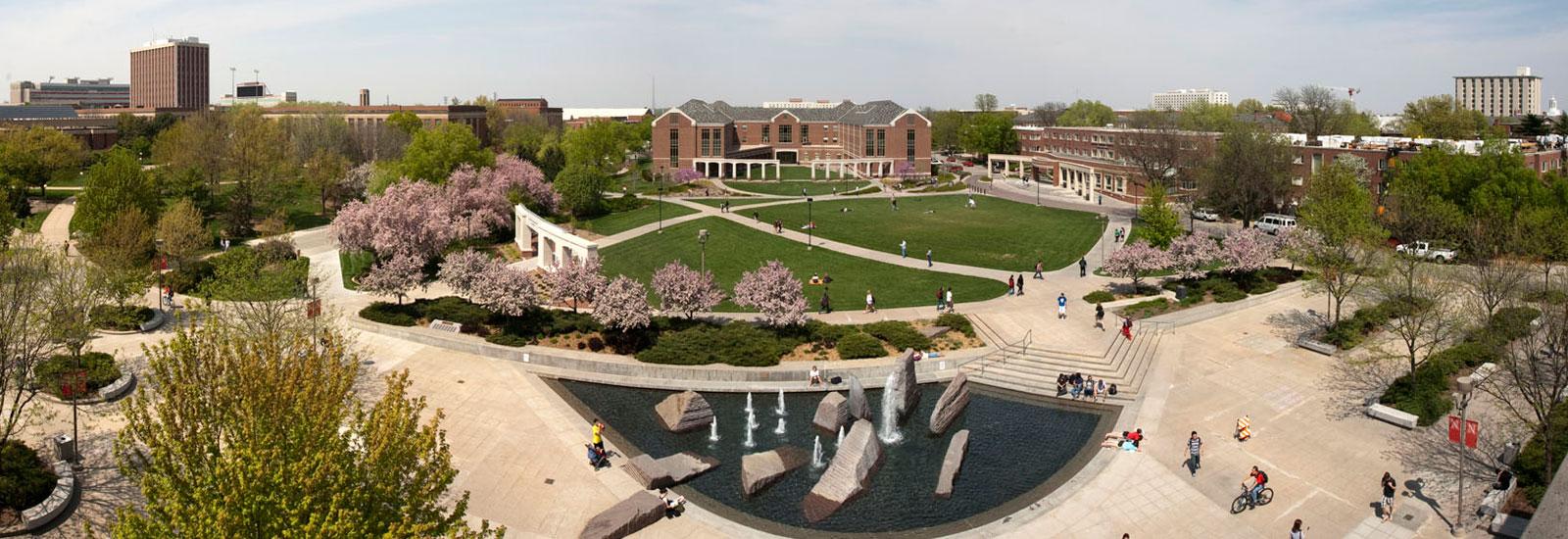
The University of Nebraska was founded in 1869, and became known in the 20th Century as a center for agricultural and ecological research. The University of Nebraska System maintains the main campus in Lincoln, and also in Omaha (UNO, including the medical school)), Kearny (UNK), and Curtis (Nebraska College of Technical Agriculture, or NCTA).

Its notable athletes in sports other than football include:

* Baseball: Kip Gross, Darin Erstad, Alex Gordon, and former Yankee Joba Chamberlain. Also, Gene Budig, President of the American League from 1994 to 1999. He also served as President of Illinois State and West Virginia University, and Chancellor of the University of Kansas.

* Basketball: Cleveland Cavaliers coach Tyronn Lue.

* Olympic Gold Medalists: Penelope Heyns, swimming for South Africa, 1996; Rulon Gardner, wrestling, 2000; Curtis Tomasevic, bobsled, 2010 Winter Olympics; and Jordan Burroughs, wrestling, 2012.

* Sports Journalism: Shelley Smith '81 of ESPN.

In other fields, Nebraska grads include:

* Arts: Novelist Willa Cather, Class of 1895; Aaron Douglas '22, Harlem Renaissance figure called "the father of African-American art"; talk show host Johnny Carson '49; opera singer Barbara Hendricks '69.

* Science: San Francisco-Oakland Bay Bridge designer Charles Purcell 1906, CNN weather anchor Chad Myers '85.

* Journalism: Jeff Zeleny '96 of CNN.

* Business: Warren Buffett '50, Vinod Gupta '69.

* Military: General John J. Pershing 1893.

* Politics, representing Nebraska unless otherwise stated: Senators Elmer Burkett 1893, Hazel Abel 1908, Kenneth Wherry 1914, James Abdnor '45 of South Dakota, Ben Nelson '63, Chuck Hagel '71 (also Secretary of Defense); Governors Nelson, George Sheldon 1892, Arthur J. Weaver 1895, Adam McMullen 1896, Elmer Holt 1902 of Montana, Robert Cochran 1910, Dwight Griswold 1914, Ralph Brooks '26, Charles Thone '50, and Stanley Hathaway '50 of Wyoming; Representatives Howard Buffett '25 (Warren's father) and John Henry Kyl '47 of Iowa (father of Senator John Kyl of Arizona).

Also, Attorney General Herbert Brownell '24; Secretary of Agriculture Clayton Yuetter '52, Karlus Ulmanis 1909, 1st Prime Minister of Latvia; and Ted Sorenson '51, aide and speechwriter to President John F. Kennedy, and to the 1968 Presidential campaign of Senator Robert F. Kennedy.

Going In. Memorial Stadium is about a mile north of downtown. Bus 55. The official address is One Memorial Stadium Drive. Don't drive in: Despite all those tailgate parties, those are people who have bought season passes. The University website specifically says:

While there is no single-game parking sold through Nebraska Athletics, there are a several convenient ways to get to the stadium on game day.

Fans are encouraged to use the easy-to-use game day shuttle service through StarTran. Shuttle service to and from the stadium begins two hours before kickoff with the last shuttle 45 minutes before kickoff. Shuttles will return to the lots immediately after the game. For more information click here.

The pick-up and drop-off points in 2017 will be:

  • Southeast Community College (88th and O Street)
  • SouthPointe Mall (27th and Pine Lake Rd.)
  • North Star High School (Six blocks east of North 27th and Folkways Blvd.)
  • Holmes Lake (70th and Van Dorn)
  • Westfield Shopping Center (66th and O Street)
  • MSC (901 West Bond)

  • Memorial Stadium opened in 1923 with a capacity of 31,000, and the demand for tickets raised it to 48,000 in 1964, 62,000 in 1966, and by the 1972 season had been expanded to 73,650. A later round of expansions brought it to 81,000 in 2006 and 87,147 in 2013. The installation of wider seats reduce capacity to the current 85,458.

    Despite its classical architecture, reminiscent of so many other 1920s stadiums that, officially and otherwise, were memorials to the dead of World War I, sight lines are not great: No stadium in FBS (formerly Division I-A) has a larger percentage of its seats outside the 20-yard lines. The huge crowds, like St. Louis Cardinals fans nearly all dressed in red, has led to the nickname The Sea of Red.
    The stadium was dedicated to all the Nebraskans who served in the Civil War and the Spanish-American War -- both with veterans still alive at that point -- and the 751 citizens of the Cornhusker State who died in World War I. Later, plaques would be dedicated to the 3,839 who died in World War II, the 225 of the Korean War, and the 422 of the Vietnam War.

    Each corner has an inscription:

    • Southeast: "In Commemoration of the men of Nebraska who served and fell in the Nation's Wars."
    • Southwest: "Not the victory but the action; Not the goal but the game; In the deed the glory."
    • Northwest: "Courage; Generosity; Fairness; Honor; In these are the true awards of manly sport."
    • Northeast: "Their Lives they held their country's trust; They kept its faith; They died its heroes."
    The field runs north-to-south. In 1970, the grass was replaced with AstroTurf, and in 1999, Nebraska became the 1st college football team to use FieldTurf. In 1999, the playing surface was named Tom Osborne Field.

    UPDATE: On October 6, 2017, Thrillist compiled a list of their Best College Football Stadiums, the top 19 percent of college football, 25 out of 129. Nebraska ranked 17th: "The fans' thick-and-thin passion makes this place a destination in itself. That, and the red balloons they release after Nebraska's first score."

    Food. Nebraska is Midwestern, but it was so long in the Big Eight, and then in the Big Twelve, that it hasn't yet figured out what the Big Ten schools figured out long ago: Food is important.

    Aside from a nice $8.00 beef brisket sandwich, there's nothing special about Memorial Stadium concessions. You're better off eating before and after the game.

    Team History Displays. Nebraska is one of the most storied programs in college football, but until 1962, their historic moments were few and far between. Then came Bob Devaney, for whom their basketball arena is named; and Tom Osborne, for whom the playing surface at Memorial Stadium is named.

    Osborne had played quarterback at Hastings College in Nebraska, but was moved to receiver for the San Francisco 49ers in 1959 and the Washington Redskins in 1960 and '61. He was then cut, and went to the University of Nebraska for graduate school.

    In 1962, Devaney was named Nebraska's head coach, having been the head coach at Wyoming (a neighboring State, though hardly a neighboring school), and before that having served on the title-winning staffs of Clarence "Biggie" Munn and Hugh "Duffy" Daugherty at Michigan State.

    The Cornhuskers hired him after they'd had 6 straight losing seasons, and he turned the program around: They went 9-2 in that 1st season, and haven't played to an unsold seat at home since. On November 3, 1962, the sellout streak started, as 36,501 fans came to see them lose to Big Eight neighbors Missouri 16-7. The streak is now at 356 consecutive games.
    Interestingly, from a New York perspective, the '62 Huskers went to the Gotham Bowl, held at Yankee Stadium on December 15. In a bit of foreshadowing, they played the University of Miami, and won a thriller, 36-34. But only 6,166 fans came out, leaving The Stadium with over 60,000 empty seats, and the Bowl was never played again.

    In 1964, Devaney named Osborne as an assistant coach; in 1969, offensive coordinator; and in 1973, Devaney was named athletic director, handing the head coaching duties over to Osborne. He remained in charge through the 1997 season, the year Devaney died, had the field named for him in 1999, got elected to Congress in 2001, left Congress to run for Governor in 2006 but lost the Republican Primary to the incumbent, and then served as athletic director from 2007 to 2013.
    Stadium plaque honoring Devaney and Osborne

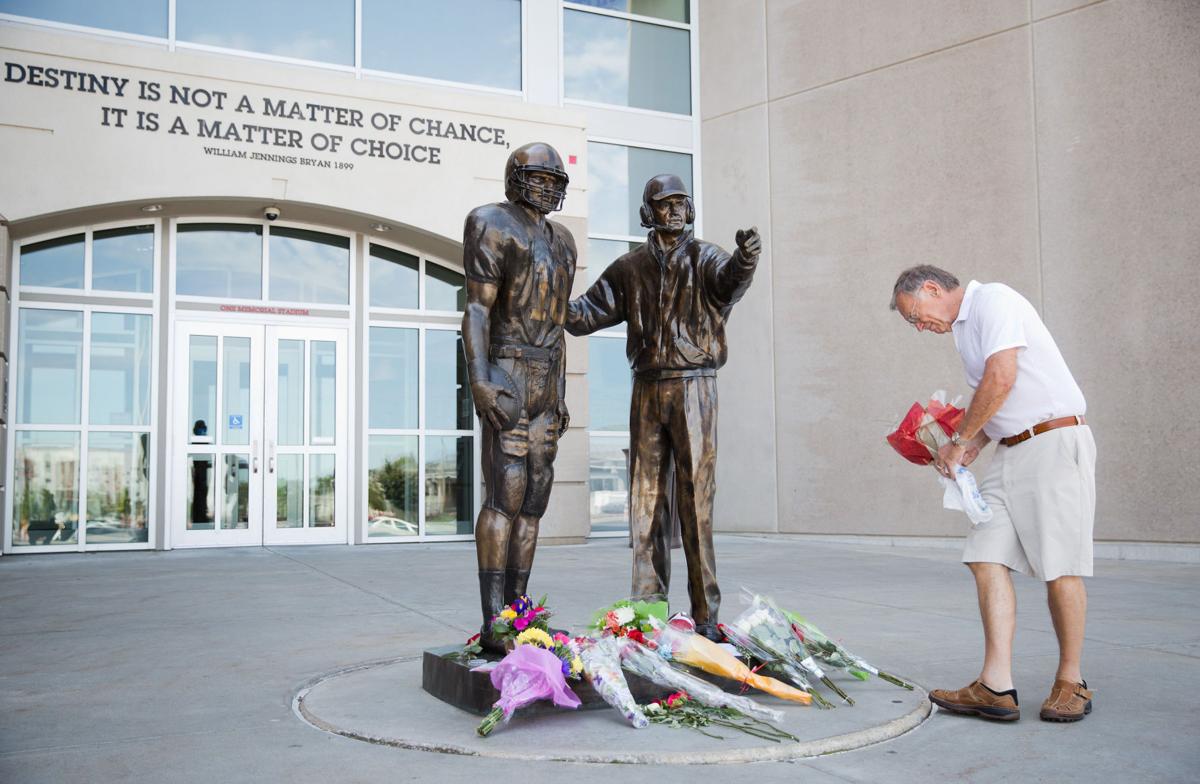
    He is still alive, age 80, and now has a statue outside the stadium, showing him posing with Brook Berringer, the quarterback on his 1994 and '95 National Championship teams, who was killed in a plane crash in 1996, right before he would have been selected in the NFL Draft.
    Osborne laying flowers at the statue, in Berringer's memory

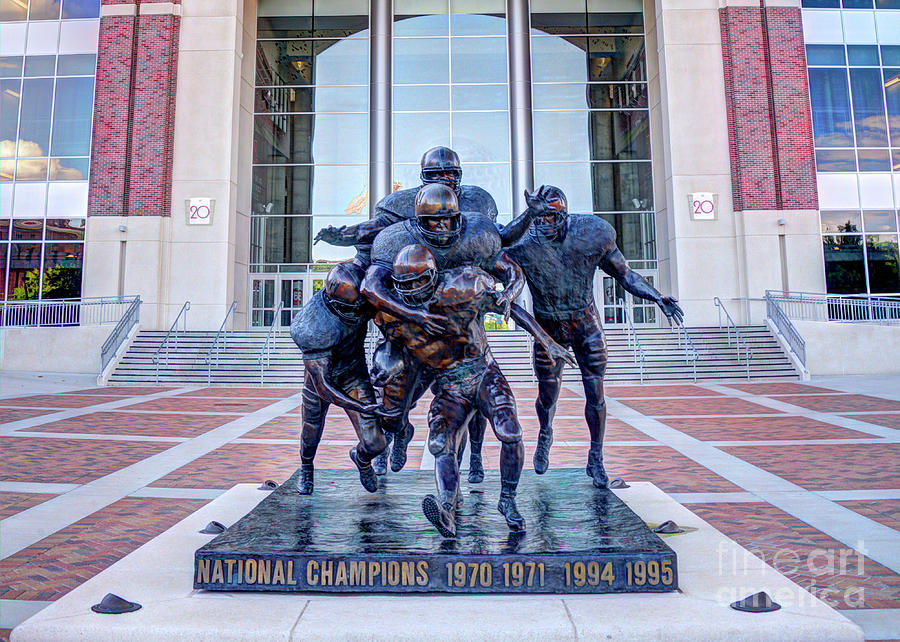
    On the east side of the Stadium is the Husker Legacy Statue, honoring the 4 National Championship teams that they officially claim: 1970, 1971, 1994 and 1995. They don't represent any particular players, but were modeled after a photograph taken during the 1995 Nebraska-Kansas State game.
    Various polling organizations have also awarded Nebraska National Championships in 1915, 1921, 1980, 1981, 1983, 1983, 1984, 1993 and 1999, but only the 4 on the statue are considered official, although they shared the 1970 title with Texas, as the polls were split.

    Nebraska was in the league officially known as the Missouri Valley Intercollegiate Athletic Association from 1907 to 1964, but nicknamed the Big Six from 1928 to 1948, the Big Seven from 1948 to 1957, and the Big Eight from 1957 to 1964, at which point it was officially renamed the Big Eight Conference.

    They won the Conference Championship in 1907, 1910, 1911, 1912, 1913, 1914, 1915, 1916, 1917, 1921, 1922, 1923, 1928, 1929, 1931, 1932, 1933, 1935, 1936, 1937, 1940, 1963, 1964 1965, 1966, 1969, 1970, 1971, 1972, 1975, 1978, 1981, 1982, 1983, 1984, 1988, 1991, 1992, 1993, 1994 and 1995. (The gap between 1940 and 1963 was due to the rise of the University of Oklahoma as a football power.)

    In 1996, the Big 8 took on 4 Texas teams from the dissolved Southwest Conference, and became the Big Twelve Conference. Nebraska won the title in 1997 and 1999. In 2011, they moved to the Big Ten. They won a Division Championship in 2012, but lost the Championship Game, and haven't added to their 43 Conference Championships.

    Nebraska has won the Orange Bowl in 1964, 1971, 1972, 1973, 1983, 1995, 1996 and 1998; the Cotton Bowl in 1974; the Sugar Bowl in 1975, 1985 and 1987; and the Fiesta Bowl in 1996 and 2000. Despite their entry into the Big Ten, they've only been in the Rose Bowl once, and that was before the Big Ten winner got an automatic berth there, in 1941, when they lost to Stanford.

    Three Huskers have had their uniform numbers retired: 20, running back Johnny Rodgers, from the 1970 and '71 National Champions, and in 1972 the school's 1st Heisman Trophy winner; 60, center Tom Novak, from the late 1940s; and 64, offensive tackle Bob Brown, from the early 1960s. Also winning the Heisman at Nebraska have been 1983 running back Mike Rozier (30), and 2001 quarterback Eric Crouch (7).
    "Johnny R, Superstar"

    Cornhuskers in the College Football Hall of Fame include:

    * From the 1910s: Ends Guy Chamberlin and Clarence Swanson.

    * From the 1920s: Tackle Ed Weir. Tackle William "Link" Lyman also played for them in the early 1920s.

    * From the 1930s: Coaches Dana X. Bible and Lawrence Jones, fullbacks George Sauer and Sam Francis, and tackle Forrest Behm.

    * From the 1950s: Halfback Bobby Reynolds. Center Mick Tinglehoff also played for them as the '50s turned to the '60s.

    * From the 1960s: Devaney, Brown, and guard Wayne Meylan.

    * From the 1970s: Devaney, Osborne, Rodgers, and defensive tackle Rich Glover, from Jersey City.

    * From the 1980s: Osborne, Rozier, and center Dave Rimington, the only 2-time winner of the Outland Trophy as the nation's best interior lineman. Mount Holly, New Jersey native Irving Fryar, later a 5-time Pro Bowler with New England, Miami and Philadelphia, also played for that 1983 team that came within a missed 2-point conversion against Miami in the 1984 Orange Bowl of being crowned not just National Champions, but perhaps the greatest team ever. (The Huskers would finally get their revenge in the 1995 Orange Bowl.) The year before, they also had future San Francisco Super Bowl running back Roger Craig.

    * From the 1990s: Osborne, Frazier, tackle Will Shields, linebacker Trev Alberts, and defensive end Grant Wistrom. From the 2000s, defensive tackle Ndamukong Suh might join them.

    There are 5 Nebraska players in the Pro Football Hall of Fame: Lyman, Chamberlin, Tinglehoff, Brown and Shields. Their Heisman winners had less luck. Although Rodgers won the 1974 Grey Cup with the Montreal Alouettes, a knee injury -- in practice, no less -- with the San Diego Chargers ended his career in 1978. Rozier had an unremarkable pro career with the USFL's Pittsburgh Maulers and the NFL's Houston Oilers. And Crouch was drafted by the St. Louis Rams, but, like Osborne, they wanted him as a receiver. He refused to switch, and the only pro action he saw, after bouncing around the NFL, was with the 2005 Hamburg Sea Devils of NFL Europa and the 2006 Toronto Argonauts in the CFL.

    For many years, Nebraska's big rival was the University of Oklahoma. The rivalry was usually played on Thanksgiving weekend. In 1959, Nebraska beat Oklahoma, ending the Sooners' 74-game conference winning streak. In 1963, Nebraska won a game that the Big 8 refused to postpone, despite President Kennedy's assassination the day before.

    On November 25, 1971, they met in Norman, Oklahoma with the Huskers ranked Number 1 in the country, and the Sooners ranked Number 2. The entire country was watching that Thanksgiving Day, and, like a few other games in that period, was hyped as "The Game of the Century." It lived up to the billing, and Johnny Rodgers and company won 35-31. In 1978, Nebraska won the regular-season game, as Number 4 beating Number 1 Oklahoma, but a rematch was set up in the Orange Bowl (which then took the Big 8 winner), and Oklahoma won it. In 1987, Oklahoma was Number 2 when they beat Number 1 Nebraska.
    As Keith Jackson of ABC, who broadcast a few of these,
    including the 1971 "Game of the Century,"
    said many times, about many rivalries,
    "These two teams just... don't... like each other!"

    The Big 8's conversion into the Big 12 put the teams in separate divisions, as Oklahoma and Oklahoma State were put in with the Texas teams to balance the divisions out, ending Huskers-Sooners as an annual rivalry. Nebraska's move to the Big Ten makes the matchup even rarer: They haven't played since Oklahoma beat them in the 2010 Big 12 Championship Game, and are not scheduled to meet again until 2021 in Norman, to celebrate the 50th Anniversary of that Game of the Century. Oklahoma leads the rivalry 45-38-3, but it's 42-23 Oklahoma since 1943, 11-7 Nebraska since 1988, and 6-2 Oklahoma since 2000.

    Nebraska played neighboring Missouri for a Victory Bell, with Nebraska leading the series 65-36-3, but with the Huskers moving to the Big Ten and the Tigers to the Southeastern Conference, it is unlikely to be played again, except maybe in a bowl game.

    With the rise of the University of Colorado as a football power in the late 1980s, they replaced Oklahoma as Nebraska's day-after-Thanksgiving game, as the Cornhuskers-Buffaloes game became, despite also being a bordering-States matchup, more than just another Big 8 matchup. Nebraska leads the series 49-18-2; 40-8-1 since 1962; 17-7-1 since 1986. With Nebraska now in the Big 10 and Colorado in the Pac-12, this game hasn't been played since 2010, but will be played in Lincoln next season.

    A rivalry with neighboring Iowa would seem like a natural, given both teams' status as the sports team in their respective States. But being in different leagues meant that they met only sporadically, and, while Iowa State was in the Big 8/12 (and still is), they never developed a rivalry with Nebraska. But Nebraska's move to the Big 10 began the awarding of The Heroes Trophy. It has replaced the Colorado rivalry as the day after Thanksgiving rivalry. Nebraska leads the series 29-15-3, but, since the trophy began, it's a 3-3 tie.

    (UPDATE: Through the 2019 season, Nebraska now leads Colorado 49-20-2, and Iowa 29-18-3.)

    Stuff. There is no official team store at Memorial Stadium. Husker Headquarters is located at 1120 P Street, 5 blocks south of the Stadium. And the University Bookstore is at 1500 S Street, 1 block south and 2 blocks east of the Stadium.

    In 2008, Mike Babcock published the coffee-table book University of Nebraska Football Vault. It is probably the most comprehensive single-volume history of the program. Osborne published a memoir in 2000, Faith in the Game: Lessons on Football, Work, and Life. In 2005, Michael Corcoran published The Game of the Century: Nebraska vs. Oklahoma in College Football's Ultimate Battle, November 25, 1971. In 2008, the DVD Tom Osborne's Nebraska Cornhuskers was released.

    During the Game. You will almost certainly be safe. Nebraska fans are a friendly bunch, with the occasional exception. The Colorado rivalry brought one of those out in the late 1980s, as Buffalo fans got a bit too big for their britches, and started some nasty taunts, inspiring Husker fans to invoke the cancer-stricken Colorado quarterback Sal Aunese, with the chant, "Sal is dead, go Big Red!" Osborne put a stop to that.

    Nebraska has a good band, and "The Cornhusker Fight Song" and the "Go Big Red" chant are real rousers. The student section is known as the Boneyard.
    There are 2 mascots. Herbie Husker has been around since 1974, and a childlike Lil' Red was added in 1994. Whether he's supposed to be Herbie's son isn't clear: He's actually taller (even with Herbie's cowboy hat), and there's no facial resemblance. At the start of the game, they ride a tandem bike onto the field, and Herbie rides in front, so, even if he's not the Dad, he's definitely the commanding officer. Herbie has been elected to the Mascot Hall of Fame.
    When Devaney was coach, he had the defensive team wear black shirts, to differentiate from the red-shirted offense. Therefore, even though Nebraska wears red jerseys -- and, on occasion, all-red uniforms -- at home, the defense remains known as the Blackshirts.

    Nebraska's roster had included Keyshawn Johnson Jr., but he's officially listed as being on a leave of absence, and expects to return next season. He's a freshman, so they'll treat this as a redshirt season. Like his father the ex-Jet, he's a receiver, and wears Number 3 in college. (His father wore it at USC, and wore 19 in the NFL.)

    While there are minor-league sports teams in the State, the nearest major-league ones are far away, in Kansas City and Denver. So Husker football is pretty much all they've got. That, and the program's success, is why they've sold out every home game for 55 years.

    Indeed, on December 4, 1982, while the worst recession between the late 1930s and the late 2000s was at its depth, and the Farm Belt was particularly hard-hit -- and you thought President Ronald Reagan's tax cuts had helped -- 16,000 Nebraska fans managed to go to a game. Against Hawaii. In Honolulu. And Aloha Stadium only seats 50,000 people. They turned it into a neutral-site game. (Nebraska won, 37-16.)

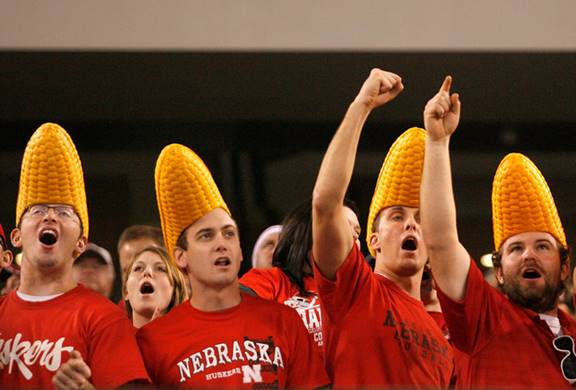
    So the fans can be excused for the banners around the stadium, indicating their places of origin, much like the bigger English soccer teams: "Californians for Nebraska," "Floridians for Nebraska," and so on. And perhaps they can even be forgiven for their variation on the Wisconsin Badgers' and Green Bay Packers' Cheesehead hats: Cobheads.
    No, I wasn't making that up.

    And, as cited by that Thrillist article, red balloons are released after Nebraska's 1st score.

    After the Game. As I said, your safety should not be an issue. Getting out in a hurry will be, so don't: Stay for the postgame band performance, which will allow the crowd to thin out a bit. Most of the good places to eat, including a few chains, are to the south of the Stadium, between O and S Streets, between Canopy (6th) and 14th Streets.

    If you want to see your favorite European "football" team in action before watching the Cornhuskers play "handegg," the top soccer bar in the State is Captain Jack's Bar, at 140 N. 12th Street at P Street, 5 blocks south of the Stadium.

    Sidelights. The 7,907-seat Bob Devaney Sports Center, a.k.a. The Bob, opened in 1976 at 1600 Court Street, about a mile northeast of the Stadium. Bus 41. It was been replaced as Nebraska's basketball arena in 2013, by the 15,500-seat Pinnacle Bank Arena, 400 Pinnacle Arena Drive -- or, if you prefer, 6th & R Streets. Bus 55.

    Nebraska doesn't have any major league teams, and isn't even all that close to any. From Memorial Stadium in Lincoln, the Kansas City sports complex is 203 miles to the southeast, downtown Minneapolis is 434 miles to the northeast, downtown St. Louis is 443 miles to the southeast, the Pepsi Center in Denver is 487 miles to the west, and the United Center in Chicago is 521 miles to the east.

    In fan percentages, according to 2014 studies, the Yankees, the Boston Red Sox and the Chicago Cubs each seem to have about 15 percent, while the closest team, the Kansas City Royals, don't even register. In the NFL, they prefer the Kansas City Chiefs to the east to the Denver Broncos to the West. In the NBA, they're all over the place, favoring the Los Angeles Lakers, the Boston Celtics, and whatever team LeBron James is playing for this season. In hockey, forget the St. Louis Blues, even though they're a bit closer, and the Chicago Blackhawks, a little further away: It's all about the Colorado Avalanche. In soccer, it's Sporting Kansas City over the Colorado Rapids.

    Nebraska has 2 minor-league baseball teams. The Lincoln Saltdogs are in the independent American Association, and won the Pennant in 2009. They play at Haymarket Park. 403 Line Drive Circle, a 15-minute walk west of Memorial Stadium, via a pedestrian overpass over I-180.
    About 50 miles to the northeast, and reachable by Lincoln by Greyhound, Megabus, or (only once a day in each direction, late at night) Amtrak, is Omaha. The Omaha Storm Chasers, formerly the Omaha Royals, have been the top farm team of the Kansas City club since their founding in 1969. They won 4 Pennants in the old American Association, and 3 since moving to the no-longer-aptly-named Pacific Coast League, for a total of 7: 1969, 1970, 1978, 1990, 2011, 2013 and 2014.

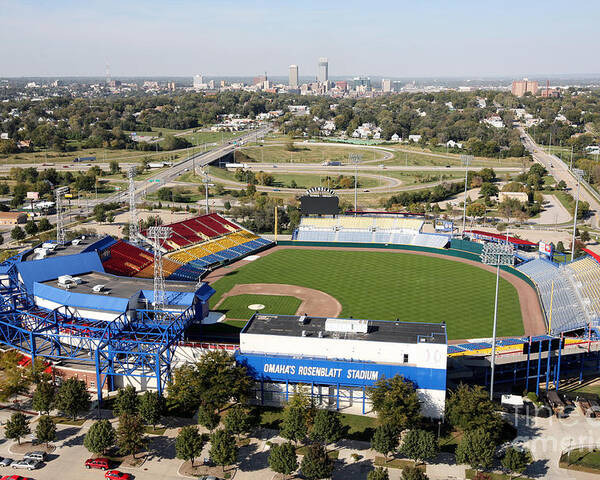
    From 1969 to 2010, they played at Johnny Rosenblatt Stadium, built in 1947 as Omaha Municipal Stadium, and renamed in 1964 for the Mayor who got it built and brought pro baseball to town. Prior to the O-Royals, it hosted the Omaha Cardinals from 1949 to 1959, and the Omaha Dodgers in 1961 and 1962. From 1950 to 2010, its capacity of 23,145 and its nationally-central location made it the home of the College World Series.
    Because the CWS forced the Storm Chasers on the road for much of June, 2 new ballparks were built, 1 for each. Rosenblatt Stadium was demolished in 2012, and the land has been used for an expansion of the city's Henry Doorly Zoo & Aquarium. 1202 Bert Murphy Avenue, about 2 1/2 miles south of downtown. Bus 13.

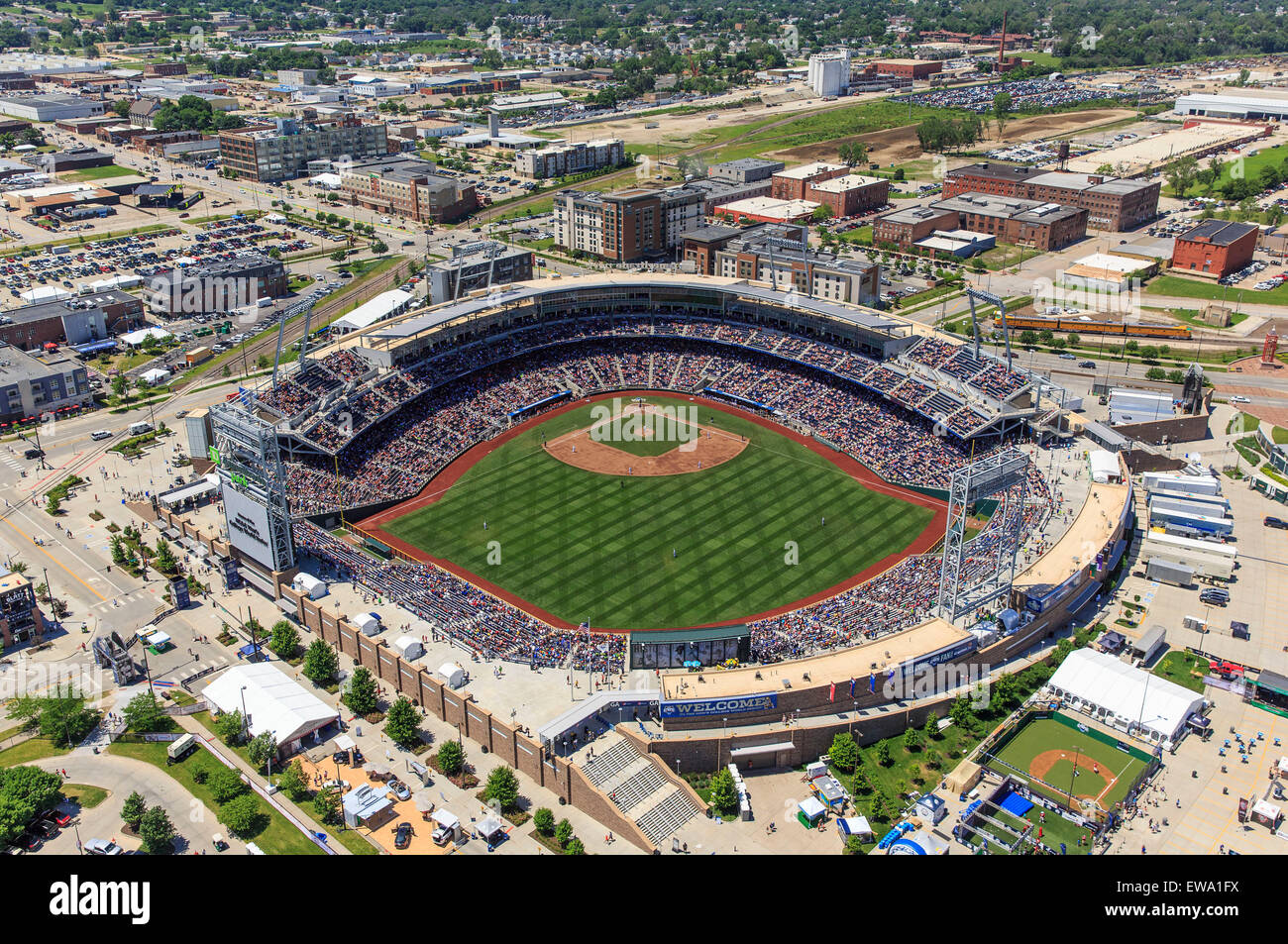
    TD Ameritrade Park Omaha opened in 2011, with 24,000 seats, with the possibility of expansion to 40,000. Creighton University also uses it for baseball. 1200 Mike Fahey Street (like its predecessor stadium, its street was named for the Mayor who got it built). Bus 30.
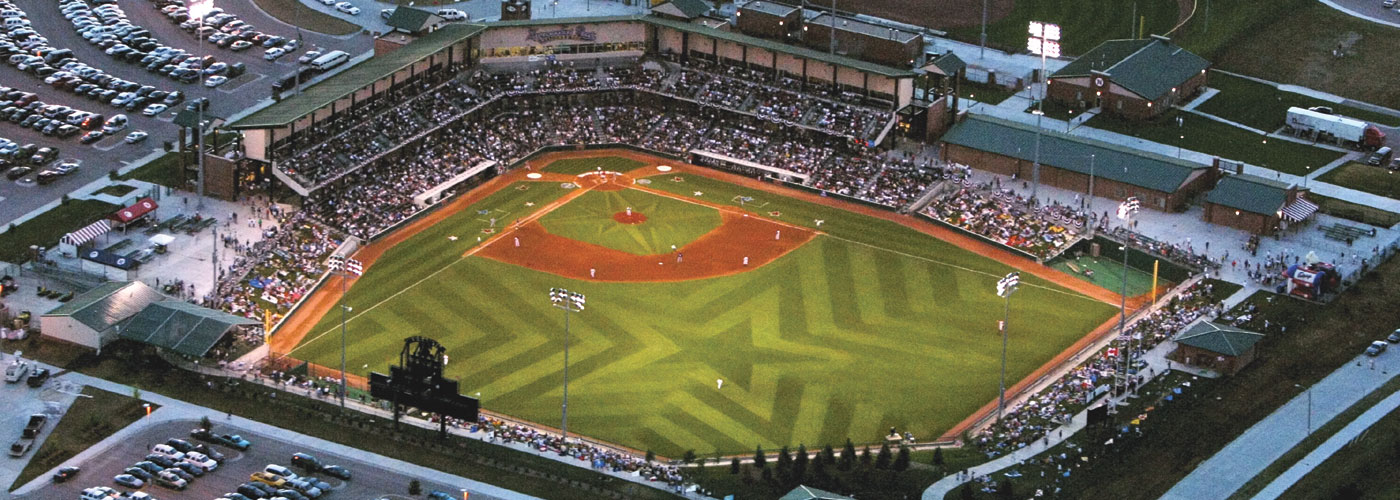
    The Storm Chasers moved to Werner Park, at 6,434 seats much easier to fill. in 2011. A statue of Omaha's greatest sports hero, Hall of Fame pitcher Bob Gibson, stands outside. 12356 Ballpark Way, in suburban Papillon, 14 miles southwest of downtown. Not reachable by public transit.
    Only 1 U.S. national soccer team game has ever been played in Nebraska, and it was the women's team, not the men's, playing Sweden to a 1-1 tie on July 13, 2010, at Michael G. Morrison, S.J., Stadium on the campus of Creighton University in Omaha. (Creighton is a Catholic school, and "S.J." means "Society of Jesus," making Morrison a Jesuit priest.) Attendance: 6,493. 1804 California Street, about 5 blocks west of TD Ameritrade Park.
    Grover Cleveland Alexander, winner of 373 games, one of the earliest Baseball Hall-of-Famers, hero of the 1926 World Series, and a native of Elba, Nebraska, is buried at Elmwood Cemetery in nearby St. Paul, where he lived his last few years. That's pretty far: 119 miles northwest of Lincoln, and you'd need a car.

    Lincoln has the Nebraska History Museum, at 131 Centennial Mall North; the Lincoln Children's Museum, just across the street at 1420 P Street; the University of Nebraska State Museum, at 645 N. 15th Street, 2 blocks east of Memorial Stadium; and the Sheldon Museum of Art, at 1209 R Street, 2 blocks south of the stadium.

    The Beatles never performed in Nebraska. Elvis Presley did. He sang in Lincoln at the University of Nebraska Coliseum in Lincoln on May 19, 1956; and at the Pershing Municipal Auditorium on June 20, 1977, on what turned out to be his last tour. Built in 1926, the Coliseum still stands, hosting Cornhusker volleyball, at 1350 Vine Street. Bus 55.
    The Pershing Center, as the newer building is now known, also still stands, downtown, at 226 Centennial Mall South. Both buildings seat about 4,000 people.
    Elvis sang 7 times at the Omaha Civic Auditorium: Twice on May 20, 1956; twice on June 30, 1974; once the next day, July 1, 1974; on April 22, 1976; and on June 19, 1977. This was the concert taped for a CBS special that was to air at Christmastime, but the footage was considered unusable. (Most of what was shown was from 2 days later, in Rapid City, South Dakota.) After he died on August 16, it aired on October 3. Roy Carr and Mick Farren, authors of Elvis: The Illustrated Record, said that Elvis looked so bad, "Had it been shown during his lifetime, it would have caused more irrevocable damage to what was left of his career than almost a decade of starring in third-rate movies."

    The Civic Auditorium was home court for Creighton University basketball from 1955 to 2003, and was home ice for minor-league hockey teams. The NBA's Kansas City-Omaha Kings played some home games there from 1972 to 1975, before dropping the Omaha from their name and committing to Kansas City -- at least, until 1985, when they moved to Sacramento. Joe Frazier defended the Heavyweight Championship there by beating Ron Stander on May 25, 1972.
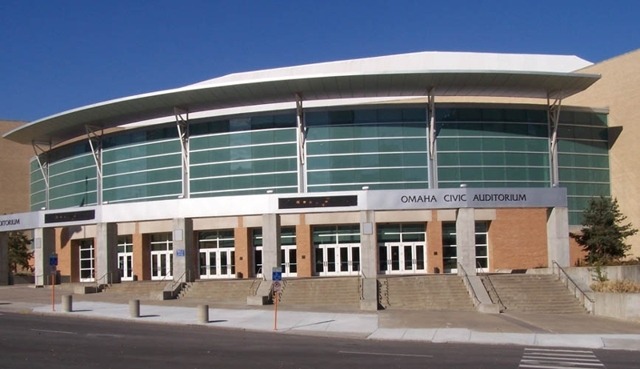
    And it was the site of the Vice Presidential Debate of October 5, 1988, in which the Republican nominee, Senator Dan Quayle of Indiana, was asked about his level of experience and maturity. He was 41, younger than any President had ever been, and this was relevant because, just since World War II, Franklin Roosevelt had died in office, Dwight D. Eisenhower had a heart attack and a stroke, John F. Kennedy was shot and killed, Ronald Reagan had been shot and survived, Harry Truman and Gerald Ford had been shot at, and Richard Nixon had been forced to resign.

    Quayle had been in the Senate for 8 years, and the Congress overall for 12 years. He said, with some justification, that this made his experience comparable to that of JFK. But his Democratic opponent, Senator Lloyd Bentsen of Texas, pointed out that he served in the House of Representatives with JFK, and knew that JFK's goals for serving the American people were very different to Quayle's, and said, "Senator, you're no Jack Kennedy." It didn't change the result of the election -- Vice President George Bush still won a landslide over Governor Michael Dukakis of Massachusetts -- but it forever branded Quayle as a whiny nincompoop, an image he fought hard, with occasional counterproductive results.
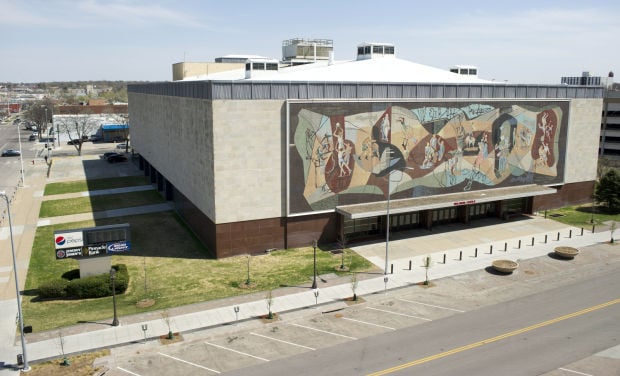
    The Ralston Arena opened in 2012, making the Civic Auditorium obsolete, and it was demolished last year. At the moment, the site remains vacant. 1804 Capitol Avenue. The new arena is the home of the Omaha Lancers of the U.S. Hockey League. 7300 Q Street, in Ralston, 8 miles southeast of downtown Omaha. Bus 13.
    There is 1 President with a tie to Nebraska, despite the 3 tries of William Jennings Bryan. On July 14, 1913, Leslie Lynch King Jr. was born at the family home in Omaha. But Les King Sr. was abusive to his wife, and she divorced him, moving to Grand Rapids, Michigan, and marrying a man named Gerald Rudolph Ford. Her new husband adopted the son and gave him his own name, and he became a University of Michigan football star, a Congressman, House Minority Leader, Vice President, and, from August 9, 1974 to January 20, 1977, the 38th President of the United States.
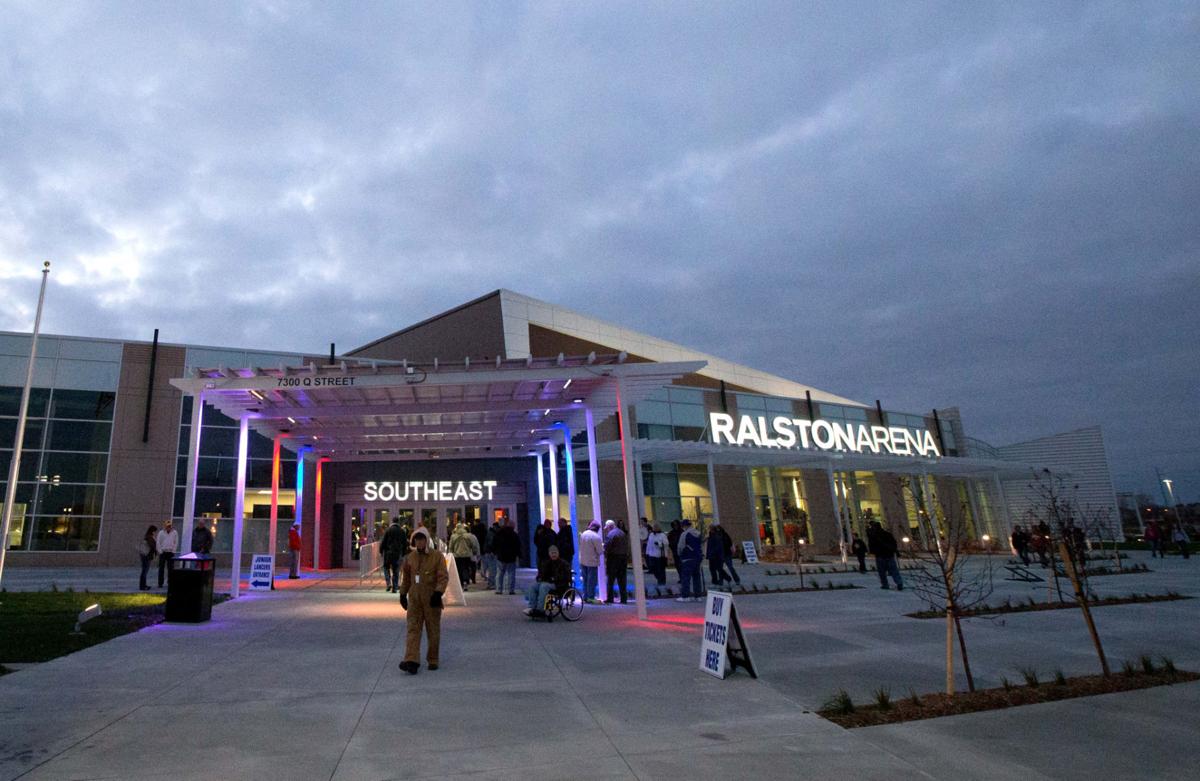
    But in 1970, no one knew that House Minority Leader Jerry Ford had a chance of becoming President. And he had become so identified with Michigan in general, and Grand Rapids in particular, that hardly anybody knew (although he did) that he had been born in Omaha. And so, that year, the house where he was born, a house of which he had no memory, was demolished. After he became President, a reconstruction was built. 3202 Woolworth Avenue, about 2 miles southwest of downtown. Bus 36.

    His Presidential Library is on the Michigan campus in Ann Arbor, and his Presidential Museum, unique among such, is not in the same complex, or even the same city, as his Library, but is rather in his hometown of Grand Rapids.

    Most TV shows and movies set in Nebraska have been Westerns. The 1939 film Union Pacific inspired a 1958-59 TV series. The following season, 1959-60, Pony Express was syndicated. More recently, from 1989 to 1992, ABC aired a show about the Pony Express, The Young Riders, with Stephen Baldwin as William F. Cody (the future Buffalo Bill really had ridden with the Express), Josh Brolin as James Butler "Wild Bill" Hickok, and Christopher Pettit as a young, not yet notorious, Jesse James.

    Also in 1989, CBS aired a Nebraska-based sitcom titled Heartland, starring Brian Keith. Ironically, the theme song was sung by that New Yorkiest of singers, doo-wop legend Dion DiMucci. The year before, CBS aired First Impressions, with Brad Garrett playing an Omaha insurance agent, but it tanked.

    Movies set in Nebraska tend to be either Westerns, or based on the 1958 killing spree of teenage psychopath Charlie Starkweather. Exceptions: Boys Town (starring Spencer Tracy as the Omaha-based orphanage leader, Father Edward Flanagan), Fail Safe, Election, and 2 of Jack Nicholson's better films, Terms of Endearment and About Schmidt.

    And many films set in Nebraska weren't filmed there at all: Caddyshack was filmed in Florida, Children of the Corn in Iowa, and Boys Don't Cry in Texas.

    *

    Nebraska football is an institution. Possibly, on gameday, a madhouse. But, if you can get into the asylum, it's one of the great experiences in American sports.