Tuesday, May 30, 2017

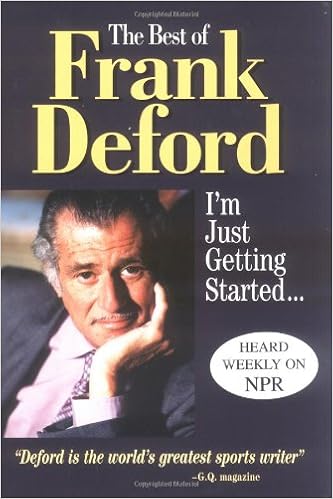
Frank Deford, 1938-2017

The man who defined sportswriting, at least at the magazine level, in my youth will get to define it no more.

Benjamin Franklin Deford III was born on December 16, 1938 in Baltimore, 3 days after 1960s Baltimore Bullets basketball star Gus Johnson (no connection besides name to the current basketball broadcaster), and 4 days after singer Connie Francis.

When Gus died, Frank (never "Ben" or "Benny") wrote a column about how he imagined himself, Gus and Connie going through life together, like the Scarecrow, the Tin Man and Dorothy on the Yellow Brick Road in The Wizard of Oz. I guess he didn't want to call anyone the Cowardly Lion, but he was born 1 day after AFL legend Billy Shaw, on the same day as actress Liv Ullman, and 1 day before mile run recordholder Peter Snell.

He grew up in Baltimore, a fan of the International League version of the Baltimore Orioles, who won Pennants in 1944 and 1950, when he was 5 and 11 years old, respectively. By the time the St. Louis Browns were moved to become the major league version of the Orioles in 1954, he was already at the Gilman School, a Baltimore prep school; by the time they won their 1st Pennant in 1966, he was already at Sports Illustrated.

(Other Gilman graduates include former Maryland Governor Bob Ehrlich, former Arizona Governor Fife Symington, Maryland Congressman John Sarbanes, and Walter Lord, author of A Night to Remember, the defining book about the RMS Titanic.)

He went to Princeton, leading a female editor at SI to tell him, "Deford, you are the last of the tall white male heterosexual Ivy League writers." Along the same lines, he titled a collection of his writings The World's Tallest Midget. (He was 6-foot-4.)

After graduating in 1962, SI hired him as a researcher, and he later became one of its best writers. He was renowned for "The Toughest Coach There Ever Was," his 1984 profile of Bob Sullivan, the head football coach at East Mississippi Junior College in the 1950s and '60s, a Marine veteran who was the only survivor of his squad on Okinawa, and a man so tough he had 2 nicknames, and was often referred to by both of them at the same time: "Bull Cyclone." At 18 pages, it is still the longest article in SI's 63-year history.

In 1988, on the Centennial of Ernest Thayer's poem "Casey At the Bat," he wrote "Casey On the Loose," first as an SI piece, then as an entire novel, imagining "The Mighty Casey" as a real person, and giving the ill-fated slugger a weird, but still better, ending to his famous game.

In his epilogue, Deford imagined, among other things, that Timothy Francis Xavier Casey's sister Kate was not only the Katie Casey mentioned by Jack Norworth in "Take Me Out to the Ballgame," but also that she was the mother of Babe Ruth. (The Babe's mother was named Kate, but she was a German-American, Katherine Schamberger, not an Irish lass named Katherine Casey.)

He wrote a biography of tennis legend Bill Tilden, a novel about college football titled Everybody's All-American (turned into a movie starring Dennis Quaid), books about roller derby, the Miss America pageant, and the New York Giants of John McGraw, The Old Ball Game. He also contributed a piece on the minor-league Orioles to his SI colleague Ron Fimrite's fantastic anthology Birth of a Fan.

In 1965, he married fashion model Carol Penner. They had 2 children, a son Christian and a daughter Alexandra, or Alex. Alex developed cystic fibrosis, and died at age 8 in 1980. Frank became an advocate for fighting CF, and wrote a memoir of his daughter, Alex: The Life of a Child. It became a TV-movie starring Coach star Craig T. Nelson and Bonnie Bedelia. Shortly after Alex's death, Frank and Carol adopted an infant girl from the Philippines, whom they named Scarlet. Frank lived to see 2 grandchildren.

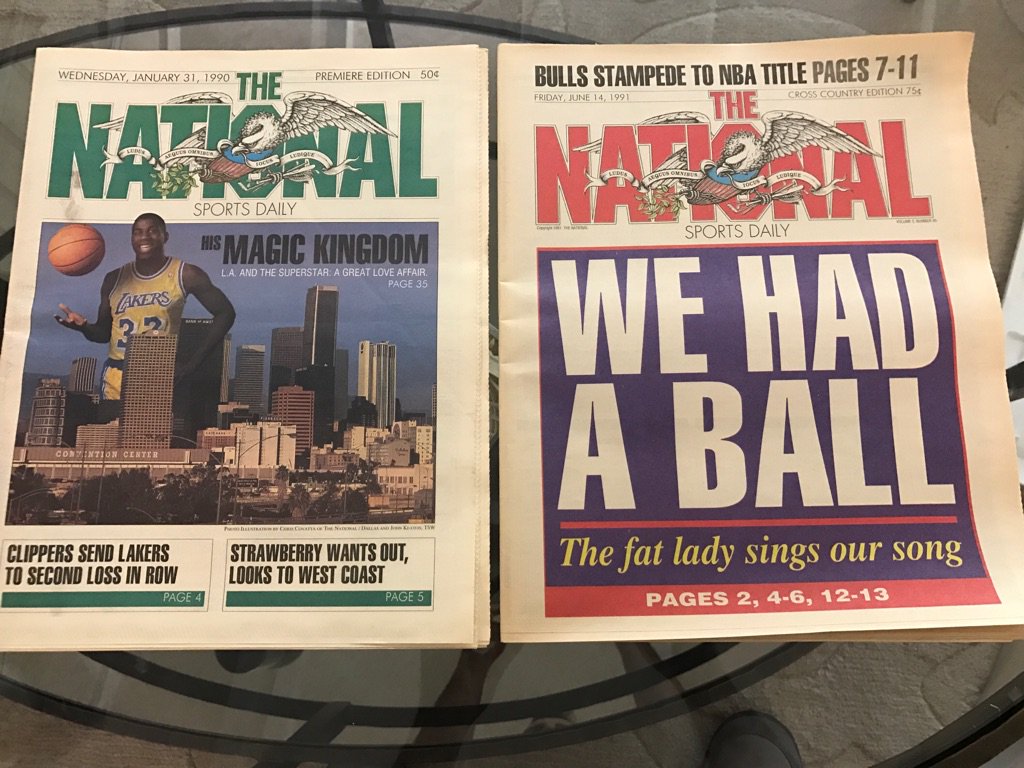
In 1980, he began a weekly show on National Public Radio. In 1989, he stepped aside from SI to help found The National Sports Daily, or The National for short. He became editor-in-chief, and the paper was first published on January 31, 1990. Most countries have at least 1 national daily newspaper devoted exclusively to sports, but it had never been tried in America. It sounded like a great idea.

The timing was horrible: Not only was ESPN making such an idea obsolete, but the price of both paper and ink had skyrocketed, and all over America, newspapers were dropping like flies, some going out of business, some merging with the more successful paper in their city. On June 13, 1991, it published its last issue.
The first and last front pages.
The New York edition of the first front page
had Patrick Ewing; the Chicago edition, Michael Jordan.

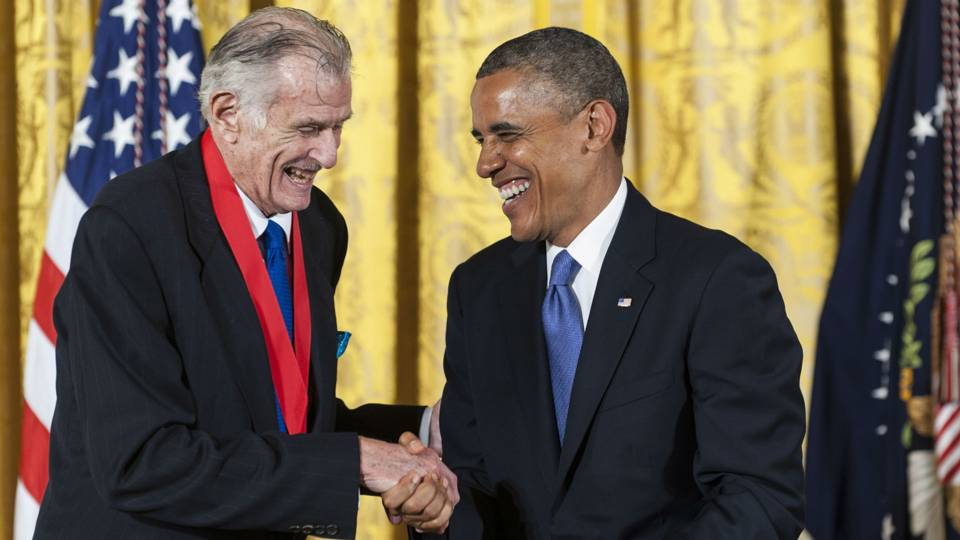
Frank was welcomed back to SI, stuck with his NPR show, and became a correspondent for HBO's Real Sports with Bryant Gumbel. He was 6 times voted National Sportswriter of the Year, won an Emmy Award in 1988, won a Cable ACE Award in 1993 for his HBO documentary on tennis icon Arthur Ashe, won a Peabody Award in 1999, was elected to the National Sportscasters and Sportswriters Association Hall of Fame, and was awarded the National Humanities Medal by President Barack Obama in 2013.
Frank Deford lived in Key West, Florida, and died there this past Sunday, May 28, 2017. He was 78 years old.

He was 6-foot-4, but in a world where sports and journalism not only both seem to be out of control, but don't seem to go together at all, he seems taller than ever. In death, as in life, he shall cast a very long shadow.

UPDATE: He was buried at Christ and Holy Trinity Church Cemetery, in the New York suburb of Westport, Fairfield County, Connecticut.

Monday, May 29, 2017

Top 10 Athletes From Wisconsin

May 29, 1848: Wisconsin joins the Union as the 30th State.

Top 10 Athletes from Wisconsin

Honorable Mention to Harry "Bud" Grant of Superior. We know him as a great football coach, but he was a fantastic athlete, too: He is the only man ever to play regular-season games in both the NFL and the NBA -- and he actually achieved more as a player in basketball, winning a title with the 1950 Minneapolis Lakers. He lettered in those sports and in baseball at the University of Minnesota, a 3-sport star there a quarter of a century before Dave Winfield was.

He was a receiver with the Philadelphia Eagles, then moved to the Canadian Football League's Winnipeg Blue Bombers. He became their head coach, and led them to 4 Grey Cups, followed by 4 NFL/NFC Championships (but no Super Bowl wins) with the Minnesota Vikings. It is as a coach that he is in the Pro Football and Canadian Football Halls of Fame.

Honorable Mention to Mark Johnson and Bob Suter, both of Madison. As members of the 1980 U.S. Olympic Hockey Team that won the Gold Medal in Lake Placid, New York, Sports Illustrated
included them in their 1st entire team to be named their Sportsmen of the Year.

Both played at the University of Wisconsin for Johnson's father, Bob Johnson, who later coached the Pittsburgh Penguins to their 1st Stanley Cup in 1991. "Badger Bob" doesn't make this list, because he was from Minnesota, and his own playing career wouldn't have qualified him anyway. Mark, a center, now coaches the Wisconsin women's team. Unfortunately, Suter, a defenseman, was the 1st member of that 1980 team to die.

Honorable Mention to Gary Suter of Madison. Bob's younger brother, a defenseman, never won an Olympic medal, but he won 2 things Bob didn't: The Stanley Cup, with the 1989 Calgary Flames; and the World Cup of Hockey (formerly the Canada Cup), with the U.S. team in 1996.

Honorable Mention to Judi Brown of Milwaukee. She won a Silver Medal as a hurdler at the 1984 Olympics in Los Angeles. In 1987, for her work with abused children, Sports Illustrated named her 1 of 8 "Athletes Who Care" as their Sportspeople of the Year.

Honorable Mention to Paul Hamm of Waukesha. In 2004, the gymnast won a Gold Medal and 2 Silver Medals at the Olympics in Athens, Greece, and the James E. Sullivan Award, annually given by the Amateur Athletic Union to the nation's outstanding amateur athlete for that year.

Honorable Mention to Suzy Favor of Stevens Point. The 1500-meter runner from the University of Wisconsin won the Honda-Broderick Cup for America's best female college athlete for the 1989-90 schoolyear.

Honorable Mention to Kevin Dean of Madison, who helped the New Jersey Devils win the 1995 Stanley Cup.

Honorable Mention to Eric Hinske of Menasha, 1 of only 3 players since the 1920s -- Ramiro Mendoza and Johnny Damon are the others -- to have won the World Series while playing for the Boston Red Sox and the New York Yankees.

Now, the Top 10:

10. Helene Madison of Madison. After breaking the world record in every event open to female swimmers in 1930 and '31, she swam to 3 Gold Medals at the 1932 Olympics in Los Angeles. There, she met Johnny Weissmuller, fellow Gold Medal swimmer, and then the movies' Tarzan. He got her what then appeared to be a big break, and she swam in 2 movies.

But the International Olympic Committee declared that, as she was now swimming for money, she was a "professional," and declared her ineligible for the 1936 Olympics in Berlin. The IOC has frequently been unfair, and sometimes even hypocritical.

9. Alan Ameche of Kenosha. Although Ron Dayne also played at the University of Wisconsin, set a still-standing NCAA record for career rushing yards, and won the Heisman Trophy in 1999, he is from New Jersey. Ameche, a cousin of actors Don and Jim, is the only Wisconsin native to have won the Trophy, playing for UW in 1954. The Badgers retired his Number 35.

With the Baltimore Colts, he was a 4-time Pro Bowler, the 1955 NFL rushing yards leader and Rookie of the Year, and a member of the 1958 and 1959 NFL Champions. He scored the overtime touchdown that won the 1958 NFL Championship Game, frequently called "The Greatest Game Ever Played," a 23-17 Colt win over the Giants at Yankee Stadium. Until James White of the New England Patriots in Super Bowl LI this past February, it was the latest-scored touchdown in any NFL game.

An Achilles injury ended his career in 1960, leaving him short of statistics that would have gotten him into the Pro Football Hall of Fame. But he is a member of the College Football and Wisconsin Athletic Halls of Fame, and was named to the NFL's 1950s All-Decade Team. He also co-founded 2 fast food chains: Gino's with his Colt teammate Gino Marchetti (founded 1957, folded 1982, revived 2010), and Ameche's Drive-In (also a burger chain, peaking at 6 in the Baltimore area).

8. Jim Otto of Wausau. He was the Oakland Raiders' starting center from their 1960 inception through the 1974 season, including the 1967 AFL Championship. Between the AFL All-Star Team before the 1970 merger and the NFL's Pro Bowl after it, he was an all-star in the 1st 13 of his 15 seasons.

He was named to the AFL All-Time Team and the Pro Football Hall of Fame. The Raiders do not retire numbers, but, in a way, his is the only one they have retired: He wore 00, because it could be read as the pronunciation of his name: "Aught-oh." The NFL no longer permits that number to be worn.

But he's not the best football player from Wausau: That's the man at #7. And he's not the best University of Wisconsin center to have played in the NFL in the 1970s: That's the man at #6.

7. Elroy Hirsch of Wausau. "Crazy Legs" was the best receiver of the 1940s and the early 1950s (essentially, the Harry Truman Presidency), getting his Number 40 retired by the University of Wisconsin. He starred for the Chicago Rockets of the All-America Football Conference, which got him noticed by the Los Angeles Rams, for whom he played in 4 NFL Championship Games, winning in 1951.

He was a 3-time Pro Bowler, and when he retired in 1957, he was 2nd to Don Hutson on the NFL's list for most career receiving yards, 7,029. He was named to the NFL's 1950s All-Decade Team and the College and Pro Football Hall of Fame. He served as the Rams' general manager in the 1960s, and as UW's athletic director in the 1970s and '80s. He may be the most popular athlete in Badger history.

6. Mike Webster of Rhinelander. Often called the best center in NFL history, he snapped for Terry Bradshaw and blocked for the Pittsburgh Steelers offense for 4 Super Bowl wins in the 1970s, making 9 Pro Bowls.

He was elected to the Pro Football Hall of Fame, and to the NFL's 1970s and 1980s All-Decade Teams and to the Steelers' 75th Anniversary Team. While the Steelers usually don't retire numbers, his Number 52 has never been given back out.

5. Dan Jansen of the Milwaukee suburb of West Allis. He was probably the best speed skater in the world at the time of both the 1988 and 1992 Winter Olympics, but his struggles in those Games have become legend. By 1994, in Lillehamer, Norway, he had been surpassed by homeland hero Johan Olav Koss, but he finally got a Gold Medal, in the 1,000 meters. He was thus given the 1994 Sullivan Award.

Had the Winter Olympics stayed on the same schedule as the Summer Games, and he had to wait until 1996, he might not even have competed. But he finally got his just reward.

4. Eric Heiden of Madison. At the 1980 Winter Olympics in Lake Placid, New York, this speed skater not only won Gold Medals in all 5 of his races, but set world records in each. He wasn't even seriously challenged in any of them. He won the Sullivan Award in 1980. His sister Beth Heiden was also world-class in speed skating, and in cycling, too.

As great as this achievement was, I can't rank him any higher, since he was only a superstar for 2 weeks.

3. Adrian "Addie" Joss of Woodland. He has the lowest WHIP (walks plus hits, divided by innings pitched) in baseball history: 0.968. He has the 2nd-lowest ERA: 1.88. He pitched 2 no-hitters, 1 of them a perfect game in 1908.

He had a 160-97 career record, all for the Cleveland Naps (forerunners of the Indians), before his 32nd birthday. But just 2 days after that birthday, on April 14, 1911, he died of meningitis. There were no antibiotics in those days. Had he appeared in so much as 1 game in the dawning 1911 season, he would have appeared in a 10th major league season, and thus qualified for the Baseball Hall of Fame. In 1978, the Hall waived this requirement due to his special circumstances, and he was elected.

2. Al Simmons of Milwaukee. Changing his Polish name of Aloisius Harry Szymanski, the great left fielder for the Philadelphia Athletics batted .334 lifetime, collected 2,927 hits (he couldn't quite make it to 3,000, or else he'd be a lot better-remembered), helped the A's win 3 straight Pennants (1929-31) and back-to-back World Series (1929-30), and played in the 1st 3 All-Star Games (1933-35).

The A's, now in Oakland, do not retire numbers from their Philadelphia years, so his Number 7 remains available. But the Phillies honored him with election to the Philadelphia Baseball Wall of Fame. He died at 54 of heart trouble, but lived long enough to see his election to the Baseball Hall of Fame.

1. Ernie Nevers of Superior. He didn't get a movie made about him like Jim Thorpe and George Gipp. Unlike Red Grange and Bronko Nagurski, his teams no longer exist in their present form. But Ernie deserves to be celebrated as an early pro football star, just as those men rightly are.

In 1924, he led the Stanford football team to an undefeated regular season, before losing to Notre Dame and their Four Horsemen in the Rose Bowl. Had there been a Heisman Trophy in 1925, he would have won it. In 2008, ESPN named ranked him 25th on their list of the Top 25 College Football Players of All Time.

He was an All-Pro 5 times: In 1926 and '27 with the Duluth Eskimos, and in 1929, '30 and '31 with the Chicago Cardinals. What happened in 1928? He sat out the season, and returned to Stanford, serving as an assistant coach to his mentor, Pop Warner. Yes, the man for whom the legendary youth football program was named.
In 1929, he returned, and set an NFL record that has never been broken, scoring all of the Cardinals' points in a 40-6 Thanksgiving Day win over Grange's Chicago Bears: He ran for 6 touchdowns (that record has been tied, but never broken) and kicked 4 extra points. He was also, by the standards of the time, a good passer and a great defensive back.

Stanford retired his Number 1. The NFL Cardinals -- not named for Stanford's teams, as they were the Indians until 1972 -- now play in Arizona, and have not retired his Number 4. He was named to the NFL's 1920s All-Decade Team, and to the College and Pro Football Halls of Fame. He also pitched for the St. Louis Browns from 1926 to 1928.
Top 10 Athletes From Rhode Island


May 29, 1788: Rhode Island becomes the last of the original 13 States to ratify the Constitution, thus gaining true Statehood. Note the 13 stars on the State Flag.

Top 10 Athletes from Rhode Island

Honorable Mention to Chris Terreri of Warwick, whose backing up of Martin Brodeur in goal helped the New Jersey Devils win the 1995 and 2000 Stanley Cups.

Honorable Mention to Norman Taber of Providence. He won a Gold Medal in the 3,000-meter relay and a Bronze Medal in the 1,500 meters at the 1912 Olympics in Stockholm, Sweden. On July 16, 1915, he set a record in the mile run: 4 minutes, 12.6 seconds. The record stood for 8 years.

10. Ernie Calverley of Pawtucket. In 1944, the guard led all college basketball players in scoring average, and got the University of Rhode Island into the NIT Final, losing what was then still considered the real national championship to Kentucky by 1 point.

He played in the early NBA with Rhode Island's team, the Providence Steamrollers, and later coached URI to 2 NCAA Tournament bids in the 1960s.

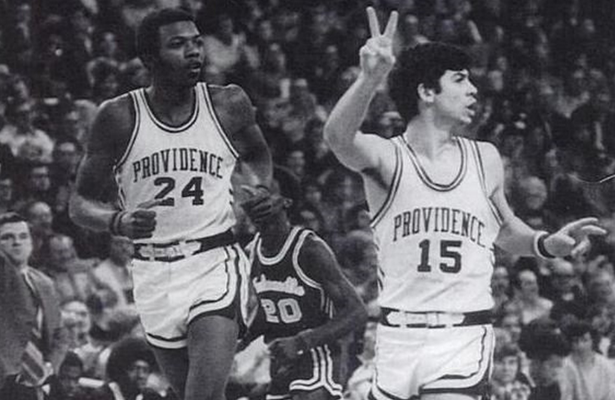
9. Marvin Barnes of South Providence. "Bad News" Barnes teamed with Ernie DiGregorio to lead coach Dave Gavitt's Providence College team to the NCAA Final Four in 1973. He became one of the stars of the ABA, playing for the Spirits of St. Louis, winning the league's Rookie of the Year in 1975 and making its '75 and '76 All-Star Games. He was later named to the ABA All-Time Team.

After the merger with the NBA, he played for the Detroit Pistons, the Buffalo Braves (after they let Ernie D go), the Boston Celtics (ditto) and the San Diego Clippers (whom the Braves became in 1978). His career was ruined by cocaine abuse, and, after getting clean, he became an anti-drug counselor. Providence retired his Number 24.

8. Steve Furness of Warwick. He starred for URI in football and track, and was invited to attend the 1972 U.S. Olympic trials for his success in the hammer throw. He turned it down, as it would have conflicted with attending training camp for the Pittsburgh Steelers.

He made the right choice: It's hard to imagine whatever he could have done in the Olympics, with the hammer thrown then dominated by steroid-ridden Eastern Europeans, with the 4 Super Bowl rings he won as a Steeler defensive tackle. When Steeler assistant coach George Perles was named head coach at Michigan State, he took Furness on his staff, and he helped them win 2 Big Ten titles.

7. Ernie DiGregorio of North Providence. Like Pistol Pete Maravich, Ernie D got a lot of hype in the 1970s, a time when the black takeover of the NBA was completed, for being a white basketball player with a lot of talent and a cool nickname.

In 1973, he and the aforementioned Marvin "Bad News" Barnes led Providence College to the Final Four. In 1974, playing for the Buffalo Braves (the team now known as the Los Angeles Clippers), he led the NBA in free throw percentage and assists per game, and was named Rookie of the Year. In 1977, he led in free throw percentage again.

Ultimately, though, his career was a disappointment. The Los Angeles Lakers acquired him for the 1977-78 season, hoping that he and Kareem Abdul-Jabbar could lead them back to the title, which he never got close to in Buffalo. But the bigger market proved him to be a big fish in a small pond. The Lakers waived him after only 25 games.

He was picked up by the Boston Celtics in 1978, and they soon let him go, too. By the time both teams had won the title again (the Lakers in 1980 and the Celtics in '81), Ernie D was finished, having played his last NBA game at age 27. In today's expansion-ridden league, he'd probably have hung on for a few more years.

He became a high school coach, including at a school for the deaf. He now works at Foxwoods Resort in Mashantucket, Connecticut, not far from his North Providence hometown. Providence retired his Number 15.
Bad News Barnes and Ernie D in 1973

6. Mark van Eeghen of Cranston. He set the single-season rushing record at Colgate University, and at the time of his retirement, he was the all-time leading rusher in Oakland Raiders history, winning Super Bowls XI and XV.

He returned to New England to finish his career with the Patriots, finishing with 6,651 yards rushing, 1,583 receiving, and 41 touchdowns. His daughter Amber van Eeghen became a Patriots cheerleader, and is married to Dan Koppen, a Pro Bowl center for the Patriots.

5. Gerry Philbin of Pawtucket. A defensive end, he was a member of the Jets' Super Bowl III team. He was twice named to the All-AFL team, and was named to the All-Time AFL Team and the New York Jets Ring of Honor.

4. Mathieu Schneider of Woonsocket. Although born in Manhattan, and spending part of his childhood in West New York, New Jersey, Rhode Island was where he was trained to play hockey. He won the 1993 Stanley Cup with the Montreal Canadiens, and the 1996 World Cup of Hockey with the U.S. team. In 22 NHL seasons, he scored 223 goals and had 520 assists, very good totals for a defenseman.

3. Vinny Pazienza of Cranston. He has since legally shortened his name to "Vinny Paz." I'm not going to argue with a man whose nickname was "The Pazmanian Devil."

He won the IBF Lightweight Championship by defeating Greg Haugen at the Providence Civic Center (now the Dunkin Donuts Center) on June 7, 1987. Just 8 months later, Haugen took the title back at Convention Hall in Atlantic City (another name change, it's now Boardwalk Hall). On October 1, 1991, he scored a TKO victory over Gilbert Dele to win the WBA Light Middleweight Championship at "The Dunk," a title he was later forced to forfeit when an injury made him back out of a defense.

Was it the hometown factor? Maybe not: While he was 12-0 in Rhode Island, he was a strong 19-3 in New Jersey, his other losses there being to Hector "Macho" Camacho and Roy Jones Jr. He also lost to Roger Mayweather (brother of Floyd Sr. and uncle of Floyd Jr.). Overall, he was 50-10, but was 40-5 as late as June 1995.

2. Davey Lopes of East Providence. He pronounces it as one syllable (Loaps), instead of the traditional two (LOH-pez). New England has a significant Portuguese community, and Portugal once had extensive colonial holdings in Africa, now independent nations. This included the islands of Cape Verde, and Lopes may be the most famous living American of Cape Verdean descent. This would not be true if Lisa "Left Eye" Lopes of TLC, not known to be related, were still alive. Wayne Fontes, who briefly played for the Jets in their early days as the Titans, and coached the Detroit Lions to 4 Playoff berths, is also of Cape Verdean descent.

The 2nd baseman and leadoff hitter for the 1970s Los Angeles Dodgers, he was a 4-time All-Star, led the National League in stolen bases in 1975 and '76, won a Gold Glove in 1978, and helped the Dodgers win the Pennant in 1977, '78 and '81, facing the Yankees in the World Series all 3 times, driving them nuts with his speed and surprising power (he hit 3 home runs in the '78 Series), finally winning it in 1981.

He was also a member of the 1984 Chicago Cubs and the 1986 Houston Astros, who won Division titles but lost in the NL Championship Series. He stole 551 bases in his career, and his steal percentage of 83 percent is 3rd-highest among all MLB players with at least 400 attempts.

The Dodgers and the Philadelphia Phillies have faced each other in the NLCS 5 times, and Lopes was involved in all 5. As a Dodger player, he won in 1977 and '78, and lost in '83. As a Phillie coach, he won in 2008 and '09, and the Phils won the Pennant both times, winning the World Series in 2008 and losing it to the Yankees in 2009.

He also reached the postseason on the coaching staffs of the San Diego Padres in 1996, '98 (reaching the World Series in '98 but losing to the Yankees) and 2005; the Phillies in 2007 and '10; the Dodgers in 2013, '14 and '15; and the Washington Nationals last year. (And they are on pace to get back in this year.) He has had one managing job, with the Milwaukee Brewers from 2000 to 2002.

1. Napoleon Lajoie of Woonsocket. That's pronounced LAH-zhoh-way. Known as Nap for short, the Frenchman for his ancestry, and Larry (I can't find the source of that nickname), he hasn't played a game in over 100 years, but he's still tops.

Charles Leo "Gabby" Hartnett, the great Chicago Cubs catcher who also managed them to the 1938 Pennant, was also born in Woonsocket, but grew up in nearby Millville, Massachusetts, and thus qualifies for that State.

In 1901, the American League's 1st season, playing for the Philadelphia Athletics, Nap became its 1st batting champion, and set a League record for batting average. For a long time, it was listed as .422. It was eventually checked, and revealed to be .426, the highest batting average for a single season in the 20th Century. He was also the AL's 1st leader in home runs and RBIs, thus winning him the Triple Crown.

Since he had jumped Leagues, having previously played for the Philadelphia Phillies, legal issues prevented him from playing in the State of Pennsylvania for any team but the Phillies. So the A's had to trade him in 1902, and he went to the Cleveland Blues. He proved so popular there that, in 1905, not only was he named player-manager, but they were renamed for him: The Cleveland Naps. (In 1915, after he left, they were renamed the Indians.)
A colorized photo

He won 3 AL batting titles. He batted .339 lifetime, and collected 3,252 hits. He wasn't as good as a manager, never coming closer to a Pennant than a near-miss in 1908. He was among the earliest inductees to the Baseball Hall of Fame, attending its opening ceremony in 1939, along with Tris Speaker, who may have succeeded him as the Indians' greatest player. He was also one of the most admired players of his time, but fans and opponents alike.

He was elected to the Baseball Hall of Fame in 1937, in its 2nd round of elections, the 1st player at 2nd base chosen. He is in the Cleveland Indians Hall of Fame, but, although he starred for both the Phillies and the A's, he has never been elected to the Philadelphia Baseball Wall of Fame. He played before there were All-Star Games, and also before there were uniform numbers, so, of course, there's no number to retire for him.

Nevertheless, Nap Lajoie is still on the short list for the title of greatest 2nd baseman who ever lived, and he's Rhode Island's greatest athlete.

May 29, 1917: Happy 100th Birthday, JFK

May 29, 1917, 100 years ago: John Fitzgerald Kennedy is born at his family's home at 83 Beals Street, in the Boston suburb of Brookline, Massachusetts.

I don't remember either Jack or Bobby Kennedy as a living, breathing, acting, achieving, dreaming public figure. I only know them as martyred heroes. Nor do I remember Ted Kennedy as an untainted public figure: The Chappaquiddick accident (and, yes, it was an accident) happened 5 months before I was born.

I don't know what it was like in those 10 years and change from November 22, 1963 to August 9, 1974, when the nation had to suffer through Vietnam, race riots and Watergate. Whether JFK would have made it different, I don't know.

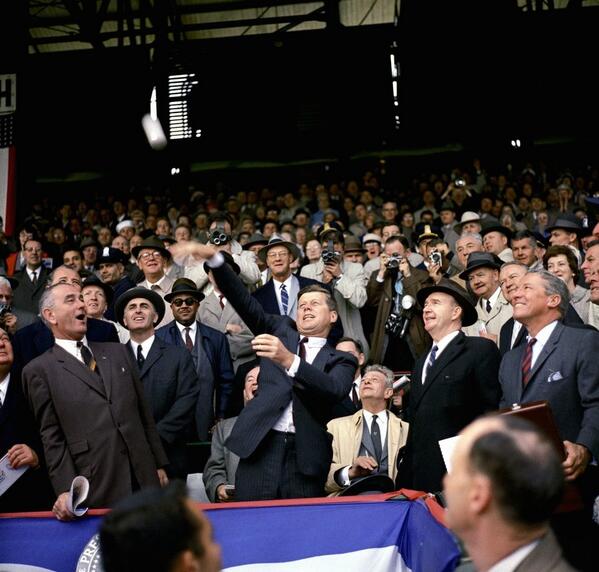
I do know that all 3 Kennedy brothers were big sports fans. JFK threw out the ceremonial first ball on Opening Day in Washington all 3 Aprils he was in office. This included 1962, when the Washington Senators opened (after the NFL's Washington Redskins had already played their first season there the fall before) District of Columbia Stadium. Just 7 years later, D.C. Stadium would be renamed for his brother, Robert F. Kennedy Memorial Stadium. (Or "RFK Stadium.")

JFK liked attending the Army-Navy Game at Municipal Stadium in Philadelphia. The stadium would be renamed for him after his assassination. As Presidents traditionally did, so as not to be seen as "taking sides," he sat on the side of the stadium where Army's bench was for one half and the Navy side for the other. But, just as his predecessor, Dwight D. Eisenhower, was an Army General in World War II and people joked he couldn't truly be neutral in the game, JFK was a Navy hero in the same war, and probably also wasn't exactly impartial.
Tossing the coin at the 1961 Army-Navy Game.

Oldest brother Joseph P. Kennedy Jr. played football at Harvard University. Jack didn't make the varsity. Bobby did, scoring a touchdown against Western Maryland, but injuring his ankle. He hadn't yet won his varsity letter, and, in those days, the only way you could was by playing in The Game. Harvard vs. Yale. So it entered into the Kennedy myth that "Bobby Kennedy played in the Harvard-Yale game with a broken leg." No, not a broken leg, but an injured ankle. He did get his letter.
"Some men see Yale beating Harvard, and say, Why?
I dream of Harvard beating Yale, and say, Why not?"
Or something like that.

In a twist of fate, his brother would be assassinated on the anniversary: November 22, 1947. Despite whatever contributions Bobby might have made, Yale won, 31-21 at the Yale Bowl in New Haven, Connecticut.

On November 19, 1955, Ted, easily the best player of the brothers, played two-way end (today, we would call it "tight end" and "defensive end," although in the two-platoon system then taking over football he most likely would have been either a tight end or a linebacker), and caught a pass and took it in for a touchdown in the Yale game.
Ted at Harvard Stadium

What the Kennedy legendeers (myself sometimes included) don't like to say is that it was the only Harvard touchdown of the day; that Ted dropped a pass in the end zone earlier, which might have made a difference; and Yale won, 21-7, also at the Yale Bowl.

This past Saturday, at Harvard Stadium, Harvard beat Yale 28-21, but Yale still solidly leads the all-time series between them, 66-59-8.

When the Red Sox had their "Impossible Dream" season in 1967, the final series of the year was between the Sox and the Minnesota Twins at Fenway Park. Ted had invited Vice President Hubert Humphrey, Minnesota's once and future Senator, to watch the games with him and the now-ailing former Ambassador Joseph P. Kennedy Sr. Bobby wasn't there that weekend, but the TV cameras caught Ted and Hubert sitting together talking about the game.

Interviewed for Impossible To Forget, a 40th Anniversary DVD about that season, Ted said that it was the last summer that he and Bobby were together, and that it made them and their father very happy to see the Red Sox win that Pennant.

When Fenway Park opened on April 20, 1912, throwing out the first-ever first ball was the Mayor of Boston, John F. "Honey Fitz" Fitzgerald, father of Rose, mother of the four Kennedy brothers. In 2009, with Ted battling a brain tumor, the Red Sox invited him to throw out the first ball on Opening Day. Weakened by his battle and 77 years, Ted threw a soft toss to new Hall-of-Famer Jim Rice right in front of the mound.

A little more than 4 months later, Ted joined his brothers, his parents, 3 of his nephews (JFK Jr. and Bobby's sons David and Michael) and all but one of his sisters -- Jean is the only one of the 9 still alive.
The Kennedy vision has outlived its visionary, but it cannot survive if we choose to forget. We must choose to remember.

Judge's Slam Leads Yanks Past A's

Yesterday was a long and busy day. Scheduled for the same 1:00 start as the Yankee game was my sister's party for my niece Mackenzie's 1st birthday, which was this past Tuesday. And she doesn't allow the watching of sports on television while she's hosting a party. One must be very discreet in using one's phone to check the score of one's team.

Then, at 5:00, was the wedding of an old family friend, and I had to use my phone not to check the score, but to give my mother directions -- to a place in a town less than 25 miles away, but in a town neither one of us had ever been to before, and where there was not really a straight road taking us there. A lot of twists and turns on hills. But we made it, and all went well at both the ceremony and the reception. (Except the coffee. That was awful. But that wasn't the bride's and/or groom's fault.) And, once we got there, I was able to look up the score, which had gone final, and it was a win.

So that was a bit of a metaphor for the Yankees' season thus far. Yesterday afternoon, Michael Pineda started the series finale against the Oakland Athletics at Yankee Stadium. He went 6 innings, allowing 3 runs (only 2 of them earned) on 3 hits and 3 walks, with 5 strikeouts.

The Yankees fell behind 2-0 in the top of the 2nd inning, but took a run back in the bottom half, on a sacrifice fly by Aaron Hicks. The Yankees loaded the bases in the 3rd, and Aaron Judge cranked one, his 16th home run of the season -- and was the day before Memorial Day. It was his 1st career grand slam, and it gave the Yankees a 5-2 lead.

The Yankees weren't done. Chris Carter brought a run home with a sac fly in the 4th. Gary Sanchez drove in a run with a double in the 7th.

Chad Green got through the 7th without any trouble, but ran into it in the 8th, allowing 2 runs. Tommy Layne couldn't get out of it, and, with Dellin Betances overworked, Joe Girardi handed the ball to Adam Warren. I'm glad I didn't know that at the time. But Warren got out of the jam, and produced a 4-out save. A Brett Gardner double in the bottom of the 8th got those 2 runs back, and produced the final score: Yankees 9, A's 5. WP: Pineda (6-2). SV: Warren (1). LP: Andrew Triggs (5-4).

It's worth noting that the Baltimore Orioles have slumped, losing 7 straight, and the Boston Red Sox have surged. It is now the Sox who are in 2nd place behind the Yankees in the American League East, 3 games behind the Yankees. The Orioles are 4 1/2 back, the Tampa Bay Rays 5 back, and the Toronto Blue Jays, who got off to an atrocious start, have picked themselves up, and are now only 7 1/2 back. In the all-important loss column, it's the Sox 4 back, the O's 5, the Rays 8 and the Jays 9.

Instead of a doubleheader, as was traditional on Memorial Day, the Yankees go down to Baltimore to begin a series with the sliding O's this afternoon. Jordan Montgomery, who has been a nice surprise thus far, starts for the Pinstripes, and Dylan Bundy for the O's. The Yankees will then head up to Canada for 4 in Toronto.

A side note: One thing that did not go well yesterday was that my legs and my back were acting up. I was in a lot of pain. Fortunately, this morning -- those of you who've read Ball Four will get this -- I'm not sore, I'm just a little stiff. It's a relief.

Sunday, May 28, 2017

CC's Arm, Holliday's Bat Beat A's

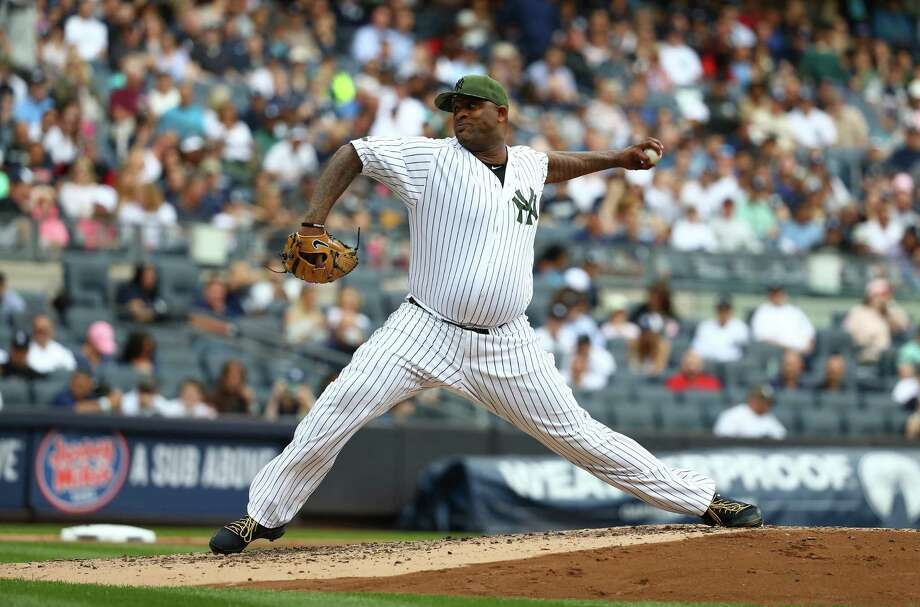
Note the Jersey Mike's ad in the background.
I think CC would like Jersey Mike's subs.

Yesterday, The Arsenal beat Chelsea to win the FA Cup, the New York Red Bulls beat the New England Revolution (yet another bunch of cheaters from New England, but, this time, it didn't work), and the Yankees... won. Not a particularly big game, and not against a particularly big rival. But I'll take it.

CC Sabathia, who grew up in Vallejo, California, with the Oakland Athletics as the closest team, started against them at Yankee Stadium. The Big Fella did well against the team he grew up rooting for, going 6 1/3 innings, allowing 2 runs on 6 hits and 3 walks, striking out 9. Of course, Joe Girardi removed him when his pitch count reached 96. God forbid, he should let a workhorse continue to work well.

The Yankees gave him an early lead to work with. With 1 out in the 1st inning, A's starter Jharel Cotton walked Gary Sanchez, hit Matt Holliday with a pitch, threw a wild pitch that advanced the runners, and gave up a sacrifice fly to Starlin Castro. One-nil to the Pinstripe Boys. (Apparently, I'm still in soccer mode.)

Both teams scored in the 6th inning. The A's scored to tie it, but with 2 out, Cotton again walked Sanchez. Cliche alert: Walks can kill you. This time, Holliday made him really pay for it, crushing a 413-foot home run to the Bleachers in left-center field.

Adam Warren finished off the 7th inning, but, as he did yesterday, Tyler Clippard ran into trouble in the 8th. Girardi must have decided not to look in the binder, because, this time, he took Clippard out before he could blow the game, and decided to risk Dellin Betances on a 5-out save. It worked: Betances faced 5 batters, and got them all out, striking out 3 of them.

Yankees 3, A's 2. WP: Sabathia (5-2 -- matching his uniform number, 52.) SV: Betances (5). LP: Cotton (3-5).

The series concludes this afternoon. Michael Pineda starts against Andrew Triggs. The Yankees go into it 2 games ahead of the Baltimore Orioles in the American League East, 3 in the loss column.

Come on you Pinstripes! (Yeah, I'm still in soccer mode. Don't forget, Arsenal were big underdogs.)

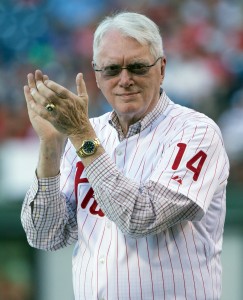
Jim Bunning, 1931-2017

Jim Bunning was a Hall-of-Famer as a pitcher. As a politician, well, let's just say we were not often in agreement. For this post, I'm going to stick to the facts.

James Paul David Bunning was born on October 23, 1931 in Southgate, Kentucky, about 3 miles across the Ohio River from downtown Cincinnati. He was born the same week as Mickey Mantle, but took much better care of himself, and, as a result, lived 22 years longer.

He attended Cincy's St. Xavier High School and Xavier University, getting a degree in economics while pitching minor-league baseball. In 1950, he signed with the Detroit Tigers, and remained in their minor-league system until his promotion in 1955. In between, he married Mary Catherine Theis.

He made his major league debut on July 20, 1955. Wearing Number 15, he started for the Tigers at Briggs Stadium (renamed Tiger Stadium in 1961), and lost to the Baltimore Orioles 6-3. Eventually, he switched to Number 14, and developed a hard slider, and a pitching motion that made his 6-foot-3, 190-pound frame look like it was jumping out at the batter, much as did that of fellow future Hall-of-Famer Bob Gibson. That slider enabled him to pitch a no-hitter against the Boston Red Sox on July 20, 1958, a 3-0 win at Fenway Park.

Sox star Ted Williams was not impressed. Jim Pagliaroni, a rookie catcher on the Sox in Ted's last season, 1960, recalled hearing Ted psych himself up in batting practice, saying things like, "My name is Ted Fucking Williams!" (He would swing the bat, and hit the ball, and produce a Crack! sound.) "And I'm the greatest hitter in baseball!" (Crack!) "Jesus H. Christ himself couldn't strike me out!" (Crack!) "Here comes Jim Bunning!" (Crack!) "Jim Bunning, with that little shit slider of his!" (Crack!) "He can't get me out, I'm Ted Fucking Williams!" (Crack!)

After the 1963 season, the Tigers traded Bunning and his slider -- Williams' opinion to the contrary, a really good one -- to the Philadelphia Phillies. The Phils raced out to 1st place in the National League, and Bunning was a big reason why. On June 21, 1964, he pitched a perfect game against the Mets at brand-new Shea Stadium.

It was the 1st regular-season perfect game in 42 years (Don Larsen, of course, pitched one in the World Series 8 years earlier), the 1st by a National League pitcher in 84 years, and the 1st no-hitter by a Phillies pitcher in 58 years. It made him only the 2nd pitcher to have pitched no-hitters in both Leagues, after Cy Young. (They have since been joined by 2 others: Nolan Ryan and Hideo Nomo.) He even doubled home 2 runs in the 6th inning, as the Phils won 6-0. It was the 1st game of a doubleheader, and the Phils also won the 2nd game, 8-2, as Rick Wise got his 1st major league win.

It was Father's Day, and Bunning was already the father of 7 children. Eventually, he would have 9, including David Bunning, now a federal judge. He had 35 grandchildren, including Patrick Towles, now the starting quarterback at the University of Kentucky; and 14 great-grandchildren.

But that 1964 season would end in embarrassment for the Phillies, as they had a 6 1/2-game lead with 12 games to play, lost 10 straight games, and blew it. for over half a century, manager Gene Mauch has been criticized for overpitching righthander Bunning and lefthander Chris Short during the slide. Fair or not, the St. Louis Cardinals won the Pennant, and then the World Series.

The Phils traded Bunning to the Pittsburgh Pirates in 1968, they traded him to the Los Angeles Dodgers in 1969, and they traded him back to the Phillies in 1970. That year, the Phils closed out their tenure at Connie Mack Stadium. On April 10, 1971, Bunning started and won the 1st game at Veterans Stadium, beating the Montreal Expos 4-1.

He retired at the end of that season, with a record of 224-184, becoming only the 2nd pitcher, after Cy Young, to have won at least 100 games in each League: 118-87 in the American, and 106-97 in the National. His career ERA was 3.27, his ERA+ 115, and his WHIP 1.179. He had 2,855 strikeouts, then 2nd on the all-time list behind Walter Johnson. He was a 9-time All-Star, was elected to the Philadelphia Baseball Wall of Fame in 1984, was elected to the Baseball Hall of Fame in 1996, and had his Number 14 retired by the Phillies in 2001.

*

In 1977, he was elected to the City Council in Fort Thomas, Kentucky. In 1979, he was elected to the State Senate. In 1983, he was the Republican nominee for Governor, but lost. In 1986, he ran for the U.S. House of Representatives, for the District that included the Kentucky suburbs of Cincinnati, including Cincinnati/Northern Kentucky International Airport. It is considered the State's most conservative District, and he won it 6 times.

When longtime Democratic Senator Wendell Ford retired, Bunning won his seat. Winning this seat in November 1998 and being sworn into it in January 1999 made him 1 of 2 Republicans who voted to impeach President Bill Clinton in the House, and then vote to convict him in his impeachment trial in the Senate. The other was Mike Crapo of Indiana. Of course, Clinton was acquitted, because the Republicans had no admissible evidence.

In 2004, knowing that his District depended on the Ohio River flowing well, and not flooding he sponsored a bill that became the Bunning-Bereuter-Blumenauer Flood Insurance Reform Act of 2004. (Apparently, to sponsor it, you had to have a German last name that started with a B.)

But that year, as he approached his 73rd birthday, people began criticizing him for "bizarre" behavior, especially concerning allegations he made against his Democratic opponent as he ran for re-election. His race was a lot closer than it was expected to be.

In April 2006, Time magazine did a profile on "America's Five Worst Senators." Fairly or not, it named Bunning to that list, saying he treated his staff badly and "shows little interest in policy unless it involves baseball." He had been part of the investigation into steroid use in the game. (I said I would stick to the facts. Saying that he was one of the worst Senators would be an opinion, and Time held it; saying that Time called him that is a fact.)

In 2009, as the Bush Recession hit rock bottom, he refused to vote for a bill boosting unemployment insurance until he was mollified with some amendments. His approval rating dropped to 28 percent, and he announced he wouldn't run again in 2010.
Jim Bunning continued to attend induction ceremonies for both the Baseball Hall of Fame and the Philadelphia Baseball Wall of Fame until last year, when he suffered a stroke. He died in a hospital in Southgate on May 26, 2017, at the age of 85.

UPDATE: He was buried at St. Stephen Cemetery in Fort Thomas, Kentucky.