It's appropriate that I do a CFL Trip Guide on July 1, 2017, Canada Day -- not just the national holiday, but the 150th Anniversary of Confederation.
The Winnipeg Blue Bombers are currently playing their season opener, away to their arch-rivals, the Saskatchewan Roughriders. Next Friday night, they play their home opener, against the Calgary Stampeders.
UPDATE: The Bombers won, 43-40 in overtime.
Before You Go. Winnipeg is in Manitoba. Manitoba is in Canada. But it's July, so the legendary Canadian cold will not be an issue. The website for the
Winnipeg Free Press is predicting low 80s for Friday afternoon, and low 60s for night.
Winnipeg is in Canada, so you're going to need to have, and bring, a valid passport. It's also in the Central Time Zone, 1 hour behind New York and New Jersey. Adjust your timepieces accordingly.
Do yourself another big favor: Change your money before you go. There are plenty of currency exchanges in New York City, including one on 42nd Street between 7th and 8th Avenue.
Leave yourself $50 in U.S. cash, especially if you’re going other than by plane, so you’ll have usable cash when you get back to your side of the border. At this writing, the exchange rate is US$1.00 = C$1.30, while C$1.00 = US 77 cents, so, for the moment, it really favors us.
Tickets. The Bombers averaged 25,936 fans per home game last season, about 77 percent of capacity. Getting tickets shouldn't be very hard.
The prices I'm citing are in Canadian dollars. In the lower bowl, midfield seats are $140, sideline seats are $114, and end zone seats are $51. In the upper deck, midfield seats are $64, and corner seats are $28. (No end zone seats up there.)
Getting There. It's 1,653 miles from Times Square to the Manitoba Legislative Building, the Province's capitol building; 1,648 miles from the Prudential Center in Newark to the MTS Centre in Winnipeg; and 66 miles from the closest border crossing, at Pembina, North Dakota, to downtown Winnipeg. (I won't be doing these for the CFL teams, but Regina, Saskatchewan, which only has a team in that League, is 1,940 miles from Times Square, and 101 miles from the closest border crossing, at Raymond, Montana.)
Knowing this, your first instinct will be to fly. Air Canada offers round-trip flights from Newark Liberty to Winnipeg's James Armstrong Richardson International Airport for as little as $837. (Richardson was a Member of Parliament, and Minister of Defence under Prime Minister Pierre Trudeau in the 1970s.) Unfortunately, there are no nonstop flights: You'd have to change planes in either Ottawa or Toronto.
You can't get from New York to Winnipeg directly by train, either. You have to change trains in Toronto.
Amtrak, however, runs just one train, the Maple Leaf, in each direction each day between New York and Toronto, in cooperation with Canada’s equivalent, VIA Rail. This train leaves Pennsylvania Station at 7:15 AM and arrives at Union Station at 7:42 PM, a trip of 12 hours and 22 minutes – 9:10 of it in America, 32 minutes of it at Customs (4:25 to 4:57 PM) and 2:45 of it in Canada. The return trip leaves Toronto at 8:20 AM, reaches the border at 10:22, and gets back to Penn Station at 9:45 PM.
Likewise, VIA Rail has just 1 train running every other day from Toronto to Winnipeg, leaving Toronto at 10:00 PM (giving you 2 hours and 18 minutes to make the change) and taking 35 hours to get to Winnipeg, arriving at 8:00 AM. It then leaves Winnipeg at 10:30 PM and arrives in Toronto at 9:30 AM 2 days later.
And the itinerary doesn't matter, because, on the available day, the train is already sold out. So let's move on.
How about the bus? Greyhound does serve Canada. But you'd have to start out from Port Authority at 12:15 AM Wednesday, and arrive at Winnipeg at 7:45 PM Thursday, in order to attend the game on Friday night. That's 43 1/2 hours: Not only is Ontario huge, but you'll be going around 3 of the 5 Great Lakes: Ontario, Huron and Superior. And you'd have to change buses in Toronto. It'll cost you $466.
Or maybe driving would be better. Keep in mind, it's better to do this with 2 people, so 1 can drive while the other sleeps. And you'll both need passports. And make sure your companion isn't someone who would say or do some wiseass thing at Customs, like answer the question, "Do you have anything to declare?" with, "I declare that I'm proud to be an American."
The most direct route bypasses Buffalo, Hamilton and Toronto -- in fact, it doesn't go through Ontario at all.
You'll need to get into New Jersey, and take Interstate 80 West. You'll be on I-80 for the vast majority of the trip, through New Jersey, Pennsylvania and Ohio. In Ohio, in the western suburbs of Cleveland, I-80 will merge with Interstate 90. From this point onward, you won’t need to think about I-80 until you head home; I-90 is now the key, through the rest of Ohio and Indiana.
Just outside Chicago, I-80 will split off from I-90, which you will keep, until it merges with Interstate 94. For the moment, though, you will ignore I-94. Stay on I-90 through Illinois, until reaching Madison, Wisconsin, where you will once again merge with I-94. Now, I-94
is what you want, taking it into Minnesota and the Twin Cities.
However, unless you want to make a rest stop actually in Minneapolis or St. Paul, you're going to bypass them entirely. Take Exit 249 to get on Interstate 694, the Twin Cities' beltway, until you merge with Interstate 494 to reform I-94. Crossing Minnesota into North Dakota, you'll take Exit 349B to get on Interstate 29 North. At Pembina, North Dakota, you'll reach Customs.
Assuming you have everything in order and don't do anything stupid, you'll be allowed to cross over into Emerson, Manitoba, and your highway will continue as Manitoba Route 29. This will soon flow into Manitoba Route 75, the Lord Selkirk Highway. Upon crossing Route 300, it will become Manitoba Route 42. Take that to Manitoba Route 62, and that will take you into downtown Winnipeg.
If you do it right, you should spend about an hour and a half in New Jersey, 5 hours and 15 minutes in Pennsylvania, 4 hours in Ohio, 2 and a half hours in Indiana, an hour and a half in Illinois, 2 and a half hours in Wisconsin, 4 and a half hours in Minnesota, 2 hours and 45 minutes in North Dakota, and a shade over an hour in Manitoba. That’s 24 hours and 30 minutes.
Counting rest stops, preferably halfway through Pennsylvania and just after you enter both Ohio and Indiana, outside Chicago, halfway across Wisconsin, outside the Twin Cities, outside Grand Forks, and counting Customs, which should have a bathroom and vending machines, it should be no more than 33 hours, which would save you time on both Greyhound and Amtrak, if not on flying.
And, on October 14, 2016, President Obama finally ended the ban on bringing Cuban cigars into America. This also applies to rum, for which Cuba is also renowned. It is still considerably easier to buy these items in Canada than in America, but, now, you can bring them back over the border.
Once In the City. The name Winnipeg comes from the Western Cree words for "muddy waters." The region was a trading center for aboriginal peoples (usually called "First Nations" in Canada, rather than "Indians" or "Native Canadians") before the arrival of Europeans. French traders built the first fort on the site in 1738. A settlement was later founded by the Selkirk settlers in 1812, the nucleus of which was incorporated as the City of Winnipeg in 1873.
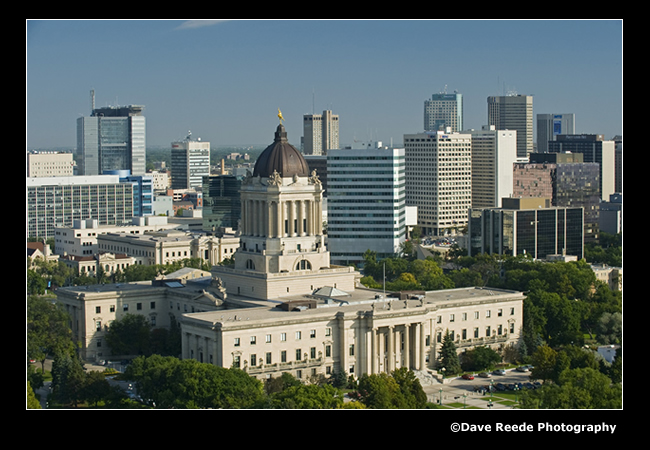
The Manitoba Legislative Building,
equivalent to a State Capitol or State House
According to the figures I have, Winnipeg has a population of 705,000, more than fellow NHL cities Detroit, Denver, Boston, Washington, Nashville, Vancouver, Raleigh, Miami, Minneapolis, Tampa, Anaheim, St. Louis, Pittsburgh, Newark and Buffalo -- but only 812,000 in its metropolitan area, meaning their "suburbs" add up to only 107,000 people. They are last in metro-area population in the NHL, although they are ahead of Hamilton and Regina in the CFL. The people are about 68 percent white, 13 percent East Asian, 11 percent Aboriginal, 4 percent South Asian, 3 percent black, 1 percent Hispanic and 1 percent Middle Eastern.

Since Canada is in the British Commonwealth, there are some subtle differences. Every measurement will be in the metric system. Dates are written not as Month/Day/Year, as we do it, but as Day/Month/Year as in Britain and in Europe. So the game is played for us on "July 7, 2017," but for them on "7 July 2017." The day before would be written by us as 7/6/17, but by them as 6/7/17.
They also follow British custom in writing time: This game is scheduled to start at 6:00 PM, and will be listed as 1800. (Those of you who have served in the military, you will recognize this as, in the words of M*A*S*H's Lt. Col. Henry Blake, "all that hundred-hours stuff.") And every word we would end with -or, they will end with -our; and some (but not all) words that we would end with -er, they end with -re, as in "MTS Centre."
Another thing to keep in mind: Don't ask anyone where the "bathroom" is -- ask for the "washroom." This difference was a particular pet peeve of mine the first time I visited Toronto, although it wasn't a problem in Montreal as I knew the signs would be in French.
Every measurement will be in the
metric system: Temperatures will be in Celsius, not Fahrenheit; distances will be in "kilometres," not miles (including speed limits, so don't drive 100 thinking it's miles); and gas prices will be per "litre," not per gallon (so don't think you're getting cheap gas, because a liter is a little more than a quart, so multiply the price by 4, and you'll get roughly the price per gallon, and it will be
more expensive than at home, not less). Better to get gas at one of your rest stops before going into Canada.
Manitoba's sales tax is 13 percent -- in 2010, this replaced the former Provincial sales tax of 5 percent and the federal GST (Goods & Services Tax) of 8 percent. In other words, the Conservative Party government of Prime Minister Stephen Harper wanted Canadians to think he'd killed the hated GST, when, in fact, Manitobans are paying pretty much the same taxes that they did before. See how stupid it is to vote for conservative candidates? It doesn't work in any country, as Canada recently admitted by dumping Harper and his Tories for Justin Trudeau and his Liberals.
The Red River divides street addresses into east and west, and the Assiniboine River divides the city into north and south. Winnipeg doesn't have a subway, and its buses are $2.50 cash and $2.15 for a prepaid ticket. Again, that's in Canadian dollars, making it cheaper than New York's MTA or New Jersey Transit. The city has no freeway "beltway."
The drinking age in Manitoba is 18. Postal Codes in Manitoba begin with the letter R. The Area Codes are 204 and 431. Utilities are run by Manitoba Hydro.
Going In. Today, the Blue Bombers play at Investors Group Field. Opening in 2013 on the campus of the University of Manitoba, it is a 33,500-seat facility that can be expanded to 40,000. The address is 315 Chancellor Matheson Road, at University Crescent, about 6 miles south of downtown. Take the Number 60 bus from downtown to the aforementioned intersection, across from IGF's southeast corner. If you drive in, parking is C$20.
The funky roof protects nearly the fans, but not the players, from precipitation, much like the old Texas Stadium outside Dallas. The playing surface is FieldTurf, and runs north-to-south. Remember, it's Canadian football, so the field is 110 yards long, not 100; 65 yards wide, not 53 1/3rd; with end zones 25 yards deep, not 10, so the passing game has more primacy; 12 men on a side, not 11; and 3 downs to get a new 1st down, not 4.
IGF hosted the 2015 Grey Cup (Edmonton beat Ottawa), and 7 games of the 2015 Women's World Cup, including the U.S.' win over Australia and draw with Sweden en route to winning the Cup. Last October 23, it hosted the NHL Heritage Classic, with the Winnipeg Jets beating the Edmonton Oilers 3-0.
Taylor Swift played its 1st concert, but its 1st sold-out concert was by then 71-year-old Paul McCartney. (For comparison's sake: When Taylor Swift was born in 1989, Paul was 47, on one of his biggest tours, and was still making the U.S. Top 40. Taylor should be so lucky in 2036.) The King and Queen of recent pop music, Jay-Z and Beyonce, played it in 2014, 1 of only 2 Canadian venues on their tour (the other being the Rogers Centre in Toronto).
In 2018, the Canadian Premier League, Canada's attempt at a "top flight" soccer league, will begin play, and Winnipeg will have a team, as yet unnamed, playing at IGF.
UPDATE: The League will start instead in Spring 2019, and will include Valour FC, owned by, and groundsharing with, the Blue Bombers.
Food. Lots of good stuff is available:
Section 101 Shawarma Khan Mobile Cart (Propriety Items plus Beverages)
Section 102 Danny’s Whole Hog Mobile Cart (Pulled Pork Sandwiches, Beer, Beverages, Snacks)
Section 103 PIZZA HOTLINE (Pizza Products, Beer, Snacks & Beverages)
Section 104 Bottoms Up Mobile Cart (Draught Beer)
Section 105 Filipino Mobile Cart (Filipino food, Beverages)
Section 106 SALISBURY HOUSE (Salisbury House propriety Items, Beer, Popcorn, Beverages, Snacks)
Section 109 Chicken Tenders & Wings (Fried Chicken, FF, Beverages, Hot Dogs, Beer, Snacks)
Section 111 Pretzel Place Mobile Cart (Pretzel items, Beverages, Beer, Snacks)
Section 112 GOAL LINE (Speciality Drinks, Beer, Liquor, Coolers, Wine)
Section 113 Mighty Mini Donuts Mobile Cart (Donuts & Beverages)
Section 115 MVP Mobile Cart (Individual Ice Creams, Snacks, Beverages, Beer)
Gate 2 Back Field Bar (Liquor)
Section 117 Bottom’s Up Mobile Cart (Draught Beer)
Section 117 PIZZA HOTLINE (Pizza Products, Gilati, Snacks, Beverages, Beer)
Section 118 Buzz & Boomer Burgers & Dogs Mobile Cart (Burgers, Hot Dogs, Snacks, Beverages, Beer)
Section 119 MVP Hot Dog Cart Mobile Cart (Individual Ice Creams, Snacks, Beverages, Beer)
Section 121 Clay Oven (East Indian Cousine, Beverages)
Section 121 MVP Mobile Cart (Individual Ice Creams, Snacks, Beverages, Beer)
Section 122 Backfield Bar Mobile Cart (Draught Beer)
Section 123 Bottom’s Up Mobile Cart (Draught Beer)
Section 124 Shawarma Khan Mobile Cart (Propriety Items plus Beverages)
Section 125 FIRST DOWN (Speciality Hot Dogs, Beverages, Beer, Snacks, Candy)
Section 126 Mighty Mini Donuts (Donuts & Beverages)
Section 127 POUR HOUSE (Speciality Drinks, Beer, Liquor, Wine)
Section 128 Chicken Tenders & Wings (Fried chicken, Beverages, Beer, Snacks)
Section 130 Bottom’s Up Mobile Cart (Draught Beer)
Section 131 Salisbury House ( Burgers, Hot Dogs, FF, Snacks, Beer, Beverages)
Section 133 Pretzel Place Mobile Cart (Pretzel items, Beverages, Beer, Snacks)
Section 134 Captain Blue Poutinerie (Poutine, Beer, Snacks)
Section 135 Danny’s Whole Hog Mobile Cart (Pulled Pork Sandwiches, Beer, Beverages, Snacks)
Section 137 Caesars & Beer Mobile Cart (Canned Beer Products)
Section 138 Bottoms Up Mobile Cart (Draught Beer)
Section 138 RUM HUT (Speciality Drinks, Beer, Liquor, Coolers, Wine)
Section 138 Bottom’s Up Mobile Cart (Draught Beer)
Section 141 Burger/Filipino Cart Mobile Cart (Filipino food, Burgers, Beverages)
Section 142 Shock Top Specialty Beers Mobile Cart (Premium draught beer, canned beer)
Section 142 New Amsterdam Vodka Bar (Speciality Drinks, Beer, Liquor, Coolers, Wine)
Section 142 Backfield Bar Mobile Cart (Draught Beer)
Section 144 Bottoms Up Mobile Cart (Draught Beer)
Section 144 Mighty Mini Donuts Mobile Cart (Donuts & Beverages)
200 Level Concourse Concessions Listing
200 Level East Side Concessions Listing
Section 201 Backfield Bar Mobile Cart (Canned Beer Products)
Section 203 HOME GROWN (Local Product, Hot Dog’s, Beverages, Beer, Snacks, Popcorn)
Section 206 GRID IRON GRILL (Burgers, Hot Dogs, FF, Snacks, Beer, Beverages)
Section 208 Chicken Tenders & Wings Mobile Cart (Fried Chicken, Snacks, Beverages)
Section 208 Shawarma Khan Mobile Cart (Propriety Items plus Beverages)
Section 210 Pretzel Place (Pretzel items, Beverages, Beer, Snacks)
Section 210 Upper Deck Bar Mobile Cart (Draught Beer)
Section 212 Mini Donuts Mobile Cart
Section 212 The Greats (Hot Dogs, Popcorn, Wraps, Beverages, Beer)
Section 214 Touch Down Bar (Speciality Drinks, Beer, Liquor, Wine)
Section 215 New Amsterdam Vodka Bar Mobile Cart (Speciality Drinks, Beer, Liquor, Coolers, Wine)
200 Level West Side Concessions Listing
Section 223 Backfield Bar (Speciality Drinks, Beer, Liquor, Coolers, Wine)
Section 224 Pretzel Place (Pretzel items, Beverages, Beer, Snacks)
Section 225 HOME GROWN (Local Product, Beverages, Hot Dogs, Popcorn, Beer, Snacks)
Section 228 Shawarma Khan Mobile Cart (Propriety Items plus Beverages)
Section 229 GRIDIRON GRILL (Burgers, Hot Dogs, FF, Snacks, Beer, Beverages)
Section 230 Bottoms Up Mobile Cart (Draught Beer)
Section 231 The Greats (Hot Dogs, Popcorn, Wraps, Beverages, Beer, Snacks)
Section 232 Upper Deck Bar Mobile Cart (Canned Beer Products)
Section 234 Mini Donuts Mobile Cart
Section 234 Chicken Tenders & Wings (Hot Dogs, Popcorn, Wraps, Beverages, Beer, Snacks)
Section 236 Touch Down Bar (Speciality Drinks, Beer, Liquor, Wine)
Section 237 Appletons Bar Mobile Cart (Speciality Drinks, Beer, Liquor, Coolers, Wine)
Team History Displays. The Bombers were founded in 1930 as the Winnipeg Football Club, which remains their official name today. They wore blue, and merged with another club, wearing gold, to forge the colors known today.
They became known as the Winnipeg 'Pegs, and it was under this name that they won their 1st Grey Cup, in 1935. This made them the 1st team west of Ontario to win it.
Winnipeg Tribune sportswriter Vince Leah, as a takeoff on Joe Louis' nickname the Brown Bomber, called the team the Blue Bombers, and so they have been ever since.
The good news is that the Bombers have won 10 Grey Cups, more than any team except the Toronto Argonauts and the Edmonton Eskimos. The bad news is that they've gone longer without winning it than any CFL team, last taking the Cup on November 25, 1990, 50-11 over the Eskimos at BC Place in Vancouver. That was their 3rd Cup in 7 years, and they won 4 in 5 years from 1958 to 1962, under Bud Grant, who would later coach the Minnesota Vikings. Grant now has a statue outside the stadium.
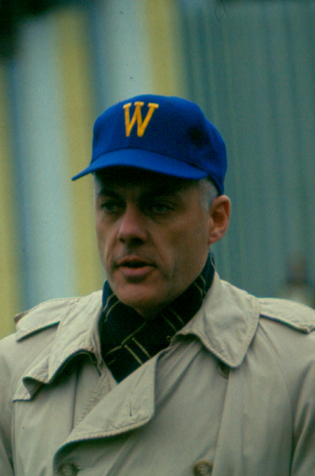
Bud Grant. And he was only in his early 30s then.
He's 90 now, and still beloved in Manitoba and Minnesota.
And they have made the Grey Cup Final 5 times since 1990, most recently in 2011 with their "Swaggerville" defense. But they still haven't won it in 17 years.
In 2005, the Bombers named a 75th Anniversary team. The players are, in alphabetical order: Greg Battle, Dieter Brock, Tom Clements, Herb Gray, Bob Cameron, Tom Casey, Fritz Hanson, Rick House, Jack Jacobs, Gerry James, Trevor Kennerd, Leo Lewis, James Murphy, Ken Ploen, Frank Rigney, Charles Roberts, Joe Poplawski, Willard Reaves, Milt Stegall and Chris Walby.
There are 32 men connected with the Blue Bombers in the Canadian Football Hall of Fame. They are:
* From the 1935, 1939 and 1941 Grey Cup Champions: Club founder and 1st CFL Commissioner Sydney Halter, team president Frank Hannibal, team executive Joe Ryan, team executive Karl Slocomb, running back and defensive back Melvin "Fritz" Hanson, running back and defensive back Eddie James, running back and defensive back Greg Kabat, running back and defensive back Russ Rebholz, running back and defensive back Art Stevenson, receiver and defensive back Chester "Ches" McCance, offensive and defensive tackle Les Lear. Bert Warwick was a quarterback on this team, later coached the Bombers into the 1945 Grey Cup Final (which they lost), and was later elected to the Hall of Fame as a "Builder" for his service at the League level. Halfback Joe Nicklin was also on this team, and he's noteworthy for a reason I'll get to shortly.
* From the 1950 and 1953 Western Interprovincial Football Union Champions (winning the WIFU but losing the Grey Cup Final): Quarterback Jack Jacobs, running back and defensive back Tom "Citation" Casey, running back and defensive back Gerry James, offensive and defensive tackle Dick Huffman. Gerry James was the son of the aforementioned Eddie James, and also played for the Toronto Maple Leafs. In 1959-60, he became the only man ever to play in the Grey Cup Final and the Stanley Cup Final in the same season, winning the former and losing the latter. Guard Tommy Lumsden also played for this team.
* From the 1958, 1959, 1961 and 1962 Grey Cup Champions: Coach Grant, James, quarterback Ken Ploen, running back Leo "the Lincoln Locomotive" Lewis, offensive tackle Frank Rigney, offensive and defensive tackle Robert "Buddy" Tinsley, and defensive end (and sometimes also guard) Herb Gray.
Leo Lewis
* From the 1965 to 1984 interregnum: Quarterback Dieter Brock, offensive tackle Bill Frank, defensive tackle John Helton.
* From the 1984 Grey Cup Champions: Head coach and general manager Cal Murphy, quarterback Tom Clements (now the offensive coordinator of the Green Bay Packers), receiver James Murphy (no relation to Cal), receiver Joe Poplawski, center John Bonk, offensive tackle Chris Walby. From the 75th Anniversary Team, running back Willard Reaves, slotback Rick House, kicker Trevor Kennerd, punter Bob Cameron.
* From the 1988 Grey Cup Champions: Cal Murphy (now just GM), James Murphy, Walby. From the 75th Anniversary Team, Kennerd, Cameron, linebacker Greg Battle (not to be confused with his contemporary, Jets linebacker Greg Buttle).
* From the 1990 Grey Cup Champions: Cal Murphy, James Murphy, Walby, defensive back Less Browne. From the 75th Anniversary Team, House (who had left before the '88 title but had been reacquired by '90), Kennerd, Cameron, Battle.
Chris Walby, a.k.a. "Big Bluto"
* From the 2001 and 2007 CFL Eastern Division Champions: Slotback Milt Steagall. From the 75th Anniversary Team, running back Charles Roberts. No players from the 2011 CFL Eastern Division Champions have yet been elected.
Hall of Fame display outside IGF
The Bombers have no officially retired numbers. They have 6 that are unofficially retired: 6, Cameron; 11, Ploen; 28, Nicklin; 63, Walby; 75, Lumsden; and 85, Stegall.
In 2006, TSN (The Sports Network, Canada's version of ESPN) named the CFL's Top 50 Players. From the Bombers, Helton came in at 12, Stegall at 15, Walby at 22, Browne at 23, Lewis at 29, Clements at 47 and Bill Frank at 49.
Although many American football stars have gone north to play in the CFL, no Heisman Trophy winner has ever played for the Bombers.
The Bombers' biggest rivals are the Saskatchewan Roughriders, against whom they play the annual Labour Day Classic. The Bombers lead this rivalry 34-18. (UPDATE: Through the 2018 season, the Bombers lead it 36-18.)
Stuff. The Bomber Store is under the south end stands. It may be that, due to the city's Western heritage, there are cowboy hats with the team logo on them. But bomber pilot helmets, in honor of the team's name? That might be a bit of a stretch.
Amazon.com doesn't seem to have any books about the Blue Bombers, but the
CFL Traditions DVD series has a video on them.
During the Game. The fans can get rowdy. "Swaggerville" was a nickname that began in 2011, applied first to the Bombers' linebacking corps, then to their entire defense, and now to their entire fan base -- even though the lack of a Grey Cup in over a quarter-century means they haven't had much to swagger about. That said, you won't be rooting for any of the teams Bomber fans tend to dislike: Saskatchewan, Toronto or Ottawa. Your safety will almost certainly not be an issue.
Unlike their fellow 'Peggers, the Winnipeg Jets, who have Stacey Nattrass, the Blue Bombers don't have a regular National Anthem singer, instead holding auditions. Their fight song is "The Winnipeg Football March." The mascots are a pair of birds, wearing old-time football helmets without facemasks: Boomer, who wears Number 00 and does more fan interaction; Buzz, who wears Number 01 and bomber-pilot glasses, and does more stunts.
Boomer and Buzz.
The Bombers tend to play their arch-rivals, the Saskatchewan Roughriders, in back-to-back weeks: On the 1st weekend in September, in Regina in one of the CFL's Labour Day Classic games, and in a game called the Banjo Bowl a week later in Winnipeg. The game got its name in 2003, when placekicker Troy Westwood, the Bombers' all-time leading points scorer, said that Riders fans were "a bunch of banjo-pickin' inbreds." As if there isn't a lot of rural area in Manitoba. He then "apologized" by saying, "The vast majority of the people in Saskatchewan have no idea how to play the banjo."
After the Game. Winnipeg is a city, but it's a Canadian city. You're going to be safer than in most American cities. And while Canadians like to drink, if you behave yourself and don't antagonize anyone, the home fans will do the same.
Investors Group Field is on the campus of the University of Manitoba, but there are a few places to eat along the adjacent Pembina Highway to the west. That's if you drove in. If you took the bus, you'd be better off going back downtown. And there is unlikely to be a bar in Winnipeg that caters to expatriate or visiting New Yorkers and New Jerseyans.
If your visit to Winnipeg is during the European soccer season, which starts up again in mid-August, your best bet to watch your club is at The Pint, at 274 Garry Street, downtown.
Sidelights. Despite the struggles of Winnipeg's football and hockey teams, the city has actually got a decent sports history.
There was a 3-building complex at 1430 Maroons Road, at the corner of Empress Street. This included the Winnipeg Arena, Winnipeg Stadium and the Polo Park horse racing track.
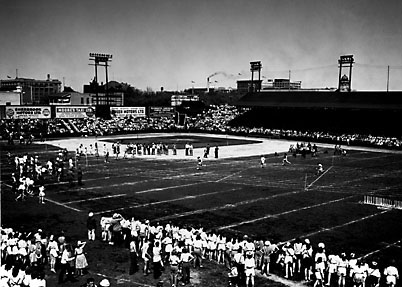
Winnipeg Stadium stood at 1465 Maroons Road, and was home to the Blue Bombers from 1953 to 2012. While there, they won 7 Grey Cups: 1958, 1959, 1961, 1962, 1984, 1988 and 1990. It was also home to baseball's Winnipeg Whips in 1970 and '71. Another baseball team, the Winnipeg Goldeyes, played there from 1954 to 1964, as a farm team of the St. Louis Cardinals, winning Northern League Pennants in 1957, 1959 and 1960. The new version of the Goldeyes played there from 1994 to 1998.
The Stadium seated about 33,000 at its peak, although temporary seating for the 1991 Grey Cup raised it to 51,985. It was switched from natural grass to artificial turf in 1988. In 2000, a hotel chain bought the naming rights, and it became Canad Inns Stadium for the rest of its existence.
The Arena was home to the Winnipeg Warriors of the Western Hockey League from its opening in 1955 until 1961, the Winnipeg Jets of the Western Canada Hockey League from 1967 to 1972, the orginal WHA/NHL Jets from 1972 to 1996, and the Manitoba Moose of the International Hockey League and the American Hockey League from 1996 to 2004, when the MTS Centre Opened.
It also hosted Game 3 of the 1972 Canadian-Soviet "Summit Series," even though Winnipeg was, at the time, not an NHL city, and was, in fact, pandering to the WHA. This was awkward because Team Canada only included players from the NHL, barring defectors to the WHA like Bobby Hull (Chicago to Winnipeg), Bernie Parent (Toronto to Philadelphia, before Philly again in the NHL) and Gerry Cheevers (Boston to Cleveland).
That, plus Bobby Orr's injury, made the series a down-to-the-last-minute-of-the-last-game affair. Had Hull been allowed and Orr able to play, the legend of the great Red Army team might have been strangled in the crib.
Note the steep upper deck and the portrait of
Canada's head of state, Queen Elizabeth II.
Like the Colisee de Quebec, 10,000 seats was enough for the WHA, but not for the NHL. So, like their WHA bretheren the Nordiques, they expanded their Louis St. Laurent-era arena to 15,000 seats. Unfortunately, also like the Nords, the Jets found the NHL rough going from 1979 onward, losing the core of their WHA dynasty in a dispersal draft, and setting a league record in 1980-81 for longest winless streak: 30 games (23 losses, 7 ties), and earning the nickname "Loseipeg."
Also like the Nords, they got better in the 1980s, and made the Playoffs again in the 1990s. But, again, like the Nords, it was too late, as the combination of a bad exchange rate and an outdated arena led to them moving. Like Winnipeg, Quebec City now has a new arena, too, so, like the Jets, the Nords could come back, too.
The Arena and the Stadium did not share space with Polo Park for long. Polo Park hosted thoroughbred racing from 1925 to 1956, and was demolished shortly thereafter. The Polo Park Mall opened in 1959. Today, an industrial site sits across Maroons Road from the mall, where the Arena and the Stadium once stood. Bus 11 from downtown.
Bell MTS Place is downtown, at 300 Portage Avenue. It opened as the MTS Centre in 2004, having been built in the hopes of attracting a moved or expansion team to the former city of the team now known as the Arizona Coyotes. The Manitoba Moose played there from 2004 to 2011. The name was just changed, as Bell Canada acquired MTS this past May.
One of the first events held there was the 2005 Juno Awards, Canada's equivalent of the Grammys. After a few preseason exhibition games, including one by the ex-Jets (then named the Phoenix Coyotes), the Atlanta Thrashers made the move, and played their 1st regular-season home game as the new Winnipeg Jets on October 9, 2011.
UPDATE: The arena was renamed the Canada Life Centre in 2021.
The University of Manitoba Bisons won the Memorial Cup, the championship of Canadian junior hockey, in 1935, 1937 and 1946. Other Manitoba-based teams to do so were the 1921 Winnipeg Junior Falcons, the 1923 Winnipeg Monarchs, the 1938 St. Boniface Seals, the 1941 and 1943 Winnipeg Rangers, the 1942 Portage la Prairie Terriers, the 1957 Flin Flon Bombers, and the 1959 Winnipeg Braves.
Prior to the construction of Winnipeg/CanadInns Stadium, the Blue Bombers played at Osborne Stadium from 1935 to 1952, winning the Grey Cup in 1935, 1939 and 1941. The Blue Bombers played exhibition games against the Columbus Bullies, champions of the 1940s version of the American Football League, at Osborne over the course of 3 weeks in 1941: Losing 19-12 on August 26, 6-0 on September 1, and 31-1 (a blocked extra point returned for a touchdown) on September 10. A baseball team called the Winnipeg Reo Rods also called it home.
Opened in 1932, with just 7,800 seats, it was too small for CFL play. It was demolished in 1956, and the Great-West Life Assurance Building now stands on the site. 60 Osborne Street at Granite Way, across from the Manitoba Legislative Building.
The current version of the Winnipeg Goldeyes has played at Shaw Park since it opened in 1999. Formerly named CanWest Global Park, it seats 7,461, making it ideal for independent leagues like the current version of the American Association (not to be confused with the longtime Triple-A league or the 1880s major league of the same name).
These Goldeyes have won 9 division titles, and Pennants in 1994 and 2012, making for 5 Pennants for Winnipeg baseball teams. "The Fishbowl" stands at 1 Portage Avenue East, at Waterfront Drive along the Red River. Number 1 or 10 bus from downtown.
From 1909 to 1955, Winnipeg's hockey center (or, should I say, "centre") was Shea's Auditorium. For many years, it held Canada's only artificial ice surface between Toronto and Vancouver. The University of Winnipeg Library now stands on the site, although their hockey rink, the Duckworth Centre, is adjacent. 515 Portage Avenue, 6 blocks west of the MTS Centre. In other words, when the new arena opened in 2004, Winnipeg hockey was coming home, even if it took the Jets a little longer.
Winnipeg has won the Stanley Cup 3 times. Did you know that? But it was a really long time ago. In fact, they've gone longer without winning the Cup than any city that has actually won it: 114 years. The Winnipeg Victorias won it in 1896, 1901 and 1902. The Victorias played at the Winnipeg Auditorium, at Garry Street and York Avenue, downtown. The Auditorium was destroyed by a fire in 1926. A bank and a parking deck now stand on the site of the greatest achievement in the history of Manitoba sports.
The Manitoba Sports Hall of Fame is at 145 Pacific Avenue at Lily Street. Number 20 bus.
Minneapolis is both the closest MLB city and the closest NBA city to Winnipeg: 456 miles away. Don't count on Winnipeg ever getting a team in either league: It would rank dead last in metropolitan area population. It already ranks last in the NHL, and still would if Quebec City returns, although not if Hamilton, Ontario gets a team as it has tried to do for the last 30 years. Even in the CFL, the Blue Bombers, at least in terms of metro population, have a "Borg ranking": 7 of 9, ahead of only the Hamilton Tiger-Cats and the Regina-based Saskatchewan Roughriders.
According to
an article in the May 12, 2014 New York Times, the most popular NBA team in the city of Winnipeg is the Miami Heat, but in the suburbs, it's the Los Angeles Lakers. I don't know why there's a difference.
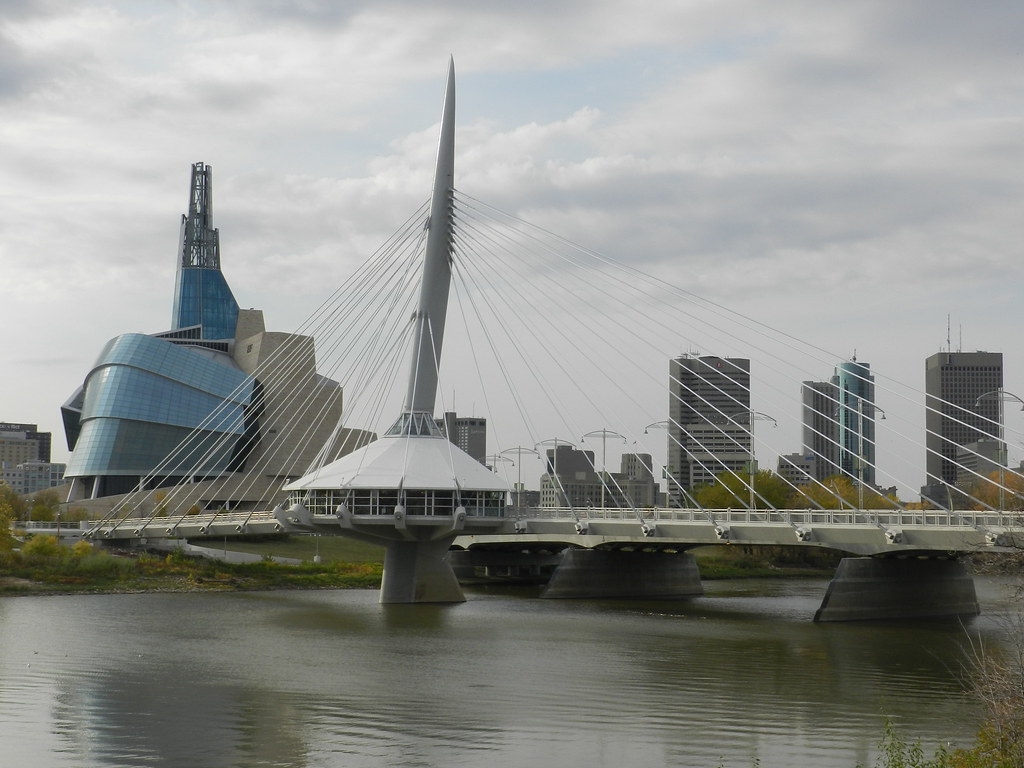
Like most major (or major-wannabe) cities, Winnipeg has museums. The Canadian Museum for Human Rights is at 85 Israel Asper Way, at York Avenue, across Pioneer Avenue from Shaw Park. Number 1 or 10 bus. Across Asper Way and the railroad tracks is the Winnipeg Railroad Museum. The Manitoba Planetarium and Science Gallery is at 190 Rupert Avenue at Main Street. Number 20 bus.
Adjacent to the Museum for Human Rights is The Forks, named for the splitting of the Red and Assiniboine Rivers. Because of this confluence, it was a meeting place for early Aboriginal peoples (Indians/Native Canadians/First Nations), European fur traders, hunters, riverboat and railway workers, and Manitoba's immigrants.
The complex now includes the Forks Market, in effect Winnipeg's South Street Seaport, Reading Terminal Market, Harborplace or Faneuil Hall/Quincy Market. 1 Forks Market Road, at Israel Asper Way. The Manitoba Children's Museum is also part of the complex, at 45 Forks Market Road. Number 1 or 2 bus.
Arthur Meighen, who served briefly twice (1920-21 and for a few weeks in 1926), is the only Prime Minister of Canada to have represented a riding (district) in Manitoba, in his case the nearby town of Portage La Prairie. There is no historical site in his honor, though.
The tallest building in Winnipeg is 201 Portage, standing a mere 420 feet at the intersection of Portage Avenue and Main Street, 3 blocks from Bell MTS Place. It looks nice, but it's no skyscraper.
Any TV shows set in Winnipeg would only be shown on Canadian television, and wouldn't be familiar to Americans. There have, however, been major films that you would recognize shot in and around Winnipeg. Many of these have been westerns or more recent period pieces that take advantage of the surrounding prairies, such as
The Assassination of Jesse James by the Coward Robert Ford (set in 1882 Missouri) and
Capote (set in 1959 Kansas while Truman Capote was researching the murders that became the basis of his book
In Cold Blood). Other movies with scenes filmed in Winnipeg include
K-19: The Widowmaker, Shall We Dance, The Constant Gardener and
The Haunting in Connecticut (despite the title).
*
Winnipeg is not very big city, and it's far away, with little to attract the local hockey fan besides hockey. But once you're there, it turns out to be a much more interesting place. Give it a go, whether you're a football fan or not.


_(cropped).jpg)