Showing posts with label wpix. Show all posts

Tuesday, September 22, 2026

September 22, 1966: Red Barber Gets Himself Fired

September 22, 1966, 60 years ago: The New York Yankees lose to the Chicago White Sox, 4-1 at Yankee Stadium. Joe Horlen is the winning pitcher, Hoyt Wilhelm gets the save, and Stan Bahnsen is the losing pitcher. Tommie Agee and Tommy McCraw hit home runs for the South Siders. Mickey Mantle does not play for the Pinstripes. Backup catcher Billy Bryan does, and goes 3-for-4.

It is a Thursday afternoon, when many people who might have gone to the game are at work, and it was rescheduled from the game that was rained out the preceding Tuesday night. Many fans hadn't heard of the rescheduling. This was, after all, the age before social media, and even before 24-hour sports TV would be able to let people know that the game would be played, and when. And the weather still wasn't great: It was cloudy throughout the game, and rain drizzled during it.

Also, the game was available on television, on WPIX, New York's Channel 11. As you can see by the photo, the station was then owned by the New York Daily News, which advertised itself as "New York's Picture Newspaper." Hence, the call letters, WPIX. Although the newspaper has since moved to new locations, the station still broadcasts out of the Daily News Building at 220 East 42nd Street, as it has since it first went on the air in 1948.

And the Yankees were wrapping up an awful season: They would finish 70-89, in 10th place, last in the American League. It was their fewest wins in 41 years, and their lowest winning percentage and their 1st last-place finish in 54 years.

Put it all together, and the attendance was predictably low. But no one could have predicted how low: 413. That is not a typographical error: Only four hundred and thirteen fans paid to attend this Major League Baseball game. Aside from the games played behind closed doors during the COVID-19 epidemic in 2020, this is the smallest recorded crowd in Yankee history, home or away.

Walter "Red" Barber had broadcast for the Cincinnati Reds from 1934 to 1938, the Brooklyn Dodgers from 1939 to 1953, and the Yankees from 1954 onward. He had also done national broadcasts, first on radio and then on television, for both NBC and CBS.

But, on this day, Barber asked the TV cameras to pan the empty stands, as he commented on the low attendance. WPIX refused to do so, on orders from the Yankees' head of media relations. Undeterred, Barber said, "I don't know what the paid attendance is today, but whatever it is, it is the smallest crowd in the history of Yankee Stadium, and this crowd is the story, not the game."

A week later, Barber was invited to breakfast with Yankees team president Mike Burke, who told him that his contract would not be renewed at the end of the season. In his memoir, Rhubarb in the Catbird Seat, Barber admitted that he was tired of broadcasting the Yankees, and, with Mel Allen having been fired after the 1964, he did not like his new broadcast partner, Joe Garagiola. He admitted that he did it on purpose, so that he would be fired. Essentially, the greatest broadcaster in baseball history "committed suicide by cop."

He was 58 years old, and was never paid to broadcast another sporting event. He wrote a few books, occasionally participated in radio broadcasts, and sat for an interview for Ken Burns' documentary Baseball. Burns did not mention this incident. Barber died in 1992, before the documentary could be finished and broadcast.

For the record: The lowest known attendance for a New York Mets home game is 1,752, in the last competitive baseball game ever played at the Polo Grounds, on September 18, 1963, a 5-1 loss to the Philadelphia Phillies.

Also on this day, the Baltimore Orioles beat the Kansas City Athletics, 6-1 at Kansas City Municipal Stadium. This game clinched the American League Pennant for the Orioles. It was the 1st Pennant for a major league team from Baltimore since the National League version of the Orioles in 1896 -- 70 years. Brooks Robinson went 1-for-5 with 2 RBIs. Frank Robinson went 3-for-5 with 2 RBIs.

Monday, August 4, 2025

August 4, 1985: Rizzuto, Seaver & Carew

August 4, 1985, 40 years ago: It is a special day in baseball. Three legends of the game receive proper honor. But only one of them was actually scheduled.

The New York Yankees were scheduled to play the Chicago White Sox on a Sunday afternoon at the original Yankee Stadium. It was Phil Rizzuto Day, and Rizzuto, known as "the Scooter," the beloved Yankee shortstop (1941-56) and broadcaster (since 1957, eventually retiring after 1996), was going to have his Number 10 retired, and a Plaque dedicated in his honor for Monument Park.

I was 15 years old, and, with my parents' permission (they, along with my grandmother, would be going with me), I called Ticketmaster the preceding Tuesday, and ordered the tickets, neither knowing nor caring who would be the day's opposing starting pitchers.

The next day, Wednesday, the starters for the Sunday game were announced: Joe Cowley for the Yankees, and Tom Seaver for the White Sox.

At that point, Cowley had 19 career wins, a total that would eventually rise to 33. Seaver had 299 career wins, a total that would eventually rise to 311.

In other words, the man that New York Met fans (for whom he won 199 of his 311) called "Tom Terrific" and "The Franchise" would be going for his 300th win, and I would be there.

Interestingly, while Seaver had made the uniform Number 41 iconic in baseball, Cowley was also wearing it for the Yankees at the time.

The ceremony for Rizzuto was great. Several of his Yankee teammates showed up, including Mickey Mantle and Whitey Ford. This was the first time I'd ever seen either of them in person.

Ex-teammate Yogi Berra was not there, having recently been fired as manager by team executive Clyde King on behalf of team owner George Steinbrenner, and having begun was turned out to be a 14-year boycott of the Yankee organization.

Ex-teammate Joe DiMaggio wasn't there, either. I don't know why. Considering the kind of praise he frequently had for Rizzuto, the only reason I can think of is his egotistical insistence on always being the last man introduced, which wouldn't have happened on another figure's Day.
In reference to two of the Scooter's favorite expressions, one of his gifts was a cow with a papier-mache halo, a "Holy Cow," named "Huckleberry."

That cow, paying no heed to the halo or to Rizzuto being just 5-foot-5 and 150 pounds, or 67 years old for that matter, stepped on his foot, causing him to fall backwards. There was a lot of gasping in The House That Ruth Built. Fortunately, Rizzuto was all right.

And he gave a speech in which he said, "This means more to me than the Hall of Fame ever could." This elicited a big cheer from the Bronx faithful, since he had not yet been elected to the Hall.

But it was a lie, and he knew it. In 1994, 9 years later, he found out just how big a lie it was, as he was finally, rightfully elected, and Yankee Fans everywhere rejoiced that he'd gotten his due while he was still alive.

It was a gorgeous Summer Sunday afternoon: Not too hot, no discernable wind. The field at the old Yankee Stadium was immaculate. Cliché Alert: It was a beautiful day for baseball.

From our box seats in Section 35 in right field -- right around the spot where Roger Maris' 61st home run of 1961 landed (although it was Section 33 in the pre-renovation configuration), we had a decent view. And we were surrounded by other Yankee Fans. This would turn out to be very helpful.

In the bottom of the 3rd inning, with the game scoreless, Mike Pagliarulo led off with a single to right. Bobby Meacham flew to center. Rickey Henderson grounded to 2nd, but Bryan Little couldn't make the double play, and threw Henderson out at 1st, allowing Pags to advance to 2nd. Ken Griffey Sr., not nearly as good as his son. but still a very good player at this stage of his career, singled to right, scoring Pags. Yankees 1, White Sox 0.

The Yankees still led 1-0 after 5 innings. But the White Sox struck back in the top of the 6th. Cliché Alert: Walks can kill you, especially the leadoff variety. Yankee starter Joe Cowley issued a leadoff walk to, somewhat appropriately, Greg Walker. Longtime Yankee nemesis Carlton Fisk grounded into a force play, getting to 1st as Walker was eliminated by Willie Randolph. But Oscar Gamble singled Fisk over to 3rd.

Billy Martin, in his 4th term as Yankee manager, dismissed Cowley, and brought in Brian Fisher. The Pale Hose hadn't yet scored. Now, they would. Tim Hulett tied the game with a double, bringing home Fisk. Ozzie Guillén, who would later manage the White Sox to a World Series win, gave the South Siders the lead by singling home Gamble. Luis Salazar grounded to short, enabling Andre Robertson to eliminate Guillén, but that left 1st and 3rd with 2 outs. Vance Law drew a walk to load the bases. Little singled home Hulett and Salazar. Harold Baines singled to left, but Dan Pasqua threw Law out at the plate.

As the Scooter would have said, "But the damage is done. I tell ya, Bill White, this is unbelievable." In the space of less than 10 minutes, the Yankees had gone from 1-0 up to 4-1 down, and were very nearly 5-1 down.

Seaver set the Yankees down in order in both the 6th and the 7th. In the 8th, he began to tire, allowing singles to Bobby Meacham and Don Mattingly, but worked out of it. Tony La Russa, noted bullpen tinkerer, was the White Sox manager at the time, but he trusted the veteran from Fresno, California to finish the job he began, and to still be on the mound to accept congratulations on Number 300 after the final out.

If Seaver's milestone had been the whole story, that would be enough of a memory. But it wasn't.

For the out-of-town scoreboard told another story -- and led to another, very shocking story. New York was playing Chicago in the National League as well, the Mets vs. the Chicago Cubs at Wrigley Field. By a wacky turn of events, this one also ended 4-1, in favor of the Mets, who were closer to 1st place at that point in the season than at any time since 1969. (When they won the Pennant in 1973, they were in last place on August 4, before going on a tear.)

And Dwight Gooden, the most heralded Met pitcher since Seaver (the most heralded, and probably even more hyped), went the distance. For some reason, I remembered him striking out 16 Cubs that day. He struck out "only" 6. He did have a 16-strikeout game that season, on August 20, a 3-0 home win over the San Francisco Giants.

The crowd at Yankee Stadium that day sure looked like it was about evenly split between Yankee Fans hoping for a win, and Met fans hoping to see Seaver win his 300th.

This was 1985. It was the peak year of soccer hooliganism in England, including the Millwall-Luton riot in an FA Cup Quarterfinal on March 13, and the Heysel Stadium disaster at the European Cup Final between Liverpool and Italy's Juventus in Brussels, Belgium on May 29, which resulted in English clubs being banned from European play for 5 seasons. (In each case, click on the 1st link for details, and the 2nd link for video.)

When the Mets-Cubs score went up on the out-of-town scoreboard, a "Let's Go Mets" chant went up from the visiting Met fans. After about 10 seconds of shock from the home fans, this blasphemous utterance was followed by a "Mets suck" chant. This was followed by a fight, and I couldn't tell which side started it: The Yankee Fans (indicating an overreaction) or the Met fans (indicating that their blue and orange skins were very thin). Whoever started the fight, it started small, then got bigger. Much bigger.

I've seen Yankees-Red Sox at the old Stadium, the new Stadium, and at Fenway Park. I've been to hockey games at Madison Square Garden, the old Boston Garden and the new Philadelphia arena. But I've never seen as much fighting at a sporting event as I saw that day. There were hundreds of people throwing punches. Most of it, including easily the worst of it (but not all of it), was in the Bleachers, and the proto-Bleacher Creatures were taking no shit from the infiltrating 7 Line Army.

There must have been about 50 people ejected by the Burns security officers. At the time, an English "football" crowd would have called that "just another matchday." An American baseball fan would call it "disgraceful." The game went on, and I have no idea if any of the players involved knew about the fighting.

The Yankees did threaten in the bottom of the 9th. Pasqua led off with a single. Seaver reared back, and, in that familiar overhand throw with his right knee brushing the mound, struck Ron Hassey out. He got Randolph to fly to right. But he walked Pagliarulo.

That brought the tying run to the plate, but it was the pathetic Meacham, then batting an inept .232. Billy knew that he needed baserunners. Surely, he was remembering the play 2 nights earlier, when Meacham got caught between 2nd and 3rd, not knowing if a Henderson fly ball would drop for a hit, which it did, and then stumbling, resulting in himself and Yogi's son Dale Berra both running through 3rd base coach Gene Michael's stop sign, and both being tagged out at the plate by Fisk. So Billy went for broke, sending up Don Baylor to pinch-hit.

Baylor was 36, and wasn't hitting much better, .239, but his OPS was .796, .188 higher than Meacham's. And he did end up with 24 doubles, 23 home runs and 91 RBIs that season. So, on paper, it was a good move. (Cliché Alert: The game isn't played on paper, it's played on grass. Had the game gone to extra innings, Billy probably would have sent Andre Robertson out to play shortstop.)

Seaver was 40, had gone the distance, was in his 2nd straight struggling inning, and had to be gassed at this point. But he reared back, reached into his bag of tricks -- one of the greatest arrays of "stuff" any pitcher has ever had -- fired, and his pitch reached the inside corner, a perfect strike.

But Baylor swung, and connected. In almost any other ballpark -- even the White Sox' home of Comiskey Park, a notoriously poor one for hitters as opposed to its windy, ivy-walled North Side NL counterpart -- this might have been a game-tying home run. But in the old Yankee Stadium, with its left-center "Death Valley," it was just a long fly. Reid Nichols, who had replaced Law in left field for Chicago, caught it. Ballgame over. White Sox win.

All 54,032 in attendance rose as one to applaud Seaver off the field, just as La Russa had intended. Yes, at age 40, he pitched a complete game. Tom Terrific had allowed just 1 run, 6 hits, and just 1 walk. He had notched 7 strikeouts, 1 more than Gooden did that day, and the much-hyped "Doctor K" was, literally, half his age. Truly, we had seen a master of his craft at work.

From Section 35, the last section of box seats in right field, I had a great view of the Bleachers (and the fighting), and, although in the outfield, I had a good view of Seaver and the strike zone. Though I hate to lose and I hate the Mets, all I could do was stand and tip my cap to Seaver. It was the only time I ever saw him pitch live.

As my man Reggie Jackson, who struggled against him in All-Star Games and late in their careers when both were in the AL, but hit an RBI double off him in Game 6 of the 1973 World Series, once said of Tom Seaver, "Blind people come to the park, just to listen to him pitch."

The entire broadcast of the game is available on YouTube, if you're so inclined. Here's the last out.

Speaking of Reggie Jackson, he was present for another big milestone on the same day. He was with the California Angels (now named the Los Angeles Angels of Anaheim), as was another future Hall-of-Famer, Rod Carew. They were playing Carew's former team, the Minnesota Twins, at Anaheim Stadium (now named Angel Stadium of Anaheim).

In the bottom of the 3rd, Carew batted against Frank Viola, and singled. It was his 3,000th career hit. It was his only hit of the day, going 1-for-5.

He was batting just .264 at the time, and retired at the end of the season. It was a far cry from his multiple batting titles in the 1970s, including a run at .400 in 1977, when he ended up at .388, with 14 homers, tying a career high, his only 100-RBI season, a Gold Glove, and the AL Most Valuable Player award, despite the Twins finishing nowhere near the Playoffs.
Carew was a legend, not fully appreciated by Calvin Griffith, the racist cheapskate who inherited the original Washington Senators from his uncle Clark, moved them to Minnesota, and then pissed off fans and players alike. Like Reggie, Rod was welcomed with open arms by "Singing Cowboy" turned media mogul and Angels owner Gene Autry.

When the news of Carew's 3,000th hit went up on the scoreboard at Yankee Stadium, everybody cheered: Yankee Fans, Met fans, and the few White Sox fans in attendance, even though Carew never played for any of them.

Managed by Gene Mauch, The Angels won, 6-5, despite Kirby Puckett's 3 RBIs for Minnesota. Reggie pinch-hit for Dick Schofield in the 8th, and grounded to 1st, resulting in a force play. He was stranded on 1st. Attendance: 41,630 -- far from a sellout, as this was the era (1980 to 1996) when The Big A had a capacity of 65,000, enabling the Los Angeles Rams to play home games there -- but, considering that Carew was on 2,999 hits, and any at-bat could be Number 3,000, a decent crowd.

There was no distraction up Interstate 5: Tommy Lasorda's Los Angeles Dodgers were in Cincinnati, where they lost to Pete Rose's Reds 5-4. Rose, MLB's last player-manager, did not put himself into the game. He had 4,168 hits in his career. At the time, the record was considered to be 4,191, by Ty Cobb. On September 11, 1985, Rose collected his 4,192nd hit. With a duplicate game found in Cobb's record, his total was officially reduced to 4,189, meaning Rose actually broke the record on September 8.

The Yankees finished the 1985 season 97-64, 2 games behind the Blue Jays in the American League Eastern Division. The Mets finished it 98-64, 3 games behind the St. Louis Cardinals in the National League East.

The Chicago teams? The Cubs, defending NL East Champions, had been slammed by the injury bug, and went from 96 wins to 77, a 19-game drop -- or from 6 1/2 games ahead of the 2nd-place Mets in '84 to 23 1/2 games behind the Cards, their arch-rivals, in '85, by that measure a whopping 30-game slide. The White Sox finished 6 games behind the Royals in the AL West.

There was no Central Division in either League in those days, meaning you had to finish ahead of 6 teams (in the AL) or 5 teams (in the NL) to make the Playoffs, instead of the 3, 4 or 5 you have to top now; and no Wild Card, meaning that, despite 97 wins -- 5 more than they won in their 1996 title season and 10 more than in their 2000 title season -- the Yankees were out of luck. So were the Mets,

If the current setup were in place then, the Yankees would have won the AL Wild Card; while the Cards would have won the NL Central, enabling the Mets to win the NL East.

In the Playoffs, the Royals came from 3 games to 1 down to beat the Jays, the Cards beat the NL West Champion Dodgers, and the Royals came back from 3 games to 2 down to beat the Cards and win an all-Missouri World Series, thanks to a controversial umpiring decision in Game 6 and a Cardinal mental meltdown in Game 7.

1985. A strange year. And nobody was bowling for soup.

Note to fans of that band: George Michael was still in Wham! and hadn't gone into his "Faith" phase yet. And when wasn't Ozzy Osbourne an actor?)

*

One final note. On September 19, 1986, a little more than a year later, the White Sox beat the Angels 7-1 in Anaheim. The ChiSox' pitcher that day pitched a no-hitter, despite walking 7 batters, and allowing a run in the 6th inning, on 3 straight walks and a sacrifice fly by Reggie. The Sox pitcher? None other than Joe Cowley, the man Tom Seaver outpitched to win Number 300.

In the preceding winter, the Yankees had traded Cowley and Hassey to the White Sox for 2 guys who never reached the majors, and Britt Burns, a solid lefty who was supposed to be the 2nd left in the rotation (along with Ron Guidry) that the Yankees so desperately needed, but had a degenerative condition in his hip, and never pitched in the majors again. That was the kind of trade that George Steinbrenner and "my baseball people" made in the 1980s.

And in a fascinating irony, that same day, although no one knew it for sure at the time, Seaver made his last major league appearance. (Appropriately, his age was 41.) The previous June, the White Sox had traded him to the Boston Red Sox, even-up, for outfielder Steve Lyons. That's right: The man today's kids know as baseball pundit "Psycho."

In his last game, Seaver started for the Red Sox against the Blue Jays at Exhibition Stadium. He only went 4 innings, and lost to the Jays, 6-4. Dave Stieb was the winning pitcher. The last batter he ever faced? Tony Fernandez, who flew out to right.

The first batter he ever faced? It was on April 13, 1967, at Shea Stadium, against the Pittsburgh Pirates, and his 1st batter was the dangerous defending NL batting champion, Matty Alou, who doubled to right. But the 22-year-old Seaver stranded him, and the Mets won, 3-2 on an 8th inning single by Chuck Hiller. The opposing pitcher was 1960 Cy Young Award winner Vernon Law.

Attendance: 5,005. It was the 3rd game of the 1967 season, the Mets were still horrible, and while Seaver had been highly-touted, many a highly-touted rookie has failed to pan out. At the time, who knew? Seaver did, however, pan out, and then some.

Moving back to 1986: The Red Sox did not include him on their roster for either the American League Championship Series or the World Series, so the September 19 loss in Toronto was his last major league appearance. But with his Boston teammates, he was introduced at Shea Stadium before Game 1 of the World Series, and appropriately got a thunderous ovation.

And you know what? After September 19, 1986, Cowley, like Seaver, never won another game. He was traded by the White Sox to the Philadelphia Phillies during spring training in 1987, went 0-4 in 5 starts, got send down in early May, went 3-9 in Triple-A, got released, and before turning 29 had thrown his last professional pitch.

Cowley is forgotten today. Seaver is remembered. So is Carew. And so is Rizzuto, who even had Seaver as a WPIX-Channel 11 broadcast partner in his last few years on the air.
Holy Cow.

"Rizzuto, Seaver and Carew." Sounds like a re-write of Terry Cashman's "Talkin' Baseball (Willie, Mickey and the Duke)."

Wednesday, July 25, 2018

July 25, 1993: Fandom Reborn

July 25, 1993, 25 years ago: An era ended, in a way, and a new one began. And most baseball fans don't know, and probably wouldn't care. But it was a big day for me.

I had been a Yankee Fan since 1977, at age 7. I wasn't old enough to remember Babe Ruth, Lou Gehrig, Joe DiMaggio or Mickey Mantle. I was a little too young to remember the pre-renovation original Yankee Stadium, and slightly too young to remember Chris Chambliss hitting a home run to win the 1976 American League Pennant.

But I do remember the Yankees winning the World Series in 1977 and 1978, and the Pennant in 1981. I remember Reggie Jackson's 3 home runs (well, 2 of them, as my parents made me go to bed, as it was a school night), the 14-game comeback against the Boston Red Sox, Bucky Dent's home run, Thurman Munson's blast against the Kansas City Royals in the Playoffs and his death in a plane crash the next year, Ron Guidry's strikeouts, Graig Nettles' miraculous plays at 3rd base, Goose Gossage dominating in relief, Dave Righetti's 4th of July no-hitter in 1983, Dave Winfield's tomahawks into left field, and Don Mattingly's big hits.

But I also remember the near-misses of the 1980s, team owner George Steinbrenner's managerial musical chairs, the triumphs and tragedies of Billy Martin, the collapse at the end of the 1980s, and George's "temporary lifetime" banishment in 1990.

The rebuilding of the Yankees under general manager Gene Michael was underway. By 1993, the Mets were a mess both competitively and behaviorally, and the Yankees were ready to contend again. The Mets have not been definitively the best baseball team in New York ever since, not even during the 2015 season, when they won the National League Pennant and the Yankees lost in the AL Wild Card Game.

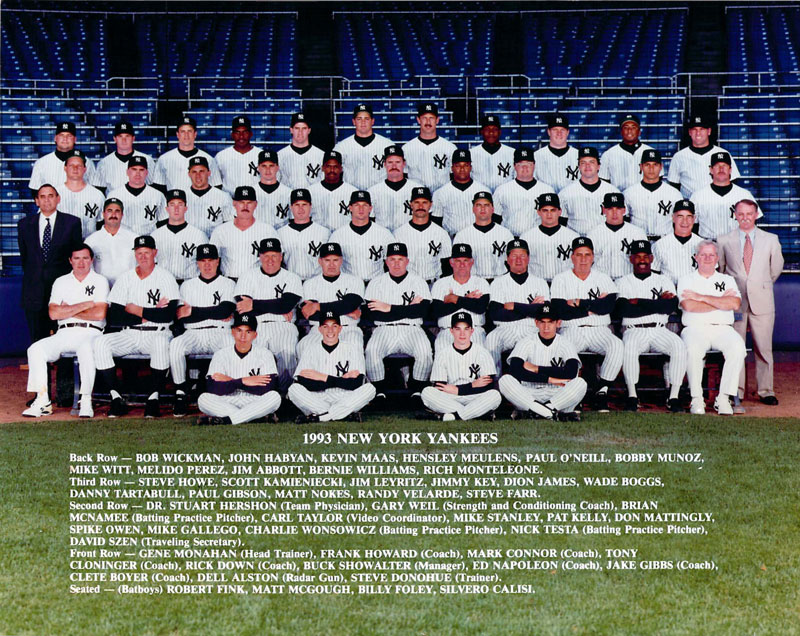
Buck Showalter was the manager. Mattingly was already the last holdover from the Eighties. Now, there were dependable veterans like Wade Boggs, Jimmy Key and Paul O'Neill, and rising players like Bernie Williams. More trades would be made, and more prospects would develop.

But you could sense that something good was happening. We didn't yet know if, say, 1996 would be a new 1976, or a false dawn that would collapse by 1999 as it did in 1989. But things were looking good, and the Yankees spent the Summer of '93 battling the defending World Champion Toronto Blue Jays for the lead in the AL Eastern Division.

On July 17, I was with the youth group at the Aldersgate United Methodist Church in my hometown of East Brunswick, New Jersey. Given our location, some of us were Yankee Fans, a few of us were Met fans, and a couple of us rooted for the Philadelphia Phillies, who were in the other direction, but not much further away than New York was. (The church was 49 miles from Yankee Stadium, 50 miles from Shea Stadium, and 63 miles from Veterans Stadium. The ballparks have changed, the distances have not.)

We spent the night of July 17-18 at a church in Fredericksburg, Virginia. We had lunch on the 18th in Dunn, North Carolina, just off Interstate 95. At Triangle Waffle, I had the best hamburger I'd ever had to that point. It was so good, I ordered a second for the road.

We arrived at Kingstree, South Carolina, with the Carolinas caught in the middle of a terrible heat wave and drought, while the Midwest, especially Iowa and Illinois, had some of the worst flooding in American history. It was a stark contrast. The State, South Carolina's largest paper, based in the State capital of Columbia, had a cartoon showing the State flag, with the traditional Palmetto tree replaced by a cactus.

At night, inside my sleeping bag (we were about 7 to a room), I would fiddle with the radio dial on my Walkman, and picked up the New York radio stations and their baseball broadcasts. I got broadcasts from as far west as St. Louis and New Orleans. (Then as now, New Orleans had a Triple-A team, but I didn't get their game, only a news station.) I still have that Walkman, although it no longer works. And it's my fault: I left it unused so long, the batteries leaked, and ruined the interior.

In the morning, with the Internet still just a rumor to me (we were still using the phrase "the information superhighway"), I would get newspapers. I saw the color photo of the press box fire at Atlanta-Fulton County Stadium on the front page of the Charleston, South Carolina-based Post and Courier. Color pictures in newspapers was still a big deal, and the Atlanta Braves were the closest Major League Baseball team to the house where we were staying, but it was still over 300 miles to the west, with Baltimore (and Washington, then without an MLB team) over 450 miles to the northeast.

The fire was put out, no one was hurt, the regularly-scheduled game was played, and, with newly-acquired Fred McGriff hitting a home run, they beat the St. Louis Cardinals.

We spent 5 days fixing up a house, and at the end, were treated to a Carolina chicken dinner. Too spicy for me. On Saturday, the 24th, we headed for the shore and the boardwalk -- not the Jersey Shore, but Myrtle Beach, South Carolina. Not only was I not impressed, but it was about as rednecky a place as you could get and still have a beach.

We spent the night at a church in Raleigh, North Carolina. According to the pictures on the wall in the foyer, one of the church leaders was named Michael Jordan. Sure, it's a fairly common name, but we were in North Carolina -- and the news of the Michael Jordan's father having disappeared was in the news. He hadn't yet been found, and we didn't yet know that he'd been murdered.

And so, that Sunday, July 25, 1993, we went up first Interstate 85, then I-95, heading north, back home. And we went back and forth, listening to whatever radio broadcast of baseball we could pick up. The Yankees were then on WABC, AM 770, but we couldn't yet reach them in Virginia.

Nor could we pick up the Mets on WFAN, 660; and it didn't matter, anyway, because they were playing the Dodgers in Los Angeles, and were a 4:05 PM Eastern Time start. Same with the Phillies, at AM 1210, then with the call letters WOGL, as they were playing the Giants in San Francisco. But the Baltimore Orioles, at WBAL, 1090 (a.k.a. "Radio 11"), were loud and clear. There was, of course, no Washington Nationals yet.

Jon Miller, now with the Giants, was then the voice of the Orioles, and he has the perfect voice for baseball on the radio. And he told us that the Yankees were already losing 8-0 to the California Angels in the 2nd inning. Melido Pérez had already been knocked out of the box. Forget it, it was over.

How over was it? According to Baseball-Reference.com, at that point, the Angels had a 97 percent chance of winning the game.

Among the scoring was a home run by Charles "Chili" Davis. This guy always hit the Yankees well. I was so glad the Yankees acquired him in 1998, not for anything he could do for them, but for the fact that he would no longer be doing anything to them. He did, however, help the Yankees win the World Series in 1998 and 1999 -- but in 1993, we had no idea of what was ahead for the Bronx Bombers.

Mike Stanley, then the Yankee catcher, led off the bottom of the 2nd with a home run, but it was still only 8-1. Nobody expected any comeback.

Anyway, we went back to the Orioles at 1090. They were in Minneapolis, and ended up losing to the Minnesota Twins 5-2.

Other American League scores that day: Boston Red Sox 8, Oakland Athletics 1 at Fenway; Cleveland Indians 11, Seattle Mariners 9 at Municipal Stadium; Detroit Tigers 3, Kansas City Royals 0 at Tiger Stadium; Milwaukee Brewers 7, Chicago White Sox 3 on the South Side; Toronto Blue Jays 9, Texas Rangers 7 in Arlington.

In the National League: Florida Marlins 7, Cincinnati Reds 3 at Joe Robbie Stadium; Braves 13, Pittsburgh Pirates 1 at Three Rivers; Chicago Cubs 3, Houston Astros 1 in 11 innings at the Astrodome; Cardinals 5, Colorado Rockes 4 in 11 innings in Denver; and Montreal Expos 5, San Diego Padres 4 in 10 innings at Jack Murphy Stadium.

We got stuck in traffic on the Virginia side of the Potomac, found our way around the Capital Beltway, and headed back up I-95 toward Baltimore. But by the time we reached Camden Yards, vacant as the O's were on the road, Miller was giving the out-of-town scoreboard, and informed us that the Yankees had come back, and it was 8-7 Angels in the 7th inning.

Now, WABC was coming in. And the Yankees got the 1st 2 men on in the bottom of the 8th. But they couldn't get those men home, and still trailed 8-7 after 8.

By now, the Mets' game in L.A. had begun. But there was only 1 Met fan in that van, 1 Phillie fan, and about 10 Yankee Fans. We were sticking with the Pinstripes.

Bottom of the 9th. Steve Frey pitching for the Halos. Danny Tartabull led off, and drew a walk. Cliché Alert: Walks can kill you, especially the leadoff variety. Stanley came up, and hit what we later learned (on the TV news) was a perfect double-play grounder to short, but Gary DiSarcina let it go between his legs, Bill Buckner-style. For the 2nd straight inning, the Yankees had 1st and 2nd on, and nobody out.

Cliché Alert: "He runs well for a catcher." Well, nobody ever used that cliché on Stanley, so Showalter sent in a pinch-runner: Hensley Meulens, once a tremendous prospect known as "Bam-Bam" for his power, but, by this point, a massive disappointment.

Bernie Williams was at the plate. Angel catcher Ron Tingley couldn't handle a Frey pitch, and it was a passed ball. Now, the tying and winning runs were in scoring position. In spite of the fact that nobody was out, Angel manager Robert "Buck" Rodgers ordered Bernie intentionally walked, to load the bases and set up a force play at home.

The batter was Paul O'Neill. He hit a fly ball to left, deep enough to score Tartabull with the tying run.

Up came the shortstop. Number 2. No, not Derek Jeter. We had barely heard any whispers about him, as he was in only his 2nd, 1st full, season of pro ball. This was Mike Gallego, a part of the Oakland Athletics' quasi-dynasty of 1988-92, and a decent player, but hardly what Jeter would become. He flew out to center. Meulens, who hadn't advanced to 3rd on O'Neill's fly, did so now. The winning run was on 3rd, but there were 2 outs.

Somewhere between the Baltimore Beltway and the Delaware State Line, we were going nuts in that van.

The batter was Pat Kelly. A good 2nd baseman, and an okay hitter. Nothing special. Except for this moment. He faced 1 pitch, and hit a sharp line drive to left field. Meulens scored. Yankees 9, Angels 8. John Habyan was the winning pitcher, in relief. Attendance: 50,429.

I thought I could hear Phil Rizzuto yell, "Holy cow!" from 150 miles away. The game was on WPIX-Channel 11, and, as I learned while watching the 11:00 edition of WABC-Channel 7's Eyewitness News, he did yell it.

There is an urban legend that says that this was the 1st time that John Sterling, on the radio, used the words, "Ballgame over! Yankees win! Theeeeeeee Yankees win!" But I never heard him drag the "the" out until Bernie's walkoff home run in Game 1 of the 1996 AL Championship Series against Baltimore. He did use "Yankees win! The Yankees win!" as early as the Jim Leyritz Game, Game 2 of the 1995 AL Division Series against Seattle.

But in that van on that warm Sunday afternoon on the John F. Kennedy Memorial Highway in Cecil County, northeastern Maryland, we were bouncing around that van like a pinball machine. Until the 1 Met fan asked us if we could now switch to the Mets broadcast.

So we did. By the time we got back to the church in East Brunswick, the Mets were on their way to wrapping up a 4-0 win over the Dodgers at Chavez Ravine. So, for the day, New York 2, Los Angeles 0. Fine with me. Like the O's, the Phils lost 5-2, to the Giants.

I was a little older than most of the kids on the trip: 23, as opposed to these 14-to-18-year-old high schoolers and recent graduates. It was the 1st time that I felt like an adult baseball fan.

That week, between the newspapers and the radio, it felt like my fandom, for both the sport and for my individual team, had been reborn.

And the next few years would both test and reward my fandom.

I can't say I loved every minute of it. But I loved a lot of those minutes!

Sunday, January 5, 2014

Jerry Coleman, 1924-2014

Rarely is a figure beloved by fans of both the Yankees and another team. There are a few examples:

* New York Mets: Darryl Strawberry, Dwight Gooden and David Cone. (But not Joe Torre. Or Yogi Berra.)
* Boston Red Sox: Wade Boggs. (But not Roger Clemens.)
* Oakland Athletics: Reggie Jackson and Catfish Hunter.
* St. Louis Cardinals: Enos Slaughter.
* Cleveland Indians: Bob Lemon.
* Brooklyn (now Los Angeles) Dodgers: Red Barber.
* San Diego Padres: Dave Winfield and Jerry Coleman.

That's about it. And it is, for a sad reason, the last of these names that I post tonight.

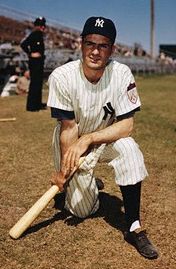
Gerald Francis Coleman was born on September 14, 1924, in San Jose, California. He was one of many Yankees in the pre-1957 era, before the Dodgers moved to Los Angeles and the Giants moved to San Francisco, to have been plucked from the rich "farmland" of the Pacific Coast League.

He was a graduate of Lowell High School, named for poet James Russell Lowell, in San Francisco. Other graduates of this distinguished institution include scientist Rube Goldberg, artist Alexander Calder, California Governor Pat Brown (father of current Governor Jerry Brown), Hewlett-Packard co-founder William Hewlett, videotape pioneer Charles Ginsburg, actress Carol Channing, President Kennedy's Press Secretary Pierre Salinger, Gorillas in the Mist author Dian Fossey, actor Bill Bixby, The Gap founder Donald Fisher, Supreme Court Justice Stephen Breyer, his brother and fellow federal Judge Charles Breyer, Star Trek costume designer William Ware Theiss, Golden State Warriors legend Tom Meschery, Dennis Marcellino of Sly's Family Stone, San Diego Charger defensive back Gill Byrd, writer Naomi Wolf, actor Benjamin Bratt, Lemony Snicket author Daniel Handler, and Walter Haas, the Levi Strauss magnate who bought the A's from Charlie Finley and saved them for the Bay Area for 2 generations. (Whether there will be a 3rd remains to be seen.) Graduating with Coleman in 1942 was Art Hoppe, longtime columnist for the San Francisco Chronicle.

The Yankees scouted and signed him, and played out the 1942 in Class D ball, before enlisting in the Marine Corps and becoming a pilot. He would also fly for the Marines in the Korean War. A few players, including Ted Williams, would serve in both of those wars, but Coleman was the only major league player to see combat in 2 wars -- any 2 wars. (Hank Gowdy was the only player to have served in World Wars I and II, and was the first player to enlist in I, but wasn't in combat for II.)

When he got back, he rose quickly, playing for the Binghamton Triplets and the Kansas City Blues in 1946, the Blues exclusively in 1947, and the Newark Bears in 1948. He made his major league debut on April 20, 1949, at Yankee Stadium, leading off, playing 2nd base, and going 0-for-4 against the Washington Senators. To make matters worse, on the very first batter he ever faced, Gil Coan, he muffed a grounder for an error. He made up for it, though, starting an inning-ending double play. This helped Vic Raschi to pitch a shutout, and a home run by Tommy Henrich helped the Yankees win, 3-0.

He got his 1st major league hit the next day, a single off Senator pitcher Forrest Thompson, in a 2-1 Yankee win, and he was on his way. When that season came down to the last 2 games, with the Yankees needing to win both at home against the Red Sox, or else the Sox would win the American League Pennant, Coleman got a hit in both games. The finale was won by his bases-loaded double in the bottom of the 8th, of Tex Hughson, as the Yankees won, 5-3, and took the Pennant. He batted .275 that year, with 2 homers and 42 RBIs, and finished 3rd in the first-ever AL Rookie of the Year balloting, behind Roy Sievers and Alex Kellner.

He made his only All-Star Team in 1950, batting .287 with 6 homers and 69 RBIs. In his 1st 3 seasons, 1949, '50 and '51, the Yankees won the World Series every year. But after just 11 games in '52, he was called back by the Corps, and flew missions over Korea. He received 13 Air Medals and 2 Distinguished Flying Crosses, rising to the rank of Lieutenant Colonel, and was known as "The Colonel" for the rest of his life. (This meant that he outranked "The Major," WWII vet Ralph Houk, his teammate as a player and the manager for much of his time as a Yankee broadcaster.) He was discharged in time to play in the last 8 games of the 1953 season, but not in time to be eligible for the World Series roster.

The 1955 World Series was the 1st and only won by the Brooklyn Dodgers. In Game 1 (which the Dodgers, everyone forgets, lost), Jackie Robinson stole home plate. To this day, Yogi Berra insists that Jackie was out. So does Whitey Ford, who was pitching that day. The film seems to bear them out. But Phil Rizzuto said that he had the best view of the play, at shortstop, and that Jackie was safe.

Whitey got tired of hearing the Scooter say this, so he looked it up. It turned out that, in the bottom of the 6th, Eddie Robinson (no relation to Jackie) had pinch-hit for Rizzuto, and Coleman had gone into to play short, and he was there when Jackie stole home in the top of the 8th! The Scooter's memory must have been playing tricks on him. Coleman's thoughts on the steal, as far as I know, were never recorded.

Coleman won another World Series with the Yankees in 1956, and another Pennant in 1957, but was released after that season, shortly after his 33rd birthday. His lifetime batting average was .263, his OPS+ a mere 83, with 558 hits, 16 homers and 257 RBIs. A decent player, but, clearly, he wasn't going to get into the Baseball Hall of Fame that way. For the entirety of his playing career, he was with the Yankees, and wore Number 42, making him the greatest Yankee to wear the number until Mariano Rivera.

In the 1958 and '59 seasons, he served as the Yankees' personnel director, effectively making him their chief scout. In 1960, he began broadcasting baseball with CBS, and in 1963 was hired to broadcast Yankee games.

My Grandma told me that, when Coleman and his former double-play partner Rizzuto used to get going, it was a riot. Sadly, there doesn't seem to be any surviving broadcasts of their banter. Red Barber was also there until 1966, and Jerry picked up the phrase "Oh, doctor!" from him. He also used phrases like, "You can hang a star on that baby!", "And the beat goes on" (presumably before Sonny & Cher recorded their song with that title), and "The natives are getting restless."

His most notable moment behind the microphone for the Yankees was his call of former teammate Mickey Mantle's 500th career home run, off Stu Miller of the Baltimore Orioles, on May 14, 1967, on WPIX-Channel 11. Because of the significance of the milestone (only 5 players had done it before Mantle), this is one of the rare surviving color videotape clips from the pre-renovation original Yankee Stadium.

Sadly, a lot of pre-1980s sports video was simply taped over by TV stations, in order to save money, as high-quality videotape was expensive then. It's why, aside from NFL Films, we don't have footage of Super Bowl I, even though both CBS and NBC broadcast it live.

After the 1969 season, Coleman left the Yankees, and broadcast for the California Angels for 2 years. In 1972, he joined the broadcast staff of the San Diego Padres, and remained in their booth for the rest of his life. With one exception: In the 1980 season, the Padres named him their manager. This proved to be a bad idea, as the Padres went just 73-89, and finished last in the National League Western Division.

In an oddity, he almost wasn't the only beloved broadcaster-turned-manager that year. After Dallas Green was the Philadelphia Phillies' manager at the end of the 1979 season, the Phils considered offering the job to Richie Ashburn, who had also been their star center fielder in the 1950s. But Phils owner Ruly Carpenter realized that, eventually, he would have to fire him, and he didn't want to go down in history as "the man who fired Richie Ashburn."

So he gave Green the job for the full season, and the Phils won their 1st World Series that year. The Padres made the decision to move their beloved broadcaster into the manager's job, and may have been the NL's worst team; the Phils didn't, and were baseball's best.

As the voice of the Padres, Coleman was behind the mike for postseason runs in 1984, 1996, 1998, 2005, 2006 and 2007 (if you count the Wild Card play-in game, and I do). His biggest moment was calling the walkoff home run of Steve Garvey in Game 4 of the 1984 NLCS, setting up the next day as the Padres won their 1st Pennant.

In a weird twist, he died just 15 days after David Coleman, a British soccer announcer, who was known for malaprops that became known as "Colemanballs." Jerry had his own, which were called "Colemanisms." Let me rattle off 3, including 1 featuring the other legend shared by the Padres and the Yankees, Dave Winfield:

* "There's a fly ball, deep to right field, Winfield goes back to the wall, he hits his head on the wall! And it rolls off! It's rolling all the way back to second base! Oh, this is a terrible thing for the Padres!" (Maybe he should have said, "Oh, doctor!")

* (Seeing the Padres' ace, with his Harpo Marx-like hair) "On the mound for the Padres is Randy Jones, the lefthander with the Karl Marx hairdo."

* "Rich Folkers is throwing up in the bullpen."

The line "He slides into second with a standup double" has been attributed to Coleman, Cleveland Indians pitcher-turned-announcer Herb Score, Pittsburgh Pirates slugger turned Mets broadcaster Ralph Kiner, and probably a few others.

He was honored with a star (appropriately enough) on the wall at San Diego/Jack Murphy/Qualcomm Stadium, and now at Petco Park, in place of a "retired number." Along with Tony Gwynn, he is also honored with a statue at Petco Park.
(Not the statue. This is him throwing out
the first ball at the Padres' 2012 home opener.)

In 2005, Coleman received the Ford Frick Award, the broadcasters' equivalent to being elected to the Baseball Hall of Fame. Up until that point, he hadn't been back to Yankee Stadium for Old-Timers' Day since he left the club's booth, because he was always working. But after that, the Padres let him return, and he always got a big hand in The Bronx. Here he is, with Don Larsen.
For the last few years, he had understandably cut his broadcast schedule back to 30 games a year. A few days ago, as is the case with too many old people who had previously been in good health, he was injured in a fall at home, and went downhill quickly. He died today, at the age of 89.

*

With his death, the following players remain living from the Yankees' 1949 World Champions: Yogi, Whitey, Bobby Brown and Charlie Silvera.

They are also the only survivors from the 1950 World Champions, although only in '49 was Silvera on the World Series roster.

From the 1951 World Champions, surviving are those 4 and Bob Kuzava.

From the 1956 World Champions, surviving are Yogi, Whitey, Don Larsen, Bob Cerv, Norm Siebern, Jerry Lumpe and Billy Hunter, better known as Earl Weaver's longtime 3rd base coach with the Baltimore Orioles, and briefly manager of the Texas Rangers. Irv Noren, also a survivor of the '52 and '53 Champs, played for the Yankees in '56 but missed much of the season with injury, including the World Series, but should also be counted as a survivor of that team. Jim Coates is still alive, but only appeared in 2 games in '56 and was not on the Series roster.

Jerry Coleman was an American hero and a Yankee Legend. Now, he becomes one of "the Ghosts of Yankee Stadium."

Semper Fi, Colonel. Ooh-rah!

UPDATE: Jerry was buried at Miramar National Cemetery in San Diego.