Showing posts with label red barber. Show all posts

Tuesday, September 22, 2026

September 22, 1966: Red Barber Gets Himself Fired

September 22, 1966, 60 years ago: The New York Yankees lose to the Chicago White Sox, 4-1 at Yankee Stadium. Joe Horlen is the winning pitcher, Hoyt Wilhelm gets the save, and Stan Bahnsen is the losing pitcher. Tommie Agee and Tommy McCraw hit home runs for the South Siders. Mickey Mantle does not play for the Pinstripes. Backup catcher Billy Bryan does, and goes 3-for-4.

It is a Thursday afternoon, when many people who might have gone to the game are at work, and it was rescheduled from the game that was rained out the preceding Tuesday night. Many fans hadn't heard of the rescheduling. This was, after all, the age before social media, and even before 24-hour sports TV would be able to let people know that the game would be played, and when. And the weather still wasn't great: It was cloudy throughout the game, and rain drizzled during it.

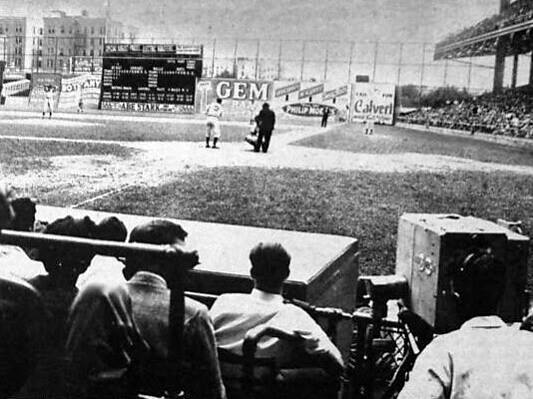
Also, the game was available on television, on WPIX, New York's Channel 11. As you can see by the photo, the station was then owned by the New York Daily News, which advertised itself as "New York's Picture Newspaper." Hence, the call letters, WPIX. Although the newspaper has since moved to new locations, the station still broadcasts out of the Daily News Building at 220 East 42nd Street, as it has since it first went on the air in 1948.

And the Yankees were wrapping up an awful season: They would finish 70-89, in 10th place, last in the American League. It was their fewest wins in 41 years, and their lowest winning percentage and their 1st last-place finish in 54 years.

Put it all together, and the attendance was predictably low. But no one could have predicted how low: 413. That is not a typographical error: Only four hundred and thirteen fans paid to attend this Major League Baseball game. Aside from the games played behind closed doors during the COVID-19 epidemic in 2020, this is the smallest recorded crowd in Yankee history, home or away.

Walter "Red" Barber had broadcast for the Cincinnati Reds from 1934 to 1938, the Brooklyn Dodgers from 1939 to 1953, and the Yankees from 1954 onward. He had also done national broadcasts, first on radio and then on television, for both NBC and CBS.

But, on this day, Barber asked the TV cameras to pan the empty stands, as he commented on the low attendance. WPIX refused to do so, on orders from the Yankees' head of media relations. Undeterred, Barber said, "I don't know what the paid attendance is today, but whatever it is, it is the smallest crowd in the history of Yankee Stadium, and this crowd is the story, not the game."

A week later, Barber was invited to breakfast with Yankees team president Mike Burke, who told him that his contract would not be renewed at the end of the season. In his memoir, Rhubarb in the Catbird Seat, Barber admitted that he was tired of broadcasting the Yankees, and, with Mel Allen having been fired after the 1964, he did not like his new broadcast partner, Joe Garagiola. He admitted that he did it on purpose, so that he would be fired. Essentially, the greatest broadcaster in baseball history "committed suicide by cop."

He was 58 years old, and was never paid to broadcast another sporting event. He wrote a few books, occasionally participated in radio broadcasts, and sat for an interview for Ken Burns' documentary Baseball. Burns did not mention this incident. Barber died in 1992, before the documentary could be finished and broadcast.

For the record: The lowest known attendance for a New York Mets home game is 1,752, in the last competitive baseball game ever played at the Polo Grounds, on September 18, 1963, a 5-1 loss to the Philadelphia Phillies.

Also on this day, the Baltimore Orioles beat the Kansas City Athletics, 6-1 at Kansas City Municipal Stadium. This game clinched the American League Pennant for the Orioles. It was the 1st Pennant for a major league team from Baltimore since the National League version of the Orioles in 1896 -- 70 years. Brooks Robinson went 1-for-5 with 2 RBIs. Frank Robinson went 3-for-5 with 2 RBIs.

Wednesday, August 3, 2022

Vin Scully, 1927-2022

As far back as a 1974 book titled Wait 'Til Next Year, about New York City's 3 Major League Baseball teams of 1947 to 1957, author Christopher Jennison wrote, "The best broadcaster in the business today is Vince Scully."

I don't know when "Vince" became "Vin," but he never became the best broadcaster in the business. That was just the Los Angeles hype machine talking. Jon Miller, the longtime broadcaster first for the Baltimore Orioles and now for the San Francisco Giants, sounded better imitating Scully than Scully sounded as himself.

Vin Scully wasn't the greatest broadcaster in baseball history. But he had the longest broadcasting career in baseball history.

Vincent Edward Scully was born on November 29, 1927 in The Bronx, New York City, and grew up across the Harlem River in the Washington Heights section of Manhattan. This was the neighborhood of the New York Giants, and it might shock Dodger fans, young and old alike, to realize that Vin Scully grew up as, as he put it, "a very big Giants fan."

His father died when Vin was only 4 years old, and his mother remarried, to a man well-off enough to put his stepson through Fordham Preparatory School and Fordham University, both in The Bronx. In between, though, he served in the U.S. Navy during World War II. At the University, he was one of the founders of its esteemed radio station, WFUV, 90.7 FM, in 1947. He also played center field for Fordham, and broadcast for their football and basketball teams.

After graduation, he sent out letters to 150 radio stations. Only one responded: WTOP, the CBS affiliate in Washington, D.C., which would later launch the career of another New York broadcasting legend, Warner Wolf. On November 12, 1949, the University of Maryland traveled to Fenway Park to play Boston University. Scully called this game for WTOP, and Maryland won, 14-13.

That got the attention of the sports director of the CBS Radio Network, who happened to be Walter Lanier "Red" Barber, who was also the main announcer for the Brooklyn Dodgers. And a spot in on the Dodgers' announcing staff had opened up, because Ernie Harwell had gone to the arch-rival Giants. (Harwell, of course, would become best known as the longtime voice of the Detroit Tigers.)

So Scully joined the Dodger team of Red Barber and Connie Desmond on WMGM, 1050 AM (now WEPN). His 1st game was on April 18, 1950, as the Dodgers were playing the Philadelphia Phillies at Shibe Park (later renamed Connie Mack Stadium) in Philadelphia. The Phillies won the game, 9-1, and would end up beating the Dodgers on the last day of the season to win the National League Pennant. Robin Roberts went the distance for the Phils, while Don Newcombe pitched only the 1st for the Dodgers. Jackie Robinson went 2-for-4.
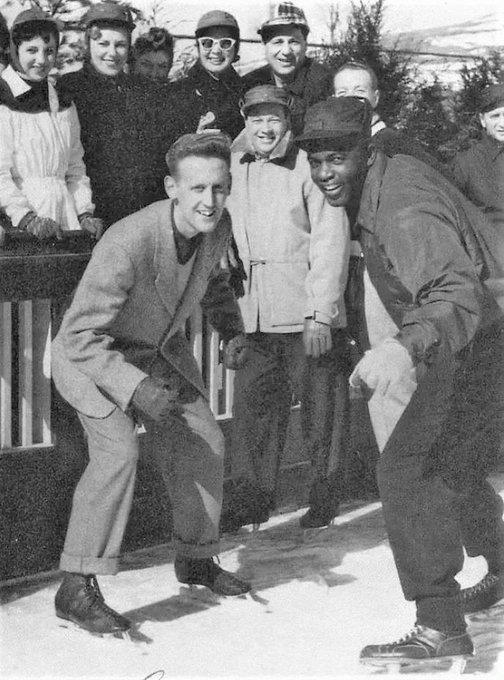
A young Scully, ice-skating with Jackie Robinson

Fed up with the meddling of Dodger owner Walter O'Malley, Barber left after the 1953 season. Fed up with Desmond's alcoholism, O'Malley fired Desmond after the 1956 season. In 1957, Scully was joined by Jerry Doggett, who remained with the team until 1987.

On October 4, 1955, the Dodgers bear the Yankees, 2-0 at Yankee Stadium, to win the World Series for the 1st time. Scully said simply, "Ladies and gentlemen, the Brooklyn Dodgers are the World Champions of baseball." Interviewed for Ken Burns' 1994 Baseball miniseries, he recalled that, as he left The Stadium and went back through Manhattan, "It was Fall. Football was in the air. We came out of the Brooklyn-Battery Tunnel, and it was New Orleans chaos!" Brooklyn had its biggest celebration since V-J Day, 10 years earlier.

Just 2 years later came the greatest heartbreak. O'Malley, who hadn't talked the City of New York into giving him land on which to build a replacement for Ebbets Field -- not that the "visionary" had tried all that hard -- moved the Dodgers to Los Angeles.

Scully went with them, and remained with them until the end of the 2016 season. That's 67 seasons of Major League Baseball.

To put that in perspective: Phil Rizzuto broadcast for the Yankees for 40 seasons, 1957 to 1996, and was on the club's payroll since signing with them as a prospective player in 1937: 60 seasons. Connie Mack, baseball's touchstone for longevity, was involved with the Athletics for their entire run in Philadelphia, 1901 to 1954: 54 seasons. Mack's 1st season in the major leagues in any capacity was as a player in 1886, making his total 69 seasons, but he was removed as manager and operating owner by his sons after 1950, so his real total is 65 seasons, 2 fewer than Scully's.

Casey Stengel, like Mack known as "The Grand Old Man of Baseball," first put on a big-league baseball uniform in 1912, and was last actively involved in the game in 1965, 54 seasons. Don Zimmer, in the last few years of his life, famously wore as his uniform number the number of seasons he'd been involved in professional baseball, his last being 66. Scully topped even that.

Scully was with the Dodgers for 17 postseason appearances, 13 trips to the World Series, and their 1st 5 World Championships. He had called games for 11 men who are already in the Baseball Hall of Fame. He had seen various Dodger players win 9 National League Most Valuable Player awards, 12 Cy Young Awards, 14 Rookie of the Year awards, 43 Gold Gloves, and 15 no-hitters by his team and 13 against it. He had called games during the Administrations of 12 Presidents (nearly 13), 2 British monarchs, 7 Popes, and 9 Commissioners of Baseball.

He was there for Carl Erskine's 14 strikeouts against the Yankees in the 1953 World Series, and Sandy Koufax's 15 against them 10 years later. He had been there for Koufax's perfect game for the Dodgers, and for Don Larsen's, Tom Browning's and Dennis' Martinez's against them.

He witnessed legendary home runs for the Dodgers by Rick Monday and Kirk Gibson, and against the Dodgers by Dick Sisler, Bobby Thomson, Hank Aaron (Number 715), Reggie Jackson, Ozzie Smith, Jack Clark and David Justice. He saw Black Friday against the Philadelphia Phillies, and Blue Monday against the Montreal Expos. He saw Fernandomania, Nomomania and Mannywood.

He watched Jackie Robinson and Maury Wills redefine baserunning; and Sandy Koufax, Mike Marshall and Tommy John, each in their own way, redefine pitching. He saw Edwin Snider, whose hair turning white early got him nicknamed Duke; Don Sutton, with his 1970s perm; Mike Marshall and Jerry Reuss, with their epic mustaches; Steve Garvey, with his 1970s helmet hair; Manny Ramirez, with his greasy dreadlocks; and Clayton Kershaw, with his massive beard.

He broadcast for the Dodgers in Brooklyn and Los Angeles; against the Giants in New York and San Francisco; against the Braves in Boston, Milwaukee and Atlanta; against the Expos in Montreal and after their move as the Nationals in Washington. He broadcast World Series games in Brooklyn, The Bronx, the South Side of Chicago, the suburbs of Minneapolis, Baltimore, Oakland, and, of course, Los Angeles, first in South Central at the Coliseum, and then downtown at Dodger Stadium.

He broadcast games at Shibe Park and Forbes Field, which opened in 1909, and at Marlins Park, which opened in 2012 and is one of several ballparks that could, conceivably, still be used in 2112. He broadcast at a time when Connie Mack, who was born in 1862 and first played in the major leagues in 1884, was still managing; and he broadcast games pitched by Julio Urías, who was born in 1996 and, if he becomes a star, could still be pitching in the late 2030s.

From 1975 to 1982, he also broadcast football and golf for CBS. From 1983 to 1989, he was NBC's lead announcer, starting the Saturday Game of the Week with, "Well, hi, everybody, and a very pleasant good afternoon to you."

His last game was against the arch-rivals, the now-San Francisco Giants, at AT&T Park (now Oracle Park) in San Francisco, on October 2, 2016. Like his first game, but unlike so many in between, it didn't go so well for the Dodgers: They lost, 7-1, getting only 4 hits. He left fans with this message:

You and I have been friends for a long time. But I know in my heart that I've always needed you more than you've ever needed me, and I'll miss our time together more than I can say. But you know what? There will be a new day, and eventually a new year. And when the upcoming Winter gives way to Spring, rest assured, once again it will be "time for Dodger baseball." So this is Vin Scully, wishing you a very pleasant good afternoon, wherever you may be.

His personal life was tinged with tragedy. In 1957, he married Joan Crawford -- not the actress. In 1972, Joan, just 35, died of an accidental medical overdose. Their son Michael was inspecting oil pipelines for leaks following the 1994 Northridge earthquake when his helicopter crash, killing him at just 33.

But in 1973, just as year after Joan died, Vin married Sandra Hunt, already with 2 children, and they had another together. Overall, he raised 6 children, and lived to see 16 grandchildren and 3 great-grandchildren. Unfortunately, Sandra suffered from amyotrophic lateral sclerosis, a.k.a. Lou Gehrig's disease, and being able to care for her, as much as anything else, was why Vin retired after the 2016 season. Of course, he was approaching his 89th birthday, which didn't help, but he did what he could for her until her death on January 3, 2021.

Among his honors:

* 4 National Sportscaster of the Year awards.
* A star on the Hollywood Walk of Fame, in 1982.
* The Ford Frick Award, the broadcasting honor of the Baseball Hall of Fame, also in 1982.
* The National Radio Hall of Fame, in 1995.
* Invited to introduce the fan-chosen MLB All-Century Team at Game 2 of the 1999 World Series.
* The Dodger Stadium press box named for him, in 2001.
* The California Sports Hall of Fame, in 2008.
* The Grand Marshal for the Tournament of Roses Parade, in 2014, after having broadcast it in 1967.
* The Presidential Medal of Freedom, in 2016.
* The renaming of Elysian Park Avenue, the street on which Dodger Stadium sits, as Vin Scully Avenue by the City of Los Angeles, also in 2016.
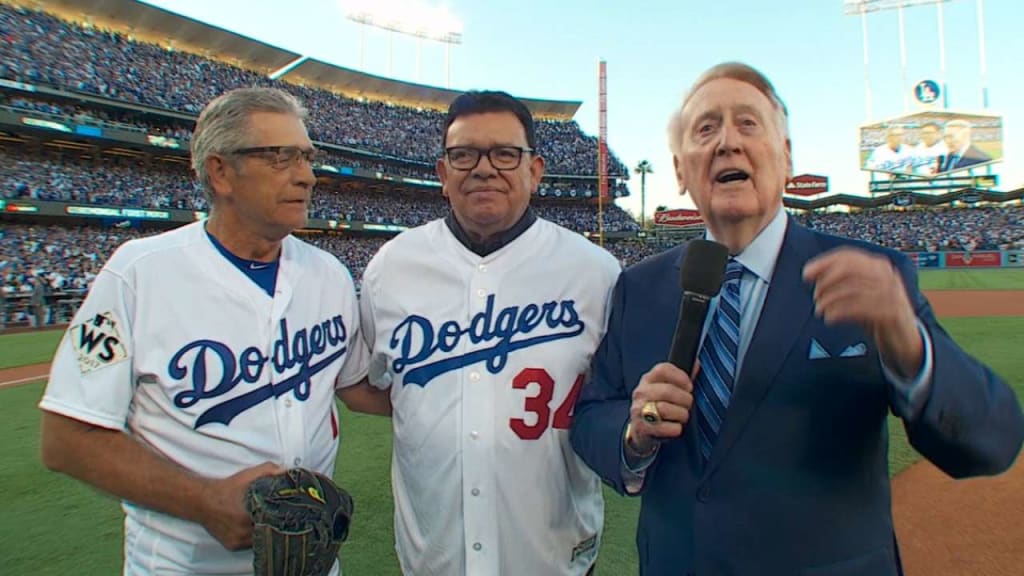
* The Dodgers invited him to throw out the ceremonial first ball before Game 2 of the 2017 World Series. Ironically, he told the crowd that he couldn't do it, as he'd picked up an infamous injury for pitchers: He'd torn his rotator cuff. He handed the ball to Fernando Valenzuela, who threw it to his fellow 1981 World Series hero, Steve Yeager.
* And, having lived long enough to see the Dodgers win one more World Series, in 2020, he was asked to narrate the official World Series highlight film.
Left to right: Yeager, Valenzuela, Scully

On November 5, 2017, he gave a speech at the Pasadena Civic Auditorium in which he responded to the NFL "take a knee" protest by saying, "I will never watch another NFL game again." He was one of millions of people who just didn't get it: It was about racism and police brutality, and had nothing to do with the song or the armed forces. It was a shameful moment in a mostly decent life.

Vin Scully died yesterday, August 2, 2022, at his home in Hidden Hills, Los Angeles County, California. He was 94 years old. No cause has been released.

I'll let Jeff Passan of ESPN have the last word: "Vin Scully was a storyteller, and nobody ever told the story of baseball better. He called games with such elegance and grace. He spoke only when necessary, allowing the broadcast to breathe when it demanded. He made baseball a more beautiful game."

Friday, April 14, 2017

April 14, 1917: Marvin Miller, Baseball Hero, Is Born

April 14, 1917, 100 years ago: Marvin Julian Miller is born. In Brooklyn. So, to Walter O'Malley, the man who was de facto dictator of baseball from 1955 to 1979, that alone was Strike 1.

While O'Malley, part owner of the Dodgers starting in 1942, and controlling owner from 1950 until his death in 1979, made his fortune foreclosing on houses as a lawyer for the Brooklyn Trust Company during the Great Depression, Miller took a different path, with his career as a lawyer, representing people who actually worked for a living, in his case the United Steel Workers. For O'Malley, that was Strike 2.

Then Miller became Executive Director of the Major League Baseball Players Association in 1966. A union that directly challenged the team owners. For O'Malley, that was Strike 3. But Miller would end up hitting a home run off him. And you wonder why O'Malley is in the Baseball Hall of Fame and Miller isn't.

In 1992, Red Barber said, "Marvin Miller, along with Babe Ruth and Jackie Robinson, is one of the two or three most important men in baseball history." At the very least, Red was right as far as the last 100 years are concerned.

The Executive Director of the MLBPA from 1966 until 1982, Miller died on November 27, 2012. He was 95. He still wasn't yet elected to the Hall of Fame.

UPDATE: He was finally elected to the Hall of Fame in 2020.

Tuesday, August 26, 2014

August 26, 1939: The 1st Baseball Game On Television

August 26, 1939, 75 years ago: The Brooklyn Dodgers host a doubleheader against the Cincinnati Reds at Ebbets Field. The 2nd game is the 1st Major League Baseball game ever broadcast on television.

In 1935, Larry MacPhail was the general manager of the Reds. He made them the 1st MLB team ever to play under lights. He also put their games on regular radio for the first time, and his broadcaster was Walter "Red" Barber, a rural Floridian who adjusted well to a big city.

In 1938, these two redheads adjusted to a much larger city, New York, when MacPhail was named general manager of the Dodgers, and brought Barber with him, breaking the "gentlemen's agreement" that none of the City's teams would broadcast their games on radio.

MacPhail also made Ebbets Field the 1st of the City's 3 ballparks to put up lights. It may not have been a coincidence that the 1st night game there was against the Reds. Fortunately for baseball history, but unfortunately for the Dodgers, this game, on June 15, 1938, was the game in which the Reds' Johnny Vander Meer became the only man, to this date, to pitch back-to-back no-hitters in the major leagues.

On April 30, 1939, the New York World's Fair got underway in Flushing Meadow-Corona Park in Queens, across Roosevelt Avenue from where Shea Stadium and Citi Field would later be constructed. The opening, with a dedication by President Franklin D. Roosevelt, himself a New Yorker, was the 1st broadcast of W2XBS, New York's 1st television station.

Run by RCA, the Radio Corporation of America, W2XBS was going to be the centerpiece of a new TV network, to go along with the radio network they had established in 1926, the National Broadcasting Company, NBC. Now, it was going to broadcast baseball, and Red Barber was going to call the action.

But only for the 2nd game. The 1st game was won by the Reds, 5-2. This was not surprising: The Dodgers were a team on the rise, and would finish 3rd in the National League that season; but the Reds went on to win the next 2 NL Pennants.

Bucky Walters, the Reds' ace, won his 21st game of the season, outpitching Luke Hamlin. Walters would finish the season 27-11. If there had been a Cy Young Award back then, he surely would have won the NL's edition that season. Hamlin didn't pitch badly, but was undone by 2 errors by his teammates.

Between games, the telecast began. Barber gave a recap of the opener, and conducted interviews, including with Dodger manager and shortstop Leo Durocher. It was the beginning of a long and productive relationship between Barber and television -- and one between Durocher and television, as "Leo the Lip" used the medium, as he had already used print and radio, for his own cynical ends.

The 2nd game was the rescheduling of a game originally set for June 12, postponed not due to weather, but because it was the Opening Day of the Baseball Hall of Fame. Hugh Casey, better known as a reliever, started for Brooklyn, and Johnny Niggeling did so for Cincinnati. As the home team's starting pitcher, Casey thus became the 1st Major League Baseball player to play on television.

The Dodgers got on the board in the bottom of the 2nd inning. Art Parks led off with a single, and Dolph Camilli hit a home run. They broke the game open in the 3rd: Pete Coscarart led off with a single, and Cookie Lavagetto doubled him home. Dixie Walker grounded out, but Parks singled again, and Camilli doubled him home. Al Todd drew a walk, and Ernie Koy singled home Parks and Camilli. The Dodgers led 6-0.

The Reds reached Casey for a run in the 8th, but that was it: The Dodgers won 6-1, and the few hundred people capable of watching this game outside Ebbets Field (where a full house of 33,535 paid to watch) got their money's worth.

Sadly, it appears that no record of this game survives: Not the original TV broadcast, not a radio recording, not a film. The photograph at the top of the page is allegedly from that game.

Later in 1939, W2XBS would also become the 1st TV station in the world to broadcast college football and the 1st to broadcast pro football. In 1940, it became the 1st American TV station to broadcast a National Hockey League game (a British station had telecast a hockey game in London in 1938), the 1st to broadcast a religious service (Easter Mass from St. Patrick's Cathedral, a short walk from the RCA Building at Rockefeller Center), and the 1st to broadcast a political convention (the Republican Convention in Philadelphia, nominating Wendell Willkie to run against FDR, unsuccessfully as it turned out).

On July 1, 1941, the Federal Communications Commission (FCC) gave licenses to W2XBS and W2XAB, which was owned by the Columbia Broadcasting Service, CBS. Doing so on the same day meant that neither could claim to be the 1st. W2XBS became WNBT, broadcasting on Channel 4. They changed their call letters to WRCA in 1954, and to WNBC in 1960. W2XAB broadcast on Channel 2, and became WCBW, and then WCBS in 1946.

The other New York VHF TV stations:

* Channel 5 went on the air on May 2, 1944, on the DuMont Network, with its call letters being WABD, for its founder, Allen B. DuMont, went independent when DuMont folded in 1956, became WNEW in 1958, and WNYW when it became a Fox station in 1956.

* Channel 13 went on the air on May 13, 1948, as an independent station, WATV. It became WNTA in 1958, and WNDT in 1962. That year, it joined National Educational Television (NET), America's 1st "public television" network. In 1970, NET became the Public Broadcasting Service, PBS, and the station's call letters were changed to WNET. Why not WPBS? Those call letters were not already being used, but were subsequently given to a PBS station in Watertown, New York, on the St. Lawrence River, Channel 16.

* Channel 11 went on the air on June 15, 1948, as WPIX, the call letters referring to its ownership by the New York Daily News, "New York's Picture Newspaper." This was not unusual: Many radio TV stations were founded by newspapers. WPIX continues to use the Daily News Building on East 42nd Street as its headquarters, even though the paper has moved its offices elsewhere. The station joined Warner Brothers in 1995, becoming part of The WB. When The WB and UPN merged in 2006 to form The CW, WPIX went along with it.

* Channel 7 went on the air on August 10, 1948, as WJZ, an ABC station, becoming WABC in 1953.

* Channel 9 went on the air on October 11, 1949, as WOR, an independent station, becoming WWOR when bought by MCA in 1987, moved to United Paramount Network (UPN) in 1995, and to MyNetwork in 2006, following the WB/UPN merger.

Wednesday, June 4, 2008

A Great Grandma

Today is June 4. It would have been the birthday of my grandmother, Grace Darton, later Grace Golden (1924-2006).

She was born in Brooklyn and grew up in Queens, in a neighborhood she called South Ozone Park -- except her house was actually in South Jamaica. But that doesn't matter now.

She was a Brooklyn Dodger fan. Not able to afford to attend many games at Ebbets Field, her lifeline, as it was for so many, was the radio broadcasts of Walter (Red) Barber.

She remembered a time when a player got hurt crashing into the outfield wall. She never remembered who it was, but it was probably Pete Reiser, a great hitter and speedy runner who ruined his career by crashing into outfield walls, which were not padded in those days. Barber, a Southerner but a college graduate at a time when not very many people were, was a very cultured man, and he was determined to sound like a Southern gentleman.

By contrast, the public-address announcer at Ebbets Field was Tex Rickards -- I'm not sure what his real name was, but he was surely nicknamed Tex after George "Tex" Rickard, the boxing promoter who built the 1925-1968 version of Madison Square Garden (a.k.a. "the Old Garden") and founded the New York Rangers. Tex Rickards had a Brooklyn accent, and wasn't very bright. There's an oft-cited legend that, between innings, the umpires got him a message to ask people sitting in the front row along the baseline to take their coats off the railing. So Tex got on his microphone, and said, "Will da fans sittin' down the foul lines please remove dere clothing?"

Apparently, in this game in which Reiser was knocked out cold, Tex asked someone why Reiser was being carted off the field on a stretcher, and was told, "He don't feel good." And his announcement could be heard over the radio: "Your attention please: Reiser has to leave the game because... he don't feel good!"

According to Grandma (who always told it as, "So-and-so has to leave the game... " because she didn't remember who it was), she laughed, because she knew what was coming: Red Barber was going to have a fit over Rickards' poor English. And he did!

*

Grandma lost both parents while she was at John Adams High School, which is in Ozone Park, a neighborhood over. She never graduated. She went to work. Getting a job was possible because many jobs that were filled by men were vacant due to the draft and enlistments for World War II.

She eventually became a bookkeeper, and held that job into the early 1990s. She married my grandfather in 1946, and, to protect her from anti-Semitism, he changed his name from George Goldberg to George Golden. My mother was born... some time after that. (Mom wouldn't want me to tell you that she's now 61. Oops. I had an accident. Well, at least Mom wasn't an "accident.")

They lived briefly in Hunter, in New York's Catskill Mountains; then on Manhattan's Lower East Side, then in the Forest Hill neighborhood on Newark's North Side, then in neighboring Belleville, then in neighboring Nutley, where they lived when Mom married Dad. Grandma and Grandpa moved to a retirement community in Brick, near the Jersey Shore, and lived there for the rest of their respective lives.

Grandma exulted and groaned with the Dodgers. Her great hero in baseball, and her great hero in life, was Jackie Robinson. She loved Pee Wee Reese. She loved Roy Campanella. She loved Gil Hodges. She loved Carl Erskine. She loved Joe Black. She loved Don Newcombe -- and, years later, long after both she and the Dodgers left the City, she ran into Newk in an elevator at the building she was working in, on Newark's Broad Street. (She guessed Newk was visiting a law firm that worked there.)

She said Carl Furillo, "the Reading Rifle," had the best outfield arm she'd ever seen. She said Billy Cox was the best third baseman she'd ever seen. She loved to tell the story of how Elwin "Preacher" Roe, a lefthanded pitcher with a great curve and a nasty sinker -- cough-spitball-cough -- but a lousy hitter even by pitchers' standards, hit a home run, and Red Barber told his listeners, "Folks, we'll never hear the end of this one." Red was right: Roe is now 93 years old, one of the oldest living former players, and he still talks about it.

But she hated manager Charlie Dressen: "Oy, God," she would occasionally say, "that Dressen was so stupid." Looking at some of his managerial moves, half a century and more after the fact, I agree.

She hated the Dodgers' arch-rivals, the New York Giants, and didn't like the most successful team in town, the New York Yankees. She hated manager Casey Stengel, probably because he'd previously been the Dodgers manager, and had stunk at it. (Which, he did.) She hated superstar center fielder Joe DiMaggio, thinking he was stuck-up. (Which, he was.) She hated catcher Yogi Berra, comparing him unfavorably with Dodger backstop Roy Campanella. (Rather, Campy should have been flattered.) She hated broadcaster Mel Allen, thinking he couldn't shine Red Barber's shoes. (Mel did have his flaws.) She didn't hate Mickey Mantle, but she thought Duke Snider was the better center fielder and the better hitter. (There were times, especially through 1955, when she had a point.)

There were, however, two Yankees she liked: Shortstop Phil Rizzuto and pitcher Whitey Ford. Why? She thought they were tough, great competitors. Yet she never liked 2nd baseman (and future manager) Billy Martin. Why? Because he was a hothead. Her word for him, and she was right. But there was another reason she liked the Scooter and the Chairman of the Board: Like her, they were from Queens: Rizzuto from Richmond Hill, Ford from Long Island City.

But she really hated the Giants. Hated Willie Mays. Hated Sal Maglie, the headhunting pitcher known as Sal the Barber because his pitches gave hitters "close shaves." Really hated broadcaster Russ Hodges. Especially hated their ballpark, the Polo Grounds.

Hated Bobby Thomson, and if you've read this blog this far, you already know why. She was listening to Red Barber's broadcast on WMGM (at 1050 AM, now ESPN Radio's New York affiliate), and heard Tex Rickards say, "Coming in to pitch for Brooklyn, Number 13, Ralph Branca." And she knew. I don't mean she figured. You know how we so often say, "I knew it"? We never really know it. But she knew it. She knew this team. She knew Branca had only one pitch, a fastball. She knew Thomson couldn't hit anything but a fastball. She knew Branca gave up too many clutch home runs. (Paging Kyle Farnsworth... Except everybody who meets Branca says he's a decent guy, which is something we can't say about Farnsworth.) And Branca had already given up a homer to Thomson in the first game of that 1951 Playoff series. She knew.

She got up out of her chair and turned off her radio. She didn't need to hear anybody tell her, as Hodges put it, that, "The Giants win the Pennant! The Giants... etc., etc., etc."

The Dodgers finally won a World Series in 1955, finally beating the Yankees, under new manager Walter Alston. Two years later, owner Walter O'Malley moved the Dodgers to Los Angeles, and talked Giants owner Horace Stoneham into keeping the rivalry going by moving them to San Francisco.

*

When the Mets arrived in 1962, she found it hard to root for them. After all, they played in the Polo Grounds, and had the orange "curlicue" interlocking NY on their caps like the Giants. But when they had their "Miracle" season in 1969, that was it: Met fan for life. Well, nobody's perfect, not even your Grandma.

Despite all her history with the Dodgers, when I asked her what was her favorite ballgame of all time, she named Game 6 of the 1986 National League Championship Series, Mets vs. Houston Astros at the Astrodome. The Mets had to win, or it would go to Game 7, and Astro pitcher Mike Scott was nearly unbeatable that year, especially in the Dome.

"He owns them," she said of Scott, an ex-Met, at the time. "They're his cousins." By the look on my face, she knew she had to explain what that meant: It's an old-time expression meaning that he does very well against them. Today, we would say that the Mets were his bitches.

The game went back and forth, back and forth, with both teams scoring in extra innings, until finally, as Met broadcaster Bob Murphy might have put it, "The Mets win the damn thing" in the 16th inning. And went on to win the World Series against the Boston Red Sox, and we all know how that happened. Don't we?

She loved those '86 Mets because of their scrappy players like Len Dykstra and Wally Backman. But she hated that the team was broken up for various reasons: Dumb trades, injuries, and, in some cases, drugs. After that, she swore she'd never love another team.

Except the Yankees finally put together a Pinstriped bunch she could love in 1996. And the Mets had a renaissance starting in 1998, and she couldn't resist.

*

She also liked the football New York Giants. And when Bill Parcells became coach of the New York Jets, she rooted for them, too. She hated cheating in all forms (and yet she liked Preacher Roe and Whitey Ford), so had she lived to see the recent Super Bowl with the Giants beating the New England Patriots, she would have loved it.

And even though the New York Rangers won three Stanley Cups in her youth (1928, 1933 and 1940), she was never into hockey. But when the New Jersey Devils arrived in 1982, she got interested. She really got into it after the Devils got good in 1992. After that 1994 double-overtime Game 7 of the Eastern Conference Finals, I told her that Stephane Matteau had become "my Bobby Thomson." That was a hard loss, except they came back the next year, and won the Stanley Cup in 1995, 2000 and 2003.

When Game 5 of the 2000 Finals against the defending champion Dallas Stars went to triple overtime (the Devils lost) and then Game 6 went to double overtime (the Devils won the Cup on Jason Arnott's goal), she stayed up for all of it, even though she had just turned 76. But in her whole life, she only saw two games live, both in 2004, with me and my mother. The Devils lost one to the Ottawa Senators, and barely escaped the other with a tie against the Minnesota Wild. (It might have been the last tie the Devils ever played, since the NHL changed the rules to create the shootout.) She never saw the Rangers play, either at the old Garden or the new one, and came to dislike them as a dirty team, despite the fact that, in her youth, they were often billed as "the classiest team in hockey." If that was ever true -- roughhousers like Ivan "Ching" Johnson and Bob Dill, a player supposedly so dirty that Steve Avery played him in the 2005 Canadian film Maurice Richard, suggest it wasn't -- it wasn't anymore.

Even though they never played for a New York team, she loved Dizzy Dean, Terry Bradshaw, Joe Montana and Wayne Gretzky.

*

On May 27, 1978, she took me to the first big-league ballgame I ever saw, at Yankee Stadium. The Yankees lost to the Toronto Blue Jays, 4-1. It would be another 8 years until we went to Shea together, to a game the Mets won over the San Diego Padres in their 1986 title season.

I never thought to ask her about the first big-league ballgame she ever saw, but I can tell you about the last. I won tickets in a radio contest, and got to see the Jackie Robinson 50th Anniversary tribute at Shea Stadium, on April 15, 1997, with the Mets playing the Los Angeles team -- it's a little hard, considering it's my Grandma, to call them "the Los Angeles Dodger$." (See? I had to make the S a dollar sign. Lord Waltermort would have understood.) I had to take her, not because it would be her last game (I couldn't have known that at the time), but because it was her hero, and her team, that was being honored.

The surviving members of the Robinson family were there, and Jackie's widow Rachel Robinson spoke. So did Baseball Commissioner Bud Selig. So did President Bill Clinton. The Mets won, 5-0 -- whether that "taught the Dodgers a lesson" is something you'll have to decide for yourself. Several old Dodgers were on hand, including Duke Snider, Don Newcombe and Sandy Koufax -- who declined to be part of the official ceremonies, but, as a longtime friend of Met owner Fred Wilpon, sat in a baseline box. Wearing a Mets cap, not a Dodgers cap.

On the way out, because our seats were behind home plate, we left through Shea's Gate C, which also contains the entrance for Mets officials and the media. And as we got out... the Robinson family turned out to be right behind us. It was a big thrill for Grandma to see Rachel Robinson up close. I was so glad I won those tickets: Taking her to this game might be the noblest thing I've ever done. (Yeah, I know: I should have done other things even nobler than that.)

And it was the last big-league game she ever saw in person. When the Philadelphia Phillies put a farm team just 6 miles from her house in 2001, she began going to several games a season. The Lakewood BlueClaws, named for a crab native to the Jersey Shore. They weren't very good, but she had a good time.

She lived long enough to see the Mets develop Jose Reyes and David Wright, but not to see the Met collapses of October 2006 and September 2007. (From the Ultimate Skybox, she's seen them, and I know what she said: "Oy, God!" Making "the Macaulay Cuklin Face." You know the one I mean.)

On what would have been her next birthday, who were the Mets scheduled to play? The San Francisco Giants, descendants of her former arch-rivals. And it gave me a chance to boo Barry Bonds.

When Armando Benitez, the ex-Baltimore Oriole and ex-Met, whose decidedly un-clutch pitching gave the Yankees big wins in the 1996 Playoffs and the 2000 World Series, came in to nail down the Giants' win, I looked up, and asked her if this was her doing. I knew Benitez would blow it. Right: Again, I didn't know. I believed. I suspected. I felt. The hell with that: I knew he would blow it. And he did.

The game went to extra innings, and Lastings Milledge hit his first major league home run to tie the game back up, and Shea Stadium went bananas. Then Milledge ran out to right field and high-fived the fans leaning over the railing, which many fans think was the beginning of the end for him in Flushing. I didn't mind it. Alas, the Met bullpen blew the game, and the Giants won. 

But what Grandma couldn't do for the Mets, she did for the BlueClaws: In 2006, having not finished over .500 in their first 5 seasons, they won the South Atlantic League Pennant.

Today would have been her 84th birthday, and her first as a great-grandmother. My sister gave her twin daughters their grandmothers' names as middle names: Ashley Grace, and Rachel Emma. In this case, "Rachel" has nothing to do with Rachel Robinson. But Grandma would have liked that, too. (UPDATE: Now that the girls are old enough to know who Jackie Robinson was, and why he matters, Rachel is thrilled that she shares a name with Mrs. Robinson. And I told them the story of how we ran into the Robinsons that night at Shea, and they loved it.)

Happy Birthday, Grandma. Enjoy the peanuts at your restored version of Ebbets Field. And watch Jackie: He's jumping off third, and I think he's gonna...
Safe.