Showing posts with label mike stanley. Show all posts

Wednesday, July 25, 2018

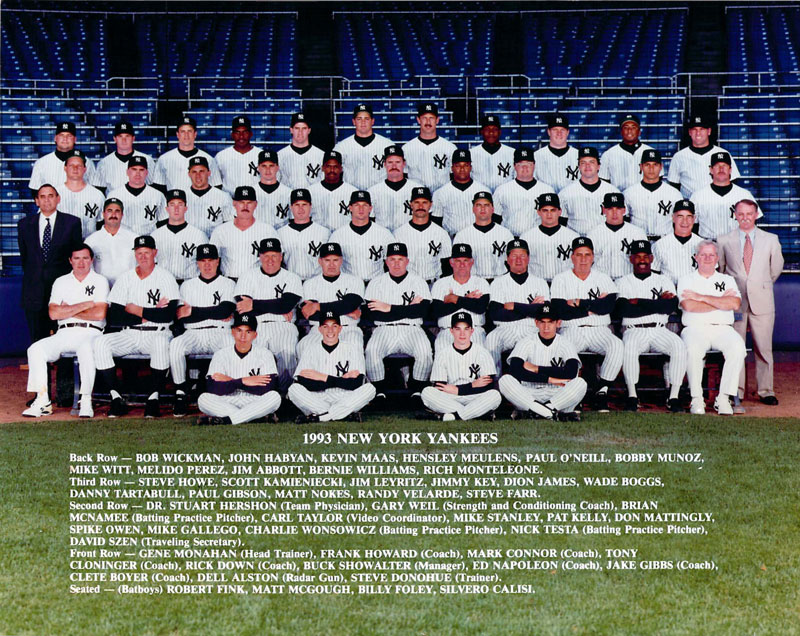
July 25, 1993: Fandom Reborn

July 25, 1993, 25 years ago: An era ended, in a way, and a new one began. And most baseball fans don't know, and probably wouldn't care. But it was a big day for me.

I had been a Yankee Fan since 1977, at age 7. I wasn't old enough to remember Babe Ruth, Lou Gehrig, Joe DiMaggio or Mickey Mantle. I was a little too young to remember the pre-renovation original Yankee Stadium, and slightly too young to remember Chris Chambliss hitting a home run to win the 1976 American League Pennant.

But I do remember the Yankees winning the World Series in 1977 and 1978, and the Pennant in 1981. I remember Reggie Jackson's 3 home runs (well, 2 of them, as my parents made me go to bed, as it was a school night), the 14-game comeback against the Boston Red Sox, Bucky Dent's home run, Thurman Munson's blast against the Kansas City Royals in the Playoffs and his death in a plane crash the next year, Ron Guidry's strikeouts, Graig Nettles' miraculous plays at 3rd base, Goose Gossage dominating in relief, Dave Righetti's 4th of July no-hitter in 1983, Dave Winfield's tomahawks into left field, and Don Mattingly's big hits.

But I also remember the near-misses of the 1980s, team owner George Steinbrenner's managerial musical chairs, the triumphs and tragedies of Billy Martin, the collapse at the end of the 1980s, and George's "temporary lifetime" banishment in 1990.

The rebuilding of the Yankees under general manager Gene Michael was underway. By 1993, the Mets were a mess both competitively and behaviorally, and the Yankees were ready to contend again. The Mets have not been definitively the best baseball team in New York ever since, not even during the 2015 season, when they won the National League Pennant and the Yankees lost in the AL Wild Card Game.

Buck Showalter was the manager. Mattingly was already the last holdover from the Eighties. Now, there were dependable veterans like Wade Boggs, Jimmy Key and Paul O'Neill, and rising players like Bernie Williams. More trades would be made, and more prospects would develop.

But you could sense that something good was happening. We didn't yet know if, say, 1996 would be a new 1976, or a false dawn that would collapse by 1999 as it did in 1989. But things were looking good, and the Yankees spent the Summer of '93 battling the defending World Champion Toronto Blue Jays for the lead in the AL Eastern Division.

On July 17, I was with the youth group at the Aldersgate United Methodist Church in my hometown of East Brunswick, New Jersey. Given our location, some of us were Yankee Fans, a few of us were Met fans, and a couple of us rooted for the Philadelphia Phillies, who were in the other direction, but not much further away than New York was. (The church was 49 miles from Yankee Stadium, 50 miles from Shea Stadium, and 63 miles from Veterans Stadium. The ballparks have changed, the distances have not.)

We spent the night of July 17-18 at a church in Fredericksburg, Virginia. We had lunch on the 18th in Dunn, North Carolina, just off Interstate 95. At Triangle Waffle, I had the best hamburger I'd ever had to that point. It was so good, I ordered a second for the road.

We arrived at Kingstree, South Carolina, with the Carolinas caught in the middle of a terrible heat wave and drought, while the Midwest, especially Iowa and Illinois, had some of the worst flooding in American history. It was a stark contrast. The State, South Carolina's largest paper, based in the State capital of Columbia, had a cartoon showing the State flag, with the traditional Palmetto tree replaced by a cactus.

At night, inside my sleeping bag (we were about 7 to a room), I would fiddle with the radio dial on my Walkman, and picked up the New York radio stations and their baseball broadcasts. I got broadcasts from as far west as St. Louis and New Orleans. (Then as now, New Orleans had a Triple-A team, but I didn't get their game, only a news station.) I still have that Walkman, although it no longer works. And it's my fault: I left it unused so long, the batteries leaked, and ruined the interior.

In the morning, with the Internet still just a rumor to me (we were still using the phrase "the information superhighway"), I would get newspapers. I saw the color photo of the press box fire at Atlanta-Fulton County Stadium on the front page of the Charleston, South Carolina-based Post and Courier. Color pictures in newspapers was still a big deal, and the Atlanta Braves were the closest Major League Baseball team to the house where we were staying, but it was still over 300 miles to the west, with Baltimore (and Washington, then without an MLB team) over 450 miles to the northeast.

The fire was put out, no one was hurt, the regularly-scheduled game was played, and, with newly-acquired Fred McGriff hitting a home run, they beat the St. Louis Cardinals.

We spent 5 days fixing up a house, and at the end, were treated to a Carolina chicken dinner. Too spicy for me. On Saturday, the 24th, we headed for the shore and the boardwalk -- not the Jersey Shore, but Myrtle Beach, South Carolina. Not only was I not impressed, but it was about as rednecky a place as you could get and still have a beach.

We spent the night at a church in Raleigh, North Carolina. According to the pictures on the wall in the foyer, one of the church leaders was named Michael Jordan. Sure, it's a fairly common name, but we were in North Carolina -- and the news of the Michael Jordan's father having disappeared was in the news. He hadn't yet been found, and we didn't yet know that he'd been murdered.

And so, that Sunday, July 25, 1993, we went up first Interstate 85, then I-95, heading north, back home. And we went back and forth, listening to whatever radio broadcast of baseball we could pick up. The Yankees were then on WABC, AM 770, but we couldn't yet reach them in Virginia.

Nor could we pick up the Mets on WFAN, 660; and it didn't matter, anyway, because they were playing the Dodgers in Los Angeles, and were a 4:05 PM Eastern Time start. Same with the Phillies, at AM 1210, then with the call letters WOGL, as they were playing the Giants in San Francisco. But the Baltimore Orioles, at WBAL, 1090 (a.k.a. "Radio 11"), were loud and clear. There was, of course, no Washington Nationals yet.

Jon Miller, now with the Giants, was then the voice of the Orioles, and he has the perfect voice for baseball on the radio. And he told us that the Yankees were already losing 8-0 to the California Angels in the 2nd inning. Melido Pérez had already been knocked out of the box. Forget it, it was over.

How over was it? According to Baseball-Reference.com, at that point, the Angels had a 97 percent chance of winning the game.

Among the scoring was a home run by Charles "Chili" Davis. This guy always hit the Yankees well. I was so glad the Yankees acquired him in 1998, not for anything he could do for them, but for the fact that he would no longer be doing anything to them. He did, however, help the Yankees win the World Series in 1998 and 1999 -- but in 1993, we had no idea of what was ahead for the Bronx Bombers.

Mike Stanley, then the Yankee catcher, led off the bottom of the 2nd with a home run, but it was still only 8-1. Nobody expected any comeback.

Anyway, we went back to the Orioles at 1090. They were in Minneapolis, and ended up losing to the Minnesota Twins 5-2.

Other American League scores that day: Boston Red Sox 8, Oakland Athletics 1 at Fenway; Cleveland Indians 11, Seattle Mariners 9 at Municipal Stadium; Detroit Tigers 3, Kansas City Royals 0 at Tiger Stadium; Milwaukee Brewers 7, Chicago White Sox 3 on the South Side; Toronto Blue Jays 9, Texas Rangers 7 in Arlington.

In the National League: Florida Marlins 7, Cincinnati Reds 3 at Joe Robbie Stadium; Braves 13, Pittsburgh Pirates 1 at Three Rivers; Chicago Cubs 3, Houston Astros 1 in 11 innings at the Astrodome; Cardinals 5, Colorado Rockes 4 in 11 innings in Denver; and Montreal Expos 5, San Diego Padres 4 in 10 innings at Jack Murphy Stadium.

We got stuck in traffic on the Virginia side of the Potomac, found our way around the Capital Beltway, and headed back up I-95 toward Baltimore. But by the time we reached Camden Yards, vacant as the O's were on the road, Miller was giving the out-of-town scoreboard, and informed us that the Yankees had come back, and it was 8-7 Angels in the 7th inning.

Now, WABC was coming in. And the Yankees got the 1st 2 men on in the bottom of the 8th. But they couldn't get those men home, and still trailed 8-7 after 8.

By now, the Mets' game in L.A. had begun. But there was only 1 Met fan in that van, 1 Phillie fan, and about 10 Yankee Fans. We were sticking with the Pinstripes.

Bottom of the 9th. Steve Frey pitching for the Halos. Danny Tartabull led off, and drew a walk. Cliché Alert: Walks can kill you, especially the leadoff variety. Stanley came up, and hit what we later learned (on the TV news) was a perfect double-play grounder to short, but Gary DiSarcina let it go between his legs, Bill Buckner-style. For the 2nd straight inning, the Yankees had 1st and 2nd on, and nobody out.

Cliché Alert: "He runs well for a catcher." Well, nobody ever used that cliché on Stanley, so Showalter sent in a pinch-runner: Hensley Meulens, once a tremendous prospect known as "Bam-Bam" for his power, but, by this point, a massive disappointment.

Bernie Williams was at the plate. Angel catcher Ron Tingley couldn't handle a Frey pitch, and it was a passed ball. Now, the tying and winning runs were in scoring position. In spite of the fact that nobody was out, Angel manager Robert "Buck" Rodgers ordered Bernie intentionally walked, to load the bases and set up a force play at home.

The batter was Paul O'Neill. He hit a fly ball to left, deep enough to score Tartabull with the tying run.

Up came the shortstop. Number 2. No, not Derek Jeter. We had barely heard any whispers about him, as he was in only his 2nd, 1st full, season of pro ball. This was Mike Gallego, a part of the Oakland Athletics' quasi-dynasty of 1988-92, and a decent player, but hardly what Jeter would become. He flew out to center. Meulens, who hadn't advanced to 3rd on O'Neill's fly, did so now. The winning run was on 3rd, but there were 2 outs.

Somewhere between the Baltimore Beltway and the Delaware State Line, we were going nuts in that van.

The batter was Pat Kelly. A good 2nd baseman, and an okay hitter. Nothing special. Except for this moment. He faced 1 pitch, and hit a sharp line drive to left field. Meulens scored. Yankees 9, Angels 8. John Habyan was the winning pitcher, in relief. Attendance: 50,429.

I thought I could hear Phil Rizzuto yell, "Holy cow!" from 150 miles away. The game was on WPIX-Channel 11, and, as I learned while watching the 11:00 edition of WABC-Channel 7's Eyewitness News, he did yell it.

There is an urban legend that says that this was the 1st time that John Sterling, on the radio, used the words, "Ballgame over! Yankees win! Theeeeeeee Yankees win!" But I never heard him drag the "the" out until Bernie's walkoff home run in Game 1 of the 1996 AL Championship Series against Baltimore. He did use "Yankees win! The Yankees win!" as early as the Jim Leyritz Game, Game 2 of the 1995 AL Division Series against Seattle.

But in that van on that warm Sunday afternoon on the John F. Kennedy Memorial Highway in Cecil County, northeastern Maryland, we were bouncing around that van like a pinball machine. Until the 1 Met fan asked us if we could now switch to the Mets broadcast.

So we did. By the time we got back to the church in East Brunswick, the Mets were on their way to wrapping up a 4-0 win over the Dodgers at Chavez Ravine. So, for the day, New York 2, Los Angeles 0. Fine with me. Like the O's, the Phils lost 5-2, to the Giants.

I was a little older than most of the kids on the trip: 23, as opposed to these 14-to-18-year-old high schoolers and recent graduates. It was the 1st time that I felt like an adult baseball fan.

That week, between the newspapers and the radio, it felt like my fandom, for both the sport and for my individual team, had been reborn.

And the next few years would both test and reward my fandom.

I can't say I loved every minute of it. But I loved a lot of those minutes!

Wednesday, March 16, 2016

Top 10 Yankee Catchers

Old-Timers Day, 1976. Left to right:
Bill Dickey, Yogi Berra, Elston Howard and Thurman Munson.

This list will have considerably fewer Honorable Mentions than that of the Top 10 Yankee Pitchers. And that's a good thing, since it reflects the luck and longevity the Yankees have had with their catchers.

Honorable Mention: Pat Collins, 1926-28. Just as the 1990s Chicago Bulls were the weakest at the most important position in basketball, center (although not that weak, as Bill Cartwright and Luc Longley were good, just not sensational), so, to, were the 1926, 1927 and 1928 Yankees, often called the greatest team in baseball history, weakest at the most important position: Catcher.

Collins, Benny Bengough and Mike Gazella were the catchers who bridged the gap between Wally Schang, who got old in 1925, and Bill Dickey, who wasn't ready to take over as the starter until 1929. Collins, who came from Sweet Springs in western Missouri, played the most of them.

Honorable Mention: Aaron Robinson, 1943-47. Here's a neat little trivia question: Who wore Number 8 on the Yankees between Bill Dickey and Yogi Berra? Here's another: Which Robinson played on the winning side of the 1947 World Series? Not Jackie. The answer to both is Aaron Robinson.

He came up for 1 game in 1943, then back up to become the starter in late 1945. In 1946, he batted .297 with 16 homers and 64 RBIs in only 100 games. But he tailed off in 1947, and it was clear that Yogi was the catcher of the future, so he was traded. But he was the starting catcher on a Yankee World Series winner, and, so far, there's been only 8 other human beings, living or dead, who could truthfully say that.

Honorable Mention: Brian McCann, 2014-present. He's played just 2 seasons with the Yankees, with 49 home runs and 169 RBIs, but a .232 batting average and an OPS+ of just 101. Good guy, good power, good defensive catcher, but not yet one of the Top 10 Yankee Catchers.

10. Jake Gibbs, 1962-71. The best quarterback the University of Mississippi has ever had -- aside from those named Manning -- he chose baseball because he could make more money. But he didn't get more than a cup of coffee in the majors until 1966, and was only the starter in '67 and '68.

His hitting stats aren't really worth mentioning. He was there mainly for his defense. He probably would have been better off if he'd gone to the NFL -- or the AFL, which was a possibility at the time. (He was drafted by the NFL's Cleveland Browns and the AFL's Houston Oilers.) Still, somebody has to round out the Top 10. Gibbs wore Number 41.

9. Rick Cerone, on and off 3 times 1980-90. The Newark native was brought in from the Toronto Blue Jays for Chris Chambliss in order to replace Thurman Munson, and helped the Yankees win the AL East in 1980 (he actually finished 7th in the MVP voting) and the Pennant in '81. But that was it, and he never again had more than 300 plate appearances in a season. His main number was 10.

I remember listening to Max Kinkel's All Night Radio show on WCBS-FM one night in 1987 (it was a music show, but he talked about sports a lot), and he was talking to someone about the Yankees, ripping Mark Salas, saying, "To me, Salas just could not call a game." The caller said that Cerone, then in his 2nd go-around, could, and Max said, "Well, Cerone can call a game, but Cerone can't throw the ball!" Sad, but true.

After his playing career, which also included a stopover with the Mets, Cerone, a Newark native and a graduate of Seton Hall University, was one of the founders of the reborn Newark Bears minor-league team.

8. Joe Girardi, 1996-99. Speaking of the Mets, as we all know, in nearly 54 seasons, no Met pitcher has ever thrown a no-hitter. (Don't tell me Johan Santana did: That was a fraud, and you know it.) But a few Mets-to-be and lots of former Mets have. Girardi caught 2 such no-hitters, by Dwight Gooden on May 14, 1996 and a perfect game by David Cone on July 18, 1999.

The Peoria, Illinois native was one of the cornerstones of the Yanks' 1996 revival, including a triple off Greg Maddux that started a 3-run rally that won Game 6 of the World Series and the Series itself. Considering that he was known for his defense, usually capable of 40-50 RBI per year but no more than that, and that he was built like the stereotypical old-time catcher and not expected to run well (though he did steal 13 bases in '96), I said at the time that hitting a triple off Maddux in the World Series was the baseball equivalent of Buster Douglas knocking out Mike Tyson.

He guided the Yanks' pitching staff until Jorge Posada was ready, and it surprised no one when he became a big-league manager. He kept a Florida Marlins team starved of payroll near .500 most of the 2006 season, got the NL Manager of the Year award, and got fired for his trouble. Named Yankee manager in 2008, he led them to the 2009 World Championship.

He started off wearing Number 45, then switched to 25 when Cecil Fielder arrived. When he was hired as manager, he wore 27 to remind the team of its goal of a 27th World Championship. He led them there. He then switched to 28, but he's been stuck on it, now into a 7th season. As much as anything else, this is due to his pitching mismanagement. Let's hope that 2016 is the year he throws away the binder and starts using his eyes to determine whether a pitcher should stay in or be relieved.

7. Mike Stanley, 1992-95. He grew up in Fort Lauderdale, where the Yankees then had their spring training camp. At first, it looked like he was going to be a big part of the Yanks' 1990s revival, batting .305 with 24 homers and 85 RBIs for the 1993 squad that hung close to the Blue Jays until mid-September. He hit .300 again in strike-shortened '94, and made the All-Star Team in '95.

But he was granted free agency, and the Yankees didn't lift a finger to re-sign him, a move that left some Yankee Fans (like me) quite puzzled, and some very angry. The Red Sox jumped at the chance, and he gave them a very solid season and much of another before a rare trade between the teams briefly brought him back in 1997. (The trade was ultimately a wash, the only other player worth mentioning being Tony Armas Jr., who the Sox soon put in the trade that brought in Pedro Martinez from the Montreal Expos.)

The Yanks may have known what they were doing, though: They got Girardi, they had Posada on the way up, and while Stanley was still productive until 2000 (he then retired at age 37), Girardi was a little younger, Posada considerably so.

6. Wally Schang, 1921-25. He came from the Buffalo area, and came up with the Philadelphia Athletics in time to play in the 1913 and '14 World Series, winning the former. But Connie Mack's breakup of his dynasty sent him to the Red Sox in 1917, where he won another Series in 1918. Harry Frazee's breakup of his dynasty meant that Schang was one of those who, in large measure, made the 1921-28 Yankees an extension of the 1912-18 Red Sox.

He helped the Yankees win their 1st 3 Pennants and their 1st World Series in 1923. He batted .300 6 times, but only twice with the Yankees. Trading him to the St. Louis Browns in 1926 looks like a bad trade, but the Yanks got a pretty good pitcher for him, George Mogridge.

Schang wrapped up his career with the Detroit Tigers in 1931, and that's the only season that he wore a uniform number. Interestingly, it was the number that Bill Dickey was already making synonymous with Yankee catchers, 8.

5. Elston Howard, 1955-67. Like the man he replaced behind the plate, he was from St. Louis. Why is he so low on this list? Actually, due to Yogi already being there, Elston, the 1st black Yankee, was mainly the Yankees' starting left fielder until 1959.

But then he became the best catcher in the game. He was the 1st black man to win the AL's MVP award, in 1963 -- this after several had won it in the NL. Mickey Mantle and Roger Maris were hurt much of that season, and Elston carried that team, helping Whitey Ford to win 24 games and young Jim Bouton to win 21.

With the Yankee dynasty having collapsed, Elston was traded to the Boston Red Sox in 1967, and helped them win their "Impossible Dream" Pennant. It's a very strange thing to look at that World Series highlight film and see Ellie in a Red Sox uniform, standing with Roger Maris in a Cardinal uniform.

In 1969, he returned to the Yankees as the AL's 1st black coach. His death due to a heart ailment in 1980 probably prevented him, at the rate George Steinbrenner was hiring and firing, from becoming New York's 1st black manager, a distinction that would later go to Willie Randolph with the Mets. The Yankees have still never had a black manager, but they retired Ellie's Number 32 and dedicated a Plaque to him in Monument Park.

4. Thurman Munson, 1969-79. In 1970, his first full season, he won the AL's Rookie of the Year. In 1976, he won the MVP. Thanks to Derek Jeter, the 1996 ROY, having been robbed of the MVP in both 1999 and 2009, and possibly also in 2006, Thurman remains the only Yankee ever to win both of those awards. (There was no ROY until 1947, denying guys like Ruth, Gehrig and DiMaggio, and Mantle's 1st season was troubled.)

In spite of injury after injury, the first man trusted with the Yankees' official Captaincy since Lou Gehrig put together 3 straight seasons, 1975-77, of at least a .300 batting average and 100 RBIs. That streak ended in '78, but he led the team to its 3rd straight Pennant and back-to-back World Championships.

The thing I love the most about Thurman is that, at the moment when the Yankees most needed a home run from him, he hit the longest home run of his career. It was Game 3 of the '78 ALCS, bottom of the 8th, trailing 4-3 to the Kansas City Royals, and Doug Bird hung a curveball, and Thurman sent it 470 feet into Monument Park.

Sadly, the next person enshrined in Monument Park would be Thurman himself, the victim of a plane crash on August 2, 1979. George Steinbrenner, his fellow native of the Cleveland area, immediately ordered the retirement of his Number 15 (which had also been worn by Yankee greats Red Ruffing, Tommy Henrich and Tom Tresh), and a year later his Plaque was ready.

3. Jorge Posada, 1995-2011. There are those who say that Posada wasn't a very good catcher. Many of those will say that Mike Piazza of the Mets and Jason Varitek of the Red Sox were better. These people are fools.

A Puerto Rico native of Cuban descent, Jorge is a legend. He caught David Wells' perfect game on May 17, 1998. He hit from both sides of the plate with power. He hit home runs in World Series games. His double ended the big 3-run rally that tied up Game 7 of the 2003 ALCS and set up Aaron Boone's Pennant-winning homer. He's raised a bundle of money for charity. And he's married to Laura Posada. This last factor cannot be discounted in discussing Jorge's greatness.

He has his Plaque in Monument Park, and his Number 20 has been retired. Sorry, Bucky Dent.

2. Bill Dickey, 1928-46. The man from northeastern Louisiana ook the title of "greatest catcher ever" away from Mickey Cochrane, and was, unusually for a catcher, one of the 10 best hitters in baseball for much of his career. He was not on the roster of the 1928 World Series, but helped the Yankees win 8 Pennants (1932, '36, '37, '38, '39, '41, '42 and '43) and 7 World Series (losing only in '42).

He was Lou Gehrig's best friend on the team, and played himself in the film The Pride of the Yankees. (So did Yankee teammates Babe Ruth, Bob Meusel and Mark Koenig, and sportscaster Bill Stern.) That scene where a teammate questions Gehrig's effort as the disease that will later bear his name is overtaking him, and Dickey punches the guy out? That really happened.

After Gehrig's illness-forced retirement in 1939, there was no official Yankee Captain until Munson, 37 years later. But Dickey was very much an unofficial captain, leading the Yankees to their 106-win season in '39, the Joe DiMaggio streak season of '41, and taking them to the '43 title when several players, including DiMaggio, Tommy Henrich and Phil Rizzuto, were off fighting World War II. (Dickey himself went into the service for the next 2 seasons.)

He came back in '46, briefly replaced Joe McCarthy as manager, and was one of Casey Stengel's coaches from 1949 to '60. His greatest accomplishment may actually have been making Yogi Berra an even better catcher than himself: As Yogi said, "Bill Dickey is learning me all his experiences."

1. Lawrence "Yogi" Berra, 1946-63. In 1944 and '45, the U.S. Navy had, arguably, the 3 greatest catchers in baseball history: Cochrane, whose playing career was over; Dickey, who had a little baseball left in him; and Yogi, who was on one of the boats during the Normandy invasion of June 6, 1944, and became the only man to be a veteran of both D-Day and Major League Baseball.

It's hard to look at Dickey's offensive stats and say that Yogi was better, but Dickey played in a hitter-friendly era, while Yogi played in a pitcher-friendly era. Yogi won 3 AL MVPs, in 1951, '54 and '55. Somebody once argued that, due to his hitting and his handling of a pitching staff that was constantly changing and yet constantly winning, Yogi might be the most valuable player the Yankees have ever had.

And, like Dickey, Yogi became sort of an unofficial captain, particularly from 1956, when Rizzuto was unceremoniously and callously released, and 1961, when new manager Ralph Houk began to insist that Mantle take more of a leadership role -- not as a slap against Yogi, but more in order to make Mickey finish growing up, and it wasn't entirely a fool's errand.

Nobody won more Pennants than Yogi: 14 (1947, '49, '50, '51, '52, '53, '55, '56, '57, '58, '60, '61, '62, '63 and '64). Nobody won more World Series: 10 (1947, '49, '50, '51, '52, '53, '56, '58, '61 and '62 -- in all of sports, only Bill Russell in basketball and Henri Richard in hockey have 11). He still holds the records for most World Series games, at-bats and hits.

In 1972, Yogi was elected to the Hall of Fame. Dickey had been elected in 1955. Upon Yogi's election, the Yankees retired Number 8 for both men. (Dickey wore 33 as a coach while Yogi was the catcher.) In 1988, both men were awarded Plaques in Monument Park.

And Yogi was a good manager: He got the Yankees to the 1964 Pennant, and the Mets to the 1973 Pennant. Not only did he have to make both teams come from behind in the process, but it made him the only manager ever to take both teams to the World Series. (I will Broadway Joe Namath guarantee you that there will never be another in my lifetime.) He lost in Game 7 both times, but there's no shame in losing a World Series to Bob Gibson and Lou Brock -- or to Reggie Jackson and Catfish Hunter, for that matter.

Today, people my age and younger know Yogi only as an elder statesman of baseball and as the guy who said funny things, often in TV commercials. They're not old enough to remember him as a manager, let alone as a player. But he was one of the true greats of the game, well before he became known for his "Yogi-isms."

As the man himself might have said, He was a living legend, until he wasn't anymore. He's still one of the game's greatest legends, although he never would have told you so himself. He was a special guy, in so many ways.

The photo at top -- Dickey, Berra (then a coach), Howard (ditto) and Munson (then the starting catcher) -- was taken on Old-Timers' Day 1977.

Tuesday, February 15, 2011

Top 10 Yankee Catchers

Talk going around spring training that if the St. Louis Cardinals don't give Albert Pujols a contract extension by noon tomorrow, he'll test the free-agent market at the end of the season.

Pujols has been the face of the franchise the last 10 years, lifting them out of the cloud of Mark McGwire. As far as anyone knows, he's clean. He gives all the appearance of being a good guy. And he has hit like hell. By the time he's done, he can give earlier Card legends Rogers Hornsby and Stan Musial, and also Willie Mays and Hank Aaron, a run for their money for the title of greatest offensive player in National League history. (Barry Bonds, of course, is ineligible; and even if McGwire's stats were clean, he was only in the NL for 4 years and change.)

Cardinal owner Bill DeWitt Jr. maybe be a filthy rich Republican campaign contributor, but that doesn't mean he's dumb. He's not going to let Albert Pujols, currently the best hitter in the game (if not necessarily the best all-around player), play for anyone else.

*

Now that that's out of the way, in honor of pitchers and catchers having reported, and the Top 10 Yankee Pitchers having been done yesterday, here are...

Top 10 Yankee Catchers

This will be a considerably shorter list. And that's a good thing, since it reflects the luck and longevity the Yankees have had with their catchers.

10. Jake Gibbs, 1962-71. The best quarterback the University of Mississippi has ever had -- at least, the best one not named Manning -- he chose baseball because he could make more money. But he didn't get more than a cup of coffee in the majors until 1966 and was only the starter in '67 and '68.

He probably would have been better off if he'd gone to the NFL -- or the AFL, which was a possibility at the time. He was drafted by the NFL's Cleveland Browns and the AFL's Houston Oilers. Still, somebody has to round out the Top 10.

9. Rick Cerone, on and off 3 times 1980-90. Brought in from the Toronto Blue Jays for Chris Chambliss in order to replace Thurman Munson, he helped the Yankees win the AL East in 1980 (he actually finished 7th in the MVP voting) and the Pennant in '81. But that was it, and he never again had more than 300 plate appearances in a season.

I remember listening to Max Kinkel's All Night Radio show on WCBS-FM one night in 1987 (it was a music show, but he talked about sports a lot), and he was talking to someone about the Yankees, ripping Mark Salas, saying, "To me, Salas just could not call a game." The caller said that Cerone, then in his 2nd go-around, could, and Max said, "Well, Cerone can call a game, but Cerone can't throw the ball!"

After his playing career, which also included a stopover with the Mets, Cerone, a Newark native and a graduate of Seton Hall University, was one of the founders of the reborn Newark Bears minor-league team.

8. Joe Girardi, 1996-99. Speaking of the Mets, as we all know, in nearly 50 years, no Met pitcher has ever thrown a no-hitter. But a few Mets-to-be and lots of former Mets have. Girardi caught 2 such no-hitters, by Dwight Gooden in 1996 and David Cone in 1999.

He was also one of the cornerstones of the Yanks' 1996 revival, including a triple off Greg Maddux that started a 3-run rally that won Game 6 of the World Series and the Series itself. Considering that he was known for his defense, usually capable of 40-50 RBI per year but no more than that, and that he was built like the stereotypical old-time catcher and not expected to run well (though he did steal 13 bases in '96), I said at the time that hitting a triple off Maddux in the World Series was the baseball equivalent of Buster Douglas knocking out Mike Tyson.

He guided the Yanks' pitching staff until Jorge Posada was ready, and it surprised no one when he became a big-league manager. He kept a Florida Marlins team starved of payroll near .500 most of the 2006 season, got the NL Manager of the Year award, and got fired for his trouble.

Named Yankee manager in 2008, he led them to the 2009 World Championship, and, with the retirements of Joe Torre, Lou Piniella and Bobby Cox, is up there with Tony LaRussa and Mike Scioscia as one of the game's most repsected managers.

7. Mike Stanley, 1992-95. At first, it looked like he was going to be a big part of the Yanks' 1990s revival, batting .305 with 24 homers and 85 RBIs for the 1993 squad that hung close to the Blue Jays until mid-September. He hit .300 again in strike-shortened '94 and made the All-Star Team in '95.

But he was granted free agency, and the Yankees didn't lift a finger to re-sign him, a move that left some Yankee Fans (like me) quite puzzled, and some very angry. The Red Sox jumped at the chance, and he gave them a very solid season and much of another before a rare trade between the teams briefly brought him back in 1997. (The trade was ultimately a wash, the only other player worth mentioning being Tony Armas Jr., who the Sox soon put in the trade that brought in Pedro Martinez from the Montreal Expos.)

The Yanks may have known what they were doing, though: They got Girardi, they had Posada on the way up, and while Stanley was still productive until 2000 (he then retired at age 37), Girardi was a little younger, Posada considerably so.

6. Wally Schang, 1921-25. He came up with the Philadelphia Athletics in time to play in the 1913 and '14 World Series, winning the former. But Connie Mack's breakup of his dynasty sent him to the Red Sox in 1917, where he won another Series in 1918. Harry Frazee's breakup of his dynasty meant that Schang was one of those who, in large measure, made the 1921-28 Yankees an extension of the 1912-18 Red Sox.

He helped the Yankees win their 1st 3 Pennants and their first World Series in 1923. Schang batted .300 6 times, but only twice with the Yankees. Trading him to the St. Louis Browns in 1926 looks like a bad trade, but they got a pretty good pitcher for him, George Mogridge.

Oddly, the "Murderer's Row" Yankees of 1926, '27 and '28 did not have a solid player at catcher, the most important position on the field. (An oddity unmatched in sports until the Chicago Bulls won 6 NBA Championships in the 1990s despite their centers being the good, but hardly great, Bill Cartwright and Luc Longley.) Pat Collins, Mike Gazella, Benny Bengough... these were not good players, but the Yanks managed to win 2 World Series, very nearly 3, with them behind the plate until Bill Dickey became the full-time catcher in 1929.

Schang wrapped up his career with the Detroit Tigers in 1931, and that's the only season that he wore a uniform number. Interestingly, it was the number that Bill Dickey was already making synonymous with Yankee catchers, 8.

5. Elston Howard, 1955-67. Why so low? Actually, due to Yogi already being there, Elston, the first black Yankee, was mainly the Yankees' starting left fielder until 1959. But then he became the best catcher in the game. He was the first black man to win the AL's MVP award, in 1963 -- this after several had won it in the NL. Mickey Mantle and Roger Maris were hurt much of that season, and Elston carried that team, helping Whitey Ford win 24 games and young Jim Bouton win 21.

With the Yankee dynasty having collapsed, Elston was traded to the Boston Red Sox in 1967, and helped them win their "Impossible Dream" Pennant. It's a very strange thing to look at that World Series highlight film and see Ellie in a Red Sox uniform, standing with Roger Maris in a Cardinal uniform.

In 1969, he returned to the Yankees as the AL's first black coach. His death due to a heart ailment in 1980 probably prevented him, at the rate George Steinbrenner was hiring and firing, from becoming New York's first black manager, a distinction that would later go to Willie Randolph with the Mets. The Yankees have still never had a black manager, but they retired Ellie's Number 32 and dedicated a Plaque to him in Monument Park.

4. Thurman Munson, 1969-79. In 1970, his 1st full season, he won the AL's Rookie of the Year. In 1976, he won the MVP. Thanks to Derek Jeter having been robbed in both 1999 and 2009, Thurman remains the only Yankee ever to win both of those awards. (There was no ROY until 1947, denying guys like Ruth, Gehrig and DiMaggio, and Mantle's 1st season was troubled.)

In spite of injury after injury, the first man trusted with the Yankees' official Captaincy since Lou Gehrig put together 3 straight seasons, 1975-77, of at least a .300 batting average and 100 RBIs. That streak ended in '78, but he made up for it by leading the team to its 3rd straight Pennant and back-to-back World Championships.

The thing I love the most about Thurman is that, at the moment when the Yankees most needed a home run from him, he hit the longest home run of his career. It was Game 3 of the '78 ALCS, bottom of the 8th, trailing 4-3 to the Kansas City Royals, and Doug Bird hung a curveball, and Thurman sent it 470 feet into Monument Park.

Sadly, the next person enshrined in Monument Park would be Thurman himself, the victim of a plane crash on August 2, 1979. George Steinbrenner, his fellow native of the Cleveland area, immediately ordered the retirement of his Number 15 (which had also been worn by Yankee greats Red Ruffing, Tommy Henrich and Tom Tresh), and a year later his Plaque was ready.

3. Jorge Posada, 1995-present. There are those who say that Posada isn't a very good catcher. Many of those will say that Mike Piazza of the Mets and Jason Varitek of the Red Sox were better. These people are fools.

Jorge is a legend. He caught David Wells' perfect game in 1998. He hits from both sides of the plate with power. He hits home runs in World Series games. His double ended the big 3-run rally that tied up Game 7 of the 2003 ALCS and set up Aaron Boone's Pennant-winning homer. He's raised a bundle of money for charity. And he's married to Laura Posada. This last factor cannot be discounted in discussing Jorge's greatness. He will get a Plaque in Monument Park, and if any later Yankee ever wears Number 20, it will be a crime. (Sorry, Bucky Dent.)

2. Bill Dickey, 1928-46. He took the title of "greatest catcher ever" away from Mickey Cochrane, and was, unusual for a catcher, one of the 10 best hitters in baseball. He was not on the roster of the 1928 World Series, but he helped the Yankees win 8 Pennants (1932, '36, '37, '38, '39, '41, '42 and '43) and 7 World Series (losing only in '42).

He was Lou Gehrig's best friend on the team, and played himself in The Pride of the Yankees. That scene where a teammate questions Gehrig's effort, not realizing that ALS is overtaking him, and Dickey punches the guy out? That really happened.

After Gehrig's illness-forced retirement in 1939, there was no official Yankee Captain until Munson, 37 years later. But Dickey was very much an unofficial captain, leading the Yankees to their 106-win season in '39, leading them through the Joe DiMaggio streak season of '41, and taking them to the '43 title when several players, including DiMaggio, Tommy Henrich and Phil Rizzuto, were off fighting World War II. (Dickey himself went into the service for the next 2 seasons.)

He came back in '46, briefly replaced Joe McCarthy as manager, and was one of Casey Stengel's coaches from 1949 to '60. His greatest accomplishment may actually have been making Yogi Berra an even better catcher than himself: As Yogi said, "Bill Dickey is learning me all his experiences."

1. Lawrence "Yogi" Berra, 1946-63. It's hard to look at Dickey's stats and say Yogi was better, but Dickey played in a hitter-friendly era, while Yogi played in a pitcher-friendly era. He won 3 AL MVPs, 1951, '54 and '55. Somebody once argued that, due to his hitting and handling a pitching staff that was constantly changing and yet constantly winning, Yogi might be the most valuable player the Yankees have ever had.

And, like Dickey, Yogi became sort of an unofficial captain, particularly from 1956, when Rizzuto was unceremoniously and callously released, and 1961, when new manager Ralph Houk began to insist that Mantle take more of a leadership role -- not as a slap against Yogi, but more in order to make Mickey finish growing up, and it wasn't entirely a fool's errand.

Nobody won more Pennants than Yogi: 14 (1947, '49, '50, '51, '52, '53, '55, '56, '57, '58, '60, '61, '62, '63 and '64). Nobody won more World Series: 10 (1947, '49, '50, '51, '52, '53, '56, '58, '61 and '62 -- in all of sports, only Bill Russell in basketball and Henri Richard in hockey have 11). He still holds the records for most World Series games, at-bats and hits.

In 1972, Yogi was elected to the Hall of Fame. Dickey had been elected in 1955. Upon Yogi's election, the Yankees retired Number 8 for both men. (Dickey wore 33 as a coach while Yogi was the catcher.) In 1988, both men were awarded Plaques in Monument Park.

And Yogi was a good manager: He got the Yankees to the 1964 Pennant, and the Mets to the 1973 Pennant. Not only did he have to make both teams come from behind in the process, but it made him the only manager ever to take both teams to the World Series. (I will Broadway Joe Namath guarantee you that there will never be another in my lifetime.) He lost in Game 7 both times, but there's no shame in losing a World Series to Bob Gibson and Lou Brock -- or to Reggie Jackson and Catfish Hunter, for that matter.

Today, people my age and younger know Yogi only as an elder statesman of baseball and as the guy who says funny things, often in TV commercials. They're not old enough to remember him as a manager, let alone as a player. But he was one of the true greats of the game, well before he became known for his "Yogi-isms."