punished, was Jefferson Davis. Among the cadets who did not take part was Robert E. Lee.
Once At the Academy -- Annapolis. Like the County in which it sits, Annapolis, the capital of the State of Maryland, was named for Anne Arundell (the County's name drops the 2nd L), Lady Baltimore, wife of Cecil Calvert, 2nd Baron Baltimore, who founded the Maryland Colony. (Her father was also a Baron.) The city was founded in 1649, and is now home to about 39,000 people, about 55 percent white, 26 percent black, 17 percent Hispanic and 2 percent Asian.
The Maryland State House
The United States Naval Academy was founded on October 10, 1845, and produces officers for both the U.S. Navy and the U.S. Marine Corps. The Air Force, the Coast Guard and the Merchant Marine have separate academies, but the Marines do not. The Academy should not be confused with the Naval War College in Newport, Rhode Island.
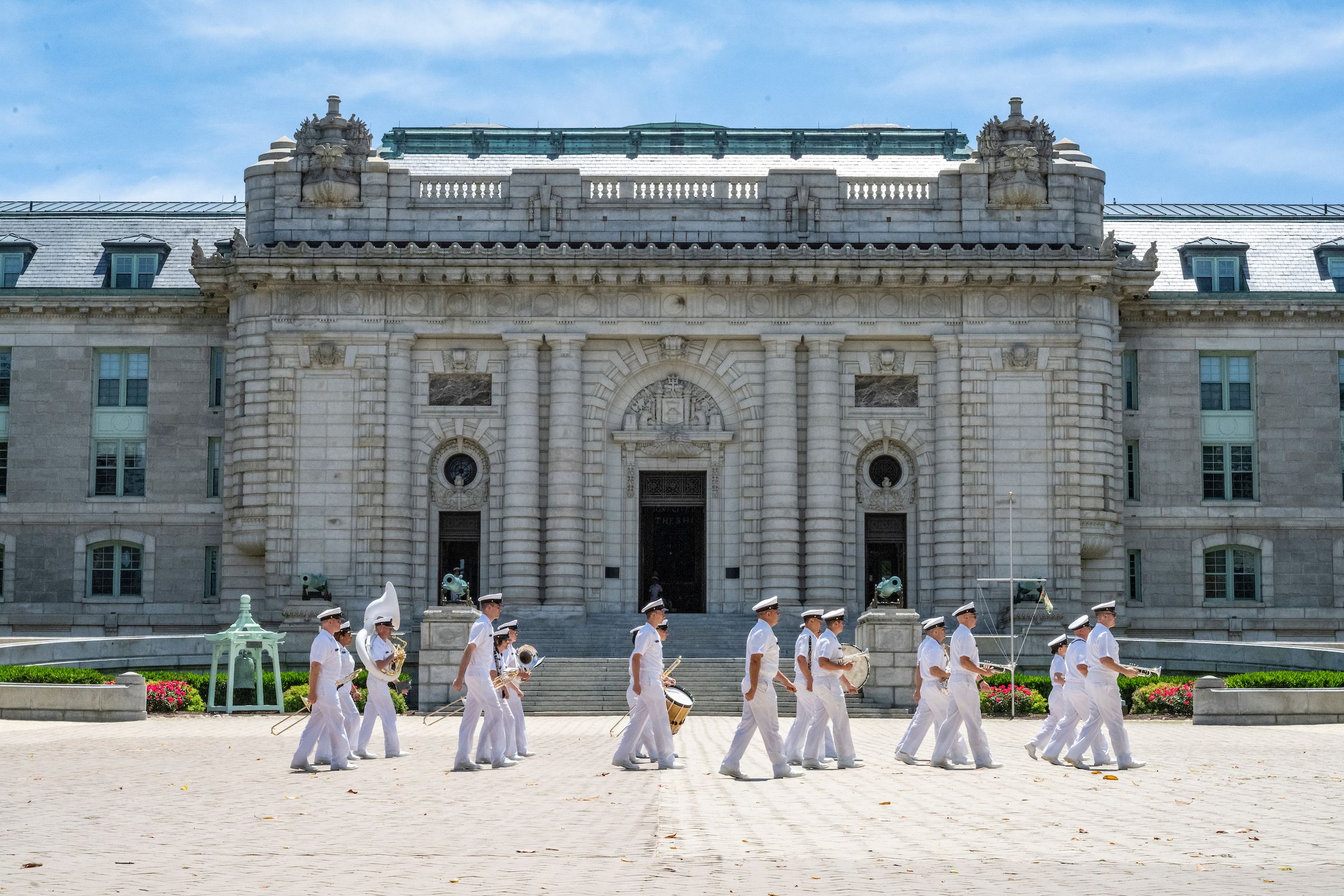
Bancroft Hall
Currently, the Academy has 4,576 Midshipmen, of whom 64 percent are white, 17 percent Hispanic, 12 percent black and 7 percent Asian. Women were first admitted in 1975, and now make up 28 percent of the students. Presuming they graduate, they will receive commissions as Ensigns in the Navy or 2nd Lieutenants in the Marines. Notable graduates include:
19th Century: George Dewey 1858, Admiral in the Spanish-American War, winner of the Battle of Manila Bay without losing a man;John A. Lejeune 1888, 3-star General in World War I, Commandant of the Marine Corps 1920-29, Marine training center Camp Lejeune in North Carolina is named for him; William D. Leahy 1897, 1st Fleet Admiral (5-star Admiral), during World War II.
1900s: Ernest King 1901, Fleet Admiral in World War II; William Halsey 1904, also Fleet Admiral in World War II; Chester Nimitz 1905, another Fleet Admiral in World War II; John McCain Sr. 1906, Admiral in World War II and founder of an Annapolis dynasty.
1910s: Richard Byrd 1912, Admiral, Arctic and Antarctic explorer; Arthur W. Radford 1916, Admiral, Chairman of the Joint Chiefs of Staff 1953-57.
1920s: Charles McVay 1920, Captain of the ill-fated USS
Indianapolis; Hyman Rickover '22, submarine Admiral, "Father of the Nuclear Navy"; Robert A. Heinlein '29, science fiction pioneer.
1930s: John McCain Jr. '31, commanded the U.S. Pacific Command while his son was a prisoner of war; Thomas H. Moorer '33, Admiral, Chairman of the Joint Chiefs of Staff 1970-74; William Lederer '36, co-author of
The Ugly American; Edward Beach '39, author of the submarine warfare novel
Run Silent, Run Deep.
1940s: John McMullen '40, engineer, former owner of the NHL's New Jersey Devils and MLB's Houston Astros, the Academy's hockey arena is named for him; Alan Shepard '45, 1st American in space aboard
Freedom 7, commanded
Apollo 14 and walked on the Moon; Walter Schirra '46, only man to fly in Projects Mercury, Gemini and Apollo; Jimmy Carter '47, 39th President of the United States, 1977-81; Jeremiah Denton '47, prisoner of war in Vietnam, Senator from Alabama; William Crowe '47, Admiral, Chairman of the Joint Chiefs of Staff 1985-89.
1950s: James Irwin '51, lunar module pilot on
Apollo 15, walked on the Moon; Jim Lovell '52, flew on
Apollo 8 and commanded
Apollo 13; Ross Perot '53, computer mogul, heavily involved in getting some Vietnam War prisoners released, 3rd party candidate for President in 1992 and 1996; William Anders '55, also flew on
Apollo 8; Politics: Charles Wilson '56, Congressman from Texas involved in Afghanistan, namesake of book and film
Charlie Wilson's War; John McCain III '58, pilot in the Vietnam War, America's most famous prisoner of war, longtime Senator from Arizona, Republican nominee for President in 2008; John Poindexter '58, National Security Advisor 1985-86, convicted in Iran-Contra; Robert "Bud" McFarlane '59, National Security Advisor 1983-85, also convicted in Iran-Contra.
1960s: Peter Pace '67, Marine General, Chairman of the Joint Chiefs of Staff 2005-07; Oliver North '68, Marine veteran of Vietnam, aide to President Reagan, convicted in Iran-Contra scandal, right-wing radio and talk show host; Michael Mullen '68, Admiral, Chairman of the Joint Chiefs of Staff 2007-11; Jim Webb '68, former Senator from Virginia.
1980s: Montel Williams '80, actor and talk show host; Alan Hale '80, astronomer known for his discovery of comets.
2000s: John S. McCain IV '09, known as Jack like his grandfather.
There seem to be more notable Annapolis graduates in fiction than West Point graduates. These include Steve McGarrett of
Hawaii Five-O (1941 in the original version, 1997 in the new version), Thomas Magnum of
Magnum, P.I. (1967), Jack Ryan in Tom Clancy's novels (1972 in
The Hunt for Red October, probably moved up for the current TV series), President Matthew Santos of
The West Wing (1982), and Harmon Rabb of
JAG (1985).
Going In. Philly sports fans' reputation will not come into play for the Army-Navy Game. This may be the most respectful sports crowd you will ever be in. Why Philadelphia? Because it's roughly halfway between the academies: 146 miles from West Point, and 122 miles from Annapolis. This will be the 120th Game, and the 89th played in Philadelphia.
The Philadelphia sports complex is at Broad Street and Pattison Avenue, 36 blocks -- 7 miles -- south of City Hall. It once included Sesquicentennial/Municipal/John F. Kennedy Stadium (1926-1992), The Spectrum (1967-2009), and Veterans Stadium (1971-2004). The arena now known as the Wells Fargo Center was built on the site of JFK Stadium. Citizens Bank Park, the new home of the Phillies, was built to the east of The Vet. And Lincoln Financial Field was built south of the new ballpark, and east of the Spectrum.
The old version of the Philly sports complex, on a 1980s postcard.
Top to bottom: The Vet, The Spectrum, JFK Stadium.
JFK Stadium hosted the Game from 1936 to 1941, and again from 1945 to 1979, at which point its condition was judged to have deteriorated too much to host it. Veterans Stadium hosted from 1980 to 2001, except for 1983, 1989, 1993, 1997 and 2000. Lincoln Financial Field, named for the insurance and investment company that owns the naming rights, has been the regular host since it opened in 2003.
There is plenty of parking in the complex, including a lot on the site of The Vet. But you'll be a lot better off if you take the subway. Not really because of the price of parking ($45 for Army-Navy), but because traffic is going to be awful.
The first time I went to a sporting event in Philadelphia, it was a 4th of July celebration at the Vet, and 58,000 people showed up to see the Phils face the Houston Astros, with Nolan Ryan pitching. The game and the fireworks combined did not last as long as it took to get out of the parking lot and onto the Walt Whitman Bridge: 2 hours and 40 minutes. Trust me: Take the freakin' subway.
Coming out of the AT&T subway station, you'll walk down Pattison Avenue, with a parking lot on the former site of Veterans Stadium to your left, and the site of the Spectrum to your right. Further to your right is the successor to the Spectrum, the Wells Fargo Center, named for the banking and insurance company. Further to your right is Lincoln Financial Field. You'll be likely to enter either at the north end zone or the west sideline.
The Philly sports complex, prior to The Spectrum's demolition in 2010.
The new home of the Eagles has seen them make the Playoffs more often than not, and reach the Super Bowl in the 2004 and 2017 seasons, winning the latter. And fan behavior, while still rowdy, is not as criminal as it was at The Vet: No more municipal court under the stands is necessary.
"The Linc" has hosted 4 games of the U.S. National Soccer Team, games of the 2003 Women's World Cup, an MLS All-Star Game, and several games by touring European teams such as Manchester United, Glasgow Celtic and A.C. Milan. It hosted an NHL Stadium Series game between the Pennsylvania teams, the Philadelphia Flyers and the Pittsburgh Penguins, in 2019. It has been selected by the U.S. Soccer Federation as a finalist
to be one of the host venues for the 2026 World Cup.
Midshipmen on the field, before marching into the stands.
The stadium looks a lot taller from the inside,
because the field is well below street level.
Inside the stadium, concourses are wide and well-lit, a big departure from The Vet. Escalators are safe and nearly always work, as opposed to the Vet, which did not have escalators, only seemingly-endless ramps. Getting to your seat should be easy. The field is natural grass, and aligned north-to-south.
Army football began on The Plain, the parade field at the Academy, about a mile northeast of Michie Stadium. It hosted the 1st Army-Navy Game, a 24-0 Navy win on November 29, 1890; and the 3rd, a 12-4 Navy win on November 26, 1892.
This was the site of 2 of the defining games of early college football, both upsets of Army: By the Carlisle Indian School, coached by Pop Warner and led by Jim Thorpe, 27-6 on November 9, 1912; and by Notre Dame, effectively introducing the forward pass to football, with Gus Dorais passing to end and future coach Knute Rockne, resulting in a 35-13 win on November 1, 1913. Before that, Notre Dame was just another small Catholic university in the Midwest; after it, it was legend.
The Plain! The Plain!
(Do not make that joke if you visit.)
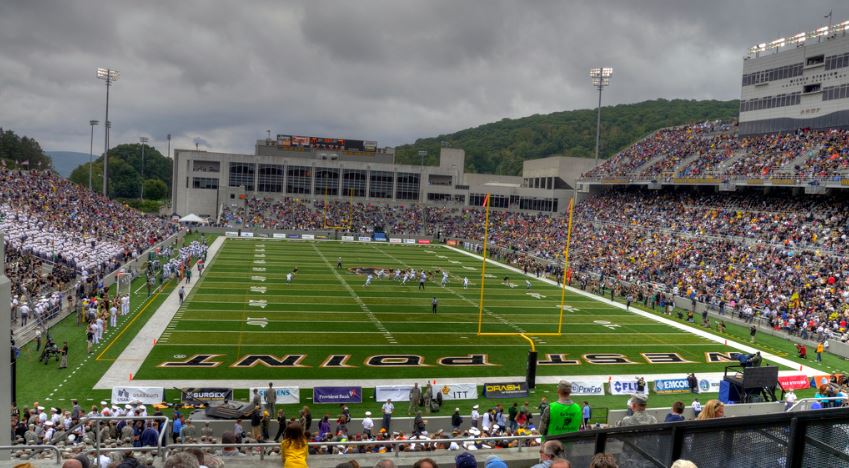
The official address for Michie Stadium is 700 Mills Road. Parking is $25. It was named for Captain Dennis Michie, who organized the 1st Army football team in 1890, and was killed in the Spanish-American War in 1898. Its 1st game was a 17-0 Army win over St. Louis University on October 4, 1924.
It seats 38,000, sits on Lusk Reservoir, with the Hudson River in view to the east, surrounded by trees, giving it, especially with the leaves changing in mid-season, one of the greatest settings in college football.
The playing surface, which runs north-to-south, and has sadly been artificial turf since 1977 (FieldTurf since 2008), has been named Red Blaik Field since 1999, in memory of the man who coached Army to the 1944, '45 and '46 National Championships.
It has hosted the Army-Navy Game only once, on November 27, 1943, due to wartime travel restrictions. Navy won, 13-0. Army didn't lost another game for 4 years, until "The Miracle of Morningside Heights," their 1947 loss at Columbia.
Navy football began in 1879 at Worden Field, like The Plain a parade ground, located at Upshur and Balch Roads. It hosted the 2nd Army-Navy Game on November 28, 1891, Army's 1st win, 32-16; and the 4th, on December 2, 1893, a 6-4 Navy win.
A recent photo of Worden Field
Navy built a stadium in 1914, but didn't start using it for football until 1924. The 12,000-seat Thompson Stadium was named for Robert Means Thompson, Class of 1868, who created or led several athletically-based organizations until his death in 1930. It was only then that the facility named simply "The Football Field" was renamed Robert Means Thompson Stadium.
Again due to wartime travel restrictions, it hosted the Army-Navy Game on November 28, 1942, a 14-0 Navy win. Neither Academy has played a home game in the series since 1943.
The Academy realized that Thompson Stadium was too small, and built Navy-Marine Corps Memorial Stadium. They tore Thompson Stadium down, and built Lejeune Hall in 1982, hosting the Naval Academy Athletic Hall of Fame and its swimming teams. 52 King George Street at Brownson Road.
The new stadium opened on September 26, 1959, with Navy beating William & Mary 29-2. The official address is 550 Taylor Avenue, at Cedar Park Road. Parking is $30. Capacity is 34,000. The playing surface runs northwest-to-southeast, has been FieldTurf since 2004, and is named Jack Stephens Field, for Jackson T. Stephens '47, who contributed to, among other things, a recent renovation of the stadium.
In addition to Navy football, the stadium has been home to the Military Bowl since 2013, the Chesapeake Bayhawks of Major League Lacrosse since 2009 (lacrosse is big in the Chesapeake region, especially in Maryland), and a game in the NHL Stadium Series on March 3, 2018, with the "host" Washington Capitals beating the Toronto Maple Leafs 5-2.
It also hosted some of the soccer games of the 1984 Olympics, despite the Games being across the country in Los Angeles; and a home game of D.C. United, between the closing of Robert F. Kennedy Stadium and the opening of Audi Field, a 1-0 win over the Columbus Crew on April 14, 2018.
Hockey configuration
Food. From the famed Old Original Bookbinder's (125 Walnut Street at 2nd, now closed) and Le Bec Fin (1523 Walnut at 16th) to the Reading Terminal Market (Philly's version of the South Street Seaport, at 51 N. 12th St at Filbert) to the South Philly cheesesteak giants Pat's, Geno's and Tony Luke's, Philly is a great food city and don't you ever forget it.
The variety of food available at The Linc. Little of it is healthy (no surprise there), but all of it is good. Tony Luke's has a stand (as it also does at the ballpark and the arena). So does Chickie's & Pete's, to sell their fish and their "crab fries" -- French fries with Old Bay seasoning mix, not fries with crabmeat. Also at The Linc are outlets of Bassett's Original Burgers & Fresh Cut Fries, Seasons Pizza, and Melt Down grilled cheese stands.
So what kind of food can you get at Michie Stadium? Fortunately, not stereotypical Army food, like Spam, powdered eggs, and creamed chipped beef on toast, served on a metal tray, the legendary "shit on a shingle." According to
StadiumJourney.com:
Concessions at Michie Stadium do not stray very far from the basics. Perhaps the most notable aspect of the concessions is that every stand in the stadium is staffed by cadets, who work the stands to raise money for their various extracurricular groups.
Virtually every concession stand at Michie Stadium has the same menu, featuring hot dogs, nachos, and various snacks such as pretzels, popcorn, cotton candy, and cracker jacks. Coca Cola products are featured at Michie Stadium, and can be purchased in popular souvenir mugs which feature free refills throughout the game.
Fans looking for a little variety can find unique items at temporary stands located in the southeast entry plaza, where cheesesteaks, pizza, and sausage sandwiches can be purchased. Concessions stands tucked in behind the north end zone feature chicken nuggets, pulled pork sandwiches, French fries, and onion rings.
At Navy-Marine Corps Memorial Stadium,
StadiumJourney says:
The permanent concession stands around the stadium offer the usual, basic food options seen at college football venues. The prices are fair, with items such as hot dogs at $3.50. No item is too expensive here. You will see many of the midshipmen trying out the many options. There also many temporary concession stands that add to the options. The Ultimate Destroyer Nachos for $8 and Wowmonds (almonds) are just a few of the nice options here.
Team History Displays. The Eagles' championship banners and retired number banners are retracted for Temple football games and the Army-Navy Game, so you won't be able to see them.
Army's teams were originally called the Cadets, which is what the players, and all the others members of the student body, actually are. But when they were in their glory years in the 1940s, newspapers called them "The Black Knights of the Hudson," for their black jerseys. So, in 1999, the Academy officially changed the teams' names to the Black Knights.
Except for 1998 to 2004, when it was a member of Conference USA, Army has been an independent team. No, they were never a member of the Big East Conference, nor the Atlantic Coast Conference, nor the American Athletic Conference, as Navy is. So they've never won a Conference Championship.
But they were awarded National Championships in 1944, 1945 and 1946. Was this due to the manpower shortage of World War II, when West Point Cadets, being trained for war, got the most obvious deferments of all? Perhaps. These titles are on the facing of the upper deck. They do not display their retroactively-awarded 1914 and 1916 National Championships. Although those were during World War I, America did not enter until the Spring of 1917, so that wasn't the reason they won.
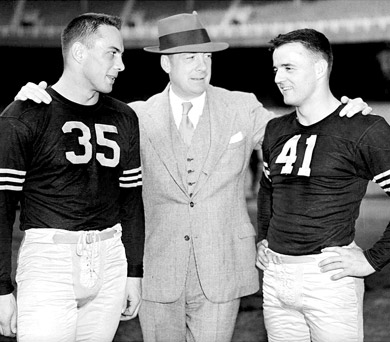
Those wartime teams were led by a pair of running backs known as Mr. Inside and Mr. Outside -- respectively, Felix "Doc" Blanchard, winner of the 1945 Heisman Trophy; and Glenn Davis, winner of the 1946 Heisman. Blanchard's Number 35 and Davis' Number 41 have been retired. So was the Number 61 of one of their blockers, guard Joe Steffy. Their 4th and most recent retired number is 24, of running back Pete Dawkins, the 1958 Heisman winner, and later a General in the Vietnam War.
There are 24 Army football players in the College Football Hall of Fame:
* From the 1900s: Quarterback Charlie Daly and halfback Paul Bunker.
* From the 1910s: Center John McEwan, tackle Alex Weyand and fullback Elmer Oliphant.
* From the 1920s: Center Ed Garbisch, halfback Harry Wilson, tackle Bud Sprague and halfback Chris Cagle.
* From the 1930s: Guard Harvey Jablonsky.
* From the 1940s, including the 3 National Championships: Tackles Robin Olds and Frank Merritt; quarterbacks Doug Kenna, Arnold Tucker and Arnold Galiffa; guards John Green and Joe Steffy; halfback Glenn Davis; fullback Doc Blanchard; and end Barney Poole. Head coach Earl "Red" Blaik is also in the Hall. In 1986, in recognition of Blaik's service to the nation, President Ronald Reagan awarded him the nation's highest civilian honor, the Presidential Medal of Freedom. (He died in 1989, at age 92.)
Blanchard, Blaik and Davis
* From the 1950s: Quarterback Don Holleder, halfbacks Pete Dawkins and Bob Anderson, and tight end Bill Carpenter.
From 1960 onward, Army football (like Navy football) simply hasn't been what it used to be. They have resisted the forward pass, and few high school stars have wanted to go to any of the service academies. Probably the most notable Army football player of the last 60 years is Andrew Rodriguez, a linebacker who rebounded from a serious back injury to win the 2011 James E. Sullivan Award as America's foremost collegiate athlete.
Future 5-star Generals Dwight D. Eisenhower and Omar Bradley played in the 1912 loss to Carlisle. Legend has it that "Ike" ended his football career when he tried to tackle Carlisle's Jim Thorpe, and Thorpe stepped on him, breaking his leg. It's not true: Ike's injury happened in the next game. Bradley also played in the 1913 loss to Notre Dame. Both played before uniform numbers were worn, or else Ike's number would surely be retired. I suppose they could retire Number 34 for him, since he was the 34th President.
Just as Army's teams used to be called the Cadets, Navy's teams are called the Midshipmen. Navy was an independent until 2015, when it joined the American Athletic Conference, and has never won a conference title. No, they never joined the Big East or the ACC, either.
They were retroactively awarded the 1926 National Championship, but there is no display for this at the stadium. Rather, they have the names of battles on the facing of the upper deck.
The Lambert Trophy, for "the best college football team in the East," has been awarded to Army in 1944, 1945, 1946, 1948, 1949, 1953 and 1958; and to Navy in 1943, 1954, 1957, 1960 (a tie vote with Yale), 1963 and 2015.
Navy have 2 Heisman Trophy winners: Running back Joe Bellino in 1960, and quarterback Roger Staubach in 1963. Staubach's Number 12 and Bellino's Number 27 are retired. So are the Number 19 of 2010s quarterback Keenan Reynolds, and the Number 30 of 1980s running back Napoleon McCallum.
There are 19 Navy players in the College Football Hall of Fame:
* From the 1900s: fullback Jonas Ingram.
* From the 1910s: Halfback John Dalton, guard John Brown.
* From the 1920s: Halfback Tom Hamilton, tackle Frank Wickhorst.
* From the 1930s: Halfback Buzz Borries, tackle Slade Cutter.
* From the 1940s: Tackle Don Whitmire, guard George Brown, end Dick Duden, halfbacks Skip Minisi and Clyde Scott, center Dick Scott.
* From the 1950s: Tackle Steve Eisenhauer (no relation to Dwight D. Eisenhower, though it must have been strange to see that name at Annapolis instead of West Point), end Ron Beagle, tackle Bob Reifsnyder and running back Joe Bellino.
* Since 1960: 1962-64 quarterback Roger Staubach, 1973-75 safety Chet Moller and 1981-85 running back Napoleon McCallum.
* Coaches: Gil Dobie, 1917-19; Bill Ingram, 1926-30, including the '26 title; Wayne Hardin, 1956-64, including Bellino's and Staubach's Heisman years; George Welsh, 1973-81.
Aside from football players, Navy's most famous athlete is Basketball Hall-of-Famer David Robinson '88.
For most of their histories, Army's football team did not accept invitations to bowl games. Army's 1st bowl was the 1984 Cherry Bowl at the Silverdome outside Detroit, and they beat Michigan State. They've also won the 1985 Peach Bowl, the 2016 Heart of Dallas Bowl, and the Armed Forces Bowl (played every year at Texas Christian University in Fort Worth since 2003, except for 2010 and 2011 at Southern Methodist University in Dallas) in 2010, 2017 and 2018.
Navy never showed reluctance to accept bowl bids. They played in the 1924 Rose Bowl, playing the University of Washington to a 14-14 tie. They've won the 1955 Sugar Bowl, the 1958 Cotton Bowl, the 1978 Holiday Bowl, the 1996 Aloha Bowl, the 2004 Emerald Bowl, the 2005 and 2014 Poinsettia Bowls, the 2009 Texas Bowl, the 2013 Armed Forces Bowl, and the 2015 and 2017 Military Bowls (played in their own stadium). They also played in bowls usually played on New Year's Day in the 1961 Orange Bowl and the 1964 Cotton Bowl, but lost.
The Army-Navy Game is prone to streaks. From 1922 to 1933, Army went 8-0-2. Navy won 5 straight, 1939-43. Then Army went 5-0-1, 1944-49. Navy won 5 straight, 1959-63. Navy went 9-1-1, 1973-83. Army won 5 straight, 1992-96. Navy won a whopping 14 straight, 2002-15. Since then, Army has won the last 3. Overall, Navy leads 60-52-7. The last tie was in 1981. Among the most notable games:
* November 27, 1926, the dedication of the original Soldier Field in Chicago (which opened in 1924 and was demolished in 2002, to make way for the new one), as a monument to the American servicemen of World War I. Navy was undefeated, and Army had lost only to Notre Dame, so this was for the National Championship. Before over 100,000 fans, the game ended in a 21-21 tie, and Navy, still undefeated, was awarded the National Championship.
* December 2, 1944, at Municipal Stadium in Baltimore. Army was Number 1, Navy Number 2, and Army won 23-7.
* December 1, 1945, at Municipal (JFK) Stadium in Philadelphia. Again, Army was Number 1, Navy Number 2, and it was, like the next year's Army-Notre Dame game, labeled "The Game of the Century." Army won 32-13.
* November 30, 1946, at Municipal Stadium in Philadelphia. Army was coming off its tie with Notre Dame and a win away to Number 5 Penn, and hadn't lost in 3 years. Navy had won their opener against Villanova, and then dropped 7 straight. And Army took a 21-0 lead.
But Navy fought back, and were down 21-18 and on Army's 2-yard line with time on the clock for 1 more play. Tom Hamilton, Navy's coach and a member of the 1926 title team, decided to go for the winning touchdown, and they didn't make it. After the game, he was asked why he didn't go for the tying field goal, and introduced a new saying to the American sports lexicon: "A tie is like kissing your sister."
* November 26, 1949, at Municipal Stadium in Philadelphia. This one was a doozy. Undefeated Army's schedule did not include Notre Dame (which won the National Championship), and it did include such teams as Davidson, VMI, and Ivy League schools Harvard, Columbia and Penn. On the other hand, they did have to travel to Michigan, then ranked Number 1, and won 21-7. And Fordham came into their game with Army 4-0, having outscored its opponents 178-34, and Army beat them 35-0. So it wasn't that bad.
Anyway, some Cadets went on a reconnaissance mission to Annapolis, to see what the Midshipmen were planning, and came back to West Point to prepare. So the Midshipmen taunted the Cadets with a rewrite of "On, Brave Old Army Team" with these lyrics: "We don't play Notre Dame, we don't play Tulane, we just play Davidson, for that's the fearless Army way!" And they unfurled a banner reading, "WHEN DO YOU DROP NAVY?" And the Cadets unfurled a banner reading, "TODAY."
Uh-oh... The next Midshipmen banner referenced the famous college for women, not far from West Point: "WHY DON'T YOU SCHEDULE VASSAR?" And the Cadets unfurled a banner reading, "WE ALREADY GOT NAVY." Annapolis' humiliation continued, as Army won 38-0.
* December 7, 1963, at Municipal Stadium in Philadelphia. There had been talk of canceling the game, scheduled for November 30, in the wake of the assassination of President John F. Kennedy. But Jacqueline Kennedy said her husband would've wanted it to be played, so it was postponed for a week.
Quarterback Rollie Stichweh led Army to a touchdown on its 1st drive. CBS, broadcasting the game, used the occasion to present the first-ever instant replay of a sports play, for that touchdown. But Navy quarterback Roger Staubach led his Number 2-ranked team to a 21-15 lead.
Stichweh got Army to 4th and goal on the Navy 2 with time running out, but he couldn't make himself hear over the roar of a crowd of 102,000 fans (the stadium seated 105,000), and he couldn't get a play off. Navy won, and were sent to the Cotton Bowl to play Number 1 Texas for the National Championship, but lost.
The following year, Municipal Stadium was renamed John F. Kennedy Stadium. It hosted the U.S. leg of the Live Aid concert in 1985, and was closed in 1992, torn down to make was for the arena now named the Wells Fargo Center.
* November 25, 1983, at the Rose Bowl in Pasadena, California. The site was chosen because the Academies wanted to bring the game to Southern California with its various military bases: An Army base in Inglewood, Naval Base San Diego, Edwards Air Force Base outside Mojave, the Marines' Camp Pendleton in Oceanside, and the Coast Guard station in Long Beach.
It was said to be the largest airlift of U.S. military personnel since World War II. The attendance was 81,000, although the Rose Bowl could then seat over 100,000. The referee -- obviously, he was NCAA-qualified, or he wouldn't have been given this job -- was noted chef, art collector, author, and, oh yes, actor Vincent Price. Navy won, 42-13, and nobody complained that Price, known for his horror movie roles, was unfair.
* December 10, 2016, at M&T Bank Stadium in Baltimore. Army won 21-17, ending Navy's 14-game winning streak in the rivalry.
Since 1972, Army, Navy and Air Force have played for the Commander-in-Chief's Trophy. Air Force has won it 19 times, Navy 15, Army 6, and there have been 4 ties. All-time in games, despite being the newest of the academies, Air Force leads Army 37-16-1 and Navy 30-22.
Whichever team wins the Trophy turns it so that their mascot faces front:
Army with a mule. Navy with a goat, Air Force with a falcon.
Both Army and Navy have rivalries with Notre Dame. The 1913 Army-Notre Dame game was the 1st meeting between the teams, and, as I said, was also the beginning of the South Bend legend. Army played Notre Dame at the Polo Grounds in New York on October 18, 1924, a 13-7 Fighting Irish win that saw the greatest sports columnist of the day, Grantland Rice, name the Irish backfield "The Four Horsemen."
On November 10, 1928, at the old Yankee Stadium, Notre Dame trailed Army 6-0 at halftime. Coach Knute Rockne told his team about George Gipp, who helped them win the 1920 National Championship, but soon died.
As Rockne told it, Gipp told him on his deathbed, "Sometime, when the team is up against it, and the breaks are beating the boys, tell them to go out there with all they've got, and and win just one for the Gipper. I don't know where I'll be then, Rock, but I'll know, and I'll be happy." And then he told them, "Gentlemen, this is that game." And the players left the locker room in tears, and beat Army 12-6.
The truth? George Gipp was a great player by the standards of his day, but also the kind of guy who, if today's rules were in effect, would've gotten Notre Dame put on probation. The movie about Rockne and Gipp hadn't been made yet. These players would have been about 10 years old when Gipp played. So, presuming Rockne did give the speech -- regardless of whether he made it up or it was true -- it wouldn't have had much of an effect. But it makes a great story!
They played at Yankee Stadium again on November 9, 1946, and it was billed as "The Game of the Century," because Notre Dame went into it ranked Number 2, Army was Number 1, Army hadn't lost since Notre Dame beat them in 1943, and Notre Dame was undefeated as well, and they had won the last 3 National Championships between them, and whoever won this one would make it 4. It was broadcast coast-to-coast on radio. Network TV was still a year away, but it would have been huge on that, too. But the game didn't live up to the hype, and ended 0-0. The National Championship was split between them.
The teams played their 1913 to 1922 and 1973 games at West Point; 1923 at Ebbets Field in Brooklyn; 1924 at the Polo Grounds; 1925 to 1929, 1931 to 1946, and 1969 at the old Yankee Stadium; 1930 at Soldier Field in Chicago; 1947, 1958, 1966, 1970, 1974, 1980, 1985, 1998 and 2006 at Notre Dame Stadium in South Bend; 1957 at Franklin Field in Philadelphia; 1965 at Shea Stadium; 1977, 1983 and 1995 at Giants Stadium; 2010 at the new Yankee Stadium (but Notre Dame was designated the home team), and 2016 at the Alamodome in San Antonio.
It ceased to be an annual rivalry after the 1947 game, and has been played only sporadically since then. Army hasn't won since 1958, Notre Dame winning the last 15 meetings, and they lead 39-8-4.
Navy's rivalry with Notre Dame has been played more often, and is also lopsided. Notre Dame leads 77-13-1, including winning 44 straight years, 1964 to 2006. In fact, Until 2007 (and even that one took 3 overtimes before Navy won, 46-44), neither Army (1958, with Pete Dawkins) nor Navy (1963, with Roger Staubach) had beaten Notre Dame without a Heisman Trophy winner playing for them. Navy won 3 of the next 4 games, but Notre Dame has since won 8 of the last 9.
Notre Dame has hosted the game in 1928 at the original Soldier Field in Chicago, in 1930, in 1937, in 1994, and in odd-numbered years since 1953. The October 13, 1928 game at Soldier Field is said to have had the largest crowd in college football history, over 120,000 people, due to Notre Dame being relatively close in northeastern Indiana, and Chicago being a Navy city, home to the Great Lakes Naval Training Station.
Because its on-campus stadium is so much smaller, Navy tends to host the game in bigger cities, frequently in Baltimore: At Municipal Stadium in 1927, 1929, 1931, 1933, 1935, 1936, 1938, 1940, 1941, 1944, 1946, 1948, 1949 and 1951; at that stadium's replacement, Memorial Stadium, in 1954, 1956, 1958, 1986 and 1988; and at that stadium's replacement, M&T Bank Stadium, in 2002, 2006 and 2008.
They've also hosted it at Cleveland Municipal Stadium in 1932, 1934, 1939, 1942, 1943, 1945, 1947, 1950, 1952, 1976, 1978; Franklin Field in Philadelphia in 1960, 1962, 1964, 1966, 1968 and 1970; Veterans Stadium in Philadelphia in 1972, 1974, 1993; Giants Stadium in 1980, 1982, 1984, 1990 and 2004; that stadium's replacement, MetLife Stadium, in 2010; FedEx Field outside Washington in 1998 and 2014; the Citrus Bowl in Orlando in 2000; TIAA Bank Field in Jacksonville in 2016; and Jack Murphy Stadium in San Diego in 2018.
Twice, the game has been played on foreign soil, in Dublin, Ireland -- which, you would presume, would feel like a home game for "the Fighting Irish"). It was played at Croke Park, the national home of the sports of Gaelic football and hurling, in 1996; and at the national soccer stadium, Aviva Stadium, in 2012. Aviva Stadium will host it again in 2020.
Stuff. The Linc has a Pro Shop, and there are also outlets in the Market Place at Garden State Park (built on the site of the old horse racing track in Cherry Hill) and in Lancaster (way out in Pennsylvania Dutch Country).
The Academies' respective stadiums have souvenir stands, but not team stores as you would find at NFL stadiums. The West Point Gift Shop is at 2110 New South Post Road, behind the Visitors' Center. There is a USMA Bookstore, at 606 Thayer Road. Navy has the USNA Gift Shop across from Lejeune Hall, and the Midshipmen Store at 101 Wilson Road. I don't know if visiting civilians can shop at the USMA Bookstore and the Midshipmen Store, or if it's only for students.
There are a lot of good books about Army football, and a few about the Army-Navy Game, but hardly any strictly about Navy football. Brian Kelly -- not the current Notre Dame coach -- wrote
Great Moments in Army Football: From the Beginning of Football all the way to Army's Great 2017 team. Lars Anderson wrote
Carlisle vs. Army: Jim Thorpe, Dwight Eisenhower, Pop Warner, and the Forgotten Story of Football's Greatest Battle.
Mike Belter wrote both
A Forgotten First National Championship: The 1914 Army Football Team and
Operation Black September: The 1977 Army Football Team. His writing is better than his timing: The former was published in 2016, a little late for its event's 100th Anniversary; and the latter was published in 2018, slightly late for its 40th Anniversary.
Jack Cavanaugh and Pete Dawkins wrote about the 1940s West Point team in
Mr. Inside and Mr. Outside: World War II, Army's Undefeated Teams, and College Football's Greatest Backfield Duo. Mark Beech wrote about Dawkins' 1958 Heisman season in
When Saturday Mattered Most: The Last Golden Season of Army Football.
In 2005, Barry Wilner and Ken Rappoport published Gridiron Glory:
The Story of the Army-Navy Football Rivalry. Randy Roberts wrote about the 1944 game in
A Team for America: The Army-Navy Game That Rallied a Nation.
Crime fiction novelist Michael Connelly and Roger Staubach wrote of Staubach's biggest regular-season game for Navy in
The President's Team: The 1963 Army-Navy Game and the Assassination of JFK. Nicholaus Mills wrote about the next year's game with
Every Army Man Is with You: The Cadets Who Won the 1964 Army-Navy Game, Fought in Vietnam, and Came Home Forever Changed. John Feinstein, who's written a lot of sports books and does radio broadcasts for Navy football, published
A Civil War: Army Vs. Navy, a Year Inside College Football's Purest Rivalry in 1997.
The year 2011 produced 2 videos about the
Army-Navy Game: A Game of Honor and
From Philadelphia to Fallujah, a reminder not only that the men playing in this game are not likely to ever play a down of professional football (a few do), but also of what Bob Feller, who pitched for the Great Lakes Naval Training Center team before becoming a Navy gunner in World War II, said: "Anybody who says sports is war has never been in a war."
During the Game. Unlike most venues in North American sports, an Eagles home game carries with it the specter of fan violence. But although this game is being played in the Eagles' stadium, it will not be an Eagles home game. It is the Army-Navy Game, and it might be the most respectful sports crowd you will ever be in. Both sides take the West Point motto of "Duty, Honor, Country" seriously.
(The Naval Academy's motto is "Ex Scientia Tridens," Latin for "Through Knowledge, Sea Power." For the Army as a whole, it's "This We'll Defend"; for the Navy as a whole, "Semper Fortis," Latin for "Always Courageous." This should not be confused with the mottoes for the Marines, "Semper Fidelis," "Always Faithful"; and the Coast Guard, "Semper Paratus," "Always Ready.")
At Michie Stadium, the Corps of Cadets sits in the northeast corner, identifiable from a distance by their all-gray uniforms, including hats and coats, giving rise to their nickname, "The Long Gray Line."
The Corps of Cadets
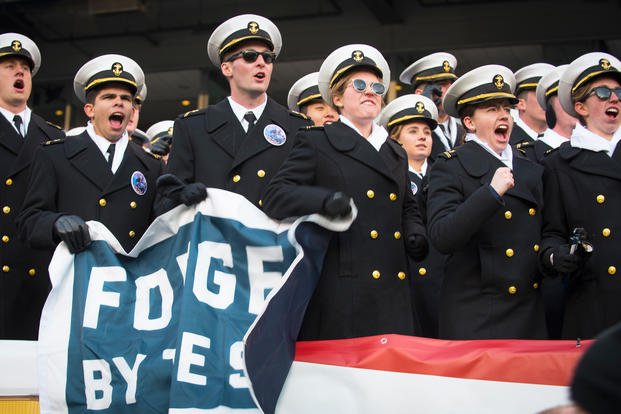
At Navy-Marine Corps Memorial Stadium, the Brigade of Midshipmen sits in the northwest corner, identifiable from a distance by their white hats and navy blue coats. At Lincoln Financial Field, each team keeps its usual position: The Cadets in the northeast, the Midshipmen in the northwest, facing each other across the north end zone.
The Brigade of Midshipmen
Each Academy's band -- together when they play each other -- plays the National Anthem, and pretty much anybody who ever served (including each Academy's current students) sings along. The West Point band played the National Anthem prior to the last game at the old Yankee Stadium in 2008, in reference to the Academy's connection to the Stadium.
There is an Army song, and an Army football fight song. The former is "The U.S. Field Artillery March," written by none other than John Philip Sousa, known for its opening verse: "Over hill, over dale, we will hit the dusty trail, as the caissons go rolling along." The latter is "On, Brave Old Army Team": "On, brave old Army team! On to the fray! Fight on to victory, for that's the fearless Army way!"
The Navy uses its traditional "Anchors Aweigh" as its fight song. Charles Zimmerman wrote it in 1906, but the lyrics were officially revised in 1926 and again in 1997. The current version has a chorus of, "Anchors aweigh, my boys, anchors aweigh! Farewell to foreign shores, we sail at break of day-ay-ay-ay! Through our last night ashore, drink to the foam! Until we meet ones more, here's wishing you a happy voyage home!"
But a different version is sung for Navy football games, and, unlike Army, Navy tweaks their rivals in their fight song: "Stand Navy down the field, sails set to the sky! We'll never change our course, so Army, you steer shy-y-y-y! Roll up the score, Navy, anchors aweigh! Sail Navy down the field and sink the Army, sink the Army grey!" (See also: Georgia Tech, and both sides of Texas vs. Texas A&M.)
Traditionally, both teams wear gold helmets, Army's with a black stripe down the middle, Navy's plain gold. However, this is not set in stone. Sometimes, Army will wear black helmets, and Navy might wear blue ones. Sometimes, the helmets will have logos: An A for Army, an N or an anchor for Navy. When Army is the designated home team, their jerseys are black, although sometimes dark gray; when Navy is, theirs are, naturally, navy blue, although sometimes gold; and the visiting team wears white. The players on both teams wear unit logos on their jerseys.
You might think that the Academies would dispense with silliness like cheerleaders and mascots, but both have both. Navy's 1st Bill the Goat (a play on "billy goat") appeared in 1893. Goats don't live as long as many other mascots, so they go through a lot of them. The current mascots are Bill XXXVI and Bill XXXVII.
In the late 1970s, Navy coach George Welsh was asked how good his team was, and tried, as they say in naval circles, an evasive maneuver. Instead of talking about the team, he said, "We're deep at goat." An Army Cadet would say, "That means you stink." Not that the team stinks, but the goats do. And Cadets have, on many occasions, if you'll pardon the pun, kid-napped the Goat.
The Army has used mules as work animals from the beginning, and as football team mascots since 1899, starting because of Navy's already-present goat mascot. Currently, there are 3: Ranger III, Stryker and Paladin.
Ranger III and Stryker
Each Academy also has a man-in-a-costume mascot. Navy's is also a goat, while Army has both a mule and a Black Knight, and was using the Knight well before the switch from "Cadets" was made official.
Not to be confused with Goat Boy,
Jim Breuer's 1996-98 character on Saturday Night Live.
Not to be confused with Francis the Talking Mule,
and John Cleese's Black Knight from
Monty Python and the Holy Grail.
In the week leading up to the game, a Cadet has to address a higher-ranking person with, "Beat Navy, sir!" and a Midshipman has to do the same with, "Beat Army, sir!" When the game ends, each team walks over to their respective band.
The Cadets and Midshipmen are given a great deal of leeway (by their standards) during the game. I went to the 1998 Rutgers vs. Army game at Rutgers Stadium, and saw the Corps jumping up and down like European soccer fans, even though Rutgers was winning the game 27-15 with a few minutes left. (That was the final score. Neither team had a winning season.)
One year, I forget which, but they were still playing at Veterans Stadium, I was watching the Army-Navy Game on TV, and it was snowing, and Army was winning, and as the clock wound down, there were Cadets standing four abreast, naked from the waist up, swinging their gray coats over their heads. How cold
was it? West Point is north of Philly, but not so far north that it's in Canada. They had to have been freezing their epaulets off. I have no idea if they faced any discipline.
The team that loses plays their Academy's Alma Mater first, and the team that wins plays theirs second. In the age of Twitter, the hashtag #SingLast was developed.
After the Game. Philadelphia is a big city, with all the difficulties of big cities as well as many of the perks of them. As this is not an Eagles game, your safety will not be an issue, no matter how many men and women trained in combat are around you.
If you drove down, and you want to stop off for a late dinner and/or drinks (except, of course, for the designated driver), the nearby Holiday Inn at 9th Street & Packer Avenue has a bar that is co-owned by former Eagles quarterback, now ESPN pundit, Ron Jaworski. As I mentioned earlier, the original outlet of Chickie's & Pete's is at 15th & Packer. Right next to it is a celebrated joint, named, appropriately enough, Celebre Pizzeria.
The legendary Pat's and Geno's Steaks, arch-rivals as intense as any local sports opponents, are across 9th Street from each other at Passyunk Avenue in the Italian Market area. My preference is Pat's, but Geno's is also very good. Be advised, though, that the lines at both are of Shake Shack length, because people know they're that good.
Also, Pat's was the original "Soup Nazi": You have to have your cash ready, and you have to quickly order your topping, your style of cheese, and either "wit" or "widdout" -- with or without onions. I haven't been there in a while, but I've been there often enough that I have a "usual": "Mushroom, whiz, wit."
Both Pat's and Geno's are open 24 hours, but, because of the length of the line, unless you drove down to the game, I would recommend not going there after the game, only before (if you can make time for it). Broad Street Line to Ellsworth-Federal, then 5 blocks east on Federal, and 1 block south on 9th.
The Tavern on Broad, at 200 S. Broad Street at Walnut, seems to be the headquarters of the local Giants fan club. Another supposed Giant fan spot is the Fox & Hound, at 1501 Spruce in Center City. Revolution House, in Old City at 200 Market Street, is supposedly Jets country. A particular favorite Philly restaurant of mine is the New Deck Tavern, at 3408 Sansom Street in University City, on the Penn campus.
You can also pick up a sandwich, a snack or a drink at any of several Wawa stores in and around the city. If you came in via Suburban Station, there's one at 1707 Arch, a 5-minute walk away; if the game lasts 3 hours or less, you have a shot at getting in, getting your order, getting out, and getting back to the station in time to catch your train.
The Army-Navy Game starts at 3:00 PM on a Saturday, so there probably aren't any European soccer games of consequence in progress at the time. However, if you do visit Philly during the European soccer season, you can probably watch
your favorite club at Fadó Irish Pub, at 1500 Locust Street in Center City. Be advised that this is home to supporters' groups for Manchester United, Liverpool, Tottenham Hotspur and Celtic FC; so if you're not particularly fond of any of those teams, you might want to stay away.
If you go to an Army home game, and want a postgame meal, you'll probably have to head up Route 9W to Cornwall, or head down Route 202 to Stony Point. And if you want to catch a morning (afternoon, Europe time) soccer game, you're probably out of luck: No bar near the Academy shows such games.
It's a different story for Navy home games, as Annapolis is a decent-sized city with lots of restaurants. There is an Annapolis chapter of the American Outlaws, the fan group for the U.S. national soccer team, and they meet at Union Jack's, 2072 Somerville Road, just off the intersection of Routes 50 and 450, about 4 miles west of the Academy.
Sidelights. Aside from the South Philadelphia Sports Complex, the Army-Navy Game was held in Philadelphia at Franklin Field from 1899 to 1904, from 1906 to 1914, in 1922, and from 1932 to 1935.
The current stadium on the site dates to 1923, but the University of Pennsylvania has been playing football on the site since 1895, making it the oldest continuously-used college football site. They have also hosted the Pennsylvania Relay Carnival, or the Penn Relays for short, America's greatest annual track and field meet, since 1895.
The Eagles played there from 1958 to 1970, including the 1960 NFL Championship Game, beating the Green Bay Packers in a day-after-Christmas thriller, 17-13. It would be their last NFL title for 57 years. Penn's football team has been considerably more successful, having won 14 Ivy League titles since the league was formally founded in 1955.
Like the Palestra, the basketball cathedral next door, the stadium at Franklin Field is in surprisingly good shape (must be all those Penn/Wharton Business School grads donating for its upkeep), although the playing field has been artificial turf since 1969. 33rd and Spruce Streets. SEPTA "Subway-Surface Lines" to 33rd Street.
As stated earlier, the Game was played on-campus for Army in 1890 and 1892 on The Plain, and at 1943 at Michie Stadium; and for Navy in 1891 and 1893 at Worden Field, and in 1942 at Thompson Stadium.
It's been held in Baltimore, just 28 miles from Annapolis, making it more of a home game for Navy, in 1924 and 1944 at Municipal Stadium, which would be converted into Memorial Stadium in 1954 (1000 E. 33rd Street, Bus 3 from downtown); and in 2000, 2007, 2014 and 2016 at M&T Bank Stadium 1101 Russell Street, Light Rail to Hamburg Street).
It's been held in the Washington, D.C. area once, on December 10, 2011, a 27-21 Navy win at FedEx Field, home of the Washington Redskins. 1600 FedEx Way, Landover, Maryland, just 24 miles from the Naval Academy, the closest it's been to either Academy since 1943. Metro Blue Line to Morgan Blvd., and then a mile's walk north.
It's been hosted in the New York Tri-State Area 15 times -- 16 if you count Princeton, whose Osborne Field hosted it in 1905, a 6-6 tie. It was replaced as the home of Princeton football in 1914 by Palmer Stadium, and in 1998 by Powers Field. The Engineering Quadrangle was built on the site. Bordered by Nassau and Olden Streets, Prospect Avenue and Murray Place. New Jersey Transit Rail to Princeton, or Coach USA Bus from Port Authority in New York to Palmer Square.
It was held at the Polo Grounds in 1913, 1915, 1916, 1919, 1920, 1921, 1923, 1925 and 1927. The Polo Grounds hosted the baseball New York Giants from 1891 to 1957, the football version from 1925 to 1955, the Yankees from 1913 to 1922, the Mets from 1962 to 1963, and the New York Titans/Jets from 1960 to 1963. A housing project called Polo Grounds Towers was built on the site. 155th Street and 8th Avenue. D Train to 155th Street.
The Game was played at the original Yankee Stadium on December 13, 1930, a 6-0 Army win; and December 12, 1931, a 17-7 Army win. The southwest corner of 161st Street and River Avenue. D Train to 161st Street. The new Stadium is on the northwest corner.
It was played at Giants Stadium in 1989, 1993 and 1997; and at its replacement at the Meadowlands, MetLife Stadium, in 2002. MetLife Stadium will host it again in 2021. (Lincoln Financial Field will host in 2020 and 2022, but, beyond that, it has not been scheduled.) 1 MetLife Stadium Drive, East Rutherford, Bergen County, New Jersey. New Jersey Transit Rail to Meadowlands, or Bus 320 from Port Authority. The Meadowlands, Yankee Stadium, and the site of the Polo Grounds are all about 48 miles from Michie Stadium.
(UPDATE: Due to COVID restrictions, the Game was played at Michie Stadium in 2020. In 2021, as scheduled, it was played at the Meadowlands.)
Only twice has the Army-Navy Game been played outside of the Northeast Corridor. On November 27, 1926, it was played, appropriately enough, at the original, then-new, Soldier Field in Chicago, a 21-21 tie. The attendance was said to be over 100,000, a lot more than the 67,000-seat capacity it had from 1970 until its closing in 2001, and that's more than the 61,500 the new one built on the site has had since its 2003 opening. 1410 Museum Campus Drive. Bus 146 from the Loop. And on November 25, 1983, it was played at the Rose Bowl, outside Los Angeles, a 42-13 Navy victory.
I wouldn't be surprised to see the Army-Navy Game one day played outside the U.S., due to the large U.S. military contingents around the world, possibly at Wembley Stadium in London, the Olympiastadion in Berlin, or the new Olympic Stadium in Tokyo. Knowing Donald Trump, if he gets a 2nd term, it could be played at the Luzhniki Stadium in Moscow, or in Dubai.
To sum up: From Michie Stadium to downtown, West Point is 52 miles from New York, 142 miles from Philadelphia, 235 miles from Baltimore, 274 miles from Washington, and 210 miles from Boston. From Navy-Marine Corps Memorial Stadium to downtown, Annapolis is 211 miles from New York, 128 miles from Philadelphia, 31 miles from Baltimore, 30 miles from Washington, and 421 miles from Boston. And the 2 stadiums are 257 miles apart from each other.
*
The Army-Navy Game is one of the great spectacles in American sport. It is a stunning display of pageantry on television. It is even grander in person. If you ever get a chance to go, take it.



.jpg)
/cdn.vox-cdn.com/uploads/chorus_image/image/56752537/shutterstock_342912272.0.jpg)









:no_upscale()/cdn.vox-cdn.com/uploads/chorus_asset/file/9840105/143307641.jpg.jpg)