Showing posts with label continental congress. Show all posts

Sunday, February 15, 2026

February 15, 1726: Abraham Clark, New Jersey Declaration Signer

February 15, 1726, 300 years ago: Abraham Clark is born in Elizabethtown, in the Province of New Jersey. In 1855, Elizabethtown was incorporated as the City of Elizabeth, the seat of the newly-created Union County.

Like George Washington, Clark was taught to be a surveyor. Like John Adams and Thomas Jefferson, he became a lawyer. He became known as "the poor man's councilor," as he offered to defend poor men who could not afford a lawyer. He married Sarah Hatfield, and they had 10 children. Alas, as New Jersey was the last State in the North to abolish slavery, Clark was a slaveholder. (There was partial abolition in 1804, but full abolition only came with the ratification of the 13th Amendment to the Constitution in 1865.)

Clark was elected as Clerk of the Provincial Assembly, and then as High Sheriff of Essex County. In 1776, with New Jersey's delegates to the Continental Congress at Philadelphia divided on the issue of independence, new delegates were elected: Clark, John Hart, John Witherspoon, Francis Hopkinson and Richard Stockton.

On July 2, 1776, they all voted in favor of independence. On July 4, 1776, the day the Declaration of Independence was officially approved, Clark wrote a letter to Colonel Elias Dayton, saying, "It is gone so far, that we must now be a free independent State, or a conquered country... We can die here but once."
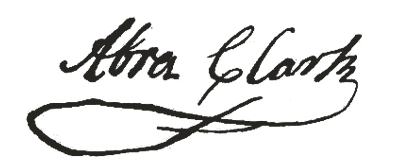
Clark's signature on the Declaration

(Dayton, 1737-1807, was a fellow Elizabeth native, a merchant, who rose to the rank of Brigadier General. His son, Jonathan, became the youngest signer of the Constitution of the United States.)

Clark remained in the Continental Congress through 1778, when he was elected as Essex County's Member of the New Jersey Legislative Council. He had 2 sons fighting in the war, and they were captured by the British, and incarcerated on the prison ship HMS Jersey, docked at Wallabout Bay, which later became the Brooklyn Navy Yard.

He served in Congress again from 1780 to 1783, and from 1786 to 1788. At the Annapolis Convention of 1786, Clark was one of New Jersey's 3 representatives, and formally motioned for the Constitutional Convention, although he was not a delegate to it.

He ran for the U.S. Senate for the 1st Congress in 1788, but lost. He ran for the U.S. House of Representatives for the 2nd Congress in 1790, and won. He was still serving when he died on September 15, 1794, in Rahway, New Jersey, at the age of 68.

He is buried at Rahway Cemetery. The adjoining Township of Clark is named for him, and so is Abraham Clark High School in the neighboring Borough of Roselle, where he lived. His original house burned down, but in 1941, a replica was built on the site, at 101 West 9th Avenue.

Saturday, June 14, 2025

June 14, 1775: The Birth of the United States Army

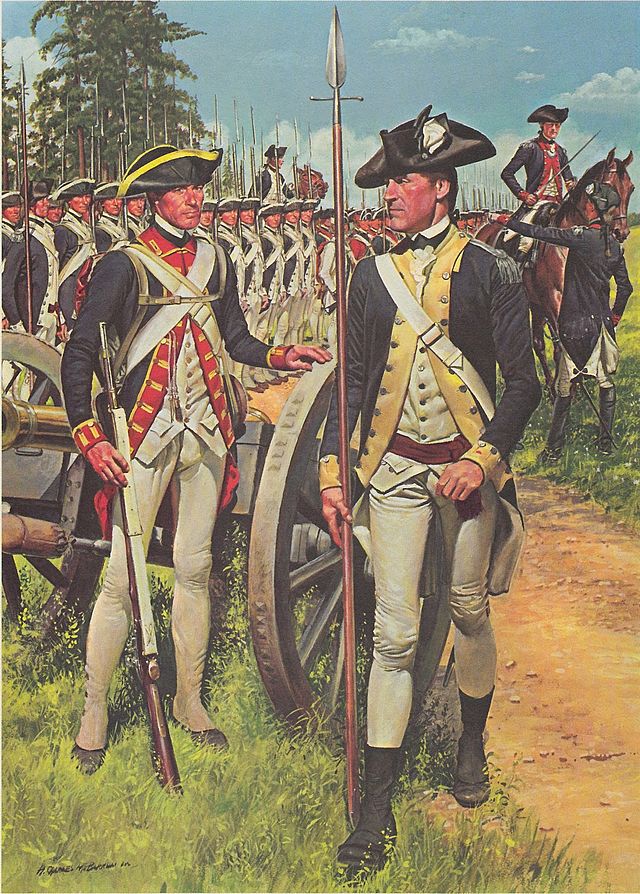
June 14, 1775, 250 years ago: Meeting in Philadelphia, at what will later be called Independence Hall, the Second Continental Congress approves a resolution to establish the Continental Army, to provide for the common defense of the 13 colonies that are, at the time, together known as British America. This is considered the birthdate of the United States Army.

It incorporates patriot forces already in place outside Boston, 22,000 of them; and New York, 5,000 of them. It also raises the 1st 10 companies of Continental Army troops on a one-year enlistment, including riflemen from the Province of Pennsylvania, the Province of Maryland, and the Colony of Virginia.

The following day, June 15, upon the suggestion of Massachusetts delegate John Adams, Virginia delegate George Washington, who had risen to the rank of Colonel in the British Army during the French and Indian War of 1755-1763, was unanimously elected to be the commander-in-chief of the Continental Army.
On June 3, 1784, after the War of the American Revolution, despite great difficulties, was won, the Congress of the Confederation created the United States Army, to replace the disbanded Continental Army. The U.S. Army would, and continues to, consider itself a continuation of the Continental Army.

In 1787, Independence Hall would again host delegates, meeting in a Constitutional Convention. They approved the Constitution of the United States, created the office of the President of the United States, and used the same language to describe the President's role in running the nation's armed forces: "Commander-in-Chief."

The United States Military Academy was founded on March 16, 1802, at Fort Clinton, named for General James Clinton, on the Hudson River at West Point, New York. The school is frequently called "West Point," although, for sports purposes, it's called "Army." The teams were officially known as the Cadets until 1999, when, to reflect the fact that its football team was nicknamed "The Black Knights of the Hudson," it was changed to the Black Knights.

On September 18, 1947, with the reorganization of the U.S. Department of War into the U.S. Department of Defense, the United States Air Force was separated from the United States Army. On April 1, 1954, a separate United States Air Force Academy was founded at Colorado Springs, Colorado.

The U.S. Army has had many great moments, including, but by no means limited to, the following:

* War of the American Revolution, 1775-1783: The Battles of Trenton, Saratoga, Monmouth Courthouse and Yorktown.

* War of 1812, 1812-1815: The Battles of Baltimore and New Orleans.

* Mexican-American War, 1846-1848: The Battles of Monterrey, Buena Vista and Chapultepec.

* American Civil War, 1861-1865: The Battles of Vicksburg, Gettysburg and Richmond, General William Tecumseh Sherman's March to the Sea, and the surrender of Robert E. Lee achieved by General Ulysses S. Grant at Appomattox Court House.

* Spanish-American War, 1898: The Battle of San Juan Hill.

* World War I, 1917 and 1918: The Battles of St-Mihiel and the Argonne Forest.

* World War II, 1941-1945: The amphibious invasions of North Africa, Italy and France, and the accompanying liberations thereof; and the "island-hopping" campaign in the Pacific.

* Korean War, 1950-1953: The amphibious landing at Incheon, saving the country, before the war dragged into a nearly three-year stalemate.

* Persian Gulf War, 1991: Rolling back the conquest of Kuwait by Iraq in a month and a half.

* Balkan Campaigns, 1995 and 1999: Removing Serbia from control of Bosnia in the former and Kosovo in the latter.

* Iraq War, 2003-2011: Removing Saddam Hussein from power in Iraq in a matter of months.
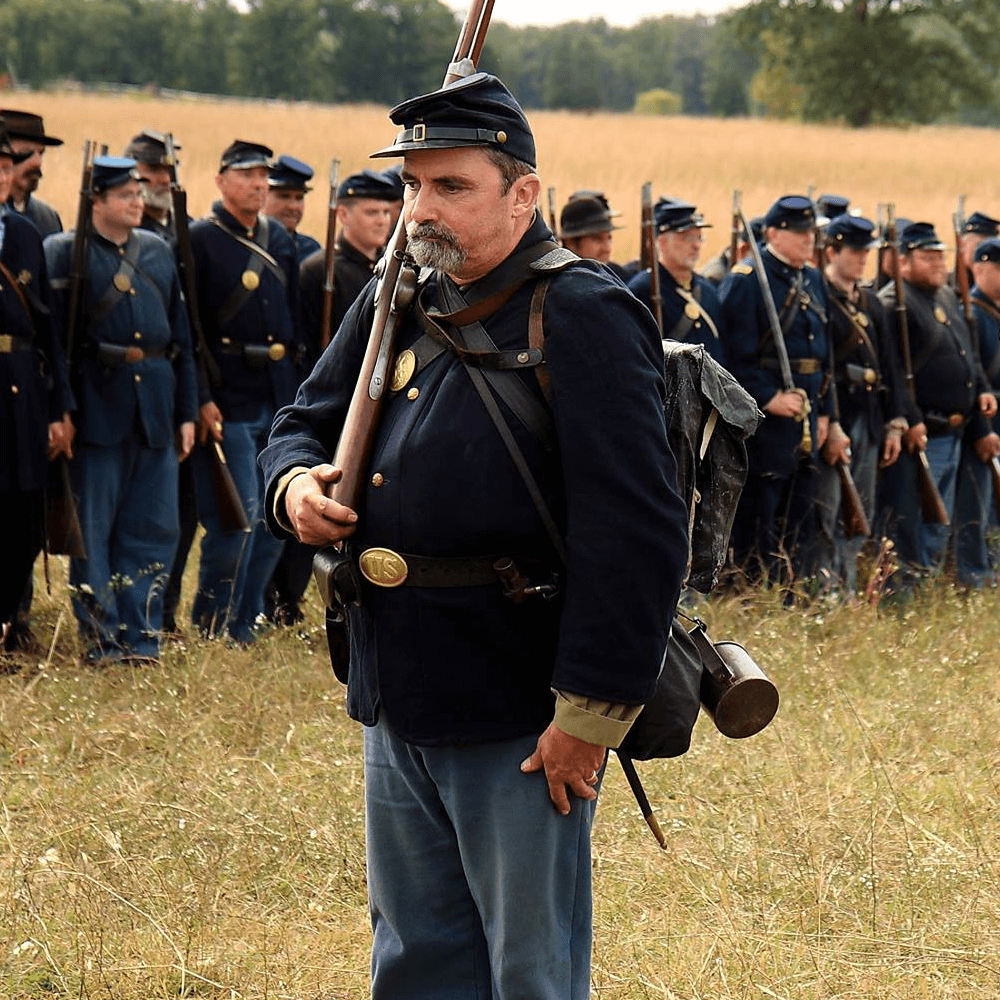
Civil War Union Army re-enactor

Unfortunately, that wasn't the end of the war. Like each of the preceding, and also the Vietnam War of 1959-1975, the Army has also had moments we'd like to forget, but dare not forget.

Of the 45 men who have served as President, 15 have served in the Army: George Washington, Andrew Jackson, William Henry Harrison, Zachary Taylor, Franklin Pierce, Abraham Lincoln, Ulysses S. Grant, Rutherford B. Hayes, James Garfield, Benjamin Harrison, William McKinley, Theodore Roosevelt, Harry Truman, Dwight D. Eisenhower and Ronald Reagan. Grant and Eisenhower are the only West Point graduates to become President.

Both of my grandfathers served in the Army: One in Alaska; the other, with General George S. Patton in the North African and Italian campaigns. My father also served, in Korea during the Vietnam War. None saw combat. Due to my congenital arthritis, I would never have passed a military physical examination; and so, if the military draft had been restored at the time when I would have been eligible, I would have been classified "4-F": Ineligible for service.
My grandfather, Staff Sergeant George Goldberg, 1945

As of June 14, 2025, the Army has (I'm rounding off) about 450,000 active duty personnel, another 330,000 in the Army National Guard, another 170,000 in the Army Reserve, and about 225,000 civilian employees.
Today, a President who lied about his physical condition to get out of serving will hold a military parade in the national capital of Washington, D.C., in celebration of his birthday (his 79th), and also of the Army's (its 250th).

I hope it rains.