Showing posts with label sesame street. Show all posts

Friday, November 24, 2023

November 24, 1983: "Sesame Street" Says Goodbye to Mr. Hooper

November 24, 1983, 40 years ago: Sesame Street airs its best-remembered episode, perhaps its most important, and certainly its saddest.

William Lee (no middle name) was born on August 6, 1908 in Brooklyn. He was a member of the Group Theatre and then the Federal Theatre in New York in the 1930s, and was later blacklisted as a result of being an unfriendly witness before the House Un-American Activities Committee. He recovered from this, and in 1956, began appearing on the soap opera As the World Turns, as Grandpa Hughes -- already playing a grandfather at the age of 48.

He taught at the American Theatre Wing, and then, in 1969, at the age of 61, he got the part of Mr. Hooper on Sesame Street. Show co-creator Joan Ganz Cooney said, "He gave millions of children the message that the old and the young have a lot to say to each other." He said of the role:

I was delighted to take the role of Mr. Hooper, the gruff grocer with the warm heart. It's a big part, and it allows a lot of latitude. But the show has something extra, that sense you sometimes get from great theater, the feeling that its influence never stops.

Mr. Hooper operated Hooper's Store, across from 123 Sesame, the signature building on the show's set. In a 1974 episode, "Mr. Hooper" (everybody called him that, except Big Bird -- more on that in a moment) was, like his portrayer, canonically revealed to be Jewish, when his phone rang, and he began speaking Yiddish. In a 1977 episode, he told Big Bird, "I grew up in a neighborhood where that was the only language a lot of people spoke."

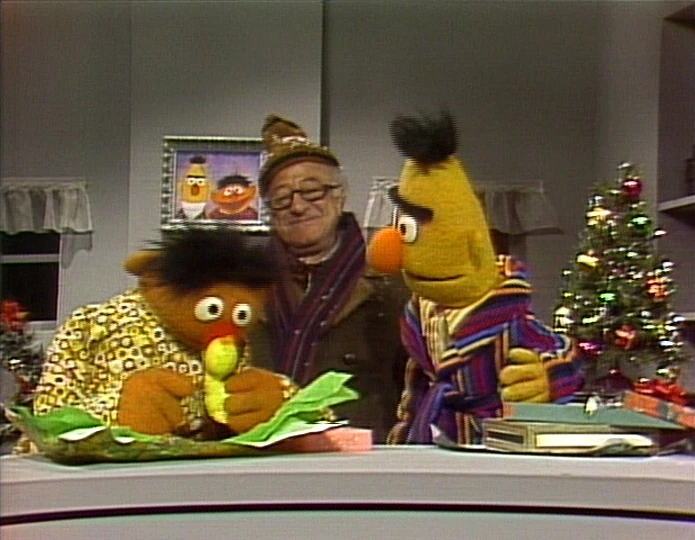
In the 1978 special Christmas Eve On Sesame Street, Mr. Hooper came through to provide a happy ending. Muppet roommates Bert and Ernie unwittingly recreated the O. Henry story The Gift of the Magi: Neither one of them had enough money to buy the other a Christmas present, so Ernie traded his beloved rubber duckie to Mr. Hooper for a cigar box, so Bert would have a good place to store his beloved paper clip collection; and Bert traded that collection to Mr. Hooper for a soap dish, so the rubber duckie wouldn't keep slipping off the edge and into the bathtub.

In one of the rare appearances by one of the show's human characters in Bert and Ernie's apartment, Mr. Hooper gave Ernie a present. He unwrapped it, and it was his rubber duckie. And he gave Bert a present. He unwrapped it, and it was a box containing his paper clip collection. The boys realized what had happened. Then they felt guilty that they hadn't gotten Mr. Hooper anything. He said, "I got the best Christmas present ever: I got to see that everybody got exactly what they wanted!"

A quirk in Big Bird's character was that he always mispronounced Mr. Hooper's name, usually coming out "Mister Looper." I remember a "Mr. Dooper" and a "Mr. Stooper" -- that last one really annoyed Mr. Hooper. When Mr. Hooper got his GED, we finally learned his first name, when he was introduced at the ceremony -- by a grownup -- as "Harold Cooper."

On November 24, 1982, at the age of 74, Will Lee taped an episode of Sesame Street -- as it turned out, for the last time. He didn't feel well that day, and barely spoke to the cast. The next day, he appeared live on national television as part of Sesame Street's float in the Macy's Thanksgiving Day Parade. There was no indication at that time that he was ill. But, just 12 days later, on December 7, 1982, he died of a heart attack. 

The Children's Television Workshop, producers of Sesame Street, had a dilemma. They based their whole show on the fact that kids were smart enough to learn things. So they knew that kids would notice if Mr. Hooper were played by a different actor, or if he stopped appearing altogether, and would need an explanation. They considered saying that the character had retired and moved away. In the end, they decided to tell the truth -- or, rather, to write the actor's truth into the character's story.

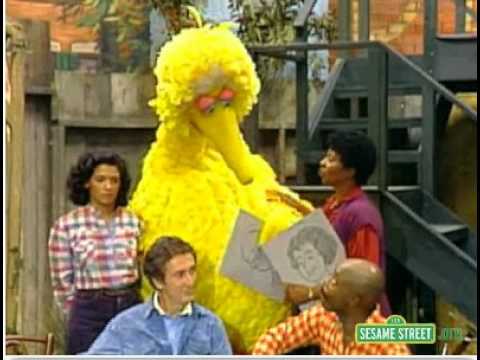
On November 24, 1983, one year to the day after his last taping -- Thanksgiving Day, a day when families were together, to help explain anything that the show might not have properly covered to the kids watching -- the episode aired, at 4:00 PM Eastern Time, hence the time of this post. It was revealed that Mr. Hooper had died some time earlier (no cause was given), but that Big Bird still didn't grasp what this meant. He had to be told that it means, "Mr. Hooper's not coming back."

Bob McGrath, who played music teacher Bob Johnson, said of the human cast, "We barely got through that show." Carroll Spinney, who both wore the Big Bird costume and operated the Oscar the Grouch Muppet, said, "The best episode we ever did was Mr. Hooper's death. Those were real tears. Will was the sweetest man."
Big Bird, played by Carroll Spinney, surrounded by, left to right:
Maria (Sonia Manzano), Bob (Bob McGrath),
Susan (Loretta Long) and Gordon (Roscoe Orman)

For a few years by that point, Northern Calloway had played David (his last name was never mentioned), a young black man who had been Mr. Hooper's assistant. David inherited Hooper's Store. After that, David hired Gina Jefferson, a teenage girl played by Alison Bartlett-O'Reilly. But Calloway fell victim to mental illness, left the show in 1989, and died a year later.

The store was then bought by Mr. Handford, a black retired firefighter played by Leonard Jackson for one season, then by David L. Smyrl. Jackson played Mr. Handford as a grumpy old man, while Smyrl found the same balance between grumpy old man and kindly old gentleman that Lee had. (David's disappearance was explained as the character simply moving away, while the change in actor for Mr. Handford was less drastic, since the character wasn't original and beloved, as Mr. Hooper and, to a lesser extent, David were.)

In 1998, Smyrl left the show, and it was explained that Mr. Handford had sold the store to Alan (whose last name has never been revealed). Alan is played by Japanese-American actor Alan Muraoka, and has run the store ever since -- his 25 years in charge nearly twice as long as the 13 years we saw Mr. Hooper run it, although we have no way of knowing how long it was open before 1969.

But, to this day, the drawing of Mr. Hooper that Big Bird made, and showed in the farewell episode, rests adjacent to Big Bird's nest, as a reminder of Mr. Hooper, and of Will Lee.
Carroll Spinney, in his 80s, began to pull back, allowing Eric Jacobson to take over as Oscar in 2015, and Matt Vogel to replace him as Big Bird 2018. Spinney died the following year. But, like Oscar, Bert and Ernie, Grover, Cookie Monster, The Count, and all the rest, Big Bird lives. Which means he'll never see Mr. Hooper again -- barring the invention of a Star Trek-style holodeck or the intervention of an artificial intelligence setup that can simulate the character.

Sunday, November 10, 2019

November 10, 1969: "Sesame Street" Premieres

November 10, 1969, 50 years ago: Sesame Street premieres on PBS. It became the greatest show in the history of children's television.

Three years earlier, TV producer Joan Ganz Cooney and Carnegie Foundation vice president Lloyd Morrisett met to discuss creating a children's television show that would "master the addictive qualities of television and do something good with them." In 1968, they founded the Children's Television Workshop (CTW), and received grants from the Carnegie Foundation (later the Carnegie Corporation of New York), the Ford Foundation, and the Corporation for Public Broadcasting.

The original title for the show was 123 Avenue B. Get it? 1, 2, 3, A, B: Counting and the alphabet. But this idea was discarded, because people would have sought out the actual address, off East 8th Street, across from Tompkins Square Park in Manhattan. At the time, the Lower East Side of Manhattan was a pretty rough neighborhood: No person aware of its conditions would have wanted to know how to get there, but kids, not knowing, would have begged their parents to take them.

So the title became Sesame Street. Sesame is a seed that is a source of oil, but, at this time, while McDonald's had introduced the Big Mac burger with its famed "sesame seed bun," the jingle mentioning it didn't debut until 1974. So most people knew the word "sesame" from "Open sesame," a line used in Ali Baba and the Forty Thieves. People would associate "sesame" with "open," with the idea that they were opening children's minds to learning.

Since what became known as "The Street" (Capital T, Capital S) was supposed to be in a generic neighborhood in New York City, where it was taped, the show was big on diversity from the start. The first character to appear on the show was Gordon Robinson, played by Matt Robinson. Gordon was a science teacher, who was married to Susan, a nurse, played by Loretta Long. Together, they owned the building that was the centerpiece of the show, with the address of 123 Sesame Street.

They wanted to show a black couple as successful and stable. Well, they got most of what they wanted: Long remained on the show until retiring in 2016, and the Gordon character was retired the following year; but there were 3 separate actors playing him. Matt Robinson left in 1972, ironically because he was behind the times: He left because of a creative difference, namely that he did not want Susan to be depicted as working outside the home. He was replaced by Hal Miller, who left in 1974 because he didn't like being on a children's show. Roscoe Orman then played the character for the next 43 years.

In 1976, Alaina Reed joined the cast as Olivia Robinson, Gordon's sister and a photographer. In 1985, Miles Orman, Roscoe's real-life son, joined the cast as Miles, the adopted son of Susan and Gordon.

Another original castmember was Will Lee, as Harold Hooper, operator of Hooper's Store, across from 123 Sesame. In a 1974 episode, "Mr. Hooper" (everybody called him that, except Big Bird -- more on that in a moment) was, like his portrayer, canonically revealed to be Jewish, when his phone rang, and he began speaking Yiddish. In a 1977 episode, he told Big Bird, "I grew up in a neighborhood where that was the only language a lot of people spoke." In the 1978 special Christmas Eve On Sesame Street, Bob wished him a Happy Hanukkah.

Bob Johnson, a music teacher, was played by Bob McGrath. Along with Loretta Long, he was the last remaining original castmember, also retiring in 2016. Bob was white, and, aside from being as talented as the other characters, had nothing to make him stand out.

One particular song he sang was "I'm Going Somewhere," and challenged the audience: "Can you guess where?" He rattled off pretty much every way you could get there, concluding with subway and jeep, before sitting on the stoop of 123 Sesame, and singing, "I'm going... to sleep," and dozing off.

In 1971, in recognition of America's growing Hispanic community, Mexican-American actor Emilio Delgado was added, as Luis Rodriguez, owner of The Fix-It Shop, next-door to Hooper's Store. That same year, Bronx native Sonia Manzano was added as teenager Maria. In 1979, to celebrate the character's 21st birthday, the cast, Muppets included, when to Puerto Rico to meet Maria's family and celebrate.

The show combined human characters, both adults and children, with Jim Henson's "Muppet" puppets. It taught letters and the words those letters stood for, and numbers. Just as every episode began with the eventually iconic theme song (starting with "Sunny day, sweeping the clouds away" and concluding with "Can you tell me how to get, how to get to Sesame Street?"), every episode ended with a castmember saying, in a parody of sponsorship, that the show was brought to you by 2 letters and a number that were featured in it. Example: "Sesame Street has been brought to you today by the letters M and P, and by the number 4." (M and P are my initials, and 4 has always been my favorite number.)

Some of the Muppet characters became icons. Carroll Spinney both wore the costume as Big Bird, who represented childlike wonder (to this day, even after Spinney's retirement and replacement, the character is said to be 6 years old), and operated the character of Oscar the Grouch.

(UPDATE: Since the show's 50th Anniversary, Caroll Spinney has died. So has Emilio Delgado.)

Several "monster" Muppets were introduced, to show kids that just because someone is different -- even a monster -- doesn't mean they're bad. Okay, Cookie Monster is a glutton, and Grover is a klutz, but they mean well.

There were Bert and Ernie. Contrary to popular belief, they are not a gay couple, and were never meant to be. (The Stonewall Riot happened just 5 months earlier.) Contrary to another popular belief, they were not named after Bert the cop and Ernie the cabdriver in the film It's a Wonderful Life.

But they were based on The Odd Couple, which had already been a Broadway play and a movie, but not yet a TV show: Bert was the "Felix," uptight with some strange hobbies; and Ernie was the "Oscar," sloppy and immature. The name and personality of Oscar the Grouch, who loved trash and lived in a trash can, may also have been a nod to Oscar of The Odd Couple.

Occasionally, Kermit the Frog, an original Jim Henson Muppet, would make an appearance. In 1976, Kermit became the "host" of The Muppet Show, which, at first, confused the heck out of me: I thought the Muppets meant Sesame Street, but he was the only Sesame Street character who appeared on it. (Eventually, Big Bird would make an appearance, and Bert and Ernie also would, but those were rare exceptions.)

And except for Kermit, no Muppet Show characters -- not Miss Piggy, not Fozzie Bear, and, thankfully, not Statler and Waldorf -- crossed over onto Sesame Street. At that age, I didn't know that the Muppets, including Kermit himself, went all the way back to 1955, and were regulars on The Ed Sullivan Show in the 1960s.

Some Muppets would be re-used. For example, TV game show host Guy Smiley was re-dressed as The Muppet Show's anchorman: "Here is a Muppet News Flash!" There was also a "Fat Blue" that was used for several early characters, including the bald, mustachioed restaurant customer who drove Grover, playing a waiter, crazy.

Let's see, I've mentioned Big Bird, Oscar, Cookie Monster, Grover, Bert, Ernie, Kermit, Guy and Fat Blue. That's one, two, three, four, five, six, seven, eight, nine! Nine nifty Muppets! Ah ah ah ah! (BOOM!) Oh yes, there was also "The Count": "Do you know why they call me The Count? Because I love to count things!" He was later given the full name of Count Von Count. He was a purple guy who looked like Count Dracula, but didn't bite anybody. (Come to think of it, while Cookie Monster would eat almost anything, not just cookies, he didn't bite anybody, either. Except for that one time when he tried to eat Guy Smiley's hand.)

The show also produced legendary songs. Kermit's "Bein' Green," meant to say that it's okay to be different; Ernie's bathtime song "Rubber Duckie"; and "Mah Na Mah Na" actually became hit records. (It was 1970. There were some considerably stranger songs on the charts in those days.) All were sung by Henson himself, who operated and voiced the corresponding Muppets.

(Officially, the hippie-looking guy who sings "Mah Na Mah Na" is named Bip Bippadotta, but everybody ended up calling him "Mahna Mahna," so that became his official name when he appeared on The Muppet Show, with "Bip" still being his Sesame Street name.)

Other songs that were featured on Sesame Street included Big Bird's alphabet song "Abcdefghijklmnopqrstuvwxyz" (pronounced "AB-ka-DEF-gee-JECK-le-min-OP-qwer-STOOV-wix-iz"), Cookie Monster's "C is for Cookie," Oscar's "I Love Trash," "Sing (Sing a Song)" and "One of These Things Just Doesn't Belong Here."

I was born just 38 days after Sesame Street debuted. The show and I grew up together. By 1978, it was big enough to get its own Christmas special, with Bert and Ernie having a storyline paralleling O. Henry's story The Gift of the Magi, except that Mr. Hooper came through to provide a happy ending. Also, Cookie Monster tried to contact Santa Claus, but every method -- his pencil, his typewriter, his phone -- reminded him of cookies, and he ate them.

And, in an unusual instance of Spinney's characters interacting, Oscar asked Big Bird how big fat Santa got down those skinny little chimneys on the roofs of city apartment buildings. Big Bird got worried that Santa might not be able to come to Sesame Street, and nobody would get any presents. Spoiler Alert: The presents showed up, and Big Bird was told that it didn't matter how it happened.

Also by that point, there were international versions of the show. It became Plaza Sesamo in Spanish-speaking countries; 1, rue Sésame in French-speaking countries; Sesam Strasse in German-speaking countries; and, from 1983 to 2015, in Israel, Rechov Sumsum, with the street in question being a safe place for Jewish and Muslim children to play together, a "neutral zone" apart from "the real world." Today, Sesame Street has variations shown in 150 different countries, in 70 languages.

Big Bird occasionally had a difficult relationship with the show's grownups. Starting in 1971, he had a friend, Mr. Snuffleupagus. This was a big thing with orange hair that looked like an elephant, with a long trunk, but without the large ears. He did, eventually, get a first name: Aloysius Snuffleupagus. But Big Bird usually just called him "Snuffy." Snuffy called him "Bird."

The Muppets and the show's kids could see him, but the grownups never did. Since they'd never heard of a snuffleupagus, and Snuffy never seemed to show up when Big Bird needed him to, they said there is no snuffleupagus, usually followed by, "Big Bird, you sure have some imagination!"

Times change, and the show had to change with it. By the mid-1980s, it began to dawn on the CTW's people that children might see that the grownups didn't believe Big Bird when he said Snuffy was "real," so they might not be believed about important things -- good or bad. So the decision was made to have them definitively see Snuffy.

The episode where it happened aired on November 18, 1985, the premiere of the show's 17th season. This was also the episode that introduced the character of Elmo, the little red monster Muppet, and he turned out to be instrumental in Snuffy's revelation. This is what I call the show's "hinge episode": Elmo proved so popular that he came to dominate the show. "Elmo's World" became a segment, but, at times, it seemed like the entire show was Elmo's world.

A quirk in Big Bird's character was that he always mispronounced Mr. Hooper's name, usually coming out "Mister Looper." I remember a "Mr. Dooper" and a "Mr. Stooper" -- that last one really annoyed Mr. Hooper. Even when Mr. Hooper got his GED, he was introduced at the ceremony -- by a grownup -- as "Harold Cooper."

On December 7, 1982, Will Lee died at age 74. The CTW had a dilemma. They based their whole show on the fact that kids were smart enough to learn things. So they knew that kids would notice if Mr. Hooper were played by a different actor, or if he stopped appearing altogether, and would need an explanation. Since it had been established on the show that he had a brother living in Chicago, they toyed with the idea of saying the character had retired and moved away.

In the end, they decided to tell the truth -- or, rather, write the actor's truth into the character's story. On November 24, 1983 -- Thanksgiving Day, a day when families were together, to help explain to the kids watching anything that the show might not have properly covered -- it was revealed that Mr. Hooper had died some time earlier (no cause was given), but that Big Bird still didn't grasp what this meant. He had to be told that it means, "Mr. Hooper's not coming back."

McGrath said of the human cast, "We barely got through that show." Spinney said, "The best episode we ever did was Mr. Hooper's death. Those were real tears. Will was the sweetest man."

In 1986, Manzano got married in real life. In 1988, she got pregnant. Now, the CTW had a very different adult issue on their hands. They couldn't have Maria disappear from the show until after Sonia's baby was born: Again, kids would notice, and ask what was going on.

So, since it had long been established that Maria worked for Luis at The Fix-It Shop, the writers wrote a story that had Luis and Maria falling in love, getting married, and having a baby. It was all above-board. It was a story that could have been told on TV, even 20 years earlier.

Except, by this point, I was an adult, and I thought it was kind of a creepy way around it. Sure, they were both Hispanic (the term "Latinx" for Hispanics of every gender identity wasn't used yet), and they already knew and liked each other. But Luis was old enough to be Maria's father! (Or so I thought. As it turned out, Manzano was 38 when the baby was born, and only 10 years younger than Delgado. But I didn't know that then.)

So, in the 1990s, Gordon and Susan's son Miles and Luis and Maria's daughter Gabi became the representatives of what could have been called Sesame Street: The Next Generation. By this point, with Northern Calloway, who played Mr. Hooper's assistant David, also having left the show (it wasn't a story I'd like to share, and he died soon thereafter), Hooper's Store was run by Alan, a Japanese-American played by Alan Muraoka, and Miles and Gabi went on to work there.

I guessed that the show would eventually write in a romance between them. This hasn't happened: When they graduated from high school (together, despite Miles being introduced as a baby 4 years earlier), and went off to college, the characters were written out of the show. 

Other difficult subjects were introduced. Deaf actress Linda Bove introduced the show's viewers to sign language and the difficulties of hearing impairments. Aristotle was introduced in 1981 as a blind Muppet, Julia in 2017 an autistic one, and Lily in 2011 as a poor one, revealed in 2018 to be homeless. Because he depended on his hearing more than any other character on the show, Aristotle is one of the few monster Muppets to have visible ears.

After September 11, 2001, an episode was written with as close a parallel to the terrorist attacks as the writers could safely come up with: Maria and Elmo are in Hooper's Store when a grease fire breaks out. Although Alan is able to put it out with his fire extinguisher, Maria still has to get Elmo out, and Elmo is traumatized by the event. And when the firefighters, wearing their full equipment, making them look bigger than people their size would normally be, try to talk to him, he's scared further. They explain things to them, and invite him to their firehouse, and he calms down.

Joan Ganz Cooney is still alive, and is scheduled to turn 90 on November 30. Lloyd Morrisett is also still alive, and turned 90 on November 2. He also co-created The Electric Company, which The CTW also ran, from 1971 to 1977.

Sesame Street was originally taped at Reeves Teletape Studios, at 81st Street and Broadway, formerly CBS Studio 72. Also taped there were The Electric Company, and several other shows, for kids and adults alike. In 1986, Reeves Teletape was demolished, and Sesame Street moved production to Unitel Video, at 515 W. 57th Street, off 10th Avenue. Since 1993, they have taped at Kaufman Astoria Studios, on a block in Astoria, Queens bounded by 35th and 36th Avenues, and 35th and 36th Streets.

In 2000, The Children's Television Workshop was renamed Sesame Workshop. In 2016, Sesame Street left PBS, and moved to HBO, where it just began its 51st season. It remains relevant.

Wednesday, December 21, 2016

Top 10 TV Christmas Episodes

Top 10 TV Christmas Episodes

UPDATE: Through the 2025-26 TV season, I have seen no reason to change this list.

10. The Andy Griffith Show, "The Christmas Story," first airing on December 19, 1960. In Mayberry, North Carolina (based on Mount Airy, the real-life hometown of Griffith, who played Sheriff Andy Taylor), department store owner and resident Scrooge Ben Weaver (Will Wright) demands that Andy lock up local moonshiner Jim Muggins (Sam Edwards). Muggins' family, as well as Andy's, gather to celebrate the holiday with Jim. Deputy Barney Fife (Don Knotts) dresses up as Santa Claus.

After witnessing how Jim and Andy and their broods can turn the jailhouse stay into a warm, inviting celebration, Weaver gets himself arrested, so he can be part of the fun, and he ends the holiday by getting a nip of Jim's hooch himself. 

9. Bonanza, "A Christmas Story," December 25, 1966. Yes, it actually aired on Christmas Day. Wayne Newton makes his 2nd appearance on Bonanza as young singer Andy Walker. Jack Oakie plays his uncle and manager, who tries to con Hoss Cartwright (Dan Blocker) out of the money he's trying to raise for an orphanage in Virginia City, Nevada. 

But Andy catches on to his uncle, and there's a Dickensian twist to the ensuing Christmas party at the Ponderosa Ranch.

8. The Man from U.N.C.L.E., "The Jingle Bells Affair," December 23, 1966. U.N.C.L.E. Agents Napoleon Solo (Robert Vaughn) and Illya Kuryakin (David McCallum) have to protect Chairman Gyorgi Koz (Akim Tamiroff), a foreign leader who looks suspiciously like Nikita Khrushchev, at the United Nations. 

In the process, the Chairman learns the true meaning of "Peace on Earth, and good will toward men."

7. The Mary Tyler Moore Show, "Christmas and the Hard-Luck Kid II," December 19, 1970. The title is a reference to an episode of That Girl, written by James L. Brooks. Brooks also wrote this episode, or, rather, co-wrote it with Allan Burns.

Mary Richards (Mary Tyler Moore) has to work on Christmas Eve and Christmas Day at Minneapolis TV station WJM, and so it seems that her favorite holiday is completely ruined. However, on her Christmas Eve shift, her coworkers come to the rescue, bringing the holiday spirit to her, and proving that even if the holiday isn’t in line with tradition, it can still be a wonderful night full of bright spirits.

6. The Honeymooners, "'Twas the Night Before Christmas," December 24, 1955. Not having enough money to buy his wife Alice (Audrey Meadows) a proper Christmas present, Brooklyn bus driver Ralph Kramden (Jackie Gleason) pawns his beloved bowling ball. And on Christmas Eve, he finds Alice has given him a proper bag for his bowling ball. 

The episode is an obvious homage to the classic New York Christmas story "The Gift of the Magi" by O. Henry.

5. The West Wing, "Noël," December 20, 2000. Deputy White House Chief of Staff Joshua Lyman (Bradley Whitford) is dealing with post-traumatic stress disorder, after being the person most seriously hurt in the recent assassination attempt on President Jed Bartlet (Martin Sheen). Yo-Yo Ma appears as himself, and his East Room cello performance triggers the memory of the police and ambulance sirens from the attempt.

Whitford won an Emmy for playing Josh in this episode. Near the end of it, Chief of Staff Leo McGarry (John Spencer) tells Josh a story about a man who falls into a hole, and puts Josh at ease by saying, "As long as I got a job, you got a job."

Honorable Mention: The West Wing had 6 Christmas episodes in its 7 seasons. I'd like to mention 3 others. The 1st, "In Excelsis Deo" (December 15, 1999), showed White House Communications Director Toby Ziegler (Richard Schiff) arranging a burial at Arlington National Cemetery for a homeless Korean War veteran who ended up with the coat he donated to Goodwill, after the police find the man murdered, with Toby's business card still in the coat pocket. And we learn that the President's secretary, Dolores Landingham (Kathryn Joosten), lost her twin sons, both Army doctors, in Vietnam on Christmas Eve 1970.

"Bartlet for America" (December 12, 2001) showed both Bartlet and McGarry in trouble for the President's concealment of his health issue, and Josh tries to stick up for him by mentioning the guy-in-the-hole story. But a cross-partisan gesture of conscience by committee counsel Cliff Calley (Mark Feuerstein) gives them a holiday reprieve, and a peaceful settlement is reached in the New Year.

"Holy Night" (December 11, 2002) reveals in a flashback that Toby was born 2 days before Christmas 1954, and that his father Julius had been a soldier in Murder, Incorporated, the Jewish organized crime group that operated in Brooklyn from the 1920s to the 1960s.

Toby had never forgiven his father for his crimes, and for having to be away from the family in prison for them. "Julie" (played in the present day by Jerry Adler) comes to the White House to try to make amends. Josh reminds Toby that his own father died during the 1st Bartlet campaign, 4 years earlier, and that, when he was a boy, his sister died in a fire, saying, "I would give anything to have a living father with a prison record, or a sister with a past." (Toby's sister was old enough to be a Hippie, and took him to antiwar protests in the Vietnam War years.) So Toby accepts his father's first step toward reconciliation.

4. M*A*S*H, "Dear Sis," December 18, 1978. In 1951, the chaplain at a U.S. Army hospital in the Korean War, 1st Lieutenant (later Captain) Francis Mulcahy (William Christopher) is writing a letter to "my sister the sister," a nun in their hometown of Philadelphia. He tells her that he doesn't feel useful, not even at Christmastime. At the episode's conclusion, the Chief Surgeon, Captain Benjamin Franklin "Hawkeye" Pierce (Alan Alda), leads a toast to tell Mulcahy just what he means to them.

In a subplot, the company clerk, Corporal Walter "Radar" O'Reilly (Gary Burghoff) tells another surgeon, Major Charles Emerson Winchester III (David Ogden Stiers) that, on Mulcahy's recommendation, he'd written to Charles' mother, and asked her to send something that would remind the down-in-the-dumps Boston Brahmin of happier times. She sent his old toboggan cap, and Charles was overjoyed. Another surgeon, Captain B.J. Hunnicutt (Mike Farrell), plays Santa.

Honorable Mention: Despite the Korean War lasting 3 years, the show had 4 Christmas-themed episodes. One, "'Twas the Day After Christmas," airing on December 28, 1981, was set around the British tradition of superiors and subordinates switching roles on the day after, Boxing Day. But, aside from Mulcahy still singing Christmas carols, it doesn't have much to do with Christmas.

In the show's 1st season, airing December 17, 1972, "Dear Dad" shows Hawkeye writing to his father in Maine about the weird goings-on at the 4077th at Christmastime. Including the fact that he has to leave a Christmas party there to attend to a wounded soldier in a foxhole. While still wearing his Santa Claus costume.

And in "Death Takes a Holiday," airing on December 15, 1980, Hawkeye, B.J. and the Head Nurse, Major Margaret Houlihan (Loretta Swit) are called away from Mulcahy's party for the local orphans, to tend to a wounded soldier. The soldier has no chance, but when Margaret finds a picture of his family in his pocket, B.J. goes back to work, saying, "A family's Christmas wreaths should be green, not black."

Thinking of his wife Peg and toddler daughter Erin back in the San Francisco suburb of Mill Valley, California, B.J. is so intent on saving the man's life that he pushes Mulcahy away when Mulcahy attempts to give the man the last rites. Mulcahy insists on doing his job, just as B.J. is insisting on doing his. B.J. relents.

Despite their efforts, the patient dies at 11:25 PM on December 25. Hawkeye, seeing his best friend take it hard, moves the clock ahead, so that the time of death will read 12:05 AM, December 26.

Farrell also wrote and directed this episode. Harry Morgan played the commanding officer, Colonel Sherman Potter, and, in this episode, Potter played Santa Claus.

3. The Twilight Zone, "The Night of the Meek," December 23, 1960. Art Carney, who played Ed Norton on The Honeymooners, is the star this time, in Rod Serling's anthology fantasy series. Fired after arriving for work late and sloshed, department store Santa Henry Corwin wanders into an alley and finds a bag filled with gifts.

The spirit of the holiday is one of the few bright spots in Henry's life, and as he begins handing out the gifts, he realizes the bag is able to produce any gift a recipient requests. After a brief jail stint that ends with Henry changing the mind of his mean, skeptical former boss, he continues handing out gifts.

Soon, one of his giftees points out that Henry has taken nothing from the bag for himself. What does he want? To continue playing Santa every year. The wish is granted when he finds an elf with a reindeer-driven sleigh waiting, to whisk him off to the North Pole. 

2. All In the Family, "The Draft Dodger," December 25, 1976. It's Christmas dinner at the Bunkers' house in Queens. Gloria and Mike Stivic (Sally Struthers and Rob Reiner) invite David (Renny Temple), an old friend of Mike's, now living in Canada, but choose not to tell Gloria's parents Archie and Edith that the reason David went to Canada is that, as the episode's title suggests, he evaded the draft during the Vietnam War.

Archie had also invited a friend, Pinky Peterson (Eugene Roche), whose son had asked him whether he should accept being drafted into the Army and fight in Vietnam, or run away to Canada. Pinky advised him to obey the law, and accept being drafted. Pinky's son was killed, making Pinky a "Gold Star Father." Also a widower, Pinky was thus alone on Christmas, and Archie, in the kind of gesture of humanity that we did not often see from him, thought Pinky could use the company.

When Archie learns the truth about David, he rants and raves, throwing all Christmas spirit to the wind, until Pinky stands up and asks if his opinion means anything. Archie, citing Pinky's circumstances, says his opinion means more than anyone else's. Pinky tells his son's story, and offers David the handshake that he says his son would have given. As usual, Archie does not take defeat well.

1. Sesame Street, "Christmas Eve On Sesame Street," December 3, 1978. I was just about to turn 9, and it was a show I'd been watching literally all my life. So, yeah, I'm biased. It's my blog, and I'm allowed to be biased in it.

There are 3 plots in the Christmas special based on the classic PBS children's series. One concerns Bert (operated by Frank Oz) and Ernie (operated by Jim Henson), and it's another redo of "The Gift of the Magi." Bert doesn't have enough money to buy a Christmas present for Ernie. So he sells his beloved paper-clip collection to Harold "Mr." Hooper (Will Lee), and uses the money to buy a soap dish for Ernie's beloved Rubber Duckie. 

But Ernie doesn't have enough money to buy a present for Bert, either, so he sells his Duckie to Mr. Hooper, and uses the money to buy a cigar box, which he thinks would be perfect for storing Bert's collection.

Then Mr. Hooper comes over and gives them presents: Bert gets his paper clips back, and Ernie gets his Duckie back. The boys each figure out what the other had done. Then, feeling guilty, they tell Mr. Hooper – who's Jewish, and has been wished a Happy Hanukkah by Bob (Bob McGrath) – that they're sorry they didn't get him anything. He tells the boys, "I got the best Christmas present ever: I got to see that everybody got exactly what they wanted."

Carroll Spinney -- who, at age 82, still voices both characters in 2016 -- as Oscar the Grouch, asks Big Bird a cruel question: How does big fat Santa Claus get down those skinny chimneys? And poor Big Bird is terrified that Santa won't be able to do it. So he enlists the help of Kermit the Frog (also Jim Henson), Grover (also Frank Oz), and some kids, to get answers. None of them makes sense, and Big Bird is more worried than ever. As it turns out, it doesn't matter how Santa does it: Apparently, he does it.

The other, much funnier subplot, tells of Cookie Monster (also Frank Oz) trying to contact Santa Claus, to ask Big Red to bring him cookies for Christmas. The problem is, Cook keeps eating his means of communication. First, he ends up eating his pencil. Then he tries to type, but the typewriter keys remind him of raisins, and then the paper reminds him of fortune cookies. Finally, he tries to call Santa on the phone, but the ends of the receiver look like "cuppy-cakes" to him.

Friday, June 7, 2013

Top 10 Most Devastating TV Character Deaths

This is not about sports.

This past Sunday night, Game of Thrones aired "Red Wedding," in which there was a Total Eclipse of the Starks.

And it wasn't like "the Moldavian Wedding Massacre" on Dynasty on May 15, 1985, where pretty much everybody got shot, but none of the major characters died. Although a character played by Ali McGraw did, and she was a big name in those days.

(For you younger readers: Confusing Dynasty with Duck Dynasty is like comparing Noel Coward to Larry the Cable Guy -- if, that is, Noel Coward had been a mean old bastard whose current and ex-wives kept trying to beat each other up.)

Surely, "Red Wedding" was one of the most shocking moments in TV history. Indeed, one guy on Twitter wrote of the series' creator, "Why doesn't George R.R. Martin use Twitter? Because he killed all 140 characters." (Another Twitterer said, "It's too bad Entourage didn't end like that.")

But how does the loss of Robb Stark, his wife Talisa, and his mother Catelyn compare to the most devastating TV character deaths ever?

It just happened, so, obviously, it hasn't yet stood the test of time. But the shock value, even for a show that killed off its seemingly most important character (Robb's father Ned) in its Season 1 finale, was huge. How vicious the murders were adds to it.

For this list, I'm only going to include the unexpected. That means that any character killed off by the writers because the actor playing him died can't be included. So you won't be seeing the likes of...

* Harold "Mr." Hooper, played by Will Lee on Sesame Street, December 7, 1982.
* Sgt. Phil Esterhaus, Michael Conrad on Hill Street Blues, November 22, 1983.
* Ernie Pantusso, a.k.a. Coach, Nicholas Colasanto on Cheers, February 12, 1985.
* Selma Hacker, Selma Diamond on Night Court, May 13, 1985.
* Ike Johnson, John Hancock on Love & War, October 12, 1992.
* Leo McGarry, John Spencer on The West Wing, December 15, 2005.
* J.R. Ewing, Larry Hagman on Dallas, November 23, 2012.

Nor will you be seeing Lt. Tasha Yar on Star Trek: The Next Generation, April 25, 1988. It was already well-known that Denise Crosby wanted to leave the show, so it wasn't really a shock.

And you certainly won't see Chuckles the Clown (who was never shown onscreen) from The Mary Tyler Moore Show, October 25, 1975. That was played for laughs. Same with the many deaths of Kenny McCormick (cartoon character voiced by Matt Stone) on South Park.

And forget about Rosalind Shays (Diana Muldaur) on L.A. Law, 1991. Yes, it was shocking. But devastating? Hell, some of us cheering when that bitch (literally) went down, when she (literally) got the shaft. Shaft. Can you dig it?

The deaths on ER? Losing Lucy Knight to a knife-wielding maniac was hard, especially since Kellie Martin, then 24 years old, still looked as young as she did on Life Goes On (she was 14 when it premiered). Losing Dr. Mark Greene (Anthony Edwards) was hard, but this was his second go-around with the brain tumor, so it was hardly unexpected. As for Dr. Robert "Rocket" Romano (Paul McCrane) to a second mishap with a helicopter within a year, well, he didn't deserve death. He did, however, deserve humiliation. But no one of these deaths makes the list.

Nor can I quite put Detective Bobby Simone, Jimmy Smits on NYPD Blue, on this list. The same goes for Grey's Anatomy or Lost, which, unlike ER, I didn't watch: When you frequently kill characters, or get rid of characters for reasons other than death, it doesn't sting as much.

One final disclaimer: This list is mainly affected by shows I've actually seen. In some cases, I didn't watch the shows, but I'm aware of their impact, and so I've made an allowance for that.

Top 10 Most Devastating TV Character Deaths

Honorable Mention: Matthew Crawley, Dan Stevens on Downtown Abbey, December 25, 2012 (episode taking place in 1921). He survived World War I and the Spanish influenza epidemic that followed it. His wife Mary was about to have a baby, and show viewers were afraid that, for the second time, a female character would die in childbirth. (Lady Sybil Branson was the first, 2 months earlier). Wrong: Matthew is driving his convertible, in high spirits, when he is hit by a truck.

Honorable Mention: Gary Shepherd, Peter Horton on thirtysomething, February 12, 1991. I never watched the show, but people who did had to watch as Nancy (Patricia Wettig) battled cancer, and while she's in the hospital, having just heard that the results of her latest test have come back negative for a relapse, she's told that Gary is dead in a car crash.

Honorable Mention: Omar Little, Michael K. Williams on The Wire, February 24, 2008. Omar was a thief who robbed drug dealers in Baltimore. In the tradition of "honor among thieves," he did have a kind of moral code. And he ended up killing 5 men over the course of the show's first 5 seasons.

With that kind of rep, clearly, he was going to get taken down. Who killed him? A drug lord, sick of Omar muscling in on his territory? A hitman, working on behalf of such a drug lord? A victim's loved one, taking the law into his own hands, to get revenge? A cop, angry that Omar had, himself, taken the law into his own hands? Someone objecting to the fact that Omar was openly gay? An ex-boyfriend?

Actually, it was a kid named Kenard (Thuliso Dingwall). True, he was involved with the Fayette Street Mafia. But he was only about 12 years old, and he took Omar down simply for the sake of gaining some street cred, being able to say he took him down, like in the Wild West.

Honorable Mention: Adriana La Cerva, Drea de Matteo on The Sopranos, May 23, 2004. Another one of those shows that always seems to have somebody dying, and in this one's case, violently. So when the death of a single character stands out to the show's fans, attention must be paid.

To me, the shocking thing was not that she'd been whacked, bumped off, rubbed out, taken out, taken down, whichever killing metaphor you want to use; or even that it happened when (she thought) she and boyfriend Christopher Moltisanti (Michael Imperioli) were going to go off together in the Witness Protection Program. It was that her killer turned out to be Silvio Dante (Steven Van Zandt).

Silvio? In a "life" of bad guys, he seemed like one of the more moral ones. Maybe he saw how Tony Soprano's (James Gandolfini) men, including Chris-tuh-fuh himself, had botched jobs before, he thought, "If you want something done right, ya gotta do it yourself."

Now, the Top 10:

10. Dan Conner, John Goodman on Roseanne, May 7, 1996. In the Season 8 finale, Darlene Conner (Sara Gilbert) and David Healy (Johnny Galecki) have gotten married, but Darlene's morbidly obese father Dan has a heart attack. As Season 9 begins, we find out he's going to be okay. Then he and wife Roseanne (Roseanne Barr) win $108 million in the lottery. Then things get crazy.

Then comes the series finale, and we find out that Roseanne made the whole thing up, writing it as a novel after Dan's heart attack turned out to be fatal. Dan wasn't perfect, but he was a good guy, and he didn't deserve to go out like that.

UPDATE: In 2018, Roseanne was revived, and it was revealed that the made-up part was the fact that Dan had died. He discovered the novel that Roseanne had written but never gotten published, and said the book would have been a success if she hadn't killed off "the most interesting character." Then, in a weird twist, Barr made some unacceptable comments, and the producers fired her, and the writers killed her character off, leaving Dan a widower.

9. Susan Ross, Heidi Swedberg on Seinfeld, May 16, 1996. The circumstances of the death of George Costanza's fiancee in the Season 7 finale are too stupid to repeat here.

That none of the characters, least of all George (Jason Alexander), seem particularly troubled, made this one tough to take. I mean, yeah, Susan wasn't especially likeable, but she wasn't a rotten person. Certainly, she wasn't as callous as George, Jerry Seinfeld (Jerry Seinfeld), Elaine Benes (Julia Louis-Dreyfus) and Cosmo Kramer (Michael Richards) were when they found out. Damn it, show some respect for the dead.

8. Captain Roy Montgomery, Ruben Santiago-Hudson on Castle, May 16, 2011. It was known that RSH was leaving the show, and in the next-to-last episode of Season 3, Montgomery said he was retiring. You know how that works: As soon as the old man, especially if he's a cop, says he's gonna retire, and live the good life with his wife, get the condo in Florida, travel the world, buy the boat -- or, as Montgomery said when Richard Castle (Nathan Fillion) asked him what he would do if he won $100 million in the lottery, "Buy me a big-ass boat" -- he's toast.

Montgomery was killed trying to protect Detective Kate Beckett (Stana Katic) from the men in the plot to kill her mother, crusading lawyer Johanna Beckett, in 1999. And before he died, he managed to get off a shot that killed one of the plotters, the man who had shot him. You know how it goes: "If I'm goin' down, I'm takin' a bunch o' them bastards with me!"

The shocking part was not that Montgomery was going to die, and violently, but that he had been in on the plot as a younger cop. Not that he had anything to do with Mrs. Beckett's death, but that he was one of 3 cops involved in the kidnapping of Mafia hitmen, and that Mrs. Beckett found out about the kidnappings (if not about Montgomery's involvement), and the cops had to get rid of her.

That brought Kate's "Batman moment," abandoning her plan to go into her mother's line of work, and becoming a homicide cop. And she ended up coming under Montgomery's command (meaning that somebody in the trail between Kate and the killers slipped up), and so he kept her under his command to watch over her. He did, until he no longer could, and it was either her life to forfeit, or his.

Kate was right when she told Castle and her homicide squad partners Javier Esposito (Jon Huertas) and Kevin Ryan (Seamus Dever), "As far as anybody outside this room knows, Roy Montgomery died a hero." Yes, he blew it as a younger man. But when he had to come through, he was a hero.

RSH had previously died in the 2nd-ever episode of The West Wing, as President Bartlet's Air Force officer doctor, aboard a Middle East trade mission plane shot down by Syria -- something I had totally forgotten until after he'd died on Castle.

7. Joyce Summers, Kristine Sutherland on Buffy the Vampire Slayer, February 27, 2001. Unlike most of these, this episode was neither a season finale nor a season premiere. Buffy Summers (Sarah Michelle Gellar) battled all kinds of supernatural bad guys and bad girls. Characters dying on that show was not unheard of. But Buffy's mother died from a brain aneurysm.

No vampire draining her blood. No werewolf mauling. No evil spirit scaring her into a heart attack. No Jason axe, or Freddy blade-glove, or Leatherface chainsaw, or even a Norman Bates kitchen knife. No violence. She's betrayed by her own body. Buffy loses her mom to something that could have happened even if she'd never heard of the supernatural world in which she battled. And it's not like she could pick up a weapon and pursue the killer and gain her revenge. There was nothing that could be done.

6. Special Agent Caitlin Todd, Sasha Alexander on NCIS, May 24, 2005. Alexander, wife of film director Eduardo Ponti (and thus daughter-in-law of Sophia Loren) wanted to leave the show and start a family.  (They now have a 7-year-old daughter and a 2-year-old son, and she has returned to TV on Rizzoli & Isles.) There were no hard feelings between Alexander and the show's producers, or between Alexander and CBS. She wanted out, and had the best possible excuse. And, unlike some of these other, she had no problem with her character going out in a blaze of glory.

By this point, a major TV show character dying, even violently, was no longer unheard of. But this was nasty. Kate Todd, who previously had 2 chances to kill Israeli doctor turned Palestinian terrorist Ari Haswari (Rudolf Martin), is shot by him from a sniper's nest shortly after she, Leroy Jethro Gibbs (Mark Harmon) and Anthony DiNozzo (Michael Weatherly) busted up a terrorist plan in Washington, D.C. This, just a moment after she dove in front of Gibbs to save him from a different sniper, saved by her bulletproof vest, so it looked like she would be okay.

This was about 58 1/2 minutes into the episode, so there was no time for either viewers or characters to process the moment before the credits rolled.

Sadistic bastard thought he was, Ari liked Kate, and, on a deep level that she painfully admitted, the feeling was mutual. But he killed her anyway, as the beginning of a plan to get Gibbs: First to break him down by killing people around him, and then killing him. This was in the Season 2 finale, seen from the agents' perspective.

The Season 3 premiere begins with the same scene shown from Ari's perspective, and after pulling the trigger, he says, "Sorry, Kate" -- probably the least sincere apology in the history of television. To make his point to Gibbs (if not to Kate), the rifle he used is nicknamed a "Kate" -- a nickname Gibbs knows, having used it himself in combat.

5. Edith Bunker, Jean Stapleton on Archie Bunker's Place (previously All in the Family), October 1980. The death this week of Stapleton reminded us of this one. It won't escape your notice that Numbers 2 and 5 on this list were on shows created and produced by Norman Lear. Unlike with James Evans, Lear and the performer in question were not at odds; Stapleton had simply decided that she'd had enough of playing Edith.

So, when the 11th season of the combined Bunker family sitcom premiered on November 2, 1980, it is revealed that Edith died a month earlier. To see Archie Bunker (Carroll O'Connor), TV's biggest blowhard, reduced to a grieving widower was hard to take: "It wasn't supposed to be like this. I was supposed to be the first one to go... You had no right to leave me that way... without giving me just one more chance to say I love you... "

4. Alice Harper Cartwright, Bonnie Bedelia on Bonanza, September 12, 1972. (Taking place in 1873. Various Civil War references, and a tombstone date, in earlier episodes proved that the show always took place 99 years in the past.) One of the running gags of pop culture was that all the women romanced by the Cartwright men die.

Ben, a.k.a. Pa (Lorne Greene) married 3 women. The 1st 2 died shortly after childbirth. The 3rd, Marie, was originally believed to have died in a fall from a horse, when her son with Ben, Joseph, a.k.a. Little Joe (Michael Landon as an adult) was very young. Decades later, in the prequel series Ponderosa, there is a retcon: Her name is Felicia, and she is murdered.

The fact of the Cartwright men's lady loves dying was even referenced on an episode of Happy Days, when Marion Cunningham (Marion Ross) watches Bonanza, says that Little Joe is getting married again, and that he hopes his wife doesn't die this time.

Actually, the "fact" is a bit of a stretch: Only once did Little Joe get married on the show. By 1972, 13 seasons into the iconic NBC drama's run, Westerns were long out as a popular form, although CBS' Gunsmoke hung on until 1975.

And, to make matters worse, Dan Blocker, who played 6-foot-3, 300-pound middle son Eric "Hoss" Cartwright, had died, from a pulmonary embolism during what should have been routine gall bladder surgery. (He was only 43 years and 5 months old -- exactly the same age I am now. My grandfather had his gall bladder taken out when he was 76 and wracked with emphysema, and he lived.) With Pernell Roberts, who played eldest son Adam, already having left the show a few years earlier, it was time to wrap it up.

The Season 14 premiere, "Forever," had originally been written by Landon as a Hoss episode. He was the one supposed to get married. But when Blocker died, it was rewritten for Joe, and Landon directed it, as he would later direct, produce and star in Little House On the Prairie and Highway to Heaven.

Joe meets Alice Harper, who'd been brought to Virginia City, Nevada by her brother. But, deeply in debt, the brother skipped town. She needs money. Joe needs a wife.  They get married. Time passes, and the couple discover they're going to become parents.  But the brother's creditors send thugs out to find him. Unable to do so, they go after his sister, the new Mrs. Cartwright.

Standing at her grave at the end of the episode, Joe simply says, "I love you" -- which was Landon's way of saying those words to Blocker, who had been his brother on film and dear friend in real life.

This may have been the 1st time in TV history, or at least on a major series, where "Bad things happen to good people," and that's what made it so difficult, as Bonanza was, and remains, 40 years after it rode off into the sunset, one of the most beloved TV shows ever.

So much of it is iconic: Pa's admonishments about right and wrong, telling the boys (well, mostly Little Joe) to, "Take your feet off the table," yet always letting them know that he was a loving father; Adam's moody brooding; Hoss' signature ten-gallon hat and Jackie Gleason-esque moon-faced smile; Little Joe becoming TV's first truly angsty teenager, even if he was already 22 when the show debuted; Victor Sen Yung being forced to speak broken English as Ponderosa Ranch cook Hop Sing but still standing up for himself, becoming an early role model for Asian Americans; and, of course, that epic opening, with the burning map of Virginia City and the 4 men riding their horses into the camera.

Today, Bonnie Bedelia is better known as Holly Gennaro McClane in Die Hard. Her full name is Bonnie Bedelia Culkin, and she is the sister of Kit and thus the aunt of Macaulay, Kieran and Rory Culkin.

A sequel series revealed that Little Joe married again, and had a son (played by Michael Landon Jr.) and a daughter; that Adam moved to Australia and had a son there; and that Hoss had a son he never knew, and that these cousins ran the Ponderosa early in the 20th Century.

3. Dolores Landingham, Kathryn Joosten on The West Wing, May 9, 2001. Joosten has since died, but was still very much active after this. Mrs. Landingham had known Jed Bartlet (Martin Sheen) since he was in a preppy New Hampshire private high school, becoming secretary first to Jed's headmaster father and then to Jed himself as Congressman, Governor and President.

Everyone felt betrayed that he had kept his sleeping-giant illness a secret from them, let alone from the country. There was going to be a Congressional investigation, possibly even impeachment. And, oh yeah, he had to decide, right now, whether he was going to run for re-election -- this, after he'd made a deal with his wife, Abbey (Stockard Channing), that, because of his condition, he would serve only one term.

With the cloud of scandal hovering over him, it seemed like the White House was caving in on the most popular POTUS in TV history. And then, in one of those episodes where the network concludes the preview by saying, "Whatever you do, don't miss the last 5 (or 2) minutes," we find out that she'd just been killed in a car crash -- having just bought the first new car of her 70-or-so-year life. This, after her husband had been dead for years.  This, after they had both been predeceased by both of their twin sons, Army doctors in a firefight in Vietnam.

Her death was announced in the next-to-last episode of Season 2, and in the finale, the President had a little chat with God after her funeral at the National Cathedral. And yet, she comes back to him as a ghost, telling him that if he's too scared to run again just because he thinks people won't vote for him because of his refusal to disclose, "Then, gosh, Jed, I'm not sure I even want to know you."

So at his press conference after announcing it, he's asked if he's going to run for re-election. And he says, "Yeah. And I'm gonna win." And he does. And he makes it through the second term alive. Unlike Mrs. Landingham, Admiral Fitzwallace, and, most heartbreakingly of all, his best friend Leo.

Speaking of Fitz (sort of)...

2. James Evans, John Amos on Good Times, September 22, 1976. Like a later sitcom with a mostly-black cast set in Chicago, Family Matters, Good Times was supposed to be about a black couple trying to be role models for their children. Fans latched onto a "breakout character," and it almost ruined the show.

Jimmy Walker's J.J. Evans (James Jr.) was a very different character to Jaleel White's Steve Urkel on Family Matters, but his too-eager embrace of his sudden fame ticked off his castmates, in particular the actors playing his parents, Amos and Esther Rolle as Florida Evans. Rolle: "He's 18, and he doesn't work. He can't read or write. He doesn't think. The show didn't start out to be that... They have made J.J. more stupid, and enlarged the role." Amos: "The writers would prefer to put a chicken hat on J.J., and have him prance around, saying, 'Dy-no-mite!' And, that way, they could waste a few minutes, and not have to write meaningful dialogue."

Finally, Amos had enough, and let Norman Lear know how he felt.  Lear essentially fired him: As with McLean Stevenson a year and a half earlier, CBS decided after Season 3, "You ain't stayin', you ain't leavin' alive."

The 2-part episode was titled "The Big Move." James is from Mississippi, and moved to Chicago after returning from the U.S. Army during the Korean War.  (Another sort-of connection with Henry Blake.) The family was poor, but never lost hope. But good news comes: James has an offer of a better job back in his home State. He goes down there to prepare for it -- Amos is never actually seen in this episode -- and is killed in a car crash.

At first, the reaction is not one of overwhelming sadness, which bothers son Michael (Ralph Carter). Even Florida doesn't seem all that affected.  Eventually, though, she realizes she is alone, not just in the room but in life, and loses it, smashing a punchbowl and saying, "Damn, damn, damn!"

This was the first time an Amos character would be killed off on a TV show, but not the last: Retired Admiral Percy Fitzwallace, former Chairman of the Joint Chiefs of Staff, would be killed on The West Wing episode "Gaza," airing on May 12, 2004. At this writing, in real life, Amos, born in Newark and growing up in neighboring East Orange, is still alive, 73 years old.

1. Lieutenant Colonel Henry Blake, M.D., McLean Stevenson on M*A*S*H, March 18, 1975.  The episode was titled, "Abyssinia, Henry." "Abyssinia," the former name for Ethiopia, was a slang term for farewell, sounding like, "I'll be seein' ya," and Blake had used the term on the show before.

The commanding officer of the 4077th Mobile Army Surgical Hospital in the Korean War, Henry was a drunk and a womanizer, and totally unsuited to the role of commanding a military unit. But he was a good doctor, and, like his successor, Col. Sherman T. Potter (Harry Morgan), understood that the people under his command were human beings first, their jobs second, and soldiers third; and that, sometimes, "going by the book" meant there would be some unfairness.

As the episode starts, the company clerk, Corporal Walter "Radar" O'Reilly (Gary Burghoff), tells Henry, whom he sees almost as a father figure (as his own dad died when he was very young), that a message has come in from I-Corps: He's got all his rotation points. He's being discharged, going home to Bloomington, Illinois. (Stevenson's real-life hometown -- he was a cousin of that town's favorite son, 2-time Democratic Presidential candidate Adlai Stevenson.)

Some time after Henry leaves, probably a few days, there is an operating session, which appeared in the script as just an empty page -- in other words, the actors didn't even know what was going to happen, except for Burghoff. Radar walks in, and says that Henry's plane was shot down by an enemy plane, and, "There weren't no survivors."

There is silence, except for the dropping of a surgical instrument clanging on the floor, and the tears of head nurse Major Margaret Houlihan, as her portrayer, Loretta Swit, seemed genuinely moved by the death of a fictional character, one with whom she was so often at odds. Even Larry Linville, playing nasty gung-ho hypocrite Major Frank Burns, seemed saddened. Operating on the same patient, Captains Ben "Hawkeye" Pierce and "Trapper John" McIntyre (Alan Alda and Wayne Rogers) looked like they were doing whaver they could to not cry, for fear that their tears would infect the patient.

Stevenson was still on the set to see the filming of this scene, and was deeply hurt. Producers Larry Gelbart and Gene Reynolds got over 1,000 letters, some understanding, many not. Gelbart later regretted the way it was handled. The first time the episode was repeated, the last scene was cut out of the broadcast, although it was included in syndication and on VHS & DVD.

Why did the writers and producers do it? They knew Stevenson wanted to move on, but did they have to kill Henry off? Why not just send him home alive? Or, if they had to have him die, let him pass away quietly in his bed, before he had a chance to leave? Why such a violent and terrifying death as a plane crash? Simple: The show was about war, and war is hell.

(Father Francis Mulcahy, played by William Christopher, used that line on the show during an OR session, and Hawkeye contradicted him: "I think war is worse than hell. There are no innocent bystanders in hell.")

If "Red Wedding" was a slug in the gut, even for generations used to shocks on TV, "Abyssinia, Henry" was not: It was a slug in the gut for generations not used to this sort of thing. Sure, they were used to the Vietnam War (for which M*A*S*H was an allegory), and had seen the assassinations of the Kennedy brothers and Martin Luther King, riots in the inner cities and at the Democratic Convention, a massacre on a college campus, and a President go too far and commit an unintentional long-term suicide for his Administration -- all within the last 12 years.

But TV wasn't like that: It was escapism. Sure, there were serious TV shows before M*A*S*H, but even on shows like that, you knew the major characters were going to be okay in the end. "Abyssinia, Henry" meant that you could never take that for granted again.

It seems self-serving, even obnoxious, for me to point out the crap people had to live through in the 12 years before "Abyssinia, Henry," and to then say that the years of my childhood were "a more innocent time." But for TV viewing, other than for the news, it really was. When Henry Blake died, so did a certain way of looking at television. And not for the better.

Wednesday, May 4, 2011

Paging Bruce Wayne: Wake Up the Bats!

"One song! You've only got one song! You've only got one song! You've only got one song!"
-- opposing fans to fans of West Ham United, East London soccer team, who seem to sing only "I'm Forever Blowing Bubbles"

*

Four hits! We only got four hits! We only got four hits! We only got four hits!

A double by Mark Teixeira. Singles by Derek Jeter, Curtis Granderson, and, in his 1st game of the season after being hurt, backup catcher Francisco Cervelli. That's all the Yankees got against Max Scherzer of the Tigers tonight, at Comerica Park in Detroit. Tigers 4, Yankees 0.

Alex Rodriguez went 0-for-3, leaving 3 men on base. However, just in case Subway Squawker Lisa is reading this, Jeter also left 2 men on. As a team, the Yankees left 14 men on base.

Fourteen men left on base. Fourteen. You can't do that.

Paging Bruce Wayne. Paging Bela Lugosi. Paging The Count from Sesame Street: Somebody's gotta wake up the bats!

Scherzer is now 5-0. Freddy Garcia (1-2) allowed a run in the 2nd and 3 in the 3rd, in the form of a home run by Magglio Ordonez. After that, he settled down and was pretty good, but the bats didn't back him up.

Tim Tschida was the 1st base umpire. If there's one thing Yankee Fans and Red Sox fans agree on, besides the love of Dunkin Donuts, it's this: Tschida is a lousy umpire. But, as far as I know, he wasn't responsible for the Yanks' defeat in any way. Credit Scherzer for getting the job done, and blame the Yankee hitters for not beating him.

Tomorrow afternoon, the series finale is played, A.J. Burnett against Morristown's Rick Porcello.

Jeter 2953 47
Rivera 570 31
A-Rod 618 145
Magic Number 132 (to eliminate Rays, 131 for Scum and O's, 129 for Jays)