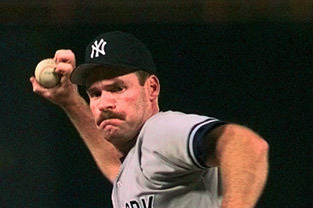
Rocco Domenico Colavito Jr. was born on August 10, 1933 in The Bronx, New York City. Being Italian-American and from The Bronx, it was easy to become a fan of both the New York Yankees and their best player at the time, Joe DiMaggio.
He attended Theodore Roosevelt High School, on East Fordham Road. Prominent TRHS graduates include baseball player Ben Oglivie; singer Dion DiMucci and all 3 of his backup singers, The Belmonts, named for nearby Belmont Avenue; actors John Garfield, June Allyson and Chazz Palminteri; and rapper French Montana. Not especially prominent, but leading TRHS to the New York City basketball championship in 1924, was George Goldberg, my grandfather. Attending the school, but not graduating, was Kiss guitarist Paul "Ace" Frehley.
Colavito did not graduate, either: He dropped out at age 16, to play semi-pro baseball. But the Yankees weren't interested in him, having Tommy Henrich in right field. Instead, the Cleveland Indians signed him in 1951. He made his major league debut on September 10, 1955. Wearing Number 38, he pinch-ran for Dale Mitchell in the top of the 7th inning, and was singled home by Bob Lemon (a pitcher who started his career as an outfielder, and could still hit), and the Indians beat the Boston Red Sox, 10-7 at Fenway Park in Boston. Ted Williams went 3-for-5 with an RBI. For the Indians, Ralph Kiner hit a home run.
(It was Kiner's 18th home run of the season, and the 369th of his career -- and the last. He retired because of a back injury. Many years later, he and Tim McCarver were broadcasting for the Mets, and a Met player hit his 1st major league home run. McCarver said he didn't remember his first: "You'd think I would, since I didn't hit many!" Kiner said, "I don't remember my last home run, because, at the time, I didn't think it would be my last!")
Colavito became a regular the next season, and finished 2nd in the voting for the American League Rookie of the Year, behind Luis Aparicio of the Chicago White Sox. In 1958, having switched to Number 6, he batted a career-high .303, hit 41 home runs, topped 100 RBIs for the 1st time with 113, and led the AL in slugging percentage with .620. He finished 3rd in the AL Most Valuable Player voting, behind Jackie Jensen of the Boston Red Sox and Bob Turley of the Yankees.
In 1959, Colavito led the AL with 42 home runs, with 111 RBIs, making his 1st All-Star Game. On June 10, he hit a record-tying 4 home runs in a game in an 11-8 Cleveland win over the Baltimore Orioles. The Indians finished 2nd, 5 games behind the White Sox, and finishing 4th in the MVP voting, behind 3 White Sox: Nellie Fox, Aparicio and Early Wynn. It was widely believed that, had the Indians won the Pennant, Colavito would have been named the MVP.
Indians fans loved him. They loved his batting stance, where he seemed to pause his practice swing in such a way that he pointed his bat at the pitcher with both hands. (Decades later, another Cleveland slugger, Jim Thome, would bat lefthanded instead of righthanded like Colavito, and point the bat with one hand.) They loved him for hitting home runs, topping 40 in back-to-back seasons despite Cleveland Municipal Stadium being a pitcher's park. They loved him for having a rifle arm in right field, the best in the AL, at a time when Roberto Clemente had the best in the NL.
"Rocky had tremendous charisma," Herb Score, Cleveland's ill-fated star pitcher, said in an interview many years later. "Fans gravitated to him, not just because he hit home runs. Rocky relished the clutch situations. He didn't always come through, but he wanted to be the guy who took that burden on his back."
Fans began to bring signs reading, "DON'T KNOCK THE ROCK." One man who did knock the rock was Frank Lane, the Indians' general manager. He had been the GM of the White Sox from 1948 to 1955, the St. Louis Cardinals from then until 1957, and the Indians ever since.
He was known as "Trader Lane" and "Frantic Frank" for making so many trades, often for no other purpose than "to shake things up." That is never a good reason to do anything, from trading a baseball player to electing a President. The media loved him, because he was good copy. His players and managers hated him, for breaking up good teams.
On April 17, 1960, just 1 day before the Indians were set to begin a new season, Lane traded Colavito to the Detroit Tigers for Harvey Kuenn. Kuenn had led the AL with a .353 batting average in 1959, and had led it in doubles 2 years in a row. This was the 1st time the defending batting champion and the returning home run leader had been traded for each other, in either League. It remains the last. People wondered why the trade was made at all.
It has been suggested that Lane wanted to get rid of any star on the team, so as to keep salaries down. Kuenn was a good player; no one questioned that. But he wasn't as big a star as Colavito. The effect on the Indians was immediate: After going 89-65 and finishing just 5 games out of 1st place in 1959, they fell to 76-78 in 1960, 21 games behind the Pennant-winning Yankees.
"I loved Cleveland and the Indians," Colavito told The Plain Dealer, Cleveland's leading newspaper, in 2010. "I never wanted to leave."
Lane was fired as Indians GM in 1961. Charlie Finley quickly hired him to be GM of the Kansas City Athletics, and, nearly as quickly, fired him. Apparently, Finley also needed to be the center of attention, and, as the owner, he wasn't going anywhere. (Well, he was, because he wanted to move the team, but he wasn't selling.) Lane would only be a GM once more, with the Milwaukee Brewers in 1971 and 1972, and died in 1981, a baseball pariah. Bobby Bragan, who had managed the Indians in 1958, was the only baseball figure who attended his funeral, and that only because he was personally asked to do so by Commissioner Bowie Kuhn.
Kuenn batted .303 over a major league career that lasted from 1952 to 1966, topping at .353 in his batting title season of 1959. He was AL Rookie of the Year in 1953, led the AL in hits 4 times and doubles 3 times, and 1960 would be his 8th All-Star season. But it would also be his last, at age 29.

Harvey Kuenn
A native of the Milwaukee suburbs, he was with the Milwaukee Braves in 1965, and was the last out, a strikeout, in Sandy Koufax's perfect game for the Dodgers over the Braves. In 1971, Lane hired him as a Brewers coach. He was still on their staff in mid-season in 1982, when George Bamberger was fired as manager, and Kuenn was named manager. The heavy-hitting team had been known as "Bambi's Bombers," and were now "Harvey's Wallbangers." Kuenn led them to their 1st Pennant -- and it remains the franchise's only Pennant -- but they lost the World Series to the St. Louis Cardinals. He died of diabetes in 1988, only 57 years old.
*
The players even switched uniform numbers: With the Indians, Kuenn got Colavito's 6; with the Tigers, whose Number 6 was already worn by future Hall-of-Famer Al Kaline, Colavito got Kuenn's 7. Gabe Paul, then the GM of the Cincinnati Reds, and later the GM of the Indians and the Yankees, said, "The Indians traded a slow guy with power for a slow guy with no power."
At first, the trade worked pretty well for Colavito: Tiger Stadium's short power alleys suited him well, and, in 1961, he had career highs with 45 home runs and 140 RBIs, helping Detroit win 101 games. But that was the year that Roger Maris hit 61 home runs and Mickey Mantle hit 54, leading the Yankees to 109 wins. So not only did his best year as a player, individually and team-wise, not give him the league lead in any major offensive category -- although, in this 1st year of AL expansion, he did become the 1st player to officially play in 163 games, thanks to a rainout and replay -- it didn't even get him as close to the Pennant as he got with the '59 Indians.
The Indians continued to struggle. In 1964, the Tigers traded Colavito to the Kansas City Athletics. The following year, the Indians got him back, in a 3-way deal with the A's and the White Sox that sent Tommie Agee and Tommy John to Chicago.
That season, Colavito had 108 RBIs, good enough to lead the AL. But in 1966, though his home run total went up from 26 to 30, his RBIs dropped to 72, and his batting average fell from .287 to .238. Injuries ended his career 2 years later, with the Yankees, even making a pitching appearance and being credited with the win. He was only 35 years old. He finished with 374 home runs and 9 All-Star berths -- but, oddly, no Gold Gloves. He is one of the best all-around baseball players not in the Hall of Fame.
Terry Pluto, longtime Cleveland newspaper columnist and the man who knows more about the franchise now known as the Cleveland Guardians than anyone, titled his 1994 book about the team's history The Curse of Rocky Colavito, pointing out that, from 1960 to 1993, the Indians never even finished within 10 games of 1st place, except for the strike-split season of 1981. Colavito said he never put a curse on the team: "Frank Lane did."
Pluto has also suggested that the worst trade the franchise has ever made is the one in which they got rid of Colavito. And the 2nd-worst was the one where they got him back. Fans can't blame that one on Frank Lane, who was already gone.
*
Colavito was a broadcaster for the Indians in 1972, 1975 and 1976; and 1st base coach for them in 1973, 1977 and 1978. In 1982 and 1983, he was hitting instructor for the Kansas City Royals. That would be his last job in baseball.
The Indians, now the Cleveland Guardians, named him to their team Hall of Fame. Should he be in the Baseball Hall of Fame? Baseball-Reference.com has a Hall of Fame Monitor, on which a "Likely HOFer" is at 100, the higher, the better. Colavito is at 82. They also have a "Hall of Fame Standards," on which the "Average HOFer" is at 50. Colavito is at 30. Both figures suggest he is well short.
And yet, those figures don't take his defense into account. One thing they did is the fact that Colavito hit 374 home runs. That's more home runs than Yankee Legends Joe DiMaggio, Yogi Berra and Johnny Mize, who are all in; and 4 fewer than Mike Trout currently has, and there are people who believe that Trout, even if he never plays another game, is a sure first-ballot Hall-of-Famer. (He's not. If he never plays another game, he shouldn't get in at all.)
B-R also has "Similarity Scores," in which they list the 10 most statistically similar players, usually weighted by position. But of the 10 players most statistically similar to Colavito, according to them, only 1 is in the Hall, and he only recently got in: Gil Hodges, who also got a boost from being a great fielder. The others: Frank Howard, Roy Sievers, Jermaine Dye, Boog Powell, George Foster, Norm Cash, Greg Luzinski, Jack Clark and Greg Vaughn. Some of those guys are close, but none has a lot of people saying they should be in.

Rocky Colavito married Carmen Perrotti, a professional dancer, in 1954. They had sons Rocky Jr. and Steven, a daughter Marisa, 5 grandchildren and 2 great-grandchildren.
Unfortunately, like Harvey Kueen, he developed diabetes. On August 11, 2015, he had to have his right leg amputated below the knee. He died from complications of diabetes at his home in Bernville, Pennsylvania, outside Reading, this past Tuesday, December 10, 2024, at the age of 91.
He was the last surviving player who had appeared on the TV show Home Run Derby in 1960, appearing in an Indians uniform, since he had not yet been traded to the Tigers. And his death leaves Stan Pawloski as the last surviving teammate of Indians pitching legend Bob Feller.