Showing posts with label radio. Show all posts

Friday, June 19, 2026

June 19, 1926: NBC Is Founded

Their 1979-86 logo. It's my favorite because
it's the only one they've ever used
that combines the letter N with a peacock.

June 19, 1926, 100 years ago: The Radio Corporation of America (RCA) founds the National Broadcasting Company (NBC), the 1st major broadcast network in America.

RCA was then owned by General Electric (GE), American Telephone and Telegraph (AT&T), Westinghouse, and United Fruit Company (forerunner of Chiquita Brands). In 1932, GE had to sell its shares of RCA, due to antitrust charges.

In 1986, with Ronald Reagan as President, and the federal government no longer caring about antitrust laws -- AT&T had been broken up in 1982, but that was a process begun under the Carter Administration -- GE was able to buy RCA, and therefore NBC, in its entirety. In 2011, Comcast bought NBC from GE, and remains the owner.

The 4 longest-continuously-running television series in American history are all still currently running on NBC: The weekly news program Meet the Press, which debuted in 1947; the morning news and entertainment program Today, or The Today Show, 1952; The Tonight Show, originally just Tonight, 1954; and Saturday Night Live, which, since 1975, has tried to do for Saturday what The Tonight Show does for weeknights.

RCA chairman David Sarnoff made NBC the first coast-to-coast radio network. In 1927, he established a 2nd radio network, which became known as NBC Blue or "The Blue Network." In 1939, he began to move NBC into television. In 1943, antitrust laws forced him to sell Blue, which became ABC. By 1947, NBC had beaten CBS in the race to become the 1st nationwide TV network.
Microphone logo, 1943-57 

In 1948, NBC became the 1st network to televise the two major American political parties' national nominating conventions. Their teaming of Chet Huntley and David Brinkley to do cover the conventions in 1956 led to the two of them co-anchoring the 1st half-hour nightly news broadcast, The Huntley-Brinkley Report, which lasted until 1970.

Huntley-Brinkley was replaced by the much more generically-titled NBC Nightly News, with John Chancellor as anchor. He was succeeded by Tom Brokaw in 1982, Brokaw was followed by Brian Williams in 2005, Williams was succeeded by Lester Holt in 2015, and Holt was succeeded by Tom Llamas in 2025.

In 1957, NBC debuted its Peacock logo, designed to symbolize the transition to color television. It would be shown with the following announcement: "The following program is brought to you in living color on NBC."
Peacock logo, 1957-75

Its official name is Johnny Chimes, after the three-note programming cue that NBC has used since 1929: "G3 E4 C4." In 1959, NBC introduced the animated "Snake" logo that would appear at the end of every broadcast, with the Chimes playing as the animation played out. It also appeared at the base of every sportscaster's microphone.
But the Snake never proved as popular as the Chimes, which remained NBC's main identifier on radio, or the Peacock, which became even more identified with the network. So much so that, when they decided to retire the Peacock in 1975, there was an uproar. The Snake was retired at the same time, but few people cared. The Peacock was used for the last time to start The Tonight Show on New Year's Eve, December 31, 1975. And host Johnny Carson roasted the network over it. He could do that: The network was not going to fire its most popular employee over a few non-profane jokes.
This 50th Anniversary logo never caught on.

The Peacock was brought back in 1979, in a combination of the new "N" logo. In 1986, NBC dropped the N, switching from an 11-feathered Peacock facing the viewer's left, which every version thus far had been, to a 6-feathered Peacock facing right, which they have used ever since.
NBC was a sports pioneer. Their 1st coast-to-coast broadcast of anything was the 1927 Rose Bowl. NBC became the 1st network to broadcast a baseball game, in 1939; a football game, that same year, first at the college level, then in the NFL; the 1st to broadcast the World Series, in 1947; and the 1st to broadcast coast-to-coast in color, with the Rose Bowl again, in 1962.

In the 1966 season, NBC owned the broadcast rights to the American Football League, while CBS held those to the NFL. As part of the leagues' merger that season, both got to cover Super Bowl I. Regrettably, due to the high cost of videotape, which led to so many events, sports and otherwise, being taped over, no complete color videotape copy of Super Bowl I exists.

This is also true for most of NBC's World Series broadcasts up until 1975. Some black & white copies, meant as backups, survive. It's only because of a resourceful New York sports fan that the 1969 "miracles," the Jets' win in Super Bowl III and the Mets' home games (3, 4 & 5) in the World Series, have been saved in their entirety. (The subsequent 1970 NBA Finals, won by the Knicks, were on ABC.)

NBC's headquarters is at 30 Rockefeller Plaza, on 6th Avenue between 49th and 50th Streets in Midtown Manhattan. Nicknamed "30 Rock," it has officially been known as the RCA Building from its opening 1933 to 1988, the GE Building from then until 2015, and the Comcast Building ever since.
NBC also owns the cable networks CNBC and Bravo, the Spanish-language network Telemundo, and the streaming service Hulu; and, with Microsoft, co-owned the cable network MSNBC, until 2026, when it restructured its cable holdings, creating the holding company Versant, and MSNBC became MS NOW.

NBC's affiliates for major league cities include:

* New York: WNBC-4 (formerly W2XBS, WNBT and WRCA)
* Philadelphia: WCAU-10 (formerly KYW-3)
* Baltimore: WBAL-11
* Washington: WRC-4
* Boston: WBTS-15 (formerly WBZ-4)
* Atlanta: WXIA-11
* Tampa: WFLA-8
* Miami: WTVJ-6
* Pittsburgh: WPXI-11
* Cleveland: WKYC-3
* Cincinnati: WLWT-5
* Detroit: WDIV-4
* Chicago: WMAQ-5
* Milwaukee: WTMJ-4
* Minneapolis: KARE-11
* St. Louis: KSDK-5
* Kansas City: KSHB-41
* Dallas: KXAS-5
* Houston: KPRC-2
* Denver: KUSA-9
* Phoenix: KPNX-12
* San Diego: KNSD-39
* Los Angeles: KNBC-4
* San Francisco: KNTV-11
* Seattle: KING-5

Friday, October 18, 2024

October 18, 1954: The Transistor Radio

October 18 is a great anniversary:
1753: Joseph Bloomfield, Revolutionary War General, early Governor of New Jersey, and namesake of my original hometown, was born.
1859: John Brown's raid on Harper's Ferry, Virginia (now in West Virginia).
1867: The Alaska Purchase is finalized.
1898: America took possession of Puerto Rico.
1918: Czechoslovakia declared independence.
1919: Pierre Trudeau, longtime Prime Minister of Canada and father of the current Prime Minister, was born.
1922: The British Broadcasting Corporation (the BBC) begins radio broadcasting.
1924: Two of the most famous games in college football history are played. Notre Dame beats Army at the Polo Grounds thanks to their backfield, "The Four Horsemen." And the University of Illinois dedicates its Memorial Stadium with 6 touchdowns by Red Grange in a win over Michigan.
1926: Rock and roll pioneer Chuck Berry was born.
1928: The great sportscaster Keith Jackson was born.
1933: Forrest Gregg, the Green Bay Packer offensive tackle that Vince Lombardi called "the finest player I ever coached," was born.
1939: Chicago Bears legend, as player and as coach, Mike Ditka was born. (Unfortunately, also born on this day was Lee Harvey Oswald.)
1940: Cynthia Weil, who wrote a bunch of hit rock and roll songs with her husband, Barry Mann, was born.
1941: The film The Maltese Falcon premiered.
1953: Willie Thrower, aptly-named, became the 1st black quarterback in the NFL, for the Bears. They lost to the San Francisco 49ers, anyway.
1954: Mort Walker and Dik Browne debuted the comic strip Hi & Lois. Separately, Walker created Beetle Bailey (Lois Flagston was Beetle's sister), and Browne created Hagar the Horrible.
1955: The Community War Memorial Arena opened in Rochester, New York. It is now known as the Blue Cross Arena at the War Memorial. And the Winnipeg Arena opened. It was demolished in 2006.
1956: Tennis legend Martina Navrátilová was born.
1958: Boxing champion Thomas Hearns was born. So was New York Attorney General Letitia James.
1959: Radio sports-talk host Chris "Mad Dog" Russo was born.
1961: The film version of West Side Story premiered.
1968: Bob Beamon wins the long jump at the Olympics, with a record of 29 feet, 2 1/2 inches.
1977: Reggie Jackson hits 3 home runs in Game 6 of the World Series, and the Yankees win the Series over the Los Angeles Dodgers.
1984: Gold Medal-winning American skier Lindsey Vonn is born.
1990: Basketball star Brittney Griner is born.
1999: The Yankees beat the Boston Red Sox in Game 5 of the American League Championship Series at Fenway Park, and win the Pennant.
2007: The football team at Rutgers University beat the University of South Florida, then ranked Number 2.
But one particular milestone stands out, and you have almost certainly enjoyed its effects:
October 18, 1954, 70 years ago: Texas Instruments announces it has begun production of the 1st transistor radio, the Regency TR-1. Baseball fans everywhere rejoice, for now they can listen to ballgames almost anywhere, from the office to the beach.
Well, they'll have to wait until April 1955 to listen to them, and until Summer 1955 to listen to them on the beach. Maybe they can listen on the beach in April 1955, if they live in California and can get Pacific Coast League broadcasts.

Sunday, August 11, 2024

August 11, 1984: Two Political Hot Buttons: Ronald Reagan and Zola Budd

August 11, 1984, 40 years ago: President Ronald Reagan is preparing for his weekly Saturday morning radio address, with a remote hookup from his home-away-from-home, his Rancho del Cielo (Ranch in the Sky) in Goleta, California.

He was scheduled, as usual, to go on the air at 12:00 Noon, Eastern Time. Since he was in California, on Pacific Time, this meant the address would begin at 9:00 AM. Usually, since Reagan started the weekly tradition in 1982, it started a few minutes late, to give the national networks time to give a short introduction.

Sure enough, this address began at 9:06. It wasn't especially memorable. It began, "My fellow Americans: I'm pleased to tell you that today I signed legislation that will allow student religious groups to begin enjoying a right they've too long been denied: The freedom to meet in public high schools during nonschool hours, just as other student groups are allowed to do."

It was typical Reagan garbage: Pandering to the religious right with something that was blatantly unconstitutional. After all, the Republican was running for re-election, with the Democratic nominee being former Vice President Walter Mondale.

What was not typical was what happened a few minutes before the broadcast. A live feed was being transmitted to radio stations around the country. Many rebroadcasters were already recording the feed, to be ready for the official transmission. Many in the media heard Reagan's impromptu remarks as he gave them, but they were not broadcast live.

Reagan, known for his sense of humor, decided to have a little fun. He said, "All right. My fellow Americans, I'm pleased to tell you today that I've signed legislation that will outlaw Russia forever. We begin bombing in five minutes."

Laughter could be heard. It's not clear who in the room was laughing. Maybe it was everyone.

Ironic: The 1st former actor to become President, the most media-savvy President ever, failed to notice that this joke was being recorded.

He also failed to notice that it wasn't funny at all. War is not funny. Nuclear destruction is not funny. And this son of a bitch was joking about starting World War III.

It took 2 days for the recording to reach the outside world. Mondale took the high road, saying, "A President has to be very, very careful with his words." He did not suggest that Reagan was mentally unstable, or in the throes of dementia. But Reagan's 1994 admission of Alzheimer's disease seemed to confirm what many people were already suspecting 10 years earlier.

On August 14, the Soviet government announced that Reagan's remarks were "unprecedentedly hostile." Soviet forces were placed on high alert, and it took some very careful words from the U.S. Department of State to calm the Soviets down.

I was 14 years old. I couldn't vote for another 4 years. I was convinced that there might not be an election in 4 years. I was hoping that America would recognize that a 73-year-old man either evil enough, crazy enough, or impaired enough to make just such a joke was unacceptable, and that they would then vote for Mondale.

When I went to bed on November 6, 1984, every State except Minnesota had been called, all for Reagan. Minnesota was Mondale's home State, and it hadn't yet been called for him. Only the majority-black District of Columbia had. Or, as comedian Jay Leno put it, "When I went to bed, Mondale had only 3 more Electoral Votes than I did, and I wasn't even running!" Mondale eventually won the State by just 4,000 votes. I have had a great deal of respect for Minnesota ever since.

But Reagan had won, and I was very, very scared.

As it turned out, Reagan's 2nd term was terrible, full of scandal and a hollow prosperity, but did not include a World War III.

Rancho del Cielo is 124 miles northwest of Los Angeles, 90 miles northwest of Reagan's Presidential Library in Simi Valley, 30 miles northwest of Santa Barbara, and 6 miles north of the Pacific Ocean at Refugio Beach. The house was built in 1871, and Reagan bought the ranch in 1974, as his 2nd term as Governor of California was winding down. (While Governors of California are now limited to 2 terms, that was not the case then, but he didn't run for a 3rd term, anyway.)

Reagan had signed his disastrous 1981 tax cut there, and had also entertained many world leaders there, including Britain's Queen Elizabeth II and Prime Minister Margaret Thatcher, and Soviet President Mikhail Gorbachev.

Friends would say of Ronald and Nancy Reagan that the ranch was his house, while any home they had near Hollywood was her house. Due to Reagan's advancing Alzheimer's disease, Nancy sold the property in 1998, to the Young America's Foundation, a conservative group, which maintains it and holds conferences there. It is now open by appointment.

After Reagan, both George Bushes, Bill Clinton and Barack Obama continued the weekly radio address. After 9 months in office, Donald Trump stopped doing it. He thought he was too good to speak to us one Noon a week, every week. Joe Biden resumed the tradition.

*

August 11, 1984 was also the day of one of the most anticipated matchups of the 1984 Olympic Games, at the Los Angeles Memorial Coliseum. The result was one that no one could have anticipated.

Mary Decker, a 26-year-old native of the suburbs of L.A., had been one of the top middle-distance runners in the world, winning a Gold Medal in the 1979 Pan American Games. Unable to compete in the 1980 Olympics in Moscow because of the U.S. boycott, she just kept going.

At the 1983 World Championships of Track & Field, she won Gold in both the 1,500 meters and the 3,000 meters. Sports Illustrated named her its Sportswoman of the Year -- before the adoption of the title "Sportsperson," this meant that she was named ahead of all male athletes as well -- and, with the Olympics coming to America the next year, she was considered a favorite to win Gold.
And yet, there was an unexpected foreshadowing on that cover.
The Dreaded SI Cover Jinx?

Zola Budd was only 18. Early in 1984, she set the women's world record in the 5,000 meters. But it was not accepted as a world record by the IAAF, the world governing body for track & field, because she was from South Africa, which had been excluded from various sports competitions due to its apartheid government. And she would be excluded from the Olympics as well.

That wasn't Budd's fault, but, due to her grandfather being a British citizen, the International Olympic Committee's rules allowed her to apply for British citizenship and compete for Great Britain in Los Angeles. She did, and this angered many people.

It shouldn't have: She wasn't breaking any rules by doing this. Instead, she was a victim of the rules, who was now using the rules to allow herself to compete. Not to guarantee victory, but just to be allowed to compete. After all, she was, thus far, too young to have even voted in a South African election, so she had nothing to do with their evil racist government.

There was also an element of weirdness in that she competed barefoot. At the time, this was legal, but has since been banned. Imagine, in 1984, the year that Nike first began offering huge sneaker contracts, competing in the Olympic Games, and its preparatory events, without even wearing shoes! But she did, including setting an officially-recognized world record in the 2,000 meters. As the renowned British sportscaster David Coleman put it, "The message will now be flashed around the world: Zola Budd is no myth."

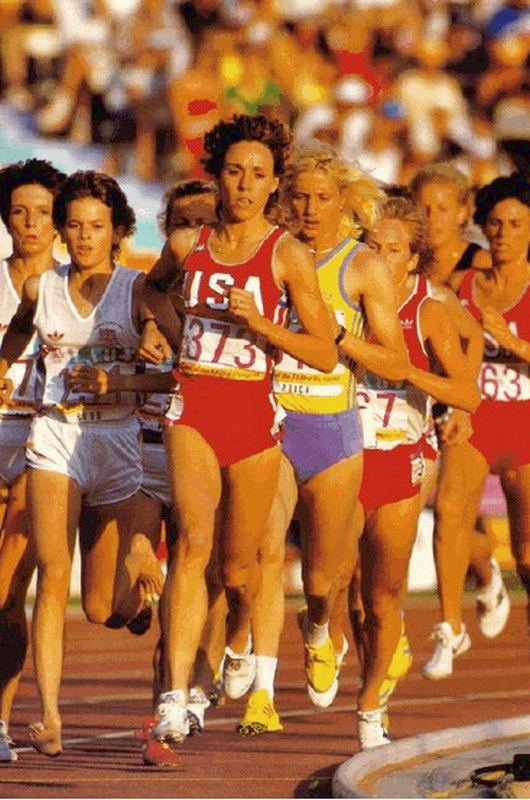
Decker and Budd were entered into one race together, the 3,000 meters. Decker had specialized in shorter distances, Budd in longer ones. Decker led early, but after the 1,500-meter mark, Budd took the lead. Running as a group was an unusual situation for both of them, as they were each used to running in front and well ahead of other competitors.
Decker at center, Budd to the left

At 1,700 meters, the first collision occurred. Decker came into contact with one of Budd's legs, knocking Budd slightly off balance. However, both women maintained their close position. Five strides on, at the race time of 4:58, Budd and Decker again made contact, with Budd's left foot brushing Decker's thigh, causing Budd to lose her balance, and sending her into Decker's path.

Decker's spiked running shoe came down hard into Budd's ankle, just above the heel, drawing blood. Videotapes later examined by Olympic officials showed Budd visibly in pain. However, she maintained equilibrium and kept stride.

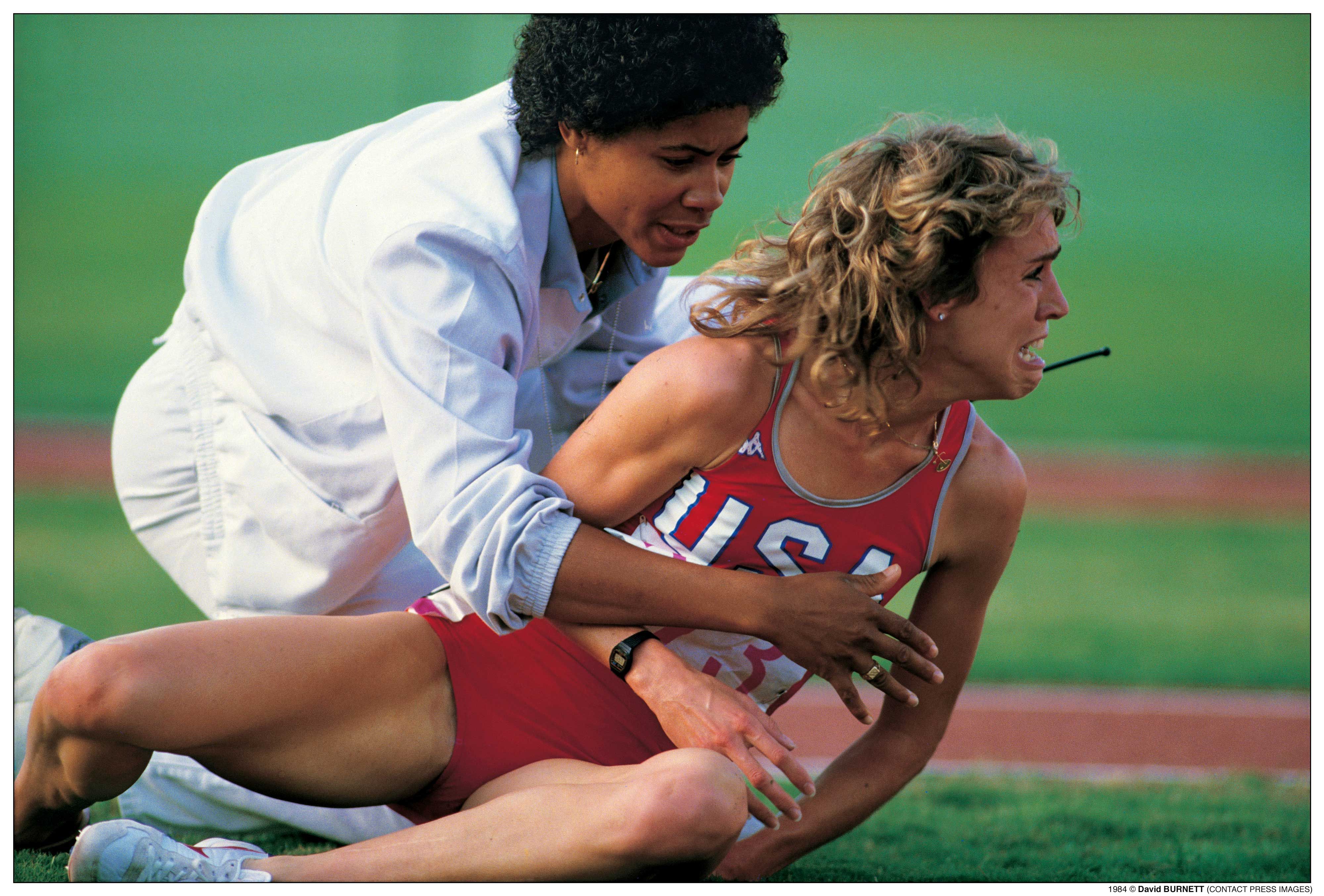
Decker did not: She fell to the curb, injuring her hip. The fall ended her race, and she was carried off the track in tears by her boyfriend and later, husband, British discus thrower Richard Slaney.
Budd, deeply affected by the occurrence, continued to lead for a while, but faded, finishing 7th. Her finishing time of 8:48 was well outside her best of 8:37. The race was won by of Maricica Puică of Romania, who also won a Bronze Medal in the 1,500 meters. Wendy Sly of Britain won the Silver Medal, and Lynn Williams of Canada won the Bronze Medal.

Budd tried to apologize to Decker in the tunnel after the race, but Decker was upset, and replied, "Don’t bother!" She was now unable to compete in any other races.

Having married Slaney, Decker gave birth to a daughter in 1986, and missed the 1987 World Championships due to injury. She ran in the 1,500 and 3,000 meters in the 1988 Olympics in Seoul, Korea, but was past her prime, and wasn't close. She retired without ever winning an Olympic Medal.

Budd returned to South Africa in 1989, and, with its eligibility restored after the release of Nelson Mandela the next year, was able to represent her home country at the 1992 Olympics in Barcelona. (Unlike soccer, for most of FIFA's history, anyway, there is no rule against competing for 2 different countries in the Olympics.) But she never won an Olympic Medal, either. She married and had 3 children.

In 2016, Decker and Budd reunited, and collaborated on a documentary about the event, The Fall. "Looking back on it now, I see it as an unlucky accident," Decker said. She also apologized to Budd for shunning her in the tunnel and after the race, and in a separate interview she said, "I was hurting, both physically and emotionally."

Budd is now coaching at her local university, and still runs long distance. She and Decker got along well when making the documentary and, as well as still sharing a passion for running, they discovered their respective husbands share a birthday.

Budd (left) and Decker, 2016

"Looking back at both our lives," she said, "neither of us had a fair chance of achieving what we really wanted to. Both of us were victims of something that was beyond our control."

Friday, December 23, 2022

December 23, 1947: Bell Labs Invents the Transistor

The 1st working transistor. Yes, it has been preserved.

December 23, 1947, 75 years ago: Bell Telephone Laboratories, or Bell Labs for short, announces the invention of the transistor at its headquarters at Murray Hill, in the Township of Berkeley Heights, Union County, New Jersey.

According to Wikipedia:

A transistor is a semiconductor device used to amplify or switch electrical signals and power. The transistor is one of the basic building blocks of modern electronics. It is composed of semiconductor material, usually with at least three terminals for connection to an electronic circuit. A voltage or current applied to one pair of the transistor's terminals controls the current through another pair of terminals. Because the controlled (output) power can be higher than the controlling (input) power, a transistor can amplify a signal. Some transistors are packaged individually, but many more are found embedded in integrated circuits...

The first working device to be built was a point-contact transistor invented in 1947 by American physicists John Bardeen and Walter Brattain while working under William Shockley at Bell Labs. The three shared the 1956 Nobel Prize in Physics for their achievement...

Transistors revolutionized the field of electronics, and paved the way for smaller and cheaper radios, calculators, and computers, among other things.

Left to right: John Bardeen, William Shockley, Walter Brattain

In 1963, Shockley went west, teaching at Stanford University between San Francisco and San Jose, leading to the region being known as Silicon Valley, for the element used in most transistors. Sadly, he also began to use his brilliant mind to pass off twisted theories of eugenics. He argued that black people were genetically inferior to white people, and that no amount of social assistance from government would make any difference.

In 1981, a science writer for the Atlanta Constitution compared Shockley's beliefs with those of the Nazis. Shockley sued for libel. He won the case, and was awarded one dollar in damages. In other words, the damage done was to his ego, for he had already damaged his own reputation with his statements. He died in 1989.

Nevertheless, we owe these 3 men a great deal, for all the technology that transistors have made possible -- including the transistor radios on which we've listened to sporting events and the Top 40 songs.

Bardeen won a 2nd Nobel Prize in 1972, with Leon Cooper and John R. Schrieffer, for a fundamental theory of conventional superconductivity. He lived until 1991. Brattain died in 1987.

The court-ordered breakup of AT&T led to the 2007 loss of Bell Labs to the company. The Labs are now run by a competitor, Japanese company Nokia.

Thursday, August 5, 2021

August 5, 1921: Baseball On Radio

Harold Arlin. Yes, that thing in front of him is a microphone,
not a tiki torch or a giant chesspiece.

August 5, 1921, 100 years ago: For the 1st time, a game in what would eventually be called Major League Baseball was broadcast on radio.

Radio station KDKA had gone on the air in Pittsburgh, at 1020 on the AM dial (hence the time of this post), on November 2, 1920, broadcasting election returns, and announcing that Warren G. Harding had been elected President.

So they were a natural to be the 1st station to broadcast baseball. On August 5, they brought their equipment across town to Forbes Field, home of the Pittsburgh Pirates, and set up to broadcast the Pirates' game against their cross-Pennsylvania rivals, the Philadelphia Phillies.

Harold Arlin was the announcer, as he had been for the Election Night debut. He was an engineer working for the station's owner, the Westinghouse Electric and Manufacturing Company. Although he had no background in the nascent radio industry, or in anything else that required the use of his voice, like stage acting, the company assigned him to call the game.
Forbes Field

The Phillies scored a run in the 1st inning, but the Pirates scored 2 in the 2nd. The Phillies came back with 3 in the 3rd, including a home run by Cy Williams. The Pirates closed to within 4-3 in the bottom of the 5th, and then took a 5-4 lead in the 6th.

The Phillies tied it in the top of the 8th. George "Possum" Whitted led off the bottom of the 8th with a single. James "Cotton" Tierney drew a walk. Three straight singles followed, by Ray Rohwer, Tony Brottem and Jimmy Zinn. This forged the final score: Pirates 8, Phillies 5. Zinn, who pitched 6 innings of relief, was the winning pitcher.
Jimmy Zinn

*

Westinghouse must have been satisfied with Arlin's work: The next day, they assigned him to become the 1st person to broadcast a tennis match over radio, a Davis Cup match in which Australia beat Great Britain.

On October 8 of that year, he became the 1st football broadcaster, again at Forbes Field, watching the University of Pittsburgh beat West Virginia University 21-13, in a rivalry that would later be known as "The Backyard Brawl." On September 14, 1923, he became the 1st boxing announcer over radio, going to the Polo Grounds in New York, to announce Jack Dempsey's wild comeback to knock Luis Firpo out and retain the Heavyweight Championship of the World.

But after 1921, Arlin never broadcast the Pirates again. He became known as radio's first celebrity interviewer, conducting interviews with William Jennings Bryan, Lillian Gish, Will Rogers and Babe Ruth. He later moved to Mansfield, Ohio, and ran Westinghouse's plant there.

Eventually, radio helped baseball regain popularity during the Great Depression. At first, team owners were afraid to "give away" games, for fear it would cause attendance to drop. The opposite happened: People who were now hearing games for the first time wanted to see them, and they were willing to play.

The Pirates didn't start regular broadcasts of their games until 1934, with Jimmy Murray and Walter E. Sickles. Starting in 1938, their main announcer was Albert "Rosey" Rowswell. When a Pirate hit a home run, he would imagine a little old lady with an apartment window facing Forbes Field, and yell, "Open the window, Aunt Minnie, here it comes!" Then he would smash a light bulb, to simulate the ball breaking Aunt Minnie's window, and say, "Too late!"

In 1947, Rowswell was joined by Bob Prince. Rowswell's last year was 1954: By this point, television began to take over -- KDKA aired Pirate games on Channel 2 -- and fans could see that what was behind the outfield fence at Forbes Field was Schenley Park and the Carnegie Library, not apartments, so Rowswell's Aunt Minnie shtick was no longer any good.

Prince was known as "The Gunner," and one of the great "homers" of baseball broadcasting. His "Gunnerisms" included this line, for when the Pirates, or "Bucs" or "Buccos," came from behind to win: "The Buccos had 'em all the way." A ball just foul was "foul by a gnat's eyelash." And, long before John Sterling began using the phrase with the Yankees, Prince said a two-run deficit was easy to overcome: "We need a bloop and a blast!" If it was three runs, he would make it, "A bleeder, a bloop and a blast!"

In 1969, Steve Arlin, grandson of Harold, became an original San Diego Padre. On June 18, 1972 -- the day after the Watergate break-in -- Steve was penciled in to pitch for the Padres against the Pirates at Three Rivers Stadium. It had been 51 years since Harold Arlin had broadcast a game for the Pirates, and Bob Prince invited him to call the game with him. Steve pitched a 2-hit shutout, and the Padres won, 1-0. Harold died in 1986, age 90; Steve followed in 2016, age 70.
Prince (left) and Arlin, June 18, 1972

Prince was fired after the 1975 season. Unlike Arlin and Rowswell, he received the Baseball Hall of Fame's award for broadcasters. From 1976 to 2008, the voice of the Pirates was Lanny Frattare. His partners included former Pirate pitchers Steve Blass, Jim Rooker and Bob Walk. Walk is still part of a Pirate broadcasting team that also includes Greg Brown, John Wehner, Joe Block, Kevin Young, Matt Capps and Michael McKenry.