Showing posts with label nuclear power. Show all posts

Sunday, April 26, 2026

April 26, 1986: The Chernobyl Disaster

April 26, 1986, 40 years ago: The Number 4 reactor explodes at the Chernobyl Nuclear Power Plant in Pripyat, Ukraine. It is the biggest nuclear accident in human history.

The accident occurred during a test of the steam turbine's ability to power the emergency feedwater pumps in the event of a simultaneous loss of external power and coolant pipe rupture. Following an accidental drop in reactor power to near-zero, the operators restarted the reactor in preparation for the turbine test with a prohibited control rod configuration.

Upon successful completion of the test, the reactor was then shut down for maintenance. Due to a variety of factors, this action resulted in a power surge at the base of the reactor which brought about the rupture of reactor components and the loss of coolant. This process led to steam explosions and a meltdown, which destroyed the containment building.

This was followed by a reactor core fire which lasted until May 4, during which airborne radioactive contaminants were spread throughout the Soviet Union and Europe.

In response to the initial accident, a 10-kilometer (6.2-mile) radius exclusion zone was created 36 hours after the accident, from which approximately 49,000 people were evacuated, primarily from Pripyat. The exclusion zone was later increased to a radius of 30 kilometers (19 miles), from which an additional 68,000 people were evacuated.

Following the reactor explosion, which killed two engineers and severely burned two more, an emergency operation to put out the fires and stabilize the surviving reactor began, during which 237 workers were hospitalized, of whom 134 exhibited symptoms of acute radiation syndrome (ARS).

A United Nations committee found that to date fewer than 100 deaths have resulted from the fallout. Model predictions of the eventual total death toll in the coming decades vary. The most widely cited study conducted by the World Health Organization in 2006 predicted 9,000 cancer-related fatalities in Ukraine, Belarus and Russia.

North America was lucky with Three Mile Island in 1979. Eastern Europe was not so lucky with Chernobyl in 1986.

Thursday, August 29, 2024

August 29, 1949: The Red Bomb

August 29, 1949, 75 years ago: The Soviet Union successfully test a device they call RDS-1, at the Semipalatinsk Test Site in Kazakhstan. The United States of American is no longer alone in possessing the atomic bomb. The "Reds" have it now, too.

It was similar to the "Fat Man" bomb that the U.S. dropped on Nagasaki, Japan: A plutonium-based implosion type weapon with an explosive yield equivalent to 22 kilotons of TNT. They had received intelligence on Fat Man thanks to Julius Rosenberg, who had been a U.S. Army engineer. He and his wife Ethel had been couriers for the Communist Party, and would be convicted of treason in 1951 and executed for it in 1953.

The Soviets called it "Reaktivnyi Dvigatel Spetsialnyi," or "Special Jet Engine." "RDS" also worked as "Reaktivnyi Dvigatel Stalina," meaning "Stalin's Jet Engine"; or "Rossiya Delayet Sama," meaning "Russia does it herself." (In contrast with Germany and many other countries calling themselves a "Fatherland," Russia has always been known as a "Motherland," or as "Mother Russia.")

Now, the Soviet Union had not just the world's 2nd-biggest military force, it had the bomb. If the Cold War was not yet well and truly on, it was now.

There are those who say that the Soviet Union was a more evil regime than Nazi Germany. The Soviets had the bomb for 42 years before their regime collapsed, and they never used it. If Hitler had the bomb, would he have hesitated to use it on Moscow? On London? If he could have loaded one onto a plane aboard their only aircraft carrier, the Graf Zeppelin, and sent a bomb to New York or Washington, would he have ordered it? It was Hitler. Of course he would have.

But he never got close. Partly because the Allies took action, and partly because Hitler chased his own best scientists into the arms of the Allies. 

Tuesday, November 7, 2023

November 7, 1983: Able Archer 83, a Close Call

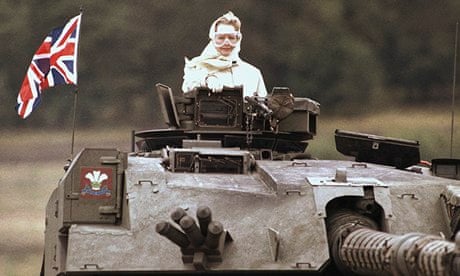
A Welsh tank unit (note the Union Jack and the daffodil logo)
taking part in Able Archer 83

November 7, 1983, 40 years ago: Able Archer 83 begins. It is the codename for wargames by the North Atlantic Treaty Organization (NATO), which had been an annual event for a few years. The purpose was to simulate a period of conflict escalation between NATO and the Warsaw Pact, meaning the Soviet Union and their satellite nations in Eastern Europe. It was coordinated from NATO headquarters in Casteau, Belgium.

This came while President Ronald Reagan was placing Pershing II missiles in Western Europe; 8 months after he made a speech declaring the Soviet Union to be "an evil empire"; 67 days after the Soviets shot down Korean Air Lines Flight 007; 42 days after Soviet Lieutenant Colonel Stanislav Petrov figured out that the detection of 2 U.S. nuclear missiles heading for Russia were a false alarm, and refused to give the order to launch a retaliation, thus becoming known (years later, once the world found out) as "The Man Who Saved the World"; and would be followed, 13 days later, with ABC airing the TV-movie The Day After, which imagined a nuclear attack on the U.S.

Able Archer 83 included some steps forward that previous exercises had not. These, on top of everything else that had happened in 1983, led the Soviet government to consider that this was a setup for an actual war. So they placed their military units on the highest possible alert.

Able Archer 83 ended on November 11 -- appropriately enough, the anniversary of the Armistice that ended World War I -- and so the Warsaw Pact forces, seeing that nothing further had happened, were ordered to stand down. This may have been the closest the world came to nuclear war, except for the Cuban Missile Crisis of 1962 and Col. Petrov's moment.

The 1980s -- especially the Autumn of 1983 -- were not "a simpler time." Not even for those of us who were kids at the time.