Showing posts with label nato. Show all posts

Friday, November 21, 2025

November 21, 1995: The Dayton Agreement

November 21, 1995, 30 years ago: The Dayton Agreement is reached at Wright-Patterson Air Force Base, outside Dayton, Ohio, ending the Bosnian Civil War. It was signed there on December 14.

It took the leadership of the President of the United States to stop it. A President who, just hours earlier, was fighting to get his own government reopened.

Taking down Slobodan Milošević and Newt Gingrich in the same week is a very impressive feat, and Bill Clinton simply doesn't get the credit he deserves.

Among the Republican politicians opposing the agreement were Senator Jesse Helms of North Carolina, a bigot who hated anyone who wasn't white and, by his definition, "Christian"; and Representative Robert Dornan of California, a Korean War bomber pilot who so loved war that he was known as "B-1 Bob," but suddenly became a pacifist when it was a liberal Democrat enforcing a peace.

What does it say about Helms and Dornan that they were less reasonable than Slobodan Milošević? A man who killed more people in 5 years than Saddam Hussein killed in 25 years, more than Fidel Castro killed in 50 years?

Just in this war, about 31,000 soldiers died, and an equal number of civilians, many of them in concentration camps, because of their religion -- in this case, Eastern Orthodox Catholic Serbs killing Bosnians for being Muslims. It had been half a century since the Holocaust, and "Never again" had happened again, on the same continent.

Finally, after 3 years of being begged to do something, and remembering how he did nothing to end the Rwandan Genocide in Africa the year before, President Clinton met with his fellow NATO leaders, and united them, and convinced President Boris Yeltsin of Russia to stay out of it. On August 30, Operation Deliberate Force began, with NATO planes bombing "Bosnian Serb" artillery positions. On November 1, Milosevic realized he could beat the Bosnians, but he couldn't beat NATO, and let peace talks begin.

As of November 21, 2025, the peace still holds. The Nobel Committee has given the Nobel Peace Prize to Presidents Theodore Roosevelt, Jimmy Carter and Barack Obama -- but not, as yet, Bill Clinton.

Thursday, April 4, 2024

April 4, 1949: NATO Is Founded

NATO Headquarters, Brussels, Belgium

April 4, 1949, 75 years ago: NATO, the North Atlantic Treaty Organization, is founded in Washington, D.C. President Harry S Truman and Secretary of State George C. Marshall set it up as a military alliance of Western Europe, where "An attack on one of us is an attack on all of us." 

The founding members of NATO were America, Canada, Britain, France, Italy, Belgium, the Netherlands, Luxembourg, Norway, Denmark, Iceland and Portugal. On February 18, 1952, with the Truman Doctrine having proven successful, and with both nations having participated in the United Nations' effort to protect South Korea during the Korean War, Greece and Turkey were admitted to NATO. On May 6, 1955, 10 years to the week after V-E Day, West Germany was admitted.

It would be a long time before new additions were made. Spain, neutral in both World Wars and fascist in World War II, were admitted in 1982, 7 years after the restoration of democracy. With the collapse of the Soviet-influenced counterpart, the Warsaw Pact, NATO waited 10 years before inviting any new members. The Czech Republic, Hungary and Poland were admitted in 1999. Bulgaria, Romania, Slovakia, the former Yugoslav nation of Slovenia, and the "Baltic States" of Lithuania, Latvia and Estonia were admitted in 2004.

Albania and the former Yugoslav nation of Croatia were admitted in 2009. The former Yugoslav nation of Montenegro was admitted in 2017. The former Yugoslav nation of North Macedonia was added in 2020. Finland, long neutral, was admitted in 2023. Sweden, also neutral through both World Wars and the Cold War, joined just last month.

And Ukraine want to join as well, but that's not possible as long as Russia are attacking them: It would mean that every NATO nation, including America, would have to go to war with Russia, and that would mean World War III.

Donald Trump is running for President in 2024, saying that if NATO members do not pay their dues, "I would encourage Russia to do whatever the hell they want." Including attack a NATO member. 

Tuesday, November 7, 2023

November 7, 1983: Able Archer 83, a Close Call

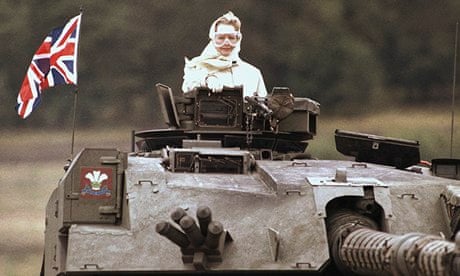
A Welsh tank unit (note the Union Jack and the daffodil logo)
taking part in Able Archer 83

November 7, 1983, 40 years ago: Able Archer 83 begins. It is the codename for wargames by the North Atlantic Treaty Organization (NATO), which had been an annual event for a few years. The purpose was to simulate a period of conflict escalation between NATO and the Warsaw Pact, meaning the Soviet Union and their satellite nations in Eastern Europe. It was coordinated from NATO headquarters in Casteau, Belgium.

This came while President Ronald Reagan was placing Pershing II missiles in Western Europe; 8 months after he made a speech declaring the Soviet Union to be "an evil empire"; 67 days after the Soviets shot down Korean Air Lines Flight 007; 42 days after Soviet Lieutenant Colonel Stanislav Petrov figured out that the detection of 2 U.S. nuclear missiles heading for Russia were a false alarm, and refused to give the order to launch a retaliation, thus becoming known (years later, once the world found out) as "The Man Who Saved the World"; and would be followed, 13 days later, with ABC airing the TV-movie The Day After, which imagined a nuclear attack on the U.S.

Able Archer 83 included some steps forward that previous exercises had not. These, on top of everything else that had happened in 1983, led the Soviet government to consider that this was a setup for an actual war. So they placed their military units on the highest possible alert.

Able Archer 83 ended on November 11 -- appropriately enough, the anniversary of the Armistice that ended World War I -- and so the Warsaw Pact forces, seeing that nothing further had happened, were ordered to stand down. This may have been the closest the world came to nuclear war, except for the Cuban Missile Crisis of 1962 and Col. Petrov's moment.

The 1980s -- especially the Autumn of 1983 -- were not "a simpler time." Not even for those of us who were kids at the time.