From @Fattcheeked on Twitter:
England World Cup recap: Beat Tunisia with a last minute goal from a set
piece. Beat not-too-good Panama and Sweden teams. Miraculously triumph
in a penalty shootout vs Colombia missing their best player. Lost 3
times to the 2 good teams they faced.
Meaning Belgium in the Group Stage, Croatia in the Semifinal, and Belgium again in the 3rd place game today.
England failed to reach the World Cup Final this time, as they have done in every single World Cup ever played, except for 1966, when it was on home soil.
England didn't enter the World Cup in the 1st 3 tournaments: 1930, 1934 and 1938. None of the British "Home Nations" did, due to a dispute with FIFA.
The World Cups of 1942 and 1946 were canceled, due to the effects of World War II.
England didn't qualify in 1974, 1978 and 1994.
They went out after the Group Stage in 1950, 1958 and 2014. 1950 was when they famously lost to the U.S.
They lost in the Round of 16 to Argentina in 1998 and Germany in 2010.
They went out after the Second Group Stage, effectively the Quarterfinals, in 1982.
They lost in the Quarterfinals to Uruguay in 1954, Brazil in 1962 and 2002, the nation then known as West Germany in extra time in 1970, Argentina in 1986, and Portugal in 2006.
They lost in the Semifinals to West Germany in 1990, and now, again, to Croatia in 2018.
And, of course, they won the Final in 1966, beating West Germany in extra time.
Famously, they went out on penalties in 1990, 1998 and 2006. They also got knocked out of of the European Championship on penalties in 1996 (in the Semifinal, to the now-united Germany) and 2012 (in the Quarterfinal, to Italy).
The Netherlands is also a leading "footballing nation" known for failing at penalties. If the English and Dutch teams ever met in the knockout round, and the scores were level after extra time 'twould be better to flip a coin, or else we could be there all night.
Tomorrow, it will be France, in its 3rd Final, having won in 1998 and lost in 2006, against Croatia, in their 1st Final.
England's theme for this tournament, the official world championship for the sport they claim to have invented, was "It's coming home." Jules Rimet, founder of the World Cup, and the man for whom the trophy is named, was French. It could be "coming home" after all.
England's most famous loss isn't the rain-soaked 1990 Semifinal in Turin, Italy, with Paul Gascoigne crying over his yellow card making him ineligible for the Final (had England made it) and the loss on penalties to Ze Germans. Nor is it the 1950 Group Stage game with the U.S. in Belo Horizonte, Brazil.
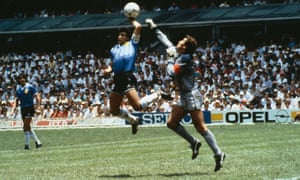
It's the 1986 Quarterfinal, against Argentina, at the Estadio Azteca in Mexico City. In the 51st minute, Argentina's star, Diego Maradona, slapped the ball with his left hand, and it went past England goalkeeper Peter Shilton, giving Argentina a 1-0 lead. The referee, Ali Bin Nasser of Tunisia, gave the goal. There was no VAR in those days. Maradona's postgame comments gave the goal its name: "The Hand of God." It is the most famous cheat in the history of sports on planet Earth.
Five minutes later, with the England players still in angry shock, Maradona scored again, a dizzying display of dribbling ending with a great shot that became known as "The Goal of the Century." Gary Lineker scored in the 81st minute, but England got no closer, and were out, 2-1.
If Nasser had correctly waved the 1st goal off, does Maradona score the 2nd? Would the England players have been able to stop him? Would they then have won 1-0 thanks to Lineker's goal? Would they then have beaten Belgium in the Semifinal, as Argentina did? Would they then have beaten West Germany in the Final, as Argentina did? We'll never know.
How much did Maradona's cheating really hurt England?
Top 5 Reasons You Can't Blame Diego Maradona's "Hand of God" for England Losing the 1986 World Cup
5. Diego Maradona. At the time, he may well have been the best player in the world. He might have scored his "Goal of the Century," or another goal, anyway. And if it had been 0-0, and thus 1-0, later than it actually was, maybe Lineker doesn't score his goal at all. And Argentina still win.
4. Mexico's Climate. Mexico has a diverse climate, but most of the cities selected for the World Cup were in deserts at high elevation. A combination of heat and thin air makes the country a difficult place to play, especially at the Azteca, giving El Tri a tremendous home field advantage.
Argentina were used to playing on that side of the world, in tropical heat, and at altitude. England, a country on the other side of the world, considerably further north, whose weather tends toward the cool and damp, and most of whose major cities aren't much above sea level, simply couldn't handle it.
Note that England's best World Cup performances have come in Europe: The 1966 win at home, the 1990 Semifinal in Italy, and the 2018 Semifinal in Russia.
3. Belgium. They didn't have a single player whose name you'd remember now, with the possible exception of Lei Clijsters, and he only because he was the father of tennis star Kim Clijsters. Only 2 of their players played their club football outside Belgium: Goalkeeper Jean-Marie Pfaff for Bayern Munich in Germany, and defender Eric Gerets for PSV Eindhoven in the Netherlands.
But 7 of Belgium's players played for R.S.C. Anderlecht, which had just won the 2nd of 3 straight league titles. Some of them had been on the Anderlecht team that won the 1983 UEFA Cup. And 4 of the Belgium players were from Club Brugge, which had just won the Belgian Cup, and, then as now, frequently does well in European competition.
The aforementioned Pfaff had just helped Bayern to its 2nd straight Bundesliga title. And the aforementioned Gerets had just helped PSV win the 1st of what turned out to be 6 straight Eredivisie (Dutch league) titles. Belgium had lots of talent, and there's no guarantee that England would have gotten past them to face...
2. West Germany. Who's kidding who? They had Lothar Matthäus of Bayern; former Bayern star Karl-Heinz Rummenigge of Internazionale; Rudi Völler of Werder Bremen; Andreas Brehme of Kaiserslautern; Felix Magath of Hamburg; Thomas Berthold of Eintracht Frankfurt; and, in goal, Harald Schumacher of Köln, who proved in his collision with Patrick Battiston of France in the 1982 World Cup that he was not above playing dirty.
This would be the 2nd of 3 straight World Cup Finals that West Germany would make, losing to Italy in 1982, losing to Argentina in 1986, and reversing that result by beating Argentina in 1990, before the reunification with East Germany later that year. "Ze Germans" were good enough to win the World Cup. The Three Lions were not.
Which leads me to...
1. England. They weren't that good. Despite the lies told by the English media, and believed by the England fans, the Three Lions, then as now, were simply not good enough to win the World Cup.
Note: All of the club affiliations I'm citing here are those of the players involved in the 1985-86 season that had concluded before Mexico 86 began.
Of the 22 players selected, 11 of them would later be selected for the 1990 team that got all the way to penalties in the Semifinal: Goalkeeper Peter Shilton of Southampton; defender Gary M. Stevens, midfielder Trevor Steven, and forward Gary Lineker of Everton; defender Terry Butcher of Ipswich Town, midfielder Bryan Robson of Manchester United, midfielder Chris Waddle of Tottenham Hotspur, goalkeeper Chris Woods of Norwich City, midfielder Steve Hodge of Aston Villa, midfielder John Barnes of Watford, forward Peter Beardsley of Newcastle United.
But 7 of them were on the 1982 team that flopped in the Second Group Stage in 1982: Shilton, Butcher, Robson, defenders Kenny Sansom and Viv Anderson of Arsenal, midfielder Glenn Hoddle of Tottenham, and midfielder Ray Wilkins of A.C. Milan (formerly of Chelsea and Manchester United).
And 7 of them weren't good enough to make any World Cup team but 1986: Defender Alvin Martin of West Ham United, striker Mark Hateley of Milan (formerly of Coventry City and Portsmouth), defender Terry Fenwick of Queens Park Rangers, defender Gary A. Stevens of Tottenham (no relation to Gary M.), midfielder Peter Reid of Everton, forward Kerry Dixon of Chelsea, and goalkeeper Gary Bailey of Manchester United.
Maybe the 1986 England team could have gotten past Argentina if the "Hand of God" goal had been correctly waved off. Maybe they could have gotten past Belgium. But they would not have beaten West Germany.
And saying, "But we invented football!" doesn't wash. Rutgers College fielded America's 1st football team, and its successor school, Rutgers, The State University of New Jersey, correctly calls itself "the birthplace of college football," but they've done precious little since 1869.
England have had some success since 1966, but not enough to justify the hype they get every 2 years when the World Cup and, in between them, the European Championships comes along.
Yes, Maradona cheated. But it probably didn't matter that much. England would not have won the 1986 World Cup had it not happened.
VERDICT: Guilty on the charge of cheating, but Not Guilty on the charge of being the reason England failed to win the 1986 World Cup.