Showing posts with label munich. Show all posts

Sunday, July 7, 2024

July 7, 1974: The Netherlands' Lost Final

Johan Cruyff and Franz Beckenbauer in the Final.
The fact that the Dutch wore a bright color
and the Germans wore black and white
seemed symbolic of each country's soccer style.

July 7, 1974, 50 years ago: Rarely is a sports competition remembered less for the team that won than for the team, or one of the teams, that lost. The 1974 World Cup was one of them.

The tournament was being held in West Germany, and the Dutch team seemed to have the best of all Dutch worlds:

* From AFC Ajax, of Amsterdam (currently or formerly), came forwards Johan Cruyff and Piet Kiezer, midfielder Johan Neeskens, right wing Johnny Rep centerback Arie Haan, right back Wim Suurbier, and left back Ruud Krol.

(Note: Since his name was usually written as "Cruyff" for the English-speaking world, that's how I'm going to spell it in this post, even though it was always written as "Cruijff" in his homeland.)

* From Feyenoord, of Rotterdam, who formed the country's greatest rivalry with Ajax, came goalkeeper Eddy Treijtel; defenders Wim Rijsbergen, Wim Jansen, Rinus Israel and Harry Vos; and midfielders Willem van Hanegem and Theo de Jong.

* From PSV Eindhoven came defender Pleun Strik and twin brother midfielders René and Willy van de Kerkhof.

* From Twente Enschede came goalkeeper Piet Schrijvers and defender Kees van Ierssel.

* From FC Amsterdam came starting goalkeeper Jan Jongbloed.

* From Belgian club Anderlecht came forward Rob Rensenbrink.

* And from Anderlecht's arch-rivals, Club Brugge, came midfielder Ruud Giels. While Belgium is mostly divided among ethnic French (Wallonia) and ethnic Dutch (Flanders), both Anderlecht and Brugge are on the Dutch side of the country.

The Netherlands -- often incorrectly called "Holland," but that name only refers to 2 provinces of the kingdom, albeit those containing Amsterdam and Rotterdam, the 2 largest cities -- defeated Uruguay 2-0, drew 0-0 with Sweden, and demolished Bulgaria 4-1 to advance to the 2nd Group Stage. There, they beat Argentina 4-0, East Germany 2-0, and defending champions Brazil 2-0.

It was beginning to look easy. They had played 6 games, and had an aggregate advantage of 14-1. With their flowing football, flowing hair and bright orange uniforms, they had captivated the entire world -- especially since this was, for many countries, still the early days of color television.

On July 7, 1974, at the Olympiastadion in Munich, the dream seemed to be coming true. The Dutch lined up for the Final against a West Germany side dominated by players from Bundesliga winners Bayern Munich, including defender Franz Beckenbauer, goalie Sepp Meier and forward Gerd Müller. In only the 1st minute of the game, Crujiff advanced into the penalty area, and Bayern's Uli Hoeness brought him down. A penalty was rightly awarded, the 1st ever awarded in a World Cup Final, and Neeskens converted to give the Dutch a lead before 2 minutes had passed.
The Olympiastadion in Munich

But the Dutch may have scored too soon, and rested on their laurels. The Germans fought back, and got a legitimate penalty of their own in the 25th minute. Müller scored in the 43rd to give West Germany the lead. The half soon came, and Cruyff argued with the referee, Englishman Jack Taylor, and was booked for this.

The Dutch came a little unglued, and although they fell no further behind, neither did they get any closer. West Germany won, 2-1. It was not a home soil victory: Indeed, in the 2nd half, they had a goal waved off for offside, and were denied what looked like another legitimate penalty.

Playwright Johan Timmers wrote, "The defeat of 1974 is the biggest trauma that happened to Holland in the 20th Century, apart from the floods of 1953 and World War II." Historian Bastiaan Bommeljé wrote, "It should have been the epiphany of the sixties. Instead it turned out to be its requiem. The team was a product of an age that had put all its money on youth and the promise of youth and the idea that good times will be here when a new generation takes over."

In his book Brilliant Orange: The Neurotic Genius of Dutch Soccer, David Winner wrote, "The most talented group of footballers their country -- almost any country -- ever produced blew it. How? Why? It's a riddle wrapped in a mystery inside an enigma." He cited a 20th Anniversary survey that showed that nearly everyone old enough to watch remembered exactly where they were, and, on that basis, he compared it to the assassination of President John F. Kennedy in 1963.

Despite the defeat in the Final, Cruyff, since 1973 playing his "club football" for FC Barcelona in Spain, was awarded the Ballon d'Or (Golden Ball), as World Player of the Year, for the 3rd time in the last 4 years. There was no doubt that he was now the best player in the world, even if he couldn't quite get his country to the greatest prize of all.

In 1977, Cruyff announced his retirement from international soccer, refusing to play in the 1978 World Cup in Argentina. For 30 years, it was believed that he was protesting the military dictatorship that took over Argentina in 1976, after the country was awarded the tournament. But in 2008, he revealed the truth: There was a threat against his family, and it got into his head, and he didn't think he would be at his best for the tournament.

Again, the Netherlands reached the Final, even without Cruyff. This time, it was a home soil victory, as the Argentines' mere qualification for the Final under the system then in place was dubious, and they scored 2 dubious goals in extra time to win 3-1. There were some Dutch players who were quoted as saying they didn't know if they would leave the stadium alive if they won.

Cruyff has been called the greatest player that Europe has ever produced. However, the lack of a World Cup sticks out on his resume, as it does for players like Puskás, Argentina's Di Stéfano and (so far) Lionel Messi, France's Raymond Kopa, Wales' John Charles, Northern Ireland's George Best, Italy's Paolo Maldini, and Portugal's Eusébio and (so far) Cristiano Ronaldo. (UPDATE: In 2022, Argentina, with Messi, won the World Cup.)

For some of those players (particularly Charles and Best), it's because their countrymen were not up to their level. For Maldini, it was down to luck: He was considered too young to make the national side in 1982 and too old in 2006, despite his 25 years of top-flight football.

But the Netherlands has had so much talent, yet their only major tournament win has been Euro 88. They would lose the World Cup Final again in 2010, to Spain. No other country that's been in at least 3 Finals has failed to win at least 1.

One more note: The Olympiastadion in Munich is 1 of 3 stadiums to have hosted an Olympic Games, a World Cup Final and a UEFA European Cup/Champions League Final. The others are the Olympiastadion in Berlin and the old Wembley Stadium in London. In a few days, the Stade de France outside Paris will make it 4. 

Friday, September 9, 2022

September 9, 1972: The Soviets Steal the Basketball Gold Medal

September 9, 1972, 50 years ago: The most blatant cheating in sports history takes place -- at least, until Diego Maradona's "Hand of God" goal in the 1986 World Cup.

Basketball was first competed for in the Olympic Games in 1936 in Berlin. And, each time, the American team had won the Gold Medal:

* 1936 in Berlin, Germany: Beat the Philippines by 33, Mexico by 15, Canada by 11. Keep in mind, this was still when the game was at an early stage. The margins would get bigger.

* 1948 in London, Great Britain: Beat Switzerland by 65, Czechoslovakia by 25, Argentina by 2 (even then, Argentina were good), Egypt by 34, Peru by 28, Uruguay by 35, Mexico by 31, France by 44.

* 1952 in Helsinki, Finland: Beat Hungary by 18, Czechoslovakia by 25, Uruguay by 12, the Soviet Union by 28, Chile by 48, Brazil by 4 (even then, Brazil were good), Argentina by 9, and, in the Gold Medal Game, the Soviets again by 11. This was the 1st Games in which the Soviets competed. Clearly, they were as good at basketball as any other European country. But no country was as good as the U.S.

* 1956 in Melbourne, Australia, with a team that included Bill Russell and K.C. Jones: Beat Japan by 58, Thailand by 72, the Philippines by 68, Bulgaria by 41, Brazil by 62, the Soviets by 30, Uruguay by 63, and the Soviets again by 34.

* 1960 in Rome, Italy. This was the original "Dream Team," the finest basketball team that had ever been assembled, and would remain so until Los Angeles in 1984, before Barcelona in 1992 set what may be an impossible standard. This team had Oscar Robertson, Jerry West, Jerry Lucas, Darrall Imhoff and Walt Bellamy, all of whom made the Basketball Hall of Fame long before the entire team was elected. This team was so good (How good was it?), future Hall-of-Famer John Havlicek only made it as an alternate.

They beat host Italy by 34 (and Italy usually has a strong league and a good national team), Japan by 59, Hungary by 34, Yugoslavia by 62, Uruguay by 58, and the Soviets by 24. 

* 1964 in Tokyo, Japan, with a team that included Bill Bradley, Walt Hazzard, Luke Jackson, and future coaching legend Larry Brown, who was a pretty good player: Beat Australia by 33, Finland by 26, Peru by 15, Uruguay by 55, Yugoslavia by 8 (they were beginning to get good), Brazil by 33, South Korea by 66, Puerto Rico by 20 (they have a national team separate from America's), and the Soviets by 14.

* 1968 in Mexico City, Mexico. This one was complicated by the fact that some of the country's best college players were boycotting the team, in response to America's racial inequities. These included Lew Alcindor (who later renamed himself Kareem Abdul-Jabbar) and his UCLA teammates, and Elvin Hayes of the University of Houston. This U.S. team still had Spencer Haywood, Jo Jo White, Charlie Scott, and Bill Hosket, who became a reserve on the New York Knicks' title team of 1970.

And, they were strong enough to beat Spain by 35, Senegal by 57, the Philippines by 21, Yugoslavia by 15, Panama by 35, Italy by 39, Puerto Rico by 5, Brazil by 12, and Yugoslavia by 15. The Yugoslavs had beaten the Soviets by 1 point in the Semifinal.

*

In 1972, in Munich, West Germany, America's best player, Bill Walton, didn't play. Hank Iba, the legendary coach of Oklahoma State, insisted that every player who wanted to be on the team had to try out. Walton, who had just led UCLA to a National Championship as a sophomore, believed he was good enough to not have to try out.

These players did try out, and did make it (listed here in alphabetical order):

* Mike Bantom, of St. Joseph's of Philadelphia, who later helped the Philadelphia 76ers reach the 1982 NBA Finals.

* Jim Brewer, who starred at the University of Illinois, and became a member of the 1982 NBA Champion Los Angeles Lakers.

* Tom Burleson, who later helped North Carolina State win the 1974 National Championship, and played 7 seasons in the NBA.

* Kenny Davis, an NAIA All-American at Georgetown -- the one in Kentucky, not the one in D.C.

* Doug Collins, a star at Illinois State, who later helped the 76ers reach 3 NBA Finals, then became a decent coach, and a Hall of Fame broadcaster.

* James Forbes, of Texas-El Paso (UTEP), who never played in either the NBA or the ABA, but went back home to El Paso and became a renowned high school coach.

* Tom Henderson, of the University of Hawaii, later a member of the 1978 NBA Champion Washington Bullets.

* Bobby Jones, who helped North Carolina reach the 1972 NCAA Final Four, reached the 1976 ABA Finals with the Denver Nuggets, and reached 3 NBA Finals with the 76ers, winning in 1983. They retired his Number 24.

* Dwight Jones, of the University of Houston, who later reached the 1983 NBA Finals with the Lakers.

* Kevin Joyce, of Bayside, Queens, the prestigious Archbishop Molloy High School of Queens, and the University of South Carolina, whose coach, Frank McGuire, had previously raided New York City while coaching at North Carolina. He went on to play in the ABA, but not the NBA.

* Tom McMillen, who starred on the ill-fated Maryland team with Len Elmore that kept running into the North Carolina team of Bobby Jones and the N.C. State team of Burleson and David Thompson, and, under the rules of the time, couldn't make the NCAA Tournament because they hadn't won the Atlantic Coast Conference title. He later played 11 seasons in the NBA, and served 6 years as a Democratic Congressman from Maryland (1987-93).

* And Ed Ratleff, of Cal State-Long Beach (a.k.a. Long Beach State), who later played 5 seasons with the Houston Rockets.

Most observers figured, if the '68 U.S. team, without Kareem or the Big E, could win the Gold Medal without much trouble, then this team could do it without Walton. (Or George Gervin, as one of my regular readers pointed out. Gervin was about to begin his junior year at Eastern Michigan University.)

And they did go through the Group Stage as if nothing out of the ordinary was going to happen. They beat Czechoslovakia 66-35. They beat Australia 81-55. They beat Cuba 67-48. Brazil gave them a tough game before falling 61-54. They beat Egypt 96-31. They beat Spain 72-56. And they beat Japan 99-33.

The Soviets were in the other Group, and won all 7 of their games, by an average of 21 points. The Semifinals surprised nobody: The U.S. beat Italy 68-38, and the Soviets beat Cuba 67-61.

All-time in Olympic basketball competition, the U.S. was now 58-0. Only 6 of those 58 games were within 10 points. They were 7-0 in Gold Medal Games. They were 6-0 against the Soviets, including 4-0 in Gold Medal Games.

So, in spite of the cloud that had hung over the Games since the massacre of 11 Israeli representatives by Palestinian terrorists 4 days earlier, there seemed little reason to believe that the Soviets would win as the teams took the floor of the Rudi-Sedlmayer-Halle in Munich, West Germany on September 9, 1972. (The arena was named after the president of the Bavarian State Sport Association. It still stands, is now named the Audi Dome, and is home to the basketball team of Bayern Munich, far better known for its soccer team.)
This was the era when, if the Soviets -- and also the athletes competing for East Germany -- couldn't win honestly, they would cheat. They gave their performers steroids. When testing for steroids came out, many of their performers -- runners, throwers in track's "field" events, swimmers, weightlifters -- started losing. Others simply stopped competing. This was especially noteworthy among female competitors in swimming and track and field.

And the Soviet teams were known for rough play in other events, most notably the water polo competition against Hungary in 1956, held after Soviet tanks crushed a Hungarian rebellion.

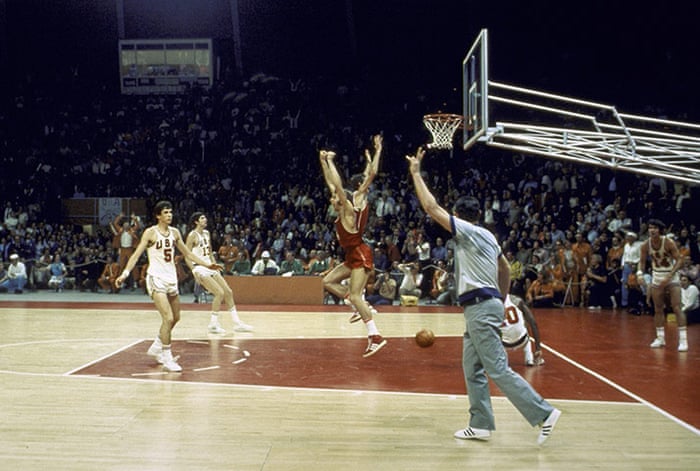
In the 1972 basketball Gold Medal Game, the Soviets took an early lead, and held it through the end of the 1st half, 26-21. Early in the 2nd half, Dwight Jones and Mikheil Korkia both went for a loose ball. Korkia punched Jones. Jones punched back. Both players were ejected. This was fine with the Soviets: Jones had been the leading scorer of the tournament, so it was the equivalent of a hockey "goon," who had no talent beyond fighting, causing both himself and the opposing team's best player to be thrown out of the game.

A minute later, one of the Soviets' better players, Alexander Belov, purposely injured Brewer. The officials called a foul, but that was it. Belov was allowed to continue. With 10 minutes to go (like U.S. college basketball, Olympic basketball games are played in 2 20-minute halves, so this was roughly the end of the 3rd quarter), the Soviets had their biggest lead, 10 points.

The U.S. should have "switched to their A game" a lot sooner, but now, they began to press. With 38 seconds left, they closed to within 1 point. With 7 seconds left, Belov attempted a cross-court pass at half-court, and Collins stole the ball. (Boston Celtics announcer Johnny Most couldn't be reached for comment.) He drove toward the basket, and was hammered by Zurab Sakandelidze.

By rights, Sakandelidze should have been assessed a technical foul, Collins should have been awarded 2 unimpeded free throws, and the U.S. should then have gotten the ball back. Instead, this was treated as an ordinary foul. Collins made the 1st, making the score 49-49. But as he made his 2nd attempt, the horn from the scorer's table sounded. Was it an attempt to distract him? If so, it didn't work: He sank it. USA 50, USSR 49. There were 3 seconds left to play.

The Soviets got the ball back, got the ball to halfcourt, and called timeout with 1 second left. But the officials put a full 3 seconds back on the clock. That's 2 seconds the Soviets didn't deserve. They made 2 passes, getting the ball to Belov, but he couldn't get a shot off. The horn sounded, and the U.S. had a 50-49 victory and the Gold Medal.

Except the officials put another 3 seconds on the clock. Iba challenged this, and threatened to take his team off the floor. He was told that if he did that, the game would be forfeited to the Soviets. Iba considered doing it anyway, since, at the time, the U.S. was on good terms with FIBA, the governing body for international basketball, and was confident of a ruling in his favor. But he later said, "I don't want to lose this game later tonight, sitting on my butt." He would win or lose it on the court.

Ivan Edeshko prepared to make the inbounds pass. Referee Artenik Arabadjian -- from Bulgaria, a Warsaw Pact nation dominated by the Soviets, and an ethnic Armenian, therefore with ties to the Soviet Union -- told McMillen to back off a bit, to give Edeshko room. McMillen knew there was no rule requiring him to do so. But he figured, if he didn't, Arabadjian would asses a technical foul.

So Edeshko's inbounds pass got away with no trouble. It became known in the Soviet Union as "The Golden Pass." Except he stepped on the end line. He should have been called for a violation, making it U.S. ball. The infraction was not called. Another cheat.

Belov, Joyce and Forbes all went for his pass as it came down. Belov caught it, Forbes fell to the floor, and Joyce fell out of bounds. Belov had an easy shot. The horn sounded again, and, this time, no more seconds were put on the clock. USSR 51, USA 50.
Left to right: Dwight Jones, James Forbes and Ed Ratleff

There were 2 referees in the game, as prescribed by FIBA rules. Arabadjian signed the official scoring sheet. The other ref, Renato Righetto of Brazil (there are a lot of people of Italian descent in South America), knew it was a screwjob, and refused to sign it.

Naturally, the U.S. protested the result to FIBA. A 5-man jury was to decide. It consisted of 2 men from Warsaw Pact nations, Ferenc Hepp of Hungary and Adam Baglajewski of Poland; Andres Keiser of Cuba, a nation hostile to the U.S.; and Rafael Lopez of Puerto Rico and Claudio Coccia of Italy, both pro-U.S. countries. Hepp announced that the jury had ruled in the Soviets' favor, and refused to say what the count was, only that it was not unanimous.

The medal ceremony was held. The Soviets accepted their Gold Medals. Cuba, which beat Italy 66-65, accepted their Bronze Medals. The U.S. team did not attend the medal ceremony, and did not accept their Silver Medals.

The U.S. appealed again, this time to the executive committee of the International Olympic Committee. The appeal was not heard until February 1973, 5 months later, and the IOC ruled that FIBA's verdict stood.

The IOC announced that, in order to release the Silver Medals to the players, the vote would have to be unanimous. For 20 years, the 12 American players were unanimous in refusing. But in 1992, Ratleff said that, while he still didn't want his, his wife wanted to be able to show the medal to their children. So he was the 1st member of the team to change his vote on accepting the medal. 

To avoid a similar situation, Davis announced that he had put a clause into his will, forbidding his wife, children, or their descendants from accepting his medal after his death. In 2012, when all 12 members were brought together for the 1st time since the Games, on the 40th Anniversary of the robbery, they all said, "No." Ratleff had since gotten divorced, and had changed his vote back, to make it unanimous once again.
The 2012 reunion

The Soviet players all claimed that they won legitimately. Of course, they did. Sergei Belov, Alexander's brother and the team's best player, later elected to the Basketball Hall of Fame, and Edeshko went out of their way to say the Americans should accept that they lost.

Hepp died in 1980, Righetto in 2001, and Arabadjian in 2017. Soviet head coach Vladimir Kondrashin died in 1999. Alexander Belov died of cancer in 1978. Zurab Sakandelidze, Mikheil Korkia and Sergei Kovalenko all died in 2004. Gennadi Volnov in 2008, Aleksandr Boloshev in 2010, Sergei Belov in 2013, Ivan Dovrny in 2015. The other Soviet players are still alive: Ivan Edeshko, Modestas Paulauskas, Alzhan Zharmukhamedov and Anatoli Polivoda.

Hank Iba died in 1993. Dwight Jones died in 2016, making further reunions impossible. He never accepted his Silver Medal. The other 11 players are still alive. None of them have ever accepted theirs. They still sit in a vault at IOC headquarters in Lausanne, Switzerland.

Monday, September 5, 2022

September 5, 1972: The Munich Massacre

September 5, 1972, 50 years ago: The Munich Massacre takes places, bringing terrorism into the modern era.

The Olympic Games were being held in Munich, in the Federal Republic of Germany -- a.k.a. West Germany. It was the 1st time the Games were held on German soil since 1936, when Germany was controlled by the Nazi Party and Chancellor Adolf Hitler.

But all signs pointed toward the host nation, a democratic and capitalist nation, handling things properly. There were no incidents between German officials, or Olympic officials, and the athletes, coaches and support staff from Israel, which had founded itself as a nation in 1948, after the defeat of the Nazis in World War II.

But that founding resulted in great bitterness with the people calling themselves "Palestinians." With the support of Egypt, Jordan and Syria, they launched a war against Israel, but when it became clear that the war was a stalemate, a settlement was reached. Another war was launched in 1967, and, this time, there was a clear result: Israel won it in 6 days.

King Hussein I of Jordan decided that further wars against Israel were not worth it. On September 16, 1970, he responded to an Islamic fundamentalist group called the Fedayeen and its attempt at a coup by declaring martial law. Thousands of Palestinians were expelled from the country, and some were killed.

In response, a new terrorist group was formed, named Black September for this event. They waited for their chance to make a big statement. They decided that the 1972 Olympics were it, as the whole world would be watching.

At 4:30 AM, Central European Time -- 10:30 PM, September 4, U.S. Eastern Time -- eight Black September operatives snuck into the Olympic Village, wearing tracksuits so as to blend in. They found the Israeli team's quarters at Connollystraße 31. They broke in. Yossef Gutfreund, an Israeli but an official, a referee for the wrestling matches rather than an athlete or a coach, tried to distract the operatives so that others could escape. Only one did, weightlifting coach Tuvia Sokolovsky. Gutfreund was knocked out and taken prisoner. Weightlifter Yossef Romano and wrestling coach Moshe Weinberg tried to fight them off, but were killed.

The gunmen took and bound 9 hostages: Gutfreund, wrestlers Eliezer Halfin and Mark Slavin, weightlifters David Berger and Ze'ev Friedman, track and field coach Amituzur Shapira, fencing coach Andre Spitzer, sharpshooting coach Kehat Shorr, and weightlifting judge Yakov Springer.

One Israeli athlete who managed to get away before being seen by the gunmen was racewalker Shaul Ladany, a survivor of the Nazis' concentration camp at Bergen-Belsen. He got word to American officials.

Prime Minister Golda Meir of Israel asked for help from other countries: "If we should give in, then no Israeli anywhere in the world shall feel that his life is safe... It's blackmail of the worst kind." King Hussein called it a "savage crime against civilization, perpetrated by sick minds." But he was the only Arab, and the only Muslim, public figure to denounce the action which had already left 2 men dead. President Richard Nixon did not take any direct action, but asked the United Nations to do so.

Black September demanded the release of 234 Palestinians jailed in Israel, and also those of the founders of the infamous West German terrorist group Red Army Faction, Andreas Baader and Ulrike Meinhof. Meir refused to negotiate.

The hours dragged on. ABC, covering the Olympics for the United States, kept going back and forth between Jim McKay, their Olympic anchor, and Peter Jennings, who headed their international news desk in London, and who was in Munich because, even before the terrorists struck, that was where the news was for the moment. McKay would receive a special Emmy Award for his coverage, and his coverage Munich is often given as a reason why Jennings ended up as the anchor of ABC World News Tonight after the death of Frank Reynolds.

By 4:30 PM (10:30 AM, U.S. Eastern), Munich police had the complex surrounded. At 6:00 PM (12:00 noon, U.S. Eastern), the terrorists demanded transportation to Cairo, the capital of Egypt, a country they believed would be friendly to them.

The West German authorities reached Prime Minister Aziz Sedki of Egypt (not President Anwar Sadat), and he told them that his country did not want to get involved. So the West German authorities lied to the terrorists, saying that the demand had been accepted.

A bus transported the terrorists and their hostages to Fürstenfeldbruck Airport. A Boeing 727 jet was waiting, but the flight crew were actually Munich police. The terrorists tried to board the plane, but realized they had been lured into a trap, and ran back. At 12:04 AM on September 6 (6:04 PM on September 5, U.S. Eastern), the terrorists' leader shot the hostages with an AK-47. The police started firing, and most of the terrorists were killed within minutes. The ones who got away were all captured by sunrise.

At 3:24 AM on the 6th -- 9:24 PM on the 5th, U.S. Eastern -- Jim McKay gave America the tragic news:

You know, when I was a kid, my father used to say, "Our greatest hopes and our worst fears are seldom realized." Our worst fears have been realized tonight. They've now said that there were eleven hostages. Two were killed in their rooms yesterday morning. Nine were killed at the airport tonight. They're all gone.

There were demands that the rest of the Games be canceled. Instead, the International Olympic Committee postponed all events set for September 6, and hosted a memorial service in the Olympiastadion, attended by 80,000 people. The callous reaction of IOC President Avery Brundage, a known anti-Semite from his days as U.S. Olympic Committee President in the 1936 Olympics in Berlin, led to his being fired.

The remaining members of the Israeli team withdrew from the Games and went home. Mark Spitz, the Jewish American swimmer who had already completed his remarkable feat of winning 7 Gold Medals, also left. So did the Egyptian team, fearing reprisals since it was now known that they weren't helping Black September. So did the teams of Algeria and the Philippines.

During the 1972 World Series, pitcher Ken Holtzman and 1st baseman Mike Epstein, Jewish players for the Oakland Athletics, wore black armbands in memory of the 11 Israelis killed at the Olympics. Reggie Jackson, a black man who had grown up in a mostly-Jewish neighborhood, also wore a black armband, although he was injured and unable to play. Major League Baseball officials, so often behind the times when it came to social issues, allowed it.