This coming Thursday, the Yankees travel to Houston to start a series with the Astros, who have knocked them out of the postseason in 2015, 2017 and 2019, and have been the only American League team to have really given them trouble so far this season.
So, how are they cheating
this time?
The Astros have long been an iconic franchise, despite not having ever won a World Series, or even a World Series game, until 2017. They were 0-7 in postseason series until 2004, took until 2005 (44 seasons) to win their 1st Pennant, and got swept in the World Series by the Chicago White Sox, but finally pulled it all together in the 1st year of the Trump Maladministration.
They are iconic for good reasons, as the team of such legendary players as Rusty Staub, Jimmy Wynn, Cesar Cedeno, J.R. Richard, Nolan Ryan, Mike Scott, Craig Biggio and Jeff Bagwell. And as the hosts of
The Bad News Bears In Breaking Training. And as participants in some storied series, including the 1980, 1986 and 2005 National League Championship Series. And as having tied in with Houston's aerospace industry.
And, to their credit, while, upon their debut in 1962, they publicized themselves as the 1st Major League Baseball team in the South, they did not encourage racism, Confederate battle flags, the playing of "Dixie" or "rebel yells."
They are also iconic for bad reasons, as the 1st team to build a dome, as the 1st to install artificial turf, and for their garish 1970s "Rainbow Brite" uniforms. And they did lay the Texas-themed stuff on a bit thick, though, with the cowboy hats and the gun images, due to their original 1962-64 name, the Houston Colt .45's. And, more than any other team -- including the Boston Red Sox, whose actions have not only been worse, but longer-lasting -- they have been "punished" for cheating.
But they are remembered. Unlike certain other teams, who tend to drop out of the spotlight when they're no longer good, and make you forget that they exist (the other MLB team in Texas comes to mind), the Astros have stayed in the baseball fan's consciousness.
It still seems strange to me to see the Houston Astros in the American League, just as it's strange to see the Milwaukee Brewers in the National League. But, that's the way it is now.
Before You Go. Weather in "The Bayou City" can be bad, which is why the Aatrodome and now the retractable-roof Minute Maid Park were built. Heat and humidity. It could be a little jarring next week. The
Houston Chronicle is predicting low 90s for the afternoons, high 70s for the evenings, and rain for all 4 days. The roof will be closed.
Houston is in the Central Time Zone, so you'll be an hour behind New York time. Although Texas was a Confederate State, you won't need to bring your passport or change your money.
Tickets. The Astros averaged 35,351 in 2019, the last pre-COVID season. That still leaves them a bit short of the park's current listed capacity of 42,060 seats. Getting tickets should not be a problem.
In spite of using "Dynamic Pricing," due to it being the Yankees in town, tickets are cheaper than we're used to in New York. Pretty much the only seats available for this series are in the upper deck, at $56.
Getting There. It's 1,629 miles from Times Square in New York to downtown Houston, and 1,637 miles from Yankee Stadium to Minute Maid Park. You're probably thinking that you should be flying.
Flying to Houston George Bush Intercontinental Airport (that's named for the father, not the son) can be done for as little as $478. Considering how far it is, that is rather cheap. Bus 102 will get you from the airport to downtown in an hour and 20 minutes.
Since the Monday after this series is the 4th of July, a lot of Amtrak runs are sold out this weekend. So I'm going to skip the train for this entry. For future reference, the last time I did this, it would have cost you $462 round-trip.
And don't be fooled by the fact that Houston's Union Station and the ballpark are next-door to each other, because Amtrak uses a different station a mile away. So let's just forget Amtrak, and move on.
Greyhound allows you to leave Port Authority Bus Terminal at 10:30 PM Saturday night, and arrive at Houston at 4:10 on Monday, a trip of 42 hours and 40 minutes. It would require changing buses in Atlanta on Sunday night.
It's $820 round-trip, but it can drop to as low as $575 with advanced purchase. You're better off spending a little extra and flying. The Houston Greyhound station is at 2121 Main Street, a mile and a half from the ballpark.
If you actually think it's worth it to drive, get someone to go with you so you'll have someone to talk to and one of you can drive while the other sleeps. You'll be taking Interstate 78 across New Jersey and into Pennsylvania to Harrisburg, where you'll pick up Interstate 81 and take that through the narrow panhandles of Maryland and West Virginia, down the Appalachian spine of Virginia and into Tennessee, where you'll pick up Interstate 40, stay on that briefly until you reach Interstate 75, and take that until you reach Interstate 59, which will take you into Georgia briefly and then across Alabama and Mississippi, and into Louisiana, where you take Interstate 12 west outside New Orleans. Take that until you reach Interstate 10. Once in Texas, Exit 770 will get you to downtown Houston.
If you do it right, you should spend about an hour and a half in New Jersey, 3 hours in Pennsylvania, 15 minutes in Maryland, half an hour in West Virginia, 5 and a half hours in Virginia, 3 hours and 45 minutes in Tennessee, half an hour in Georgia, 4 hours in Alabama, 2 hours and 45 minutes in Mississippi, 4 hours and 30 minutes in Louisiana and 2 hours in Texas. Including rest stops, and accounting for traffic, we're talking about a 40-hour trip.
Even if you're only going for one game, no matter how you got there, get a hotel and spend a night. You'll be exhausted otherwise. Trust me, I know: Trains and buses are not good ways to get sleep.
Once In the City. Houston was founded in 1836 as Allen's Landing, and was renamed for Sam Houston, "the Father of Texas." It would take until December 29, 1845 for Texas to be admitted to the Union as the 28th State. It seceded from the Union on February 23, 1861, and was readmitted on March 30, 1870.
There are 2.2 million people in Houston proper, making it the 4th-largest in America, and 6.3 million in the metropolitan area, making it 5th. But with multiple teams, it's only the 10th-largest market in the NBA, and the 7th-largest in MLB and the NFL.
The weather in Houston is
so bad! (How bad
is it?) A "bayou" (BYE-yoo) is a body of water, typically found in a flat, low-lying area, and can be either an extremely slow-moving stream or river, often with a poorly-defined shoreline, or a marshy lake or wetland. And Houston is known as the Bayou City.
When people talk about "the bayou," they usually mean Louisiana. But Southeast Texas is also bayou country, and it frequently leaves Houston hot, humid and muggy. It's a breeding ground for mosquitoes. The Astrodome had to be built not just to promote Houston, or to protect people from the heat, but to protect them from the bugs. Sandy Koufax of the Los Angeles Dodgers said, "Some of those mosquitoes are twin-engine jobs."
Fortunately, just as there's an overhead walkway system in Minneapolis, and an "Underground City" in Montreal, in their cases to protect pedestrians from their cities' notoriously cold Winter, there is a "Houston Tunnel System," begun in the 1930s, and inspired by New York itself, by the system under Rockefeller Center. Regardless of how much this may help, remember to stay hydrated.
The sales tax in the State of Texas is 6.25 percent, but in the City of Houston it goes up to 8.25 percent. The city doesn't appear to have a "centerpoint," where the address numbers start at 1, but there is a Main Street, running northeast/southwest. ZIP Codes in the Houston area start with the digits 77. The Area Codes are 713, with 281, 346 and 832 as overlays.
Houston has not 1, not 2, but 3 beltways: Interstate 610, a.k.a. the Inner Loop; Beltway 8, a.k.a. the Sam Houston Tollway; and State Highway 99, a.k.a. the Grand Parkway.
Like most Texas cities now, Houston has a Hispanic plurality, if not yet a majority: 44 percent. It's about 26 percent white, 24 percent black, and 6 percent Asian. It's mostly white on the west side; mostly black on the south, northwest and northeast sides; and mostly Hispanic on the north, east and southeast sides.
Houston, and South Texas, have had some racial disturbances. On August 13, 1906, in Brownsville on the Rio Grande (the border between Texas and Mexico), a white bartender was killed and a Hispanic policeman was wounded by gunshots. The blame fell on a segregated unit of black soldiers at nearby Fort Brown.
Following a U.S. Army Inspector General's report, President Theodore Roosevelt, in his role as Commander-in-Chief, ordered dishonorable discharges for 167 of those soldiers, costing them pensions and the right to serve in federal service jobs. This is a blot on TR's record, and in 1972, President Richard Nixon pardoned them and rewrote their discharges as honorable.
There were 21 deaths in a riot in Houston on August 23, 1917, when members of the all-black 24th United States Infantry Regiment at Camp Logan fought back against the all-white Houston Police Department. After a series of courts-martial that could only have been a kangaroo court, there were 19 executions, and 41 soldiers were sentenced to life imprisonment.
There was a race riot in Beaumont, about 85 miles east of Houston, on June 15, 1943, with 3 deaths. On May 17, 1967, there was a riot on the campus of the historically-black Texas Southern University, leading to the death of a police officer and the arrests of 500 students. But once it was found that the officer had died from "friendly fire," the ricochet of a fellow officer's bullet, all charges against the students were dropped. And there was a race riot in the Moody Park neighborhood of north Houston on May 7, 1978, with no deaths.
There is a light rail system, called METRORail, but you probably won't need it to get from a downtown hotel to the ballpark. One zone is $1.25, and the price rises to $4.50 for 4 zones, so a daypass is a better bargain at $3.00.

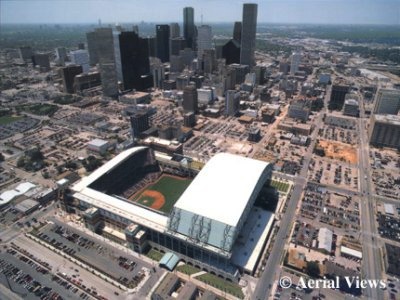
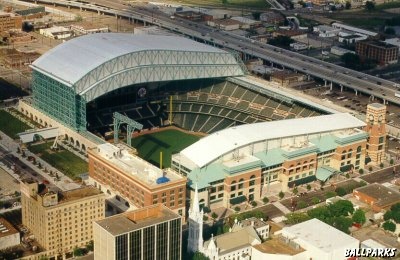
Minute Maid Park is in Downtown Houston. The mailing address is 501 Crawford Street. Parking is $15. METRORail to Convention District. Crawford Street bounds the left field side, Texas Avenue the 3rd base side, Hamilton Street the 1st base side and Congress Street the right field side. The ballpark points due north, but that won't matter, since its only "open" side, left field, has a window that doesn't face any neat-looking skyscrapers.
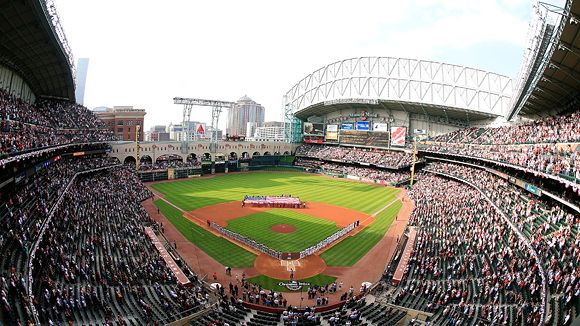
Unlike the Astrodome, "the Juice Box" has real grass. Also unlike its infamous predecessor, it is definitely a hitter's park. The left-field pole is just 315 feet from home plate, with the Crawford Boxes (named for the street) above. Left-center is 362, deep left-center is 404, center is 436 (the deepest current fence in MLB), right-center is 373, and the right-field pole is 326.
With roof open
Originally named Enron Field when it opened in 2000, the park was nicknamed Ten Run Field -- before Enron became the largest bankruptcy ever to that point, and Coca-Cola bought the naming rights and stuck the Minute Maid brand name, which it owns, on the stadium.
This change in the stadium name, but not in the propensity for offense, led Yankee broadcaster John Sterling, during an Interleague game there, to tell partner Charlie Steiner, "You know, Charlie, I understand that, at Minute Maid Park, the balls are juiced." To which Steiner said, "Ah, that's just pulp fiction."
With roof closed
Left field features a CITGO sign, but that and the 315-foot distance -- and the cheating -- are the only things that will remind anyone of Fenway Park in Boston. While a rail line does go past Fenway, the Red Sox don't incorporate that into the park. Here, they do, with an old-style steam locomotive chugging past for each Astro home run. It pulls a boxcar loaded with oranges, presumably for Minute Maid production.
The train, with the pre-2017 championship banners
The ballpark's longest home run is a 469-foot drive by Jake Marsinick on June 18, 2017. There's some dispute as to who hit the longest home run at the Astrodome, but it's usually credited to a 500-footer hit by Jimmy Wynn on April 12, 1970.
The home plate is the one used at the Astrodome, so the Astros have been using the same one since 1965. Center field features Tal's Hill, an incline in the mode of Cincinnati's old Crosley Field. It's named for Tal Smith, longtime Astro executive. And, like the pre-renovation old Yankee Stadium and Tiger Stadium in Detroit, the flagpole is on the field and in play. Above the Hill is the Phillips 66 Home Run Pump, a mockup of an old-style gasoline pump that displays how many Astro home runs have been hit there since the 2000 opening.
The foul poles have Chick-fil-A cows on them, reading "EAT MOR FOWL," as opposed to the chain's usual "EAT MOR CHIKN." When an Astro hits one of these "fowl poles" on the fly, every fan in attendance gets a coupon for a free chicken sandwich. Hunter Pence, now with the San Francisco Giants, was the first to hit the left-field pole, and former Met Kazuo Matsui was the first to hit the right-field pole.
The Houston College Classic is a baseball tournament that includes hometown schools the University of Houston and Rice University, and other schools, usually Texas schools. The ballpark has also hosted soccer, boxing and concerts.
Food. Being a "Wild West" city, you might expect Houston to have Western-themed stands with "real American food" at its ballpark. Being a Southern State, you might also expect to have barbecue. And you would be right on both counts. They have Tex-Mex food at Goya Latin Cafe and La Cantina at Section 119, El Real Fajita at 131, Kickin' Nachos at 114 and 427, Maverick Smokehouse at 124 and 410, Taqueria and Grille at 216, and Rosa's Cantina at 411 (almost certainly named for the place in the Marty Robbins song "El Paso," even if that is on the other side of the State).
They work the train theme with All Aboard at 109, Union Station at 113, Dining Car Grill at 125, Whistle Stop Libations at 218 and Chew Chew Express at 416.
There's also stands with baseball-themed names: Baseball Bar at 207 and Little Biggs Slider Cart at 111. Chinese food is at Larry's Big Bamboo at 118 and Little Bamboo at 422, and there are 5 Papa John's Pizza stands. And there are several Blue Bell Ice Cream stands.
According to
a recent Thrillist article, the best thing to eat at Minute Maid Park is the brisket at Texas Smoke, at 125 and 406. The company's owner, celebrity chef Bryan Caswell, is an Astros fan.
Team History Displays. The Astros, like the Mets, celebrated their 50th Anniversary season in 2012, so they now have plenty of history. However, also like the Mets, it's a very hit-and-miss history.
Stanchions representing their titles are on a light tower above the left field wall, next to the train: Their 2017 World Series win; their 2005 and 2019 Pennants; their NL Western Division titles of 1980 and '86; their NL Central Division titles of 1997, '98, '99 and 2001; and their 2018 and '21 AL Western Division titles.
The 2017 banner tends to stand out.
And not just because it was obtained by cheating.
Yes, I said it again.
The club's retired numbers crown the scoreboard in right field. Officially, there are 9 of them: 32, 1960s pitcher Jim Umbricht, who died of cancer while still a young player; 40, 1970s pitcher Don Wilson, who also died while still active; 24, 1960s-70s outfielder Jimmy Wynn; 25, 1970s outfielder Jose Cruz; 49, 1970s pitcher, 1990s manager, and on-again-off-again broadcaster Larry Dierker; 34, 1980s pitcher Nolan Ryan, a Houston-area native; 33, 1980s pitcher Mike Scott; and the 2 men who got the Astros through their 1990s and 2000s postseason berths, 5, 1st baseman Jeff Bagwell, and 7, 2nd baseman Craig Biggio.

The universally-retired 42 for Jackie Robinson, who was already elected to the Hall of Fame before the Astros ever played a game, is also on that wall. This is somewhat appropriate, seeing as how the Astros were the 1st MLB team to play in a former Confederate State, and putting his number with the Astros' retired numbers is an effective acknowledgment that the arrival of Robinson and other nonwhite players was a good thing.
Not on that wall, and not officially retired, but neither has it been reissued, is the 57 of 1990s pitcher Darryl Kile, who died while with the St. Louis Cardinals in 2002.
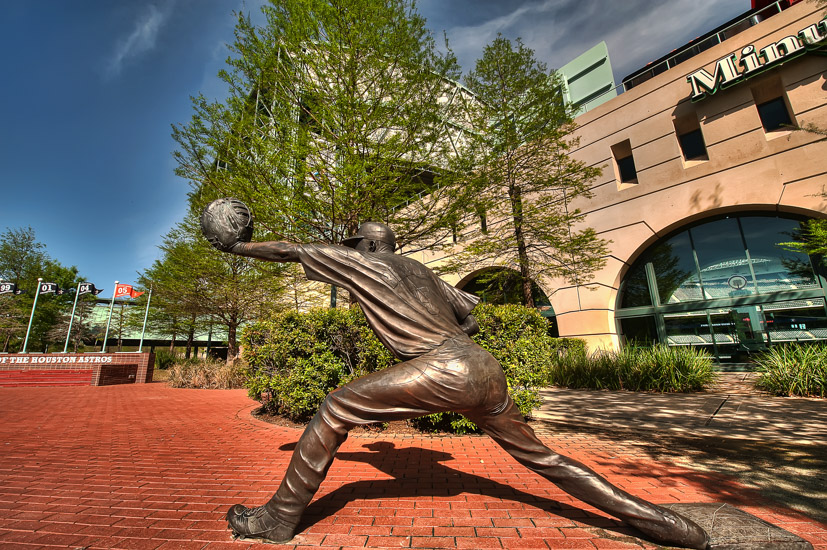
Statues of Bagwell and Biggio are located in the exterior of the ballpark, in a space known as The Plaza at Minute Maid Park. The Plaza also displays pennants for all Astros division and league championships, as well as several plaques to commemorate notable Astros and their achievements.Biggio and Bagwell were the 1st players elected to the Baseball Hall of Fame with Astro caps on their plaques. Also having played for the Astros and in the Hall are Nellie Fox, Robin Roberts, Eddie Mathews, Joe Morgan, Nolan Ryan, Don Sutton, Randy Johnson and Ivan Rodriguez. To this list can be added Leo Durocher, who ended his long in-uniform baseball career as the Astros' manager in 1972 and '73; and broadcasters Gene Elston and Milo Hamilton.
Of those, only Biggio, Bagwell, Morgan and Ryan were Astros more than just briefly, although Mathews hit his 500th career home run with him. Ryan was with the Astros when he pitched his 5th no-hitter, surpassed Walter Johnson's 3,508 strikeouts to become the all-time leader, and became the 1st pitcher to strike 4,000 batters out. As the 1969 Astros sang, to the tune of a Tom Lehrer song and as quoted by pitcher Jim Bouton in his book Ball Four, "It Makes a Fellow Proud to Be an Astro."
The Astros established a team Hall of Fame in 2019. Included are:
* From the 1960s: Morgan, Wynn, Umbricht, Wilson, Dierker, Elston, founding owner Roy Hofheinz, 3rd baseman Bob Aspromonte (a Brooklyn native whose 1971 tenure with the Mets made him the last active former Brooklyn Dodger), and executive Tal Smith.
* From the 1970s: Wynn, Wilson, Dierker, Elston, Hofheinz, Smith, Cruz, pitcher J.R. Richard (whose 1980 stroke cut short a likely Hall of Fame career and may have cost the Astros at least 1 title), pitcher Joe Niekro, center fielder César Cedeño, and 1st baseman Bob Watson.
* From the 1980 Division Champions: Dierker as a broadcaster, Elston, Smith, Cruz, Niekro, Cedeño, Ryan, and outfielder Terry Puhl.
* From the 1986 Division Champions: Dierker as a broadcaster, Elston, Smith, Cruz, Ryan, Scott, Puhl and Hamilton.
* From the 1997, '98, '99 and 2001 Division Champions: Dierker as manager, Smith, Hamilton, Bagwell, Biggio, 1st baseman Lance Berkman; and pitchers Shane Reynolds, Roy Oswalt and Billy Wagner.
* From the 2005 Pennant winners: Smith, Hamilton, Bagwell, Biggio, Berkman and Oswalt. No members of their 2015-present title area have yet been elected.
Bagwell, Biggio, Morgan (a Texas native), Mathews (a Texarkana native), Berkman (a New Braunfels native who attended Houston's Rice University), Ryan (an Alvin native), Roberts and Dierker have been elected to the Texas Sports Hall of Fame, which is located in Waco. So have 2004-06 Astros Roger Clemens, born in Ohio but grew up in the Houston suburbs with Ryan as his hero; and Andy Pettitte, born in Louisiana but grew up in the Houston suburbs with Clemens as his hero. So have 1960s infielder Pete Runnels (a Lufkin native) and 1960s scout Lee Ballanfant (a Waco native).
Ryan and Clemens with Ryan as his hero, were named to the Major League Baseball All-Century Team in 1999, although Clemens hadn't yet thrown a pitch for the Astros. That same year, they and Morgan were named to The Sporting News' 100 Greatest Baseball Players. In 2006, Astro fans chose Ryan for the DHL Hometown Heroes poll. In 2022, ESPN
named its 100 Greatest Baseball Players. Among players who played
significant time for the Astros, Clemens was ranked 17th, Morgan 37th, Ryan 42nd, and Justin Verlander 72nd. Neither Biggio nor Bagwell made that list.
The Astros started playing the Rangers in the regular season when Interleague Play began in 1997, and have played each other within the American League since 2013. Since 2001, the winner of the season's Lone Star Series has received the Silver Boot. The Rangers lead the all-time series, 125-111, and the seasons are evenly divided at 9-9, with 4 splits. But the Astros were the 1st of the 2 to win a Pennant, and the 1st to win a World Series. (The Astros' cheating worked; the Rangers' cheating, mostly steroids, not as well.)
Stuff. Minute Maid Park has a Team Store in the left field corner of the ballpark, selling standard team-store gear. This being Texas, cowboy-style hats with the team logo are available.
A 50th Anniversary (1962-2012) team video is available, and so is a CD of longtime Astro broadcaster Milo Hamilton (who is probably best known not for any of his Astros' calls but for calling Hank Aaron's 715th home run while with the Braves). And Major League Baseball Projections has released a commemorative DVD series about the 2017 World Championship.
As for books about the team, as you might have guessed, the World Series win, following a nasty hurricane, led to a commemorative book: Joe Holley has written
Hurricane Season: The Unforgettable Story of the 2017 Houston Astros and the Resilience of a City. Sara Gilbert (not the
Roseanne actress) has published a 50th Anniversary retrospective, with the not-very-imaginative title of
The Story of the Houston Astros. Jose De Jesus Ortiz and former Astro catcher Brad Ausmus commemorated the 2005 Pennant season with
Houston Astros: Armed and Dangerous.
During the Game. A recent
Thrillist article on "
Baseball's Most Intolerable Fans" ranked Astro fans 27th -- that is, the 4th most tolerable. Having played 56 seasons before winning a single World Series game has dampened the traditional Texas arrogance: As the article puts it:
Despite being Texans, and thus genetically predisposed to boasting and scorning other people's brisket, the fanbase that supports the Astros evokes many of the same feelings as the -- gasp -- Brewers fans: long suffering, and non-threatening to opposing fans.Winning it all has changed them. Like Red Sox fans, they either honestly believe their team didn't cheat, or that it was justified to counter their opponents' cheating.
If you were wearing Dallas Cowboy gear to a Houston Texans game, or Texas Longhorns gear to a Texas A&M Aggies game (or vice versa), you might be in trouble. But Astro fans aren't especially hostile to New Yorkers, so safety shouldn't be an issue. (Nor would it be if you were wearing Dallas Mavericks or San Antonio Spurs gear to a Houston Rockets game.)
None of these Astros-Yankees games will feature a promotion. This season, the Astros are wearing a 60th Anniversary patch on their uniforms.

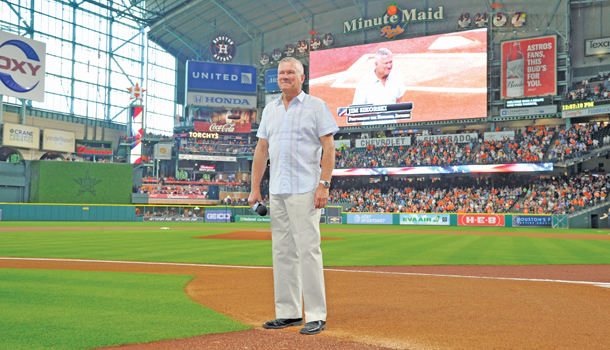
Jim Sikorski of the Houston Grand Opera has been the Astros' National Anthem singer since 1980 -- and has been openly gay almost the whole time, a rare thing in both Texas and baseball. Astro fans do not seem to have a problem with this.
Jim Sikorski
Their mascot is Orbit, a "little green man" alien, tying in with the Astrodome's space-age theme. When the new park opened, he was replaced with Junction Jack, a jackrabbit dressed in an old-time railroad engineer's uniform, tying in with the train theme. But fans wanted Orbit back, and in 2013, he returned and Jack was dumped.
Orbit is not touching Adrian Beltre.
During the 7th inning stretch, after playing "Take Me Out to the Ballgame," the Astros play that classic Texan song "Deep in the Heart of Texas." Their postgame victory song is "My Texas," by the Josh Abbot Band (featuring Pat Green).
After the Game. Houston is a comparatively low-crime city, and as long as you behave yourself, they'll probably behave themselves, win or lose.
Post-COVID, there appears to be no go-to bar for New Yorkers living in the Houston Area. Biggio's, a restaurant owned by the Astro legend, is at 1777 Walker Street, 3 blocks south of the ballpark. To the north, a block down Hamilton, at Franklin Street, is a place with a much better name: Joystix. Sadly (if you're looking to have drinks and fun after the game), this is a place that sells old pinball machines and video games, not a 1980s nostalgia place (which would tie in with the Astros' most successful period until 1997), not a combination 1980s-style mall (or beach boardwalk) arcade and modern bar. It's probably just as well: Can you imagine the combination of Pac-Man and beer (or worse, Missile Command and whiskey)?
If your visit to Houston is during the European soccer season, and you want to watch your favorite club play, the best place to do so is The Richmond Arms, 5920 Richmond Drive, 8 miles west of downtown. Bus 20 to Sage Road & San Felipe Road, then transfer to Bus 32 to Fountainview Drive at Richmond Drive.
Sidelights. On November 30, 2018,
Thrillist published a list of "
America's 25 Most Fun Cities," and Houston came in 18th.
Houston's sports history isn't all wrapped up in the Astrodome. There are other sites worth visiting.
In 1965, the Astrodome opened, and was nicknamed "The Eighth Wonder of the World." It sure didn't seem like an exaggeration at the time: The first roofed sports stadium in the world. (Supposedly, the Romans built stadia with canvas roofs, but that's hardly the same thing.)
The 1st game at the Astrodome was an exhibition game on April 9, 1965, between the Astros and the Yankees, who were about to begin their collapse from their Dynasty, although that wasn't clear yet. President Lyndon B. Johnson and First Lady Claudia "Lady Bird" Johnson, both Texans, were on hand, but it was Governor John Connally who threw out the first ball. Mickey Mantle hit the stadium's 1st home run, but the Astros won 2-1 in 10 innings. The Yankees would not play in Houston again until Interleague play, in 2003.
Three days later, on April 12, 1965, the 1st regular-season game was played, and the Astros lost 2-0 to the Philadelphia Phillies, thanks to a home run by Dick Allen (the 1st home run there that counted) and a shutout by Chris Short.
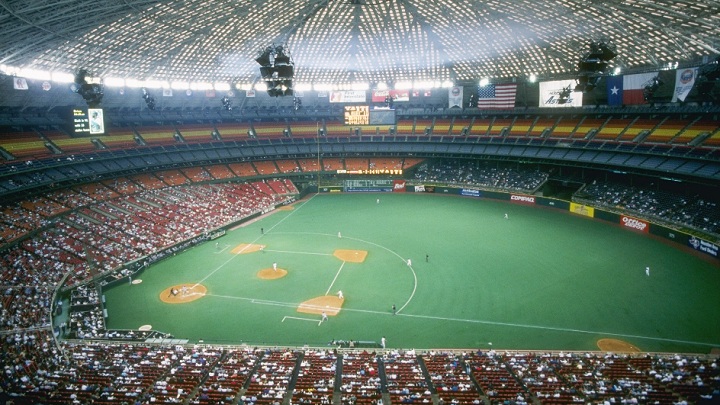
In the beginning, with skylights, real grass,
and the center field scoreboard, huge for its time.
Fielders lost the ball in the Sun due to the roof's skylights. So they were painted over. Then the grass died. So they contacts Monsanto, which had been experimenting with artificial grass. They called it ChemGrass. The Astros called it AstroTurf, installed in on March 19, 1966, and a legend was born.
Once, the Astrodome was flashy enough to be the site of movies like
The Bad News Bears in Breaking Training and
Murder at the World Series. Both were released in 1977. In the latter, the Astros, who had never yet gotten close to a Pennant, played the Series against the Oakland Athletics, who had just gotten fire-sold by owner Charlie Finley.
In the 1980s, with the famed scoreboard
removed for seating expansion
The Astros played there until 1999, and then moved into Enron Field/Minute Maid Park for the 2000 season. The AFL/NFL's Oilers played at the Astrodome from 1968 (thus becoming the 1st pro football team to play on artificial turf), to 1996, when they moved to Tennessee to become the Titans.

The Astrodome also hosted the legendary 1968 college basketball game between Number 1 UCLA (with Kareem Abdul-Jabbar, then still Lew Alcindor) and Number 2 University of Houston (whose Elvin Hayes led them to victory, before falling to UCLA in that year's Final Four), the 1971 Final Four (UCLA beating Villanova in the Final), and the cheese-tastic 1973 tennis match between Billie Jean King and Bobby Riggs, the "Battle of the Sexes."
The Astrodome hosted 3 fights for the Heavyweight Champion of the World, with the defending Champion winning all 3 by knockout: Muhammad Ali over Cleveland Williams on November 14, 1966; Ali over Ernie Terrell on February 6, 1967; and Larry Holmes over Randall "Tex" Cobb on November 26, 1982.
In 1971, Evel Knievel sold the place out on back-to-back nights, jumping his motorcycle over 13 cars both times. He talked about jumping over the Dome itself, but that was one idiotic idea that was never attempted.
The Dome's 1st concert was on December 17, 1965. The Supremes sang. As the opening act. For Judy Garland, who got paid $43,000 for one show -- about $400,000 in today's money. She sang 13 songs in 40 minutes, concluding with, of course, "Over the Rainbow." This was before the Astros adopted the Rainbow Brite uniforms.
Elvis Presley sang there on February 27, 28 and March 1, 1970 and on March 3, 1974. It hosted Selena's last big concert before her murder in 1995, and when Jennifer Lopez starred in the film
Selena, it was used for the re-creation of that concert.
In 2004, the same year NRG (then Reliant) Stadium hosted the Super Bowl (which was won by... Janet Jackson, I think), the Astrodome was used to film a high school football playoff for the film version of
Friday Night Lights, and the old Astros 1980 and 1986 division title banners can be clearly seen.
In 2002, the new NFL team, the Houston Texans, began play next-door to the Astrodome, at NRG Stadium, which, like Minute Maid Park, has a retractable roof. Suddenly, the mostly-vacant Astrodome seemed, as one writer put it, like a relic of a future that never came to be. (This same writer said the same thing of Shea Stadium and, across Roosevelt Avenue, the surviving structures of the 1964 World's Fair.)
Today, though, the Astrodome seems, like the Republican Party that held a ridiculously bigoted Convention there in 1992, stuck in the past, and not just because they renominated failed President George H.W. Bush. The former Eighth Wonder of the World is now nicknamed the Lonely Landmark, and while it served as a shelter for people displaced from New Orleans by Hurricane Katrina in 2005, since 2008, when it was hit with numerous code violations, only maintenance workers and security guards have been allowed to enter.
In 2019, the Harris County Commissioners, the Dome's overseers, approved the Astrodome Revitalization Project, which would have raised the stadium's floor to use the space underneath as a huge parking garage; and, later in the year, scrapped the plan. There is now no plan for what to do with the Astrodome.
The former Eighth Wonder of the World, dwarfed by its replacement
NRG Stadium hosted the Final Four in 2011 (Connecticut beating Butler in the Final), and in 2016 (Villanova beating North Carolina). In 2005, when Hurricane Katrina hit New Orleans and rendered the Superdome unusable for that season, it hosted the Bayou Classic, the annual Thanksgiving Saturday football game and battle of the bands between Louisiana's Grambling State and Southern University.
NRG Stadium hosted the Final Four in 2011 (Connecticut beating Butler in the Final), and earlier this year (Villanova beating North Carolina). It hosted Super Bowl LI in 2017, with (take your pick: The Atlanta Falcons choking, or the New England Patriots cheating). It hosted 4 games each in the CONCACAF Gold Cups of 2005 and 2007, and 2 games each in that tournament in 2009, 2011, 2019 and 2021.
It will host the 2023 NCAA Final Four and the 2023-24 College Football National Championship Game, and it has been approved by FIFA to be one of the host venues for the 2026 World Cup.
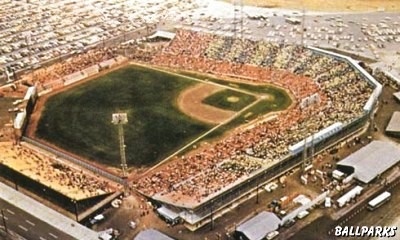
It was built roughly on the site of Colt Stadium, which was the baseball team's home in their 1st 3 seasons, 1962, '63 and '64, when they were known as the Houston Colt .45's (spelled with the apostrophe), before moving into the dome and changing the name of the team. The climate-controlled stadium was necessary because of not just the heat and the humidity, but because of the mosquitoes.
Later, seeing the artificial turf that was laid in the Astrodome for 1966 after the grass died in the first season, due to the skylights in the dome having to be painted due to the players losing the ball in the sun, Koufax, he of the mosquito quip, said, "I was one of those guys who pitched without a cup. I wouldn't do it on this stuff." And Dick Allen of the Philadelphia Phillies, looking at the first artificial field in baseball history, said, "If a horse can't eat it, I don't want to play on it."
The Astrodome hosted a 1988 match between the national soccer teams of the U.S. and Ecuador, which Ecuador won. NRG Stadium has hosted 3 such matches, a 2008 draw with Mexico, a 2011 win over Panama, and a 2016 loss to Argentina in the Copa America. The Mexico team has made it a home-away-from-home, playing several matches there.
The NRG complex, including the Astrodome, is at 8400 Kirby Drive at NRG Parkway. METRORail to Stadium Park/Astrodome station.
The NBA's Houston Rockets played at the Summit, later known as the Compaq Center, from 1975 to 2003. Elvis sang at The Summit on August 28, 1976. It's been converted into the Lakewood Church Central Campus, a megachurch presided over by Dr. Joel Osteen. 3700 Southwest Freeway at Timmons Lane. Number 25 bus.
The Houston Aeros, with Gordie Howe and his sons Mark and Marty, won the World Hockey Association championships of 1974 and 1975, while playing at the Sam Houston Coliseum, before moving into the Summit in 1975 and folding in 1978. Elvis sang there on October 13, 1956, and the Beatles played there on August 19, 1965. It was built in 1937 and demolished in 1998.
It replaced Sam Houston Hall, where the 1928 Democratic Convention nominated Governor Alfred E. Smith of New York, who thus became the 1st Catholic nominated for President by a major party. The Hobby Center for the Performing Arts is now on the site. 801 Bagby Street, at Rusk Street, downtown. METRORail to Theater District station.
The nearest NHL team to Houston is the Dallas Stars, 242 miles away. If Houston had an NHL team, its metropolitan area would rank 10th in population in the NHL.
The Houston Oilers played at Jeppesen Stadium from 1960 to 1964. They won the 1960 AFL Championship Game there, won the 1961 title game on the road, and lost the 1962 title game there -- and, as the Oilers and the Tennessee Titans, haven't gone as far as the rules allowed them to since 1961.
Built in 1942, it became Robertson Stadium, and was the former home of the University of Houston football team and the former home of MLS' Houston Dynamo. The new UH football facility, TDECU Stadium, has been built at the site. 3874 Holman Street at Cullen Blvd. METRORail to Robertson Stadium/UH/TSU station.
The Dynamo have moved to PNC Stadium (formerly BBVA Compass Stadium), at 2200 Texas Avenue at Dowling Street. The NWSL's Houston Dash have played there since their 2014 inception. Within walking distance of downtown. It is also the home field of the football team at Texas Southern University, which won the National Championship of black college football in 1952 and 2010. On January 29, 2013, it hosted its 1st U.S. national team match, a 0-0 draw with Canada.
The USMNT played there again on March 26, 2019, a 1-1 draw with Chile. The U.S. women's team beat Mexico 6-2 there on April 8, 2018. The USMNT played there again on March 26, 2019, a 1-1 draw in a friendly with Chile. It hosted 6 games of the 2021 CONCACAF Gold Cup.
The Oilers played the 1965, '66 and '67 seasons at Rice Stadium, home of Rice University. Although built in 1950 and probably already obsolete, it seated a lot more people than did the Astrodome, and so Super Bowl VIII was played there instead of the Astrodome in January 1974, and the Miami Dolphins won it -- and haven't won a Super Bowl since. It has been significantly renovated, and Rice still uses it. University Blvd. at Greenbriar Street, although the mailing address is 6100 S. Main Street. Number 700 bus.
Before there were the Astros, or even the Colt .45's, there were the Houston Buffaloes. The Buffs played at Buffalo Stadium, a.k.a. Buff Stadium, for most of their history, from 1928 to 1961, when the Colt .45's made them obsolete.
They were a farm team of the St. Louis Cardinals, and as a result, in its last years Buff Stadium was renamed Busch Stadium. The Cardinal teams of the 1930s that would be known as the "Gashouse Gang" first came together in Houston, with Dizzy and Daffy Dean, Joe Medwick, Pepper Martin and Enos Slaughter. Later Buff stars included Cleveland Indians 3rd baseman Al Rosen, Pittsburgh Pirates pitcher Wilmer "Vinegar Bend" Mizell, Negro League legend Willard Brown, Cardinal MVP Ken Boyer, and Phillies shortstop Ruben Amaro Sr. (father of later GM Ruben Amaro Jr.).
Wanting to lure in more customers, but also to beat the infamous Houston heat, lights were installed in 1930, 5 years before any major league park had them. The Buffs won 8 Texas League Pennants: 1928, 1931, 1940, 1947, 1951, 1954, 1956 and 1957. A martial arts school is on the site now. 1600 Cullen Blvd., at Leeland Street, about 2 1/2 miles southeast of downtown. Number 20 bus.
There's another notable sports site in Houston: The U.S. Military Entry Processing Station, in the Customs House, where Muhammad Ali, then living and training in Houston, had to report to fulfill his draft obligation. He did report there, on April 28, 1967, and refused to be drafted. (To be fair, they did call his birth name, Cassius Clay, not his legal name, Muhammad Ali.) Ali was convicted of draft evasion and stripped of the Heavyweight Title. He stayed out of prison on appeal, and the case went all the way to the Supreme Court, which overturned the conviction.
The Customs House is still standing, and still used in part by the U.S. Department of Defense. 701 San Jacinto Street. Central Station on METRORail.
In addition to the preceding, Elvis sang at Hofheinz Pavilion on November 12, 1971; and June 4 and 5, 1975. He also sang at the City Auditorium on October 8, 1955 and April 21, 1956. It's better known as the venue where R&B singer Johnny Ace mistakenly shot himself before a show on Christmas Day, December 25, 1954. The Jones Hall for the Performing Arts replaced it in 1966. 615 Louisiana Street at Capitol Street, downtown.
Also, early in his career, Elvis sang in Houston at the Paladium Club (8100 S. Main Street, near the Astrocomplex) on November 26, 27 and 28, 1954; Cook's Hoedown (603 Capitol Street, around the corner from Jones Hall) on November 27 and December 28, 1954, and April 24 and August 7, 1955; Magnolia Gardens (12044 Riverside Street, no public transit) on April 24, May 22, June 19 and August 7, 1955; and Eagles Hall at 2204 Louisiana Street on January 1 and March 19, 1955 (2204 Louisiana Street, downtown). All of these have since been demolished.
Elvis sang near the University of Texas campus in Austin, 160 miles to the northwest, at Dessau Hall on March 17, 1955, the Sportscenter on August 25, 1955, the Skyline Club on January 18, 1956, and the Municipal Auditorium on March 28, 1977. And he sang near the Texas A&M campus, 100 miles to the northwest, at the Rodeo Grounds in Bryan on August 23, 1955 and the G. Rolle White Coliseum in College Station on October 3, 1955;
Elvis also sang in South Texas at the City Auditorium in Beaumont, 85 miles to the northeast, on June 20 and 21, 1955 and January 17, 1956; at the football stadium at Conroe High School, 40 miles to the north, on August 24, 1955; in Corpus Christi, 200 miles to the southwest, at the Hoedown Club on July 3, 1955 and the Memorial Coliseum on April 16, 1956; in Galveston, 50 miles to the southeast, at the City Auditorium on January 16, 1956; at the baseball field in Gonzales, 130 miles to the west, on August 26, 1955; at Woodrow Wilson High School in Port Arthur, 90 miles to the east on November 25, 1955; and at Southwest Texas State University (LBJ's alma mater, now "Texas State"), 165 miles to the west, on October 6, 1955.
There are other places that might be considered "South Texas" where he sang, I include them with "West Texas" when I do this for the San Antonio Spurs.
The tallest building in Houston, and in all of Texas, is the JPMorgan Chase Tower, formerly the Texas Commerce Tower. It was built in 1982 at 600 Travis Street at Texas Avenue, downtown, and stands 1,002 feet tall, rising 75 stories above the concrete over the bayou. It is the tallest 5-sided building in the world.
Houston's version of New York's American Museum of Natural History is the Houston Museum of Natural Science, in Hermann Park, at Main Street and Hermann Park Drive. The Houston Museum of Fine Arts is at 1001 Bissonnet Street, just 5 blocks away. Both can be reached by METRORail via the Museum District station.
Of course, the name "Houston" is most connected with two things: Its namesake, the legendary Senator, Governor and war hero Sam Houston, and the Johnson Space Center, the NASA control center named after President Lyndon B. Johnson, who, as Senate Majority Leader, wrote the bill creating NASA and the Space Center, because he thought it would bring a lot of jobs and money to Houston (and he was right).
Most historic sites relating to Sam, however, are not in the city that bears his name. As for reaching the Johnson Space Center, it's at 2101 NASA Parkway and Saturn Lane. The Number 249 bus goes there, so if you don't have a car, Houston, you won't have a problem.
George H.W. Bush and his wife Barbara Bush lived in Houston after his Presidency. Both died in 2018, and were buried at the George Bush Presidential Library, at Texas A&M University, 100 miles away in College Station. As a former baseball player, Bush is the only President so far who had his Library designed by HOK, designer of several sports facilities including our own MetLife Stadium.
The Alley Theatre, downtown at 615 Texas Avenue, opened in 1968, and in 1976 hosted the Vice Presidential debate between Senators Walter Mondale and Bob Dole. This is where Dole named World War I, World War II, and the Korean and Vietnam Wars as "all Democrat wars" -- forgetting that the Republicans wanted America to get into all but World War II, and didn't want that one because they liked the Nazis' anti-union status; and that it was actually the Republicans who got us into Vietnam.
There have been a few TV shows set in Houston, but the only one that lasted was Reba, starring country singer Reba McIntire. But it was filmed in Los Angeles, so if you're a fan, you won't find the house in Houston.
Congressman Matthew Santos, a Houston native played by Jimmy Smits, was inaugurated as President on the last episode of The West Wing. Of interest to me was Outlaws, in which a sheriff tried to capture his former gang, but all 5 of them were transported from 1899 to 1986. Realizing they needed each other, they teamed up, and, with the gold that was transported with them, they bought what they needed and formed a private detective agency. It lasted just 1 season.
Films set in Houston, in addition to the sports-themed ones, include Brewster McCloud (which also used the Astrodome), Logan's Run (which used the Houston Hyatt Regency for some scenes),
Telefon (set there but filmed in California), Terms of Endearment, Reality Bites, and, perhaps most iconically, Urban Cowboy.
*
Houston can be hot, but it's a good sports town, and, best of all, it's not Dallas. So there can be a good old time in the hot town tonight.




/arc-anglerfish-arc2-prod-pmn.s3.amazonaws.com/public/ML5PFCXQIZGDTK56NYNH57MSJ4.jpg)

/cdn.vox-cdn.com/uploads/chorus_asset/file/9553611/usa_today_10330016.jpg)