Showing posts with label manhattan. Show all posts

Sunday, September 20, 2026

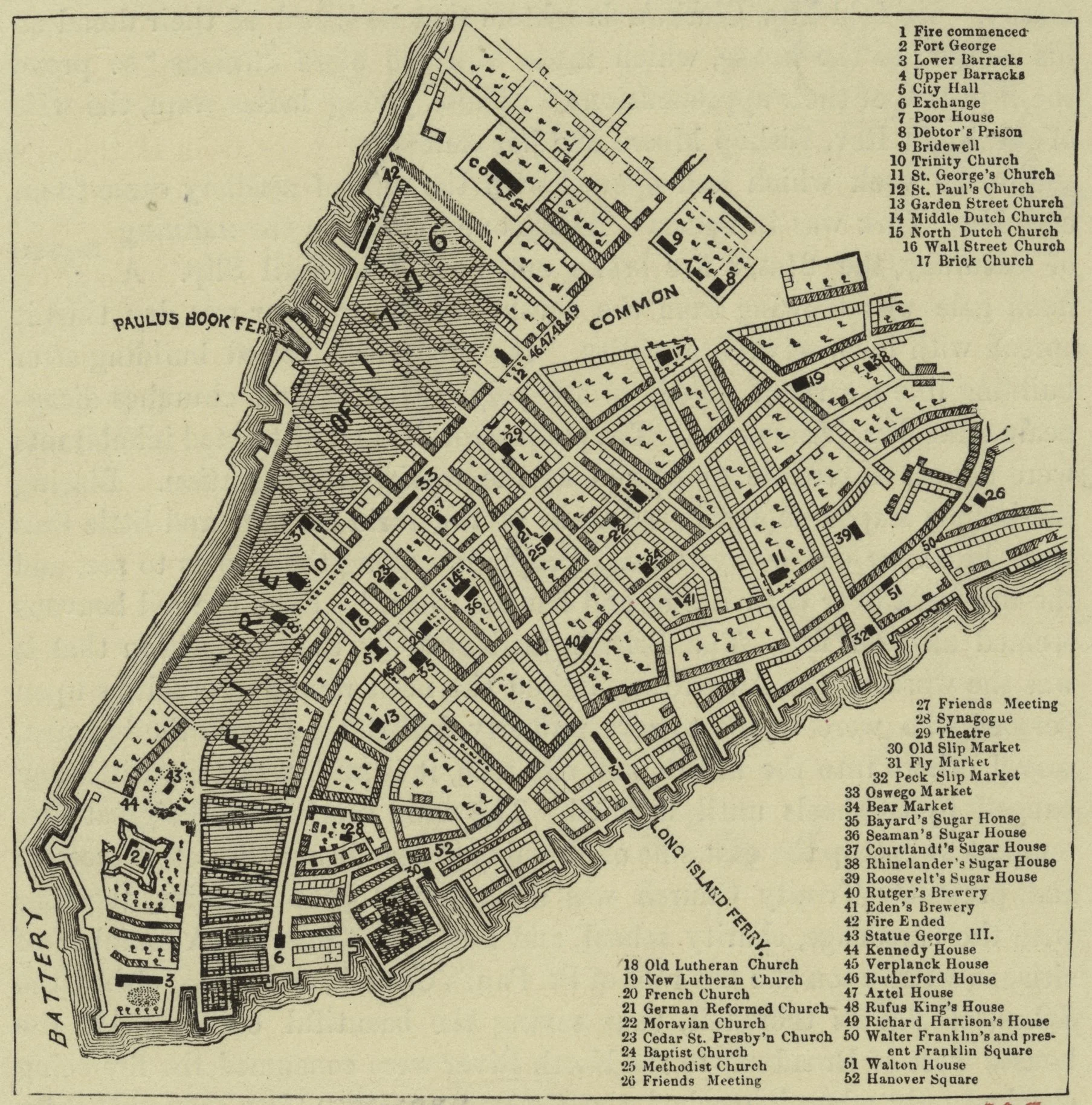
September 20, 1776: The Great Fire of New York


Have you ever wondered why Boston, Philadelphia, Baltimore, and even older New Jersey cities like Newark, Elizabeth, Perth Amboy and Trenton have building that predate American independence in 1776, but there aren't too many of them in New York? And why even the ones that are in the City aren't in Manhattan? (Fraunces Tavern, built in 1719, is one of the exceptions.)

This is why:

September 20, 1776, 250 years ago: The Great Fire of New York was set. It didn't "start," it "was set."

It was a bad Summer for the brand-new United States of America. The British Army was attacking the Continental Army, forerunner of the United States Army, commanded by General George Washington. On August 27, Washington's troops were defeated in Brooklyn in what became known as the Battle of Long Island. A dense fog enabled them to escape across the East River to Manhattan, in a maneuver that, in his book 1776, historian David McCullough called "America's Dunkirk."
On September 11, a date that was fraught with history, especially in America, well before 2001, a peace conference was held on Staten Island, including the British naval commander, Admiral Richard Howe, brother of their army commander, General William Howe; and American representatives including Benjamin Franklin and John Adams. It failed. A civilian exodus from the City began.

On September 15, British troops landed at Kips Bay, north of what was then the limits of New York City, roughly at what is now East 25th Street. On September 16, the Battle of Harlem Heights was fought, roughly where Riverside Church is now, at 120th Street at Riverside Drive. The Continentals pushed the British back.

On September 20, the British decided to smoke out whatever resistance remained. A fire was set at the Fighting Cocks Tavern, near Whitehall Slip, at the southern tip of Manhattan Island, roughly where Whitehall Ferry Terminal is now. The fire destroyed from 10 to 25 percent of the buildings in the City, while some unaffected parts of the City were plundered. It burned until the next morning.

On September 22, the British executed an American spy, Nathan Hale, a 21-year-old native of Coventry, Connecticut. Captain John Montresor, a British officer who was present at the hanging, reported that Hale's last words were, "I only regret that I have but one life to lose for my country."
On October 28, Washington lost the Battle of White Plains. On November 16, defeat in the Battle of Fort Washington, a location named for him, meant that he had to get his troops across the Hudson River, and evacuate New York, roughly at the point where the bridge named for him now stands. They made their way across New Jersey, and across the Delaware River into Pennsylvania. As Thomas Paine, who was with them, wrote in his pamphlet The American Crisis, "These are the times that try men's souls."

Washington needed a miracle. On December 25, 1776, he made his own Christmas miracle.

It wasn't until November 25, 1783, after the Treaty of Paris recognizing American independence was signed and copies reached American shores, that the British Army ended their occupation of New York City. On December 4, Washington resigned his commission, and said goodbye to his troops at the oldest remaining building in Manhattan, Fraunces Tavern, which survived the fire, and has survived others over the years.
New York City was rebuilt. It is always being rebuilt. Old buildings -- but not pre-Revolution old -- are always being replaced by new ones. Americans claim to have respect for their heritage, but we tend not to have much respect for our physical history.

I am all for America in general, and New York in particular, looking forward. But you can't know where you're going unless you know where you've been.

Sunday, May 24, 2026

May 24, 1626: Peter Minuit Buys Manhattan

May 24, 1626, 400 years ago: Peter Minuit buys Manhattan Island from the native Indians for $24. Or so the legend says.

The truth is a bit more complicated.

Henry Hudson, an English explorer, had sailed up the Hudson River on September 2, 1609, claiming a large swath of land for the Dutch Republic. The Hudson Valley, up to present-day Albany and Schenectady, in what became the State of New York; Long Island, including what is now the Boroughs of Brooklyn and Queens, and Nassau County, named for the ruling house of the Netherlands; what is now the western half of Connecticut; the entirety of New Jersey; much of southeastern Pennsylvania, including what became Philadelphia; northernmost Delaware; and the northeastern corner of Maryland. This colony became known as New Netherland. Its capital, occupying the southern tip of Manhattan Island, was named New Amsterdam, after the mother country's capital.
"Manhattan" was a word from the language of the Native Americans living there, the Lenape tribe, meaning "the place where we get bows" -- in other words, the wood to make bows for arrows. One of the many legends of early New York that has proven to not be true is that it was originally "Manahatta," meaning "place of many hills," although the island does have many hills.

Peter Minuit was born in Wesel, Germany between 1580 and 1585 into a Calvinist family that had moved from the city of Tournai, presently part of Wallonia in Belgium, then controlled by Spain, in order to avoid Spanish Catholic authorities, who were not favorably disposed toward Protestants. Minuit married Gertrude Raedts in 1613. She was from a wealthy family, and she probably helped him establish himself as a broker.

Minuit joined the Dutch West India Company, and was sent with his family to New Netherland in 1625 to search for tradable goods other than the animal pelts that then were the major product coming from New Netherland. He returned in the same year, and in 1626 was appointed the new director of New Netherland. He sailed to North America and arrived in the colony on May 4, 1626.

He is credited with purchasing the island of Manhattan, from Native Americans in exchange for traded goods valued at 60 guilders. That figure came from a letter by a representative of the Dutch States-General and member of the board of the Dutch West India Company, Pieter Janszoon Schagen, to the States-General in November 1626. In 1844, New York historian John Romeyn Brodhead converted the figure of Fl 60 (or 60 guilders) to US$24. By 2006, 60 guilders in 1626 was worth approximately $1,000 in current dollars, according to the Institute for Social History of Amsterdam.

The original inhabitants of the area were unfamiliar with the European notions and definitions of ownership rights. For the Indians, water, air and land could not be traded; therefore, it is likely that both parties probably went home with totally different interpretations of the sales agreement. The Lenape probably thought they were the ones who got the great deal.

A contemporary purchase of rights in nearby Staten Island, to which Minuit also was party, involved duffel cloth, iron kettles, axe heads, hoes (garden tools -- the prostitutes came later), wampum, drilling awls, "Jew's harps" and "diverse other wares."

In 1632, the Dutch West India Company recalled Governor Minuit, essentially firing him for corruption. So political corruption in New York City goes back that far. He left the Netherlands, and in 1637, having made a deal with Sweden, he sailed up the Delaware River, and established the colony of New Sweden.

The following year, he was at sea, and his ship was lost in a hurricane. Without his guidance, New Sweden never had a chance, as the mother country was losing what became known as the Thirty Years War, ending its status as a European power. In 1655, the Dutch reclaimed New Sweden as part of New Netherland.

In 1664, as part of the Anglo-Dutch War, England conquered New Amsterdam without firing a shot. Although the Netherlands ended up winning the war, England got to keep New Netherland. It renamed both the colony and its capital city New York, after the Duke of York, brother of King Charles II. He later became King James II.

Monday, June 16, 2025

June 16, 1965: Bob Dylan Records "Like a Rolling Stone"

June 16, 1965: A planned anti-war protest at The Pentagon becomes a "teach-in," with demonstrators distributing 50,000 leaflets in and around the building.

On the same day, Bob Dylan records the familiar version of "Like a Rolling Stone," at Studio A at Columbia Records, at 799 7th Avenue at 52nd Street in New York. He does not one take like the legend says, but 15 takes, in addition to one done the day before. The 4th take is the one we all know.

He had already written and recorded these songs: "Blowin' in the Wind," "Masters of War," "A Hard Rain's a-Gonna Fall," "Don't Think Twice, It's All Right," "The Times They Are a-Changin'," "With God On Our Side," "When the Ship Comes In," "My Back Pages," "Subterranean Homesick Blues," "Maggie's Farm," "Mr. Tambourine Man," "It's Alright, Ma (I'm Only Bleeding)" and "It's All Over Now, Baby Blue." All of those were done before his 24th birthday, on May 24, 1965. Now, he had written and recorded "Like a Rolling Stone."

Like some of Bob's other songs from around the same time -- especially "Maggie's Farm" and "It's All Over Now, Baby Blue," and the subsequent "Ballad of a Thin Man" -- it was a message to the people who were upset with him for "going electric," seemingly "betraying folk music" and its "movement." They never understood that he was a rocker at heart, loving Elvis Presley and Little Richard as much as he did Woody Guthrie and Pete Seeger.

In spite of being a full 6 minutes long, the song reached Number 2 on Billboard magazine's Hot 100 chart. Keeping it out of the Number 1 slot: "I Got You Babe" by Sonny & Cher. Cher made it up to Bob by making his song "All I Really Want to Do" her 1st solo hit single.

In 1967, the magazine Rolling Stone was founded, named for this song. The band The Rolling Stones was named after the Muddy Waters song "Rollin' Stone," which Dylan may have named his song after. There was, of course, the previous proverb: "A rolling stone gathers no moss."

In 2004, Rolling Stone put "Like a Rolling Stone" at Number 1 on their list of the 500 Greatest Songs of All Time. They occasionally revive the list. In 2010, they kept it at Number 1. In 2021, they put it at Number 4, behind Aretha Franklin's version of Otis Redding's "Respect," Public Enemy's "Fight the Power," and Sam Cooke's "A Change Is Gonna Come."

Bass guitarist Joe Macho (who also recorded under the name Joe Mack) died in 1977, producer Tom Wilson in 1978, guitarist Mike Bloomfield in 1981, pianist Paul Griffin in 2000, drummer Bobby Gregg in 2014, guitarist and tambourine player Bruce Langhorne in 2017, and pianist Frank Owens in 2023.

The other musicians on this recording are still alive: Organist Al Kooper, guitarist Al Gorgoni, and, of course, guitarist, harmonica player and singer Bob Dylan. There were no backup singers.

Saturday, August 31, 2024

Major League Distances from Ivy League Cities

* Dartmouth College, Hanover, New Hampshire. Red Sox, Patriots, Celtics, Red Sox, Revolution.
MLB: 127 to Boston Red Sox.
NFL: 151 to New England Patriots.
NBA: 125 to Boston Celtics.
NHL: 125 to Boston Bruins.
MLS: 151 to New England Revolution.

* Harvard University, Cambridge, Massachusetts. Red Sox, Patriots, Celtics, Red Sox, Revolution.
MLB: 3 to Boston Red Sox.
NFL: 22 to New England Patriots.
NBA: 3 to Boston Celtics.
NHL: 3 to Boston Bruins.
MLS: 22 to New England Revolution.

* Brown University, Providence, Rhode Island. Red Sox, Patriots, Celtics, Red Sox, Revolution.
MLB: 41 to Boston Red Sox.
NFL: 21 to New England Patriots.
NBA: 41 to Boston Celtics.
NHL: 41 to Boston Bruins.
MLS: 21 to New England Revolution.

* Yale University, New Haven, Connecticut. Mets, Giants, Knicks, Islanders, NYCFC.
MLB: 70 to New York Mets, 73 to New York Yankees, 135 to Boston Red Sox.
NFL: 83 to New York Giants, 83 to New York Jets, 126 to New England Patriots.
NBA: 80 to New York Knicks, 83 to Brooklyn Nets, 138 to Boston Celtics.
NHL: 77 to New York Islanders, 80 to New York Rangers, 90 to New Jersey Devils, 138 to Boston Bruins.
MLS: 73 to New York City FC, 89 to New York Red Bulls, 126 to New England Revolution.

* Columbia University, New York, New York. Yankees, Giants, Knicks, Rangers, NYCFC.
MLB: 3 to New York Yankees, 9 to New York Mets.
NFL: 14 to New York Giants, 14 to New York Jets.
NBA: 5 to New York Knicks, 10 to Brooklyn Nets.
NHL: 5 to New York Rangers, 18 to New Jersey Devils, 19 to New York Islanders.
MLS: 3 to New York City FC, 17 to New York Red Bulls.

* Princeton University, Princeton, New Jersey. Phillies, Eagles, 76ers, Devils, Red Bulls.
MLB: 45 to Philadelphia Phillies, 59 to New York Yankees, 62 to New York Mets.
NFL: 45 to Philadelphia Eagles, 48 to New York Giants, 48 to New York Jets.
NBA: 45 to Philadelphia 76ers, 51 to Brooklyn Nets, 52 to New York Knicks.
NHL: 42 to New Jersey Devils, 45 to Philadelphia Flyers, 52 to New York Rangers, 69 to New York Islanders.
MLS: 44 to New York Red Bulls, 58 to Philadelphia Union, 59 to New York City FC.

* University of Pennsylvania, Philadelphia, Pennsylvania. Phillies, Eagles, 76ers, Flyers, Union.
MLB: 5 to Philadelphia Phillies.
NFL: 5 to Philadelphia Eagles.
NBA: 5 to Philadelphia 76ers
NHL: 5 to Philadelphia Flyers.
MLS: 16 to Philadelphia Union.

* Cornell University, Ithaca, New York. Yankees, Bills, Knicks, Sabres, Red Bulls.
MLB: 225 to New York Yankees, 233 to New York Mets, 246 to Toronto Blue Jays.
NFL: 157 to Buffalo Bills, 211 to Hamilton Tiger-Cats, 217 to New York Giants, 217 to New York Jets, 244 to Toronto Argonauts.
NBA: 224 to New York Knicks, 224 to Brooklyn Nets, 247 to Toronto Raptors.
NHL: 153 to Buffalo Sabres, 213 to New Jersey Devils, 224 to New York Rangers, 240 to New York Islanders, 247 to Toronto Maple Leafs.
MLS: 213 to New York Red Bulls, 225 to New York City FC, 244 to Toronto FC.

Saturday, October 28, 2023

October 28, 1963: The Demolition of the Old Penn Station

October 28, 1963, 60 years ago: Demolition begins on the original Pennsylvania Station, built in 1910 between 31st and 33rd Streets, and 7th and 8th Avenues in Midtown Manhattan. Since most of the station's operations were underground, there wasn't much disruption of service.

By this point, the most beloved train station in America didn't look so good. That photo above is not colorized: The marble had been stained by over half a century of pollution. And with the decline in train travel compared to the rise of driving and flying, a train station this grand was no longer necessary. The successor station would be utilitarian at best -- and a commuter's nightmare at worse.

When the Pennsylvania Plaza complex opened in 1968, including the new Madison Square Garden above it, Penn Station had become completely subterranean, and it went from being one of the most beloved transit centers in America to one of the most hated.

But the original station's destruction spurred the landmark preservation movement in New York City, which helped to save Grand Central Terminal in the 1970s, Carnegie Hall in the 1980s, and so many other great buildings. Still, not every great building was saved: Once Lincoln Center opened, the original Metropolitan Opera House was demolished in 1967, and a boxy skyscraper was put up in its place.

Sunday, October 3, 2021

October 3, 1951: The Shot Heard 'Round the World

October 3, 1951, 70 years ago: Along with the Bucky Dent Game of 1978, this may be the most written-about single game in the history of baseball. And if you have to ask why, then you don't know the history of baseball.

The New York Gothams began play in the National League in 1883. In 1886, after a particularly rousing victory, their manager, Jim Mutrie, called them "my big boys, my giants," and they were the New York Giants from then on. In 1925, a football team would be named after them, and they still use that name.

Their first home had been a polo field in what became known as the East Harlem section of Manhattan. In 1890, they moved to 155th Street and 8th Avenue, where Harlem meets Washington Heights, with a cliff called Coogan's Bluff overlooking it. The stadiums that would be built there, first the one, then another on the same site after a 1911 fire, would carry the name "the Polo Grounds" from their previous home, even though polo was one of the few outdoor sports capable of being played outdoors that the place never hosted.

Up until 1898, New York and Brooklyn were separate cities. In 1883, a team was founded in the American Association. It would eventually become known as the Trolley Dodgers, due to Brooklyn being covered with trolley lines and locals having to dodge them. Eventually, this was shortened to "Dodgers."

In 1913, their owner, Charles Ebbets, built a ballpark on a spot near Prospect Park, where the neighborhoods of Bedford-Stuyvesant, Crown Heights and Flatbush come together. Someone suggested he name it for himself, and Ebbets Field was born.

The separate cities of New York and Brooklyn, and after 1898 the Boroughs of Manhattan and Brooklyn, developed a rivalry above and beyond baseball. But the rivalry between the Giants and the Dodgers was nasty, even more so than the one that eventually developed between the 3rd team established in New York, the American League's Yankees, and the Boston Red Sox.

After all, not only were the Polo Grounds and Ebbets Field just 13 miles apart, but, with the 154-game schedule of the time, they played each other 22 times a year. Like the old saying goes, "Familiarity breeds contempt." As Keith Jackson would later say of certain college football rivalries, "These two teams just don't like each other." And the fans, who had to live together in the City, and in the nearby suburbs, didn't like each other, either.

The Giants always had money, and the Dodgers didn't. The Giants won the Pennant in 1904, 1905, 1911, 1912, 1913, 1917, 1921, 1922, 1923, 1924, 1933, 1936 and 1937; and the World Series in 1905, 1921, 1922 and 1933. The Dodgers didn't win nearly as much: The Pennant in 1916 and 1920.

Because of a messy divorce, Charles Ebbets died broke in 1925. At his rainy funeral, another part-owner caught a cold and, in those pre-antibiotic days, developed pneumonia and died. As if the team's finances weren't precarious enough, the Great Depression came. Eventually, one-quarter ownership of the team came into possession of a bank, the Brooklyn Trust.

In 1934, the Giants were leading the NL, and, in a radio interview, someone asked Bill Terry, the Giants' manager and 1st baseman, about the upcoming series with Brooklyn. He mockingly said, "Brooklyn? Is Brooklyn still in the league?" Down the stretch, the Dodgers beat the Giants enough times that a surge by the St. Louis Cardinals cost the Giants another Pennant. The Dodgers, already known in the Brooklyn dialect as "Dem Bums," couldn't win, but they could spoil things for the "Jints."

In 1938, the bank hired Larry MacPhail away from the Cincinnati Reds, and installed him as team president. He renovated Ebbets Field, brought broadcaster Red Barber with him from Cincinnati, and rebuilt the team. By 1941, they were Pennant winners again. But, as the Giants did in 1923, '36 and '37 (after beating them in '21 and '22), the Dodgers lost the World Series to the Yankees. The words "WAIT 'TIL NEXT YEAR" appeared in a headline of the Borough's newspaper, The Brooklyn Eagle.

Except "Next Year" never seemed to come. The Dodgers had replaced the Giants as New York's 2nd team, but the Yankees had already replaced the Giants as New York's 1st team. The Dodgers fell 2 games short of the Pennant in 1942. Then came World War II. In the 1st season back, 1946, the Dodgers finished in a tie with the Cardinals, but lost a Playoff.

In 1947, the Dodgers desegregated baseball with Jackie Robinson, and won the Pennant -- but lost the Series to the Yankees. After missing out in 1948, they won again in 1949, but lost the Series to the Yankees. In 1950, they lost the Pennant on the final day of the season, to the Philadelphia Phillies. So, going into the 1951 season, they'd already had 3 recent World Series losses, were 0-5 in the Series overall, and had 3 nasty near-misses for the Pennant.

But they were loaded: 1st baseman Gil Hodges was a slugger and a fine fielder; 2nd baseman Robinson excelled in all aspects of the game, especially baserunning; shortstop Harold "Pee Wee" Reese and 3rd baseman Billy Cox were slick fielders; center fielder Edwin "Duke" Snider might have been the best all-around player in the NL; right fielder Carl Furillo was a terrific hitter with a great arm; catcher Roy Campanella was a slugger who was the best game-caller in the NL; and the starting rotation was strong with Don Newcombe, Elwin "Preacher" Roe, Carl Erskine and Ralph Branca. Oddly, they could never settle on a regular left fielder.

The Giants? The infield was Whitey Lockman, Eddie Stanky, Alvin Dark and Hank Thompson; the outfield was Monte Irvin, Bobby Thomson and Don Mueller; the catcher was Wes Westrum; and the rotation was Sal Maglie, Larry Jansen, Jim Hearn and Dave Koslo. Irvin and Maglie were genuine stars, and pretty much every regular was good. But, aside from Irvin in left field, I don't think most Dodger fans would have swapped players with the Giants at any position.

The players on each team didn't like each other. To make matters weirder, the Giants manager was the man who had managed the Dodgers to the Pennant in 1941, Leo Durocher, a nasty man in so many ways, including his arguments with umpires that got him nicknamed "Leo the Lip."

He had been suspended for the entire 1947 season by Commissioner Albert "Happy" Chandler, for what he called "conduct detrimental to the game." It was Burt Shotton who managed the Dodgers to that Pennant. Durocher was reinstated for 1948, but Branch Rickey, who had succeeded MacPhail as team president, was tired of him.

When Giants owner Horace Stoneham fired Mel Ott, one of their most popular players ever but a poor manager, he called Rickey, and asked if he could hire Durocher. One man's trash being another man's treasure, Rickey told Durocher about the idea, and Durocher, knowing that Rickey was as cheapskate and Stoneham would pay him more, went for it. Dodger fans considered him a traitor, and hated him above all other Giant personnel, not knowing that it wasn't his idea.

Top 5 Reasons You Can't Blame Leo Durocher for Leaving the Dodgers for the Giants

5. The Publicity. It helped both teams. Certainly, the Dodgers no longer had to worry about Leo generating bad publicity for them.

4. Team Types. Durocher had been a member of the 1934 World Champion St. Louis Cardinals, "the Gashouse Gang." Aside from Joe Medwick, they weren't a power-hitting team. They were scrappy, scratch-out-whatever-runs-you-can team. The Dodgers were that kind of team, but were becoming a power team. The Giants were going the other way.

Leo was a good fit for the 1941-47 Dodgers, not the Giants of the same period. But from 1948 to 1955, the years he managed the Giants, he was a better fit for them than he would have been for the Dodgers, even if he had behaved himself.

3. Horace Stoneham. It was his idea, not Durocher's.

2. Branch Rickey. He was happy to go along with it.

1. The Dodgers Were Better Off.

Shotton returned, and managed the Dodgers through the 1950 season, winning the 1949 Pennant. He was replaced by Charlie Dressen for 1951.

The Dodgers started the season just 11-10, but then won 29 of their next 39, and led the NL by 7 games on June 23. Early on, the Giants had an 11-game losing streak, for a 2-12 start. Then they won 9 out of 11, but it still took them until May 28, Memorial Day, to get back to .500, at 20-20. An 8-1 run got them to 35-27 on June 19, 5 games behind the Giants.

Part of the reason the Giants got going is that, on May 25, they called up a black kid from an industrial town outside Birmingham, Alabama, who was tearing up Class AAA ball: A center fielder named Willie Mays. With Hank Thompson not hitting, Bobby Thomson was moved to 3rd base, and Mays turned out to be the NL Rookie of the Year.

But the Dodgers went 10-2 from June 30 to July 13, to lead the NL by 9 games. Then they went 1-6 after the All-Star Break, but still led by 7 1/2. On July 20, they started a 10-game winning streak, and were 9 1/2 up when it ended on July 31. On August 8, they swept a doubleheader from the Giants. The next day, they made it a 3-game sweep.

Someone on the Dodgers declared, "The Giants is dead." The quote hit the newspapers. It sure seemed like it: On August 11, the Giants were 13 1/2 games behind the Dodgers, and the rest of the NL was behind the Giants. It looked like another Yankees vs. Dodgers "Subway Series."

A funny thing happened on the way to the Subway Series. The Giants started cheating. They had a sign-stealing system at the Polo Grounds, and it allowed them to go 50-12 down the stretch, including 20-3 at home.

Meanwhile, the Dodgers coasted: From September 9 to 28, they went just 7-11, and fell into a tie for 1st place, blowing their huge lead. On the scheduled last day of the regular season, they needed to beat the Phillies in Philadelphia just to force a best-2-out-of-3 Playoff for the Pennant against the Giants, and while it took them 14 innings, they did it.

Game 1 of the Playoff was set for October 1, at Ebbets Field. Hearn outpitched Branca, who gave up a home run to Thomson in the 4th inning, a foreshadowing. Irvin also homered, and the Giants won, 3-1.

Game 2 was played on October 2, at the Polo Grounds. The Dodgers bounced back in a big way, with home runs from Robinson, Hodges, Andy Pafko (finally, they found a left fielder) and Rube Walker, who was catching in place of Campanella, who was injured, ending a season in which he would be named the NL's Most Valuable Player. (Home runs on the season: Hodges 40, Pafko 30, Robinson 19, Walker... 4.) Clem Labine pitched a 6-hit shutout, and the Dodgers beat the Giants 10-0.

Dodgers manager Charley Dressen stuck with Labine the whole way, making it next to impossible for him to pitch in the deciding game the next day, also at the Polo Grounds.

*

This is what the world was like on October 3, 1951, 70 years ago today:

There were 16 teams in the major leagues, 8 in each League. There was a National League team in Boston, and American League teams in Philadelphia, Washington and St. Louis. There were no teams south of the Potomac and Ohio Rivers, and, with the just-barely exceptions of the St. Louis Cardinals and Browns, no teams west of the Mississippi. The Pacific Coast League considered itself just as good as the AL and the NL, and its fans called the majors "the eastern leagues."

Fenway Park in Boston and Wrigley Field in Chicago were the only MLB stadiums in use then that are still in use now. There were no artificial turf fields, and no domes, retractable or otherwise. There were a few black players, but not many. There were a few Hispanic players, but nearly all of them were light-skinned enough to qualify as "white." There were no Asian players.

Ty Cobb, Tris Speaker, Napoleon Lajoie, Honus Wagner, Cy Young, and 1890s stars Hugh Duffy and William "Dummy" Hoy, who was deaf but a fine all-around player, were still alive. Of the defining players of my childhood: Carl Yastrzemski was 12 years old; Willie Stargell was 11; Pete Rose was 10; Tom Seaver, Steve Carlton and Rod Carew were 6; Reggie Jackson and Rollie Fingers were 5; Nolan Ryan was 4; Johnny Bench and Carlton Fisk were 3; Mike Schmidt was 2; and, on that very day, David Mark Winfield was born in St. Paul, Minnesota. George Brett wasn’t born yet.

Nor were any of the current managers or head coaches of the New York Tri-State Area's major league sports teams. In fact, the Mets, the Jets, the Nets, the Islanders and the Devils didn't exist yet. Nor did the Liberty, the Red Bulls or NYCFC -- or even their respective leagues. Indeed, for the soccer teams, the previous league hadn't even been founded.

The current titleholders were the Yankees in baseball, the Cleveland Browns in football, the Rochester Royals in basketball, and the Toronto Maple Leafs in hockey. (Did I mention that this was a long time ago? As of 2021, the Royals, now the Sacramento Kings, have never reached the Finals again, the Browns haven't done so since their 1964 NFL Championship, and the Leafs haven't done so since their 1967 Stanley Cup.) The Heavyweight Champion of the World was Jersey Joe Walcott. England's Football League had been won by Tottenham Hotspur of Middlesex (absorbed into North London in 1965), and its FA Cup by Newcastle United.

The Olympic Games have since been held 5 times in America; 4 times in Japan; 3 times each in Canada and Italy; twice each in France, Australia, Norway, Austria, Korea and Russia; and once each in Britain, Finland, Mexico, Germany, Bosnia, Spain, Greece, China and Brazil. The World Cup has since been held twice each in Mexico and Germany; and once each in America, England, Switzerland, Sweden, Chile, Argentina, Spain, Italy, France, Japan, Korea, South Africa, Brazil and Russia.

There were 48 States in the Union, and 22 Amendments to the Constitution of the United States. There had not been a Civil Rights Act since 1875. There was no Medicare, Medicaid, Environmental Protection Agency, OSHA or Title IX. The ideas that women could decide for themselves if and when to have a child, and that people of the same gender could get married and have all the legal rights of a regular marriage, were radical. But the idea that corporations were "people" and entitled to the rights thereof was absolutely ludicrous.

The President of the United States was Harry Truman. Herbert Hoover, and the widows of Franklin Roosevelt, Calvin Coolidge and Woodrow Wilson were still alive. Dwight D. Eisenhower was President... of Columbia University in New York. John F. Kennedy, Richard Nixon and Gerald Ford were in the U.S. House of Representatives. Lyndon Johnson was in the U.S. Senate. Jimmy Carter was in the U.S. Navy.

George H.W. Bush was in the oil business in Texas. His son George W. Bush, Bill Clinton and Donald Trump were all 5 years old. Joe Biden was about to turn 9. Barack Obama wasn't born yet.

The Governor of the State of New York was Thomas E. Dewey, who had been the Republican Party's nominee for President in 1944 and 1948, and an organized crime-busting District Attorney before that. The Mayor of the City of New York was Vincent Impellitteri. The Governor of New Jersey was Alfred E. Driscoll, whose New Jersey Turnpike would open on November 30, and whose Garden State Parkway would soon begin construction.

There were still living veterans of the American Civil War, America's Indian Wars, the Franco-Prussian War, and the Zulu War. French trade union leader Léon Jouhaux was about to be awarded the Nobel Peace Prize "for his work on social equality and Franco-German reconciliation."

The Prime Minister of Canada was Louis St. Laurent; and of Britain, Clement Attlee. The monarch of both nations was King George VI, but he was dying of lung cancer, and would be succeeded 4 months later by his 25-year-old daughter, who became Queen Elizabeth II.

The Pope was Pius XII. The current Pope, Francis, was then 14-year-old Jorge Mario Bergoglio, in school in his native Buenos Aires, Argentina. There have since been 14 Presidents of the United States, 15 Prime Ministers of Britain, and 7 Popes.

Major novels of 1951 included The Catcher in the Rye by J.D. Salinger, The Caine Mutiny by Herman Wouk, From Here to Eternity by James Jones, The End of the Affair by Graham Greene, The Teahouse of the August Moon by Vern Schneider, and, from science fiction, Foundation by Isaac Asimov, The Puppet Masters by Robert A. Heinlein, and The Illustrated Man by Ray Bradbury.

Tennessee Williams' play The Rose Tattoo debuted. The year's nonfiction bestsellers included Chicago: City on the Make by Nelson Algren, The Rebel by Albert Camus, White Collar: The American Middle Classes by C. Wright Mills, and The Origins of Totalitarianism by Hannah Arendt, in which she made the absolutely correct judgment that "The most ardent revolutionary will become a conservative, the day after the revolution."

Major films of the early Autumn of 1951 included the Biblical film David and Bathsheba, the science fiction classic The Day the Earth Stood Still, Jim Thorpe -- All-American, An American in Paris, Little Egypt, A Place in the Sun, The Red Badge of Courage, the 1st film version of Tennessee Williams' A Streetcar Named Desire, and Rhubarb, in which a cat inherits ownership of a baseball team in Brooklyn.

C.S. Lewis published Prince Caspian, part of his Narnia series. His close friend J.R.R. Tolkien had published The Hobbit years earlier, but had not yet published any part of the Lord of the Rings trilogy. Ian Fleming was writing for The Times of London, and would soon begin to stop talking about writing a spy novel, and start writing Casino Royale. Gene Roddenberry was the chief speechwriter for William H. Parker, Chief of Police for the City of Los Angeles, and had begun writing episodes of a new TV series, Mr. District Attorney. George Lucas was 7 years old, Steven Spielberg 5, Stephen King 3, George R.R. Martin 2, and J.K. Rowling wasn't born yet.

The film Superman and the Mole Men would premiere the next month, beginning George Reeves' run as the Man of Steel. Robert Lowery was the most recent actor to play Batman. Wonder Woman had yet to debut onscreen, and, except for Captain America, played in a 1944 film by Dick Purcell, most of the classic Marvel Comics characters hadn't yet been created.

Television shows that had recently debuted included Dragnet, Watch Mr. Wizard, The Roy Rogers Show; the soap operas Love of Life and Search for Tomorrow; the anthology series Hallmark Hall of Fame, which eventually grew into The Hallmark Channel; the disastrous TV version of Amos & Andy, proving that audiences would rather listen to white actors playing black men on the radio than watch black men playing black men on TV; and I Love Lucy, which broke ground in that it not only starred, but was produced by, a woman and a nonwhite man, who were married to each other: Lucille Ball and Desi Arnaz (who was, nonetheless, a very light-skinned Cuban). In addition to I Love Lucy, CBS also debuted its "Eye" logo.

The Number 1 song in America was "Because of You," the 1st major hit for Tony Bennett. Frank Sinatra lied when he sang, years later, "When I was 35, it was a very good year": He left his 1st wife, Nancy Barbato, to marry actress Ava Gardner, and was ripped for it in the media, and his career fell apart. (Ava soon helped to restart it by getting him cast in the film version of From Here to Eternity.) Elvis Presley was in high school. Bob Dylan and Paul Simon were 10 years old, John Lennon was about to turn 11, and Billy Joel and Bruce Springsteen were 2.

Inflation was such that what $1.00 bought then, $10.52 would buy now. A U.S. postage stamp cost 3 cents, and a New York Subway ride 10 cents. The average price of a gallon of gas was 27 cents, a cup of coffee 30 cents, a burger 15 cents, a movie ticket 47 cents, a new car $1,315, and a new house $18,000. The Dow Jones Industrial Average closed that day at 275.87.

The tallest building in the world was the Empire State Building in Manhattan. There were no mobile telephones. Telephone numbers were still based on "exchanges," based on the letters on a rotary dial. So a number that, today, would be (718) 293-6000 (this is the number for the Yankees' ticket office, so I’m not hurting anyone's privacy), would have been CYpress 3-6000. There were no ZIP Codes, either. They ended up being based on the old system: The old New York Daily News Building, at 220 East 42nd Street, was "New York 17, NY"; it became "New York, NY 10017."

There were no photocopiers. Computers were new and huge: Alan Turing was still alive, and Tim Berners-Lee, Steve Jobs and Bill Gates weren't born yet. Diners Club had introduced the credit card, but American Express had not yet popularized it. There were no automatic teller machines. There were artificial kidneys, but no artificial hearts. Transplanting a kidney was possible, but not a heart, lung or liver. The polio vaccine was still in development. Insects, dogs and apes had been launched into the accepted definition of "space," but no object had yet been put into orbit.

In the late Summer and early Autumn of 1951, Volkswagen began production of the Type 1, which became known as the classic "Beetle." Australia, New Zealand and the United States signed the ANZUS mutual defense treaty. NATO accepted Greece and Turkey as members. Prime Minister Liaquat Ali Khan of Pakistan was assassinated. Winston Churchill led the Conservative Party to victory in Britain, and regained the post of Prime Minister. And a storm killed over 100 people in Southern Italy.

In North America, Shoppers World, considered the 1st shopping mall, opened outside Boston in Framingham, Massachusetts. Oklahoma A&M University, renamed Oklahoma State in 1958, beat Drake University in football, 27-14, and one of the players on that Southern team broke the jaw of Drake's black star running back, Johnny Bright. And Bill Barilko, whose goal had won the Stanley Cup for the Toronto Maple Leafs, was killed in a plane crash.

Jazz composer Jimmy Yancey, and cereal tycoon Will Kellogg, and U.S. Soccer Federation founder Thomas Cahill died. Mark Harmon, and Michael Keaton, and Mark Hamill were born. So were rock and roll legends Chrissie Hynde, Gordon "Sting" Sumner, John Mellencamp and Bootsy Collins.

So were star quarterback Bert Jones, and hockey legend Guy Lafleur, and basketball star Bob McAdoo, and baseball announcer Jon Miller, and soccer coach Claudio Ranieri, and football coach Nick Saban, and, as I said, on the exact day of the Playoff decider, Baseball Hall-of-Famer Dave Winfield.

That's what the world was like on October 3, 1951, when the New York Giants and the Brooklyn Dodgers met to decide the National League Pennant at the Polo Grounds.

*
It was cloudy that Wednesday, and there was a threat of rain, so only 34,320 fans came to the 55,987-seat Harlem Horseshoe. At 1:30 PM, home plate umpire Lou Jorda signaled to Giant starter Sal Maglie, and said, "Play ball!"

Maglie struck Furillo out. He walked Reese and Snider. Robinson singled Pee Wee home. 1-0 Dodgers. Pafko grounded out, and Hodges popped up. In the bottom of the 1st, Stanky flied out, Dark popped up, and Mueller lined out.

2nd inning: Cox grounded out. Walker struck out. Newcombe popped up. Irvin grounded out. Lockman and Thomson singled, but Mays lined out. 1-0 Dodgers.

3rd inning: Furillo grounded out. Reese popped up. Snider struck out. Westrum walked. Maglie bunted him over. Stanky grounded into a double play. 1-0 Dodgers.

4th inning: Robinson grounded out. Pafko struck out. Hodges grounded out. Dark popped up. Mueller lined out. Irvin grounded out. 1-0 Dodgers.

5th inning: Cox bunted for a hit. Walker struck out. Newcombe grounded out. Furillo flied out. Lockman grounded out. Thomson doubled. Mays struck out. Westrum was intentionally walked, to set up a force play. Maglie struck out. Still 1-0 Dodgers.

6th inning: Reese struck out. Snider singed, but was caught stealing. Robinson walked. Pakfo popped up. Stanky flied out. Dark grounded out. Mueller popped up. Still 1-0 Dodgers.

Top of the 7th: Hodges popped up. Cox grounded out. Walker singled. Newcombe grounded out. But as the Dodgers took the field for the bottom of the 7th, Newcombe was beginning his 270th inning of the season. He was pitching on fumes. He gave up a double to Irvin. Lockman grounded into a fielder's choice that advanced Irvin to 3rd. Thomson hit a sacrifice fly that scored Irvin with the tying run.

A mound conference was convened. Dressen, Walker, and the entire Dodger infield surrounded Newcombe. This included Jackie Robinson. He was the 1st black man to play in the major leagues since 1884. Newcombe was the 1st black man to become a successful major league pitcher.

Jackie knew that, if Newk couldn't get the job done, people would say a black pitcher couldn't do it. Newk had already given up what would now be called a walkoff home run to Tommy Henrich in Game 1 of the 1949 World Series, and the home run to Dick Sisler that won the 1950 Pennant for the Phillies. To use another phrase that wasn't yet in use, Newk "couldn't win the big one."

Jackie told Newk, "You keep pitching until your fucking arm falls off."

The batter was Mays. Lockman was still on 1st. Newk got Mays to ground to Dark, who started an inning-ending double play. It was 1-1.

Top of the 8th: Top of the order up. Furillo lines back to Maglie. Then, the Dodgers began to pick Newcombe up. Reese singled. Snider singled Reese over to 3rd. Maglie threw a wild pitch that advanced the runners, scoring Reese. With 1st base open, Robinson was walked. No good: Pafko singled Snider home. Hodges popped up. But Cox singled Robinson home. Walker grounded out. 4-1 Brooklyn.

Bottom of the 8th: The 3-run cushion helped settle Newcombe down. He struck out Bill Rigney, who was pinch-hitting for Westrum. Hank Thompson was sent up to pinch-hit for Maglie, and grounded out. And Stanky popped up. End of 8: Dodgers 4, Giants 1. Dem Bums needed 3 more outs.

Top of the 9th. Larry Jansen now pitching for the Giants. Ray Noble replaces Westrum as catcher. Dressen should have pinch-hit for Newcombe. He didn't, possibly because it was already known that, for a pitcher, Newcombe was a very good hitter. But he grounded out. So did Furillo. And Reese flew out.

Bottom of the 9th. It is an inning we are still talking about, 70 years later to the day. The Dodgers go into it with a 4-1 lead. Just 3 more outs, and they will face the Yankees in Game 1 of the World Series, the next day, at Yankee Stadium.

Ernie Harwell was broadcasting the game on television for NBC. Some of the Yankees were watching, and Mickey Mantle, a rookie a few days before his 20th birthday, asked who they should be rooting for. He was told, the Giants, because the World Series share was based on the gate receipts, and the Polo Grounds had 24,000 more seats than Ebbets Field. So the Giants winning would mean more money for the Yankees, regardless of whether they got a winner's share or a loser's share.

The Dodgers had to get 3 more outs, allowing 2 or fewer runs. But Newcombe was gassed. He allowed a single to Dark. He allowed a single to Mueller. Now, the tying run was at the plate, in the form of a future Hall-of-Famer, Irvin. Newk got him to pop up to Hodges. But Lockman doubled to left, scoring Dark, and sending Mueller to 3rd.

There was a break in the action, because there was a sprain in his ankle. He was replaced by Clint Hartung.

Dressen knew he finally had to take Newcombe out. He got on the bullpen phone. Clyde Sukeforth, the pitching coach, previously the scout who found Robinson, answered. Dressen could choose between Erskine and Branca, 2 righthanders, to face, potentially, the next 2 batters, both righthanded, Thomson and Mays.

As soon as Sukeforth picked up the phone, Erskine threw a pitch in the dirt. Sukeforth told Dressen this, and told him that Branca was pitching well. Dressen said, "Send in Branca."
The announcement came over the public address system, "Now coming in to pitch for Brooklyn, Number 13, Ralph Branca." Number 13, the traditional unlucky number. Thomson was a good hitter against a fastball, but only against a fastball. And Branca had only a fastball. And he'd already given up a home run to Thomson in Game 1 of the Playoff.

Red Barber was broadcasting the game for the Dodgers, over WMGM, 1050 on the AM dial. My grandmother, then living with my grandfather and mother on the Lower East Side of Manhattan, knew the details. She knew that Branca was the wrong choice to face Thomson. She turned off the radio. John Sterling, later the Yankees' radio announcer, was then 13 years old, and likes to say, "You just can't predict baseball." That day, Grandma predicted baseball. Because, in this case, it wasn't that hard to do.

Thomson was at bat. Mays was on deck. He may have been Willie Mays, but he was 20, a rookie, and very nervous. There's no guarantee that Mays would have done anything good. He could have made the last out.

Thomson stepped into the box. Branca's 1st pitch was a strike call on the outside corner. It was 3:58 PM. Russ Hodges had the call on the Giants' radio station, WMCA, 570 AM:

Bobby hitting at .292. He's had a single and a double, and he drove in the Giants' first run with a long fly to center. Brooklyn leads it 4–2. Hartung down the line at third, not taking any chances. Lockman with not too big of a lead at second, but he'll be runnin' like the wind if Thomson hits one.

Branca throws. There's a long drive, it's gonna be, I believe... (dramatic pause)
The Giants win the Pennant! The Giants win the Pennant! The Giants win the Pennant! The Giants win the Pennant! (Three seconds of crowd noise)
Bobby Thomson hits into the lower deck of the left-field stands! The Giants win the Pennant! And they're goin' crazy! They're goin' crazy! Hey-oh! (Seven seconds of nothing but crowd noise)

I don't believe it! I don't believe it! I do not believe it! Bobby Thomson hit a line drive into the lower deck of the left-field stands! And this blamed place is goin' crazy! The Giants! Horace Stoneham has got a winner! The Giants won it, by a score of 5-4, and they're pickin' Bobby Thomson up, and carryin' him off the field!


More than any home run, more than Bill Mazeroski's in 1960, more than Carlton Fisk's in 1975, more than Bucky Dent's in 1978, more than Kirk Gibson's in 1988, more than Joe Carter's in 1993, more than any hit by David Ortiz in 2004, this is the most talked-about home run in baseball history. The only other serious contender for the title is Babe Ruth's apparent called shot in the 1932 World Series.

There's a picture taken from center field, as Thomson touched home plate. Jackie Robinson was standing behind 2nd base, making sure Thomson did. Was he thinking about the moment in 1908, at 2nd base, on that plot of land if not at that stadium, when Fred Merkle failed to touch the base, costing the Giants the Pennant?
It didn't matter: Thomson did touch all the bases, including the plate, Robinson ripped off his cap, and made the long walk, all the way back to the blockhouse in center field, with the Giants' clubhouse on one side and the visiting team's on the other.

There's another photo, showing Branca sprawled on the steps up to the clubhouse, with former Dodger star, now coach, Harry "Cookie" Lavagetto, sitting next to him, a cigarette in his hand.
A priest was in the Dodger locker room, Father Pat Rowley. Branca asked him, "Why me?" Rowley told him, "Because God knew your faith would be strong enough to bear this cross." Rowley was there because his cousin was Branca's girlfriend, Ann Mulvey. They were soon married. Branca lost the Pennant, but got the girl.
The game, and the Giants' comeback to get there, are called "The Miracle of Coogan's Bluff." They almost kept it going, taking 2 of the 1st 3 games of the World Series against the Yankees. But the Yankees took the next 3 for the title.

Taking a line from "Concord Hymn," Ralph Waldo Emerson's 1837 poem about the Battle of Lexington and Concord in 1775 that started the American Revolution, Thomson's homer became known as "The Shot Heard 'Round the World." 

The day after the game, October 4, 1951, the New York Daily News ran a front-page game recap under the headline, "The Shot Heard 'Round the Baseball World"; and a New York Times editorial that same day called Thomson's homer "the home run heard round the world." According to baseball historian Jules Tygiel, "These two phrases merged in the popular memory," and the Thomson blast became "The Shot Heard 'Round the World."

Indeed, it was, literally, heard around the world: American troops, fighting in the Korean War, and stationed in various bases in Europe and Asia, and on ships at sea, heard it on Armed Forces Radio. So did writer George Plimpton, a Giants fan studying at Cambridge University in England.

Giant fans were happier about this than they were about winning the World Series 3 years later, because it was against the hated Dodgers. Dodger fans were more crushed by this than they were about losing any World Series to the Yankees, because they hated the Giants more. And, 70 years later, Dodger fans now elderly are still hearing about it.

Now it is done. Now the story ends. And there is no way to tell it. The art of fiction is dead. Reality has strangled invention. Only the utterly impossible, the inexpressibly fantastic, can ever be plausible again.
-- Red Smith, in the next day's New York Herald Tribune. If Red wasn't the greatest sportswriter ever, this paragraph certainly shows why he's a contender for the title.

*

The Dodgers did recover. They won the Pennant in 1952. They lost the World Series to the Yankees. They won the Pennant in 1953. They lost the World Series to the Yankees. The Giants won another Pennant in 1954, and beat the Cleveland Indians in the World Series. It would be the team's last until 2010, as they developed a habit of painful close calls similar to those that the Dodgers had faced.

Finally, in 1955, after going 0-7 in World Series play, 0-5 against the Yankees, "Next Year" finally came for Brooklyn. The Dodgers beat the Yankees in the World Series, thanks to a great catch by Sandy Amoros -- a left fielder -- and a shutout by Johnny Podres in Game 7 at Yankee Stadium. They won another Pennant in 1956, but the Yankees, needing revenge over the Dodgers for the 1st time, got it.

After the 1957 season, the Dodgers moved to Los Angeles. The move was made by Walter O'Malley, who had been the lawyer that the Brooklyn Trust Company had hired to manage their share of the team's ownership. He had bought the bank's share, and either bought out or dominated the remaining part-owners.

He needed another team in California, to save money on travel costs. Giants owner Stoneham, as unhappy with the condition of the Polo Grounds and its neighborhood as O'Malley was with the size of Ebbets Field and the condition of its neighborhood, was going to move the team to Minneapolis, where their top farm team was. When O'Malley suggested San Francisco, Stoneham went for it. The rivalry went to the West Coast, and while they're now 425 miles apart, it has been every bit as nasty as it was when the gap was 13 miles.

The teams' bereaved fans were united in 1962, by a new team, the New York Mets, whose fans, those old enough to remember the Giants and Dodgers as New York teams and not, hated the Yankees every bit as much as the older fans among them hated each other.

Ebbets Field hosted "midget auto" races for 2 years, and was torn down in 1960. The Polo Grounds hosted a Heavyweight Championship fight between Floyd Patterson and Ingemar Johansson, then became the home of the AFL's New York Titans from 1960 to 1963 (they became the Jets in 1963), and the home of the Mets in 1962 and '63. It was torn down in 1964, just days before its replacement as the Mets' and Jets' home, Shea Stadium, opened. The same demolition crew that tore down Ebbets Field tore down the Polo Grounds, with the same wrecking ball, painted to look like a baseball.

The Dodgers have since won the World Series in 1959, 1963 (over the Yankees), 1965, 1981 (over the Yankees), 1988 and 2002; and won Pennants but lost the World Series in 1966, 1974, 1977 (to the Yankees), 1978 (to the Yankees), 2017 and 2018.

The Giants won Pennants in 1962 (history repeating itself, a Playoff won over the Dodgers, although there was no dramatic home run, and then they lost the World Series to the Yankees), 1989 and 2002, before winning the World Series in 2010, 2012 and 2014. And there have been times from 1962 onward that the Giants have spoiled Playoff berths for the Dodgers, and the Dodgers have done it for the Giants.

In 2014, Travis Ishikawa hit a bottom-of-the-9th home run to win the NL Championship Series for the Giants, echoing Thomson's homer. But it was against the St. Louis Cardinals, not the Dodgers; and it was in Game 5, not a deciding Game 7. Fox broadcaster Joe Buck used the phrase "The Giants win the Pennant!" only once. 

The rivalry continues: This season, they have both won over 100 games, and, on the last day of the regular season, one will win the National League Western Division, and the other will host the NL Wild Card Game. At this writing, it remains undecided. (UPDATE: The Giants won the Division, but the Dodgers beat them in the NL Division Series, scoring a run in the top of the 9th to beat the Giants 2-1 in San Francisco in the deciding Game 5.)

Branca, a native of Mount Vernon, Westchester County, New York, eventually found out about the Giants' cheating, and was upset about it. Thomson always claimed he never saw a signal about what pitch was coming. He didn't have to: He knew that Branca only had a fastball.

Nevertheless, Branca and Thomson became friends, and often did autograph sessions at memorabilia shows together.
Thomson, born in Glasgow, Scotland and raised in Staten Island (hence his nickname, "The Staten Island Scot"), died in 2010. He was cremated, and there is no gravesite. Branca died in 2016, and was buried at Gate of Heaven Cemetery in Hawthorne, Westchester County, the same cemetery as Babe Ruth and Billy Martin. He was 90.

Willie Mays, who became one of the greatest players who ever lived, is the only player from the game still alive.

But the Bobby Thomson Game, and the Shot Heard 'Round the World that won it, will live forever.
Tuesday, September 11, 2018

How to Be a Rutgers Fan In Kansas

The University of Kansas is far better known for its basketball team than its football team, which has now followed up its season-opening 26-23 home overtime loss to Nicholls State of Louisiana -- an FCS (formerly known as Division I-AA) team -- with a 31-7 win away to Central Michigan.

This coming Saturday, they will host Rutgers, which got pummeled 52-3 by Ohio State yesterday.

On November 10, they will play away to Kansas State University, in the annual "Sunflower Showdown." KSU has also split its 1st 2 games, although in a much more understandable fashion, hosting and beating an FCS team, the University of South Dakota, 27-24; and then hosting a ranked team, Mississippi State, and losing 31-10.

Before You Go. Kansas is mostly flat, and the term "plains" is appropriate: It's plain. This means that, in the Winter, it can get very windy and terribly cold. But a comparative lack of shade means that, in the Summer, it can get beastly hot. And, as anyone who's ever seen a film version of The Wizard of Oz knows, Kansas (along with neighboring Oklahoma) is "Tornado Alley."

Next Saturday is predicted to be in the mid-80s at gametime (11:00 AM Central), and should drop to the high 60s at night. "Isolated thunderstorms" are predicted for Sunday, but you may be on your way home and out of Kansas by then.

With the exception of the westernmost one-quarter or so, which is in the Mountain Time Zone, Kansas is in the Central Time Zone, 1 hour behind New York. Adjust your timepieces accordingly.

Tickets. KU's stadium seats 50,071, and a horrible 1-11 season last year meant that only once did they top 33,000 in attendance, and that was for the KSU game, and even that only drew 36,223. (Along with Indiana, Kansas is the only Midwestern State that's a basketball State, not a football State.) Getting tickets shouldn't be hard. Seats will be $55 in lower midfield, $45 in sideline ends, and $20 in the north end zone. (No seats in the south end zone.)

KSU's stadium also seats 50,000, but they were 8-5 last season, and all 7 home games were sellouts. Their tickets will be tougher to get. They're $50 on the lower sidelines, and $30 in the end zone and in the upper deck.

Getting There. It's 1,208 miles from High Point Solutions Stadium (Rutgers Stadium) in Piscataway, New Jersey to David Booth Kansas Memorial Stadium in Lawrence. Knowing this, your first instinct will be to fly out there.

Neither Lawrence nor Manhattan has a large enough population base, by itself, to warrant and International Airport. So, if you're going to fly in, you'll end up landing in Kansas City, and then you should probably rent a car, 52 miles to the southwest, down Interstates 435 South and 70 West. To KSU's Bill Snyder Family Stadium in Manhattan, it's 133 miles west. You could get a round-trip, non-stop flight for under $800.

And you may have to fly in and rent a car, or just drive all the way, to see a Kansas State home football game, because neither Amtrak nor Greyhound goes anywhere near Manhattan, Kansas.

Amtrak does go to Lawrence. It sends the Lake Shore Limited out of Penn Station at 3:40 PM Eastern Time, to Union Station in Chicago at 9:45 AM Central Time. Then you have to switch to the Southwest Chief, leaving Chicago at 2:50 PM, and arrives at Lawrence at 11:47 PM, meaning you would need to leave New York on Thursday afternoon to get there Friday night in order to attend the game. Round trip fare is $395. Lawrence's Amtrak station is at 413 E. 7th Street.

Lawrence's Greyhound station is at 6 E. 6th Street, across from the town's library. The round-trip fare is $348, but it can drop to as low as $271 with advanced purchase.

If you decide to drive, it's far enough that it will help to get someone to go with you and split the duties, and to trade off driving and sleeping. You'll need to get on the New Jersey Turnpike, and take Interstate 78 West across New Jersey, and at Harrisburg get on the Pennsylvania Turnpike, which at this point will be both I-70 and I-76. When the two Interstates split outside Pittsburgh, stay on I-70 west.

You'll cross the northern tip of West Virginia, and go all the way across Ohio (through Columbus), Indiana (through Indianapolis), Illinois and Missouri. I-70 becomes the Kansas Turnpike, and you'll take Exit 202 onto McDonald Drive. This street will flow into Iowa Street, and you'll turn left onto W. 9th Street toward the KU campus.

If you do it right, you should spend about an hour and 15 minutes in New Jersey, 5 hours in Pennsylvania, 15 minutes in West Virginia, 3 hours and 45 minutes in Ohio, 2 hours and 30 minutes in Indiana, 2 hours and 30 minutes in Illinois, 4 hours and 15 minutes in Missouri, and 45 minutes in Kansas before you reach the campus for your hotel. That's a little over 20 hours. Counting rest stops, preferably 7 of them, and accounting for traffic in both New York and Kansas City, it should be about 29 hours.

Once In the City. The Kansas Territory was the site of several conflicts between advocates for slavery and advocates for its abolition, both before and after it was admitted to the Union, on January 29, 1861, as the 34th and last State before the American Civil War began. Both the State of Kansas and the cities of Kansas City -- a bigger one in Missouri and a smaller, adjacent one in Kansas -- are named for the Kanza tribe of Native Americans who lived there.

Kansas City is set on the confluence of the Missouri and Kansas rivers, and on the Missouri/Kansas State Line. Kansas City, Kansas is a separate city with about 150,000 people, and is known locally as KCK, while the more familiar city is KCMO. KCMO is one of the smallest cities in North American major league sports, with just 480,000 people, and one of the smallest metropolitan areas, with 2.4 million.
Kansas is the Sunflower State, and is home to just under 3 million people. It is Middle America, and that's literally true: The midpoint of the 48 Contiguous States (not including Alaska and Hawaii) is within its borders.
It's also famously conservative: It's only voted for a Democratic nominee for President once since 1936, in 1964, and even then, it was one of Barry Goldwater's best States in his 44-State loss to Lyndon Johnson. It's elected archconservative Senators, one of whom, Sam Brownback, became one of the worst Governors in the country, his tax cut bankrupting the State. In 2004, historian and political scientist Thomas Frank published What's the Matter With Kansas?

The answer, as it turns out, is the Wichita-based Koch Brothers, Charles G., age 82, and David H., 78, each of whom is currently believed to have fortunes in excess of $50 billion. They call themselves "libertarian" but are actually conservative fanatics, and they donate so much to Republican politicians as to practically own their votes, manipulating the evangelical and bigoted bents of said candidates and their voters.
Presuming Brett Kavanaugh joins Neil Gorsuch as successful appointees to the Supreme Court, on top of the massive tax cut they got, they probably won't mind one bit if, sometime thereafter, Donald Trump is impeached and removed, and Midwestern conservative nut Mike Pence becomes President. They only needed Trump and his rhetoric for the 2016 election and the "right" to govern. (UPDATE: He did.)

Lawrence, founded in 1854, is home to about 95,000 people, not counting student residents, and is part of the Kansas City metropolitan area. It was named for the town of Lawrence, Massachusetts, itself named for Amos Adams Lawrence, an abolitionist, at a time when Kansas was ground zero for the debate over slavery.

This included the Sacking of Lawrence by a pro-slavery mob on May 21, 1856, killing 1 person; the subsequent Pottawatomie Massacre by abolitionist John Brown and his men 3 days later, killing 5 people; and the raid by Confederate guerrilla William Quantrill, including the brothers Frank and Jesse James, on August 21, 1863, killing over 200.

In Lawrence, the Kansas River divides addresses into North and South, and Massachusetts Street divides them into East and West. The local newspaper is the Lawrence Daily World. The city is 81 percent white, 6 percent Hispanic, 5 percent black, 5 percent Asian, and 3 percent Native American. Lawrence Transit, a.k.a. The T, runs buses. The University runs KU on Wheels. Both bus systems are free to KU students, faculty and staff. For everyone else, The T is $1.00 per ride.
The World War II Memorial Campanile,
with Fraser Hall in the background

Despite being officially named the University of Kansas, the school's name is usually abbreviated to "KU." It was founded in 1865. In addition to the main campus in Lawrence, there's one in Leavenworth. Famous alumni include:

* Sports other than football and basketball, which I'll discuss in "Team History Displays": Glenn Cunningham '31, former world record holder in the 1,500 meter and mile runs; Bill Nieder '55, Gold Medalist in the shot put at the 1960 Olympics; Al Oerter '58, Gold Medalist in the discus throw at the 1956, '60, '64 and '68 Olympics; Billy Mills '60, Gold Medalist in the 10,000 meters at the 1964 Olympics; Philip Asnchutz '61, founder of Qwest, and one of the guiding forces in Major League Soccer; and Jim Ryan '68, former world record holder in the 800 and 1,500 meters and the mile. Baseball All-Star Bob Allison attended and played at KU, but did not graduate.

* Politics, from Kansas unless otherwise stated: Governor Alf Landon, Class of 1908, and his daughter, Senator Nancy Kassebaum '54; Governors George Docking '25 and his son Robert Docking '48, Governor William H. Avery '34, Governor Robert F. Bennett '50; Juan Manuel Santos '73, who just finished 2 terms as President of Colombia, winner of the 2016 Nobel Peace Prize. Bob Dole attended KU, and played football and basketball there, but after World War II, transferred to the University of Arizona, and got his degree there.

* Journalism: William Allen White 1890, Bill Kurtis '62, baseball sabermetrician Bill James '73, and sportscaster Kevin Harlan '82.

* Arts: Playwright William Inge '35, novelist Evan Connell '47, director Herk Havey '48, actor Terry Kiser '62, novelist Sara Paretsky '67, actress Dee Wallace '70, actress Betsy Randle '77, sportscaster Kevin Harlan '82, comedian Rob Riggle '92, and actor Paul Rudd '92.

* Science: Vitamin co-discoverer Elmer McCollum 1903, Pluto discoverer Clyde Tombaugh '36, plutonium co-discoverer Joseph W. Kennedy '37 (they may have known each other, inspiring Kennedy to name his element after Tombaugh's planet), and Paul Ehrlich '57.

Manhattan, home of KSU (it has no other campuses), has about 52,000 people. It was founded in 1855, and named for what the Kanza tribue called the Great Blue Earth River, "Manyinkatuhuudje." New York's Manhattan comes from the Lenape tribe's name, "Manna-hata," or "Island of Many Hills." So, hearing the Kanza name, the white settlers in the "Popular Sovereignty" or "Bleeding Kansas" period called it "Manhattan," because that's what it sounded like to them. And, as New York is the Big Apple, the Kansas version is called the Little Apple.

The town is about 82 percent white, 6 percent Hispanic, 6 percent black, 5 percent Asian, and 1 percent Native American. The main newspaper is the Manhattan Mercury. Poyntz Avenue separates addresses into North and South, and the numbers increase westward from the Kansas River. ATA Bus has a $1.00 fare.
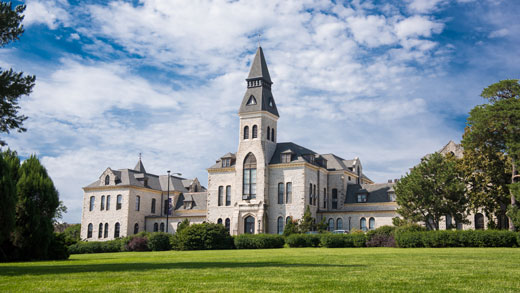
KSU's Anderson Hall

Noted KSU graduates include:

* Sports, other than Football and Basketball: Baseball pitcher Elden Auker '32, catcher Earl Woods '53 (Tiger's father, a Manhattan, Kansas native, broke the color barrier in Big Eight baseball, before embarking on a career as an Army officer), sprinter Thane Baker '56 (won a full medal set, Gold, Silver and Bronze at the 1956 Olympics), and triple jumper Kenny Harrison '88 (Gold Medal at the 1996 Olympics). Mitch Holtus '79 is a broadcaster for the Kansas City Chiefs.

* Arts: Historian Kenneth S. Davis '34, record producer Jerry Wexler '46, actor Gordon Jump '57, and actor Eric Stonestreet '96.

* Politics, from Kansas unless otherwise stated: Senator and Secretary of the Interior Fred Seaton '31, Congressman John Rhodes of Arizona '38, House Minority Leader 1973-83 and instrumental in convincing President Nixon to resign; current Senator Pat Roberts '58, Governor John Carlin '62, White House Press Secretary Marlin Fitzwater '65; General Richard Myers '65, former Chairman of the Joint Chiefs of Staff, and since 2016 the President of KSU; Governor Mike Hayden '66, and Senator and Governor Sam Brownback '79.

The Kansas State Capitol is in Topeka, 64 miles west of downtown KCMO, 26 miles west of the University of Kansas campus in Lawrence, 60 miles southeast of the Kansas State University campus in Manhattan (sure doesn't look like the one in New York), and 140 miles northeast of Kansas' largest city, Wichita.
The Kansas State House, in Topeka

ZIP Codes for the Kansas side of Kansas City start with the digits 66 and 67; for Lawrence, 66044; and for Manhattan, 66502. The beastly prefix of 666 is in the State capital of Topeka, although Area Code 666 is not used anywhere in America. The Area Codes for Kansas are 785 (for both Lawrence and Manhattan) and 913 (for most of the Kansas side of the Kansas City metropolitan area). The sales tax for the State is 6.15 percent.

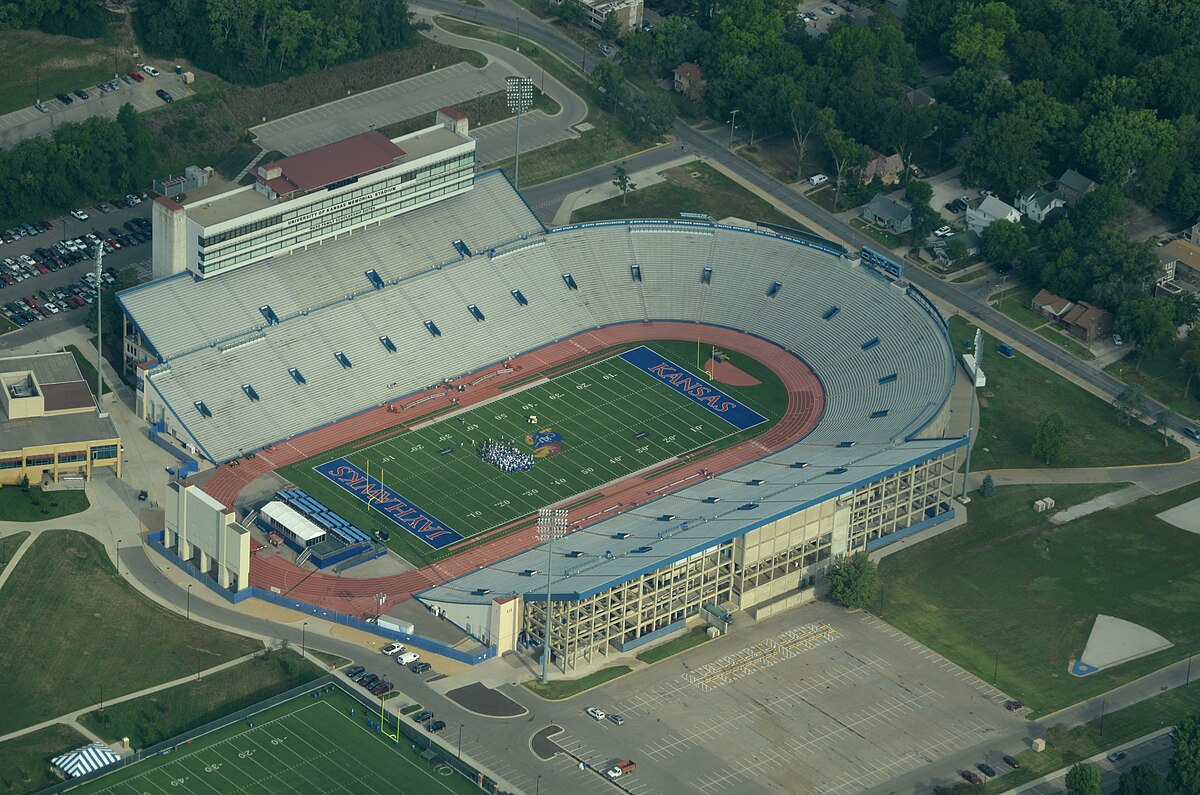
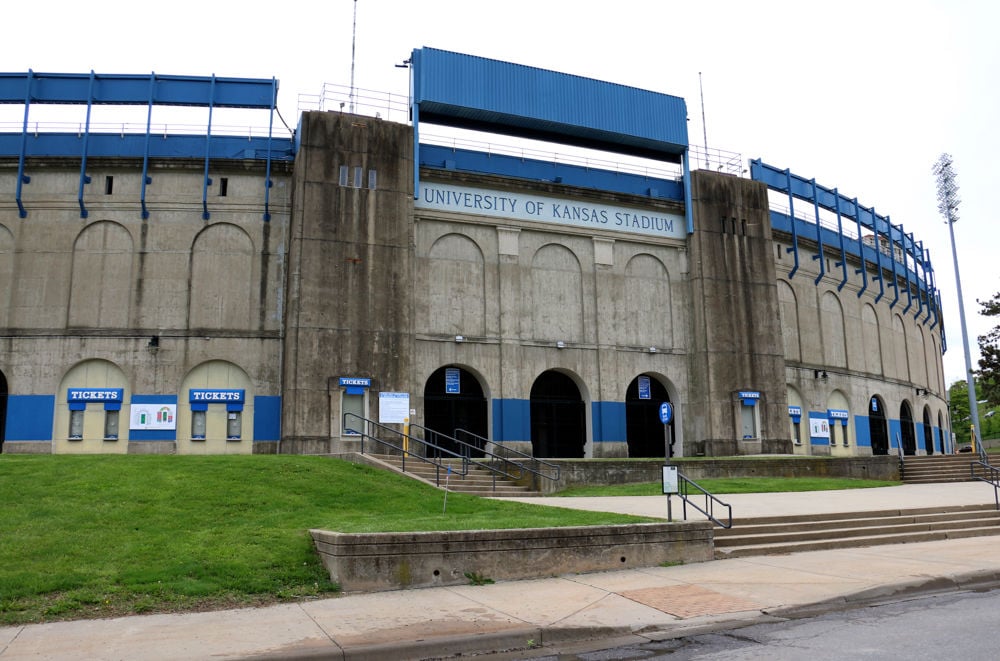
Going In. KU's Memorial Stadium opened in 1921, and, like so many college football stadiums built in the 1920s (or shortly before, or shortly after), it is a memorial to the University's, and indeed the State's, losses in World War I.
Last year, the school renamed it David Booth Kansas Memorial Stadium, after David G. Booth '68, a Lawrence native who donated $50 million to renovate the stadium. He got his graduate degree from the University of Chicago, and his $300 million to their business school, also renamed for him, is the largest donation ever given to a college's business school.
The address of the stadium is 1101 Maine Street (not "Main"), at Fambrough Way, just west of downtown. Bus 4 will get you to 9th & Maine, 2 blocks north. If you drive in, parking is $25.

The stadium is a horseshoe pointing south, and the field has been artificial turf since 1970.
UPDATE: On November 19, 2018, Moneywise compiled a list of their Worst College Football Stadiums, the bottom 19 percent of college football, 25 out of 129. KU's Memorial Stadium came in 21st, with fans polled citing "uncomfortable bench seating" and "The bathrooms were not even air condition" -- a definite problem in Kansas in September.

Mention must also be made of the most famous building in the State of Kansas, and that's the Jayhawks' basketball arena, Allen Field House. Dr. Forrest C. Allen. A student of basketball's inventor, Dr. James Naismith, who coached there from 1898 to 1907, "Phog" Allen coached KU basketball from 1907 to 1909, and again from 1919 to 1956. That last season, 1955-56, was the 1st season of the building that bears his name. It's at 1651 Naismith Drive, about 2 miles southwest of downtown. Bus 10 or 11 will get you within a 5-minute walk.

He wasn't just a Ph.D.: He had a doctorate in osteopathy, and was his team's athletic trainer as well, said to have a "magic touch." His nicknames were Doc for his profession, and Phog for his "foghorn voice."

He won 26 Conference Championships, 2 Helms Athletic Foundation-awarded National Championships in 1922 and 1923, and the NCAA Tournament in 1952. He coached the U.S. team to the Gold Medal in the 1952 Olympics in Helsinki, Finland. He coached Adolph Rupp, Ralph Miller, Dean Smith, Clyde Lovellette and Bob Dole, and, though retiring before he could coach him, recruited Wilt Chamberlain. He was a charter inductee into the Basketball Hall of Fame in 1959.
ESPN The Magazine has called the 16,300-seat Allen Fieldhouse the loudest venue in college basketball. The court has been named for Naismith. So, while basketball wasn't invented there (KU is one of the truly great basketball schools, but it's not that great), it could be argued that, between Naismith and Allen, basketball coaching was invented there.
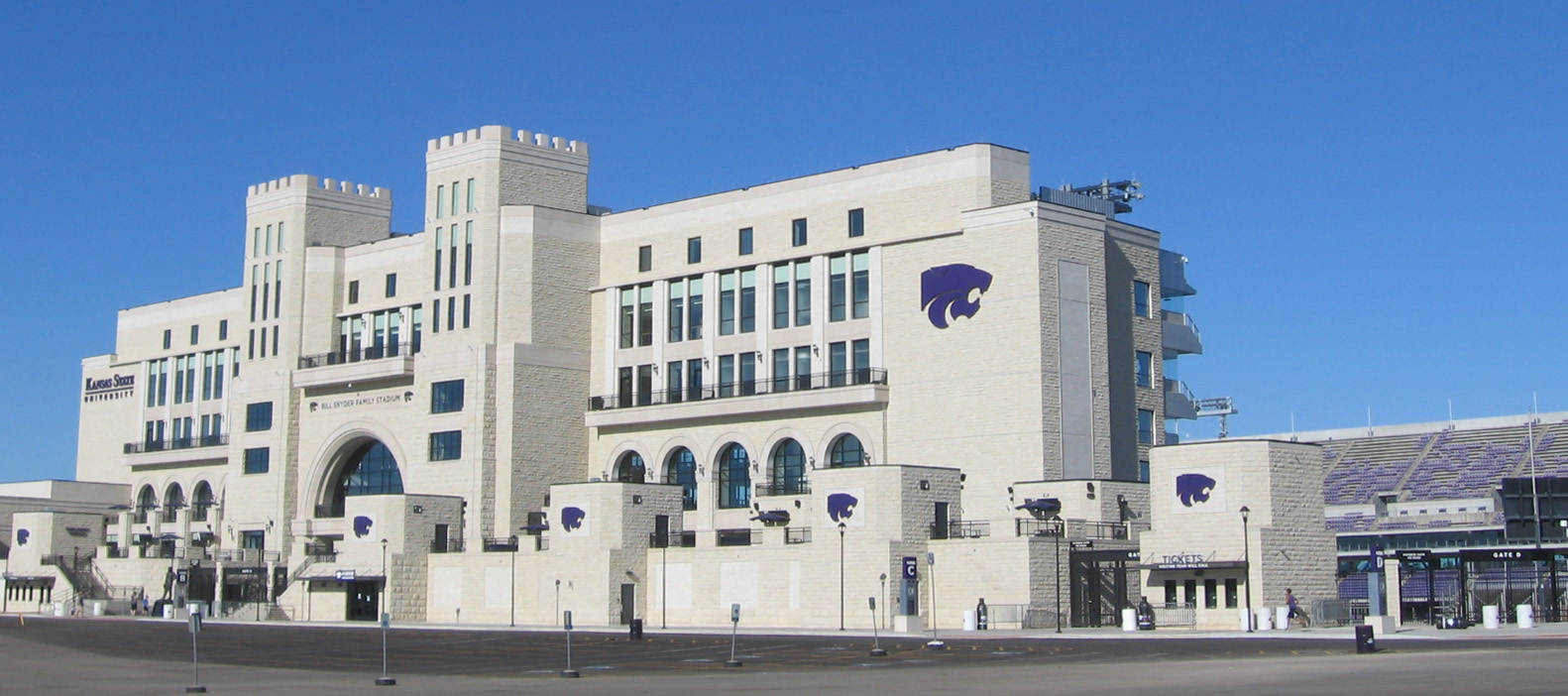
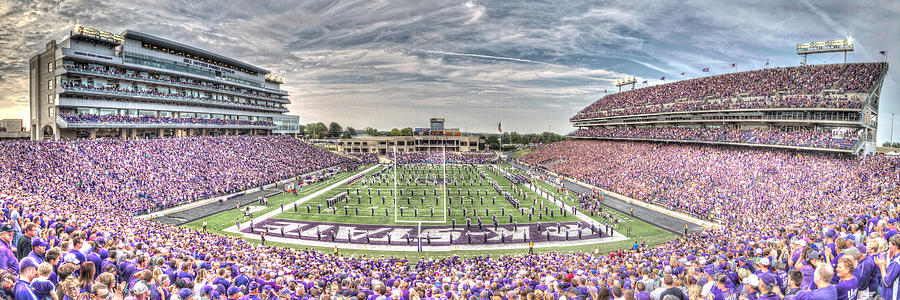
As for the Wildcats: The current KSU Stadium was named just that, "KSU Stadium," when it opened in 1968. After the 2005 season, coach Bill Snyder retired, and the school offered to rename it for him. He said, "If you are going to do it, name it after the people that I care about the most." So it became "Bill Snyder Family Football Stadium."
He returned to coach in 2009, and is 1 of only 5 Division I-A/Football Bowl Subdivision coaches ever to coach at a stadium named for him, joining Amos Alonzo Stagg at the University of Chicago, Bear Bryant at Alabama, Shug Jordan at Auburn and LaVell Edwards at Brigham Young. (Snyder is the only one still alive, let alone active.)

The address is 1800 College Avenue, at Kimball Avenue, about 2 miles northwest of downtown Manhattan. Take the Red bus in. If you drive in, parking is $20.
Snyder Family Stadium. Behind it, Bramlage Coliseum,
built in 1986, a.k.a. The Octagon of Doom.
Behind that, Ahearn Field House, built in 1950.

It is the opposite of KU's stadium: A horseshoe pointing north. Like KU's stadium, KSU's field was changed from real grass to artificial turf in 1970. Since a 1991 replacement was done, it's been named Wagner Field, in honor of donors Dave and Carol Wagner.
Prior to that, from 1922 to 1967, the Wildcats played at World War I Memorial Stadium, which had to be replaced because it seated only 17,500 people.
Food. According to a preseason 2016 article on KUAthletics.com:

Memorial Stadium concessions will showcase a variety of new items and stands. "The Lighter Side" located near sections 7 and 20 will feature grilled chicken sandwiches, veggie burgers, chicken salad, fruit cups and yogurt. Fans will also want to visit the "Bavarian Pretzel Cart" with parmesan butter and herb pretzels, pizza pretzels and pretzel bites. Some other new additions will be the giant smoked turkey leg and tornado potato fries. Click here to see a complete concession map and offerings.


KSU doesn't get specific on KStateSports.com, only saying:

The concession stands located on the concourse of Bill Snyder Family Stadium are available when stadium gates open two (2) hours prior to kickoff. No other food may be brought into the stadium.

Team History Displays. Kansas has won or tied for its conference's title 9 times: 1891, 1892, 1893, 1895, 1908, 1930, 1946, 1947 and 1968. They've won 6 bowl games: The 1961 Bluebonnet Bowl, the 1992 and 1995 Aloha Bowls, the 2005 Fort Worth Bowl, the 2008 Insight Bowl, and their only victory in a major, the 2008 Orange Bowl. They also reached the Orange Bowl in 1948 and 1970, but lost.

KU's Memorial Stadium has a Ring of Honor atop the northern bowl, honoring 14 players:

* From the 1940s: Running back and defensive back Ray Evans, end Otto Schnellbacher, and offensive tackle Mike McCormack.

* From the 1950s: Offensive linemen George Mrkonic and Ollie Spencer.

* From the 1960s: Quarterbacks John Hadl and Bobby Douglass, defensive end John Zook, and running backs Curtis McClinton, Gale Sayers and John Riggins.

* From the 1970s: Quarerback David Jaynes, and quarterback and safety Nolan Cromwell.

* From the 1980s: Linebacker Willie Pless.

The Jayhawks have retired 3 uniform numbers: Hadl's 21, Evans' 42, and Sayers' 48. They are in the College Football Hall of Fame, as is 1950s running back Jim Bausch. McCormack, Sayers and Riggins are in the Pro Football Hall of Fame, and cases can be made for Hadl and Cromwell, too.

Not on that list were 1940s Jayhawk teammates Bud Adams, founding owner of the Houston Oilers/Tennessee Titans franchise, and longtime Senate Majority Leader and 1996 Republican Presidential nominee Bob Dole.

There are 27 Kansas basketball players with their uniform numbers on banners in Allen Fieldhouse, but these numbers are not retired. The school says it's the jerseys that are retired, not the numbers. Along with longtime broadcaster Max Falkenstein, given Number 60 in honor of 60 years of broadcasting (61, actually: 1945-2006), they are:

* From the 1920s: 12, guard Paul Endacott '23; 8, guard Charlie T. Black '24; 7, center Tusten Ackerman '25; 26, guard Gale Gordon '27; and 36, center Al Peterson '27.

* From the 1930s: 5, guard Fred Pralle '38. Not yet honored is center William "Skinny" Johnson '33.

* From the 1940s: 5, forward Howard Engleman '41; 10, forward Charles B. Black '47 (no relation to Charlie T.); 15, guard Ray Evans '47 (as previously mentioned, also honored in football).

* From the 1950s: 16, center Clyde Lovellette '52; 23, forward B.H. Born '54; and 13, center Wilt Chamberlain '59 (led them to the NCAA Final in '57, played in '58, but left to play for the Harlem Globetrotters in '59 before he could legally join the NBA). Not yet honored is guard Allen Kelley '54.

* From the 1960s: 32, forward Bill Bridges '41; 13, center Walt Wesley '66; 15, guard Jo Jo White '69.

* From the 1970s: 40, forward Dave Robisch '71; and 15, forward Bud Stallworth '72.

* From the 1980s: 14, guard Darnell Valentine '81; and 25, forward Danny Manning '88.

* From the 1990s: 11, guard Jacque Vaughn '97; 34, forward Paul Pierce '98; and 45, forward Raef LaFrentz '98.

* From the 21st Century: 0, forward Drew Gooden '02; 4, forward Nick Collison '03; 10, guard Kirk Hinrich '03; 23, forward Wayne Simien '05; and 15, guard Mario Chalmers '08.

Endacott, Johnson, Lovellette, Kelley, Chamberlain and White are in the Basketball Hall of Fame. So are coaches Naismith, Allen, Larry Brown and Roy Williams.
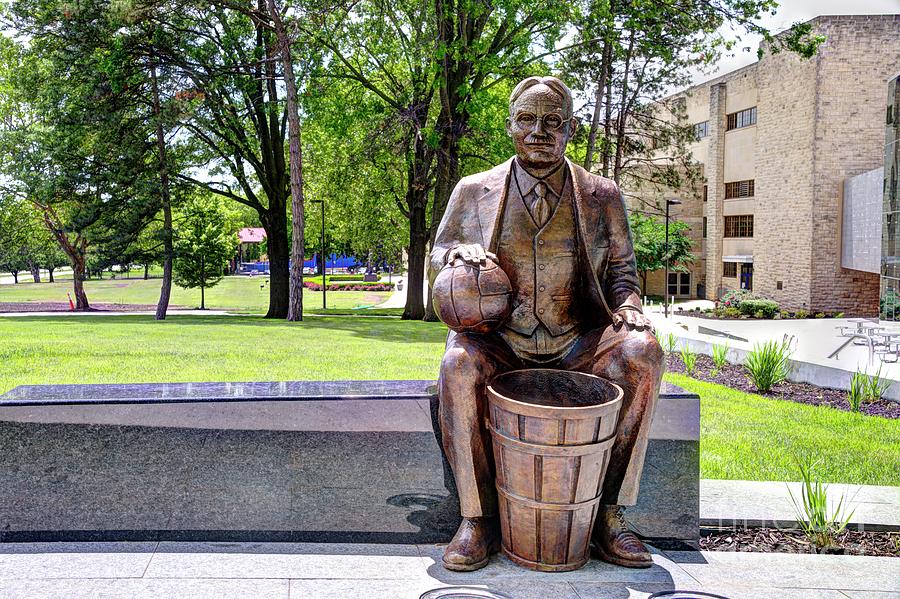
Allen has a statue outside his Fieldhouse. Behind that is the DeBruce Center, with a statue of Naismith. He also has statues in his hometown of Almonte, Ontario, Canada; and at the Basketball Hall of Fame in Springfield, Massachusetts, not far from Springfield College, formerly the YMCA where he invented the sport.
As another resourceful Canadian named James, Doohan of Star Trek,
would have said, "He invented the thing!"

While the Kansas Jayhawks have been mediocre for most of the last half-century, the Kansas State Wildcats were one of the worst programs in college football until Bill Snyder arrived in 1989. They didn't go to their 1st bowl game until the 1982 Independence Bowl, and didn't win their 1st until the 1993 Copper Bowl.

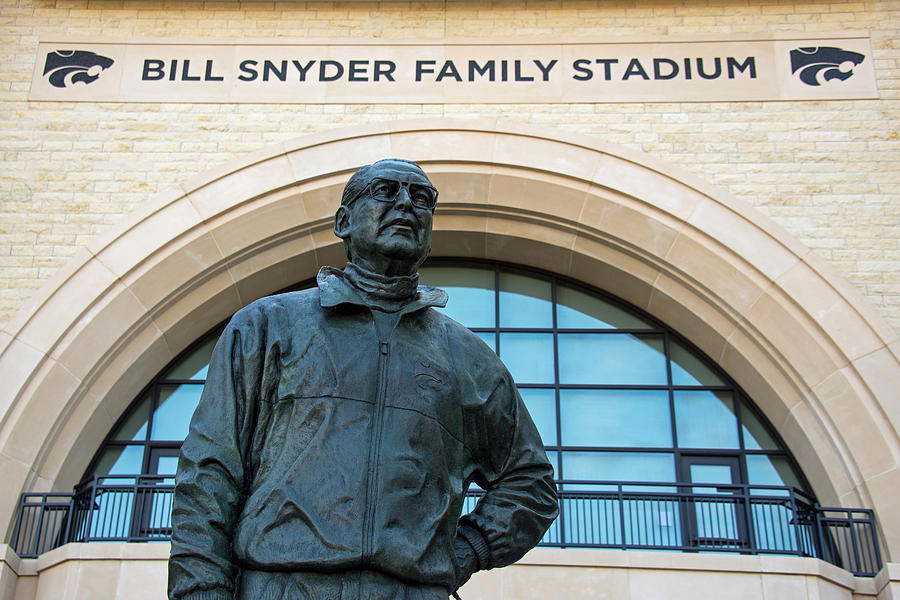
However, they've now won the 1993 Copper Bowl, the 1995 Holiday Bowl, the 1997 Fiesta Bowl, the 1999 and 2002 Holiday Bowl, the 2001 Cotton Bowl, the 2013 Buffalo Wild Wings Bowl, the 2016 Texas Bowl, and the 2017 Cactus Bowl. They've also won or shared their league's title 6 times: 1909, 1910, 1912, 1934, 2003 and 2012. They have a statue of Snyder outside the stadium that bears his name.
They've retired 1 number, 11, for 2 quarterbacks, Lynn Dickey '70 and Steve Grogan '74. Their All-Americans have included linebacker Gary Spani '77, cornerback Chris Canty '96, kicker Martin Grmatica '98, cornerback Terence Newman '02, running back Darren Sproles '03, center Nick Leckey '03, and receiver Tyler Lockett '14.

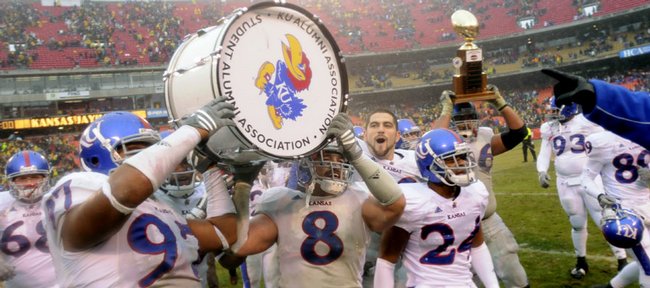
Kansas and Kansas State first played each other in 1902, and have played each other every year since except 1910. In 1969, the Governor's Cup was first awarded. KU went 17-1-3 from 1902 to 1923, 10-1 from 1941 to 1952, and 19-1-2 from 1956 to 1977. But KSU has won the last 9, and 21 of the last 25.
The 2 versions of the Governor's Cup

There is a dispute as to the all-time record, because KU refuses to accept that they had to forfeit their win in the 1980 game, because they insist that they had paperwork showing that the ineligible player they'd used was, in fact, eligible. KU say they lead 65-44-5, KSU says it's 64-45-5.

Wildcat fans say their biggest rival is the Jayhawks. But Jayhawk fans are much more likely to say their biggest rival is the University of Missouri. This was the 1st college football rivalry west of the Mississippi River, and there is real history behind it, not just sports history. Real history. Really bloody history. They didn't call the Jayhawk State "Bleeding Kansas" for nothing.

In the years immediately before, during, and even for a little while after the American Civil War, there was some deadly serious fighting. Kansas was a free State, Missouri a slave State, although it never joined the Confederacy. Confederate sympathizers from Missouri would cross over and wreak havoc in Kansas, including in Lawrence.

On May 21, 1856, "the Sacking of Lawrence" occurred. On August 21, 1863, William Quantrill led Quantrill's Raiders (including a young pair of brothers named Frank and Jesse James) in a massacre, killing 164 people, all civilians. The football rivalry between Kansas and Missouri became known as the Border War, and, perhaps appropriately, was first played on October 31, 1891 -- Halloween.
The winner receives the Indian War Drum, also known as the Osage War Drum, with a Jayhawk logo on one side, and a block M with a Missouri Tiger head on the other. The rivalry was so nasty that it sometimes had to be played on neutral ground in Kansas City -- in Missouri's State, but considerably closer to Kansas' campus, with the ticket allotment evenly divided. It was played in Kansas City from 1891 to 1906, again from 1908 to 1910 (in St. Joseph, Missouri in 1907), in 1944 and '45 (probably due to wartime travel restrictions), and at Arrowhead Stadium from 2007 to 2011.
Missouri's move to from the Big 12 to the Southeastern Conference put an end to it, at least for football. As with the KU-KSU rivalry, there is a dispute as to the record, as the 1960 game was forfeited to Missouri by the league then known as the Big Eight, because Kansas used an ineligible player. According to Kansas, Missouri leads 56-55-5 -- meaning a restart and a Kansas win in the next game would tie the series at 56-all. According to everybody else (including the Big 12 and the NCAA), Missouri leads 57-54-5.
  
Stuff.  There are souvenir stands at each school's stadium, but no team stores. KU's bookstore is in the Student Union, at 1301 Jayhawk Blvd., about a 5-minute walk south on Mississippi Street from Memorial Stadium. The KSU Campus Store is at 820 N. 17th Street, to the east of the stadium.

The best book available on KU sports is by the aforementioned broadcaster, Max Falkenstein: Max & the Jayhawks: 50 Years On & Off the Air With KU Sports, published with Doug Vance in 1996. And, as KU's other big rival is Missouri, in 2005, the sports staff of The Kansas City Star published Rivals! MU vs. KU: A Classic Sports Match-up, Since 1891. In 2000, Mark Stallard published Wildcats to Powercats: K-State Football Facts and Trivia.

During the Game. Neither Kansas fans nor Kansas State fans have a rough reputation. You should have no safety issues. But if you do manage to get a ticket for their game against each other, it's best to stick with the home fans.

What's a Jayhawk? It's a shortened form of Jayhawker, a term for guerrilla fighters in the Civil War, later generally applied to residents of Kansas and turned into the redheaded, blue-bodied bird familiar to college sports fans today. KU has used the indentifier since 1912. They have used a mascot named Big Jay since the 1960s, and his little friend (not son or brother) Baby Jay since 1971.
Big Jay and Baby Jay

At home football games, the Marching Jayhawks perform both an opening pregame show and a halftime show that changes throughout the season. The pregame program begins with the members of the band sprinting down the stairs of the northern bowl of Memorial Stadium. The band runs onto the field to a cadence by the drum line. Here the official fight song of KU "I'm a Jayhawk" is played. The "Kansas Song" is then played as the Marching Jayhawks perform their historic KU counter march. "Fighting Jayhawk" is played after the counter march.

The band is then joined by a group of the Rock Chalk Dancers, KU's dance team, for the historic "Sunflower Song" and accompanying drill. The band then performs the National Anthem, the alma mater "Crimson and the Blue," and the Rock Chalk Chant. This chant -- "Rock chalk, Jayhawk, KU" -- is the first thing most people think about when they think of Kansas sports. Rock chalk is limestone, common in Kansas. They also wave their arms back and forth, slowly, in a formation called "Waving Wheat."
I give them a 10 for passion, and a 4 for synchronization.


Like Northwestern, Kansas State's mascot is purple and named Willie the Wildcat. But K-State's Willie isn't much of a costume. It's just a papier-mache head on top of a guy in a football uniform, Number 0. Their band, The Pride of Wildcat Land, uses both "Wildcat Victory" and the legendary country song "The Wabash Cannonball" as fight songs. Being that they're in Kansas, "On the Atchison, Topeka and Santa Fe" might have been more geographically appropriate, but the Indiana-based "Wabash Cannoball" is a better tune.
After the Game. You (and, if you came that way, your car) should be safe. But there's not much to eat around either stadium, and you may have to go back to 9th Street in Lawrence, or to downtown Manhattan, to get something.

If you visit to Kansas is during the European soccer season, which has now begun again, the Red Lyon Tavern shows matches in Lawrence, at 944 Massachusetts Street, downtown. But in Manhattan, Kansas, you may be out of luck.

Sidelights. The Harry S Truman Sports Complex in Kansas City, which includes the Royals' Kauffman Stadium and the Chiefs' Arrowhead Stadium, is 49 miles from KU and 130 miles from KSU. Naturally, the Royals are the State's most popular MLB team, and the Chiefs the most popular NFL team. You'd have to get to westernmost Kansas to find pockets of fans of the Colorado Rockies and the Denver Broncos, and southwesternmost Kansas to find any kinds of numbers of supporters of the Texas Rangers and the Dallas Cowboys.

However, due to there being no NHL team in Kansas City since the 1974-76 experiment with the Scouts (the team that became the New Jersey Devils in 1982), the St. Louis Blues being too far to the east, and the Dallas Stars too far to the south, Denver's team, the Colorado Avalanche, is the most popular NHL team in Kansas.

Since the Kansas City Kings moved to Sacramento in 1985, the NBA has tailed off in popularity as well. The nearest NBA team is the Oklahoma City Thunder, 315 miles from Lawrence and 354 from Manhattan. The Minnesota Timberwolves are 480 and 561, respectively; the Chicago Bulls, 549 and 631; the Denver Nuggets, 566 and 610.

The nearest MLS team is Sporting Kansas City, whose Children's Mercy Park is just 29 miles from Lawrence and 111 miles from Manhattan. This complex also includes CommunityAmerica Ballpark, home of the Kansas City T-Bones of the American Association, an "independent league" roughly equivalent to Class A. The T-Bones are thus the closest professional baseball team to both Lawrence and Manhattan.

The AA also includes the Wichita Wingnuts, who replaced an affiliated team, the Wichita Wranglers, who had played in the Class AA Texas League from 1987 to 2007. Before that, the city was home to the Wichita Aeros from 1970 to 1984, and the Wichita Indians from 1950 to 1955. And the independent Pecos League has the Garden City Wind.

Wichita teams won Pennants in 1918 (Jobbers), 1921 (Witches), 1930 (Aviators), 1987, 1992 and 1999 (Wranglers). From 1934 onward, the Wichita teams played at 6,400-seat Lawrence-Dumont Stadium. After 85 seasons, the city now plans to tear it down and replace it with a new ballpark. 300 S. Sycamore Street.
Lawrence-Dumont Stadium

Basketball inventor and former KU coach Dr. James Naismith (1861-1939) is buried at Memorial Park Cemetery, 1517 E. 15th Street in Lawrence. His greatest pupil, and a lot of guys' greatest teacher, Dr. Forrest Clare "Phog" Allen, is buried across the street in Oakhill Cemetery, 1605 Oak Hill Avenue. Both are about a mile and a half east of downtown Lawrence, and about 2 miles east of Memorial Stadium.

One of the main attractions on the KU campus is the University of Kansas Natural History Museum, 1345 Jayhawk Blvd., just to the south of the bookstore. The Campanile Bell Tower, the school's memorial to World War II, is across Marvin Grove from the bookstore and the museum, on Memorial Drive.

The Beatles never performed in Kansas. Kansas City, yes, at Municipal Stadium; the State of Kansas, no. Elvis Presley did, 6 times, 3 early in his career, 3 later. He played 2 shows at the Forum in Wichita on May 18, 1956. 330 N. Broadway. On May 21, 1956, he played the Municipal Auditorium in Topeka. The 1940 structure was torn down in 1987, and replaced with the Topeka Performing Arts Center. 214 SE 8th Avenue.

In his later years, Elvis did 3 shows at the Henry Levitt Arena, now named the Charles Koch Arena, on the campus of Wichita State University: June 19, 1972; October 7, 1974; and December 27, 1976. 2100 N. Hillside Street.

The 1856 Sacking of Lawrence and the 1863 Lawrence Massacre, a.k.a. Quantrill's Raid, were both centered on the Free State Hotel, which had to be rebuilt both times. The Eldridge Hotel has been built on the site. 701 Massachusetts Street, in the downtown area known as Historic Lawrence.

Kansas has produced a President, Dwight David Eisenhower. Although born in Denison, Texas, he lived almost his entire youth in Abilene. (Note that the Texas city of the same name spells it "Abeline.") When he left the Presidency in 1961, he wanted his Presidential Library in his hometown. The complex includes the Library, the Museum, the Boyhood Home, and the Place of Meditation, where "Ike" and his wife Mamie are laid to rest.

200 SE 4th Street, in Abilene. Unfortunately, it's almost totally inaccessible without a car, as befitting the 1950s, for most of which he was President: 44 miles southwest of Manhattan, 88 miles west of Topeka, 93 miles north of Wichita, 116 miles west of Lawrence, and 153 miles west of Kansas City.

Charles Curtis, a Topeka native and the 1st person known to be of Native American descent to serve in the U.S. Senate (elected 1906), was elected Vice President with Herbert Hoover in 1928.

Alfred M. Landon, a KU grad elected Governor in in 1932, was one of the few Republicans to survive the Democratic landslides of the early 1930s, and was nominated for President in 1936. The Convention wanted Senator Styles Bridges of New Hampshire as his running mate, until someone pointed out that the Democrats could sing, "Landon-Bridges, falling down!" So they nominated the publisher of the archconservative Chicago Daily News, Frank Knox, and the slogan became, "Off the rocks with Landon and Knox!"

The Democrats noted that Landon was always wearing a sunflower pin, symbolizing his home State, and started saying, "Sunflowers wilt in the Fall." They were right: With voters remembering that the Republicans put them into the Great Depression, incumbent President Franklin D. Roosevelt won 46 out of 48 States, and 523 out of 531 Electoral Votes. Landon won only Vermont and Maine.

In a gesture toward bipartisanship, FDR appointed Knox as Secretary of the Navy in 1940, and he served until dying in office in 1944. Landon left the Governorship after one term, went back to the oil industry, supported FDR in the war effort, supported Harry Truman's Marshall Plan, and even supported Lyndon Johnson's Great Society. Alf Landon lived to be 100 years old, until 1987, long enough to see his daughter, Nancy Landon Kassebaum, elected to the U.S. Senate.

But when people not old enough to remember Ike or Alf think of Kansas politicians, they think of Robert Joseph Dole. Barely surviving a shoulder wound that cost him the use of his right arm, Bob was elected to the House of Representatives in 1960, and to the Senate in 1968. He was named Chairman of the Republican National Committee in 1971, but, as things turned out, he was RNC Chair when the Democratic National Committee's offices were broken into at the Watergate Hotel complex in Washington in 1972.

Dole was never accused of any of the Nixon Administration crimes that fell under the umbrella term "Watergate," and was nominated for Vice President alongside Gerald Ford in 1976. He did the campaign no favors, though, and his "Democrat wars" comment in his debate with Walter Mondale not only might have been enough to cost Ford a very close election with Jimmy Carter, but branded him "the Dark Prince of American Politics." Impressionist Jim Morrison called him "Darth Dole," and Saturday Night Live actors Dan Aykroyd and Norm Macdonald made hay with their impersonations.

Dole served as Senate Republican Leader from 1985 to 1996. He ran for President in 1980, but didn't win any Primaries. He tried again in 1988, but finished 2nd in delegates to the elder George Bush. Finally, in 1996, he was nominated, at 73 the oldest 1st-time major party nominee ever. But, knowing his reputation, he may have compensated too much. It didn't matter: Bill Clinton beat him easily. Dole retired from the Senate in mid-campaign, and his electoral career was over.

In spite of the many disagreements he made over the years, Dole should be commended for his efforts in favor of his fellow veterans, and for reaching across the aisle to work with Senator George McGovern on hunger and Senator Ted Kennedy on helping the disabled. His alma mater, the University of Kansas, established the Robert J. Dole Institute of Politics, not quite a Presidential Library, but close. 2350 Peterfish Drive in Lawrence, about a mile west of the main campus.

The tallest building in Kansas is the Epic Center, a rather plain-looking 385-foot structure that went up in 1987. 301 N. Main Street in Wichita.

The 1962 horror film Carnival of Souls was filmed in Lawrence. The 1983 nuclear-war TV-movie The Day After was filmed in Kansas City and Lawrence. The city was "destroyed again" in the 2006 TV series Jericho. Sam and Dean Winchester, the protagonists of the TV series Supernatural, are from Lawrence, but they travel throughout the country, and filming is done in Vancouver.

Most movies filmed or set in Kansas tend to be Westerns, such as The Plainsman, Dodge City, Santa Fe Trail, Red River, Winchester '73, Dances with Wolves and Sarah, Plain and Tall. The TV Western Gunsmoke was set in Dodge City, although that's 335 miles southwest of KCMO, 299 miles southwest of Lawrence, and 228 miles south of KSU; and, besides, it was filmed in Hollywood. Kansas' desolate plains lend themselves well to Depression-era films like Splendor in the Grass, Paper Moon and The Great Waldo Pepper.

The 1978 version of Superman established the hero's hometown of Smallville, previously considered a typical American small town, as being in Kansas, and every version of Superman since has accepted this. Plains, Trains and Automobiles had a big chunk set in Wichita, but those scenes were actually filmed in Illinois.

And, of course, Kansas was the setting for the "real" parts of L. Frank Baum's novel The Wonderful Wizard of Oz, and all its film adaptations since. (Judy Garland's line as Dorothy in the most familiar version, 1939, is one of those movie/TV lines everybody gets wrong: It's actually, "Toto, I've a feeling we're not in Kansas anymore!")

Brian McClendon, KU '86, the director of engineering for Google Earth, made Lawrence the program's default starting point.

*

The Kansas Jayhawks, and the Kansas State Wildcats, are best known for their basketball programs. But their football programs have had their moments, too. And now, Rutgers is going out to play Kansas.

The nice part is, it's a roadtrip RU fans haven't made before. The not-so-nice part is, for both Rutgers and Kansas, it may be their best chance at a win for the rest of the season!