Showing posts with label war of the american revolution. Show all posts

Sunday, September 20, 2026

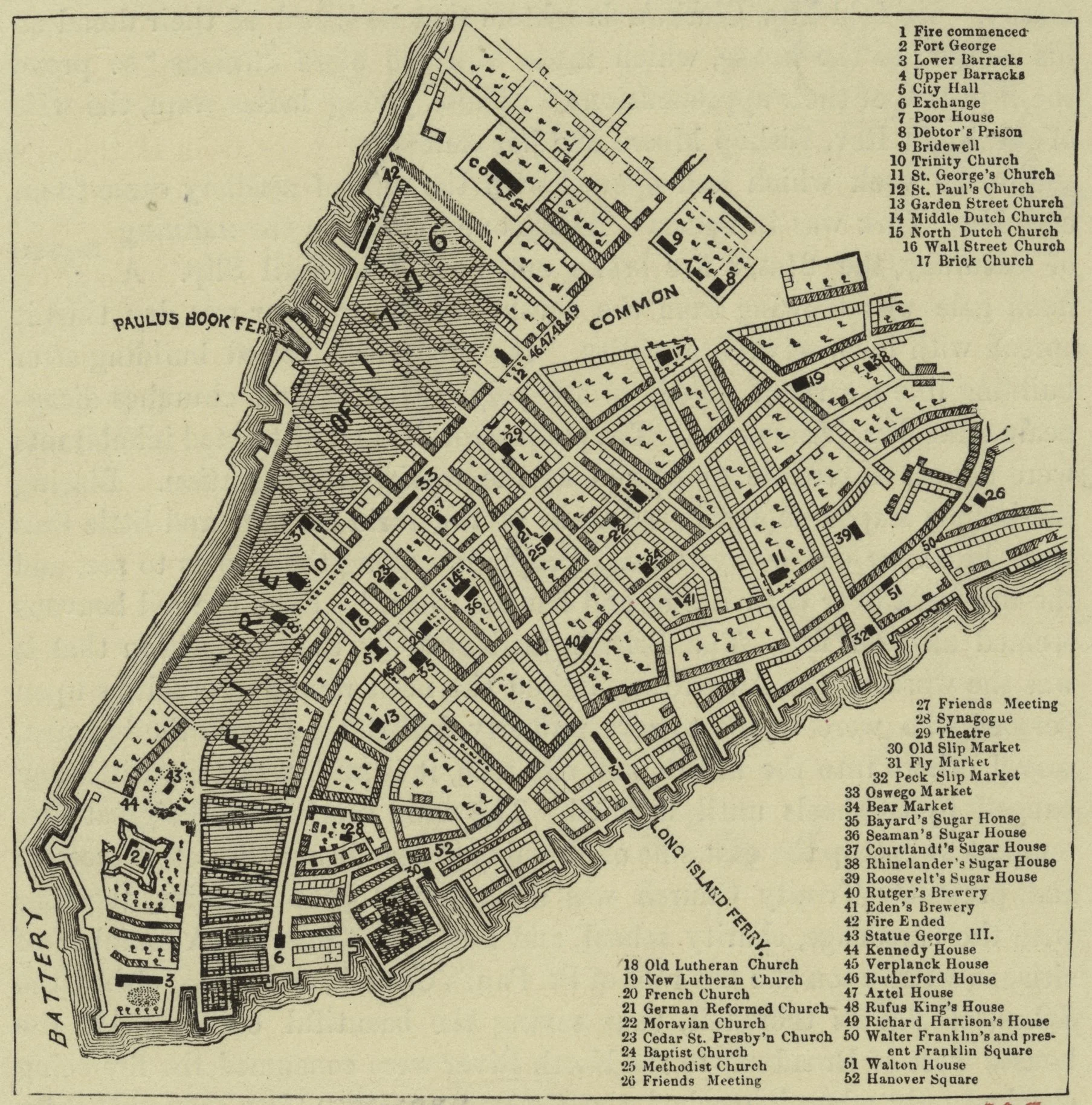
September 20, 1776: The Great Fire of New York


Have you ever wondered why Boston, Philadelphia, Baltimore, and even older New Jersey cities like Newark, Elizabeth, Perth Amboy and Trenton have building that predate American independence in 1776, but there aren't too many of them in New York? And why even the ones that are in the City aren't in Manhattan? (Fraunces Tavern, built in 1719, is one of the exceptions.)

This is why:

September 20, 1776, 250 years ago: The Great Fire of New York was set. It didn't "start," it "was set."

It was a bad Summer for the brand-new United States of America. The British Army was attacking the Continental Army, forerunner of the United States Army, commanded by General George Washington. On August 27, Washington's troops were defeated in Brooklyn in what became known as the Battle of Long Island. A dense fog enabled them to escape across the East River to Manhattan, in a maneuver that, in his book 1776, historian David McCullough called "America's Dunkirk."
On September 11, a date that was fraught with history, especially in America, well before 2001, a peace conference was held on Staten Island, including the British naval commander, Admiral Richard Howe, brother of their army commander, General William Howe; and American representatives including Benjamin Franklin and John Adams. It failed. A civilian exodus from the City began.

On September 15, British troops landed at Kips Bay, north of what was then the limits of New York City, roughly at what is now East 25th Street. On September 16, the Battle of Harlem Heights was fought, roughly where Riverside Church is now, at 120th Street at Riverside Drive. The Continentals pushed the British back.

On September 20, the British decided to smoke out whatever resistance remained. A fire was set at the Fighting Cocks Tavern, near Whitehall Slip, at the southern tip of Manhattan Island, roughly where Whitehall Ferry Terminal is now. The fire destroyed from 10 to 25 percent of the buildings in the City, while some unaffected parts of the City were plundered. It burned until the next morning.

On September 22, the British executed an American spy, Nathan Hale, a 21-year-old native of Coventry, Connecticut. Captain John Montresor, a British officer who was present at the hanging, reported that Hale's last words were, "I only regret that I have but one life to lose for my country."
On October 28, Washington lost the Battle of White Plains. On November 16, defeat in the Battle of Fort Washington, a location named for him, meant that he had to get his troops across the Hudson River, and evacuate New York, roughly at the point where the bridge named for him now stands. They made their way across New Jersey, and across the Delaware River into Pennsylvania. As Thomas Paine, who was with them, wrote in his pamphlet The American Crisis, "These are the times that try men's souls."

Washington needed a miracle. On December 25, 1776, he made his own Christmas miracle.

It wasn't until November 25, 1783, after the Treaty of Paris recognizing American independence was signed and copies reached American shores, that the British Army ended their occupation of New York City. On December 4, Washington resigned his commission, and said goodbye to his troops at the oldest remaining building in Manhattan, Fraunces Tavern, which survived the fire, and has survived others over the years.
New York City was rebuilt. It is always being rebuilt. Old buildings -- but not pre-Revolution old -- are always being replaced by new ones. Americans claim to have respect for their heritage, but we tend not to have much respect for our physical history.

I am all for America in general, and New York in particular, looking forward. But you can't know where you're going unless you know where you've been.

Sunday, April 26, 2026

April 26, 1726: Lord Stirling Is Born

April 26, 1726, 300 years ago: William Alexander is born in Manhattan. He held a claim to be the male heir to the Scottish title of Earl of Stirling, through Scottish lineage, being the senior male descendant of the paternal grandfather of an earlier William Alexander, the 1st Earl of Stirling, who had died in 1640, and he sought the title sometime after 1756. The goal was vast land holdings in America that the holder of the title was to enjoy.

His claim was initially granted by a Scottish court in 1759. But in 1762, Britain's House of Lords overruled the court, and denied him the title. He continued to refer to himself "Lord Stirling" regardless. Officially, the British government considers the title of Earl of Stirling to have tied out with Henry Alexander, the 5th Earl, in 1739.

He inherited a large fortune from his father, dabbled in mining and agriculture, and lived a life filled with the trappings befitting a Scottish lord. This was an expensive lifestyle, and he eventually went into debt to finance it.

In 1747, he married Sarah Livingston (1725–1805), daughter of Philip Livingston and sister of Governor William Livingston. They had a son, William; and 2 daughters, Mary and Catherine.

The elder William began building a grand estate in the Basking Ridge section of Bernards Township, Somerset County, New Jersey. Upon its completion, sold his house in New York and moved there. George Washington was a guest there on several occasions during the War of the American Revolution, and gave away Catherine at her wedding to Continental Congressman William Duer.

He was commissioned a Major General in the Continental Army, and commanded a brigade at the Battle of Long Island in Brooklyn, where his rearguard action resulted in his capture, but allowed the main body of the army to escape. He was later returned by prisoner exchange, received a promotion, and continued to serve with distinction throughout the war. Trusted by Washington, in 1778 he commanded troops at the Battle of Monmouth Courthouse in Manalapan, New Jersey, and exposed the Conway Cabal. He was with Washington when he accepted the British surrender at the Battle of Yorktown in 1781.

By that point, he was suffering from gout and rheumatism, and his heavy drinking didn't help. He died on January 15, 1783 in Albany, New York, and did not live to see the official end of the war, with the Treaty of Paris.

His grandson, William Alexander Duer, served as President of Columbia University, which was built on land owned by the Livingston family. He was also an ancestor of General Philip Kearny Sr. and General Philip Kearny Jr.

Stirling Township in Somerset County, near his home in Basking Ridge, and Sterling, Massachusetts were named for him. So were a middle school built on land once occupied by the Long Island battlefield, in the Gowanus section of Brooklyn; and an elementary school in New Brunswick, New Jersey, where he had once been stationed.

Tuesday, March 17, 2026

March 17, 1776: The Siege of Boston

Henry Knox

March 17, 1776, 250 years ago: The Siege of Boston ends. No, this has nothing to do with the Yankees playing the Red Sox, or any other sporting event. It is the 1st great victory for the Continental Army in the War of the American Revolution.

The siege began on April 19, after the first battles of the war, at Lexington and Concord, Massachusetts, when Massachusetts militias blocked land access to Boston. The Continental Congress, meeting in Philadelphia, formed the Continental Army from the militias involved in the fighting, and appointed George Washington as commander in chief.

In June 1775, the British seized Bunker Hill and Breed's Hill, two Continental Army positions overlooking Boston. But their casualties proved heavy, and their gains were insufficient to break the Continental Army's encirclement.

After this, the Americans laid siege to Boston. No major battles were fought during this time, and the conflict was limited to occasional raids, minor skirmishes, and sniper fire. British efforts to supply their troops were significantly hindered by the smaller but more agile Continental Army and patriot forces operating on land and sea. The British suffered from a continual lack of food, fuel, and supplies.

In November 1775, General Washington sent General Henry Knox on a mission to bring the heavy artillery that had recently been captured at Fort Ticonderoga in Upstate New York. In a technically complex and demanding operation, Knox brought the cannons to Boston in January 1776, and this artillery fortified Dorchester Heights, which overlooked Boston Harbor.

This development threatened to cut off the British supply lifeline from the sea. The British commander, General Willie Howe, saw his position as indefensible, and he withdrew his forces from Boston to Halifax, Nova Scotia on March 17.

It has often been said that the American Revolution began in Boston on March 5, 1770, when British militia -- effectively, the first Boston Police -- fired on people throwing snowballs at them, killing 5 of them, the event that became known as the Boston Massacre. Six years later, the British bugged out of Boston. For what would eventually become known as the Hub City, the war was essentially over.

That would not be the case for points west and south: Connecticut, New York, New Jersey, Pennsylvania, Virginia, North Carolina, South Carolina and Georgia would all suffer terribly over the next 5 years.

When Washington became the 1st President of the United States, he appointed Knox to be the 1st Secretary of War, the post known since 1947 -- despite what Donald Trump and Pete Hegseth might now say -- as Secretary of Defense.

Saturday, January 10, 2026

January 10, 1776: "Common Sense" Is Published

Thomas Paine

January 10, 1776, 250 years ago: Thomas Paine publishes a pamphlet he titles Common Sense. However, in the words of François-Marie Arouet, the French philosopher known as Voltaire, whom Paine would have admired as a freethinker and an atheist -- and who, 2 years later, just before his death, would meet Paine's fellow Founding Father, Benjamin Franklin, in Paris -- is alleged to have said, "Common sense is not very common."

Paine was born on February 9, 1737 in Thetford, Norfolk, East Anglia, England. He trained as a corsetmaker, and opened a shop in Sandwich, Kent, south of London. He married, but both wife and child died in childbirth. He became an excise officer in Cornwall in England's West Country, then a schoolteacher in Lewes, Sussex, near the South Coast.

Lewes was a center of antimonarchy sentiment, and it was there, in 1771, that he began writing antimonarchy pamphlets. It's also where he married again, but they separated in 1774, and he never married after that, and is not known to have fathered any children that survived.

In September 1774, mathematician, Fellow of the Royal Society, and Commissioner of the Excise George Lewis Scott introduced him to Benjamin Franklin, who was there as a voice for colonial opposition to British colonial rule. Franklin recommended emigrating to America, and Paine arrived in Philadelphia on November 30, 1774, with letters of introduction from Franklin to his friends in his adopted hometown.

In March 1775, he became editor of Franklin's publication, the Pennsylvania Magazine. In it, he published articles opposing British rule of America, slavery, and the effect of religion in public life.

In April 1775, the War of the American Revolution broke out, and was getting more serious on January 10, 1776, when Paine's 47-page pamphlet, Common Sense, appeared, signed anonymously "by an Englishman." Paine's original title for the pamphlet was Plain Truth -- which, with considerable irony, later became the title of a Christian magazine -- but Paine's friend, the Philadelphia-based physician and pro-independence advocate Benjamin Rush, suggested Common Sense instead.

It was passed around and often read aloud in taverns, contributing significantly to spreading the idea of republicanism, bolstering enthusiasm for separation from Britain, and encouraging recruitment for the Continental Army.

Paine provided a new and convincing argument for independence by advocating a complete break with history. Common Sense was oriented to the future in a way that compelled the reader to make an immediate choice. It offered a solution for Americans disgusted with and alarmed at the threat of tyranny.

It was an immediate success, with Paine estimating it sold 100,000 copies in 3 months to the 2 million residents of the 13 colonies. During the course of the American Revolution, one biographer estimated a total of about 500,000 copies were sold, including unauthorized editions.

The June 29, 1776, issue of the Pennsylvania Evening Post contained a letter by Paine, signed "Publicus," in which he, aware of the Continental Congress' move toward independence -- he has long been rumored to have assisted Thomas Jefferson in writing the Declaration of Independence -- misspelled "Independence," but also suggested an official name for the new country:

EVERY moment that I reflect on our affairs, the more am I convinced of the necessity of a formal Declaration of Independance. Reconciliation is thought of now by none but knaves, fools and madmen; and as we cannot offer terms of peace to Great-Britain, until, as other nations have done before us, we agree to call ourselves by some name, I shall rejoice to hear the title of the UNITED STATES OF AMERICA, in order that we may be on a proper footing to negotiate a peace.

The Declaration was approved on July 2, and published on July 4. On December 19, 1776, with the war going badly for the Continental Army, Paine published a new pamphlet, The American Crisis, to re-inspire patriotism in Americans:

These are the times that try men's souls: The summer soldier and the sunshine patriot will, in this crisis, shrink from the service of their country; but he that stands it now, deserves the love and thanks of man and woman. Tyranny, like Hell, is not easily conquered; yet we have this consolation with us, that the harder the conflict, the more glorious the triumph. What we obtain too cheap, we esteem too lightly: it is dearness only that gives every thing its value. Heaven knows how to put a proper price upon its goods; and it would be strange indeed if so celestial an article as freedom should not be highly rated.

General George Washington thought it would be effective enough to inspire his soldiers, so he read it aloud to them. Within a week, they crossed the Delaware River from Pennsylvania to New Jersey, and won the Battle of Trenton. Within a few more days, they won the Battle of Princeton.

Paine returned to Britain in 1787, and wrote Rights of Man in 1791, to rebut critics of the French Revolution, particularly the Anglo-Irish conservative writer Edmund Burke. 

The British government of Prime Minister William Pitt the Younger was worried by the possibility that the French Revolution might spread to Britain, and had begun suppressing works that espoused radical philosophies. Paine's work advocated the right of the people to overthrow their government and was therefore targeted with a writ for his arrest issued in early 1792.

Paine fled to France in September, despite not being able to speak French, but he was quickly elected to the French National Convention. While there, his authorship of Rights of Man led to a trial and conviction in absentia in England in 1792, for the crime of seditious libel.

The Girondins, the moderate faction in the Revolution, regarded him as an ally; consequently, the more radical Montagnards regarded him as an enemy. In December 1793, Paine was arrested, and taken to Luxembourg Prison in Paris. He completed the first part of The Age of Reason just before he was arrested.

He was released in November 1794, thanks to the efforts of the U.S. Minister to France, future President James Monroe. But Paine had already angered many of his allies with his attacks on both Christianity and Washington, now in his 2nd term as the nation's 1st President. He returned to the U.S. in 1802, but his attacks on religion led to him being ostracized, and when he died on June 8, 1809, in New York at the age of 72, only 6 people attended his funeral.

His reputation began to recover in the mid-19th Century, as the last remaining participants in the American Revolution died of old age. President Abraham Lincoln and scientist Thomas Edison both considered Paine to be a great influence on them. In 1884, his house and farm in New Rochelle, New York became the basis for the Thomas Paine Memorial, a National Historical Site.

In 1943, novelist Howard Fast wrote Citizen Tom Paine. In 1987, actor Richard Thomas adapted it into a one-man stage play. Paine has been played by Robert Vaughn in a 1974 installment of the TV anthology series Witness to Yesterday, Harvey Keitel in the 1982 film That Night in Varennes, Roger Reese in the 1996 PBS miniseries Liberty! The American Revolution, and was voiced by Nils Haaland in the animated PBS series Liberty's Kids in 2002.

Sunday, March 31, 2024

March 31, 1774: The Intolerable Acts

March 31, 1774, 250 years ago: In response to the Boston Tea Party, the British Parliament passes what the Patriot cause will label the Intolerable Acts. They were:

• The Boston Port Act, closing of the Port of Boston, effective until the destroyed tea was paid for.

• The Massachusetts Government Act, taking away the Colony’s charter and essentially putting it under British martial law.

• The Administration of Justice Act, which allowed the Royal Governor to order trials of accused royal officials to take place in Great Britain if he decided that the defendant could not get a fair trial in Massachusetts. George Washington called this the "Murder Act," because he believed that it allowed officials to harass colonists and then escape justice. And…

• The Quartering Act. While many sources claim that it allowed troops to be billeted in occupied private homes, a historian's 1974 study claimed that this is a myth, and that the act only permitted troops to be quartered in unoccupied buildings. It did, however, apply to all 13 Colonies, not just Massachusetts.

The Patriot cause labeled these new laws "the Intolerable Acts." Had the British government -- more the Prime Minister, Frederick, Lord North, than the man usually painted as the villain of the story, King George III -- only sought to arrest the men behind the Tea Party, John Hancock and Samuel Adams, and gone no further, things probably would not have escalated.

Instead of abusing British law, they would have been seen as upholding British law, which, for the most part, the people of "British America" had been fine with until now.

But North and Parliament did what tyrants tend to do: They overreacted, and colonists saw the government as betraying its ideals of freedom. And so, the American Revolution became inevitable.