Showing posts with label grover cleveland. Show all posts

Saturday, December 11, 2021

The State of The Arsenal on Founders Day

December 11, 1886, 135 years ago today: The Arsenal Football Club played its 1st game. It was on the Isle of Dogs, at a ground recently occupied by Millwall Football Club, against a team named Eastern Wanderers, which went out of business a few years later. The new club won, 6-0.

They were originally a works team -- what we in the U.S. would call a company team, as both the Chicago Bears and Green Bay Packers began -- at the Royal Arsenal (hence the nickname "The Gunners," which led to their fans later being tagged "The Gooners") in Woolwich (the 2nd W is silent), in what was then the county of Kent but is now part of Southeast London (SE16).

They called themselves Dial Square Football Club, after the section of the Arsenal where they worked. On Christmas Day, December 25, 1886, they met at the nearby Royal Oak pub, to make things more official, and changed their name to the Royal Arsenal Football Club.

The 1st game under the new name, and the 1st game that could be called a "home game" for them, was on January 8, 1887, at Plumstead Common, 2 miles away, against a nearby club called Erith, and Royal Arsenal won, 6-1.
(The Royal Arsenal at Woolwich. Photo dated 1960.)

In 1893, they turned professional and were admitted to England's Football League, but had to change their name, as Queen Victoria had signed a law prohibited any professional team from having "Royal" in its name. (This is not the case in Spain, where there are professional soccer teams named Real Madrid, Real Mallorca, Real Betis, etc.) And, of course, being professional, they had ceased to be a "club," even though the word remains part of the organization's name, and the fans continue to call their team "my club."

So they took on the name of their locality, and were Woolwich Arsenal from then until 1913, when they moved to a new stadium at Highbury in North London, "The Arsenal" until 1919 and "Arsenal Football Club" since, although "The Arsenal" is frequently still used, especially by the club's fans.

They could have changed their name to "Highbury Arsenal," or "Islington Arsenal," even though neither the Borough of Islington nor the Highbury neighborhood had any connection to the Royal Arsenal, aside from the club. As a result, Arsenal are 1 of only 2 professional clubs in England without a locality as part of their official name. The other is Port Vale, located in Stoke-on-Trent, Staffordshire.
Not quite the 1st Arsenal team, but perhaps the earliest known team photo, 1888.

Herbert Chapman was signed to manage Arsenal in 1925. He led them to win the Football Association Cup in 1930, and the Football League Division One in 1931 and 1933, before his death midway through the 1933-34 season. Under Joe Shaw, and then George Allison, the team he built went on to win the League again in 1934, 1935 and 1938, and the FA Cup in 1936. A rebuild after World War II, under manager Tom Whittaker, resulted in League titles in 1948 and 1953, and an FA Cup in 1950.

Like Chapman, Whittaker died in office, in 1956, and a down period resulted. The team's fortunes were turned around under Bertie Mee. In 1970, he guided the team to the Inter-Cities Fairs Cup, the tournament now known as the UEFA Europa League. In 1971, Arsenal took both the League and the FA Cup, "The Double." A mid-1970s rebuild under Terry Neill led to an FA Cup win in 1979.

In 1986, George Graham, one of the players from the '71 Double was named manager. He led the team to the 1987 League Cup, the 1989 and 1991 League titles, the 1st-ever English domestic "cup double" (the League Cup and the FA Cup) in 1993, and the European Cup Winners' Cup (a tournament that no longer exists) in 1994.

In 1996, Arsène Wenger was named the team's 1st manager not a native of the British Isles, and he revamped everything, from tactics to exercise to diet. In 1998, now in the era of the Premier League, he took Arsenal to another Double. He did it again in 2002. He led them to another FA Cup in 2003. And he led them through the entire 2003-04 Premier League season without losing a game: Played 38, won 26, drawn 2, lost exactly none. It had never been done before, and it hasn't been done since. The unbeaten string eventually reached 49 games.

(The 1st season of the Football League was in 1888-89, and Lancashire team Preston North End went through the 22-game season unbeaten, and also won the FA Cup. But 38 is a lot more games than 22.)

After another FA Cup win in 2005, Arsenal advanced to the Final of the UEFA Champions League in 2006, their last season at Highbury. With the opening of the new 60,000-seat Emirates Stadium, the construction debt had to be paid off, and Wenger had less of a budget than before. Still, he managed to keep the team in the Champions League places.

A small but loud and angry section of the fanbase began to demand that Wenger spend more money on "world-class players," because they believed that winning the League title was all that mattered. When Wenger ended a 9-year trophy drought by winning the 2014 FA Cup, this small but loud and angry section decided that it wasn't enough.

Nor was it enough when he did it again in 2015 and 2017. They demanded that he be fired for not giving them another League title -- as if he hadn't already given them 3, as many as any other Arsenal manager had ever done. (Allison had won 3; Chapman, Whittaker and Graham had each won 2, Shaw 1.)

By 2017, Arsenal had been surpassed by bigger-spending teams run by billionaire owners, and fell out of the Champions League places. Late in the 2018 season, Wenger announced he was leaving. It is still debated whether he was fired, or he quit due to even his great patience finally being worn out by the whiners.

New manager Unai Emery turned out to be a poor replacement, and was fired in favor of Mikel Arteta, the Spanish midfielder who had captained the 2014 and '15 Cup wins. Things have been shaky under his leadership.

On this Founders Day, Arsenal hosted Hampshire team Southampton, and beat them 3-0, following 2 awful-looking losses to the only 2 teams in England that have won more trophies, Liverpool and Manchester United.

The Arsenal have a great past, and a promising future. But the present is a bit of a mist. The hope is that the team can, within a short time, return to its former heights.

Good old Arsenal, we're proud to say your name.
While we sing this song, we'll win the game!

Happy Anniversary, and come on you Gunners! (COYG)

Monday, November 8, 2021

The End of an Era (Not a Good Thing)

It's the end of an era. The New York Yankees did not exercise their option on Brett Gardner. This makes him a free agent.

Whether he is still capable of contributing in 2022, a season in which he will turn 39, remains to be seen. Or perhaps not: He might retire.

But he's had a good career. In 14 major league seasons, all with the Yankees, he's batted .256, with 1,470 hits, 139 of them home runs -- not bad for a player not known as a power hitter. He stole 274 bases. He led the American League in stolen bases in 2011, and in triples in 2013. He was an All-Star in 2015, and was awarded a Gold Glove in 2016.

More than this, his rookie season was 2008. And so, he ended up becoming the last Yankee who played home games at the old Yankee Stadium. (If Gardner does retire, it will leave David Robertson, no longer with the Yankees, as the last active player to have played home games at the old Stadium.)

What's more, he was with the Yankees when they won the 2009 World Series. He was the last remaining Yankee who had played for them in a World Series.

And so, unless the Yankees sign him again in this off-season, they will go into the 2022 season without a single player who has ever worn Pinstripes in a World Series. This has not happened since 1996, 26 years earlier.

It's the end of an era, and this is not a good thing.

*

November 8, 1519: Moctezuma II, Emperor of Tenochtitlan, meets Hernán Cortés
de Monroy y Pizarro Altamirano, captain of a Spanish expedition to the Aztec Empire. History remembers them as Montezuma and Hernando Cortes. On June 29, 1520, Cortes' men killed Montezuma, and the Spanish conquest of the Western Hemisphere was on.

November 8, 1572: The States General of the Netherlands (Staaten-Generaal) openly rebels against the Empire of Spain. In 1581, it will proclaim the Dutch Republic. In 1648, the Peace of Westphalia guaranteed, among other things, that Spain would accept the sovereignty of the Dutch Republic.

The Republic was replaced in 1795 by the Batavian Republic, in 1806 by the Kingdom of Holland (as a client state of Napoleon Bonaparte's Empire of France), and in 1815 by the United Kingdom of the Netherlands. In 1830, Belgium broke away. In 1839, so did Luxembourg.

But the Netherlands became a great nation, renowned for art, culture and tolerance. And, in the 1970s, soccer, though it would lose 2 World Cup Finals -- in each case, to the host nation: West Germany in 1974 and Argentina in 1978. In 2010, in South Africa, a nation with a heavy Dutch influence, Spain would gain a small measure of revenge for losing the Dutch, by beating the Netherlands team in a nasty World Cup Final.

November 8, 1861, 160 years ago: The USS San Jacinto intercepts the British ship RMS Trent, and captures 2 Confederate diplomats who were sailing to Europe to try to enlist Britain and France into allying with the Confederate States of America in the American Civil War.

The British government demanded an apology over what became known as The Trent Affair. President Abraham Lincoln walked a fine line, releasing the diplomats, and disavowing the San Jacinto's actions, but not apologizing. The diplomats did reach Britain and France, but failed.

Had they succeeded, the entry of Britain and France into the conflict would have led to the Union's defeat, and slavery might have survived in North America for years to come.

November 8, 1864: After looking like he would lose just 2 months earlier, President Abraham Lincoln is re-elected. General William Tecumseh Sherman won the Battle of Atlanta, and after that, Lincoln's challenger, his former General-in-Chief, George McClellan, didn't have a chance. Lincoln won 55 percent of the popular vote to McClellan's 45, and took 22 States to McClellan's 3 -- New Jersey, Delaware and Kentucky -- for a 212-21 Electoral Vote win.

McClellan had run as a "peace candidate," willing to give the Confederacy its independence in exchange for an end to the war. Now, victory was in sight, and Lincoln was a far easier winner than anyone had anticipated.

November 8, 1887: Doc Holliday dies of tuberculosis at a sanitarium in Glenwood Springs, Colorado, becoming one of many TB patients to go to Colorado thinking that the mountain air would help his afflicted lungs. He was just 36. He was seen to utter his last words, looking at his bare feet, and dying in bed, and say, "This is funny."

It was funny to him because he was one of the Wild West's best-known gunmen, and he fully expected to "die with his boots on" in a gunfight. The nickname was not just a nickname: John Henry Holliday was a dentist, but he was also highly skilled with both pistol and shotgun. It was a shotgun that he took with him to the OK Corral in Tombstone, Arizona on October 26, 1881, with the Earp brothers. He appears to have been the man who killed the outlaw Johnny Ringo the next year.

The late baseball pitcher Roy Halladay was nicknamed "Doc" in his honor. He's been played in films by, among others, Cesar Romero, Walter Huston, Victor Mature, Kirk Douglas, Arthur Kennedy, Jason Robards, Stacy Keach, Dennis Hopper, Val Kilmer, both Dennis and Randy Quaid, and, in an upcoming film bio, Jeremy Renner.

He's been played on TV by Adam West (the future Batman played him 3 times), Myron Healey (on The Life and Legend of Wyatt Earp), Martin Landau (on Tales of Wells Fargo), Christopher Dark (on
Bonanza) and Sam Gilman (on the Star Trek episode "Spectre of the Gun"). The fantasy Western
Wynonna Earp imagines him to have survived to the present day, and he joined forces with Wyatt's great-great-granddaughter to battle supernatural creatures -- and also to produce a child. He's played by Tim Rozon.

November 8, 1889: Montana enters the Union as the 41st State.

November 8, 1892: For the 1st time, a former President is returned to the office. Grover Cleveland, the 22nd President of the United States, becomes the 24th President (a ruling by the State Department has decided that he is designated as the 22nd and the 24th), defeating the man who, under dubious circumstances, defeated him 4 years earlier, the 23rd President, Benjamin Harrison.

It was a 3-way race, and, as a result, for the 3rd time, Cleveland finished 1st in the popular vote without getting a majority: He had 46 percent, Harrison 43 percent, and James P. Weaver of the Populist Party 8.5 percent. Cleveland won 277 Electoral Votes, Harrison 145, and Weaver 22.

November 8, 1894: Michael Joseph Kelly, sometimes (erroneously) called baseball's 1st true superstar, dies in Boston, where he had been scheduled to appear in vaudeville. "King" Kelly had taken a ferry up from New York, and caught pneumonia. Had today's medicine been available then, he would have been fine. Instead, the pneumonia, and the toll of years of alcoholism, killed him at age 36.

The catcher for the Chicago White Stockings (Cubs), the 1st player sold for $10,000 (after the 1886 season, to the Boston Beaneaters, forerunners of the Braves), definitely the subject of the song "Slide, Kelly, Slide," and possibly the inspiration for the poem "Casey at the Bat," Kelly had played his last major league game only 14 months earlier, and his last professional game 3 months previously.

He might not have been finished, and if he'd taken care of himself, he certainly wouldn't have been. As great a player as he was, he wasn't very smart when it came to handling himself. He was thus a precursor to many players, including Mickey Mantle and Manny Ramirez.

He was married, but his only child had died shortly after birth, earlier in 1894. The Baseball Hall of Fame was not established until 1936. When it elected him in 1945, there was no one available to accept his plaque. Had he taken better care of himself, he would then have been 87.

Also on this day, poet Robert Frost has his work published for the 1st time. His poem "My Butterfly" is published in a newspaper, The New York Independent. They pay him $15, about $400 in today's money.

November 8, 1896, 125 years ago: The College of the Holy Cross hosts Boston College in Worcester, Massachusetts, and wins 6-2. This is the 1st game of a local football rivalry that lasted until 1986, when changing conference affiliations made it difficult.

In 2018, they played each other in football for the 1st time in 22 years. Holy Cross may regret it, because BC beat them 62-14. BC leads the rivalry 49-31-3.

Also on this day, Stanley Raymond Harris is born in Port Jervis, Rockland County, New York, and grows up in nearby Pittston, Pennsylvania. In 1919, Bucky Harris debuted as the 2nd baseman for the Washington Senators. In a 1920 game, there was an incident on the field, and he stood up to Ty Cobb. His status as a respected player, including by Cobb himself, was immediate.

Ind in 1924, only 27 years old, he was named the Senators' permanent manager -- the youngest in baseball history to that point. (Roger Peckinpaugh had been 23 when he finished out the 1914 season as interim manager of the Yankees.) It worked: While still excelling as a player, Harris led the Senators to back-to-back Pennants, and to their only World Championship in 1924.

He was fired after the 1928 season, and bounced around, managing the Senators a total of 3 times. He managed the Yankees to a World Championship in 1947, but after a 3rd place finish in 1948, he was fired for Casey Stengel.

He last managed with the Detroit Tigers in 1956, still ranks 7th on the all-time list of managerial wins (although he lost more games, managing mostly weak teams), was elected to the Baseball Hall of Fame in 1975, and died on his 81st birthday, November 8, 1977.

*

November 8, 1900: József Eisenhoffer is born in Budapest, Hungary. A left half (today, we'd say he played on the left wing), he starred for soccer teams in his homeland, Austria, France, and America, including Brooklyn Wanderers and the Jewish team New York Hakoah. He played for Hungary in the 1924 Olympics in Paris.

He helped Olympique de Marseille win the Coupe de France in 1935, and became player-manager and led them to the 1937 league title. But in 1944, he was injured in an air raid on Budapest, and never recovered, dying on November 13, 1945, just past his 45th birthday.

Also on this day, Margaret Munnerlyn Mitchell is born in Atlanta. The granddaughter of a Confederate soldier who made a fortune in lumber used to rebuild Atlanta after Union forces burned it down in 1864, she became a writer for the Atlanta Journal, and read voraciously. At one point, her 2nd husband, John Robert Marsh, finally yelled, "For God's sake, Peggy! Can't you write a book, instead of reading thousands of them?"

So she wrote a novel, about plantation life in Georgia, published in 1936: Gone With the Wind. Both it and the movie made of it in 1939 are shameless pandering to the antebellum South and the postwar South's devotion to its "Lost Cause."

Although she had several articles published in the Journal, and also wrote a novella, GWTW was her only novel published in her lifetime. She served as a Red Cross volunteer in World War II, and died on August 16, 1949, 5 days after being hit by a car as she was walking across Peachtree Street. She was 48, and was survived by her husband. They had no children. The driver served 11 months in prison for involuntary manslaughter, and lived until 1994.

Unlike William Faulkner, the other preeminent Southern writer of the 20th Century, Margaret Mitchell, a.k.a. Peggy Marsh, who was only 3 years younger, did not live to see Brown v. Board, the Montgomery Bus Boycott, the Little Rock Nine, the Greensboro sit-ins, or the integration of Ole Miss. Neither lived to see the integration of the University of Alabama, the Civil Rights Act of 1964, or the Voting Rights Act of 1965. We can only guess how it would have affected their writing.

November 8, 1904: Theodore Roosevelt, who became President when William McKinley was assassinated 3 years earlier, is elected in his own right, the 1st "accidental President" to achieve the honor. John Tyler in 1844, Millard Fillmore in 1852, and Andrew Johnson in 1868 were so unpopular that they knew they wouldn't be nominated. Chester Arthur decided in 1884 that he was too ill to try.

It was an easy choice: The massively charismatic and widely-experienced TR was opposed by the incredibly boring Alton B. Parker, whose highest office was as a federal judge. That's how strapped for talent the Democratic Party was at the time.

TR got 56 percent of the popular vote, Parker not even 38 percent. TR got 336 Electoral Votes, Parker only 140, all in the "Solid South," which wouldn't have voted for Jesus if he were nominated by the Party of Lincoln. (It was only 40 years since the Civil War, after all.) TR did get 47 percent in Kentucky and 43 percent in Tennessee.

That night, TR makes a big mistake: He tells the press he won't run for what would amount to a 3rd term in 1908. He keeps his promise, but he tries again in 1912, and it splits the Republican Party. In a way, that split between well-meaning progressives and selfish conservatives has never been healed.

*

November 8, 1913: Frank Joseph McGuire is born in Manhattan. Although he played basketball at St. John's University in Queens, and also in an early pro league, he is better known as a coach. He was St. John's head coach from 1947 to 1952, reaching the 1952 NCAA Final, losing to the University of Kansas.

Among his players were the brothers Al and Dick McGuire, no relation to him. Dick became a great player for the Knicks. While Al was a marginal player for the Knicks, he became the head coach at Marquette University in Milwaukee, leading them to the 1977 National Championship, and becoming a great sportscaster.

After the 1952 NCAA Tournament, Frank McGuire was hired by the University of North Carolina. He brought down New Yorkers, Irish Catholics like Tommy Kearns and Jews like Lennie Rosenbluth. It became known as the Underground Railroad -- almost the opposite of the original version, although his players were hardly slaves. In 1957, he led the Tar Heels to an undefeated season, beating Kansas and Wilt Chamberlain in the Final.

In 1961, a point-shaving scandal forced him to leave Chapel Hill, and hand the reins to his assistant -- ironically, given his 2 Final appearances, a Kansas man, Dean Smith. McGuire became the head coach of the Philadelphia Warriors, with Chamberlain, who had the greatest individual season any basketball player has ever had, averaging 50.4 points per game, including a 100-point game against the Knicks on March 2, 1962.

But when the Warriors were sold to Frank Mieuli, he moved them to San Francisco, and McGuire didn't want to go west. He spent 2 years working in public relations in New York, and then from 1964 to 1980 coached the University of South Carolina, leading them to the 1971 Atlantic Coast Conference Championship. He went 549-237 in his career, was elected to the Basketball Hall of Fame and the North Carolina Sports Hall of Fame, and lived until 1994.

November 8, 1919: Herbert Henry Carnegie is born in Toronto. A center of Jamaican descent, he could have been the 1st black player in the NHL, since the New York Rangers offered him a minor-league contract in 1948. But he was already making more money playing alongside future Montreal Canadiens legends Jean Béliveau and Jacques Plante on the Quebec Aces in the Quebec Senior League, so he turned it down.

Herb Carnegie later founded Future Aces, a hockey school, training hundreds of players. He was elected to the Ontario Sports Hall of Fame, and lived until 2012.

*

November 8, 1922: Thomas Luttgen Walker is born in Milwaukee. This Tommy Walker is not the character from The Who's rock opera Tommy. But this one also has a musical legacy, connected to sports.

Both a placekicker on the University of Southern California football team and a trumpeter in the school's marching band, he wrote a fanfare that he said was a combination of cavalry charge calls and "The Call to the Post" at horse races. After playing it, "Da da da DAT da DAH!" he would yell, "Trojan warriors, charge!" Eventually, the "Trojan warriors" part was dropped, and it is now universally known as "Charge!" Walker later became the director of events at nearby Disneyland, and died in 1986.

A Yankee legend said that Yankee Stadium organist Eddie Layton invented "Charge!" in 1967. He didn't, and never claimed he did. But, at that time, he did invent the rhythm that gets played there before "Charge!": "DUN dun dun dun DUN dun dun dun... " Mike Burke, then president of the Yankees, heard the fans clapping along with it, and told him to make it a regular thing. He did, and began following it with "Charge!" Sports Illustrated cleared the matter up in a 1990 article.

Also on this day, Ademir Marques de Menezes is born in Recife, Brazil. Better known by just his first name, Ademir was one of the leading figures in Brazilian football, starring for hometown club Sport Recife and Rio de Janeiro club Vasco da Gama.

He led the Brazilian national team to the Final of the 1950 World Cup on home soil, but spectacularly lost. He did, however, take them to victory in the 1952 Panamerican Championship. He died in 1996.

Also on this day, Christiaan Neethling Barnard is born in Beaufort West, South Africa. In 1967, he performed the 1st human-to-human heart transplant. The patient, Louis Washkansky, lived 18 days, but his immune system had been weakened by the drugs he was given to prevent rejection of the donor heart, and he died of pneumonia.

Barnard would continue to perform heart transplants, one of his patients living 32 years thereafter. He eventually retired from surgery due to arthritis. An Afrikaner (South Africa native of Dutch ancestry), he opposed his homeland's governmental policy of apartheid, and lived long enough to see it overturned, dying in 2001.

*

November 8, 1939: According to DC Comics, 12-year-old Fawcett City orphan Billy Batson first says, "Shazam!", and "magic lightning" strikes him and turns him into Captain Marvel, a super-powered adult, on a November 8. The characters debuted in Whiz Comics #2, dated February 1940. So, November 8, 1939.

"Shazam" was the name of the ancient wizard who gave Billy his powers, his name spelled out by the initials of the gods and heroes who contributed those powers: S for the wisdom of Solomon, H for the strength of Hercules, A for the stamina of Atlas, Z for the power of Zeus, A for the courage of Achilles, and M for the speed of Mercury. (Some of these traits overlap: Clearly, Atlas had to have significant strength, and The Iliad calls Achilles "swift-footed.") To change back into Billy, Captain Marvel says, "Shazam!" again.

Originally, Billy was said to live in New York. When DC bought the rights to the characters from Fawcett Comics, it definitively wrote that Billy/Cap lived in Fawcett City. As with most DC cities, it is a fictional city whose exact location is left ambiguous. Most of the time, it's said to be in the Midwest, but this has varied from Indiana to Wisconsin to Minnesota.

The 1986 post-Crisis On Infinite Earths reboot moved Cap's adventures to San Francisco -- forcing a change in the radio station for which Billy becomes a teenage reporter from WHIZ to KWHZ, or "K-Whiz." This did not last, and by 1991, it was Fawcett City again.

Due to copyright issues, Marvel Comics holds the trademark on the name "Captain Marvel," and has used it for a succession of superheroes. So, for legal reasons, DC can use the name Captain Marvel for its character, but can't use that name as the title of any publication or video production based on him.

As a result, their comics, cartoons, and a 1974-77 live-action Saturday-morning CBS show have had to use the title Shazam! This has led to confusion, with some people thinking that the caped hero in the red costume with the yellow lightning bolt on his chest is, in fact, named Shazam. In 2012, DC just gave up, and made "Shazam" his official name.

This was not the case in 1941, when The Adventures of Captain Marvel made him the 1st superhero ever to appear in a movie. (Superman appeared in a cartoon later in the year, but not in a live-action film until 1948, with Batman debuting on screen in 1943.) Frank Coughlan Jr. (1916-2009), a former child actor already too old to play the part, played Billy Batson, and Tom Tyler (1903-1954) played Captain Marvel.

In 2019, Warner Brothers released the film, Shazam! Asher Angel, 16 and the time of filming, played a 14-year-old Billy living in the real city of Philadelphia; while Zachary Levi, then 38, played Cap, having already played a Marvel Comics character, the Asgardian warrior Fandral, in the Thor films. The joke was that the character was more mature as Billy than he was as Cap.

Speaking of superhero origins...

November 8, 1940: The Mark of Zorro premieres, starring Tyrone Power as Don Diego Vega (whose name translates to "Lord James Star"), a nobleman in Spanish-controlled California in the early 19th Century. Like medieval England's Robin Hood, he is angry at the way those in power treat the people, and becomes an outlaw to help them, taking the name El Zorro (The Fox). The story had previously been filmed, silent, in 1920, with Douglas Fairbanks Sr.

Batman creator Bob Kane freely admitted that Zorro was an influence: A man appearing to be an effete, wealthy playboy dresses in black, has an often-comical assistant (Don Diego's servant Bernardo became Bruce Wayne's Alfred Pennyworth), has a hideout in a cave under his home, and has a black ride (Zorro's "Batmobile" being his horse, Tornado).

In some versions of Batman's origin, the Power version of The Mark of Zorro is the film that young Bruce was taken to by his parents, Thomas and Martha, after which the parents were shot and killed, and Bruce swore to take revenge on crime, in the tradition of Zorro. It's worth noting, though, that in most versions of the Zorro story, including the Disney-produced 1957-59 ABC TV series starring Guy Williams, the character's father, while wronged by the Spanish authorities, is still alive during the course of the story.

November 8, 1942: Operation Torch is launched, the Allied invasion of Nazi-held North Africa in World War II. Landing points include several points in Morocco, including Casablanca; and the Algerian cities of Algiers and Oran. At the time, Morocco and Algeria were French colonies, but were heavily influenced by Nazi-controlled "Vichy France."

The invasion is planned by Lieutenant General Dwight D. Eisenhower, who would learn from both the successes and mistakes of Operation Torch, a year and a half later when planning the Allied invasion of Western Europe, Operation Overlord, a.k.a. "D-Day."

By Thanksgiving Day, November 26, the Allies were in control of Morocco. On that day, the film
Casablanca premiered, set in early December 1941, right before America entered The War due to the Japanese attack on Pearl Harbor.

Among the American soldiers stationed in Casablanca at the time was Sergeant George Goldberg, later to rename himself George Golden, my future grandfather. A Yankee Fan from The Bronx, he was nominally Jewish, but hated organized religion, believing it to be the cause of all human strife. But, as they were determined to wipe the Jews off the face of the Earth, he hated the Nazis more than he hated religion, and enlisted.

Grandpa was a photographer in civilian life, and my mother once showed me some pictures he'd taken in the service. One showed a very tall French general, conferring with 2 of his officers. Grandpa may not have known who the general was, but, clearly, he was a man of some importance. It turned out to be Charles de Gaulle. If a soldier tried to take a picture of an army's commanding officer like that today, he'd be in big trouble.

Grandpa also served with the invading U.S. Army in Italy. In both cases, his ultimate commanding officer --- aside, of course, from his Commander-in-Chief, President Franklin D. Roosevelt -- was Major General, later Lieutenant General, George S. Patton, "Old Blood and Guts."

Also on this day, Ángel Tomás Cordero Jr. is born in Santurce, Puerto Rico, the same hometown as Roberto Clemente. The 1st Puerto Rican elected to the United States Racing Hall of Fame, the son of renowned jockey and horse trainer Angel Cordero Sr. won 7,057 races, including the Kentucky Derby in 1974, 1976 and 1985; the Preakness Stakes in 1980 and 1984; the Belmont Stakes in 1976; 4 Breeders' Cup races, 3 Jockey Club Gold Cups, and an Arlington Million. He is still alive.

He came into controversy at the 1980 Preakness. He was riding Codex, and came upon Genuine Risk, who, 2 weeks earlier, had become the 1st filly in 65 years to win the Kentucky Derby. Jacinto Vásquez, Genuine Risk's Panamanian jockey and, as a fellow Hispanic, something of a rival to Cordero, got a little too close. Cordero nudged Codex over and bumped Genuine Risk, affecting the outcome of the race. Don't judge Cordero too harshly: Vásquez later got involved in some shady things, while this remained the only blot on Cordero's career.

Also on this day, Alessandro Mazzola is born in Turin, Italy, where his father, Valentino Mazzola, was a star with soccer team Torino, but died with most of his teammates in a plane crash in 1949, known as the Superga Disaster.

Sandro and his brother, Ferruccio Mazzola, overcame the loss of their father, and both played top-flight calcio (what the Italians call soccer). Ferruccio (1945-2013) was a midfielder for several teams, helping Rome club Lazio win its 1st Serie A (national league) title in 1974, alongside future New York Cosmos star Giorgio Chinaglia.

Sandro Mazzola was an attacking midfielder who played 17 seasons for Internazionale Milano, leading La Grande Inter to league titles in 1963, 1965, 1966 and 1971, and the European Cup in 1964 and 1965. He and Ferruccio were briefly teammates in 1967, when Inter again reached the European Cup Final, losing to Celtic. Between them, the father and 2 sons won 10 league titles.

Sandro helped Italy win Euro 1968, but they lost the Final of the 1970 World Cup, because the manager, Ferruccio Valcareggi, could never find a way to put the 2 great Milan-based stars of the era, Sandro Mazzola of Inter and Gianni Rivera of AC Milan, together in the same lineup. Sandro also played in the 1966 and 1974 World Cups. Sandro became a commentator for Italian network RAI, including for Italy's wins in the 1982 and 2006 World Cups, and is still active in that role.

November 8, 1943: Martin Stanford Peters is born in Plaistow, East London. The midfielder starred for his local club, West Ham United, and while he wasn't yet a regular when they won the 1964 FA Cup, he blossomed for them as they won the 1965 European Cup Winners' Cup.

That got him noticed by Alf Ramsey, manager of the England national team, and Peters was selected for the 1966 World Cup, which England won on home soil, with Peters starting in the Final. He later played in the 1970 World Cup, and for North London's Tottenham Hotspur, and won the League Cup in 1971 and 1973 and the UEFA Cup in 1972.

He later managed Sheffield United. Although he lived to see the 50th Anniversary of the World Cup win, 2016 was also the year he was diagnosed with Alzheimer's disease, along with several other members of that England team. He died on December 21, 2019.

November 8, 1944: Edward Emil Kranepool is born in Manhattan, and grows up in The Bronx. A star at James Monroe High School, the school's biggest since Hank Greenberg, and no MLB Draft then being in place, Ed Kranepool was fair game. The Bronx-based Yankees decided they didn't need him, so the Mets snapped him up.

He made his major league debut, still 17 years old, on September 22, 1962. He became my mother's favorite player, as he was the 1st man of her generation to make the majors, and with a local team, no less. He played mostly right field, and some 1st base, in 1963, but he'd been brought up too soon. He was sent down to Triple-A. He still couldn't hit, and was sent all the way back down to Class D (what we would now call the Rookie League.) A banner appeared at the Polo Grounds, mocking the not-yet-19-year-old: "IS KRANEPOOL OVER THE HILL?"

On May 30, 1964, he played all 18 innings of a doubleheader with the Buffalo Bisons, when the Mets called him back up. At brand-new Shea Stadium, they played a doubleheader against the San Francisco Giants, and the nightcap went 23 innings. Ed Kranepool played 50 innings in 2 days. But he was up for good: He made the National League All-Star Team in 1965 (only 20 years old), and was a member of the Mets' 1969 "Miracle" World Championship, and their 1973 National League Pennant.

Later in his career, he did commercials for Gillette Foamy shaving cream. One ad began with him repeatedly striking out on black-and-white film, and the announcer, possibly Met broadcaster Bob Murphy (the ad isn't on YouTube, and I'm working on memory here), said, "From 1962 to 1970, Ed Kranepool batted .227."

The ad then shows him lathering up with Foamy, then, with some symbolism, switches the film to color, and shows him slicing a line drive down the right field line for a double: "Since 1971, Ed's batted .283! What do you think of that, Ed?"

The ad plays on ballplayers' tendency toward superstition, and shows Ed, in the dugout, in full uniform but lathered up, holding a can of Foamy, saying, "I don't know, but now, I shave every other inning." (God only knows why he really started hitting better at age 26, but the stats were correct.)

He played his last game on September 30, 1979, shortly before turning 35, with a .261 lifetime batting average, and 1,418 career hits, a club record until surpassed by David Wright. He was elected to the Mets Hall of Fame, became a stockbroker, making enough money to live in tony Old Westbury, Long Island. But he developed diabetes, and had a toe amputated. At age 77, he has recently recovered from a kidney transplant.

November 8, 1946, 75 years ago: The Gillette Cavalcade of Sports, which had debuted on radio in 1942, makes its television debut on NBC. For all intents and purposes, it is America's 1st sports TV show, and runs until 1960.

Also on this day, the Buffalo Bisons of the National Basketball League play their 1st game, at the Buffalo Memorial Auditorium. They include William "Pop" Gates and William "Dolly" King, who thus become the 1st black players in a formerly all-white professional basketball league, after the debuts of Kenny Washington and Woody Strode with the Los Angeles Rams in the NFL, and after the debuts of Marion Motley and Bill Willis with the Cleveland Browns in the AAFC, but 5 months before Jackie Robinson in baseball. The Bisons beat their geographic rivals, the Syracuse Nationals, 50-39.

But this would be the high point of the Bisons. On Christmas Day, noting that they needed 3,600 fans per game to break even. and weren't even getting 1,000, general manager Leo Ferris announced that they were moving to Moline, Illinois. That region has been called the Tri-Cities, along with Rock Island, Illinois and Davenport, Iowa; and the Quad Cities, with Bettendorf, Iowa added. The team became the Tri-Cities Blackhawks.

They didn't make it there, either, and kept moving. In 1951, they became the Milwaukee Hawks. In 1955, they became the St. Louis Hawks. In 1968, despite on-court success (including the NBA title in 1958 and a Division title in 1968), they weren't drawing well, and they moved again. The 2021-22 season is their 54th as the Atlanta Hawks.

Also on this day, Guus Hiddink is born in Varsseveld, the Netherlands. An ordinary player as a soccer midfielder, he became a great manager. With PSV Eindhoven, he won the Eredivisie (national league) in 1987, 1988, 1989, 2003, 2005 and 2006; the KNVB-Beker (Dutch Cup) in 1988 (a Double), 1989 (a Double), 1990 and 2005 (a Double); and the 1988 European Cup (a European Treble, and the 1972 Ajax Amsterdam team is the only other Dutch squad to achieve this).

With Chelsea, he won the 2009 FA Cup. In the World Cup, he managed the Netherlands to 4th place in 1998, host South Korea to 4th in 2002, and Australia to the Round of 16 in 2006. He managed Russia to the Semifinal of Euro 2008. He made a brief return to Chelsea in 2016, possibly saving them from relegation and setting them up for their 2017 Premier League title. 

November 8, 1949: William O'Dwyer, the 100th Mayor of New York City, is elected to a 2nd term. But the Democrat is soon caught up in a police corruption scandal. He resigned as Mayor on August 31, 1950. President Harry S Truman appointed him U.S. Ambassador to Mexico, and he served 2 years in that post. He lived until 1964.

Also on this day, Alfred E. Driscoll is elected to a 2nd term as Governor of New Jersey. His 1st term was the last 3-year term for that office, as, in 1947, he conducted the convention that wrote the current Constitution of the State of New Jersey. As such, his 2nd term was the 1st 4-year term for Governor.

The Republican had already established the New Jersey Turnpike Authority, which would build the superhighway of that name; and would soon establish the New Jersey Highway Authority, creating the Garden State Parkway.

Also on this day, Wayne Robert LaPierre Jr. is born in Schenectady, New York, and grows up in Roanoke, Virginia. In 1977, after working as a legislative aide to a member of the Virginia House of Delegates -- ironically, a Democrat -- he joined the National Rifle Association. In 1991, he joined its executive board. Although he has never been its official leader, he has been its most prominent spokesman.

He once supported background checks for people who want to buy guns. That is no longer the case: He believes that anyone should be able to buy any kind of firearm, whenever they want, regardless of their criminal and/or mental history. He doesn't care who has to die in the process, including children, having made despicable comments after school shooting after school shooting.

Even the New York Post, America's most prominent right-wing newspaper, realized he'd gone too far: On December 22, 2012, 8 days after a school shooting in Newtown, Connecticut, and the day after a tone-deaf press conference at the Willard Hotel in Washington, the paper put his picture on its front page, with the giant headline "GUN NUT!" The competing Daily News went further, calling him "THE CRAZIEST MAN IN AMERICA."

Also on this day, the man who would become known as the King of Country Music, Hank Williams, releases what becomes his signature song, "I'm So Lonesome I Could Cry."

Also in music on this day, Bonnie Lynn Raitt is born outside Los Angeles in Burbank, California, where her father, John Raitt, was an actor. She released her self-titled debut album in 1971, was part of the MUSE Festival (a.k.a. the No Nukes Concerts) at Madison Square Garden in 1979, and, after giving up booze, had a career renaissance in the late 1980s and early 1990s.

November 8, 1961, 60 years ago: Eric Wayne Martin is born outside Houston in Van Vleck, Texas. A receiver, he made the 1988 Pro Bowl, and was named to the New Orleans Saints Hall of Fame. He is 2nd on the Saints' all-time lists in receptions and receiving yards, in each case behind Marques Colston.

November 8, 1965: Michael David Peluso is born in Pengilly, Minnesota. A left wing, Mike Peluso was one of the hardest fighters in hockey, starting with the Chicago Blackhawks in 1990. In the 1991-92 season, he was assessed 408 penalty minutes, the 4th NHL player to receive 400 or more in a season. There has never been a 5th.

He came to the New Jersey Devils in 1993, and in 1995, formed the Crash Line with center Bobby Holík and right wing Randy McKay. They shut down each Playoff team's leading scorer: Cam Neely of the Boston Bruins, Jaromir Jagr of the Pittsburgh Penguins (Mario Lemieux sat the year out for health reasons), Eric Lindros of the Philadelphia Flyers and Sergei Fedorov of the Detroit Red Wings.

As the final second ticked down of Game 4 of the Devils' upset sweep of the Wings, the Fox Sports cameras caught Peluso sitting on the bench, crying so hard his face had gotten puffy. He had achieved the dream.

He played 2 more seasons for the Devils, and 1 each for the St. Louis Blues and the Calgary Flames. After that, his tears would not be of joy: He has suffered seizures and memory loss, and been diagnosed with dementia, anxiety and clinical depression. He has sued all the teams he played for, suggesting that they knew about his concussions and didn't tell him about the danger of continuing to play. He has been offered a settlement of $325,000, but has rejected it: He wants the verdict more than he wants the money. The case has not yet gone to trial.

*

November 8, 1970: The New Orleans Saints are playing the Detroit Lions at Tulane Stadium, and trail 17-16 with time for one more play. The early Saints were terrible: They had debuted in 1967, and were 13-34-2 in their brief history, including 1-5-1 that season. Tom Fears, the Hall of Fame receiver for the Los Angeles Rams who had been named their 1st head coach, had just been fired, and this was their 1st game under J.D. Roberts, who finished out that season and lasted just 2 more.

At this point, the NFL had the goalposts on the goal line. And the record for the longest field goal was 56 yards, by Bert Rechichar of the Baltimore Colts in 1953. In the 17 years since, no one had even attempted a field goal longer than that. It was the kind of stunt that could only be done at the end of the 1st half or the end of the game, for fear of giving the opposition great field position.

The Saints were on their own 44-yard line. Their quarterback was Billy Kilmer. Two years later, Kilmer would take the Washington Redskins to the NFC Championship and Super Bowl VII. But, at this point, he was best remembered as a single-wing quarterback at UCLA, and not a great passer. The idea of Kilmer flinging the ball 56 yards for a touchdown did not fill Roberts with confidence.

But they had a placekicker named Tom Dempsey. Despite being born with no right hand and half of a right foot, requiring him to wear a special shoe, he had kicked a 55-yarder the year before. He thought he could make it from 62 yards, and convinced Roberts to let him try a field goal from a distance far beyond that from which anyone had yet had the guts to try. Not even in the freewheeling, recently wrapped-up AFL.

This was in New Orleans, a city below sea level. It was on real grass, not artificial turf, and this was the middle of the season, so the field was in bad shape. (Tulane Stadium would get artificial turf the next season.) There was no kicking tee: In the NFL, that's only legal for kickoffs. There was game-winning pressure. Years later, a scientist hired by ESPN determined that the flat front of Dempsey's half-shoe may actually have made the kick less likely to be good. His only advantage was a slight wind behind him.

What's more, he decided he'd actually have a better chance if the placement were an additional yard back, 8 yards instead of the legally-mandated 7, making the kick 63 yards.

Dempsey faced the enclosed north end of Tulane Stadium's semicircle. Jackie Burkett snapped the ball, and it was low. Holder Joe Scarpati had trouble with it, but set it down properly. Dempsey sent the ball straight on, and it flew, and flew, and flew... and it perfectly split the uprights, good by a full 3 yards. Final score: Saints 19, Lions 17. The stunning kick was the highlight of not just the Saints' season -- they wouldn't win another game, finishing 2-11-1 -- but, arguably, their entire history until their Super Bowl season of 2009-10.

The next season, 1971, Dempsey was traded to the Philadelphia Eagles, and he led the NFL in field goal percentage, 70.4 percent, kicking a 54-yarder. He spent 4 seasons with them, the 1st 3 with those awful white helmets with green wings, before they went back to the traditional white (or silver) wings with green helmets for 1974. He spent the 1975 and 1976 seasons with the Los Angeles Rams, 1977 with the Houston Oilers, and 1978 and 1979 with the Buffalo Bills, before retiring.

In 1974, the NFL moved the goal posts from the goal line to the end line, at the back of the end zone. From that point onward, a 63-yard field goal would be made not at your own 37, but your own 47. In 1977, the NFL added the "Tom Dempsey Rule": "Any shoe that is worn by a player with an artificial limb on his kicking leg must have a kicking surface that conforms to that of a normal kicking shoe." Dempsey was still active, so he was "grandfathered in," and allowed to continue using his flat-fronted shoe.

He finished his career making 252 out of 282 extra points, or 89.4 percent; and 159 of 258 field goals, or 61.6 percent. (Maybe 63 would have been appropriate, but he wasn't quite that good.) He tried 39 field goals from 50 yards or longer, and made 12 of them, an astounding percentage for the time.

He was elected to the Saints' team Hall of Fame. He has never been elected to the Pro Football Hall of Fame in Canton, Ohio -- only 2 pure kickers, as opposed to pre-1970 kickers who also played other positions, have been: Jan Stenerud, and another Saint, Morten Andersen -- but the shoe he wore for the record-setting kick is on display there.

Following his career, Dempsey returned to New Orleans, worked as a salesman for an oil company, and then Saints owner Tom Benson, who owned a string of car dealerships, hired him to run one. In 2013, he revealed he was suffering from dementia. He was eventually taken to a senior residence in New Orleans, and he was 1 of 15 residents who tested positive for the coronavirus. He died on April 4, 2020, at the age of 73.

Dempsey's record stood alone until 1998, when Jason Elam of the Denver Broncos tied it. It was tied again in 2011, by Sebastian Janikowski of the Oakland Raiders. Both of these kicks came in the mile-high air of Denver. In 2012, David Akers, then with the San Francisco 49ers, hit a 63-yarder against the Green Bay Packers, in a city that's 581 feet above sea level.

On December 8, 2013, 43 years after Dempsey set the record, Matt Prater of the Broncos broke it, kicking a 64-yard field goal to end a half against the Lions, the same team against whom Dempsey's kick was made. This, too, was in Denver. I remind you that Dempsey kicked his 63-yarder below sea level.

On October 7, 2018, in Charlotte, North Carolina, 761 feet above sea level, Graham Gano did something no kicker had done since Dempsey: Kick a game-winning field goal 63 yards or more. He did so to give the Carolina Panthers a 33-31 win against the New York Giants. Afterward, he told the media that he always wanted to kick one that far to win a game, just like Dempsey had. Dempsey heard about it, and sent him an autographed kicking tee.

On September 26, 2021, Justin Tucker of the Baltimore Ravens set a new record, 66 yards -- in a 19-17 win over the Detroit Lions, in Detroit, 656 feet above sea level.

*

November 8, 1971, 50 years ago: With the Nassau Coliseum in Hempstead -- mailing address, Uniondale -- nearing completion, the National Hockey League grants a franchise to Long Island, and the New York Islanders are born.

Also on this day, Led Zeppelin release their 4th album. After Led Zeppelin III received mixed reviews, they decided to not give this album a title, or to put the band's name on the cover. Instead, the cover shows a painting by Barrington Colby titled The Hermit. Each member of the band chose a symbol that appeared on the cover. So the album is nicknamed Led Zeppelin IV, Four Symbols, and The One With the Old Guy On the Cover.

It's also known as Stairway to Heaven, after the most familiar track on it, and the band's signature song, although lead singer Robert Plant has insisted that the ultimate Zep song is "Kashmir," off their 1975 album Physical Graffiti.

Side one consists of "Black Dog," "Rock and Roll," "The Battle of Evermore" and "Stairway to Heaven." Side two consists of "Misty Mountain Hop" (like "Evermore," part of Plant's obsession with J.R.R. Tolkien's The Lord of the Rings), "Four Sticks," "Going to California," and the one song on the album that isn't an original, a cover of Memphis Minnie's "When the Levee Breaks."

It remains Zep's most popular album, having sold over 37 million copies, and is regarded by many -- oddly, not including the surviving band members -- as one of the greatest albums in rock and roll history. In a 2002 issue of Spin magazine, Chuck Klosterman called it "the most famous hard-rock album ever recorded" and "the origin of everything that sounds, feels, or even tastes vaguely metallic." The former plaudit is justifiable, as he said, "most famous," not necessarily "best" or "greatest"; the latter might be disputed by fans of Black Sabbath.

Also on this day, the PBS children's show Sesame Street debuts the character of Aloysius Snuffleupagus -- or, as his best friend Big Bird calls him, Mr. Snuffleupagus or Snuffy. He was portrayed by Jerry Nelson until 1978, then Michael Earl until 1981, and by Martin P. Robinson ever since.

Snuffy was meant to represent kids' "imaginary friends." As a result, only Big Bird and the kids ever saw him, and the grownups thought he didn't exist, and they said, "Big Bird, you sure have some imagination."

I was born a few weeks after Sesame Street's debut in 1969, and grew up with it and watching it. At the start of every episode, a graphic of a number appeared on the screen. It took me years to figure out what this number meant: It was the number of episodes that had aired.

I had hoped that they would celebrate the 2,000th episode of the show by finally letting the grownups see Snuffy, and realize that Big Bird had been telling the truth all along. No such luck. 

The show's writers realized that, by seeing that the grownups didn't believe Big Bird, kids might start thinking that grownups might not believe them about more important things. So they wrote an episode in which the grownups saw Snuffy. It aired on November 18, 1985, as the premiere of their 17th season, and Episode Number 2,096. (Ah, ah, ah, ah.) This was also the debut appearance of Elmo, who turns out to be instrumental in Snuffy's revelation.

That was what I call the "hinge episode" of Sesame Street. Before it, it was just the Street, with occasional ventures outside, and the original (or sort-of original) cast. After that, there were adjacent streets, new characters, old ones were phased out (due to the actors' retirements or, in a couple of cases, deaths), and cute little red-furred Elmo became, metaphorically, the 800-pound gorilla that dominated the show.

Also on this day, Hannie Caulder premieres. It is a Western starring Raquel Welch as a wronged woman, who seeks revenge, and is trained by a gunfighter in his skill. She is told, "You're a hard woman, Hannie Caulder." She says, "There are no hard women. Only soft men." Yes, that line, and the screenplay, were written by men: Burt Kennedy and David Haft.

The film is produced by Welch and her husband at the time, Patrick Curtis, through their company, Curtwel Productions. Curtis was cast as the baby version of Beau Wilkes in Gone with the Wind, and, 82 years later, is that film's last surviving castmember.

Robert Culp plays Hannie's trainer, Christopher Lee plays the gunsmith who designs and builds her gun, and Ernest Borgnine, Jack Elam and Strother Martin play the men who wronged her.

November 8, 1972: Home Box Office (HBO) begins broadcasting. In sports, it became renowned for boxing broadcasts and Real Sports with Bryant Gumbel.

Also on this day, Gretchen Mol (no middle name) is born in Deep River, Middlesex County, on the Boston side of Connecticut. She played Officer Annie Norris on Life On Mars, and Gillian Darmody on Boardwalk Empire. She now has a recurring role on the period-piece HBO reboot of Perry Mason.

November 8, 1975: Notre Dame beats Georgia Tech 24-3 at Notre Dame Stadium in South Bend, Indiana. By the Fighting Irish's standards, it was an unremarkable game in an unremarkable season, going 8-3 with no invitation to a bowl game, and with the 2 guys who would become their biggest stars, quarterback Joe Montana and linebacker Bob Golic, both being freshmen and backups.

But in this last home game for several seniors, head coach Dan Devine, who took over this season from the retiring Ara Parseghian, decided -- on his own, not persuaded to do so like the movie said -- to have defensive end Daniel Eugene "Rudy" Ruettiger, who hadn't played a down in 4 years and wouldn't get another chance, dress in his Number 45 uniform for the game.

Devine sends Ruettiger in for Notre Dame's final defensive series, and he is in for 3 plays: A kickoff, an incomplete pass by Tech quarterback Rudy Allen (whose name actually was Rudolph), and a sack of Allen by Ruettiger. And thus did the story of the film Rudy, starring Sean Astin, end. At least they got that part right. It's not the most ridiculous movie ever made about Notre Dame football, but it is about the school's most ridiculous player.

Also on this day, The Summit opens in Houston. The arena becomes the home of the Houston Rockets, who win their 1st game there on this night, 116-112 over the Cleveland Cavaliers. It will be their home until the Toyota Center opens in 2003, including back-to-back NBA Championships in 1994 and 1995.

It was also the home of the World Hockey Association's Houston Aeros from 1975 to 1978. It is now the Lakewood Church Central Campus, the seat of Dr. Joel Osteen's "megachurch." It probably pisses him off to no end that the cheers he gets there are less than those gotten there by Hakeem Olajuwon, a black Muslim.

It didn't help that, during Hurricane Harvey in August 2017, he refused to open it as a shelter for those fleeing the floods until shamed into doing so on social media. People like him are why people believe the quote that is often incorrectly attributed to Gandhi: "Your Christians are so unlike your Christ."

November 8, 1977: Congressman Ed Koch, having already gone through a bruising Democratic Primary, and a runoff against Mario Cuomo, then the Secretary of State for the State of New York, is finally elected Mayor. He would win 3 terms, and help bring the City back from economic ruin. But, despite his bold promises, crime would continue to be out of control -- including, as it turned out, in the City government, which ended up dooming his chances for a 4th term in 1989.

Governor Brendan Byrne of New Jersey is re-elected. He had won his 1st term with 66 percent of the vote, but his signing of the State's 1st sales tax infuriated people, dropping him to 17 percent in the polls, and earning him the nickname "One-Term Byrne." The anger faded, and he won 56 percent of the vote against State Senator Ray Bateman.

In his 2nd term, he got the Meadowlands Arena built in 1981, just before he was term-limited out of office, and his name was placed on it. In 1996, the naming rights expired, and, still angry over his tax hike, a vengeful Republican legislators sold the name to Continental Airlines. "I was immortal for 15 years," Byrne said.

In San Francisco, where the city council is known as the Board of Supervisors, Harvey Milk is elected to a seat that includes the Castro district, along with New York's Greenwich Village then the most famous "gay neighborhood" in America. The 47-year-old Long Island native and camera store owner becomes the 1st openly gay public official to win elective office anywhere in America.

Milk thus becomes a gay icon, and many people hope he'll become their "Martin Luther Queen." Unfortunately, within a year, he will face the same end as Martin Luther King: Assassination and martyrdom.

*

November 8, 1981, 40 years ago: Bradley Joseph Davis is born in the St. Louis suburb of St. Charles, Missouri. A left wing, he made his Major League Soccer debut with the New York/New Jersey MetroStars (forerunners of the New York Red Bulls) in 2002. In 2006 and 2007, he won MLS Cups with the Houston Dynamo.

A 6-time MLS All-Star, he concluded his playing career in 2016, with Sporting Kansas City. For the U.S. national team, he helped them with the 2005 CONCACAF Gold Cup, but only appeared in 1 World Cup, in 2014. He retired after the 2016 season.

Also on this day, Joseph John Cole is born in Paddington, West London. The left winger won the Intertoto Cup with East London's West Ham United in 1999. With West London's Chelsea, he won the Premier League in 2005, 2006 and 2010; the FA Cup in 2007, 2009 and 2010 (a Double); and the League Cup in 2005 and 2007 (a Cup Double). He later played for the new version of the Tampa Bay Rowdies in the United Soccer League, North American soccer's 2nd division, and is now back at Chelsea as a coach.

In 2010, Goal.com announced 2 "done deals": Joe Cole was being signed by North London's Arsenal, and Marouane Chamakh of French club Girondins de Bordeaux was being signed by Liverpool. It turned out to be the other way around: Cole to Liverpool, and Chamakh to Arsenal. "Reporting" things like this are why that website is called Fail.com. To be fair, though, both Arsenal and Liverpool might have been better off had Goal.com been right.

Also on this day, The Brooklyn Bridge premieres on PBS. It is the 1st documentary film produced by Florentine Films and its head, Ken Burns. Burns and PBS have worked together ever since.

November 8, 1989: The NBA's expansion Minnesota Timberwolves play their 1st home game, at the Target Center in Minneapolis. It was the 1st home game for a Minnesota NBA team since the Minneapolis Lakers got knocked out of the Eastern Division Finals by the St. Louis Hawks on March 24, 1960, and then moved to Los Angeles.

But the T-Wolves really chose the wrong opponent: The Chicago Bulls, who win, 96-84. Michael Jordan blitzes his way to 45 points, while Tony Campbell nets 31 for the shellshocked hosts. At least the inaugural fans got their money's worth from Jordan.

Also on this day, Giancarlo Cruz Michael Stanton is born in Los Angeles. Growing up, most people called him "Mike Stanton," but, not wanting to be confused with the relief pitcher for several teams, including the Yankee Dynasty, he began going by "Giancarlo Stanton."

The right fielder reached the major leagues with the Miami Marlins in 2010, and became a Yankee in 2018. He has hit 312 career home runs, including some of the longest in the major leagues since his debut. He is a 4-time All-Star, led the National League in homers in 2014, and led it in home runs and RBIs in 2017, and was awarded the NL's Most Valuable Player.

In 2018, he became "the new A-Rod." Like Alex Rodriguez, the last huge-priced free agent the Yankees went after, he hits home runs, but not when they're most needed, and he evaporated in his 1st postseason. Injuries limited him to 18 games in 2019. He hardly played in the 2020 regular season, but, to his credit, was one of the few Yankees to step up in the postseason, hitting 6 home runs before the Yankees were knocked out.

Stanton played the 2021 season as if he wants to be known as "a real Yankee." He batted .273, with 35 home runs and 97 RBIs. It certainly wasn't his fault that the Yankees failed this year. But to be a Yankee Legend, he has to win the World Series. A-Rod got his 2009. Maybe 2022 will be Stanton's year.

November 8, 1991, 30 years ago: Hardy Brown dies in a nursing home in Stockton, California at age 67. He was one of the earliest documented cases of football-contact-induced dementia. In addition, his right shoulder was so wracked with arthritis that he couldn't lift his arm to scratch his head or brush his hair.

He was 1 of only 2 players, along with Ben Agajanian, to play in the All-America Football Conference (1948 Brooklyn Dodgers, 1949 Chicago Hornets), the NFL (1950 Baltimore Colts, 1950 Washington Redskins, 1951-55 San Francisco 49ers and 1956 Chicago Cardinals), and the 1960s version of the AFL (1960 Denver Broncos).

The aforementioned shoulder was his trademark, using it to flatten ballcarriers. The Los Angeles Rams, arch-rivals of the 49ers, offered a $500 bounty to any player who could knock Brown out of the game. That's about $5,000 in today's money, and NFL owners were notorious for underpaying their players for such hazardous duty, so this was considered a lot of money. No player was able to collect it. Years later, Bob Waterfield, the Rams' Hall of Fame quarterback, was hit by a car, and his first response was, "I didn't know that Hardy Brown was in town."

In spite of all of this, he was only named to 1 Pro Bowl, in 1952, and he has been forgotten when people have named their various all-time teams. With hardly any TV coverage, and not much surviving film of him, Hardy Brown is something of a legend.

Thursday, November 4, 2021

MLB Title Droughts as of 2021

This is my 564th post of the calendar year, setting a new record.

Last World Series Win:
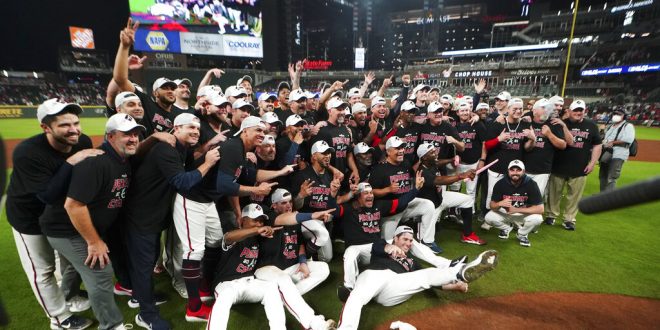
1. 2021 Atlanta Braves
2. 2020 Los Angeles Dodgers
3. 2019 Washington Nationals
4. 2018 * Boston Red Sox
5. 2017 * Houston Astros
6. 2016 Chicago Cubs
7. 2015 Kansas City Royals
8. 2014 San Francisco Giants
9. 2011 St. Louis Cardinals
10. 2009 New York Yankees
11. 2008 Philadelphia Phillies
12. 2005 Chicago White Sox
13. 2003 Miami Marlins
14. 2002 Los Angeles Angels
15. 2001 Arizona Diamondbacks
16. 1993 Toronto Blue Jays
17. 1991 Minnesota Twins
18. 1990 Cincinnati Reds
19. 1989 Oakland Athletics
20. 1986 New York Mets
21. 1984 Detroit Tigers
22. 1983 Baltimore Orioles
23. 1979 Pittsburgh Pirates
24. 1948 Cleveland Indians
25. None in 24 seasons: Tampa Bay Rays
26. None in 29 seasons: Colorado Rockies
27. None in 45 seasons: Seattle Mariners
28. None in 50 seasons: Texas Rangers
29. None in 52 seasons: Milwaukee Brewers
30. None in 53 seasons: San Diego Padres

Last Pennant:
1. 2021 Atlanta Braves
2. 2021 * Houston Astros
3. 2020 Los Angeles Dodgers
4. 2020 Tampa Bay Rays
5. 2019 Washington Nationals
6. 2018 * Boston Red Sox
7. 2016 Chicago Cubs
8. 2016 Cleveland Indians
9. 2015 Kansas City Royals
10. 2015 New York Mets
11. 2014 San Francisco Giants
12. 2013 St. Louis Cardinals
13. 2012 Detroit Tigers
14. 2011 Texas Rangers
15. 2009 New York Yankees
16. 2009 Philadelphia Phillies
17. 2007 Colorado Rockies
18. 2005 Chicago White Sox
19. 2003 Miami Marlins
20. 2002 Los Angeles Angels
21. 2001 Arizona Diamondbacks
22. 1998 San Diego Padres
23. 1993 Toronto Blue Jays
24. 1991 Minnesota Twins
25. 1990 Cincinnati Reds
26. 1990 Oakland Athletics
27. 1983 Baltimore Orioles
28. 1982 Milwaukee Brewers
29. 1979 Pittsburgh Pirates
30. None in 45 seasons: Seattle Mariners

*

November 4, 1796, 225 years ago: For the 1st time in American history, a Presidential election is truly contested. President George Washington has agreed to serve only 2 terms, and his time is just about up.

The Federalist Party nominates its 1st candidate, the incumbent Vice President, John Adams. The Democratic-Republican Party nominates its 1st candidate, the 1st Secretary of State, and the author of the Declaration of Independence, Thomas Jefferson. Once great friends, the 2 titans of 1776, Adams of the North and Jefferson of the South, are now political arch-rivals.

Adams wins the States of Massachusetts (his home State), New Hampshire, Vermont, Rhode Island, Connecticut, New York, New Jersey and Delaware; and 3 of the 7 Electoral Votes in Maryland; and 1 vote each in Pennsylvania, Virginia (Jefferson's home State) and North Carolina, for a total of 71 Electoral Votes.

Jefferson wins the entire States of Georgia, South Carolina, Tennessee and Kentucky, plus 11 out of 12 Electoral Votes in North Carolina, 20 out of 21 in Virginia, 4 out of 7 in Maryland, and 14 out of 15 in Pennsylvania, for a total of 68. In other words, had "faithless electors" not abandoned Jefferson in Virginia, North Carolina and Pennsylvania -- or had he hung onto 2 more Votes in Maryland -- he would have won. Instead, Adams becomes the 2nd President of the United States.

But the way elections worked at the time, by finishing 2nd, Jefferson becomes Vice President, setting up 4 years of partisan nastiness -- not so much by each man as by their respective supporters. There is a rematch in 1800, and Jefferson wins. Things got so bad that Adams snuck out of town in the middle of the night on Inauguration Day, March 4, 1801, and did not attend the ceremonies.

He and Jefferson never saw each other again. Eventually, Adams' wife Abigail talked him into sending a letter of reconciliation from Quincy to Charlottesville, and their friendship was restored, if not face-to-face.

They died on the same day, July 4, 1826 -- the 50th Anniversary of the signing of the Declaration of Independence. Knowing he was dying, Jefferson wanted to know if he would make it, and, every time he drifted back into consciousness, he would ask, "Is this the Fourth?" They kept telling him it wasn't, and he kept drifting away and drifting back and asking, until they could finally tell him the truth, that it was, and he could finally die in peace at age 83.

Long-distance communication being what it then was, Adams didn't know this. A few hours later, at age 90, he spoke his last words: "Thomas Jefferson lives. Independence forever." At this time, his son, John Quincy Adams, was the President.

*

November 4, 1808: James Madison, then Secretary of State to outgoing President Thomas Jefferson, is elected the 4th President of the United States. The Father of the Constitution, and the nominee of the Democratic-Republican Party, he defeats Charles Cotesworth Pinckney, who was making his 2nd run, 122 Electoral Votes to 47. Madison won 12 States to Pinckney's 5.

November 4, 1856: James Buchanan is elected the 15th President of the United States. He wins 19 States for 174 Electoral Votes. John C. Fremont, the 1st man to run for President as the nominee of the Republican Party, wins 11 States for 114 Electoral Votes. Millard Fillmore, the 13th President, in his only run for the top job, was the nominee of the American Party -- an anti-immigrant group known as "The Know-Nothings" for the way they tried to cover up their activities -- wins only Maryland, and its 8 Electoral Votes.

Fremont was a hero General of the Mexican-American War. In the early 21st Century, the History Channel series The Conquerors would call him "The Conqueror of California." He was 1 of the State's 1st 2 U.S. Senators, and, long after this election, served as Territorial Governor of Arizona. He was also the 1st major-party nominee to have facial hair, in his case a mustache and a beard.

(Abe Lincoln didn't yet have the beard in 1860, but from 1864 to 1908, every man elected President but 1, William McKinley, would have at least a mustache, and most of them had beards. But aside from the mustachioed Thomas Dewey in 1944 and 1948, no major-party nominee has had facial hair since 1916.)

Despite being the only President who never married -- legends that he was gay remain, though hardly proven -- Buchanan must have seemed like the perfect guy at the time: He had served Pennsylvania in both houses of Congress, had been Secretary of State under President James K. Polk, and had been U.S. Minister (today, we would say, "Ambassador") to both Britain and Russia.

Indeed, the fact that Buchanan was serving as Minister to Britain under President Franklin Pierce (who was now so unpopular that he couldn't possibly be re-elected), and wasn't available to speak out on the issue of slavery, meant he had offended no one.

That would change. Buchanan satisfied no one, combining a depression shortly after he was sworn in (the Panic of 1857) with an unwillingness to do anything to stop the rising tensions leading to the Civil War. He was every bit as bad as Pierce was -- the 2 worst Presidents this country has ever had. Yes, worse than Herbert Hoover, Richard Nixon and George W. Bush. Until, that is, Donald Trump.

November 4, 1879: William Penn Adair Rogers is born in Oologah, Oklahoma Territory. Will Rogers was a stage performer, famous for his rope tricks, and a newspaper columnist, one of the nation's leading commentators and humorists in the early 20th Century, until his death in a plane crash, flying with famed aviator Wiley Post, at America's northermost point, Barrow, Alaska, on August 15, 1935.

What did he have to do with sports? As far as I know, nothing. But on January 1, 1947, the Will Rogers Bowl was played at Taft Stadium in Oklahoma City. Pepperdine beat Nebraska Wesleyan 38-13. Only 800 people paid to see it, so it was never played again.

*

November 4, 1884: One of the closest and nastiest elections in American history ends. Grover Cleveland was the Democratic nominee, the Governor of New York. He had a reputation for honesty, to the point where, when he was accused of fathering a child out of wedlock, institutionalizing the mother to keep her quiet, and putting the kid up for adoption, and his advisers asked him what to do, he said, "Above all, tell the truth." So they said nothing.

In contrast, the Republican nominee was, as the song went, "Blaine! Blaine! James G. Blaine! The continental liar from the State of Maine!" He was a U.S. Senator, and had been Speaker of the U.S. House of Representatives, and Secretary of State under President James Garfield. Indeed, he was standing next to Garfield when he was shot. Had Charles Guiteau's aim been a little off, Garfield would likely have been running for re-election against Cleveland, and, without Blaine's many scandals (which had nothing to do with Garfield), he might have won easily.

Just before the election, Blaine had attended a dinner in New York, where one of the speakers, the Rev. Samuel Burchard, called the Democrats "the Party of Rum, Romanism and Rebellion!" In other words, they were against the movement for the Prohibition of alcohol, they had great support among Roman Catholics (and thus, it was believed, would be puppets of the Pope in a country dominated by Protestants), and supported slavery and the South during the Civil War.

That speech hit the papers. It cost Blaine the State of New York, which had a lot of Catholic and anti-Prohibition voters, and was wobbling on Cleveland even though he had been popular as Governor and as Mayor of Buffalo. And it made all the difference: By winning New York, Cleveland took the Electoral Vote 219 to 182. He won just 48.9 percent of the popular vote, to Blaine's 48.3. In fact, Cleveland ran for President 3 times, and won the popular vote all 3 times (though he lost the Electoral Vote in 1888, winning it again in 1892), but on none of those occasions did he win a majority.

When Cleveland was beaten in 1888, under dubious circumstances, his opponent, Benjamin Harrison, returned Blaine to the State Department, but he resigned due to ill health in 1892, and died just before the term ended in 1893. Had Burchard -- not related to another Republican activist by that name, a Congressman from Wisconsin -- kept his mouth shut, Blaine would have become the 22nd President of the United States, and Cleveland would only be remembered for, "Ma! Ma! Where's my pa?" Instead, the Democrats' answer was, "Gone to the White House, ha, ha, ha!"

So what was the truth? In 1874, between offices and in private law practice (he had been Sheriff of Erie County), Cleveland paid child support for Maria Halpin and her son, named Oscar Folsom Cleveland. Maria was, apparently, mentally ill, and was indeed institutionalized, though there is no evidence that it was on Cleveland's request. The boy was adopted, was given the name James E. King Jr., and became a doctor like his adoptive father.

The thing was, in those days, long before DNA or even blood tests would have shed some light on the subject, Grover Cleveland was not the only possible father. Another possible father was Cleveland's law partner, whose name was Oscar Folsom. But of the several possible fathers, Cleveland was the only one who was not married at the time, and thus would be the one least scandalized -- or so he thought.

By today's standards, we would find what Cleveland did next to be much worse: He married Frances Folsom, the daughter of Oscar Folsom, who had died and left her guardianship to him. She was 21 when they married in 1886, making her by far the youngest First Lady ever, and their wedding the 1st ever held in the White House itself.

But as icky as their relationship sounds, it lasted for the rest of his life, until 1908. She died in 1947 -- as did Oscar Folsom Cleveland/Dr. James D. Fox Jr. Grover and Frances Cleveland had 5 children: Ruth, Esther, Marion, Richard and Francis. Ruth was not, as the legend says, the namesake of the Baby Ruth candy bar. She died of diphtheria at age 12. The rest all lived until at least 1974, and Francis lived until 1995. Rev. Burchard died in 1891, Blaine in 1893, and Harrison in 1901.

*

November 4, 1916: Walter Leland Cronkite Jr. is born in St. Joseph, Missouri. He was the anchor and managing editor of The CBS Evening News from 1962 to 1981, presiding over such events as the Civil Rights Movement, the Cuban Missile Crisis, the assassination of President John F. Kennedy, the Great Society, the Vietnam War, 2 Arab-Israeli Wars, the assassinations of Martin Luther King and Robert F. Kennedy, the 1968 Democratic Convention and the riot outside, the 1st manned Moon landing, the Kent State Massacre, President Richard Nixon's visit to China, Watergate and Nixon's resignation, the U.S. Bicentennial, the Camp David Accords, and the Iran Hostage Crisis. "And that's the way it is."

He became known as "the most trusted man in America." When he summed up his visit to Vietnam early in 1968 and said that it was time to stop fighting and find a diplomatic way out, President Lyndon Johnson said, "If I've lost Cronkite, I've lost Middle America," and chose not to run for re-election.

His connection to sports is that he did voiceovers in ads for his alma mater, the University of Texas, that aired during college football broadcasts. He died in 2009.

November 4, 1918: Lieutenant Wilfred Owen, having already survived enough encounters with death in World War I to make most people think he was invincible, is killed in action as his unit crosses the Sambre-Oise Canal in northern France. The native of Oswestry, Shropshire in the West Midlands of England was just 25. Had he lived just 7 more days, he would have made it.

He and Siegfried Sassoon were regarded as the greatest British poets whose work was based on the events of that war. Certainly, both were better than the leading American poet killed in that war, Joyce Kilmer.

I knew Owen's name before I knew his story: He was one of the poets for whom streets were named in Greenbriar, the retirement community my grandparents moved to in Brick, Ocean County, New Jersey. (Sassoon and Kilmer were not among them, even though Kilmer was from New Jersey.)

What passing-bells for these who die as cattle?
Only the monstrous anger of the guns.
Only the stuttering rifles' rapid rattle
Can patter out their hasty orisons.
No mockeries now for them; no prayers nor bells,
Nor any voice of mourning save the choirs, 
The shrill, demented choirs of wailing shells;
And bugles calling for them from sad shires.

What candles may be held to speed them all?
Not in the hands of boys, but in their eyes
Shall shine the holy glimmers of goodbyes.
The pallor of girls' brows shall be their pall;
Their flowers the tenderness of patient minds,
And each slow dusk a drawing down of blinds.


Also on this day, James Furman Bisher is born in Denton, North Carolina. Dropping his first name, Furman Bisher went to, yes, Furman University in Greenville, South Carolina. But he transferred to the University of North Carolina, graduating at age 20, and then becoming editor of a local newspaper.

After editing a military newspaper and the Armed Services Radio Network while in the U.S. Navy in World War II, he became sports editor of the Charlotte News (now part of the Charlotte News & Observer). In 1949, he got the only interview Shoeless Joe Jackson ever did after his 1921 trial, and covered the 1st NASCAR race.

In 1950, he was hired by the Atlanta Constitution, also wrote for the Atlanta Journal, and finally for the combined paper. He covered every Masters from 1950 to 2008, every Kentucky Derby from 1950 to 2011, and every Super Bowl from II to XLV -- missing I. He was elected to the National Sportscasters and Sportswriters Hall of Fame, and the Georgia Sports Hall of Fame. The man who succeeded Grantland Rice as the South's greatest sportswriter died in 2012.

Also on this day, Arthur William Matthew Carney is born in Mount Vernon, Westchester County, New York. He was wounded on D-Day, but survived World War II to become one of the finest actors of his generation, either comedic or dramatic.

If you only know Art Carney as Ed Norton on The Honeymooners, you're missing a lot. And if you don't even know him for that, let the record show that not only was Norton the basis for every sitcom "wacky neighbor" that followed, but his entry into the Kramden apartment was obviously ripped off by Michael Richards as Cosmo Kramer on Seinfeld. (The difference being, Kramer was the one coming up with get-rich-quick schemes, while Norton was always getting roped into them.)

Carney gained famed before that. His 1st film was Pot of Gold, in 1941. Jimmy Stewart once went on
The Tonight Show, and told Johnny Carson it was the last film he made before going off to The War. When he got back, he did what everybody else with money was doing at the time: He bought a television set. As he told Carson, the first thing Stewart saw on the set was a movie, and he decided it was the worst film he'd ever seen. And then he saw himself walk onto the screen, and realized it was
Pot of Gold. He'd never seen the finished version until then. And he went to his grave still believing it was a lousy movie. Carney's opinion of it is not publicly known.

Among his early roles, Carney was noted for impersonating both Franklin Roosevelt and Dwight D. Eisenhower. On The Morey Amsterdam Show, he played Charlie the doorman, and popularized the catchphrase, "Ya know what I mean?" This was long before the unseen character of Carlton the doorman on Rhoda, and long before Jim Varney's Ernest P. Worrell also used the catchphrase.

In 1950, Jackie Gleason hired him for his variety show, and The Honeymooners grew out of that. In addition to sewer worker Ed Norton to Gleason's bus driver Ralph Kramden, he participated in the "Reginald Van Gleason III" sketch, as Reggie's uptight, monocle-wearing father. As a result of appearing on The Jackie Gleason Show and The Honeymooners, Carney won 6 Emmy Awards.

In 1960, he starred in the Twilight Zone episode "The Night of the Meek," playing a hard-luck department store Santa Claus who turns into the real thing. He played Santa again in the 1984 TV-movie The Night They Saved Christmas. In 1965, he debuted the role of Felix Ungar on Broadway in Neil Simon's The Odd Couple, opposite Walter Matthau's Oscar Madison. (The name was spelled "Ungar" in the play and the movie. It became "Unger" on the TV show)

In 1974, he starred in Harry and Tonto, and won the Oscar for Best Actor, beating out Dustin Hoffman, Jack Nicholson, Al Pacino and Albert Finney. As Norton would have said, "Va va va voom!" In 1978, he played a key role in the Star Wars Holiday Special. In 1979, he, George Burns and Lee Strasberg played old guys looking for one last thrill, so they rob a bank, in Going In Style. (Burns was 83, Strasburg was 78, and Carney was 60 but could pass for older.)

In 1988, he made my favorite commercial of all time, and for a product I don't even like, Coca-Cola. With Brian Bonsall of Family Ties as his grandson, "Grandpa's Magic Pinecone" turns into the Rockefeller Center Christmas Tree. It gets me every time.

Art Carney died on November 9, 2003, just after his 85th birthday, at his home in Westbrook, Connecticut. You know the clueless middle-aged GEICO executive who starred with the Gecko in those commercials? That's Art's grandson, Brian Carney.

*

November 4, 1922: The football team of the University of Alabama goes to Philadelphia, and beats the University of Pennsylvania 9-7 at Franklin Field. The stadium of that name that had stood since 1895 would soon be demolished, and replaced on the same site by the current Franklin Field.

This upset of an Ivy League school is considered a landmark day in the history of Southern football, and it helped launch 'Bama on a run of success that continued throughout the 1920s and '30s and established the school's legend, before Bear Bryant was even a player (and while he was one).

Also on this day, Edwin Frank Basinski is born in  Buffalo. An infielder, he was a wartime callup for the Brooklyn Dodgers, appearing in 39 games in the 1944 season, and 108 more in 1945. He had 56 more games, all with the 1947 Pittsburgh Pirates, finishing with a "lifetime" batting average of just .244. He did, however, play in the minor leagues until 1959, including a long tenure with the Portland Beavers, which earned him a place in the Pacific Coast League Hall of Fame.

At age 99, Eddie Basinski is the 2nd-oldest living former MLB player, 1 of 12 living former Brooklyn Dodgers, and the last living player whose name is mentioned in jazz singer Dave Frishberg's ode to ballplayers of his youth, "Van Lingle Mungo."

Also on this day, British archaeologist Howard Carter discovers the tomb of King Tutankhamen (reigned 1334-1325 BC) in the Valley of the Kings, about 400 miles south of the Egyptian capital of Cairo.

November 4, 1924: President Calvin Coolidge, who took the office on the death of Warren Harding the year before, is elected to a full term in his own right. The Republican, who had been Governor of Massachusetts before being Vice President, took advantage of a split in the Democratic Party that nullified a split in the Republican ranks.

The slogan was "Keep Cool with Coolidge," and the nation agreed. He won 382 Electoral Votes, and 54 percent of the popular vote. John W. Davis, a former Congressman from West Virginia and U.S. Ambassador to Britain, won 136 Electoral Votes, but his 29 percent represents the lowest popular-vote percentage in the history of the Democratic Party. Senator Robert La Follette of Wisconsin, formerly a Republican but now the leader of the Progressive Party, won his home State for 13 Electoral Votes, and took 16 percent of the vote.

Coolidge had recently lost his 16-year-old son John to an infection that could have been easily treated had antibiotics been invented. He had also recently watched the Washington Senators win the District of Columbia's only World Series to date. He did not like baseball, but his wife Grace did.

He was known as "Silent Cal" for his reticence. Legend has it that 2 women, seeing him at a party, made a bet. So one walked up to him and said, "I made a bet with my friend that I could get you to say 3 words to me." And Coolidge said, "You lose."

Even when he decided not to run for a 2nd full term, he was brief: He told the press simply, "I do not choose to run for President in 1928," and walked away. He may have seen the Crash of 1929 coming, and didn't want to get blamed for it. He should be, but he left his successor, Herbert Hoover, holding the bag.

November 4, 1927: William Calhoun (no middle name) is born in San Francisco. A forward, Bill Calhoun is the last surviving player from the 1951 Rochester Royals, the only NBA Championship for the franchise now known as the Sacramento Kings. 

Also on this day, Carl Ernest Sawatski is born in Shickshinny, Pennsylvania. He played in the major leagues from 1948 to 1963, mainly as a backup catcher, including to Del Crandall on the 1957 World Champion Milwaukee Braves. His lifetime batting average was .242. He later served as general manager of the Arkansas Travelers of the Class AA Texas League, and then as President of that League. He died in 1991.

November 4, 1928: Arnold Rothstein is rubbed out. "The Brain," who led the Mob's fix of the 1919 World Series, was also the guy who figured out that Prohibition was the way to turn organized crime in America into big business, while Al Capone was still an up-and-comer.

But, like drug dealers who got hooked on their own product, the lure of his original line of work, gambling, proved too much for "The Big Bankroll." He lost $320,000 (about $4.87 million today) in a 3-day high-stakes poker game. He said (O the irony) that the game was fixed, and refused to pay up.

He was shot at the Park Central Hotel, where a man then a rising star, Albert Anastasia, would see his reign as "the Boss of All Bosses" come to a similar end in 1957. It took Rothstein 2 days to die, and he refused to rat his killer out, telling the police, "You stick to your trade, I'll stick to mine." He was 46, and he always knew he would come to such an end: A favorite saying of his was, "The odds on everything in life, including life itself, are six to five against."

A man was arrested for the murder, but was acquitted for lack of evidence, and they may have gotten the wrong guy anyway.

Rothstein was played by Robert Lowery (who played Batman in a 1949 film serial) in The Rise and Fall of Legs Diamond in 1960, future Fugitive star David Janssen in The Big Bankroll in 1961, Michael Lerner in Eight Men Out in 1988, F. Murray Abraham in Mobsters in 1991, and Michael Stuhlbarg on
Boardwalk Empire in the early 2010s. In the 1974 film The Godfather Part II, Mario Puzo had Hyman Suchowsky, the character based on Meyer Lansky (played by Lee Strasberg), give himself the "street name" Hyman Roth because he admired Rothstein.

In The Great Gatsby, F. Scott Fitzgerald used Rothstein as a character, giving him the name Meyer Wolfsheim, a man who managed to "play with the faith of 50 million people." The character does not appear in the 1926 and 1949 film versions, but was played by Howard Da Silva in 1974, and by Indian film superstar Amitabh Bachchan in 2013.

Also on this day, Jay Lowell Van Noy is born in Garland, Utah. He played 6 games as an outfielder for the St. Louis Cardinals in 1951. He later coached at Brigham Young University, was elected to the Utah Sports Hall of Fame, and died in 2010.

*

November 4, 1930: Richard Morrow Groat is born in the Pittsburgh suburb of Wilkinsville, Pennsylvania. Dick Groat is a rare 2-sport star. He played basketball at Duke University long before that was cool, setting an NCAA record with 839 points in the 1952 season, and his Number 10 was the 1st they ever retired. He played the 1952-53 season with the Fort Wayne Pistons.

He gave up basketball because he was better at baseball. A 5-time All-Star, the shortstop won the World Series, the National League batting title, and the NL Most Valuable Player with the 1960 Pittsburgh Pirates. His hometown team traded him to the St. Louis Cardinals, and he won another World Series in 1964. He has since gone back to basketball, broadcasting for the University of Pittsburgh's team. He is 1 of 11 surviving '60 Pirates, and 1 of 16 surviving '64 Cards.

November 4, 1931
, 90 years ago: Marie Mansfield (no middle name) is born in the Jamaica Plain section of Boston. A pitcher, she played in the All-American Girls Professional Baseball League from the 1950 to 1954. Except for a brief time with the Battle Creek Belles in Michigan, it was all for the Rockford Peaches in Illinois.

She helped them win the Pennant in 1950, and led the League in strikeouts in 1953. In 1990, under her married name of Marie Kelley, she sat with Mary Pratt and Dottie Green, fellow Boston-area natives who played in the AAGPBL, for an interview with Ken Burns for his Baseball miniseries. Dottie died in 1992, before the miniseries could air. Mary died earlier this year. Marie is still alive.

November 4, 1937: Emmette Bryant (no middle name) is born in Chicago. A guard, Em Bryant played 4 seasons for the Knicks, but they didn't win anything until after they got rid of him. His 1st season away from them, 1968-69, he won the NBA Championship with the Boston Celtics. That's how the Celtics' luck went in those days.

He later coached under his former teammate Bill Russell with the Seattle SuperSonics, and remained in Seattle, working for the State of Washington through its Department of Social and Health Services. He says, "I'm just a teacher that happened to play pro ball." He is still alive.

Also on this day, Loretta Jane Swit is born in Passaic, Passaic County, New Jersey. For 11 seasons, 1972 to 1983, she played Major Margaret "Hot Lips" Houlihan, the head nurse of a U.S. Army hospital in the Korean War, on M*A*S*H. Sally Kellerman played the role in the 1970 film version. The actresses didn't look much like each other then, but bear a stronger resemblance to each other now.

Swit was also the 1st actress to play New York Police Detective Christine Cagney, in the 1981 TV-movie Cagney & Lacey, also on CBS. But when it was picked up as a series, her M*A*S*H
commitment prevented her from playing the role, which made a star out of Sharon Gless, along with Tyne Daly as Detective Mary Beth Lacey. Swit retired from acting in 1998.

*

November 4, 1943: Charles Bishop Scarborough III is born in Pittsburgh. Probably the 2nd-most famous graduate of the University of Southern Mississippi, behind Brett Favre, and a U.S. Air Force veteran of the Vietnam War who still holds a pilot's license, Chuck Scarborough has been the news anchor at WNBC-Channel 4 in New York since 1974. No one has done New York local news longer. In 2017, he cut back, and now anchors only the 6:00 PM broadcast.

From 1980 to 2012, he and Sue Simmons -- who, I was surprised to find out, is actually a year older -- anchored the news program together, first as NewsCenter 4, then as News 4 New York. At 32 years, it remains the longest anchor pairing in New York history.

November 4, 1944: President Franklin D. Roosevelt has what turns out to be his last campaign rally, at Fenway Park in Boston. Orson Welles introduces him. While FDR speaks, Welles sits next to Frank Sinatra on the stage. FDR says:

Today, in this war, our fine boys are fighting magnificently all over the world. And among those boys are the Murphys and the Kellys, the Smiths and the Joneses, the Cohens, the Carusos, the Kowalskis, the Schultzes, the Olsens, the Swobodas, and, right in with all the rest of them, the Cabots and the Lowells.

All of these people, and others like them, are the life-blood of America. They are the hope of the world. It is our duty to them to make sure that, big as this country is, there is no room in it for racial or religious intolerance, and that there is no room for snobbery.

Boy, did FDR know his audience. A year later, he was dead, but Sinatra starred in The House I Live In, a 10-minute film in which he stops a group of boys from abusing a Jewish kid, and sings the inclusive title song: "That looks like America to me." 

In his 1966 song "That's Life," Sinatra would sing, "I've been a puppet, a pauper, a pirate, a poet, and pawn and a king." As metaphors go, it was accurate. Both FDR and Welles could have said the same.

November 4, 1946
, 75 years ago: Danny Ray Godby is born in Logan, West Virginia. An outfielder, he played 13 games in the major leagues, all for the St. Louis Cardinals late in the 1974 season. He returned to his home State and became a high school coach, and is still alive.

Also on this day, Laura Lane Welch is born in Midland, Texas. In 1977, she married George W. Bush, which made her the First Lady of Texas from 1995 to 2000, and First Lady of the United States from 2001 to 2009.

It's always struck me as odd that, while her husband seemed to revel in his lack of intellectualism, not seeming to mind that people thought him stupid and/or ignorant, she was a librarian.

Also on this day, UNESCO is founded: The United Nations Educational, Scientific and Cultural Organization. Based in Paris (not in New York, like the UN's General Assembly), its purpose is "to contribute to promoting international collaboration in education, sciences, and culture in order to increase universal respect for justice, the rule of law, and human rights along with fundamental freedom proclaimed in the United Nations Charter."

It has selected 1,121 "World Heritage Sites" for having cultural, historical, scientific or other form of significance, and they are thus legally protected by international treaties. There are 24 of them in America. None are officially in my home State of New Jersey: The the Statue of Liberty is officially within the State of New York, but it is closer to land in New Jersey.

Independence Hall in Philadelphia is the only other such site in the Northeastern U.S., although there are 4 others that have been nominated for consideration: The Moravian Church Settlements in Bethlehem, Pennsylvania; and, in New York, Ellis Island (which might be included in an extension of the Statue of Liberty's site), the Brooklyn Bridge and Central Park.

*

November 4, 1950: Grover Cleveland Alexander dies on his farm in his hometown of St. Paul, Nebraska, after years of drinking and epilepsy wrecking his health. He was 63. He won Pennants with the 1915 Philadelphia Phillies, the 1918 Chicago Cubs, and the 1926 and 1928 St. Louis Cardinals. He won 373 games, sharing the all-time NL lead with Christy Mathewson, and 3rd all-time behind Cy Young (split over both leagues) and Walter Johnson (American League). He pitched 90 shutouts, 2nd only to Johnson.

He will forever be best remembered for pitching the most famous strikeout in baseball history, to Tony Lazzeri of the Yankees with the bases loaded and 2 outs in the bottom of the 7th inning, with the Cards up 3-2. What everybody -- including the 1952 film The Winning Team, starring Ronald Reagan as Alex -- tends to forget is that it didn't end the game.

After Mathewson, Johnson and Young, he was only the 4th pitcher elected to the Hall of Fame. In 1999, The Sporting News listed him 12th on their 100 Greatest Baseball Players, trailing only Johnson (4th) and Mathewson (7th) among pitchers. Since he played before uniform numbers were worn, the Phillies honor him with a "P" stanchion with their retired numbers.

Also on this day, Nat "Sweetwater" Clifton, the 1st black player to sign with an NBA team, makes his debut, 4 days after Earl Lloyd of the Washington Capitols became the 1st black player to play in an NBA game. He scores only 4 points, but has 9 assists, and helps the Knicks to defeat the defending NBA Champions, the Minneapolis Lakers, 71-69.

November 4, 1952: General Dwight D. Eisenhower, the great American hero of World War II, is overwhelmingly elected President. The Republican nominee won 442 Electoral Votes, while the Democratic nominee, Governor Adlai Stevenson of Illinois, won only 9 States for 89 Electoral Votes. "Ike" won the popular vote, 55 to 44 percent, ending 20 years of Democratic governance in the White House. The Republicans also win both houses of Congress.

November 4, 1955: Cy Young dies in Newcomerstown, Ohio. Belying his name, he was 88. The next season, Major League Baseball instituted the Cy Young Award, for the most valuable pitcher in baseball. In 1967, they began handing them out for the most valuable pitcher in each League.

His 511 wins -- and 313 losses -- will never be approached under the current rules and thought processes of baseball. In 1999, 88 years after he pitched his last game, he was named to the Major League Baseball All-Century Team, and The Sporting News named him Number 14 on their list of the 100 Greatest Baseball Players, behind only Johnson, Mathewson and Alexander among pitchers.

*

November 4, 1960
: The Twilight Zone airs the episode "The Howling Man." Chaim Winant, credited as H.M. Wynant, plays a man who, in 1925, was fooled into releasing the Devil from a castle's dungeon, and finally manages to track him down and imprison him again. John Carradine plays the castle's keeper, and Robin Hughes plays the eponymous howling man.

Wynant is still alive at age 94, and acted as recently as 2018. Carradine, founder of one of the great acting families that includes David, Keith, Robert and Ever, died in 1988. Hughes died in 1989.

Also on this day, Kathleen Mary Griffin is born in the Chicago suburb of Oak Park, Illinois. A member of the Chicago-based comedy troupe The Groundlings, her 1st TV appearance was in a commercial promoting the Chicago White Sox.

Kathy Griffin played restaurant critic Vicki Groener on the NBC sitcom Suddenly Susan, hosted several comedy specials, and starred in Bravo's reality series Kathy Griffin: My Life On the D-List. In 2008, her 1st ablum, For Your Consideration, made her the 1st female comedian to debut at the top of Billboard magazine's Top Comedy Albums chart. In 2014, her album Calm Down Gurrl won the Grammy Award for Best Comedy Album.

From 2009 to 2016, she co-hosted New Year's Eve Live on CNN with Anderson Cooper. She was fired from broadcast after her May 30, 2017 video of herself holding up a Donald Trump mask that made it look like she was holding up his bloody severed head. Her career has never recovered, but, while she apologized for the video, she has not let up on her criticism of Trump.

She is now dealing with lung cancer, and had half of a lung removed. It would be terribly ironic if she died before Trump. But she's a lot likelier than he is to get into Heaven.

November 4, 1961, 60 years ago: East Brunswick High School, in its 1st season of varsity football, plays South River for the 1st time. South River, the school to which East Brunswick sent its students until EBHS opened in 1958, wins, 26-0. The schools would play 15 times, with an even split, 7-7-1. However, South River would deal EB their only loss in 2 State Championship seasons, 1966 and 1972.

November 4, 1967: Tampa Stadium opens, adjacent to Tampa's minor-league ballpark, Al Lopez Field. At first, it seated 46,481 people. A 1975 expansion raised capacity to 74,301. Its unusual shape led to its nickname, The Big Sombrero.

It became home to the football team at the University of Tampa, but they dropped their program after the 1974 season. It was home to the Tampa Bay Rowdies from 1975 to 1993, and they won the Tampa Bay area's 1st league championship, the North American Soccer League title, in 1975.

The NFL's expansion Tampa Bay Buccaneers moved in for 1976, and lost their 1st 26 games. They managed Division titles in 1979 and 1981, but were mostly awful. Indeed, the Tampa Bay Bandits may have been -- along with the Philadelphia Stars -- the only United States Football League team better-run than the NFL team in the same market.

Tampa Stadium hosted Super Bowl XVIII in 1984 (Los Angeles Raiders over Washington Redskins) and Super Bowl XXV in 1991 (Giants over Buffalo Bills). It hosted the Outback Bowl from 1986 to 1998, and the Tampa Bay Mutiny of Major League Soccer from 1996 to 1998. In 1997, the University of South Florida entered Division I and played there for that season.

In 1996, restaurant chain Houlihan's bought the naming rights, and until its replacement by the adjacent Raymond James Stadium in 1998 and its demolition the next year, it was known as Houlihan's Stadium.

November 4, 1969: John Lindsay, denied renomination by the Republican Party, and running as the nominee of the Liberal Party, is re-elected Mayor of New York. The opposition to him had fragmented: The Democratic nominee was Mario Procaccino, a conservative serving as City Comptroller and widely viewed as a racist; while the nominee of the Republican and Conservative Parties was John Marchi, a State Senator from Staten Island who was so conservative he made Barry Goldwater look like Bobby Kennedy.

When Lindsay was denied renomination, he looked finished. The fact that he had presided over race riots and municipal strikes while calling New York "Fun City" didn't help. He may have been the 1st major politician to run having used the expression "Mistakes were made" -- used many times by many people since, without specifically saying, "I have made mistakes" -- and used an expression that would later be used by some of his successors, calling the job of Mayor of New York "the second-toughest job in America."

On this day, Lindsay got 41 percent of the vote -- not a majority, but a plurality, and over the 40 percent threshold for a runoff -- while Procaccino got 34 percent and Marchi got 22 percent.

What saved Lindsay? It wasn't just liberals and minorities, afraid of what Procaccino or Marchi would do. It was the Mets. Their run to a World Series win allowed him to identify with them, and he was in the locker room when they won the Series at Shea Stadium on October 16, 19 days before the election. He then gave them a ticker-tape parade and a big ceremony at City Hall. (He gave the Super Bowl-winning Jets a ceremony, too, but not a parade.)

Lindsay's 1st term was hard. His 2nd term was a bit more peaceful in terms of civil strife, but harder in terms of holding the City's government and economy together. He might have wished he had lost. He did not run for a 3rd term in 1973 -- he wouldn't have had a chance -- and he died in 2000.

Also on this day, William T. Cahill, a Republican Congressman representing Camden County, is elected Governor of New Jersey. After 16 years of Democratic Governors, under Robert Meyner and, since a Governor of New Jersey can't serve 3 consecutive terms, Richard J. Hughes, people wanted something different, and when Meyner was nominated to regain the office, he couldn't get any traction.

Cahill got the State legislature to pass the bill creating the New Jersey Sports and Exposition Authority, which built the Meadowlands Sports Complex. But he raised taxes, and 3 major Republican officials were convicted of crimes. He was denied renomination by his own Party in 1973. He went on to teach at Princeton University, and died in 1996.

Also on this day, The Allman Brothers Band release their self-titled debut album. It includes the song "Whipping Post."

Lead guitarist Duane Allman was killed in a motorcycle crash in Macon, Georgia in 1971. Bass guitarist Berry Oakley was also killed in a motorcycle crash, just a year later and only 3 blocks from the site of Duane’s crash. Both died before the band's biggest hit, the next year: "Ramblin' Man." Lead singer and organist Greg Allman and drummer Butch Trucks died in 2017. Guitarist Dickey Betts is about to turn 77. Drummer Jai Johanny "Jaimoe" Johanson is 76.

Also on this day, Matthew McConaughey (no middle name) is born in Uvalde, Texas. Admit it: After playing a stoner in Dazed and Confused, a lawyer in A Time to Kill, winning an Oscar as an AIDS patient in Dallas Buyers Club, and apparently playing another stoner in some Cadillac commercials, you forgot he was in a baseball movie, playing left fielder Ben Williams in the 1994 remake of Angels In the Outfield. 

Also on this day, Sean John Combs is born in Manhattan, and grows up in nearby Mount Vernon, Westchester County, New York. The rapper, music producer, and fashion designer is known by many names: Sean John, Puff Daddy, Puffy, P. Diddy, or just Diddy. Personally, I will always think of him as The Guy Who Got Jennifer Lopez Arrested.

*

November 4, 1980: Sadaharu Oh retires after 22 seasons with the Tokyo-based Yomiuri Giants. The 1st baseman had a .301 lifetime batting average, 2,786 hits, and 868 home runs, still over 100 more than any player in the North American major leagues has hit. He won the Central League's Most Valuable Player 9 times, and 11 Japan Series in 13 years between 1961 and 1973.

As a manager, he took the Giants to the 1987 Pennant, the Fukuoka SoftBank Hawks to Japan Series titles in 1999 and 2003, and the Japan team to victory in the 1st World Baseball Classic in 2006. He is still alive, age 78.

November 4, 1981
, 40 years ago: The Cincinnati Reds trade outfielder Ken Griffey Sr. to the Yankees for pitching prospects Freddie Toliver and Brian Ryder. Ryder had been one of the Yankees' top prospects, but gets hurt, and never reaches the majors, throwing his last professional pitch at age 23. Toliver makes the majors, but is never effective, and last plays in 1993 with a career record of 10-16.

Griffey plays fairly well for the Yankees for 5 years, but the most notable effect of his Bronx tenure is that it made his son Ken Griffey Jr. refuse to ever to play for the Yankees. So when his contract with the Seattle Mariners ran out in 1999, he went "home" to the Reds.

Also on this day, Dallas Green resigns as Phillies manager, to become the general manager of the Cubs. He will use his Philly connections to fleece his former team, including getting Ryne Sandberg. Pat Corrales is named Phillies manager, but is fired in 1983, and replaced by GM Paul Owens, who then leads them to a Pennant -- the 1st of 2 they won while Sandberg was in Chicago, who won none. So maybe it wasn't so bad a trade.

Also on this day, Vincent Lamar Wilfork is born in the Miami suburb of Boynton Beach, Florida. A defensive tackle, he helped the University of Miami win the 2001 National Championship. He made 5 Pro Bowls, and helped the New England Patriots win Super Bowls XXXIX and XLIX. He was named to their 50th Anniversary Team. He will be eligible for the Pro Football Hall of Fame in 2021.

November 4, 1982: Devin Devorris Hester is born in the Miami suburb of Riviera Beach, Florida. The 4-time Pro Bowler is pro football's ultimate return man. In the 2006 season, as a rookie, he helped the Chicago Bears reach Super Bowl XLI, and became the 1st player, and is still the only one, ever to return the opening kickoff of a Super Bowl for a touchdown. The Bears lost to the Indianapolis Colts anyway.

He finished his career in 2016 with 255 receptions, 3,311 receving yards, 16 touchdowns, 11,028 return yards, and the following NFL records: 20 career kick return touchdowns, 14 career punt return touchdowns, and 6 kick return touchdowns in a season. He was named to the NFL's 2000s All-Decade Team, and will be eligible for the Pro Football Hall of Fame in 2022. As part of their 100th Season celebrations, the Bears named him to their 100 Greatest Players.

November 4, 1984: Dustin James Brown is born in Ithaca, New York. He captained the Los Angeles Kings to the 2012 and 2014 Stanley Cups. He is still with them, but is no longer their Captain.

November 4, 1988: The expansion Charlotte Hornets make their NBA debut. It doesn't go so well: They got clobbered, 133-93 by the Cleveland Cavaliers at the Charlotte Coliseum. Laker legend Kurt Rambis and Bloomfield, New Jersey native Kelly Tripucka each put up 16 points for the Hornets, but the Cavs get 22 points from Ron Harper and 20 from Brad Daugherty.

Also on this day, the film They Live premieres. John Carpenter cast pro wrestler Roddy Piper as a common laborer who becomes a rather uncommon hero, uncovering an alien conspiracy. All along, we thought Hulk Hogan was a good guy and "Rowdy Roddy" was a jerk. In real life, it was the other way around all along.

Most alien invasion movies are about the successful attempt to stop the invasion, or about the rebellion to reverse the invasion after it's taken over. They Live was different: It was about an invasion that had succeeded, and the world didn't even know it.

I was working in a theater when it came out, and loved it -- ironically, to the point where it became one of the reasons I quit that lousy job.

Piper gave one of the classic lines in film history: "I have come here to chew bubblegum and kick ass. And I'm all out of bubblegum.

Also on this day, Desmond Demond Bryant is born in Galveston, Texas. A 3-time Pro Bowler in 8 seasons with the Dallas Cowboys, Dez Bryant has caught 531 passes for 7,459 yards and 73 touchdowns. But they released him after last season. He was signed by the New Orleans Saints, but got hurt in practice, and never played for them. He now layed for the Baltimore Ravens.

November 4, 1989: The expansion Orlando Magic -- named for nearby Walt Disney World, "The Magic Kingdom" -- make their NBA debut, at the now-demolished Orlando Arena (a.k.a. the O-Arena). The New Jersey Nets spoil the party, winning 111-106. Dennis Hopson scored 24 points for the visitors, while the Magic's Terry Catledge led all scorers with 25.

*

November 4, 1991
, 30 years ago: Star Trek: The Next Generation airs the episode "Unification, Part I." Leonard Nimoy plays Ambassador Spock, now 138 years old, and Captain Jean-Luc Picard (Patrick Stewart) and the crew of the USS Enterprise-D must determine whether the unthinkable has happened: The United Federation of Planets' greatest living diplomat has defected to the Romulan Star Empire, warlike offshoots of Spock's people, the Vulcans.

The next week's Part II explains what has happened: Spock saw an opportunity at what 20th Century Earth would call détente, and possible reunification between the Vulcan and Romulan peoples. It was a setup: Spock was not a defector, but a patsy. But the unification movement, while not yet reaching the level of the Romulan government, is real, and Picard agrees with Spock's decision to stay behind.

Part I also features the death of Spock's father, Ambassador Sarek (Mark Lenard). Part II ends with Spock's mind-meld with Picard, who had previously mind-melded with Sarek, finally resolving the lifelong conflict between father and son.

November 4, 1996, 25 years ago: Jerry Rice of the San Francisco 49ers becomes the 1st NFL player to catch 1,000 passes. He catches another for a touchdown, and the 49ers beat the New Orleans Saints, 24-14 at the Superdome in New Orleans.

Easily the greatest receiver ever, and possibly the greatest player, he finished his career with 1,549 receptions, 22,895 receiving yards, 23,546 all-purpose yards, 197 receiving touchdowns, and 208 overall touchdowns, all still records.

Also on this day, Star Trek: Deep Space Nine airs the episode "Trials and Tribble-ations," Paramount Pictures' official tribute to the 30th Anniversary of the Star Trek franchise. It was written by David Gerrold, who had written the Original Series' most popular episode, "The Trouble With Tribbles." Sets were recreated, and computer-generated imagery (CGI) was combined with these new sets to create the illusion that DS9's characters were involved in the original episode.

Captain Benjamin Sisko (Avery Brooks) and the crew of the USS Defiant are sent 104 years into their past by Arne Darvin (Charlie Brill, reprising his earlier role), seeking revenge for his arrest and exile from the Klingon Empire for the failure of his mission of that time, to stop the Federation's attempt to acquire the border world known as Sherman's Planet.

In the original episode, Darvin had poisoned a grain shipment, intending to kill the people on the planet, but the tribbles had eaten it, killing them, leading to his being discovered by Captain James T. Kirk (William Shatner) and the crew of the Constitution-class USS Enterprise.

Now, Darvin's plan uses he Defiant and a Bajoran artifact it had found to go back in time. He planted a bomb in a fake tribble, with the intention of blowing up the space station in orbit around the planet, thus killing Kirk, and making him a hero of the Empire. Using the Defiant's replicators to create 23rd Century Starfleet uniforms and equipment, Sisko and his officers board the station to try to find the bomb.

In the process, Dr. Julian Bashir (Alexander Siddig) and Chief Petty Officer Miles O'Brien (Colm Meaney) end up in the famous scene where Chief Engineer Montgomery Scott (James Doohan) starts a fight by punching out Lieutenant Korax (Michael Pataki), a Klingon officer who had first said that the Enterprise, Scotty's pride and joy, should be hauling garbage; then, when Scotty insisted that he rephrase that, said that the ship should be hauled away as garbage. O'Brien replaces the original actor who was asked by Kirk who started the fight, using the same line, "I don't know, sir." Which, in the new version, unlike the old one, is true.

*

November 4, 2002: Around the Horn premieres on ESPN, sort of a McLaughlin Group for sports. Max Kellerman hosts until January 30, 2004. Tony Reali has been the host and moderator since February 2, 2004.

Current regular panelists include: Woody Paige of the Colorado Springs Gazette, formerly the Denver Post; Bob Ryan and Jackie MacMullan, both formerly of The Boston Globe; Bill Plaschke of the Los Angeles Times; Tim Cowlishaw of The Dallas Morning News; Kevin Blackistone of Fanhouse.com, formerly of The Dallas Morning News; Israel Gutierrez, formerly of The Miami Herald; Frank Isola of the New York Daily News; Sarah Spain and Jorge Sedano of ESPN; Pablo S. Torre and Mina Kimes of ESPN The Magazine; Bomani Jones, who co-hosts Highly Questionable on ESPN with Miami Herald columnist Dan Le Batard; Jon Weiner, a.k.a. "Stugotz," who co-hosts Le Batard's radio show; Justin Tinsley of ESPN's The Undefeated; Domonique Foxworth, a former NFL cornerback who now hosts an ESPN radio show; Dianna Russini, a correspondent for ESPN's NFL Live!; and Ramona Shelbourne, Clinton Yates, Elle Duncan, David Jacoby, Malika Andrews, 
Emily Kaplan, Joon Lee and Harry Lyles Jr. of ESPN.com.

Notable former panelists: J.A. Adande and T.J. Simers, formerly of the Los Angeles Times; Charlie Pierce, Michael Holley and Michael Smith, formerly of The Boston Globe; Richard Justice, formerly of the Houston Chronicle; Jemele Hill, formerly of the Detroit Free Press; Kate Fagan, formerly of ESPN; and, most controversially, Jay Mariotti of Fanhouse.com, formerly of the Chicago Sun-Times, on nearly every episode until 2011, when he was fired following a domestic violence scandal.

As of this weekend, Paige is the all-time leader in appearances, with 2,810, and in wins, with 635. Kimes holds the record for highest winning percentage, with a minimum of 100 appearances: 30.7 percent. 

Other win totals: Cowlishaw 503, Plaschke 401, Mariotti 329 (until his firing, he and Paige were neck-and-neck for the all-time lead for a few years), Blackistone 323, 
Adande 320, MacMullan 258, Ryan 206, Guiterrez 175, Jones 159, Isola 145, Smith 136, Spain 105, Torre 103, Yates 92, Kimes 58, Shelburne 42, Fagan 41, Hill 22, Sedano 20, Kaplan 19, Duncan 9, Tinsley 8, McNutt 6, Lee 5, Stugotz 4, Foxworth 3, Jacoby 3, Lyles 2, Russini 1 and Andrews 1. Simers won the pilot episode, but only won 10 until he drifted away.

November 4, 2004: With the original Charlotte Hornets having been moved to New Orleans 2 years earlier, the expansion Charlotte Bobcats make their NBA debut, 16 years to the day after the original Hornets did.

This game was also played at the now-demolished Charlotte Coliseum, but it didn't go much better: The Washington Wizards beat the 'Cats, 103-96. Emeka Okafor scored 19 for the hosts, but Antawn Jamison (a North Carolina graduate) dropped 24 on them for the Wiz.

When the Hornets changed their name to the New Orleans Pelicans, the Bobcats were given the Charlotte Hornets name and records (1988-2002), and have added them to the Bobcats' history (not that it was much).

November 4, 2007: The Minnesota Vikings beat the San Diego Chargers 35-17 at the Metrodome in Minneapolis. Adrian Peterson rushes for 296 yards, an NFL record that still stands, and 3 touchdowns.

November 4, 2009: Game 6 of the World Series. The Yankees beat the Philadelphia Phillies, 7-3 at the new Yankee Stadium, and clinched their 27th World Championship, 8 years to the day after they should have.

Andy Pettitte started and won. Mariano Rivera got the save. Hideki Matsui, in what turned out to be his last game with the Yankees, drove in 6 runs, including hitting a home run, a blast, off a "blast from the past," Pedro Martinez. I don't think any Yankee homer -- not by Chris Chambliss, Reggie Jackson, Bucky Dent, Don Mattingly, Jim Leyritz, Bernie Williams, Tino Martinez, Scott Brosius, Derek Jeter, even Aaron Boone -- has ever made me feel better, because of what Pedro the Punk represents.

Jeter, Rivera, Pettitte and Jorge Posada, the holdovers from 2001, got their rings, Posada his 4th (his 5th title, though I don't think he got a ring for 1996), the others their 5th. For Alex Rodriguez, Mark Teixeira and CC Sabathia, their 1st. And Pedro never appeared in another major league game.

The slates had been wiped clean. As Hank Steinbrenner requested, the universe had been restored to order.

Let's hope that no future baseball season will ever have to wait until November 4 to be resolved. We need scheduling reform.

Yes, the Yankees had taken Title 27. They have not taken Title 28. They have not even won a Pennant. Since then, they have lost in the AL Championship Series in 2010, 2012, 2017 and 2019; in the AL Division Series in 2011, 2018 and 2020; in the AL Wild Card Game in 2015 and 2020; and missed the Playoffs completely in 2013, 2014 and 2016.

Explain to me why Cashman still has a job.

November 4, 2011, 10 years ago: 
The Jerry Sandusky scandal breaks, on an off-week for the Penn State football team. Not surprisingly, the Nittany Lions lose 3 of their last 4 games (and barely win the other). Very surprisingly, after this date, Joe Paterno is removed from power, proving to him that he is not, as he believed, the most powerful person in the Pennsylvania State University system, and he never coaches another game.

The fact that Paterno was already dying of cancer was not widely known, but it meant that he wouldn't have coached in 2012 and beyond anyway. But it should not generate sympathy for him. His tolerance of Sandusky's indefensible actions is his greatest crime, but hardly his only one. For decades, his supporters said he "ran a clean program." Even before November 4, 2011, this had been revealed as a lie. But we had no idea just how big the lie was.