Showing posts with label frank howard. Show all posts

Tuesday, November 21, 2017

How to Go to the Palmetto Bowl: Clemson vs. South Carolina

The State House in Columbia, with its Confederate Memorial

This Saturday, the football team at the University of South Carolina hosts its cross-State rival, the defending National Champions, Clemson University, in a rivalry known as the Palmetto Bowl, in honor of their home, the Palmetto State.

Before You Go. South Carolina is in the South, so it could be a bit warmer than you're used to, including at this time of year. Saturday is forecast for mid-60s by day, low 40s by night. You won't need a Winter jacket for the entire trip, but you should still bring one.

Although South Carolina was the original "Southern State," you don't need a passport or to change your money to visit. It's in the Eastern Time Zone, so you don't have to fiddle with your timepieces, either.

Tickets. Both teams have stadiums seating over 80,000 people. Clemson nearly always sells theirs out, and South Carolina usually gets over 70,000. Getting tickets might be hard, especially for this game.

Pretty much every seat for this Palmetto Bowl at Williams-Brice Stadium is going for $134 and up, though you might be able to get a seat in the upper deck for $112. And because Clemson has already played its last home football game of the season, I wasn't able to get ticket prices. I did find a site (not the University's) that said that the average ticket price was $83.

Getting There. This will be Thanksgiving Weekend, so demand means that the usual guidelines for availability and pricing will not apply.

It's 717 miles from Times Square in Midtown Manhattan to Williams-Brice Stadium in Columbia, South Carolina, and 777 miles to Memorial Stadium in Clemson, South Carolina. Knowing this, your first instinct will be to fly.

Unfortunately, neither Columbia nor Clemson (nor Greenville nor Spartanburg, near Clemson) is big enough to have a major airport. You may be better off flying to Charlotte Douglas International Airport and renting a car and driving the last 102 miles to Columbia or 132 miles to Clemson -- or flying to Atlanta's Hartsfield-Jackson International Airport and renting a car and driving the last 219 miles to Columbia or 133 miles to Clemson.

Amtrak goes to both towns. Columbia is on their New York-to-Florida routes, the Silver Star and the Silver Meteor. It would be $438 round-trip, except every train from Florida to New York is sold out for Sunday. You would have to stay in Columbia an extra night. The station is at 850 Pulaski Street, at the western edge of downtown. You'd have to walk a few blocks to Assembly & Blossom Streets, and take the Garnet Bus (campus bus) to get to the stadium, 2 1/2 miles to the southeast.

Were this game at Clemson, you could take the Crescent, their New York-to-New Orleans train. It leaves Penn Station at 2:15 PM and arrives in Clemson at... 4:54 AM. The return trip leaves at 9:45 PM and arrives back in New York at 10:35 the next morning. It'll cost a whopping $496 this week. The station is at 1105 Tiger Blvd., about a mile north of the campus. Red Route bus.

Greyhound to Columbia may not feel worth it, either. Round-trip fare is $338, but it can drop to $299 with advanced purchase. 710 Buckner Road, about 5 miles north of downtown. You'd have to walk a mile and a half to Main and Oakland Streets to get Bus 101 to downtown. Greyhound to Clemson is worse: The Dog doesn't even go to Clemson. It gets no closer than 4500 Highway 81 South in Anderson, 20 miles to the southeast. Fortunately, Clemson Area Transit runs bus service to Clemson proper.

So it looks like the best way down is driving. For Columbia, you'll be going down Interstate 95 (or its New Jersey equivalent, the Turnpike) almost the whole way, until Exit 160B, onto Interstate 20 West. That will get you to Columbia's beltway, at Exit 76A, taking Interstate 77 South, to Exit 5, to State Route 48 North, which will get you to the stadium.

It'll be about 2 hours from the Lincoln Tunnel to the Delaware Memorial Bridge, 20 minutes in Delaware, and an hour and a half in Maryland, before crossing the Woodrow Wilson Bridge, at the southern tip of the District of Columbia, into Virginia. Then it will be 3 hours or so in Virginia, another 3 hours in North Carolina, and about 2 hours and 15 minutes in South Carolina. That's a little over 12 hours. Given rest stops, preferably in one in each State from Maryland to South Carolina, you're talking about a 16-hour trip.

For Clemson, take the New Jersey Turnpike/I-95 all the way from New Jersey to Petersburg, Virginia. Exit 51 will put you on I-85 South, and that will take you right through North Carolina and into South Carolina. Take Exit 19 to U.S. Route 76 West, to State Route 93 West, and that will take you to the campus.

You'll be in New Jersey for about an hour and a half, Delaware for 20 minutes, Maryland for 2 hours, inside the Capital Beltway (Maryland, District of Columbia and Virginia) for half an hour if you're lucky (and don't make a rest stop anywhere near D.C.), Virginia for 3 hours, North Carolina for 4 hours, and South Carolina for 2 and a half hours. That's about 14 hours. Throw in rest stops, and it'll be closer to 18 hours.

Once In the State. Like North Carolina, South Carolina was named for the King of England at the time of its settlement, Charles I. It has just under 5 million people, and is 1 of 4 States, along with North Carolina, Virginia and Georgia, to be both 1 of the Original 13 and 1 of the Confederate 11.

Indeed, while South Carolina was the 8th State to ratify the Constitution of the United States, on May 23, 1788, it was also the 1st State to secede from the Union, on December 20, 1860, shortly after the election of Abraham Lincoln as President. It had threatened to do so once before, during the Nullification Crisis of 1832, before being cowed into submission by (possible) native son Andrew Jackson. It was the 6th former Confederate State readmitted to the Union, on July 9, 1868, but is still in the shadow of its racist and rebellious past.

During the Reconstruction period, there were riots in Laurens in 1870, and in Hamburg and Ellenton in 1876. There were massacres in Lake City and Greenwood County in 1898. In 1919, Charleston became one of many American cities stricken by race riots.

On February 8, 1968, South Carolina Highway Patrol officers fired on 200 protestors on the campus of the historically-black South Carolina State University in Orangeburg, wounding 28, killing 3 of them. This preceded the similar massacres on the campuses of Kent State University in Ohio and Jackson State University in Mississippi in 1970, but is less well-remembered outside the Carolinas.

And on June 17, 2015, a 21-year-old white supremacist walked into the mostly-black Emanuel African Methodist Episcopal Church in Charleston, where a Bible study was being held, and shot and killed 9 people, including the pastor, who was also a State Senator. This filthy act finally led the State legislature to take the Confederate Flag down from the State House flagpole, where it had flown under the American and State flags since 1962.
Prominent newspapers in South Carolina include the Columbia-based The State, the Greenville News (pretty much the paper for the Clemson community), the Charleston-based Post and Courier (not to be confused with South Jersey's Courier-Post), the Myrtle Beach-based Sun News, and the Spartanburg-based Herald-Journal.

Founded in 1786 as a State capital with a central location, and named for Christopher Columbus, Columbia is home to about 135,000 people, with a metropolitan area of a little under a million. (It's neck-and-neck with Charleston as the largest city in the State.) It's about 51 percent white, 43 percent black, 4 percent Hispanic and 2 percent Asian.Street addresses increase eastward and westward from the Congaree River, and increase northward. The University of South Carolina -- and nobody outside the State calls it either "Carolina" or "USC," but people inside the State do -- was founded in 1801.


Notable graduates from outside the world of sports include:

* Entertainment: Actress Amanda Baker '01; Entertainment Tonight co-host Leeza Gibbons '78; and all 4 members of the band Hootie and the Blowfish, founded at the school in 1986: Darius Rucker, Mark Bryan, Dean Felber and Jim Sonefeld.

* Literature: Charles Frazier '86.

* Journalism: Jim Hoagland '61, Rita Cosby '89.

* U.S. Senators, representing South Carolina unless otherwise stated: Senators Josiah Evans, William Harper and Stephen D. Miller, all 1808; William C. Preston 1812, George McDuffie 1813, Andrew Butler 1817, Franklin Elmore 1819, Dixon Hall Lewis 1820 of Alabama, James Henry Hammond 1825, Wade Hampton III (also a prominent Confederate General) and John W. Johnston 1836, Louis Wigfall 1837 of Texas, Thomas J. Robertson 1843, William Pollock 1891, Christie Benet 1902, Alva Lumpkin 1908, Olin Johnston '24, Donald S. Russell '25, Thomas Wofford '28, Ernest "Fritz" Hollings '47 and Lindsey Graham '77.

* Governors, of South Carolina unless otherwise stated: The aforementioned Miller, McDuffie, Hammond, Hampton, Johnston, Russell and Hollings; John Murphy 1808 of Alabama, Richard Manning 1811,John Gayle 1815 of Alabama, Charles J. McDonald 1816 of Georgia, William McWillie 1817 of Mississippi, John Peter Richardson II 1819, William Aiken 1825, John B. Floyd 1829 of Virginia, Andrew Magrath 1831, John Hugh Means 1832, Milledge Bonham 1834, John Manning 1836, William D. Simpson 1843, Thomas Jeter 1846, John Peter Richardson III 1849, Joseph Harley 1902, Richard Jefferies 1910, George Timmerman '37, John C. West '46, Robert McNair '47, Richard Riley '59, Henry McMaster '73, David Beasley and Jim Hodges '79. Riley also served as U.S. Secretary of Education.

Other political figures: White House Chief of Staff Andy Card '71; and political consultant Lee Atwater '77. If you count law enforcement as "politics," add FBI Agent Melvin Purvis '25.

Clemson the city has only about 14,000 permanent residents, while Clemson the University, founded in 1899 and known until 1964 as Clemson Agricultural College of South Carolina, has about 23,000 students. And, of course, a sellout at Memorial Stadium has a population of about 81,000. The city is about 81 percent white, 12 percent black, 5 percent Asian and 2 percent Hispanic.

Both the city and the University were founded by Thomas Green Clemson IV, a mining engineer from Philadelphia who had studied at the Sorbonne (the University of Paris). He had married Anna Maria Calhoun, daughter of John C. Calhoun, the leading Southern politician of the 1st half of the 19th Century, and the staunchest defender slavery and States' Rights ever had. When Calhoun died in 1850, Clemson inherited his Fort Hill plantation in what was then part of the town of Pendleton, and built his university around it.


Notable non-sports alumni of Clemson include: Nancy O’Dell '90, so Clemson also has an Entertainment Tonight host; actor James Michael Tyler '84, a.k.a. Gunther on Friends; Governor, Senator, and segregationist 3rd-party candidate for President in 1948 Strom Thurmond '23; and Governor and U.S. Ambassador to the United Nations Nikki Haley '93.

The Central Midlands Regional Transit Authority, a.k.a. The Comet, runs buses in the Columbia area, with a single fare of $1.50. Clemson Area Transit (CAT) runs free buses around town, and to Anderson. ZIP Codes in South Carolina start with the digits 29. For the Columbia area, it's 290, 291 and 292; for the Clemson-Greenville-Spartanburg area, 296. The Area Code for Columbia is 803, and for Clemson 864. The State has no sales tax.
Clemson has no highway beltway, but Columbia sort of has one, formed by Interstates 20 (north), 77 (east and south) and 26 (west).

Columbia's electricity is run by South Carolina Electric & Gas (SCE&G), while Clemson's is run by Blue Ridge Electric Cooperative.

South Carolina is known for 2 beach areas: Myrtle Beach (137 miles east of Williams-Brice Stadium, 284 miles southeast of Clemson Memorial Stadium), and Hilton Head Island, a.k.a. the Grand Strand (153 miles south of USC, 242 miles southeast of Clemson).

Going In. The official address of the University of South Carolina's Williams-Brice Stadium is 1125 George Rogers Blvd., about 2 1/2 miles south of downtown. If you drive in, parking is a whopping $40.
It opened in 1934 as Columbia Municipal Stadium, not as a school facility, with 17,600 seats. In 1941, it was renamed Carolina Stadium. It was expanded to 34,000 seats in 1949, and 42,517 in 1959. The estate of Martha Williams, whose husband Thomas Brice had played for the Gamecocks in the early 1920s, funded an expansion to 56,140 in 1972, and it was renamed Williams-Brice Stadium. And so, the stadium known as the Cock Pit also began to be called "the Billy Brice" and "the Willy B."

It was expanded again to 72,400 in 1982, and to the present 80,250 in 1996. It is a horseshoe pointing northwest. The field is aligned northwest-to-southeast, and was switched to artificial turf in 1970, and back to natural grass in 1984. The stadium has also hosted rock concerts, and a 1987 visit by Pope John Paul II.
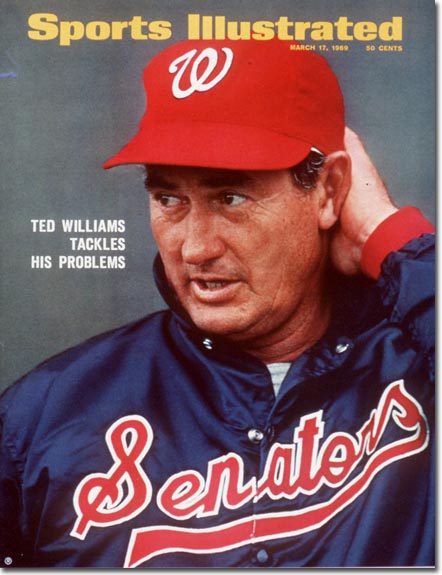
The official address of Clemson's Memorial Stadium is 1 Avenue of Champions, just to the southwest of downtown. If you drive in, parking costs $25. Like Tiger Stadium at Louisiana State, it is nicknamed Death Valley. The playing surface is named Frank Howard Field, for their head coach from 1940 to 1969, when, "I retired due to illness. The alumni got sick of me."
It opened in 1942 with 20,500 seats, was expanded to 43,451 in 1960, 53,306 in 1978, 79,845 in 1984, and its present 81,500 in 2008, making it the largest stadium in the Atlantic Coast Conference. Unusual among football fields, due to the angle of the sun, the field is aligned east-to-west. It has always been real grass. Behind the east end zone is "The Hill."

Not only is Clemson more successful in football than South Carolina, but it has the honor of having the only venue in the entire State to have hosted a regular-season major league sporting event. When the NFL granted a franchise to Charlotte for the 1995 season, to be named the Carolina Panthers, it was determined that the stadium being built in downtown Charlotte wouldn't be ready until 1996, so the Panthers played their 1st season at Clemson.
This past October 6, Thrillist compiled a list of their Best College Football Stadiums, the top 19 percent of college football, 25 out of 129. Clemson came in 5th.

Food. The South is known for great food. The Carolinas, in particular, are known for good barbecue. Unfortunately, both universities' websites only state that they have concession stands. It's bad enough for a not-that-big program like the Gamecocks', but the Tigers'? Does that sound like a defending National Championship program to you?

Team History Displays. South Carolina has one of the lamest histories of any Football Bowl Subdivision (FBS, formerly Division I-A) schools. It's not quite Rutgers bad, but bad enough. They went undefeated in the Southern Conference in 1933, but still lost the title to Duke who played 1 more conference game.

In 1969, they won the Atlantic Coast Conference title. Then they made the mistake of leaving the ACC in 1972, and this independent status hurt them. In 1984, their "Black Magic" team (so named for their all-black uniforms) won their 1st 9 games and rose to as high as Number 2 in the polls, but a loss away to Navy and another to Oklahoma State in the Gator Bowl dropped them to 10-2 and Number 11 in the final poll.

In 1992, they joined the Southeastern Conference. It took them until 2010 to win the SEC East Division and advance to the SEC Championship Game -- and Auburbn slaughtered them.

They reached their 1st bowl game on New Year's Day 1946, losing the Gator Bowl to Wake Forest. They lost their 1st 8 bowl appearances, a record. Finally, on January 2, 1995, they won the Carquest Bowl at whatever the Miami Dolphins' stadium was named that year. Since then, they've won the 2001, 2002 and 2013 Outback Bowls; the 2006 Liberty Bowl, the 2012 and 2014 Capital One Bowls, and the 2014 Independence Bowl. But they've still never appeared in one of the big bowls that were traditionally played on New Year's Day: The Rose, the Orange, the Sugar, the Cotton, or the Fiesta.

Only 2 Gamecock players are in the College Football Hall of Fame. Running back George Rogers won the 1980 Heisman Trophy, and that's why the street on the north side of Williams-Brice Stadium is named for him. Receiver Sterling Sharpe played for them from 1983 to 1987. (His brother Shannon Sharpe went to Savannah State in Georgia.)

The Gamecocks retired Rogers' Number 38 and Sharpe's Number 2, as well as the 37 of 1951 running back Steve Wadiak and the 56 of 1964 center Mike Johnson. Rogers was a Pro Bowler for the New Orleans Saints and the Washington Redskins, and was a member of the 'Skins team that won Super Bowl XXII. There is now a movement to get a statue for him, for outside the stadium.
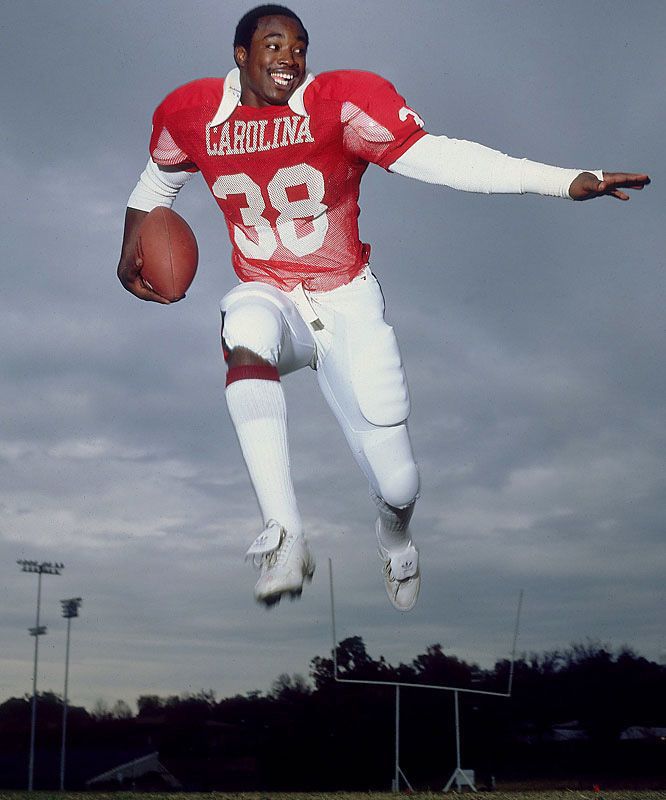
Hopefully, they'll choose a pose less awkward than this one.

Clemson is far more successful, and not just recently. They had undefeated seasons in 1900, 1906, 1948 and 1950. They surprised people by winning the National Championship in 1981 -- and then surprising no one by getting busted for recruiting violations the next season.

In 2015, they got all the way to the National Championship Game, but lost a thriller to Alabama. In 2016, they got back, and this time, they won a thriller over Ohio State, for their 2nd National Championship.
They won the title in the Southern Intercollegiate Athletic Association in 1900, 1902, 1903 and 1906; and in the Southern Conference in 1940 and 1948. Despite the admittance of such schools as Florida State, Syracuse and Pittsburgh, no school has won more Atlantic Coast Conference football titles than Clemson's 16: 1956, 1958, 1959, 1965, 1966, 1967, 1978, 1981, 1982, 1986, 1987, 1988, 1991, 2011, 2015 and 2016. Total: 22 league titles. They also won the ACC Atlantic Division in 2009, but lost the ACC Championship Game.

But Clemson only has 3 players in the College Football Hall of Fame: 1939 halfback Banks McFadden, 1981 linebacker Jeff Davis, and 1982 safety Terry Kinard. The last 2 both played on the 1981 title team. They've got more head coaches in the Hall: John Heisman (yes, the man for whom the Trophy was named, he coached there 1900-03), Jess Neely (1931-39), Frank Howard (1940-69), and, newly-elected, Danny Ford (1978-89).

Actually, the most famous Clemson football personality may be a defensive tackle who followed them: William Perry, a man so big and full of food he was nicknamed The Refrigerator. As a rookie in the 1985 season, his tackling, and his running with the ball and blocking in close-to-the-goal situations helped the Chicago Bears win the Super Bowl, and made him a national folk hero, and not just for fat people. His brother Michael Dean Perry also played for Clemson, and had a decent career with the Cleveland Browns.
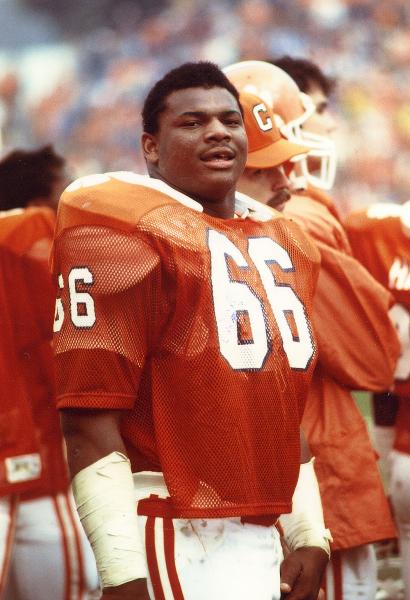
Clemson has 3 retired numbers: The 66 of McFadden, the 4 of 1978 quarterback Steve Fuller (Jim McMahon's backup and Fridge Perry's teammate on the '85 Bears), and the 28 of 2009 running back C.J. Spiller. McFadden's number wasn't retired so much for his playing as for his service as an assistant coach and an administrator at the school.

South Carolina, as you might guess, has rivalries with neighboring North Carolina and Georgia. Clemson has rivalries with North Carolina State, Georgia, Georgia Tech and Florida State. But their biggest rivalries are with each other. They've played each other since 1896, and every year since 1909. Clemson leads 68-42-4, having won the last 3, although South Carolina won the 5 before that. (UPDATE: Through the 2019 season, Clemson leads 71-42-4, having won the last 6.)

Starting in 1980, they played for the Hardee's Trophy, named for the Carolina-based burger chain. In 2015, it was replaced with the Palmetto Trophy.
Stuff. The Bignon Gameday Center, at the northeast corner of Williams-Brice Stadium, is the main team store. You can also check out the University Bookstore at 1400 Greene Street. Clemson doesn't have a big team store at Memorial Stadium. Their Bookstore is at 720 McMillan Road, on the main campus, a few blocks east of the stadium.

In 2009, Fritz P. Hamer and John Daye published A History of College Football in South Carolina: Glory on the Gridiron. It's easily the best volume covering either school, although it doesn't have Clemson's more recent title.

During the Game. I've been to South Carolina, and most people there, black and white alike, are reasonably friendly. But I haven't been to a football game there. As usual, the best advice I can give you is stick with whichever is the home team.

South Carolina had a tradition of cockfighting going back to colonial times, and so the University's teams are called the Gamecocks. Of course, this has led to the word "COCKS" being posted on caps, shirts, bumper stickers, etc. A dormant railroad track near the stadium has had cabooses set up in garnet and white, and is known as the Cockaboose Railroad. One side of the stadium will shout, "GAME!" and then the other, "COCKS!" and repeat.

Since 1969, what's known as the Fighting Gamecock Logo has graced their helmets, with a rooster inside a block C. Sometimes, the helmet is black; sometimes, white; sometimes, garnet red. Sometimes, the jerseys have "CAROLINA" above the front uniform numbers; sometimes, "GAMECOCKS."
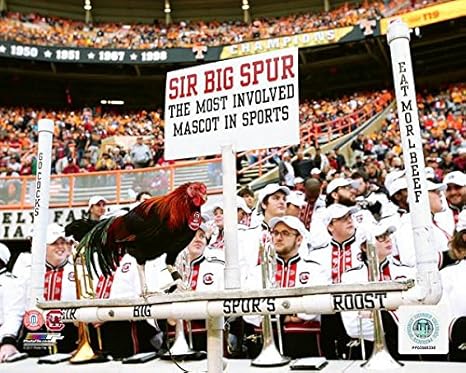
Sir Big Spur, the live Gamecock mascot

Since 1983, the players have entered to the tune of Richard Strauss' "Also Sprach Zarathustra" -- known to some of you as the theme from 2001: A Space Odyssey, and to some of you as the song that began every Elvis Presley concert from 1969 to 1977. This was a tradition started by Joe Morrison, the 1959-72 Giants running back who became South Carolina head coach in 1983, and died in office in 1989. There are 2 mascots: A costumed mascot named Cocky, and a live mascot named Sir Big Spur.
Anybody that fat shouldn't be so cocky.
He's almost as fat as Refrigerator Perry.

When South Carolina score, a rooster's crow is played over the loudspeakers. The Mighty Sound of the Southeast band plays the fight songs "Go Carolina" and "USC Fight Song." When the band plays "Louie, Louie," the fans jump up and down. Shock absorbers were put in, so that the upper deck can sway but not collapse. Still, Joe Morrison said, "If it ain't swayin', we ain't playin'." That became a bumper sticker slogan that is still seen all over the State. At the end of every game, win or lose, the band plays the Alma Mater and "Amazing Grace."

In 1939, Clemson head coach Jess Neely and athletic director Rupert Fike founded the IPTAY Scholarship Fund, to help fund the football program. "IPTAY" stood for "I Pay Ten A Year," meaning $10 -- about $175 in today's money. The IPTAY Center, the team training facility, now stands in the northwest corner of Memorial Stadium. However, after the 1981 National Championship dissolved into the 1982 scandal, it was joked that IPTAY stood for "I Pay Ten Athletes Yearly."

In 1966, Samuel C. Jones, a Clemson graduate, Class of 1919, had a gift for coach Frank Howard, saying, "Here's a rock from Death Valley, California to Death Valley, South Carolina." At first, Howard didn't think it was a big deal, and used it as a doorstop. Soon, he told IPTAY executive director Gene Willimon, "Take this rock and throw it over the fence, or out in the ditch, do something with it, but get it out of my office!"

And so, just as Charles Darwin was not a Social Darwinist, and Karl Marx has been said to not be a Marxist, Howard's Rock was something that Frank Howard wanted nothing to do with. But Willimon put it on a pedestal at the top of the hill that the team ran down in the east end zone to enter the field. on September 24, 1966, they opened the season by touching the rock on the way down, and beat the University of Virginia.

A tradition was accidentally born. Howard told the players, "Give me 110 percent, or keep your filthy hands off my rock!" The players touched the rock before every game through 2012, and then ran down the hill while the band plays "Tiger Rag" (a.k.a. "Hold That Tiger"!) in what Brent Musberger called "the most exciting 25 seconds in college football."
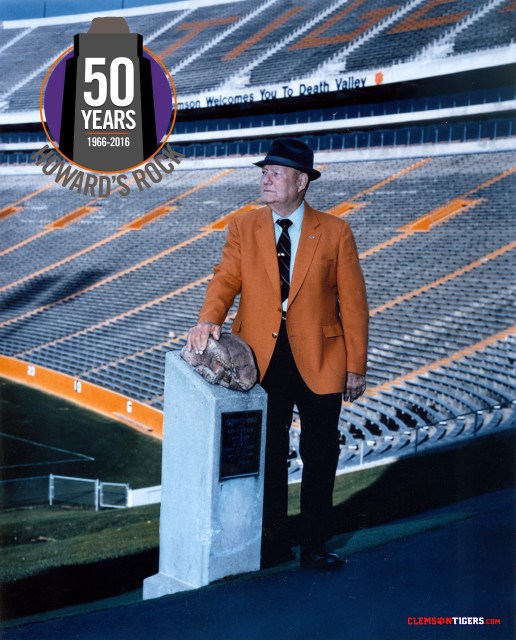
But things began to happen. Before the 1992 South Carolina-Clemson game, the rock was vandalized. Now, Clemson ROTC cadets guard the rock for 24 hours prior to every game -- home or away. In 2013, it was vandalized again, and was put in a protective case: Players can now only touch the case, not the rock itself. It doesn't seem to have affected their performance, as they've won a National Championship (and nearly another) since.
Clemson have a great team, but horrible uniforms. White paw prints on orange helmets are bad enough. Sometimes they wear all orange. Sometimes they wear all purple. Sometimes they mix it up, and it's actually worse. Never has a team looked so bad while playing so good.
"Running Down the Hill" in all orange.
It's not even an orange that matches the entryway.

In 1988, Florida State, then ranked Number 10, traveled to Number 3 Clemson, and came away with a victory in Death Valley, on a trick play that Bobby Bowden drew up, called the "puntrooskie." As is tradition with Florida State, they then cut out a piece of the field, and took it back to their practice field's "Sod Cemetery," where other pieces of field from road upsets are "buried."

Clemson coach Danny Ford didn't like that, so when Clemson returned the favor the next season, beating the Seminoles in Tallahassee, he cut a piece of Doak Campbell Stadium sod out, and started Clemson's Victory Graveyard at their practice facility, one-upping FSU by having actual headstones instead of just plaques to mark the "graves."
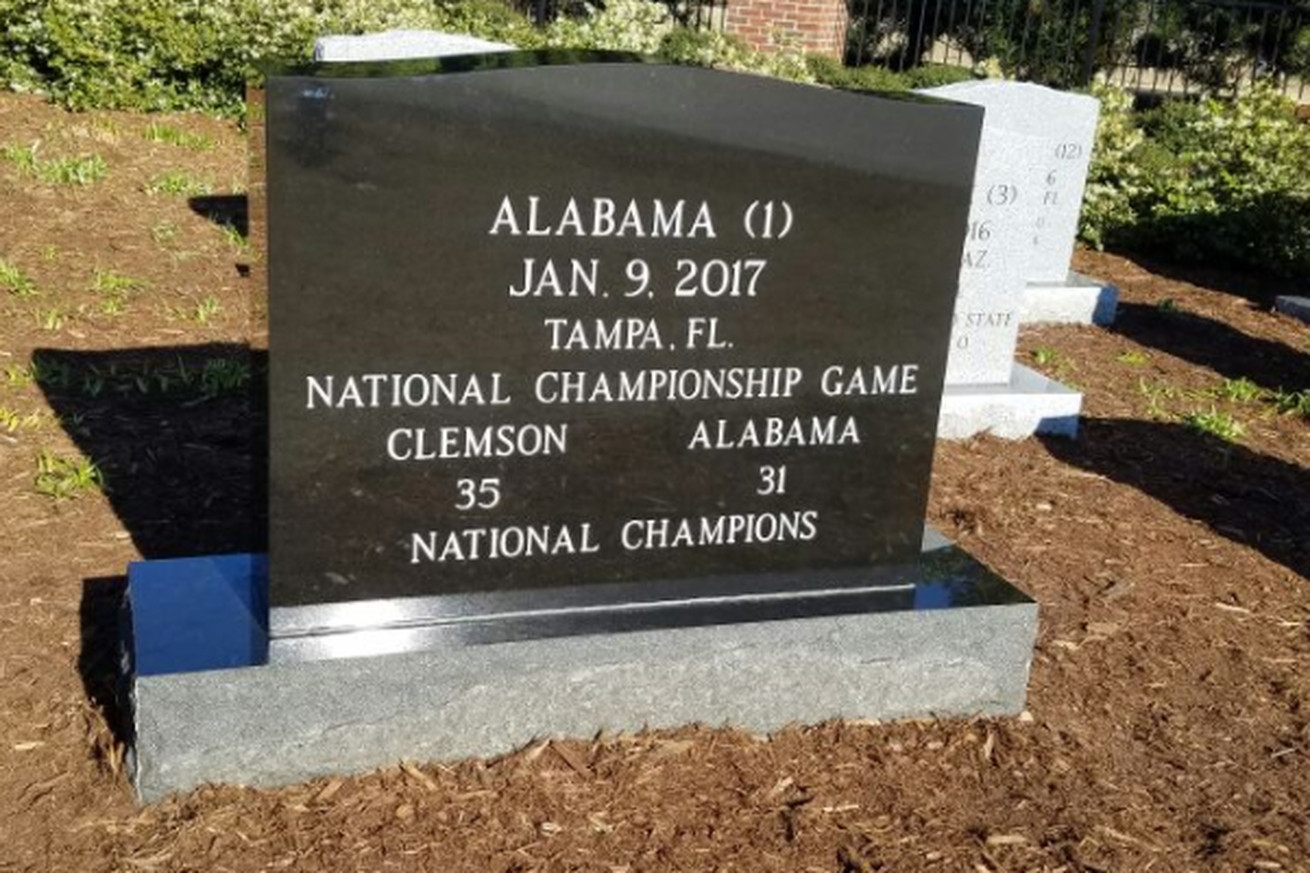
Apparently, neutral-site wins count, too.

Clemson has 2 guys in Tiger suit mascots: The Tiger, who wears Number 0; and The Cub, a smaller guy who wears Number 1/2. Presumably, they're meant to be father and son, but they're both current students.
After the Game. There isn't much to eat near Memorial Stadium. You'll probably have to go downtown. At South Carolina, there are more options. Across from the northwest corner of the stadium, there's 2 Fat 2 Fly Stuffed Chickens, at 905 Bluff Road. To the south, there's a Bojangles at 1130 Bluff Road, and a Waffle House at 1210 Bluff Road.

If your visit to South Carolina is during the European soccer season, your choices are limited. In Columbia, it's the British Bulldog Pub. At Clemson, you'd have to go to Spartanburg, to Mother's.

Sidelights. Aside from the Gamecocks and the Tigers, the most popular sports in South Carolina are NASCAR (it's the home of Darlington Raceway) and golf (especially when you get to the Atlantic Coast, with Myrtle Beach and Hilton Head Island).

The Charlotte Knights began playing Class AAA baseball in Fort Mill, South Carolina in 1989, before moving to downtown Charlotte in 2014. Now, there are 4 minor-league baseball teams in the State, all in Class A: The Myrtle Beach Pelicans of the Carolina League, and 3 teams in the South Atlantic League, the Columbia Fireflies, the Charleston RiverDogs and the Greenville Drive.

There's also 2 minor-league hockey teams, the Greenville Swamp Rabbits and the North Charleston-based South Carolina Stingrays. The Charleston Battery are one of the best-supported teams in minor-league soccer.

South Carolina State University, a historically black college and university (HBCU), has won the "National Championship of black college football" 7 times: 1976, 1977, 1981, 1982, 1994, 2008 and 2009. This does not exactly make the Bulldogs more successful than the Gamecocks and the Tigers combined, but it does point out that the Gamecocks and Tigers do not have a duopoly on Palmetto State football talent or achievement.

SCSU have produced Los Angeles Rams Hall-of-Fame defensive tackle Deacon Jones, Pittsburgh Steelers All-Pro safety Donnie Shell, Giants Hall of Fame linebacker and Captain Harry Carson, and Detroit Lions Pro Bowl defensive end Robert Porcher.

SCSU play at Oliver C. Dawson Stadium, a 22,000-seat facility built in 1955, and named for their longtime athletic director. 300 College Avenue in Orangeburg, about 40 miles southeast of Columbia, 150 miles southeast of Clemson, and about 77 miles northwest of Charleston.
As you might guess, the most popular NFL team in South Carolina is the Carolina Panthers, whose Bank of America Stadium in downtown Charlotte is just 12 miles from the State Line, after they played their 1st season at Clemson.

But, probably due to TV exposure in the 1970s and '80s, and to the Carolinas not having a team until 1995, there's a lot of Dallas Cowboy, Pittsburgh Steeler and Washington Redskin fans in the State, and a little spillover of Atlanta Falcon fans from Georgia.

The Atlanta Braves dominate baseball fandom, although the fact that both the Yankees and the Mets have had farm teams in the State has led to their having a presence in Palmetto State baseball fandom. The Raleigh-based Carolina Hurricanes are easily the most popular NHL team. And once you get away from the Charlotte area, there aren't many Hornets fans in the State. Neither Columbia nor Clemson is close enough to have many Hornets fans or many Atlanta Hawks fans. It's pretty much the Los Angeles Lakers, and whatever team LeBron James is playing for now.

The State's favorite son in sports was Joseph Jefferson Jackson, a.k.a. Shoeless Joe. He is buried at Woodlawn Memorial Park, at 1 Pine Knoll Drive in his hometown of Greenville, 104 miles northwest of Columbia and 33 miles northeast of Clemson.

Historic sites in the State include the State House, the South Carolina Military Museum, and pretty much the entire City of Charleston, including Fort Sumter, where the Civil War began.

South Carolina may have produced a President: Andrew Jackson was born on March 15, 1767, in the Waxhaw region that straddles the Carolina State Line, but no one is really sure on which side, as there is no birth record. If he was born on the South side, then that's 1 for South Carolina, 2 for North Carolina; otherwise, he joins James Polk and Andrew Johnson as Tar Heel-born Presidents.

Jackson's political teammate, then rival, John C. Calhoun remains the defining politician in the State's history, even more than Strom Thurmond. His house on the former Fort Hill Plantation, with his son-in-law Thomas Clemson's university built around it, is now the John C. Calhoun Mansion and Library -- one of the few Vice Presidents to have anything like a "Presidential Library."

While the bench scene from Forrest Gump was filmed in Savannah, Georgia, most of the movie was filmed in Beaufort, South Carolina. The 1993 college football film The Program was filmed on the South Carolina campus, including at Williams-Brice Stadium. A scene from the 1998 college football-themed film The Waterboy was also filmed there. The TV Show Army Wives was set in North Charleston.

*

South Carolina is a State with issues. One is that it's "a drinking State with a football problem." That problem will get settled, at least until next Fall, when the South Carolina Gamecocks and the Clemson Tigers clash this Saturday night.

Wednesday, April 2, 2014

Cincinnati's All-Time Baseball Team

Contrary to popular belief, the Cincinnati Red Stockings of 1869-70 were not the first professional baseball team. They were just the first ones to admit it. Also, they lasted only those 2 seasons, and have no connection to the current Cincinnati Reds, who were founded in the American Association in 1882, joined the National League in 1892, and, while they've had some serious droughts, have also put together some excellent eras: 1918-26, 1938-44, 1956-65, 1969-80, 1985-92, 1994-2000, and since 2010.

Because of the pretense that they were "the first professional baseball team," historically, the Reds were always the 1st National League team to play in a season. The Washington Senators would kick off the American League season, so the President of the United States could come to throw out the ceremonial first ball.

With TV futzing everything up, as it has with so many sports, the Reds are no longer a guaranteed lid-lifter for the entire NL. However, to this day, the Reds take Opening Day very seriously, having a big parade through downtown Cincinnati before their home opener. For that alone, they are worthy of some respect.

4. Cincinnati's All-Time Baseball Team

This team consists of players from the southern half of Ohio. The dividing line is pretty much the northern edge of Interstate 270, the "beltway" around the State capital of Columbus. The State House is 107 miles from Cincinnati’s Great American Ballpark, and 142 miles from Jacobs Field, or whatever the Indians are calling it now.

This team also includes players from southern Indiana, except for that little southwestern tail, and from Kentucky, except for its westernmost part – those two sections belong to the St. Louis Cardinals' region. It also includes southern West Virginia, with the northern part of the Mountaineer State belonging to Pittsburgh and the eastern Panhandle region going to Washington, D.C. – although the only player from the Panhandle good enough for me to even consider for the D.C. regional team was John Kruk.

What does this Cincinnati All-Time Team have? Good contact hitting. Good power hitting. Good starting pitching, although most of it is old-time -- or even so old as to be "old-tyme." It's a little weak in the bullpen, though, and I'm not sure about the catcher, mainly because he hasn't played a game in 117 years (and has been dead for 108).

Still, this should be a team that would do well by the Queen City of the Midwest. Not to be confused with Seattle, which is known as the Queen City of the Northwest; or with Charlotte, which bills itself as the Queen City of the Southeast.

As far as I know, there's no "King City" anywhere in the U.S., although New York is known as the Empire State, and the aforementioned Seattle is in Washington State's King County. And, of course, New York has Kings County (the Borough of Brooklyn) and Queens County (the Borough of Queens).

1B Al Oliver of Portsmouth, Ohio.  He actually played a little bit more center field, but try cracking the starting lineup at that position on this team. So I'm putting him at 1st base, which he played well enough to earn the nickname "Scoop."

He finished 2nd to Ted Sizemore for NL Rookie of the Year in 1969, but he had a far better career than any of the others in the top 5 in the vote, making 7 All-Star Teams. He won the World Series with the Pittsburgh Pirates in 1971. He also helped the Pirates reach postseason play in 1970, '72, '74 and '75, nearly helped the Pirates to do so in '73 and the Texas Rangers in '78, and got there in his final season with the 1985 Toronto Blue Jays.

He led the NL in batting, hits, doubles, total bases and RBI in 1982 as a member of the Montreal Expos. He was also, starting with the '78 Rangers (after wearing 16 for the Pirates), the 1st player to regularly wear the Number 0 – to represent not zero, but an O for Oliver.

He batted .303 lifetime, and had an OPS+ 121 and 2,743 hits. Of all players eligible for the Hall of Fame but not yet in, the only players with more hits are Craig Biggio, Harold Baines, Vada Pinson, and steroid cheats Rafael Palmeiro and Barry Bonds.

On Baseball-Reference.com's Hall of Fame Monitor, where a "Likely HOFer" is at 100, he's at 116, meaning he should get in. On their "Hall of Fame Standards," where an "Average HOFer" is at 50, he's at 40, meaning he shouldn't. On their "Most Similar Batters," his top 10 include HOFers Zack Wheat, Roberto Clemente (his Pirate teammate), Joe Medwick and Enos Slaughter. (And the aforementioned Pinson, and another Pirate teammate who’s not in, Dave Parker.) He belongs.

Honorable Mention to Charlie Gould, the only member of the 1869-70 Cincinnati Red Stockings who was actually from Cincinnati, or even from anywhere near it. He was one of the Red Stockings who moved east to form the Boston Red Stockings -- forerunners of today's Atlanta Braves -- and led the National Association in triples in 1872, as the Red Stockings won the 1st of 4 straight Pennants.

That was the only Pennant Gould won as a member of a pro league, as he was gone the next season. In 1876 and '77, he played with the new Cincinnati Red Stockings of the National League, but they went out of business after the 1880 season, before the new Cincinnati Reds were formed in 1882.

Somewhat Honorable Mention to Kevin Youkilis of Cincinnati. He's one of the most annoying players of his generation, and, at age 35 and playing in Japan, he may not play in the North American majors again. But he's got a career OPS+ of 123, is a 3-time All-Star and a 1-time Gold Glove, and has appeared in 4 postseasons, including the Red Sox' tainted titles of 2004 and '07. It would have been fun if the Yankees' experiment with him had paid off; instead, he made only 118 plate appearances before getting hurt, the Yanks didn't make the Playoffs, and the Sox won another tainted title.

2B Billy Herman of New Albany, Indiana. A 10-time All-Star, he batted .304 lifetime with a 112 OPS+. He helped the Chicago Cubs win Pennants in 1932, '35 and '38, and the Brooklyn Dodgers in '41, although he never won a World Series. (His injury late in '41 was a big reason why the Dodgers didn't win that one.) He led the NL in doubles in '35 and in triples in ’39.

He had 2,345 career hits, including 486 doubles and 82 triples. He's a member of the Hall of Fame and the Cubs' Walk of Fame outside Wrigley Field, although they've never retired a number for him. (He wore several, and wore 4 the most.)

SS Barry Larkin of Archbishop Moeller H.S. in Cincinnati. A true hometown hero, he turned down free-agent offers from other teams to stay with the Reds. He was a 12-time All-Star, the 1st time at age 24 and the last in his final season at 40 – and it wasn't an honorary thing, either, as he batted .289 that season.

He helped the Reds win the 1990 World Series, and got them into the postseason again in 1995 and '99 (and had them in first place in the NL Central when the Strike of ’94 hit). He also won 3 Gold Gloves, and the 1995 NL Most Valuable Player award. Lifetime batting average .295, OPS+ 116, 2,340 hits including 441 doubles and 76 triples. Hall of Fame, and the Reds retired his Number 11.

Very Honorable Mention to Harold "Pee Wee" Reese of Lousville, Kentucky. He played for the Triple-A Louisville Colonels, then a Boston Red Sox farm team, and legend has it that the Sox sold him to the Brooklyn Dodgers because Sox manager Joe Cronin was insecure about losing his own place as the Sox shortstop. Big mistake? Not really, because the Sox did have Johnny Pesky coming up, which also suggests that the story about Cronin's insecurity may also have been exaggerated.

He got his nickname not from being short (he was 5-foot-10) but from his childhood prowess at marbles, which were often called "peewees." He was the best shortstop in the NL in the 1940s and the 1st half of the 1950s – no mean feat in an era with Marty Marion and later Alvin Dark around.

A 10-time All-Star, he helped the Dodgers win 7 Pennants and nearly made it 11. He wasn't a great hitter, but he did manage 2,170 hits during his career, 330 of them doubles and 80 of them triples. He stole 232 bases, leading the NL in steals in 30. That's not an easy thing to do when your teammate is Jackie Robinson.

Which brings us to Pee Wee's most important legacy: As Dodger Captain, and also as a white Southerner, he let it be known that Robinson would be accepted, and that anyone who wouldn't accept him was gone – and, after that 1947 Pennant-winning season, that included Southerners Dixie Walker and Eddie Stanky, despite both having been quite popular on the team and with Dodger fans. It was the right, move, not just morally but competitively.

In May 1947, when the Dodgers were in Cincinnati – across the river from the Southern State of Kentucky and in many ways more Southern than Midwestern – Pee Wee heard so many nasty words from the stands at Crosley Field, from fans of the Reds, the team he had grown up rooting for, that he called time out, walked from his shortstop position to Jackie's at 1st base, and put his arm around Jackie for a brief chat.

No film or photograph of the event survives, but plenty of witnesses have revealed that it actually happened. What he said to Jackie isn't recorded (though the film 42 suggests they discussed the Civil War), and it doesn't matter. What matters is what this gesture said to the crowd: "I'm a white Southerner, and this black man is my teammate, and I'm too much of a gentleman to call you a bunch of dumb fucking rednecks in any other way."

The moment is recreated in a statue of the two men outside MCU Park, home of the minor-league Brooklyn Cyclones. Pee Wee is in the Hall of Fame, and the Dodgers retired his Number 1.

3B Mike Schmidt of Dayton, Ohio. He grew up with Cincinnati as the closest major league city, at a time when the Reds' top player was Frank Robinson, so he wore Robinson's Number 20 with the Philadelphia Phillies. The Phillies have retired this number, elected him to the Philadelphia Baseball Wall of Fame, and erected a statue of him outside Citizens Bank Park.

In 1983, when the team celebrated its 100th Anniversary, they held fan balloting for their all-time team and their all-time greatest player. Schmidt was chosen their all-time greatest player. And he still had 159 homers and an MVP award to go!

Schmidt was an All-Star 12 times – including being voted the starting 3rd baseman on the NL team in 1989, after he'd already announced his retirement. He stayed true to his principles by not playing, but also stayed true to the fans who chose him by flying out to Anaheim and appearing in uniform for the event.

His career OPS+ was an astounding 147. He had 2,234 hits, including 408 doubles, 59 triples, and 548 home runs – more than any 3rd baseman in history, more than any righthanded hitter of his generation, and more than any National Leaguer of his generation. (Only Reggie Jackson, in that generation, topped him among lefties and American Leaguers.)

He led the NL in homers 8 times, in RBIs 4 times, had 9 100-RBI seasons, and in 1980 hit 48 homers for a new team record that stood until Ryan Howard hit 58 in 2006. NL MVP in 1980, '81 and '86. And he wasn't just a great hitter: He won 10 Gold Gloves. He is most people's pick for the greatest 3rd baseman ever.

He helped the Phillies reach postseason play 6 times in an 8-year span from 1976 to 1983, winning the 1980 World Series (that year, he was both the regular-season and the Series MVP) and the 1983 Pennant. In addition to the awards from his team, he was elected to the Hall of Fame and the All-Century Team.  When The Sporting News announced its 100 Greatest Baseball Players in 1999, he came in at Number 28. He’s a Hall of Fame person, too.

LF Frank Howard of Columbus, Ohio. His 1st nickname was Hondo. At 6-foot-7 and 280 pounds, it's easy to see why they called him the Monster. He looked more like a football player, or at least a basketball player. In fact, he played those sports and baseball at The... Ohio State University.

Called up too late to help the Los Angeles Dodgers win the 1959 World Series, he was NL Rookie of the Year in 1960, and helped the Dodgers win the 1963 Series before being traded to the Washington Senators, where he became known as the Capital Punisher.

He led the AL in homers in 1968 and '70, and nearly did so in '69 except that his predecessor as D.C.'s biggest bopper, Harmon Killebrew, hit 49 for the ex-Senators, now the Minnesota Twins, to Howard's 48. Howard also led the AL in total bases and slugging in '68, total bases in '69 and RBIs in '70. When the Senators moved to become the Texas Rangers after the '71 season, he hit the last home run in team history.

Traded to the Detroit Tigers late in '72, he helped them win the AL East. A 4-time All-Star, he had a career OPS+ of 142, and hit 382 home runs. He did slow down at age 34 and retired at 36, after not being signed by any MLB team and injuring his back in, literally, his first swing with the Japanese club that signed him. All this makes him look like he fits the steroid profile, but at his size he wouldn't have needed 'em if offered: Without steroids, he was bigger than Mark McGwire.

Without that injury, he might have gotten back into the majors, and gotten well over 400 homers, and could well have gotten into the Hall of Fame. Baseball-Reference.com has him at "only" 61 on their HOF Monitor and 26 on their HOF Standards. And none of his 10 Most similar Batters are in. So it doesn't look like he'll get in.

Still, at the time he retired, only Hank Aaron, Willie Mays, Frank Robinson, Killebrew, Jimmie Foxx and Ernie Banks were righthanded hitters with more career homers. He is honored with a statue outside Nationals Park, and is listed on the Washington Hall of Stars display at the park.

CF Ken Griffey Jr. of Archbishop Moeller H.S. in Cincinnati. At this position, the Cincinnati team is loaded. They can also call on Earle Combs of Pebworth, Kentucky, a Hall-of-Famer who preceded Joe DiMaggio and Mickey Mantle at the position for the Yankees, winning 4 Pennants and 3 World Series before a skull fracture against the unpadded outfield walls of the time prematurely ended his career.

Then there's David "Gus" Bell of Louisville, Kentucky, who helped the Reds win the 1961 Pennant and whose son David "Buddy" Bell and grandson David Bell (apparently no nickname) also played in the majors. Then there's Jimmy Wynn of Taft H.S. in Cincinnati. The Toy Cannon was stuck in the Astrodome, but still hit a lot of home runs, including a memorable blast in his hometown in 1967, onto the Mill Creek Expressway (Interstate 75) just beyond the left-field wall at Crosley Field.

But they all have to take a back seat to Junior, who, like his father Ken, was born in Donora, Pennsylvania (also the hometown of Stan Musial), but grew up in Cincy while his father played there. Barring steroid revelations (I seriously doubt that he used them) or any other kind of ethical calamity (such as befell another Moeller grad, Pete Rose), will be elected to the Hall of Fame on his 1st try in 2016.

A 13-time All-Star, a 10-time Gold Glover, the 1997 AL MVP, he had a 135 career OPS+, 2,781 hits including 524 doubles and 630 home runs – 4th-best all-time among honest men – plus 1,836 RBIs. He had 8 100-RBI seasons and 7 40-homer seasons, 4 in which he led the AL, twice hitting 56, the most in an AL season since Roger Maris' 61 in '61.

He led the Seattle Mariners to their 1st 2 postseason berths, as 1995 and '97 AL West Champions, and in particular his '95 run saved Major League Baseball in the Pacific Northwest, as a ballot initiative passed that got Safeco Field built. He had 398 homers before his 30th birthday. He was being hailed as the new Willie Mays.

Unfortunately, injuries were never far away, and he became the new Mickey Mantle instead. Only once did he top 30 homers after age 30, and never again had 100 RBIs. Either he or Barry Bonds, also the son of a good-but-not-quite-great major leaguer, was the best player of his generation. Griffey's reputation took a bit of a hit, but as the revelations about his contemporaries, including Bonds, began to pile up, Griffey began to look a lot better.

Aside from his comeback with the M's in his last 2 seasons, his Number 24 has not been given back out by that team, and they will surely retire it. He deserves a statue outside Safeco: That stadium, and the team that plays there, wouldn't be there now if it wasn't for him. When The Sporting News announced its 100 Greatest Baseball Players in 1999, right in his prime, he came in at Number 93.

Honorable Mention to Oscar Charleston of Indianapolis, Indiana. Since we don't have reliable statistics from the Negro Leagues, and since those leagues were probably, at best, made up of mostly Triple-A players, it's hard to say how good he was.

But what we do have tells us that, in 53 exhibition games against all-white teams of major leaguers, he batted .318 with 11 homers. 53 x 3 = 159, a full season today, so that's .318 and on a pace for 33 homers. So had he played in the majors, he would probably have been as good as they came.

He also managed the Pittsburgh Crawfords to a few Pennants… while still playing for them, at close to 40 years old, which attests to both his durability and his quick mind. Baseball historian Bill James calls him the 4th-best player ever. If only we could know for sure what he could do against competition that was all (or at least mostly) major-league caliber. When The Sporting News announced its 100 Greatest Baseball Players in 1999, he came in at Number 67.

RF Chuck Klein of Indianapolis, Indiana. The Hoosier Hammer is often derided by baseball historians because his hitting feats were achieved in the "bandbox" of Baker Bowl, home of the Phillies from 1895 to 1938, which had a 280-foot right field fence (albeit with a high wall in a vain attempt to discourage cheap homers), ideal for a lefthanded hitter like Klein; and did so in the homer-happy early 1930s.

He was a great slugger between the ages of 23 and 28, a good one from 29 to 32, and just another player from then on, averaging only 115 games a season from then on. If any player of his era "fits the steroid profile," he's the one. Yet I can't find any record of him being injured in those latter years, only that, at some point, he developed a drinking problem that eventually caused long-term health and financial issues, and then caused his death at age 53.

But although he played in 17 separate seasons, he only played enough games to add up to 14 full seasons. So maybe his numbers deserve another look. His career home run total was "only" 300, but he hit 191 of those in his first 6 seasons, before turning 29. Just before turning 32, he had 257.

If he had simply kept up that pace until he was 38, he might have had at least the 382 that Howard hit -- which would also be more than were hit by Joe DiMaggio, Yogi Berra, Johnny Mize, Ralph Kiner, Gil Hodges, Orlando Cepeda, Tony Perez, and his fellow oft-derided Phillies slugger Dick Allen. It would also have been as many as Jim Rice, and nearly as many as Duke Snider, Al Kaline, Johnny Bench, Dale Murphy and Joe Carter.

He led the NL in home runs 4 times in 5 years. The 1st was in 1929, when he peaked at 43. The next year, he hit 59 doubles -- on the way to 398 in his truncated career -- collected a whopping 445 total bases, and had 170 RBIs (but didn't lead the League because that was the year Hack Wilson set the all-time record of 191). He had 6 100+ RBI seasons, leading the League twice. Twice he led in hits, 3 times each in runs scored and slugging. He even led the NL in stolen bases in 1932, albeit with just 20. He won the Triple Crown in 1933, and had an amazing 176 OPS+. That concluded a 3-year stretch in which, in the first 3 years of the current format for the Most Valuable Player award, he finished 2nd, 1st and 2nd in the voting, despite the Phillies being nowhere near the Pennant race.

He also represented the NL and the Phillies in the 1st 2 All-Star Games. In 1936, he hit 4 home runs in a game, the 1st National Leaguer to do so in 40 years. Even with his decline, his career OPS+ was a very strong 137 -- meaning that, in a high-offense era, he was still 37 percent better at producing runs than the average player.

And yet, after the 1933 season, his Triple Crown season, the Phillies traded him to the Cubs for Harvey Hendrick (no, I'd never heard of him, either), Ted Kleinhans (ditto) and Mark Koenig (the shortstop of the late 1920s Yankee champions but washed up by then). Were the Phillies stupid? Perhaps, but they were also desperate: It was the Depression, and the Cubs, backed by all that Wrigley chewing gum money, paid $65,000 for the best slugger in the National League; the players were the throw-ins.

When Klein didn't quite work out on the North Side of Chicago, in 1936 they sent him back to North Philly. In 1939, the Phils released him, probably thinking his production was no longer making his drinking worth it. The Pirates signed him up, then released him at the end of the year, and then the Phils signed him again, and he stayed with them to the end, 1944. Within a decade, he was dead.

Still, he was elected to the Hall of Fame, although by the Veterans Committee well after he died. He wore several numbers in his career, so the Phillies put a "P" logo for him up with their retired numbers. When The Sporting News announced its 100 Greatest Baseball Players in 1999, he came in at Number 92. Clearly, not everyone thinks he was just a Baker Bowl hitter.

Honorable Mention to Sam Thompson of Danville, Indiana. This guy goes back to Cleveland. The Presidency of Grover Cleveland. In 1887, he led the Detroit Wolverines to the NL Pennant, leading the league in batting, hits, triples, RBIs (166, a record for the time), slugging and total bases. But the Wolverines couldn't maintain it, and had to sell him to the Philadelphia Phillies. He led the NL in homers in 1889 and '95, hits and doubles in '90 and '93, and RBIs in '94 and '95. He retired after the 1898 season, but came back for 8 games with the new Detroit team, the AL's Tigers, in 1906 at age 46.

He had a lifetime batting average of .331, and an OPS+ of 146, so he was great by the standards of his own time, not just benefiting from the era’s pitching conditions, especially since he was great both before and after the 1893 move-back from 50 feet to 60 feet, 6 inches. He was elected to the Baseball Hall of Fame and the Philadelphia Baseball Wall of Fame.

Honorable Mentions to 3 latter-day Yankees: Paul O’Neill of Columbus, Ohio, who helped his home-State Reds win the 1990 World Series before bringing his "Warrior" mentality to the Yankees for 4 more titles; David Justice of Covington, Kentucky, right across the Ohio River from Cincinnati, who was a big part of the Atlanta Braves' revival in the 1990s, winning 4 Pennants and the 1995 World Series, and then helping the Indians win the 1997 Pennant and the Yankees win the Series in 2000 and the Pennant in 2001; and Nick Swisher of Parkersburg, West Virginia, who enlivened the 2009 World Champions with his bat and his personality, made the All-Star team the next season, also reached the postseason with the A's and the White Sox, and is now with the Indians, sitting on a decent career home run total of 231 and an OPS+ of 118.

C William "Buck" Ewing of Hoagland, Ohio.  Think Thompson went back a long way? Ewing debuted in 1880, during the Administration of Rutherford B. Hayes. He played his best years with the New York Giants, winning NL Pennants in 1888 and '89, and then helped the Cleveland Spiders win the Temple Cup in 1895, before closing his career with his hometown Reds in 1897.

(The Temple Cup was a trophy given to the winner of a postseason series between the NL's 1st- and 2nd-place teams from 1894 to '97. Because the 2nd-place team won in '94, '95 and '97, people lost interest, and the Cup was withdrawn, although it's now on display at the Hall of Fame. Imagine if baseball had kept it, and treated it the way the NHL treats the Stanley Cup. Would we now be hearing Yankee Fans ask, "How many Temple Cups has your team won?" Ironically, no current team has ever won one, unless you count the 1894 Cup won by the Giants who are now in San Francisco.)

Ewing may have been the best player of the 1880s, and he was pretty good in the 1890s, too. His lifetime batting average was .303, and his OPS+ 129. He was also the 1st player ever to hit 10 home runs in a season, in 1883. He played every position: 636 games at catcher, 253 at 1st base, 193 in right field, 127 at 3rd base, 51 at 2nd base, 34 at shortstop, 34 in center field, 9 in left field and 9 pitching. And he was regarded as a good fielder at all of them.

He died of diabetes in 1906, age 47, and in 1939, when the Hall of Fame held an election to determine which 19th Century players were worthy, they chose Ewing, Cap Anson, Old Hoss Radbourn, Al Spalding, Charles Comiskey and Candy Cummings – although Spalding and Comiskey had credentials as executives that exceeded their impressive records as players, and Cummings got in mainly because he claimed to have invented the curveball, which he probably hadn't actually done. And Anson was also a pretty good manager.

So Ewing was the only 19th Century player who was elected mainly as a player, at a time when there were still plenty of people alive who could have seen those men play.

Honorable Mention to an even earlier player: Cal McVey of Indianapolis, Indiana. Like Charlie Gould, he was a member of the 1869-70 Cincinnati Red Stockings, and was one of the ones who formed the Boston Red Stockings. Unlike Gould, he stuck with them through the entire length of the National Association, winning Pennants in 1872, '73, '74 and '75, leading that league in hits and RBIs twice each.

Like some of those Red Stockings, including Al Spalding, he went back west to form the Chicago White Stockings, forerunners of today's Cubs, and won the 1st NL Pennant in 1876, before returning to the NL's Cincinnati Red Stockings in their final 2 seasons, 1878 and '79.

If you want a 20th Century catcher for the Cincinnati-area team, the best I can give you is Hank Gowdy of Columbus, Ohio, and he still goes back a long way. He starred for the Boston Braves and the Giants, including the Braves' 1914 "Miracle" World Championship. He was the first MLB player to enlist in World War I, and, well after he retired from the game, became the only player to have served in both World Wars.

He wasn't much of a hitter (although he did bat .299 in 1921 and .317 in '22), and only 3 times did he have more than 300 plate appearances. But he must have been a good-fielding catcher, a good handler of pitchers, or a good influence on his teammates, because, even while missing the entire 1918 season in the service, plus the 1926 and '28 seasons in the high minors before returning to the Braves for 2 years, he still played 17 seasons in the majors.

If you want one more recent than the Roaring Twenties, the best one is Rollie Hemsley of Syracuse, Ohio. He was a 5-time All-Star, batted .309 for the St. Louis Browns in 1934, and won Pennants with the Cubs in 1932 and the Yankees in 1942 and '43, and nearly did so with the Indians in 1940. Seriously, I tried to find a better one from after World War II, the post-integration era, and I just couldn't. The best I could find was Steve Swisher of Parkersburg, West Virginia, a decent fielder but a lifetime .216 hitter, who's now best known as the father of the aforementioned Nick Swisher.

SP Amos Rusie of Mooresville, Indiana. "The Hoosier Thunderbolt" was probably the fastest pitcher of the 1890s. He was just 29-34 for the New York Giants in 1890, but then, he was only 19 years old. And he did strike out 341 batters. Over the next 4 seasons his win totals were 33, 32, 33 and 36. So the 1893 increase of the pitching distance from 50 feet to 60 feet, 6 inches appears not to have affected him at all. (Unlike Gus Weyhing of Louisville, Kentucky, who I considered for this team, since "Cannonball" won 264 games in the majors, but was 177-124 before the move-back and just 87-108 after it, making him a great pitcher from age 21 to 25 but a mediocre one from 26 to 32 and basically then being done.)

Rusie led the NL in wins once, ERA twice, and strikeouts 6 times. He held out for the entire 1896 season in a dispute with Giants owner Andrew Freedman, who, to put it succinctly and politely, was a real piece of work. He returned in 1897 and won 28 games. Having been hit in the head by a line drive in 1898, he did not appear in a game in 1899 or 1900, and was traded by the Giants to the Cincinnati Reds on December 15, 1900.

Before getting hit, he was 27 years old and had won 246 games. Afterward, he appeared in just 3 games at the major league level, and won none. The man he was traded for? He was 20 at the time of the trade, and had appeared in 6 games and won none; he went on to win 373. His name was Christy Mathewson. This may have been the most lopsided trade in baseball history. Nevertheless, Rusie was elected to the Hall of Fame in 1977, having died in 1942.

SP Mordecai Brown of Nyesville, Indiana. For the record, Mordecai Peter Centennial Brown was named "Centennial" because he’d been born in America's Centennial year of 1876, was nicknamed "Brownie" because of his last name, was nicknamed "Miner" because he'd been one, and was nicknamed "Three Finger" (or "Three-Fingered") because of a farm accident which cost him his index finger and damaged the others. So unless you are dumb enough to not count the thumb, he actually had 4 fingers on his right hand, not 3. But the damage, particularly with the way it twisted his middle finger, left him with a grip that gave him a curveball and a change-up matched by few others in baseball history.

It took until age 26 for a big-league team to give him a chance, in 1903, and moving to the Chicago Cubs in 1904, it was between him and Christy Mathewson as to who was the best pitcher in the NL for the next few years. They opposed each other 24 times, usually before big crowds anxious to see a great pitchers' duel, and Brown won 13, Matty 11.

Brown won 20 or more games 6 times, 25 or more 4 times, peaking at 29-9 in 1908. Six times he had an ERA under 2.00, and five times he had a WHIP under 1.000. In 1906, he had a 0.934 WHIP, and a 1.04 ERA, still the lowest in the NL since the 1893 mound-distance moveback. Thanks in part to his pitching the makeup game, forced by Giant Fred Merkle's "Boner," that gave the Cubs the 1908 Pennant, he won Pennants in 1906, 1907, 1908, 1910, and, with the Chicago Whales of the Federal League, in 1915. He made 3 starts for the Cubs in the 1907 and 1908 World Series, all shutouts. Those 2 remain the only World Series the Cub franchise has ever won.

His career record was 239-130 for an outstanding .648 winning percentage, a miniscule 2.06 ERA (and an ERA+ of 139, so he wasn’t just taking advantage of the Dead Ball Era), a 1.066 career WHIP, and 55 shutouts. He also pitched in relief a lot for his era, including in the 1908 title-decider, collecting 49 saves, although that statistic was unknown at the time. Too bad, because his 13 saves in 1911 were a major league record at the time. He died in 1948, and was elected to the Hall of Fame a year later.

SP Carl Mays of Liberty, Kentucky. He would probably be in the Hall of Fame if he were not the only pitcher in major league history to have thrown a pitch that led to a player's death. On August 16, 1920, pitching for the Yankees against the Indians, the submarine-style hurler struck Indian shortstop Ray Chapman in the head, at a time when batting helmets did not exist. Chapman got up, told Yankee catcher Wally Schang, "I'm all right. Tell Mays not to worry," started toward 1st base, and then collapsed. He never regained consciousness, and died the next day.

Mays lived another 51 years, and insisted to the end that he hadn't tried to hit Chapman, who was, before the beaning, known for ducking into pitches. The ball rebounded back to Mays, and from the sound, he thought Chapman had hit the ball, and he'd thrown it to 1st, which suggests he was telling the truth when he called it an accident.

But people wanted to say Mays did it on purpose, because he already had a reputation for nastiness, treating teammates and team management badly. It's what got him traded from the Red Sox to the Yankees during the 1919 season. This was the 1st of the Yanks-Sox transactions that Sox owner Harry Frazee made to dismantle the 1912-18 Sox champions and, for all intents and purposes, make the 1921-28 Yank champions, highlighted, of course, by Babe Ruth. Mays was a member of 6 Pennant-winning teams, 3 in Boston, 3 in New York, and pitched for the 1915, '16, '18 and '23 World Champions. He peaked in 1921, going 27-9. His career record was 208-126, for a .623 winning percentage. His ERA was 2.92, his ERA+ 120, and his WHIP 1.207.

Is that good enough to get him into the Hall of Fame? According to Baseball-Reference.com, their HOF Monitor has him at 114 of 100 (so, yes), and their HOF Standards has him at 41 of 50 (so, no). Their 10 Most Similar Pitchers includes 3 HOFers: Stan Coveleski, Chief Bender and Jack Chesbro. Maybe, already not being a nice guy, Mays still wouldn't be in if Chapman were still alive at his death.

Of course, being white, he was no relation to Willie Mays, but a cousin a couple of times removed, Joe Mays, pitched for the Minnesota Twins a few years ago.

SP Jesse Haines of Clayton, Ohio. He was one of the players who turned the Cardinals from St. Louis' 2nd team (behind the Browns) into one of baseball's 1st teams. He was 210-158 (not appreciably better than Carl Mays), won 20 on 3 occasions, and helped the Cards win Pennants in 1926, '28, '30, '31 and '34, winning the World Series in '26 (he started Game 7 but developed a blister, leading to Grover Cleveland Alexander's famed strikeout of Tony Lazzeri, but Haines was still the winning pitcher), '31 and '34.

By the time of that last win, Haines was 40 and was not an integral member of the "Gashouse Gang." He is in the Hall of Fame, although he is often considered one of the lesser-deserving members.

SP Jim Bunning of Southgate, Kentucky. Forget his lunacy (or was it senility?) as a Republican Senator from his home State: This guy could pitch. One of the few pitchers to throw no-hitters in both Leagues, the graduate of Cincy's Xavier University did it in the American League for the Tigers in 1958, and in the National League with a perfect game for the Phillies in 1964.

He only had 1 20-win season, going 20-8 with the '57 Tigers, but won 19 on 4 occasions, including 1964 when it was almost enough to get the Phils the Pennant. Unfortunately, manager Gene Mauch overused him down the stretch, and that's one of the reasons for the '64 Phillie Phlop. Bunning was traded away in 1968, but came back in 1970, and was the winning pitcher in both the last game at Shibe Park/Connie Mack Stadium (October 1, 1970) and the first game at Veterans Stadium (April 10, 1971) – both over the Montreal Expos.

He won 224 games, had an ERA+ of 114 and a WHIP of 1.179. It took a while for him to get into the Hall of Fame, by which point he'd already been in the U.S. House of Representatives for 10 years. He was elected to the Senate in 1998, but chose not to run for re-election in 2010.

Honorable Mention to Ferdie Schupp of Louisville, Kentucky, whose 0.90 ERA in 1916 is the lowest in big-league history with at least 100 innings pitched (albeit just 140), and who went 21-7 for the 1917 Giants, helping them win the Pennant.

Honorable Mention to Paul Derringer of Springfield, Kentucky, who helped his "hometown" Reds win the 1939 Pennant and the 1940 World Series, winning 223 games and being inducted into the Reds Hall of Fame.

Honorable Mention to Carl Erskine of Anderson, Indiana, the curveball master who became one of the Brooklyn Dodgers' "Boys of Summer," helping them win 6 Pennants and the 1955 World Series. Still alive at age 87, "Oisk" won 122 games, 4 in Los Angeles and the rest in Brooklyn).

Honorable Mention to Lew Burdette of Nitro, West Virginia, who starred for the Milwaukee Braves, winning 203 games, including 3 against the Yankees in the 1957 World Series (this after the Yanks traded him away, albeit getting the valuable Johnny Sain in the deal). He also saved 33 games, no longer a big deal for a single season but, at the time, a good total for a career.

And a very Honorable Mention to Joe Nuxhall of Hamilton, Ohio. In 1944, 2 months before his 16th birthday, World War II had left the Reds' organization so bereft of healthy arms that he was called up, and he became the youngest player in major league history. He pitched one game, 2/3 of an inning, and got rocked, allowing 2 hits and 5 runs for a 67.50 ERA. He didn't appear in another big-league game for 8 years.

But once he did, he was ready. From 1952 to 1966, ages 23 to 37, mostly for the Reds (he was traded away in 1961 but got back a year later), he won 135 games, losing 117, and had 19 saves. He led the NL in shutouts in 1955, albeit with 5. After retiring, he became a Reds broadcaster, teaming up with Marty Brennaman to form one of the most beloved broadcasting teams ever. The youngest man ever to appear in a big-league game began to refer to himself as "The Old Lefthander," and was inducted into the Reds Hall of Fame. He died in 2007, age 79.

RP Jeff Montgomery of Wellston, Ohio. He debuted with his "hometown" Reds in 1987, but they let him go to the Kansas City Royals. With the "Nasty Boys" in their bullpen -- Rob Dibble, Randy Myers and Norm Charlton -- it may not have been a big mistake in the short term, but in the long run, they could have used him, especially in 1995, when they got swept in the NL Championship Series. He saved 304 games for the Royals, including a League-leading 45 in 1993, resulting in what is still the franchise's best season since their 1985 title. Montgomery was a 3-time All-Star.

Honorable Mention to Woodie Fryman of Flemingsburg, Kentucky. A starter until he was 38, he then saved 46 games for the Expos over the next 4 years. His career record was only 141-155, but he also had 58 saves.

MGR Miller Huggins of Cincinnati, Ohio. A graduate of the University of Cincinnati and its law school, he was a pretty good player despite his size (5-foot-6, 140 pounds), playing 2nd base for the Reds and the Cardinals, batting .304 in 1912 and leading the NL in walks 4 times.

He managed the Cardinals from 1913 to 1917, and was then hired to run the Yankees, leading them to their first 6 Pennants, a pair of three-peats: 1921, '22, '23, '26, '27 and '28, winning the World Series in '23, '27 and '28. On September 25, 1929, aged only 50 but always looking much older, he died of a blood disorder that could have been cured with today’s medicine.

On May 30, 1932, between games of a Memorial Day doubleheader, the Yankees dedicated a Monument to him, on the field in front of the flagpole at Yankee Stadium. This was the beginning of what became first "the Monuments" and then, after the 1974-75 renovation, "Monument Park."

From 1925 to 1961, the Yankees' spring training home was at Crescent Lake Park in St. Petersburg, Florida. In 1931, they renamed it Miller Huggins Field, using it as a practice facility while "real games" were played at Al Lang Field. When the Yanks moved across the State to Fort Lauderdale in 1962, the expansion Mets took it over, and renamed it Huggins-Stengel Field, using it until opening their Port St. Lucie complex in 1989. In 1964, Miller Huggins was elected to the Baseball Hall of Fame.

GM Wesley Branch Rickey of Flat, Ohio. Ordinarily, I wouldn't include a GM on this team, but I had to mention Branch Rickey. He invented the farm system, allowing the Cardinals to become the dominant team in the National League between 1926 and 1946. Moving on to the Dodgers, he made them into the dominant team in the NL between 1947 and 1956.

This was due in large part to an even greater innovation than the farm system, which saved teams a lot of money on scouting: He reintegrated the game, bringing in Jackie Robinson, Roy Campanella, Don Newcombe and others. He moved on to the Pittsburgh Pirates, and helped them build into the 1960 World Champions. In all, the teams he built won 16 Pennants (and nearly 7 others) and 8 World Series, ranging from 1926 to 1960.

He was first involved in professional baseball in 1903, when Theodore Roosevelt was President, movies were new and didn't talk, there was no radio broadcasting, certainly no television, hardly anyone had an automobile, the airplane was a few months from being invented, the World Series was first played, and baseball was played in stadiums with wooden grandstands and no lights, with no major league teams south of the Potomac and Ohio Rivers and none more than 2 miles west of the Mississippi River.

He was last involved in professional baseball at his death at age 84 in 1965, when Lyndon Johnson was President, color TV was in vogue, the Space Age was underway, baseball was integrated, the majors stretched from coast to coast, and there was a team in the South, playing day games and night games under a dome.

And along the way, he changed baseball more than anyone before (except for the game’s original builders) or since. And he changed it for the better, even if he was often cheap: It was said he had money and he had players, and he didn't like to see the two mix. But he was one of baseball’s great men, and was elected to the Hall of Fame in 1967.

And finally... Dishonorable Mention to Pete Rose of Western Hills H.S. in Cincinnati. You blew it, Pete. You thought you were bigger than the game. No, you weren't. Babe Ruth was bigger than baseball. Jackie Robinson was bigger than baseball. That's it, just those 2 guys. Pete Rose was never bigger than baseball. Now, he is far smaller than it.

When The Sporting News announced its 100 Greatest Baseball Players in 1999, he came in at Number 25. And, in light of misdeeds of more recent players, and recent revelations of misdeeds of previous players, maybe what Pete did no longer seems so bad.

It doesn't matter: He knew what the rule was, he chose to break it anyway, he got caught, and he lied about it for 14 years. If he had come clean immediately, and apologized at the time, he probably would have been reinstated a few years later, been allowed to be elected to the Hall of Fame, had a proper ceremony for the retirement of his Number 14 by the Reds (who've only issued it once since he left, briefly to his son Pete Jr.), and been re-embraced by the game, officially and otherwise. But he played us for fools, and, to this day, he gives the impression that he's not sorry that he did it, only sorry that he got caught.

Which still puts him ahead of David Ortiz, who refused to admit that he did what he did and got caught. And, while he crashed into Ray Fosse and started a fight with the much smaller Bud Harrelson, it's not like he threw a fastball to injure someone, or threw a 72-year-old man to the ground by his head, is it? Pete Rose turned himself from one of baseball's greatest heroes into one of its greatest villains, but there are worse ones.

Tuesday, September 4, 2012

How Long It's Been: Washington, D.C. Had a Baseball Team with a Winning Record

On September 26,  1969, the Washington Senators defeated the Cleveland Indians, 4-1, at what had been known as District of Columbia Stadium, but, earlier in the year, in memory of the assassinated Presidential candidate, Senator from New York, U.S. Attorney General and brother of an assassinated President, was renamed Robert F. Kennedy Memorial Stadium.

The winning pitcher was Joe Coleman, a pretty good fastball pitcher in his day.  The losing pitcher was former Yankee Stan Williams.

Names you might recognize from the Senators are Frank Howard, Del Unser, Mike Epstein (who was nicknamed "Super Jew," and I'm not sure if that's a compliment or bigotry) and Ed Brinkman – the guy the scouts were looking for when they discovered his high school teammate, Pete Rose.

And Lee Maye, who hit a home run in this game, and had played on the Milwaukee Braves teams of the late 1950s, and even sang on a couple of hit records at the same time – but should not be confused with the better-hitting Lee May. (Nor should Lee Maye be confused with Willie Mays, although they were both from Alabama and both wore Number 24.) Their manager was legendary hitter Ted Williams.

Names you might recognize from the Indians are Ken "Hawk" Harrelson, future Yankee coach Jose Cardenal, Duke Sims (who would go on to hit the last home run in the pre-renovation original Yankee Stadium), and Richie Scheinblum, who, a year later, would say of his team, "They ought to change our name to the Cleveland Utility Company. All we have are utility players."

And Tony Horton, a good ballplayer, but a deeply troubled young man who, the next season, would attempt suicide, quit baseball, recover, and live a normal life working in the telecommunications industry – but he has never returned to baseball, not even for an Old-Timers' Day.

Their manager was Alvin Dark, who helped the Giants win Pennants as a player in New York and manager in San Francisco, and would go on to head across the Bay and win a World Series with Oakland.

The attendance was 6,727. Nope, that’s not a misprint: Six thousand, seven hundred and twenty-seven. RFK Stadium seated about 45,000 for baseball. This is one of the reasons that the Senators would move to the Dallas area after the 1971 season, and become the Texas Rangers: They never had good attendance.

What is the significance of this game? It was the Senators' 82nd win of the season, guaranteeing that, for the 1st time in 24 years, a Washington baseball team would finish with a record better than .500.

It just happened again, yesterday, September 3, 2012, with a 2-1 Washington Nationals victory over the Chicago Cubs at Nationals Park. It was the 1st time in 43 years, and just the 2nd time in 67 years.  Two-thirds of a century.

It hadn't happened since September 26, 1969. How long has that been?

*

These 43 years include almost the entire existence of the Montreal Expos, who began in April of that year, and moved to Washington after the 2004 season. The Nationals played the 2005, '06 and '07 seasons at RFK before opening Nationals Park, which has now hosted its 1st Playoff-qualifying season.

The San Diego Padres also began play that season, although, as with the Milwaukee Brewers and the Los Angeles Angels, there had previously been a minor-league team with the name. Also beginning play were the Kansas City Royals and the Seattle Pilots, but the Pilots flopped and, with their finances a mess, were sold to used-car dealer Bud Selig, who moved them to his hometown, and they adopted the Milwaukee Brewers name.

RFK Stadium still stands, but it is no longer the home of Washington baseball or football. It still serves as the home of the local soccer team, D.C. United. Of the 24 ballparks used by Major League Baseball teams that year, only 9 still stand, and only 5 are still in use by the teams then using them: Fenway Park in Boston, Wrigley Field in Chicago, Dodger Stadium and Angel Stadium in the Los Angeles area, and the Oakland Coliseum.

Still standing but no longer being used by an MLB team: The aforementioned RFK Stadium, San Diego Stadium (now Qualcomm Stadium and still the home of the NFL's Chargers), Candlestick Park (still the home of the NFL's San Francisco 49ers) and the Astrodome in Houston (dormant, its future uncertain).

The only NFL teams still in the same stadiums they were in for the 1969 season are the Chargers, the 49ers, the Raiders (who left Oakland and returned), and the Green Bay Packers (Lambeau Field).  From the NBA and the NHL combined, only one arena remains from the 1969-70 season that was about to begin: Madison Square Garden in New York, then billed as "the New Madison Square Garden Center," but now older than the "Old Garden" that it replaced.

Washington hadn't had an NBA team since the Capitols went bust in 1951, after firing their coach, Red Auerbach. He then became the head coach of the Boston Celtics; at this point in 1969, the Celts had won 11 of the last 13 NBA Titles, making Red's firing by the Capitols perhaps the dumbest transaction in NBA history.

The District of Columbia and its metropolitan area would get back into the NBA in 1973, when the Baltimore Bullets moved down Interstate 95, and changed their name to the Washington Wizards in 1997. The D.C. area would not have a major league hockey team until the Capitals arrived in 1974.

The biggest problem for Washington baseball was just up I-95: The Baltimore Orioles, who had become a Pennant contender in 1960, and a World Champion in 1966, and were on their way to winning 109 games in this 1969 season – but would be shocked in the World Series by the New York Mets, who clinched the 1st National League Eastern Division title, in this 1st year of divisional play, 2 days before the Senators clinched their winning season. The Yankees? They were barely a .500 team in this, their 1st season without Mickey Mantle since 1950.

Major League Baseball celebrated the 100th Anniversary of professional baseball, with, among other things, an all-time team that proclaimed Babe Ruth "Baseball's Greatest Player Ever" and Joe DiMaggio "Baseball's Greatest Living Player." Also on their list of greatest living players, but like Joe D no longer living in 2012, were George Sisler, Charlie Gehringer, Joe Cronin, Pie Traynor, Ted Williams, Billy Dickey, Lefty Grove and Bob Feller.  The only ones still alive are Stan Musial and Willie Mays – Mays still being active in 1969.

The National Football League celebrated its 50th season (the next year would be its 50th Anniversary) with an all-time team, with members like Johnny Unitas, Marion Motley, Don Hutson, Leo Nomellini and Emlen Tunnell – then all still alive (Unitas still active), now all dead.

The NFL, in the process of being merged with the AFL, and had a combined total of 26 teams. As I said, there was a team in Baltimore, but it wasn't the Ravens. There was one in St. Louis, but it wasn't the Rams. There was one in Houston, but it wasn't the Texans. The Boston Patriots had yet to move out to the suburbs and become "the New England Patriots." The Dallas Cowboys, Miami Dolphins, Pittsburgh Steelers, Oakland Raiders, San Francisco 49ers and Patriots had yet to win any World Championships. Between them, they have now won 24. 

Some of the NFL's founding fathers were not only still alive, but still involved: George Halas with the Chicago Bears, Art Rooney with the Steelers, and Dan Reeves with the Los Angeles Rams – no relation to the Cowboys running back of the same name, later to be head coach of the Broncos, Giants and Atlanta Falcons.


The defending World Champions in the 4 major sports were the Detroit Tigers in baseball, the New York Jets (believe it) in football, the Boston Celtics in basketball and the Montreal Canadiens in hockey. The Jets had actually won a title before the Knicks, who were now -- if you didn't count the American Basketball Association's New York Nets, out on Long Island -- the only New York team without a World Championship. But that would soon change. The Islanders and the Devils hadn't started play yet.


The... Ohio State University, led by Woody Hayes, were defending National Champions, but were about to be shocked by arch-rival Michigan, in their 1st season being coached by one of Woody’s former players and assistants, Bo Schembechler.

USC's arch-rivals, the University of California at Los Angeles (UCLA), coached by John Wooden and led by Lew Alcindor (later to be Kareem Abdul-Jabbar) and Michael Warren (later to be Sgt. Bobby Hill on Hill Street Blues and Jessica Alba's father-in-law), had won their 3rd straight National Championship in basketball, going 88-2 in the process.

Lew had just been drafted by the Milwaukee Bucks, who got him because they finished tied with the Phoenix Suns with the worst record in the NBA in 1968-69 (each club's 1st season), and the tie was broken when… the Bucks won a coin toss. Unfair? Perhaps: The Bucks did get a title out of it, in 1971, but haven't won one since; the Suns have never won one, although, like the Bucks, they've usually been good since.

There was no official Heavyweight Champion of the World, as Muhammad Ali had been stripped of the title for refusing to be drafted, an unconstitutional measure that would take until October 30, 1974 to be rectified. Joe Frazier and Jimmy Ellis would soon fight in a "unification" bout to decide who was the official champion.

What were the defining baseball players of my childhood doing in September 1969? Reggie Jackson was wrapping up his 2nd full season, in which he hit 47 home runs. Thurman Munson and Carlton Fisk had recently made their big-league debuts. Tom Seaver and Nolan Ryan were helping the Mets to their Miracle – but, 20 days later, after it was completed, if you had bet then that neither one would ever win another World Championship, people would have laughed at you. (Of course, they also would have laughed if you had then bet that Ryan would win more games in the majors than Seaver.)

Pete Rose won his 2nd straight NL batting title, and his Cincinnati Reds teammate Johnny Bench had a pretty good season, but they hadn't yet won their 1st Pennant -- that would come the next season. Rod Carew was about to finish off his 1st AL batting title, and there would be 6 more. Carl Yastrzemski hit 40 home runs and drove in 111 runs, but his Red Sox had already changed significantly from their "Impossible Dream" Pennant team of 2 years earlier. Steve Carlton had recently set a new NL record with 19 strikeouts -- but still lost the game to the Mets. Willie Stargell had recently become the 1st player to hit a home run completely out of Dodger Stadium. Four years later, he would do it again.

Mike Schmidt was still playing at Ohio University (not to be confused with The… Ohio State University) and had yet to face a professional pitch. George Brett was still at El Segundo High School in Los Angeles County.

Of the 24 MLB teams then playing, all but one, the Chicago Cubs, was playing their home games in stadiums with permanent lights. Only one, the Houston Astros, was playing on an artificial turf field, and only the Astros were playing under a dome (retractable or otherwise). There was no designated hitter, and no regular season interleague play.

The current Washington team's manager, Davey Johnson, was then the 2nd baseman for the Orioles, was then usually called "Dave Johnson," and, though he didn't know it yet, would soon become involved in the Mets' 1st World Championship -- he made the last out of the World Series. He would also be involved in their 2nd: He was their manager.

Tom Coughlin of the Giants was starting his 1st coaching job, as a graduate assistant at his alma mater, Syracuse University. Terry Collins of the Mets was at Eastern Michigan University. Mike Woodson of the Knicks and John Tortorella of the Rangers were 11 years old. Rex Ryan of the Jets was 6, and his father, Buddy Ryan, was an assistant to Weeb Ewbank on the Super Bowl-winning Jets. Joe Girardi of the Yankees was about to turn 5. Avery Johnson of the Nets and Jack Capuano of the Islanders were 3. Peter DeBoer of the Devils was 1.

The Olympic Games have since been held in America 4 times, Canada 3 times, Japan twice, and once each in Germany, Austria, Russia, Bosnia, Korea, France, Spain, Norway, Australia, Greece, Italy, China and Britain. The World Cup has since been held in Mexico and Germany twice each, and once each in America, Argentina, Spain, Italy, France, Japan, Korea and South Africa.

Richard Nixon was President of the United States. Harry Truman and Lyndon Johnson were still alive. So was the widow of Dwight D. Eisenhower, who had died earlier in the year. Gerald Ford was the Minority Leader of the U.S. House of Representatives. Jimmy Carter was a former State Senator in Georgia, about to run his second, much more successful, campaign for Governor. Ronald Reagan was in his first term as Governor of California.

George Herbert Walker Bush was a Congressman from Texas, and his son George had entered the Texas Air National Guard. Apparently, it was okay for him and his father to support the Vietnam War even if he didn't have to actually fight in it. Bill Clinton was at Oxford University on a Rhodes Scholarship, and Hillary Rodham was about to be named valedictorian at Wellesley College. Al Gore was in the U.S. Army in Vietnam, while Dan Quayle was in the Indiana National Guard. Guess which one supported the war, and which one didn't.

Joe Biden was about to be admitted to the Delaware bar, and was too old to be drafted. Mitt Romney had just gotten married, and had gotten a draft deferment as a Mormon missionary. His father, George Romney, was President Nixon's Secretary of Housing & Urban Development. Dick Cheney and Newt Gingrich both had teaching deferments. Rudy Giuliani got a deferment as a law clerk. John McCain did not have a deferment, and the Navy pilot was a prisoner of war in Vietnam. John Boehner enlisted in the U.S. Navy, but was later discharged for medical reasons, and was now going to college. Jon Corzine was a new college graduate, and about to enlist in the Marine Corps. Barack Obama was not subject to the draft, being just 8 years old.

Washington, District of Columbia, had neither a Mayor nor a Governor. It had a President of the Board of Commissioners, and in 1969 that President was the aptly-named Walter E. Washington, the 1st black person to hold the post. In 1974, when the District was finally allowed to elect a Mayor and a City Council, Washington was elected. Subsequent Mayors – the notorious Marion Barry, Sharon Pratt Kelly, Anthony A. Williams, Adrian Fenty and the now-troubled Vincent Gray – have had to perform the services that both a Mayor of the City and a Governor of the State would do for that city of 618,000 people – more than the State of Wyoming, and a little less than Vermont.

The Governor of New York was Nelson Rockefeller, having made 3 unsuccessful runs for President. The Mayor of New York City was John Lindsay, who had just been denied renomination by the City’s Republican Party because of his poor handling of snow removal during the blizzard earlier in the year. But he would win a 2nd term as a 3rd-party nominee.

The Governor of New Jersey was Richard J. Hughes, about to wrap up his second term. Former Governor Robert B. Meyner would try to get the office back, but would fail, losing to South Jersey Congressman William T. Cahill.

The last Justice of the U.S. Supreme Court in 1969 to still be on it was former football star Byron "Whizzer" White, in 1993. They are all dead now.

Hugh Carey was in Congress. Ed Koch, David Dinkins and Mario Cuomo were practicing law. Brendan Byrne was Essex County Prosecutor. Tom Kean was in the New Jersey Assembly, Harry Reid in Nevada's. Michael Bloomberg was a young stockbroker. 

Nancy Pelosi was about to move to San Francisco, where her brother-in-law was on the Board of Supervisors. Jim Florio was the assistant city attorney for Camden. Mitch McConnell was an assistant to the man whose job he would later hold, Senator Marlow Cook of Kentucky. George Pataki and Donald DiFrancesco were in law school. 

Christine Todd was about to join the Nixon Administration, working in the Office of Economic Opportunity. (There's a laugh: The future Christie Whitman working in the War On Poverty? That's like Jim McGreevey becoming a priest! Wait a minute... ) Richard Codey was in the family business: He was a funeral director. David Paterson was in high school. Barack Obama, Michelle Robinson (Obama), Eliot Spitzer, Andrew Cuomo, Jim McGreevey and Chris Christie were in grade school. Sarah Palin was in kindergarten -- unless she quit. Paul Ryan was not born yet.


There were then 25 Amendments to the Constitution. There was, as yet, no Environmental Protection Agency, Title IX or legalized abortion. The Stonewall Riot had happened just a few weeks before.

The United Nations' International Labour Organization was about to be awarded the Nobel Peace Prize. The Pope was Paul VI. Joseph Ratzinger, the future Pope Benedict XVI, was teaching at the University of Regensburg in his native Germany.

Canada's Prime Minister was Pierre Trudeau. He was young (50), dashing and charismatic. It was as if John F. Kennedy was singing lead for the Beatles -- in French. Canada had just gotten the Expos, their 1st Major League Baseball team. And a group called The Guess Who had just become Canada’s biggest rock band ever (to that point). For the first time ever, Canada was hip. Especially if you were an American worrying about being drafted. 

Elizabeth II was Queen of England -- that still hasn't changed -- but she was just 43 years old. Britain's Prime Minister was Harold Wilson. 
There have since been 8 Presidents of the United States, 8 Prime Ministers of Britain and 4 Popes.

The English Football League season that had just begun would be won by Everton, the "other club" in Liverpool, and the FA Cup, for the 1st time, would be won by West London's Chelsea.  In the season that ended earlier in the year, the League was won by Leeds United, and the FA Cup was won by Manchester City, the defending League Champions, beating Leicester City 1-0 on a goal by Neil Young – no, not that Neil Young.

AC Milan, led by perhaps Italy's greatest player ever, Gianni Rivera, won their 2nd European Cup by beating Ajax Amsterdam, led by 21-year-old wunderkind Johan Cruijff. Ajax and their "Total Football" would be back, big-time. 

There were still living veterans of America's Indian Wars, the Mahdist War, the Boer War and the Spanish-American War. There were still living survivors of the Johnstown Flood of 1889, the competitors of the 1st modern Olympics of 1896, and the players of the 1st World Series of 1903.

Major novels of 1969 included The Godfather by Mario Puzo, Slaughterhouse-Five by Kurt Vonnegut, The Andromeda Strain by Michael Crichton, The French Lieutenant's Woman by John Fowles, Portnoy's Complaint by Philip Roth, Rich Man, Poor Man by Irwin Shaw, and The Seven Minutes by Irving Wallace (about a novel, of the same title, that was "the most banned book in history," containing a woman's thoughts during 7 minutes of sex).

Also published that year was Naked Came the Stranger by Peneleope Ashe. This was a name used for a composite of 24 authors, conspiring to see if a novel could be really, really bad, but still sell big if it had a lot of sex scenes in it. This was a truly late-Sixties kind of experiment – and, for better or for worse, it worked.

Stephen King was at the University of Maine, George R.R. Martin was at Northwestern University, and J.K. Rowling was 4 years old. No one had yet heard of John Rambo, Spenser: For Hire, George Smiley, The Punisher, Rocky Balboa, T.S. Garp, Arthur Dent, Jason Bourne, Hannibal Lecter, Celie Harris, Kinsey Millhone, Jack Ryan, Forrest Gump, John McClane, Alex Cross, Bridget Jones, Robert Langdon, Bella Swan, Lisbeth Salander or Katniss Everdeen.

Major non-fiction books included the career-launching memoir I Know Why the Caged Bird Sings by Maya Angelou, and the career-launching historical work Mary, Queen of Scots by Antonia Fraser. 

Films out in late September 1969 included the "counterculture" "classic" Easy Rider (you'd think I would have liked it, but I hated it), the Westerns Butch Cassidy and the Sundance Kid and The Wild Bunch, Woody Allen's directorial debut Take the Money and Run, Paul Mazursky's directorial debut Bob & Carol & Ted & Alice, Charlton Heston's poor take on football Number One, the Nicol Williamson version of Hamlet (with Marianne Faithfull as Ophelia and Anthony Hopkins as Claudius), and Elvis Presley's The Trouble with Girls (and How to Get Into It).

James Bond was about to be played by George Lazenby for the 1st and only time, in On Her Majesty's Secret Service. Adam West's TV version of Batman had recently been canceled. Bob Holiday, in the 1966 Broadway musical It's a Bird... It's a Plane... It's Superman, was the most recent live-action Man of Steel. The Doctor Who franchise was in the process of regenerating from Patrick Troughton to Jon Pertwee. Michael Douglas (in his 2nd movie) and Peter Strauss (in his 1st) were about to premiere in Hail, Hero! Douglas' future wife, Catherine Zeta-Jones, was born the day before, on September 25, 1969.

Television shows that debuted in the 1969-70 season included Room 222, Marcus Welby, M.D., Medical Center, The Brady Bunch, and kids' shows Sesame Street, H.R. Pufnstuf and Scooby-Doo, Where Are You? From Britain came the debuts of Monty Python's Flying Circus and The Benny Hill Show. Robert Kardashian was in law school, Bruce Jenner was playing college football in Iowa, Kristen Mary Houghton was about to turn 14, and none of them knew each other yet.

On September 26, 1969, The Beatles released what was, chronologically, their last album, Abbey Road. Psychedelia and bubblegum music peaked at around this time, and the Number 1 song in America was "Sugar, Sugar," by a group led by studio-session singer Ron Dante and labeled "The Archies," after the comic-book characters.

Elvis Presley had recently released From Elvis in Memphis, which included Mac Davis' "In the Ghetto," Burt Bacharach's "Any Day Now," and "Only the Strong Survive," which Jerry Butler had turned into a big hit (he'd written it with the rising Philadelphia-based geniuses Kenny Gamble and Leon Huff). By November 1, his song "Suspicious Minds" would be Number 1. Elvis was reminding everyone who was king around here anyway, and he was enjoying it. Woodstock had happened the month before -- but Altamont was coming.

"Suspicious Minds" was written by Mark James. He would also write Elvis' songs "Always On My Mind" and "Moody Blue"; hits for his boyhood friend from Houston, B.J. Thomas, including "Hooked On a Feeling" and "The Eyes of New York Woman"; and "Sunday Sunrise" by Brenda Lee. "Always On My Mind" would also be a hit for Willie Nelson and Pet Shop Boys.

Frank Sinatra had recently released "My Way." Bob Dylan had recently released Nashville Skyline. The Jackson 5 were about to hit it big. Michael was 11. Madonna was the same age, but wouldn't have a hit for another 13 years. Billy Joel's 1st band, The Hassles, had just released its 2nd album, but was about to break up. Bruce Springsteen had just formed a band named Child, which would become Steel Mill, and would evolve into The E Street Band. Elton John was about to release his 1st album. David Bowie had released "Space Oddity," but had yet to suggest the legend he was to become.


Inflation has been such that what $1.00 bought then, $6.24 would buy now. A U.S. postage stamp was 6 cents. A New York Subway token was 20 cents, but the city in question, Washington, wouldn't have a subway system until 1976. The average prices of a gallon of gas was 35 cents, a cup of coffee 42 cents, a McDonald's meal 79 cents (49 cents of that being the recently-introduced Big Mac), a movie ticket $1.20, a new car around $2,300, and a new house $28,100. The Dow Jones Industrial Average closed that day at 824.18.

The tallest building in the world was the Empire State Building. There were artificial kidneys, but no artificial hearts. There were birth control pills, but no Viagra.

In the early Autumn of 1969, the first automatic teller machine (ATM) in America was installed in Rockville Centre, Long Island, New York. (Barclays Bank had introduced them in London 2 years earlier.) Credit cards were still a relatively new thing. Former heavyweight champion Rocky Marciano was killed in a plane crash. The Chicago Eight trial began. Colonel Moammar Khadafy overthrew King Idris of Libya. And 750,000 people demonstrated against the Vietnam War in Washington on Moratorium Day.

Architect Ludwig Mies van der Rohe, and golf legend Walter Hagen, and skating superstar Sonia Henie died. Brett Favre, and Rachel Hunter, and Gwen Stefani were born.

September 26, 1969. A Major League Baseball team based in Washington, D.C. clinched a winning season. Now, it has happened again, for the 1st time in 43 years.

Can they take it to the next level? It may depend on whether they let Stephen Strasburg pitch in the postseason.

(UPDATE: They didn't let Strasburg pitch. I wonder what they would now give to have let Strasburg pitch 1 inning of the 2012 National League Division Series. Specifically, the 9th inning of the deciding Game 5.)