Showing posts with label barry larkin. Show all posts

Tuesday, October 20, 2020

How Long It's Been: The Cincinnati Reds Won a World Series (Or Even a Pennant)

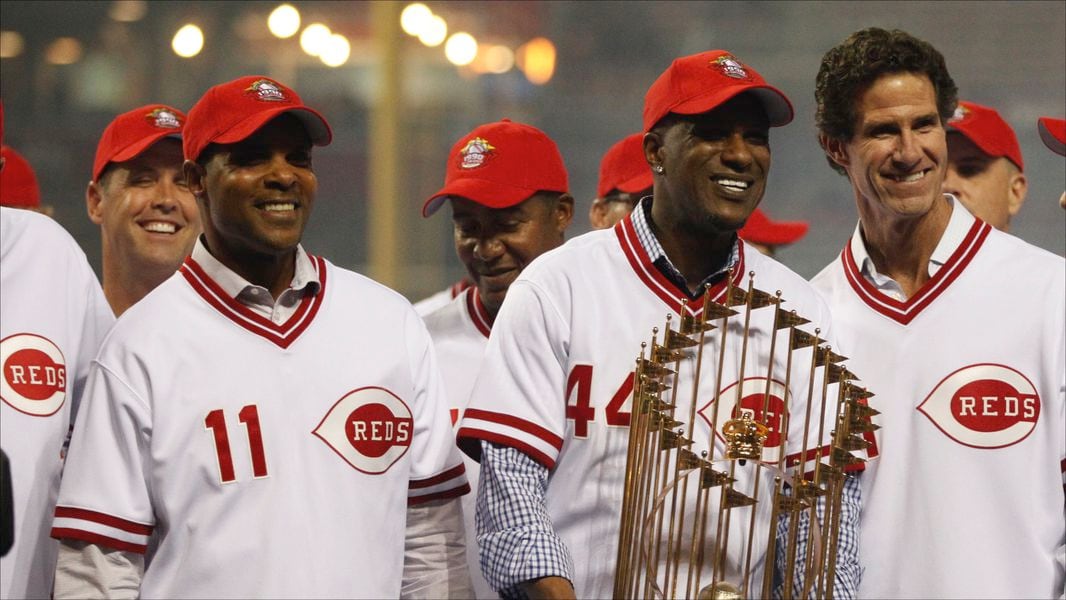
Barry Larkin (11), Eric Davis (44) and Paul O'Neill (21)
with the 1990 World Series trophy.

October 20, 1990, 30 years ago: The Cincinnati Reds beat the Oakland Athletics, 2-1 in Game 4 of the World Series, at the Oakland Coliseum. What had been predicted as an easy victory, possibly even a 4-game sweep, by the A's, the defending World Champions on their 3rd straight American League Pennant, became a 4-game sweep in the other direction, by the National League's Reds. 

As he had in Game 1, José Rijo outpitched Dave Stewart, to win Most Valuable Player honors. With the A's leading 1-0 going into the top of the 8th inning, Barry Larkin singled, Herm Winningham beat out a bunt for a hit, and Paul O'Neill reached on an error to load the bases. The tying and winning runs scored rather undramatically, on a groundout by Glenn Braggs and a sacrifice fly by Hal Morris, respectively.

It remains one of the greatest upsets in World Series history: The Reds won 91 regular-season games to the 103 for the A's, but outscored the A's 22-8. This title also reversed the result of the 1972 World Series, when the Reds, in their "Big Red Machine" era, lost to the A's in 7 games, despite Oakland's best player, Reggie Jackson, being unavailable due to injury.

This time, the Reds lost both Eric Davis and Billy Hatcher, who batted a record .750 (9-for-12) in the Series, in the clinching Game 4, but didn't need them.

It was the 5th World Series won by the Reds. They also won in 1919, 1940, 1975 and 1976, while winning Pennants but losing the World Series in 1939, 1961, 1970 and, as said, 1972.

The Reds haven't won a Pennant since. They led the NL Central Division when the Strike of '94 hit. They won the Division in 1995, and swept the Los Angeles Dodgers in the NL Division Series, but were then swept by the Atlanta Braves in the NL Championship Series. They lost a Playoff for the NL Wild Card in 1999 -- to the Mets. How embarrassing.

They didn't get close to the postseason again until 2006, finishing 3 1/2 games out of 1st place. They won the Division in 2010 and 2012, but lost the NLDS to the Philadelphia Phillies and the San Francisco Giants, respectively. In 2013, they lost the NL Wild Card Game to the Pittsburgh Pirates. They then had 6 straight seasons of 86 or more losses, 4 of them of 94 or more, until this season, when they made the COVID-19-forced expanded Playoffs, and got swept in 2 straight for the Braves.

So, in the last 30 years, the Reds have had their moments. But it's been 30 years to the day since they last won the World Series. And 30 years and 8 days, since October 12, 1990, since they won a Pennant -- or even a single NLCS game. How long has that been?

*

Those Reds were managed by Lou Piniella, the former Yankee outfielder and manager, who was hired the year before, after the biggest of all Reds legends, Pete Rose, was permanently banned from baseball. By a weird turn of events, Piniella and the Oakland manager, Tony La Russa, grew up in Tampa and were teammates on an American Legion baseball team.

He inherited a team that had Larkin, who went to the Hall of Fame; O'Neill, just coming into his own, a right fielder who would go on to help the Yankees win 4 World Series; Hatcher, who had previously helped the Houston Astros win a Division title; Davis, a center fielder who looked like he would become an all-time legend, but who would be limited by injuries to 282 home runs, 349 stolen bases and 3 Gold Gloves; and Chris Sabo, a former Rookie of the Year who would be a 3-time All-Star.

The pitching was good: Rijo would go on to lead the NL in strikeouts in 1993. That year, Danny Jackson would help his team win the Pennant, although that team would be the Phillies, not the Reds. Tom Browning had thrown a perfect game, and won 123 games before a broken arm ended his career. And they had a trio of relievers known as "The Nasty Boys": Rob Dibble, Norm Charlton and Randy Myers, the latter a member of the Mets' 1986 World Series winners.

Major League Baseball had 26 teams, but had not yet expanded to Florida or the Mountain Time Zone. The Montreal Expos hadn't yet moved to Washington. There were no Asian players, no Interleague Play, and, a year earlier, the SkyDome in Toronto (now the Rogers Centre) became the 1st MLB stadium with a retractable roof.

The Chicago White Sox were about to move from the 80-year-old Comiskey Park to a new stadium with the same name (now U.S. Cellular Field). They were 1 of 4 teams still using a ballpark built before World War I, 6 using one built before World War II, and 8 built before the Space Age. (Now, each of those 3 categories is down to 2.) Today, only 7 teams are using the same stadium they were using in 1990: The A's, the Royals, the Red Sox, the Dodgers, the Chicago Cubs, the Toronto Blue Jays, and the team now known as the Los Angeles Angels. In 2002, the Reds closed Riverfront Stadium, and moved to the new Great American Ball Park the next season.

The Giants hadn't won the World Series in 36 years (and not at all since moving to San Francisco), the Cleveland Indians 42 years, the Red Sox 72 years, the White Sox 73 years, and the Cubs 82 years. All but the Indians have since ended their droughts.

The Colorado Rockies, the Miami Marlins, the Tampa Bay Rays and the Arizona Diamondbacks hadn't begun play yet. Those 4 teams, plus the Blue Jays, the Angels, the Houston Astros, the Texas Rangers, the Braves since they moved to Atlanta, and the Expos/Nationals franchise hadn't yet won the Pennant. The Marlins, the D-backs, the Jays, the Angels, the Braves since they moved to Atlanta, and the Expos/Nats hadn't yet won the World Series. All of those achievements have since been reached.

A month earlier, Bobby Thigpen of the White Sox set a new record of 57 saves, which would stand for 18 years. A few weeks before that, Ken Griffey Sr. and Ken Griffey Jr. of the Seattle Mariners became the 1st father and son to play on the same team at the same time, and hit back-to-back home runs.

The Yankees, besieged by injuries, finished last for the only time since 1966. George Steinbrenner fired Bucky Dent as manager while the Yankees were playing a series with the Red Sox at Fenway Park, site of Bucky's greatest moment as a player. When he was invited to return for Old-Timers' Day -- the one OTD between 1951 and 1998 that neither Joe DiMaggio nor Mickey Mantle appeared -- Dent got a huge ovation, and a "Steinbrenner sucks!" chant went up.

George would soon be suspended by Commissioner Fay Vincent for hiring Howard Spira, a Mob-connected compulsive gambler who had worked for Dave Winfield's charitable foundation, to dig up dirt on the slugger. He failed, George got caught, and was given a lifetime ban, with the opportunity to be reinstated after 2 years (which he was). George had already traded Winfield to the Angels by the time he was banned. With Gene Michael put in charge of baseball operations, the rebuilding of the Yankees began.

Emblematic of this awful Yankee season was Andy Hawkins pitching 8 innings of no-hit ball against the White Sox in the last game the Yankees ever played at Comiskey, but losing 4-0 because of his walks and 3 8th-inning errors. Although he pitched a complete game and didn't allow any hits, MLB decided to not credit him with a no-hitter. Nolan Ryan was, for the 6th time, and also won his 300th game (although not in the same game).

In the NFL, there were 2 teams in Los Angeles, and no team in Oakland, St. Louis or Baltimore. Those cities would get teams again, while Los Angeles lost out, and then gained 2 new teams -- actually, 2 old teams, 1 of which was 1 of the 2 they lost in 1994. There was no team in Carolina, Jacksonville or Tennessee, but those places would get teams. There was a team in Houston, but it was the Oilers, not the Texans.

The NBA has since added Toronto, Vancouver (who moved to Memphis) and a new Charlotte team to replace the one that moved to New Orleans; while the Seattle SuperSonics were moved to Oklahoma City. The NHL has added 11 teams, and moved 5: Since 1990, Minnesota, Quebec City, Winnipeg, Hartford and Atlanta have all lost their teams; while only Minnesota and Winnipeg have gotten their teams replaced.

Baseball legends Joe DiMaggio, Ted Williams, Bob Feller, Warren Spahn, Billy Herman and Charlie Gehringer were still alive. Ryan, George Brett, Robin Yount and Carlton Fisk would hang on as active players until 1993. The other defining players of my childhood had all retired.

In addition to Larkin, Ryan, Brett, Yount and Fisk, the following players were then active, and are now in the Baseball Hall of Fame: Bert Blyleven, Goose Gossage, Dave Winfield, Gary Carter, Jack Morris, Andre Dawson, Alan Trammell, Eddie Murray, Ozzie Smith, Paul Molitor, Tim Raines, Lee Smith, Harold Baines, Ryne Sandberg, Cal Ripken, Wade Boggs, Tony Gwynn, Kirby Puckett, Greg Maddux, Edgar Martinez, Tom Glavine, Roberto Alomar, Craig Biggio, Randy Johnson, John Smoltz, Larry Walker, Ken Griffey Jr. and, a rookie that season, Frank Thomas.

And, from the defeated A's, Dennis Eckersley and Rickey Henderson, along with manager La Russa. But not Dave Stewart or Dave Parker (neither quite had the career stats), and not Mark McGwire or
José Canseco (now known to be steroid cheats).

Mariano Rivera had just debuted in professional baseball that summer. Derek Jeter had just started high school. Alex Rodriguez, David Ortiz and Jimmy Rollins were in junior high, Albert Pujols was 10, CC Sabathia was 9, Robinson Cano and current Royals ace James Shields were 8. David Wright, Justin Verlander and Miguel Cabrera were 7, Max Scherzer was 6, Felix Hernandez was 4, Buster Posey was 3, Clayton Kershaw and Stephen Strasburg were 2, Madison Bumgarner was 1, Giancarlo Stanton was 11 months old, José Altuve was 5 months old, Gerrit Cole was 6 weeks old, and Mike Trout, Christian Yelich, Aaron Judge, Mookie Betts, Bryce Harper, Clint Frazier, Gleyber Torres and Juan Soto weren't born yet. (Those players are all listed in descending order of birth, oldest to youngest.)

Current Reds manager David Bell was in the farm system of the Cleveland Indians, for whom his father, Buddy Bell, had played. Aaron Boone of the Yankees was in high school. Luis Rojas of the Mets was 9 years old.

Tom Thibodeau of the Knicks was an assistant coach with the Minnesota Timberwolves. Barry Trotz of the Islanders was an assistant coach for the minor-league Baltimore Skipjacks. Lindy Ruff of the Devils was playing for the Rangers. David Quinn, now the head coach of the Rangers, was out of hockey due to battling a long-term illness. Steve Nash of the Nets and Ronny Deila of New York City FC were in high school. Gerhard Struber of the Red Bulls was 13 years old. Adam Gase of the Jets was 12. Joe Judge of the Giants was 10. And Walt Hopkins of the Liberty was 5.

In addition to the A's, the defending World Champions were the San Francisco 49ers in football, the Detroit Pistons in basketball, and the Edmonton Oilers in hockey. (The Oilers haven't won since, either.) The Heavyweight Champion of the World was James "Buster" Douglas, who had knocked out the previously unbeaten Mike Tyson 6 months earlier, but was about to lose it to Evander Holyfield.

The Olympic Games have since been held in America twice, France, Spain, Norway, Japan, Australia, Greece, Italy, China, Canada, Britain and Russia. The World Cup, which had recently been held in Italy, with Germany winning it (as they did this year), has since been held in America, France, Japan, Korea, Germany, South Africa and Brazil.

There were 26 Amendments to the Constitution of the United States. The idea that corporations were "people" and had the rights thereof was considered ridiculous -- but so was the idea that a person could legally marry a person of the same gender. No Justices then on the Supreme Court are still on it.

The President of the United States was George H.W. Bush. His son George W., having failed spectacularly in business, had recently (with more than a little help from his "friends") bought the Texas Rangers. Ronald Reagan, Jimmy Carter, Gerald Ford, Richard Nixon, their wives, and the widows of Lyndon Johnson and John F. Kennedy were still alive.

Bill Clinton was about to be elected to a 5th term as Governor of Arkansas. Barack Obama was President... of the Harvard Law Review. Joe Biden was Chairman of the Senate Judiciary Committee. Kamala Harris was newly hired as an Assistant District Attorney in her native Alameda County, California -- Oakland, the city just dethroned as World Champions of baseball. Mike Pence was a lawyer who was about to become 0-for-2 in races for Congress. And Donald Trump was between wives and bankruptcies. His life was a mess. The more things change, the more they stay the same.

The Governor of New York was Mario Cuomo, whose son, current Governor Andrew Cuomo, was Chairman of the New York City Homeless Commission, reporting to Mayor David Dinkins. The Governor of New Jersey was Jim Florio. The Governor of Ohio was Richard Celeste, although former Cleveland Mayor George Voinovich was about to be elected to replace him. The Mayor of Cincinnati was Charles Luken.

The current holders of those offices? I've told you of Andrew Cuomo. Current New York Mayor Bill de Blasio was an aide to Dinkins. Current New Jersey Governor Phil Murphy was a rising star at Goldman Sachs. Current Ohio Governor Mike DeWine was in Congress, and was about to be elected Lieutenant Governor on Voinovich's ticket. And current Cincinnati Mayor John Cranley was in high school.

There were still living veterans of the Spanish-American War, the Boxer Rebellion, the Philippine Campaign, the Mexican Revolution, the Boer War and the Russo-Japanese War. There were still living survivors of the Johnstown Flood of 1889, the sinking of the General Slocum in 1904, and the San Francisco Earthquake of 1906.

Soviet President Mikhail Gorbachev was about to be awarded the Nobel Peace Prize. The Pope was John Paul II. The current Pope, Francis, Jorge Mario Bergoglio, was a bishop in Buenos Aires in his native Argentina.

The Prime Minister of Canada was Brian Mulroney. The head of state for Canada, and Britain, was Queen Elizabeth II -- that hasn't changed -- but Prime Minister Margaret Thatcher was about to lose her job to John Major, due to her support of an onerous poll tax. There have since been 5 Presidents of the United States, 7 Prime Ministers of Britain, and 3 Popes.

England's Football League had recently been won by Liverpool for a record 18th time -- but they haven't won it since. Manchester United had won the FA Cup, their 1st trophy under manager Alex Ferguson, who said he was determined to beat Liverpool and "knock them off their fucking perch." It would take until 1993, but he would do it.

Major novels of 1990 included Clear and Present Danger by Tom Clancy, Jurassic Park by Michael Crichton, L.A. Confidential by James Ellroy, Get Shorty by Elmore Leonard, The Bourne Ultimatum by Robert Ludlum, and The Burden of Proof by Scott Turow. The last of these became a TV miniseries the next year, while the rest all became major feature films. Stephen King was working on Needful Things. George R.R. Martin, frustrated that his screenplays and teleplays were getting cut, or dropped completely, decided to return to fantasy novels, and began the process that led to Game of Thrones. J.K. Rowling was on a long train trip from Manchester to London, when she got the idea that would become the Harry Potter series.

Major films of the Autumn of 1990 included Goodfellas, Pacific Heights, Avalon, Henry & June, Miller's Crossing, Mr. Destiny, Jacob's Ladder, Rocky V, Misery, and Home Alone. Steven Spielberg was directing Hook, a story of a grownup Peter Pan (played by Robin Williams) returning to Neverland, and George Lucas helped him out on it.

TV series that were beginning in the new 1990-91 season included The Fresh Prince of Bel-Air, Law & Order, Beverly Hills 90210, Evening Shade, Tiny Toon Adventures, Captain Planet & the Planeteers, the even more cartoonish Dream On, and The Flash, starring John Wesley Shipp as DC Comics' Scarlet Speedster.

Michael Keaton was reaping the benefits of the previous year's Batman film, Christopher Reeve was still thought of as Superman, Lynda Carter was still thought of as Wonder Woman, and Nicholas Hammond was still the most recent live-action Spider-Man. Timothy Dalton had played James Bond in the previous year's Licence to Kill, but quit, and legal wrangling kept the 007 franchise in limbo for a while. So was Doctor Who, recently canceled with the last and Seventh Doctor having been Sylvester McCoy.

NBC made a sitcom, Ferris Bueller, based on the 1986 John Hughes film. But it moved the action from the suburbs of Chicago to those of Los Angeles, made Ferris a year younger than his sister Jeanie rather than a year older, and made Sloane a blonde instead of a brunette. Despite having The Fresh Prince of Bel-Air as its lead-in, it tanked, and was canceled after 12 of the 13 episodes were aired. It was replaced on NBC's schedule by Blossom. But even Ferris Bueller was a success compared to ABC's combination of a cop show and a musical, the execrable Cop Rock.

Jerry Seinfeld was known, but no one had yet heard of George Costanza, Elaine Benes and Cosmo Kramer. Or of Deadpool, Buffy Summers, Fox Mulder, Ross Geller & Rachel Greene, Bridget Jones, Xena, Carrie Bradshaw, Jed Bartlet, Tony Soprano, Leroy Jethro Gibbs, Rick Grimes, Lisbeth Salander, Bella Swan, Don Draper, Katniss Everdeen, Walter White or Richard Castle.

Ricky Nelson's twin sons, Matthew and Gunnar, recording as "Nelson," had the Number 1 song in the country, "(Can't Live Without Your) Love and Affection." If people were shocked by how "Rick" looked at the "Garden Party" in 1971, they would have been appalled at the twins' long bleach-blond, metal-esque hair. Still, it gave the Nelson family the 1st father & son Number 1 hits in the Rock and Roll Era.

Paul McCartney was touring for his album Flowers In the Dirt. Celine Dion gave her 1st English-language concert. A band named for basketball star Mookie Blaylock debuted, but soon changed its name to Pearl Jam. 2 Live Crew were acquitted of obscenity charges.

The Geto Boys, The Rembrandts and The La's released their self-titled debut albums, Bob Dylan Under a Red Sky, George Michael Listen Without Prejudice, Vol. 1, Neil Young Ragged Glory, Warrant Cherry Pie, AC/DC The Razor's Edge (including "Thunderstruck"), Megadeth Rust In Peace, Roseanne Cash Interiors, Mary Chapin Carpenter Shooting Straight In the Dark, and Paul Simon The Rhythm of the Saints, including what remains his last hit, "The Obvious Child," which has the lyric, "The cross is in the ballpark."

Kris Jenner was in the process of divorcing Robert Kardashian, so she could marry 1976 Olympic hero Bruce Jenner. None of the children of any of the 3 of them was famous yet. Kanye West and Shakira were 13 years old; Sean Murray and Stana Katic 12; Katie Holmes, Heath Ledger and Pink 11; Cote de Pablo 10; Christina Aguilera, Alicia Keys, Hyden Christensen, Jessica Alba, Natalie Portan, Chris Evans and Beyonce 9; Britney Spears, Sienna Miller, Cobie Smulders, Hayley Atwell, Kirsten Dunst, Cory Monteith and Elisabeth Moss 8; Matt Smith, Anne Hathaway, Henry Cavill and Andrew Garfield 7; Emily Wickersham 6; Katy Perry and Scarlett Johansson 5; Lady Gaga, Robert Pattinson and Lea Michele 4; Emilia Clarke, Kit Harington, Naya Rivera and Rose Leslie 3; Rhianna 2; Emma Stone and Daniel Radcliffe 1; Taylor Swift 9 months, Kristin Stewart and Emma Watson 5 months; and Cardi B, Selena Gomez, Demi Lovato, Miley Cyrus, Ariana Grande, Justin Bieber, Halsey, all of the members of One Direction, all of the members of BTS, and all of the Modern Family kids hadn't been born yet.

Inflation was such that what $1.00 bought then, $1.99 would buy now. A U.S. postage stamp cost 25 cents, and a New York Subway ride $1.15. The average price of a gallon of gas was $1.22, a cup of coffee $1.49, a McDonald's meal (Big Mac, fries, shake) $5.23, a movie ticket $4.23, a new car $15,045, and a new house $150,100. The Dow Jones Industrial Average closed the preceding day, a Friday, at 2520.79.

The World Wide Web was about to debut, but hardly anybody would know about it for a while. Mobile phones were still the size of the original Star Trek series' communicators. The Hubble Space Telescope had been launched, but it wasn't working, and would need to be repaired by a later shuttle mission. The 1st digital camera was sold in the U.S. The leading home video game system was the Sega Genesis. The birth control pill was long-established, but there was, as yet, no Viagra.

In the Autumn of 1990, Operation Desert Shield was launched, to ready American troops to push Saddam Hussein's Iraqi army out of Kuwait. Presidents Bush and Gorbachev met in Helsinki, Finland to discuss the situation, and those of the breakaway Soviet republics. Germany was reunified for the 1st time since 1945, and under a free government for the 1st time since 1933. A devastating civil war began in the African nation of Rwanda. China opened its 1st McDonald's and its 1st Pizza Hut. Walmart opened its 1st store in the Northeast, in York, Pennsylvania. 

Leonard Bernstein, and William S. Paley, and Cookie Lavagetto died. Jennifer Lawrence, and John Wall, and John Tavares were born.

October 20, 1990. The Cincinnati Reds won the World Series, after winning the National League Pennant. They have never won another of either.

Will they win them in the near future? Stay tuned.

Tuesday, May 8, 2018

Cincinnati's 10 Greatest Athletes

The Big Red Machine, 1976 -- note the National League Centennial patch.
Back row: George Foster, Cesar Geronimo and Ken Griffey Sr..
Middle row: Pete Rose, Dave Concepcion, Joe Morgan and Tony Perez.
Front: Johnny Bench.

This week, the Mets are in Cincinnati to play the Reds.

Cincinnati's 10 Greatest Athletes

Honorable Mention to Cincinnati Reds players in the Baseball Hall of Fame, who did not otherwise make the Top 10: John "Bid" McPhee, Jake Beckley, Sam Crawford, Joe Kelley, Eppa Rixey, Ernie Lombardi, Tony Perez, Tom Seaver and Ken Griffey Jr. McPhee spent his entire career with the Reds, and any of the rest of them would have made the Top 10 if they had done so.

Honorable Mention to Charlie Joiner, who began his NFL career with the Bengals before moving on to Hall of Fame status with the Houston Oilers and the San Diego Chargers. He is 1 of only 3 players in the Bengals' 1st 50 years to be elected to Canton. Terrell Owens is another, and he played only 1 season there near the end. The other is at Number 3 on this list.

Honorable Mention to Wayne Embry, a 5-time All-Star with the Cincinnati Royals, but was elected to the Basketball Hall of Fame as an executive, with other teams.

Honorable Mention to Mike Gartner and Mark Messier, who briefly played for the Cincinnati Stingers of the World Hockey Association before starring in the NHL.

10. Jack Twyman, forward, Cincinnati Royals, 1957-66, plus the preceding 2 seasons with them in Rochester. In 1959-60, he and Wilt Chamberlain became the 1st players to average 30 points per game in an NBA season. In Jack's case, he topped out at 59 points, which an astonishing figure -- for almost anyone but Chamberlain.

Twyman last played in the NBA in 1966, having made 6 NBA All-Star Games. The closest the Royals came to a title while he was there was the Eastern Division Finals, losing them to the Boston Celtics in 1963 and 1964.

He became a broadcaster, calling NBA games on ABC with play-by-play man Chris Schenkel. On May 8, 1970, the Knicks were about to play the Los Angeles Lakers in Game 7 of the NBA Finals at Madison Square Garden. Knick captain Willis Reed had been injured in Game 5 and didn't play in Game 6. No one knew if he would play in Game 7.

But when he walked out of the tunnel onto the court, Jack Twyman had the iconic call: "I think we see Willis coming out!" Reed scored the Knicks' 1st 2 baskets, and didn't score any more, but the Knicks were inspired to a 113-99 victory and their 1st title after 24 years of trying. Twyman did the postgame interviews in the Knick locker room.

Twyman left broadcasting, and became an executive at a Cincinnati food-production company. He became sole owner, and made $3 million when he sold it in 1996. He died in 2012, as a member of the Basketball Hall of Fame, with the Royals/Kings having retired his Number 27, and the basketball world remembering how he crossed racial boundaries to care for his fellow Pittsburgh native and stricken Royals teammate Maurice Stokes.

9. Barry Larkin, shortstop, Cincinnati Reds, 1986-2004. A true hometown hero, he turned down free-agent offers from other teams to stay with the Reds. He was a 12-time All-Star, the 1st time at age 24 and the last in his final season at 40 – and it wasn't an honorary thing, either, as he batted .289 that season.

He helped the Reds win the 1990 World Series, and got them into the postseason again in 1995 and '99 (and had them in 1st place in the NL Central when the Strike of '94 hit). He also won 3 Gold Gloves, and the 1995 NL Most Valuable Player award. He had a lifetime batting average of .295, OPS+ 116, 2,340 hits including 441 doubles and 76 triples. The Reds retired his Number 11, and he has been elected to the Baseball Hall of Fame.

8. Jerry Lucas, forward, Cincinnati Royals, 1963-69. One of several of these guys who would rank higher had he spent his entire career in one city. On the other hand, if he hadn't left Cincinnati, he might not have won his only NBA Championship, with the 1973 Knicks.

A 7-time All-Star, including being named the MVP of the 1965 NBA All-Star Game, he was Rookie of the Year in 1964, helping the Royals to their best finish ever, as an Eastern Division Finalist. This followed an amateur career in which he was twice the national high school player of the year, twice the national college player of the year, twice the NCAA Final Four Most Outstanding Player, 3 times a Final Four participant, a 1960 National Champion with Ohio State (with John Havlicek and Bobby Knight as teammates), and a 1960 Olympic Gold Medalist.

Ohio State retired his Number 11, and the Royals (now the Sacramento Kings) retired his Number 16. He was named to the Basketball Hall of Fame and the NBA's 50th Anniversary 50 Greatest Players.

7. Frank Robinson, right field, Cincinnati Reds, 1956-65. This is a joke, right? Frank Robinson, the best player the Reds had been 1926 and 1967, only 7th? Keep in mind, he didn't even play half his career in the Queen City of the Midwest.

In his rookie year, 1956, he set a rookie record for home runs, and nearly helped the Reds win the National League Pennant. In 1961, he led them to the Pennant with a season that got him the NL's Most Valuable Player award. He had an even better season in 1962, but with Willie Mays and Maury Willis having amazing seasons, he was locked out.

Shortly after his rookie season, Branch Rickey, then running the Pittsburgh Pirates, offered the Reds all kinds of deals for Frank. Gabe Paul, then the Reds' general manager, said, "I wouldn't give you Frank Robinson for your whole team." This was a team that then included Roberto Clemente, Bill Mazeroski, Dick Groat and Vern Law.

But after the 1965 season, Bill DeWitt, the new Reds GM after having been that of the St. Louis Browns (and whose son and grandson are now running the St. Louis Cardinals), decided that Frank was "an old 30," and traded him to the Baltimore Orioles for Milt Pappas and 2 other guys. The Reds did need pitching, but this was a bad trade: By the time the Reds won the Pennant again in 1970, it was Frank's O's that beat them in the World Series.

Over his career, he hit 586 home runs, fell just 57 hits short of 3,000, and became the only man to win the MVP in both Leagues. He was named to the Baseball Hall of Fame, and in 1999 The Sporting News ranked him 22nd on their list of the 100 Greatest Baseball Players.

Both the Reds and the Orioles retired Frank's Number 20. There are statues of him outside the Reds' Great American Ball Park, the Orioles' Camden Yards, and, in reflection of his status as MLB's 1st black manager, one of him handing off a lineup card outside the Cleveland Indians' Progressive Field. As far as I know, he's the only man with statues outside 3 MLB parks. In 2005, George W. Bush awarded him the nation's highest civilian honor, the Presidential Medal of Freedom.

6. Edd Roush, center field, Cincinnati Reds, 1916-26, with a return in 1931. "I didn't know if I'd make it to the major leagues," the native of rural Indiana said in an interview late in life, "but I didn't care. I just had to get away from those damn cows."

Getting away from those damn cows was good for him, and for the Reds. He had a lifetime batting average .323, OPS+ of 127, 2,376 hits, and was said to have had the best outfield arm of his era. He insisted until his death, as the last surviving member of that team, that the Reds would have won the 1919 World Series even if the White Sox had played it on the level.

He is in the Hall of Fame, and although he played before numbers were worn, he was probably the greatest player the Reds ever had until Johnny Bench came along. In reflection of this, he was invited to throw out the ceremonial first ball at the last game at Crosley Field, on June 24, 1970.

5. Joe Morgan, 2nd base, Cincinnati Reds, 1972-79. If he had spent his entire career in Cincinnati, he'd be a serious contender for Number 1 on this list. The was the best 2nd baseman of my lifetime, and that includes Ryne Sandberg, Lou Whitaker, Craig Biggio, Roberto Alomar and Jeff Kent.

He had a 132 career OPS+. His 268 home runs made him the all-time leader among 2nd basemen, since surpassed by Sandberg and Kent. He had 2,517 hits, and 689 stolen bases, including 9 straight seasons with at least 40, and 3 of at least 60. He reached the postseason 6 times, including 3 Pennants and the 1975 and '76 World Championships with the Reds, seasons in which he was also the National League's Most Valuable Player.

The Reds have retired his Number 8, and he's in the Hall of Fame. All this despite being just 5-foot-7. As for his broadcasting, well…

4. Pete Rose, several positions but was 3rd base at his peak, Cincinnati Reds, 1963-78 and 1984-86. No player in the history of Major League Baseball played in more games, or had more plate appearances, at-bats, or hits -- or outs. He was named to 17 All-Star Games, including at 5 different positions. He won a Rookie of the Year (1963), a National League Most Valuable Player award (1973), 3 batting titles and even 2 Gold Gloves.

He has long been fond of saying that no player has played in more winning games. He reached postseason play 8 times, and just missed 6 others, winning 6 Pennants and 3 World Series, including 1975, when he was awarded the Series MVP and Sports Illustrated's Sportsman of the Year. He had a 44-game hitting streak, tied for the longest in NL history. The Reds have retired his Number 14, and the fans, for whom he once symbolized baseball for an entire generation, named him to the Major League Baseball All-Century Team.

But he knew the rule, baseball's one "death penalty" rule, and he broke it anyway. The thing is, if he had come clean immediately, he probably would have been reinstated at the 1st opportunity, as George Steinbrenner was when he was "permanently banned" a year later. And he'd probably have gotten into the Baseball Hall of Fame only a little late. But he blew it.

And it's not the only thing he blew. Every now and then, new revelations come out. He still gambles. He was a womanizer, something known to the media during his playing days, but covered up. And the Philadelphia Phillies, for whom he played from 1979 to 1983 and helped to win 2 Pennants, canceled a ceremony electing him to their team hall of fame when it got out that he may have been fooling around with a teenage girl at some point.

And he will never be elected to the Hall during his lifetime. They may wait until after he dies to remove him from the "permanently ineligible" list. Because most fans will not want to hear his acceptance speech.

3. Anthony Muñoz, offensive tackle, Cincinnati Bengals, 1980-92. When The Sporting News named its 100 Greatest Football Players in 1999, it listed him 17th. When the NFL Network listed its 100 Greatest Players in 2010, he was 12th. In 11 years, with him already well retired and new players having made their mark, he rose in the historical eye. In each vote, he was the highest-ranking offensive lineman.

An 11-time Pro Bowler, he helped the Bengals win both of their AFC Championships, in 1981 and 1988. He was named NFL Man of the Year (the award now named for Walter Payton) in 1991, in honor of his activities both on and off the field. He is a member of the Pro Football Hall of Fame, and the NFL's 1980s All-Decade and 75th Anniversary Teams.

The Bengals have officially retired only 1 number, that of the 1st player they ever signed, 1968-79 center Bob Johnson, Number 54. A good player for a long time, but not a Hall-of-Famer. The Number 78 worn by Muñoz is not officially retired, but it hasn't been given back out since he retired.

2. Oscar Robertson, guard, Cincinnati Royals, 1960-70. He was, almost certainly, the greatest athlete ever to play for a Cincinnati team, and he did so for a team that the vast majority of the people in the Ohio Valley can't even remember.

If we were measuring his entire career, including the NBA Championship he won with the Milwaukee Bucks in 1971 and the one he nearly walked away a champion after winning in 1974 (but lost in Game 7), he would be Number 1 on this list.

People talk about "triple-doubles": Getting double figures, 10 or more, in points, rebounds and assists in a single game. In 2016-17, Russell Westbrook of the Golden State Warriors had 42 triple-doubles, breaking the record of 41, and actually averaged a triple-double for a season, becoming the 2nd player ever to do so. The 1st, the only one to do so in the NBA's 1st 70 seasons, and the previous record-holder? Oscar Robertson, with the 1961-62 Cincinnati Royals: 30.8 points, 12.5 rebounds, 11.4 assists -- to Westbrook's 31.6, 10.7 and 10.4.

"The Big O" led the University of Cincinnati to the NCAA Final four in 1959 and 1960, and led the nation in scoring, and was named College Player of the Year by The Sporting News, in all 3 of his college seasons. (Freshmen were not eligible until 1972-73.) One of the current college basketball player of the year trophies is named the Oscar Robertson Trophy.

He and Jerry West of West Virginia -- an urban black man from a Northern State and a rural white man from a crypto-Southern State -- were named co-captains of the U.S. team that won the Gold Medal at the 1960 Olympics in Rome, a team often considered the best amateur basketball team of all time. (The 1984 team with Michael Jordan and Patrick Ewing might have been better.) The aforementioned Terry Dischinger was also on that team, and it was, collectively, elected to the Basketball Hall of Fame.

A 12-time NBA All-Star, he was named All-Star Game MVP 3 times, Rookie of the Year in 1961, and MVP of the regular season in 1964. The Royals had Robertson, Jerry Lucas and Jack Twyman, Hall-of-Famers all, but they couldn't reach the NBA Finals, unable to crack the Boston Celtic dynasty, losing to them in the Eastern Conference Finals in 1963 and 1964.

In 1970, Robertson was traded to the Milwaukee Bucks, who had the young Lew Alcindor (later Kareem Abdul-Jabbar), and Oscar finally got his ring in 1971. He closed his career by reaching the Finals again in 1974, but, again the Celtics were in the way. He retired as the NBA's all-time leader in assists (a record broken by Magic Johnson, who was surpassed by John Stockton) and steals (a record broken by Stockton).

He has the rare status of having 3 different uniform numbers retired: 12 by the University of Cincinnati; 14 by the Royals' successors, the Sacramento Kings; and 1 by the Bucks. He was named to the Basketball Hall of Fame (twice, in his own right and with the 1960 U.S. Olympic Team) and the NBA's 50th Anniversary 50 Greatest Players.

50? He might still be one of the Top 10, 44 years after his last game. If you're making out your all-time starting lineup, you can have only 2 guards. A fan doing so in 1974, or even 1984, would have had it easy: Oscar and Jerry. Making your all-time team now? It comes down to Oscar, Magic and Michael. And if you're leaving Oscar out, ask yourself how old you are, and how much of Oscar you've seen.

1. Johnny Bench, catcher (later switching to 1st base and 3rd base), Cincinnati Reds, 1967-83. Contrary to anything that Sparky Anderson ever said, it certainly doesn't embarrass Oscar Robertson to compare him to Johnny Bench -- or vice versa.

A 14-time All-Star, and a 10-time Gold Glove, Bench was named National League Rookie of the Year in 1968, NL Most Valuable Player in 1970 and 1972, and World Series MVP in 1976. He helped the Reds reach 6 postseasons, winning 4 Pennants and the 1975 and 1976 World Series. He hit 389 home runs, and at his retirement had more home runs at the position of catcher than anyone.

The Reds retired his Number 5, and erected a statue of him outside Great American Ball Park. He was elected to the Baseball Hall of Fame, was ranked 16th on The Sporting News' 100 Greatest Baseball Players, and was named to the Major League Baseball All-Century Team.

Wednesday, April 2, 2014

Cincinnati's All-Time Baseball Team

Contrary to popular belief, the Cincinnati Red Stockings of 1869-70 were not the first professional baseball team. They were just the first ones to admit it. Also, they lasted only those 2 seasons, and have no connection to the current Cincinnati Reds, who were founded in the American Association in 1882, joined the National League in 1892, and, while they've had some serious droughts, have also put together some excellent eras: 1918-26, 1938-44, 1956-65, 1969-80, 1985-92, 1994-2000, and since 2010.

Because of the pretense that they were "the first professional baseball team," historically, the Reds were always the 1st National League team to play in a season. The Washington Senators would kick off the American League season, so the President of the United States could come to throw out the ceremonial first ball.

With TV futzing everything up, as it has with so many sports, the Reds are no longer a guaranteed lid-lifter for the entire NL. However, to this day, the Reds take Opening Day very seriously, having a big parade through downtown Cincinnati before their home opener. For that alone, they are worthy of some respect.

4. Cincinnati's All-Time Baseball Team

This team consists of players from the southern half of Ohio. The dividing line is pretty much the northern edge of Interstate 270, the "beltway" around the State capital of Columbus. The State House is 107 miles from Cincinnati’s Great American Ballpark, and 142 miles from Jacobs Field, or whatever the Indians are calling it now.

This team also includes players from southern Indiana, except for that little southwestern tail, and from Kentucky, except for its westernmost part – those two sections belong to the St. Louis Cardinals' region. It also includes southern West Virginia, with the northern part of the Mountaineer State belonging to Pittsburgh and the eastern Panhandle region going to Washington, D.C. – although the only player from the Panhandle good enough for me to even consider for the D.C. regional team was John Kruk.

What does this Cincinnati All-Time Team have? Good contact hitting. Good power hitting. Good starting pitching, although most of it is old-time -- or even so old as to be "old-tyme." It's a little weak in the bullpen, though, and I'm not sure about the catcher, mainly because he hasn't played a game in 117 years (and has been dead for 108).

Still, this should be a team that would do well by the Queen City of the Midwest. Not to be confused with Seattle, which is known as the Queen City of the Northwest; or with Charlotte, which bills itself as the Queen City of the Southeast.

As far as I know, there's no "King City" anywhere in the U.S., although New York is known as the Empire State, and the aforementioned Seattle is in Washington State's King County. And, of course, New York has Kings County (the Borough of Brooklyn) and Queens County (the Borough of Queens).

1B Al Oliver of Portsmouth, Ohio.  He actually played a little bit more center field, but try cracking the starting lineup at that position on this team. So I'm putting him at 1st base, which he played well enough to earn the nickname "Scoop."

He finished 2nd to Ted Sizemore for NL Rookie of the Year in 1969, but he had a far better career than any of the others in the top 5 in the vote, making 7 All-Star Teams. He won the World Series with the Pittsburgh Pirates in 1971. He also helped the Pirates reach postseason play in 1970, '72, '74 and '75, nearly helped the Pirates to do so in '73 and the Texas Rangers in '78, and got there in his final season with the 1985 Toronto Blue Jays.

He led the NL in batting, hits, doubles, total bases and RBI in 1982 as a member of the Montreal Expos. He was also, starting with the '78 Rangers (after wearing 16 for the Pirates), the 1st player to regularly wear the Number 0 – to represent not zero, but an O for Oliver.

He batted .303 lifetime, and had an OPS+ 121 and 2,743 hits. Of all players eligible for the Hall of Fame but not yet in, the only players with more hits are Craig Biggio, Harold Baines, Vada Pinson, and steroid cheats Rafael Palmeiro and Barry Bonds.

On Baseball-Reference.com's Hall of Fame Monitor, where a "Likely HOFer" is at 100, he's at 116, meaning he should get in. On their "Hall of Fame Standards," where an "Average HOFer" is at 50, he's at 40, meaning he shouldn't. On their "Most Similar Batters," his top 10 include HOFers Zack Wheat, Roberto Clemente (his Pirate teammate), Joe Medwick and Enos Slaughter. (And the aforementioned Pinson, and another Pirate teammate who’s not in, Dave Parker.) He belongs.

Honorable Mention to Charlie Gould, the only member of the 1869-70 Cincinnati Red Stockings who was actually from Cincinnati, or even from anywhere near it. He was one of the Red Stockings who moved east to form the Boston Red Stockings -- forerunners of today's Atlanta Braves -- and led the National Association in triples in 1872, as the Red Stockings won the 1st of 4 straight Pennants.

That was the only Pennant Gould won as a member of a pro league, as he was gone the next season. In 1876 and '77, he played with the new Cincinnati Red Stockings of the National League, but they went out of business after the 1880 season, before the new Cincinnati Reds were formed in 1882.

Somewhat Honorable Mention to Kevin Youkilis of Cincinnati. He's one of the most annoying players of his generation, and, at age 35 and playing in Japan, he may not play in the North American majors again. But he's got a career OPS+ of 123, is a 3-time All-Star and a 1-time Gold Glove, and has appeared in 4 postseasons, including the Red Sox' tainted titles of 2004 and '07. It would have been fun if the Yankees' experiment with him had paid off; instead, he made only 118 plate appearances before getting hurt, the Yanks didn't make the Playoffs, and the Sox won another tainted title.

2B Billy Herman of New Albany, Indiana. A 10-time All-Star, he batted .304 lifetime with a 112 OPS+. He helped the Chicago Cubs win Pennants in 1932, '35 and '38, and the Brooklyn Dodgers in '41, although he never won a World Series. (His injury late in '41 was a big reason why the Dodgers didn't win that one.) He led the NL in doubles in '35 and in triples in ’39.

He had 2,345 career hits, including 486 doubles and 82 triples. He's a member of the Hall of Fame and the Cubs' Walk of Fame outside Wrigley Field, although they've never retired a number for him. (He wore several, and wore 4 the most.)

SS Barry Larkin of Archbishop Moeller H.S. in Cincinnati. A true hometown hero, he turned down free-agent offers from other teams to stay with the Reds. He was a 12-time All-Star, the 1st time at age 24 and the last in his final season at 40 – and it wasn't an honorary thing, either, as he batted .289 that season.

He helped the Reds win the 1990 World Series, and got them into the postseason again in 1995 and '99 (and had them in first place in the NL Central when the Strike of ’94 hit). He also won 3 Gold Gloves, and the 1995 NL Most Valuable Player award. Lifetime batting average .295, OPS+ 116, 2,340 hits including 441 doubles and 76 triples. Hall of Fame, and the Reds retired his Number 11.

Very Honorable Mention to Harold "Pee Wee" Reese of Lousville, Kentucky. He played for the Triple-A Louisville Colonels, then a Boston Red Sox farm team, and legend has it that the Sox sold him to the Brooklyn Dodgers because Sox manager Joe Cronin was insecure about losing his own place as the Sox shortstop. Big mistake? Not really, because the Sox did have Johnny Pesky coming up, which also suggests that the story about Cronin's insecurity may also have been exaggerated.

He got his nickname not from being short (he was 5-foot-10) but from his childhood prowess at marbles, which were often called "peewees." He was the best shortstop in the NL in the 1940s and the 1st half of the 1950s – no mean feat in an era with Marty Marion and later Alvin Dark around.

A 10-time All-Star, he helped the Dodgers win 7 Pennants and nearly made it 11. He wasn't a great hitter, but he did manage 2,170 hits during his career, 330 of them doubles and 80 of them triples. He stole 232 bases, leading the NL in steals in 30. That's not an easy thing to do when your teammate is Jackie Robinson.

Which brings us to Pee Wee's most important legacy: As Dodger Captain, and also as a white Southerner, he let it be known that Robinson would be accepted, and that anyone who wouldn't accept him was gone – and, after that 1947 Pennant-winning season, that included Southerners Dixie Walker and Eddie Stanky, despite both having been quite popular on the team and with Dodger fans. It was the right, move, not just morally but competitively.

In May 1947, when the Dodgers were in Cincinnati – across the river from the Southern State of Kentucky and in many ways more Southern than Midwestern – Pee Wee heard so many nasty words from the stands at Crosley Field, from fans of the Reds, the team he had grown up rooting for, that he called time out, walked from his shortstop position to Jackie's at 1st base, and put his arm around Jackie for a brief chat.

No film or photograph of the event survives, but plenty of witnesses have revealed that it actually happened. What he said to Jackie isn't recorded (though the film 42 suggests they discussed the Civil War), and it doesn't matter. What matters is what this gesture said to the crowd: "I'm a white Southerner, and this black man is my teammate, and I'm too much of a gentleman to call you a bunch of dumb fucking rednecks in any other way."

The moment is recreated in a statue of the two men outside MCU Park, home of the minor-league Brooklyn Cyclones. Pee Wee is in the Hall of Fame, and the Dodgers retired his Number 1.

3B Mike Schmidt of Dayton, Ohio. He grew up with Cincinnati as the closest major league city, at a time when the Reds' top player was Frank Robinson, so he wore Robinson's Number 20 with the Philadelphia Phillies. The Phillies have retired this number, elected him to the Philadelphia Baseball Wall of Fame, and erected a statue of him outside Citizens Bank Park.

In 1983, when the team celebrated its 100th Anniversary, they held fan balloting for their all-time team and their all-time greatest player. Schmidt was chosen their all-time greatest player. And he still had 159 homers and an MVP award to go!

Schmidt was an All-Star 12 times – including being voted the starting 3rd baseman on the NL team in 1989, after he'd already announced his retirement. He stayed true to his principles by not playing, but also stayed true to the fans who chose him by flying out to Anaheim and appearing in uniform for the event.

His career OPS+ was an astounding 147. He had 2,234 hits, including 408 doubles, 59 triples, and 548 home runs – more than any 3rd baseman in history, more than any righthanded hitter of his generation, and more than any National Leaguer of his generation. (Only Reggie Jackson, in that generation, topped him among lefties and American Leaguers.)

He led the NL in homers 8 times, in RBIs 4 times, had 9 100-RBI seasons, and in 1980 hit 48 homers for a new team record that stood until Ryan Howard hit 58 in 2006. NL MVP in 1980, '81 and '86. And he wasn't just a great hitter: He won 10 Gold Gloves. He is most people's pick for the greatest 3rd baseman ever.

He helped the Phillies reach postseason play 6 times in an 8-year span from 1976 to 1983, winning the 1980 World Series (that year, he was both the regular-season and the Series MVP) and the 1983 Pennant. In addition to the awards from his team, he was elected to the Hall of Fame and the All-Century Team.  When The Sporting News announced its 100 Greatest Baseball Players in 1999, he came in at Number 28. He’s a Hall of Fame person, too.

LF Frank Howard of Columbus, Ohio. His 1st nickname was Hondo. At 6-foot-7 and 280 pounds, it's easy to see why they called him the Monster. He looked more like a football player, or at least a basketball player. In fact, he played those sports and baseball at The... Ohio State University.

Called up too late to help the Los Angeles Dodgers win the 1959 World Series, he was NL Rookie of the Year in 1960, and helped the Dodgers win the 1963 Series before being traded to the Washington Senators, where he became known as the Capital Punisher.

He led the AL in homers in 1968 and '70, and nearly did so in '69 except that his predecessor as D.C.'s biggest bopper, Harmon Killebrew, hit 49 for the ex-Senators, now the Minnesota Twins, to Howard's 48. Howard also led the AL in total bases and slugging in '68, total bases in '69 and RBIs in '70. When the Senators moved to become the Texas Rangers after the '71 season, he hit the last home run in team history.

Traded to the Detroit Tigers late in '72, he helped them win the AL East. A 4-time All-Star, he had a career OPS+ of 142, and hit 382 home runs. He did slow down at age 34 and retired at 36, after not being signed by any MLB team and injuring his back in, literally, his first swing with the Japanese club that signed him. All this makes him look like he fits the steroid profile, but at his size he wouldn't have needed 'em if offered: Without steroids, he was bigger than Mark McGwire.

Without that injury, he might have gotten back into the majors, and gotten well over 400 homers, and could well have gotten into the Hall of Fame. Baseball-Reference.com has him at "only" 61 on their HOF Monitor and 26 on their HOF Standards. And none of his 10 Most similar Batters are in. So it doesn't look like he'll get in.

Still, at the time he retired, only Hank Aaron, Willie Mays, Frank Robinson, Killebrew, Jimmie Foxx and Ernie Banks were righthanded hitters with more career homers. He is honored with a statue outside Nationals Park, and is listed on the Washington Hall of Stars display at the park.

CF Ken Griffey Jr. of Archbishop Moeller H.S. in Cincinnati. At this position, the Cincinnati team is loaded. They can also call on Earle Combs of Pebworth, Kentucky, a Hall-of-Famer who preceded Joe DiMaggio and Mickey Mantle at the position for the Yankees, winning 4 Pennants and 3 World Series before a skull fracture against the unpadded outfield walls of the time prematurely ended his career.

Then there's David "Gus" Bell of Louisville, Kentucky, who helped the Reds win the 1961 Pennant and whose son David "Buddy" Bell and grandson David Bell (apparently no nickname) also played in the majors. Then there's Jimmy Wynn of Taft H.S. in Cincinnati. The Toy Cannon was stuck in the Astrodome, but still hit a lot of home runs, including a memorable blast in his hometown in 1967, onto the Mill Creek Expressway (Interstate 75) just beyond the left-field wall at Crosley Field.

But they all have to take a back seat to Junior, who, like his father Ken, was born in Donora, Pennsylvania (also the hometown of Stan Musial), but grew up in Cincy while his father played there. Barring steroid revelations (I seriously doubt that he used them) or any other kind of ethical calamity (such as befell another Moeller grad, Pete Rose), will be elected to the Hall of Fame on his 1st try in 2016.

A 13-time All-Star, a 10-time Gold Glover, the 1997 AL MVP, he had a 135 career OPS+, 2,781 hits including 524 doubles and 630 home runs – 4th-best all-time among honest men – plus 1,836 RBIs. He had 8 100-RBI seasons and 7 40-homer seasons, 4 in which he led the AL, twice hitting 56, the most in an AL season since Roger Maris' 61 in '61.

He led the Seattle Mariners to their 1st 2 postseason berths, as 1995 and '97 AL West Champions, and in particular his '95 run saved Major League Baseball in the Pacific Northwest, as a ballot initiative passed that got Safeco Field built. He had 398 homers before his 30th birthday. He was being hailed as the new Willie Mays.

Unfortunately, injuries were never far away, and he became the new Mickey Mantle instead. Only once did he top 30 homers after age 30, and never again had 100 RBIs. Either he or Barry Bonds, also the son of a good-but-not-quite-great major leaguer, was the best player of his generation. Griffey's reputation took a bit of a hit, but as the revelations about his contemporaries, including Bonds, began to pile up, Griffey began to look a lot better.

Aside from his comeback with the M's in his last 2 seasons, his Number 24 has not been given back out by that team, and they will surely retire it. He deserves a statue outside Safeco: That stadium, and the team that plays there, wouldn't be there now if it wasn't for him. When The Sporting News announced its 100 Greatest Baseball Players in 1999, right in his prime, he came in at Number 93.

Honorable Mention to Oscar Charleston of Indianapolis, Indiana. Since we don't have reliable statistics from the Negro Leagues, and since those leagues were probably, at best, made up of mostly Triple-A players, it's hard to say how good he was.

But what we do have tells us that, in 53 exhibition games against all-white teams of major leaguers, he batted .318 with 11 homers. 53 x 3 = 159, a full season today, so that's .318 and on a pace for 33 homers. So had he played in the majors, he would probably have been as good as they came.

He also managed the Pittsburgh Crawfords to a few Pennants… while still playing for them, at close to 40 years old, which attests to both his durability and his quick mind. Baseball historian Bill James calls him the 4th-best player ever. If only we could know for sure what he could do against competition that was all (or at least mostly) major-league caliber. When The Sporting News announced its 100 Greatest Baseball Players in 1999, he came in at Number 67.

RF Chuck Klein of Indianapolis, Indiana. The Hoosier Hammer is often derided by baseball historians because his hitting feats were achieved in the "bandbox" of Baker Bowl, home of the Phillies from 1895 to 1938, which had a 280-foot right field fence (albeit with a high wall in a vain attempt to discourage cheap homers), ideal for a lefthanded hitter like Klein; and did so in the homer-happy early 1930s.

He was a great slugger between the ages of 23 and 28, a good one from 29 to 32, and just another player from then on, averaging only 115 games a season from then on. If any player of his era "fits the steroid profile," he's the one. Yet I can't find any record of him being injured in those latter years, only that, at some point, he developed a drinking problem that eventually caused long-term health and financial issues, and then caused his death at age 53.

But although he played in 17 separate seasons, he only played enough games to add up to 14 full seasons. So maybe his numbers deserve another look. His career home run total was "only" 300, but he hit 191 of those in his first 6 seasons, before turning 29. Just before turning 32, he had 257.

If he had simply kept up that pace until he was 38, he might have had at least the 382 that Howard hit -- which would also be more than were hit by Joe DiMaggio, Yogi Berra, Johnny Mize, Ralph Kiner, Gil Hodges, Orlando Cepeda, Tony Perez, and his fellow oft-derided Phillies slugger Dick Allen. It would also have been as many as Jim Rice, and nearly as many as Duke Snider, Al Kaline, Johnny Bench, Dale Murphy and Joe Carter.

He led the NL in home runs 4 times in 5 years. The 1st was in 1929, when he peaked at 43. The next year, he hit 59 doubles -- on the way to 398 in his truncated career -- collected a whopping 445 total bases, and had 170 RBIs (but didn't lead the League because that was the year Hack Wilson set the all-time record of 191). He had 6 100+ RBI seasons, leading the League twice. Twice he led in hits, 3 times each in runs scored and slugging. He even led the NL in stolen bases in 1932, albeit with just 20. He won the Triple Crown in 1933, and had an amazing 176 OPS+. That concluded a 3-year stretch in which, in the first 3 years of the current format for the Most Valuable Player award, he finished 2nd, 1st and 2nd in the voting, despite the Phillies being nowhere near the Pennant race.

He also represented the NL and the Phillies in the 1st 2 All-Star Games. In 1936, he hit 4 home runs in a game, the 1st National Leaguer to do so in 40 years. Even with his decline, his career OPS+ was a very strong 137 -- meaning that, in a high-offense era, he was still 37 percent better at producing runs than the average player.

And yet, after the 1933 season, his Triple Crown season, the Phillies traded him to the Cubs for Harvey Hendrick (no, I'd never heard of him, either), Ted Kleinhans (ditto) and Mark Koenig (the shortstop of the late 1920s Yankee champions but washed up by then). Were the Phillies stupid? Perhaps, but they were also desperate: It was the Depression, and the Cubs, backed by all that Wrigley chewing gum money, paid $65,000 for the best slugger in the National League; the players were the throw-ins.

When Klein didn't quite work out on the North Side of Chicago, in 1936 they sent him back to North Philly. In 1939, the Phils released him, probably thinking his production was no longer making his drinking worth it. The Pirates signed him up, then released him at the end of the year, and then the Phils signed him again, and he stayed with them to the end, 1944. Within a decade, he was dead.

Still, he was elected to the Hall of Fame, although by the Veterans Committee well after he died. He wore several numbers in his career, so the Phillies put a "P" logo for him up with their retired numbers. When The Sporting News announced its 100 Greatest Baseball Players in 1999, he came in at Number 92. Clearly, not everyone thinks he was just a Baker Bowl hitter.

Honorable Mention to Sam Thompson of Danville, Indiana. This guy goes back to Cleveland. The Presidency of Grover Cleveland. In 1887, he led the Detroit Wolverines to the NL Pennant, leading the league in batting, hits, triples, RBIs (166, a record for the time), slugging and total bases. But the Wolverines couldn't maintain it, and had to sell him to the Philadelphia Phillies. He led the NL in homers in 1889 and '95, hits and doubles in '90 and '93, and RBIs in '94 and '95. He retired after the 1898 season, but came back for 8 games with the new Detroit team, the AL's Tigers, in 1906 at age 46.

He had a lifetime batting average of .331, and an OPS+ of 146, so he was great by the standards of his own time, not just benefiting from the era’s pitching conditions, especially since he was great both before and after the 1893 move-back from 50 feet to 60 feet, 6 inches. He was elected to the Baseball Hall of Fame and the Philadelphia Baseball Wall of Fame.

Honorable Mentions to 3 latter-day Yankees: Paul O’Neill of Columbus, Ohio, who helped his home-State Reds win the 1990 World Series before bringing his "Warrior" mentality to the Yankees for 4 more titles; David Justice of Covington, Kentucky, right across the Ohio River from Cincinnati, who was a big part of the Atlanta Braves' revival in the 1990s, winning 4 Pennants and the 1995 World Series, and then helping the Indians win the 1997 Pennant and the Yankees win the Series in 2000 and the Pennant in 2001; and Nick Swisher of Parkersburg, West Virginia, who enlivened the 2009 World Champions with his bat and his personality, made the All-Star team the next season, also reached the postseason with the A's and the White Sox, and is now with the Indians, sitting on a decent career home run total of 231 and an OPS+ of 118.

C William "Buck" Ewing of Hoagland, Ohio.  Think Thompson went back a long way? Ewing debuted in 1880, during the Administration of Rutherford B. Hayes. He played his best years with the New York Giants, winning NL Pennants in 1888 and '89, and then helped the Cleveland Spiders win the Temple Cup in 1895, before closing his career with his hometown Reds in 1897.

(The Temple Cup was a trophy given to the winner of a postseason series between the NL's 1st- and 2nd-place teams from 1894 to '97. Because the 2nd-place team won in '94, '95 and '97, people lost interest, and the Cup was withdrawn, although it's now on display at the Hall of Fame. Imagine if baseball had kept it, and treated it the way the NHL treats the Stanley Cup. Would we now be hearing Yankee Fans ask, "How many Temple Cups has your team won?" Ironically, no current team has ever won one, unless you count the 1894 Cup won by the Giants who are now in San Francisco.)

Ewing may have been the best player of the 1880s, and he was pretty good in the 1890s, too. His lifetime batting average was .303, and his OPS+ 129. He was also the 1st player ever to hit 10 home runs in a season, in 1883. He played every position: 636 games at catcher, 253 at 1st base, 193 in right field, 127 at 3rd base, 51 at 2nd base, 34 at shortstop, 34 in center field, 9 in left field and 9 pitching. And he was regarded as a good fielder at all of them.

He died of diabetes in 1906, age 47, and in 1939, when the Hall of Fame held an election to determine which 19th Century players were worthy, they chose Ewing, Cap Anson, Old Hoss Radbourn, Al Spalding, Charles Comiskey and Candy Cummings – although Spalding and Comiskey had credentials as executives that exceeded their impressive records as players, and Cummings got in mainly because he claimed to have invented the curveball, which he probably hadn't actually done. And Anson was also a pretty good manager.

So Ewing was the only 19th Century player who was elected mainly as a player, at a time when there were still plenty of people alive who could have seen those men play.

Honorable Mention to an even earlier player: Cal McVey of Indianapolis, Indiana. Like Charlie Gould, he was a member of the 1869-70 Cincinnati Red Stockings, and was one of the ones who formed the Boston Red Stockings. Unlike Gould, he stuck with them through the entire length of the National Association, winning Pennants in 1872, '73, '74 and '75, leading that league in hits and RBIs twice each.

Like some of those Red Stockings, including Al Spalding, he went back west to form the Chicago White Stockings, forerunners of today's Cubs, and won the 1st NL Pennant in 1876, before returning to the NL's Cincinnati Red Stockings in their final 2 seasons, 1878 and '79.

If you want a 20th Century catcher for the Cincinnati-area team, the best I can give you is Hank Gowdy of Columbus, Ohio, and he still goes back a long way. He starred for the Boston Braves and the Giants, including the Braves' 1914 "Miracle" World Championship. He was the first MLB player to enlist in World War I, and, well after he retired from the game, became the only player to have served in both World Wars.

He wasn't much of a hitter (although he did bat .299 in 1921 and .317 in '22), and only 3 times did he have more than 300 plate appearances. But he must have been a good-fielding catcher, a good handler of pitchers, or a good influence on his teammates, because, even while missing the entire 1918 season in the service, plus the 1926 and '28 seasons in the high minors before returning to the Braves for 2 years, he still played 17 seasons in the majors.

If you want one more recent than the Roaring Twenties, the best one is Rollie Hemsley of Syracuse, Ohio. He was a 5-time All-Star, batted .309 for the St. Louis Browns in 1934, and won Pennants with the Cubs in 1932 and the Yankees in 1942 and '43, and nearly did so with the Indians in 1940. Seriously, I tried to find a better one from after World War II, the post-integration era, and I just couldn't. The best I could find was Steve Swisher of Parkersburg, West Virginia, a decent fielder but a lifetime .216 hitter, who's now best known as the father of the aforementioned Nick Swisher.

SP Amos Rusie of Mooresville, Indiana. "The Hoosier Thunderbolt" was probably the fastest pitcher of the 1890s. He was just 29-34 for the New York Giants in 1890, but then, he was only 19 years old. And he did strike out 341 batters. Over the next 4 seasons his win totals were 33, 32, 33 and 36. So the 1893 increase of the pitching distance from 50 feet to 60 feet, 6 inches appears not to have affected him at all. (Unlike Gus Weyhing of Louisville, Kentucky, who I considered for this team, since "Cannonball" won 264 games in the majors, but was 177-124 before the move-back and just 87-108 after it, making him a great pitcher from age 21 to 25 but a mediocre one from 26 to 32 and basically then being done.)

Rusie led the NL in wins once, ERA twice, and strikeouts 6 times. He held out for the entire 1896 season in a dispute with Giants owner Andrew Freedman, who, to put it succinctly and politely, was a real piece of work. He returned in 1897 and won 28 games. Having been hit in the head by a line drive in 1898, he did not appear in a game in 1899 or 1900, and was traded by the Giants to the Cincinnati Reds on December 15, 1900.

Before getting hit, he was 27 years old and had won 246 games. Afterward, he appeared in just 3 games at the major league level, and won none. The man he was traded for? He was 20 at the time of the trade, and had appeared in 6 games and won none; he went on to win 373. His name was Christy Mathewson. This may have been the most lopsided trade in baseball history. Nevertheless, Rusie was elected to the Hall of Fame in 1977, having died in 1942.

SP Mordecai Brown of Nyesville, Indiana. For the record, Mordecai Peter Centennial Brown was named "Centennial" because he’d been born in America's Centennial year of 1876, was nicknamed "Brownie" because of his last name, was nicknamed "Miner" because he'd been one, and was nicknamed "Three Finger" (or "Three-Fingered") because of a farm accident which cost him his index finger and damaged the others. So unless you are dumb enough to not count the thumb, he actually had 4 fingers on his right hand, not 3. But the damage, particularly with the way it twisted his middle finger, left him with a grip that gave him a curveball and a change-up matched by few others in baseball history.

It took until age 26 for a big-league team to give him a chance, in 1903, and moving to the Chicago Cubs in 1904, it was between him and Christy Mathewson as to who was the best pitcher in the NL for the next few years. They opposed each other 24 times, usually before big crowds anxious to see a great pitchers' duel, and Brown won 13, Matty 11.

Brown won 20 or more games 6 times, 25 or more 4 times, peaking at 29-9 in 1908. Six times he had an ERA under 2.00, and five times he had a WHIP under 1.000. In 1906, he had a 0.934 WHIP, and a 1.04 ERA, still the lowest in the NL since the 1893 mound-distance moveback. Thanks in part to his pitching the makeup game, forced by Giant Fred Merkle's "Boner," that gave the Cubs the 1908 Pennant, he won Pennants in 1906, 1907, 1908, 1910, and, with the Chicago Whales of the Federal League, in 1915. He made 3 starts for the Cubs in the 1907 and 1908 World Series, all shutouts. Those 2 remain the only World Series the Cub franchise has ever won.

His career record was 239-130 for an outstanding .648 winning percentage, a miniscule 2.06 ERA (and an ERA+ of 139, so he wasn’t just taking advantage of the Dead Ball Era), a 1.066 career WHIP, and 55 shutouts. He also pitched in relief a lot for his era, including in the 1908 title-decider, collecting 49 saves, although that statistic was unknown at the time. Too bad, because his 13 saves in 1911 were a major league record at the time. He died in 1948, and was elected to the Hall of Fame a year later.

SP Carl Mays of Liberty, Kentucky. He would probably be in the Hall of Fame if he were not the only pitcher in major league history to have thrown a pitch that led to a player's death. On August 16, 1920, pitching for the Yankees against the Indians, the submarine-style hurler struck Indian shortstop Ray Chapman in the head, at a time when batting helmets did not exist. Chapman got up, told Yankee catcher Wally Schang, "I'm all right. Tell Mays not to worry," started toward 1st base, and then collapsed. He never regained consciousness, and died the next day.

Mays lived another 51 years, and insisted to the end that he hadn't tried to hit Chapman, who was, before the beaning, known for ducking into pitches. The ball rebounded back to Mays, and from the sound, he thought Chapman had hit the ball, and he'd thrown it to 1st, which suggests he was telling the truth when he called it an accident.

But people wanted to say Mays did it on purpose, because he already had a reputation for nastiness, treating teammates and team management badly. It's what got him traded from the Red Sox to the Yankees during the 1919 season. This was the 1st of the Yanks-Sox transactions that Sox owner Harry Frazee made to dismantle the 1912-18 Sox champions and, for all intents and purposes, make the 1921-28 Yank champions, highlighted, of course, by Babe Ruth. Mays was a member of 6 Pennant-winning teams, 3 in Boston, 3 in New York, and pitched for the 1915, '16, '18 and '23 World Champions. He peaked in 1921, going 27-9. His career record was 208-126, for a .623 winning percentage. His ERA was 2.92, his ERA+ 120, and his WHIP 1.207.

Is that good enough to get him into the Hall of Fame? According to Baseball-Reference.com, their HOF Monitor has him at 114 of 100 (so, yes), and their HOF Standards has him at 41 of 50 (so, no). Their 10 Most Similar Pitchers includes 3 HOFers: Stan Coveleski, Chief Bender and Jack Chesbro. Maybe, already not being a nice guy, Mays still wouldn't be in if Chapman were still alive at his death.

Of course, being white, he was no relation to Willie Mays, but a cousin a couple of times removed, Joe Mays, pitched for the Minnesota Twins a few years ago.

SP Jesse Haines of Clayton, Ohio. He was one of the players who turned the Cardinals from St. Louis' 2nd team (behind the Browns) into one of baseball's 1st teams. He was 210-158 (not appreciably better than Carl Mays), won 20 on 3 occasions, and helped the Cards win Pennants in 1926, '28, '30, '31 and '34, winning the World Series in '26 (he started Game 7 but developed a blister, leading to Grover Cleveland Alexander's famed strikeout of Tony Lazzeri, but Haines was still the winning pitcher), '31 and '34.

By the time of that last win, Haines was 40 and was not an integral member of the "Gashouse Gang." He is in the Hall of Fame, although he is often considered one of the lesser-deserving members.

SP Jim Bunning of Southgate, Kentucky. Forget his lunacy (or was it senility?) as a Republican Senator from his home State: This guy could pitch. One of the few pitchers to throw no-hitters in both Leagues, the graduate of Cincy's Xavier University did it in the American League for the Tigers in 1958, and in the National League with a perfect game for the Phillies in 1964.

He only had 1 20-win season, going 20-8 with the '57 Tigers, but won 19 on 4 occasions, including 1964 when it was almost enough to get the Phils the Pennant. Unfortunately, manager Gene Mauch overused him down the stretch, and that's one of the reasons for the '64 Phillie Phlop. Bunning was traded away in 1968, but came back in 1970, and was the winning pitcher in both the last game at Shibe Park/Connie Mack Stadium (October 1, 1970) and the first game at Veterans Stadium (April 10, 1971) – both over the Montreal Expos.

He won 224 games, had an ERA+ of 114 and a WHIP of 1.179. It took a while for him to get into the Hall of Fame, by which point he'd already been in the U.S. House of Representatives for 10 years. He was elected to the Senate in 1998, but chose not to run for re-election in 2010.

Honorable Mention to Ferdie Schupp of Louisville, Kentucky, whose 0.90 ERA in 1916 is the lowest in big-league history with at least 100 innings pitched (albeit just 140), and who went 21-7 for the 1917 Giants, helping them win the Pennant.

Honorable Mention to Paul Derringer of Springfield, Kentucky, who helped his "hometown" Reds win the 1939 Pennant and the 1940 World Series, winning 223 games and being inducted into the Reds Hall of Fame.

Honorable Mention to Carl Erskine of Anderson, Indiana, the curveball master who became one of the Brooklyn Dodgers' "Boys of Summer," helping them win 6 Pennants and the 1955 World Series. Still alive at age 87, "Oisk" won 122 games, 4 in Los Angeles and the rest in Brooklyn).

Honorable Mention to Lew Burdette of Nitro, West Virginia, who starred for the Milwaukee Braves, winning 203 games, including 3 against the Yankees in the 1957 World Series (this after the Yanks traded him away, albeit getting the valuable Johnny Sain in the deal). He also saved 33 games, no longer a big deal for a single season but, at the time, a good total for a career.

And a very Honorable Mention to Joe Nuxhall of Hamilton, Ohio. In 1944, 2 months before his 16th birthday, World War II had left the Reds' organization so bereft of healthy arms that he was called up, and he became the youngest player in major league history. He pitched one game, 2/3 of an inning, and got rocked, allowing 2 hits and 5 runs for a 67.50 ERA. He didn't appear in another big-league game for 8 years.

But once he did, he was ready. From 1952 to 1966, ages 23 to 37, mostly for the Reds (he was traded away in 1961 but got back a year later), he won 135 games, losing 117, and had 19 saves. He led the NL in shutouts in 1955, albeit with 5. After retiring, he became a Reds broadcaster, teaming up with Marty Brennaman to form one of the most beloved broadcasting teams ever. The youngest man ever to appear in a big-league game began to refer to himself as "The Old Lefthander," and was inducted into the Reds Hall of Fame. He died in 2007, age 79.

RP Jeff Montgomery of Wellston, Ohio. He debuted with his "hometown" Reds in 1987, but they let him go to the Kansas City Royals. With the "Nasty Boys" in their bullpen -- Rob Dibble, Randy Myers and Norm Charlton -- it may not have been a big mistake in the short term, but in the long run, they could have used him, especially in 1995, when they got swept in the NL Championship Series. He saved 304 games for the Royals, including a League-leading 45 in 1993, resulting in what is still the franchise's best season since their 1985 title. Montgomery was a 3-time All-Star.

Honorable Mention to Woodie Fryman of Flemingsburg, Kentucky. A starter until he was 38, he then saved 46 games for the Expos over the next 4 years. His career record was only 141-155, but he also had 58 saves.

MGR Miller Huggins of Cincinnati, Ohio. A graduate of the University of Cincinnati and its law school, he was a pretty good player despite his size (5-foot-6, 140 pounds), playing 2nd base for the Reds and the Cardinals, batting .304 in 1912 and leading the NL in walks 4 times.

He managed the Cardinals from 1913 to 1917, and was then hired to run the Yankees, leading them to their first 6 Pennants, a pair of three-peats: 1921, '22, '23, '26, '27 and '28, winning the World Series in '23, '27 and '28. On September 25, 1929, aged only 50 but always looking much older, he died of a blood disorder that could have been cured with today’s medicine.

On May 30, 1932, between games of a Memorial Day doubleheader, the Yankees dedicated a Monument to him, on the field in front of the flagpole at Yankee Stadium. This was the beginning of what became first "the Monuments" and then, after the 1974-75 renovation, "Monument Park."

From 1925 to 1961, the Yankees' spring training home was at Crescent Lake Park in St. Petersburg, Florida. In 1931, they renamed it Miller Huggins Field, using it as a practice facility while "real games" were played at Al Lang Field. When the Yanks moved across the State to Fort Lauderdale in 1962, the expansion Mets took it over, and renamed it Huggins-Stengel Field, using it until opening their Port St. Lucie complex in 1989. In 1964, Miller Huggins was elected to the Baseball Hall of Fame.

GM Wesley Branch Rickey of Flat, Ohio. Ordinarily, I wouldn't include a GM on this team, but I had to mention Branch Rickey. He invented the farm system, allowing the Cardinals to become the dominant team in the National League between 1926 and 1946. Moving on to the Dodgers, he made them into the dominant team in the NL between 1947 and 1956.

This was due in large part to an even greater innovation than the farm system, which saved teams a lot of money on scouting: He reintegrated the game, bringing in Jackie Robinson, Roy Campanella, Don Newcombe and others. He moved on to the Pittsburgh Pirates, and helped them build into the 1960 World Champions. In all, the teams he built won 16 Pennants (and nearly 7 others) and 8 World Series, ranging from 1926 to 1960.

He was first involved in professional baseball in 1903, when Theodore Roosevelt was President, movies were new and didn't talk, there was no radio broadcasting, certainly no television, hardly anyone had an automobile, the airplane was a few months from being invented, the World Series was first played, and baseball was played in stadiums with wooden grandstands and no lights, with no major league teams south of the Potomac and Ohio Rivers and none more than 2 miles west of the Mississippi River.

He was last involved in professional baseball at his death at age 84 in 1965, when Lyndon Johnson was President, color TV was in vogue, the Space Age was underway, baseball was integrated, the majors stretched from coast to coast, and there was a team in the South, playing day games and night games under a dome.

And along the way, he changed baseball more than anyone before (except for the game’s original builders) or since. And he changed it for the better, even if he was often cheap: It was said he had money and he had players, and he didn't like to see the two mix. But he was one of baseball’s great men, and was elected to the Hall of Fame in 1967.

And finally... Dishonorable Mention to Pete Rose of Western Hills H.S. in Cincinnati. You blew it, Pete. You thought you were bigger than the game. No, you weren't. Babe Ruth was bigger than baseball. Jackie Robinson was bigger than baseball. That's it, just those 2 guys. Pete Rose was never bigger than baseball. Now, he is far smaller than it.

When The Sporting News announced its 100 Greatest Baseball Players in 1999, he came in at Number 25. And, in light of misdeeds of more recent players, and recent revelations of misdeeds of previous players, maybe what Pete did no longer seems so bad.

It doesn't matter: He knew what the rule was, he chose to break it anyway, he got caught, and he lied about it for 14 years. If he had come clean immediately, and apologized at the time, he probably would have been reinstated a few years later, been allowed to be elected to the Hall of Fame, had a proper ceremony for the retirement of his Number 14 by the Reds (who've only issued it once since he left, briefly to his son Pete Jr.), and been re-embraced by the game, officially and otherwise. But he played us for fools, and, to this day, he gives the impression that he's not sorry that he did it, only sorry that he got caught.

Which still puts him ahead of David Ortiz, who refused to admit that he did what he did and got caught. And, while he crashed into Ray Fosse and started a fight with the much smaller Bud Harrelson, it's not like he threw a fastball to injure someone, or threw a 72-year-old man to the ground by his head, is it? Pete Rose turned himself from one of baseball's greatest heroes into one of its greatest villains, but there are worse ones.

Tuesday, October 19, 2010

Cincinnati's All-Time Baseball Team

I realize this has nothing to do with tonight's Game 4 of the ALCS. I realize that I said I would do a piece on the firing of Casey Stengel, and its effects on the Yankees, on the 50th Anniversary of the event, which was yesterday. And I realize that the Reds have already been eliminated from the Playoffs, as I was hoping to be able to post this while they were still in it.

But I do want to get this out of the way. After this, there will be only 2 teams' regional all-time teams left to do. The New York teams.

Cincinnati's All-Time Baseball Team

This team consists of players from the southern half of Ohio. The dividing line is pretty much the northern edge of Interstate 270, the "beltway" around the State capital of Columbus. The State House is 107 miles from Cincinnati’s Great American Ballpark, and 142 miles from Jacobs Field, or whatever the Indians are calling it now.

This team also includes players from southern Indiana, except for that little southwestern tail, and from Kentucky, except for its westernmost part – those belong to the St. Louis Cardinals' region. It also includes southern West Virginia, with the northern part belonging to Pittsburgh and the eastern Panhandle region going to Washington, D.C. – although the only player from the Panhandle good enough for me to even consider for the D.C. regional team was John Kruk.

What does this Cincinnati All-Time Team have? Good contact hitting. Good power hitting. Good starting pitching, although most of it is old-time -- or even "old-tyme." A little weak in the bullpen, though, and I'm not sure about the catcher, mainly because he hasn't played a game in 113 years (and has been dead for 104).

Still, this should be a team that would do well by the Queen City of the Midwest. (Not to be confused with Seattle, which is known as the Queen City of the Northwest. As far as I know, there's no "King City" anywhere in the U.S., although New York is known as the Empire State.)

1B Al Oliver of Portsmouth, Ohio. He actually played a little bit more center field, but try cracking the starting lineup at that position on this team. He finished 2nd to Ted Sizemore for National League Rookie of the Year in 1969, but had a far better career than any of the others in the top 5 in the vote, making 7 All-Star Teams.

He won the World Series with the Pittsburgh Pirates in 1971, and also helped them reach postseason play in 1970, '72, '74 and '75, nearly helped the Pirates to do so in '73 and the Texas Rangers do it in '78, and got there in his final season with the 1985 Toronto Blue Jays.

He led the NL in batting, hits, doubles, total bases and RBI in 1982 as a member of the Montreal Expos. He was also, starting with the '78 Rangers (after wearing 16 for the Pirates), the 1st player to regularly wear the Number 0 – not as a zero, but to represent an O for Oliver.

He batted .303 lifetime, OPS+ 121, and had 2,743 hits. Of all players eligible for the Hall of Fame but not yet in, only Harold Baines and Vada Pinson have more hits. On Baseball-Reference.com's Hall of Fame Monitor, where a "Likely HOFer" is at 100, he's at 116; on their "Hall of Fame Standards," where an "Average HOFer" is at 50, he's at 40.

 On their "Most Similar Batters," his top 10 included HOFers Zack Wheat, Roberto Clemente (his Pirate teammate), Joe Medwick and Enos Slaughter. (And another Pirate teammate who's not in, Dave Parker.) He belongs.

Honorable Mention to Charlie Gould, the only member of baseball's 1st openly professional team, the 1869-70 Cincinnati Red Stockings, who was actually from Cincinnati, or even anywhere near it.

 He was one of the Red Stockings who moved east to form the Boston Red Stockings -- forerunners of today's Atlanta Braves -- and led the National Association in triples in 1872, as the Red Stockings won the first of 4 straight Pennants. That was the only Pennant Gould won as a member of a pro league, as he was gone the next season.

In 1876 and '77, he played with the new Cincinnati Red Stockings of the National League, but they went out of business after the 1880 season, before a new team with the name formed in the American Association in 1882 and joined the NL in 1892. That team is the one that became today's Cincinnati Reds.

 So if you hear a Reds fan tell you his team is "the oldest team in professional baseball" -- he's wrong. In a manner of speaking, the Braves are, even though they've only been in their current city since 1966, which was roughly 100 years after the original, amateur, version of the Cincinnati Red Stockings was formed.

2B Billy Herman of New Albany, Indiana. A 10-time All-Star, he batted .304 lifetime with a 112 OPS+. He helped the Chicago Cubs win Pennants in 1932, '35 and '38, and the Brooklyn Dodgers in '41, although he never won a World Series. (His injury late in '41 was a big reason why the Dodgers didn't win that one.)

He led the NL in doubles in '35 and in triples in '39. He had 2,345 career hits, including 486 doubles and 82 triples. Hall of Fame, and a member of the Cubs' Walk of Fame outside Wrigley Field, although they've never retired a number for him. (He wore several, wore 4 the most.)

SS Barry Larkin of Archbishop Moeller High School in Cincinnati. A true hometown hero, he turned down free-agent offers from other teams to stay with the Reds. He was a 12-time All-Star, the 1st time at age 24 and the last in his final season at 40 – and it wasn't an honorary thing, either, as he batted .289 that season.

He helped the Reds win the 1990 World Series, and got them into the postseason again in 1995 and '99 (and had them in 1st place in the NL Central when the Strike of '94 hit). He also won 3 Gold Gloves, and the 1995 NL Most Valuable Player award. He had a lifetime batting average of .295, OPS+ 116, 2,340 hits including 441 doubles and 76 triples.

He is now eligible for the Hall of Fame. What does Baseball-Reference.com say? HOF Monitor 118 (that would be a yes), HOF Standards 47 (that would almost be a yes). Similar Batters including HOFers Ryne Sandberg, Joe Cronin and Pee Wee Reese (who I'll get to in a moment) – also Alan Trammell and Lou Whitaker, both of whom I think should be in, and Roberto Alomar, some people's choice to go in (but not mine). Put him in. The Reds appear to be waiting until his election to retire his Number 11, but it has not been given out since he retired as a player.

UPDATE: He was elected in 2012, and the Reds retired his number.

Very Honorable Mention to Harold "Pee Wee" Reese of Lousville, Kentucky. Played for the Triple-A Louisville Colonels, then a Boston Red Sox farm team, and legend has it that the Sox sold him to the Brooklyn Dodgers because Sox manager Joe Cronin was insecure about losing his own place as the Sox shortstop. Big mistake? Not really, because the Sox did have Johnny Pesky coming up.

He wasn't short: He was 5-foot-10. Rather, he got his nickname from his childhood prowess at marbles, which were often called "peewees." Reese was the best shortstop in the National League in the 1940s and the 1st half of the 1950s – no mean feat in an era with Marty Marion and later Alvin Dark around.

A 10-time All-Star, he helped the Dodgers win 7 Pennants and nearly made it 11. He wasn't a great hitter, but he did manage 2,170 hits during his career, 330 of them doubles and 80 of them triples. He stole 232 bases, leading the NL in steals in 30. Not an easy thing to do when your teammate is Jackie Robinson.

Which brings us to Pee Wee's most important legacy: As Dodger captain, and also as a white Southerner, he let it be known that Robinson would be accepted and that anyone who wouldn't accept him was gone – and, after that 1947 Pennant-winning season, that included Southerners Dixie Walker and Eddie Stanky, despite both having been quite popular on the team and with Dodger fans. It was the right, move, not just morally but competitively.

In May 1947, when the Dodgers were in Cincinnati – across the river from the Southern State of Kentucky and in many ways more Southern than Midwestern – Pee Wee heard so many nasty words from the stands at Crosley Field, from fans of the Reds, the team he had grown up rooting for, that he called time out, walked from his shortstop position to Jackie's at 1st base, and put his arm around Jackie for a brief chat.

What he said to Jackie isn't recorded, and it doesn't matter. What matters is what this gesture said to the crowd: "I'm a white Southerner, and this black man is my teammate, and I'm too much of a gentleman to call you a bunch of dumb fucking rednecks in any other way."

The moment is recreated in a statue of the men outside MCU Park, home of the minor-league Brooklyn Cyclones. Pee Wee is in the Hall of Fame, and the Dodgers retired his Number 1.

3B Mike Schmidt of Dayton, Ohio. He grew up at a time when the Reds' top player was Frank Robinson, so he wore Robinson's Number 20 with the Philadelphia Phillies. The Phillies have retired this number, elected him to the Philadelphia Baseball Wall of Fame, and erected a statue of him outside Citizens Bank Park. In 1983, when the team celebrated its 100th Anniversary, they held fan balloting for their all-time team and their all-time greatest player. Schmidt was chosen their all-time greatest player. And he still had 159 homers and an MVP award to go!

Schmidt was an All-Star 12 times – including being voted the starting 3rd baseman on the NL team in 1989 after he'd already announced his retirement. He stayed true to his principles by not playing, but also stayed true to the fans who chose him by flying out to Anaheim and appearing in uniform for the event.

His career OPS+ was an astounding 147. He had 2,234 hits, including 408 doubles, 59 triples, and 548 home runs – more than any 3rd baseman in history, more than any righthanded hitter of his generation, and more than any National Leaguer of his generation. (Only Reggie Jackson, in that generation, topped him among lefties and American Leaguers.) He led the NL in homers 8 times, in RBIs 4 times, had 9 100-RBI seasons, and in 1980 hit 48 homers for a new team record that stood until Ryan Howard hit 58 in 2006. NL MVP in 1980, '81 and '86. And he wasn't just a great hitter: He won 10 Gold Gloves. He is most people's pick for the greatest 3rd baseman ever.

He helped the Phillies reach postseason play 6 times in an 8-year span from 1976 to 1983, winning the 1980 World Series (both regular-season and Series MVP) and the 1983 Pennant. In addition to the awards from his team, he was elected to the Hall of Fame and the All-Century Team. He’s a Hall of Fame person, too.

LF Frank Howard of Columbus, Ohio. At 6-foot-7 and 280 pounds, it's easy to see why they called him the Monster. He looked more like a football player, or at least a basketball player. In fact, he played them and baseball at The... Ohio State University. Called up too late to help the Los Angeles Dodgers win the 1959 World Series, he was NL Rookie of the Year in 1960, and helped the Dodgers win the 1963 Series before being traded to the Washington Senators, where he became known as the Capital Punisher.

He led the AL in homers in 1968 and '70, and nearly did so in '69 except that his predecessor as D.C.'s biggest bopper, Harmon Killebrew, hit 49 for the ex-Senators, now the Minnesota Twins, to Howard's 48. Howard also led the AL in total bases and slugging in '68, total bases in '69 and RBIs in '70. When the Senators moved to become the Texas Rangers after the '71 season, he hit the last home run in team history.

Traded to the Detroit Tigers late in '72, he helped them win the AL East. A 4-time All-Star, career OPS+ 142, 382 home runs. He did slow down at age 34 and retired at 36, making him look like he fit the steroid profile, but at his size he, wouldn't have needed 'em if offered.

Baseball-Reference.com has him at "only" 61 on their HOF Monitor and 26 on their HOF Standards. And none of his 10 Most similar Batters are in. So it doesn't look like he’ll get in. Still, at the time he retired, only Hank Aaron, Willie Mays, Frank Robinson, Killebrew, Jimmie Foxx and Ernie Banks were righthanded hitters with more career homers. He is honored with a statue outside Nationals Park, and is listed on the Washington Hall of Stars display at the park.

CF Ken Griffey Jr. of Archbishop Moeller High School in Cincinnati. At this position, the Cincinnati team is loaded. They can also call on Earle Combs of Pebworth, Kentucky, a Hall-of-Famer who preceded Joe DiMaggio and Mickey Mantle at the position for the Yankees, winning 4 Pennants and 3 World Series before a skull fracture against the unpadded outfield walls of the time prematurely ended his career.

Then there's David "Gus" Bell of Louisville, Kentucky, who helped the Reds win the 1961 Pennant and whose son David "Buddy" Bell and grandson David Bell (apparently no nickname) also played in the majors. Then there's Jimmy Wynn of Taft High School in Cincinnati. The Toy Cannon was stuck in the Astrodome, but still hit a lot of home runs, including a memorable blast in his hometown in 1967, onto the Mill Creek Expressway (Interstate 75) just beyond the left-field wall at Crosley Field.

But they all have to take a back seat to Junior, who, like his father Ken, was born in Donora, Pennsylvania (also the home town of Stan Musial), but grew up in Cincy while his father played there. He just retired this season, and barring steroid revelations (I seriously doubt he used them) or any other kind of ethical calamity, will be elected to the Hall of Fame on his 1st try in 2016.

He was a 13-time All-Star, a 10-time Gold Glover, the 1997 AL MVP, a 135 career OPS+, 2,781 hits including 524 doubles and 630 home runs – 4th-best all-time among honest men – plus 1,836 RBIs. 8 100-RBI seasons. 7 40-homer seasons, 4 in which he led the AL, twice hitting 56, the most in an AL season since Roger Maris' 61 in '61.

He led the Seattle Mariners to their 1st 2 postseason berths, as 1995 and '97 AL West Champions, and in particular his '95 run saved Major League Baseball in the Pacific Northwest, as a ballot initiative passed that got Safeco Field built. He had 398 homers before his 30th birthday. He was being hailed as the new Willie Mays.

Unfortunately, injuries were never far away, and he became the new Mickey Mantle instead. Only once did he top 30 homers after age 30, and never again had 100 RBIs. Either he or Barry Bonds, also the son of a good-but-not-quite-great major leaguer, was the best player of his generation. Griffey's reputation took a bit of a hit, but as the revelations about his contemporaries, including Bonds, began to pile up, Griffey began to look a lot better. Aside from his comeback with the M's the last 2 seasons, his Number 24 has not been given back out, and will surely be retired by the team. He deserves a statue outside Safeco. It, and the team, wouldn't be there now if it wasn't for him. (UPDATE: He was elected to the Hall on the 1st try, and his number was retired.)

Honorable Mention to Oscar Charleston of Indianapolis, Indiana. Since we don't have reliable statistics from the Negro Leagues, and since those leagues were probably, at best, made up of mostly Triple-A-quality  players, it's hard to say how good he was. But what we do have tells us that, in 53 exhibition games against all-white teams of major leaguers, he batted .318 with 11 homers. 53 x 3 = 159, a full season today, so that's .318 and on a pace for 33 homers.

So, had he played in the majors, he would probably have been as good as they came. He also managed the Pittsburgh Crawfords to a few Pennants… while still playing for them, at close to 40 years old, which attests to both his durability and his quick mind. Baseball historian Bill James calls him the 4th-best player ever. If only we could know for sure what he could do.

RF Sam Thompson of Danville, Indiana. This guy goes back to Cleveland. The Presidency of Grover Cleveland. In 1887, he led the Detroit Wolverines to the NL Pennant, leading the league in batting, hits, triples, RBIs (166, a record for the time), slugging and total bases. But the Wolverines couldn't maintain it, and had to sell him to the Philadelphia Phillies. He led the NL in homers in 1889 and '95, hits and doubles in '90 and '93, and RBIs in '94 and '95.

He retired after the 1898 season, but came back for 8 games with the new Detroit team, the AL's Tigers, in 1906 at age 46. Lifetime batting average .331, and an OPS+ of 146, so he was great by the standards of his own time, not just benefiting from the era's pitching conditions, especially since he was great both before and after the 1893 move-back from 50 feet to 60 feet, 6 inches. He is a member of the Baseball Hall of Fame and the Philadelphia Baseball Wall of Fame.

Honorable Mentions to Chuck Klein of Indianapolis, Indiana, another Phillies slugger in the Hall of Fame; Paul O’Neill of Columbus, Ohio, who helped his home-State Reds win the 1990 World Series before bringing his "Warrior" mentality to the Yankees for 4 more titles; and David Justice of Covington, Kentucky, right across the river from Cincinnati, who was a big part of the Atlanta Braves' revival in the 1990s, winning 4 Pennants and the 1995 World Series, and then helping the Indians win the 1997 Pennant and the Yankees win the Series in 2000 and the Pennant in 2001.

C William "Buck" Ewing of Hoagland, Ohio. Think Thompson went back a long way? Ewing debuted in 1880, during the Administration of Rutherford B. Hayes. He played his best years with the New York Giants, winning NL Pennants in 1888 and '89, and then helped the Cleveland Spiders win the Temple Cup in 1895, before closing his career with his hometown Reds in 1897.

(The Temple Cup was a trophy given to the winner of a postseason series between the NL's 1st- and 2nd-place teams from 1894 to '97. Because the 2nd-place team won in every year but 1896, people lost interest, and the Cup was withdrawn, although it's now on display at the Hall of Fame. Imagine if baseball had kept it, and treated it the way the NHL treats the Stanley Cup. Would we now be hearing Yankee Fans ask, "How many Temple Cups has your team won?" Ironically, no current team has ever won one, unless you count the 1894 Cup won by the Giants, who are now in San Francisco.)

Ewing may have been the best player of the 1880s, and pretty good in the 1890s, too. His lifetime batting average .303, OPS+ 129. He was also the 1st player ever to hit 10 home runs in a season, in 1883. He could play any position. Seriously: 636 games at catcher, 253 at 1st base, 235 in the outfield, 127 at 3rd base, 51 at 2nd base, 34 at shortstop and 9 pitching. And he was regarded as a good fielder at all of them.

He died in 1906, age 47, and in 1939, when the Hall of Fame held an election to determine which 19th Century players were worthy, they chose Ewing, Cap Anson, Old Hoss Radbourn, Al Spalding, Charles Comiskey and Candy Cummings – although Spalding and Comiskey had credentials as executives that exceeded their impressive records as players, and Cummings got in mainly because he invented the curveball, which he probably hadn't actually done. And Anson was also a pretty good manager. So Ewing was the only one elected mainly as a player.

Honorable Mention to an even earlier player: Cal McVey of Indianapolis, Indiana. Like Charlie Gould, he was a member of the 1869-70 Cincinnati Red Stockings, and was one of the ones who formed the Boston Red Stockings. Unlike Gould, he stuck with them through the entire length of the National Association, winning Pennants in 1872, '73, '74 and '75, leading that league in hits and RBIs twice each.

Like some of those Red Stockings, including Al Spalding, he went back west to form the Chicago White Stockings, forerunners of today's Cubs, and won the 1st NL Pennant in 1876, before returning to the NL's Cincinnati Red Stockings in their final 2 seasons, 1878 and '79.

SP Amos Rusie of Mooresville, Indiana. "The Hoosier Thunderbolt" was probably the fastest pitcher of the 1890s. He was just 29-34 for the New York Giants in 1890, but was only 19 years old. And he did strike out 341 batters. Over the next 4 seasons his win totals were 33, 32, 33 and 36. So the 1893 increase of the pitching distance from 50 feet to 60 feet, 6 inches appears not to have affected him at all.

(Unlike Gus Weyhing of Louisville, Kentucky, who I considered for this team, since "Cannonball" won 264 games in the majors, but was 177-124 before the move-back and just 87-108 after it, making him a great pitcher from age 21 to 25 but a mediocre one fro 26 to 32 and basically then being done.)

Rusie led the NL in wins once, ERA twice, and strikeouts 6 times. He held out for the entire 1896 season in a dispute with Giants owner Andrew Freedman, who was a real piece of work. He returned in 1897 and won 28 games.

Having been hit in the head by a line drive in 1898, he did not appear in a game in 1899 or 1900, and was traded by the Giants to the Cincinnati Reds. Before the trade, made on December 15, 1900, he was 29 years old and had won 246 games. After the trade, he appeared in just 3 games and won none. The man he was traded for? He was 20, and had appeared in 6 games and won none; he went on to win 373. His name was Christy Mathewson. This may have been the most lopsided trade in baseball history. Nevertheless, Rusie was elected to the Hall of Fame in 1977, having died in 1942.

SP Mordecai Brown of Nyesville, Indiana. For the record, Mordecai Peter Centennial Brown was named “Centennial” because he'd been born in 1876, was nicknamed "Brownie" because of his last name, was nicknamed "Miner" because he'd been one, and was nicknamed "Three Finger" (or "Three-Fingered") because of a farm accident which cost him his index finger and damaged the others.

So unless you are dumb enough to not count the thumb, he actually had 4 fingers on his right hand, not 3. But the damage, particularly with the way it twisted his middle finger, left him with a grip that gave him a curveball and a change-up matched by few others in baseball history.

It took until age 26 for a big-league team to give him a chance, in 1903, and moving to the Chicago Cubs in 1904, it was between him and Christy Mathewson as to who was the best pitcher in the NL for the next few years. In fact, they opposed each other 24 times, and Brown won 13, Matty 11. 

Brown won 20 or more games 6 times, 25 or more 4 times, peaking at 29-9 in 1908. Six times he had an ERA under 2.00, and 5 times he had a WHIP under 1.000. In 1906 he had a 0.934 WHIP, and a 1.04 ERA, still the lowest in the NL since the 1893 mound-distance moveback.

Thanks in part to his pitching the makeup game, forced by New York Giant Fred Merkle's "Boner," that gave the Cubs the 1908 Pennant, he won Pennants in 1906, 1907, 1908, 1910, and, with the Chicago Whales of the Federal League, in 1915. He made 3 starts for the Cubs in the 1907 and 1908 World Series, all shutouts. Those 2 remain the only World Series the Cub franchise has ever won. (UPDATE: Finally, that is no longer true.)

His career record was 239-130 for an outstanding .648 winning percentage, a miniscule 2.06 ERA (and an ERA+ of 139, so he wasn't just taking advantage of the Dead Ball Era), a 1.066 career WHIP, and 55 shutouts. He also pitched in relief a lot for his era, including in the 1908 title-decider, collecting 49 saves, although that statistic was unknown at the time. Too bad, because his 13 saves in 1911 were a major league record at the time. He died in 1948, and was elected to the Hall of Fame a year later.

SP Carl Mays of Liberty, Kentucky. He would probably be in the Hall of Fame if he were not the only pitcher in major league history to have thrown a pitch that led to a player's death. On August 16, 1920, pitching for the Yankees against the Cleveland Indians, the submarine-style hurler struck Indian shortstop Ray Chapman in the head, at a time when batting helmets did not exist. Chapman got up, told Yankee catcher Wally Schang, "I’m all right. Tell Mays not to worry," started toward first base, and then collapsed. He never regained consciousness, and died the next day.

Mays lived another 51 years, and insisted to the end that he hadn't tried to hit Chapman, who was, before the beaning, known for ducking into pitches. The ball rebounded back to Mays, and from the sound, he thought Chapman had hit the ball, and he'd thrown it to 1st, which suggests he was telling the truth when he called it an accident.

But people wanted to say Mays did it on purpose, because he already had a reputation for nastiness, treating teammates and team management badly. It's what got him traded from the Boston Red Sox to the Yankees during the 1919 season. This was the 1st of the Yanks-Sox transactions that Sox owner Harry Frazee made to dismantle the 1912-18 Sox champions and, for all intents and purposes, make the 1921-28 Yank champions, highlighted, of course, by Babe Ruth.

Mays was a member of 6 Pennant-winning team,s 3 in Boston, 3 in New York, and pitched for the 1915, '16, '18 and '23 World Champions. He peaked in 1921, going 27-9. His career record was 208-126, for a .623 winning percentage. His ERA was 2.92, his ERA+ 120, and his WHIP 1.207.

Is that good enough to get him into the Hall of Fame? According to Baseball-Reference.com, their HOF Monitor has him at 114 of 100, and their HOF Standards has him at 41 of 50. Their 10 Most Similar Pitchers including 3 HOFers: Stan Coveleski, Chief Bender and Jack Chesbro. Maybe, already not being a nice guy, Mays still wouldn't be in if Chapman were still alive at his death. Of course, being white, he was no relation to Willie Mays, but a cousin a couple of times removed, Joe Mays, pitched for the Minnesota Twins a few years ago.

SP Jesse Haines of Clayton, Ohio. One of the players who turned the Cardinals from St. Louis' 2nd team into one of baseball's 1st teams, he was 210-158, won 20 on 3 occasions, and helped the Cards win Pennants in 1926, '28, '30, '31 and '34, winning the World Series in '26 (he started Game 7 but developed a blister, leading to Grover Cleveland Alexander's famed strikeout of Tony Lazzeri, but Haines was still the winning pitcher), '31 and '34. By the time of that last win, Haines was 40 and was not an integral member of the "Gashouse Gang." He is in the Hall of Fame, although often considered one of the lesser-deserving members.

SP Jim Bunning of Southgate, Kentucky. Forget his lunacy (or was it senility?) as a Republican Senator from his home State: This guy could pitch. One of the few pitchers to throw no-hitters in both Leagues, the graduate of Cincy's Xavier University did it in the American for the Detroit Tigers in 1958, and in the National League with a perfect game for the Philadelphia Phillies in 1964.

He only had 1 20-win season, going 20-8 with the '57 Tigers, but won 19 on 4 occasions, including 1964 when it was almost enough to get the Phils the Pennant. Unfortunately, manager Gene Mauch overused him down the stretch, and that's one of the reasons for the '64 Phillie Phlop. Bunning was traded away in 1968, but came back in 1970, and was the winning pitcher in both the last game at Shibe Park/Connie Mack Stadium (October 1, 1970) and the first game at Veterans Stadium (April 10, 1971) – both over the Montreal Expos.

He won 224 games, had an ERA+ of 114 and a WHIP of 1.179. It took a while for him to get into the Hall of Fame, by which point he'd already been in the U.S. House of Representatives for 10 years. He was elected to the Senate in 1998, but chose not to run for re-election this year. It's just as well: Next week he turns 79.

Honorable Mention to Ferdie Schupp of Louisville, Kentucky, whose 0.90 ERA in 1916 is the lowest in big-league history with at least 100 innings pitched (albeit just 140), and who went 21-7 for the 1917 Giants, helping them win the Pennant.

And to Paul Derringer of Springfield, Kentucky, who helped his "hometown" Reds win the 1939 Pennant and 1940 World Series, winning 223 games and being inducted into the Reds Hall of Fame; Carl Erskine of Anderson, Indiana, the curveball master who became one of the Brooklyn Dodgers' "Boys of Summer," helping them win 6 Pennants and the 1955 World Series (still alive at age 83, "Oisk" won 122 games, 4 in Los Angeles and the rest in Brooklyn); and Lew Burdette of Nitro, West Virginia, who starred for the Milwaukee Braves, winning 203 games, including 3 against the Yankees in the 1957 World Series (this after the Yanks traded him away, albeit getting the valuable Johnny Sain in the deal).

RP Joe Nuxhall of Hamilton, Ohio. Okay, he was mostly a starter, but I couldn't find a reliever I liked anywhere in the vast Cincy geographical range. In 1944, 2 months before his 16th birthday, World War II had left the Reds' organization so bereft of healthy arms that he was called up, and became the youngest player in major league history. He pitched 1 game, 2/3 of an inning, and got rocked, allowing 2 hits and 5 runs for a 67.50 ERA. He might not have been distraught, or had the Reds' organization dismayed by this performance, but he didn't appear in another big-league game for 8 years.

But once he did, he was ready. From 1952 to 1966, ages 23 to 37, mostly for the Reds (he was traded away in 1961 but got back a year later), he won 135 games, losing 117, and had 19 saves. He actually led the NL in shutouts in 1955, albeit with 5.

After retiring, he became a Reds broadcaster, teaming up with Marty Brennaman to form one of the most beloved broadcasting teams ever. The youngest man ever to appear in a big-league game began to refer to himself as "The Old Lefthander," and was inducted into the Reds Hall of Fame. He died in 2007, age 79.

MGR Miller Huggins of Cincinnati, Ohio. A graduate of the University of Cincinnati and its law school, he was a pretty good player despite his size (5-foot-6, 140 pounds), playing 2nd base for the Reds and the St. Louis Cardinals, batting .304 in 1912 and leading the NL in walks 4 times. He managed the Cardinals from 1913 to 1917, and was then hired to run the Yankees, leading them to their 1st 6 Pennants, a pair of three-peats: 1921, '22, '23, '26, '27 and '28, winning the World Series in '23, '27 and '28.

On September 25, 1929, aged only 50 but always looking much older, he died of a blood disorder that probably could have been cured with today's medicine. On May 30, 1932, between games of a Memorial Day doubleheader, the Yankees dedicated a Monument to him, on the field in front of the flagpole at Yankee Stadium. This was the beginning of what became first "the Monuments" and then, after the 1973-76 renovation, "Monument Park."

From 1925 to 1961, the Yankees' spring training home was at Crescent Lake Park in St. Petersburg, Florida. In 1931, they renamed it Miller Huggins Field, using it as a practice facility while "real games" were played at Al Lang Field. When the Yanks moved across the State to Fort Lauderdale in 1962, the expansion Mets took it over, and renamed it Huggins-Stengel Field, using it until opening their Port St. Lucie complex in 1989. In 1964, Miller Huggins was elected to the Baseball Hall of Fame.

GM Wesley Branch Rickey of Flat, Ohio. He invented the farm system, allowing the St. Louis Cardinals to become the dominant team in the National League between 1926 and 1946. Moving on to the Brooklyn Dodgers, he made them into the dominant team in the NL between 1947 and 1956. This was due in large part to an even greater innovation than the farm system, which saved teams a lot of money on scouting: He reintegrated the game, bringing in Jackie Robinson, Roy Campanella, Don Newcombe and others. He moved on to the Pittsburgh Pirates, and helped them build into the 1960 World Champions. In all, the teams he built won 16 Pennants (and nearly 7 others) and 8 World Series, ranging from 1926 to 1960.

He was first involved in professional baseball in 1903, when Theodore Roosevelt was President, movies were new and didn't talk, there was no radio broadcasting, certainly no television, hardly anyone had an automobile, the airplane was a few months from being invented, the World Series was first played, and baseball was played in stadiums with wooden grandstands and no lights, with no major league teams south of the Potomac and Ohio Rivers and none more than 2 miles west of the Mississippi River.

He was last involved in professional baseball at his death at age 84 in 1965, when Lyndon Johnson was President, color TV was in vogue, the Space Age was underway, baseball was integrated, the majors stretched from coast to coast, and there was a team in the South, playing day games and night games under a dome.

And along the way, he changed baseball more than any person before (except for the game's original builders) or since. And he changed it for the better, even if he was often cheap: It was said he had money and he had players, and he didn't like to see the two mix. But he was one of baseball's great men.

And finally... Dishonorable Mention to Pete Rose of Western Hills High School in Cincinnati. You blew it, Pete. You thought you were bigger than the game. No, you weren't. Babe Ruth was bigger than baseball. Jackie Robinson was bigger than baseball. That's it, just those 2 guys. Pete Rose was never bigger than baseball. Now, he is far smaller than it.