Showing posts with label bob uecker. Show all posts

Thursday, January 16, 2025

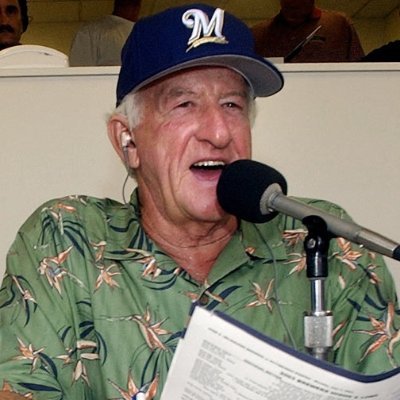
Bob Uecker, 1934-2025

Bob Uecker was living proof that you didn't need to be a great baseball player to be a baseball legend. Sadly, he is living proof no more.

Robert George Uecker was born on January 26, 1934 in Milwaukee. The son of immigrants from the German part of Switzerland, he grew up a fan of the minor-league Milwaukee Brewers. While serving in the U.S. Army, he played on service baseball teams. The Boston Braves had moved to Milwaukee for the 1953 season, and they signed him to a contract.

On April 13, 1962, he became the first Milwaukee native -- indeed, the first Wisconsin native -- to play for the Milwaukee Braves. It was a Friday the 13th, and maybe that was an omen. In the top of the 9th inning, Uecker, wearing Number 8, pinch-hit for pitcher Ron Piché, and grounded out to 2nd base. The Braves lost to the Los Angeles Dodgers, 6-3 at the newly-opened Dodger Stadium in Los Angeles.

Uecker was a catcher, and a decent fielder as one, but not much of a hitter. He would finish his career with a lifetime batting average of exactly .200. He hit 14 home runs, but 1 was off Sandy Koufax of the Dodgers. Just before the 1964 season, the Braves traded him to the St. Louis Cardinals. Now wearing Number 9, he backed up Tim McCarver on the team that won the World Series.
Pictured: A St. Louis Cardinal wearing Number 9
Definitely not Enos Slaughter, Roger Maris,
Joe Torre or Terry Pendleton.

After another year in St. Louis, he was traded to the Philadelphia Phillies. He joked that he got pulled over by a policeman, and was fined $400: "$100 for drunk driving, and $300 for being with the Phillies."

In 1967, they traded him to the Braves, who had moved to Atlanta. He was the only catcher on the roster willing to catch the knuckleball thrown by pitcher Phil Niekro, and so he ended up leading the National League in passed balls. He said, "The best way to catch a knuckleball is to wait until it stops rolling, and pick it up." (Another 1960s catcher, future manager Jeff Torborg, said, "There are two theories about catching the knuckleball. Unfortunately, neither of them work.")

The Braves released him after the season. It was during the World Series, so nobody noticed. He was only 33 years old. It seemed like an ignominious end to an inconsequential baseball career.

*

A funny thing happened on the way to obscurity. Many funny things. Uecker stayed in Atlanta, and, like many other ex-catchers before and since, became a broadcaster, calling the Braves' games. In 1971, a new version of the Milwaukee Brewers, in the American League, hired him as a broadcaster. He became the most popular figure in the team's history, ahead of even such great players as Robin Yount and Paul Molitor. His home run call was, "Get up! Get up! Get outta here! Gone!"

He kept his self-deprecating humor. He said he'd become a household name, but, "The household was in Menomonee Falls, Wisconsin." (A western suburb of Milwaukee, a short drive from County Stadium.) In the 1970s, ABC hired him for national broadcasts on Monday Night Baseball. In the 1980s, he moved over to NBC for the Saturday Game of the Week. The whole country heard how funny he could be.

This led Milwaukee-based Miller Brewing Company to put him in their famous commercials for Lite Beer. In the best-known one, he thinks he's got great complimentary tickets to a game, but the usher says, "You're in the wrong seat, buddy, come on." And when the ad gets back from the tagline ("Lite Beer from Miller: Everything you've always wanted in a beer, and less"), Uecker is shown way up in the upper deck in right field (or, in a variation, behind a support pole), and says to the few people around him, "Great seats, hey, buddy?" Such seats became known as "Uecker seats."

In 1985, he went back to ABC, and starred in the sitcom Mr. Belvedere, as a Pittsburgh-based sportswriter who often clashed with the titular housekeeper. In 1988, because Cleveland Municipal Stadium, the real-life home of the team then known as the Cleveland Indians, wasn't available as a filming location for the film Major League, County Stadium was chosen instead, and Uecker was cast as broadcaster Harry Doyle. He played the role as more like Chicago Cubs announcer Harry Caray, heavy-drinking and sarcastic, than as his usual affable self.

In 2003, the Baseball Hall of Fame gave him its broadcasting honor, the Ford Frick Award. In spite of a .200 lifetime batting average, and never appearing in more than 80 major league games in a season, Bob Uecker was a Hall-of-Famer. (Actually, the Hall goes out of its way to say that the winners of its media awards, both broadcasting and sportswriting, are not members of the Hall of Fame. But everybody treats them as such.)

He was honored both inside and outside County Stadium's successor, now named American Family Field. In 2005, inside, in honor of his 50th season in professional baseball, the Brewers placed a Number 50 with his name on it up in the outfield with their retired numbers, though uniform number 50 remains in circulation for them. In 2009, inside, he was inducted into the Milwaukee Brewers Wall of Honor. In 2012, a statue of him was dedicated outside.
Uecker was married twice. With his 1st wife, Joyce, he had 4 children. Son Steve, from San Joaquin Valley Fever, and daughter Leeann, from Lou Gehrig's disease, predeceased him. He later married Judy, which ended in divorce.

In 2010, Bob missed some broadcasts due to heart surgery and recovery from it. In 2014, like many veteran broadcasters, he cut back to doing home games only. In 2023, he was diagnosed with cancer, but still broadcast through that season and the 2024 season. He died today, January 16, 2025, at his home in Menomonee Falls. He was a few days short of his 91st birthday. He was survived by his 2nd ex-wife, Judy; a daughter, Sue Ann; and a son, Bob Jr.

With his death, there are 10 surviving players from the 1964 World Champion St. Louis Cardinals: Bob Skinner, Julián Javier, Dal Maxvill, Bill White, Carl Warwick, Gordie Richardson, Ray Washburn, Ron Taylor, Charlie James and Bob Humphreys.

Tuesday, September 2, 2014

That's All We Got?

My home computer's difficulties have made updating this blog incredibly difficult. It's been 6 days since I could last do so.

So I start with the first game that I wasn't able to post: Last Wednesday, August 27, the 2nd game of a 3-game series in Detroit against the Tigers.

This was a good game. In fact, it contained the biggest inning the Yankees had in years, the 3rd inning, against David Price, the former Tampa Bay Rays ace that the Tigers thought would solidify their chance at the American League Pennant. Now, they're not even in 1st place in the AL Central. If the current standings hold, they'll be one of the AL Wild Cards.

The Yankees should have such problems, and no more.

Here's that 3rd inning:

Jacoby Ellsbury led off with a single. He stole 2nd.

Derek Jeter doubled him home. 1-0 Yankees.

Martin Prado singled Jeter over to 3rd.

Mark Teixeira doubled off the wall. Jeter scored. 2-0 Yankees.

Carlos Beltran singled. Prado scored. 3-0 Yankees.

Brian McCain singled. Teix scored. 4-0 Yankees.

Chase Headley singled, loading the bases with nobody out.

Brett Gardner grounded to short, too deep for a double play, and beat it out. Beltran scored. 5-0 Yankees. Five runs in, bases still loaded, still nobody out.

Francisco Cervelli singled. McCann scored. 6-0 Yankees. Six runs in, bases still loaded, still nobody out.

Price was relieved. His team wasn't. The Yankees had now batted around, all 9 men reaching base.

Ellsbury flew to left, a sacrifice fly. Finally, the 1st out. Headley scored. 7-0 Yankees.

Jeter flew to center. Gardner scored. 8-0 Yankees.

Prado grounded to 3rd, the Tigers finally stopping the bleeding.

For a fan who's spent the better part of 3 seasons wondering why the Bronx Bombers haven't been doing enough bombing, it was truly something to behold. And to wonder we can't do half that (4-run innings) more often.

The Tigers scored single runs in the 4th, 6th, 8th and 9th innings, but didn't get close. Yankees 8, Tigers 4.

WP: Shane Greene (4-1). No save. LP: Price (12-10).

*

The Yankees and Tigers played the rubber game of the series the next afternoon, and the Yankees went back into RISPfail mode. An Ellsbury single in the 3rd and a McCann single in the 4th drove in runs, but that was it. There were only 3 other hits. Hiroki Kuroda pitched well in vain, and Shawn Kelley blew a 2-2 tie in the bottom of the 9th, thanks to an RBI single by Alex Avila.

To make matters worse, 2 former Yankee pitchers benefited from the Yankees' ineptitude: Joba Chamberlain (in full mountain-man mode with that beard that he wasn't allowed to grow as a Yankee) and Phil Coke (the 2008-09 edition of the lefty reliever who the Yankees should never, ever bring in, although they won the 2009 World Series in spite of him).

Tigers 3, Yankees 2. WP: Coke (2-2). LP: Kelley (2-5). So we dropped 2 of 3 to the contending Tigers.

*

The Yankees then went to Toronto to play those pesky Blue Jays. On Friday night, they trailed 1-0 going into the 7th, and there was a feeling that the single Toronto run was going to hold up.

It didn't. It wasn't quite the 8-run outburst of 2 days earlier, but the Yankees got a nice rally going against Mark Buehrle, who'd pitched pretty well thus far. McCann doubled to deep right. Beltran walked. Brett Gardner hit a drive to deep right for another double, scoring McCann and Beltran. 2-1 Yankees. Ichiro Suzuki beat out an infield single. Buerhle was removed for Aaron Loup. Headley struck out. Then Joe Girardi ordered a double steal, and the Jays' catcher, former Yankee Dioner Navarro, threw it away. Gardner scored. 3-1. Then Ellsbury cranked one to right, his 14th home run of the season. 5-1.

Chris Capuano, pitching one of his best games all season, took that lead into the bottom of the 7th, but ran out of gas. Adam Warren finished the 7th, but couldn't finish the 8th.

Neither could Josh Outman, making his 1st Yankee appearance, a lefthander about to turn 30, and mediocre in the majors thus far, whom the Yankees just got in a waiver deal with the Cleveland Indians. "Outman." Great name for a pitcher! But bad uniform number: 48, the same number as was worn on the Yankees as Coke, "Kerosene Kyle" Farnsworth and Boone "Fucking" Logan!

Robertson had to get a 4-out save. But, get it he did. Yankees 6, Blue Jays 3. WP: Capuano (2-3). SV: Robertson (35). LP: Buehrle (11-9).

*

Saturday, August 30, is the anniversary of the birth of my grandfather, George Golden, born George Goldberg in 1906, grew up in The Bronx, and became a Yankee Fan, and made me one. If he had watched this game, he would have said, "Oh, woe is me, woe is me, and a gevalt!"

In the top of the 4th, after Gardner and Jeter struck out, Beltran was hit with a pitch, and Teix doubled him over to 3rd. But he couldn't score. Then McCann was hit with a pitch to load the bases. It was only 2-0 Toronto at this point, so if Prado could get a hit, who knows? But he popped up to 3rd.

Beltran walked in the 6th. Stephen Drew walked in the 7th. That was it. That was all the baserunners for the Yankees in the game: One hit, 2 walks, 2 hit batsmen.

I'm reminded of the line that Bob Uecker used when playing Harry Doyle, the hard-drinking Cleveland broadcaster in the Major League films. He looked at his scoresheet at the end of the game, and said, on the air, "That's all we got? One goddamned hit?" His partner covered the microphone and said, "You can't say 'goddamned' on the air!" And Doyle said, "That's okay, no one's listening anyway."

In a case like that, you can't even credit the opposing pitcher -- in this case, Drew Hutchinson. He's not that good. The Yankees simply didn't hit.

And so, that 2-0 Jays lead held up. (9-11). SV: Sanchez (1). LP: Pineda (3-3).

*

On Sunday, Brandon McCarthy was fine for 5 innings. Thereafter, he gave up  3 Toronto homers: To Jose "Joey Bats" Bautista (Isn't it about time somebody tested this guy for steroids?), Edwin Encarnacion (one of those guys who always seems to do well against the Yankees), and to former Yankee hero, now known steroid cheat, Melky Cabrera (his 16th of the season, his 4th against his former team).

Blue Jays 4, Yankees 3. WP: J.A. Happ (9-8). SV: Casey Janssen (20). LP: McCarthy (5-4 since joining the Yankees).

*

And so, with less than 4 weeks remaining in the regular season, with 27 games to go, the Yankees are 8 1/2 games (8 in the loss column) behind the Baltimore Orioles for the AL Eastern Division title. We are 4 games (3 in the loss column) behind the Tigers for the 2nd AL Wild Card slot.

And now, in the middle of a slump, the Yankees come home... to face the Boston Red Sox. True, The Scum are well out of the race, but they will do anything to beat the Yankees. Not "anything within the rules," but "anything."

These next 3 games could be very long -- not just officially.

Thursday, May 8, 2014

How to Be a New York Baseball Fan In Milwaukee -- 2014 Edition

The Yankees went to Milwaukee every season from 1970 to 1997, when the Brewers got kicked over from the American League to the National League. Now, they only go there when the quirks of the Interleague schedule work out that way. After finishing this series with the Angels, the Yankees will go there.

I should have had this up days ago. At least now, I'll be caught up with these trip guides.

Remember: Please don't make your travel arrangements for the series starting tomorrow, as it will be too expensive by plane, and too late by train and bus.

As for the Mets, who played the Braves in Milwaukee from 1962 to 1965, and began playing the Brewers regularly in 1998, the quirks of the Interleague schedule mean that they'll only make one trip to Milwaukee this season, and it won't be until July 24.

Disclaimer: Although I have been to Milwaukee, and saw a game at the old County Stadium, I have not been back since Miller Park opened. However, much of this information is taken from the Brewers' website, and should be accurate.

Before You Go. Milwaukee is on Lake Michigan, which makes it chilly in the winter.  But this is early May, so the weather shouldn't be much of an issue.

The Milwaukee Journal Sentinel website is predicting high 60s for the afternoons and mid-50s for the evenings. They are predicting thunderstorms for Friday and Sunday, but Miller Park has a retractable roof, so it won't rain on you during the games.

Milwaukee is in the Central Time Zone, an hour behind New York. Adjust your various timepieces accordingly.

Tickets. In spite of 2 Playoff berths in a recent 4-season stretch (2008 & '11), the Brewers only drew an average of 31,248 last season, due to their tailoff. Still, that was better than they usually do, it's a lot better than the White Sox, and only a shade behind the Cubs. So far this season, in spite of jumping out to the best record in baseball, they've averaged less, 30,869. Nevertheless, as the Yankee-Brewer rivalry has long since gone by the wayside, you should be able to buy any ticket you can afford.

But that affording may be difficult, as the Brewers charge much higher prices for the Yankees (and the Cubs, White Sox and Twins) than they do for other teams. On the Field Level (lower), Infield Boxes are $100 and Outfield Boxes are $80. On the Loge (middle), Infield Boxes are $75 and Outfield Boxes are $60. On the Terrace (upper), Boxes are $35 and Reserved are $30. Bleachers are $42.

Getting There.  Downtown Milwaukee is 879 land miles from Times Square. And Miller Park is 893 miles from Citi Field, 887 miles from Yankee Stadium II. Knowing this, your first reaction is going to be to fly out there.

At first, unlike some other Midwestern cities, this seems like a good idea if you can afford it. Even if you order today, just 1 day in advance, American Airlines can fly you there for $854 round-trip. However, there is a catch: There are no non-stops between any of the New York area airports and General Mitchell International Airport in Milwaukee: You will change planes, most likely in Chicago, and you'll spend nearly as much time on the ground at O'Hare as you do in the air. The GRE bus will get you downtown in a little over half an hour. (Billy Mitchell was a Milwaukee-area native and an early advocate for air power.)

The Milwaukee Intermodal Station, which serves both Greyhound and Amtrak, is at 433 W. St. Paul Avenue, at 5th Street. There are 3 daily Greyhound runs that will get you from New York to Milwaukee. Two require 2 changeovers. The one that only requires 1 leaves Port Authority at 10:15 PM, and includes rest stops at Milesburg, Pennsylvania; Cleveland, and Elkhart, Indiana, before arriving in Chicago at 2:30 the next afternoon (Central Time).  There's an hour's wait before leaving Chicago at 3:30 and arriving in Milwaukee at 5:35.  That's 20 hours and 20 minutes, counting the time change. So if you leave Port Authority at 10:15 on Thursday night, you'll arrive in Milwaukee with just enough time to check into a downtown hotel and get out to the ballpark in time for the Friday night game. (Meaning, if you hurry after reading this, you could still do it.) You can return home at 8:05 Sunday night, although you'll have to make transfers at Chicago (10:45 PM), Cleveland (8:35 AM) and Buffalo (1:00 PM) to get back to Port Authority by 9:50 PM.  Round-trip fare is $312, but you can get it for $237 if you get a Web-Only Fare).

Amtrak’s Lake Shore Limited (formerly known as the Twentieth Century Limited when the old New York Central Railroad ran it from Grand Central Terminal to Chicago's LaSalle Street Station) leaves New York's Penn Station at 3:40 every afternoon, and arrives at Union Station at 225 South Canal Street in Chicago at 9:45 (Central Time) every morning. From there, you have to wait until 1:05 PM to get on "Hiawatha Service," which will bring you to Milwaukee at 2:34. That's 23 hours, 49 minutes. If you start this trip on Thursday afternoon in order to see the entire 3-game series (which you could have done if I had de-glitched sooner and gotten this up in time), you can leave Milwaukee by Amtrak on 5:45 on Sunday afternoon, be in Chicago at 7:14, and leave Chicago on the Lake Shore Limited at 9:30 and arrive back at Penn Station at 6:35 PM on Monday. Round-trip fare is $302.

If you decide to drive, it’s far enough that it will help to get someone to go with you and split the duties, and to trade off driving and sleeping.  You'll need to get into New Jersey, and take Interstate 80 West. You'll be on I-80 for the vast majority of the trip, through New Jersey, Pennsylvania and Ohio. In Ohio, in the western suburbs of Cleveland, I-80 will merge with Interstate 90. From this point onward, you won’t need to think about I-80 until you head home; I-90 is the key, until it merges with Interstate 94, which will merge with Interstate 43, but you have to worry only about I-94.

I-94 will split off from I-43 at downtown Milwaukee, and then "turn left," becoming the East-West Freeway.    Take Exit 308A for Mitchell Blvd., then turn right on Frederick Miller Way (named for the founder of Miller Beer; a left turn will get you onto Selig Drive, named for the Commissioner and former Brewer owner). The ballpark will be on your left. The official address for "The Keg" is 1 Brewers Way.

If you do it right, you should spend about an hour and a half in New Jersey, 5 hours and 15 minutes in Pennsylvania, 4 hours in Ohio, 2 hours and 30 minutes in Indiana, an hour and a half in Illinois, and just under an hour in Wisconsin. That's about 15 hours and 45 minutes. Counting rest stops, and accounting for traffic in both New York and Chicago, it should be no more than 20 hours, which would save you time on both Greyhound and Amtrak, if not on flying.

Once In the City. As Alice Cooper taught us in the film version of Wayne's World, Milwaukee gets its name from a Native American word meaning "the good land." But this may not be true: Another version says the name comes a word meaning "Gathering place by the water." Either way, it's true: The land of Wisconsin is good for farming, and Milwaukee is based on a confluence of 3 rivers that flow into Lake Michigan: The Milwaukee, the Menomonee, and the Kinnickinnic; so there's plenty of water.  The Milwaukee separates the city's streets into North and South, and the other 2 rivers separate them into East and West.

Founded in 1846, the city has about 600,000 people, making the 3rd-largest in the Great Lakes region behind Chicago and Detroit.  But the metropolitan area has only about 2 million, making it dead last among the 30 MLB teams, about 200,000 less than Number 29, Cincinnati; about 400,000 less than Number 28, Kansas City. But the construction of modern Miller Park means that the Brewers, unlike the Braves to Atlanta in 1965, won't be moving out of Milwaukee in the foreseeable future.

Wisconsin's sales tax is 5 percent, but inside Milwaukee County, it's 5.6 percent. Which is still lower than those of the States of New York, New Jersey and Connecticut even before local taxes are added on.

Going In. Getting from downtown to Miller Park by public transportation is a little tricky. The Number 10 bus goes down Wisconsin Avenue, but its closest point is a little over a mile from the stadium. You'd need to get off at the intersection of Wisconsin Avenue and 44th Street, under I-94, to Selig Drive. You'd make a right on Selig, and on your left will be Miller Park, and on your right is a baseball field on the site of its predecessor, Milwaukee County Stadium.  Make a left on Brewers Way and proceed to the home plate gate. The Milwaukee County Transit System has a fare of $2.25 for its buses.

Milwaukee has its bad neighborhoods, but like County Stadium, Miller Park is an island in a sea of parking, so regardless of whether you took a bus or drove, you should be safe. The stadium points southeast, as did County Stadium before it, but that doesn't matter a whole lot, since you're 4 miles west of downtown and Milwaukee doesn't exactly provide a great view of skyscrapers. Speaking of County Stadium, it was on the opposite side of Brewers Way from Miller Park, and a new baseball field was put on the site. Parking at Miller Park is $25.

Outside the ballpark, there is a sculpture titled "Teamwork," in memory of the 3 construction workers killed in the collapse of a crane in 1999.  The collapse not only killed those men, but damaged the unfinished stadium so badly that its opening date had to be pushed back from April 2000 to April 2001.

As I said, Miller Park has a retractable roof. At this time of year, the roof is likely to be open, unless it gets hot -- and, as I said when citing the forecast, it probably won't get hot (but rain may be a factor). The park is not symmetrical: Left field is 344 feet from home plate, left-center is 371, center is 400, right-center is 374, and right is 345.  t's better for hitters with the roof closed, better for pitchers with the roof open.

Russell Branyan hit the longest home run at Miller Park so far, a 480-foot shot in 2004.  I can't find a definitive answer as to who hit the longest homer at County Stadium, although the only player who appears to have hit one all the way out of it was Cecil Fielder, 502 feet in 1991. Oddly, his son Prince Fielder would later play for the Brewers, but didn't hit the longest at Miller Park before going to the American League and playing for his father's team, the Detroit Tigers. (For all the home runs hit by sluggers such as Hank Aaron, Eddie Mathews, Joe Adcock, Gorman Thomas and Rob Deer while County Stadium was their home park, I can find no record of any of them hitting one there that was longer than Cecil's 502-footer.)

County Stadium hosted the only game, to date, played by the U.S. national soccer team in Wisconsin. It was on July 28, 1990, against East Germany, in one of that foul country's last games before being reunited with their Federal Republic (West German) brothers. We lost.

Food. In Big Ten Country, where tailgate parties are practically a sacrament, you would expect the Milwaukee ballpark to have lots of good options. With Wisconsin's German heritage in mind, there are Beer Carts and Brat Boys stands all over the place, and a Friday's Beer Garden at the Left Field Gate. A "bratwurst with red sauce" has been one of Major League Baseball's most-honored culinary delights since the Braves were in town. The Brewers also serve various other sausages, many of them of ethnic varieties, as reflected in the Sausage Race.

Like Greg Luzinski in Philadelphia, Boog Powell in Baltimore, and a few others, Milwaukee has a barbecue stand operated by a club legend, in this case "Stormin' Gorman" Thomas. Gorman's Corner is behind Section 103 in right field. There's a Fry Bar at Section 106, baked potato stands at 125 and 214, and "Hot Cheese" at 208. (Hot cheese? Yes, they serve grilled cheese sandwiches and cheese fries.) Big B's Diner has locations at 110 and 126, and Bernie's Clubhouse, named for Bernie Brewer, at 422. Friday's Front Row Sports Grille -- named after a line from a Miller Lite commercial that Bob Uecker did back in the day -- is in left field.

Fortunately, the ballpark has several ice cream stands. Unfortunately, the ice cream is Blue Bunny, which I suggest staying away from. Blue Bunny is so bad, it makes Turkey Hill taste like Breyer's. But there are also Dippin' Dots stands.

Team History Displays. Outside the front entrance are 5 sculptures. In addition to "Teamwork," there are honors for 4 significant figures from Milwaukee's baseball history: Hank Aaron of the Braves (who also played his last 2 years with the Brewers), and Brewers founding owner Allan H. "Bud" Selig (now the Commissioner), shortstop Robin Yount, and Bob Uecker, who was the first Milwaukee (or even Wisconsin) native to play for the Braves, and now longtime broadcaster for the Brewers.

It was because Major League was filmed in Milwaukee, rather than Cleveland, that Ueck was hired to play the Indians' acerbic, hard-drinking broadcaster Harry Doyle -- much closer to Harry Caray's real-life personality than to Ueck's.

The Brewers' retired numbers are high above center field: 4, Paul Molitor, 3rd baseman and designated hitter 1978-92; 19, Yount, shortstop-center field 1973-93; 34, Rollie Fingers, pitcher 1981-85; 44, Aaron, DH 1975-76; and the universally-retired 42 of Jackie Robinson.

The Brewers have also not reissued, though not also retired: 17, Wisconsin native Jim Gantner, 2nd baseman 1976-92; 28, Prince Fielder 1st base 2005-11; and 50, which hangs with the retired numbers in honor of Uecker's first 50 years in pro baseball. If you saw Mr. 3000, sorry, but Stan Ross (1st base, 1978-95 & 2004 -- taking the place of Cecil Cooper for a few years) is fictional, and while his Number 21 is not currently being worn, it has not been retired.

It appears that a Brewer must be elected to the Baseball Hall of Fame to have his number retired. (Having been given the Ford Frick Award, the Hall's award for broadcasters, Uecker does thus qualify.) The only other player to have played for the Brewers and be elected to the Hall is Don Sutton, pitcher 1982-84. Although his Number 20 has been retired by the Los Angeles Dodgers, it has not been retired by the Brewers -- and anyway, Brewer fans remember it better as the number of Gorman Thomas (center field 1973-83).

The Brewers do have a team Hall of Fame, with a whopping 59 members:

* Straddling the eras: Selig and Uecker.

* From the 1970s, but not making it into the team's 1st era of contention: Aaron; pitchers Ken Sanders and Jim Colborn; outfielders Dave May and Johnny Briggs; catcher Darrell Porter; and 1st baseman George Scott.

* From the 1978 team that was the 1st Brewer squad to make it into a Pennant race, but not making it to the 1982 Pennant: Pitchers Bill Castro and Bill Travers, outfielder Sixto Lezcano and 3rd baseman Sal Bando.

* From the 1982 Pennant winners: Yount, Molitor, Fingers, Gantner, Sutton, Thomas; manager Harvey Kuenn (a Milwaukee native who had once played for the Braves); pitchers Jim Slaton, Jerry Augustine, Moose Haas, Mike Caldwell, Bob McClure and Pete Vukovich; catcher Ted Simmons, 1st baseman Cecil Cooper, 3rd baseman Don Money, left fielder Ben Oglivie and right fielder Charlie Moore.

* From the close calls of 1987 and 1988, but joining after the 1982 Pennant: Pitchers Teddy Higuera, Bill Wegman, Chris Bosio, Dan Plesac and Chuck Crim; catcher Bill Schroeder (now a Brewers broadcaster), and outfielders Rob Deer, B.J. Surhoff and Darryl Hamilton.

* From the 1990s: Pitchers Jaime Navarro, Cal Eldred, Mike Fetters and Bob Wickman; catcher Dave Nilsson, 1st baseman John Jaha, 2nd basemen Fernando Viña and Mark Loretta, shortstops Pat Listach and José Valentín, 3rd basemen Kevin Seitzer and Jeff Cirillo; and outfielders Greg Vaughn and Jeromy Burnitz.

* From the 2000s, but not making it to 2008: 1st baseman Richie Sexson and outfielder Geoff Jenkins.

* From the 2008 Wild Card team: Pitcher Ben Sheets, and infielders Bill Hall and Craig Counsell. Counsell is the only player thus far honored from the Brewers' 2011 NL Central Division Champions.

The Brewers also have a Milwaukee Baseball Walk of Fame, honoring greats from both teams. In addition to Selig, Kuenn, Uecker, Aaron, Yount, Molitor, Fingers, Money, Thomas, Gantner, and Higuera, it honors former general manager Harry Dalton. From the Braves, it honors Aaron, Kuenn, pitchers Warren Spahn and Lew Burdette, 3rd baseman Eddie Mathews, shortstop Johnny Logan and general manager John Quinn.

In addition to Aaron, Spahn, Mathews, Yount, Molitor, Thomas, Gantner, Kuenn, Cooper, Selig and Uecker, the Wisconsin Athletic Hall of Fame has honored minor-league Brewers stars Charlie Grimm and Joe Hauser, and Wisconsin-born Hall-of-Famers Kid Nichols and Addie Joss.

Aaron and his fellow Milwaukee Brave Warren Spahn were named to the Major League Baseball All-Century Team in 1999. That same year, The Sporting News named Aaron, Spahn, Braves star Eddie Mathews, Fingers and Molitor to their 100 Greatest Baseball Players. In the TV special that NBC did for the 100 Greatest Baseball Players, John Rawlings, then TSN's editor, admitted that, despite being a Hall-of-Famer, a member of the 3,000 Hit Club and an MVP at 2 different positions, Yount was one of the last players cut.

The Brewers hang their notations for their 1982 American League Pennant, their 2008 National League Wild Card berth, and their 2011 NL Central Division title over the left-field fence, over the Front Row Sports Grille. There is also a Braves Monument at Miller Park. But there is no mention of the Braves' 1957 World Championship or 1958 NL Pennant, or the American Association Pennants won by the Triple-A version of the Milwaukee Brewers in 1913, 1914, 1936, 1943, 1944, 1945, 1951 and 1952.

Stuff. The Brewers Team Stores are located at the Home Plate and Left Field Gates.  The usual items that can be found at a souvenir store can be found there.

The Brewers have been around for over 40 years now, but because Milwaukee, as a city, gets lost in the shadows not only of Chicago, 90 miles to the south, but the smaller yet higher-profile city of Green Bay, 115 miles to the north, the Brewers tend to get forgotten. They trail not only the Packers, but also the football team at the University of Wisconsin in popularity among Badger State teams. (They may even trail that school's very successful hockey program, even though Milwaukee doesn't have an NHL team.) Their recent success has moved them ahead of the NBA's Bucks, though: While the Bucks are usually good, they haven't reached the NBA Finals in almost 40 years, and their 1971 title seems so far back that it might as well have been won by a team that moved away and has since been replaced, as with Minneapolis and the Lakers.

As a result of this, there aren't many good books about the Brew Crew. Todd Mishler wrote Baseball in Brewtown: America's Pastime in Milwaukee. It covers not just the Brewers, but their preceding Triple-A namesake, and the Braves, and the teams that called the city home in the 19th Century. But it was published in 2005, and doesn't cover the recent renaissance that saw the Brewers win the NL's Wild Card in 2008 and the NL Central in 2011.

Milwaukee's greatest baseball moment -- their only World Championship in the sport to date -- came when the Yankees, finding the much smaller city's over-the-top reaction to the Brewers to be comical, called Milwaukee "Bushville" (as in "bush league"), and came to regret it. This story is told in John Klima's book Bushville Wins! The Wild Saga of the 1957 Milwaukee Braves and the Screwballs, Sluggers, and Beer Swiggers Who Canned the New York Yankees and Changed Baseball. The title is longer than the Series was -- and both the '57 and the '58 Series went the full 7.

The 1957 World Series' official highlight film seems not to be in an official package sold at either Brewers or Braves games. The Brewers do have a DVD honoring their lone Pennant: Harvey's Wallbangers: The 1982 Milwaukee Brewers. Uecker narrates this story about Kuenn and his leadership of a club that had been terrible until 1977, then became a "close but no cigar" team under George Bamberger, before Bambi was fired and Kuenn was brought in, turning "Bambi's Bombers" into "Harvey's Wallbangers."

There is also The Essential Games of the Milwaukee Brewers. While there are a few bonus features on this DVD, there are only 4 games, as opposed to the standard 6: 1982 AL Championship Series Game 5, in which the Brew Crew won what is still their only Pennant; 1982 World Series Game 4, a come-from-behind victory in a Series they went on to lose in 7; September 28, 2008, a date which lives in Met infamy but in Brewer legend as they clinched the Wild Card berth by beating their arch-rivals, the Cubs; and 2011 NL Division Series Game 5, in which they beat the Arizona Diamondbacks to win a postseason series for the first time in 29 years (and only the 2nd time in their 43 years of play).

During the Game. Brewer fans, as you might expect in America's foremost brewing city, like to drink. If this were a Packer game and you were wearing Chicago Bears or Minnesota Vikings gear, you might be in trouble. If this were a UW game and you were wearing University of Minnesota gear, you might be in trouble. If this were a Bucks game and you were wearing Chicago Bulls gear, you'd probably be safe. If this were a Brewers-Cubs game, and you were wearing Cubs gear, you might be in trouble. But it's a Brewers-Mets game, so if don't start anything, they won't continue anything. Wisconsinians are good people.

Since 1973, the Brewers have had a mascot, Bernie Brewer. At County Stadium, there was a giant keg and beer stein behind center field, with a chalet next to it. Upon each Brewer home run, Bernie, a man in a costume whose big foam head had a big blond mustache, would slide down a chute from the chalet into the mug, releasing balloons. The setup was removed in 1984, but restored in 1993. A new version was installed in left field when Miller Park opened in 2001.

The Sausage Race began in in the 1980s, as a cartoon show on the scoreboard. Live races by men (sometimes women) in 7-foot-3 sausage suits began in 1994: They would come out of the left field gate and run toward home plate. The original sausages are #1, Brett Wurst (a bratwurst in lederhosen, representing the city's German heritage); #2, Stosh (a guy in a rugby shirt, cap and sunglasses, representing Polish sausage), and #3, Guido (wearing a chef's outfit, representing Italian sausage).  #4, Frankie Furter (a guy in a baseball uniform, representing standard hot dogs) was added in 1995; and #5, Cinco (a sombrero-wearing Chorizo) in 2006.

The original cartoon version was inspired by the "Dot Race" that used to appear on the scoreboard at Texas Rangers games, which also inspired the Airplane Race on the DiamondVision board at Mets games and The Great City Subway Race at Yankee games. Since then, the Rangers have returned the favor, having made the Dot Race live-action, but they are designed to resemble Texas pioneers Davy Crockett, Jim Bowie and Sam Houston.

In addition, the Pittsburgh Pirates have the Great Pierogi Race, the Washington Nationals have the Racing Presidents, the Tampa Bay Rays have a race involving various Pepsi products, the Kansas City Royals race Heinz condiments, the Cleveland Indians race hot-dog toppings, the Houston Astros race Taco Bell Hot Sauce packets, the Atlanta Braves race tools sponsored by Home Depot, the Minnesota Twins race animals with a Minnesota connection; and the Arizona Diamondbacks select kids to race in hot dog suits with varying condiments.

In the 7th inning stretch, after playing "Take Me Out to the Ballgame," the Brewers play "The Beer Barrel Polka": "Roll out the barrel, we'll have a barrel of fun... "

After the Game. As Miller Park is separated from the city by parking, safety should not be an issue. Although Milwaukeeans like to drink, this is not a Packers or Badgers game, so you should be fine.

Unfortunately, I can find no reference to any Milwaukee bar or restaurant that caters to New York expatriates.

Sidelights. Milwaukee's sports history is long, but not especially successful, especially when you consider the 119-mile distance between the city and the State's most successful sports team, the Green Bay Packers. Milwaukee County Stadium was located behind the home plate entrance to Miller Park (which was built across center field from its predecessor.

The Braves played there from 1953 to 1965, the Brewers from 1970 to 2000, and the Packers played several home games there from 1953 to 1994, first 2 out of their 6 (when the NFL had a 12-game schedule), then 2 of their 7 (14), and finally 3 of their 8 (16), plus a preseason game (an another preseason game at the University of Wisconsin's Camp Randall Stadium). The Packers played a Playoff game against the Los Angeles Rams at County Stadium in 1967, before winning the NFL Championship against the Dallas Cowboys at Lambeau Field on New Year's Eve, the famed Ice Bowl.

* Borchert Field. The minor-league Milwaukee Brewers played here from 1888 to 1952, at a wooden park originally named Athletic Park and renamed for former owner Otto Borchert. These Brewers were the first pro baseball team owned by Bill Veeck, from 1941 to 1945, before he moved on to the major leagues. It was at "Borchert's Orchard" that he first tried his promotional stunts, and it made Milwaukee one of the most successful minor-league markets, not just on the field but at the box office. The Brewers won 8 Pennants there, including 3 straight under Veeck, and in their last 2 seasons of existence before the Braves came in.

The Milwaukee Bears of the Negro Leagues also played here, as did the Milwaukee Badgers of the NFL from 1922 to 1926, and the Packers played the occasional Milwaukee game here from 1933 to 1952. Actually, the place was better for football than for baseball: Like the Polo Grounds, it had a distant center field but foul poles that were much too close, 267 feet. An overhanging roof that covered the infield stands didn't help matters. As Veeck himself put it, "Borchert Field, an architectural monstrosity, was so constructed that the fans on the first-base side of the grandstand couldn't see the right fielder, which seemed perfectly fair in that the fans on the third-base side couldn't see the left fielder. 'Listen,' I told them. 'This way you'll have to come back twice to see the whole team.'" 

Borchert stood between North 7th & 8th Streets, and Burleigh & Chambers Streets.  The entire land area is now occupied by Interstate 43, the North-South Freeway, and entrance-and-exit ramps. It's in a bit of a rough neighborhood, so unless you're just that into baseball history, if you have to cross one item off your list, this is the one. Number 50 bus to Holton & Burleigh, then Number 60 bus, or walk 12 blocks west.

* Milwaukee Mile. This racetrack, on the grounds of the Wisconsin State Fair in suburban West Allis, is the oldest continuously-operating auto racetrack in the world. "But Mike," you say, "auto racing is not a sport.  Why are you talking about it?" Because the track's infield was used as the Packers' main Milwaukee-area home from 1934 to 1951. Seating 45,000, the stadium was nicknamed the Dairy Bowl for Packer games, including the 1939 NFL Championship Game, in which the Packers beat the Giants, 27-0. The Milwaukee Chiefs of the 1940-41 version of the American Football League also played here.

I don't know if this is the earliest remaining stadium to have hosted an NFL game (1933), but it's almost certainly the oldest site (racing began there in to 1903). 7722 W. Greenfield Avenue at 77th Street. Number 60 bus to 60th & Vliet Streets, then transfer to Number 76 bus.

* MECCA and Bradley Center. The old and new Milwaukee arenas, across State Street from each other at 4th Street, are loaded with history. The old one, built in 1951, now known as the U.S. Cellular Arena, was originally known as the Milwaukee Arena, then from 1974 to 1995 as the Milwaukee Exposition Convention Center and Arena (or MECCA). Two NBA teams called it home: The Milwaukee Hawks from 1951 to 1955, before moving to St. Louis (and later to Atlanta); and the Milwaukee Bucks from their debut in 1968 until 1988.

The Bucks played their 1971 NBA Championship season, their only title, there, although they clinched on the road in Baltimore. The Milwaukee Admirals, a minor-league hockey team, played here from 1973 to 1988, and won the 1976 United States Hockey League title. Elvis Presley sang here on June 28, 1974 and April 27, 1977. The Beatles played here on September 4, 1964. The inductees to the previously mentioned Wisconsin Athletic Hall of Fame are honored here in a Wisconsin Athletic Walk of Fame, which also includes Green Bay Packers, Milwaukee Bucks, Wisconsin Badgers, and State natives who made it big elsewhere.

The new arena, now the BMO Harris Bradley Center, has been the Bucks' home since 1988. While they've usually been good, they haven't reached the NBA Finals since 1974 (at the MECCA) or even the Conference Finals since 2001 (at the Bradley Center). The Admirals also call the Bradley Center home, and won the 2004 Calder Cup here. Marquette University, which reach the 1974 NCAA National Championship and won it in 1977, also plays at the Bradley Center, after having played at the MECCA and before that at the site I'm about to mention. The University of Wisconsin, in Madison, is the only other Wisconsin school to reach the Final Four, and that was all the way back in 1941, although they've reached hockey's version, the Frozen Four, many times.

The nearest NHL team is the Chicago Blackhawks, 93 miles away. If Milwaukee had an NHL team, it would rank 23rd in population among NHL markets. The nearest MLS team is the Chicago Fire, 104 miles away.

Wisconsin, let alone Milwaukee, has never produced a President -- although, in 2012, Congressman Paul Ryan was the Republican nominee for Vice President, and he's pretty young by political standards, so he could run for President in the future. But the Milwaukee Auditorium, built in 1909 at 500 W. Kilbourn Avenue downtown (across from the MECCA), has been one of the city's most historic sites. It's where Theodore Roosevelt, running to return to the Presidency on the Progressive Party ticket in 1912, gave a speech on October 14. For an hour and a half. After having been shot. The shooting happened a block away, at the Hotel Gilpatrick, now the Hyatt, at 333 W. Kilbourn. He recovered, and finished 2nd to Democratic nominee Woodrow Wilson, but ahead of incumbent Republican William Howard Taft.

Other Presidents, and men who tried to be, spoke at the 4,000-seat building now named the Milwaukee Theatre: Taft in 1911, Wilson in 1916, Wendell Willkie in 1944, John F. Kennedy in 1960, Michael Dukakis in 1988, and the George Bushes, the father in 1991 and the son in 2000. Martin Luther King gave a noted speech there in 1964. Elvis sang there on June 14, and 15, 1972, even though the MECCA was already an established arena.

* Happy Days. Airing from 1974 to 1984 but taking place in Milwaukee from 1955 to 1965, this ABC sitcom did as much to make Milwaukee famous as beer and the Braves did. A statue of Henry Winkler as Arthur "Fonzie" Fonzarelli -- a.k.a. The Bronze Fonz -- is at 117 E. Wells Street, on the Riverwalk, across from the 1895-built, 353-foot-high City Hall, which will be recognized by fans of Happy Days' spinoff series, Laverne & Shirley, although the sign saying, "WELCOME MILWAUKEE VISITORS" is long-gone.

The Cunningham house was said to be at 565 North Clinton Drive, an address which does not actually exist in the Milwaukee area. The exterior was shot in Los Angeles, near the Paramount Pictures studios. Both the original building used as the exterior for Arnold's, in the Milwaukee suburbs, and its replacement, in Los Angeles, have been demolished. The exterior shot for Richie and Joanie's alma mater, Jefferson High School, was filmed at Milwaukee's Washington High at 2525 N. Sherman Blvd.

Milwaukee doesn't have museums on the level of New York, Philadelphia or Chicago, but of note is the Milwaukee Public Museum, at 800 W. Wells Street, at 8th Street downtown.

The tallest building in Wisconsin is the U.S. Bank Center, formerly the First Wisconsin Center, at E. Wisconsin Avenue & N. Van Buren Street.  Openin gin 1973, it is 601 feet high.  It's not much to look at, unlike the building it replaced as such, City Hall.

If you want to go on a brewery tour, be my guest -- or, rather, put your money down and be their guest.  But I have no interest in it, so you'll have to look up your own info.

*

Milwaukee may not be one of America's biggest cities, but it's one of the most fun.  And sports, including baseball, is a big part of it.  A Brewers game is a good time, whether the team is good or not.

Monday, February 10, 2014

Longest-Serving Active MLB Broadcasters

With the death of Ralph Kiner last week, and of Jerry Coleman last month, I was wondering just how many "old-time broadcasters" are left.

Certainly, Vin Scully is still with the Dodgers, the last link to their Brooklyn days (that most of us know of, anyway).

The following list shows only how long the broadcaster in question has been with his current team. I list the longest-serving current one with each of the 30 current MLB teams, plus anyone else who has been with them for at least 20 years. (For Arizona and Tampa Bay, of course, that last stat won't be possible until Opening Day 2017; for Washington, not until Opening Day 2024.)

Studio analysts don't count, only guys actually in the booth calling the game.

57th, Vin Scully, Los Angeles Dodgers, 1958 (That's the team's entire L.A. history. He arrived with the Dodgers in Brooklyn in 1950, so if he makes it to Opening Day this year, and he seems to be in good health at age 86, it will be 65 seasonss. Even Connie Mack and Phil Rizzuto weren't on a single team's payroll for that long. A recipient of the Ford Frick Award, the broadcasters' equivalent of being elected to the Baseball Hall of Fame.)

57th, Jamie Jarrin, Los Angeles Dodgers, 1958 After moving to the U.S. from Ecuador in 1955, he had never seen a baseball game. But he has broadcast every game the franchise has played as a Los Angeles team, all in Spanish, and has received the Frick Award from the Hall of Fame. He has been joined by Dodger legend Fernando Valenzuela.)

46th, Denny Matthews, Kansas City Royals, 1969 (That's the franchise's entire history, although he now has a reduced workload. Frick Award.)

44th, Bob Uecker, Milwaukee Brewers, 1971 (One season short of the franchise's entire history. Despite all the jokes, including his own, about his ineptitude as a player, he was the first Wisconsin native to play for the Milwaukee Braves. Frick Award.)

43rd, Mike Shannon, St. Louis Cardinals, 1972 (Also played for them. John Rooney, although a relative newcomer to St. Louis, has been broadcasting for nearly 30 years.)

41st, Marty Brennaman, Cincinnati Reds, 1974 (Good timing, as they won the World Series in 1975 and '76. Frick Award. His son Thom is also a broadcaster, and has worked with the Reds since 2007.)

36th, Eric Nadel, Texas Rangers, 1979 (He received this year's Frick Award.)

35th, Tom Grieve, Texas Rangers, 1980 (also played for them)

35th, Ted Leitner, San Diego Padres, 1980 (Taking over for Jerry Coleman in Coleman's ill-advised year as manager, stayed on with him. Dick Enberg's long broadcasting career brought him to the Padres' booth in 2010, although his best-known baseball work was for the then-California Angels in the 1960s and '70s.)

34th, Jerry Howarth, Toronto Blue Jays, 1981 (Buck Martinez, who also played for and managed them, broadcast for them from 1987 to 1999, and returned to their booth in 2010, so this will be his 18th season in their booth.)

32nd, Ken Harrelson, Chicago White Sox, 1982 (missing one season as team GM; played for several teams, but not the White Sox)

32nd, Steve Blass, Pittsburgh Pirates, 1983 (Also pitched for them. Lanny Frattare retired in 2008, after 33 seasons.)

32nd, Joe Castiglione, Boston Red Sox, 1983

32nd, Dick Bremer, Minnesota Twins, 1983

32nd, Rick Rizzs, Seattle Mariners, 1983

30th, Milo Hamilton, Houston Astros, 1985 (Though with a reduced workload, this will be his 54th year in an MLB booth, which included calling Henry Aaron's 715th home run for the Braves in 1974. Frick Award.)

30th, Duane Kuiper, San Francisco Giants, 1985 (Also played for them. Jon Miller has been broadcasting MLB games since 1974, entering his 41st season, but continuously with the Giants only since 1997, his 18th. He's won the Frick Award, Kuiper hasn't.)

28th, Bill Brown, Houston Astros, 1987

26th, John Sterling, New York Yankees, 1989 (Previously did games for the Braves; also in New York, for the Nets, Islanders, WHA's New York Raiders & WFL's New York Stars, and hosted a sports-talk show on WMCA as far back as 1971. His career is high, and it is far. Though some people wish he was gone.)

26th, Gary Cohen, New York Mets, 1989 (A Queens native and a Met fan from Day One.)

25th, Tom Hamilton and Rick Manning, Cleveland Indians, 1990 (Manning played for them.)

24th, Ed Farmer, Chicago White Sox, 1991 (Also played for them.)

23rd, Michael Kay, New York Yankees, 1992 (Previously worked with Sterling on Nets broadcasts.)

22nd, Mike Krukow, San Francisco Giants, 1993 (Also played for them.)

22nd, Fred Manfra, Baltimore Orioles, 1993 (Joe Angel started with them in 1988, left in 1993, and returned in 2004.)

22nd, Jim Price, Detroit Tigers, 1993

22nd, Felo Ramirez, Miami Marlins, 1993 (Now 90 years old, the Cuban émigré he was doing Spanish broadcasts on radio well before the team then named the Florida Marlins arrived. In addition, Dave Van Horne has broadcast for the Marlins since 2001, and previously did so for the Montreal Expos, 1969 to 2000, their entire history to that point, so that's 46 seasons in total. Both Ramirez and Van Horne have received the Frick Award.)

21st, Greg Brown, Pittsburgh Pirates, 1994

19th, Ken Korach, Oakland Athletics, 1996

19th, Pat Hughes, Chicago Cubs, 1996 (The deaths of Harry Caray and Ron Santo, and the move of Steve Stone across town to the White Sox, have seriously dented the Cub announcers' institutional memory.)

17th, Larry Andersen, Philadelphia Phillies, 1998 (Took over as the Phils' player-turned-broadcaster after the death of Hall-of-Famer Richie Ashburn. With the deaths of Ashburn, Harry Kalas and Andy Musser, and the recent firing of Chris Wheeler and Gary Matthews, the Phils' broadcasting seniority has gone way down in recent years. Incredibly, Bill Campbell, who broadcast for them from 1963 to 1970, is not only still alive, but still doing a radio show.)

17th, Dewayne Staats and Todd Kalas, Tampa Bay Rays, 1998 (The franchise's entire history; Staats, owner of the best name in the history of baseball broadcasting, previously did Yankee games 1990-94; Kalas is the son of legendary Phillies voice Harry.)

17th, Greg Schulte, Arizona Diamondbacks, 1998 (the franchise's entire history)

13th, Terry Smith, Los Angeles Angels of Anaheim, 2002

13th, Jack Corrigan and Drew Goodman, Colorado Rockies, 2002

10th, Chip Caray, Atlanta Braves, 2005 (The Braves' longest-serving continuous announcer, son of former Braves announcer Skip and grandson of St. Louis/Chicago legend Harry, has only been there since 2005 because of a major shakeup in 2007. Chip previously broadcast for the Cubs, as did his grandfather before him. Hall of Fame pitcher Don Sutton, who hasn't broadcast for any of the teams for whom he played, broadcast for the Braves from 1989 to 2006, went to the Nationals for 2 years, and returned, so this will be his 24th season with them. Although a native of Alabama, he was already in the minor leagues when the Braves moved to Atlanta, so he wasn't able to grow up  a fan of theirs.)

10th, Charlie Slowes, Washington Nationals, 2005 (Previously with the Rays for their entire history to that point, 1998-2004.)

So that's 10 Frick Award winners currently broadcasting: Scully, Jarrin, Matthews, Uecker, Brennaman, Nadel, Hamilton, Ramirez, Van Horne and Miller.

Tuesday, September 28, 2010

Milwaukee's All-Time Baseball Team

The Mets are playing out the string. So are the Milwaukee Brewers.

Neither of these facts is surprising: Since April 1970, when the Brewers made their debut, these 2 teams have made the postseason a grand total of 9 times in those 41 seasons.

The surprising part is that the Brewers are now, since 1998, in the National League. True, the Braves were in both the NL and Milwaukee from 1953 to 1965 (and had a bit of a rivalry with the Brooklyn Dodgers from 1953 to 1957 and the L.A. edition of the Bums thereafter), but it still doesn’t make sense to see the Brewers on the Mets’ schedule.

They've never faced each other in the postseason – although the Yankees and Brewers played each other in the strike-forced 1981 AL East Championship Series. The Yanks took the 1st 2 at Milwaukee County Stadium, then the Brew Crew took the next 2 at the old Yankee Stadium.

George Steinbrenner then went into the Yankee locker room and reamed them out, spewing profanities left and right. Bobby Murcer, trying to play both the veteran leader and the Christian gentleman, said, "Now is not the time, George, now is not the time." George said, "It is the time, goddamnit!" And did another 30 seconds of that before Rick Cerone stood up and said, "Fuck you, George!" and stormed out of the room. That shocked George and everyone else, and the next night, led by back-to-back 4th-inning homers by Reggie Jackson and Oscar Gamble, and another by, appropriately, Cerone, the Yanks won the deciding Game 5, 7-3.

The closest the Mets and Brewers have ever come to meeting in the postseason was in 2008, when a Playoff matchup was possible going into the final day, but the Mets completed yet another collapse for the NL East, and the Brewers edged the Mets for the NL Wild Card. It was also possible in 2007, when the Mets had their previous NL East collapse and the Brewers finished only 2 behind the Chicago Cubs for the NL Central.

In 1987, the Brewers were in the AL East race most of the way, before stalling at 91 wins and finishing 7 games behind the Detroit Tigers, while the Mets just missed in the NL East, 3 behind the St. Louis Cardinals. It was the Cardinals who beat the Brewers in their only World Series to date, a 7-game thriller in 1982.

Milwaukee's All-Time Baseball Team

This is limited to just 1 State, Wisconsin, and not even all of that: Westernmost Wisconsin, the Eau Claire area, is considerably closer to Minneapolis than to Milwaukee. (Eau Claire itself: 92 miles to Minneapolis, 246 miles to Milwaukee.) Theoretically, you could include the Upper Peninsula of Michigan, but no player from that region was good enough to make this team.

Which means that, despite the relatively small region, Milwaukee has a pretty decent all-time baseball team. A solid infield. A very powerful outfield. And the 1st 3 starters are pretty strong. After that, well, I said, "pretty decent," not "great."

1B Fred Luderus of Milwaukee. A star for the Phillies in the 1910s, he helped them win their 1st Pennant in 1915. A career OPS+ of 114, he hit 251 doubles despite only having full seasons in the majors between the ages of 25 and 33, although he remained a productive player in the high minors until he was 39.

2B Jim Gantner of Fond du Lac. A graduate of the University of Wisconsin at Oshkosh, he was the starter for the only Brewer Pennant-winner in 1982, and in that World Series he batted .333 with a .943 OPS. He never batted .300 but batted at least .280 6 times, and hit 262 doubles. He played over 1,400 games at 2B and over 300 at 3B. He pitched an inning for the Brewers in a 1979 game, allowing 2 hits but no walks and no runs.

SS Tony Kubek of Bay View High School in Milwaukee. He recently received the Ford Frick Award, equivalent to election to the Hall of Fame as a broadcaster, for his work with NBC on the Saturday Game of the Week and on World Series broadcasts, most notably the 1975 Cincinnati-Boston epic.

But he was a pretty good player, too. He was the 1957 AL Rookie of the Year, and in both that season and 1958 he returned home to play the Braves in the World Series, losing in '57 but winning in '58. He made 3 All-Star teams, formed a superb double-play combination with Bobby Richardson, and hit 178 doubles and 30 triples despite a back injury ending his career when he was just 29. 

He's probably best known for a ground ball that hit a pebble and hit him in the throat in Game 7 of the 1960 World Series, helping the Pittsburgh Pirates beat the Yankees. But he did help the Yankees win the Series in 1958, 1961 and 1962.

3B Lafayette "Lave" Cross of Milwaukee. This guy goes back a ways, all the way to 1887, the 1st term of President Grover Cleveland. A converted catcher, he starred for 3 Philadelphia teams: The Athletics of the American Association, the Phillies in the NL, and the Athletics in the AL (no connection to the AA team except by name).

A career .292 hitter, he had 2,651 hits, 412 of them doubles in the really dead-ball era, and stole 303 bases. Twice had an OPS+ of 132, and 2 others times over 120. He helped the Brooklyn Dodgers win the NL Pennant in 1900 (technically, the last "World Championship" the franchise would win for 55 years) and the A's win AL Pennants in 1902 and 1905.

Honorable Mention to Ken Keltner of Boy's Technical High School in Milwaukee. A 7-time All-Star with the Cleveland Indians, he had an OPS+ of 112, 308 doubles, and 2 100-RBI seasons. But he's best known as a good fielder, who made 2 stirring stops to help the Indians halt Joe DiMaggio’s 56-game hitting streak on July 17, 1941.

He nearly helped the Indians win the Pennant in 1940, and had his best season for their World Champions of 1948, batting .297 with 31 homers and 119 RBI. But injuries made that his last full season, and 3 years later he was retired. He spent much of the rest of his life as a scout, and was inducted into the Indians' team Hall of Fame.

LF Al Simmons of Milwaukee. The State of Wisconsin is loaded at left field, with Davy Jones of Cambria (the 1907-09 Detroit dynasty), Morrie Arnovich of Superior (a 1940s All-Star), Andy Pafko of Boyceville (won Pennants in the 1950s both with the Dodgers and with his home-State Braves), and even Harvey Kuenn played a lot of left field.

But I'm going with Aloys Harry Szymanski, known as Bucketfoot Al for the way he stepped toward 3rd base when he swung. He swung very well: .334 batting average, 132 OPS+, 2,927 hits – just 73 more, and had he been in the 3,000 Hit Club, he would be much better-remembered today.

Those were the most hits of any righthanded hitter in AL history until surpassed by Al Kaline. Of those 2,927, 539 were doubles and 307 were homers – that total ranked him 5th on the all-time list when he retired, behind Babe Ruth, his A's teammate Jimmie Foxx, Mel Ott and Lou Gehrig. He had 1,827 RBI.

He helped the Philadelphia Athletics return to glory, winning the World Series in 1929 and '30 and 107 games and the Pennant before losing the Series in '31. Here's his averages for 1925 (age 23) through 1931 (29): .387, .341, .392, .351, .365, .381 and .390 (the last 2 winning the AL batting title). He had at least 100 RBI in each of his 1st 11 seasons, getting 157 to lead the AL in '29, 165 in '30 and 151 in '32. (Incredibly, in '30 he lost the RBI title to Gehrig with 174, and in '32 to Foxx with 169.)

After the 1932 season, needing cash after having lost all his money in the stock market and the A's successes not paying for themselves, Connie Mack sold Simmons to the Chicago White Sox. As a South Sider, beginning with the next season, he started in the 1st 3 All-Star Games. He began to decline and then bounced around a bit, before returning to the A's as a player-coach under Mack.

He died of a heart attack shortly after turning 54, in 1956. He is in the Hall of Fame and on the Philadelphia Baseball Wall of Fame (his plaque having been moved from Veterans Stadium to the Philadelphia Athletics Historical Society house in nearby Hatboro). However, the A's, out of Philly since 1954, have not retired a number for him. (He wore several, but in '31 when the A's started wearing numbers, he wore 7.)

On August 19, 1996, to highlight an article about the 1929 A's, suggesting that they, not the 1927 Yankees, were the greatest baseball team ever, Sports Illustrated put Simmons on the cover, rather than Mack or fellow Hall-of-Famers Foxx, Mickey Cochrane or Lefty Grove. Three years later, The Sporting News named him Number 43 on their list of the 100 Greatest Baseball Players.

CF Clarence "Ginger" Beaumont of Rochester. Another old-old-old-timer, this graduate of Wisconsin's Beloit College helped the Pittsburgh Pirates win the NL Pennant in 1901, '02 and '03. In 1902, he won the NL batting title, and in 1903 he led the League in games, at-bats, hits, total bases and runs. His career batting average was .311, OPS+ 123. Unfortunately, the Pirates had already traded him by the time they won the 1909 World Series, but in his last season, 1910 (he was only 33), he helped the Cubs win a Pennant.

RF Harvey Kuenn of West Allis. He actually played more shortstop than any other position, but right field was his 2nd-most frequent position, and I needed someone here. He was AL Rookie of the Year in 1953, and made the All-Star team in his 1st 8 full seasons. He led the AL in hits in 1953, '54, '56 and '59, and in doubles in '55, '58 and '59.

He won the '59 batting title with a .353 average, but just before the next season, the Detroit Tigers traded him to the Indians for the previous season's home-run leader, Rocky Colavito. The trade worked out much better for the Tigers, as Cleveland fans, loving the Rock, booed Kuenn for no good reason. He didn't hit for much power, but he did bat .308 that season. The Indians traded him to the San Francisco Giants, and he helped them win the 1962 Pennant. His lifetime batting average was .303, with 2,092 hits, 356 of them doubles, and an OPS+ of 108.

He is also the manager of this team, having taken the Brewers – nicknamed "Harvey's Wallbangers" for their power hitting – to that 1982 Pennant, still the only Pennant won by a Milwaukee team since the Ike Age. His son Harvey Kuenn Jr. also played in the Brewers' system.

C Damian Miller of West Salem. He had a relatively short career, but he did make the NL All-Star Team in 2002. He is here for his fielding – and because the next-best choice is Charlie Ganzel, who won 5 NL Pennants from 1887 to 1897, but was not substantially better, stat-wise. Miller helped the Arizona Diamondbacks reach 3 postseasons (including the 2001 World Championship) and the Chicago Cubs 1 (2003, nearly winning the Pennant).

SP Charles "Kid" Nichols of Madison. This is a tough choice, geographically speaking, because he's listed as having gone to Queen Elizabeth High School in Surrey, British Columbia, Canada. (Which Queen Elizabeth? He would have graduated in 1887, so not Elizabeth II, nor her mother the wife/widow of King George VI.)

But there's no doubting why he's in the Hall of Fame: 361 wins against just 208 losses from 1890 to 1906, including 7 times in 8 years winning at least 30 – both before and after the pitching distance moved from 50 feet in 1892 to 60 feet, 6 inches in 1893, so that didn't affect him much. He won an additional 103 games in the high minors, for a total of 464 – he could have ended up 2nd on the all-time wins list behind Cy Young, his only rival for the title of Pitcher of the Decade for the 1890s. 

His career ERA was 2.96, ERA+ 140, WHIP 1.224. He won Pennants with the Boston Beaneaters in 1891, '92, '93, '97 and '98. He was probably the best pitcher the franchise now known as the Atlanta Braves had until Warren Spahn, to say nothing of Greg Maddux.

SP Adrian "Addie" Joss of Beaver Dam. From 1902 to 1910, he was 160-97, ERA 1.89 (2nd-lowest ever), WHIP 0.968 (lowest ever). He pitched a perfect game in 1908. He won 51 games in 2 years for the Cleveland Indians in 1907 and '08. He was absolutely sensational. After just 9 seasons, he was 31, and should have been just getting started.

But just before the 1911 season, he died of spinal meningitis. Today's medicine could have saved him. It wasn't until 1978 that the Hall of Fame waived its 10-season requirement for him. After all, it wasn't his fault" If he'd been stricken just 1 week, later he would have pitched at least once in the 10th season, and qualified.

SP Burleigh Grimes of Emerald. In 1920, the spitball and other doctorings of the baseball were banned, but 17 pitchers were allowed to continue using it for the rest of their careers. Grimes was the last to use the spitter legally, in 1934.

Before that, however, he was fantastic, winning 270 games and losing 212. He had 5 20-win seasons, and won Pennants with the Brooklyn Dodgers in 1920, the St. Louis Cardinals in 1931, and the Chicago Cubs in 1932. He is in the Hall of Fame.

SP Dick Bosman of Kenosha. He's not up to the level of the 1st 3; in fact, he was just 82-85 for his career. But in 1969, pitching for the Washington Senators, he went 14-5 and led the AL with a 2.19 ERA. He went 16-12 in 1970, but the next season, the Senators' last before moving to become the Texas Rangers, his run support vanished and he was only 12-16.

On September 30, 1971, he started the last game the Senators ever played, against the Yankees at Robert F. Kennedy Stadium, and stood to be the winning pitcher as the Senators led 7-5 with 1 out left in the 9th, before the angry fans stormed the field and the game was forfeited to the Yankees. He also started the team's 1st game as the Rangers. He had only 1 more winning season and was done at 32. He has since gone on to become one of baseball’s best pitching coaches.

SP Shane Rawley of Racine. He was a journeyman for the Seattle Mariners, but in 1982 the Yankees traded for him, and he went 27-28 for the Pinstripes before being traded to the Phillies for Marty Bystrom and Keith Hughes on June 30, 1984. Stupid trade! Why would you give up a proven reliever like Bystrom for a .500 pitcher like Rawley?

Guess what, it was the Yankees, not the Phillies, who were stupid. Bystrom made 15 appearances for the Yankees, was awful and injured, and never pitched after age 26. Rawley went 13-8 in '85, 11-7 in '86, and 17-11 in '87. Don't get me started: This one hurts. Do you think the Yankees couldn't have used his arm in those seasons? He fell apart in '88, and was done a year later at 33, finishing 111-118 – but at a time when he could have helped the Yankees a lot, he was stuck on a poor Phils team. That trade didn't work out for anybody.

RP Rinold "Ryne" Duren of Cazenovia. He was known for his "coke-bottle glasses" and his wild warm-up tosses. He was one of those guys who could throw hard, but you never knew where it was going to go.

One of those players the Yankees of the 1950s always seemed to get from the Kansas City Athletics right when they needed one, in 1958 he led the AL with 20 saves and had a 2.02 ERA and a 1.097 WHIP. It was his only good year in a Yankee uniform, but it meant a World Championship. It was injury and alcohol that did him in, and years later he beat the booze.

In 1982, I was watching the Yankees' Old-Timers Game on WPIX-Channel 11, and Joe Pepitone stepped in to bat against Duren. Mel Allen was broadcasting from a table behind home plate, piped into the public-address system, and said, "Don't worry, Joe. He won't hit you... hard!" Legend has it that Ryne Sandberg was named after Ryne Duren.

Honorable Mention to Jerry Augustine of Kewaunee and the University of Wisconsin at La Crosse. A lefty complement to the righthanded Duren, Augustine played his entire career for his home-State Brewers. He won 25 games for the Brewers in 1977 and '78 as they became a respectable team, then was converted into a reliever. He didn't help much down the stretch in 1982, and did not appear in the World Series. But he did help a terrible team become a good one.

Finally, add to this team, Honorable Mention to Bob Uecker, of Technical High School in Milwaukee, the 1st Badger Stater to play for a Wisconsin MLB team, with the Braves in 1962 and '63, and was the backup catcher on the 1964 World Champion St. Louis Cardinals, and has been the voice of the Brewers almost since their inception.

He also starred as family patriarch George Owens on the ABC sitcom Mr. Belvedere, and in a hilarious series of commercials for Miller Lite beer. With his penchant for comedy, intentional and otherwise, he titled his autobiography Catcher In the Wry. Of course, if you ever saw him try to hit, you'd probably use his home-run call on him: "Get up! Get up! Get outta here!"