Friday, November 19, 2010

Top 5 Reasons You Can't Blame Ara Parseghian For "Tying One for the Gipper"

On November 19, 1966, 44 years ago today, one of college football's "Games of the Century" was played at Spartan Stadium in East Lansing, Michigan.

Michigan State, coached by Hugh "Duffy" Daugherty and known as "Duffy's Toughies," defending National Champions and now back-to-back Big Ten Champions, were undefeated, and ranked Number 1 in one of the major polls in use at the time and Number 2 in the other. Notre Dame, coached by Ara Parseghian, was also undefeated, and ranked 1st in one and 2nd in the other.
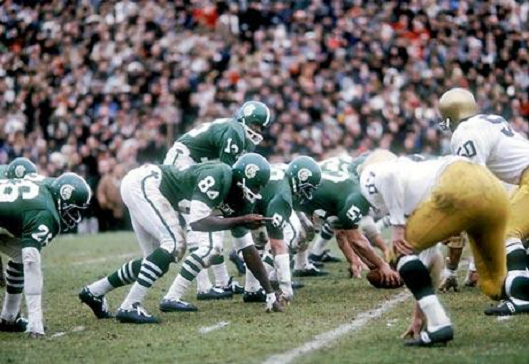
ABC televised the game nationally, albeit on a tape delay. This was the 1st time a single college football game went coast-to-coast over national television -- and in color, no less -- except for New Year's Day bowl games.

This was a time when the words "in color" and "coast-to-coast" still had a special meaning. Even today, ABC/ESPN and CBS split some of their games regionally: While the East Coast and the Midwest might see, for example, Ohio State vs. Penn State, the South and the West Coast might see, say, Southern California vs. Texas. But each network usually staggers its schedule so that, on any given Saturday, there's at least one game that most of the country, unless their own team is otherwise occupied, will want to see. In 1966, such a thing was still a novelty.

These two teams weren't even supposed to play. Notre Dame had usually played the University of Iowa on the 3rd Saturday in November from 1945 onward. But after 1964, Iowa opted out of that arrangement. Since Michigan State only had 9 regular-season games scheduled, and it was a relatively short trip -- about 160 miles, or 3 hours by road -- the game was set up, and as luck would have it, they both came in undefeated, Number 1 vs. Number 2.

Michigan State had gone to the Rose Bowl the year before. At the time, the Big Ten Conference had 2 unbelievably stupid rules: No team could go to the Rose Bowl in back-to-back years, and only the Conference Champion (or, if disqualified by the preceding stupid rule, the 2nd-place team) could go to any bowl game. This meant that, regardless of the result of their game against Notre Dame, MSU were not going to play a bowl game. (Purdue, quarterbacked by future Miami Dolphin Super Bowl winner Bob Griese, finished 2nd, and went on to their 1st-ever Rose Bowl, and won it for what remains the only time in their history.)

Notre Dame had a policy against bowl games, and hadn't been to one since Knute Rockne's legendary "Four Horsemen" (Harry Stuhldreher, Jim Crowley, Don Miller & Elmer Layden) beat Ernie Nevers' Stanford in the Rose Bowl on New Year's Day 1925. They wouldn't stop turning down bowl invitations until the 1970 season. So for both the Spartans and the Fighting Irish, this was it.

At first, it didn't go too well for Notre Dame: Their leading rusher, Nick Eddy, did not play due to a shoulder injury. Quarterback Terry Hanratty got sacked by the massive (for the time, anyway) Spartan defensive lineman (and future actor) Charles "Bubba" Smith, and had to leave the game with an injury. Center George Goeddeke hurt his ankle blocking for a punt.

Early in the 2nd quarter, the Spartans took a 7-0 lead on a Regis Cavender touchdown. (God only knows what Regis Philbin, at age 32 already a known entertainer and a big Notre Dame fan, thought of a man named Regis scoring against his beloved Irish.) Dick Kenney, a barefooted kicker, added a field goal to make it 10-0 Michigan State. (Barefoot kickers are now illegal in high school in every State except Massachusetts and Texas. It's still legal in college and in the NFL, but very rare since the 1980s.)

Notre Dame came back. Backup quarterback Coley O'Brien threw a touchdown pass to Bob Gladieux, and it was 10-7 Spartans at the half. On the 1st play of the 4th quarter, Joe Azzaro kicked a field goal to tie it. There was still plenty of time left for either team to win the game.

A Spartan pass play gave both teams a good chance to score: Quarterback Jimmy Raye attempted to pass to Gene Washington (not the man who went on to All-Pro honors with the 49ers and then became an executive in the NFL's main office; this one went on to play for the Vikings and Broncos), but Washington outran the pass, doubled back, and Tom Schoen intercepted it. That gave the Irish a chance, but Azzaro just missed what could have been a game-winning field goal.

The last series of the game began with 1:10 left on the clock, and Notre Dame had the ball on its own 30-yard line. Gaining 40 yards in 70 seconds would have put them in position for Azzaro to try again to win it with a field goal.

But Parseghian chose to run out the clock. Final score, Michigan State 10, Notre Dame 10.
I've seen ESPN Classic's broadcast of the game's surviving footage, which is all but the 1st quarter. The video is clear, the color is bright, and both teams, while looking small compared to the college teams of today, fought hard, and both seemed worthy of the National Championship -- until the last 70 seconds, of course.

Normally, the national media, so swept up in the myth of the Golden Dome -- Knute Rockne, George Gipp and Rockne's "Win One for the Gipper" speech, the Four Horsemen, Frank Leahy and "Leahy's Lads," and Paul Hornung... and this was well before Rudy Ruettiger and his movie, Joe Montana, and Lou Holtz's tenure -- gives Notre Dame the benefit of the doubt.

Not this time. In Sports Illustrated's writeup of the game, Dan Jenkins, then as now perhaps the greatest living writer on the subject of college football, titled his article "Tying One for the Gipper." Jenkins quoted one observer as saying, "Parseghian had no guts."

Was that fair? Here was Ara's explanation: "We'd fought hard to come back and tie it up. After all that, I didn't want to risk giving it to them cheap. They get reckless and it could cost them the game. I wasn't going to do a jackass thing like that at this point."

Both teams ended the season 9-0-1. And the polls? Both the Associated Press (the college football writers) and United Press International (the coaches), still issuing their final polls before the bowl games, ranked Notre Dame Number 1 in their last poll, Michigan State Number 2, and undefeated Alabama Number 3.

Alabama, led by Paul "Bear" Bryant and actually having a bowl game to win, did so, and finished 11-0. They should have thus gotten their 3rd straight National Championship (splitting the 1965 polls with Michigan State). Both Notre Dame and Alabama claim to be 1966 National Champions, but Notre Dame still gets the official recognition. Keith Dunnavant came out with a book about the '66 Crimson Tide squad and how they were screwed by the polls, titling it The Missing Ring.

Ara Parseghian won another National Championship at Notre Dame in 1973, this time beating Alabama in a Number 1 vs. Number 2 matchup in the Sugar Bowl. That year, Ohio State and Michigan played to a tie, thus tying for the Big Ten title, and the Conference sent Ohio State to the Rose Bowl. Despite this, Ohio State coach Woody Hayes joined with Bo Schembechler, once his player and assistant coach but now the Michigan coach, in his outrage, and together they got the only-the-Rose-Bowl rule changed.

Parseghian retired after the 1974 season, and became a broadcaster in the sport. A statue of him stands outside Notre Dame Stadium. He is 87 years old, and still full of life. Yet he still gets dogged by charges of cowardice for 1966. (Duffy Daugherty died in 1987, barely living to see the 20th Anniversary of the game.)

I'm not a Notre Dame fan. Indeed, I once did a blog post of "The Top 10 Reasons to Hate Notre Dame." Ara's successor, Dan Devine, who led them to the 1977 National Championship with Joe Montana at quarterback, once said, "There's Notre Dame fans, and then there's Notre Dame haters, and, frankly, they're both a pain in the ass."

But I think we can let Ara off the hook. For 3 seasons, ESPN ran a series called The Top 5 Reasons You Can't Blame... I loved that series, and have many of the episodes on tape. I wish they'd release the series on DVD. They never did an episode for Ara. I'll do it now.

The Top 5 Reasons You Can't Blame Ara Parseghian for "Tying One For the Gipper"

Here's some reasons that didn't make the cut, because they happened afterward:

Vince Lombardi. Although America already had a "winning is everything" mentality, it would not be until a documentary a year later, in 1967, that the nation heard the great Green Bay Packer coach say the words, "Winning isn't everything, but it's the only thing." If Lombardi had publicly said that before the fall of 1966, maybe Ara would have noted that, and gone for the win.

Tom Osborne. Still an assistant to Bob Devaney at the University of Nebraska in 1966, in the 1984 Orange Bowl he would get Nebraska back from a 31-17 deficit to 31-30 in the final minute. A tie and a final record of 12-0-1 would probably have salvaged a National Championship for one of the most spectacular teams in college football history, the 1983 Nebraska Cornhuskers.

But, remembering "Parseghian had no guts," Osborne went for the 2-point conversion and the 32-31 win and the 13-0 record. They didn't make it, and the National Championship -- dubiously, in my opinion -- went to the Huskers' opponents in that game, the University of Miami. If such a situation had arisen in a bowl game prior to the 1966 season, maybe Ara would have noted that, and gone for the win.

Herman Edwards. Just 12 years old at this point, Herm was playing junior high school football. He was a long way from becoming an NFL head coach, and giving us those famous words: "This is what the greatest thing about sports is: You play to win the game. Hello? You play to win the game! You don't play it to just play it! That's the great thing about sports: You play to win!"

Granted, most coaches' press conferences weren't televised in those days. But, surely, if some NFL coach had said something like this in the years leading up to November '66, maybe Ara would have noted it, and...

But these things weren't there for Ara to note. So here's the Top 5 Reasons:

5. Woody Hayes. Like Bo Schembechler, Ara both played for Woody and coached under him at Miami University of Ohio before becoming a great head coach himself. Woody's philosophy was simple: Run the football. Or, as it became known, "Three yards and a cloud of dust."

I'm not sure if Woody came up with those words himself, but words that have been attributed to him are, "There are three things that can happen when you throw the football, and two of them are bad." In other words, an incomplete pass and an interception.

When Ara had 70 seconds of play remaining, and 70 yards to go for a touchdown, and at least 40 yards to go for a field goal, no doubt he heard Woody's wisdom in his mind. After all, at the time, the man was still, along with Bear Bryant at Alabama, one of the top 2 coaches in college football.

This was after Darrell Royal had won the 1963 National Championship at Texas, but before Royal's Longhorns won it in 1969 (featuring another "Game of the Century," against Arkansas) and 1970. This was after John McKay had won the 1964 National Championship at Southern California (including a late-season win over Notre Dame that killed their title hopes that season), but before McKay's Trojans won it in 1967 (featuring yet another "Game of the Century," against UCLA) and 1972. And 1966 was Joe Paterno's 1st season as the head man at Penn State, so he wasn't yet a legend.

At the time, Woody and the Bear were it. Ara wanted to be "it," and, to do that, he couldn't lose this game. So he chose to not risk losing on an interception that might put Michigan State in position to win with a last-second field goal. It worked, and, as times changed, Ara became part of that top tier of great college football coaches.

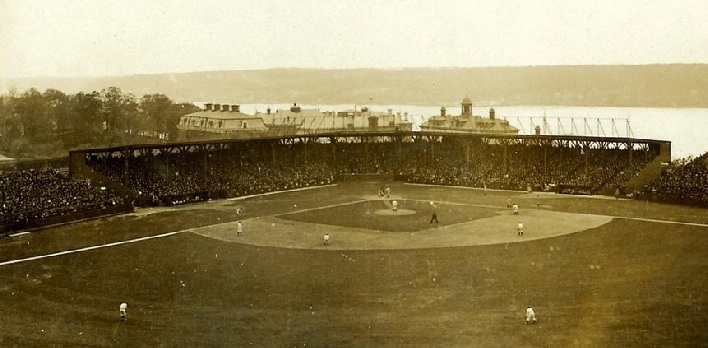
4. Frank Leahy. In 1946, Army was undefeated and ranked Number 1, and Notre Dame was undefeated and ranked Number 2, and they finished the regular season against each other, at the original Yankee Stadium, in the 1st college football game to get the "Game of the Century" tag from the national media.

That game did not live up to the hype, ending in a 0-0 tie. As they would say in that other kind of football, soccer, "a turgid nil-nil draw." The word "turgid" so perfectly suits 0-0 draws, regardless of what game you call "football."

Leahy had "tied one for the Gipper" 20 years before Ara. Yet he never got the derision that Ara got. Probably because it wasn't on television: In order to see this game in its entirety, you had to be inside The Stadium. Newsreel highlights in movie theaters wouldn't have shown you all you needed to see. Nobody's ever said, "Leahy had no guts." Essentially, he played for a tie, and got away with it.

3. Duffy Daugherty. Michigan State's head coach didn't exactly go for the win, either. And it really did cost his team the National Championship. But nobody mocked him for it, and nobody, in Michigan or elsewhere, holds it against him now.
Ara Parseghian (left) and Duffy Daugherty

2. The Odds Were Against the Irish. Michigan State had the home field. They were the defending National Champions. They were favored to win. And Notre Dame went into the game with a major injury (their top rusher) and got more of them as the game went on (their starting quarterback and their starting center). And still, they held Michigan State to just 10 points at home and avoided a loss. That's a pretty good achievement.

Again, I don't like Notre Dame. But Ara Parseghian deserved, and still does deserve, to be exonerated for playing for the tie. And here's the biggest reason of all:

1. A Win Wasn't Necessary. The polls proved it, giving Notre Dame the National Championship anyway. Ara knew that a loss would kill their national title dreams, just as they had against USC 2 years earlier. But a tie would still leave them undefeated.

And, as they nearly always do (except where this one game was concerned), the national media gave Notre Dame the benefit of the doubt, and crowned them National Champions, even though Alabama, undefeated and untied in 11 games as opposed to undefeated but tied in 10 games, was a more deserving National Champion.

Sounds like Ara Parseghian had more guts than the media: Not only were they gutless in claiming him to be a coward, but they ended up rolling over for the Irish anyway. If not for Ara himself.

VERDICT: Not Guilty.

As Top 5 Reasons host Brian Kenny would say at this point in the show, "Maybe we changed your mind, maybe we didn't, but, hopefully, we led you think about things in a new light."

UPDATE: Ara Parseghian died on August 2, 2017, living long enough to see November 19, 2016, the 50th Anniversary of this "Game of the Century." He never took his good health for granted, and continued to raise money for research into diseases that have hit his family.
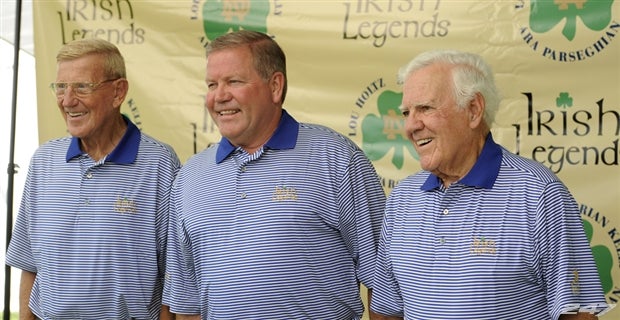
Lou Holtz, current Notre Dame coach Brian Kelly, Ara Parseghian

The teams last played each other on September 23, 2017, a few weeks after Parseghian's death. Notre Dame won, 38-18, raising their lead in the rivalry to 47-29-1. It should be 49-29-1, but due to the discovery of their use of ineligible players, the NCAA vacated all of their wins, including their wins over Michigan State, in the 2012 and 2013 seasons.

Thursday, November 18, 2010

Moneyball: A Loser

A movie version of Michael Lewis’ book Moneyball: The Art of Winning an Unfair Game, about the Oakland Athletics of the early 2000s and their general manager, Billy Beane, is currently being filmed.

Beane is being played by Brad Pitt -- who I once saw at the old Yankee Stadium, sitting in the Field Boxes with his adopted son Maddox Jolie-Pitt, but not with Angelina Jolie, a "significant other" who is far more significant than he is.

Paul DePodesta, Beane's assistant GM at the time, has been renamed Peter Brand, and is played by Jonah Hill, best known for appearing in Judd Apatow's gross-out sex-comedy films, especially Superbad. (These were recently "Airplaned" into a parody film titled The 41-Year-Old Virgin Who Knocked Up Sarah Marshall and Felt Superbad About It.)

Art Howe, the A's manager at the time, is played by Philip Seymour Hoffman. Two real-life major league players are confirmed as being in the film, albeit playing other big-leaguers: Royce Clayton, a former All-Star shortstop who has acted before but did not play himself when his character was struck out by Dennis Quaid's Jim Morris in The Rookie, plays A's shorstop/steroid cheat Miguel Tejada; and Jason Windsor, who really did play for the A's, but as a pitcher, plays outfielder and first baseman John Mabry.

Michael Lewis is currently riding a wave of success from the film version of his book The Blind Side, about football player Michael Oher and his adopted family, which won Sandra Bullock the Oscar for Best Actress. Aaron Sorkin, the genius behind A Few Good Men, The West Wing, and the brief but wonderful Sports Night (I still miss you, Sabrina Lloyd), assisted Lewis and others on the screenplay.

*

I've never understood why everyone made a fuss over, and why someone's now making a movie about, Moneyball and Beane. (Sounds like a bad 1970s cop (or private eye) show: Moneyball and Beane. Freebie and the Bean. Tenspeed and Brownshoe. B.J. and the Bear. (Okay, that one was about a trucker and his chimp.)

But why make a fuss over Billy Beane, and the theories that inspired Moneyball?

A, The A's have never won a Pennant with Beane as general manager. He's been there since 1998, 12 seasons, and they haven't even won so much as an ALCS game since 1992. No Pennants since 1990. No World Series since 1989. Observe:

* 2000: Won the AL West. Won Game 1 of the ALDS against the Yankees, and forced a Game 5 at home at the Oakland Coliseum (or whatever corporate name it had at the time). Yankees won.

* 2001: Won the AL Wild Card. Won Games 1 and 2 of the ALDS against the Yankees at Yankee Stadium. Only needed to win 1 of the last 3, the first 2 of which would be at the Coliseum. Yankees won.

* 2002: Rode a 20-game winning streak, longest in AL history, to a Western Division title, and didn't have to face the Yankees in the ALDS. Faced the Minnesota Twins. Had the home-field advantage. Lost the series.

* 2003: Won the AL West. Won Games 1 and 2 of the ALDS against the Boston Red Sox. Only needed to win 1 of the last 3, and if it went to a Game 5, it would be in Oakland. Lost the series.

* 2004: Just missed the Wild Card, losing it out to the Red Sox. Who knows what would have happened if they, rather than the Sox, had been the Wild Card.

* 2005: Again, did not make the Playoffs.

* 2006: Won the AL West again, and this time, won a postseason series for the first (and still only) time since 1990, beating the Twins. Went into the ALCS against the Detroit Tigers, knowing that Games 1 and 2, and, if necessary, 6 and 7, would be in Oakland. Got swept.

* 2007-10: Haven't appeared in the postseason since.

Granted, winning 4 Playoff berths in 7 years is impressive, no matter how much money your team spends. After all, there are 6 teams that don't have 4 postseason appearances in their entire history: The Colorado Rockies, the Florida Marlins, the Milwaukee Brewers, the Seattle Mariners, the Tampa Bay Rays, and the Montreal Expos/Washington Nationals franchise. The Washington Senators/Texas Rangers franchise only got its 4th just this season.

And there are 5 teams that haven't reached the postseason at all since the 21st Century dawned (11 seasons now) and the A's "Moneyball Era" began: The Baltimore Orioles, the Kansas City Royals, the Pittsburgh Pirates, the Blue Jays and the Expos/Nationals. (And the Rangers and Cincinnati Reds just did it this season.)

B, In spite of the A's "success" from 2000 to 2006, no franchise in baseball -- perhaps none in all of North American major league sports -- is in more danger of moving to a new metropolitan area. This is largely due to the fact that they don’t have a suitable ballpark, while across San Francisco Bay, the San Francisco Giants do, and that was true before the Giants won this year’s World Series.

Plans to build new ballparks next door to the Oakland Coliseum, and in nearby Fremont and Hayward, have fallen through. An effort is being made to have them move down the coast of San Francisco Bay to San Jose, but that's traditionally been Giants territory (the Giants have their Triple-A team there in the Pacific Coast League, and once had a Single-A, California League team there), so that wouldn't be a good place for the A's.

The A's may not be as close to moving as Charlie Finley nearly made them to Denver in 1978 and New Orleans in 1979, or as close as the Giants came to heading to Toronto in 1976 or Tampa Bay in 1992 (for the 1993 season), but, as they say in medical dramas, I'm not going to lie to you: It doesn't look good.

Translation: This team is dying, and none of Beane's "achievements" has been able to save it, and there's no reason to believe the publicity generated by Moneyball: The Movie is going to help. After all, the Minnesota Twins were nearly contracted just 8 years after they were the focus of Little Big League.

(The Chicago Cubs didn't exactly need the help provided by Taking Care of Business and Rookie of the Year. Nor were the Red Sox hurting when Fever Pitch came out -- and a lot of Red Sox fans actually hate that movie. The Rookie didn't help the Rays at all. Nor did life immediately imitate art after the 1994 version of Angels In the Outfield, any more than the Pirates were helped by the original 1951 version. And The Scout did the Yankees no favors. Of course, having Major League may have helped the Cleveland Indians get new owners who were willing to build a new ballpark, but, so far, that's not a good track record.)

*

Now, Sandy Alderson and J.P. Ricciardi, they have won Pennants and World Series. Not together, though: Alderson was the architect of the A's team that won 4 AL West titles in 5 years from 1988 to 1992, including 3 straight Pennants and the 1989 World Series; Ricciardi was involved in building the team that replaced them as the next great AL team, the 1992 & '93 World Champion Blue Jays. Neither franchise has won a Pennant since those guys left. Gibbs Rule Number 39: There is no such thing as coincidence.

At least in theory, the Mets hiring the proven Alderson and Ricciardi is not all that different from their 1980 hiring of Frank Cashen, the man who built the Baltimore Orioles into a team that won 8 Division Titles in 18 years, including 6 Pennants and 3 World Series. Hiring Alderson and Ricciardi appears to be the right move, although that largely depends on who Alderson hires as field manager.

Billy Beane has always refused to go to his team's owners and say, "Give me more money, so I can sign the players we need to put us over the top." And don't tell me they didn't have the money: If you can afford to buy the team's entire organization, you can afford to buy 3 impact players that can make the difference between contending for a championship and winning one.

If the A's move, if Major League Baseball in the East Bay dies, Beane will be the man who sold the killer the gun. It's time to stop treating him like a genius and a hero. He is, in fact, a coward, content to be a big fish in a small pond -- and the pond may soon be drained.

George Steinbrenner would have fired his sorry ass around 2004 or so.

Wednesday, November 17, 2010

Top 10 Crooks In Baseball

November 17, 1973, 37 years ago today: Richard Nixon proved he was the father of the modern Republican Party. Reagan, both Bushes, Gingrich, Cheney, Boehner... they're not just crooks, they're all arch-criminals. America cannot trust them. So often, we soon forget... but we always figure it out.

Who are the top 10 crooks in baseball history?

10. Hal Chase. Probably no player ever "threw" more games, or did so over a longer period, than "Prince Hal," who played from 1905 to 1919. He even used his reputation as baseball's best-fielding 1st baseman of the time to make errors, and thus cast doubt not on his own honesty but on the fielding ability of the infielders throwing to him. And he confessed it all.

9. Carl Pavano. If you're talking who is the biggest crook ever among players, there can be no other candidate, not even Chase. Pavano got a $39.95 million contract to play for the Yankees for 4 years. He faced 542 batters for the Yankees in those 4 years. That's $73,708.49 per batter.

He went 9-8 (and the Yankees were a bit more than a .500 team at the time), his ERA+ was 89 (11 percent worse than the AL average), his WHIP was 1.455, and, oh yeah, he crashed his Corvette and broke some ribs -- and didn't tell Yankee management for 2 weeks.

Little wonder he was nicknamed "American Idle." Thief! Fraud! Crook!

8. Walter O'Malley. Face it: If he could have made more money staying in Brooklyn than going to Los Angeles, the Dodgers would still be in Brooklyn today. If he could have made more money in London, in Tokyo, in Antarctica, or the freakin' Moon, that's where Dodger Stadium would be today.

Let's not forget that he offered the city of Los Angeles a deal: In return for giving him the 300 acres of land on which Dodger Stadium and its parking lots sit, he would accept only 77 games' worth of parking revenue. In other words, half of the season's games. The city fathers were stupid: It never occurred to him that, in the other half of the games, the Dodgers would be on the road.

Let's remember also that he got the people living on the site of Dodger Stadium evicted from their homes. He'd already done that in his pre-baseball life, as an attorney for landlords. Walter O'Malley was scum. And he was a crook.

7. Charlie Comiskey. No, not the 8 Chicago White Sox players under his employ who took money from gamblers to throw the 1919 World Series. The man who drove them to it. And knew about it. And did nothing to stop it.

6. Scott Boras. His clients have included Alex Rodriguez, Manny Ramirez, Iván Rodríguez and Éric Gagné -- steroid cheats. (Magglio Ordonez, another of Boras' Bonus Babies, has also been suspected.)

They have also included several guys who got huge contracts and didn't pan out: Todd Van Poppel, Barry Zito (at least, since he's left Oakland, the Giants won this year's World Series despite him), Kevin Millwood (much less successful as a Phillie and an Oriole than as a not-yet-fabulously-paid Brave), both Jeff Fucking Weaver and his brother Jared Weaver, Kenny (Coward of the County) Rogers, and, with the current Mets, Carlos Beltrán and Oliver Perez.

Then, of course, there were the $252 million contract he negotiated for A-Rod with the Texas Rangers, which eventually plunged the team into bankruptcy; and the extension of said contract to $275 million with the Yankees. All this before A-Rod had won so much as a Pennant.

I suppose we can blame A-Rod for, until October 2009, not living up to the contract, but we sure can't blame him for getting a lot of money that no mere athlete deserves. Not even Derek Jeter. Scott Boras is a thief.

5. Jeffrey Loria. First he bought the Montreal Expos, and promised he would never move them. Then he made that come true, but only because he so seriously defunded them that they couldn't compete in MLB. Then, with assistance from Commissioner Bud Selig and his fellow owners, he was allowed to sell the Expos back to MLB at a massive profit, and buy the Florida Marlins (whose owners then bought the Boston Red Sox). This led to MLB taking the team out of unprofitable Montreal.

And whose fault was it that the city was unprofitable for baseball? Not all Loria's, but mainly Loria's -- and move them to Washington, D.C. Washington deserved a team, but not that team.

Now willing to spend a little money (but not that much), Loria bought himself a World Championship in 2003. Being a Yankee Fan, I certainly can't fault him for trying that. But then he broke up that team to save money, and the Marlins have barely been competitive since.

He's getting a new ballpark in 2012, but does he really deserve it? He doesn't deserve a luxury suite at Your Corporation's Name Goes Here Field. He deserves a different suite, like at Sing Sing.

4. Arthur Soden. The owner of the franchise best known as the Boston Braves from 1876 to 1907, and acting President of the National League in 1882 and '83, he decided to move the Troy Trojans (across the river from Albany) to New York where they became the Giants, and the Worcester Ruby Legs (possibly eliminating competition for his "Beaneaters") to Philadelphia where they became the Phillies. So I guess we should thank him for that.

But he was also the man who suggested the reserve clause to his fellow owners, keeping players bound for life to one club (or so the owners wanted the players to believe) unless they were traded or outright released, not to mention a back-door way to what we would now call a salary cap.

It gets worse: In 1890, he practically kept the NL in business by funding several teams, enabling them to crush the Players League and the 1st players' union.

And he capped his career by responding to the founding of the American League in 1901, including another team in Boston, the one that became known as the Red Sox, by... raising ticket prices. The "Royal Rooters," Boston's biggest baseball fan club, deserted the NL club en masse and moved to the AL club.

That, as much as anything else, is the reason why Boston was a Red Sox town continuously from 1901 onward. In the 52 seasons in which both teams played in Boston, 1901 to 1952, the Braves only had the higher per-game attendance 7 times -- all between 1921 and 1933, starting after Sox owner Harry Frazee sold Babe Ruth, and ending the year Tom Yawkey bought the Sox and started rebuilding them. Even as the Braves won their last 2 Boston Pennants, the Red Sox had higher attendance: 6,055 to 5,055 (a 20 percent advantage for the Sox) in 1914, and 20,000 to 19,000 (a 5 percent advantage for the Sox) in 1948.

I suppose that if someone other than Yawkey had bought the Sox from 1933 onward, the Braves might have been the team that survived in Boston, and the Red Sox might have been the one that moved. But Arthur Soden certainly ended the era when the Braves were the unquestioned most popular sports team in New England. And all because he was a greedy crook.

It's just as well, I suppose: As bad as the Yankee-Red Sox rivalry is, can you imagine if the Mets and Braves were a New York-New England rivalry?

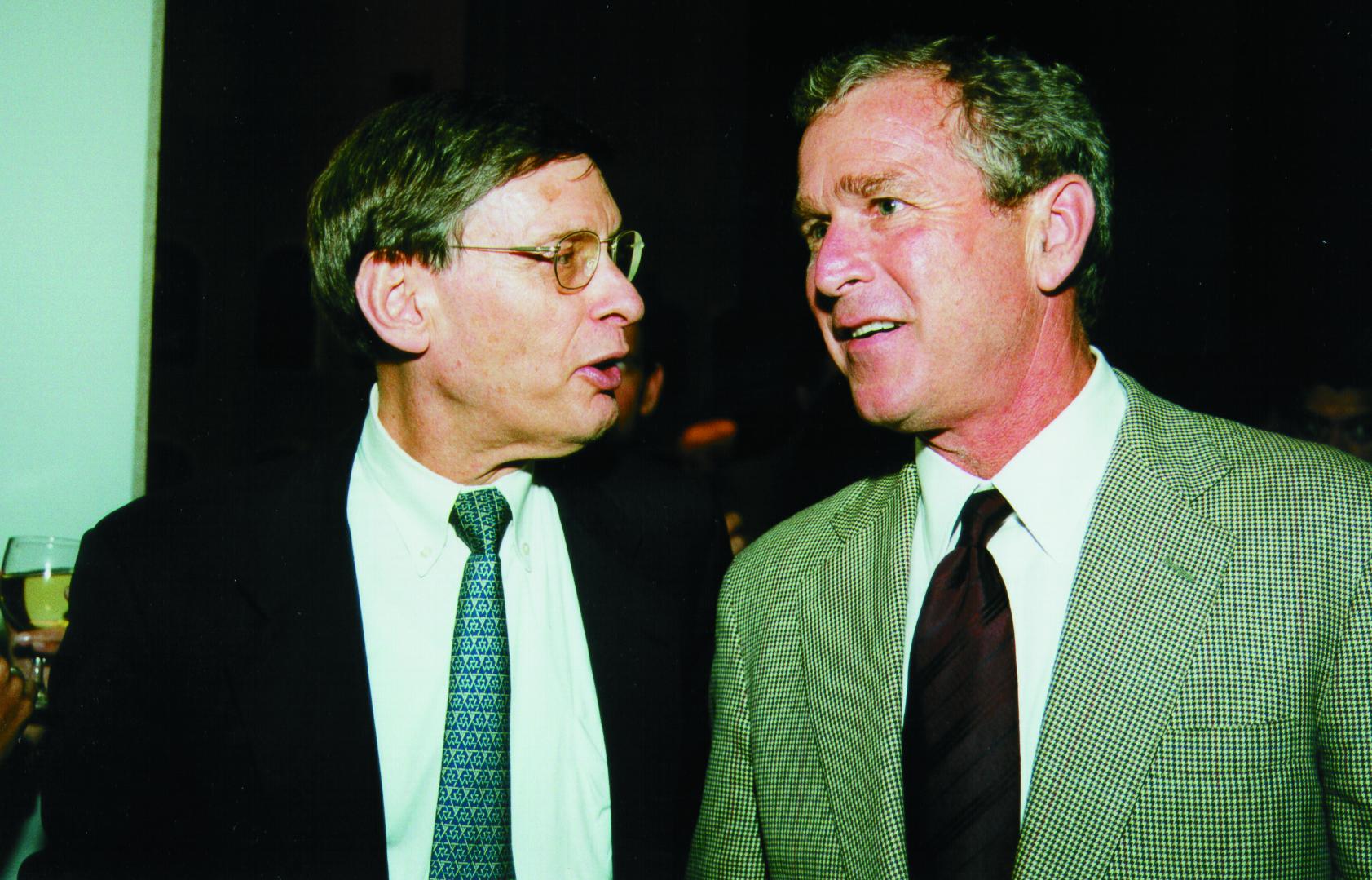
3. Allan H. Selig Jr. Before becoming Commissioner, or Acting Commissioner, or a powerful force among the owners, or the owner of the Milwaukee Brewers, or even the man trying the hardest (and eventually succeeding) to bring Major League Baseball back to Milwaukee after the Braves left town, "Bud" Selig was... a used-car salesman. He even sold a rookie Braves catcher named Joe Torre his first car.

All jokes about "Would you buy a used car from this man?" (which brings us back to Nixon) aside, Selig went on to become the 1st Commissioner in the history of major league sports, anywhere on this planet (including soccer in any country) to cancel a postseason in order to save money for the team owners. (That was on September 12, 1994, a date which lives in infamy. Unfortunately, he was not the last: Gary Bettman canceled an entire NHL season 10 years later.)

And he tore down and replaced Milwaukee County Stadium, one of the most fun ballparks ever, and replaced it with Miller Park, for one reason and one reason only: To make more money.

As a team owner, becoming Commissioner was a conflict of interest of epic proportions. And he looked the other way on steroids, although he certainly had help on that matter from the Players' Association and its director Don Fehr (who could also have made this list). He also looked the other way on the Red Sox' pitchers targeting the Yankees with headhunting pitches -- because he knew that publicity generated by the Yanks-Sox rivalry meant more television revenue, and thus more money for Major League Baseball and the team owners.

I have to issue a disclaimer: In 1993, before most of these reason for my anger toward him developed, anticipating the realignment of MLB's divisions to prepare for the added round of Playoffs, I wrote a letter (this was before the era of e-mail) to Selig, making suggestions as to how the divisions should be aligned. Exactly what my realignment plan was at the time, I can't remember.

But Selig sent me a very nice return letter, thanking me for my idea. This was clearly not a form letter: This required thought in composition. And it was actually signed, not by a robo-pen (or whatever they call signature-writing machines). I really liked him after that: He seemed a Commissioner in touch with the thoughts of the fans. Little did I know that, just a year later, he would commit the greatest crime in baseball history.

2. Rupert Murdoch. Okay, he wasn't that crooked as owner of the Los Angeles Dodgers from 1997 to 2004. But this isn't the Top 10 Baseball Crooks, it's the Top 10 Crooks In Baseball. And it takes a special kind of person to buy the Dodgers from the O'Malley family, and become the worst human being ever to own that franchise.

Number 1? Easy choice, especially when you consider who I chose for Number 2.

1. George W. Bush. Okay, he wasn't that crooked as owner of the Texas Rangers from 1989 to 1998 (with his ownership in a blind trust after his 1994 election as Governor, hence the team technically didn't reach the postseason while he was the man controlling the team)...
Crook Number 3 and Crook Number 1, in happier times.

But has there ever been a bigger criminal in American history? Nope, not even Richard Nixon himself -- even if he did sort of steal the Presidential election in 1968 by sending Madame Chennault to Paris to sabotage the Vietnam peace negotiations. But he didn't actually steal votes like Bush did.

"Were it within my power to forgive you, I would. But your forgiveness will have to come from someone other than me."
-- Joseph N. Welch

Tuesday, November 16, 2010

Mike Lupica vs. Jabba the Guv

Yesterday -- I can't seem to find a link to it -- New York Daily News columnist Mike Lupica proves that, while he's often wrong about sports, he is completely right (that is, correct, not right-wing) about politics.

He called Chris Christie, New Jersey's Blob-in-Chief, "Ralph Kramden." The blustery, blubbery Brooklyn bus driver from The Honeymooners.

Calling Chris Christie "Ralph Kramden" is a terrible insult. To Honeymooners fans.

Ralph was poor, and Christie hates the poor. Ralph was an urban guy, and Christie hates the cities. He thinks they're a drain on rich people's fortunes and that they don't pay enough taxes. He's one of those "Fuck 'em, they don't vote for us anyway" guys -- the kind I wish Democrats would be more often!

Chris Christie is not Ralph Kramden. Ralph had a conscience. He realized he made mistakes, and he was ashamed of them. Christie, Jabba the Guv, has no shame, doesn't care who he hurts, and has far more "crazy harebrained schemes" than Ralphie Boy ever did.

I'd threaten to send Christie to the Moon, but there ain't a rocket in this country with enough thrust to send him to the Moon!

As Ralph's pal Ed Norton would say, there's only one place Christie belongs: The sewer! Which is what New Jersey will be if we don't kick him out in 2013!

Monday, November 15, 2010

J! E! T! S! CPR!


For the 2nd week in a row, the New York Jets needed overtime to beat a weak team, but got it done: Last week, the Detroit Lions; this week, the Cleveland Browns.

At the rate the Jets are going, they might win the Super Bowl, but there won't be anybody at the victory parade: Their fans will all get heart attacks!

That's better than the ulcers that Giant fans got yesterday, losing to the Dallas Cowboys.

So the Cowboys were 1-7 under Wade Phillips, and are now 1-0 under Jason Garrett, who I once saw quarterback Princeton at the old Palmer Stadium.

Clearly, Phillips was the problem. But it could also mean that the Cowboy players quit on their coach, and are only now choosing to play well now that he's gone. (Shades of Tottenham going from Juande Ramos to Harry Redknapp.)

Yesterday, on Fox NFL Sunday, Terry Bradshaw -- who, ironically, once faced accusations from the Cowboys that he was "so dumb, he couldn't spell 'cat' if you spotted him the C and the A" -- said that Cowboy owner Jerry Jones isn't going to get anywhere if he doesn't hire a real general manager instead of doing the job himself.

Jerry's a smart guy, but Terry is right here. After all, look how much better the Yankees got when George Steinbrenner was no longer the de facto GM.

Then there's the Brad Childress situation with the Minnesota Vikings. Not to be confused with the Brett Favre situation with the Vikes, and he has got to go: He can't play anymore. (Same with Kerry Collins, who totally screwed the Tennessee Titans yesterday -- but that's a whole other set of issues.)

Look, I don't care how much you hate your coach: You do not quit on him. Whether you like your coach or not, you must respect his authority. The owner does not, and has the right to replace him; but if the players do not, they don't play, and get replaced by someone who does. The NFL Players Association is a far weaker union than its baseball and basketball counterparts, and doesn't have much leverage if a team decides to cut a player, for any reason.

It doesn't matter if your team's head coach is a player's coach or a nasty old martinet: You do your damnedest. Or, as "player's coach" Herman Edwards taught us, "Hello? You play to win the game!"

Herm hasn't won anything more than a Division Title (2002 AFC East with the Jets -- after this rant, one of the more successful coaching rants in sports history), and may never be a head coach again. But no player ever quit on him. Whatever his difficulties, he got his players to try.

Herm said he didn't care if you don't have any wins. The Buffalo Bills didn't have any wins going into yesterday, yet they played to win the game, and they did. Granted, it was against the Lions, who are still not a very good team. But the Bills made sure that the Lions' "record record" of 0-16 in 2008 will stand for another season.

Besides, I've been to Buffalo and to Detroit. Buffalo's got its problems, but there's a lot to like about it, even today. Detroit? That city is one step from unsalvagable.

Actually, the highlight of football Sundays for me is watching Terry, Howie and the rest on Fox NFL Sunday. What does that say about the quality of the NFL today, when the highlight of the day is the very beginning?

Actually, it may say more about me: That Terry was the best quarterback in the game when I was a kid (before his elbow woes became acute and Joe Montana came in), and that I miss him on the field, and that he represents the good things about football to me.

Friday, November 12, 2010

Top 10 Best Days In Yankee History

A few weeks ago, I did the top 10 worst. This time, the best. As with the worst, these will be in chronological order, and will not necessarily involve actual games.

Top 10 Best Days In Yankee History

1. January 9, 1903. This was the day American League founder and President Byron Bancroft "Ban" Johnson approved the move of the AL's Baltimore Orioles to New York, where they would take on the name "Highlanders" until officially being renamed the "Yankees" in 1913, though the name had been around nearly from the start. So this day is as close to an official "birthday" as the Yankees have. Naturally, it is a great day, as the founding day is for all 30 MLB teams.
For the record, the Mets were granted National League membership on March 6, 1961. Which means, although the 50th Anniversary of their first game isn't until April 11, 1962, their 50th Birthday is less than 4 months away.

2. January 11, 1915. The Yankees' 1st owners, Frank Farrell and Big Bill Devery are sick of losing, sick of the baseball business, and sick of each other. So they sell the team to Jacob Ruppert and Tillinghast L'Hommedieu Huston.

Ruppert, son of a German immigrant, was a brewer (the Ruppert Houses project now stands on the site of the Ruppert Brewery at 92nd Street & 2nd Avenue on the Upper East Side), and had served 2 terms as a Democratic Congressman from New York. Due to his political connections, he had been named an honorary colonel in the New York National Guard.

Huston was an engineer, who had made his name and fortune helping the U.S. Army out during the Spanish-American War in 1898, rising to the rank of Captain. So Ruppert was nicknamed "Colonel" (you didn't dare call him "Jake"), and Huston was nicknamed "Cap" (which he still answered to even after he went off to World War I and was promoted to an actual Colonel, though he also answered to "Til").
Ruppert and Huston, flanking
Commissioner Kenesaw Mountain Landis,
at the opening of Yankee Stadium, April 18, 1923

Ruppert was a lot like George Steinbrenner: He was not willing to pay for mediocrity, but he was willing to spend to build a champion. He and Huston did so, although by the time the Yankees won their 1st World Series in 1923, they, like the men from whom they purchased the franchise, had had enough of each other (Huston never liked Miller Huggins, Ruppert's choice for manager), and Ruppert bought out Huston's half-share.

Ruppert's heirs dedicated a plaque in his memory that graced the outfield wall of the pre-renovation Yankee Stadium from 1940 to 1973, and hung on the wall in the old Stadium's Monument Park from 1976 to 2008 and is now in the new Stadium's Monument Park. And the street connecting 157th and 161st Streets on the 3rd-base side of the old Stadium was named Ruppert Place. But Huston has been virtually forgotten. There is no memorial to him at the new Stadium. Nor was there at the old one.

When Ruppert died in 1939, he was still the sole owner of the Yankees, and had been around the team nearly every day until his final illness, so there were big headlines; when Huston died the year before, it hardly made the papers, no current member of the team had even met him.

Nevertheless, when "the Colonels" bought the Yankees, they set an ambitious course that intended championships -- if not a gigantic new stadium -- from the start. In 1915, the Yankees were New York's 3rd-most-popular team, and it wasn't even close.

By 1923, and the Yanks' defeat of the Giants in the World Series after losing the last 2 to them, they were not only the most popular team in New York, but, thanks to someone I'm about to mention, they were the most popular sports team in the world.

3. December 26, 1919. Let's clear some things up right now. Harry Frazee, owner of the Boston Red Sox from 1916 to 1923, is not to blame for selling George Herman "Babe" Ruth to the Yankees. Ruth himself is. Ruth, about to turn 25 years old, was still very much a juvenile delinquent -- perhaps not a malicious sort, but he was, in the word he had hated since he was sent off to a combination orphanage/reform school in Baltimore at age 7, "incorrigible." He had openly defied his manager and his team owner, was making unreasonable demands, and was one of the champion carousers of that ear. He made today's star athletes and music stars look like rank amateurs.

Frazee had no choice: He had to get rid of the Babe, just to restore order at Fenway Park. And with a dispute cutting the AL in half, there were only 2 teams willing to make deals with him: The Yankees and the Chicago White Sox. And the White Sox were owned by Charlie Comiskey. There are 2 things everyone not a White Sox fan remembers about Comiskey today: He was cheap, and that caused the Black Sox Scandal that was then about to break. Comiskey was willing to make a deal with Frazee, but he wasn't willing to pay what he considered an exorbitant sum for Ruth.

Ruppert and Huston were. So they bought Ruth's contract for $125,000, by far the biggest sum ever spent on a player transfer in North American sports. (I seriously doubt that any soccer club -- in Europe, South America or anywhere else -- had yet reached that figure on a player transfer.) The deal was announced a few days later, on January 5, 1920. The rest is history.
Well, history and myth. Let me make a point that others have made: Frazee was hurting, all right, but it was because Ruth was giving him headaches and ulcers. He was not hurting for cash. He didn't need the money to finance a new Broadway play: The plays he was producing, mostly musical comedies, were doing well. And the play most often cited as the reason for the Ruth sale, No, No, Nanette, didn't debut until 1925.

Say what you want about Harry Harrison Frazee, but he didn't sell Ruth because he was greedy, and he didn't sell Ruth so he could sacrifice the Red Sox on the altar of Broadway.

Funny thing: When the Yankees played the Red Sox in Game 7 of the 2003 ALCS, I couldn't get in, so I went from bar to bar in Manhattan looking for a good place to watch it, until finally deciding I had to go up to The Stadium to be there for the result, whatever it turned out to be. But because it was now after midnight, the trains were on a different schedule. So I got off at 50th Street, and soon found myself at 220 West 48th Street, outside the Longacre Theatre, which had once been owned by... Harry Frazee. Once I realized the significance of where I was and what it represented (where Frazee staged the plays that he supposedly needed to sell Ruth to finance), I heard a tremendous sound on my Walkman: Aaron Boone hitting the Pennant-winning home run, giving the supposed Curse of the Bambino one last extension. Tell me God isn't a Yankee Fan!

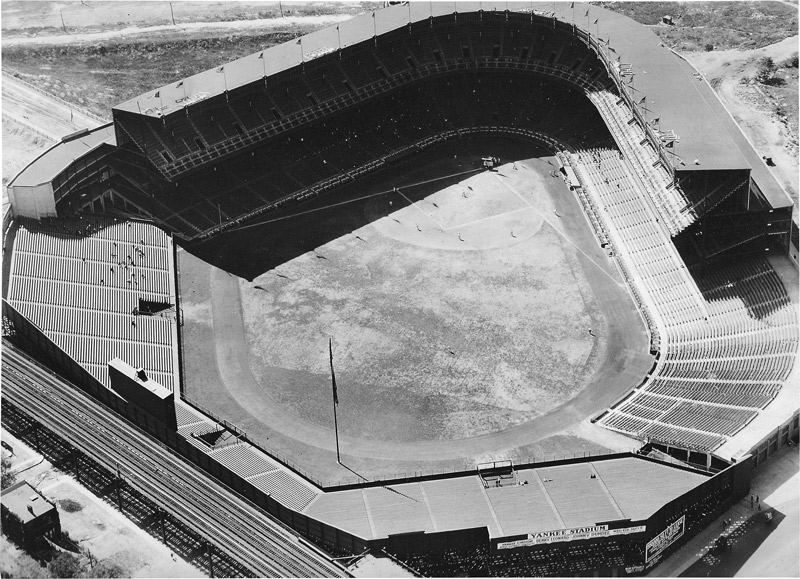
4. April 18, 1923. Opening Day of the original Yankee Stadium. The biggest ballpark yet built, and although it wouldn't stay that way (Cleveland Municipal Stadium would seat more), The Stadium, as much as anything else, became part of the Yankees' identity and mystique. Ruth hit the park's first home run, and the Yankees beat (who else?) the Red Sox, 4-1.
5. November 21, 1934. The Yankees purchase the contract of an outfielder, who had just turned 21 years old, from the San Francisco Seals of the Pacific Coast League. No other big-league team seemed to want him. Why not? Knee injury. The Yankees took a chance, giving the Seals $25,000, 5 players, and the right to hang onto the kid for the 1935 season before sending him east for 1936. His name? Joseph Paul DiMaggio.

Ruth had played his last game for the Yankees, although the general public didn't know that yet. Gehrig was just 31 and still at his peak -- in fact, he'd just won the Triple Crown. But with DiMaggio, the Yankees had secured their future, all the way through the 1940s and into the early 1950s.
Bill Dickey, Lou Gehrig, Joe DiMaggio and Tony Lazzeri.
This has to be from either 1936 (Joe's 1st season with the Yankees)
or 1937 (Tony's last with the Yankees).

This made what we now think of as "The Yankee Mystique" possible -- including the scoutings and signings of the cornerstones of their 1950s dynasty: Mickey Mantle, Yogi Berra and Whitey Ford. They no longer needed Ruth to promote themselves. Purchasing DiMaggio turned the Yankees from a team that had a great generation into a team for all generations. In essence, they went from being what the New York Islanders became from 1975 to 1987 to being... the New York Yankees.

Neat little footnote: DiMaggio's 1st pro game was for the Seals on October 1, 1932 -- the very day Ruth called his shot against the Chicago Cubs in the World Series.

6. October 12, 1948. The Yankees take the next step in their future-securing by hiring Charles Dillon "Casey" Stengel as manager. He'd gotten a reputation, both as a player and as a manager, for being a "clown."
As Jim Ogle, the Newark Star-Ledger reporter who later ran the Yankee Alumni Association (making him responsible for putting together Old-Timers' Day), put it, "Well, the clown did pretty well. He won 10 Pennants in 12 years, and made the Yankee legend and mystique grow volumes." As Casey himself would have put it, "And you can look it up."

7. April 14, 1955. This the only date on this list to involve an actual game. And it was a loss, to the Red Sox of all teams, 8-4 at Fenway Park. So had could this have been one of the best days in Yankee history?

Because Elston Howard played left field at the end of the game. The Yankees had finally put a black player on the field in a game that counted. It had been 8 years since Jackie Robinson had done the same for all of baseball.
It should be noted that the Red Sox were then managed by Pinky Higgins, who allegedly said, "There'll never be a (N-word) on the Red Sox as long as I'm the manager." In 1959, he was fired, and Pumpsie Green was promoted from the minors, making the Sox the last MLB team to integrate.

Oddly, no one blames Sox general manager (and former shortstop and field manager) Joe Cronin for the color bar at Fenway, yet 1959 was the year he was named AL President and the year the Sox integrated. Coincidence? That's what the incurious believe in.

For the record, Higgins returned as manager a year later, and had more black players on the field than the man in between his tours of duty, Billy Jurges. Not that I'm blaming Jurges or exonerating Higgins, but it is interesting that for years, no one dared blame Cronin.

8. January 3, 1973. George Steinbrenner and his group buy the Yankees from CBS. The era of Yankee management tolerating mediocrity was over. The Boss Years were about to begin.
George and Joan Steinbrenner at Yankee Stadium, 1973

When George bought the Yankees, the purchase price was $8.8 million, about $45.2 million in today's money. When he died earlier this year, the team and all its assets were said to be worth $1.6 billion. About 35 times what he paid.
George and Joan Steinbrenner, 2000, considerably happier

9. July 30, 1990. Commissioner Francis T. "Fay" Vincent permanently bans Steinbrenner from the day-to-day management (although not the actual ownership, and financial responsibilities and receipt of income thereof) of the team. This was because George had hired Howie Spira, a private investigator and compulsive gambler, to find damaging information about Yankee star Dave Winfield and his charitable foundation, in order to discredit Winfield.

If Spira ever found anything, it has never been publicly revealed. For that reason, Dave, in the exact opposite of what George intended, was the only one of the three who came out looking good. Spira turned to Vincent, and George was banned. George was, however, permitted to apply for reinstatement after 2 years, and in 1993 reinstatement was granted.

The Yankees were already in last place at the time -- 1908, 1912, 1966 and 1990 remain the only last-place finishes in the team's history -- and I actually went to the game that night, against the Detroit Tigers. The Yankees won, 6-2. Only 24,037 attended, and what a relief there was in the crowd. I'm not ashamed to admit it: I took part in the "Steinbrenner sucks!" chant.

If you had told us that night that, as a result of the banning order, Gene Michael (whose initials, appropriately, are GM) would rebuild the organization, top to bottom, and within 6 years we'd be World Champions again, I think we would have taken it. But if you had told us then that, 6 years later, we'd be chanting, "Thank you, George!" at the ticker-tape parade following said World Series win, we'd have wondered what you were smoking.

And yet, both came true: Both the Yankees and their Boss were rehabilitated, restored and redeemed. In order for both the team and Steinbrenner to be redeemed, George had to go. As Richie Ashburn would've said to his broadcast partner, "Hard to believe, Harry."

10. July 30, 2009. If you're a Red Sox fan, and you're intellectually honest, this was The Day the Music Died. This was the day it was revealed that both David Ortiz and Manny Ramirez flunked steroid tests in 2003 -- meaning the team's 2004 and 2007 World Championships were illegitimate.

Maybe Manny was already a great hitter without steroids, but there's no way the Sox would've won either title with the David Ortiz who averaged 14 homers and 59 RBIs a year for the Minnesota Twins from 1997 to 2002. Big Papi was a big fat fraud.

To this day, Sox fans chant "Sterrrr-oids!" at the Yankees, especially Alex Rodriguez, who was never caught AS a Yankee, and whose first World Championship game 6 years -- not 1 year -- after he was caught. Since 1918, Yankees 27, Red Sox 0*. The Curse of the Bambino could not be broken without the Sox cheating. So if it ever actually existed, then... it still does.

And the collapse of October 17-20, 2004 counts for nothing. The Yankees didn't choke, the Sox fucking cheated.

And July 30, 2009 was the day that confirmed that we never deserved such ignominy. And the Sox did. In other words, the Curse of the Mitchell Report was dead.

And any Sox fan who says those 2004 and 2007 titles are real, whether I know you or not, you can kiss my ring. Take your pick: There's 27 of them. All real.

Wednesday, November 10, 2010

Derek Jeter Deserved His Gold Glove

Derek Jeter, Robinson Cano and Mark Teixeira won Gold Gloves yesterday.

They all deserved the honor.

Yes, even Jeter.

"Advanced fielding metrics rank him as mediocre at best at shortstop these days." -- Lisa Swan, Subway Squawkers

Advanced fielding metrics? I'm not going to doubt Lisa's "True Yankee Fan" status just because she likes Alex Rodriguez and Joe Girardi more than Derek Jeter and Joe Torre, respectively. Besides, she's merely backing up the point of the actually offensive (and she frequently agrees he's offensive) Wallace Matthews of ESPN (and formerly of the New York Post, that great bastion of irresponsible journalism):

You really don't need to consult any statistics or advanced fielding metrics to know what your own eyes told you if you watched enough Yankees games this season, which is that there can really be no argument that both Teixeira and Cano are among the best, if not the best, at their respective positions.

And neither did you need any numbers to tell that Jeter is not.

This is not to say he is a bad shortstop. Far from it. At 36, Jeter remains sure-handed and rifle-armed. His instincts, as always, are perfect -- his fundamentals rock-solid. Along with Cano -- and some would say, because of Cano -- he still turns a terrific double play. Any ball hit right at him is a guaranteed out.

And that is both a compliment and an indictment. Because if it isn't hit right at him, and I mean right at him, then it's a base hit. 

Talk about damning with faint praise.

"Theoretical physicists will tell you that an elephant can hang from a cliff with his tail tied to a daisy. But use your eyes." -- Jim Garrison

"Statistics are like women; mirrors of purest virtue and truth, or like whores to use as one pleases." -- Theodor Billroth

"There are two kinds of statistics, the kind you look up and the kind you make up." -- Rex Stout

"The average human has one breast and one testicle." -- Des McHale. Ouch. Actually, at the rate humanity is going, it may be down to one breast and .8 balls.

"Say you were standing with one foot in the oven and one foot in an ice bucket. According to the percentage people, you should be perfectly comfortable." -- Bobby Bragan, although I've also seen this attributed to another mediocre player turned cagey manager, Eddie Stanky.

"He uses statistics as a drunken man uses lampposts, for support rather than for illumination." -- Andrew Lang. I'm not sure who he is, but I first saw this attributed to broadcaster Vin Scully.

"Statistics are like bikinis: What they reveal can be good, but what they don't reveal can be more important." -- Aaron Levenstein, whoever he was.

"Lucy, tell your statistics to shut up." -- Charles Schulz as Charlie Brown, Peanuts

Derek Jeter has 5 Gold Gloves now. He deserves them all.

Go ahead, cite your statistics. They may suggest that I am wrong. They will never prove it.

As I've said many times, facts can be true or false, but opinions can never be proven right or wrong, only agreed with, or not.