Showing posts with label willie mccovey. Show all posts

Friday, November 14, 2025

Top 10 Worst Baseball MVP Choices

Yesterday, surprising no one, Major League Baseball's Most Valuable Player awards went to Aaron Judge of the Yankees in the American League, and to Shohei Ohtani of the Los Angeles Dodgers in the National League.

I am of the firm belief that the MVP should only go to a player who helps his team get into the postseason. If you helped your team get into the Playoffs, by definition, you have more value, and are more valuable, than a player who didn't help his team get into the Playoffs. Never mind Judge, or Cal Raleigh of the Seattle Mariners, or Vladimir Guerrero Jr. of the Toronto Blue Jays: The 25th man on each of those teams was more valuable than any player on any of the teams that didn't make it.

Top 10 Worst Baseball MVP Choices

Remember: While the voting is announced after the postseason, the MVP voting is based on regular-season performance only. I think that's wrong, but that's how they do it. As Joe Girardi would say, "It's not what you want." But as Aaron Boone would say, "It is what it is."

The current award began in the 1931 season, so no previous versions will be taken into account -- or held to account. And while some of these choices now look bad due to revelations of cheating, that was not known at the time, so I can't include those choices.

Honorable Mention: 1949 American League: Ted Williams, Boston Red Sox. This will be considered blasphemy in New England. They're wrong. First, let's look at the MVPs won by Yankees that "should" have been given to the Splendid Splinter.

Joe DiMaggio of the Yankees was awarded the American League MVP for 1941. Red Sox fans, now 3 generations removed, remain angry about this. They say Ted's .406 average was a greater achievement than DiMaggio's 56-game hitting streak the same season. They forget that the award is Most Valuable Player, not Most Outstanding Player. Ted's great season did not get the Red Sox the Pennant, finishing 2nd, 17 games behind the Yankees. Joe's great season put the Yankees on a run that led to them winning the World Series.

There would be another MVP controversy in 1942. Ted batted .356, hit 36 home runs, and had 137 RBIs. Each of these led the League, giving him the Triple Crown. But the Sox finished 2nd to the Yankees, a not-very-close 9 games back, and the MVP went to Joe Gordon, who did bat .302 with 103 RBIs, though only 18 home runs, and played 2nd base superbly. How do you deny a Triple Crown winner the MVP? Again: Most Valuable Player, not Most Outstanding Player.

In 1946, the Red Sox ran away with the Pennant. This time, there was no denying Ted: He batted .342, hit 38 home runs, and had 123 RBIs (oddly, none of these led the AL), and he was an easy choice for MVP.

Then came the World Series. The opposition was the St. Louis Cardinals. Led by the NL's answer to Ted, Stan Musial, the Cards were in their 4th World Series in 6 years, having won in 1942 and 1944, and lost in 1943. But Ted was nursing an elbow injury, and only batted .200, 5-for-25. Stan didn't hit well, either, and neither would end up the big story of the Series. The Cards won in 7 games.

Ted won the Triple Crown again in 1947, as he batted. .343, hit 32 home runs and had 114 RBIs. But, again, the Sox didn't win the Pennant. In 1947, DiMaggio won the MVP by 1 point in the voting over Ted -- because 1 writer, whose name has never been revealed, left Ted off his ballot completely. If he had even listed Ted 10th, Ted would have won it. But he wouldn't have deserved it: The Sox finished 3rd, 14 games behind the Yankees (and 2 behind the Tigers).
 
In 1949, the Sox and Yanks battled for the Pennant all the way to the final weekend. The Sox led the Yanks by 1 game with 2 to go, against each other, at Yankee Stadium. All the Sox had to do was win 1 of the 2. The Yankees won them both, 5-4 and 5-3. Ted went 1-for-3 with a walk in the Saturday game, and 0-for-2 with 2 walks in the Sunday game.

In spite of the Sox not winning the 1949 Pennant, the Yanks didn't have any single player who stood out above the others -- DiMaggio being hurt much of the year, keeping his power stats down -- so Ted got his 2nd MVP. But he had also begun to get a reputation as coming up small in big games. This ignores the fact that, in those 3 end-of-season games in '48 and '49, he did reach base 5 times. But, in those days, you rarely heard the cliché , "A walk is as good as a hit."

Ted hit 43 home runs and had 159 RBIs. His .343 slightly trailed George Kell of the Tigers for the batting title, costing him a record 3rd Triple Crown by the slimmest of margins. But he got 13 of a possible 16 1st-place votes, and won the MVP.

Among the Yankees, Phil Rizzuto finished 2nd, reliever Joe Page 3rd, and Tommy Henrich 6th. But the Scooter just didn't have big stats, and as for Page, nobody was willing to give the MVP to a relief pitcher to that point. The next year, Jim Konstanty of the Philadelphia Phillies became the 1st, in the NL. No AL reliever would get the award until Rollie Fingers of the Milwaukee Brewers in 1981.

So Ted didn't help his team win the Pennant. Yogi Berra finished 15th in the voting, but, giving the Yankees their 1st good year from a catcher since 1943, he was probably the best choice. Since there was no obvious candidate, I'm making Ted's '49 win an Honorable Mention.

Other Honorable Mentions: 1947 National League, Bob Elliott of the Boston Braves over Jackie Robinson of the Brooklyn Dodgers; 1953 American League, Al Rosen of the Cleveland Indians over Yogi Berra of the New York Yankees; 1954 American League, Yogi over Larry Doby of the Indians.

Derek Jeter probably should have won it in 1999, 2006 and 2009. At least, on those occasions, the winner was from a Playoff team: Respectively, Iván Rodríguez of the Texas Rangers (now believed to have been a steroid cheat), and Justin Morneau and Joe Mauer of the Minnesota Twins.

10. 1958 American League: Jackie Jensen, Boston Red Sox. The Red Sox were 3rd, 13 games behind the Yankees. So this one made no sense at all: Jensen did lead the AL with 122 RBIs, but his 35 homers were surpassed by 4 players, including Mickey Mantle's AL-leading 42; and he only batted .286, 3rd on his own team behind Ted Williams with an AL-leading .328 and Pete Runnels with .322, and also behind Mantle at .304.

Did the voters simply not want to give Mantle a 3rd consecutive award? That wouldn't happen in either League until 2004, with Barry Bonds. But Mantle only finished 5th. Bob Turley finished 2nd, and became the 1st Yankee to win the Cy Young Award.

9. Tie. Four selections of three players for the Chicago Cubs in the National League. In 1952, Hank Sauer led the NL in home runs and RBIs. But his Cubs were exactly .500, 77-77, 19 1/2 games behind the Pennant-winning Dodgers. They finished 5th, making this the 1st MVP awarded to a player on a "second-division" theme. Joe Black finished 3rd, tops among Dodgers. But since Konstanty had just won it 2 years earlier, maybe the voters weren't ready to give it to another reliever.

Everybody loves Ernie Banks. Even Chicago White Sox and St. Louis Cardinals fans grudgingly respected him. But, as with Sauer, the Cubs were 2nd-division teams in Ernie's MVP seasons, 5th in both seasons.

In 1958, Hank Aaron of the Pennant-winning Milwaukee Braves did not surpass Banks in homers, 30 to an NL-leading 47; or RBIs, 95 to an NL-leading 129; but did surpass him in batting average, .326 to .313. But he didn't even finish 2nd: Willie Mays of the San Francisco Giants did.

In 1959, statistically, Banks was comparable to another Brave, Eddie Mathews: Mathews batted .306 to Banks' .304, Mathews' 46 homers edged Banks' 45 for the MLB lead, and Banks' 143 RBIs were well ahead of Mathews' 114. The Los Angeles Dodgers won the Pennant, but their highest finisher was Wally Moon, in 4th, and his stats weren't even close. Still, a 2nd-division player, no matter good, no matter how decent, and no matter how beloved, shouldn't win the MVP.

Likewise, Andre Dawson became beloved by Cub fans for signing with them as a free agent for the 1987 season, and delivering, at least on an individual basis. He wasn't on steroids, but this decision was like the Sauer and Banks MVP choices on steroids. Dawson hit 49 home runs and had 137 RBIs to lead the NL, but the Cubs finished 76-85, 18 1/2 games out of 1st in the NL East.

So, if not the Hawk, then who? The Wizard? Ozzie Smith of the Pennant-winning St. Louis Cardinals finished 2nd, batting .303 with 75 RBIs and 43 stolen bases -- but no home runs. No nonpitcher has ever won the MVP with no homers. In contrast, the 3rd-place finisher, also a Cardinal, was Jack Clark, who hit 35 homers and had 106 RBIs. It should have been him, even if Dawson had him beat on character by a lot.

8. 1991 American League: Cal Ripken, Baltimore Orioles. The O's were 67-95, 24 games behind the AL East-winning Toronto Blue Jays. Giving Cal the MVP was a joke. But the 2nd-place finisher was no better: Cecil Fielder led the AL in RBIs and tied for the lead in homers, but the Detroit Tigers were 7 games out. Fishing 3rd was Frank Thomas, but the Chicago White Sox were 8 back in the AL West. José Canseco of the Oakland A's was 4th, and tied Fielder for the homer lead, but the A's were 11 back.

Finishing 5th was Joe Carter of the Blue Jays. He helped them win the Division, with 33 homers and 108 RBIs. His teammate Roberto Alomar finished 6th. Kirby Puckett of the World Series-winning Minnesota Twins finished 7th, but, aside from a .319 batting average, wasn't all that close. It should have been Carter.

7. 2023 American League: Shohei Ohtani, Los Angeles Angels. I don't care how great he was as a hitter and/or a pitcher: The Angels finished 73-89, 17 games out of 1st place, 16 games out of the last AL Playoff slot. Corey Seager of the World Champion Texas Rangers finished 2nd, and it should have been him.

6. Tie: 2014, 2016 and 2019 American League: Mike Trout, Los Angeles Angels. Trout's fans claim that he would be a 1st-ballot Hall-of-Famer even if he never plays another game. After all, he's won 3 MVPs, and every player with 3 MVPs -- and no serious steroid accusations -- is in the Hall.

So the question becomes, "Did Trout deserve those MVPs?" In 2014, the Angels won the AL Western Division. This remains Trout's only postseason appearance -- and he went 1-for-12 as the Angels got swept in 3 straight by the Kansas City Royals. But Victor Martinez of the Detroit Tigers, who also made the Playoffs, batted .048 higher than Trout, and was close to him in homers and RBIs. Oddly, though the Royals won the Pennant, their closest finisher was Alex Gordon, 12th.

In 2016, the Angels finished 74-88, 15 games out of the last AL Playoff berth. Mookie Betts of the AL East-winning Red Sox finished 2nd, and beat Trout in batting average, .318 to .315; homers, 31 to 29; and RBIs, 113 to 100. So what possible reason was there to pick Trout? Unless you believe the Red Sox were cheating, but no serious accusation has ever been leveled at Betts.

In 2019, the Angels finished 72-90, 24 games out of the last AL Playoff slot. Trout got the MVP, anyway. Who finished 2nd in the voting? Alex Bregman of the Pennant-winning Houston Astros, already known cheaters. Who finished 3rd? Marcus Semien of the Oakland A's, who made the Playoffs. So it should have been Martinez in '14, Betts in '16, and Semien in '19.

And, no, Trout is not yet a Hall-of-Famer. He's at least 2 good seasons short of having the stats.

5. 1969 National League: Willie McCovey, San Francisco Giants. No question, McCovey had a great season: .320, 45 homers, and 126 RBIs. The HR and RBI totals were surpassed only by Harmon Killebrew of the Minnesota Twins, who won the AL Western Division, in this 1st season of Divisional Play. But the Giants finished 3 games behind the Atlanta Braves in the NL Western Division.

Should a Brave have won the NL MVP? Hank Aaron finished 3rd, batting .300 with 44 homers and 97 RBIs. But, truly, in lower-case letters, the most valuable player in the National League was the ace pitcher of the World Champion New York Mets, Tom Seaver: 25-7, 2.21 ERA, 1.039 WHIP (not that WHIP had yet been created as a stat).

To this day, no Met has ever been selected as an MVP. Yogi Berra, Willie Mays, Ken Boyer, Keith Hernandez, Kevin Mitchell, Rickey Henderson, Mo Vaughn, Jeff Kent and Justin Verlander have all won MVPs, and all have played for the Mets -- but none in the same season.

4. 1937 American League: Charlie Gehringer, Detroit Tigers. No question about it: He was a great player, one of the best 2nd basemen who ever lived. He was a great fielder, so reliable he was known as the Mechanical Man. He batted .371 to lead the League.

But he had 96 RBIs. His teammate, Hank Greenberg, had 184 RBIs, nearly breaking Lou Gehrig's AL record of 185 set in 1931. Greenberg literally had more than twice as many RBIs as his teammate who got the MVP. What's more, Joe DiMaggio, not yet 23 years old, led the Yankees to win the World Series, batting .346, leading the AL with 46 home runs (a Yankee record for righthanded hitters that lasted until 2005), and had 167 RBIs (no Yankee, indeed hardly anybody, has come close to that since). Greenberg deserved it more than Gehringer, but it should have been DiMaggio.

3. 1962 National League: Maury Wills, Los Angeles Dodgers. One of many examples of the L.A. media machine promoting a city athlete more than he deserved. The nation was seduced by the new record that Wills set with 104 stolen bases. But it was an insane pick: On his own team, Tommy Davis led the NL with a .346 batting average and 153 RBIs, with 27 homers; and Don Drysdale went 25-9. They finished 3rd and 5th, respectively.

Willie Mays finished 2nd, and helped the San Francisco Giants win the Pennant. He batted .304, had 141 RBIs, and led MLB with 49 home runs. He should have been the MVP. Frank Robinson finished 4th, and had a better season, statistically anyway, than he had the year before, when he led the Cincinnati Reds to the Pennant and rightly won the MVP.

2. 2003 American League: Alex Rodriguez, Texas Rangers. As I said to start, this has nothing to do with whatever we know, and whatever we suspect, about steroid use. This is about what was known at the time. The Rangers finished 71-91, 24 games out of the last AL Playoff berth. The highest-finishing player among those making the Playoffs was Jorge Posada of the Yankees, in 3rd.

1. 1978 American League: Jim Rice, Boston Red Sox. This one was just plain fucking stupid, unless you believe that the MVP should never go to a pitcher. Ron Guidry went 25-3 with a 1.74 ERA and 248 strikeouts, which stood as a Yankee team record for 45 years.

To make it more amazing, 14 of Guidry's 25 wins came in the next game after a Yankee loss. Even in one of the games he lost, to Mike Flanagan and the Orioles on August 4, he went the distance, allowing 2 runs, 1 earned, 5 hits, no walks, and struck out 10. In his 7 no-decisions, the Yankees won 5, and the 2 they lost were 2-1 and 5-4. With a little more support, he could have gone 30-2. "Most Valuable."

If the Red Sox had a left fielder who batted .260, hit 10 homers and had 50 RBIs, instead of Rice, with .315, 46 and 139, those power totals running away with the AL titles, they would have missed the Playoffs -- which they did with him, as the Bucky Dent Game is officially considered a regular-season game, not part of the MLB postseason. If the Yankees had an average pitcher going .500, 14-14, in Guidry's spot in the rotation, that 11-game difference would have dropped them from 100-63 and World Champions to 89-73 and 4th place in the AL East.

This was the easiest MVP choice of all time. And the voters blew it.

Sunday, October 16, 2022

October 16, 1962: Terry to McCovey to Richardson

October 16, 1962, 60 years ago: Game 7 of the World Series at Candlestick Park in San Francisco. Oddly, the Yankees' 1956 World Series hero, Don Larsen, is available to pitch against them, for the San Francisco Giants.

Tony Kubek, who missed much of the season due to military service, grounds into a double play in the 5th inning, but a run scores on the play. The score remains Yankees 1, Giants 0 in the bottom of the 9th. With 2 outs and Matty Alou on 1st‚ Willie Mays rips a double to right off Ralph Terry‚ but great fielding by Roger Maris keeps Alou from scoring.

The Yankees now have a choice to make: Have the righthanded Terry, who gave up Bill Mazeroski's Series-winning homer in Game 7 in 1960, pitch to the next batter, the dangerous lefthander Willie McCovey; or walk him to load the bases, and set up the Series-clinching out at any base, and pitch to the equally dangerous but righthanded Orlando Cepeda. (Keep in mind, Mazeroski was righthanded.)

Between them, they would hit 900 home runs in the major leagues: McCovey 521, Cepeda 379. Nobody knows that yet, but everybody knows that both were already All-Stars, and that both had been Rookie of the Year: Cepeda in 1958, McCovey in '59. It's like choosing between the guillotine and the hangman's noose.

Oddly, despite all the talk about whether to pitch to McCovey or Cepeda, removing Terry for a relief pitcher, possibly a lefthander to pitch to the lefthanded McCovey, seems never to have been discussed.

They decide to pitch to McCovey. "Stretch" hits a screaming liner toward right field‚ but 2nd baseman Bobby Richardson takes one step to his left and snares it. Ballgame over, Yankees win, theeeeeeee Yankees win. Barely. It is the 1st World Series Game 7 that ends 1-0. There has since been only one more, in 1991, and that one went 10 innings.

It is the Yankees' 20th World Championship, their 2nd in a row. Terry, who had also won 23 regular season games, Game 5 of the Series, and soon the Cy Young Award, is awarded the Series MVP award. He is fully redeemed for having given up the Mazeroski homer.

However, the Yankees will not win another World Series for 15 years. The Giants? They would have to wait another 27 years just to get into another Series, and won't win one until 2010.

Peanuts cartoonist Charles Schulz, a Giants fan living in nearby Santa Rosa, soon draws a cartoon having Charlie Brown yell to the heavens, "Why couldn't McCovey's drive have been just three feet higher?" McCovey did his job, and the Giants took the Series to the last out of the last game. They just got beat by a team that was a little bit better.

Still alive from the 1962 World Champion Yankees, 60 years ago, are 8 players: Richardson, Kubek, Bud Daley, and Hector Lopez; plus Joe Pepitone, Rollie Sheldon, Jack Reed and Jake Gibbs, who never got into any of the Series games. Surviving from the Giants are 6 players: Cepeda, Willie Mays, Juan Marichal, Felipe Alou, Gaylord Perry and Bobby Bolin.

Saturday, March 19, 2022

Ralph Terry, 1936-2022

Who is the greatest Yankee ever to wear Number 23? Don't tell me Don Mattingly. This man accomplished far more.

Ralph Willard Terry was born on January 9, 1936 in Big Cabin, Oklahoma, about 40 miles southwest of future teammate Mickey Mantle's hometown of Commerce. Other Yankee stars from Oklahoma have included Bobby Murcer, from Oklahoma City; and Allie Reynolds, from Bethany, just outside Oklahoma City.

Terry starred in football and basketball in high school, but, like Mantle, his high school didn't have a baseball team, and he had to find amateur teams on which to play. He was at the University of Missouri at Kansas City in 1953, when the Yankees signed him.

He made his major league debut on August 6, 1956, at Fenway Park in Boston. Wearing Number 21, he started, pitched 5 2/3rds innings, allowing 3 runs on 7 hits and 3 walks, striking out 4. He gave up a home run to Jimmy Piersall, and gave up a walk and a single to Ted Williams before retiring him on a comeback grounder. Mantle went 0-for-3, but the Yankees got 2 hits each from Yogi Berra, Elston Howard and Jerry Coleman, and beat the Boston Red Sox, 4-3. Terry had his 1st major league win.

Unfortunately, he was destined for "The Kansas City Shuttle": The Kansas City Blues had been the Yankees' top farm team, and when the Philadelphia Athletics moved to Kansas City in 1955, the Yankees continued to treat the destination like a farm team, sending prospects and/or washed-up players there in exchange for a player or two who could help them win the Pennant that season.

On June 15, 1957, Terry, 2nd baseman Billy Martin and right fielder Bob Martyn were sent to the A's, for pitcher Ryne Duren, and outfielders Harry "Suitcase" Simpson (so nicknamed because he was traded so often) and Jim Pisoni. That trade is far better remembered for Martin's exile from the Yankees, which didn't end until he was hired as manager in 1975. He wasn't punished for his bad behavior off the field: That was just a convenient excuse. The truth was, he simply wasn't hitting, and Bobby Richardson was ready to replace him.

On May 26, 1959, the Yankees brought Terry back, also acquiring outfielder Hector Lopez for pitchers Johnny Kucks and Tom Sturdivant and infielder Jerry Lumpe, a man manager Casey Stengel once described as, "He looks like the greatest player in the world, until you play him."

Now wearing Number 23, Terry had a bad season in 1959, but improved to 10-8 in 1960. In the bottom of the 9th inning of Game 7 of the World Series against the Pittsburgh Pirates, Stengel brought him in to pitch. He faced one batter, Bill Mazeroski. He was already known as the best-fielding 2nd baseman in the game, but was not known for his hitting. Nevertheless, he hit a home run, and it gave the Pirates the Series. Terry was now the only man ever to give up a walkoff home run in a World Series Game 7, and still is.

If that awful distinction bothered him, he didn't pitch like it thereafter. In 1961, he went 16-3, and helped the Yankees reach the World Series again. Unfortunately, the only game they lost in the Series was Terry's start, in Game 2.

In 1962, he went 23-12, and made the All-Star Game for the only time in his career. At the time, the Cy Young Award went to the best pitcher in both leagues, and it was given to Don Drysdale of the Los Angeles Dodgers, a travesty. (The Dodgers did not win their Pennant.) Again, Terry lost Game 2 of the World Series, this time to the San Francisco Giants. But he won Game 5, and a rain delay meant that he was available for Game 7.

The Yankees scored a run on a double play in the top of the 5th inning, and that 1-0 lead held into the bottom of the 9th. Terry didn't allow a hit until the 6th inning, a single by, ironically, the opposing pitcher, Jack Sanford. He gave up a triple to Willie McCovey in the 7th, but struck Orlando Cepeda out to end the threat. Those were the only 2 hits Terry allowed over the 1st 8 innings.

But Matty Alou led off the 9th with a bunt single. Terry struck out Matty's brother, Felipe Alou, then struck out Chuck Hiller. But Willie Mays doubled down the right field line. A great throw by Roger Maris was the only thing preventing Matty from scoring.

One more out needed to win the World Series. But the tying run was on 3rd base, and the winning run was on 2nd. The batter was McCovey. Yankee manager Ralph Houk had a big decision to make. No one ever talks about the possibility of bringing in a fresh arm to face McCovey: Despite this being the 31st batter of the game that Terry would face (his pitch count is not listed in the box score), he was going to be left in.

The question was: Do we let the righthanded Terry pitch to the dangerous lefthander McCovey, or walk him, setting up a force play at every base, and pitch to the also-dangerous righthander Cepeda? No one yet knew that McCovey would finish his career with 521 home runs, or that Cepeda would finish his with 379, giving the 2 men 900 home runs even between them. Their reputations as hard hitters were already established.

Houk, Terry, catcher Elston Howard, and the infielders talked it over, and they decided to pitch to McCovey. Terry threw, and McCovey hit a vicious line drive that looked like it might drive home the runs to make the Giants the World Champions. But Richardson took 1 step to his left, and snared it. The Yankees had won, 1-0. Terry was fully redeemed for 1960, and was named the Series' Most Valuable Player.

In 1963, he went 17-15, leading the American League in games started for the 2nd straight year. After leading in innings pitched and batters faced the year before, he led in complete games and WHIP. The Yankees won another Pennant, but were swept in the World Series by the Dodgers. Terry pitched only 3 innings in the Series, and did not figure into a decision.

All that throwing caught up with him. In 1964, he only went 7-11, and only pitched 2 innings in the Yankees' World Series loss to the St. Louis Cardinals. On October 21, 1964, Terry was sent to the Cleveland Indians, as the player to be named later in the deal that brought in Pedro Ramos.

He went 11-6 for the Indians in 1965, but felt he was treated poorly by management, and was traded to the A's for 1966. He battled injury, and in mid-season, was traded to the Mets. He made 2 appearances for them, on April 14 and 22, and was released on May 16, never to pitch again. His career record was 107-99, and he had exactly 1,000 strikeouts.

In a 1989 interview, Terry said, “I got to play with Roger Maris when he hit 61 home runs. I got to play with Mickey Mantle, one of the greatest baseball players who ever lived. I got to play for Casey Stengel. I played on seven pennant winners, pitched in five World Series. I screwed one up, and I won one. That’s a lot to happen to one guy.”

He left sports to become a professional golfer. He was good at it: He won the 1980 Midwest PGA Championship, qualifying for the 1981 PGA Tour. In 1986, he started playing on the Senior PGA Tour. He retired to Larned, Kansas, where he was an insurance agent. He married Tanya Simmons in 1960, and they were together to the end. They had sons Raif and Gabe, 2 grandchildren, and 2 great-grandchildren.
On December 31, 2021, he slipped on a patch of ice and hit his head. He had to be taken to a long-term care facility, where he died this past Wednesday, March 16, 2022. He was 86 years old.

With his death, there are now:

* 3 living players from the 1956 World Champion New York Yankees: Bobby Richardson, Billy Hunter and Lou Skizas.

* 7 living players from the 1961 World Champion New York Yankees: Richardson, Tony Kubek, Hector Lopez, Billy Gardner, Rollie Sheldon, Bud Daley and Jack Reed.

* 8 living players from the 1962 World Champion New York Yankees: Richardson, Kubek, Lopez, Sheldon, Daley, Reed, Joe Pepitone and Jake Gibbs.

* 14 living men who played on the Yankees for Casey Stengel: Richardson, Hunter, Skizas, Kubek, Lopez, Art Schallock, Bobby Shantz, Zach Monroe, Gary Blaylock, Jim Bronstad, Gordie Windhorn, Fred Kipp, Hal Stowe and Johnny James.

* 9 living players who were interviewed for the 1987 documentary New York Yankees: The Movie: Richardson, Roy White, Lou Piniella, Ron Guidry, Willie Randolph, Tommy John, Dave Righetti, Dave Winfield and Don Mattingly. (Footage of interviews with Reggie Jackson and Rickey Henderson was shown, but they didn't sit for new interviews.)

* And 2 living men who pitched complete-game shutouts in Game 7 of a World Series: Sandy Koufax of the 1965 Los Angeles Dodgers, and Jack Morris of the 1991 Minnesota Twins.

Thursday, November 1, 2018

Willie McCovey, 1938-2018

We lost a Giant yesterday. In more ways than one.

Willie Lee McCovey was born on January 10, 1938 in Mobile, Alabama. He is the greatest lefthanded hitter ever to come from that city. But not the greatest hitter overall: That would be Hank Aaron. Aaron is the reason McCovey wore Number 44 throughout his career. Aaron is also the reason Reggie Jackson wore 44 starting with his arrival on the Yankees in 1977 -- after his original choices, 9 which he'd worn in Oakland and Baltimore, and 42 in memory of Jackie Robinson, were unavailable.

In what turned out to be one of his last interviews, he talked about the practice, common at the time, of radio announcers reading baseball plays off a telegraph:  "At night, we'd gather around the radio to listen to a guy who recreated the play-by-play of Major League Baseball games by reading the ticker. With sound effects, he made it seem real.

"My friends and I played sports in the streets or empty fields. We played softball in a large local playground. Jesse Thomas was the director. I pitched, and was a better pitcher than a first baseman. But I could hit the ball hard."

McCovey dropped out of school at age 12, and went to work full-time. On March 12, 1955, shortly after he turned 18, the New York Giants, among the earliest teams to desegregate, signed him as a free agent. They kept him in the South for most of his minor-league days, with the Sandersville Giants in the Class D Georgia State League in 1955, the Danville Leafs of Virginia in the Class B Carolina League in 1956, and the Dallas Eagles in the Class AA Texas League in 1957. At every step, he proved what a powerful hitter he was, including helping the Eagles win the Pennant.

There was a problem, though: Willie was a 1st baseman, and the Giants already had a great-hitting 1st baseman coming through the ranks: Orlando Cepeda. He reached the big club in 1958, and won the National League Rookie of the Year. Willie was stuck on the Phoenix Giants of the Class AAA Pacific Coast League in 1958 and 1959, until, finally, they had little choice but to call him up.

He made his major league debut on July 30, 1959, at Seals Stadium in San Francisco, the home of the city's former PCL team that the Giants were using as a temporary home until Candlestick Park could open the next year. Batting 3rd and playing 1st base, while Cepeda played 3rd base, Willie had one of the best debuts in MLB history, going 4-for-4, all off fellow future Hall-of-Famer Robin Roberts: Singling to right in the 1st inning, hitting a leadoff triple to center in the 4th, singling Willie Mays home in the 5th, and tripling Mays home in the 7th. Mike McCormick went the distance for the Giants, and they beat the Philadelphia Phillies 7-2.

McCovey finished the 1959 season with a .354 batting average -- but not enough plate appearances to qualify for the NL batting title -- 13 home runs and 38 RBIs. That was in 2 months of play. Nevertheless, he won the NL Rookie of the Year award in a unanimous vote.

*

He kept hitting, and Giants management kept wondering what to do with these 2 gems, McCovey and Cepeda, who both wanted to play 1st base. There was no designated hitter in those days, and it was the NL, anyway. McCovey was put in left field. In 1962, he helped the Giants win their 1st Pennant since the move to San Francisco.
McCovey showing why he was called "Stretch," reaching for a high
 pickoff throw at Yankee Stadium during the 1962 World Series.
Mickey Mantle got back to 1st safely anyway.
That's 2 guys, 1,057 career home runs.

They played the Yankees in the World Series, and it went to Game 7 at Candlestick. Tony Kubek, the Yankee shortstop, who missed much of the season due to military service, grounded into a double play in the 5th inning, but a run scored on the play. The score remained Yankees 1, Giants 0 in the bottom of the 9th. With 2 outs and Matty Alou on 1st‚ Mays ripped a double to right off Ralph Terry‚ but great fielding by Roger Maris kept Alou from scoring.

The Yankees now had a choice to make: Have the righthanded Terry, who gave up Bill Mazeroski's Series-winning homer in Game 7 in 1960, pitch to the next batter, the dangerous lefthander McCovey; or walk him to load the bases and set up the Series-clinching out at any base, and pitch to the equally dangerous but righthanded Orlando Cepeda.

Bobby Richardson, the Yankees' 2nd baseman, later said in an interview, "Really, not much of a choice." It was like choosing between the guillotine and the hangman's noose. Oddly, despite all the talk about whether to pitch to McCovey or Cepeda, removing the tiring righthanded Terry for a relief pitcher, possibly a lefthander to pitch to the lefthanded McCovey, seems never to have been discussed.

They decided to pitch to McCovey. He hit a screaming liner toward right field‚ but Richardson took one step to his left and snared it. Ballgame over, and the Yankees won -- barely.

Peanuts cartoonist Charles Schulz, a Giants fan living in nearby Santa Rosa, soon drew a cartoon having Charlie Brown yell to the heavens about it. A month later, he drew another.
In 1986, when he was elected to the Baseball Hall of Fame, he was asked how he'd like to be remembered, he said, "I'd like to be remembered as the guy who hit the ball over Bobby Richardson's head in the seventh game." As recently as 2014, he said, "I still think about it all the time. I still think, 'If I could have hit it a little more... "

That's not fair. It's nearly impossible to hit a ball harder than McCovey did at that moment. He did his job as well as anyone could have legitimately asked, and the Giants took the Series to the last out of the last game. They just got beat by a team that was a little bit better -- or, maybe, given that the line drive didn't tear Richardson's glove off, maybe a little luckier.

In 1963, McCovey was named to his 1st All-Star Game, and led the NL with 44 home runs, despite the windy conditions at Candlestick. The Giants would have near-misses in the 1964, '65 and '66 seasons, finishing a combined 6 1/2 games out of 1st place in those 3 seasons.

A knee injury limited Cepeda to just 33 games in '65, making McCovey the regular 1st baseman. Trading Cepeda to the St. Louis Cardinals early in '66 ensured that the job was McCovey's long-term. (In spite of wanting to play the same position, there was never any bad blood between Cepeda and McCovey.)

On the one hand, this was a bad trade: The Giants got Ray Sadecki, a lefthanded pitcher who'd helped the Cards win the 1964 World Series, but he got hit hard with the Giants; while Cepeda's knee got better, and he helped the Cards win the Pennant in 1967 (and the World Series, too) and '68.

But McCovey became the best 1st baseman in baseball: At 6-foot-4 and 200 pounds, he was able to reach up to get high throws, and stretch out to get low ones. "Stretch" became his nickname. When McDonald's introduced the Big Mac burger in 1968, Willie also became known as "Big Mac."

Mays said, "He could hit a ball farther than anyone I ever played with. You could talk all day about balls he hit." On September 16, 1966, he hit what was probably the longest home run in Candlestick Park history, about 500 feet.

In 1968, he led the NL with 36 homers and 105 RBIs. In 1969, he led in both categories again, reaching career highs with 45 homers and 126 RBIs. In spite of the Mets' "Miracle" season, McCovey edged Tom Seaver for the NL Most Valuable Player award. In 1970, he hit 39 homers, and again had 126 RBIs.
The National League's starting lineup at the 1969 All-Star Game
in Washington. Left to right: Manager Red Schoendienst, 
left fielder Matty Alou, shortstop Don Kessinger, 
right fielder Hank Aaron, 1st baseman Willie McCovey,
3rd baseman Ron Santo, left fielder Cleon Jones,
catcher Johnny Bench, and 2nd baseman Félix Millán.
Starting pitcher Steve Carlton was warming up in the bullpen.
Hall-of-Famers in bold.

Many years later, Hall-of-Famers Jackson and Bob Gibson of the Cardinals collaborated on a book titled Sixty-Feet, Six Inches, talking about how the game is played, was played, and should be played. Gibson, one of the most intimidating pitchers in baseball history, and one who did not scare easily, called McCovey "the scariest hitter in baseball." Reggie agreed, having seen plenty of footage of McCovey on the San Francisco local news while he was playing for the Oakland Athletics from the A's' arrival there in 1968 until the shocking trade of 1973.

But the Giants' tendency for near-misses continued. In 1969, the 1st season of Divisional Play, they were 3 games short of the NL Western Division title. In 1971, they won the NL West, but lost the NL Championship Series to the Pittsburgh Pirates. And injuries caught up with him. Both of his knees were injured, and he developed arthritis in them.

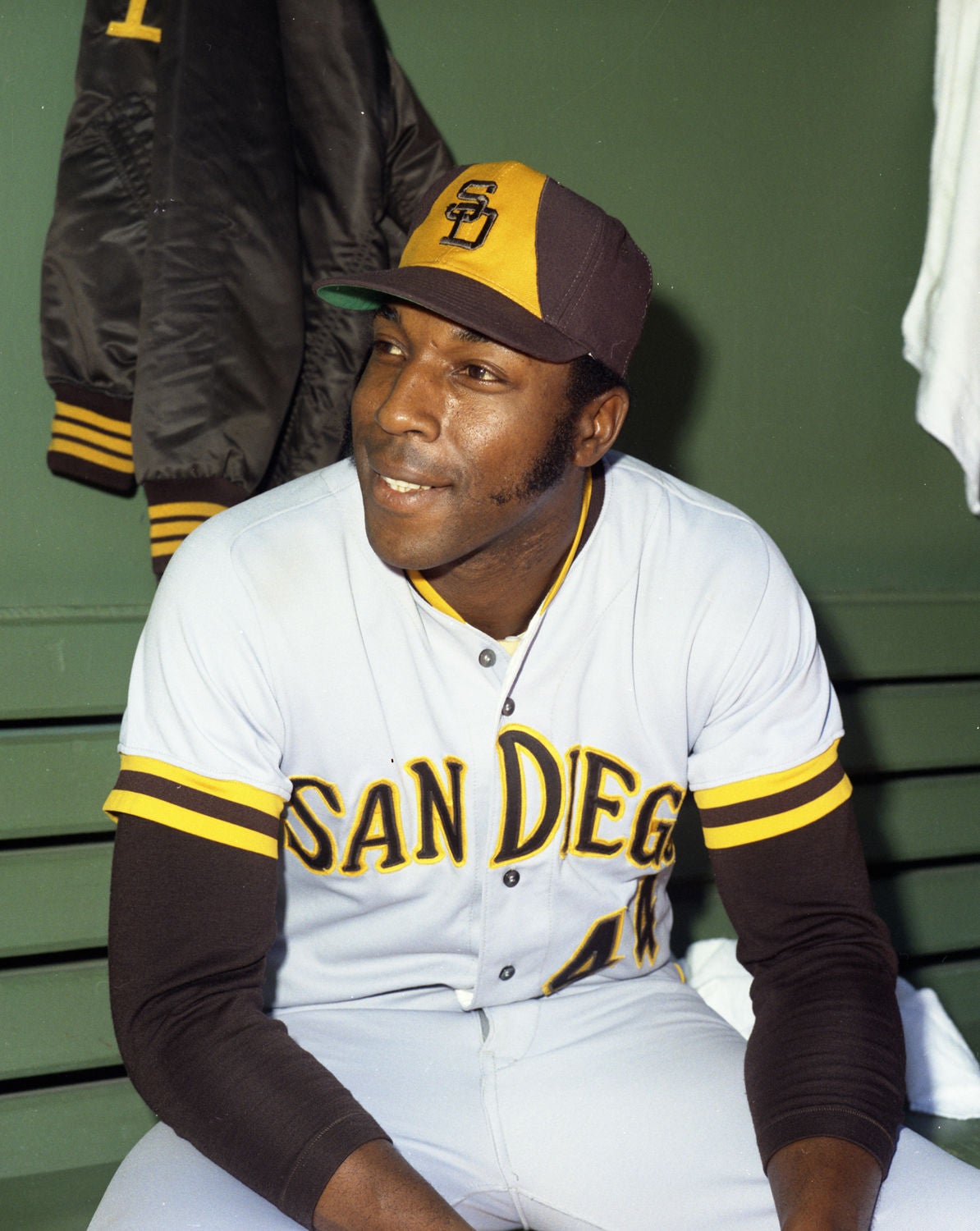
And then came the unthinkable. Or maybe, not so unthinkable, because of the trade of Mays to the Mets a year earlier. But on October 25, 1973, Willie Mac, the most popular player in San Francisco Giants history -- as a newspaper columnist once said, San Francisco was a city where "they cheer Khrushchev and boo Willie Mays" -- was traded to the San Diego Padres, along with Bernie Williams, for pitcher Mike Caldwell.
Brown clothes and sideburns: A classically Seventies combination.

No, not that Bernie Williams. This was an outfielder who never really made it. Caldwell was a 25-year-old lefthander. He pitched well for the Giants in 1974, but was clobbered in '75 and '76, and they traded him away. It took until 1978, with the Milwaukee Brewers, for him to develop the curveball that would make him one of the nastiest pitchers in the American League for a few years, and he finished 137-130 for his career -- but only 22-25 for the Giants.

Willie said, "I'm just 35, and I can still play 3 or 4 more years on the field. I feel in pretty good shape, and stay in good shape."

Willie McCovey, a San Diego Padre? It didn't seem right. He was with them for nearly 3 seasons, until August 30, 1976, when Charlie Finley bought his contract for the Oakland Athletics, hoping that his presence in the lineup could help the A's win the AL West for the 6th straight season, and that Giant fans might cross San Francisco Bay to pay to see their former hero at the Oakland Coliseum. Neither hope was realized: People in the Bay Area liked the A's, but they hated Finley, and didn't want to give them their money.
Santo played for the Chicago White Sox, Sal Maglie
for the Brooklyn Dodgers, and the 1990s Yankees
had a few ex-Mets. So this image isn't that strange.

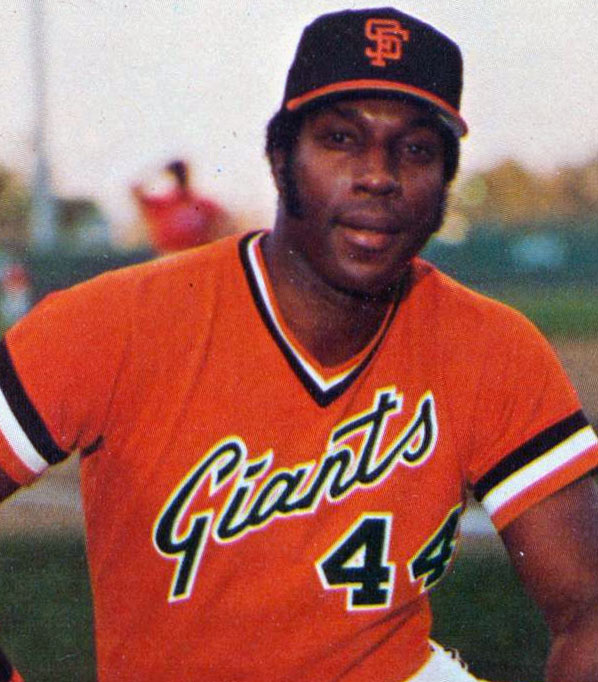
Finley, one of the cheapest baseball team owners of the modern era, basically used Willie as a rental, and didn't try to re-sign him as his contract ran out. The Giants reached out to him, and brought him home. In 1977, at age 39, he batted .280 (his best average in 7 years), hit 28 home runs (his best in 4), and had 86 RBIs (his best in 8). He was named NL Comeback Player of the Year.
Orange and sideburns: An even more classically Seventies combination.

Manager Joe Altobelli, later a coach for the Yankees' 1981 American League Pennant winners and manager of the Baltimore Orioles' 1983 World Champions, said, "We didn't want Willie to embarrass himself. He has done just the opposite. He's had a super Spring, and he's a super person. If I had his body, and I'm 45, I think I'd still be playing, too."

It wasn't quite a last gasp, but it was his last great season. On June 30, 1978, he hit the 500th home run of his career off Jamie Easterly of the Atlanta Braves, at Atlanta-Fulton County Stadium. He announced his retirement effective with the 1980 All-Star Break, and got proper farewells, both at Candlestick and at the place where he ended up playing his last game, on July 6: The home of the Giants' arch-rivals, Dodger Stadium. After an RBI sacrifice fly in his last at-bat, the Los Angeles fans gave him a nice hand.

He finished with a lifetime batting average of .270, 2,211 hits including 521 home runs, and 1,555 RBIs. Oddly, he only made 6 All-Star Games. At the time he retired, his 521 homers tied him with Ted Williams for 8th on the all-time list. It was the most any lefthanded hitter had hit in National League play, surpassing a previous Giant, from the New York era, Mel Ott. McCovey himself would be surpassed by another Giant, Barry Bonds *. Of McCovey's 521 home runs, 18 were grand slams, which remains a National League record.

*

On September 21, 1980, the Giants retired his Number 44, and instituted the Willie Mac Award, given annually to the Giants' "most inspirational player." The 1st winner was Jack Clark.

In 1986, his 1st year of eligibility, Willie was elected to the Baseball Hall of Fame. I attended the induction ceremony. The streets of Cooperstown, New York were loaded with Giants fans, many of them wearing the black caps with the orange SF monogram, some of them wearing "Croix de Candlestick" pins.

Incidentally, let me give you some advice: Unless it's someone you have to see, like your childhood idol, don't go to Cooperstown on Induction Weekend. A town with 2,500 or so permanent residents simply isn't equipped to handle 100,000 visitors. It's why the induction ceremony was moved to a new facility outside of town in 1992, with shuttle bus service. Go, but go any other time.

In 1996, he and fellow Hall-of-Famer Duke Snider of the Brooklyn Dodgers pled guilty to federal tax fraud charges, for failing to report about $10,000 in income from sports card and memorabilia shows. McCovey was given 2 years of probation and fined $5,000. President Barack Obama pardoned him just before leaving office in 2017. (Snider had died in 2011.)

In 1999, The Sporting News ranked McCovey 56th on their list of the 100 Greatest Baseball Players, and he was named a finalist for the Major League Baseball All-Century Team. The following year, the Giants moved into what's now named AT&T Park. An inlet of San Francisco Bay beyond the right field fence was named McCovey Cove. A statue of him was dedicated outside the ballpark.

After his retirement, he worked in the Giants' front office as a "senior adviser" (much as Reggie does for the Yankees), and as a Spring Training instructor. He married twice, first to a woman named Karen, and they had a daughter, Allison. Earlier this year, at AT&T Park, he married Estela Bejar.

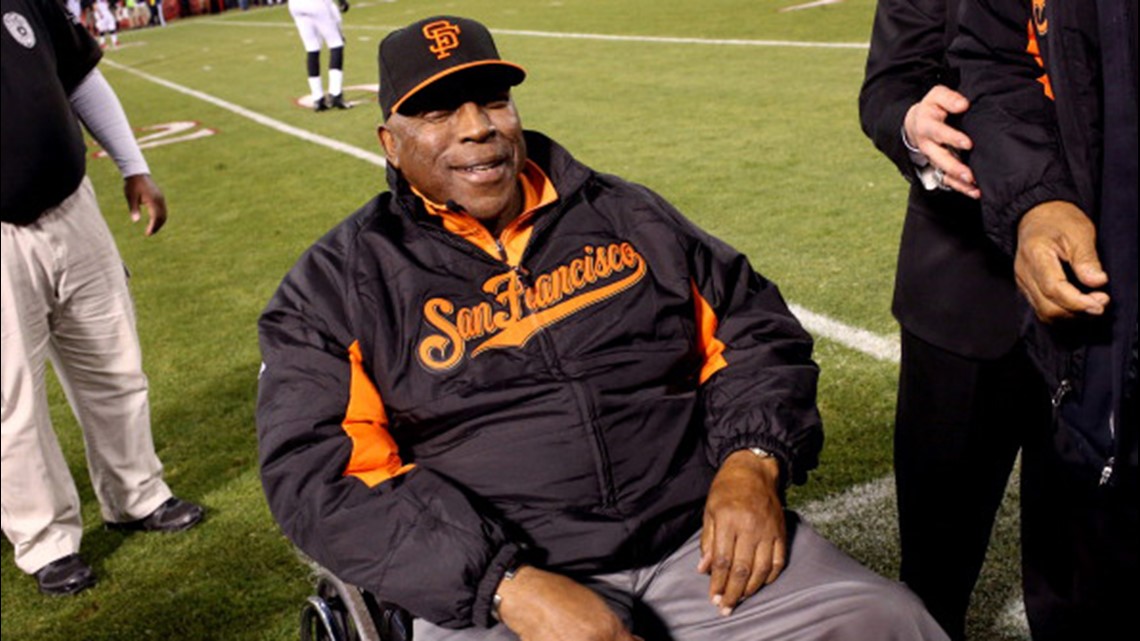
But his arthritic knees left him wheelchair-bound by 2002. In 2005, after another surgery, he said, "Lord, I've even lost count how many. It's at least a dozen on each knee." And you thought Mickey Mantle and Joe Namath had bad knees. They did. Willie's were worse.
In 2014, he was hospitalized with an infection that nearly killed him. This week, he was taken to Stanford University Medical Center in Palo Alto, California, with another infection. This time, the doctors couldn't stop it. Willie McCovey was 80 years old.

Orlando Cepeda said, "I'm very broken up. He was not only a teammate, but a brother."

If McCovey, Cepeda, Willie Mays, Juan Marichal, Bobby Bonds, and the rest of that 1st generation of San Francisco Giants were brothers, then future Giants have been cousins, as suggested by the tribute of Bobby's son, Barry Bonds: "I am crying over losing you, even when you told me not to. ... Uncle Mac thank you for your mentorship and unconditional love for me and my family. You will be dearly missed."

It was more than Willie's physical size, his talent, and the name of his team that made him a Giant. It was who he was.

UPDATE: He was buried at Cypress Lawn Memorial Park, in the San Francisco suburb of Colma, California. Also buried there: Baseball legends Lefty O'Doul and Dolph Camilli, singer Eddie Fisher, newspaper publisher William Randolph Hearst, and groundbreaking journalist Lincoln Steffens. Joe DiMaggio is also buried in Colma, but at Holy Cross Cemetery.

    Tuesday, August 21, 2018

    The San Francisco Bay Area's 10 Greatest Athletes

    Jerry Rice (left) and Joe Montana

    This week, the Mets are visiting the San Francisco Giants.

    The San Francisco Bay Area's 10 Greatest Athletes

    As is the case everywhere else, but it seems especially so here, I'm only counting what the athlete did in the metro area in question. What Willie Mays, Reggie Jackson, Catfish Hunter and Rickey Henderson did in New York, what Orlando Cepeda did in St. Louis, what Joe Montana did in Kansas City, and so on, does not matter here.

    Honorable Mention to San Francisco Giants in the Baseball Hall of Fame
    , who did not otherwise make the Top 10: Orlando Cepeda and Gaylord Perry. Buster Posey may join them someday.

    Honorable Mention to Oakland Athletics in the Baseball Hall of Fame, who did not otherwise make the Top 10: Jim "Catfish" Hunter, Reggie Jackson, Rollie Fingers and Dennis Eckersley.

    The A's are particularly hurt by the splitting of careers between teams and cities, as Catfish, Reggie and Rickey Henderson did big things with the Yankees; Fingers with San Diego and Milwaukee; Eck with Cleveland, Boston and the Chicago Cubs; and later A's stars Mark McGwire with St. Louis and Jason Giambi with the Yankees. (This was also true of their Philadelphia years, and for the same reason: Money. Only, while Charlie Finley was merely cheap, Connie Mack was actually skint, and needed to sell great players off.)

    Honorable Mention to San Francisco 49ers in the Pro Football Hall of Fame, who did not otherwise make the Top 10: Joe Perry, Leo Nomellini, Y.A. Tittle, Hugh McElhenny, Bob St. Clair, John Henry Johnson, Jimmy Johnson, Dave Wilcox, Fred Dean, Charles Haley, Steve Young and Terrell Owens. Roger Craig should be in the Hall of Fame, and good cases can be made for John Taylor, Randy Cross, Guy McIntyre and Harris Barton.

    When The Sporting News named its 100 Greatest Football Players in 1999, Young was ranked 63rd. When the NFL Network named its 100 Greatest Players in 2010, he was ranked 81st.

    Honorable Mention to Oakland Raiders in the Pro Football Hall of Fame, who did not otherwise make this Top 10: Jim Otto, Fred Biletnikoff, George Blanda, Willie Brown, Art Shell, Ken Stabler, Ray Guy, Dave Casper, Ted Hendricks, Tim Brown, Jerry Rice and Warren Sapp. (Rice and Sapp each played 4 seasons for the Raiders late in their careers, therefore, they qualify here.) Charles Woodson becomes eligible in 2021, and will surely join them. Jack Tatum never will. Chances are, neither will Lester Hayes.

    Somebody from the Raiders had to be in my Top 10, but picking the greatest Raider wasn't easy. Al Davis believed nobody should outshine anybody else... especially not outshine him. He never retired a uniform number, not even 00 for Jim Otto (a play on his name: "Aught-Oh"), a number used only that once in NFL history. So it's not like we can say, "He's the only/first Raider to get his number retired."

    Complicating things further is the fact that 3 legitimate contenders for the title of "Greatest Raider Ever" played for them all or mostly in Los Angeles: Marcus Allen, Howie Long and Mike Haynes.

    When The Sporting News named its 100 Greatest Football Players in 1999, Brown was ranked 50th, Shell 55th, Hendricks 64th, Otto 78th, Biletnikoff 94th, and Blanda 98th. When the NFL Network named its 100 Greatest Players in 2010, Otto was ranked 63rd, Brown 66th, Shell 76th, Hendricks 82nd, and Biletnikoff and Blanda had dropped off the list.

    Honorable Mention to San Francisco/Golden State Warriors in the Basketball Hall of Fame, who didn't otherwise make this Top 10: Guy Rodgers, Nate Thurmond, Robert Parish, Chris Mullin and Šarūnas Marčiulionis. Kevin Durant will likely join them. ("San Francisco," 1962 to 1971; "Golden State" since moving to Oakland. Their new arena in San Francisco opens next year, but they've chosen to keep the "Golden State" name.)

    Very Honorable Mention to Wilt Chamberlain, center, San Francisco Warriors, 1962-65. The absolutely indisputable greatest basketball player who ever lived, he played 3 seasons for the Warriors in Philadelphia, and then 3 in the City By the Bay, before being traded to Philadelphia's replacement team, the 76ers. So I can't put him in the Bay Area's Top 10. But he did get the Warriors to the 1964 NBA Finals. Ironically, when Wilt finally won a title in 1967, it was the Warriors that his Sixers beat in the Finals.

    Honorable Mention to San Jose Sharks stars Patrick Marleau and Joe Thornton. There are 5 former Sharks players in the Hockey Hall of Fame, but, between them, they played just 9 seasons for the team, and none is thought of mainly as a Shark: Igor Larionov, Sergei Makarov, Ed Belfour, Teemu Selanne and Rob Blake.

    Honorable Mention to the San Jose Earthquakes' greatest player to play for them, Landon Donovan; and the greatest player for the franchise, Chris Wondolowski. (Donovan played a lot longer for their arch-rivals, the L.A. Galaxy.

    10. Rick Barry, forward, San Francisco Warriors 1965-67, Oakland Oaks 1968-69, Golden State Warriors 1972-78. The details of where he played, when, and didn't play, and why, aren't relevant here. Here's what's relevant:

    He led the NBA in scoring and was named All-Star Game MVP in 1967, having been named Rookie of the Year the season before. He helped the Warriors win the 1967 NBA Western Division title, but lost the Finals. He became the 1st NBA star to bolt for the ABA, crossing the Bay and winning the 1969 ABA Championship with the Oakland Oaks, and the 1972 Eastern Division title with the New York Nets.

    He then returned to his former team, now in Oakland and calling themselves the Golden State Warriors. He was a 12-time All-Star, 8 times in the NBA and 4 in the ABA. In 1975, he led the NBA in steals, and helped the Warriors win their 1st title since moving from Philadelphia in 1962, and won the Finals MVP.

    He closed his career in 1980 with the Houston Rockets. The year before, he set an NBA record with a .947 free throw percentage. One of the last players to make free throws underhanded, he retired with a career percentage of .900, then the all-time leader. (Both records have since been broken.)

    The Warriors retired his Number 24. He was elected to the Basketball Hall of Fame, and named to the ABA All-Time Team and the NBA's 50th Anniversary 50 Greatest Players, 1 of 5 players so honored. His sons Brent and Jon also played in the NBA.

    9. Gene Upshaw, guard, Oakland Raiders, 1967-81. You might have expected the greatest Raider ever to be a defensive back, a position Al Davis liked to have great players in: Willie Brown, Jack Tatum, Lester Hayes, Mike Haynes, Charles Woodson. Or a maniac defensive lineman, such as Ben Davidson, Otis Sistrunk, John Matuszak or Lyle Alzado.

    But there's something weirdly poetic about it being an offensive lineman. A whole side of the Raider line made the Pro Football Hall of Fame: Center Jim Otto, guard Gene Upshaw, and tackle Art Shell. Known as Highway 63 for his uniform number and the "road" he cleared for Raiders to run on, Upshaw made the 1968 AFL All-Star Game, and then 6 NFL Pro Bowls, for a total of 7 such games. He was a rookie on the 1967 AFL Champions, losing Super Bowl II, and won Super Bowls XI and XV with the Raiders. He is the only man to make the Super Bowl in 3 different decades with the same team (1967-68, 1976-77, 1980-81).

    From 1983 until his death in 2008, he served as executive director of the players' union, the National Football League Players Association. Ironically, it was right after he was inducted into the Hall of Fame in 1987 that he led the last players' strike.

    In addition to the Hall, he was named to the NFL's 75th Anniversary Team and its 1970s All-Decade Team. When The Sporting News named its 100 Greatest Football Players in 1999, Upshaw was ranked 62nd. When the NFL Network named its 100 Greatest Players in 2010, Upshaw had actually gained in appreciation, ranked 56th.

    8. Willie McCovey, 1st base, San Francisco Giants, 1959-73 and 1977-80, plus Oakland Athletics 1976. A 6-time All-Star, he was NL Rookie of the Year in 1959, and MVP in 1969. His lifetime batting average was only .270, but his OPS+ was a mighty 147. He hit 521 home runs, and hit line drives that could have taken an infielder's head off.

    Unfortunately for him, his only trip to the World Series, with the 1962 Giants, ended with him hitting a line drive that could have gotten the tying and winning runs in Game 7 home, but Bobby Richardson of the Yankees caught it. The Giants also came close to the Pennant in 1964, 1965 and 1966, and won the NL Western Division in 1971.

    The Giants retired his Number 44, dedicated a statue to him outside AT&T Park, named the part of San Francisco Bay right outside the park "McCovey Cove," and since his 1980 retirement, have annually presented the Willie Mac Award to their "most inspirational player." In 1999, The Sporting News ranked him 56th on their 100 Greatest Baseball Players. He was elected to the Baseball Hall of Fame in 1986, and I was at the induction ceremony.

    7. Steph Curry, guard, Golden State Warriors, 2009-present. Since he is still with the team, he could rise higher. Already a 5-time NBA All-Star, he is 1 win away from being a 4-time NBA Champion. Still, 3 is more than most guys get: 2015, 2017 and 2018. Indeed, it's as many as LeBron James has, and as many as Wilt Chamberlain and Rick Barry, the previous 2 contenders for the title of the Warriors' greatest player ever, combined.

    In his 1st title season, 2015, he won the NBA All-Star Game Three-Point Contest. In 2016, the 1 year since 2014 that he didn't win the NBA title, he led the NBA in scoring and steals, guiding the Warriors to a single-season record 73 regular-season wins. He has surpassed not only his father, Dell Curry, who was a pretty good player in his time, but every player the Bay Area version of the Dubs has ever had -- though not Wilt for an entire career.

    6. Juan Marichal, pitcher, San Francisco Giants, 1960-73. He's no longer the winningest Hispanic pitcher in major league history, having been surpassed by Dennis Martinez and now (with pharmaceutical help) Bartolo Colon. But he's begun to get the recognition he was frequently denied in the 1960s, a decade in which the high-kicking Dominican won more games than any other pitcher, including Whitey Ford, Sandy Koufax, Don Drysdale and Bob Gibson.

    A 10-time All-Star, he helped the Giants to the 1962 National League Pennant and the 1971 NL Western Division title, although they fell just short a few other times while he was there. He finished with a career record of 243-142. They have retired his Number 27, and dedicated a statue to him outside AT&T Park. He was the 1st Dominican player, and the 1st Hispanic pitcher (aside from Negro League star Martin DiHigo, who was not strictly a pitcher), elected to the Hall of Fame.

    5. Rickey Henderson, left field, Oakland Athletics, on and off from 1979 to 1998. I'm not sure if he's the greatest player to have played for the Oakland A's, but he's the greatest player in the franchise's 1st half-century in Oakland, where he grew up after having been born in Chicago.

    He had a career OPS+ of 127. He set records, unlikely to ever be broken, for stolen bases in a season, 130 in 1982, and in a career, 1,405 -- no one else is even over 1,000. He had 6 .300 seasons. He hit 297 home runs, including the most leadoff homers. An 11-time All-Star, he only won 1 Gold Glove, but he was also named the 1990 American League Most Valuable Player. He is the all-time leader in runs scored with 2,295. Briefly, before being surpassed by Barry Bonds, he was also the all-time leader in walks with 2,190. He is a member of the 3,000 Hit Club.

    He reached the postseason with the A's in 1981, '89, '90 and '92, the Toronto Blue Jays in '93, the San Diego Padres in '96 and the Mets in '99 (infamously playing poker in the dugout during the clinching Game 6). He won the World Series with the '89 A's and the '93 Jays.

    He was elected to the Baseball Hall of Fame. The A's not only retired his Number 24, but named the playing surface at the Oakland Coliseum after him, Rickey Henderson Field, making him the only person so honored in any of the "big four" North American major league sports. (This has happened many times with football fields and basketball courts in college, but not in the majors.) When The Sporting News named its 100 Greatest Baseball Players in 1999, Rickey, still active, was ranked 51st.

    He is perhaps the most egotistical ballplayer of all time. Yet as Bill James, King of the Statheads, says, "If you could split him in two, you'd have two Hall-of-Famers."

    4. Ronnie Lott, safety, San Francisco 49ers, 1981-90. It says something about the dynasty that Bill Walsh built that the 49ers not only have the Numbers 1, 2 and 4 players on this list, but that these men could be, respectively, the greatest receiver, quarterback and defensive back who ever lived.

    A 10-time Pro Bowler, Lott made 63 interceptions, returning them for 730 yards. He forced 16 fumbles in his career, and scored 5 touchdowns -- as a defensive player.

    He helped the 49ers win Super Bowls XVI, XIX, XXIII and XXIV. He was named to the College and Pro Football Halls of Fame, and the NFL's 75th Anniversary, 1980s and 1990s All-Decade Teams. The 49ers retired his Number 42. When The Sporting News named its 100 Greatest Football Players in 1999, Lott was ranked 23rd. When the NFL Network named its 100 Greatest Players in 2010, he rose significantly, to 11th.

    3. Willie Mays, center field, San Francisco Giants, 1958-72. Remember: What he did in New York doesn't matter -- and even if it did, he might not be ahead of the 2 guys in front of him. But...

    Say, hey, do you know of any other athlete who's enough of a cultural icon that his name has been worked into The Honeymooners, Peanuts and Star Trek? Nope, not even Babe Ruth, the one and only player selected ahead of Mays in The Sporting News' 1999 list of the 100 Greatest Baseball Players.

    Willie, Hank, and Stan Musial share the record of appearing in the most All-Star Games, 24. He was named NL Rookie of the Year in 1951, and the MVP twice, in 1954 and 1965, and probably should have won at least 1 more. He won 12 Gold Gloves, and would have won more had the award been established earlier than 1957. He led the League in batting average once, home runs 4 times and stolen bases 4 times.

    From 1954 to 1965, he was 1 of the top 3 players in baseball every year, and was still one of the top 10 as late as 1971, when he was 40 years old. He batted at least .300 and had at least 100 RBIs 10 times each. His lifetime batting average was .302, he had a 156 OPS+, his 3,283 hits included 523 doubles, 140 triples and 660 home runs, and he had 1,903 RBIs. He also had 338 stolen bases, making him the only guy with 500 homers and 300 steals until Barry Bonds came along.

    He was less lucky in the team achievement department. In his 1st 2 full seasons -- he missed most of 1952 and all of 1953 serving in the U.S. Army in the Korean War -- he helped the New York Giants win the 1951 Pennant and the 1954 World Series, including making the most famous defensive play in the history of sports, "The Catch," in Game 1. After that, there was a Pennant with the San Francisco version of the Giants in 1962, a Division title in 1971, and he closed his career with the Pennant-winning 1973 Mets, looking like he should have retired at least a year earlier.

    The Giants retired his Number 24, filed the street address for their new AT&T Park as 24 Willie Mays Plaza, and dedicated a statue of him outside it. He was elected to the Baseball Hall of Fame and the Major League Baseball All-Century Team. In 2015, Barack Obama awarded him the nation's highest civilian honor, the Presidential Medal of Freedom.

    2. Joe Montana, quarterback, San Francisco 49ers, 1979-92. Is he the greatest quarterback who ever lived? For me, it's a tough call deciding between Joe and Johnny Unitas. The difference between them is a hair -- and not one of Joe's long blond hairs, but one of Johnny's short black crewcut hairs.

    He led the San Francisco 49ers into Super Bowls XVI, XIX, XXIII and XXIV, winning them all, making them NFL Champions for 1981, 1984, 1988 and 1989. He was named MVP of Super Bowls XVI, XIX and XXIV, and Sports Illustrated Sportsman of the Year for 1990. (An SI cover at the end of 1989 seemed to unofficially award their Sportsman of the Decade to Montana, Magic Johnson and Wayne Gretzky.)

    An 8-time Pro Bowler, he was named NFL MVP in 1989 and 1990. An injury led the 49ers to think of his age and his health, and they released him in favor of Steve Young. The Kansas City Chiefs signed him, and he got them to the 1993 AFC Championship Game, still their best performance since Super Bowl IV after the 1969 season.

    The 49ers retired his Number 16. He was named to the Pro Football Hall of Fame (but not the College Football Hall), and the NFL's 1980s All-Decade and 75th Anniversary Teams. And while Mauch Chunk, Pennsylvania changed its name to Jim Thorpe, Pennsylvania, the town of Ismay, Montana changed its name to Joe, Montana.

    1. Jerry Rice, receiver, San Francisco 49ers, 1985-2000. The Sporting News named him Number 2 among all players, behind Brown. And he still had several good years left. When the NFL Network did its 100 Greatest Players 11 years later, they listed Rice as Number 1.

    In 1989, the year he was named MVP of Super Bowl XXIII, Don Hutson, then on the short list for the title of greatest receiver ever, said Rice was better than he was -- and this was after Rice had just 4 full seasons in the NFL.

    Herewith the evidence, and the numbers are staggering. He made 13 Pro Bowls, the 1st at age 23, and the last at age 39. A receiver making the Pro Bowl at thirty-nine years old! He was named NFL Offensive Player of the Year in 1987 and 1993. He won Super Bowls XXIII, XXIV and XXIX with the San Francisco 49ers, being named MVP in XXIII.

    Career receptions: 1,549 -- he was the 1st man with 1,000, and the next-best is Tony Gonzalez with 1,325. Receiving yards: 22,895 -- next-best is Terrell Owens with 15,934, nearly 6,000 less! All-purpose yards: 23,546 -- slightly ahead of Brian Mitchell with 23,330. Receiving touchdowns: 197 -- next-best is Randy Moss with 156. Overall touchdowns: 208 -- next-best is Emmitt Smith with 175. In other words, he was not only great, but the numbers suggest he was insanely great.

    The 49ers retired his Number 80. He was elected to the College and Pro Football Halls of Fame, and to the NFL's 1980s and 1990s All-Decade Teams and its 75th Anniversary Team.

    Thursday, December 14, 2017

    Top 10 Athletes From Alabama

    December 14, 1819: Alabama is admitted to the Union as the 22nd State.

    July 13, 1868: Alabama is readmitted to the Union after having seceded for the Civil War.

    December 12, 1819: Alabama really rejoined the Union, rejecting Roy Moore for the U.S. Senate, and electing Doug Jones.

    Top 10 Athletes From Alabama

    Note: While Paul William Bryant is the person best known for being associated with sports in Alabama, and he was a good football player at the University of Alabama in the 1930s, he was from Arkansas. And, besides, this is about athletes, with what they may have later done as coaches and executives being irrelevant. Therefore, the Bear will not be on this list.

    Bryant was "the other end" when 'Bama had the great Don Hutson. But he, too, was born and raised in Arkansas. Joe Louis and Evander Holyfield were born in Alabama, but learned to box elsewhere. Same with Jesse Owens and running.

    Honorable Mention to members of the Baseball Hall of Fame who didn't otherwise make the Top 10: Joe Sewell of Wetumpka, Henry "Heinie" Manush of Tuscumbia, Early Wynn of Hartford, Billy Williams of Whistler. Tim Hudson of Phenix City might join them, as he becomes eligible in 2021. Sewell, a graduate of the University of Alabama, was a charter inductee into the recently established College Baseball Hall of Fame.

    A Very Honorable Mention to Leroy Robert "Satchel" Paige. The age-old questions about him were, "How old was he?" and "What would he have done if he'd been allowed to play in the white major leagues from the beginning?" Since the statistics we have on him are woefully incomplete, I can't honestly put him in the Top 10 -- even though he might be in the Top 4.

    Here's what we do know: He first pitched in the Negro Leagues with the 1926 Chattanooga Black Lookouts -- many of the teams in the all-black leagues, even in the South, took on the names of the white team in the same city (including the most absurdly-named one of all, the Atlanta Black Crackers).

    He won Pennants with the 1936 Crawfords, and the Kansas City Monarchs in 1939, 1940, 1941, 1942 and 1946. He also famously played in the Dominican Republic, for a team sponsored by dictator Rafael Trujillo, in 1937 and in the Mexican League in 1938.

    In 1934, Dizzy Dean -- also a rural Southerner who might have been the best pitcher in the world at the time, and who also liked to tell conflicting stories about his background, including his birthdate -- knew he couldn't get Satch for the St. Louis Cardinals, but was enlightened enough to tell him, "Satch, if you an' me was on the same team, we'd have the Pennant wrapped up by the 4th of July, and then I'd take you fishin' until World Series time."

    After the 1946 season, knowing the players needed money after World War II, Bob Feller organized a barnstorming tour, leading a team of white players, and hiring Satch to lead a team of black players.

    Satch was built like Pedro Martinez, tall and skinny, but could still bring serious heat. And throw some odd pitches, sometimes making them up on the spot, like Luis Tiant (against whose father he'd pitched in Winter leagues in the Caribbean), David Cone and Orlando (El Duque) Hernandez.

    He liked to say, "I ain't never thrown an illegal pitch. But, sometimes, I throw a pitch that ain't never been seen by this generation." He called one pitch "Bat Dodger," and it had nothing to do with Brooklyn. But his control was so sharp, he claimed in his 40s that he could still throw a ball over the top of a Coca-Cola bottle.

    He was the biggest drawing card in black baseball, and whenever his team would face the Homestead Grays, setting up a battle between him and Josh Gibson, it was the toughest ticket in town. But when it was not he but his 1945 Monarchs teammate Jackie Robinson who was selected by the Brooklyn Dodgers to be the 1st black man in Major League Baseball since 1887, he was hurt. He later admitted that Robinson was the right man, because of his disposition.

    In 1948, Bill Veeck, who'd already made Larry Doby the 1st black player in the American League, signed Satch for the Cleveland Indians. Satch had just turned 42 years old, still the oldest "rookie" in MLB history. (Veeck went down to Mobile, bribed who he had to bribe, and got his hands on the elusive birth certificate.) He went 6-1 down the stretch, and he and Doby became the 1st black men to play on a World Series winner.

    Satch played on the Indians through 1949, spent the 1950 season with the Negro Leagues' Philadelphia Stars, and when Veeck bought the St. Louis Browns in 1951, signed him again, staying through the end of the franchise in 1953. Despite Yankee manager Casey Stengel liberally using racist language, he named Satch to the AL All-Star Team in 1952 and 1953 -- the latter at age 47.

    The Negro Leagues having fallen apart due to the majors having taken their best players, he was still pitching regularly in the minor leagues in 1961, age 55. On September 25, 1965, desperate for attendance, Kansas City Athletics owner Charlie Finley held a Negro Leagues Night, and signed Satch to a contract to once again play in K.C.'s Municipal Stadium. At 59, he was the oldest MLB player ever, tossing 3 scoreless innings, allowing only 1 hit.

    He was the 1st player elected to the Baseball Hall of Fame by the special committee looking at Negro League candidates, in 1971. In 1999, The Sporting News ranked him 19th on their 100 Greatest Baseball Players, the highest-ranking of the 5 players they chose based on their Negro League reputations.

    Honorable Mention to James Lamar "Dusty" Rhodes of Mathews. His home run in the 10th inning won Game 1 of the 1954 World Series -- a game I will mention again in this post -- for the New York Giants, and he was given the Babe Ruth Award as the Series MVP.

    Honorable Mention to Jimmy Key of Huntsville. He went 186-117 as a major league pitcher, winning World Series with the 1992 Toronto Blue Jays and the 1996 Yankees. He should be in the Hall of Fame.

    Honorable Mention to David Robertson of Tuscaloosa. A graduate of Paul W. Bryant High School, he helped the Yankees win the 2009 World Series, and was the Pinstripes' 1st closer after the retirement of Mariano Rivera. That didn't last long, as Brian Cashman, in another of his rocket-scientist moves, let him go, but he's brought D-Rob back.

    Honorable Mention to Johnny Mack Brown of Dothan. Perhaps the 1st in the long line of great football players at the University of Alabama, the running back led them to the 1925 National Championship, before a film career that lasted from the end of the Silent Era in 1927 to the end of World War II in 1945, specializing in Westerns.

    Honorable Mention to Pat Sullivan of Birmingham. The quarterback won the Heisman Trophy in 1971. Auburn retired his Number 7. He also played basketball there. His pro career was a bust, but he coached Texas Christian University to the 1994 Southwest Conference title, and he's in the College Football Hall of Fame.

    Honorable Mention to Jameis Winston of the Birmingham suburb of Hueytown. In 2013, he became the 1st Freshman ever to win the Heisman Trophy, and led Florida State University, to the National Championship. He was also a baseball star there. It remains to be seen how well he will do in the pros, as he is now the starting quarterback of the Tampa Bay Buccaneers.

    Despite all their football glory, the University of Alabama has only had 2 Heisman winners: Mark Ingram Jr., 2009, who grew up in Michigan; and Derrick Henry, 2015, who grew up in Florida. So neither one qualifies here. Cam Newton of Auburn, the 2010 Heisman winner, isn't from Alabama, either, but Georgia. So is Auburn baseball legend Frank "Big Hurt" Thomas.

    Honorable Mention to members of the Pro Football Hall of Fame from Alabama, who didn't otherwise make the Top 10: Lee Roy Jordan of Excel, Ken Stabler of Foley, John Stallworth of Tuscaloosa, and Walter Jones of Aliceville. Philip Rivers of Decatur and DeMarcus Ware of Auburn could join them someday.

    Honorable Mention to Justin Tuck of Rockford, a defensive end who helped the Giants win Super Bowls XLII and XLVI.

    Honorable Mention to William "Pop" Gates of Decatur. He starred for one of the early great black pro basketball teams, the New York Renaissance, and was the 1st black player in the National Basketball League, in 1946, for the Moline, Illinois-based Tri-Cities Blackhawks, the team now known as the Atlanta Hawks. He is in the Basketball Hall of Fame.

    Honorable Mention to Artis Gilmore of Dothan. A center, he got Jacksonville University into the Final of the 1970 NCAA Tournament, losing to UCLA. With the Louisville-based Kentucky Colonels in the ABA, he was Rookie of the Year and Most Valuable Player in 1972, MVP of the All-Star Game in 1974, and MVP of the Playoffs as he led the Colonels to the 1975 ABA Championship.

    He played for the Chicago Bulls and San Antonio Spurs after the 1976 merger. He was an 11-time All-Star, 5 in the ABA and 6 in the NBA. He was named to the ABA All-Time Team and the Basketball Hall of Fame.

    Honorable Mention to Ben Wallace of Hayneville. He was the defensive rock of the 2004 NBA Champion Detroit Pistons, and is the only undrafted player ever selected by NBA fans to start in the All-Star Game. He will be eligible for the Basketball Hall of Fame next year.

    Honorable Mention to Vonetta Flowers of Birmingham. Until the 1988 Jamaican bobsled team, the idea of black performers in Olympic bobsledding events never occurred to most people. After that, black American sprinters, and even football player Herschel Walker, started preparing for it.

    The one who did was Flowers, who sprinted at the University of Alabama at Birmingham (UAB), and turned to the Winter Olympics after failing to qualify for the Summer Games. In 2002, in Salt Lake City, she became the 1st black person, of any country, of either gender, to win a Gold Medal in the Winter Olympics, as the brakewoman with Jill Bakken, a white Oregonian, as the driver.

    Now, for the Top 10:

    10. Junious "Buck" Buchanan of Birmingham. Not that long ago, a guy 6-foot-7 and 270 pounds was considered gigantic in the NFL. Buck came out of a segregated high school in Birmingham, and went to the program that defined football at "historically black colleges and universities" (HBCUs), Grambling State University in northern Louisiana, under coach Eddie Robinson.

    Despite Missouri being a quasi-Southern State, and the team's owner Lamar Hunt being a Dallas native, the Kansas City Chiefs had no qualms about drafting black players, including those from HBCUs. Buck was the greatest defensive tackle in AFL history. He made 8 All-Star teams, 6 in the AFL and 2 in the NFL after the merger. He helped the Chiefs win the AFL title in 1966 (losing Super Bowl I) and 1969 (winning Super Bowl IV).

    He was elected to the College and Pro Football Halls of Fame. The Chiefs retired his Number 86, and named him to their team Hall of Fame. He was named to the AFL All-Time Team.

    9. Terrell Owens of Alexander City. He played basketball at the University of Tennessee at Chattanooga, helping them reach the 1995 NCAA Tournament. But his best sport was football. Few players generated as many yards as he did, and few generated as much controversy.

    A 6-time Pro Bowler, he caught 1,078 passed for 15,934 yards and 153 touchdowns -- including the fact that he was the 1st, and is still the only, player to have scored a touchdown against all 32 current teams.

    But, like some other athletes I could mention -- Cliff Lee, Jaromir Jagr, Zlatan Ibrahimovic -- team after team finally had enough of him and couldn't get rid of him fast enough. He feuded with Jeff Garcia, his quarterback on the San Francisco 49ers.

    He was the subject of an arbitration ruling as to where he would go, and it was the Philadelphia Eagles. He helped them reach Super Bowl XXXIX in 2005, and, despite an injury, seemed determined to singlehandedly win it, but it was not to be. He then sought a contract renegotiation, and it got ugly, as he slammed his quarterback again, this time, Donovan McNabb.

    Once, as a 49er, he had scored a touchdown, and then ran back to the star logo at midfield at Texas Stadium, and spiked the ball on it. This made Dallas Cowboy fans despise him. But when the Cowboys picked him up in 2006, they loved him. He spent 3 years with them, and then team owner Jerry Jones released him, with no explanation.

    He spent a season each with Buffalo and Cincinnati, and then no one would pick him up for 2011. Seattle did so for 2012, but cut him in preseason. He played his last NFL game at age 35. Why? In his last season, he caught 72 passes for 983 yards. Clearly, he wasn't over the hill.

    He is now eligible for the Hall of Fame. It may take a lot of guts to elect him. It shouldn't: He has the numbers. How likable he is should not be an issue. (UPDATE: He was elected in 2018.)

    After all, this guy made it in his sport:

    8. Charles Barkley of Leeds. The forward for Auburn University was named Southeastern Conference Player of the Year for 1984, but wasn't selected for the U.S. team for the Olympics in Los Angeles. The U.S. Olympic Committee would make it up to him once professionals were allowed to compete, as he played on the "Dream Team" in Barcelona in 1992 and "Dream Team II" in Atlanta in 1996, winning 2 Gold Medals.

    An 11-time NBA All-Star, "the Round Mound of Rebound" was the MVP of the 1991 All-Star Game. Controversy followed him wherever he went: The Philadelphia 76ers, the Phoenix Suns, the Houston Rockets. He was named NBA MVP in 1993, helping the Suns win the Western Conference title, before losing to Michael Jordan's Chicago Bulls in the Finals. He was elected to the Basketball Hall of Fame and, while still active, to the NBA's 50th Anniversary 50 Greatest Players. His Number 34 has been retired by Auburn, the Sixers and the Suns.

    He also gained renown as a disciplinary problem. But the media cut him some slack, because he cooperated with them, to the point where he was frequently named to "the All-Interview Team." TNT hired him as an NBA studio analyst, and that's how the generation growing up watching LeBron James and Steph Curry knows him. They should know his playing. To ignore it would be, as Sir Charles himself would say, "Turrible."

    7. Ozzie Newsome of Muscle Shoals. Despite being home to only 13,000 people, with a name like "Muscle Shoals," you would expect that this town in the northwest corner of Alabama has produced at least one great football player. In addition to Ozzie, it's produced Jason Allen, Dennis Homan, Leigh Tiffin, and Rece Davis, better known for his work on ESPN.

    An All-American and a 3-time SEC Champion at the University of Alabama, Ozzie made 3 Pro Bowls with the Cleveland Browns, catching 662 passes for 7,980 yards and 47 touchdowns. These were fantastic numbers for a receiver in the era. He was a tight end, for which these numbers were unheard-of.

    He is a member of the College and Pro Football Halls of Fame, the NFL's 1980s All-Decade Team, and the Browns' Ring of Honor. He was in their front office when they moved to become the Baltimore Ravens after the 1995 season, receiving a ring for their win in Super Bowl XXXV. In 2002, he was named their general manager, the 1st black man to hold that office with any NFL team, and built the squad that won Super Bowl XLVII.

    6. Vincent Edward "Bo" Jackson of the Birmingham suburb of Bessemer. There haven't been many 2-sport athletes since Bo knew baseball and Bo knew football. Bo also knew track, as a sprinter, long jumper and high jumper, although he never competed in it beyond his sophomore year at Auburn University.

    In football, he helped Auburn win the 1983 Southeastern Conference Championship and the 1984 Sugar Bowl -- and they should also have been awarded the National Championship. (They went into that game Number 3 in the nation, and Number 1 Nebraska and Number 2 Texas both lost.) He was injured for most of 1984, but won the Heisman Trophy in 1985. Auburn retired his Number 34. In 2008, ESPN named ranked him 8th on their list of the Top 25 College Football Players of All Time.

    A bureaucratic screwup resulted in his refusal to play for the Tampa Bay Buccaneers, even though they held the top pick in the 1986 NFL Draft. They drafted him anyway, and he sat out the year to sign with baseball's Kansas City Royals, who had also drafted him. The Bucs' draft rights ran out, and he was then drafted by the Los Angeles Raiders.

    He played parts of 4 seasons for the Raiders, missing the early part due to baseball (Raiders owner Al Davis was fine with that), rushing for 2,782 yards. In 1990, the Raiders won the AFC Western Division title, but in a Playoff game against the Cincinnati Bengals, his hip was dislocated, ending his football career. (The Bengals haven't won a Playoff game since. The Curse of Bo Jackson, anyone?)

    In baseball, he starred for the Royals, making the All-Star Game in 1989 and hitting a 475-foot blast to the football bleachers at Anaheim Stadium (perhaps appropriately). They cut him after his injury, though. He got a hip transplant, becoming the 1st athlete to play any sport at the major league level after such a surgery.

    He played the 1993 season with the Chicago White Sox and the 1994 season with the California Angels, before realizing that it wasn't going to work out. He played his last major league game in any sport at the age of 32. Not quite as depressing as Gale Sayers or Bobby Orr, but then, Sayers and Orr, however superbly, only played 1 sport.

    Bo knew baseball, and Bo knew football. But we only know a small part of what Bo would have done after January 13, 1991. That day changed sports history, and we can only speculate as to how.

    5. John Hannah of Albertville. The son of Herb Hannah, who played for the NFL Giants in 1951, John followed his father onto the University of Alabama football team, helping them win SEC titles in 1971 and 1972. Bear Bryant later said he was the greatest lineman he ever coached.

    He was drafted by the New England Patriots. On August 3, 1981, at the start of his 9th season, Sports Illustrated put him on its cover, with the legend "THE BEST OFFENSIVE LINEMAN OF ALL TIME." Hannah knew of "The Dreaded SI Cover Jinx," and, in their next week's issue, quoted him in their "They Said It" feature: "Lord, help me: This is going to be a long year." He was right: They went 2-14.

    There would be better times. He made 9 Pro Bowls, and helped the Patriots win the AFC Eastern Division title in 1976, and the AFC Championship in 1985, although they lost Super Bowl XX. He was elected to the College and Pro Football Halls of Fame, making him the 1st player to spend all or most of his career as a Patriot enshrined in Canton.

    The Patriots elected him to their team Hall of Fame and retired his Number 73. He was named to the NFL's 75th Anniversary All-Time Team, and he and Walter Payton were the only players elected to the All-Decade Team for both the 1970s and the 1980s. In 1999, The Sporting News ranked him 20th on their list of the 100 Greatest Football Players, the highest-ranking guard, and 2nd to Anthony Munoz among offensive linemen. In 2010, the NFL Network ranked him 24th on their list of the 100 Greatest Players.

    His brother Charley Hannah and David Hannah also made All-SEC at Alabama, and Charley was a member of the Los Angeles Raiders team that won Super Bowl XVIII in 1984.

    4. Willie McCovey of Mobile. The best lefthanded hitter, and the best infielder (1st base), to come from Alabama, is "Stretch." But he's only the 2nd-best Giant from Alabama, and the 2nd-best baseball player from Mobile!

    A 6-time All-Star, he was NL Rookie of the Year in 1959, and MVP in 1969. His lifetime batting average was only .270, but his OPS+ was a mighty 147. He hit 521 home runs, and hit line drives that could have taken an infielder's head off.

    Unfortunately for him, his only trip to the World Series, with the 1962 San Francisco Giants, ended with him hitting a line drive that could have gotten the tying and winning runs in Game 7 home, but Bobby Richardson of the Yankees caught it. The Giants also came close to the Pennant in 1964, 1965 and 1966, and won the NL Western Division in 1971.

    The Giants retired his Number 44, dedicated a statue to him outside AT&T Park, named the part of San Francisco Bay right outside the park "McCovey Cove," and since his 1980 retirement, have annually presented the Willie Mac Award to their "most inspirational player." In 1999, The Sporting News ranked him 56th on their 100 Greatest Baseball Players. He was elected to the Baseball Hall of Fame in 1986, and I was at the induction ceremony.

    (A word of advice: If you want to go to the Hall of Fame, I say, Absolutely, do it, but not for Induction Weekend. Cooperstown, New York held 2,500 people at its peak, and it was not designed to hold the 100,000 people who descend on it on that weekend every year -- which is about double what it was when I first went! When I went back in 1994, for Phil Rizzuto, it was nuts!)

    3. Bart Starr of Montgomery. After an injury-plagued collegiate career at the University of Alabama -- before Bear Bryant got there -- the school's basketball coach, Johnny Dee, told his friend Jack Vainisi, personnel director for the Green Bay Packers, about Starr. He split time with Babe Parilli until Vince Lombardi arrived in 1959, and made Starr a starter, and a star.

    He made 4 Pro Bowls, despite playing in the same league at the same time as Johnny Unitas, Bobby Layne, Y.A. Tittle, Sonny Jurgensen, John Brodie, Don Meredith and Fran Tarkenton. The Packers reached the 1960 NFL Championship Game, and then won 5 titles in 7 years, including the 1st 2 Super Bowls, of which Starr was named the MVP. He remains the only man to quarterback a team to 5 NFL Championships -- without cheating, anyway. He was named NFL MVP in 1966, and his quarterback sneak for a touchdown won the 1967 NFL Championship Game, a.k.a. "The Ice Bowl."

    He was elected to the Pro Football Hall of Fame and the NFL's 1960s All-Decade Team. The Packers elected him to their team Hall of Fame and retired his Number 15. In 1999, The Sporting News
    ranked him 41st on their list of the 100 Greatest Football Players. In 2010, the NFL Network ranked him 51st on their list of the 100 Greatest Players.

    2. Hank Aaron of Mobile. He was a guest on the TV show Home Run Derby, filmed at Wrigley Field in Los Angeles before the 1960 season, and with the home runs he hit, he won more money on it than any other player.

    Having said that, he wasn't then thought of as a power hitter. He had already won batting titles in 1956 and 1959, but, at that point, he seemed a better candidate for a .400 batting average on a season (which he didn't do) or 3,000 career hits (which he did) than he was for breaking Babe Ruth's still-standing records of 61 home runs in a season (he topped out at 47) and 714 home runs in a career.

    From 1958 to 1962, there were 2 All-Star Games every year. That's how Hammerin' Hank played in 24 All-Star Games in 23 seasons. He won 3 Gold Gloves as a right fielder, led the National League in home runs and RBIs 4 times each, and in 1957 led the Milwaukee Braves to their city's only World Championship, hitting an extra-inning home run to win the Pennant clincher and winning the MVP. He also played on their 1958 Pennant team, their 1959 Playoff team, and, after the move to Atlanta, their 1969 NL West Champions.

    In 1968, he hit his 500th career home run, and people realized he had that many despite being only 34 years old. Until then, Mickey Mantle and Willie Mays were considered the likeliest to surpass Ruth's 714. In 1970, Aaron got his 3,000th hit, becoming the 1st man to reach both major hitting milestones, beating Mays to it by a few weeks. In 1972, he passed Mays. As he approached the milestone all through 1973, he got more mail than anyone in America except President Richard Nixon -- some of it dreadfully racist, but the vast majority of it supportive.

    On April 8, 1974, he hit his 715th home run to surpass Ruth. He would finish with 755, an all-time record that lasted until 2007... and is still the most among honest men. He also set records with 2,297 RBIs, 1,477 extra-base hits, and 6,856 total bases. He had a .305 lifetime batting average and a 155 OPS+. He finished with 3,771 career hits. Think about that for a moment: If you don't count any of his home runs, he would still have over 3,000 hits! He is up there with Mays, Stan Musial and Rogers Hornsby as the best hitter in National League history.

    This is why the award given to the best hitter in each league, a relatively new award, is called the Hank Aaron Award. Both the Braves and their replacements in Milwaukee, the Brewers, for whom he played his last 2 seasons, retired his Number 44. The address of Turner Field, the Braves' former ballpark, was filed with the U.S. Postal Service as 755 Hank Aaron Drive. It has a statue of him outside, as does Miller Park in Milwaukee. The minor-league ballpark in his hometown, home of the Class AA Mobile BayBears, is Hank Aaron Stadium.

    He and Ruth are the only individual players to have an exhibit all to themselves at the Baseball Hall of Fame in Cooperstown, New York, to which he was elected in his 1st year of eligibility. He came in 5th on The Sporting News' list of the 100 Greatest Baseball Players, and was easily elected to the Major League Baseball All-Century Team. In 2002, George W. Bush awarded him the nation's highest civilian honor, the Presidential Medal of Freedom.

    1. Willie Mays of the Birmingham suburb of Fairfield. Say, hey, do you know of any other baseball player who's enough of a cultural icon that his name has been worked into The Honeymooners, Peanuts and Star Trek? And was on What's My Line? Twice?

    Nope, not even Babe Ruth, the one and only player selected ahead of Mays in The Sporting News' 1999 list of the 100 Greatest Baseball Players.
    Willie, Hank, and Stan Musial share the record of appearing in the most All-Star Games, 24. He was named NL Rookie of the Year in 1951, and the MVP twice, in 1954 and 1965, and probably should have won at least 1 more. He won 12 Gold Gloves, and would have won more had the award been established earlier than 1957. He led the League in batting average once, home runs 4 times and stolen bases 4 times.
    No, the uniforms don't look right.
    But 7,054 hits, 1,415 of them home runs, don't lie.

    From 1954 to 1965, he was 1 of the top 3 players in baseball every year, and was still one of the top 10 as late as 1971, when he was 40 years old. He batted at least .300 and had at least 100 RBIs 10 times each. His lifetime batting average was .302, he had a 156 OPS+, his 3,283 hits included 523 doubles, 140 triples and 660 home runs, and he had 1,903 RBIs. He also had 338 stolen bases, making him the only guy with 500 homers and 300 steals until Barry Bonds came along.

    He was less lucky in the team achievement department. In his 1st 2 full seasons -- he missed most of 1952 and all of 1953 serving in the U.S. Army in the Korean War -- he helped the New York Giants win the 1951 Pennant and the 1954 World Series, including making the most famous defensive play in the history of sports, "The Catch," in Game 1. After that, there was a Pennant with the San Francisco version of the Giants in 1962, a Division title in 1971, and he closed his career with the Pennant-winning 1973 Mets, looking like he should have retired at least a year earlier.

    The Giants retired his Number 24, filed the street address for their new AT&T Park as 24 Willie Mays Plaza, and dedicated a statue of him outside it. Back in New York, a playground built at the Polo Grounds Towers housing project was named Willie Mays Field. He was brought back to the Mets because owner Joan Payson had been a Giants part-owner, and the Mets have unofficially retired 24 for him.

    He was elected to the Baseball Hall of Fame and the Major League Baseball All-Century Team. In 2015, Barack Obama awarded him the nation's highest civilian honor, the Presidential Medal of Freedom.

    Because he started out as a center fielder in New York, he would be forever compared to his contemporary, Mickey Mantle; and Mantle's predecessor, Joe DiMaggio -- compounded by the Giants moving from New York to San Francisco, DiMaggio's hometown. Mantle vs. Mays was the ultimate New York playground argument, more than Rizzuto vs. Reese, Berra vs. Campanella, or Ford vs. Newcombe -- and would remain so well after the Dodgers and Giants skipped town.

    Mays and Mantle were the opening guests on Home Run Derby, and Mays took an 8-2 lead, but Mantle won 9-8. Willie was invited back, and beat 3 Washington Senators (soon to be Minnesota Twins), Bob Allison, Harmon Killebrew (who had previously dethroned Mantle on the show) and Jim Lemon, before being defeated by his fellow New York-to-California transplant, Gil Hodges.

    Indeed, when Allen Barra, who's also written biographies of Yogi Berra and Bear Bryant, went back to Birmingham, where his journalism career started, and wrote a book about their minor-league ballpark, Rickwood Field, which was Willie's 1st pro home, with the 1948 Birmingham Black Barons of the Negro Leagues, he learned so much about Willie, who had been his favorite player, that he decided to write a biography -- and came to the conclusion that, while there had been good biographies of both Willie and Mickey, one thing seemed to be missing from them: The comparison with each other, and their relationship. So he expanded his idea, and the result was the fantastic Mickey and Willie: Mantle and Mays, the Parallel Lives of Baseball's Golden Age.
    The greatest center fielder who ever lived.
    And another pretty good player.

    Mays also had the greatest song any athlete's ever had. It came out during the title season of 1954, and you can almost hear the Big Band Era phase out, and the Rock and Roll Era take over.

    Was Willie Mays the greatest ballplayer who ever lived? I've argued that, because he was a great pitcher, Babe Ruth's ability to prevent runs was greater than Mays'. And I've also seen numbers -- including some posted by Barra, who, predisposed to prefer Mays, was forced to reconsider -- that show that Mantle wasn't just a better peak hitter, but a better all-around player.

    But "suggesting" and "showing" aren't necessarily proving. Willie was one of the top players in baseball from Harry Truman's 2nd term to Richard Nixon's 1st. At the release of Destination Moon and at Neil Armstrong's one small step and one giant leap 18 years later. Through the eras of Frank Sinatra and Elvis Presley through the entire run of the Beatles. That's plenty to "Say Hey" about.
    I'll let Ted Williams have the last word: "If there was a guy born to play baseball, it was Willie Mays."